Learning Answer-Entailing Structures for Machine Comprehension
Mrinmaya Sachan1∗ Avinava Dubey1∗ Eric P. Xing1 Matthew Richardson2 1Carnegie Mellon University 2Microsoft Research 1{mrinmays, akdubey, epxing}@cs.cmu.edu 2[email protected]
Abstract
Understanding open-domain text is one of the primary challenges in NLP. Ma-chine comprehension evaluates the sys-tem’s ability to understand text through a series of question-answering tasks on short pieces of text such that the correct answer can be found only in the given text. For this task, we posit that there is a hid-den (latent) structure that explains the rela-tion between the quesrela-tion, correct answer, and text. We call this theanswer-entailing structure; given the structure, the correct-ness of the answer is evident. Since the structure is latent, it must be inferred. We present a unified max-margin framework that learns to find these hidden structures (given a corpus of question-answer pairs), and uses what it learns to answer machine comprehension questions on novel texts. We extend this framework to incorporate multi-task learning on the different sub-tasks that are required to perform machine comprehension. Evaluation on a publicly available dataset shows that our frame-work outperforms various IR and neural-network baselines, achieving an overall accuracy of 67.8% (vs. 59.9%, the best previously-published result.)
1 Introduction
Developing an ability to understand natural lan-guage is a long-standing goal in NLP and holds the promise of revolutionizing the way in which peo-ple interact with machines and retrieve informa-tion (e.g., for scientific endeavor). To evaluate this ability, Richardson et al. (2013) proposed the task of machine comprehension (MCTest), along with
∗
*Work started while the first two authors were interns at Microsoft Research, Redmond.
a dataset for evaluation. Machine comprehension evaluates a machine’s understanding by posing a series of reading comprehension questions and as-sociated texts, where the answer to each question can be found only in its associated text. Solutions typically focus on some semantic interpretation of the text, possibly with some form of probabilistic or logical inference, in order to answer the ques-tions. Despite significant recent interest (Burges, 2013; Weston et al., 2014; Weston et al., 2015), the problem remains unsolved.
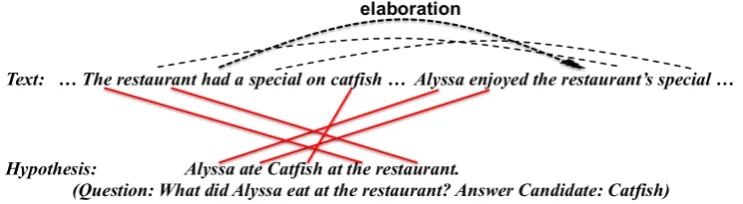
In this paper, we propose an approach for ma-chine comprehension. Our approach learns latent answer-entailing structures that can help us an-swer questions about a text. The anan-swer-entailing structures in our model are closely related to the inference procedure often used in various mod-els for MT (Blunsom and Cohn, 2006), RTE (MacCartney et al., 2008), paraphrase (Yao et al., 2013b), QA (Yih et al., 2013), etc. and correspond to the best (latent) alignment between a hypoth-esis (formed from the question and a candidate answer) with appropriate snippets in the text that are required to answer the question. An example of such an answer-entailing structure is given in Figure 1. The key difference between the answer-entailing structures considered here and the align-ment structures considered in previous works is that we can align multiple sentences in the text to the hypothesis. The sentences in the text con-sidered for alignment are not restricted to occur contiguously in the text. To allow such a dis-contiguous alignment, we make use of the docu-ment structure; in particular, we take help from rhetorical structure theory (Mann and Thomp-son, 1988) and event and entity coreference links across sentences. Modelling the inference proce-dure via answer-entailing structures is a crude yet effective and computationally inexpensive proxy to model the semantics needed for the problem. Learning these latent structures can also be
Figure 1: Theanswer-entailing structurefor an example from MCTest500 dataset. The question and answer candidate are combined to generate a hypothesis sentence. Then latent alignments are found between the hypothesis and the appropriate snippets in the text. The solid red lines show the word alignments from the hypothesis words to the passage words, the dashed black lines show auxiliary co-reference links in the text and the labelled dotted black arrows show the RST relation (elaboration) between the two sentences. Note that the two sentences do not have to be contiguous sentences in the text. We provide some more examples ofanswer-entailing structuresin the supplementary.
ficial as they can assist a human in verifying the correctness of the answer, eliminating the need to read a lengthy document.
The overall model is trained in a max-margin fashion using a latent structural SVM (LSSVM) where the answer-entailing structures are latent. We also extend our LSSVM to multi-task set-tings using a top-level question-type classification. Many QA systems include a question classifica-tion component (Li and Roth, 2002; Zhang and Lee, 2003), which typically divides the questions into semantic categories based on the type of the question or answers expected. This helps the sys-tem impose some constraints on the plausible an-swers. Machine comprehension can benefit from such a pre-classification step, not only to constrain plausible answers, but also to allow the system to use different processing strategies for each cate-gory. Recently, Weston et al. (2015) defined a set of 20 sub-tasks in the machine comprehen-sion setting, each referring to a specific aspect of language understanding and reasoning required to build a machine comprehension system. They in-clude fact chaining, negation, temporal and spatial reasoning, simple induction, deduction and many more. We use this set to learn to classify ques-tions into the various machine comprehension sub-tasks, and show that this task classification fur-ther improves our performance on MCTest. By using the multi-task setting, our learner is able to exploit the commonality among tasks where pos-sible, while having the flexibility to learn task-specific parameters where needed. To the best of our knowledge, this is the first use of multi-task learning in a structured prediction model for QA.
We provide experimental validation for our model on a real-world dataset (Richardson et al.,
2013) and achieve superior performance vs. a number of IR and neural network baselines.
2 The Problem
Machine comprehension requires us to answer questions based on unstructured text. We treat this as selecting the best answer from a set of can-didate answers. The cancan-didate answers may be pre-defined, as is the case in multiple-choice ques-tion answering, or may be undefined but restricted (e.g., to yes, no, or any noun phrase in the text).
Machine Comprehension as Textual
Entail-ment: Let for each question qi ∈ Q, ti be the
unstructured text and Ai = {ai1, . . . , aim} be
the set of candidate answers to the question. We cast the machine comprehension task as a tex-tual entailment task by converting each question-answer candidate pair (qi, ai,j) into a
hypothe-sis statement hij. For example, the question
“What did Alyssa eat at the restaurant?” and answer candidate “Catfish” in Figure 1 can be combined to achieve a hypothesis “Alyssa ate Catfish at the restaurant”. We use the question matching/rewriting rules described in Cucerzan and Agichtein (2005) to achieve this transforma-tion. For each question qi, the machine
com-prehension task reduces to picking the hypothe-sisˆhi that has the highest likelihood of being
en-tailed by the text among the set of hypotheses hi = {hi1, . . . , him}generated for that question.
Leth∗
i ∈hibe the correct hypothesis. Now let us
define the latent answer-entailing structures.
3 Latent Answer-Entailing Structures
hy-pothesis. We consider the quality of a one-to-one word alignment from a hypothesis to snippets in the text as a proxy for the evidence. Hypoth-esis words are aligned to a unique text word in the text or an empty word. For example, in Fig-ure 1, all words but “at” are aligned to a word in the text. The word “at” can be assumed to be aligned to an empty word and it has no effect on the model. Learning these alignment edges typi-cally helps a model decompose the input and out-put structures into semantic constituents and de-termine which constituents should be compared to each other. These alignments can then be used to generate more effective features.
The alignment depends on two things: (a) snip-pets in the text to be aligned to the hypothesis and (b) word alignment from the hypothesis to the snippets. We explore three variants of the snippets in the text to be aligned to the hypothesis. The choice of these snippets composed with the word alignment is the resulting hidden structure called an answer-entailing structure.
1. Sentence Alignment: The simplest variant is to find a single sentence in the text that best aligns to the hypothesis. This is the structure considered in a majority of previous works in RTE (MacCartney et al., 2008) and QA (Yih et al., 2013) as they only reason on single sentence length texts.
2. Subset Alignment:Here we find a subset of sen-tences from the text (instead of just one sentence) that best aligns with the hypothesis.
3. Subset+ Alignment: This is the same as above except that the best subset is an ordered set.
4 Method
A natural solution is to treat MCTest as a structured prediction problem of ranking the hypotheses hi such that the correct hypothesis
is at the top of this ranking. This induces a constraint on the ranking structure that the correct hypothesis is ranked above the other competing hypotheses. For each text ti and hypotheses
set hi, let Yi be the set of possible orderings
of the hypotheses. Let y∗
i ∈ Yi be a correct
ranking (such that the correct hypothesis is at the top of this ranking). Let the set of possible answer-entailing structures for each text hypoth-esis pair(ti,hi)be denoted byZi. For each text
ti, with hypotheses set hi, an ordering of the
hypothesesy ∈ Yi, and hidden structurez ∈ Zi.
we define a scoring functionScorew(ti,hi,z,y)
parameterized by a weight vector w such that we have the prediction rule: (ybi,zbi) =
arg maxy∈Yi,z∈ZiScorew(ti,hi,z,y). The
learning task is to findw such that the predicted ordering ybi is close to the optimal ordering
y∗
i. Mathematically this can be written as
minw12kwk2 + CPi∆(yi∗,z∗i,ybi,zbi) where
z∗
i = arg maxz∈ZiScorew(ti,hi,z,y∗i) and ∆ is the loss function between the predicted and the actual ranking and latent structure. We simplify the loss function and assume it to be independent of the hidden structure (∆(y∗
i,z∗i,ybi,zbi) = ∆(yi∗,ybi)) and use a
lin-ear scoring function: Scorew(ti,hi,z,y) =
wTφ(ti,hi,z,y) where φ is a feature map
dependent on the textti, the hypothesis sethi, an
ordering of answers y and a hidden structure z. We use a convex upper bound of the loss function (Yu and Joachims, 2009) to rewrite the objective:
min
w
1
2kwk2−C
X
i
wTφ(t
i,hi,z∗i,y∗i) (1)
+C
n
X
i=1 max
y∈Yi,z∈Zi{w
Tφ(t
i,hi,z,y) + ∆(y∗i,y)}
This problem can be solved using Concave-Convex Programming (Yuille and Rangarajan, 2003) with the cutting plane algorithm for struc-tural SVM (Finley and Joachims, 2008). We use phi partial order (Joachims, 2006; Dubey et al., 2009) which has been used in previous structural ranking literature to incorporate ranking structure in the feature vectorφ:
φ(ti,hi,z,y) =
X
j:hij6=h∗i
cj(y)(ψ(ti, h∗i, z∗i)
−ψ(ti, hij, zj)) (2)
where,cj(y) = 1ifh∗i is abovehij in the ranking
yelse−1. We use pair preference (Chakrabarti et al., 2008) as the ranking loss∆(y∗
i,y). Here, ψ
is the feature vector defined for a text, hypothesis and answer-entailing structure.
Solution:We substitute the feature map definition
(2) into Equation 1, leading to our LSSVM formu-lation. We consider the optimization as an alter-nating minimization problem where we alternate between getting the bestzij andψ for each
(Joachims, 2002). Algorithm 1 describes our over-all procedure Here, we use beam search for
infer-Algorithm 1Alternate Minimization for LSSVM
1: Initializew
2: repeat
3: zij = arg maxzwTψ(ti, hij, z)∀i, j 4: Computeψfor eachi, j
5: Ci =∅ ∀i
6: repeat
7: for i= 1, . . . , ndo
8: r(y) = wTφ(ti,hi,z,y) +
∆(y∗
i,y)−wTφ(ti,hi,z∗i,y∗i)
9: ybi = arg maxy∈Yir(y)
10: ξi= max{0,maxy∈Uir(y)} 11: if r(ybi)> ξi+then 12: Ci=Ci∪ybi
Solve: min
w,ξ
1
2kwk2+C
X
i
ξi
∀i,∀y∈ Ci :wTφ(ti,hi,z∗i,y∗i)
≥wTφ(ti,hi,z,y) + ∆(y∗i,y)−ξi
13: untilno change in anyCi
14: until Convergence
ring the latent structurezij in step 3. Also, note
that in step 3, when the answer-entailing structures are “Subset” or “Subset+”, we can always get a higher score by considering a larger subset of sen-tences. To discourage this, we add a penalty on the score proportional to the size of the subset.
Multi-task Latent Structured Learning:
Ma-chine comprehension is a complex task which of-ten requires us to interpret questions, the kind of answers they seek as well as the kinds of inference required to solve them. Many approaches in QA (Moldovan et al., 2003; Ferrucci, 2012) solve this by having a top-level classifier that categorizes the complex task into a variety of tasks. The sub-tasks can correspond to various categories of ques-tions that can be asked or various facets of text un-derstanding that are required to do well at machine comprehension in its entirety.It is well known that learning a task together with other related sub-tasks leads to a better solution for each sub-task. Hence, we consider learning classifications of the sub-tasks and then using multi-task learning.
We extend our LSSVM to multi-task settings. Let S be the number of sub-tasks. We assume that the predictor w for each subtask s is
par-titioned into two parts: a parameter w0 that is globally shared across each subtasks and a pa-rametervs that is locally used to provide for the
variations within the particular subtask: w = w0 +vs. Mathematically we define the scoring
function for text ti, hypothesis sethi of the
sub-task s to be Scorew0,v,s(ti,hi,z,y) = (w0 + vs)Tφ(ti,hi,z,y). The objective in this case is
min
w0,vλ2kw0k 2+λ1
S
S
X
s=1
kvsk2 (3)
S
X
s=1
n
X
i=1 max
y∈Yi,z∈Zi{(w0+vs)
Tφ(t
i,hi,z,y)
+ ∆(y∗i,y)} −CX
i
(w0+vs)Tφ(t,hi,z∗i,y∗i)
Now, we extend a trick that Evgeniou and Pon-til (2004) used on linear SVM to reformulate this problem into an objective that looks like (1). Such reformulation will help in using algorithm 1 to solve the multi-task problem as well. Lets define a new feature mapΦs, one for each sub-tasksusing
the old feature mapφas:
Φs(ti,hi,z,y) = (φ(ti,hµi,z,y),0| {z }, . . . ,0 s−1
,
φ(ti,hi,z,y),0| {z }, . . . ,0 S−s
)
where µ = Sλ2
λ1 and the 0 denotes the zero vector of the same size as φ. Also define our new predictor as w = (√µw0,v1, . . . ,vS).
Using this formulation we can show that wTΦs(ti,hi,z,y) = (w0 +vs)Tφ(ti,hi,z,y)
andkwk2 = P
skvsk2 +µkw0k2. Hence, if we now define the objective (1) but use the new fea-ture map andwthen we will get back our multi-task objective (3). Thus we can use the same setup as before for multi-task learning after appropri-ately changing the feature map. We will explore a few definitions of sub-tasks in our experiments.
Features: Recall that our features had the form
“Antonymy” ‘Class-Inclusion’ or ‘Is-A’ relations using Wordnet (Fellbaum, 1998). We compute ad-ditional features of the aforementioned kinds to match named entities and events. We also add features for matching local neighborhood in the aligned structure: features for matching bigrams, trigrams, dependencies, semantic roles, predicate-argument structure as well as features for match-ing global structure: a tree kernel for matchmatch-ing syntactic representations of entire sentences us-ing Srivastava and Hovy (2013). The local and global features can use the RST and coreference links enabling inference across sentences. For in-stance, in the example shown in figure 1, the coref-erence link connecting the two “restaurant” words brings the snippets “Alyssa enjoyed the” and “had a special on catfish” closer making these features more effective. The answer-entailing structures should be intuitively similar to the question but also the answer. Hence, we add features that are the product of features for the text-question match and text-answer match.
String edit Features: In addition to looking for features on exact word/phrase match, we also add features using two paraphrase databases ParaPara (Chan et al., 2011) and DIRT (Lin and Pantel, 2001). The ParaPara database contains strings of the form string1 →string2 like “total lack of”→ “lack of”, “is one of” → “among”, etc. Simi-larly, the DIRT database contains paraphrases of the form “IfXdecreasesYthenXreducesY”, “If
XcausesYthenXaffectsY”, etc. Whenever we have a substring in the text can be transformed into another using these two databases, we keep match features for the substring with a higher score (ac-cording tow) and ignore the other substring. The sentences with discourse relations are related to each other by means of substitution, ellipsis, conjunction and lexical cohesion, etc (Mann and Thompson, 1988) and can help us answer certain kinds of questions (Jansen et al., 2014). As an ex-ample, the “cause” relation between sentences in the text can often give cues that can help us an-swer “why” or “how” questions. Hence, we add additional features - conjunction of the RST label and the question word - to our feature vector. Sim-ilarly, the entity and event co-reference relations can allows the system to reason about repeating entities or events through all the sentences they get mentioned in. Thus, we add additional features of the aforementioned types by replacing entity
men-tions with their first menmen-tions.
Subset+ Features:We add an additional set of fea-tures which match the first sentence in the ordered set to the question and the last sentence in the or-dered set to the answer. This helps in the case when a certain portion of the text is targeted by the question but then it must be used in combina-tion with another sentence to answer the quescombina-tion. For instance, in Figure 1, sentence 2 mentions the target of the question but the answer can only be given when in combination with sentence 1.
NegationWe empirically found that one key
lim-itation in our formulation is its inability to handle negation (both in questions and text). Negation is especially hurtful to our model as it not only results in poor performance on questions that re-quire us to reason with negated facts, it provides our model with a wrong signal (facts usually align well with their negated versions). We use a simple heuristic to overcome the negation problem. We detect negation (either in the hypothesis or a sen-tence in the text snippet aligned to it) using a small set of manually defined rules that test for presence of words such as “not”, “n’t”, etc. Then, we flip the partial order - i.e. the correct hypothesis is now ranked below the other competing hypotheses. For inference at test time, we also invert the prediction rule i.e. we predict the hypothesis (answer) that has the least score under the model.
5 Experiments
Datasets:We use two datasets for our evaluation.
(1) First is the MCTest-500 dataset 1, a freely
available set of 500 stories (split into 300 train, 50 dev and 150 test) and associated questions (Richardson et al., 2013). The stories are fictional so the answers can be found only in the story it-self. The stories and questions are carefully lim-ited, thereby minimizing the world knowledge re-quired for this task. Yet, the task is challenging for most modern NLP systems. Each story in MCTest has four multiple choice questions, each with four answer choices. Each question has only one cor-rect answer. Furthermore, questions are also anno-tated with ‘single’ and ‘multiple’ labels. The ques-tions annotated ‘single’ only require one sentence in the story to answer them. For ‘multiple’ ques-tions it should not be possible to find the answer to the question in any individual sentence of the passage. In a sense, the ‘multiple’ questions are
harder than the ‘single’ questions as they typically require complex lexical analysis, some inference and some form of limited reasoning. Cucerzan-converted questions can also be downloaded from the MCTest website.
(2) The second dataset is a synthetic dataset released under the bAbI project2 (Weston et al.,
2015). The dataset presents a set of 20 ‘tasks’, each testing a different aspect of text understand-ing and reasonunderstand-ing in the QA settunderstand-ing, and hence can be used to test and compare capabilities of learning models in a fine-grained manner. For each ‘task’, 1000 questions are used for training and 1000 for testing. The ‘tasks’ refer to question categories such as questions requiring reasoning over single/two/three supporting facts or two/three arg. relations, yes/no questions, counting ques-tions, etc. Candidate answers are not provided but the answers are typically constrained to a small set: either yes or no or entities already appear-ing in the text, etc. We write simple rules to con-vert the question and answer candidate pairs to hy-potheses. 3
Baselines: We have five baselines. (1) The first
three baselines are inspired from Richardson et al. (2013). The first baseline (called SW) uses a sliding window and matches a bag of words constructed from the question and hypothesized answer to the text. (2) Since this ignores long range dependencies, the second baseline (called SW+D) accounts for intra-word distances as well. As far as we know, SW+D is the best previ-ously published result on this task.4 (3) The
third baseline (called RTE) uses textual entail-ment to answer MCTest questions. For this base-line, MCTest is again re-casted as an RTE task by converting each question-answer pair into a statement (using Cucerzan and Agichtein (2005)) and then selecting the answer whose statement has the highest likelihood of being entailed by the
2https://research.facebook.com/researchers/1543934539189348 3Note that thebAbIdataset is artificial and not meant for
open-domain machine comprehension. It is a toy dataset gen-erated from a simulated world. Due to its restrictive nature, we do not use it directly in evaluating our method vs. other open-domain machine comprehension methods. However, it provides benefit in identifying interesting subtasks of ma-chine comprehension. As will be seen, we are able to lever-age the dataset both to improve our multi-task learning algo-rithm, as well as to analyze the strengths and weaknesses of our model.
4We also construct two additional baselines (LSTMand
QUANTA) for comparison in this paper both of which achieve superior performance toSW+D.
story. 5 (4) The fourth baseline (called LSTM)
is taken from Weston et al. (2015). The base-line uses LSTMs (Hochreiter and Schmidhuber, 1997) to accomplish the task. LSTMs have re-cently achieved state-of-the-art results in a vari-ety of tasks due to their ability to model long-term context information as opposed to other neu-ral networks based techniques. (5) The fifth base-line (called QANTA)6 is taken from Iyyer et al.
(2014). QANTA too uses a recursive neural net-work for question answering.
Task Classification for MultiTask Learning:
We consider three alternative task classifications for our experiments. First, we look at question classification. We use a simple question classi-fication based on the question word (what, why, what, etc.). We call this QClassification. Next, we also use a question/answer classification7from Li
and Roth (2002). This classifies questions into dif-ferent semantic classes based on the possible se-mantic types of the answers sought. We call this QAClassification. Finally, we also learn a clas-sifier for the 20 tasks in the Machine Compre-hension gamut described in Weston et al. (2015). The classification algorithm (called TaskClassifi-cation) was built on the bAbI training set. It is essentially a Naive-Bayes classifier and uses only simple unigram and bigram features for the ques-tion and answer. The tasks typically correspond to different strategies when looking for an answer in the machine comprehension setting. In our ex-periments we will see that learning these strategies is better than learning the question answer classi-fication which is in turn better than learning the question classification.
Results: We compare multiple variants of our
LSSVM8 where we consider a variety of
answer-entailing structures and our modification for nega-tion and multi-task LSSVM, where we consider three kinds of task classification strategies against the baselines on the MCTest dataset. We con-sider two evaluation metrics: accuracy (propor-tion of ques(propor-tions correctly answered) and NDCG4 5The BIUTEE system (Stern and Dagan, 2012)
available under the Excitement Open Platform http://hltfbk.github.io/Excitement-Open-Platform/ was used for recognizing textual entailment.
6http://cs.umd.edu/ miyyer/qblearn/
7http://cogcomp.cs.illinois.edu/Data/QA/QC/
8We tune the SVM regularization parameterC and the
69.85 59.45
61
63.24 66.15 64.83
67.65 67.99 67.83
40 50 60 70 80
Single Multiple All
Percentage Accuracy
0.869 0.82
0.83
0.857 0.863 0.861
0.867 0.869 0.868
0.65 0.7 0.75 0.8 0.85 0.9
Single Multiple All Subset+/Negation Task Classification
Subset+/Negation QAClassification
Subset+/Negation QClassification
Subset+/Negation
Subset+
Subset
Sentence
QANTA
LSTM
RTE
SW+D
SW
[image:7.595.90.519.69.353.2]NDCG
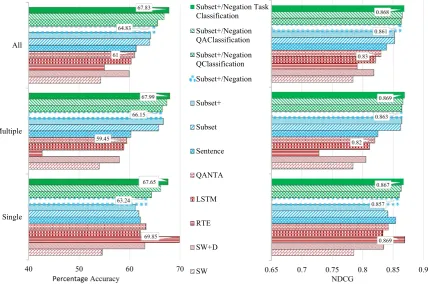
Figure 2: Comparison of variations of our method against several baselines on the MCTest-500 dataset. The figure shows two statistics, accuracy (on the left) and NDCG4(on the right) on the test set of MCTest-500. All differences between the baselines
and LSSVMs, the improvement due to negation and the improvements due to multi-task learning are significant (p <0.01) using the two-tailed paired T-test. The exact numbers are available in the supplementary.
(J¨arvelin and Kek¨al¨ainen, 2002). Unlike classifi-cation accuracy which evaluates if the prediction is correct or not, NDCG4, being a measure of rank-ing quality, evaluates the position of the correct answer in our predicted ranking.
Figure 2 describes the comparison on MCTest. We can observe that all the LSSVM models have a better performance than all the five baselines (including LSTMs and RNNs which are state-of-the-art for many other NLP tasks) on both met-rics. Very interestingly, LSSVMs have a consid-erable improvement over the baselines for “mul-tiple” questions. We posit that this is because of our answer-entailing structure alignment strategy which is a weak proxy to the deep semantic in-ference procedure required for machine compre-hension. The RTE baseline achieves the best formance on the “single” questions. This is per-haps because the RTE community has almost en-tirely focused on single sentence text hypothesis pairs for a long time. However, RTE fares pretty poorly on the “multiple” questions indicating that of-the-shelf RTE systems cannot perform infer-ence across large texts.
Figure 2 also compares the performance of LSSVM variants when various answer-entailing structures are considered. Here we observe a clear benefit of using the alignment to the best subset structure over alignment to best sentence structure. We furthermore see improvements when the best subset alignment structure is augmented with the subset+ features. We can observe that the negation heuristic also helps, especially for “single” ques-tions (majority of negation cases in the MCTest dataset are for the “single” questions).
It is also interesting to see that the multi-task learners show a substantial boost over the sin-gle task SSVM. Also, it can be observed that the multi-task learner greatly benefits if we can learn a separation between the various strategies needed to learn an overarching list of subtasks re-quired to solve the machine comprehension task.9
The multi-task method (TaskClassification) which uses the Weston style categorization does better
9Note that this is despite the fact that the classifier in not
than the multi-task method (QAClassification) that learns the question answer classification. QAClas-sification in turn performs better than multi-task method (QClassification) that learns the question classification only.
6 Strengths and Weaknesses
A good question to be asked is how good is struc-ture alignment as a proxy to the semantics of the problem? In this section, we attempt to tease out the strengths and limitations of such a structure alignment approach for machine comprehension. To do so, we evaluate our methods on various tasks in thebAbl dataset.For the bAbI dataset, we add additional features inspired from the “task” dis-tinction to handle specific “tasks”.
In our experiments, we observed a similar gen-eral pattern of improvement of LSSVM over the baselines as well as the improvement due to multi-task learning. Again multi-task classification helped the multi-task learner the most and the QA clas-sification helped more than the QClasclas-sification. It is interesting here to look at the performance within the sub-tasks. Negation improved the per-formance for three sub-tasks, namely, the tasks of modelling “yes/no questions”, “simple nega-tions” and “indefinite knowledge” (the “Indefinite Knowledge” sub-task tests the ability to model statements that describe possibilities rather than certainties). Each of these sub-tasks contain a sig-nificant number of negation cases. Our models do especially well on questions requiring reasoning over one and two supporting facts, two arg. rela-tions, indefinite knowledge, basic and compound coreference and conjunction. Our models achieve lower accuracy better than the baselines on two sub-tasks, namely “path finding” and “agent mo-tivations”. Our model along with the baselines do not do too well on the “counting” sub-task, al-though we get slightly better scores. The “count-ing” sub-task (which asks about the number of ob-jects with a certain property) requires the inference to have an ability to perform simple counting op-erations. The “path finding” sub-task requires the inference to reason about the spatial path between locations (e.g. Pittsburgh is located on the west of New York). The “agents motivations” sub-task asks questions such as ‘why an agent performs a certain action’. As inference is cheaply mod-elled via alignment structure, we lack the ability to deeply reason about facts or numbers. This is
an important challenge for future work.
7 Related Work
The field of QA is quite rich. Most QA evaluations such as TREC have typically focused on short factoid questions. The solutions proposed have ranged from various IR based approaches (Mittal and Mittal, 2011) that treat this as a problem of re-trieval from existing knowledge bases and perform some shallow inference to NLP approaches that learn a similarity between the question and a set of candidate answers (Yih et al., 2013). A majority of these approaches do not focus on doing any deeper inference. However, the task of machine compre-hension requires an ability to perform inference over paragraph length texts to seek the answer. This is challenging for most IR and NLP tech-niques. In this paper, we presented a strategy for learning answer-entailing structures that helped us perform inference over much longer texts by treat-ing this as a structured input-output problem.
Another advantage of our approach is its sim-ple and elegant extension to multi-task settings. There has been a rich vein of work in multi-task learning for SVMs in the ML community. Evge-niou and Pontil (2004) proposed a multi-task SVM formulation assuming that the multi-task predictor w factorizes as the sum of a shared and a task-specific component. We used the same idea to propose a multi-task variant of Latent Structured SVMs. This allows us to use the single task SVM in the multi-task setting with a different feature mapping. This is much simpler than other compet-ing approaches such as Zhu et al. (2011) proposed in the literature for multi-task LSSVM.
8 Conclusion
In this paper, we addressed the problem of ma-chine comprehension which tests language under-standing through multiple choice question answer-ing tasks. We posed the task as an extension to RTE. Then, we proposed a solution by learning la-tent alignment structures between texts and the hy-potheses in the equivalent RTE setting. The task requires solving a variety of sub-tasks so we ex-tended our technique to a multi-task setting. Our technique showed empirical improvements over various IR and neural network baselines. The la-tent structures while effective are cheap proxies to the reasoning and language understanding re-quired for this task and have their own limitations. We also discuss strengths and limitations of our model in a more fine-grained analysis. In the fu-ture, we plan to use logic-like semantic represen-tations of texts, questions and answers and explore approaches to perform structured inference over richer semantic representations.
Acknowledgments
The authors would like to thank the anonymous reviewers, along with Sujay Jauhar and Snigdha Chaturvedi for their valuable comments and sug-gestions to improve the quality of the paper.
References
[Berant et al.2013] Jonathan Berant, Andrew Chou, Roy Frostig, and Percy Liang. 2013. Semantic parsing on freebase from question-answer pairs. In
EMNLP, pages 1533–1544. ACL.
[Blunsom and Cohn2006] Phil Blunsom and Trevor Cohn. 2006. Discriminative word alignment with
conditional random fields. In Proceedings of the 21st International Conference on Computational Linguistics and the 44th annual meeting of the Asso-ciation for Computational Linguistics, pages 65–72. Association for Computational Linguistics.
[Burges2013] Christopher JC Burges. 2013. Towards the machine comprehension of text: An essay. Tech-nical report, Microsoft Research TechTech-nical Report MSR-TR-2013-125, 2013, pdf.
[Chakrabarti et al.2008] Soumen Chakrabarti, Rajiv Khanna, Uma Sawant, and Chiru Bhattacharyya. 2008. Structured learning for non-smooth ranking losses. In Proceedings of the 14th ACM SIGKDD International Conference on Knowledge Discovery and Data Mining, pages 88–96.
[Chan et al.2011] Tsz Ping Chan, Chris Callison-Burch, and Benjamin Van Durme. 2011. Rerank-ing bilRerank-ingually extracted paraphrases usRerank-ing mono-lingual distributional similarity. InProceedings of the GEMS 2011 Workshop on GEometrical Models of Natural Language Semantics, pages 33–42. [Collobert et al.2011] Ronan Collobert, Jason Weston,
L´eon Bottou, Michael Karlen, Koray Kavukcuoglu, and Pavel Kuksa. 2011. Natural language process-ing (almost) from scratch. The Journal of Machine Learning Research, 12:2493–2537.
[Cucerzan and Agichtein2005] S. Cucerzan and E. Agichtein. 2005. Factoid question answering over unstructured and structured content on the web. InProceedings of TREC 2005.
[Dubey et al.2009] Avinava Dubey, Jinesh Machchhar, Chiranjib Bhattacharyya, and Soumen Chakrabarti. 2009. Conditional models for non-smooth ranking loss functions. InICDM, pages 129–138.
[Evgeniou and Pontil2004] Theodoros Evgeniou and Massimiliano Pontil. 2004. Regularized multi–task learning. InProceedings of the Tenth ACM SIGKDD International Conference on Knowledge Discovery and Data Mining, pages 109–117.
[Fellbaum1998] Christiane Fellbaum. 1998. WordNet: An Electronic Lexical Database. Bradford Books. [Feng and Hirst2014] Vanessa Wei Feng and Graeme
Hirst. 2014. A linear-time bottom-up discourse parser with constraints and post-editing. In Proceed-ings of the 52nd Annual Meeting of the Association for Computational Linguistics (Volume 1: Long Pa-pers), pages 511–521.
[Ferrucci2012] David A Ferrucci. 2012. Introduction to this is watson. IBM Journal of Research and De-velopment, 56(3.4):1–1.
[Hochreiter and Schmidhuber1997] Sepp Hochreiter and J¨urgen Schmidhuber. 1997. Long short-term memory.Neural computation, 9(8):1735–1780. [Iyyer et al.2014] Mohit Iyyer, Jordan Boyd-Graber,
Leonardo Claudino, Richard Socher, and Hal Daum´e III. 2014. A neural network for factoid question answering over paragraphs. In Empirical Methods in Natural Language Processing.
[Jansen et al.2014] Peter Jansen, Mihai Surdeanu, and Peter Clark. 2014. Discourse complements lexical semantics for non-factoid answer reranking. In Pro-ceedings of the 52nd Annual Meeting of the Associa-tion for ComputaAssocia-tional Linguistics (Volume 1: Long Papers), pages 977–986.
[J¨arvelin and Kek¨al¨ainen2002] Kalervo J¨arvelin and Jaana Kek¨al¨ainen. 2002. Cumulated gain-based evaluation of ir techniques. ACM Transactions on Information Systems (TOIS), 20(4):422–446. [Joachims2002] Thorsten Joachims. 2002. Optimizing
search engines using clickthrough data. In Proceed-ings of the eighth ACM SIGKDD international con-ference on Knowledge discovery and data mining, pages 133–142. ACM.
[Joachims2006] T. Joachims. 2006. Training linear SVMs in linear time. In ACM SIGKDD Inter-national Conference On Knowledge Discovery and Data Mining (KDD), pages 217–226.
[Li and Roth2002] Xin Li and Dan Roth. 2002. Learn-ing question classifiers. In Proceedings of the 19th international conference on Computational linguistics-Volume 1, pages 1–7.
[Lin and Pantel2001] Dekang Lin and Patrick Pantel. 2001. Dirt@ sbt@ discovery of inference rules from text. In Proceedings of the seventh ACM SIGKDD international conference on Knowledge discovery and data mining, pages 323–328.
[MacCartney et al.2008] Bill MacCartney, Michel Gal-ley, and Christopher D Manning. 2008. A phrase-based alignment model for natural language infer-ence. InProceedings of the conference on empirical methods in natural language processing, pages 802– 811.
[Mann and Thompson1988] William C Mann and San-dra A Thompson. 1988. {Rhetorical Struc-ture Theory: Toward a functional theory of text organisation}.Text, 3(8):234–281.
[Mittal and Mittal2011] Sparsh Mittal and Ankush Mit-tal. 2011. Versatile question answering systems: seeing in synthesis. International Journal of Intelli-gent Information and Database Systems, 5(2):119– 142.
[Moldovan et al.2003] Dan Moldovan, Marius Pas¸ca, Sanda Harabagiu, and Mihai Surdeanu. 2003. Per-formance issues and error analysis in an open-domain question answering system. ACM
Trans-actions on Information Systems (TOIS), 21(2):133– 154.
[Richardson et al.2013] Matthew Richardson, J.C. Christopher Burges, and Erin Renshaw. 2013. Mctest: A challenge dataset for the open-domain machine comprehension of text. In Proceedings of the 2013 Conference on Empirical Methods in Natural Language Processing, pages 193–203. [Sammons et al.2009] M. Sammons, V. Vydiswaran,
T. Vieira, N. Johri, M. Chang, D. Goldwasser, V. Srikumar, G. Kundu, Y. Tu, K. Small, J. Rule, Q. Do, and D. Roth. 2009. Relation alignment for textual entailment recognition. InTAC.
[Srivastava and Hovy2013] Shashank Srivastava and Dirk Hovy. 2013. A walk-based semantically en-riched tree kernel over distributed word representa-tions. InEmpirical Methods in Natural Language Processing, pages 1411–1416.
[Stern and Dagan2012] Asher Stern and Ido Dagan. 2012. Biutee: A modular open-source system for recognizing textual entailment. In Proceedings of the ACL 2012 System Demonstrations, pages 73–78. [Sultan et al.2014] Arafat Md Sultan, Steven Bethard, and Tamara Sumner. 2014. Back to basics for monolingual alignment: Exploiting word similarity and contextual evidence. Transactions of the Asso-ciation of Computational Linguistics – Volume 2, Is-sue 1, pages 219–230.
[Weston et al.2014] Jason Weston, Sumit Chopra, and Antoine Bordes. 2014. Memory networks. arXiv preprint arXiv:1410.3916.
[Weston et al.2015] Jason Weston, Antoine Bordes, Sumit Chopra, and Tomas Mikolov. 2015. Towards ai-complete question answering: A set of prerequi-site toy tasks.
[Yao and Van Durme2014] Xuchen Yao and Benjamin Van Durme. 2014. Information extraction over structured data: Question answering with freebase. In Proceedings of the 52nd Annual Meeting of the Association for Computational Linguistics (Volume 1: Long Papers), pages 956–966. Association for Computational Linguistics.
[Yao et al.2013a] Xuchen Yao, Benjamin Van Durme, Chris Callison-Burch, and Peter Clark. 2013a. A lightweight and high performance monolingual word aligner. InACL (2), pages 702–707.
[Yao et al.2013b] Xuchen Yao, Benjamin Van Durme, Chris Callison-Burch, and Peter Clark. 2013b. Semi-markov phrase-based monolingual alignment. InProceedings of EMNLP.
[Yu and Joachims2009] Chun-Nam Yu and T. Joachims. 2009. Learning structural svms with latent variables. In International Conference on Machine Learning (ICML).
[Yuille and Rangarajan2003] A. L. Yuille and Anand Rangarajan. 2003. The concave-convex procedure.
Neural Comput.
[Zhang and Lee2003] Dell Zhang and Wee Sun Lee. 2003. Question classification using support vector machines. InProceedings of the 26th annual inter-national ACM SIGIR conference on Research and development in informaion retrieval, pages 26–32. ACM.