A framework for the successful implementation of
turnaround maintenance projects.
OBIAJUNWA, Christopher Chinedu.
Available from Sheffield Hallam University Research Archive (SHURA) at:
http://shura.shu.ac.uk/20132/
This document is the author deposited version. You are advised to consult the publisher's version if you wish to cite from it.
Published version
OBIAJUNWA, Christopher Chinedu. (2010). A framework for the successful implementation of turnaround maintenance projects. Doctoral, Sheffield Hallam University (United Kingdom)..
Copyright and re-use policy
See http://shura.shu.ac.uk/information.html
Ad3etts Centre, City Campus Sheffield S1 1WD
1 0 1 9 6 8 1 5 4 3
Sheffield Hgfcam university Learnina and IT Services Adsetts Centra City Campus
Sheffield S1 1WB
ProQuest Number: 10697439
All rights reserved
INFORMATION TO ALL USERS
The qu ality of this repro d u ctio n is d e p e n d e n t upon the q u ality of the copy subm itted.
In the unlikely e v e n t that the a u th o r did not send a c o m p le te m anuscript and there are missing pages, these will be note d . Also, if m aterial had to be rem oved,
a n o te will in d ica te the deletion.
uest
ProQuest 10697439
Published by ProQuest LLC(2017). C op yrig ht of the Dissertation is held by the Author.
All rights reserved.
This work is protected against unauthorized copying under Title 17, United States C o d e M icroform Edition © ProQuest LLC.
ProQuest LLC.
789 East Eisenhower Parkway P.O. Box 1346
A Framework for the
Successful Implementation of Turnaround
Maintenance Projects
Christopher Chinedu Obiajunwa
A thesis submitted in partial fulfilment o f the requirements of
Sheffield Hallam University for the degree o f
Doctor o f Philosophy.
ABSTRACT
The manufacturing sector is of enormous economic and social significance to any state economy and its people. In the UK, the manufacturing sector accounts for about 13% of GDP and employs about four million people representing approximately 14% of the working population. Manufacturing processes depend on the performance of the facility (machines, equipment and tools) and the human resource (labour). These machines and equipment degrade with age and usage and, therefore, require maintenance.
Despite the strategies adopted for their maintenance, there comes a time due to age, operating/environmental conditions and statutory requirements when the entire facility had to be shut down for necessary repairs, maintenance and project works. This is called Shutdown Maintenance also known as Turnaround Maintenance (TAM).
Although several works have been carried out by organisations and professionals in recent times to optimize TAM projects, organisations are still struggling with TAM projects with reported alarming rates of failure.
A preliminary literature review and pilot studies identified that the major cause of TAM project failures are attributed to the use of Engineering, Procurement and Construction (EPC) project management methodologies to manage TAM projects without considering their unique features.
Findings from a comprehensive literature review, questionnaire survey and case studies in major process plants in the UK, were used to develop a unique best practice framework (and its components parts) which were validated by very experienced, proactive and industry-based hands-on TAM professionals.
The conclusions which are drawn from this research study includes establishment of TAM evaluation criteria, TAM critical success factors, TAM manager selection criteria, TAM management methodologies and the TAM project implementation framework.
DEDICATION
This Research Study is dedicated to
ACKNOWLEDGEMENTS
I am very grateful and thankful to my Director of studies, Prof. Paul Stephenson and Supervisor, Prof. Alan Griffith for their advice, direction and supervision. Sincerely, without their invaluable guidance and support, this research project would not have been successful. Their confidence in my work and detailed and critical review at every stage of the research work kept the project on track and in the right direction.
My special thanks to the Research administrators of Centre for Built Environment, Sheffield Hallam University; especially Ann Wilson and Sam Wharam for their support.
I am also thankful to the staff of the Process plants approached during the case studies, questionnaire survey and framework validation for their contributions to this research.
Many thanks to all my fellow researchers in the Faculty of Development and Society, especially, Ezekiel Awe and Mahdi and others for their encouragement. I am particularly indebted to Dr. Julius Fapohunda for his advice; he was a real source of inspiration.
I owe a lot to my wife, Princess, who have been of superb encouragement. Her love, patience, commitment, selfless dedication has carried me through the difficult times. She is really my Angel. My lovely children Prylla and Chris Jnr. (who was bom at the peak of this research) also kept me moving.
TABLE OF CONTENTS
A bstract i
Dedication ii
Acknowledgements iii
Abbreviations xi
Glossary of Terms xii
List of Tables xiv
List of Figures xx
CHAPTER 1. PR O JEC T INTRODUCTION
1.1 Aims of the Chapter... 1
1.2 Background of study ... ... 1
1.3 Research focus... ... 3
1.4 Research aims... ... ... ... 6
1.5 Research objectives... ... . 6
1.6 Significance of the Research study... 7
1.7 Overview of research methodology ... ... 8
1.8 Guide to the thesis ... ... ... 9
1.9 Summary of the chapter ... 11
CHAPTER 2. MAINTENANCE IN ENGINEERING FA CILITIES 2.1 Aims of the chapter ... 12
2.2 What is m aintenance?... ... 12
2.3 Development of Maintenance philosophies... 13
2.3.1 First generation ... 13
2.3.2 The Second generation. ... 15
2.3.3 The Third generation ... 15
2.3.4 Recent generation ... 16
2.5 Benefits of a good maintenance system. ... 20
2.6 Types of maintenance... 22
2.6.1 Unplanned m aintenance... 22
2.6.2 Planned maintenance... 24
2.6.2.1 Predictive maintenance... 25
2.6.2.2 Preventive maintenance.. ... 26
2.6.2.3 Improvement maintenance... 28
2.6.2.4 Corrective Maintenance... 28
2.6.2.5 Total productive maintenance... 30
2.6.2.6 Reliability-centred maintenance 32 2.6.2.7 Risk-based Maintenance... 34
2.6.2.8 Shutdown Maintenance ... 36
2.7 Summary of the chapter . ... 36
CHAPTER 3. TURNAROUND MAINTENANCE IMPLEMENTATION 3.1 Aims of the chapter. ... ... 3 8 3.2 Turnaround M aintenance... ... 38
3.2.1 What is Turnaround maintenance?... 38
3.2.2 Need for Turnaround maintenance... 39
3.3 Turnaround maintenance implementation... 41
3.3.1 TAM as a Project management strategy... 42
3.3.2 TAM project implementation process... 44
3.3.3 Problems of successful implementation of TAM projects.,. 47 3.4 Features of a Turnaround maintenance project ... 48
3.5 TAM project implementation success evaluation... 50
3.5.1 Management success evaluation ... 53
3.5.2 Perceptions of stakeholders ... 55
5.5.3 Resultant Benefits... 56
3.6 Critical success factors of TAM project implementation 57 3.6.1 TAM project manager ... ... 60
3.6.2 Top (corporate) management support... 61
3.6.3 TAM project goals & objectives ... 61
3.6.5 TAM project plans/schedules ... ... 63
3.6.6 Communications ... ... 64
3.6.7 Organisation/organisational structure.. ... ... 65
3.6.8 Technical tasks... 67
3.6.9 Personnel Recruitment... ... 67
3.6.10 Contract strategy... ... ... ... 68
3.6.11 Logistics... ... ... ... ... . 70
3.6.12 Scope... ... . 70
3.6.13 Environment, Health & Safety. ... 71
3.6.14 Technology... ... 72
3.6.15 Monitoring and Feedback. ... ... 73
3.6.16 Adequate Resource allocation... 74
3.6.17 Troubleshooting... 74
3.6.18 Regulatory b o d ie s... ... 75
3.7 Summary of the Chapter... ... 77
CHAPTER 4. TURNAROUND MAINTENANCE PROJECT MANAGEMENT 4.1 Aims of the chapter, ... ... . 78
4.2 Selection of a TAM manager ... ... . 78
4.2.1 Duties of a TAM manager ... 79
4.2.2 Possible errors in choosing a TAM manager ... 81
4.2.3 Desirable Personal qualities of a TAM manager ... 83
4.2.4 Skills, Knowledge & competencies for managing TAM projects... 88
4.3 Management methodologies for TAM project success... 100
4.3.1 Scope m anagem ent... 101
4.3.2 Time management ; ... 102
4.3.3 Cost management.,... 104
4.3.4 Quality management. ... 104
4.3.5 Human Resource management. ... 105
4.3.6 Communications management... ... 106
4.3.7 Risk management... 106
4.3.8 Health, Safety and Environment management... 107
4.3.10 Contract m anagem ent... 109
4.3.11 Logistics management ... 110
4.4 Innovations towards optimising TAM project management... 110
4.4.1 RAPID project ... I l l 4.4.2 RAMapproach... 112
4.4.3 MACRO project... 113
4.4.4 ROMAN - planning tool... 113
4.4.5 Integration application speeds Turnaround projects... 114
4.5 Findings from the Innovations ... 114
4.6 Summary of the chapter... 115
CHAPTER 5. RESEARCH METHODOLOGY 5.1 Aims of the chapter... 117
5.2 Introduction ... 117
5.2.1 The research process... 118
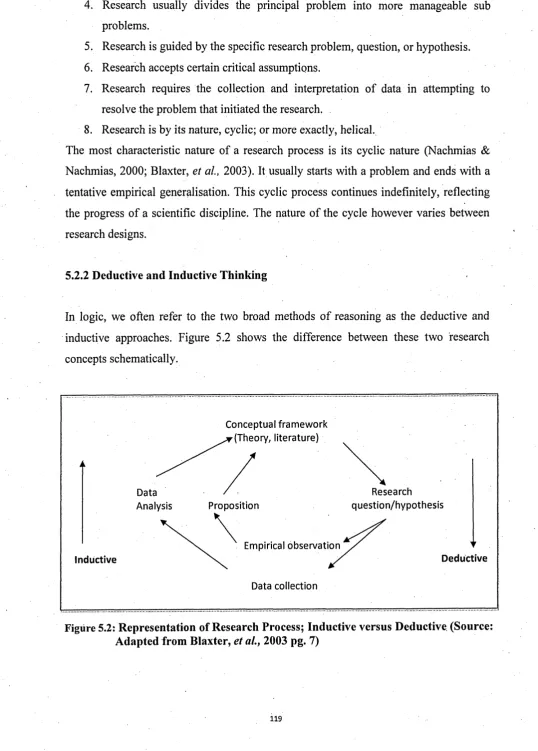
5.2.2 Deductive and Inductive thinking... 119
5.2.3 Research philosophy... 121
5.3 Research Approaches ... 122
5.3.1 Quantitative research ... 122
5.3.2 Qualitative research ... 123
5.3.3 Comparing quantitative and qualitative research... 124
5.3.4 The mixed-method research... 125
5.3.5 Triangulation... 130
5.4 Methodological framework adopted for this research... 131
5.4.1 Research statement... ... 131
5.4.2 Research question... ... 133
5.5 Selection of research approach... ... 134
5.5.1 Guide to the selection of research approach. ... 134
5.5.2 Research approach adopted for this research... 136
5.6 Selection of Research strategies... 138
5.6.1 Qualitative research strategies... 138
5.6.2 Quantitative Research strategies... 140
5.7.1 Features of the case studies method... 143
5.7.2 Case selection ... 145
5.7.3 Quality o f Case study research designs. ... 147
5.7.4 Sources of Evidence... .. 151
5.8 Survey Research... 155
5.8.1 Survey methods... 155
5.8.2 Reliability and validity of survey research... ....163
5.9 Pilot Studies... 165
5.9.1 Pilot studies adopted in this research. ... 166
5.10 Conceptual Theoretical Framework... . 169
5.10.1 Rationale for the framework... 171
5.11 Research design adopted for this research... ....: ... 171
5.12 Summary of the chapter.. . . ... 174
CHAPTER 6. QUANTITATIVE DATA ANALYSIS 6.1 Aims of the chapter ... 176
6.2 Quantitative data collection ... ... . 176
6.3 Analysis of respondents ... . ... . 177
6.4 Modes of analysis... 179
6.5 Data analysis and findings. ... 181
6.5.1 TAM project evaluation... 181
6.5.2 Selection of TAM manager... 202
6.5.3 TAM project critical success factors... 209
6.5.4 Management m ethodologies... ... 237
6.6 Summary of the chapter. ... 255
CHAPTER 7. QUALITATIVE DATA ANALYSIS 7.1 Aims of the chapter ... 256
7.2 Profile of case organisations ... 256
7.3 TAM project activities of the case organisations. ... .259
7.4 Methods of data collection ... 260
7.5 Method of data analysis... 263
7.6 Case studies analysis and findings... 263
7.6.1 Reasons for TAM projects... . ... 263
7.6.2 Avoiding TAM projects ... 264
7.6.3 Barriers of managing TAM p ro je c ts... 265
7.6.4 Solutions to the barriers ... 266
7.6.5 TAM projects management success evaluation... 267
7.6.6 Perceptions of stakeholders ...270
7.6.7 Resultant benefits at handover. ... 273
7.6.8 TAM manager and management skills ... 273
7.6.9 Factors affecting TAM projects and management strategies. ...276
7.7 Summary of the chapter... 303
CHAPTER 8. TURNAROUND MAINTENANCE FRAMEWORK DEVELOPMENT 8.1 Aims of the chapter... 305
8.2 Sources of data for the framework ... 305
8.3 Introduction to the framework... ... 306
8.4 Turnaround maintenance implementation framework structure. ...307
8.5 Turnaround maintenance management concept... ... ...307
8.6 Turnaround maintenance management leadership team... 311
8.7 Turnaround maintenance management implementation... 315
8.7.1 Top management issues... 315
8.7.2 TAM management issues ... 319
8.8 Turnaround maintenance management post mortem... 336
8.8.1 Evaluation... 336
8.8.2 Close out reports... ...339
8.9 Turnaround maintenance management improvements strategies 340 8.10 Summary of the chapter... 342
CHAPTER 9. TAM FRAMEWORK VALIDATION 9.1 Aims of the ch ap ter... 344
9.3 TAM framework validation process... 344
9.4 Feedback and Analysis... 346
9.5 Summary of findings from the Validation process ... 362
9.6 Summary of the chapter.... ... 364
CHAPTER 10. CONCLUSIONS AND RECOMMENDATION 10.1 Aims of the chapter... 365
10.2 Summary of the research process. ... 365
10.3 Summary of findings from the literature.„ . . . . ... 367
10.4 Summary of research fin d in g s... 368
10.5 Conclusions ... 370
10.6 Significance of the research.. ... 371
10.7 Recommendations... 373
10.8 Limitations of the research... 376
10.9 Applicability of the framework ... 376
10.10 Suggestions for further research ... 377
10.11 Summary of the chapter... ... 378
REFERENCES... ... I
ABBREVIATIONS
APM : Association for Project Management
APMBOK: Association for Project Body of Knowledge
BSI: British Standards Institution CPM Critical Path Method
CBM: Condition-based maintenance CM: Corrective maintenance
EPC: Engineering, Procurement and Construction. FMEA: Failure Modes and Effect Analysis
GDP: Gross Domestic Product
GERT Graphical Evaluation and Review Technique IM: Improvement maintenance
ISO: International organisation for Standardisation KPI: Key performance indicator
NDT: Non-destructive test PdM: Predictive maintenance
PERT Program Evaluation and Review Technique PM: Preventive maintenance
PMBOK: Project Management body of knowledge
PMI: Project Management Institute
RBM: Risk-based maintenance
RCM: Reliability-centred maintenance TA: Turnarounds
TAM: Turnaround Maintenance
TM: TAM project manager
GLOSSARY OF TERMS
Availability: is the measure of the percentage (or fraction) of time that a plant is capable of producing its end product at some minimum acceptable level.
Breakdown: - failure resulting in the non-availability of an item.
Clean: - to reduce contamination to an acceptable condition.
Condition-based maintenance: - preventive maintenance initiated as a result of knowledge of the condition of equipment from routine or continuous checking.
Corrective Maintenance - is the performance of unplanned (i.e. unexpected) maintenance tasks to restore the functional capabilities of failed or malfunctioning equipment or system.
Emergency maintenance: - maintenance wherein it is necessary to put the item on hand immediately to avoid serious consequences.
Failure: the termination of the ability of equipment to perform its required function.
Inspection - a careful and critical scrutiny of an item carried out without dismantling, by using the senses of sight, hearing, smell, taste and touch.
Maintainability: is the relative ease and economy of time and resources with which an item can be retained in, or restored to, a specified condition when maintenance is performed by personnel having specified skill levels, using prescribed procedures and resources, at each prescribed level of maintenance and repair.
Maintenance: - a combination of any actions carried out to retain an item in, or restore to, an acceptable condition. (Note that the actions referred to are those associated with initiation, organization and implementation).
Maintenance Program - a list allocating specific maintenance to a specific period.
Maintenance Schedule: - a comprehensive list of maintenance and incidence.
Overhaul: - a comprehensive examination and restoration of an item or a major part thereof, to an acceptable condition.
Planned output per period - lost output per period
Output index = planned output per period
Predictive Maintenance - is a conditioned-based maintenance that attempts to evaluate the condition of equipment by performing periodic or continuous (on line) equipment monitoring. The ultimate goal is to perform maintenance "just in time", before the equipment fails in service.
Preventive maintenance- maintenance carried out at predetermined intervals, or to other prescribed criteria, and intended to reduce the likelihood of an equipment or system not meeting an acceptable condition.
Rehabilitation: - extensive maintenance intended to bring property or building up to current acceptable conditions often involving improvements.
Reliability: is the probability that a device will satisfactorily perform a specified task (function) for a specified period of time under given operating conditions.
Repair: - to restore an item to an acceptable condition by the renewal, replacement or mending of decayed or damaged parts.
Restoration - maintenance actions intended to bring an item back to its original appearance or state.
REVAMP - to revise, renovate equipment or system with the aim of improvements; predominantly modernization or refurbishment o f existing facilities.
Running Maintenance: - maintenance which can be carried out while the equipment is in service
Servicing - the replenishment of consumables needed to keep an item in operating condition (Note this was sometimes used in broader context of
maintenance but this is not now a recommended practice.
Shutdown maintenance: - maintenance which can be carried out while the equipment system is out of service.
Test: - to compare the response of an item with a suitable or defined application of a stress, energy or measurement.
M T B F (mean time between failure) - a measure o f how long on average, a plant (or Equipment) will perform before an unplanned failure occurs. - a measure o f Reliability
M TTR (meantime to restore) - a measure o f how long on average, it will take to bring the plant (or equipment) item back to normal serviceability when it fails - a measure o f Maintainability.
Availability A = M T B F
LIST OF TABLES
PAGE
Table 2.1; The development of Maintenance Philosophies 14
Table 2.2: A checklist of maintenance objectives 19
Table 2.3: Benefits of good maintenance 21
Table 2.4: Features of Total productive maintenance 31
Table 3.1: Comparison of EPC and TAM projects 49
Table 3.2: Literatures on Project success measurement criteria 52
Table 3.3: Project type and success measurement criteria 57
Table 3.4: List of literatures on critical success factors of Project implementation 58
Table 4.1: Management skills and knowledge for refurbishment projects 89
Table 4.2: Project management skills for generic projects 90
Table 4.3: List of Personal Attributes, Management Skills and
Knowledge/Awareness for successful TAM projects. 98
Table: 5.1: Characteristics of Philosophical paradigms. 121
Table 5.2: Comparison of Research Paradigms - strength and weaknesses. 122
Table 5.3: The attributes of qualitative and quantitative research paradigms. 124
Table 5.4: Guide for the selection of a Research approach. 135
Table 5.5: Characteristics of major types Qualitative strategies 139
Table 5.6: Comparison of the different Quantitative research strategies 141
Table 5.7: Relevant situations for Different research strategies 142
Table 5.8. Strategies for the selection of samples and cases for a Case study. 146
Table 5.9: Tests and techniques for establishing validity and reliability in
case study Research 147
Table 5.10: Sources of Evidence in case study Research: Strengths and
Table 5.11: Evaluation of the three Survey Methods 156
Table 5.12: Types of Survey Questions and their best uses. 162
Table 6.1: Cross-tabulation of Industry group and the Respondents 178
Table 6.2: Analyses of the working experience of the Respondents 178
Table 6.3: % Scores, Median, ANOVA and Validity analyses of Cost Evaluation 182
Table 6.3b: Reliability Analysis of Cost Evaluation scales 182
Table 6.4: % Scores, Median and ANOVA and validity analyses of
Time evaluation 183
Table 6.4b: Reliability Analysis of Time Evaluation scales 184
Table 6.5: % Scores, Median, ANOVA and Validity analyses & Reliability
of scales of Quality Evaluation 185
Table 6.6: % Scores, Median and ANOVA and Validity analyses & Reliability
of scales of Functionality Evaluation 185
Table 6.7: % Scores, Median and ANOVA and Validity analyses & Reliability
of scales of Safety Evaluation 186
Table 6.8: % Scores, Median and ANOVA and Validity analyses & Reliability of scales of Environmental performance Evaluation 187
Table 6.9: % Scores, Median and ANOVA and Validity analyses Client/Top
Management perception of TAM success 189
Table 6.9b: Reliability Analysis of Client/Top management perception
on TAM success scales 190
Table 6.10: % Scores, Median, ANOVA and Validity analyses Contractors perception
of TAM success 190
Table 6.1 Ob: Reliability Analysis of Contactor perception on TAM success scales
-Inter-item correlation. 191
Table 6.10c: Reliability Analysis of Contactor perception on TAM success scales -
Item-Total statistics. 191
Table 6.11: % Scores, Median and ANOVA and Validity analyses of TAM
management team perception of TAM success 192
Table 6.1 lb: Reliability Analysis of TAM management team on TAM
Table 6.12: % Scores, M edian, A N O V A and V alidity analyses Plant operators'perception o f TA M success
Table 6.12b: Reliability Analysis o f Plant operators' perception on TAM success scales - Inter-item correlation.
Table 6.13: % Scores, Median and ANOVA and Validity analyses of Maintenance team perception of TAM
Table 6.14: % Scores, Median, ANOVA and Validity analyses of assessment of the Resultant benefits o f TAM projects.
Table 6.14b: Reliability Analysis of Resultant benefits evaluation for TAM projects-Inter-total statistics.
Table 6.14c: Reliability analysis of Resultant Benefit evaluation - Inter-Item Correlation
Table 6.15: % Scores, Median, ANOVA and Validity analyses of assessment of the Resultant benefits of TAM projects.
Table 6.15b: Reliability analysis of Resultant Benefit evaluation at Hand-over - Inter-Total Statistics.
Table 6.15c: Reliability analysis of Resultant Benefit evaluation (Hand-over) - Inter-Item Correlation.
Table 6.16: Median, Validity analyses & Reliability of scales of TAM Success Measures
Table 6.17: % Scores, Median, ANOVA and Validity analyses &
Reliability o f scales o f Personal attributes of a TAM manager
Table 6.18: % Scores, Median and ANOVA and Validity analyses & Reliability of scales TAM Management skills
Table 6.19: %Scores, Median, ANOVA and Validity analyses &
Reliability of scale of Knowledge needed to manage TAM projects.
Table 6.19b: Item-Total statistics - Knowledge and awareness areas
Table 6.20: Median, ANOVA and Validity analyses & Reliability of scale of Qualities of a TAM manager.
Table 6.20b. List of Qualities of a TAM project manager
Table 6.21: % Scores, Median, ANOVA and Validity analyses & Reliability o f scale TAM Philosophy
Table 6.22: % Scores, Median and ANOVA and Validity analyses &
Reliability of scale Top Management support.
T able 6.23: % Scores, Median, ANOVA and Validity analyses & Reliability o f
scale TAM goals and objectives. 212
Table 6.24: % Scores, Median and ANOVA and Validity and Reliability analyses for TAM Manager as a factor
Table 6.25: % Scores, Median and ANOVA and Validity and
Reliability analyses for Organisation/organisational structure
Table 6.26: % Scores, Median, ANOVA and Validity & Reliability analyses for TAM Management Team.
Table 6.27: % Scores, Median, ANOVA and Validity and Reliability analyses for Planning
Table 6.28: % Scores, Median, ANOVA and Validity & Reliability analyses for TAM Work Scheduling
Table 6.29: % Scores, Median, ANOVA and Validity & Reliability analyses for Communication
Table 6.30: % Scores, Median, ANOVA and Validity & Reliability analyses for Technical Tasks
Table 6.31: % Scores, Median, ANOVA and Validity & Reliability analyses for Personnel Recruitment.
Table 6.32: % Scores, Median, ANOVA and Validity & Reliability analyses for Contract Strategy
Table 6.33: % Scores, Median and ANOVA and Validity and Reliability analyses for Logistics
Table 6.34: % Scores, Median and ANOVA and Validity and Reliability •analyses for Work Scope
Table 6.35: % Scores, Median, ANOVA and Validity & Reliability analyses for Health, Safety & Environment
Table 6.36: % Scores, Median and ANOVA and Validity and Reliability analyses for Technology Factor.
Table 6.37: % Scores, Median, ANOVA and Validity and Reliability analyses for Monitoring and Feedback Factor.
Table 6.38: % Scores, Median, ANOVA and Validity & Reliability analyses for Adequate Resource Allocation.
Table 6.39b: Reliability analyses for Troubleshooting
-Inter-Item Correlation Matrix 229
Table 6.40: % Scores, Median, ANOVA and Validity & Reliability analyses for Regulatory Bodies. •
Table 6.41: Analysis of Critical Success Factors of T'AM project.
Table 6.42: % Scores, Median, ANOVA and Validity & Reliability analyses for Scope Management
Table 6.43: % Scores, Median, ANOVA and Validity & Reliability analyses for Time Management
Table 6.44: % Scores, Median, ANOVA and Validity & Reliability analyses for Cost Management
Table 6.45: % Scores, Median, ANOVA and Validity & Reliability analyses for Quality Management
Table 6.46: % Scores, Median and ANOVA and Validity and Reliability analyses for H.R Management
Table 6.47: % Scores, Median, ANOVA and Validity & Reliability analyses
for Communications Management 243
Table 6.48: % Scores, Median and ANOVA and Validity and Reliability
analyses for Risk Management. 244
Table 6.49: % Scores, Median and ANOVA and Validity and Reliability analyses
for Health, Safety & Environmental Management. 246
Table 6.50: % Scores, Median, ANOVA and Validity & Reliability
analyses for Materials Management. 247
Table 6.51: % Scores, Median and ANOVA and Validity and Reliability
analyses for Contract Management. 248
Table 6.5lb: Reliability analyses for Contract Management - Item-Total Statistics 249
Table 6.51c: Reliability analyses for Contract Management - Item-Total Statistics 2 250
Table 6.52: Median and ANOVA and Validity analyses & Reliability of
scales of TAM Management Methodologies 251
Table 7.1: Analysis of Case Organisations' TAM Activities as at end o f 2008 260
Table 7.2: Analyses of the Working Experience o f the Main Interviewed Staff 262
Table 7.3: Survey Results: Personal Attributes and Management Skills
required for TAM Management 274
xviii
230
231
237
239
240
241
242-Table 7.4 Survey Results: Knowledge and Awareness areas required for TAM
Management 275
Table: 8.1 Personal Attributes and Management Skills &
Knowledge areas required TAM Managers 317
[image:23.613.5.559.58.789.2]LIST OF FIGURES
PAGE
Figure 2.1: Factors affecting maintenance objective setting 18
Figure 2.2: Maintenance Objectives 18
Figure 2.3: How successful maintenance management can maximise
organisational profit 20
Figure 2.4: Types o f maintenance 23
Figure 2.5: RCM and other maintenance types 32
Figure 3.1: TAM project cycle 45
Figure 3.2: Major problems of TAM project implementation 48
Figure 3.3: Proposed TAM project success measurement model 53
Figure 3.4: The interaction between TAM critical success factors 76
Figure 4.1: Interaction between TAM manager's skills, attributes and functions with management methodologies and TAM outcome 99
Figure 5.1: The main stages of the research process 118
Figure 5.2: Representation of research process; inductive versus deductive 119
Figure 5.3: Mixed-method research process 126
Figure 5.4: Integrating qualitative and quantitative research methods 129
Figure 5.5: Conceptual framework for the successful implementation
of TAM projects. 170
Figure 5.6: Research process flowchart 172
Figure 6.1: Analysis of respondents 177
Figure 8.1: Illustration of the various sources of data for TAM framework
development 306
Figure 8.2: The structure of TAM project implementation framework 308
Figure 8.3: Relationship between organisational & managerial critical
success factors 310
Figure 8.4: The TAM Leadership team structure 312
Figure 8.5: TAM implementation showing responsibilities
[image:25.612.10.557.56.787.2]Figure 8.6: Interaction between TAM manager's skills, attributes and functions with management methodologies and TAM outcome
Figure 8.7: Kinds of TAM Work scope
Figure 8.8: Framework for TAM success measurement criteria
Figure I: Screen display of the Primary nodes used for the case studies data
315
316
319
337
1.0: PROJECT INTRODUCTION
1.1 AIMS OF THE CHAPTER
This chapter aims to familiarise the reader with the purpose and the subject area of this research. The chapter presents an overview of manufacturing industry, identifying the importance o f manufacturing to a state economy. It then introduces the research subject area, identifying its importance to manufacturing. The aims and objectives of this research are also outlined together with the significance o f the study. The chapter . highlights an overview o f research methodology and concludes with the chapter guide of the thesis.
1.2. BACKGROUND OF STUDY
Manufacturing is of immense importance to the populace. Virtually everything on earth today is manufactured; from clothing to the food and drink that sustains the human race. Even the construction industry depends on manufacturing as most construction materials pass through a manufacturing process. The manufacturing sector is of enormous economic and social significance to any state economy and its people.
According to the U.S Department of Commerce report on Manufacturing in America, (2004):
"Manufacturing is crucial to the U.S economy. Every individual and industry depends
on manufactured goods. In addition, innovations and productivity gains in the
manufacturing sector provide benefits fa r beyond the products themselves."
The report also explained that the manufacturing sector accounts for 14% of U.S Gross domestic product (GDP) and 11% of total US employment.
Manufacturing has been, and continues to be critical to the success of the UK economy. Britain’s strength as a prosperous trading nation over the past three centuries was built on manufacturing. According to the former UK Prime Minister, Gordon Brown,
"...for this government manufacturing not only has been, but remains and will always
be, critical to the success o f the British economy" (BERR, 2008).
"Manufacturing: New Challenges, New Opportunities", and The Engineering Employers' Federation (EEF, 2009) titled "Manufacturing Performance", the UK manufacturing sector accounts for about 13% of UK GDP and about 50% of the UK's exports are manufactured goods.
The following provides a snapshot of the continued importance of UK manufacturing according to BERR (2008):
• The UK is the world’s sixth largest manufacturer measured by output • UK manufacturing contributes £150 billion per annum to the economy • Half of UK exports is from the manufacturing sector
• UK manufacturing accounts for 50% productivity growth since 1997 • 75% of business of Research & Development is for manufacturing • UK manufacturing is consistently in top rankings of high-tech exports
• Manufacturing accounts for more foreign direct investment than any country apart from the USA.
In addition, this sector employs about four million people representing approximately 14% of the working population of UK (BERR, 2002).
Manufacturing is the use of machines, equipment, tools and labour to transform raw materials into finished goods. The success of manufacturing therefore depends on the performance of the facility (machines, equipment and tools) and the human resource (labour). Machines and equipment degrades with age and usage and ultimately becomes non-operational. The rate of degradation depends on decisions made during the design and manufacturing stages, the operating conditions, the usage intensity and the operators' skills (Murthy, et al. 2002). Adequate maintenance management strategies are therefore required to avoid failure of equipment and to ensure that the right volume is sustained.
equal, the unit price o f the products will rise. Effective maintenance management therefore forms an important approach towards reducing total manufacturing costs and improving productivity of the production process as failure to manage maintenance can lead to high penalty cost due to downtime.
Maintenance costs range from 12 - 23% of operating costs in UK manufacturing and the spending on maintenance in the UK is around £15 billion a year (Cross, 1988).
Analysing maintenance performance across Europe, Cross (1988) affirmed that though, in absolute terms, maintenance performance (costs) has improved in the UK; it still lags behind its European counterparts. Evidence from case studies of four UK
manufacturing firms shows, that none of them has adopted the third (nor the recent) generation of the maintenance philosophy in its true sense yet (Cooke, 2003). The study according to Cooke (2003) found that there is:
• too little maintenance planning and too much fire-fighting
• insufficient use of measurement of maintenance efficiency and long-term planning
• inadequate budgetary control in maintenance
• a lack of appreciation of the direct costs of maintenance, e.g., the cost of loss of asset availability
• a low level of awareness of modem maintenance techniques of the third and recent generations of maintenance philosophy; and
• limited connection (if any) between maintenance strategy and business strategy. Therefore to secure the UK's future wealth, manufacturing maintenance management has to become more productive, efficient and innovative to cope with the changing business environment (Cholasuke, et al. 2004).
1.3. RESEARCH FOCUS
maintenance. These planned maintenance strategies are later aligned with proactive strategies such as Total productive maintenance (TPM), Reliability-centred maintenance (RCM) and more recently Risk-based maintenance (RBM). Despite these maintenance strategies there comes a time due to age, operating/environmental conditions and statutory requirements when the entire facility (especially Process industries) had to be shut down for necessary repairs, maintenance and project works. This is called Turnaround Maintenance (TAM) or Turnaround, (TA).
All the major process industries (refining, petrochemicals, power generation, pulp & paper, Beer breweries, Soap manufacturers and fertilizer) and oil production facilities have their own nomenclature for this maintenance project. For the purposes of this research work, TAM is intended to encompass all types of industrial projects for existing process plants including: I&Ts (Inspection & Testing), Shutdowns, Planned outages, Debottlenecking projects, Revamps where an operating plant must be shut down until the work is completed and then re-started - thus "turning around" the plant (Ertl, 2005).
In reality, failures of Turnarounds are common in industries (Ertl, 2005) and most organisations are now resorting to comparative performance metrics to gauge the success or otherwise of a Turnaround. Some metrics according to Oliver (2003) includes; duration, total cost, turnaround costs, safety, start-up incidents, unscheduled downtimes, environmental incidents and savings. The major cause of TAM project implementation failures, as identified from literatures, is that organisations are still implementing TAM as EPC (Engineering, Procurement & Construction) projects. There are obvious differences between EPC project and Turnaround projects (Ertl, 2005; Oliver, 2002, 2003; Levitt, 2004; Lenahan, 1999). Consequently, TAM projects require specialized project management methodology in order to be successful (Ertl, 2005).
adequate skills to handle this with their attendant issues like changes in cost, time, materials, spares and personnel, the TAM is bound to fail.
Other scope-related problems arise because of multiple sources of work items such as capital projects, process needs, inspection requirements, operational needs and maintenance. For a Turnaround to be successful, these work items should be integrated to form an integrated plan and scope (Oliver, 2003; Williams, 2004; Motylenski, 2003). Clark & Hayes (2003) maintained that if this is not done, significant sum o f money will be wasted on TAM through; redundant scope, labour inefficiencies, multiple mobilisations and demobilisations, and schedule issues.
Ertl (2005), identified specific management methodology like; Scope, Time, cost, Quality, Human Resources, Communication and Risk management as essential to the success of a TAM project. This implies that inadequacies in any of these areas mentioned can lead to TAM failure.
For a successful TAM project, the organisation should set up a long range business plan to establish long-term plan to control schedules and budgets for the TAM (Krings, 2004; Mclay, 2003; Oliver, 2001, 2002 & Williams, 2004). This should be integrated into the overall corporate plan (Oliver, 2002). Without long-range plans, (Krings, 2004), major repairs and inspections often do not get adequate attention until it is too late to properly prepare for their executions.
Duffuaa & Daya (2004), Gupta, et al. (1997) and Oliver (2001), insist that the most suitable people should be selected with great care to forge the strongest possible organisation (management or core team) for controlling the event. According to Mclay (2003), the TAM team should represent all areas of responsibility: administration, operations, engineering, and maintenance; health, safety, and environment (HSE); quality assurance (QA); procurement, planning, and scheduling; and turnaround supervision. In addition the contractor representatives should also be included in this TAM team (Lenahan, 1999).
total TAM cost. Therefore, effectiveness of this activity is vital to achieve a successful Turnaround (Motylenski, 2003).
Not including support services such as safety training and management, industrial hygiene monitoring, lead and asbestos testing, and environmental monitoring as part of a turnaround can have a serious impact on scheduled activities as unanticipated delays push the completion date further and further (CAM, 2003). In the domain of nuclear power plants; risk and safety management are very critical and therefore the planning and scheduling system has to enforce safety constraints guaranteeing that the state of the plant is safe at any time during the outage (Gomes, et a l 1997).
In view of the above issues,, this research intends to identify and establish the factors that affect the implementation of TAM projects and develop an operational framework to assist operators of engineering facilities in TAM projects.
The set objectives of this research work will be achieved using appropriate research methodology. It is envisaged that the research findings and inferences will provide engineering facilities with the operational guide to reduce if not eliminate TAM project failures.
1.4. RESEARCH AIMS
The aims of this research work are to determine the critical success factors that affect TAM implementation projects and to develop a framework to ensure the successful implementation of TAM projects.
1.5. RESEARCH OBJECTIVES
In line with the aims of this research, the objectives of the project are:
1. To identify and establish success measurement criteria o f TAM projects.
2. To identify and establish critical success factors of the implementation of TAM projects.
3. To evaluate and establish how these critical success factors can be efficiently managed using TAM management specific methodology.
5. To develop and validate a framework for the successful implementation of TAM projects.
1.6. SIGNIFICANCE OF THE RESEARCH STUDY
The importance of successful TAM implementation cannot be overemphasised; unsuccessful implementation affects the organisation and the economy adversely. The cost of TAM projects is enormous and can represent up to 40% of the annual
maintenance budget of a process plant (Foy, 1999). Shell's report on the TAM project at their refinery in Athabasca, Canada put the cost of their TAM in 2006 at $100-125 million and was extended beyond the planned eight-week duration (Pokharel & Jiao, 2008). TAM performance statistics show that there is still significant improvement required to achieve predictably competitive results. According to Vichich (2008), the average high complexity turnaround exceeds cost and schedule targets by more than 20% and
• 83% of turnarounds do not satisfy all performance expectations; and
• 1 in 4 turnarounds significantly under-perform in more than one success criteria dimension; and are deemed a failure.
In some third world countries, such as Nigeria, the inability to carryout successful Turnarounds in their refineries is one of the causes of petroleum products scarcity despite being a major OPEC oil producer. This is because TAM failures can reduce the capacity of the oil refinery and can also make it difficult to recover its productivity and efficiency (Pokharel & Jiao, 2008). 'Catastrophic failure' which may arise from
inadequate Turnaround (or no Turnaround/ scheduled maintenance at all) in the power sector can be a major disaster in the developed countries (2003 London Blackout). Snow (2007) reports that oil prices can be affected by shutdown maintenance o f a major oil refinery. This means that TAM activities impacts negatively on the economy of a nation and the populace and hence the need for its successful implementation. Failures of TAM management can also result in loss of revenue, cash, and market share of the organisation and increased routine maintenance costs and reduced reliability/availability of equipment - increasing the cost of production.
successfully. Turnaround failures (budgets blown by millions of dollars, target dates missed by days) are still as prevalent as ever (Ertl, 2005). This implies that there is the need to carry out a robust empirical research to reveal the causes of failures of TAM projects in engineering facilities.
Also it has been shown that management methodology applicable to EPC projects (which organisations are using) are not effective in managing TAM projects and is a major contributor to the failures of TAM projects. Ertl (2005) identified that the maturity of ,the project management discipline in process industries for turnarounds is still very poor and stagnant. This has resulted in poor TAM project management, evaluation and appointment of the TAM Management team. This research work will however address these issues by identifying and establishing:
• The success measurement criteria to evaluate the TAM project implementation • The critical success factors of TAM projects
• The management skills/knowledge needed for TAM project management
• And management methodologies applicable to TAM projects to ensure that the TAM implementation success.
Finally, the Turnaround Maintenance Project Implementation, (TMPI) best practice framework to be developed intends to be a benchmark to serve as a reference for averting the TAM project implementation failures.
1.7 OVERVIEW OF RESEARCH METHODOLOGY
The aims of the research have been achieved by identifying and establishing the critical success factors and the development of a framework for the successful implementation of TAM projects based on the analysis of the literature, survey and case studies.
1.8. GUIDE TO THE THESIS
This section presents a brief guide on the contents of each chapter o f the thesis. These are as follows:
Chapter 2 presents an insightful literature on the basics of maintenance in engineering facilities. The definition and the reasons for carrying out maintenance are outlined. The developmental changes in maintenance philosophy from First generation (period up to World War II) to the Fourth or Recent generation (Year 2000 to the present) are explained. The chapter also presents the objectives of carrying out maintenance as well as factors affecting them. This is followed by a brief explanation of the benefits of a good maintenance system. Further, the chapter outlines the types of maintenance and briefly explains the various forms of maintenance strategies. Turnaround Maintenance (TAM) or Shutdown maintenance is identified as a proactive maintenance strategy and is a common feature in manufacturing organisations.
Chapter 3 focuses on the main theme of this thesis, Turnaround Maintenance (TAM). Definitions and explanations of TAM and the reasons for this maintenance strategy are presented in details. This chapter also shows that TAM can be considered as project, since it exhibits the characteristics of a typical project. The various phases of TAM project are outlined. This chapter also identifies the real problems o f successful implementation of TAM projects. These problems are elaborated in this chapter.
various innovations embarked upon by various organisations and professionals to optimize TAM project implementation.
Chapter 5 presents the research methodology adopted for this research. Different methodological approaches are explained in details. The chapter covers in detail research process, different methodological concepts and approaches for research, strength and weakness of the different methods. The chapter explains how the methodological approach was chosen for the research and explains its justification. The details of the pilot studies carried out in this study are also presented. This is followed by an outline of the conceptual theoretical framework which guided this research. Finally, the chapter presents the research design which outlined the structure for data collection and analysis.
Chapter 6 reports on the quantitative data collected and the analysis. The chapter presents the data collection methods including the analysis of respondents. It then highlights the methods employed for analysing the quantitative data from the questionnaire survey. The analysis of the data constitutes the major part o f this chapter. The chapter presents both descriptive and inferential statistical analysis using SPSS 16.0.
Chapter 7 presents the qualitative data collection and analysis involving the case studies of six continuous process plants in the UK. The chapter starts with selection criteria of the cases and then the profiles of the case organisations. Analyses o f typical TAM activities of the organisations are presented outlining their TAM intervals, labour input and duration of the project. The methods o f data collection are also outlined with the details of TAM experience of the main staff interviewed. Then the tools used for the analysis of the case studies data are provided. Finally, the data analysis of the case studies is presented.
Chapter 8 reports on the development of the TAM project implementation framework based on the analysis of the literature review, questionnaire survey and the case studies. The chapter presents the framework which is elaborated in five detailed areas; the TAM concept, Leadership Team, Implementation process, Post implementation and Improvement strategies.
received from the industry is then presented. Analysis of the feedback from these verifiers is also presented. Finally, a summary of the findings from the validation are outlined.
Chapter 10 is the final chapter of the thesis. It presents the summary of the research work highlighting the methods of data collection and analysis; This section is followed by the summary of findings from the literatures and the research findings section which summed up the main research findings. Also the chapter outlines the main conclusions and the significance of the framework which explained the novelty and contributions this research makes to the body of knowledge and its benefits to organisations for TAM projects implementation. The chapter also covers the recommendations to various parties that will benefit from the TAM framework. Further this chapter highlights the limitations of this research and their applicability to other engineering facilities. Finally, the chapter is concluded with the identification of some areas for further research work.
1.9 SUMMARY OF THE CHAPTER
2.0: MAINTENANCE IN ENGINEERING FACILITIES
2.1 AIMS OF THE CHAPTER
This chapter begins with the introduction of maintenance and how maintenance has developed different philosophies from pre-World War II to the present. It presents the objectives of maintenance in engineering facilities and the factors affecting them. A review of the benefits of effective maintenance and how it affects the profitability of the organisation is presented. The chapter also presents the different types o f maintenance, identifying shutdown maintenance as one of the proactive maintenance strategies. The chapter concludes with a chapter summary.
2.2 WHAT IS MAINTENANCE?
The objective of forming and operating an industrial company is to make a profit (Clifton, 1974). Modem industrial societies are characterised by their dependence on technology to produce goods and services. Every business (mining, processing, manufacturing, and service-oriented businesses such as transport, health, utilities, and communications) need equipment to deliver its outputs. Intense competition, coupled with rapid changes in technology has resulted in improvements to equipment so that the output has increased dramatically. Equipment degrades with age and usage and ultimately becomes non-operational. Murthy, et al. (2002) stated that the rate of degradation depends on decisions made during the design and manufacturing stages, the operating conditions, the usage intensity and the operators' skills. Adequate maintenance strategies are therefore required to avoid complete failure of the equipment and to ensure that the right volume is produced.
Moubray (1997) identified that maintenance and modification are the two elements to the management of any physical asset and stated that maintenance is carried out towards
1ensuring that physical assets continue to do what their users want them to do’.
The British Standard Glossary of terms (BS 3811:1993) defined maintenance as:
'Combination o f all technical and administrative actions, including supervision actions,
intended to retain an item, or restore it to, a state in which it can perform a required
From the aforementioned definitions it can be seen that maintenance is a set of organised activities that are carried out in order to keep an item in its best operational condition with minimum cost required.
With the increasing complexity, sophistication and cost of modem equipment, maintenance has become an indispensable part of a manufacturing system. Manufacturing organisations are depending more and more upon the skills and organisation of the maintenance function and is growing in importance and size as a specialised function (Clifton, 1974).
2.3. DEVELOPMENT OF MAINTENANCE PHILOSOPHIES
The nature of maintenance work has changed in recent decades as a result of a huge increase in the number and variety of physical assets to be maintained, increasing automation and complexity, new maintenance techniques and changing views on maintenance organisation and responsibilities (Moubray, 1997). Cholasuke, et al. (2004) stated that the importance of the facility maintenance management in the manufacturing environment has increased rapidly as many organisations aim to become world class. For many organisations it is important to respond to global competitive pressure by seeking to increase their productivity, maximising the overall equipment effectiveness and pursing an effective and efficient maintenance program.
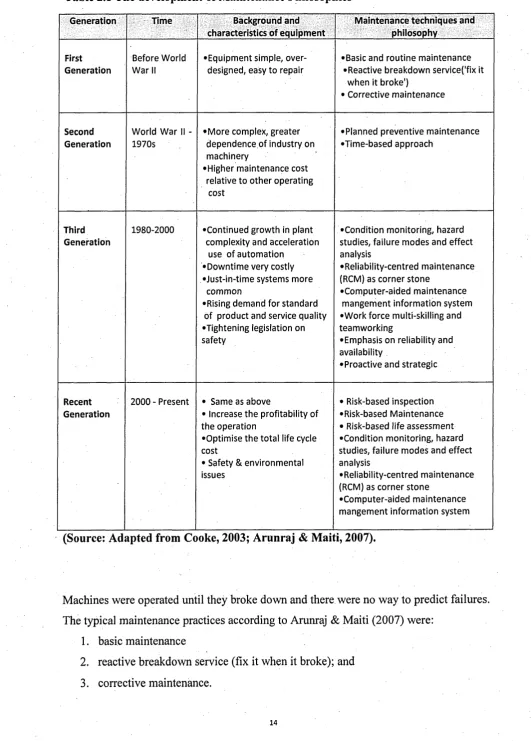
There has been a very remarkable change in the perceptions and approaches of maintenance since the World War II. This evolution of maintenance philosophies is categorised into four generations as shown in Table 2.1.
2.3.1 First Generation
Table 2.1 The development of Maintenance Philosophies
Generation Time Background and characteristics of equipment
Maintenance techniques and philosophy
First Generation
Before World W ar II
• E q u ip m e n t simple, over- designed, easy to repair
• Basic a n d ro u tin e m a in te n a n c e • Reactive b rea k d o w n service('fix it
w h e n it broke')
• Corrective m a in te n a n c e
Second Generation
World W ar II - 1970s
• M o re complex, g rea ter d e p e n d e n c e of industry on m achinery
•Higher m a in te n an c e cost relative to o th e r o p erating
cost
• Planned preve ntive m a in te n a n c e • Tim e-based a p p ro a ch
Third Generation
1980-2000 •C ontinue d grow th in plant complexity and acceleration
use of au to m a tio n •D o w n tim e very costly •Just-in-time system s m o re
co m m o n
•Rising d e m a n d for s ta n d ard of p ro d u ct a n d service quality •Tightening legislation on safety
•Condition monitoring, hazard studies, failure m o d e s an d effect analysis
•Reliability-centred m a in te n a n c e (RCM) as co rn e r s t o n e
•C o m p u te r-a id ed m a in te n a n c e m a n g e m e n t in form ation system •W ork fo rce multi-skilling a nd te a m w o rk in g
• Emphasis o n reliability a n d availability
• Proactive an d strategic
Recent Generation
2000 - P re sent • Sam e as above
• Increase th e profitability of t h e o p era tio n
•Optim ise th e tota l life cycle cost
• Safety & environm ental issues
• Risk-based inspection •Risk-based M a in te n a n ce • Risk-based life a s s e s s m e n t •Condition m onitoring, hazard studies, failure m o d e s an d effect analysis
• Reliability-centred m a in te n a n c e (RCM) as co rn e r s to n e
•C o m p u te r-aid e d m a in te n a n c e m a n g e m e n t inform ation system
(Source: Adapted from Cooke, 2003; Arunraj & Maiti, 2007).
Machines were operated until they broke down and there were no way to predict failures. The typical maintenance practices according to Arunraj & Maiti (2007) were:
1. basic maintenance
[image:39.616.19.551.21.763.2]2.3.2. The Second Generation
Due to pressures, during the World War II, there was increased demand for goods o f all kinds while the supply of industrial manpower dropped sharply (Moubray, 1997). This led to increased mechanisation and by 1950's machines of all types became more numerous and more complex. This brought the idea that equipment failures could be prevented, and hence the concept of preventive maintenance. The maintenance strategy during this period is mainly equipment overhauls done at fixed intervals. This was usually time-based approach of planned maintenance management. Moubray (1997) noted that there was a relative increase in the cost of maintenance compared to other operating costs. This resulted in the growth o f maintenance planning and control which greatly helped to bring maintenance and its cost under control. The maintenance polices adopted were (Arunraj & Maiti, 2007):
1. Planned preventive maintenance 2. time based maintenance; and
3. system for planning and controlling work.
2.3.3 The Third Generation
Considering the amount of capital committed to fixed assets and the sharp increase in the cost of the assets, the need to maximise the life of the assets became a very big challenge. By mid-seventies till 1990's the process of change in the industry has gathered even greater momentum. Moubray (1997) identified new expectations, new research and new techniques as the classes of these changes. During this third generation, the new expectations include:
• Higher plant availability • Greater safety
• Better product quality
• No damage to the environment • Longer equipment life
• Greater cost effectiveness.
Quite apart from greater expectations, research is changing many o f the most basic beliefs about age and failure. In particular, it is apparent that there is less and less connection between the operating age of most assets and how they are to fail.
• decision support tools, such as hazard studies, failure modes and effects analyses and expert systems
• new maintenance techniques, such as condition monitoring
• designing equipment with a much greater emphasis on reliability and maintainability
• a major shift in organisational thinking towards participation, team-working and flexibility.
2.3.4 Recent Generation
In the 1990s, risk based inspection and maintenance methodologies started to emerge and gain popularity beyond 2000. This generation is highly characterised by the inception of risk-based inspection and maintenance in addition to RCM and Condition- based maintenance (CBM). Up till 2000, maintenance and safety were treated as separate and independent activities. The overall objective of the maintenance process is to increase the profitability of the operation and optimise the total life cycle cost without compromising safety or environmental issues. Inspection and maintenance planning based on risk analysis minimises the probability of system failure and its consequences. It helps management in making correct decisions concerning investment in maintenance and related fields (Arunraj & Maiti, 2007).
Effectively, according to Moubray (1997), the key challenges facing modem maintenance management include:
• to select the most appropriate techniques; and • to deal with each type of failure process
These are done in order to fulfil all the expectations of the owners of the assets, the users of the assets and the society as a whole:
• in the most cost-effective and enduring fashion; and
• with the active support and co-operation of all the people involved.
2.4 MAINTENANCE OBJECTIVES
and the achievement of the plant outputs. The formulation of a maintenance objective is more complex than this and it usually involves the users, owners and the safety department specifying what they want from the maintenance function. Only then can the maintenance function be able to decide how best to maintain the plant (the maintenance strategy) in order to achieve the requirements at minimal maintenance cost (Kelly, 1997).
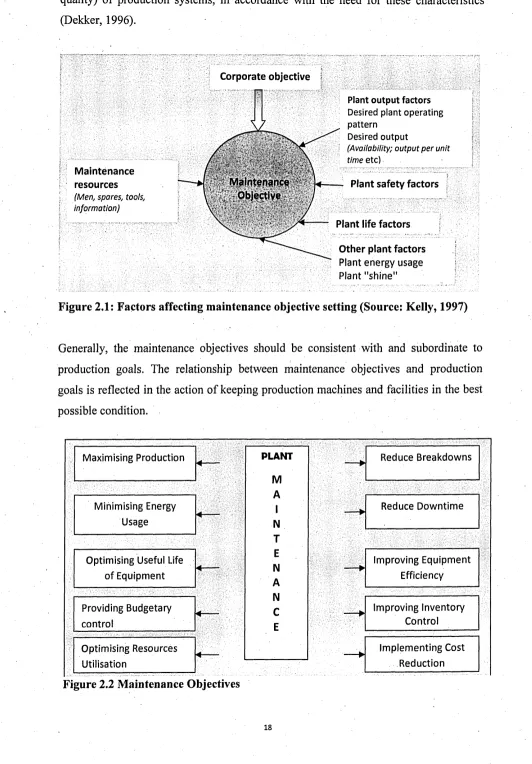
The main factors that should be taken into account in the formulation of maintenance objective are shown in Figure 2.1. These factors according to Kelly (1997) are:
1. Maintenance Resources (men, spares and tools) - can be considered as inducing the direct cost of maintenance. The level of maintenance resources can easily be changed in the case of contract arrangements, much more slowly if the resources are in-house.
2. Maintenance resources and plant longevity - A proportion of the maintenance resources is necessarily devoted to ensuring that the machineries and equipments survive up to or beyond the design operating life. The maintenance work involved here is mainly ’protective', e.g. preventing the corrosion of structures, but can also be a major part replacement.
3. Maintenance resources and desired plant safety (equipment integrity) - Here, again there will usually be no clearly appropriate level or frequency of maintenance. The sensible approach here is to set safety standards by process of engineering judgement based on experience and wherever possible, analyses of plant failures. The extent to which such standards have been compiled with should then be periodically audited.
4. Maintenance Resources and product output - Product output can be expressed in various ways, but the most useful of these is usually the output index because it combines several other parameters.
Considering these factors, Kelly (1997, pg.88) stated that the general maintenance objective is: 'to achieve the agreed plant operating pattern, product output and quality, within the accepted plant condition and safety standards'.
quality) o f production systems, in accordance with the need for these characteristics (Dekker, 1996).
M a in ten a n ce resou rces
(Men, spares, tools, information)
O ther plant factors
[image:43.620.26.558.21.785.2]P la n t e n e r g y u s a g e s P la n t " s h i n e "
Figure 2.1: Factors affecting maintenance objective setting (Source: Kelly, 1997)
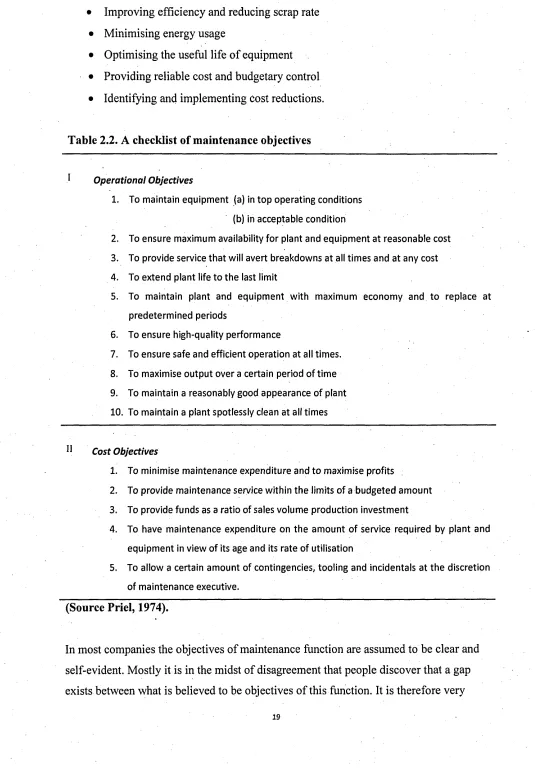
Generally, the maintenance objectives should be consistent with and subordinate to production goals. The relationship between maintenance objectives and production goals is reflected in the action of keeping production machines and facilities in the best possible condition.
R e d u c e B r e a k d o w n s
R e d u c e D o w n t i m e
I m p r o v i n g I n v e n t o r y C o n t r o l
I m p l e m e n t i n g C o s t
R e d u c t i o n M a x im is i n g P r o d u c t i o n
P ro v id i n g B u d g e t a r y
c o n t r o l
O p t i m i s i n g R e s o u r c e s
U tilisa tio n
I m p r o v i n g E q u i p m e n t
E fficiency O p t i m i s i n g U seful Life
o f E q u i p m e n t M in i m is in g E n erg y
U s a g e
PLANT
figure 2.2 Maintenance Objectives
C orporate ob jectiv e
Maintenance Objective
Plant output factors
Desired pla nt op eratin g p a t te r n
Desired o u t p u t
(Availability; output per unit time etc)
Plant s a fe ty factors
Figure 2.2 shows the summary maintenance objectives which include: • Improving efficiency and reducing scrap rate
• Minimising energy usage
[image:44.619.16.551.29.798.2]• Optimising the useful life of equipment • Providing reliable cost and budgetary control • Identifying and implementing Cost reductions.
Table 2.2. A checklist of maintenance objectives
1 O p e r a tio n a l O b je c tiv e s
1. To m a in ta in e q u i p m e n t (a) in t o p o p e r a t i n g c o n d i tio n s
(b) in a c c e p t a b l e c o n d itio n
2. To e n s u r e m a x im u m availability fo r p la n t a n d e q u i p m e n t a t r e a s o n a b l e c o s t
3. To p ro v id e se rv ic e t h a t will a v e r t b r e a k d o w n s a t all ti m e s a n d a t a n y c o s t
4. To e x t e n d p la n t life t o t h e last limit
5. To m a in ta in p la n t a n d e q u i p m e n t w ith m a x im u m e c o n o m y a n d t o r e p l a c e a t
p r e d e t e r m i n e d p e rio d s
6. To e n s u r e hig h-quality p e r f o r m a n c e
7. To e n s u r e s a f e a n d efficient o p e r a t i o n a t all t im e s .
8. To m a x im is e o u t p u t o v e r a c e r ta in p e r i o d o f t i m e
9. To m a in ta in a r e a s o n a b l y g o o d a p p e a r a n c e o f p la n t
10. To m a in ta in a p la n t sp o tlessly c lean a t all t im e s
C o st O b je c tiv e s
1. To m in im ise m a i n t e n a n c e e x p e n d i t u r e a n d t o m a x im is e profits
2. To p r o v id e m a i n t e n a n c e s e rv ic e w ith in t h e limits o f a b u d g e t e d a m o u n t
3. To p ro v id e f u n d s as a ra tio o f s a le s v o l u m e p r o d u c t i o n i n v e s t m e n t
4. To h a v e m a i n t e n a n c e e x p e n d i t u r e o n t h e a m o u n t o f se rv ic e r e q u i r e d by p la n t a n d
e q u i p m e n t in v iew o f its a g e a n d its r a t e o f utilisation
5. To allo w a c e r ta in a m o u n t of c o n t in g e n c ie s , to o lin g a n d in c id e n tals a t t h e d isc re tio n
o f m a i n t e n a n c e ex e cu tiv e.
(Source Priel, 1974).
important and advisable to spell out the objectives in clear terms (Kelly, 1997; Priel, 1974; Clifton, 1974). Priel (1974) identified cost objectives and operational objectives as the main areas that needs clear definition which are explained in the checklist in Table 2.2.
2.5. BENEFITS OF GOOD MAINTENANCE SYSTEM
With the change in manufacturing processes emphasising lean manufacturing, the reliability and availability of plant are vitally crucial (Cholasuke, et al., 2004).
Ineffective plant maintenance leads to poor machine performance, loss of market share, loss of production which ultimately leads to loss of profit.
Price V o lu m e
Profit
M ain ten an ce (Direct cost)
Reduce Cost
Loss of Production (M aintenance indirect cost)
Increase Revenue
Successful Maintenance
• Enhanced and c o n siste n t p ro d u ct quality to secu re, o r e ven in crease th e c u sto m ers. • R educe co st of
m ain ten an ce system by extending useful life of th e a sset.
• Reduce th e cost of em ploying reactive m ain ten an ce • Minimize breakdow ns
• Minimize do w n tim e • Minimize rew ork • Minimize inventory • Minimize sp are p arts • Minimize overtim e • Minimize accidents
• Im prove reliability & availability.
• Im prove p lan t p erfo rm an ce. • Su p p o rt new m arket o p p o rtu n ities
Figure 2.3: How successful maintenance management can maximise organisation profit. (Source: Cholasuke, etal., 2004).