The obligatory passage point : abstracting the meaning in
tacit knowledge
WALTON, John
Available from Sheffield Hallam University Research Archive (SHURA) at:
http://shura.shu.ac.uk/7427/
This document is the author deposited version. You are advised to consult the
publisher's version if you wish to cite from it.
Published version
WALTON, John (2013). The obligatory passage point : abstracting the meaning in
tacit knowledge. In: JANIŪNAITĖ, Brigita, PUNDZIENE, Asta and PETRAITE,
Monika, (eds.) Proceedings of the 14th European Conference on Knowledge
Management. Reading, UK, Academic Conferences and Publishing International
Limited, 769-775.
Copyright and re-use policy
See
http://shura.shu.ac.uk/information.html
Sheffield Hallam University Research Archive
THE OBLIGATORY PASSAGE POINT: ABSTRACTING THE MEANING IN TACIT KNOWLEDGE John Walton
Sheffield Hallam University Sheffield S1 1WG
United Kingdom [email protected]
Abstract: The lived experience of individuals in the workplace results in an accumulation of dispositions to act. Such dispositions have been termed knowledge [Boisot 1998]. Further, this knowledge is considered to be tacit or explicit [Baumard 1999]. Therefore tacit knowledge is one of the precursors of new knowledge. There have been a number of hypotheses as to how such knowledge is transformed into explicit knowledge [Nonaka et al 2000], and then subsequently diffused [Boisot 1998]. Moreover it is impossible to know the magnitude of tacit knowledge that is not articulated, however insightful, original or crucial it may be. The transformation to the explicit rendition can and will act as a filter in an attempt to eliminate meaningless utterances. Therefore some tacit knowledge will be lost in this process. This is an Obligatory Passage Point (OPP) a concept normally associated with Actor Network Theory [Latour 2005]. This is where the decision is made as to ‘what counts’ as legitimate knowledge and it is irreversible. This obligatory passage point is for all tacit knowledge in a community, an organization or even a nation.
The case study presented comprises a small number of individuals working in a third sector environment. Although there is agreement as to what is to be achieved, the how question remains open. Despite the common concrete experiences, the tacit appreciation of the perceived action world varies significantly. A process by which an inventory of tacit knowledge can be established, abstracted and combined to act as a base to affect dispositions and expectations is described. The path to the subsequent generation of actionable knowledge is plotted which can subsequently form the basis for an intervention.
The delineation between tacit knowledge and explicit knowledge in this context is explored by the application of the obligatory passage point. Utilizing the principles of language by Karl Buller the notion of legitimation is discussed. The OPP is significant because when tacit knowledge is shared, there is a process of gaining inter-subjective agreement which legitimizes the explicit representation of the tacit knowledge. The eye can see and interpret the world, but it cannot see itself. All tacit knowledge is gained through the mind’s eye. The collective minds are seeing the collective tacit knowledge of the group and agreeing.
Keywords: Actor Network Theory; Tacit Knowledge;
1. Introduction
Organizations are effective as a result of collective action. The annual appraisal is a process that evaluates an employee’s contribution against targets set previously; it is perceived as an objective way of assessing a subordinate by a superior. Fundamentally, the appraisal system is reductionist; central to this process are the assumptions of the design and planning schools of strategy [Mintzberg 1998]. It is appropriate where the environment and the operations of the firm are very stable. The subject of this paper proposes an alternative, that of a review of the previous year, with an assessment by the employee of the success or otherwise of the work undertaken.
Comparing the two approaches, appraisals are mechanistic and objective, with asymmetric power relationship between the appraiser and the appraisee. Whilst appraisals rely on explicit knowledge, targets, budgets and the like, reviews place much more emphasis on tacit knowledge [Baumard 1999]. The appraisal process is synoptic, the review is potentially panoptic. With an appraisal system there is a unitary view, and the outcome must lie on a predetermined path. With a review, the organizational is with insight, providing its own rationalization.
This paper investigates the reification of tacit to explicit knowledge during the annual review process described as a case study. The literature is explored to provide the focus of the methodological issues involved in the research. Following this the results from the field work are presented. Finally, the relevance and the diffusion of the outcome are discussed, together with a suggestion of the location of the obligatory passage point.
with the work of Karl Popper's worlds in the generation of actionable knowledge [Popper 1972]. This may allow a bridge to be built between second and third generation knowledge management [Snowden 2007].
Utilizing the approach here, we dare to know, to consider and to act on an exposition of those directly involved in the realization of a superordinate goal by means of actionable knowledge.
2. The case study
Access Space, a not for profit organization, was founded in 2000 by the current CEO, James Wallbank. The original purpose was to provide digital opportunities at all levels as well as developing a new empowering relationship with technology.
One of the super ordinate goals is to embrace the development of the individual. Participants are encouraged to build a functioning computer using reconfigured scrap hardware and freely available software. This means that the cognitive powers of the individual in the right environment can build a machine of equivalent functionality to one marketed by the major companies yet at a fraction of the price. The cost is the experience and time of the staff and the commitment of the participant. In engaging in purposeful action interpersonal skills are developed, together with opportunities for creativity and innovation. All these lead to enhanced self-esteem and the acquisition of intellectual capital [Walton 2010]. The core competence of Access Space was the skill in using disparate parts to make a functioning whole.
The Board of Trustees was conscious that appraisals had not been undertaken for the staff including the CEO. This was in part due to an assumption that, because of the close proximity of the staff both with each other and the CEO that this would be unnecessary. However, it was decided to implement not an appraisal, but review for each member of staff. The intention was not to measure contribution against pre-determined targets (appraisal) but invite each member of staff to look back at the year and talk about their lifeworld.
From the outset Access Space has received funding from the United Kingdom’s Arts Council. When this funding was withdrawn in 2011 the effect on the Access Space was profound. Therefore, this was a time of questioning, not for answers, but a search for what the right sort of questions might look like.
The point had been reached where a thorough review of the way things were done, who did them and why things were done in the first place was required.
3. Literature review
Data is the physical state of a system, [Boisot 1998]. Information is the difference that makes a difference [Bateson 1972]. That is, it allows individuals to understand what it is they perceive. Information is an alteration of expectations, therefore the more our expectations are altered the more informative the information is said to be. Being informed however is not the same thing as action. The information is taken by the individual, and as a consequence of this the cognitive process can give rise to actions. Accordingly, knowledge is a disposition to act [Boisot 1998]. Knowledge therefore arises out of data, but is significant from it.
To qualify as being legitimate, knowledge must satisfy three criteria: it must be true; the knower must be able to justify its existence by reasoning from other knowledge and the knower must believe it. This triumvirate criteria of knowledge being justified true belief, as stated by Plato holds true today just as it did three millennia ago [Ayer 1956].
Knowledge has been classified variously as objective versus subjective, tacit as opposed to explicit. Tacit knowledge [Baumard 1999] is difficult to formalize in coherent language therefore it can be difficult if not impossible to imitate. Explicit knowledge [Nonaka et al 2000] can be written down and represented by narrative, tables and formulae.
The delineation between tacit and explicit knowledge, and the transition from one to another, gave rise to the SECI framework [Nonaka et al 2000]. This formed the basis of second generation knowledge management.
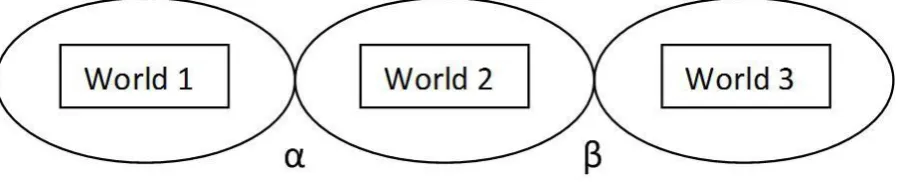
experiences. World three is the locus of abstract concepts so it is in this world that critical discussion and debate take place. This is the world of scientific theories.
The crucial point is worlds one and three are not in direct communication; world two is the mediator between them. This representation is not new however, it was known to Plato and the Stoics. The significance is that it makes the distinction between the object in focus and the logical representation of it. The perception of the object resides in world two and the latter in world three.
[image:4.595.75.525.207.299.2]In line with this, the conception of tacit knowledge is generated by the interaction of world two with world one. There could be an abstract conceptualization which will then reside in world three. This would occur if the perception of the lived experience (the tacit knowledge) is made explicit and there is inter subjective agreement of its logical conceptualization placing it in world three.
Figure 1. The three worlds of Karl Popper
Following this line of argument, tacit knowledge will be initiated at position α whilst agreed explicit knowledge will reside a position β. Therefore there are two levels of capture and two filters. First there is that impression of the action world on the individual. This is the concrete experience (first capture). Secondly, there is a conceptualization of this to form an abstract concept. This is the first filter and the second capture as the concrete is now represented in world three as an abstract concept. Finally, abstract concepts, because they can be expressed in fully formed language, can be subject to refutation furnishing the second filter. The remaining content of world 3 (which will often but not always shared) contains yet to be refuted abstract knowledge This is why theories are abstract and simple and experiences are always event concrete and rich [Popper 1972].
This has an impact on the way tacit and explicit knowledge are viewed: explicit knowledge must reside in world 3, whilst tacit knowledge must reside in world one. This, Popper explains is why knowledge in world three is independent of the knower.
There is another bifurcation of knowledge proposed by Cook and Brown (1999) where they draw the distinction between knowledge in possession and knowledge in action. This has a significant impact on the work proposed by Popper. What is required then, is a methodology that will allow in situ capture of the deployment of knowledge (knowledge in action) which will then enable the construction of conceptual models (knowledge in possession).
Grounded theory methodology (GTM) is an attempt to collect and interpret data in situ [Glasier & Corbin 1990]. GTM enables a complex situation to become analytically tractable. By using the constant comparative method, items of data are compared and contrasted enabling categories (free nodes) of data germane to the situation to emerge. These categories or nodes will in turn permit the relationship between the nodes to be articulated allowing the generation of a conceptual model that will bring greater understanding of the phenomena under consideration. When no more categories or attributes can be added to the model, it is said to be 'saturated' or complete.
Data in GTM is not merely narrative data. Pictures, diagrams, body language and even the elocutionary force of an utterance can be considered to be data. In sum, grounded theory aims to elicit the actual lived experience of individuals groups and teams. It provides ‘initial systematic discovery of theory from the data of social research' [Glasier & Strauss 1967:3].
The identification of what constitutes a problem to be solved and resolved is problematisiation. This means that different actors might and indeed would perceive different ‘issues of concern’ within the same problem situation. Thus ANT acknowledges plurality of view. The focus of ANT is to the identification of issues of concern that all actors will enroll to address. The Obligatory passage point is the point of access into this collective action and is according to the ANT theories irreversible.
Knowledge Management is advancing rapidly not necessarily from technological determinism, but from environmental velocity and knowledge intensity of products and services. The rate limiting step in both individual and organisational performance could be the generation conception and deployment of actionable knowledge. The three worlds of Karl Popper furnish an insight into the manner in which individual perceptions are captured, experienced and rationalized. This provides a route from sense experience to tacit knowledge and thence to explicit knowledge. Explicit knowledge that is capable of being critically assessed will result in a body of knowledge that is actionable
4. The research method
The research was conducted in three phases: the engagement phase; the data collection phase and the interpretation phase. The methodology is inductive and qualitative in nature.
The engagement phase involved co-ordinating the trustees and the staff to the need and the benefits of a review process. The data collection phase relied heavily on Grounded Theory Methodology whilst the interpretation phase was unfolded using Actor Network Theory [Latour 2005].
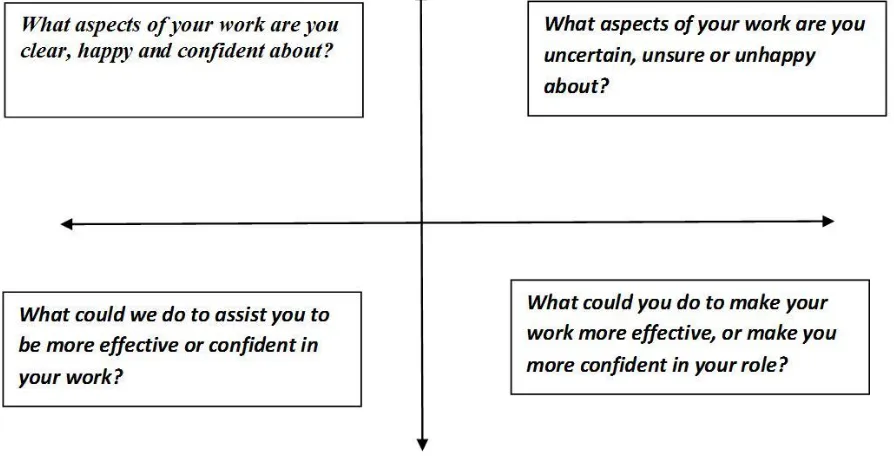
Each session was conducted in a room furnished in a simple manner a table: with five chairs, a blank white board, and some marker pens. The intention was to create a neutral environment which would encourage reflection.
[image:5.595.71.518.385.617.2]The subject was introduced to the framework and then asked to instantiate it. At this point the researcher sat down to assume a passive posture, while the subject was standing in an active posture.
Figure 2: The ‘empty’ data collection framework.
As the instantiation of the framework progressed to become a model, some subjects drew links from one item to another in a different quadrant. Instantiating a model is not a linear method; the model does not have a start and finish. Indeed, as the model is constructed, various parts will be embellished by additions and afterthoughts. This means that the subjects themselves are linking activates, qualities and roles in the diagram. In one instance lines were drawn to link together elements located in different quadrants. This was incorporated in the coding.
In every case the session of one hour, was exceeded. The session ended when no more could be added to the model. This suggested that the model was saturated.
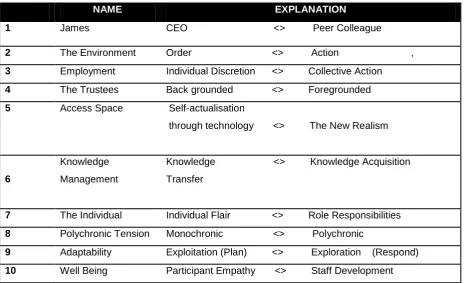
The aim was to select the minimum area that represented a coherent semantic statement. The implications of the initial data collecting phase gave rise first to open coding and then to the classification into nodes, as shown in table 1.
Two meetings were then convened to present these initial findings. These meetings were recorded, and from them using GTM two further nodes were added. Although the data had been interpreted, the next stage involved the meaning of the information, and this used the insights of Actor Network Theory.
5. Findings
Coding involved the identification of constituents of the model produced from each session. Using the constant comparison method, elements were progressively grouped into nodes that will categorise a single concept.
The next stage was to validate and explore these categories; so two focus groups were convened, one composed of the trustees and one of the staff. Two members of the staff play a trustee role. After each group the nodes were fine tuned in the light of the feedback. All is data, and the comments lead to exploration directed by theoretical sampling. The meaning attributed to the node can be 'fine-tuned' due to inter-subjective agreement. These ‘free’ nodes shown in table one.
This process acted as filter between worlds 1 and 2 i.e. searching for common experiences whilst discarding idiosyncratic comments.
[image:6.595.67.533.388.671.2]The nodes contain discrete categories of the life world of staff in Access Space. However, the nodes cover a spectrum of experiences of the staff. Each node is therefore expressed a spectrum of two elements held in binary opposition. The meaning given by individual will be a dialectic which will furnish a unique position on the spectrum of meaning.
Table 1: The Nodes
NAME EXPLANATION
1 James CEO <> Peer Colleague
2 The Environment Order <> Action ,
3 Employment Individual Discretion <> Collective Action
4 The Trustees Back grounded <> Foregrounded
5 Access Space Self-actualisation
through technology <> The New Realism
6
Knowledge Management
Knowledge <> Knowledge Acquisition Transfer
7 The Individual Individual Flair <> Role Responsibilities
8 Polychronic Tension Monochronic <> Polychronic
9 Adaptability Exploitation (Plan) <> Exploration (Respond)
10 Well Being Participant Empathy <> Staff Development
of the organisation. Ensuring an appropriate balance is a challenge both for the individual and the organisation as a whole.
6. Discussion
The empirical work showed a gap between knowledge in possession of the collective action and' knowledge in action of the individual experience [Cook & Brown 1999]. Furthermore, it did illuminate the difference between the concrete experiences and the challenges to assume a desired future abstract state. The nature of these tensions shows how demanding working in this context can actually be. Given the limited resources of the organisation it was recognised that not every issue can be addressed, but this did not inhibit the sincere involvement of a staff in trying to articulate the issues.
That codification of the data into nodes and the subsequent discussion brought out about inter subjective agreement is a positive outcome for the team; it gave the staff a legitimate vocabulary of semantic integrity. It also demonstrates that even in a benign almost collegiate environment, tacit knowledge can be difficult to articulate. Socialisation, the first stage of the SECI spiral [Nonaka et al
2000] is not an easy stage for anyone.
This is congruent with the concept of problematisation in Actor Network Theory. In fact, as the research outcome was discussed with the staff and the notion that the nodes represented the perception of all the staff (albeit with slight reservations) it became clear the main discussion was about the meaning of the nodes and their relevance to the future abstract state.
The future abstract state was also important even though it was almost impossible to articulate. There has to be a passage towards a future in which the superordinate goal can make itself manifest by the users (participants) of the services Access Space provides.
Therefore, the organisation is going through a process of translation [Callon 1986] and this will involve four steps problematisation; interessement; enrolment; and mobilisation.
The point is that problematisation had not been discussed openly; the review process had therefore provided a legitimate basis for this to take place, even though this was an unexpected outcome. Problematisation requires that a focal actor bring all the other actors though an obligatory passage point. As its name implies all actors have to agree to journey through this point. And the passage is irreversible. The passage was the willingness to produce an honest rendition of their individual lifeword. The focal actor was the researcher.
From a knowledge management point of view, the OPP furnished the substratum from which tacit knowledge can be converted into explicit knowledge and then combined to form an expression of the collective knowledge generated de novo. It is the consideration of this collective de novo knowledge that prepares the way for interassessment between the actors in the network.
The translation process, although incomplete (the enrolment and mobilisation had yet taken place), had a significant effect of the perceived level of power distance [Hofstede 1980]. This was a beneficial and cathartic outcome and one that was unexpected
The case study ended during the process of enrolment, that is the commitment of the actors in the light of the now knowledge to engage in a disposition to act. Before this can happen of course, mobilisation has to occur.
Though the space is not chaotic, the interaction with the participants can be so. The sessions are event driven, and so are unpredictable. In line with this staff rely heavily on bounded rationality as opposed to comprehensive rationality [Simon 1999] in addressing problems.
This raises questions about the use of tacit knowledge, and the awareness the staff have of this. The obligatory passage point articulates and filters appropriate course of action that congruent with the agreed superordinate goals. As can be seen from the collection of nodes the question of prioritisation has still to be made. If tacit knowledge cannot be articulated, it will reside in world two of Popper’s conceptualisation. However anxious, frustrated, ecstatic or fulfilled the staff may be there is no way to gain intersubjective agreement. This is because the knowledge would have to reside in world three.
knowledge flows characterises third generation knowledge management [Snowden 2007].This suggests that a synthesis of knowledge management together with an understanding of the nature of tacit knowledge can provide a potent precursor to the powerful ramifications of Actor Network Theory.
7 Conclusion
The case study illustrates how the review process can reify and synthesise these knowledge flows. Furthermore, using Actor Network Theory, certain fundamental, often unstated assumptions were surfaced and articulated. The researcher in the role of the central actor managed the obligatory passage point by which all the other actors pass to enable there interests to be recognised.
This additional knowledge, now explicit, can be mapped between world two and world three of Popper's model of knowledge. This enhances the quality of the problematization, makes interassment
amenable to critical appraisal, and create a foundation for enrolment.
Whilst the review process described here recognising the contribution of the individual, it also made the allowed the performance of the many to become analytically tractable.
The author would like to thank Sr Anne Walton, BEd CPS, for advice and insightful criticism during the preparation of this paper.
References
Baumard Philippe (1999). Tacit knowledge in organizations. SAGE Publications.
Boisot, M. (1999). Knowledge assets: Securing competitive advantage in the information economy.
Oxford University Press, USA.
Callon, M, Law, J and RIP, Arie (1986). Mapping the dynamics of science and technology. Springer. Cook, S. and Brown, J. (1999). Bridging epistemologies: The generative dance between
organizational knowledge and organizational knowing. Organizational science, 10 (4), 381. Hofstede, G. (1980). Motivation, leadership, and organization: Do American theories apply abroad.
Organizational dynamics, 9 (1), 42-63.
Latour, B. (2005). Reassembling the social: An introduction to actor-network-theory. Oxford University Press, USA.
Mintzberg, H., Ahlstrand, B. W. and Lampel, J. B. (2008). Strategy safari: The complete guide through the wilds of strategic management. Financial Times/Prentice Hall.
Nonaka, I., TOYAMA, R. and KONNO, N. (2000). SECI,, Ba and leadership: A unified model of dynamic knowledge creation. Long range planning, 33 (1), 5.
PolyaniI, M. (1966). The logic of tacit inference. Philosophy, 41 , 1-18. Popper, K R. (1972). Objective knowledge. Clarendon Press Oxford.
Simon, H A. (1999). Bounded rationality and organizational learning. Reflections: The SoL journal, 1
(2), 17-27.
Snowden, D J. and Boone, Mary E. (2007). A leader's framework for decision making. Harvard business review, 85 (11), 68.
Strauss, A. L., Corbin, J. M. and LYNCH, M. (1990). Basics of qualitative research: Grounded theory procedures and techniques. Sage Newbury Park, CA.