R E S E A R C H
Open Access
Caught in the middle with multiple displacement
amplification: the myth of pooling for avoiding
multiple displacement amplification bias in
a metagenome
Rachel Marine
1, Coleen McCarren
2, Vansay Vorrasane
3, Dan Nasko
1, Erin Crowgey
1, Shawn W Polson
1and K Eric Wommack
1*Abstract
Background:Shotgun metagenomics has become an important tool for investigating the ecology of microorganisms. Underlying these investigations is the assumption that metagenome sequence data accurately estimates the census of microbial populations. Multiple displacement amplification (MDA) of microbial community DNA is often used in cases where it is difficult to obtain enough DNA for sequencing; however, MDA can result in amplification biases that may impact subsequent estimates of population census from metagenome data. Some have posited that pooling replicate MDA reactions negates these biases and restores the accuracy of population analyses. This assumption has not been empirically tested.
Results:Using mock viral communities, we examined the influence of pooling on population-scale analyses. In pooled and single reaction MDA treatments, sequence coverage of viral populations was highly variable and coverage patterns across viral genomes were nearly identical, indicating that initial priming biases were reproducible and that pooling did not alleviate biases. In contrast, control unamplified sequence libraries showed relatively even coverage across phage genomes.
Conclusions:MDA should be avoided for metagenomic investigations that require quantitative estimates of microbial taxa and gene functional groups. While MDA is an indispensable technique in applications such as single-cell genomics, amplification biases cannot be overcome by combining replicate MDA reactions. Alternative library preparation techniques should be utilized for quantitative microbial ecology studies utilizing metagenomic sequencing approaches.
Keywords:Metagenomics, Microbial ecology, Multiple displacement amplification, PacBio SMRT sequencing, DNA library construction
Background
Metagenomics has revolutionized the field of microbial ecology, providing a culture-independent means of study-ing the structure and metabolic potential of a microbial community. Obtaining sufficient quantities of high-quality DNA for sequencing is a consistent technical challenge for many metagenomics studies, and is especially the case
for studies of viral communities. To circumvent low DNA yields from environmental samples, several amplification methods have emerged, with each method having specific advantages and drawbacks. Linker amplified shotgun li-brary (LASL) procedures require as little as 1 pg of DNA and minimize %GC content amplification bias (≤1.5-fold), but are low throughput [1]. Transposase-based protocols (e.g., Nextera, Illumina Corp., San Diego, CA, USA) [2] and linear amplification for deep sequencing (LADS) [3] proto-cols require slightly greater quantities of DNA (1 to 40 ng), with Nextera being better adapted for high-throughput li-brary preparation, albeit with an acknowledged bias against * Correspondence:[email protected]
1
Delaware Biotechnology Institute, University of Delaware, 15 Innovation Way, Newark, DE 19716, USA
Full list of author information is available at the end of the article
higher %GC DNA content as compared to linker amplified metagenomes [4].
Multiple displacement amplification (MDA) has been one of the most commonly used means of amplifying environmental genomic DNA (gDNA), especially viral gDNA, prior to the construction of DNA fragment se-quencing libraries [5]. This technique utilizes the phi29 DNA polymerase, and is capable of producing long frag-ments (12 kb average) under isothermal conditions [6]. While MDA provides an easy and effective means of amplifying minute quantities of DNA, biases associated with this technology, including chimera formation, pref-erential amplification of circular single stranded DNA (ssDNA) and non-uniform amplification of linear ge-nomes, have been documented [7,8]. Furthermore, the ability to accurately estimate the frequency of individual populations from multiple displacement amplified envir-onmental gDNA has been challenged in controlled ex-periments [9]. MDA-induced errors in population frequency estimates are believed to arise from preferen-tial amplification of particular genomic regions during initial MDA priming events [10,11]. Several investigators have proposed that the impact of such preferential amp-lification on metagenome sequencing can be avoided by pooling several independent MDA reactions run on a single sample of template environmental DNA [12-17]. However, to our knowledge, the assumption that pooling MDA reactions minimizes representational bias in shot-gun metagenome sequence libraries has not been thor-oughly tested.
We constructed two mock viral communities to exam-ine the representational bias of MDA treatments versus an unamplified control sample using circular consensus reads from Single Molecule Real-Time (SMRT) sequen-cing (Pacific Biosciences (PacBio), Menlo Park, CA, USA). SMRT sequencing was ideally suited to the ex-periment as DNA amplification is not required in the process of preparing DNA fragment libraries for sequen-cing, whereas Illumina and 454 pyrosequencing tech-nologies employ bridge amplification and emulsion PCR, respectively.
Methods
Mock community construction
Two mock bacteriophage communities were constructed. These communities were ideally suited to the experiment as the small genome size of phages enabled us to obtain deep sequence coverage with modest levels of sequencing (one PacBio SMRT cell per community treatment). DNA
integrity was assessed by running≥25 ng DNA on a 0.6%
agarose gel. Genomic samples with observed degradation products (T4, VBP32 and VBpm10) were purified using gel extraction to isolate large fragments (>48.5 kb) away from smaller DNA fragments. Phage DNA was quantified
using the Qubit Quant-iT dsDNA high-sensitivity kit (Invitrogen, Carlsbad, CA, USA) to calculate the amount of DNA to add for each phage during mock community preparation. The first community comprised of nine mycobacteriophage genomes with a similar %GC content of about 63% GC. Genome populations (phage gDNA) oc-curred at different frequencies in a tiered structure so that the most abundant and least abundant comprised 28.19% and 0.04% of the community, respectively. The second community included eight phage gDNA samples added at equal-genome equivalents and having a range of %GC content from 35.3 to 67.5%. (Additional file 1: Table S1).
Amplification treatments
Three library treatment preparations were performed for each community: an unamplified control, a library con-structed from a single MDA treatment (MDA1), and a library constructed from a pool of five replicate MDA reactions (MDA5). For the MDA treatments, six reac-tions per mock community type (tiered and even) were amplified using the Illustra Genomiphi V2 DNA Ampli-fication kit (GE Healthcare, Pittsburgh, PA, USA). Ten nanograms of gDNA per reaction were amplified accord-ing to the manufacturer’s instructions. One MDA treat-ment for each library was run for 2 hours at 30°C and sequenced individually (MDA1 treatment) while five replicate reactions were run for 1.5 hours at 30°C and then pooled together before library preparation and se-quencing (MDA5 treatment). No amplification prior to fragment library construction was performed for the control treatment.
Library preparation and sequencing
One microgram of each DNA treatment (MDA1, MDA5 and control) was prepared for PacBio circular consensus sequencing (CCS) using the 2-kb Template Preparation and Sequencing protocol from Pacific Biosciences. CCS involves the creation of short fragment libraries (500 to 2000 bp) where individual reads are sequenced in mul-tiple passes due to circularization of template molecules using SMRTbell adapters. This allows for the generation of consensus sequences that are higher quality (up to >99% accuracy) than single pass sequences. DNA was fragmented to a target length of 2 kb using Covaris S2 Adaptive Focused Acoustic Disruptor (Covaris, Inc., Woburn, MA, USA) and concentrated using 0.6× volume of Agencourt AMPure XP magnetic beads (Beckman Coulter, Pasadena, CA, USA). Fragmented DNA was end-repaired and SMRTbell adapters were ligated to the blunt ends. SMRTbell templates were purified using 0.6× vol-ume AMPure beads before annealing of the sequencing primer and DNA polymerase. SMRT sequencing was per-formed at the University of Delaware Sequencing and Genotyping Center using C2/C2 chemistry on a Pacific
Marineet al. Microbiome2014,2:3 Page 2 of 8
Biosciences RS sequencer. A total of six samples, consist-ing of a control, pooled MDA and sconsist-ingle MDA sample for each library, were sequenced on separate SMRT cells with 2 × 45 minute movies.
Analysis of control and multiple displacement amplification treatments
Sequence coverage across each phage genome was assessed to examine the potential impact of MDA ampli-fication on the representation of genomic regions of phage within the mock communities. CCS reads greater than 300 bp from each library were recruited to genome reference sequences using CLC Genomics Workbench version 5.5.1 (Cambridge, MA, USA) using the following mapping parameters: mismatch cost 2, insertion cost 3, deletion cost 3, length fraction 0.5, and similarity frac-tion 0.8. Sequences used in this recruitment experiment are available through NCBI BioProject PRJNA231204. Mapping at lower stringency allowed chimeric reads in the MDA treatment libraries to recruit to their respect-ive reference genomes, with chimeric regions trimmed out before coverage analyses. Unmapped reads were ei-ther host genomic contamination (as determined by BLAST analysis) or poorer quality reads. Since longer reads tend to have higher error scores due to fewer se-quencing passes, average read length tended to be higher for the unmapped fraction compared to mapped reads. Results of the CCS recruitment for each community are summarized in Additional file 1: Table S2. Read recruit-ment was also performed at a similarity fraction of 0.95 and length fractions of 0.6 and 0.9, as two of the ge-nomes in Community 1 (Fruitloop and Wee), were simi-lar, with 94.8% similarity over the first 33.1 kb of their genomes. Nevertheless, the resulting genome coverage pattern for phages Fruitloop and Wee remained the same regardless of the similarity and length settings (Additional file 1: Figure S1). Genome coverage at every position in the reference genome for each treatment was calculated using the mpileup function of SAMtools [18] and graphed using R (version 2.14.0) [19]. Gene coverage for each genome was computed using a custom perl script (Calculation ORF Coverage, http://sourceforge. net/projects/calculationorfcoverage/). Comparison of gene coverage between treatments by performing pairwise t-tests and Pearson’s correlation coefficient was computed using JMP statistical software (version 9.0.0; SAS, Cary, NC, USA).
Results
The PacBio sequencing technology is particularly sensi-tive to DNA quality as input DNA is sequenced directly with no prior PCR amplification or cloning steps [20]. The performance of MDA is also dependent on input DNA quality. In a heterogenous mixture of DNA, degraded
gDNA will have fewer amplification branches during MDA leading to unbalanced amplification of viral com-munity members [21-23]. Since mock communities were constructed from phage gDNA isolated by multiple la-boratories using different DNA extraction techniques and storage conditions, the DNA quality of each viral genome in the mock community was variable. Six of the 15 phage genomes were covered poorly. In the case of the tiered community (Community 1), phages Catera, Angelica and Solon had low coverage because they were designed to be rare members within the mock community. Other phages (T4, VBpm10 and Athena) were poorly covered due to ei-ther unknown issues in the sequencing pipeline or pos-sibly poor quality of input phage gDNA. In control mock communities, phages T4, VBpm10 and Athena had lower coverage than expected, likely due to poor DNA quality. Removal of smaller degradation products was attempted for T4 and VBpm10 using gel extraction, but this was likely unsuccessful. Because these three genomes se-quenced poorly, the resulting rank genome distribution of phages within the metagenome library did not match the predicted mock community structure. However, the ma-jority of phage genomes in the experiments (five genomes from each community) had sufficient sequencing cover-age, and thus it was possible to examine the potential in-fluence of MDA on representation of phage genomic regions (Additional file 1: Table S1).
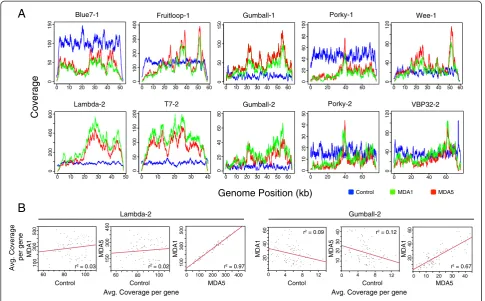
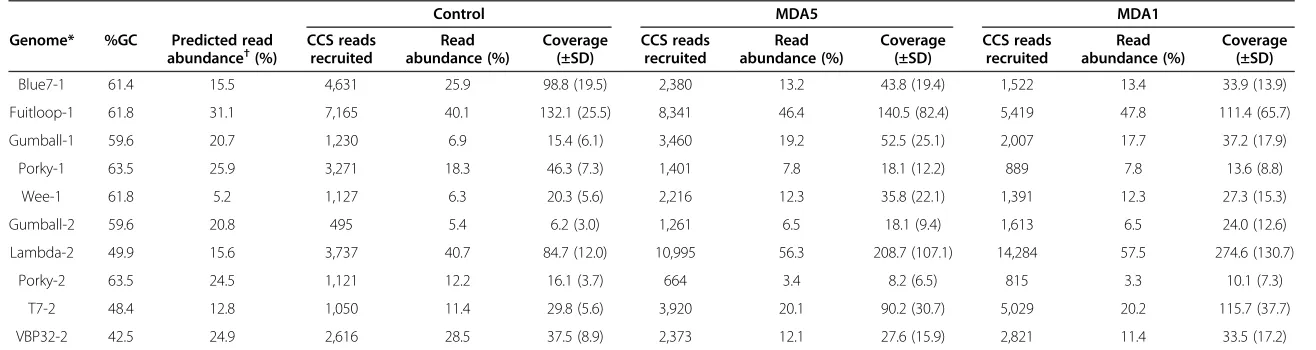
Coverage patterns across each genome in both the pooled and single MDA treatments displayed a striking similarity to one another, and differed from the control treatments that tended to have relatively even coverage across the genomes (Figure 1A). In most cases, the coverage plots for the MDA1 and MDA5 treatments were highly similar. In agreement with this observation, genomes from the MDA treated libraries had a greater standard deviation of coverage as compared with ge-nomes in the control treatment (Table 1). This was par-ticularly evident for phage Fruitloop. While average coverage of the Fruitloop genome was similar across treatments, the standard deviation was roughly three times greater in MDA treatments compared to control. Pairwise comparison of average sequence coverage per gene in the treatments indicated a high correlation be-tween MDA treatments (P< 0.0001) but not between the
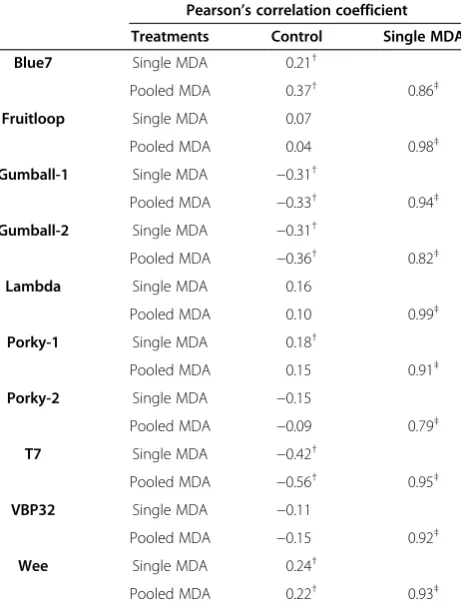
MDA treatments and the control. The r2values of the
linear regressions ranged from 0.67 to 0.97 (correlation coefficient values of 0.79 to 0.99) in comparisons of aver-age sequence coveraver-age per gene in the MDA1 and MDA5 treatments (Figure 1B, Table 2). Similar compari-sons for the control versus MDA1 treatments or control
versus MDA5 treatments yielded r2 ranges of 0.01 to
when compared across treatments (Figure 1A, Table 2) and across communities (Table 3). This suggests that the composition of the mock community did not influence resulting genome coverage patterns, and that MDA biases were likely sequence-dependent.
Coverage bias in the MDA treatments occurred to-wards the middle of the genome for several phages (Blue7, Porky, Wee, lambda, Fruitloop, T7, and Gumball) relative to the ends of the genome (Figure 1A). The bias towards the middle is understandable as MDA priming events producing fragments of sufficient length for sequencing would likely have proceeded towards the middle of the linear genome thus leading to an over-representation of DNA (and subsequently sequence reads) in the middle of the phage genome. A few ge-nomes also showed coverage peaks within 10 kb of one or both ends (lambda, Blue7, VBP32, Wee, Gumball, and Fruitloop). These peaks are difficult to explain, but may have resulted from a bias in the priming efficiency of subsets of the random hexamers used in priming the MDA reaction [24,25]. Five to 1,140 bp were missing
from genome termini in both MDA treatments, with the notable exception of Gumball and VBP32 which have ter-minally redundant genomes. This phenomena of missing bases at the ends of linear genomes has been reported be-fore in the sequencing of chromosomal ends [22,26,27] and is likely the result of DNA fragments becoming pro-gressively shorter as priming events near the terminal end of a genome. Subsequently these short fragments are lost during library construction or filtered out in bioinformatic processing and longer fragments containing the ends are rare within the sequence library.
Discussion
An important aim of metagenomics is to assess the fre-quency of taxa and gene functions within natural micro-bial communities through DNA sequence data. The rigor of these assessments rests on how well the frequency of a sequence within a metagenome library reflects the fre-quency of its originating microbial population within the community. These data indicate that the frequency of se-quence reads from a viral community gDNA sample
150
100
50
0
0 10 20 30 40 50
0 10 20 30 40 50 0 10 20 30 40
0 10 20 30 40 50 60 0 10 20 30 40 50 60
0 10 20 30 40 50 60
0 10 20 30 40 50 60 0 20 40 60
0 20 40 60 0 20 40 60
150
100
100
50
0
400
300
200
100
0
200
150
100
50
0
80
60
40
20
0
80
60
40
20
0
600
400
200
0
500
300
100
450
300
150
500
300
100
20
40
60
10
20
30
40
20
40
60
50
40
30
20
10
0
120
80
40
0
120
80
40
0
Blue7-1 Fruitloop-1 Gumball-1
Gumball-2
Lambda-2 Porky-2
Porky-1
T7-2 VBP32-2
Wee-1
Genome Position (kb)
Avg. Coverage
per gene
Avg. Coverage per gene Avg. Coverage per gene
Coverage
MDA5
MDA1 MDA1
r2 = 0.03 r2 = 0.02 r2 = 0.97
r2 = 0.09 r2 = 0.12
r2 = 0.67 60 80 100
Control Control MDA5
MDA5
MDA1 MDA1
Contol Control MDA5
MDA1
Control MDA5
60 80 100 0 100 200 300 400 0 4 8 12 0 4 8 12 0 10 20 30 40
Lambda-2 Gumball-2
B
A
Figure 1Sequence coverage of mock viral community genomes from control and multiple displacement amplification treatments. (A)Depth of coverage across the length of the genome for community members from control and multiple displacement amplification (MDA) treatments. The blue plot represents genome coverage for the control community, the green plot represents genome coverage for the single MDA treatment (MDA1), and the red plot represents genome coverage for the pooled MDA treatment (MDA5).−1 and−2 indicates mock community 1 and mock community 2, respectively.(B)Linear regression of pairwise comparison of gene coverage between control, MDA1 and MDA5 treatments for Lambda-2 and Gumball-2. Each point represents a single gene.
Marineet al. Microbiome2014,2:3 Page 4 of 8
Table 1 Pacific Biosciences circular consensus recruiting to each genome and genome coverage
Control MDA5 MDA1
Genome* %GC Predicted read abundance†(%)
CCS reads recruited
Read abundance (%)
Coverage (±SD)
CCS reads recruited
Read abundance (%)
Coverage (±SD)
CCS reads recruited
Read abundance (%)
Coverage (±SD)
Blue7-1 61.4 15.5 4,631 25.9 98.8 (19.5) 2,380 13.2 43.8 (19.4) 1,522 13.4 33.9 (13.9)
Fuitloop-1 61.8 31.1 7,165 40.1 132.1 (25.5) 8,341 46.4 140.5 (82.4) 5,419 47.8 111.4 (65.7)
Gumball-1 59.6 20.7 1,230 6.9 15.4 (6.1) 3,460 19.2 52.5 (25.1) 2,007 17.7 37.2 (17.9)
Porky-1 63.5 25.9 3,271 18.3 46.3 (7.3) 1,401 7.8 18.1 (12.2) 889 7.8 13.6 (8.8)
Wee-1 61.8 5.2 1,127 6.3 20.3 (5.6) 2,216 12.3 35.8 (22.1) 1,391 12.3 27.3 (15.3)
Gumball-2 59.6 20.8 495 5.4 6.2 (3.0) 1,261 6.5 18.1 (9.4) 1,613 6.5 24.0 (12.6)
Lambda-2 49.9 15.6 3,737 40.7 84.7 (12.0) 10,995 56.3 208.7 (107.1) 14,284 57.5 274.6 (130.7)
Porky-2 63.5 24.5 1,121 12.2 16.1 (3.7) 664 3.4 8.2 (6.5) 815 3.3 10.1 (7.3)
T7-2 48.4 12.8 1,050 11.4 29.8 (5.6) 3,920 20.1 90.2 (30.7) 5,029 20.2 115.7 (37.7)
VBP32-2 42.5 24.9 2,616 28.5 37.5 (8.9) 2,373 12.1 27.6 (15.9) 2,821 11.4 33.5 (17.2)
*-1, -2 indicates data from community one and community two, respectively.†Predicted read abundances were recalculated to take into account the low recruitment of phage Athena, T4 and VBpm10. CCS, circular consensus sequencing; MDA, multiple displacement amplification.
e
2014,
2
:3
Page
5
o
f
8
mejournal.com
/content/2
amplified using MDA does not accurately reflect the true frequency of taxa or gene functions among viral popula-tions within the original sample. MDA clearly caused cer-tain regions of the phage genomes to be over-represented in the resulting sequence library. Counter to current thinking, pooling of several MDA reactions did not
alleviate this bias as coverage patterns within genomes were recurrent across experiments and reactions. The most parsimonious explanation for this phenomenon is that the random hexamers used for priming the MDA re-action did not in fact prime randomly across all genomes. The consequence of unequal priming efficiency of MDA was that subsets of genes from a given viral genome were artificially over- or under-represented within the resulting metagenome sequence library.
Many viral genomes, especially phage genomes, have a modular genetic organization with genes clustered ac-cording to their functional roles such as head assembly, tail assembly and genome replication [28]. Because the middle portions of linear phage genomes tended to be over-represented, genes within these regions would also be over-represented within the library relative to their true abundance within the genomes. Many phages have similar functions located at similar locations in their
ge-nomes, such as theλsupergroup within the siphoviridae
family [29]. At the community scale, inaccuracies in the frequency of gene functional groups caused by MDA could be linked with the typical position of a given func-tional gene group within a phage genome. It should also be noted that non-uniform coverage could hamper assembly-based community analyses that strive to as-semble genome-length fragments from a complex mix-ture of multiple genotypes [30,31].
Considerable effort has been focused on evaluating and optimizing methods for metagenomic library con-struction. LASL is a commonly utilized alternative to MDA for preparing metagenomic libraries [1,4,32,33]. While starting DNA quantities as low as 1 pg have been successfully prepared for Illumina sequencing using the LASL, such low starting amounts of DNA require more PCR cycles to generate sufficient DNA for sequencing. As a consequence, sequences at the extremes of %GC content can be under-represented. At greater initial DNA quantities (10 to 100 ng), fewer PCR cycles are needed leading to a smaller degree of %GC bias [1]. Ini-tial analyses of a relatively new technique, known as LADS, indicate that LADS libraries produced more uni-form coverage than PCR-based library preparations across low and high %GC genome regions [3]. However, the LADS procedure has been found to generate a greater number of duplicate and chimeric reads as com-pared to standard Illumina library protocols [34]. More research is needed to evaluate the performance of LADS for metagenomic investigations. Transposase-based Nex-tera™kits have been increasingly utilized in the
construc-tion of metagenomic fragment libraries for Illumina
sequencing. While better suited to high-throughput sample preparation, Nextera also suffers from %GC biases linked to the PCR step and a slight bias in se-quence targeting by the transposase during DNA
Table 3 Correlation coefficient of pairwise comparison of gene coverage across communities for mycobacteriophage Gumball and Porky
Pearson’s correlation coefficient
Gumball-2
Treatments Single MDA Pooled MDA
Gumball-1 Single MDA 0.92‡ 0.88‡
Pooled MDA 0.90‡ 0.89‡
Porky-2
Treatments Single MDA Pooled MDA
Porky-1 Single MDA 0.86‡ 0.85‡
Pooled MDA 0.84‡ 0.88‡
Comparisons were of average coverage for each predicted gene in a genome.
‡P< 0.0001. MDA, multiple displacement amplification.
Table 2 Correlation coefficient of pairwise comparison of gene coverage in control and multiple displacement amplification treatments
Pearson’s correlation coefficient
Treatments Control Single MDA
Blue7 Single MDA 0.21†
Pooled MDA 0.37† 0.86‡
Fruitloop Single MDA 0.07
Pooled MDA 0.04 0.98‡
Gumball-1 Single MDA −0.31†
Pooled MDA −0.33† 0.94‡
Gumball-2 Single MDA −0.31†
Pooled MDA −0.36† 0.82‡
Lambda Single MDA 0.16
Pooled MDA 0.10 0.99‡
Porky-1 Single MDA 0.18†
Pooled MDA 0.15 0.91‡
Porky-2 Single MDA −0.15
Pooled MDA −0.09 0.79‡
T7 Single MDA −0.42†
Pooled MDA −0.56† 0.95‡
VBP32 Single MDA −0.11
Pooled MDA −0.15 0.92‡
Wee Single MDA 0.24†
Pooled MDA 0.22† 0.93‡
Comparisons were of average coverage for each predicted gene in a genome.
†P< 0.05.
‡P< 0.0001. MDA, multiple displacement amplification.
Marineet al. Microbiome2014,2:3 Page 6 of 8
fragmentation [2,4,35]. Despite the documented biases of the LASL and Nextera protocols, the degree of bias in these techniques is substantially lower than that of MDA protocols [9,33,36].
In theory, any amount of amplification has the potential to skew the ambient distribution of mixed community DNA. Therefore, an optimal library preparation would re-quire no amplification steps. PCR-free protocols are avail-able, but the large amount of input DNA needed for such procedures can be prohibitive for ecological studies [37]. The advent of new sequencing technologies coupled with new protocols to prepare DNA for sequencing are paving the way for future methodologies that may exclude any type of amplification. Library preparation methods that re-quire as little as 1 ng DNA have been demonstrated for PacBio SMRT sequencing [38]. With continuing develop-ment, such methodologies hold promise for removing amplification bias from metagenomic investigations.
Conclusions
Our findings contribute to the growing evidence that MDA should not be utilized in metagenomic studies seeking quantitative information on the population structure of a microbial community. MDA has been an invaluable tool in several important areas of research, in-cluding single cell genomics and forensics [7,32,33,39]. The efficient amplification of circular ssDNA templates during MDA has been exploited to explore the diversity of ssDNA viruses [40-43]. Within microbiome research, MDA protocols are an easy means of obtaining sufficient DNA for next generation sequencing; however, subse-quent observations of microbial taxa and gene functions within metagenome libraries are not quantitative. The practice of pooling replicate MDA reactions from a single sample does not alleviate biases in the representation of sequences within a library. Researchers should carefully evaluate their requirements for quantitative data on the frequency of microbial taxa and gene functions before utilizing MDA in a microbiome investigation.
Additional file
Additional file 1:Table S1.Bacteriophage genomes within two mock viral communities.Table S2.Results of Pacific Biosciences circular consensus sequencing read recruitment to reference genomes.Figure S1. Coverage patterns of Fruitloop and Wee for control and multiple displacement amplification treatments using A) 95% similarity and 60% length fraction and B) 95% similarity and 90% length fraction for reference mapping parameters.
Abbreviations
bp:base pair; CCS: circular consensus sequencing; gDNA: genomic DNA; LADS: linear amplification for deep sequencing; LASL: linker amplified shotgun library; MDA: multiple displacement amplification; PacBio: Pacific Biosciences; PCR: polymerase chain reaction; SMRT: Single Molecule Real-Time; ssDNA: single stranded DNA.
Competing interests
The authors declare that they have no competing interests.
Authors’contributions
RM carried out the design and constructed the mock viral communities, analyzed sequencing data, performed statistical analyses and drafted the manuscript. CM and VV participated in construction of the mock viral communities and sequencing analysis. DN and EC participated in the bioinformatic analyses. SWP and KEW were involved in the design of the experiment and the drafting of the manuscript. All authors read and approved the final manuscript.
Acknowledgements
This work was supported through grants to KEW and SWP from the National Science Foundation (MCB-0731916 and OCE-1148118) and the Gordon and Betty Moore Foundation. RM was supported through a graduate fellowship from the University of Delaware Institute for Soil and Environmental Quality. CM and VV were supported through undergraduate research funding from the Delaware NSF EPSCoR program. Computational infrastructure support provided by the University of Delaware Center for Bioinformatics and Computational Biology (CBCB) Core Facility was made possible through funding from the NIH NIGMS (8P20GM103446-12), and NSF EPSCoR (EPS-081425). The authors are grateful to Bruce Kingham and Olga Shevchenko of the University of Delaware Sequencing and Genotyping Facility for sequencing support. We thank Helen Donis-Keller, Daniel Russell, Erica Sims, Graham Hatfull, and Bo Zhang for providing mycobacteriophage DNAs; and William Wilson and Ilana Gilg for providing vibriophage DNA.
Author details 1
Delaware Biotechnology Institute, University of Delaware, 15 Innovation Way, Newark, DE 19716, USA.2Washington College, 300 Washington Avenue, Chestertown, MD 21620, USA.3Delaware Technical Community College, 400 Stanton-Christiana Road, Newark, DE 19713, USA.
Received: 29 August 2013 Accepted: 17 December 2013 Published: 30 January 2014
References
1. Duhaime MB, Deng L, Poulos BT, Sullivan MB:Towards quantitative metagenomics of wild viruses and other ultra-low concentration DNA samples: a rigorous assessment and optimization of the linker amplification method.Environ Microbiol2012,14:2526–2537.
2. Marine R, Polson SW, Ravel J, Hatfull G, Russell D, Sullivan M, Syed F, Dumas M, Wommack KE:Evaluation of a transposase protocol for rapid generation of shotgun high-throughput sequencing libraries from nanogram quantities of DNA.Appl Environ Microbiol2011,77:8071–8079. 3. Hoeijmakers WAM, Bártfai R, Françoijs K, Stunnenberg HG:Linear
amplification for deep sequencing.Nat Protoc2011,6:1026–1036. 4. Solonenko SA, Ignacio-Espinoza JC, Alberti A, Cruaud C, Hallam S, Konstantinidis
K, Tyson G, Wincker P, Sullivan MB:Sequencing platform and library preparation choices impact viral metagenomes.BMC Genomics2013,14:320. 5. Thurber RV, Haynes M, Breitbart M, Wegley L, Rohwer F:Laboratory
procedures to generate viral metagenomes.Nat Protoc2009,4:470–483. 6. Lasken RS, Egholm M:Whole genome amplification: abundant supplies of
DNA from precious samples or clinical specimens.Trends Biotechnol2003, 21:531–535.
7. Binga EK, Lasken RS, Neufeld JD:Something from (almost) nothing: the impact of multiple displacement amplification on microbial ecology. ISME J2008,2:233–241.
8. Polson SW, Wilhelm SW, Wommack KE:Unraveling the viral tapestry (from inside the capsid out).ISME J2011,5:165–168.
9. Yilmaz S, Allgaier M, Hugenholtz P:Multiple displacement amplification compromises quantitative analysis of metagenomes.Nat Methods2010, 7:943–944.
10. Dichosa AEK, Fitzsimons MS, Lo C, Weston LL, Preteska LG, Snook JP, Zhang X, Gu W, McMurry K, Green LD, Chain PS, Detter JC, Han CS:Artificial polyploidy improves bacterial single cell genome recovery.PLoS One
2012,7:e37387.
12. Abulencia CB, Wyborski DL, Garcia JA, Podar M, Chen W, Chang SH, Chang HW, Watson D, Brodie EL, Hazen TC, Keller M:Environmental whole-genome amplification to access microbial populations in contaminated sediments.Appl Environ Microbiol2006,72:3291–3301.
13. Dinsdale EA, Edwards RA, Hall D, Angly F, Breitbart M, Brulc JM, Furlan M, Desnues C, Haynes M, Li L, McDaniel L, Moran MA, Nelson KE, Nilsson C, Olson R, Paul J, Brito BR, Ruan Y, Swan BK, Stevens R, Valentine DL, Thurber RV, Wegley L, White BA, Rohwer F:Functional metagenomic profiling of nine biomes.Nature2008,452:629–632.
14. Dinsdale EA, Pantos O, Smriga S, Edwards RA:Microbial ecology of four coral atolls in the Northern Line Islands.PLoS One2008,3:e1584. 15. Cassman N, Prieto-Davó A, Walsh K, Silva GGZ, Angly F, Akhter S, Barott K,
Busch J, McDole T, Haggerty JM, Willner D, Alarcón G, Ulloa O, DeLong EF, Dutilh BE, Rohwer F, Dinsdale EA:Oxygen minimum zones harbour novel viral communities with low diversity.Environ Microbiol2012,14:3043–3065. 16. Hewson I, Barbosa JG, Brown JM, Donelan RP, Eaglesham JB, Eggleston EM,
Labarre BA:Temporal dynamics and decay of putatively allochthonous and autochthonous viral genotypes in contrasting freshwater lakes. Appl Environ Microbiol2012,78:6583–6591.
17. Willner D, Furlan M, Haynes M, Schmieder R, Angly FE, Silva J, Tammadoni S, Nosrat B, Conrad D, Rohwer F:Metagenomic analysis of respiratory tract DNA viral communities in cystic fibrosis and non-cystic fibrosis individuals. PLoS One2009,4:e7370.
18. Li H, Handsaker B, Wysoker A, Fennell T, Ruan J, Homer N, Marth G, Abecasis G, Durbin R, 1000 Genome Project Data Processing Subgroup:The sequence alignment/Map format and SAMtools.Bioinformatics2009, 25:2078–2079.
19. R Project for Statistical Computing.[http://www.r-project.org/] 20. Pacific biosciences technical notes, microbial assembly experimental
design.[www.pacificbiosciences.com/pdf/TechnicalNote_Experimental_ Design_for_Microbial_Assembly.pdf]
21. Bergen AW:Effects of electron-beam irradiation on whole genome amplification.Cancer Epidem Biomar2005,14:1016–1019.
22. Lage JM, Leamon JH, Pejovic T, Hamann S, Lacey M, Dillon D, Segraves R, Vossbrinck B, González A, Pinkel D, Albertson DG, Costa J, Lizardi PM:Whole genome analysis of genetic alterations in small DNA samples using hyperbranched strand displacement amplification and array-CGH. Genome Res2003,13:294–307.
23. Mead S, Poulter M, Beck J, Uphill J, Jones C, Ang CE, Mein CA, Collinge J: Successful amplification of degraded DNA for use with high-throughput SNP genotyping platforms.Hum Mutat2008,29:1452–1458.
24. Marcy Y, Ishoey T, Lasken RS, Stockwell TB, Walenz BP, Halpern AL, Beeson KY, Goldberg SMD, Quake SR:Nanoliter reactors improve multiple displacement amplification of genomes from single cells.PLoS Genet
2007,3:1702–1708.
25. Hansen KD, Brenner SE, Dudoit S:Biases in Illumina transcriptome sequencing caused by random hexamer priming.Nucleic Acids Res2010, 38:e131.
26. Panelli S, Damiani G, Espen L, Sgaramella V:Ligation overcomes terminal underrepresentation in multiple displacement amplification of linear DNA.Biotechniques2005,39:174–180.
27. Tzvetkov MV, Becker C, Kulle B, Nürnberg P, Brockmöller J, Wojnowski L: Genome-wide single-nucleotide polymorphism arrays demonstrate high fidelity of multiple displacement-based whole-genome amplification. Electrophoresis2005,26:710–715.
28. Krupovic M, Prangishvili D, Hendrix RW, Bamford DH:Genomics of bacterial and archaeal viruses: dynamics within the prokaryotic virosphere. Microbiol Mol Biol Rev2011,75:610–635.
29. Brüssow H, Desiere F:Comparative phage genomics and the evolution of Siphoviridae: insights from dairy phages.Mol Microbiol2001,39:213–222. 30. Kunin V, Copeland A, Lapidus A, Mavromatis M, Hugenholtz P:A
bioinformatician's guide to metagenomics.Microbiol Mol Biol Rev2008, 72:557.
31. Mavromatis K, Ivanova N, Barry K, Shapiro H, Goltsman E, McHardy AC, Rigoutsos I, Salamov A, Korzeniewski F, Land M, Lapidus A, Grigoriev I, Richardson P, Hugenholtz P, Kyrpides NC:Use of simulated data sets to evaluate the fidelity of metagenomic processing methods.Nat Methods
2007,4:495–500.
32. Henn MR, Sullivan MB, Stange-Thomann N, Osburne MS, Berlin AM, Kelly L, Yandava C, Kodira C, Zeng Q, Weiand M, Sparrow T, Saif S, Giannoukos G, Young SK, Nusbaum C, Birren BW, Chisholm SW:Analysis of high-throughput
sequencing and annotation strategies for phage genomes.PLoS One2010, 5:e9083.
33. Kim KH, Bae JW:Amplification methods bias metagenomic libraries of uncultured single-stranded and double-stranded DNA viruses. Appl Environ Microbiol2011,77:7663–7668.
34. Oyola SO, Otto TD, Gu Y, Maslen G, Manske M, Campino S, Turner DJ, Macinnis B, Kwiatkowski DP, Swerdlow HP, Quail MA:Optimizing Illumina next-generation sequencing library preparation for extremely AT-biased genomes.BMC Genomics2012,13:1.
35. Adey A, Morrison HG, Asan, Xun X, Kitzman JO, Turner EH, Stackhouse B, MacKenzie AP, Caruccio NC, Zhang X, Shendure J:Rapid, low-input, low-bias construction of shotgun fragment libraries by high-density in vitro transposition.Genome Biol2010,11:R119.
36. Pinard R, de Winter A, Sarkis GJ, Gerstein MB, Tartaro KR, Plant RN, Egholm M, Rothberg JM, Leamon JH:Assessment of whole genome amplification-induced bias through high-throughput, massively parallel whole genome sequencing.BMC Genomics2006,7:216.
37. Kozarewa I, Ning Z, Quail MA, Sanders MJ, Berriman M, Turner DJ: Amplification-free Illumina sequencing-library preparation facilitates improved mapping and assembly of (G + C)-biased genomes. Nat Methods2009,6:291–295.
38. Coupland P, Chandra T, Quail M, Reik W, Swerdlow H:Direct sequencing of small genomes on the pacific biosciences RS without library preparation. Biotechniques2012,53:365–372.
39. Raghunathan A, Ferguson HR, Bornarth CJ, Song W, Driscoll M, Lasken RS: Genomic DNA amplification from a single bacterium.Appl Environ Microbiol2005,71:3342–3346.
40. Desnues C, Rodriguez-Brito B, Rayhawk S, Kelley S, Tran T, Haynes M, Liu H, Furlan M, Wegley L, Chau B, Ruan Y, Hall D, Angly FE, Edwards RA, Li L, Thurber RV, Reid RP, Siefert J, Souza V, Valentine DL, Swan BK, Breitbart M, Rohwer F:Biodiversity and biogeography of phages in modern stromatolites and thrombolites.Nature2008,452:340–343.
41. Kim KH, Chang HW, Nam YD, Roh SW, Kim MS, Sung Y, Jeon CO, Oh HM, Bae JW:Amplification of uncultured single-stranded DNA viruses from rice paddy soil.Appl Environ Microbiol2008,74:5975–5985.
42. Kim M, Park E, Roh SW, Bae J:Diversity and abundance of single-stranded DNA viruses in human feces.Appl Environ Microbiol2011,77:8062–8070. 43. Rosario K, Nilsson C, Lim YW, Ruan Y, Breitbart M:Metagenomic analysis of
viruses in reclaimed water.Environ Microbiol2009,11:2806–2820.
doi:10.1186/2049-2618-2-3
Cite this article as:Marineet al.:Caught in the middle with multiple displacement amplification: the myth of pooling for avoiding multiple
displacement amplification bias in a metagenome.Microbiome20142:3.
Submit your next manuscript to BioMed Central and take full advantage of:
• Convenient online submission
• Thorough peer review
• No space constraints or color figure charges
• Immediate publication on acceptance
• Inclusion in PubMed, CAS, Scopus and Google Scholar
• Research which is freely available for redistribution
Submit your manuscript at www.biomedcentral.com/submit
Marineet al. Microbiome2014,2:3 Page 8 of 8