Teaching the new English curriculum in a Chinese school :
An ethnographic study.
FANG, Xi I.
Available from Sheffield Hallam University Research Archive (SHURA) at:
http://shura.shu.ac.uk/19638/
This document is the author deposited version. You are advised to consult the
publisher's version if you wish to cite from it.
Published version
FANG, Xi I. (2009). Teaching the new English curriculum in a Chinese school : An
ethnographic study. Doctoral, Sheffield Hallam University (United Kingdom)..
Copyright and re-use policy
See
http://shura.shu.ac.uk/information.html
Sheffield Hallam University Research Archive
Learning and information Service* Adsetts Centre, City Canpue
Sheffield S1 1WD
101 963 649 1
REFERENCE
ProQuest Number: 10694519
All rights reserved
INFORMATION TO ALL USERS
The qu ality of this repro d u ctio n is d e p e n d e n t upon the q u ality of the copy subm itted.
In the unlikely e v e n t that the a u th o r did not send a c o m p le te m anuscript and there are missing pages, these will be note d . Also, if m aterial had to be rem oved,
a n o te will in d ica te the deletion.
uest
ProQuest 10694519
Published by ProQuest LLC(2017). C op yrig ht of the Dissertation is held by the Author.
All rights reserved.
This work is protected against unauthorized copying under Title 17, United States C o d e M icroform Edition © ProQuest LLC.
ProQuest LLC.
789 East Eisenhower Parkway P.O. Box 1346
Teaching the New English Curriculum in a Chinese School: An
Ethnographic Study
Xi Fang
A thesis submitted in partial fulfilment of the requirements of Sheffield Hallam University
for the degree of Doctor of Philosophy
Abstract
In 2004, the Ministry of Education (MOE) of China disseminated a new English curriculum (NEC) for high schools. The NEC promotes communicative language teaching (CLT), particularly task based language teaching (TBLT). This thesis reports an ethnographic study exploring the experience of five Chinese teachers of English in their implementation of the NEC. The researcher worked as a temporary English teacher in a high school in Southeast China between September 2007 and July 2008 gathering data through participant observation. Research data include interviews, classroom observations, documentations and fieldnotes. Grounded theory was used for data analysis.
The study highlights the complexity of teachers’ work. Four main ‘push’ factors are identified as pushing the teachers to implement the NEC and five factors are considered to be the main obstacles for NEC implementation. Some forces act both as constraint and possibility for all teachers, and some forces may act as constraint for one teacher, but may serve as possibility for another teacher. Many issues discussed by earlier studies of TBLT implementation in China and other Asian countries are also referenced in this study, although some issues are experienced in different ways by the research participants. The role of teacher agency is confirmed by the findings and the influence of social and institutional context is recognised. The importance of teacher cognition in their implementation of the NEC is also supported by findings. A construct of teacher beliefs is proposed and an interwoven relationship between teacher cognition, social context and practices is identified.
Table of Contents
List o f T a b le s...vi
List o f F ig u re s...viii
A cknow ledgem ents...ix
S ta te m e n t... x
A bbreviations and C o n ve n tio ns...xi
CHAPTER 1: IN T R O D U C T IO N ... 1
1. 1 General outline of the re s e a rc h ...1
1. 2 D evelopm ent of the research interest... 2
1. 3 Research basis for this th e sis... 3
1. 4 S ta k e h o ld e rs ...4
1. 5 O rganisation of the th e s is ... 5
1. 6 G lo s s a ry ... 6
CHAPTER 2: LITERATURE R E V IE W ...11
2. 1 TBLT and current debates in E L T ... 12
2.1.1 T B L T...12
2.1.2 The im plem entation o f TBLT...14
2.1.3 Is TBLT a 'good' m e th o d ?...16
2.1.4 Is there any ‘best m e th o d '?...17
2.2 Studies which have stimulated my research... 19
2.2.1 Social context and language te a c h in g...19
2.2.2 Teacher cognition and language te a c h in g...23
2.3 Seeking a fram ework for the investigation of curriculum im plem entation 27 2.3.1 Possible m odels for the investigation o f curriculum im plem entation .27 2.3.2 M odels which have influenced m y investigation o f curriculum im p le m e n ta tio n...29
2.4 Implementing the NEC or teaching the N E C ? ... 32
2.5 C onclusion...33
CHAPTER 3: M E TH O D O LO G Y ... 35
3.1 Theoretical considerations... 36
3.2 The pilot s tu d y ...40
3.2.1 The setting, research participants and research pro cess...40
3.2.3 Reflection on the pilo t s tu d y...43
3.3 E th n o g rap h y...44
3.3.1 E th n o g ra p h y...44
3.3.2 Rationale for using ethn o gra p h y...45
3.4 Negotiating a c c e s s ... 48
3.4.1 Negotiating access to the fie ld...48
3.4.2 N egotiating access with the research p a rtic ip a n ts...50
3.5 My Presentation in the F ie ld ... 53
3.5.1 The creation o f m y ro le...54
3.5.2 Overt o r covert re s e a rc h ?...55
3.5.3 The presentation o f s e lf...57
3.6. Data collection: process, techniques and ra tio n a le ... 59
3.7 Data organisation and a n a ly s is ...69
3.7.1 G rounded th e o ry...69
3.7.2 The conceptual fram ework o f Pierre B ourdieu...73
3.8 E thics...76
3.9 R e fle c tio n ...78
3.9.1 M aking the fam iliar stra n g e...78
3.9.2 Dilem m as in the field...79
3.10 C onclusion... 80
CHAPTER 4: THE C ONTEXTUAL BACKGROUND FOR THE NEW ENGLISH CURRICULUM (N E C )... 81
4.1 Salient features of the Chinese education system ... 82
4.1.1 The significance o f e d u c a tio n...82
4.1.2 The hierarchical education s y s te m...84
4.1.3 H ighly com petitive education environm ent...87
4.1.4 N U EE and high school education in C h in a...89
4.2 Initiatives of the N E C ... 91
4.2.1 P olitical a g e n d a...91
4.2.2 Critique o f C hina’s education system and reform as a re s p o n s e 94 4.3 The NEC fram ework of concepts... 96
4.3.1 N ew objective: all-round ability to use E n g lis h...96
4.3.2 Inductive approach: try, explore, discover and p ra c tis e...100
4.4 Responses to the N E C ... 105
4.4.1 Response o f the JZ provincial D O E...106
4.4.2 Public re s p o n s e s...107
4.5 C onclusion... 108
CHAPTER 5: THE SCHO OL C O N T E X T ... 110
5.1 General introduction of the sch o o l...111
5.2 Teachers’ and students' tim e ta b le s ... 114
5.3 My role as a te a c h e r... 116
5.4 Hierarchy of teachers and defining capital in C H S ...117
5.4.1 Institutional p o s itio n...119
5.4.2 Teachers' teaching s k ill...119
5.4.3 'Face' [M T F j and social connections [Z ^ M ]...120
5.4.4 'Seniority' in terms o f age and years o f w orking...121
5.5 Positioning the five research p a rticip a n ts... 122
5.5.1 Participant one: A n y a...122
5.5.2 Participant two: B a iju a n...123
5.5.3 Participant three: C aili...124
5.5.4 Participant four: D e n g h u a...124
5.5.5 Participant five: E n c h u...125
5.6 Multiple duties of the English te a c h e rs ...126
5.7 W orkflow of the Grade 2 English T e a m ...127
5.8 Teaching materials used by teachers of the Grade Two English Team 130 5.9 C onclusion...134
CHAPTER 6: TEACHERS TALKING ABO U T THE NEC AND THEIR P R A C T IC E S ... 136
6.1 T eachers’ positions regarding the NEC: knowledge, orientation and e n g a g e m e n t... 138
6.1.1 Anya: “find resonance in the N E C ”....139
6.1.2 Baijuan: “you c a n ’t do this every d a y ”...140
6.1.3 Caili: “you have to use it in ‘top cla sse s’”...142
6.1.4 Denghua: “NEC principles are only fo r ‘top classes’”...144
6.1.5 Enchu: “Students w on ’t listen if it’s not relevant to N U E E ”...146
6.1.6 C onclusion... 149
6.2.1 U ncertainty...150
6.2.2 In s e c u rity...154
6.3 T eachers’ perceived goal c o n flic ts ... 157
6.3.1 Pulling forces against NEC im plem entation...159
6.3.2 Pushing forces o f teaching the N E C...166
6.3.3 C onclu sio n...170
6.4 T eachers’ orientation towards goal co n flicts ... 171
6.4.1 A nya: attach equal im portance to both form -focused instruction and C L T...171
6.4.2 Baijuan: Focus on form, use C LT at tim es to please s tu d e n ts 171 6.4.3 Caili: Link form and m eaning in one activity...172
6.4.4 D enghua: focus on fo rm...175
6.4.5 Enchu: focus on fo rm...175
6.5 Two levels of th in k in g ? ... 176
6.6 Chinese teachers, W estern approaches... 183
6.6.1 Is the teacher’s role to transm it knowledge or to facilitate learning? ...183
6.6.2 What is the language to be ta u g h t?...185
6.6.3 Do learner activities prom ote learning?...188
6.6.4 Do C LT activities pose disciplinary c h a lle n g e s?...189
6.7 Teacher developm ent...189
6.7.1 Case 1: B aijuan’s changing perceptions and pra ctices...190
6.7.2 Case 2: D enghua’s changing perceptions and p ra c tic e s...196
6.7.3 Main factors in teacher cognition developm ent...201
6.8 C onclusion... 204
CHAPTER 7: OBSERVING TEACHERS IN P R A C T IC E ...205
7.1 Use of NEC p rin c ip le s ... 206
7.2 High em phasis on fo r m ... 210
7.3 Difference between teaching for external observers and teaching for s tu d e n ts...213
7.4 Different levels of student participation...215
7.4.1 M anaging large c la s s e s...216
7.4.2 Teaching differently in different c la sse s...218
7.6 Economic use of class hours...221
7.7 Teachers working long hours... .224
7 .7.1 Marking every assignment... 225
7.7.2 Reciting from memory... 227
7.8 Conclusion... 229
CHAPTER 8: DISCUSSION AND C O N C L U S IO N ... 231
8.1 Teachers’ experiences of teaching the N E C ... 232
8.2 Teacher cognition and teachers’ practices... 236
8.3 Social context and teachers’ practices... 241
8.4 Conclusion... 244
CHAPTER 9: REFLECTION AND IM P L IC A T IO N S ... 245
9.1 The research jo u rn ey... 245
9.2 Reflection on the methodology... 247
9.3 Significance of the study...249
9.3.1 Findings...249
9.3.2 Theoretical contributions...250
9.3.3 Methodological contributions... 250
9.4 Practical implications...250
9.4.1 Implications for curriculum developers...250
9.4.2 Implications for teacher educators:... 252
9.4.3 Directions for future research...253
9.5 Final remarks... ... ... 253
R E F E R E N C E S ... 255
-List of Tables
Table 1.1: Scope of chapter 1 ...1
Table 2.1: Scope of chapter 2 ... 11
Table 2.2: Com ponents of school context (Boyd, 1 9 9 2 )...20
Table 3.1: Scope of chapter 3 ... 35
Table 3.2: The three research participants for the pilot s tu d y ...40
Table 3.3: Schedule of the pilot study fie ld w o rk ...41
Table 3.4: Different layers of gate k e e p e rs ... 49
Table 3.5: Background of the five research p a rticip a n ts... 52
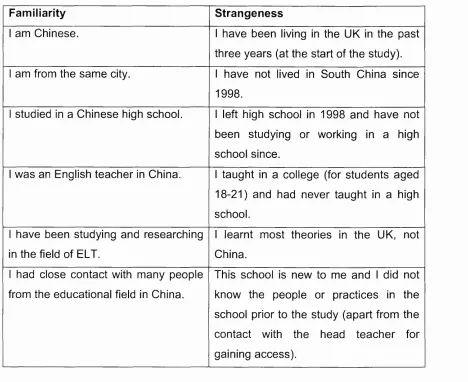
Table 3.6: My different levels of fam iliarity and strangeness in the setting 55 Table 3.7: Rationale for unstructured o b s e rv a tio n s ... 61
Table 3.8: Rationale for sem i-structured interviews and focused interviews 62 Table 3.9: Sources and Examples of D ocum entation...65
Table 3.10: Sum m ary of D a ta ... 67
Table 3.11: Ethical considerations in the re s e a rc h ... 76
Table 4.1 Scope of chapter 4 ... 81
Table 4.2: Chinese legal resident status system ... 83
Table 4.3: Major docum ents in relation to basic education re fo rm ...95
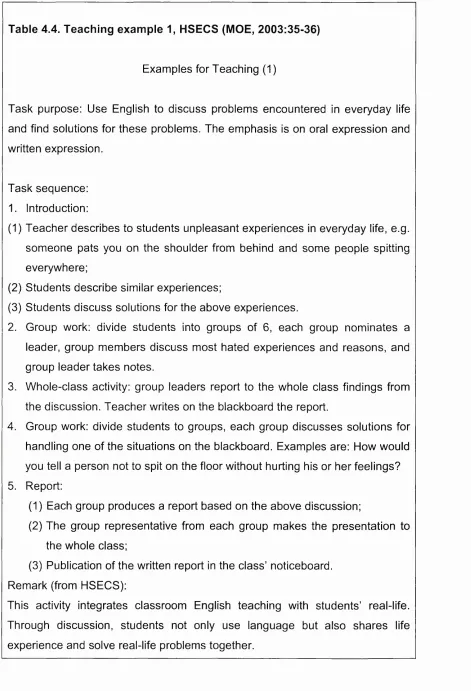
Table 4.4. Teaching example 1, HSECS (MOE, 2 0 03:35-36)...101
Table 4.5: Teaching example 4, HSECS (MOE, 2 0 0 3 :3 9 )...102
Table 4.6: Action plan of the HSECS (MOE, 2 0 0 3 ) ... 104
Table 5.1: Scope of chapter 5 ... 110
Table 5.2: classification and num ber of classes in C H S ... 111
Table 5.3: School tim e ta b le ...115
Table 5.4: Schedule for the English te a c h e rs ...116
Table 5.6: my teaching schedule after March 2 0 0 8 ... 117
Table 5.7: Caili’s teaching history... 124
Table 5.8: Denghua’s teaching history... 125
Table 5.9: research participants’ non-academic roles...126
Table 5.10: Modules of Study and plans for study... 131
Table 5.11: Elements of the Textbook... 132
Table 6.1: Scope of chapter 6 ... 137
Table 6.2: Caili’s belief in the incorporation of examination preparation with teaching the N E C ... 173
Table 6.3: Teachers talking about what is 'good'...177
Table 6.4: Teachers talking about ‘what works’ ... 178
Table 6.5: The influence of teachers... 201
Table 7.1: Scope of chapter 7 ...205
Table 7.2: Observational transcript: The World’s Most Useful Gift Catalogue (15/05/2008 at 8:25-9:10am )... 206
Table 7.3: Anya’s teaching arrangement between 10/03/2008 and 2 1 /0 3 /2 0 0 8 ... 210
Table 7.4 Observational Transcript of Denghua's C lass...212
Table 7.5: Anya and Caili’s handling of texts... 220
Table 7.6: Denghua and Enchu’s handling of texts... 220
Table 7.7 Observation Transcript of Caili’s C la s s ... 221
Table 7.8: Timetable for Grade Two English Teachers... 224
Table 8.1: Scope of chapter 8 ...231
List of Figures
Figure 2.1.: Host culture complex (Holliday, 1994, p.29) 22
Figure 2.2: teacher cognition, schooling, professional education, and 26
classroom practice (Borg, 2006, p. 41)
Figure 3.1: Continuum of Participant Observation 60
Figure 4.1: Stages of Schooling in China 85
Figure 4.2: Management structure in China’s education system 87
Figure 4.3: Ranking table of schools in LQ according to local’s view 88
Figure 4.4: NUEE Framework 90
Figure 4.5: Framework of all-round ability to use English 99
Figure 5.1: Organisational structure in CHS 118
Figure 5.2: working flow chart of the grade 2 English team 129
Figure 6.1: Interpretations and Reinterpretation of the NEC 153
Figure 6.2: Continuum of goals suggested in teachers’ comments 157
Figure 6.3: Teachers’ perceived goal conflicts 158
Figure 6.4: The relationship between teacher cognition, habitus and the
field 182
Figure 6.5. Baijuan’s changing perceptions and practices 195
Figure 6:6: Denghua’s changing perceptions and practices 200
Figure 7.1: Layout of a typical classroom in CHS 216
Figure 8.1: the interaction between teacher cognition, habitus and the field 239
Acknowledgements
I would first and foremost take this opportunity to express my sincerest gratitude to
my supervisors for their professional supervision and for the tremendous support
they have given me. Without their support I would not be able to complete this
research and make so much progress in my study. During these three years’
journey, they have become my friends and family.
I also want to thank the five research participants, other teachers and students in the
school, where this ethnographic study took place, for helping me to complete my
research.
Statement
This PhD thesis is all original work. The objectives and purposes of the research are
outlined in chapter 1 - 3 . The assistance received from supervisors and other
colleagues has been according to accepted standards of academic research and
ethics. References are outlined in the bibliography and the nature of the input from
these academic writings is outlined throughout the thesis.
Published work using material from this thesis research is contained in the following
book:
Fang, X. (forthcoming). Teaching the New English Curriculum in a Chinese High School: An Ethnography Study, in T. Muller and S. Herden (eds.) Innovating ELT in
Abbreviations and Conventions
1. Abbreviations
TBLT: Task-based Language Teaching CLT: Communicative Language Teaching L2: Second Language
ELT: English Language Teaching
HSECS: High School English Curriculum Standard NEC: New English Curriculum
MOE: Ministry of Education of China DOE: Department of Education.
NUEE: National University Entrance Examination EFL: English as a Foreign Language
PPP: Presentation, practice, production
2. Conventions
2.1. Conventions for referring to places involved in the study
People/places involved in the study: Referred to as:
The school for this ethnographic study CHS (Chuangxin High School)
The city where the school for this ethnographic study locates
LQ (Linqiao City)
The province where the school for this ethnographic study locates
JZ province
2.2. Conventions for transcribing classroom observations
T=Teacher R=Researcher
Ss: Group of students choral S1, S2 e tc.id e n tifie d student
[In italics]=texts translated from Chinese
CHAPTER 1: INTRODUCTION
This chapter gives a general outline of this thesis, including a summary of the
research, the rationale for this research, the research basis, intended stakeholders
for this research, the organisation of the thesis, and a glossary to assist reading.
The presentation structure of this chapter is outlined in Table 1.1:
Table 1.1: Scope of chapter 1
1.1 General outline of the research
1.2 Development of the research interest
1.3 Research basis for this thesis
1.4 Stakeholders
1.5 Organisation of the thesis
1.6 Glossary
1. 1 General outline of the research
This thesis reports an ethnographic study exploring the experience of five English
teachers in a Chinese high school (pre-university stage) in their implementation of a
national new English curriculum (NEC). The purpose is to reveal the ways in which
the NEC is experienced by teachers in their contexts, for example, the possibilities
and constraints of implementing the NEC, and the role of agency in teachers’
practices. This study draws on what Holliday (1994: 14) calls a
sociology-anthropology methodology for investigation in an effort to "connect an
understanding of the wider social picture with a deep exploration of what happens
between people". In addition to the recognition of teacher cognition in their
curriculum implementation, this study also explores the institutional and social
context in which the teachers’ work takes place and investigates possible
connections with teachers’ curriculum implementation. Grounded theory is used in
analysing the rich data collected from 10-month ethnographic fieldwork. The
purpose is to generate theories grounded in the data produced by listening to the
voices of teachers and observing their everyday practices. The analysis also draws
understanding and explaining teacher cognition and practices in the teachers’
implementation of the NEC.
1. 2 Development of the research interest
A personal interest in the Chinese educational reform of English teaching led me to
engage in this research. In 2004, the Ministry of Education (MOE) of China
disseminated the new English curriculum (NEC), as a part of the 8th educational
reform in China. At the core of the NEC is the promotion of communicative language
teaching (CLT), and particularly a method linked with the CLT approach called task
based language teaching (TBLT). The NEC is believed to be very different from the
previous teaching styles in China and from the Chinese culture of learning (Cortazzi
and Jin, 1999; Hu, 2002; Rao, 1996). It is also promoted by the official discourse as
a “radical” change, and the NEC principles were advertised as being “advanced”
and “modern” in comparison with the previous curriculum.
I was both excited and concerned about the change: in the literature (Cortazzi and
Jin, 1996:65), stories are told about the “four-centredness” of English language
teaching (ELT) in China with a focus on the teacher, the textbook, grammar and
vocabulary. This teaching is claimed to limit students’ learning. In terms of my own
experience, I remembered how frustrated I was in my first spoken English class at
university when the American teacher tried to get students to talk: I had almost
never talked in English prior to that class. I was excited to see this government
initiative in curriculum innovation and I was eager to see how the NEC might bring
changes to the classroom, to teachers and to students. On the other hand, I was
also concerned about teachers. Given the large classes, examination-oriented
education system and the existing teaching and learning styles, would there be
difficulties and challenges for teachers’ implementation of the NEC? How would
they perceive the change? How would they experience it? Because of my interest
and curiosity, I decided to choose to investigate NEC implementation in China at
PhD level after I graduated from my MA Education programme. The reason why I
chose to study teachers was simple: for my MA thesis, I investigated teachers’
support of children’s language development and I was interested in doing research
with teachers. Also, I have taught English in a college in China, and I was interested
to see how other teachers teach English, and how their strategies might be similar to
or different from mine.
With this in mind, the investigation began by examining areas in relation to ELT and
curriculum implementation. I was drawn to the ‘post-method’ discussion and I
became particularly interested in two areas of research: teacher cognition (e.g. Borg,
2006; Elbaz, 1983; Woods, 1996) and social context (e.g. Bax, 2003; Bruce and
Rubin, 1992; Holliday, 1994). I was also influenced by Ball’s (1994) conceptual
model for the analysis of policy implementation, for example, the dichotomy of
agency/structure, policy as text/policy as discourse and macro/micro context. Thus,
the research sets out to investigate teachers’ situated experiences of teaching the
NEC while addressing the wider institutional and social context. Three research
questions are addressed:
■ What are teachers’ experiences of teaching the NEC?
■ What is the role of teacher cognition in teachers’ practices?
■ What is the role of social context in teachers’ practices?
It is suggested in the literature that the research on situated policy implementation
and practitioner agency is scarce (Clarke et al., 2007; Ramanthan and Morgan,
2007; Canagarajah, 2005) and the understanding of teacher cognition lacks data
about state education, prescribed curriculum and non-native teachers (Borg, 2006;
Woods, 1996). My interest corresponded to a perceived need in the field for in-depth
situated studies of this type.
1. 3 Research basis for this thesis
The aim of the research is to explore and uncover the meanings behind teachers’
decisions in their implementation of the NEC and understand how they make sense
of the world in their practical situations. The enquiry is constructive and
interpretative, using different theories and data collection techniques in order to
construct an understanding of teachers that is most truthful to their work.
The research draws on an ethnographic study carried out between September 2007
and July 2008. During this period of time, I worked as a temporary English teacher
in a high school in Southeast China gathering data through participant observation.
My multiple identities, for example, as a Chinese national having been educated in
China to first degree level and having taught in China, and as a postgraduate
student at a UK university have developed my intercultural competence which has
research. The prolonged engagement in the setting and the participant observer
role enabled me to develop a good rapport with teachers, offered in-depth
understanding and an insider perspective of teachers' experiences of teaching the
NEC: I was able to observe teachers performing in a wide range of settings (e.g.
teaching in classrooms, teaching for demonstration, preparing lessons and
discussing with each other in the office). The main research participants are five
English teachers of the grade 2 age group, who differ from each other with regard to
their gender, teaching experience and types of class taught. Additionally, I also
interviewed 15 other English teachers in the school and observed 38 demonstration
lessons of teachers inside and outside the school. In total, data include 69
semi-structured and focused interviews, 107 classroom observations,
documentation and about 250,000 words’ fieldnotes.
1. 4 Stakeholders
This research is potentially interesting to a wide range of stakeholders. Examples
are:
■ Curriculum developers: through participant observation and detailed description,
this thesis provides an in-depth understanding of the NEC experience from
teachers’ perspectives. It investigates how teachers make their decisions about
the use of the NEC and examines the possibilities and constraints associated
with teaching the NEC. The thesis also suggests some practical
recommendations for curriculum developers.
■ Teacher educators: this thesis also discusses the developmental history of
teachers and areas in relation to the evolvement of teacher cognition and
practices, and suggests an alternative framework for teacher education
programmes.
■ Ethnographers in training: this thesis gives a detailed account of my experience
of doing ethnographic fieldwork, highlights the complexity of the research
process, and discusses my strategies and dilemmas in the field. Training
ethnographers may find it interesting to read my experience to enhance their
awareness about fieldwork.
■ Researchers who are interested in teacher cognition, culture of teaching and
policy implementation, particularly those who have an interest in the Chinese
context.
1. 5 Organisation of the thesis
This thesis consists of 9 chapters. After a general outline of the thesis in chapter 1,
chapter 2 reviews the literature in relation to the enquiry, for example, TBLT,
curriculum implementation and current debates and perspectives in ELT. It also
discusses my perspectives with regard to ELT, my interest in teacher cognition and
social context. Chapter 2 also explains the framework for this investigation, and the
rationale for my framework.
Chapter 3 introduces the methodological issues I considered and the procedures
that I followed in this study. It discusses my theoretical stance and its implications
for this enquiry and illustrates the process of my research: negotiation of access, my
consideration of self presentation and the detailed procedures that I followed for
data collection and analysis. This chapter also includes my reflection on the
research design and research process.
Bearing in mind the influence of context in teachers’ practices, chapters 4 and 5
discuss the institutional and social context in which teachers’ work is embedded.
Chapter 4 examines the NEC and the wider social context in which the curriculum is
initiated, developed and implemented. Some salient features of the Chinese
education system and their implications for teachers’ implementation of the NEC are
discussed. In chapter 5, the emphasis is on the institutional context of teachers’
work. Apart from a detailed introduction of the school for this ethnographic study, the
capital that may be at stake in the field is also discussed, along with the five
research participants’ positions in relation to their possession of capital.
Chapter 6 and chapter 7 focus on the five research participants. Chapter 6 explores
the experience of the NEC implementation from teachers’ perspectives. It discusses
teachers’ orientation towards the NEC, their engagement with the NEC, their
emotions associated with teaching the NEC, the goal conflicts they voiced in relation
to teaching the NEC and the positions they take in response to the goal conflicts. It
also explores teachers’ cultural orientations and their development of teacher
cognition and practices. In an attempt to demonstrate the complex nature of
teachers’ work, the writing is deliberately descriptive and relies on the teachers’
voices to illuminate their thinking and situation. Chapter 7 focuses on the
practices. It analyses the patterns and differences in teachers’ practices. The
observational data is also compared with the interview data discussed in the
previous chapter.
Chapter 8 concludes the discussion of chapters 4-7 by answering the three research
questions addressed in chapter 1: it summarises teachers’ experiences of teaching
the NEC and discusses the role of teacher cognition and social context in teachers’
practices. In Chapter 9, a reflection on the research is made. It also discusses how
this research may have contributed to knowledge and suggests some practical
recommendations for researchers, curriculum developers and teacher educators.
1. 6 Glossary
Since this study is carried out in China, some terms may be China-specific and
some terms used in China may be used differently in other countries. Therefore, this
section gives a list of terms that may be needed in reading.
Academic Affairs Division t]: The Academic Affairs division is the authority
for academic management in the school. Its responsibilities include developing
academic policies and coordinating lesson planning and evaluation.
Arts class [3tf4$E]: In Chinese high schools, classes are divided into arts classes
and science classes. In addition to the common areas (Chinese language,
mathematics and foreign language), students in arts classes also study history,
geography and politics.
City[flJ]: In the context of Chinese government, a city is the second level of
administrative division in China, the first being province. There are 11 cities in JZ
province and the population for LQ city, where the school for this ethnographic study
locates, is about 6 million.
Class teach er[itt±{T ]: In Chinese schools and universities, it is common to have a
class teacher, who takes the main responsibility for monitoring and supporting
students' social development and disciplinary management in class and out of class.
For example, class teachers write developmental records for their students and
County [Hr]: In the context of Chinese government, a county is the third level of
administrative division in China, the first being province and the second being city.
There are 9 counties in LQ City.
Department of Discipline An administrative department in the school
responsible for students’ disciplinary management, for example, to ensure students
comply with school regulations.
Demonstration le s s o n s [^ T f^ ]: Demonstration lessons are lessons in which
teachers demonstrate their teaching to other teachers. There are two types:
experienced teachers demonstrating teaching to less experienced teachers from the
same school or other schools; peers in the teachers’ team within a school for mutual
exchange and development.
English corner This is a weekly occasion in CHS organized by the
American teachers for students to talk with each other in English.
Experienced teachers [S iS H £ l!ftJ^F ]: I have used the term experienced teachers
to describe teachers who have taught for longer times. It does not denote the
meaning of expertise.
Expert teachers It is the highest professional title for secondary school
teachers. Teachers in Chinese high schools are graded into four professional levels
(expert, senior, level 1 and level 2) according to their teaching experience, their
publications, their (students’) achievements and, for expert and senior teachers, an
anonymous vote in the school and in the city. It does not denote my evaluation of
one teacher being more "expert" than the other.
G ra d e [^ |$ ]: Grade refers to age group. There are three grades in high schools in
China.
High s c h o o l[i^ 4 3]: High school is a pre-university stage in China, providing
Key school[ I I S c h o o l s in China are graded into at least two levels: key
schools and non-key schools. The criteria for grading include teaching facilities,
previous students' academic performances, and staff members' qualifications and
achievements. Key school is higher on the hierarchy than non-key school. For
admission into key schools, students need to have higher scores in the entrance
examination. In LQ, the city where the school for this ethnographic study is located,
the 82 high schools are graded into four levels: grade 1 key schools, grade 2 key
schools, grade 3 key schools and non-key schools. CHS, the school for this
ethnographic study, is a grade 1 key school.
NUEE[ilj%]: The National University Entrance Examination, which selects high
school students for university entrance.
Non-key school Schools in China are graded into at least two levels:
key schools and non-key schools (see glossary ‘key schools’ for criteria for
classification). Non-key school is lower in the hierarchy than key school. Students
with lower scores in the entrance examination will be accepted to study in non-key
schools.
Normal University It refers to university for training teachers, chiefly for
training secondary school teachers.
‘Ordinary class’ In many Chinese high schools, students are allocated to
‘top classes’ and ‘ordinary classes’ on the basis of their scores in the high school
entrance examination. ‘Ordinary classes’ are for students without the highest
performance in the examination.
P ro vin ce^ ']: In the context of Chinese government, a province is the first level of
administrative division in China. There are 22 provinces in China. The population for
JZ province, the province where the school for this ethnographic study locates, is
about 50 million.
Quality education [jRffiifcW]: It is promoted in the policy Decisions on Deepening
Education Reform and Fully Promoting Quality Education [ 4 ^ 4 ^ 0 ^ ^ {T
The term is used in China to denote all-round development of students (e.g.
physical development, creativity, imagination, thinking and independent study skills)
rather than the evaluation of quality provision of education institutions.
Round[jS]: In Chinese high schools, teachers of a subject usually teach the same
group of students for three years, from students' admission in grade one to their
graduation in grade three. This is called a 'round'.
Science class [JlS-SE]: In Chinese high schools, classes are divided into arts
classes and science classes. In addition to the common areas (Chinese language,
mathematics and foreign language), students in science classes also study
chemistry, physics and biology.
Senior t e a c h e r [ j | jIt is the second highest professional title for secondary
school teachers. Teachers in Chinese high schools are graded into four professional
levels (expert, senior, level 1 and level 2) according to their teaching experience,
their publications, their (students’) achievements and, for expert and senior teachers,
an anonymous vote in the school and in the city.
Teaching competition K ]: This is an event, normally organised by
the local education authority, for teachers to demonstrate their teaching skills in a
competition in front of an audience of other teachers and judges. On these
occasions, teachers give a lesson to a group of students (often randomly assigned
by the local education authority) and judges (normally prestigious teachers and
managers of the local education authority) give scores according to teachers’
performance in the lesson.
Teaching plan competition This is an event organised by LQ
Education Bureau for teachers to demonstrate the ‘quality’ of their lesson plans. On
these occasions, teachers from each school work in a team to produce Powerpoint
presentations illustrating their plans for teaching and judges (normally prestigious
teachers and managers of the local education authority) give scores according to
their presentations. The powerpoint presentations are also made public via the
T o p class’ In many Chinese high schools, students are allocated to ‘top
classes’ and ‘ordinary classes’ on the basis of their scores in the high school
entrance examination. Top classes’ are for students with the highest performance
CHAPTER 2: LITERATURE REVIEW
As introduced in chapter 1, a nationwide new English curriculum (NEC) for high
schools was disseminated in China in 2004. At the core of the NEC is the promotion
of communicative language teaching (CLT), particularly a method linked with the
CLT approach called task based language teaching (TBLT). In this chapter, my
purpose is to present to readers some key concepts in relation to the investigation
(e.g. TBLT and curriculum), explore the current debates and perspectives in ELT
and discuss my perspectives with regard to ELT. My purpose is also to explain the
framework for this investigation, along with the rationale for my framework. The
presentation structure of this chapter is outlined in Table 2.1:
Table 2.1: Scope of chapter 2
2.1. TBLT and current debates in ELT
2.1.1 TBLT
2.1.2 The implementation of TBLT
2.1.3 Is TBLT a 'good' method?
2.1.4 Is there any 'best' method?
2.2 Studies which have stimulated my research
2.2.1 Social context and language teaching
2.2.2 Teacher cognition and language teaching
2.3 Seeking a framework for the investigation of curriculum implementation
2.3.1 Possible models for the investigation of curriculum implementation
2.3.2 Models which have influenced my investigation of curriculum
implementation
2.4 Implementing the NEC or teaching the NEC?
2. 1 TBLT and current debates in ELT
2.1.1 TBLT
This section investigates the concept of TBLT in order to enable readers to better
understand the analysis in later chapters in which teachers' use of TBLT is
investigated.
Richards and Rogers (2001:223) define TBLT as “an approach based on the use of
tasks as the core unit of planning and instruction in language teaching”. In the
literature, there is some debate on the classification of TBLT, for example, whether it
is an approach or a method (Nunan, 2004) and whether it is linked to any particular
method at all (Kumaravivelu, 1993). However, most writers tend to perceive TBLT
as a method linked to the CLT approach, with the labels 'modification' (Klapper,
2003), 'latest realization' (Nunan, 2004) or 'offshoot' (Kumaravadivelu, 2006).
TBLT is a relatively new term in ELT literature, first appearing in 1979 in Southern
Indian’s Bangalore Project (Prabhu, 1987). This experimental language programme
emerged because the approach used in India at the time, the
structural-oral-situational approach, was not particularly well received by
practitioners. First of all, Structural-Oral-Situational approach was considered less
effective in bringing about grammatically correct spoken English as it promised.
Secondly, some activities encouraged by the structural-oral-situational approach
were less successful in encouraging learner involvement, for example, some
learners were reluctant to participate in affective activities encouraged by the
structural-oral-situational approach (Howatt and Widdowson, 2004). The Bangalore
project team believed that intellectually biased activities were more applicable in the
Indian ELT context and meaning focused tasks would be more effective in
promoting successful language acquisition. The assumption was that
comprehension sharpened by the possibility of having to respond later is more
effective in engaging learners than comprehension for its own sake. Therefore,
task-based activities engendered by the need to respond and communicate were
seen as more successful in promoting language acquisition by activating learners’
cognitive processes (Prabhu, 1987). A series of graded reasoning tasks (e.g.
puzzles detection and mental arithmetic) were therefore designed and implemented
in the Bangalore project. This approach was later known as task based learning
task based learning and pedagogy (Foster, 1999), task based approach (Littlewood,
2004) and task based language teaching (Nunan, 2004). To ensure consistency,
task based language teaching (TBLT) is used throughout this thesis.
Along with the various labels attached to it, TBLT is also defined and emphasized
differently by different writers (Ellis, 2003; Littlewood, 2004; Nunan, 2004; Prabhu,
1987; Skehan, 1998; Willis, 1996). However, most writers seem to agree that the
key feature of TBLT is its focus on the communication of meaning through related
activities or procedures. There is also a general consensus with regard to the
following characteristics:
■ The target language should be used by the learners for a communicative
purpose in order to achieve an outcome. Therefore, the emphasis is on
meaning rather than on form and task completion is prioritized (e.g. Bygate et
al., 2001; Ellis, 2003; Lee, 2001; Nunan, 1989; Skehan, 1998; Willis, 1996).
However, learners are able to notice linguistic features through
meaning-focused activities (e.g. Nunan, 2004; Willis, 1996).
■ The instruction should be learner-centred rather than teacher controlled (e.g.
Bygate et al., 2001; Nunan, 2004; Skehan, 1998). However, appropriate teacher
intervention is necessary in smoothing the activity and facilitating the acquisition
of formal linguistic elements (e.g. Willis, 1996).
■ The task objective should be attainable and clearly specified (e.g. Nunan, 2004).
The instructional sequence should be carefully graded to maximize
comprehension and learning (e.g. Nunan, 2004; Prabhu, 1987; Willis, 1996), for
example, pre-task language study may contribute to the ‘noticing’ of formal
features during communication in the task cycle (e.g. Willis, 1996).
■ The task activities should be designed in a way that resembles real world
activities and promotes natural language use (e.g. Ellis, 2003; Skehan, 1998).
■ A range of task work should be arranged in order to provide maximum exposure
to comprehensible input and improve various skills (e.g. Ellis, 2003; Long, 1983;
Nunan, 1991).
As summarized in the reviews of Ellis (2000) and Skehan (2003), recent research
on TBLT has been motivated by two main second language (L2) acquisition theories:
the psycholinguistic approach and the sociocultural approach. Researchers with the
psycholinguistic perspective have explored how task characteristics and conditions
affect learners' allocation of attentional resources during task performance
development by bringing together input features, learner-internal capacities, and
language production (Long, 1996; Gass, 2003). Whereas researchers in the
psycholinguistic tradition have emphasised the role of the inherent task properties
on performance and acquisition, socio-cultural researchers have focused on how
tasks are accomplished by learners and teachers and how the process of
accomplishing them might contribute to language acquisition. They tend to believe
that learning arises in, rather than through, interaction. The interest in a task is to
allow participants to shape it to their own ends and to build meanings collaboratively
that are unpredictable and personal (Lantolf, 2000), for example, improvement may
be achieved through the scaffolding between learners.
Now thirty years since TBLT was initialized, tasks have become a familiar resource
in language classrooms. The concept, though originating in India, has been
developed and promoted by quite a number of Western writers. In fact, Ellis
(2003:331) claims that ELT is an "Anglo-American creation". A review of literature
suggests that TBLT has increasingly appeared in ELT publications. Let us take the
British based ELT journal as an example, there were only 2 articles titled 'task' in the
1980s, the number rose to 8 in the 1990s, and becomes 19 in the 2000s.
Advocators of TBLT include such authority figures as Ellis (2000, 2003); Littlewood
(2004, 2007); Long (1985, 2005) and Nunan (1989, 2004). Proponents of TBLT
often promote it as a most effective teaching approach, superior to ‘traditional’
methods, and soundly based in theory and research. Willis (1996) advocates TBLT
as a perfect middle path of focus on form and focus on meaning. Ellis (2003:28)
argues that "tasks are both necessary and sufficient for learning". Nunan (2004) and
Long (2005) claim that TBLT is a learner-centred approach and is therefore able to
address the growing need for relevance and accountability in L2 teaching,
particularly for learners with specific academic, occupational or vocational purposes.
Howatt and Widdowson (2004:366) conclude that TBLT “has become a new
orthodoxy” . For Nunan (2004:13) also, TBLT is “the new orthodoxy” with major
publications and government policies.
2.1.2 The implementation of TBLT
Currently, the impact of TBLT largely resides in the field of ELT (Klapper, 2003).
Although it is considered mainly an Anglo-American creation (Ellis, 2003), TBLT
seems most influential in the Asia-Pacific region. In his survey of the educational
policies and practices in the Asia-Pacific region, Nunan (2003) finds that TBLT is
claimed to be one of the central principles of ELT curricula in all the countries he
studies: Japan, Vietnam, China, Hong Kong, Korea and Malaysia. However, despite
the enthusiasm for introducing TBLT in ELT, resistance to and challenges for
implementing a TBLT framework are reported in most of the countries Nunan (2003)
has studied (e.g. Butler & Lino 2005;Carless 2004; Lee, 2005; Littlewood, 2007).
The first stated problem resides in the design of TBLT. Some authors argue that
certain procedures and outcomes of TBLT seem too idealized to be achieved.
According to Willis (1996) and Nunan (2004), the idealized outcome of TBLT is the
'noticing' of linguistic elements during task completion and between learners.
However, it is argued that learners may become too pre-occupied with completing
tasks to notice linguistic elements (Carless, 2004) and learners with a higher level of
linguistic and cognitive proficiency may dominate the interaction (Lee, 2005) and
even question the value of peer interaction (McDonough, 2004). Another
procedure promoted by Willis (1996) is that teachers may 'notice' the linguistic
elements arising out of the task cycle and explain these elements during the
post-task cycle. However, Li (2003) argues that with the demand of class
management, it seems too difficult for teachers to attend to all the interaction in
different groups.
The second stated problem is the contextual constraints within the educational
system. First of all, most of the South East Asian countries have large class sizes
and implementing a TBLT method makes disciplinary management a challenge.
Students may engage in off-task activities (Li, 2003). They may communicate in
their first languages rather than the target language (Carless, 2004). They may also
become noisy while carrying out tasks and this may annoy administrators and
teachers from other classes (Li, 1998). Secondly, researchers from nearly all the
countries Nunan (2003) studies report that an examination-oriented evaluation
system is a major obstacle to the implementation of TBLT (Chow & Mok-Cheung
2004; Li, 1998; Shim & Baik, 2004). Thirdly, the limitation of resources may also
affect TBLT implementation (Hu, 2005). Additionally, most of the teachers do not
have experience of living and studying in an English-speaking country, and they
report a lack of confidence in using English to carry out communicative activities
The third stated problem is the influence of the social and cultural environment. Hu
(2002) claims that TBLT may not fit in with China’s 'culture of learning'. He argues
that education is conceived in China more as a process of knowledge accumulation
than as a process of using knowledge for immediate purposes. Therefore, teachers
and students may doubt the value of doing task-based activities in which teachers
do not 'transmit' knowledge. Similar findings of cultural mismatches are also
reported in Hong Kong (Chow and Mok-Cheung, 2004), Japan (Samimy and
Kobayashi, 2004) and South Korea (Shim and Baik, 2004).
2.1.3 Is TBLT a ’good’ method?
As seen from the above discussion, context is the main obstacle for TBLT to be well
received in Asia-Pacific regions. The stated problems include large classes,
examination-oriented education systems and different learning and teaching culture.
Given Ellis’ claim (2003) that TBLT is mainly an Anglo-American creation, these
problems may seem less obvious. Actually, some researchers (e.g. Carless, 2007)
have anticipated resistance to the implementation of a TBLT method in
Confucian-heritage countries where the teaching conditions and educational ethos
in these countries are very different from the west.
In addition to the potential influence of educational and social context, the diverse
perspectives among TBLT writers themselves may have also created tension and
confusion for the successful implementation of TBLT. In fact, the definition of task is
itself a debate. According to Long (1985), task may not involve educational purpose
and language use at all. A piece of work such as painting a fence is also a task. On
the other hand, Nunan (2004) classifies tasks into pedagogic task and target task,
and claims that pedagogic task should involve language use and reflect real world
experience. However, debate still persists as to whether tasks should reflect native
speaker’s experience (authenticity) or foresee the learners’ experience
(genuineness) in the real world context (Guariento and Morley, 2001). Additionally,
there is also debate as to whether form-focused activity constitutes a task. Estaire
and Zanon (1994) consider it an enabling task while Ellis (2000) argues it is just an
exercise. In addition to the diverse perspectives on task definitions, there are still
debates in terms of task procedures. According to Wells (1985), tasks should be the
core of language teaching. However, Bruton (2002) argues that tasks should be
used only as adjuncts to facilitate structure-based teaching. Furthermore, there are
also various opinions with regard to the selection and sequence of tasks (Skehan,
2003). Since TBLT writing is far from showing a consensus, teachers may rely on
their intuitions to make decisions about which tasks to include in a syllabus and the
order in which the tasks should be presented. This may also lead to the perceived
failure of TBLT if different criteria are used forjudging implementation.
The challenge of TBLT implementation leads some writers to argue that TBLT is not
a ‘good’ method. Sheen (1994) argues that the theoretical base of TBLT is not
critically analyzed. In Swan’s opinion (2005:376), TBLT lacks theoretical foundation,
as well as empirical evidence. He even asserts that TBLT innovations are just
“legislation by hypothesis”.
However, reviewing ELT history suggests that the ‘failure’ of TBLT implementation
is not a single scenario. The ELT profession has a long history of seeking the ‘best’
way of teaching. There has been no lack of teaching approaches and methods in
ELT literature, from what we called “panaceas” (e.g. the Direct Method), “new
wonder cures” (e.g. Suggestopedia) to some major and lasting paradigm shifts (e.g.
from audiolingualism to communicative language teaching) (Klapper, 2003:33). All
these approaches and methods have generated a variety of innovations in ELT,
either on a large scale or in a relatively smaller context, usually as a result of the
dissatisfaction with the previous approach (Richards and Rogers, 2001). For
example, the rise of CLT is a response to the perceived failure of the structural
approach and the advent of TBLT is an evolution of CLT. It is in this context that
some researchers start to question whether there is an alternative to method, rather
than an alternative method (Kumaravadivelu, 2006).
2.1.4 Is there any ‘best method'?
Earlier debates in ELT were perhaps based on the conviction that it was possible to
find a ‘best method’. Once it was found, it was thought that it could lead to
widespread acceptance and success in the profession. This stance, which is
ultimately based on a positivist view, may see the ELT professional endeavour as a
form of progress towards finding idealized universal teaching methods (Howatt and
Widdowson, 2004). However, the frequent ‘failures’ of new approaches along with
the influence of the postmodernist climate in mainstream research make some
Kumaravadivelu (2006) sees Pennycook (1989) and Prabhu (1990) as early
advocates of the advent of the ‘post method era’ (Richards and Rogers, 2001) or
‘post method condition’ (Kumaravadivelu, 1994). Pennycook’s (1989) paper leads
ELT professionals to question the neutrality of method because he claims that the
concept of method “reflects a particular view of the world and is articulated in the
interests of unequal power relationships” (p. 589-590) and that it “has diminished
rather than enhanced our understanding of language teaching” (p. 597). Prabhu
(1990) also seeks to put an end to the obsession with the search for the 'best
method'. He argues that no method can be objectified and simplified to be good or
bad. The validity lies in its power to influence teachers’ subjective understanding of
teaching. The debates between different methods are important, only in the sense
that they help teachers better understand the method and modify the method for
their own use. Prabhu (ibid) also argues that the challenge facing the ELT
profession is not how to design a new method but how to devise a new way to help
activate and develop teachers' varied senses of plausibility to “operate with some
personal conceptualization of how their teaching leads to desired learning” (p. 172).
This perception is echoed by Kumaravadivelu (1992) who argues that the duty of
the ELT profession is only to help teachers to develop a capacity to generate varied
and situation-specific ideas within a general framework that makes sense in terms of
current pedagogical and theoretical knowledge. Widdowson (2003) also expresses
the view that ELT professionals and curriculum designers should not prescribe the
way teachers should follow, but suggest directions for teachers to explore. Similar
concerns are also expressed by a number of other prominent ELT figures, for
example, Brown (2002), Howatt and Widdowson (2004) and Richards (1990).
In addition to the postmethod discussion, another change in the ELT profession is
the shift from systemic discovery to critical discourse, which is described by
Kumaravadivelu (2006:70) as “connecting the word with the world”. In this climate,
much thought has been given to the complexity of language teaching and learning.
For example, language learning is believed to be related to wider social, cultural and
political domains. Locality and the lived experiences of teachers and students are
very much highlighted. The critical turn has given rise to a range of discussions and
new horizons of exploration. Examples are language and identity (Parmenter, 1997),
discourse analysis (Fairclough, 1995), classroom interaction (Kumaravadivelu,
1999), pedagogical cultures and local realities (Canagarajah, 2005), and teacher
cognition (Borg, 1998; Woods, 1996). My thinking is very much influenced by the
postmethod discussion and critical discourse investigation. Therefore, in this
investigation of teachers’ curriculum implementation, I do not aim to evaluate
teachers’ practices or to look for a ‘best’ method that would work for all. Rather, I am
more interested in understanding the practices from their perspectives, for example,
the thinking behind their classroom practices, and the contextual influences on their
decision making. The focus has been influenced by two areas of research: social
context and teacher cognition. These two areas are discussed in the following
section.
2.2 Studies which have stimulated my research
Although ethnography is exploratory in nature and ethnographers should guard
against preconceived assumptions which may prejudice the data collection and
analysis, it is the case that foreshadowed problems, informed by previous
experience or literature, may serve as a useful starting point for research and make
the researcher better equipped for the work (Hammersley and Atkinson, 1995). For
example, such considerations allow areas of investigation to be identified more
precisely, efficiently and systematically. This section introduces two areas of studies
that have stimulated my research: social context and teacher cognition.
2.2.1 Social context and language teaching
Learning and teaching do not take place in a vacuum but are the products of the
society and culture in which they belong (Bruce and Rubin, 1992). In response to
the methodological debate, Bax (2003:281) argues that "methodology is not the
magic solution" and "the context is a crucial determiner of the success or failure of
learners". In his paper, he criticizes questioning by a young inexperienced teacher
of a relatively experienced teacher who does not use CLT. In her study of
Vietnamese teachers, Ha (2004) argues that qualities of teaching and learning may
vary from culture to culture. Even if the same view is shared between cultures, the
practice may still be diverse. Similar concerns are also expressed by many other
researchers, for example, Breen (1986), Holliday (1994), Howatt and Widdowson
(2004) and Javis and Atsilarat (2004). The discussion in 2.1.2 also supports such a
In addition to ELT, the importance of context for curriculum implementation is also
supported by mainstream literature in education, for example, Fullan (2007) and
Hargreaves (1994). In his research investigating schools involved in the Improve
Quality of Education for All (IQEA) programme in the UK, Hopkins (2001:67)
concludes that, "Without a clear focus on internal conditions of schools, the
improvement effort will quickly become marginalized".
Social context has attracted much interest in ELT research and in literature, but the
term context is used in rather diverse ways (Holliday, 1994). In this thesis, Boyd's
definition of school context will be used. As defined by Boyd (1992), school context
is comprised of two fundamental components: school ecology and school culture
(see Table 2.2). School ecology factors include: (1) the availability of resources; (2)
physical aspects of the school; (3) student and teacher demographics; and (4) local,
state, and federal policies. School culture includes the system of relationships and
shared norms, attitudes, and beliefs within the school. Such a definition seems to be
accepted by many other researchers, for example, Hall and Hord (2001) and
Holliday (1994).
Table 2.2: Components of school context (Boyd, 1992)
School Context
School Ecology: School culture:
■ Resources ■ Relationship
■ Physical conditions ■ Interactions
■ Demographics ■ Communication characteristics
■ Politics ■ Norms of practices
■ Hierarchical structures ■ Shared values and beliefs
Within context, Holliday (1994) distinguishes between two kinds of context: macro
context and micro context. The macro context includes the wider societal and
institutional influences on what happens in the classroom and the micro context
consists of the socio-psychological aspects of group dynamics within the classroom.
Citing Bowers (1987:8-9, in Holliday, 1994:15), Holliday argues that, "the classroom
is a microcosm which, for all its universal magisterial conventions, reflects in
fundamental social terms the world that lies outside the window". Therefore, much
of the classroom interaction is very likely to be derived from influences from outside
the classroom, for example, relationships of status, resources and market forces.
Classroom interactions can not be fully understood without knowledge of the wider
macro picture. In this investigation, I will adopt what Holliday (1994:14) calls a
sociology-anthropology methodology for investigation in an effort to "connect an
understanding of the wider social picture with a deep exploration of what happens
between people". I will try to explore the macro context in which teachers live and
investigate possible connections with teachers’ curriculum implementation.
An important element of context is culture. As defined earlier, culture is seen as a
system of relationships, shared norms, attitudes and beliefs (Boyd, 1992). Breen
(1986) argues that it is only through looking at the classroom as culture that we can
begin to understand what is going on in the classroom. Culture of teaching has
generated much discussion in ELT literature, a popular area of which is national
culture, for example, Shamim (1996) an