Abstract—Feedstock costs accounts for the larger percentage
of biodiesel production cost. The use of less expensive feedstock and optimization of the process variables that affect the yield presents the opportunity of significantly reduction of this cost. This paper investigates the effect of temperature and catalyst concentration on the transesterification of Mango (Magnifera
indica) seed oil with methanol using potassium hydroxide as
catalyst. The biodiesel produced was characterized to ascertain its suitability for use as fuel. Results obtained showed that increase in temperature result in corresponding increase in the biodiesel yield. A yield of 83% wt was obtained at an optimum temperature of 60 oC. A similar trend was observed on the effect of catalyst concentration, with the optimum being 80 %wt at 1% w/v. Analysis of the biodiesel produced showed consistency with the threshold standard values quoted by ASTM and EN for biodiesel and fossil diesel. This signifies that the biodiesel produced from mango seed is of good quality and can be used to consolidate the fossil based diesel.
Index Terms—Biodiesel, transesterification, Mango seed oil,
Catalyst concentration, Temperature
I. INTRODUCTION
HE dependence on petroleum as the energy source comes at a high cost and the world petroleum production has perhaps reached its peak [1]. Experts suggested that existing oil and gas reserves would only last for a few additional years [2]. Besides emissions from the burning of these fuels such as CO2 CO, NOx and sulfur containing residues are the principal causes of global warming [3]. This has stimulated the widespread search for a cheap and an eco- friendly alternative source
[4]
.Biofuels offer a partial solution to many of these problems [5]. The feed stocks for biofuel production are produced by domestic agriculture, which means that Biofuel
Manuscript received March 14, 2014; revised March 26, 2014. Musa U. Department of Chemical Engineering, Federal University of Technology Minna, Nigeria (Phone: +2348032318723; e-mail: [email protected])
Mohammed, I. A. Department of Chemical Engineering, Federal University of Technology Minna, Nigeria (e-mail: [email protected])
Sadiq M. M. Department of Chemical Engineering, Federal University of Technology Minna, Nigeria (e-mail: [email protected])
Aliyu M. A. Department of Chemical Engineering, Federal University of Technology Minna, Nigeria (e-mail: [email protected]) / Process Systems Engineering Group, School of Engineering, Cranfield University, UK (Phone: +447818993296, e-mail: [email protected])
Suleiman B. Department of Chemical Engineering, Federal University of Technology Minna, Nigeria (e-mail: [email protected])
Talabi S. Department of Chemical Engineering, Federal University of Technology Minna, Nigeria.
production occurs domestically [5]. In order to meet the rising energy demand and diminishing petroleum reserves; fuels such as biodiesel and bioethanol, are in the forefront of alternative technologies under development. Accordingly, the viable alternative for the compression-ignition engines is biodiesel [2].
Biodiesel is a mono alkyl ester of fatty acids derived from vegetable oils and animal fats; it is a clean and renewable fuel [6-7]. It is a liquid which varies in colour between golden and dark brown depending on the production feedstock [8]. Biodiesel is one of the most attractive biofuel because of its biodegradability, higher flash point (150OC), reduced exhaust emissions, miscibility in all ratios with petroleum diesel, compatibility with the existing fuel distribution infrastructure and inherent lubricity [9]. Other attractive features of biodiesel includes; non flammability, non toxic, reduced petroleum imports, low sulphur content, domestic production and oxygenating potentials [10-12]. Biodiesel production enjoys a positive social impact by enhancing rural revitalization [11]. Various vegetable oils (edible or non edible) and animal fats used for biodiesel production are rice bran oil, coconut oil, Jatropha curcas oil, castor oil, cotton seed oil, palm oil, olive oil, palm kernel oil, soybeans oil, sunflower oil, canola oil, tallow, waste grease, peanut oil, corn oil, madhuca indica, pongamia pinnala [6, 13-15] fish oil, safflower oil, and linseed oil [16].
This oil crops put together are not capable of providing enough vegetable oil for the commercial production of biodiesel that is required to put out of place all petroleum diesel as an alternative transport fuels. At present only small quantities of biodiesel are produced for blending with petroleum diesel at a level of a few percentages. There is therefore the need to search for other oil bearing seeds that has been under utilized for commercial production of biodiesel.
More so process design and operation parameters differ significantly depending on the properties of the raw materials used as feedstock oils and the quality of biodiesel desired.
Mango seed contain 9-13 % oil depending upon variety. The oil is high in unsaturated fatty acid such as oleic acid with 46.22 % [17], which compared favorably with 44.7 % oleic acid of Jatropha Curcas oil and higher than 15.4 % of Palm oil, 21.1 % for Sunflower oil and 23.4 % for Soybean
Production and Characterization of Biodiesel
from Nigerian Mango Seed Oil
Musa Umaru, Member, IAENG, Mohammed, Ibrahim A., Member, IAENG, M. M. Sadiq, A. M. Aliyu, B. Suleiman, and Talabi Segun
oil [18]. Mango (Magnifera indica) belongs to the genus
Magnifera of the family Anacardiaceae. The genus contains
several species that bear edible fruits. They are tropical fruit bearing trees which thrive well in Asia and Africa [19-20]. Major producers of mango in Africa are Nigeria and Guinea [21]. The fruit is one of most economically important fruit which has been used as raw material for many canned fruit product, where the flesh is utilized resulting in a vast amount of mango seeds and peels being discarded as waste [22]. Aside from been used in canned fruits factories, there is need for further processing of the mango kernel (seed), following the facts that it seed contains a type of fat called mango seed Almond fat (MAF) that is high in stearic acid content [22]. To the best of the author knowledge there is no documented research on the production of methyl ester from
Nigerian mango seed oil.
This paper provides insight into the extraction of oil from mango seed oil and its subsequent transesterification to biodiesel using potassium hydroxide. It also explores the relationships between the relevant reaction variables (i.e. catalyst amount and reaction temperature) and the product characteristics (i.e. ester content and yield). This is aimed at providing an alternative raw material for biodiesel production in Nigeria
.
II. MATERIALS AND METHODS
A. Oil Extraction
The extraction procedure described by Nzikou et al., (2009) using petroleum ether at 60 0C in 5-1 soxhlet extractor for 8 hours was employed. The oil was then recovered by evaporating off the solvent using rotary evaporator model no. TT107R (Techmel and Techmel, USA) and residual solvent was removed by drying in an oven at 60 0C for 1 hour and flushed with 99.9 % Nitrogen. The extracted oil was then characterized and the result presented in Table I.
B. Transesterification Procedure
The oil extracted was dehydrated by heating the above 100 oC on a hot plate to dry away it water content. The dehydrated oil was esterified to reduce the percentage free fatty acid by agitating with a mixture of 300 ml methanol and 1 %w/v of H2SO4 acid, heated to 60 o C for one hour. The mixture was allowed to settle in a separating funnel, the upper layer containing methanol and water while the lower layer contained the vegetable oil. The oil was separated and methanol was recovered from methanol – water mixture via distillation.
The biodiesel was synthesized in a 450 ml conical flask equipped with a thermometer and mounted on a magnetic stirrer hotplate. The agitation was kept constant. 240 ml of the oil were introduced in to the reactor and measured amount of methanol/KOH stock solution (60ml) was heated separately to the reaction temperature. It was added to the reactor and stirrer was started.
The temperature for the process was varied from 45 to 65 o
C at a molar ratio of oil/alcohol of 6:1, catalyst concentration of 1% w/v KOH for one hour each. The reaction product mixture was allowed to stand for 16 hours to separate into the biodiesel phase (upper phase) and glycerol (lower phase). Acetic acid was added to the collected biodiesel, followed by warm water; washing to remove impurities. The washing was repeated until no trace of soap found and final product dried in an open beaker on a hot plate. The yield of each ester was measured.
The transesterification procedure was repeated for various catalyst concentrations. The catalyst was prepared in concentration range of 0.5 to 1.2 % w/v. To achieve the first concentration level 0.25 g of catalyst was dissolved in 40ml of methanol (BDH England) and the mixture stirred for 20 minutes, to form potassium methoxide. The methoxide was introduced gently into the heated oil and entire content was brought to a temperature of 60 0C and maintained at this temperature for 1 hr reaction time. The procedure described above was repeated for others catalyst concentration level. The yield of biodiesel produced, washed and dried were measured and recorded.
III. RESULT AND DISCUSSION
The oil extracted was characterized, and the result obtained are shown in Table I
TABLEI
PHYSIOCHEMICAL PROPERTIES OF MANGO SEED OIL
Characterization Result
Oil Yield (%) 14
Saponification Value (mgKOH/g) 194.72
Peroxide Value (meq/kg) 0.60
Free Fatty Acid (mgKOH/g) 3.92
Specific Gravity 0.94
Iodine Value (g I/100g oil) 39.9
Acid value 7.84
A. Effect of Temperature
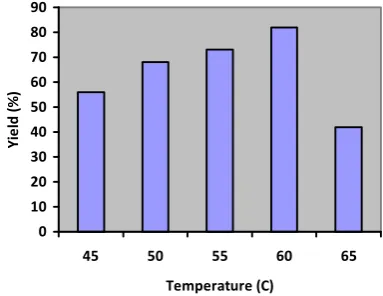
Temperature plays an important role during biodiesel production; this is because the rate of reaction is strongly influenced by the reaction temperature [15, 23]. Figure 1 shows the result of temperature variation from 45 0C to 65 0
another plausible reason for the observed low conversion at 65 0C. Results obtained in this study are also in agreement with the work by [13, 16, 25-26].
0 10 20 30 40 50 60 70 80 90
45 50 55 60 65
Temperature (C)
Yie
ld
[image:3.595.70.262.103.251.2]
(%)
Fig 1. Yield of Biodiesel against Temperature
B. Effect of Catalyst Concentration
From the result obtained as shown in figure 2, the catalyst concentration increase from 0.33 to 1 %w/v, a progressive increase in percentage conversion in the reaction was achieved and thereafter experienced a decrease I yield above this concentration (1 % w/v of KOH). It was obvious that increase in catalyst concentration beyond 1 % w/v of KOH results in a decrease in biodiesel yield. Hence the yield at 1.17 % w/v was lower than the yield obtained at 0.33 % w/v. This can be clearly explained by the reversible nature of transesterification reaction. The findings from this studies is very consistent with opinion of [13], who reported that catalyst concentration greater than 1 % w/v may have favored the backward reaction, thereby shifting the equilibrium from the right to the left, hence the formation of glycerol. In comparing results of this findings with that of previous researchers such as [27] for Jatropha Curcas oil and [8] for Tiger nut oil as biodiesel resource, the result is in accordance with their findings.
0 10 20 30 40 50 60 70 80 90
0.25 0.5 0.75 1 1.25
Catalyst Concentration (%w/v)
Yi
e
ld
(%
)
Fig 2. Yield of Biodiesel against Catalyst Concentration
C. Characteristics of Transesterified Mango Seed Oil
The biodiesel characterization shows similarities to that of fossil diesel. The physical and chemical properties of the
biodiesel were determined. Other tests such as specific gravity, specific gravity, flash point, water content, viscosity, acid number and distillation profile were determined and the result are in accordance with the ASTM and EN standard. The result is as shown in Table II.
TABLEII
COMPARISON OF THE BIODIESEL PRODUCED AND CONVENTIONAL DIESEL
Fuel Property
Standards This Work
[28] [29] Diesel
ASTM
Biodiesel ASTM
Biodiesel EN Kinematic
Viscosity
1.3–4.1 4.0 – 6.0 3.5 – 5.0 5.82 4.42 4.82
Specific Gravity (kg/l)
0.85 0.88 0.881 0.84
Density (lb/gal)
7.1 7.3 860–900 7.02 877
Carbon Residue
0.15 Max
0.05 0.30
Flash Point (oC)
60 – 80 100 – 170 >101 127 171 128
Cloud Point (oC)
-35 – 5 -3 – 15 12 3 8
Pour Point (oC)
-35 – 15
-5 – 10 - 4 6 -2
Cetane Number
40 – 55 48 – 65 51 min 56 58
Acid Number
0.50 Max
0.5 max 0.80 0.28
Water and Sediment
0.05 Max
0.05 0.15 Trac
e
Source: [30]
Kinematic viscosity is a measure of resistance of fluid flow under the influence of gravity [30]. The result from this work shows a kinematic viscosity of 5.82 which is quite in agreement with the ASTM norms and the reported work. The result is however slightly higher than the European Norms (EN Standard) and ASTM standard for the kinematic viscosity of the fossil diesel. Viscosity of a fuel is related to the fuel lubricity. Low viscosity fuels are unlikely to provide satisfactory lubrication in fuel injection pumps; these often lead to seepage and increase in wear [29]. High viscosity in fuel are responsible for atomization of fuel, incomplete combustion and increased exhaust emissions, choking of the injections thereby forming larger droplets on injector, ring carbonization and accumulation of the fuel in the engine [31]. The result from this study shows that biodiesel from mango seed oil can be used for biodiesel production.
Specific gravity of the fuel is very important in diesel engine because fuel injection system operates on a volume metering basis. The values of specific gravity obtained for mango seed oil methyl ester was 0.881 with a corresponding density value of 881kg/m3. This value lies within the notable standards and also in close proximity to the findings of other studies.
[image:3.595.62.253.557.709.2]Gerpen et al., [30], reported that the major cause of surplus carbon residue in biodiesel is excessive total glycerin. The low value obtained in this study indicates that glycerin was minimal and in compliance with the minimum standard stipulated. This is as a result of complete separation and effective removal of glycerol after tranesterification.
Flash point is the minimum temperature at which a fuel must be heated for it to ignite air -vapor mixture. The U.S. Department of Transportation specified 90 0C as the flash point for non hazardous fuel [32]. The flash point for this work is 127 0C. This result shows appreciable consistency with both ASTM, EN standard for biodiesel and works of other researchers. The high value obtained in this study clearly signifies that the biodiesel produced is basically free from methanol; this is because even small quantity of methanol can reduce the flash point reasonably and also negatively affects diesel engine parts such as fuel pumps, seals and elastomers.
Cetane number is a measure of ignition quality of diesel fuel. The higher the cetane number, the easier the fuel will ignite when it is injected into the engine the better the fuel. Beside the reduction of viscosity resulting from transesterification of vegetable oil, one of the most evident changes that result from process is the significant increase in the cetane number of the fuel produced. This work indicates that the cetane number was 56. The value obtained is in agreement with both ASTM and EN standard. This implies the mango biodiesel produced to have high ignition quality.
Water content shows the cleanliness of the fuel produced. The water content of property that of 0.015 % volume was low when compared with the ASTM standard of 0.05 (% vol.). Hence the fuel does not have the tendency to support microbial growth in the storage tank [23]. This low water content is an indication of the efficiency of the drying method employed in this work.
The acid value obtained for this work is relatively high compare to the EN standard and reported work of [28]. Acid value measures directly the free fatty acids content of the methyl ester. It clearly helps to state the corrosive nature of the fuel, its filter clogging tendency and the amount of water that may be likely present in the biodiesel. This parameter can also be used to measure the freshness of the biodiesel. The higher the acid value the lower the quality of the fuel.
The cloud and pour point are criterion used for low temperature performance of a fuel. This work reporte a values 12 0
C and - 4 0C for cloud and pour point respectively which are in agreement with the ASTM standard and the reported literatures. This properties help to show the behavior of the biodiesel under a specified climate setting. This shows the biodiesel produced from mango can be used in cold climate region.
IV. CONCLUSION
Mango seed oil is suitable for the production of methyl (biodiesel) which has similar properties to petro diesel.
Although the oil content of the seed is about 14 % which is low compared to other oil seeds; there is certainly the possibility of breeding special genetically modified varieties to yield more oil. Optimum temperature of 60 0C and catalyst concentration of 1% w/v at reaction time of one hour and molar ratio of alcohol to oil of 6:1 gives the highest yield of 83 wt %. The result of biodiesel characterization shows that the fuel fulfills most of the ASTM and EN Standard so can be used as a possible candidate for replacement for petroleum diesel.
REFERENCES
[1] Campbell, C.J. (1997). The Coming Oil Crisis. Essex, England: Multi-Science Publishing Company and Petroconsultants, S.A.
[2] Demirbas, A. (2006) “Global biofuel strategies”. Energy Edu. Sci.
Technology 17, 27 – 63
[3] An fei HSU, Kerby J (2002) “Immobilized Lipase Catalyzed Production of alkyl esters of restaurant grease as biodiesel”
Biotechnology. Appl Biochem., 36: 181 – 186
[4] Benjamin, I.,Ugheoke. Patrick, D.O, Kefas, H.M and Onoche, E.O.” Determination of Optimal Catalyst Concentration for maximum Biodiesel yield from Tiger nut oil Retrieved from http://ijs.academidirect.org/A10/131136.htm ppl-5
[5] Pahl, Greg (2005). Biodiesel: growing a new energy economy. White River Junction, VT: Chelsea Green Publishing Co
[6] Knothe, G. (2006) Analyzing biodiesel: Standards and other methods
“Journal of American oil chemist society” 83, 823 – 833.
[7] Demirbas A (2009) “Characterization of Biodiesel Fuels” Energy
Source Part A 31 889 – 896
[8] Oghome; P. Ibe, E.C. (2009) “An Investigation into properties of Biodiesel from locally made groundnut oil” Global Journal of
Engineering and Technology Vol. 21 (4) 651 – 659.
[9] Knothe, G.(2008).“Designer Biodiesel: Optimizing Fatty Ester Composition to improve Fuel properties, “Energy & Fuel (22) 1358 – 64.
[10] Antolin G., Tinaut, F (2002) optimization of biodiesel production by sunflower oil transesterification “Bioresource Technology (83) 111-114.
[11] Anton A. kiss., Alexandre C. Dimian, Gadi Rothenberg (2006)., “Solid Acid Catayst for Biodiesel production – toward sustainable Energy” “Advance Synthesis Catalysis”, 348 75 -81.
[12] Bugaje I.M and Mohammed I.A (2006) “Biofuels Production Technology’”Sci. & Tech. Forum (STF) Zaria, Niger 1st Edition;. [13] Darnoko D. and Munnir Cheryan (2000) “Kinetic of Palm oil
Transesterification in a Batch Reactor” Journal of American oil
chemist vol. 77 no 22 Retrieved from http://www.fingerprint.com. On
20 January 2010.
[14] Fangrui Ma, Milford I., A. Hanna (1999) “Biodiesel production: a review “Bioresource Technology Journal”(70) 1-15
[15] Devanesan, M.G, Viruthagir, T. Sugumar, N. (2007) Transesterification of Jatropha oil using immobilized pseudommas Fluorescens” “African Journal of Biotechnology Vol.6 (21) Pg 2497 – 20501 retrieved from http://academicjournals.org/AJB April 20,2010. [16] Freedman B. Pyrde E.H., Mounts T.L (1984) “Variables affecting
yields of fatty esters from transesterified vegetable oils” Journal
American oil chemist society (61) 1638 – 1643.
[17] Nzikou, J. M., Kimbonguila, A., Matos, L., Loumouamou, B., Pambou-Tobi, N. P. G., Ndangui, C. B., Abena, A. A., Silou, Th., Scher, J. and Desobry, S. (2010) “Extraction and characteristics of seed kernel oil from mango (Mangifera indica)” Research Journal of
Environmental and Earth Sciences 2(1): 31-35.
[18] Emil Akbar, Zahira Yaakob; Siti Kartom Kamarudin, Manal Ismail and Jum’at Salimon (2009) characteristic and composition of Jatropha curcas oil seed from Malaysia and its potential as biodiesel feedstock. [19] Sigh, L.B (1960) “The Mango (Botany, Cultivation and Ultilization).
Leonard Hill, London, UK.
[20] Vandrendriessche, H. (1976) “Tropical fruit Products. In: Tropical fruit process Industry. Development Centre of the Organization, Paris, France, pp; 15-16.
[21] Ayaga Benedict (2007) Application of 23 factorial design for
extraction and characterization of mango kernel. B.Eng Degree
[22] Phimnipha kaphueakngam, Adrian Flood, and Sopart Sonwai (2009) production of cocoa butter equivalent from mango seed almond fat and palm oil mid-fraction, Asian journal Of Food and Agro-Industry; pp 1-5
[23] Bajpai Dirya and V.K Tyagi (2006) “Biodiesel: Sourece, Production, Composition, Properties and its Benefits” Journal of Oleo Science” vol 55.No. 10 pp 487-502.
[24] Patil P.D; Deng S., (2009) “Optimization of biodiesel production from edible and non – edible vegetable oils” “fuel”, (88) 7 1302 – 11306 [25] Noureddini, H., Zhu, D. (1997) “ Kinetics of Transesterification of
Soy bean oil” Journal of American Oil Chemist. Vol. 74 (11) [26] Jha, M.K Gupta, A.K. and Vipan Kumar (2007) “ Kinetics of
Transeterification on Jatropha Curcas Oil to Biodiesel Fuel” In: Proceeding of the World Congress on Engineering and Computer
Science. San Francisco, USA.
[27] Tint Tink kywe; Mya Mya Oo (2009) “Production of Biodiesel from Jatropha Oil (Jatropha Curcas) in pilot plant” In Proceedings of World
Academy of Science, Engineering and Technology vol. (38) ISSN
2070-3740
[28] Enweremadu C.C. and Alamu O.J. (2010) Development and characterization of biodiesel from shea nut butter, Int. Agrophysics, 24, 29-34
[29] Raja Antony S., Robinson smart D.S. and C. Lindon Robert Lee, (2011). Biodiesel Production from Jatropha oil and its
Characterization, Res. J. Chem. Sci., 1(1), 81–87.
[30] Gerpen, J.V; Shank, B Pruszko, R; clement D and Knothe, G. (2004)
“Biodiesel production Technology”; subcontractor report, July 2004
NREL/SR – 510 – 36244 wwwjire/.gov.pp1-10
[31] Wang, Y.Z., Shemmeri. T., Eames. P., McMullan. J., Hewitt, N., and Huang. Y. (2006). An Experimental Investigation of the performance and gaseous exhaust emission of a diesel using blends of a vegetable oil. Appl. Therm. Eng. 26, 1684-1691.