Lignans belong to a large group of plant phenols which have attracted our attention in the last two dec-ades not only due to their multiple biological effects but also because of their structural abundance. From the structural viewpoint, plant lignans are formed by joining the two phenylpropanoid precursors at beta-carbon atoms of both propyl side chains. Most
frequently, they are dimers but also some higher oligolignans were described in Umezawa (2003) and Wilför et al. (2006). As secondary metabo-lites of vascular plants, lignans show also effects of antioxidants, antitumor protectants, antiviral, and antibacterial substances, insecticides, fungicides, oestrogens, antioestrogens and, last but not least,
439
Wines with Increased Lignan Content by the Addition
of Lignan Extracts
Josef Balík1, Pavel Híc1, Jana kulicHová1, Pavla NovotNá2, Jan tříska3,
Naděžda vrcHotová3, Jan stroHalm 2 and milan Houška2
1mendel university in Brno, Faculty of Horticulture, lednice, czech republic;
2Food research institute Prague, Prague, czech republic; 3Global change research centre,
czech academy of sciences, České Budějovice, czech republic
Abstract
Balík J., Híc P., Kulichová J., Novotná P., Tříska J., Vrchotová N., Strohalm J., Houška M. (2016):
Wines with increased lignan content by the addition of lignan extracts. Czech J. Food Sci., 34: 439–444.
Red and white wines [Grüner Veltliner white wine and Blue Limberger (Blaufränkisch) red wine (vintage 2013)] were enriched with lignan hydroxymatairesinol originated from spruce knots. These spruce knots with removed resin were extracted with ethyl alcohol of agricultural origin. Ethanol extracts of lignans were then used to enrich wine sorts. Enriched wines were stored for 13 months. At 2, 6, and 13 months, samples were taken and subjected to a variety of analyses and sensory evaluations. Analyses included 7-hydroxymatairesinol and alpha-conidendrin lignan content, antioxidant activity (as determined by FRAP), total polyphenols, and sensory evaluation. The obtained data were evaluated using the analysis of variance to determine which factors e.g. wine type, quantity of added lignan extracts, additional sugar, method of preservation, and storage time had the most significant influence on lignan content, an-tioxidant activity and polyphenol content. In all cases the lignan content in the wines was significantly influenced by the addition of lignan extracts. After one year of storage, lignan contents changed only moderately and added lignans were stable in stored wines. Total polyphenol content in wines and the antioxidant activity of wines were significantly influenced by the type of wine (i.e., red or white). The presented method of wine enrichment with lignans opens the door for the production of extra quality wines.
Keywords: enrichment of white and red wines;7-hydroxymatairesinol; alpha-conidendrin; antioxidant activity; total
polyphenol content; sensory evaluation
Nomenclature: FRAP – ferric reducing antioxidant power (mM Trolox/l); F-statistic – corresponding F-quantile (see
table for analysis of variance for individual parameters); Lignan CONI – alpha-conidendrin; lignan HMR –
7-hydroxy-matairesinol; lignan concentration HMR + CONI (mg/l); P-value – corresponding probability – if the P-value is lower
than the selected significance level (the selected value is 0.05 here), this predictor is statistically significant (see the table for analysis of variance valid for individual factors); sensory evaluation (–); total polyphenols (mg/l expressed as gallic acid); importance – verbal expression of the results of analysis of variance (important/unimportant)
substances protecting against cardiovascular diseases (Thompson et al. 1998; Harmatha & Dinan 2003; Lindahl et al. 2011).
Some plant lignans (matairesinol, secoisolaricires-inol, lariciressecoisolaricires-inol, pinoresinol) can be metabolised by intestinal bacteria to the mammalian lignans enterodiol and enterolactone. Both enterolignans like oestrogens bind with low affinity to the oestro-gen receptor. Metabolites of 7-hydroxymatairesinol (HMR) were characterised also as enterolactone and 7-hydroxyenterolactone by comparison with authentic reference compounds (Heinonen et al. 2001; Adlercreutz 2007).
Lignans are phytoestrogens present in seeds, veg-etable oils, cereals, legumes, fruits, and vegveg-etables as aglycones, glycosides, esterified glycosides, or as bio-oligomers. High levels of lignans were found out particularly in flax and sesame (Mazur & Adler-creutz 1998; Meagher & Beecher 2000; Sicilia et al. 2003). The amount of lignans (lariciresinol, pinores-inol, secoisolaricirespinores-inol, matairespinores-inol, syringarespinores-inol, isolariciresinol) in red wines ranged from 0.812 mg/l to 1.406 mg/l. The main lignan in all studied wines was isolariciresinol and the percentage amount of mam-malian lignan precursors varied from 34% to 43% in red wines (Nurmi et al. 2003). The content of selected lignans (lariciresinol, pinoresinol, secoisolariciresinol, matairesinol) in white wines ranged from 0.155 mg/l to 0.255 mg/l. In grape juices, their common level is lower than 0.1 mg/l (Milder et al. 2005).
The alternative rich source of plant lignans is a coniferous tree (Picea abies) and knots in trees have a potential for the extraction of e.g. HMR (Saarinen et al. 2000; Holmbom et al. 2003). An application output of our own experiments was the national patent (Balík et al. 2015).
The objective of this research was to prepare lig-nan-enriched wine through the addition of lignan extracts from spruce knots (after resin removal) into the production process. During the period of 13 months the wine samples were analysed to deter-mine the effects of the enrichment process, such as lignan content, antioxidant activity (using FRAP), and total polyphenol content after selected stor-age times. Sensory evaluations of wines were also performed. The secondary aim of our effort was to present a method how to develop a dietary supple-ment with enriched content of lignans of natural origin regardless of the wine law. The analysis of variance helped us to predict significant impacts of the preparation process parameters (addition of
lignan extracts, sugar addition, preservation method, heat treatment of grapes – thermomaceration, stor-age time) on analytical parameters (lignan content, antioxidant activity, total polyphenols, and FRAP).
MAtErIAL ANd MEthods
The methods mentioned here were described in detail by Novotná et al. (2016). Therefore, only different parts are mentioned here.
Lignan extract preparation. The method used
was the same as described by Novotná et al. (2016). Knots of spruce (Picea abies) trees were milled using a cutting mill (Cutting Mill SM 100; Retsch, Haan, Germany) and extracted to gain the substantially concentrated alcoholic solution of HMR and alpha-conidendrin (CONI). The residual non-polar solvent was removed from the wooden material under reduced pressure using a vacuum rotary evaporator and a freeze dryer (Heto Power Dry PL3000; Thermo Fisher Scientific, San Jose, USA). Subsequently, the wood chips prepared in this way were used for making an extract using ethanol of agricultural origin with minimum alcoholic strength, 96% vol., at a boiling temperature under reflux. The content of HMR was 91.63 g HMR/l of the alcoholic lignan extracts and the content of alpha-conidendrin (CONI) was 7.25 g CONI/l of alcoholic lignan extracts.
Sample preparations. Grüner Veltliner dry white
wine and Blue Limberger (Blaufränkisch) dry red wine (vintage 2013) were used. The liquid lignan extracts were added into the wines with vigorous stirring, at 25-30°C. The dosage of the liquid lignan extracts corresponded to the contents of lignan (HMR and CONI) in wine 15 and 30 mg/l of wine (samples E15 and E30, respectively). The lignan extracts were not added to the wine marked as sample E0. Sucrose was then added in an amount of 0 or 150 g/l and the wines were preserved using pasteurisation at 70°C for 15 min or by adding alcohol of agricultural origin to 18% vol.
Sample storage. Prepared samples of wines
were stored at temperatures between 1 and 3°C for 13 months. Samples of wines were analysed after 2, 6, and 13 months of storage.
Lignan content analysis. HMR was identified as
the main lignan in spruce knots. Alpha-conidendrin was also found in small concentrations.
Determination of antioxidant activity using
method was carried out at pH 3.6 in acetate buffer (23 mM sodium acetate trihydrate in a solution of 34 mM acetic acid). The reaction mixture contained 12 mM FeCl3 solution, 10 mM 2,4,6-tris(2-pyridyl)-s-triazine in 40 mM HCl solution, and a buffer at a 1 : 1 : 10 ratio.
Total polyphenol determination using
Folin-Cio-calteu reagent. In this method, 0.5 ml of white wine
(or 0.1 ml of red wine) was put into a 50-ml volumetric flask with approximately 20 ml of deionised water and mixed with 1 ml of the Folin-Ciocalteu reagent.
Sensory assessment. Sensory evaluation of
en-riched wines was performed by a panel of trained evaluators. A line segment of 100 mm in length (equivalent to 100 points) was used, along which the evaluators marked the value of the parameter being tested. The number of the evaluators ranged from 9 to 12. The evaluators assessed the intensity of woody notes in the aroma of wines (0 very weak, 100 very strong), astringency intensity and bitter-ness of wines (0 very weak, 100 very strong), and their assessment of consumer acceptability of wines (0 unacceptable, 100 outstanding). Evaluation of all sample parameters was marked on the same straight line (differentiated by sample codes). Parameters valid for individual samples were evaluated by mean values and standard deviations.
Statistical methods. Significance of parameters of
the preparation process (addition of lignan extracts, sugar addition, preservation method, heat treat-ment of grapes – thermomaceration, storage time) in relation to analytical parameters (lignan content, antioxidant activity, total polyphenols, and FRAP) was determined by analysis of variance. All analytical
parameters were measured using 2 samples with the exception of sensory evaluation, which was performed by 9 to 12 evaluators. Arithmetic mean and standard deviation were calculated for all parameters. These values were plotted in all figures (the column heights are averages and whisker or bar segments represent standard deviations). The statistical evaluation of the data was done using analysis of variance and QC Expert 3.1 statistical software (TriloByte Statistical Software, Pardubice, Czech Republic). The liquid lignan extracts were added into the wines with vig-orous stirring, at 25-30°C. The dosage of the liquid lignan extracts corresponded to the contents of lignan (HMR and CONI) in wine 15 and 30 mg in 1 litre of wine (samples E15 and E30, respectively). The lignan extracts were not added to the wine marked as sample E0. Czech Republic). The following factors were evaluated: type of wine (red, white), quantity of added lignan extracts (E0, E15, or E30), quantity of added sugar (0 g; 150 g/l), preservation method (PA – pasteurisation, A18 – added alcohol to 18% vol.), and storage time (2, 6, and 13 months). Lignan content, antioxidant activity determined by FRAP, and polyphenol content were evaluated as variables that could affect the above-mentioned wine factors.
rEsuLts ANd dIsCussIoN
Red and white wine with the addition of lignan
extracts. As provided by ANOVA, the F-test for the
influence of added lignan extracts (as predictor) on the content of lignans was highly significant (P < 0.0001). At the same time, the influence of wine type, sugar,
0 5 10 15 20 25 30 35
13VB-E0-
C0-PA
13VB-E15-C0-PA
13VB-E30-C0-PA
13VB-E0- C150-PA 13VB-E15- C150-PA 13VB-E30- C150-PA 13VB-E0- C150-A18 13VB-E15- C150-A18 13VB-E30- C150-A18
Li
gn
an (mg/l)
2 months 6 months 13 months
0 5 10 15 20 25 30 35
Li
gn
ans (mg/l)
13VB-E0-
C0-PA
13VB-E15-C0-PA
13VB-E30-C0-PA
13VB-E0- C150-PA 13VB-E15- C150-PA 13VB-E30- C150-PA 13VB-E0- C150-A18
[image:3.595.67.529.562.704.2]13VB-E15- C150-A18 13VB-E30- C150-A18
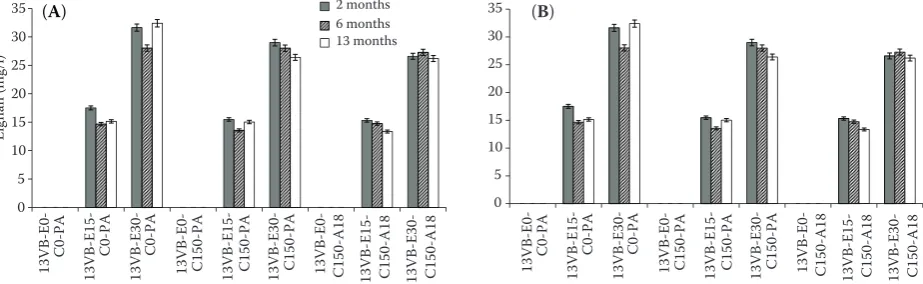
Figure 1. Lignan content in samples of (A) red and (B) white wine with added lignan extracts during storage
Explanation for Figures 1‒4; 13 = year of test; VC = red wine, VB = white wine; E0, E15, E30 = lignan dose (HMR + CONI) per 0; 15; 30 mg/l; C0, C150 = sugar dose per 0 or 150 g/l; PA – pasteurisation (70°C, 15-min holding time); A18 – alcohol dose per 18% vol.; 2, 6, 13 – storage time in months (storage temperature 1–3°C)
441
preservation, and storage time have no significant effect on the content of lignans. ANOVA for the influence of wine type (as predictor) on the content of total polyphe-nols and antioxidant activity showed highly significant F values (P < 0.0001). At the same time, the influence of added lignan extracts, sugar, preservation, and stor-age time on the same parameters was not significant.
Content of lignans. Determined lignan contents in
wine samples after two months of storage correspond with the applied doses of lignan extracts (0; 15; 30 mg of lignans per 1 litre of wine). Samples with no added lignan extract designated by E0 were analysed and natural lignan contents were lower than the detection limit of the analytical method (Figure 1). There are data in literature and commercial leaflets about the recommended daily intake of 7-HMR lignan dose 40 mg per adult person per day [e.g. Swanson – http://www. swansonvitamins.com/swanson-ultra-7-hmrlignans-from-norwegian-spruce-tree-40-mg-60-caps].
Small differences were related to the technology of sample mixture with addition of sugar and alcohol.
After 6 months of storage, lignan contents in red and white wines mostly decreased in comparison with samples stored for 2 months. After 13 months of storage, lignan contents changed only moderately and added lignans were enough stable in stored wines. Samples prepared from Grüner Veltliner grapes had higher levels of lignans compared to samples prepared from Limberger grapes (Figure 1).
Sensory evaluation. All three groups of red wine
[image:4.595.66.530.103.251.2]samples showed an increase in the intensity of woody notes following the addition of lignan extracts (Fig-ure 2A). There was an increase in the astringency intensity and bitterness in all three groups of red wines enriched with lignans; the highest values were associated with samples prepared with the dose of lignan extracts E30, but without sugar or alcohol sup-plement. Consumer acceptability for red wines with no added sugar (the first 3 samples) was not affected by the addition of lignan extracts. For wines with added sugar, a slight increase in the evaluation of consumer acceptability compared to the control sample was
Figure 2. Sensory evaluation of (A) red and (B) white wine with added lignan extracts assessed after thirteen months of storage (number of evaluators = 10) (for explanation see Figue 1)
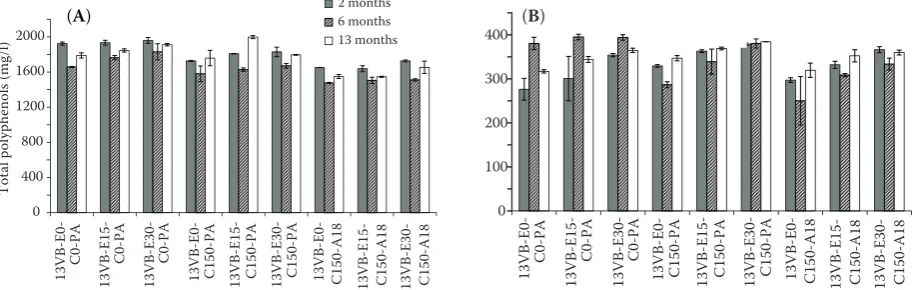
Figure 3. Total polyphenol content in samples of (A) red and (B) white wine with added lignan extracts during storage (for explanation see Figue 1)
0 20 40 60 80 100 13VC-E0-C0-PA-1 3 13VC-E15-C0-PA-1 3 13VC-E30-C0-PA-1 3 13VC-E0- C150-P A -13 13VC-E15- C150-P A -13 13VC-E30- C150-P A -13 13VC-E0-C15 0-A18-1 3
13VC-E15- C150-A18-1
3
13VC-E30- C150-A18-1
3
Sensory
assesment
intensity of woody notes in the aroma intensity of astringent and bitter in taste tone consumer acceptability rating
13VB-E0- C0-PA 13VB-E15-C0-PA 13VB-E30-C0-PA
13VB-E0- C150-PA 13VB-E15- C150-PA 13VB-E30- C150-PA 13VB-E0- C150-A18 13VB-E15- C150-A18 13VB-E30- C150-A18 0 20 40 60 80 100 Sensory assesment 13VB-E0- C0-PA 13VB-E15-C0-PA 13VB-E30-C0-PA
13VB-E0- C150-PA 13VB-E15- C150-PA 13VB-E30- C150-PA 13VB-E0- C150-A18
13VB-E15- C150-A18 13VB-E30- C150-A18
0 100 200 300 400
PA PA PA 13VB-E0- C150-PA
13VB-E15- C150-PA 13VB-E30- C150-PA 13VB-E0- C150-A18 13VB-E15- C150-A18 13VB-E30- C150-A18
Total p ol yphenols (mg/l) 13VB-E0- C0-PA 13VB-E15-C0-PA 13VB-E30-C0-PA
13VB-E0- C150-PA 13VB-E15- C150-PA 13VB-E30- C150-PA 13VB-E0- C150-A18
13VB-E15- C150-A18 13VB-E30- C150-A18
0 400 800 1200 1600 2000
Total polyphenols (mg/l)
2 months 6 months 13 months 13VB-E0- C0-PA 13VB-E15-C0-PA 13VB-E30-C0-PA
13VB-E0- C150-PA 13VB-E15- C150-PA 13VB-E30- C150-PA 13VB-E0- C150-A18 13VB-E15- C150-A18 13VB-E30- C150-A18
442
(A) (B)
[image:4.595.66.525.588.733.2]found. The sample of red wine without lignan extracts but with sugar addition had the best rating.
For white wines there was an increase in the woody aroma associated with the addition of lignan extracts regardless of the presence or absence of added sugar (Figure 2B). This was almost equally true of white wines prepared with sugar and alcohol. Astringency intensity and bitterness of white wines increased with the addition of lignan extracts, in both wines prepared with and without added sugar; for wines with added sugar and alcohol this parameter did not change. Consumer acceptability for all three white wine groups was little changed by the addi-tion of lignan extracts. The greatest changes were associated with samples having been prepared with added sugar. The samples of white wine without addition of alcohol but with sugar addition had the best rating.
Total polyphenols. Total polyphenol content in all
samples of red wine was about 5 times higher (from 1.480 mg/l to 1.910 mg/l) than for white wines (from 250 mg/l to 395 mg/l) irrespective of the addition of lignan extracts (Figure 3). The addition of lignan extracts had a higher effect on the contents of poly-phenols in lignan-enriched white wines than in red wines. Polyphenol contents in lignan-enriched wines changed irregularly during storage. The lowest values were found in samples with added alcohol (Figure 3).
Antioxidant activity. Antioxidant activity of all
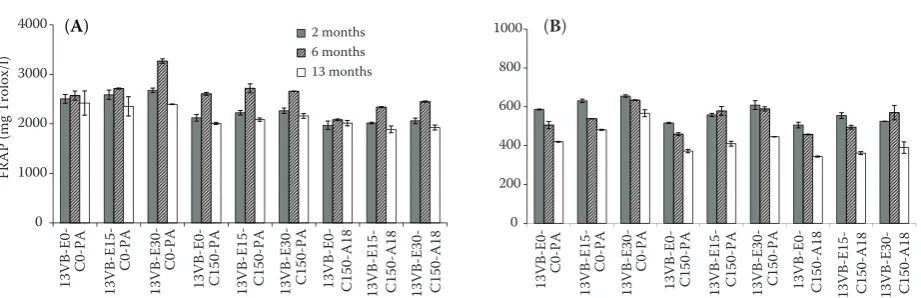
samples of red wines determined by FRAP (from 7.55 mM Trolox/l to 13.06 mM Trolox/l) was about 4 times higher than that of white wines (from 1.37 mM Trolox/l to 2.62 mM Trolox/l) irrespective of the ad-dition of lignan extracts (Figure 4). The antioxidant activity of red wines with added lignan extracts was generally highest after 2 months of storage, and then
declined during further storage. For white wines with added lignan extracts, antioxidant activity mostly decreased during storage and its values were signifi-cantly lower after 13 months (Figure 4).
CoNCLusIoNs
This paper deals with the preparation of red and white wines enriched with lignans through the addition of lignan extracts from spruce knot chips stripped of resin. A sensory evaluation and analysis of lignans content, antioxidant activity and polyphenols was done for wines after 2, 6, and 13 months of stor-age. Determined lignan contents in wine samples agreed with the applied doses of lignan extracts. In the course of one-year storage no significant loss of lignan content was observed in the lignan-enriched red and white wines. The addition of lignan extracts did not significantly increase the total polyphenol content and antioxidant activity of wine samples. The intensity of woody aroma and also the astringency and bitterness intensity of all wine samples increased with the quantity of added lignan extracts. The best consumer acceptability rating of lignan-enriched wines was found for white wine samples with sugar addition (150 g/l). These doses seem to be optimum from sensory quality of the wine tested. The presented method of wine enrichment with lignans opens the door for production of wines or wine-based products of extra quality.
references
[image:5.595.66.527.101.250.2]Adlercreutz H. (2007): Lignans and human health. Critical Reviews in Clinical Laboratory Science, 44: 483–525. Figure 4. Antioxidant activity (FRAP) of (A) red and (B) white wine with added lignan extracts during storage (for explanation see Figue 1)
0 1000 2000 3000 4000
FRAP
(mg Trolox/l)
2 months 6 months 13 months
13VB-E0-
C0-PA
13VB-E15-C0-PA
13VB-E30-C0-PA
13VB-E0- C150-PA 13VB-E15- C150-PA 13VB-E30- C150-PA 13VB-E0- C150-A18 13VB-E15- C150-A18 13VB-E30- C150-A18
0 200 400 600 800 1000
FRAP
(mg Trolox/l)
13VB-E0-
C0-PA
13VB-E15-C0-PA
13VB-E30-C0-PA
13VB-E0- C150-PA 13VB-E15- C150-PA 13VB-E30- C150-PA 13VB-E0- C150-A18 13VB-E15- C150-A18 13VB-E30- C150-A18
443
Balík J., Híc P., Soural I., Tománková E., Houška M., Stro-halm J., Tříska J., Vrchotová N., Moos M., Marešová I. (2015): Must, wine or wine-based beverage with in-creased amount of natural lignans and process for pre-paring thereof. National Patent Application No. 305406, Industrial Property Office, Czech Republic.
Harmatha J., Dinan L. (2003): Biological activities of lignans and stilbenoids associated with plant-insect chemical interactions. Phytochemistry Reviews, 2: 321–330. Heinonen S., Nurmi T., Liukkonen K., Poutanen K., Wähälä
K., Deyama T., Nishibe S., Adlercreutz H. (2001): in vitro
metabolism of plant lignans: new precursors of mam-malian lignans enterolactone and enterodiol. Journal of Agricultural and Food Chemistry, 49: 3178–3186. Holmbom B., Eckerman Ch. Eklund P., Hemming J. Nisula
L., Reunanen M., Sjöholm R., Sundberg A., Sundberg K. Willför S. (2003): Knots in trees – a new rich source of lignans. Phytochemistry Reviews, 2: 331–340.
Lindahl G., Saarinen N., Abrahamsson A., Dabrosin C. (2011): Tamoxifen, flaxseed, and the lignan enterolactone increase stroma- and cancer cell-derived IL-1Ra and de-crease tumor angiogenesis in estrogen-dependent breast cancer. Cancer Research, 71: 51–60.
Mazur W., Adlercreutz H. (1998): Naturally occurring estro-gens in food. Pure and Applied Chemistry, 70: 1759–1776. Meagher L.P., Beecher G.R. (2000): Assessment of data on
the lignan content of foods. Journal of Food Composition and Analysis, 13: 935–947.
Milder I.E.J., Arts I.C., van de Putte B., Venema D.P., Holl-man P.C. (2005): Lignan contents of Dutch plant foods: a database including lariciresinol, pinoresinol, secoisola-riciresinol and matairesinol. British Journal of Nutrition, 93: 393–402.
Nurmi T., Heinonen S., Mazur W., Deyama T., Nishibe S., Adlercreutz H. (2003): Lignans in selected wines. Food Chemistry, 83: 303–309.
Saarinen N.M., Wärri A., Mäkelä S.I., Eckerman C., Reu-nanen M., Ahotupa M., Salmi S.M., Franke A.A., Kangas L., Santti R. (2000): Hydroxymatairesinol, a novel enterol-actone precursor with antitumor properties from
conifer-ous tree (Picea abies). Nutrition and Cancer, 36: 207–216.
Sicilia T., Niemeyer H.B., Honig D.M., Metzler M. (2003): Identification and stereochemical characterization of lignans in flaxseed and pumpkin seeds. Journal of Agri-cultural and Food Chemistry, 51: 1181–1188.
Thompson L.U. (1998): Experimental studies on lignans and cancer. Baillière’s Clinical Endocrinology and Me-tabolism, 12: 691–705.
Umezawa T. (2003): Diversity in lignan biosynthesis. Phy-tochemistry Reviews, 2: 371–390.
Wilför S. M., Smeds A.I., Holmbom B.R. (2006): Chromato-graphic analysis of lignans. Journal of Chromatography A, 1112: 64–77.
Received: 2015–12–18 Accepted after corrections: 2016–06–13
corresponding author: