On: 5 September 2007
Access Details: [subscription number 773565843] Publisher: Taylor & Francis
Informa Ltd Registered in England and Wales Registered Number: 1072954 Registered office: Mortimer House, 37-41 Mortimer Street, London W1T 3JH, UK
International Journal of Control
Publication details, including instructions for authors and subscription information: http://www.informaworld.com/smpp/title~content=t713393989
Stability issues of finite-precision controller structures for
sampled-data systems
R. H. Istepanian; S. Chen
Online Publication Date: 15 October 1999
To cite this Article: Istepanian, R. H. and Chen, S. (1999) 'Stability issues of finite-precision controller structures for sampled-data systems', International Journal of Control, 72:15, 1331 - 1342
To link to this article: DOI: 10.1080/002071799220146 URL:http://dx.doi.org/10.1080/002071799220146
PLEASE SCROLL DOWN FOR ARTICLE
Full terms and conditions of use:http://www.informaworld.com/terms-and-conditions-of-access.pdf
This article maybe used for research, teaching and private study purposes. Any substantial or systematic reproduction, re-distribution, re-selling, loan or sub-licensing, systematic supply or distribution in any form to anyone is expressly forbidden.
The publisher does not give any warranty express or implied or make any representation that the contents will be complete or accurate or up to date. The accuracy of any instructions, formulae and drug doses should be independently verified with primary sources. The publisher shall not be liable for any loss, actions, claims, proceedings, demand or costs or damages whatsoever or howsoever caused arising directly or indirectly in connection with or arising out of the use of this material.
Downloaded By: [University of Southampton] At: 14:19 5 September 2007
S tability issues of ® nite-precision controller structures for sampled-data systems
J. WU{, R. H. ISTEPANIAN{ and S. CHEN}
The paper investigates the sensitivity of closed-loop stability with respect to (w.r.t.) ® nite word length (FWL) e ects in the implementation of the digital controller coe cients. Both the shift and delta operators are considered for controller parameterization. Two tractable lower-bound measures of closed-loop stability are studied, and the optimal realization of general FWL controller structures is formulated as a constrained non-linear optimization problem. The emphasis of the paper, however, is on the derivation of a new algorithmic approach for the optimal realization of FWL PID controller structures. It is shown that, for PID structures, the optimization can be decoupled into two unconstrained problems with a maximum of four independent variables. An optimization strategy is developed to provide an e cient computational method for searching the optimal FWL PID controller realization with maximum stability bound and minimum bit-length requirement. Simulation results involving an IFAC benchmark PID controller system are presented to illustrate the e ectiveness of the proposed strategy.
1. Introduction
The recent advances in ® xed-point implementation of digital controllers, such as the design of dedicated ® xed-point digital signal processor and digital control processor architectures, have made FWL implementa-tion an important issue in modern control engineering. Improved control performance and increased levels of integration are particularly important in many appli-cation areas, such as consumer electronic products, automotive and electromechanical control systems. This is because controller hardware implementation with ® xed-point arithmetic o er the advantages of speed, memory space, cost and simplicity over ¯ oat-ing-point arithmetic (Masten and Panahi 1997). However, a designed stable closed-loop system may become unstable when the in® nite-precision controller is implemented using a ® xed-point processor due to FWL e ects. The `robustness’ of closed-loop stability w.r.t. controller parameter perturbations therefore is a critical issue in ® xed-point implementations and relevant control engineering applications.
In recent years, many results have been reported in the literature dealing with the issues of FWL controller implementation. The degradation e ects of FWL on the digital controller designed using an LQG cost function
has been investigated (Moroneyet al. 1980). The e ects
of FWL implementated digital controller on the stability
and performance of sampled-data systems has been analysed (Fialho and Georgiou 1994). A stability measure quantifying the FWL e ects has been
devel-oped (Moroney et al. 1980, Fialho and Georgiou
1994). However, computing explicitly this measure is still an unsolved open problem. To overcome this computational di culty, two tractable lower bounds of this stability measure have been derived (Li 1998,
Istepanian et al. 1998 a). The criteria derived provide
lower bounds proportional to the closed-loop pole sensitivity measures w.r.t. controller parameter pertur-bations. It can be shown that the lower bound of
Istepanian et al. (1998) is a better stability measure
than that of Li (1998).
Recent investigations on ® nite-precision controller realizations have mainly been based on these two lower-bounds of the stability measure and some similar
criteria (Madievski et al. 1995, Istepanian et al. 1996,
Li and Gevers 1996, Istepanianet al.1998 b). The
pres-ent study continues this theme with an emphasis on developing a new optimization method for the optimal realization of ® nite-precision controller structures. The problem is formulated as a constrained non-linear opti-mization problem. In particular, for PID sttuctures, the constrained optimization can be decoupled into two unconstrained optimization problems, which permits the development of an e ective computational method for obtaining the optimal FWL PID realization with the maximum closed-loop stability measure. Notice that PID controllers have been the most popular controllers in process and industrial control applications for over 50 years and continue to maintain their popularity despite opportunities to apply more advanced control method-ologies. This is because of their simplicity, versatility, robustness and successful commercial performance (AÊstroÈm and Wittenmark 1989). Most of the studies in this area still focus on tuning methods, and very few studies have been reported to date on the FWL
International Journal of ControlISSN 0020± 7179 print/ISSN 1366± 5820 online#1999 Taylor & Francis Ltd http://www.tandf.co.uk/JNLS/con.htm
http://www.taylorandfrancis.com/JNLS/con.htm
Received 5 September 1997. Revised 11 January 1999. Accepted 23 March 1999.
{National Key Laboratory of Industrial Control Tech-nology, Institute of Industrial Process Control, Zhejiang Uni-versity, Hangzhou, 310027, P.R. China.
{Department of Electrical and Computer Engineering, Ryerson Polytechnic University, 350 Victoria Street, Toronto, Ontario, Canada M5B 2K3.
Downloaded By: [University of Southampton] At: 14:19 5 September 2007
implementation issues of discrete PID structures using ® xed-point arithmetic (Istepanian 1997).
In all the above-mentioned works addressing the closed-loop stability issues of FWL controller struc-tures, the controllers were described and realized with the usual shift operator. It is known that discrete-time systems can also be described and realized with the delta operator (Middleton and Goodwin 1990). Two major
advantages are claimed for the use of ¯ operator
parameterization: a theoretically uni® ed formulation of continuous-time and discrete-time systems; and better numerical implementation properties (Gevers and Li 1993). As with the majority of earlier works, the results presented in this paper, when it was ® rst submitted, were based on the shift operator parameterization. We have since extended the approach to the delta operator
parameterization (Wu et al. 1999 a,b). These new
results are included in this revised paper. Our simulation
study con® rms that the ¯ operator parameterization
generally results in better closed-loop stability robust-ness in FWL implementations, compared with the usual shift operator parameterization.
The paper is organized as follows. In }2, a
closed-loop stability measure is presented for sampled-data systems with the shift operator parameterization and FWL implemented controllers. Two tractable lower bounds of this stability measure are considered. The optimal controller realization which maximizes the closed-loop stability measure can be obtained by solving a constrained optimization problem, and this is
pre-sented in }3. Section 4 speci® cally studies the optimal
realization of digital PID controllers subject to FWL constraints. Section 5 extends these results to include the delta operator parameterization. A practical bit
length consideration is also discussed. In}6, the e
ec-tiveness of the proposed optimization strategy for PID structures is illustrated by the numerical example of an IFAC benchmark PID control problem (Whidborne
et al.1995). Both the shift-operator and delta-operator
controllers were tested in the simulation study. Discussions and some concluding remarks are given
in}7.
2. S tability robustness measures of zoperator based controllers with FW L consideration
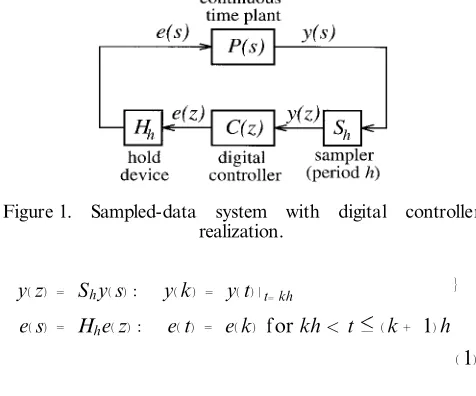
Consider the sampled-data system depicted in ® gure
1, whereP…s† is the continuous-time ® nite-dimensional
linear time-invariant plant, C…z† is the discrete-time
® nite-dimensional linear shift-invariant controller with
zindicating the usual shift operator, Sh is the sampler
with sampling periodh, andHh is the hold device. The
outputs of the sampler and hold device are given by
y…z† ˆ Shy…s†: y…k† ˆ y…t† jtˆkh
e…s† ˆ Hhe…z†: e…t† ˆ e…k† f orkh< t …k‡ 1†h
)
…1†
respectively. Assume that P…s† is strictly proper. Let
…Ap;Bp;Cp;0† be a state-space realization ofP…s†, that is
P…s† ˆ Cp…sI¡ Ap†¡1Bp …2†
where Ap 2 R m m, Bp2 Rm l and Cp2 Rq m. Let
…Ac;Bc;Cc;Dc† be a state-space realization of C…z†,
that is
C…z† ˆ Cc…zI¡ Ac†¡1Bc‡ Dc …3†
whereAc2 R n n, Bc2 R n q, Cc2 R l nandDc2 Rl q.
The state-space realization for a given input± output transfer function is not unique. For example, if
…Ac;Bc;Cc;Dc† is a realization of C…z†, so is … T ¡1AcT ,
T ¡1Bc, CcT , Dc† for any similarity transformation
T 2 R n n. Considering the behaviour of the
sampled-data system at its sampling instants, we obtain a dis-crete-time feedback system
y…z† ˆ ShP…s†Hhe…z†
e…z† ˆ C…z†y…z†
)
…4†
The plantP…z† ˆ ShP…s†Hhis the discretization of P…s†,
whose state-space realization is…Az;Bz;Cz;0† with
Azˆ eAph2 R m m
Bzˆ
… h
0e
Ap½B
pd½ 2 Rm l
Czˆ Cp2 R q m
9
> > > > > > =
> > > > > > ;
…5†
It can easily be seen that the corresponding state-space
description…A;B;C;D† of the discrete-time closed-loop
system (4) without considering FWL e ects is given by
[image:3.552.288.526.36.234.2]Downloaded By: [University of Southampton] At: 14:19 5 September 2007
Aˆ
Az‡ BzDcCz BzCc
BcCz Ac
" #
ˆ
Az 0
0 0
" #
‡
Bz 0
0 In
" #
Dc Cc
Bc Ac
" #
Cz 0
0 In
" #
ˆ M0‡ M1XM2ˆ A…X† …6†
Bˆ
Bz
0 ; Cˆ ‰Cz 0Š; Dˆ 0 …7†
where M02 R …m‡n† …m‡n†, M12 R …m‡n† …l‡n† and
M22 R …q‡n† …m‡n† are some ® xed matrices that depend
onP…s† andh, Indenotes then nidentity matrix, and
Xˆ
Dc Cc
Bc Ac
" #
ˆ
p1 p2 . . . pq‡n
pq‡n‡1 pq‡n‡2 . . . p2…q‡n†
.. .
.. .
. . . ...
p…l‡n¡1† …q‡n† ‡1 p…l‡n¡1† …q‡n† ‡2 . . . p…l‡n† …q‡n†
2
6 6 6 6 6 6 4
3
7 7 7 7 7 7 5
…8†
will be referred to as the controller matrix.
Suppose that C…z† has been chosen to make the
sampled-data system stable and the realization of C…z†
isX. Since the sampled-data system is stable if and only
if the system (4) is stable (Chen and Francis 1991), it
follows that the eigenvalues of A…X†, denoted by
f¶i;1 i m‡ ng, satisfy
j¶ij <1; 8i2 f1;. . .;m‡ ng …9†
When the realization…Ac;Bc;Cc;Dc† of C…z† is
imple-mented with a ® xed-point processor, the controller
matrix X is perturbed into X‡ X due to the FWL
e ects, where
Xˆ
p1 p2 . . . pq‡n
pq‡n‡1 pq‡n‡2 . . . p2…q‡n† ..
.
.. .
. . . ...
p…l‡n¡1† …q‡n† ‡1 p…l‡n¡1† …q‡n† ‡2 . . . pN
2
6 6 6 6 6 4
3
7 7 7 7 7 5
…10†
and Nˆ …l‡ n† …q‡ n†. Each element of X is
bounded, that is
·… X†= max
i2 f1;...;Ng
j pij °
2 …11†
For a ® xed-point processor of Bs bits
°ˆ 2¡ …Bs¡BX† …12†
where 2BX is a `normalization’ factor such that the
abso-lute value of each element of 2¡BXXis not larger than 1.
With the perturbation X, ¶i is moved to ¶~i. The
closed-loop system is unstable if and only if there exists
i2 f1;. . .;m‡ ng such thatj¶~ij 1.
To see when the round-o error will cause the closed-loop system to be unstable, de® ne
·0…X†= inff·… X†: A…X† ‡ M1 XM2 is unstableg
…13†
It quanti® es the stability robustness of the realizationX
to the FWL e ects. However, computing explicitly the
value of ·0…X† is still an unsolved open problem. How
`robust’ a controller realization is to the FWL e ects can
also be viewed from a di erent angle. Let Bmins be the
smallest word length that can guarantee the closed-loop
stability. It would be highly desirable to knowBmins for a
given controller realization. However, except in simula-tion, it is impractical to test the closed-loop system by
reducingBs until it becomes unstable.
To overcome the di culty in the computation of
·o…X†, Istepanian et al. (1998 a) introduced a lower
bound of ·0…X† as
·1…X†= min
i2 f1;...;m‡ng
1¡ j¶ij
XN
jˆ1
@ ¶i=@pj X
…14†
We have the following theorem.
Theorem 1: A…X† ‡ M1 XM2 is stable if ·… X† <
·1…X†.
Proof: When Xis small, using a ® rst-order
approx-imation we have (Li and Gevers 1996, Istepanianet al.
1998 a)
¶iˆ ¶~i¡ ¶i
XN
jˆ1
@ ¶i
@pj X pj; 1 i m‡ n …15†
where ¶~i are the eigenvalues of A…X‡ X†. It follows
that
j ¶ij
XN
jˆ1
@ ¶i
@pj X j pjj ·… X†
XN
jˆ1
@ ¶i
@pj X …16†
Thus for 1 i m‡ n, if
·… X† < 1
¡ j¶ij
XN
jˆ1
@ ¶i=@pj X
…17†
Downloaded By: [University of Southampton] At: 14:19 5 September 2007
j¶~ij j¶ij ‡ j ¶ij j¶ij ‡ ·… X†
XN
jˆ1
@ ¶i
@pj X
<j¶ij ‡ 1
¡ j¶ij
XN
jˆ1
@ ¶i=@pj X
XN
jˆ1
@ ¶i
@pj X ˆ 1 …18†
which means thatA…X‡ X† is stable. &
The following lemma shows that·1…X† can be
com-puted easily. The proofs of this lemma can be found in
Istepanian et al. (1998 a).
Lemma 1: L et A…X† be diagonalizable and have f¶i;iˆ 1;. . .;m‡ ng as its eigenvalues, and xi be a
right eigenvector of A…X† corresponding to the
eigen-value ¶i. Denote Mxˆ ‰x1 xm‡nŠ and My ˆ
‰y1 ym‡nŠ ˆ M¡xH, where yi is called the reciprocal
left eigenvector corresponding to ¶i, and H denotes
the transpose and conjugate operation. Then
8i2 f1;. . .;m‡ ng
@ ¶i
@Xˆ
@ ¶i
@p1
@ ¶i
@p2 . . .
@ ¶i
@pq‡n
@ ¶i
@pq‡n‡1
@ ¶i
@pq‡n‡2
. . . @ ¶i
@p2…q‡n†
.. .
.. .
. . . ...
@ ¶i
@p…l‡n¡1† …q‡n† ‡1
@ ¶i
@p…l‡n¡1† …q‡n† ‡2
. . . @ ¶i
@pN 2 6 6 6 6 6 6 6 6 6 6 6 6 6 6 4 3 7 7 7 7 7 7 7 7 7 7 7 7 7 7 5
ˆ MT1yixTiM2T …19†
where T denotes the transpose operation, and * the
con-jugate operation.
When a designed in® nite-precision stable controller
Xis implemented with a ® xed-point processor, the norm
of the controller perturbation ·… X† and the
lower-bound stability measure ·1…X† can be evaluated. If
·1…X† > ·… X†, the closed-loop stability is maintained.
Furthermore, whenXis implemented with a ® xed-point
processor ofBsbits, from (11) and Theorem 1, it is easily
seen that the closed-loop system is stable if
·1…X† > 2
¡ …Bs¡BX†
2 …20†
De® neB^mins1 as the smallest integer that is not less than
¡ log2 ·1…X† ¡ 1‡ BX. We can use B^mins1 as a super
estimate of Bmins . Thus, ·1…X† provides a tractable
closed-loop stability robustness measure of X with
FWL considerations.
Another tractable stability robustness measure with FWL considerations was discussed by Li and Gevers (1996) and Li (1998). This measure is de® ned as
·2…X† = min
i2 f1;...;m‡ng
1¡ j¶ij
N XN
jˆ1
@ ¶i=@pj X
2 v
u u t
…21†
It is also a lower bound of·0…X†. Similarly, an estimate
^
Bmins2 of Bmins can be computed based on ·2…X†. Since
XN
jˆ1
@ ¶i
@pj X
! 2
NX
N
jˆ1
@ ¶i
@pj X
2
…22†
we have·2…X† ·1…X† ·0…X†. It is clear that·1…X†,
which is closer to·0…X†, is a better stability robustness
measure and can provice a better estimate ofBmin2 .
3. Optimal realization ofzoperator based controller structures with FW L consideration
From the previous section, we know that there are
di erent realizations X for a given C…z†, and the
stability measure·1…X† is a function of the realization.
It is of practical importance to ® nd a realization such
that·1…X† is maximized. Such a realization is optimal in
the sense that it has maximum closed-loop stability robustness to FWL e ects. The digital controller imple-mented with an optimal realization means that the stability of the closed-loop system is guaranteed with a minimum hardware requirement in terms of word
length. Given an initial realizationX0 of C…z†
X0ˆ D
0
c C0c
B0c A0c
" #
…23†
any realization of C…z† can be expressed as:
XT =
Il 0
0 T ¡1 X0
Iq 0
0 T
…24†
whereT 2 R n nand det… T † 6ˆ 0. From (6), the
closed-loop transition matrix is
A…XT † ˆ Az 0
0 0 ‡
Bz 0
0 In
Il 0
0 T ¡1
X0
Iq 0
0 T
Cz 0
0 In
ˆ
Im 0
0 T ¡1
Az 0
0 0
Im 0
0 T
‡
Im 0
0 T ¡1
Bz 0
0 In
X0 Cz 0
0 In
Im 0
0 T
ˆ
Im 0
0 T ¡1
A…X0†
Im 0
0 T
Downloaded By: [University of Southampton] At: 14:19 5 September 2007
Obviously, A…XT † has the same eigenvalues as A…X0†.
Let¶0i be theith eigenvalue of A…X0†, andx0i andy0i be
the corresponding right and reciprocal left eigenvectors,
respectively. From (25), theith right and reciprocal left
eigenvectors ofA…XT † are
Im 0
0 T ¡1 x
0
i 2 Cm‡n and Im 0
0 T T y
0
i 2 C m‡n
…26†
respectively. Applying Lemma 1, we have
@ ¶i
@XXˆX
T
ˆ
BTz 0
0 In
" #
Im 0
0 T T
" #
…y0i† …x0i†T
Im 0
0 T ¡T
" #
CzT 0
0 In
" #
ˆ
Il 0
0 T T
" #
BTz 0
0 In
" #
…y0i† …x0i†T
CTz 0
0 In
" #
Iq 0
0 T ¡T
" #
ˆ
Il 0
0 T T
" #
@ ¶i
@XXˆX0
Iq 0
0 T ¡T
" #
…27†
From (14), (19) and (27), the optimal realization problem of FWL controllers can be de® ned as the fol-lowing maximization problem
’= max
XT
·1…XT † ˆ max
XT
min
1 i m‡n
1¡ j¶0ij
XN
jˆ1
@ ¶i=@pj XˆX
T
…28†
For the complex-valued matrixM2 C m nwith elements
Mi;j, de® ne a norm
kMks=
Xm
iˆ1
Xn
jˆ1
jMi;jj …29†
The optimization problem (28) is equivalent to the mini-mization problem
vˆ 1
’ = minXT
max
1 i m‡n
@ ¶i=@X†
… jXˆX
T s
1¡ j¶0ij
ˆ min
T 2 Rn n det… T † 6ˆ0
max
1 i m‡n
Il 0
0 T T
" #
Fi
Iq 0
0 T ¡T
" #
s
…30†
where
Fiˆ
…@ ¶i=@X† jXˆX0
1¡ j¶0ij
; 1 i m‡ n …31†
are the eigenvalue sensitivity matrices.
Thus the optimal controller realization problem is posed as an optimization problem with the cost function
f… T † ˆ max
1 i m‡n
"
Il 0
0 T T
#
Fi
"
Iq 0
0 T ¡T
#
s
…32†
and the constraint det… T † 6ˆ 0. Evidently, the cost
func-tion (32) is non-smooth and non-convex, and optimiza-tion must be based on a direct search without the aid of cost function derivatives. The conventional optimization methods for this kind of problem, such as Rosenbrock and Simplex algorithms (Kowalik and Osborne 1968, Beveridge and Schechter 1970, Dixon 1972), in general can only ® nd a local minimum. A more serious problem,
however, is the need to satisfy det… T † 6ˆ 0 during the
optimization process. It is well known that constrained optimization is more di cult to solve, compared with unconstrained optimization. In all the previous works (Gevers and Li 1993, Li and Gevers 1996, Istepanian
et al. 1996, 1998 a,b), similar optimization problems
were solved with some success by using a conventional direct search algorithm and ignoring the constraints during optimization. Nevertheless, the possible pitfall of violating the constraint by this kind of approach remains, which may result in an invalid solution.
4. Optimal realization ofzoperator based PID controller structures with FW L consideration From the previous discussion, we know there is a need to develop some new e cient numerical algorithm for solving the optimal FWL controller realization problem. A main contribution of this paper is to show how this can be achieved for the optimal FWL PID controller realization problem. Assume that
C…z† is a digital physically realizable non-interacting
PID controller structure (Rad and Lo 1994). Let
…A0c2 R2 2;B0c2 R 2 1;Cc02 R 1 2;D0c2 R † be an initial
realization of the PID controller C…z†. From (30), the
optimal FWL PID controller realization problem is de® ned as the optimization problem
v= min
T 2 R2 2 det… T † 6ˆ0
max
1 i m‡2
"
Il 0
0 T T
#
Fi
"
Iq 0
0 T ¡T
#
s …33†
As is di cult to handle the constraint det… T † 6ˆ 0
directly in numerical optimization, we show in the following theorem that the optimization problem (33) can be decoupled into the two `simpler’ unconstrained problems. First we de® ne the two cost functions
f1…x;y;w† ˆ max
1 i m‡2
w 0 0
0 x 0
0 y 1=x
2
6 4
3
7 5 Fi
1=w 0 0
0 1=x 0
0 ¡y x
Downloaded By: [University of Southampton] At: 14:19 5 September 2007 and
f2…x;y;u;w† ˆ max
1 i m‡2
w 0 0
0 x u
0 …xy¡ 1†=u y
2
6 6 4
3
7 7 5
Fi
1=w 0 0
0 y ¡ u
0 …1¡ xy†=u x
2
6 6 4
3
7 7 5
s …35†
Theorem 2: L et
v1ˆ min
x2 …0;‡ 1 †
y2 … ¡ 1;‡ 1 †
w2 …0;‡ 1 †
f1…x;y;w† …36†
and
v2 ˆ min
x2 … ¡ 1;‡ 1 †
y2 … ¡ 1;‡ 1 †
u2 …0;‡ 1 †
w2 …0;‡ 1 †
f2…x;y;u;w† …37†
Then
vˆ minfv1;v2g …38†
If vˆ v1 and …xopt1;yopt1;wopt1† is the optimal solution
of problem …36†, the optimal solution of problem …33†
is given as
T optˆ 1
wopt1
xopt1 yopt1
0 1=xopt1
" #
…39†
If vˆ v2 and …xopt2;yopt2;uopt2;wopt2† is the optimal
solution of problem…37†, the optimal solution of problem
…33† is given as
T optˆ 1
wopt2
xopt2 …xopt2yopt2¡ 1†=uopt2
uopt2 yopt2
" #
…40†
The proof of Theorem 2 is given in the Appendix.
Note that f1…x;y;w† and f2…x;y;u;w† are still
nonsmooth and nonconvex functions, and it may be di -cult for a conventional non-gradient-based algorithm (Kowalik and Osborne 1968, Beveridge and Schechter 1970, Dixon 1972) to obtain a global minimum solution. This di culty, however, can be overcome by employing an e cient global optimization strategy, such as the genetic algorithm (GA) (Goldberg 1989, Davis 1991,
Man et al. 1997) or the adaptive simulated annealing
(ASA) (Ingber and Rosen 1992, Ingber 1996, Rosen
1997, Chen et al. 1998). In this study, we adopt the
ASA for its simplicity and ease of programming. The detailed implementation of the ASA algorithm can be found in Ingber and Rosen (1992), Ingber (1996), Rosen
(1997) and Chenet al.(1998). It is equally valid to adopt
the GA in the optimization.
5. Extension tod operator parameterization
The results presented in}}2± 4 are derived based on
the z operator parameterization. These have been
extended to delta operator based controllers in a new
study (Wuet al.1999 a,b). The delta operator is de® ned
as (Middleton and Goodwin 1990)
¯ˆ z
¡ 1
h …41†
Let a state-space realization of the ¯-based controller
C…¯† be …A¯;c;B¯;c;C¯;c;D¯;c†. The subscript ¯
dis-tinguishes this model from the z-based controller
reali-zation …Ac;Bc;Cc;Dc†. A state-space model of the
closed-loop system in the ¯ domain is …A¯;B¯;C¯;D¯†
with the eigenvalues of A¯ being f¶¯;i;1 i m‡ ng.
Notice that, just as in the z-based case of (6),
A¯ ˆ A¯…X¯† is a function of the controller matrix
X¯ ˆ
D¯;c C¯;c
B¯;c A¯;c
…42†
The relationships between thezand¯parameterizations
are well known (Neuman 1993 a,b). For example, two
state-space models of C…z† andC…¯† are linked by
Acˆ hA¯;c‡ In; Bcˆ hB¯;c; Ccˆ C¯;c; Dcˆ D¯;c
…43†
and the two sets of the eigenvaluesf¶ig andf¶¯;ig satisfy
¶iˆ 1‡ h¶¯;i; 8i …44†
From (44), we have the condition of closed-loop
stability in the¯ domain.
Lemma 2: The discrete-time system …A¯;B¯;C¯;D¯† is
stable if and only if
¶¯;i‡ 1
h <
1
h; 8i …45†
We can now summarize the main results of Wuet al.
(1999 a,b). Similar to (14), a lower-bound stability
meas-ure for¯-based FWL controllers is
·1…X¯† = min
1 i m‡n
…1=h† ¡ j¶¯;i‡ …1=h† j
XN
jˆ1
@ ¶¯;i=@pj
X¯
…46†
wherepjare the elements of X¯. The optimal realization
problem of ¯-based controller structures with FWL
consideration is posed as a constrained optimization
problem with the cost function f… T † as de® ned in (32)
and subject to the constraint det… T † 6ˆ 0, but the
eigen-value sensitivity matrices are now given di erently by
Fiˆ
…@ ¶¯;i=@X† jXˆX
¯;0
…1=h† ¡ j¶0¯;i‡ …1=h† j
Downloaded By: [University of Southampton] At: 14:19 5 September 2007
where X¯;0 is the initial realization of the controller
matrix and¶0¯;i the eigenvalues ofA¯…X¯;0†. The
compu-tation of @ ¶¯;i=@Xis the same as given in (19) but the
matricesM1 and M2 are now formed di erently from
the state-space model of the¯-based plant modelP…¯†. It
can also be shown that the optimal realization problem
of ¯-based FWL PID controller structures can be
decoupled into two unconstrained optimization prob-lems and a theorem similar to Theorem 2 can be proved
(Wuet al. 1999 a).
It is worth pointing out a practical constraint on the
FWL implementation of ¯-based controllers, which is
often overlooked. The state-space equation of the ¯
-based controller
¯x…k† ˆ A¯;cx…k† ‡ B¯;cu…k† …48†
is realized using
x…k‡ 1† ˆ x…k† ‡ h…A¯;cx…k† ‡ B¯;cu…k† † …49†
The sampling period hshould be implemented exactly
without any FWL errors in order to avoid further
per-turbations to the controller X¯. Otherwise, analysis
based onX¯ may not be valid. Notice that controllers
based on thezoperator do not have this problem.
More speci® cally, assume that h can be realized
exactly byBh bits with the integer part of h requiring
Bh;Ibits and the fractional part of hrequiringBh;F bits.
Let B^mins1 be the smallest integer that is not less than
¡ log2·1…X¯† ¡ 1‡ BX. Here 2BX is the normalization
factor for X¯. In the z-based case, we can use B^
min
s1 as
an estimated minimum bit length that can guarantee the
closed-loop stability. In the ¯-based case, this needs
modi® cation to take into accountt the requirement of
implementinghexactly. A modi® ed estimate of the
mini-mum bit length that can guarantee the closed-loop sta-bility is
^
Bminsh ˆ maxfBh;I;BXg ‡ maxfBh;F;B^mins1 ¡ BXg …50†
For example, if hˆ 23 and B^mins1 ˆ 8 with BXˆ 1, the
estimated minimum bit length isB^minsh ˆ 3‡ …8¡ 1† ˆ 10.
If hˆ 2¡10 and B^mins1 ˆ 4 with BXˆ 1, B^minsh ˆ
1‡ 10ˆ 11.
6. A numerical example
To show how the optimization approach presented earlier can be used e ciently for designing optimal FWL PID controller structures, we consider the following
IFAC benchmark PID control system (Whidborne et
al.1995). The continuous-time plant model is
P…s† ˆ 25
… ¡0:4s‡ 1†
…s2‡ 3s‡ 25† …5s‡ 1†
…51†
and the designed PID controller is
C…s† ˆ 1:311‡ 0:431
s ‡
1:048s
1‡ 12:92s …52†
The sampled-data system with the in® nite-precision
digi-tal controller is stable when the sampling periodh 23.
The range of the sampling period tested in the
simu-lation was 23 to 2¡12, to cover the slow to very fast
sampling conditions. For the comparison purpose,
both the zand ¯ based controllers were investigated in
the simulation. To study the important role of the opti-mization algorithm employed, both the conventional Rosenbrock and advanced ASA algorithms were used in the optimization.
6.1. Results forzoperator based controllers
Given a sampling rate, the discrete-time plant
model P…z† and the digital controller C…z† were
obtained. The initial controller realization X0 was
chosen to be the controllable canonical realization.
The eigenvalues f¶ig of the ideal closed-loop system
and the eigenvalue sensitivity matrices fFig were then
computed. The optimal PID controller realizations obtained by solving the optimization problems (36) and (37) with the Rosenbrock algorithm were denoted
as X~opt1 and X~opt2, respectively. Similarly, the two
optimal solutions of (36) and (37) obtained using the
ASA algorithm were denoted as Xopt1 and Xopt2,
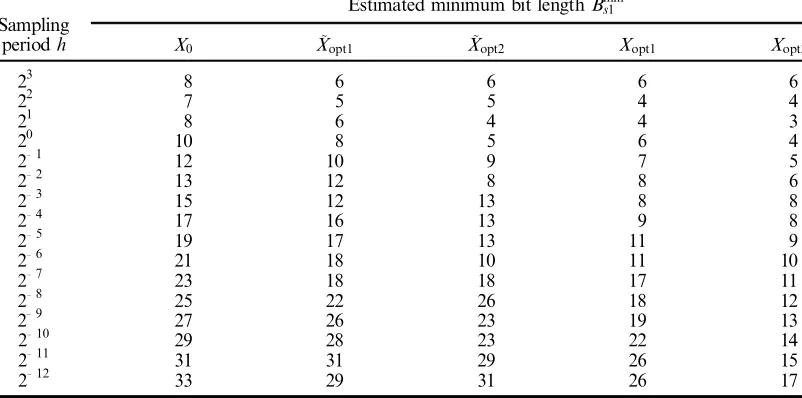
respectively. Table 1 summarizes the values of the
stability lower bound measure·1for di erent controller
realizations under various sampling conditions, and table 2 lists the corresponding estimated minimum bit lengths that can guarantee the closed-loop stability for these controller realizations.
Several observations can readily be made. The results given in tables 1 and 2 show that the optimal controller realizations have much larger closed-loop stability margins than the non-optimal controllable canonical realization and require much smaller word lengths in ® xed-point implementation. In the very fast
sampling condition of hˆ 2¡12, the stability measure of
Xopt2 is 105 times larger than that ofX0. It can also be
seen that, when the sampling rate increases, the
closed-loop stability measure of the z-based controller
decreases considerably. This is true for non-optimal and optimal controller realizations. The ASA algorithm generally yielded better optimization results, compared with the Rosenbrock algorithm. From the results listed in table 1, it is obvious that the conventional Rosenbrock algorithm often missed the true global optimal solution, particularly under fast sampling conditions.
6.2. Results for¯ operator-based controllers
The discrete-time plant model P…¯† and controller
Downloaded By: [University of Southampton] At: 14:19 5 September 2007
controller realization X¯;0 was chosen to be the
`controllable’ or direct-form realization. The eigenvalues
f¶¯;ig of the ideal closed-loop system and the eigenvalue
sensitivity matricesfFig were then calculated to form
the two optimization problems, similar to (36) and (37). The optimal PID controller realizations obtained
using the Rosenbrock algorithm were denoted asX~¯;opt1
and X~¯;opt2, respectively, and the two optimal
realiza-tions obtained using the ASA algorithm were denoted
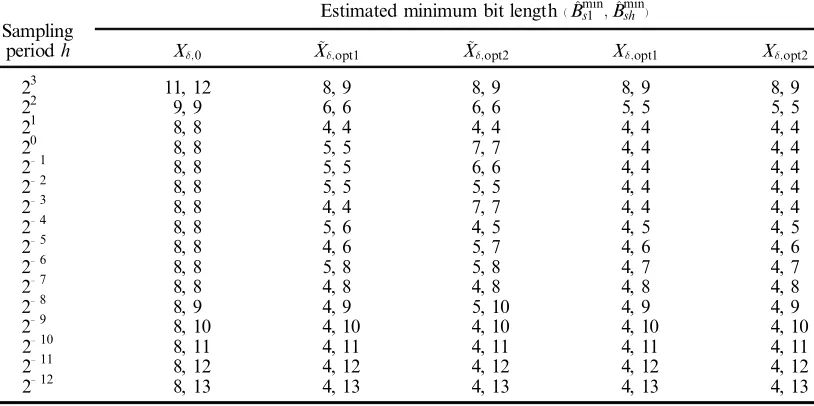
asX¯;opt1 andX¯;opt2, respectively. Table 3 provides the
values of the stability lower bound measure for di erent controller realizations under various sampling
con-ditions, and table 4 gives the corresponding estimated minimum bit lengths that can guarantee the closed-loop
stability for these realizations. Both the B^mins1 and B^minsh
are listed in table 4.
The results show that the optimal¯-based controller
realization has a much better closed-loop stability margin than the non-optimal direct-form realization
X¯;0, although the di erence is not as great as in
the case of zparameterization. The results also con® rm
that the ¯-based controller realizations have better
stability bounds than the z-based realizations under
fast sampling conditions. Increasing the sampling rate
Stability measure·1 Sampling
periodh X0 X~opt1 X~opt2 Xopt1 Xopt2
23 1.306137e-2 3.856 044e-2 3.893 488e-2 3.767 304e-2 3.675 970e-2
22 1.738083e-2 1.128 260e-1 1.244 934e-1 1.495 225e-1 1.641 928e-1
21 5.898659e-3 6.305 634e-2 6.994 177e-2 1.232 973e-1 1.273 720e-1
20 1.754786e-3 2.805 390e-2 3.574 639e-2 5.466 344e-2 7.310 598e-2
2¡1 4.819871e-4 9.198 569e-3 9.684 189e-3 2.580 249e-2 3.771 688e-2
2¡2 1.265127e-4 2.625 682e-3 1.056 738e-2 8.901 379e-3 1.921 549e-2
2¡3 3.242422e-5 1.361 176e-3 8.597 592e-4 6.696 976e-3 9.719 583e-3
2¡4 8.208513e-6 2.757 079e-4 6.607 722e-4 2.931 593e-3 4.889 652e-3
2¡5
2.065125e-6 6.045 046e-5 7.753 055e-4 8.875 924e-4 2.144 777e-3
2¡6 5.179179e-7 1.073 104e-5 1.216 844e-3 5.955 617e-4 1.073 485e-3
2¡7
1.296848e-7 1.512 025e-5 2.101 092e-5 1.523 501e-5 5.331 186e-4
2¡8 3.244692e-8 6.614 090e-7 3.962 129e-6 8.400 932e-6 3.021 479e-4
2¡9 8.114948e-9 1.758 011e-7 7.370 831e-7 5.230 490e-6 1.240 600e-4
2¡10
2.029139e-9 3.318 801e-8 4.552 015e-7 5.204 957e-7 6.892 182e-5
2¡11 5.073338e-10 1.023 806e-8 7.476 508e-9 6.273 487e-8 3.090 558e-5
2¡12 1.268400e-10 2.150 888e-9 2.923 607e-9 1.970 226e-8 1.327 938e-5
Table 1. Lower-bound stability measures of di erentzoperator based controller realizations for various sampling periods.
Estimated minimum bit lengthB^mins1
Sampling
periodh X0 X~opt1 X~opt2 Xopt1 Xopt2
23 8 6 6 6 6
22 7 5 5 4 4
21 8 6 4 4 3
20 10 8 5 6 4
2¡1 12 10 9 7 5
2¡2 13 12 8 8 6
2¡3 15 12 13 8 8
2¡4 17 16 13 9 8
2¡5 19 17 13 11 9
2¡6 21 18 10 11 10
2¡7 23 18 18 17 11
2¡8 25 22 26 18 12
2¡9 27 26 23 19 13
2¡10 29 28 23 22 14
2¡11 31 31 29 26 15
2¡12 33 29 31 26 17
[image:9.552.75.481.53.242.2] [image:9.552.76.477.306.505.2]Downloaded By: [University of Southampton] At: 14:19 5 September 2007
leads to a slightly improved stability margin for the
¯-based controller realization. This is in contrast to the
z-based controller realization, which has considerably
degraded stability margin when the sampling rate increases. Although the estimated minimum bit length
based on ·1 and the realization is consistently 4 for
various sampling conditions, the modi® ed estimate of the minimum bit length is larger and increases as the sampling rate increases. Even taking this into account, however, the estimate of the minimum bit length is
still smaller than that of the corresponding z-based
controller.
7. Conclusions
In this paper we have proposed a new optimal procedure for the sensitivity analysis of closed-loop stability, subject to FWL implemented controller coe -cients. It has been shown that the optimal realization of ® nite-precision digital controllers can be interpreted as a constrained optimization problem. In particular, for ® nite-precision PID controllers, the optimization can be decoupled into two unconstrained optimization prob-lems. An e cient optimization approach has been devel-oped for solving this optimal FWL PID controller
Stability measure·1 Sampling
periodh X¯;0 X~¯;opt1 X~¯;opt2 X¯;opt1 X¯;opt2
23 1.477 681e-3 9.853 745e-3 9.990 982e-3 9.852 372e-3 9.986 133e-3
22 4.068 193e-3 6.091 837e-2 6.051 241e-2 6.267 552e-2 6.439 696e-2
21 5.081 170e-3 6.838 224e-2 6.964 563e-2 6.842 345e-2 7.051 816e-2
20 5.721 692e-3 7.119 400e-2 4.360 879e-2 7.136 269e-2 7.310 503e-2
2¡1 6.086 598e-3 7.225 940e-2 6.204 462e-2 7.274 529e-2 7.445 603e-2
2¡2 6.279 701e-3 7.370 771e-2 6.446 224e-2 7.328 164e-2 7.515 015e-2
2¡3 6.379 331e-3 7.175 426e-2 4.686 201e-2 7.353 966e-2 7.549 933e-2
2¡4 6.429 949e-3 7.148 362e-2 7.104 903e-2 7.409 947e-2 7.567 885e-2
2¡5
6.455 462e-3 7.053 846e-2 6.664 081e-2 7.393 526e-2 7.576 799e-2
2¡6 6.468 270e-3 7.404 889e-2 6.680 168e-2 7.396 521e-2 7.581 252e-2
2¡7
6.474 687e-3 7.405 083e-2 7.118 904e-2 7.397 951e-2 7.583 418e-2
2¡8 6.477 899e-3 7.081 827e-2 6.691 980e-2 7.417 212e-2 7.584 603e-2
2¡9 6.479 505e-3 7.407 674e-2 6.685 483e-2 7.411 691e-2 7.585 130e-2
2¡10
6.480 309e-3 7.064 170e-2 7.114 443e-2 7.413 070e-2 7.585 433e-2
2¡11 6.480 711e-3 7.404 690e-2 7.104 011e-2 7.419 079e-2 7.585 577e-2
2¡12 6.480 912e-3 7.064 419e-2 6.683 266e-2 7.422 571e-2 7.585 604e-2
Table 3. Lower-bound stability measures of di erent¯operator based controller realizations for various sampling periods.
Estimated minimum bit length…B^mins1 ;B^minsh †
Sampling
periodh X¯;0 X~¯;opt1 X~¯;opt2 X¯;opt1 X¯;opt2
23 11, 12 8, 9 8, 9 8, 9 8, 9
22 9, 9 6, 6 6, 6 5, 5 5, 5
21 8, 8 4, 4 4, 4 4, 4 4, 4
20 8, 8 5, 5 7, 7 4, 4 4, 4
2¡1 8, 8 5, 5 6, 6 4, 4 4, 4
2¡2 8, 8 5, 5 5, 5 4, 4 4, 4
2¡3 8, 8 4, 4 7, 7 4, 4 4, 4
2¡4 8, 8 5, 6 4, 5 4, 5 4, 5
2¡5 8, 8 4, 6 5, 7 4, 6 4, 6
2¡6 8, 8 5, 8 5, 8 4, 7 4, 7
2¡7 8, 8 4, 8 4, 8 4, 8 4, 8
2¡8 8, 9 4, 9 5, 10 4, 9 4, 9
2¡9 8, 10 4, 10 4, 10 4, 10 4, 10
2¡10 8, 11 4, 11 4, 11 4, 11 4, 11
2¡11 8, 12 4, 12 4, 12 4, 12 4, 12
2¡12 8, 13 4, 13 4, 13 4, 13 4, 13
Table 4. Estimated minimal bit lengths of di erent¯ operator based controller realizations for various sampling periods. B^mins1 is estimated from·1and the realization, andB^minsh is the modi® ed estimate
[image:10.552.75.481.53.242.2] [image:10.552.74.481.291.494.2]Downloaded By: [University of Southampton] At: 14:19 5 September 2007
realization problem. The approach is equally valid for
the digital controllers based on either z or ¯ operator
parameterization.
The theoretical results have been veri® ed using a numerical example based on an IFAC benchmark PID control system. The results obtained demonstrate that the proposed approach greatly improves the stability robustness with minimum word length characteristics, compared to non-optimal realizations. The important role of an e cient global optimization method in search-ing for the true optimal controller realization has also been highlighted in the numerical example. The
simula-tion study also con® rms that the¯-based controller has
clear advantages over the z-based controller in FWL
implementation, particularly under fast sampling con-ditions.
Future work will investigate the extension of the e cient method for obtaining the FWL PID controller realizations presented in this study to FWL higher-order controller realizations. Ongoing work will also explore the integration of the proposed optimization procedure with the closed-loop controller performance and the sparseness consideration of controller realizations. This will provide a multi-objective framework to develop the optimal ® nite-precision controller realization that possesses the optimal trade-o between minimal computational requirements, improved performance and stability robustness.
Acknowledgments
This work was supported by the UK Royal Society under an ex-agreement China± British research visit Grant (652053.Q606/AJM). The ® rst author, JW, would also like to thank National Natural Science Foundation of China under Grant 69504010 and Cao Guangbiao Foundation of Zhejiang University for their ® nancial supports.
Appe ndix
De® ne then ndiagonal matrix set
n= fUˆ diag…u1;u2;. . .;un†:ui2 f ¡ 1;1g
8i2 f1;. . .;ng g …53†
From the de® nition ofkMks (29), we have
Lemma 3: 8M2 Cm n, U12 m and U22 n
kU1Mksˆ kMks and kMU2ksˆ kMks …54†
Proof of Theorem 2: De® ne the sets
±0= T ˆ
t1 t2
t3 t4
" #
:t12 R;t22 R;t32 R;t42 R;t1t4¡ t2t36ˆ 0
( )
±1= T ˆ
t1 t2
0 t4
" #
:t12 R;t22 R;t42 R;t1t46ˆ 0
( )
±2= T ˆ
t1 t2
t3 t4
" #
:t12 R;t22 R;t32 R;t42 R;t36ˆ 0;t1t4¡ t2t36ˆ 0
( ) 9 > > > > > > > > > > > = > > > > > > > > > > > ;
…55†
Construct the optimization problems
v1= min
T 2±1 i2 f1;max...;m‡2g
"
1 0
0 T T
#
Fi
"
1 0
0 T ¡T
#
s …56†
and
v2= min
T 2±2 i2 f1;max...;m‡2g
"
1 0
0 T T
#
Fi
"
1 0
0 T ¡T
#
s …57†
Obviously ±0ˆ ±1[ ±2 and, therefore, vˆ minfv1;v2g.
De® ne the function sgn… †
sgn…x† ˆ 1
; x 0
¡1; x< 0
…58†
Consider the optimization problem (56). Utilizing
Lemma 3, 8 T 2 ±1 and8i2 f1;. . .;m‡ 2g we have
"
1 0
0 T T
#
Fi
"
1 0
0 T ¡T
#
s
ˆ
1 0 0
0 t1 0
0 t2 t4
2 6 4 3 7 5 F
1 0 0
0 1=t1 0
0 ¡t2=…t1t4† 1=t4
2 6 4 3 7 5 s
ˆ 1
jt1t4j
p
1 0 0
0 sgn…t1† 0
0 0 sgn…t4†
2 6 4 3 7 5
1 0 0
0 t1 0
0 t2 t4
2 6 4 3 7 5 Fi
1 0 0
0 1=t1 0
0 ¡t2=…t1t4† 1=t4
2 6 4 3 7 5
1 0 0
0 sgn…t1† 0
0 0 sgn…t4†
2 6 4 3 7 5
jt1t4j
p
s
ˆ
1=
jt1t4j
p
0 0
0 jt1=t4j
p
0
0 sgn…t4†t2=
jt1t4j
p
jt4=t1j
p 2 6 4 3 7 5 Fi
jt1t4j
p
0 0
0 jt4=t1j
p
0
0 ¡ sgn…t4†t2=
jt1t4j
p
jt1=t4j
p 2 6 4 3 7 5 s
…59†
Downloaded By: [University of Southampton] At: 14:19 5 September 2007
xˆ
jt1j=jt4j
p
2 …0;‡ 1 †
yˆ sgn…t4† t2
jt1t4j
p 2 … ¡ 1 ;‡ 1 †
wˆ 1
jt1t4j
p 2 …0;‡ 1 †
9 > > > > > > > > = > > > > > > > > ;
…60†
Then
f1…x;y;w†= max i2 f1;...;m‡2g
w 0 0
0 x 0
0 y 1=x
2 6 6 4 3 7 7 5 Fi
1=w 0 0
0 1=x 0
0 ¡y x
2 6 6 4 3 7 7 5 s ˆ max
i2 f1;...;m‡2g
1 0
0 T T
" #
Fi
1 0
0 T ¡T
" #
s …61†
and
v1= min
T 2±1i2 f1;max...;m‡2g
1 0
0 T T
" #
Fi
1 0
0 T ¡T
" #
s
ˆ min
x2 …0;‡ 1 †
y2 … ¡ 1;‡ 1 †
w2 …0;‡ 1 †
f1…x;y;w† …62†
If vˆ v1 and …xopt1;yopt1;wopt1† is the solution of the
optimization problem (62)
vˆ v1ˆ max
i2 f1;...;m‡2g
wopt1 0 0
0 xopt1 0
0 yopt1 1=xopt1
2 6 6 4 3 7 7 5 Fi
1=wopt1 0 0
0 1=xopt1 0
0 ¡ yopt1 xopt1
2 6 6 4 3 7 7 5 s ˆ max
i2 f1;...;m‡2g 1
wopt1
wopt1 0 0
0 xopt1 0
0 yopt1 1=xopt1
2 6 6 4 3 7 7 5 Fi
1=wopt1 0 0
0 1=xopt1 0
0 ¡ yopt1 xopt1
2 6 6 4 3 7 7 5 wopt1
s
…63†
which means that
T optˆ 1
wopt1
xopt1 yopt1
0 1=xopt1
…64†
is the optimal solution of the problem (33).
By considering (57) in a similar way, we can prove
the rest of Theorem 2. &
References
Åstroïm, K. J., and Wittenmark, K., 1989, Computer Controlled Systems, Theory and Design (Englewood Cli s, NJ: Prentice Hall).
Beveridge, G. S. G., and Schechter, R. S., 1970,
Optimization: Theory and Practice(McGraw-Hill).
Chen, S., Luk, B. L., andLiu, Y.,1998, Application of adap-tive simulated annealing to blind channel identi® cation with HOC ® tting. Electronics L etters,34, 234± 235.
Chen, T., andFrancis, B. A.,1991, Input± output stability of sampled-data systems. IEEE Transactions on Automatic Control,36, 50± 58.
Davis, L. (Ed.), 1991, Handbook of Genetic Algorithms(Van Nostrand Reinhold).
Dixon, L. C. W.,1972,Nonlinear Optimisation(London: The English Universities Press Ltd).
Fialho, I. J., and Georgiou, T. T.,1994, On stability and performance of sampled-data systems subject to wordlength constraint. IEEE Transactions on Automatic Control, 39,
2476± 2481.
Gevers, M., and Li, G.,1993, Parameterizations in Control, Estimation and Filtering Problems: Accuracy Aspects
(London: Springer Verlag).
Goldberg, D. E., 1989, Genetic Algorithms in Search, Optimization, and Machine L earning (Reading, MA.: Addison-Wesley).
Ingber, L., 1996, Adaptive simulated annealing (ASA): lessons learned. Journal of Control and Cybernetics, 25,
33± 54.
Ingber, L., and Rosen, B. E., 1992, Genetic algorithms and very fast simulated reannealing: a comparison.
Mathematical and Computer Modelling, 16, 87± 100.
Istepanian, R. H.,1997, Implementation issues for discrete PID algorithms using shift and delta operators parameter-izations. In Proceedings of the 4th IFAC W orkshop Algorithms and Architectures for Real-Time Control
(Vilamoura, Portugal) , pp. 117± 122.
Istepanian, R. H., Li, G., Wu, J., and Chu, J., 1998 a, Analysis of sensitivity measures of ® nite-precision digital controller structures with closed-loop stability bounds.
IEE Proceedings of the Control Theory and Applications,
145, 472± 478.
Istepanian, R. H., Pratt, I., Goodall, R., and Jones, S.,
1996, E ect of ® xed point parameterization on the perform-ance of active suspension control systems. In Proceedings of the 13th IFAC W orld Congress (San Francisco, USA), pp. 291± 295.
Istepanian, R. H., Wu, J., Whidborne, J. F., Yan, J., andSalcudean, S. E.,1998 b, Finite-word-length stability issues of teleoperation motion-scaling control system. In
Proceedings of the UKACC Control’98 (Swansea, UK), pp. 1676± 1681.
Kowalik, J., and Osborne, M. R., 1968, Methods for Unconstrained Optimization Problems(New York: Elsevier).
Li, G.,1998, On the structure of digital controllers with ® nite word length consideration.IEEE Transactions on Automatic Control,43, 689± 693.
Downloaded By: [University of Southampton] At: 14:19 5 September 2007
Madievski, A. G., Anderson, B. D. O., and Gevers, M.,
1995, Optimum realizations of sampled-data controllers for FWL sensitivity minimization.Automatica,31, 367± 379.
Man, K. F., Tang, K. S., Kwong, S., andHalang, W. A.,
1997, Genetic Algorithms for Control and Signal Processing
(London: Springer).
Masten, M. K., andPanahi, I.,1997, Digital signal proces-sors for modern control systems. Control Engineering Practice,5, 449± 458.
Middleton, R. H., and Goodwin, G. C., 1990, Digital Control and Estimation: A Uni® ed Approach (New Jersey: Prentice Hall).
Moroney, P., Willsky, A. S., andHoupt, P. K.,1980, The digital implementation of control compensators: the coe -cient wordlength issue. IEEE Transactions on Automatic Control,25, 621± 630.
Neuman, C. P.,1993 a, Transformations between delta and forward shift operator transfer function models. IEEE Transactions on System Man and Cybernetics,23, 295± 296.
Neuman, C. P.,1993 b, Properties of the delta operator model of dynamic physical systems.IEEE Transactions on System Man and Cybernetics,23, 296± 301.
Rad, A. B., andLo, W. L.,1994, Predictive PI controller.
International Journal of Control,60, 953± 975.
Rosen,B.E.,1997, Rotationally parameterized very fast simu-lated reannealing. Submitted to IEEE Transactions on Neural Networks, 1997.
Whidborne, J. F., Murad, G., Gu, D. W., and
Postlethwaite, I.,1995, Robust control of an unknown plantÐ the IFAC93 benchmark. International Journal of Control,61, 589± 640.
Wu, J., Istepanian, R. H., Chen, S., Chu, J., and
Whidborne, J. F.,1999 a, Optimizing stability bounds of ® nite-precision controller structures for sampled-data systems in the delta operator domain. Submitted to IEE Proceedings of the Control Theory and Applications.