University of Southampton Research Repository
ePrints Soton
Copyright © and Moral Rights for this thesis are retained by the author and/or other copyright owners. A copy can be downloaded for personal non-commercial
research or study, without prior permission or charge. This thesis cannot be
reproduced or quoted extensively from without first obtaining permission in writing from the copyright holder/s. The content must not be changed in any way or sold commercially in any format or medium without the formal permission of the
copyright holders.
When referring to this work, full bibliographic details including the author, title, awarding institution and date of the thesis must be given e.g.
AUTHOR (year of submission) "Full thesis title", University of Southampton, name of the University School or Department, PhD Thesis, pagination
HYPERMEDIA INTEROPERABILITY: NAVIGATING
THE INFORMATION CONTINUUM
By
David Edward Millard
A thesis submitted for the degree of Doctor of Philosophy
Department of Electronics and Computer Science, University of Southampton,
United Kingdom.
ABSTRACT
FACULTY OF ENGINEERING
ELECTRONICS AND COMPUTER SCIENCE DEPARTMENT
Doctor of Philosophy
Hypermedia Interoperability: Navigating the Information Continuum by David Edward Millard
Open Hypermedia Systems are designed to allow links to be authored and followed on top of any media format. The link structures are held separately from the documents in a software component called a Link Server. As hypermedia has matured as a research topic attention has turned to standardising the way in which components talk to Link Servers in order to provide interoperability.
The Open Hypermedia Systems Working Group took up this challenge and proposed an Open Hypermedia Protocol (OHP). However, the scope of this proposal proved to be too large and the protocol was divided into domain specific parts (Navigational, Spatial and Taxonomic Hypermedia), tackling each domain differently, but consistently. It is questionable whether this step was the correct one, as the domains share many similar features.
In this thesis I present a detailed examination of the information spaces that the OHP was attempting to model (from all these considered hypertext domains), which incorpo-rates notions of both behaviour and context. This examination looks at what it means to navigate around the many dimensions of information, across these domains, and reveals a cohesive and continuous structure that I call the Information Continuum.
Contents
Acknowledgements ix
Chapter 1 Introduction 1
1.1 Overview of Research . . . 2
1.2 Contributions . . . 4
1.3 Outline of this Document . . . 4
1.4 Declaration . . . 6
Chapter 2 Background 7 2.1 Introduction . . . 7
2.2 Pioneers . . . 7
2.3 Early Systems . . . 10
2.3.1 ZOG and KMS . . . 10
2.3.2 Notecards . . . 12
2.3.3 Intermedia . . . 13
2.3.4 Neptune/Hypertext Abstract Machine . . . 14
2.4 Issues for Second Generation Systems . . . 15
2.4.1 Search and Query in a Hypermedia Network . . . 16
2.4.2 Composites - Augmenting the Basic Node and Link Model . . . . 16
2.4.3 Virtual Structures for Dealing with Changing Information . . . . 17
2.4.4 Computation in (over) Hypermedia Networks . . . 17
2.4.5 Versioning . . . 18
2.4.6 Support for Collaborative Work . . . 18
2.4.7 Extensibility and Tailorability . . . 19
2.5 Hypermedia Models. . . 19
2.5.1 The Dexter Model . . . 20
2.5.2 The Amsterdam Model . . . 21
2.5.3 The Trellis Model. . . 23
2.6 Open Systems . . . 24
2.6.1 Microcosm . . . 25
2.6.2 DeVise Hypermedia (DHM) . . . 27
2.6.3 Hyper-G . . . 29
2.6.4 SEPIA . . . 30
2.6.5 Multicard . . . 33
2.6.6 Chimera . . . 34
2.7 The World Wide Web . . . 34
2.8 Movement within Information Spaces . . . 35
2.8.1 Linking . . . 36
2.8.2 Spaces . . . 36
2.8.3 Context . . . 37
2.8.4 Composites . . . 38
2.9 Interoperability Efforts . . . 38
2.9.1 Dexter Revisited . . . 38
2.9.2 Standard Protocols . . . 39
2.9.3 Open Hypermedia Protocol. . . 40
2.10 Summary . . . 40
Chapter 3 Development of OHP-Nav 41 3.1 Introduction . . . 41
3.1.1 A Common Data Model . . . 42
3.1.2 The Assumed Architecture . . . 44
3.1.3 Message Definitions (EBNF vs. XML) . . . 46
3.1.4 Message Header . . . 47
3.1.5 Opaques. . . 48
3.1.6 Messages . . . 52
3.2 Demonstration at HT’98 . . . 55
3.2.1 The Southampton CSF . . . 56
3.2.2 Findings and Issues . . . 56
3.3 Architectural Assumptions (the CSF). . . 60
3.4 The Definition of OHP-Nav in IDL . . . 62
3.5 Summary . . . 63
Chapter 4 Development of OHP-Service 65 4.1 Introduction . . . 65
4.2 The Evolving Interoperability Effort . . . 66
4.2.1 Structural Computing . . . 66
4.2.2 The Data Model . . . 67
4.2.3 Naming . . . 67
4.2.4 Hypertext Requirements . . . 68
4.2.5 Collaboration . . . 69
iv
4.3.1 Services as Objects - The Computation . . . 71
4.3.2 Progress and Feedback . . . 72
4.3.3 Composite Services. . . 73
4.3.4 The OHP-Service Package . . . 74
4.3.5 A Descending Order of Complexity . . . 77
4.4 Demonstration at HT’99 : The Solent System . . . 79
4.4.1 Description of the Architecture . . . 79
4.4.2 Sample Applications: Generic Media Player and Car Stereo . . . 81
4.4.3 Lessons learned from Solent . . . 82
4.5 Experiences with XML . . . 83
4.5.1 Storing Arbitrary XML Structured Objects . . . 83
4.5.2 Pattern Matching Algorithms. . . 84
4.5.3 Lessons Learned . . . 86
4.6 Summary . . . 86
Chapter 5 Infrastructure and Communication 89 5.1 Introduction . . . 89
5.2 The Languages of Communication . . . 89
5.3 Communication and Meaning. . . 92
5.3.1 Semiotics . . . 92
5.3.2 Contextual Discourse . . . 94
5.3.3 Performatives . . . 97
5.4 Summary . . . 100
Chapter 6 The Information Continuum 101 6.1 Introduction . . . 101
6.2 Hypertext Domains . . . 101
6.2.1 The Navigational Domain . . . 102
6.2.2 The Spatial Domain . . . 103
6.2.3 The Taxonomic Domain . . . 105
6.3 Information Spaces . . . 106
6.3.1 The 6D Model . . . 107
6.3.2 The Information Continuum . . . 112
6.3.3 Time as a Contextual Dimension . . . 115
6.4 Summary . . . 116
Chapter 7 The Development of FOHM 118 7.1 Introduction . . . 118
7.2 Inter-Domain Interoperability . . . 118
7.3.1 Comparison of Domains . . . 120
7.3.2 A Fundamental Hypertext Layer . . . 120
7.3.3 A FOHM Example . . . 121
7.3.4 Levels of Structure in FOHM . . . 122
7.4 The Contribution of the Domains . . . 124
7.4.1 Navigational Hypertext: Introducing the Anchor . . . 124
7.4.2 Spatial Hypertext: Classification within Relationships . . . 125
7.4.3 Taxonomic Hypertext: Perspectives and Context . . . 128
7.5 Summary . . . 132
Chapter 8 The Implementation of FOHM 134 8.1 Introduction . . . 134
8.2 Agent Implementation . . . 134
8.2.1 Description of SoFAR . . . 135
8.2.2 The FOHM ontology . . . 136
8.2.3 The FOHM Server . . . 138
8.2.4 The Spatial Client . . . 139
8.2.5 The Navigational Client . . . 141
8.3 Cross-Domain Browsing . . . 142
8.3.1 Browsing Spatial Structure . . . 142
8.3.2 Browsing Navigational Structure . . . 144
8.3.3 Issues . . . 144
8.4 FOHM as an Interoperability Approach . . . 148
8.4.1 FOHM and Structural Computing . . . 148
8.4.2 The Semantic Content of FOHM . . . 151
8.5 Summary . . . 153
Chapter 9 Conclusions 154 9.1 The Threads of Research . . . 155
9.1.1 Interoperability Standards . . . 155
9.1.2 Cross Domain Interoperability . . . 157
9.1.3 Communication Infrastructure . . . 158
9.1.4 Services and Behaviour. . . 160
9.1.5 Context . . . 161
9.2 Future Work . . . 162
9.2.1 Formal Definition of Domains within FOHM . . . 163
9.2.2 Behaviour . . . 164
9.2.3 Context . . . 165
9.2.4 Symmetry of FOHM . . . 165
vi Appendix A OHP-Nav Definition - Extended Backus-Naur Form (EBNF) 169
A.1 The Definition Language . . . 169
A.2 Message Header . . . 170
A.3 Opaques . . . 171
A.4 Messages . . . 171
A.4.1 Endpoints . . . 171
A.4.2 Datarefs . . . 174
A.4.3 Links . . . 176
A.4.4 Nodes . . . 179
A.4.5 Scripts . . . 182
A.4.6 Presentation Specifiers . . . 184
A.4.7 Services . . . 186
A.5 Opaques . . . 188
A.5.1 Location Specifications (LOCSPEC) . . . 189
A.5.2 Presentation Specifications (PSPEC) . . . 190
A.5.3 Content Specifications (CONTENTSPEC) . . . 191
A.5.4 Script Specifications (SCRIPTSPEC) . . . 192
Appendix B OHP-Nav Definition - eXtended Markup Language (XML) 193 B.1 The Definition Language . . . 193
B.2 The Document Type Definition . . . 193
Appendix C OHP-Nav Definition - Interface Definition Language (IDL) 200 C.1 The Definition Language . . . 200
C.2 The IDL Definition . . . 200
Appendix D OHP-Service Definition (XML) 207 D.1 OHP Service Document Type Definition . . . 207
D.2 The Document Type Definition . . . 207
Appendix E Performatives 212 E.1 KQML Performatives . . . 212
E.2 FIPA’s Agent Communication Language . . . 213
Appendix F FOHM SoFAR Ontology 215 F.1 The Definition Language . . . 215
F.2 The FOHM XML Definition . . . 215
Bibliography 224
List of Figures
2.1 Dexter Hypertext Model . . . 20
2.2 Amsterdam Hypermedia Model Atomic and Composite Components . . . 22
3.1 Hypertext Data Model . . . 42
3.2 Example of Data Model. . . 43
3.3 Assumed Architecture . . . 46
3.4 EBNF Definition for a CreateNode Message . . . 53
3.5 EBNF Example for a CreateNode Message . . . 54
3.6 XML DTD Extract for a CreateNode Message . . . 54
3.7 XML Example of CreateNode Message . . . 55
3.8 The Southampton Foo Configuration . . . 57
3.9 OHP-Nav Traffic . . . 57
3.10 OHP-Nav Architecture . . . 61
4.1 Evolution of Hypermedia Systems . . . 66
4.2 OHP Suite Data Model . . . 68
4.3 Combining Services . . . 73
4.4 The ‘Find Similar Images’ Composite Service . . . 74
4.5 XML DTD definition of a Service . . . 76
4.6 XML DTD definition of a Composite Service . . . 77
4.7 The Component Architecture of the Solent System . . . 80
4.8 Media Player and Car Stereo as Sample Applications of Solent . . . 82
4.9 XML Object to be Stored . . . 83
4.10 XML Object Hierarchy . . . 84
4.11 The XML Object Stored in the Solent database . . . 84
4.12 Retrieval Algorithms at Work . . . 86
5.1 Layered Protocol Architecture . . . 92
6.1 The OHP Node Link model . . . 103
6.2 Fuzzy Membership of a Composite . . . 105
6.3 Example Taxonomy . . . 106
6.4 Rules for Taxonomy Parenting . . . 107
viii
6.5 Visualising an Information Space . . . 108
6.6 The 6D Model of Hypermedia . . . 109
6.7 Cross Dimensional Links within the 6D Model . . . 110
6.8 A Contextual Link (or Concept) . . . 114
7.1 The Fundamental Data Model . . . 121
7.2 Some Fundamental Functions and Queries . . . 122
7.3 FOHM Structures: A Navigational Link to a Spatial List . . . 123
7.4 FOHM Structures: Two Navigational Links . . . 124
7.5 FOHM Structures: A Spatial Structure . . . 126
7.6 Link Structures : A Set of Slides . . . 128
7.7 Link Structures : A Stack of Slides . . . 129
7.8 Alternative Implementations of Perspective . . . 130
7.9 FOHM Structures: A Taxonomic Hierarchy . . . 131
8.1 Example of the FOHM XML Ontology Definition . . . 138
8.2 FOHM Storage Actions . . . 139
8.3 The Spatial FOHM client . . . 140
8.4 The Navigational FOHM client . . . 141
8.5 Navigating through two Spaces to a Node . . . 143
8.6 Creating a Link and Viewing it as a Space . . . 145
8.7 FOHM FollowLink Predicate . . . 147
8.8 Integrating FOHM with Construct . . . 149
9.1 FOHM Symmetry . . . 166
Acknowledgements
I would like to thank my supervisor, Hugh Davis, for his support and advice throughout the work described in this thesis. In particular I appreciate his willingness to involve me in his international research and also his guidance through the minefield of Hypertext Literature. I would also like to thank Wendy Hall for her enthusiasm and encouragement, not to mention her amazing ability to find the funds that sent me to numerous workshops and conferences, seemingly out of thin air.
My thanks are also extended to the many members of the IAM research group that have helped me in one way or another over the years. Mark Weal, Ian Heath, Luc Moreau, Dave DeRoure, Steve Blackburn, Gareth Hughes, Danius Michaelides and Jon Griffith. Most of all I am indebted to Sigi Reich for his incredible patience during our numerous discussions. Without his contributions I could never have reached as far as I have.
I must also thank my parents for their support and encouragement, not only over the last six years, but over the last twenty four. Its been a long time coming but it finally looks like I might get a job.
Finally, I must thank all the friends who have listened to my ramblings and helped keep me sane. In particular special thanks go to my girlfriend Jo Bird for all her love and understanding, and for helping me remember what it’s really all about.
Chapter 1
Introduction
“Far from being economic and demonstrably advantageous, the immense number and variety of human idioms, together with the fact of mutual in-comprehensibility, is a powerful obstacle to the material and social progress of the species.”
GEORGE STEINER, AFTER BABEL
Hypermedia systems were first described hypothetically in Vannevar Bush’s land-mark 1945 paper ‘As We May Think’ (Bush, 1945). Bush describes machines designed to help people think and communicate. Machines that bridge the physical, social and intellectual gaps that otherwise divide us, by helping people locate, navigate and absorb information.
Due to the tremendous technical challenges involved it wasn’t until the advent of the electronic computer and the work of Engelbart some two decades later that a real system, NLS/Augment, was developed (Engelbart, 1963). During the same period Ted Nelson was developing his system, Xanadu, with the aim of creating a global literary environment. It was Nelson who first coined the term ‘hypertext’ to refer to non-linear text, a method with which to present and navigate this environment (Nelson, 1987).
The early 1990’s saw the emergence of a dichotomy of approaches to creating these hypertext systems. One approach resulted in the development of Open Hypermedia Sys-tems (OHSs) (see Section 2.6 for an overview). These systems maintain links as first class objects which are stored separately from documents. This enables the system to be applied to an open set of file formats (including video and audio media) and also enables powerful searching and indexing of the information held in the system, as well as assurance of link consistency. The other approach resulted in the World Wide Web
that uses embedded link information to enable a browser to follow hypermedia pathways through documents.
Although far further from the vision of Bush, it is this latter system that has en-joyed unimagined popularity over the last few years, while the functionally more ad-vanced OHSs have enjoyed only limited commercial success. This is because of two overwhelming factors that support the WWW, distribution and interoperation. Because the system is distributed, many people can access the same pool of information. This is aided by the standard formats employed in the WWW, both the file format (HTML) and networking protocols (http) are standard across all browsers and platforms. This results in network effects, where the value of the system grows proportionally to the number of users (Whitehead, 1999).
In recognition of the importance of interoperation the Open Hypermedia Systems Working Group (OHSWG), of which the author is a part, has been working to create a standard Open Hypermedia Protocol (OHP) that will enable different OHSs to commu-nicate (Davis et al., 1996). This has brought many different approaches to hypermedia together in a common research effort. It was quickly realised that to successfully create a standard protocol for interoperability a standard data model was required, which could represent all the structures that the various systems required in a sensible and compli-mentary fashion.
To complicate matters further it was realised that some OHSs operated in a totally dif-ferent paradigms then others. This resulted in the definition of several hypertext domains, the most frequently discussed of which are:
1. Navigational Hypertext : Point and click navigation between documents.
2. Spatial Hypertext : The spatial organisation of information, where implicit colour, shape and size structure is managed explicitly by the system.
3. Taxonomic Hypertext : The structuring of information into related categories, form-ing taxonomies, such that the information can be easily reasoned about.
1.1
Overview of Research
3 However, the OHSWG is a diverse group with varied research interests and the OHP grew as a result of different peoples concerns. While other researchers worked on is-sues such as collaborative hypertext and workflow I concentrated on extending the ba-sic definition of services that existed in the early protocol into a more powerful generic mechanism for the dynamic discovery and invocation of functionality, enshrined in OHP-Service a parallel protocol to the OHP. At the same time the groups understanding of protocol design was growing and OHP was redefined using XML and split into a suite of complimentary protocols, OHP-Nav, OHP-Space and OHP-Tax. Initially only OHP-Nav was defined.
To start with the OHP was concerned only with the domain of Navigational Hypertext and it was assumed that other protocols for other domains would be created at a later date (Davis et al., 1999). However, I and a few other researchers took the view that since the relational information represented in all three domains has approximately the same form, it would be appropriate to consider the commonalties of the domains and explore the possibility of creating a single unifying data model. This would allow a navigational browser to explore information generated in a spatial editor, or a taxonomic ‘crawler’ to reason about the information it found on a variety of servers, whatever the domain the information was authored in. To do this required an investigation into not only the scope and form of each domain but also the nature of hyperstructure and information spaces.
The result of my work in this area was the Fundamental Open Hypermedia Model (FOHM) (Millard et al., 2000). FOHM builds on the data model that was developed for OHP-Nav, but excludes the communication and formatting information that complicated the OHP suite. FOHM takes the approach that the hypertext model should be general enough to support all the structures in the three supported domains, but specific enough that performance does not suffer.
Each of the domains contains structure not found in the others, but to enable a com-mon model FOHM has to incorporate all structures. This results in some surprising con-sequences, as many advanced features peculiar to specific hypertext systems emerge. For example, MEMOIR (Pikrakis et al., 1998) is a system that, on request, records the paths that users travel throughout the system. These ‘trails’ are then available to other users as first class objects in the system. Structures found in Spatial hypertext (such as lists and queues) would appear in Navigational hypertext in much the same way. Conversely a Navigational trail would appear as a Spatial list in a Spatial browser.
The earlier work that had been undertaken on OHP and later the Nav and OHP-Service protocols was moving towards an advanced infrastructure for communication between components. In particular it was becoming apparent that the dynamic discovery and invocation properties of OHP-Service would be useful to many different kinds of application; indicating that it might be better located in some form of infrastructure layer.
Independently of the OHP effort other researchers within the IAM group at Southamp-ton were working on agent frameworks and developing a prototype system known as So-FAR (Moreau et al., 2000). This system fitted in very well with ideas of service discov-ery at the application level and after an investigation into the communication paradigm of autonomous agents and their proposition based languages, a proof of concept imple-mentation of FOHM was created using the SoFAR agent framework.
1.2
Contributions
The work presented in this thesis contributes to the area of hypermedia interoperability, more specifically it looks independently at both how hypermedia systems communicate and also what they communicate.
This contribution has taken form in three ways :
1. The Work of the OHSWG : As part of the OHSWG I was a major contributor to the development and implementation of OHP and the subsequent creation and defini-tion of OHP-Nav.
2. A Conceptual Model of the Information Continuum : The work of the OHSWG became a foundation for my own exploration of the different hypermedia domains. The development of the 6D Model and notion of the Information Continuum repre-sents an advance in the understanding of how hypermedia can be used to navigate information spaces and how the various domains of hypermedia relate to one an-other.
3. The Development of FOHM : This cross-fertilisation of hypermedia domains re-sulted in the definition of FOHM as a cross-domain model for communication. An implementation has been constructed based on the SoFAR agent framework, main-taining a clean separation between the mechanisms and content of communication that was not present in the OHP suite of protocols.
1.3
Outline of this Document
5 work as a basis to consider the semantic content and syntactic form of any interoper-ability attempt. Finally it describes the FOHM model and presents the FOHM SoFAR implementation.
Chapter 2 presents a review of past hypermedia research and systems in order to provide a context for the following interoperability work.
Chapter3describes the OHP definition that I first worked on and helped evolve into OHP-Nav. It also describes the implementation and subsequent demonstration of inter-operability at Hypertext’98 in Pittsburgh, PA.
Chapter4builds on this OHP-Nav definition to present OHP-Service, a parallel proto-col developed by Sigi Reich and myself for the dynamic discovery and invocation of ser-vices. It also looks at parallel work in the field of Structural Computing. Together these two research threads throw up questions about the nature of hypermedia functionality and the place of the OHP suite in a world where generic communication infrastructures are beginning to emerge.
Chapter 5 tackles the issues of communication and syntax. In particular exploring the separation of semantic content from syntactic constraints and turning to the agent and human worlds of communication for inspiration.
Chapter6examines what it means to navigate through information systems. Exam-ining the different roles of hypermedia domains in the information world and producing a conceptual model of the information continuum.
Chapter7builds on this conceptual model to produce FOHM, a Fundamental Open Hypermedia Model, capable of consistently and sensibly encoding the structures from any of the three domains explored. This involves examining what unique properties each domain brings to the hyperstructure, including internal link structure and a dependance on context.
Chapter8presents the SoFAR agent framework developed by other researchers within the IAM group and explains how this infrastructure facilitated a prototype FOHM imple-mentation. The lessons of this implementation are explored and the FOHM approach is compared to that of Structural Computing to see in which ways they are compatible.
1.4
Declaration
Chapter 2
Background
2.1
Introduction
In this chapter I will explore the historical and technical background upon which this thesis builds. Firstly I will describe the pioneering work undertaken in the hypertext field and the systems that were subsequently developed in the following decades.
Using Frank Halasz’s excellent dissection of hypermedia issues as a starting point I will then go on to describe modern hypermedia and open hypermedia systems and models. Which, while evidently more advanced than their early counterparts, still do not address all of Halasz’s points.
Finally I will reflect on recent trends in hypermedia research and in particular con-centrate on the interoperability efforts that were beginning to emerge at the start of the work associated with this thesis.
2.2
Pioneers
When they first appeared computing machines were applied to problems of a mathemati-cal nature, complex mathemati-calculations and data analysis tasks. In Bush’s landmark 1945 paper ‘As We May Think’ (Bush, 1945), he describes how this computing power could be used to manage and store the increasing volume of information that a complex civilisation generates. He calls for a post-war effort to mechanise the scientific literature system.
Bush describes the ‘memex’ a theoretical device in which an individual may store all of their books, records and communications; a device that is mechanised to allow rapid and flexible consultation of that material. He also describes the associative nature of human memory and how, by mimicking this ability in a machine, we may assist thinking.
He envisages trails, recorded non-linear paths though this information, trails that can be amended, annotated and shared easily with others.
Although the memex is described as being implemented with mechanical machinery and microfiche it is still a remarkable vision; one that, even with the electronic computing power we have today, has not yet been fully realised.
Engelbart developed the ideas for such a real system some two decades later at the Stanford Research Institute. In 1963, they had been implemented in NLS (oN Line Sys-tem)/Augment (Engelbart, 1963). NLS was a sophisticated system that included the use of television images and the first appearance of the mouse. Files in NLS were struc-tured as a hierarchy of statements. Links could exist between any two files or between statements in a file.
NLS was implemented in three major parts; a database of non-linear text, view filters that took selected information from this database and views that structured and displayed this information. The viewing filters could clip the hierarchy at a particular level (depth) or truncate the number of items displayed. The system also allowed the construction of customised filters (defined in a ‘high level content analysis language’) that would display only statements containing a certain content.
During the same period Ted Nelson was developing his system, Xanadu, with an-other idea in mind: to create a global literary environment. The long-term goal, de-scribed in his book ‘Literary Machines’ was to place the entire world’s literary corpus on line (Nelson, 1987). It was here that Nelson coined the term ‘hypertext’ to refer to non-linear text. Xanadu was designed to save space via the heavy use of links (known as transclusions), only original documents and changes are saved, the system reconstructing any version of a document for display. Emphasis was placed on maintaining copyright and dealing with accounting and royalty distribution.
In 1985 Yankelovich and Meyrowitz considered the differences between printed and electronic media (Yankelovich et al., 1985), formulating a set of capabilities that elec-tronic document systems should posses to maximise the advantages of elecelec-tronic media while overcoming some of the disadvantages.
9 a variety of versions and displayed in a variety of styles.
Considering these differences Yankelovich and Meyrowitz require a system to pro-vide tools for:
Promoting connectivity Promoting audio visualization Creating and revising documents
Browsing, searching, customising, and retrieving information Preserving the historical integrity of information
In his classic survey (Conklin, 1987), Conklin maintains that links are the essential feature of a hypertext system and that other common features (such as text processing facilities and windowed views) are merely an extension of this basic concept. He also acknowledges the extension of hypertext to other media (hypermedia) in which the ele-ments that are networked together can be text, graphics, digital sound, animations or any other type of data.
Conklin also discusses the advantages and disadvantages of hypertext. He concludes that there are two fundamental problems in hypertext systems. The first is described as disorientation or the ‘lost in space’ problem (van Dam, 1988). This results from having to deal with a non-linear path, the reader must know both where they are within the network and where they are going. As hypertext offers more degrees of freedom then linear text, more dimensions in which one can move, it is easier for a reader to become lost or disorientated.
The second problem involves the cognitive overhead needed to create, name and keep track of links. This is described as the ‘cognitive overload’ problem. It is important in a hypertext system that the system itself does not distract the reader from the actual material.
However, Conklin also summarises the advantages of hypertext:
The ease of tracing reference material either forward to a referent or backward to the reference.
The ease of creating new references and the ability of a user to generate their own networks or annotate someone else’s.
The information structuring abilities of hypertext tools, both hierarchical and non-hierarchical.
The ability to thread text segments together in many ways, creating customised documents that can serve many functions.
There is modularity of information since the same text segment can be referenced from several places, creating less overlap and duplication.
References move with the associated text creating a consistency of information. The user can have several paths of enquiry open at any one time (task stacking) such that any given path can be unwound to the original task.
Support for collaboration. Several authors can collaborate on the creation (or an-notation) of any document.
2.3
Early Systems
The early hypertext systems that followed the work of these pioneers were monolithic in nature, in that they used their own proprietary formats and were constructed as sin-gle large applications. They did however allow experimentation with different forms of hypertext and allowed researchers to address the problems identified by Conklin.
2.3.1 ZOG and KMS
ZOG, described as a ‘general purpose human-computer interface system’ (McCracken & Akscyn, 1984), was developed at Carnegie-Mellon University (CMU) in the late 1970’s and early 80’s.
It was the first hypertext system to be used and evaluated extensively in the field.
ZOG is based around a basic unit of representation called a frame; a screen full of information. ZOG itself was implemented with purely textual frames although graphics were considered in the design. The frames are represented in a hierarchy and contain both information and possible selections. The user can make selections with a pointing device (e.g. mouse or touch screen) or via the keyboard. The selection is associated with an action, where an action is a sequence of commands in the ZOG language. This language contains commands for traversing the network, invoking utilities and entering an editor.
11 In essence the ZOG system was designed to provide simple structure to information that could be used by both novices and experts with little effort. This was put to the test in 1980 when a project began to put an implementation of ZOG onboard the U.S.S. Carl Vincent (a U.S. Navy Aircraft Carrier). Early in 1983 a complete ZOG-based system was installed onboard the ship. Running over 28 networked PERQ computers, it contained (initially) over 20,000 frames.
The system was used to both write and display the Ship Organisation and Regula-tion Manual (SORM). In addiRegula-tion Technical manuals where created for the aircraft and weapons elevators. The online version of these manuals were integrated with videodisk material, the ZOG frames imposing structure on what would otherwise be an essentially flat format.
During the first month of installation there were approximately 500 sessions of ZOG use on board the carrier. After six months usage had increased considerably with 30 serious users and the involvement of over 85 percent of the ship’s departments.
ZOG was a robust real system that was operationally tested and proved to be useful. It was capable of assimilating many different types of application due to the generality of the frame model. However its authors criticise it for depending on high network and disk speeds for efficient use and also for its lack of graphical ability or of a fast database query language. ZOG’s dependence on a consistent, total interface prevented them from making the leap to open hypermedia.
In 1981 the team from CMU behind ZOG formed the company ‘Knowledge Systems’ and began work on the successor to ZOG, known as KMS (Akscyn et al., 1988). KMS built on the successes of the previous system, using a database of frames that could contain any combination of text and graphics. ZOG only allowed the display of a single frame on screen at any one time. KMS allows a single card taking the entire screen or two taking half each.
In addition to the more graphical nature of the product, KMS was also different to ZOG in that it made no distinction between editing and browsing, preferring a single consistent interface across both modes of use. The KMS team likens KMS to a reduced instruction set computer (RISC) in that it achieves performance through simplicity.
into the chosen cohesive document at runtime.
KMS continued the simplicity of the ZOG system while involving more complex data types. Although the system itself became more complex, it had the advantage of faster hardware and they were able to keep link following times down to sub-second standards. In combination with the simple nature of the data model this meant that KMS became appropriate for a number of tasks related to hypertext browsing. Bulletin boards were easily implemented using public writable frames and e-mail was implemented using frames with access restricted to the parties involved in the conversation.
Using KMS as a general file management and communication framework was very advantageous as it led to a much higher level of system integration. In fact the KMS team even suggested that given some standardisation of hypermedia, perhaps built around the data model, hypermedia may eventually replace the desktop metaphor as the reigning human-computer interaction paradigm.
2.3.2 Notecards
Notecards was a hypermedia system developed by Randall Trigg, Thomas Moran and Frank G. Halasz at Xerox Parc. It is general hypermedia environment run on desktop workstations, designed for use by small workgroups.
It is implemented within the Xerox Lisp programming language and is designed around two primitive constructs, notecards and links. A notecard is an electronic rep-resentation of a standard paper notecard. Each one can contain text or images and is displayed in a windowed environment so that many notecards can be shown at once. A link is used to interconnect these notecards. Each link is a typed directional connection between a source and destination notecard. Links are anchored in a specific location in the source notecard but the destination is always an entire notecard.
In addition there are special cases of notecards. Browsers contain a structure diagram of a network of notecards, represented via the title of each notecard contained in a box with the links between notecards represented as lines between these boxes. The user can actually use these browsers to edit the underlying hypermedia structure directly. The system also contains fileboxes that are used to organise or categorise large collections of notecards. The system requires that all notecards (including fileboxes) must be filed in a filebox.
13 Marshall et al, describe how a hypertext, although network-like in structure, is still viewed in a linear fashion by the reader through the following of a series of links or relationships (Marshall & Irish, 1989). This introduces problems such as maintaining coherence and keeping track of context.
In Notecards a guided tour is a series of nodes linearly linked together using links of type ‘GuidedTour’. The author uses a graph-based editor to construct the tour and add it to the system. At each point of the tour the user has access to five special options, presented as links, one to take them to the start of the tour, one to take them to the next and previous nodes, another to jump to any point in the tour and the last to reset the tour.
The paper identifies four types of meta-information required for a guided tour:
Expository text referring to the original network;
Instructions to the reader on how to interpret the current display; Descriptions of the structure of the tour;
Textual and annotative devices that offset the effects of fragmentation;
This meta-information forms a narration of the tour that acts as a presentation vehicle. In this case the display indicates which order cards should be read in and when and why they referred to each other.
A spine is the primary path through a tour with minimal branching and it is along this path that an author can assure coherence.
Marshal et al (Marshall & Irish, 1989) conclude that a guided tour is a valuable way of presenting a trail (as identified by Bush) through information in a way that it becomes understandable and accessible to a general audience.
2.3.3 Intermedia
Intermedia was developed in 1988 at Brown University (Yankelovich et al., 1988). Es-sentially a hypermedia system for a University setting, it differed significantly from its peers in that it dealt in lengthy documents and not small sections that could be displayed on screen in a single chunk (like a card). To enable efficient hypermedia in such an en-vironment it became necessary to allow links to be made to anchor points (called blocks) within a document as well as entire documents. In fact Intermedia allows bi-directional links from any block in any document to any other block in any other.
A further major distinction between Intermedia and other existing systems of the time was that Intermedia did not store link and block information within the document. Instead maintaining a web of these objects externally to the data. The web and the document were combined at runtime to construct the user view with the Intermedia system maintaining consistency between the data and meta-data.
Intermedia was built on top of an object-oriented application framework with the aim of easy extensibility. It also aided the Intermedia developers in creating a consistent user interface across Intermedia’s five main browsers.
2.3.4 Neptune/Hypertext Abstract Machine
Developed at the Tektronix Laboratory in 1986, Neptune was a serious attempt to apply hypertext to the world of CAD, concentrating on versioning and configuration manage-ment (Delisle & Schwartz, 1986). The developers identified CAD systems as those that would particularly benefit from hypertext, in that they had to deal with a variety of related data types (e.g. IC layouts, logic descriptions, timing descriptions etc.).
Their original argument was that hypertext could provide an excellent storage mech-anism for all this information.
Neptune was designed as a layered architecture, based on a transaction based server known as the Hypertext Abstract Machine (HAM). This presents a generalised storage model for nodes and links and presents distributed access across a network, synchronising multi-user activity and providing transaction-based crash recovery.
An application layer is then built on top of the HAM and an interface layer on top of that to create a new hypertext application. The HAM doesn’t care about the contents of nodes (considered at this low level to be simply binary data). It defines operations for creating, deleting and updating nodes and links and maintains a complete version history of this web (the hypergraph). At runtime it can provide access to the hypergraph at any level of this version history.
Like Intermedia, links can be made to offsets within files. They can also refer to specific versions of nodes within the hypergraph or can refer to the latest version. Appli-cation layers can add unrestricted numbers of attribute/value pairs to any link or node, the lists of which are managed by the HAM. Semantic understanding is therefore not needed in the HAM itself.
15 documents in a sensible manner and a Node Browser allows the viewing of single nodes within the system.
Specialist commands are available within the system to allow Neptune to function as a practical CAD system. For example the ‘linearizeGraph’ function flattens a hierarchical document so that it is suitable for producing hard copies for distribution.
Neptune’s version control did not stretch to branching, a feature that the authors ac-knowledged was important in a real world setting.
The functioning of the HAM was further explained in the 1988 Communications of the ACM (Campbell & Goodmann, 1988). The HAM offers seven categories of opera-tions that can be applied to a variety of objects:
Create operations. These create new HAM objects, each object is given a unique identifier and is also given a creation time (the first entry in its version tree); Delete operations mark objects as deleted, but the objects themselves remain as historical entities. The last version entry being the time of deletion;
Destroy operations free all the space previously required for an object;
Change operations modify data within an existing object again making an entry in that objects version history;
Get operations retrieve data from existing objects. The operation takes both a unique identifier and a version time for the object to be retrieved;
Filter operations selectively retrieve information from a given graph. It takes a predicate, a version time and a list of attributes and returns objects that fulfil the appropriate conditions for the specified version time;
In addition there are several operations that do not quite fit into these categories. These include string-searching functions, context merging algorithms and transaction management.
The team behind the HAM hoped that it represented a first step toward a standard terminology and storage model that would form the basis for future hypermedia systems.
2.4
Issues for Second Generation Systems
KMS and Neptune as similar in concept but with more advanced user interfaces, dealing with media other then text and primarily designed for single users or small workgroups.
The issues he proposes were based on the areas where he thought Notecards (and the other second-generation systems) showed weaknesses. He believed that they represented an agenda for hypermedia research for the next generation. These issues were:
2.4.1 Search and Query in a Hypermedia Network
Halasz recognised navigational access of data to be the defining feature of hypertext, however he claimed that experience with Notecards had indicated that navigational access alone was not enough. He claims that effective access to the data is only achieved when query-based access is added to navigational access.
He proposes two classes of query/search mechanisms: content search and structure search. In content search all the objects in the network are considered separately and are examined independently for a match to a given query. In structure search the hypermedia network is examined for subsets of objects that match a given pattern. He suggests that a standard language is needed in which to formulate structural queries, and that work must be undertaken to develop engines to process these queries quickly and efficiently.
Halasz also suggests that, once developed, search and query facilities will become critical parts of a hypermedia system, acting as filters so that users can describe the in-formation that interests them and the network can be displayed accordingly.
2.4.2 Composites - Augmenting the Basic Node and Link Model
In Notecards Halasz had noticed many attempts to utilise existing mechanisms to imple-ment the composition of individual nodes (cards) and link into higher level entities. For example a ‘head card’ used to gather a group of associated cards together. He suggests an important step in hypertext design would be to add composition as a primitive construct to the basic hypermedia model. This enables structures to be constructed and referenced in the hypermedia system on a par with other primitives.
He also identifies a number of problems and issues regarding composites;
Can a given node be included in more then one composite?
Do links refer to a node, or a node in the context of a given composite?
17 Should composites be implemented using typed links or is a different mechanism necessary?
2.4.3 Virtual Structures for Dealing with Changing Information
A Virtual structure is one that does not exist statically in the structure server, instead the concept or conditions for the structure are stored and it is only instantiated when needed by the system or a user. Otherwise it is identical to a real structure and can be treated identically by all external programs and people. Halasz identifies the need for virtual structures having watched how people construct Notecard sub-networks.
He realised that they constantly revised the structure of the network as it was develop-ing and that they had no real idea of the structure until the network was almost complete. He envisaged virtual structures of being of use when designing such networks, they could represent concepts not yet finalised in reality. For example a virtual node could represent the supporting evidence of a claim, even when that evidence had not yet been found or added to the system. The system resolves these at runtime as they become exposed to the user.
He adds that coupled with a query mechanism and composite structures, virtual struc-tures become even more powerful. For example a virtual link could associate a real source anchor with a query which would be resolved at runtime (e.g. link to evidence if it exists, else link to another node, perhaps explaining the absence of that evidence).
Halasz argues that virtual structures allow hypermedia systems to adapt to changing information in a way that is not possible with the current static models.
2.4.4 Computation in (over) Hypermedia Networks
Hypermedia systems were typically passive systems, in that they allowed the retrieval and storage of hypermedia structures and data but did not actually process or analyse that data. Halasz recognised the importance of active computational engines and commented on their use externally with Notecards. He draws a parallel between knowledge based systems, which involve AI processing of the data, and hypermedia systems.
2.4.5 Versioning
The Notecards hypermedia system did not support versioning, only one copy of each card was maintained with changes written directly to it. Yet Halasz records several requests for a versioning system and notes that one is almost essential for some tasks (his example is software configuration). Thus he identifies versioning as an important feature that hypermedia systems should support.
He identifies two possible levels of versioning. The first is done at the lower level by keeping a complete version history for all the objects in the system. Whenever an object is changed its version history is updated. The second involves considering the hypermedia network as a whole, in this case an author may decide to collect several changes into one version change.
Another issue is that an objects version history may branch, one object evolving into two or more with the same original ‘parent’. Dealing with branched version histories raises some interesting questions regarding references between objects. An anchor can now be a particular version of an object or the latest version of that object. In a branched version environment what constitutes the latest version is not entirely obvious.
Composites add the complication of how a sub-objects versioning (and branching) should propagate to the composite(s) it is contained within.
2.4.6 Support for Collaborative Work
Halasz identifies collaborative work as one of the most important and under-supported feature of a hypermedia system. He identifies two areas of collaborative systems in need of attention. The first involves the actual mechanics of a system where multiple authors are allowed access to the same area of data. The second involves the social interactions between people in the process of collaborative work.
The mechanics of a collaborative system essentially involve the locking of data while a user has access. Typically, better locking has been achieved through increased gran-ularity of the system, e.g. locking sections of a document rather then the entire node. Halasz points out the further granularity can be obtained by classing different types of access. For example one user could still modify links within a document while another user was actually editing the text.
19 describes how previous work has identified three types of collaboration. Substantive ac-tivity with involves the actual creation of data, annotative activities involve annotating the substantive work using comments, questions etc. The last type of collaborative activity is the least supportive and comes under the banner of social interaction. It is the procedural activities evolved in collaboration, e.g. discussions, decisions and other actions focusing of the use of the collaborative system.
Halasz concludes that future systems need to concentrate not only on finer locking and notification mechanisms and systems but also on improving the social interactions between collaborators.
2.4.7 Extensibility and Tailorability
The last of the seven issues regards the difficulty hypermedia systems having in balancing their generic nature with the specific tasks they are prepared to do in the real world. Halasz regards the generic nature of the hypermedia system as a problem to users as each is required to undertake a major design task before using the system.
To overcome the lack of support for specific tasks, Halasz believes that future hyper-media systems need to be extensible and tailorable, to enable them to cope with specific problems more effectively and also those that lie outside the domains for which the sys-tems were originally designed.
He identifies the use of interpreted languages as being of particular value and draws upon experience with GNU Emacs to show how a language such as LISP can be extended to deal with a particular domain, enhancing the effectiveness of the tools in that domain considerably. The key is that such extensions should be available to every user not only those who are technically trained with the system.
He concludes his paper with a call to the community to address these seven issues and produce the next generation of hypermedia systems.
2.5
Hypermedia Models
Runtime Layer
Presentation of the Hypertext: User interaction; dynamics
Storage Layer
A Database containing a network of nodes and links
Within Component Layer
The content/structure inside each of the nodes Presentation Specification
[image:31.612.241.410.33.223.2]Anchoring
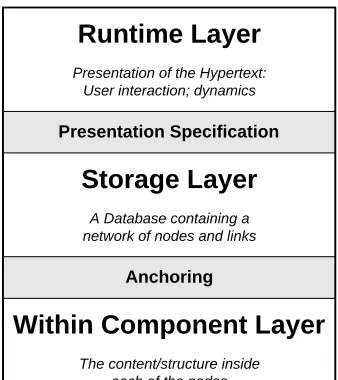
Figure 2.1: Dexter Hypertext Model
2.5.1 The Dexter Model
In December 1990 a workshop (Moline et al., 1990) was held on hypertext standardisa-tion at which various models of hypertext were discussed. One of the results of this work-shop was the ‘Dexter Reference Model’ (Halasz & Schwartz, 1994) the goal of which was to allow easy comparison between systems and thus work towards interoperability standards.
The model divides systems into three layers. The Runtime Layer contains all the facilities a user requires for constructing and browsing a hypertext. The Storage Layer represents the actual structures of the hypertext (e.g. links and nodes). The Within-Component Layer represents the content of the particular node or document.
There are also two interfaces within the model. The Presentation Specifications In-terface lies between the Runtime and Storage layers. It represents information on how the runtime layer is to process (represent) the objects in the storage layer. For example whether a viewer should open a file for viewing or editing. The Anchoring Interface is a mechanism for addressing locations or items within the content of an individual com-ponent. This maintains a clean separation between the Storage and Within Component layers.
The Within Component layer is responsible for maintaining the position of the an-chors within the various components (which remain opaque to the storage layer). While the storage layer deals with maintaining anchors within the node link structure.
21 model assumes that other reference models will be used that are specific to a particular application or data type.
The Dexter model was a major step forward, both technically in the sense that it allowed for n-ary links and composite nodes (no system at the time supported both these features) and also as it represented a major collaboration between hypertext researchers and institutions. It’s impact on interoperability work, the limitations identified and the ways in which it has been extended are discussed in Section2.9.
2.5.2 The Amsterdam Model
One of the concerns voiced about the Dexter Model was the lack of consideration it showed for emerging multimedia systems. The Amsterdam Hypermedia Model (AHM), developed by Lynda Hardman and Dick Bulterman at CWI (Hardman et al., 1994), at-tempted to marry the hyperstructures of the Dexter model with these new systems.
One of the biggest problems they came across was deciding on how a multimedia presentation ordered itself in Dexter terms. There are two aspects to this: Collection, where several items are presented together as one, and Synchronisation where those items are ordered in a presentation relative to one another. The authors suggest three Dexter based possibilities:
1. Hidden Structures: All the information is placed in the content, i.e. inside Dexter’s within-component layer. The problem with this is that it does not scale very well to more complex multimedia presentations.
2. Separate Structures: Each multimedia item is defined as a separate block. This makes all the structure transparent but synchronisation must be done explicitly and can become a big issue for large presentations.
3. Composite Structures: This combines the two approaches above; internalising complex relationships but leaving more basic ones exposed. Although this would work, it requires a specific solution for each presentation and does not provide a uniform solution.
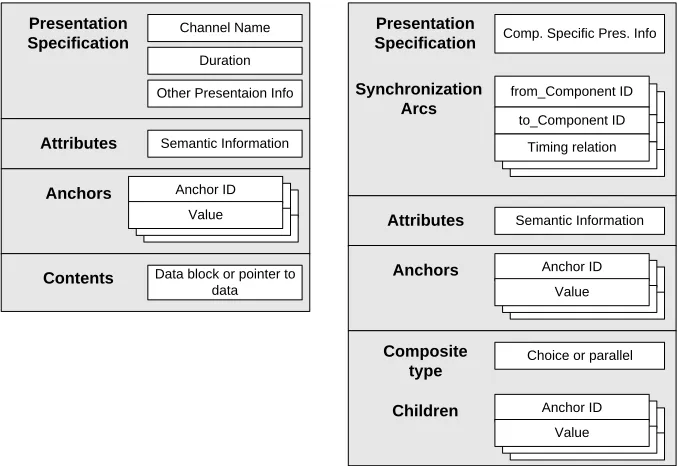
The AHM was produced by combining the Dexter model with the CWI Multimedia Interchange Format (CMIF) multimedia model and adding extensions to cover what was left. It is based on atomic and composite components as shown in Figure2.2.
Channel Name Duration Other Presentaion Info Presentation
Specification
Semantic Information Attributes
Anchors Anchor ID
Value
Data block or pointer to data Contents
Comp. Specific Pres. Info Presentation
Specification
Synchronization Arcs
Semantic Information Attributes
Anchors Anchor ID
Value
Children Anchor ID
Value Choice or parallel Composite
type
Atomic Component Composite Component
from_Component ID to_Component ID
[image:33.612.156.495.63.296.2]Timing relation
Figure 2.2: Amsterdam Hypermedia Model Atomic and Composite Components
component contains no temporal information as this can all be calculated from the com-ponents it contains. Instead it contains collections of Synchronisation Arcs, structures that define fine grained relative ordering information about the contained components.
The model also defines Channels. These are abstract devices for defining global presentation attributes. By abstracting this information out of components the AHM allows the same document to be presented in different ways simply by respecifying which channel to use for a particular component.
Lastly the AHM has a notion of anchor context. The Context object is a composite that contains a collection of components that are effected by a linking operation. Contexts allow specific display options to be associated with each link; in particular the source component can be retained or replaced, enabling a finer granularity of control over the presentation.
The AHM was implemented in the form of the CMIF editor (CMIFed) (Hardman & Bulterman, 1995) which allowed users to construct presentations using the AHM model. The authors found
23
2.5.3 The Trellis Model
While the Dexter and Hypermedia models attempt to provide a framework against which to compare existing systems and aid in the creation of new ones, other researchers have pursued models that aid the formal analysis of hypertexts. The Trellis hypertext model (Stotts & Furuta, 1989) (Furuta & Stotts, 1990b) was developed by P. David Stotts and Richard Furuta at the University of Maryland. Hypertext is often depicted as a directed graph of nodes and connections. Trellis extends this notion to Petri nets. A Petri net permits the specification of a hypertext’s browsing semantics, attaching meaning to the connections between nodes.
This Petri net structure can be viewed in two ways. Firstly it can appear as a for-mal language; describing a set of strings of symbols where each symbol represents a transition in the net. Secondly it can be thought of as an automata where the Petri net represents a state transition system. This means that semantics of the Petri net are defined mathematically as opposed to residing in any code that manipulates a directed graph.
A hypertext is built up of a Petri net structure, a set of document contents, a set of components (windows, buttons etc.) and collection of mappings between them.
The Trellis team point out that the model could be used to provide a basis for solving several hypertext problems:
1. Display Parameters: Certain characteristics of the display can be calculated, e.g. the maximum number of simultaneously required windows;
2. Concurrent Browsing Paths and Synchronisation: The model lends itself naturally to multiple browsing paths, in addition an author can specify that several paths are concurrent and also that they must be synchronised at certain points;
3. Node Reachability and Unreachability: It is possibly to verify that all the nodes within the hypertext can be reached and also discover which nodes can be reached from different starting points (this can vary according to access control and tailored hypertext semantics);
Using the Trellis model as their formalisation, the Trellis team extended their work to describe a hypertext ‘meta-structure’ that can be used as a reference model in a similar way to Dexter and AHM. They called this the Trellis hypertext reference model, or Trellis r-model (Furuta & Stotts, 1990a).
1. Abstract Component Level: This contains the components that will be associated together to form the hypertext;
2. Abstract Hypertext Level: This contains the connections between the components of the Abstract Component Level;
3. Concrete Context Level: This contains the mapping from the hypertext’s abstract representation (the two levels described above) to its physical representation and presents a physically based description of the hypertext;
4. Concrete Hypertext Level: This level maps the concrete representations generated in the layer described above into a set of windows for display;
5. Visible Hypertext Level: This level represents the display and interaction of the hypertext with one or more users;
It is important to realise that the r-model does not enforce any particular data or link model. These distinctions are recognised by the model but specific details are encapsu-lated within the Abstract Levels. Likewise content and presentation is modeled separately from this structure and itself is hidden within the Concrete Levels.
Thus the r-model is less operational than Dexter. Rather than being an abstract ma-chine it is a functional organisation showing relationships between elements in the vari-ous different layers, that might be used to serve as a high-level design guide for system implementers.
2.6
Open Systems
At the beginning of the 1990’s it was realised that the closed systems of previous years would not be sufficient in the future, particularly for industrial scenarios where compa-nies wished to continue using existing data and products (Davis et al., 1992). In partic-ular it was thought that hypermedia functionality should be available to all applications across the desktop, this meant a complete separation of link information from content. This approach gave birth to Open Hypermedia Systems.
25
2.6.1 Microcosm
In 1990 researchers at the University of Southampton identified four problems common to the hypertext systems of the time and designed a system, Microcosm, to overcome them (Fountain et al., 1990).
1. Authoring effort required; Documents become available far faster then they can be converted for a hypertext system. This can limit the data that a user has access to. 2. Hypertext systems are closed; Usually run as stand-alone systems that will not
communicate with other software packages. This results in a lack of extensibility that means it can be difficult to cope with new data formats.
3. Proprietary document formats; it is not possible to take documents present in one system and use them in another, for example documents written in a proprietary word processor would have to be reformatted for the hypertext system. This actu-ally makes the ‘Authoring’ problem worse.
4. Problems with read-only media; Many hypertext systems use tags or pointers within the data to represent links. When that data is read only (e.g. a CDROM) then this is not possible unless the links are already on the medium, in which case they cannot be updated or removed.
Microcosm was designed with a strict set of guiding principles:
No distinction between author and user; All users can also be authors, and authors
can browse their material in the same way as users.
Loosely coupled system; Microcosm is a set of communicating tasks, open in
struc-ture. It should be possible to add further components to the system to increase its functionality.
Separation of links from data objects; Information about relationships between
documents is separate from the documents themselves. Thus we have two levels of information; data (text, graphics, sound) and meta-data (relationships and links between data).
In 1993 Microcosm had become a mature hypertext system; the separation of links from data allowed Microcosm to let users navigate in a variety of ways (Davis et al., 1992).
Specific Links: Links an object at a specific point in a source document that
con-nects to a particular object in a destination document.
Dynamic Links: As Microcosm uses a database of links and nodes it is possible to
user selection in a source text document the system could do a grep for the same text in other documents.
Local Links: A dynamic link from a given object at any point in a specific document
that connects to a particular object in a destination document.
Generic Links: A dynamic link from a given object at any position in any document
that connects to a particular object in a destination document. Thus new documents added to the system may already contain links.
Relevance Links: Alternatively the node set could be pre-indexed to assist this
pro-cess. In which case it is possible to cluster documents according to their relevance to each other. It is possible for a user to then request all relevant documents (those in the same cluster).
Because of its open nature Microcosm could be used with any viewer. This could be a problem as the viewer may not actually be aware of Microcosm, particularly since at the time hypertext functionality was not common in off the shelf applications.
Microcosm thus works with three types of viewers. Fully aware Microcosm viewers were written explicitly with Microcosm in mind and allow the user to access the full range of Microcosm functionality. Partially aware viewers were applications that were tailorable in some respect, which enables them to become Microcosm aware, although the full range of features may not have been accessible. Unaware viewers were applications that could not be adapted. These could not natively use any Microcosm features but could still act as destination points of link traversal.
Microcosm also incorporated a feature that allowed MS Windows users to use Micro-cosm from Unaware viewers by communicating through the clipboard. MicroMicro-cosm was then responsible for reading the information and constructing an appropriate message for the application.
Experience with Microcosm allowed a general reflection on open systems.
Advantages:
Ability to cope with large numbers of documents with the added value of link following devices.
Data remains accessible to the applications that originally created it.
Ability to process the links. E.g. keep separate sets of links for different users and manipulate those sets.
Authoring effort is reduced via the use of local and generic links
27 Disadvantages:
Position of Anchors. When a user follows a link into a large document the viewer is normally required to move the view to the exact endpoint of the link within that document. This is not possible with unaware viewers, although it is less of a problem in partially aware viewers.
Editing problem. Because the links are not kept within the documents, if the docu-ments are edited away from the Microcosm system then the links may no longer be accurate. Similarly if the file is deleted then the link will dangle. This is combated in Microcosm be recording a time stamp on all links and nodes, when these change in relation to each other then Microcosm can either try and repair the link or will warn the user (Davis, 1995).
Experiments were also undertaken to see if Microcosm could be distributed (Hill & Hall, 1994) using TCP/IP as a transport mechanism for the messages. These were successful using
a peer to peer and client/server approach due to the openness of the system, with only a small performance hit. These experiments included multiple users accessing the same linkbase (database of links) however true collaboration was not supported.
2.6.2 DeVise Hypermedia (DHM)
In 1992 researchers at the University of Aarhus, Denmark decided to build a new Hyper-text system based firmly on the Dexter model. Both to prove the validity of that model but also to demonstrate its flaws and suggest improvements. The DeVise project resulted in the first version of DeVise Hypermedia (DHM) (Grønbæk & Trigg, 1994) an open and extensible architecture based around an Object Oriented Database (OODB).
The major revision that the DHM team made to the model was the inclusion of dan-gling links, i.e. links with zero or one endpoint were allowed in the system. They point out that this is a natural extension of the model, which allows incremental construction of links within the system and lazy updating and garbage collection when endpoints or nodes are deleted from the system.
DHM also explored the notion of link directionality. They identify three main no-tions:
1. Semantic direction: A semantic relationship between one endpoint and another, for example A ‘Supports’ B.
3. Traversal direction: In this case the user, during the creation process, explicitly gives the link a direction. The link can only be traversed in this direction, relying on a menu of ‘back-links’ as a mechanism to traverse them in the opposite direction.
The Dexter model allows for the specification of direction in a link but does not explain which of these notions it actually assumes. In DHM they tried to avoid this question by specifying all links as bi-directional at creation and allowing the user to modify this if they so wish.
Another problem they identified with the model concerned the use of Anchors as an abstraction between content and the actual hypermedia structures within the storage layer. The problem is caused when composites are used within the storage layer. An-chors to these composites are not defined, even though both composites and anAn-chors are transparent to the model. DHM includes composites as first class objects alongside nodes and links as defined in the Dexter model but it also extends the notion of composites to include virtual composites, computed components and structured composites.
DHM was extended to include support for collaboration (Grønbæk et al., 1997). This was seen as an important area as many large design projects that could benefit from hyper-media also had requirements in the collaboration area. The DHM researchers identified six modes of collaboration, describing the various ways in which users could utilise the same hypermedia system together.
1. Separate responsibilities. The material is split into several parts, each part is ma-nipulated by at most one user (although viewing another’s material is possible). This was seen as a very loose form of collaboration mainly consisting of one user making use of material controlled by another.
2. Turn taking. This is the same as ‘Separate responsibilities’ but each part may alternate between users. At most one user is allowed to modify a given part. This requires some support in the system to manage the part to user relationship. 3. Dynamic exchange. During a session, users may exchange parts dynamically. Thus
a user who wishes to modify a part controlled by another user may request that user to transfer their lock.
4. Alternative versions. Different users may develop different versions of the same part. These may be merged later.
5. Mutual sessions. Two or more users may work on the same part at the same time, changes being immediately updated on any shared sections of the part. A co-operative commit is required to update the part in the OODB.
29 DHM included support for the first four of these. Other projects in the same depart-ment concentrated on the last two outside of DHM itself.
2.6.3 Hyper-G
Hyper-G was an ambitious system that came out of the Graz University of Technology in the early 1990s (Kappe et al., 1993). It was an attempt to write an open hypermedia sys-tem for a particular distributed application, in this case a modern University Information System.
It was written to specifically deal with four areas:
1. Research. Giving individual scientists immediate access to the results of other researchers, accessing publications, libraries and databases of interest.
2. Teaching. Supporting the process of teaching and learning
3. Administration. Access and maintenance of relevant