Abstract—The purpose of this paper is to update recent research of the fleet size and mix vehicle routing problem (FSMVRP), the heterogeneous fleet vehicle routing problem (HFVRP), and the extensions in a form of a literature review. In this paper, four major components of the problem: classification, considerable input data characteristics, decision making approaches, and heuristic and meta-heuristics algorithms are discussed. The comprehensive overview of the heterogeneous vehicle routing problem which puts a special emphasis on robustness approach is concluded and demonstrated in a simplified structure which has never been presented before. New potential research areas resulting from the survey are suggested in the final section.
Index Terms— Heterogeneous fleet vehicle routing problem, Fleet size and mix, Robustness approach, Uncertainty
I. INTRODUCTION
HE vehicle routing problem (VRP) is one of the most interesting topics in which a lot of research put the effort to develop new methodology for solving a problem in which an efficient solution is obtained. Real-world problem deals with a heterogeneous VRP more than with a homogeneous type. When heterogeneous vehicles are considered in the VRP, the problem can be classified into two major classical problems: the heterogeneous fleet vehicle routing problem (HFVRP) and the fleet size and mix vehicle routing problem (FSMVRP). The problem variants such as time windows, split deliveries, etc., appear as additional constraints that can be involved in the model to represent border on the real business. The further details of the problems are discussed in section A of the literature review.
The heterogeneous vehicle routing problems demonstrate the facts if uncertainty is considered in the decision making. The uncertainty increases the difficulty for solving the problems, it has to use the proper techniques such as robust and stochastic approaches to handle such situations. The details of data characteristics and solution approaches, which are proposed in the recent works, are reviewed in
Manuscript received December 23, 2013; revised January 9, 2014. K. Soonpracha, Department of Industrial Engineering, Faculty of Engineering, Kasetsart University, 50 Phahon Yothin Road, Chatuchak,
Bangkok 10900, Thailand; (corresponding author, e-mail:
A. Mungwattana, Center of Excellence in Logistics and Department of Industrial Engineering, Kasetsart University, 50 Paholyothin Rd., Chatuchak, Bangkok 10900, Thailand (e-mail: [email protected]).
G.K. Janssens, Research group Logistics, Hasselt University, Agoralaan 1, 3590 Diepenbeek, Belgium (e-mail: [email protected]).
T. Manisri, Department of Industrial Engineering, Sripatum University (Bangkhen Campus), 61 Paholyothin Rd., Chatuchak, Bangkok 10900, Thailand (e-mail: [email protected]).
section B and C of the literature review.
The complexity of the HFVRP, FSMVRP, and the extensions forces research to put the efforts to develop the procedure called heuristic and metaheuristic algorithms for obtaining the solutions. In section D of the literature review, these schemes are up-to-date.
The final aim of this research is to conclude the problem structure and to introduce the new challenging problems in the heterogeneous vehicle routing problems for the academic world to develop a new methodology as an option for the business sectors.
II. LITERATUREREVIEW
A. FSMVRP, HFVRP, and the extensions
A homogeneous classification of vehicles, i.e. only one single type of vehicles with the same capacity, is composed in the classic VRP, but in the real world the use of a heterogeneous vehicle fleet is likely to yield better results than homogeneousproblem [1]. Most research on the VRPs focus on a homogeneous fleet, but the reality of the routing problems involves an aspect of the heterogeneous vehicle fleet in usual [2].
The literature review on heterogeneous vehicle routing can classify the problem into two major groups, the first group studies the heterogeneous fleet vehicle routing problem (HFVRP) and the second one studies the fleet size and mix vehicle routing problem (FSMVRP). Both types are similar, except that the available number of vehicles called fleet size is different. The FSMVRP makes use of an unlimited number of vehicles, the HFVRP is in opposite [2], [3]. Anyhow, few researchers assume infinite vehicle resources in the HFVRP [4]–[6]. Most studies relating to FSMVRP focus on a strategic planning that a decision has to be made for investing or re-sizing the number of vehicles aims at an efficient business plan, while the HFVRP puts more emphasis on optimizing the total cost of the existing available vehicles.
In practice, a distribution system can operate from more than a single depot, called the multi-depot problem [7], [8]. The multi-trip problem allows a truck to perform several travels with the different drivers. A trip in such problem is defined by a sequence of client visitation [9]. When the vehicle fleet is not required to return to the central distribution center after the service task is performed completely, this problem is called the open VRP [10].
The restriction on working hours of the drivers to respect the labor protection laws and the contracting time requirement of the customers make up another limitation of the FSMVRP which has the specific name as time windows
Heterogeneous VRP Review and Conceptual
Framework
Kusuma Soonpracha, Anan Mungwattana, Gerrit K. Janssens, and Tharinee Manisri
(TW). A truck that reaches a customer before the earliest time, after the latest time and after the route time incurs a waiting time, a tardiness time and overtime, respectively [11]. The FSMVRPTW and HFVRPTW can be found in the published research work [12]–[20]. Another generalization problem of the VRP concentrates on line-haul. If some goods have to be picked up from a customer and carried to the distribution center on the way back, this is called backhaul. A practical vehicle routing problem is possible mixed up between line-haul and back-haul customers [21]. Further, when the variability of product types is extended from single to product mix, the specific problem of multiple products is determined [22]. The customer demand in the classic VRPs has to be served by a single carrier. The problem with split deliveries does not limit the number of trucks to deliver the products [23]–[25]. The overload variant is studied by adding a penalty term in the objective function when the carrying weight exceeds the capacity limitation [26].
B. Considerable Input Data Characteristics in FSMVRP, HFVRP and the extensions
A problem data set of a model, a representation of a real world problem, can be determined either in a deterministic or in a non-deterministic way. The problem is called deterministic if the data set is identified as a single-value which usually represents an average behavior of the system [27]. Otherwise the concerned system information is imperfect by the impact of some noise and some errors. The FSMVRP, HFVRP and the extensions have the general variants consisting of customer demand, number of customers, geographical location, travel time, service time, vehicle capacity or its productivity, and transportation cost such as travel cost, third-party carrier cost, etc. These elements can be assumed either as a single value or turned to be a non-specific value. The uncertainty is considered when the problem is supposed to be most likely to the nature.
The literature reviews of the prior classical FSMVRP [8], [28]–[35] found that the assumptions of the customer demand, travel distance, travel time and vehicle capacity are all determined in a deterministic way. A single-point value of service time is included in some studies [1], [36]. Yuan-yuan & Jian-bin [37] introduce the homogeneous fleet size with seasonal demand and set the planning period as multi-periodic. Time windows limitation can be classified either into hard or soft time windows. Some authors [12], [13], [15], [18] assume hard time windows in which a late arrival is not allowed. By contrast, an extra cost is punished when a truck cannot reach a destination within the latest permission [14]. Belfiore and Yoshizaki [24], [25] present the FSMVRPTWSD and assume the certain value for all data sets. The depot is enlarged the scope from single to multiple locations [7], [8], anyway the concerned evidences of the other variants are known with a fixed value.
The usual routing problem of the limited available fleet size known as HFVRP is investigated in [4]–[6], [8], [32], [34], [38], [39]. Li et al. [10] identify all input parameter sets as deterministic for the open HFVRP. The research scope is broadened by limiting the time windows [16].
Ceschia et al. [19] suggest a multiple days planning horizon and define the input parameter as deterministic.
The option of separating the certain demands which exceed the vehicle capacity is supposed in the study of De Campos and Yoshi [40]. De la Cruz et al. [22] present the service of multiple products which account for the weight and volume into the calculation method, nevertheless, the requirement of the customer demands is still consistent. According to Dondo & Cerda´ [41], the real world vehicle routing usually include more than one depot, their solution is covered by the multi-depot problem. Anyway the customer orders and the consideration of journey times are maintained as deterministic. The mixing of line-haul and back-haul customers is exhibited in the HFVRP [21], the data pertaining to customer requisitions are set as a uni-value. The capacity relaxation is presented, where overload carrying is allowed such as during the peak hours [26]. Only one of all HFVRP’s papers addresses the random customer locations and the demands with uniform distribution in HFVRP with multiple trips [9].
The above surveys of FSMVRP, HFVRP, and the extensions indicate that few research papers place emphasis on uncertain inputs. Anyhow, the uncertain parameters are studied in the wide range of the homogeneous vehicle fleet. The random parameters are explored in the problem called the stochastic vehicle routing problem and the robust vehicle routing problem. A difference between both problems is the outcome that will be discussed in the next section. The studies of the homogeneous fleet that must serve fluctuating demand with a known number of customers and the locations exist in some works [42]–[49]. The attribute of uncontrollable travel times between the clusters is focused in Janssens et al. [50], Manisri et al. [11], and Yin et al.
[51]. More than fifty articles of stochastic VRPs are referred in the paper by Daneshzand [52] who categorizes the uncertain data into four stochastic factors: customer demand, travel time, customers, and service time. All above papers refer to the homogeneous VRPs. The heterogeneous VRPs are indicated in the absence of uncertainty focus.
C. Approaches in Decision Making
An outcome of a final selection among several problem scenarios is obtained from a decision making process. In this study, the decision making approaches are divided into three groups: deterministic, stochastic, and robust where the fundamental review is mainly referred to some scholastically works [27], [42], [53]–[57]. The deterministic approach assumes that if a model is constructed by assuming all known inputs with a fixed value of the best-guess or the worst-case, an outcome is certain with a unique set of outputs. The deterministic solution is, perhaps, best for the specific model, but not for all real situations. The solution of the deterministic approach is optimal but for the most likely. It may be wrong or unacceptable if the presence of significant data is changed by an uncertain effect.
expected benefit over all scenarios, the optimal solution obtained from the approach reflects the characteristics of real situations. The stochastic optimization solution is more acceptable than the results of deterministic approach, nevertheless the size of the stochastic program grows fast in the number of time periods and stochastic parameters. Most of the stochastic VRPs recently concentrate on two classes: recourse-constrained and chance-constrained (so called probabilistic-constrained) problems. Recourse-constrained problems are characterized by making a decision for several stages; the two-stage problem is the basic idea. An initial decision is made in the first stage before realizing the actual problem. The recourse decision is taken in the next stage where the possible scenarios are formed with a probability of realization assigned to each. The decision in this period is required to balance the first decision making. Chance-constrained problem looks at the possibility of constraint violation. The constraints are modeled as the probability form to make sure that the function will not larger than an acceptable value within a significant level. In the simplest case, the stochastic approaches force the decision makers to assign a probability distribution in advance, but this action leads to a difficulty in practice. The important failure of the stochastic optimization approaches raised by Kouvelis and Yu [54] is that the final decision depends upon only one realized data scenario. The solution does not protect uncertainty against the whole system.
Apart from the stochastic optimization approach, the robustness approach is another way to handle the uncertainty. Mulvey et al. [53] explain two robust terms: solution robust and model robust. The term ‘solution robust’ is used if it remains ‘close’ to optimal for all scenarios. The term ‘model robust’ is used if a robust solution remains almost feasible for any scenario realizations. The aim of the approach is to produce a reasonable decision under any likely input data scenario over a pre-specified planning horizon using robust solution concept [54]. Bertsimas & Sim [58] develop a robust model using a parameter called ‘price of robust’ to control the tradeoff between the probability of violation and the objective function effect. The robustness approaches can be applied for various cases, the classic application is the diet problem [53]. Bertsimas and Simchi-Levi [59] present a prior optimization by constructing a prior route and updating later depending on the random information.
In logistics and networks, the study of road networks using the robust approaches consisting of sensitivity-based, scenario-based and min-max is presented [51]. These techniques are used to handle the perturbed demand. Hosseini and Dullaert [60] present two major approaches: reactive and proactive robustness. The reactive approach indicates the post-optimality that is to discover the impact of data perturbation on the constructed model. The sensitivity analysis is one of the reactive approaches [61]. The proactive type applies for improving the solution that is less sensitive to the uncertainty [60]. Stochastic optimization and robustness are classified into this group. Sörensen [27] classifies the robust approaches into three types: sensitivity analysis, mathematical programming approach, and control approach. Ben-tal et al. [62] identify the robust optimization as the immunization against uncertainty. They illustrate the
basic assumptions of robust optimization approach named ‘here and now’. The robust model of Hosseini and Dullaert [60] is adopted the formulation supposed by Mulvey [53] and put an additional term of error in the constraint formulization. The robust optimization models of logistic networks consisting of variability, regret, and min-max formations are developed in the research. Moghaddam et al.
[49] refer to the concept of robust optimization illustrated by El Ghaoui [63] that the robust area is the interaction of two areas of feasible solutions that are obtained from a deterministic problem and the problem when the parameter is disturbed by some noise.
D. Heuristics and Metaheuristics for FSMVRP, HFVRP and the extensions
The results of the literature review repeat the knowledge that the FSMVRP, HFVRP, and the extensions lack of insight in the study of robustness. The robustness is considered in several homogeneous VRPs, but not for heterogeneous VRPs. Hoff et al. [2] point out that the road-based problems lack the study of uncertain customer locations, customer demands, and traffic conditions. The robust solution is the good answer to a question of acquiring vehicle numbers in the long run. The robustness is addressed in some classifications of fleet management such as dynamic fleet management, air and marine transportation but the robustness study is short for fleet composition and VRPs [64].
It is because published work on the robust FSMVRP, HFVRP, and their extensions do not exist. The review in this section is performed by investigating the related studies. A robust solution is generated to solve two uncertain sources: the future demands and the vehicle productivity in the fleet sizing problem [43]. Sungur et al. [44] present a robustness procedure to solve the capacitated VRP. The Miller-Tucker-Zemlin (MTZ) formulation, used for the general VRP, is modified by replacing the suggested model of demand uncertainty. Zhu et al. [65] present the robust optimization considering the worst case for VRPTWSD.
Exact algorithms have proven to be unsuccessful for solving complex problems, the solution times are too large when solving problems of large size. Moghaddam et al. [46], [49] construct ant colony optimization (ACO) and advanced particle swarm optimization (PSO) algorithms. As mentioned in Ólafsson [66], metaheuristics are designed to undertake the complex optimization problems and for many real-world problems that are combinatorial in nature. Examples include methods such as ACO, PSO, Tabu search (TS), genetic/evolutionary algorithms (GA/EA), iterated local search (ILS), scatter search (SS), etc.
Sörensen & Sevaux [45] develop a sampling based approach to estimate the robustness and flexibility of a solution using GA hybridized with local search. Goh et al.
the stochastic duration times with distribution free of the project network. Janssens et al. [50] establish a methodology in which a heuristic is used to find out a solution that answers ‘what-if’ questions. The algorithm considers the network where represents a VRP with uncertain travel time solution.
Literature in the field of robust vehicle routing problem is absolutely not vast, especially in the case of heterogeneous VRPs. The heuristics and metaheuristics paradigms of the existing FSMVRP, HFVRP, and the extensions with certain data are surveyed in consequence. The first published research of FSMVRP is initiated by Golden et al. [69]. The savings heuristic based on the Clarke and Wright-method is utilized in the novel. Osman & Salhi [1] present the route perturbation constructive heuristic and Tabu search (TS) procedure. A generalized insertion (GENI) heuristic is used for constructing the initial routes, the unstringing and stringing (US) is applied in the improvement phase [28]. The concept of TS and adaptive memory procedure (AMP) is adapted to avoid catching in bad local optima trap and to update memory in a pool of the solutions, respectively [36]. Wassan and Osman [29] select the reactive TS concepts to balance the search between diversification and intensification. The TS algorithm based on insertion and swap neighborhood moves is applied for FSMVRP [30]. The generic algorithm (GA) is implemented, the local search on a chromosome for the improvement stage is repeated until no improving move can be found for any mutation pairs [31]. The GA-based algorithm is also applied in the research studied by Prins [9] but this time it is hybridized with a local search and distance measure in solution space to diversify the search. Baldacci and Mingozzi [8] introduce the exact algorithm based on the set partitioning formulation which is able to solve the problem by an integer linear programming solver. Penna et al. [34] construct routes by iterated local search.
The FSMVRPTW is more complex and harder to solve. Dullaert et al. [12] adapt the savings perspective based on Golden et al. [69] and redesign the scheme by adding the concepts of combination and elimination. Amico et al. [14] produce a multi-start constructive heuristic and adopt the ruin and recreate approach to obtain new solutions. Bräysy
et al. [15] suggest merging the routes in the first phase, and then examining route elimination by local search; the procedure is modified resulting in increasing ability of large-problem size solving [17]. Repoussis and Tarantilis [18] present the adaptive memory programming solution approach. Belfiore and Yoshizaki [24] perform the study of FSMVRPTWSD and conduct the scatter search approach to solve the problem; this scheme is implemented in a real-life case of a major Brazilian retail group. The framework is modified by the same authors to make a competitive solution method with several well-known benchmark problem sets [25]. The heuristic algorithm is designed by using the giant tour and enhancing the solution by a seven-operation composition heuristic algorithm in the FSMVRP with multiple depots [7].
Tarantilis et al. [38] introduce the backtracking adaptive threshold accepting method for solving HFVRP. The linear programming based column generation approach is developed to obtain the lower bounds for all HFVRP
variants [4]. Anyhow the literature review that is done by Baldacci and Mingozzi [8] shows that the results by applying the exact method presented in Fukasawa et al. [70] dominate the lower bounds proposed by Golden et al. [69], Yaman [71] and Choi and Tcha [4]. The variable neighborhood search is presented in Imran et al. [39]. The multi-start adaptive memory procedure and path relinking (PR) are used for solving the HFVRP [5]. A modified TS is in the study of Brandão [30].
A reactive variable neighborhood TS algorithm added the reformation in a phase is suggested for solving the HFVRPTW [16]. The asynchronous situated co-evolution (ASiCo) algorithm is inspired by natural evolution in terms of the use of decentralized and asynchronous open-ended evolution [20]. Ceschia et al. [19] enlarge the problem variant by dealing a carrier-dependent cost in the HFVRPTW, the TS, neighborhood structure and the prohibition rules are applied. Dondo and Cerda [41] recommend a hybrid cluster-based heuristic for the HFVRPTW with multiple depots. The aim of accelerating the search performance leads to the suggestion of implementing the two-pheromone ant colony system for the HFVRPTW with multiple products [22]. The particle swarm optimization approach is applied for solving the HFVRPTW with mixed backhauls [21]. The overload HFVRPTW is proposed to use an insertion-based framework for obtaining solutions [26]. The multi-trip HFVRP is presented by Prins [9], who chooses the greedy heuristic, the local search and TS to accomplish the problem goal. Li et al. [10] produce a multi-start adaptive memory procedure with modified TS algorithm for a new variant of the open HFVRP.
All above works share the same target aiming to obtain an optimal solution, specifically a total cost to be minimized. The robust problem is excluded that the objective is to obtain the close solution optimization. The VRP and its variants have the general target of finding the routes that optimize some objective function. Although the heuristic and metaheuristic algorithms proposed by each author as reviewed above are efficient and can yield good solutions, these schemes do not guarantee the optimality.
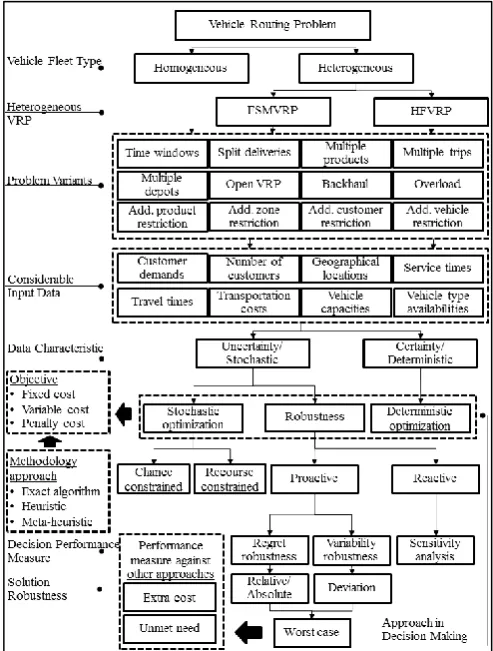
III. THE FSMVRP AND HFVRP CONCEPTUAL FRAMEWORK Resulting from the survey, a simplified structure is developed for clarifying a comprehensive overview of problem conceptual framework as shown in Fig.1. The purpose of this structure design is to demonstrate the sequential idea for developing the new interesting problems in the field of the heterogeneous fleet vehicle routing problem and its variants.
In this study, the VRP is composed of: homogeneous and
heterogeneous vehicle routing problems. The difference between both types is a variety of the vehicle kinds: the homogenous VRP makes use of only one single type with the same vehicle capacity, and the heterogeneous class makes use of the vehicles with dissimilar capacities.
heterogeneous fleet VRP is used. The number of available vehicles is a trigger that makes the problems differ from each other: the fleet size is limited and unlimited for HFVRP and FSMVRP, respectively.
Fig. 1 The comprehensive overview of the heterogeneous VRP which puts a special emphasis on robustness approach
The problem variants of either homo- or heterogeneous VRP can be considered in common. The variants which appear in current research consist of time windows, split deliveries, multi-product, multi-depot, multi-trip, open VRP, backhaul and overload. The definitions are described in section II-A. In real-world practice, the other limitations in business can be grouped into 4 general restrictions as following: 1) the product restriction is such as ‘some products cannot be transported in the same truck’, 2) the zone restriction is for example: ‘some areas limit automobile-access and/or time-access’, 3) the customer restriction is for instant: ‘some customers cannot be assigned the same route’, and 4) the vehicle restriction is such as ‘some trucks are equipped with a speed limiter’. These variants are missing from current research topics.
The considerable input data of all VRPs usually consist of customer demands, number of customers, geographical locations of both customers and depots, travel times, and transportation costs (fixed and variable costs). The vehicle capacities (or productivities) and availabilities are two other parameters that are considered in reality. The original vehicle capacities can decrease after several year-usage. In the case of limited number of vehicles, it may happen that some resources need maintenance causing that the available numbers are not as to the plan. The last couple variants have not been founded yet in any academic studies.
The data characteristics of all above constraints can be
supposed as of stochastic (or uncertain) or deterministic (or certain) nature. Most recent works, especially in the homogeneous VRP, consider certain data where the best guessing is determined. The deterministic character reduces the complexity of the problems but it is unlike from the real practice. The uncertain data, called stochastic in many research, is most likely to the world of nature which is more complicated and complex. The uncertain data is less appearing in the VRP studies. From the best knowledge of ours, no authors produce yet the studies of heterogeneous VRP in the case of uncertainty.
The objective function of the heterogeneous VRP is to minimize the cost function which usually composted with 1) a vehicle fixed cost (acquisition cost, number of vehicle, etc.), 2) a variable cost (traveling cost by vehicle: travel distance, time travelled, en route time travelled: sum of distance travelled, service times and waiting times), and 3) a penalty cost (constraint violation punishment). In most cases, the sum of fixed and variable costs identify the objective function. The penalty cost is added to the sum of fixed and variable cost.
The research puts efforts to accomplish the goal of the problems by developing various efficient methodology approaches. In the heterogeneous VRPs, most academicians construct the heuristic and metaheuristic algorithms to cope with the complexity of NP-hard problems. The exact algorithm is less studied. Even it can produce a high solution quality, the huge of time spending to solve the large problem size is the obstacle.
Although the various algorithms are proposed with the difference names and platforms, the procedures can be grouped into two major phases: initial solution construction, and solution improvement. It is well acknowledgeable that a good initial solution leads to a good result. The heuristic and metaheuristic schemes that are implemented in recent research can be consolidated as follows: iterated local search (2-opt, 3-opt, or-opt, exchange move, swap, shift, split, λ-interchange, cross), branch-and-bound, adaptive memory procedure, variable neighborhood, ant colony optimization, Tabu search, genetic algorithm, evolutionary algorithm, scatter search, saving-based, route perturbation procedure, generalized insertion, unstringing and stringing, greedy heuristic (nearest neighborhood, insertion-based, sweep-based, weighted saving criterion), threshold accepting-based, ruin and recreate approach, simulated annealing base, path relinking, Pareto concept based, asynchronous situated co-evolution algorithm, and so on. Although these algorithms proposed are efficient and can yield good solutions, these schemes do not guarantee optimality. Either adaptation or construction of a new algorithm is still challenging for the researchers who are interested in the study of the heterogeneous VRPs under uncertainty which is a brand new problem.
The stochastic optimization and robustness approaches are input by uncertain or randomized parameters. Two major approaches of stochastic optimization are common used: chance and recourse constraints. A final decision depends on only one realized data scenario, not for protecting uncertainty against all situations. The robustness approach in this paper is based on the scenario-based approach and can be grouped into two classes; proactive and reactive, regarding to the characteristic of each approach. The reactive robust approach is the post-optimality that is applied after a decision has been made. Sensitivity analysis is one of the techniques that is classified in this group. It is used to test the relationship between a solution and the uncertainty in inputs. In contrast, the proactive robust approach implements to yield a solution close to optimum for the whole scenarios of uncertain environment. It is beneficial in long run planning.
In this study, the proactive robustness approach arranges in two decision performance measurements classes: regret and variable robustness. The regret robustness makes use of the relative and absolute robustness criteria. Both are used to measure the performance of the decision. An absolute robustness measure is proper for the single scenario decision and is applied for evaluating the decision across all scenarios. A relative robustness measure compares against the best possible performance in each scenario resulting in percentages of the best decision. The robust deviation criterion is an example in the class of variable robustness. This criterion is similar to the relative robustness, but it does not evaluate as a percentage.
The solution robustness is obtained by applying a concept of worst case target to hedge against uncertainty in all input environments with a reasonable outcome. In this paper, the robust discrete optimization is suggested by using the minimax criterion that is one of the worst case approaches. The methodology, stated by Kouvelis and Yu [54], is to evaluate the highest level of cost taken across all possible future input data scenarios is as low as possible, as a result that the outcome can protect the worst that might happen.
The robust solution is finally performed performance measurement against the other approaches. The indicators suggested in this paper include the extra cost and the unmet requirements. The extra cost indicator is to compare the cost of the robust approach with respect to the expected cost of the optimal solution of the deterministic approach. The unmet requirements (e.g. demand, travel time, etc.) indicator is used for evaluating the effect on the unmet needs when the deterministic approach faces with the worst case. Both indicators can be used for balancing the cost and unexpected of data in uncertain situation of the heterogeneous VRPs.
IV. CONCLUSION
This paper aims to demonstrate the sequential idea for developing new interesting problems in the field of heterogeneous fleet vehicle routing problem and its variants. Results from the surveys indicate that most recent works assume the inputs as deterministic, the considerable stochastic or uncertain data are missing. The recommendation here is to put emphasis on contribute the studies by considering the uncertainty where is practical in
real-world.
The robustness approach is very attractive because it is used to yield the reasonable solution (i.e. good enough and close to optimum) and can hedgeagainst the risk of change under uncertainty. According to the statement of many authors the robust approach is one of the potential techniques that can handle the uncertain environments which are the representation of the real-life topics that this research gives the priority to investigate.
The heuristic and metaheuristic algorithms can be either renewed or innovated to solve the robust heterogeneous fleet vehicle routing problem and its variants under uncertainty of an input parameter such as travel time, demand, number of customer, etc. It is due to the uncertain characteristic of the input data, the modification of randomized search heuristics such as genetic/evolutionary algorithms, ant colony optimization, particle swarm optimization, and so on, are suggested to hybridize either an initial solution construction or the solution improvement phase.
The final process of the study should evaluate the robust solution against the other approaches such as deterministic. The reason is to balance between the expensive cost when a robust approach is applied and the unmet need when the deterministic approach has to suffer once the worst case happens.
REFERENCES
[1] I. H. Osman and S. Salhi, Local search strategies for the vehicle fleet
mix problem. In Modern heuristic search methods. V. Rayward-Smith, I. Osman, C. R. Reeves and G. Rayward-Smith, Eds., Chichester: John Wiley & Sons, 1996, pp. 131-154.
[2] A. Hoff, H. Andersson, M. Christiansen, G. Hasle and A.
Lokketangen, "Industrial aspects and literature survey: fleet composition and routing," Computers & Operations Research, vol. 37, no. 12, pp. 2041-2061, 2010.
[3] R. Baldacci, M. Battarra and V. Daniele, "Routing a heterogeneous fleet of vehicles," Technical Report DEIS OR.INGCE, vol. 1, 2007.
[4] E. Choi and D.-W. Tcha, "A column generation approach to the
heterogeneous fleet vehicle routing problem," Computers & Operations Research, vol. 34, pp. 2080-2095, 2007.
[5] X. Li, P. Tian and Y. Aneja, "An adaptive memory programming
metaheuristic for the heterogeneous fixed fleet vehicle routing problem," Transportation Research Part E, vol. 46, pp. 1111-1127, 2010.
[6] J. Brandão, "A tabu search algorithm for the heterogeneous fixed fleet
vehicle routing problem," Computers & Operations Research, vol. 38, pp. 140-151, 2011.
[7] S. Salhi and M. Sari, "A level composite heuristic for the
multi-depot vehicle fleet mix problem," European Journal of Operational Research, vol. 103, pp. 95-112, 1997.
[8] R. Baldacci and A. Mingozzi, "A unified exact method for solving different classes of vehicle routing problems," Mathematical. Programming, vol. 120, pp. 347-380, 2009.
[9] C. Prins, "Efficient heuristics for the heterogeneous fleet multitrip VRP with application to a large-scale real case," Journal of Mathematical Modelling and Algorithms, vol. 1, pp. 135-150, 2002.
[10] X. Li, S. C. Leung and P. Tian, "A multistart adaptive memory-based
tabu search algorithm for the heterogeneous fixed fleet open vehicle routing problem," Expert Systems with Applications, vol. 39, pp. 365-374, 2012.
[11] T. Manisri, A. Mungwattana and G. K. Janssens, "Minimax
optimisation approach for the robust vehicle routing problem with time windows and uncertain travel times," International. Journal of Logistics Systems and Management, vol. 10, no. 4, pp. 461-477, 2011.
[13] P. P. Belfiore and L. P. L. Fávero, "Scatter search for the fleet size and mix vehicle routing problem with time windows," CEJOR, vol. 15, pp. 351-368, 2007.
[14] M. D. Amico, M. Monaci, C. Pagani and D. Vigo, "Heuristic
approaches for the fleet size and mix vehicle routing problem with time windows," Transportation Science, vol. 41, no. 4, pp. 516-526, 2007.
[15] O. Bräysy, W. Dullaert, G. Hasle and D. Mest, "An effective
multirestart deterministic annealing metaheuristic for the fleet size and mix vehicle routing problem with time windows," Transportation Science, vol. 42, no. 3, pp. 371-386, 2008.
[16] D. Paraskevopoulos, P. Repoussis and C. Taranti, "A reactive variable
neighborhood tabu search for the heterogeneous fleet vehicle routing problem with time windows," Journal of Heuristics, vol. 14, pp. 425-455, 2008.
[17] O. Bräysy, P. P. Porkka, W. Dullaert, P. Repoussis and C. Tarantilis
"A well-scalable metaheuristic for the fleet size and mix vehicle routing problem with time windows," Expert Systems with Applications, vol. 36 no. 4, pp. 8460-8475, 2009.
[18] P. Repoussis and C. Tarantilis, "Solving the fleet size and mix vehicle routing problem with time windows via adaptive memory programming," Transportation Research Part C, vol. 18, pp. 695-712, 2010.
[19] S. Ceschia, L. D. Gaspero and A. Schaerf, "Tabu search techniques for the heterogeneous vehicle routing problem with time windows and carrier-dependent costs," Journal of Scheduling, vol. 14, pp. 601-615, 2011.
[20] A. Prieto, F. Bellas, P. Caamaño and R. J. Duro, "Solving a heterogeneous fleet vehicle routing problem with time windows through the asynchronous situated coevolution algorithm," In: Advances in Artificial Life. Lecture Notes in Artificial Intelligence no. 5778Springer-Verlag, pp. 200-207, 2011.
[21] F. Belmecheri, C. Prins, F. Yalaoui and L. Amodeo, "Particle swarm
optimization algorithm for a vehicle routing problem with heterogeneous fleet, mixed backhauls, and time windows," Journal of Intelligent Manufacturing, 2012.
[22] J. J. De la Cruz, C. D. Paternina-Arboleda, V. Cantillo and J. R. Montoya-Torres, "A two-pheromone trail ant colony system--tabu search approach for the heterogeneous vehicle routing problem with time windows and multiple products," Journal of Heuristics, 2011.
[23] G. Guidolin de Campos, H. T. Yoshizaki and P. P. Belfiore, "Genetic
algorithms and parallel computing for a heterogeneous fleet vehicle routing problem with time windows and split deliveries," XII ICIEOM - Fortaleza, 2006.
[24] P. Belfiore and H. T. Yoshizaki, "Scatter search for a real-life heterogeneous fleet vehicle routing problem with time windows and split deliveries in Brazil," European Journal of Operational Research, vol. 199, pp. 750-758, 2009.
[25] P. Belfiore and H. T. Yoshizaki, "Heuristic methods for the fleet size and mix vehicle routing problem with time windows and split deliveries," Computers & Industrial Engineering, vol. 64, pp. 589-601, 2013.
[26] M. N. Kritikos and G. Ioannou, "The heterogeneous fleet vehicle routing problem with over loads," International Journal of Production Economics, 2013.
[27] K. Sörensen, "A framework for robust and flexible optimisation using
metaheuristics with applications in supply chain design," A PhD thesis of Universiteit Antwerpen Faculteit Toegepaste Economische Wetenschappen, 2003.
[28] M. Gendreau, G. Laporte, C. Musaraganyi and É. D. Taillard, "A tabu
search heuristic for the heterogeneous fleet vehicle routing problem," Computers & Operations Research, vol. 26, pp. 1153-1173, 1999. [29] N. A. Wassan and I. H. Osman, "Tabu search variants for the mix
fleet vehicle routing problem," Journal of the Operational Research Society, vol. 53, pp. 768-782, 2002.
[30] J. Brandão, "A deteministic tabu search algorithm for the fleet size and mix vehicle routing problem," European Journal of Operational Research, vol. 195, pp. 716-728, 2009.
[31] S. Liu, W. Huang and H. Ma, "An effective genetic algorithm for the
fleet size and mix vehicle routing problems," Transportation Research Part E, vol. 45, pp. 434-445, 2009.
[32] C. Prins, "Two memetic algorithms for heterogeneous fleet vehicle
routing problems," Engineering Applications of Artificial
Intelligence, vol. 22, pp. 916-928, 2009.
[33] A. Subramanian, P. H. V. Penna, E. Uchoa and L. S. Ochi, "A Hybrid
Algorithm for the Fleet Size and Mix Vehicle Routing Problem," European Journal of Operational Research, vol. 221, no. 2, pp. 285-295, 2012
[34] P. H. V. Penna, A. Subramanian and L. S. Ochi, "An iterated local search heuristic for the heterogeneous fleet vehicle routing problem," Journal of Heuristics, vol. 19, no. 2, pp. 201-232, 2011.
[35] A. Redmer, J. Żak, P. Sawicki and M. Maciejewski, "Heuristic
approach to fleet composition problem," Social and Behavioral Sciences, vol. 54, pp. 414-427, 2012.
[36] J. Renaud and F. F. Boctor, "A sweep-based algorithm for the fleet size and mix vehicle routing problem," European Journal of Operational Research, vol. 140, pp. 618-628, 2002.
[37] Z. Yuan-yuan and L. Jian-bin, "Dynamic optimal model of vehicle fleet size and exact algorithm," System Engineering - Theory & Practice, vol. 27, no. 2, pp. 83-91, 2007.
[38] C. Tarantilis, C. Kiranoudis and V. Vassiliadis, "A threshold
accepting metaheuristic for the heterogeneous fixed fleet vehicle routing problem," European Journal of Operational Research, vol. 152, pp. 148-158, 2004.
[39] A. Imran, S. Salhi and N. A. Wassan, "A variable neighborhood-based heuristic for the heterogeneous fleet vehicle routing problem," European Journal of Operational Research, vol. 197, pp. 509-518, 2009.
[40] G. G. de Campos and H. T. Yoshi, "Genetic algorithms and parallel computing for a heterogeneous fleet vehicle routing problem with time windows and split deliveries," Gestao & Producao, vol. 13, no.2, pp. 271-281, 2006.
[41] R. Dondo and J. Cerda´, "A cluster-based optimization approach for the multi-depot heterogeneous fleet vehicle routing problem with time windows," European Journal of Operational Research, vol. 176, pp. 1478-1507, 2007.
[42] W. Stewart and B. Golden, "Stochastic vehicle routing: a
comprehensive approach," European Journal of Operational Research, vol. 14, pp. 371-385, 1983.
[43] G. F. List, B. Wood, L. K. Nozick, M. A. Turnquist, D. A. Jones, E.
A. Kjeldgaard and C. R. Lawton, "Robust optimization for fleet planning under uncertainty," Transportation Research Part E, vol. 39, pp. 209-227, 2002.
[44] I. Sungur, F. Ordónez and M. Dessouky, "A robust optimization approach for the capacitated vehicle routing problem with demand uncertainty," Inst. Ind. Eng. Trans., vol. 40, no. 5, pp. 509-523, 2008. [45] K. Sörensen and M. Sevaux, "A practical approach for robust and
flexible vehicle routing using metaheuristics and Monte Carlo sampling," Journal of Mathematical Modelling and Algorithms, vol. 8, pp. 387-407, 2009.
[46] B. F. Moghaddam, S. J. Sadjadi and S. M. Seyedhosseini,
"Comparing mathematical and heuristic methods," International Journal of Research and Reviews in Applied Sciences, vol. 2, no. 2, pp. 108-116, 2010.
[47] A. Aguirre, M. Coccola, M. Zamarripa, C. Méndez and A. Espuña, "A
robust MILP-based approach to vehicle routing problems with uncertain demands," 21st European Symposium on Computer Aided Process Engineering – ESCAPE 21, pp. 633-637, 2011.
[48] J. C. Goodson, J. W. Ohlmann and B. W. Thomas, "Cyclic-order neighborhoods with application to the vehicle routing problem with stochastic demand," European Journal of Operational Research, vol. 217, pp. 312-323, 2012.
[49] B. F. Moghaddam, R. Ruiz and S. J. Sadjadi, "Vehicle routing problem with uncertain demands: An advanced particle swarm algorithm," Computers & Industrial Engineering, vol. 62, pp. 306-317, 2012.
[50] G. K. Janssens, A. Caris and K. Ramaekers, "Time Petri nets as an evaluation tool for handling travel time uncertainty in vehicle routing solutions," Expert Systems with Applications, vol. 36, pp. 5987-5991, 2009.
[51] Y. Yin, S. M. Madanat and X.-Y. Lu, "Robust improvement schemes
for road networks under demand uncertainty," European Journal of Operational Research, vol. 198, pp. 470-479, 2009.
[52] F. Daneshzand, "The vehicle-routing problem," Logistics Operations and Management, pp. 127-153, 2011.
[53] J. M. Mulvey, R. J. Vanderbei and S. A. Zenios, "Robust optimization
of large-scale systems," Operations Research, vol. 43, no. 2, pp. 264-281, 1995.
[54] P. Kouvelis and G. Yu, Robust discrete optimization and its
applications, Dordrecht: Kluwer academic publishers, 1996. [55] D. P. Bertsekas and J. N. Tsitsiklis, Introduction to Probability,
Athena Scientific, 2000.
[56] M. H. Van der Vlerk, Stochastic Programming Library 1996-2007.
[Online]. Available: http://www.eco.rug.nl/mally/spbib.html.
[57] A. Shapiro, D. Dentcheva and A. Ruszczynski, Lecture on stochastic
[58] D.J. Bertsimas and M. Sim, "The price of robustness," Operations Research, vol. 52, no. 1, pp. 35-53, 2004.
[59] D. J. Bertsimas and D. Simchi-Levi, "A new generation of vehicle routing research: robust algorithms, addressing uncertainty," Operations Research, vol. 44, no. 2, pp. 286-304, 1996.
[60] S. Hosseini and W. Dullaert, "Robust optimization of uncertain logistics networks," In: R. Farahani, S. Rezapour, L. Kardar (eds.), Logistics Operations and Management: Concepts and Models, pp. 359-370, Elsevier, 2011.
[61] J. Rosenhead, "Robust analysis," London School of Economics &
Political Science, 2002. [Online]. Available: http:
//www.inescc.pt/~ewgmcda/ForRosenh.html.
[62] A. Ben-Tal, L. El Ghaoui and A. Nemirovski, Robust optimization,
Princeton University Press, 2009.
[63] G. Laurent El, "Robust optimization and applications," 2003. [Online
presentation]. Available: http:
//www.stanford.edu/class/ee392o/IMA2003.pdf.
[64] M. Bielli, A. Bielli and R. Rossi, "Trends in models and algorithms for fleet management," Procedia Social and Behavioral Sciences, vol. 20, pp. 4-18, 2011.
[65] J. Zhu, M. Gao and J. Huang, "A robust approach to vehicle routing for medical supplies in large-scale emergencies," in J. Huang and L. She (eds.) International Symposium on Emergency Management December 2009, Beijing, China (ISEM’09), pp. 535-538, 2009. [66] S. Ólafsson, "Metaheuristics," in Nelson and Henderson (eds.),
Handbook on Simulation, Handbooks in Operations Research and Management Science VII, Elsevier, pp. 633-654, 2006.
[67] C. Goh, K. Tan, C. Cheong and Y. Ong, "An investigation on
noise-induced features in robust evolutionary multi-objective optimization," Expert Systems with Applications, vol. 37, pp. 5960-5980, 2010. [68] L. P. Devroye, "Inequalities for the completion times of stochastic
PERT networks," Mathematics of Operations Research, vol. 4, no. 4, pp. 441-447, 1979.
[69] B. Golden, A. Assad, L. Levy and F. Gheysens, "The fleet size and mix vehicle routing problem," Computers & Operations Research, vol. 11, pp. 49-66, 1984.
[70] R. Fukasawa, H. Longo, J. Lysgaard, M. Poggi de Aragão, M. Reis, E. Uchoa, and R. Werneck, “Robust branch-and-cut-and-price for the capacitated vehicle routing problem,” Mathematical Programming, vol. 106, pp. 491-511, 2006.
[71] H. D. Yaman, “Formulations and valid inequalities for the