Abstract—The role of product information signals on product uncertainty has been getting some attention lately since 2008, however uncertainty effect within online commerce context is still limited, especially on selling agro-based product online. This paper discusses the effects product information signals i.e. factors that contribute to the mitigation of product uncertainty, specifically for agro-based product. An agribusiness portal in Malaysia is chosen for this study, in which a variety of agro-based products are marketed. Constructs were employed from literature review and existing research models. Hypotheses were crafted and their effects were then measured using statistical techniques. Based on the empirical result obtained, it has been discovered that product description together with product information signals such as value, facilitation of buying process, communication, third party product certification and seller description have different influencing power to reduce product uncertainty in agro-based product. Specifically, third party product certification and facilitation of buying process have the least influence power in this context of study. Suggestions are also provided towards improving the portal in reducing product uncertainty. By incorporating elements suggested in online product description, sellers’ integrity will be raised, thus increasing trust for purchasing agro-based products online.
Index Terms—product uncertainty, product information signals, agro-based product, product descriptions
I. INTRODUCTION
HE activity of buying and selling various products online has gained very much attention lately, as the Internet technology provides platforms such as blogs, social network based websites and online marketplace to market products online. In Malaysian context, many prominent online marketplaces have helped sellers meet potential buyers based on product offerings ranging from search products to experience products [1]. In addition, with the strong efforts
Manuscript received March 06, 2013; revised April 07, 2013. This work was supported by MIMOS Berhad, Malaysia and funded by the Research and Innovation Management Center of Universiti Utara Malaysia, Kedah, Malaysia under Research Grant S/O code 11931.
Nor F. Abd Ghani is with the School of Computing, College of Arts and Sciences, Universiti Utara Malaysia, Malaysia (phone: +604-928 4701; fax: +604-928 4753; e-mail: farzana@ uum.edu.my).
Huda Ibrahim, Nor I. Yusop and Mohd K. Kasiran are with the School of Computing, College of Arts and Sciences, Universiti Utara Malaysia, Malaysia (e-mail: [email protected]; [email protected]; [email protected]).
Nor A. Mohd. Noor is with the Othman Yeop Abdullah Graduate School of Business, Universiti Utara Malaysia, Malaysia (e-mail: [email protected]).
from Malaysian government to promote the usage of online channel to conduct online transaction for instance e-Government services, public awareness to go online are becoming increased [2]-[4]. In light of this, the booming of new online platforms of marketing has emerged, particularly the creation of online websites which attracts mass users, in this case a perfect place where sellers can meet potential buyers.
Agribazaar is one of the Internet based portals initiated by the Department of Agriculture, Ministry of Agriculture and Agro-Based Industry Malaysia (MOA). It has been considered as a marketing channel which allows individual or organizations to register with the portal in order to promote their business and share their knowledge on best practices related to agro-based businesses [4]. According to [5], marketing channels can be of different types, ranging from advertising channels, order processing channels, to customer support channels.
Agribazaar has been designed to improve market reach, efficiency, and productivity in the community involves in buying or selling agro-based products. Nevertheless, literatures have shown that many Malaysian agropreneurs face problems in distributing their products to customers and many do not know the existence of various internet based applications that can be used for improving their agro-based businesses, as according to [6] and [7].
For the Agribazaar users who took advantage of this free portal to search for potential business opportunity and browsed for agro-based product online, before deciding to purchase, they usually make some efforts to evaluate product phsyically to support the decision making. Buyers would contact the sellers through email or contact number to make business deal. In some cases, if the location is ideal to meet, they would make first contact via telephone and conduct the trading face to face once the product is reviewed. Thus, buyers would be able to review the product physically as what discovered by [4]. This shows that product review process play an important role in convincing the buyers to buy a product, together with the clarity of the product information posted in Agribazaar.
However, before moving to product physical evaluation process, one buyer would need to be convinced with the product through information posted online. It might be difficult to know whether the claim was indeed true or otherwise as the buyers could not use their senses to touch, feel, smell and taste the product until they were evaluated
The Effects of Product Information Signals to
Product Uncertainty of Agro-based Online
Product Descriptions
Nor F. Abd Ghani, Huda Ibrahim, Nor A. Mohd. Noor, Nor I. Yusop and Mohd K. Kasiran
physically. For example, according to [8], a seller might claim that his or her vegetables were freshly picked the day before he or she posted the offer over the portal. Therefore, this creates some doubt on products and sellers themselves, due to the complexity of product characteristics and trustworthiness level of the sellers perceived by the buyers. This shows that trust need to be established from the moment buyers view the product description online.
This paper begins with an overview on the role of online product descriptions in influencing the product uncertainty on purchasing the agro-based product through Agribazaar portal. The effect of product description and other information signals complementing with the product description will also be described in the later section. This study has answered calls by [9] to expand the scope of research in the area of product uncertainty, specifically to expand the knowledge of agro-based product trading. Propositions made aims to suggest essential elements or information needed to be incorporated when posting the product information. It serves as guidance for the sellers’ community to embark on effective ways for marketing of their agro-based product online.
II. PRODUCT DESCRIPTIONS ON AGRIBAZAAR PORTAL
Product descriptions made in the Agribazaar portal represent sellers’ integrity and ability to describe product characteristics. Appendix 1 shows information that can be posted online to describe agro-based product in the portal. Products in the portal are described by a limited text with an option to choose a suitable readymade static image or to use a real image to represent a close visual description of the product. Nevertheless, feedback obtained from a focus group discussion conducted by [4] revealed that there is a need for the sellers to be able to describe their product interactively in the portal, apart from using static image and text. They feel that the website should offer facility for uploading pictures of their product or show a video of it. Many evidence, for example in a study by [10] supported this conviction as text and static images cannot convey rich information for example the dynamicity of the product e.g. weight.
Same scenario can also be found in other types of product, for example car, personal items and etc. Research done by [11]-[14] found that product descriptions have been found to play significant role in mitigating product uncertainty and hence building trust amongst buyers. The study by [12] also suggested that product uncertainty mitigation being applied to other types of product in testing the sellers’ integrity towards building up trust. This in line with suggestion by [15] which discussed that the theory on information signals that explains that product descriptions along with other information of a product are cues or mechanism used to reduce information asymmetry.
III. PRODUCT UNCERTAINTY IN ONLINE MARKETPLACES
Product description has been found to have influence on product uncertainty with respect to seller’s integrity and buyer’s trust. Uncertainty has been defined differently across contexts. According to [16], environmental uncertainty and behavioral uncertainty are two major types of uncertainty. Uncertainty can originate either from the environment
(environmental uncertainty) or from the transaction partners in an economic exchange (behavioral uncertainty). Within this distinction, [17] defined environmental uncertainty as the degree to which the future states of the environment cannot be accurately predicted due to imperfect information, while [18] viewed behavioral (psychological) uncertainty to arise from the individual losing control of the environment. Integrating these two dimensions, [19] explained that uncertainty may arise from multiple characteristics that affect a party’s uncertainty perceptions.
In the context of online marketplaces from the buyer’s perspective, uncertainty arises from the sellers and the products. This is because buyers cannot control the behavior of sellers and they do not have perfect information of products. Buyer’s uncertainty is defined as the degree to which the outcome of a transaction cannot be accurately predicted due to seller and product related factors [20]. Following that definition, uncertainty in online marketplaces arises from the complexity of the environment related to the sellers’ behavior and the product’s characteristics. Accordingly, uncertainty in online marketplaces is herein defined as the degree to which a buyer does not have complete information of the seller’s future behavior (seller uncertainty) and the product characteristics (product uncertainty).
The IS literature has implicitly assumed that seller and product uncertainty are part of a unitary construct, even if some recent work distinguishes between product uncertainty and seller uncertainty. This is in line with the belief by [12] and [21]-[23] that seller uncertainty arises from information asymmetry that prevents buyers from assessing the seller’s behavior, while product uncertainty prevents them from assessing the product’s characteristics.
Research done by [11] and [12] also suggested that product uncertainty mitigation being applied to other types of product. They further suggested testing the construct separately with seller uncertainty. Therefore, this study was set to embark on this direction.
IV. PRODUCT INFORMATION SIGNALS
Researches by [11]-[14] proved the fact that product descriptions plays significant role in mitigating product uncertainty and building trust for the buyer to buy the product. A theory on information signals by [15] explains that product descriptions along with other information of a product are cues or mechanism used to reduce information asymmetry. Many literatures such as in [24] and [25] have shown that information signal help buyers to reduce consumer uncertainty and facilitate decision making. A list of constructs tested in this study with its source of literature is shown in the Table I.
These construct represents the features/facility offered in the website to help describe the agro-based product posted in the website. They were chosen with the intention to test their influence towards the product uncertainty in the context of this study. Also, the result should be able to contribute to the body of knowledge of product uncertainty particularly when selling agro-based product online.
TABLE I
SOURCE OF LITERATURE OF THE CONSTRUCTS TESTED
Constructs Tested Source of Literature
Product Description
Dimoka & Pavlou (2008), Szymanski & Hise (2000), Palmer (2002) and Jiang & Benbasat (2007a), Suh & Lee (2005), Jiang & Benbasat (2005), Jiang & Benbasat (2007b) and Spence (1973)
Value Pollack (1977) and Milgrom & Roberts (1986)
Usability Burke (2002), Kempf & Smith (1998)
Communication Hong & Pavlou (2011) and Burke (2002)
3rd Party Product
Certification Dimoka, Hong & Pavlou (2012) and Stewart (2003)
Seller Description Dimoka & Pavlou (2008)
Another theory to examine how far the Internet interface is helpful to a buyer in evaluating a product is theory of product diagnosticity as mentioned by [26]. IS theories on product representation by [27] and online presentation formats (e.g. in [10] and [28]) provide justification on the role of online product descriptions to reduce the product uncertainty. The role of third party also cannot be neglected, as according to [29], reputable third parties can transfer their trust to other entities. Therefore, trusted third parties in certifying the quality of product information is also needed in reducing the product uncertainty.
Effect of price can influence the product uncertainty. Theories by [30] on posted price from economics suggested that high prices signal high product quality. This is again agreed by [31] as buyers also associate high prices with product quality. Following arguments by [25] on facilitating decision making as part of product information signals; communication facility between buyers and sellers, and facilitating buying process available in the portal are considered essential to be studied. Seller reputation also needed to be evaluated in terms of how they can influence the effectiveness of product information. [12] argue that information signals are relying upon the reputation of their source, in this case the seller and seller’s self description.
According to the literature discussed herein, product information signals such as picture of the product, product text description, product condition, third party certifications and seller information found in online marketplace may have some influenced to the uncertainty of the product. Therefore, the product information posted requires different level of trust when it comes to product type and might require a different set of mechanisms to describe it, in order to improve the credibility of the product.
V. METHODOLOGY AND FINDINGS
The research conducted on Agribazaar Portal was covered in three phases. Firstly, online product descriptions posted in Buy and Sell section in Agribazaar portal was observed to
comprehend the information posted online, such as the text/terms used for describing the product.
Second, the way Agribazaar users utilized the feature in the portal was observed to understand what kind of information signals used as a complement the description of the product, apart from describing using text, built-in images or customized images and others. This step attempts to understand whether the sellers’ have good knowledge to use available features to describe their product in the portal.
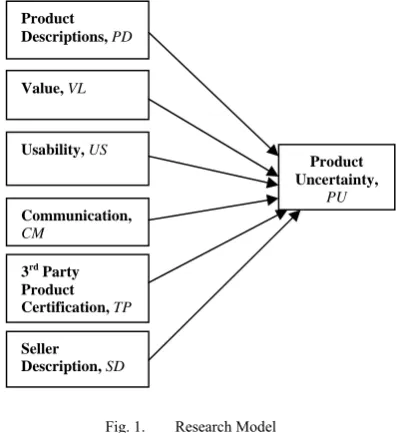
[image:3.595.328.528.291.508.2]Finally, In addition to the steps above, other constructs regarding the online product description and other product information signals was employed from the literature review. Sampling activity was completed and a research model was then developed to test the hypotheses as shown in Fig. 1. All constructs are hyphothesized to have negative relationship to product uncertainty or in other words, can reduce product uncertainty.
Fig. 1. Research Model
A sampling procedure was conducted to determine the population size. Approximately, only 200 active and unique users were regularly making offering and publish their product information in the Buy/Sell section, although the total of registered users were more than 70,000 unique ids as discovered in the website statistic page in December 2012. From our observation, the portal still lack of active participation in the buying and selling activities. This shows that majority of registered user are not serious buyers and sellers. Consequently, we choose to proceed with the survey with active users only, to prevent biasness. This is because, only users who have some experience (between 1-5 years) reviewing product descriptions in the portal were deemed fit to participate in the survey, where as the remaining users were neglected.
A. Experimental Findings
Cronbach Alphas of the measures were all comfortably above the lower limit of acceptability as suggested by [32] that is α > .65. Hence, all the measures were highly reliable. Prior performing to the actual hypotheses tests, correlations
Product Descriptions, PD
Value, VL
Usability, US
Seller
Description, SD Communication, CM
3rd Party Product Certification, TP
Product Uncertainty,
between the constructs were derived. The influences of independent factors on product uncertainty were then tested using multiple regressions. Table II shows the correlation structure of the data used in this study.
TABLE II
CONSTRUCT CORRELATION MATRIX
Factors PU PD VL US CM TP SD
PU 1.0
PD -.73** 1.0
VL -.73** .61* 1.0
US -.44** .34** .43** 1.0
CM -.51** .58** .50* .53** 1.0
TP -.61** .53** .61** .47** .77* 1.0
SD -.70** .54* .55* .55* .64* 73* 1.0
The finding shows a significant negative correlations exist between PU and PD (r= -.73), VL (r= -73), US (r= -44), CM (r= -.51), TP (r= -.61) and SD (r= -.70); suggesting support for all the hypothesized relationship. The individual hypotheses were then tested using a multiple regression prediction model with PU as the dependent variable and PD, VL, US, CM, TP and SD as the independent variables.
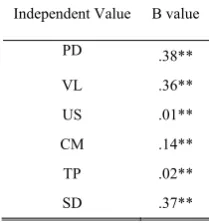
The results obtained as shown in Table III revealed that all the six constructs were found to be significant in the prediction model. The results provide support for the relationships between PD (β = .38; p < .01), VL (β = .36; p < .01) and US (β = .01; p < .01) with PU. Also, the rest of the hypotheses were also supported where significant relationships found between PU and CM (β = .14; p < .01), TP (β = .02; p < .01) and SD (β = .37; p < .01), respectively. F value of 17.58 indicates that all six independent variables significantly influence product uncertainty with 74 percent of the variation in product uncertainty.
TABLE III
THE INFLUENCE OF INDEPENDENT VARIABLES (IV)ON PRODUCT
UNCERTAINTY
Independent Value Β value
PD .38**
VL .36**
US .01**
CM .14**
TP .02**
SD .37**
Note: R² = .74; F = 17.58; Sig. F = .00; ** p < .01
VI. DISCUSSIONS AND RECOMMENDATIONS
In this paper, the role of product information signals and product description in mitigating product uncertainty was investigated. The result indicates the elements or information needed to be incorporated when posting product information, thus reducing product uncertainty.
When queried on the problem with the portal, users highlighted issues such as the authenticity of ‘true’ sellers and whether the sellers would make necessary action to facilitate the selling. This is true in the context of whether sellers truly describe themselves (SD), and whether buyers feel easy to communicate with the sellers (CM); with influencing power of .37 and .14, respectively. This is supported by a study by [33] which discovered that when a seller shares confidential information with a buyer, he or she is more likely to trust the seller.
The seller need to be aware should there any queries from the buyer regarding the product through mechanisms offered in the portal (private message, posted contact details such as email, address and phone number). Another aspect that users highlighted in the survey is there is a need to include knowledge sharing facility, in terms of buyers’ testimony on the product and on the sellers’ previous transactions to reduce uncertainty from the sellers’ side and also to reduce the complexity of the product as suggested by [20].
Buying and selling activities takes place when the customers contacted the sellers through email or telephone after the sellers posted the product information in the portal. It can be seen that the portal is still in first stage of the e-business model as discussed by [34], as no online payment facility is being utilized so far. Therefore, underlying issues, such as security and risk involved need to be studied.
Agribazaar classifies the agro-based product information into categories by product type and provides useful contact for potential customers. More interactive features such as customization of the product/item offering, in which users can add pictures, video and include more description of their product should be added to the portal. One important description to reduce doubt on sellers is the usage of Google Map facility to show the location of the seller. Again, this will greatly increase trust on sellers following recommendation from [33].
users.
Some security mechanism should be incorporated in the portal to establish trust without revealing sensitive information. An example would be using VeriSign Authentication Service by [35] that allows sellers and buyers to conduct online business with confidence as being practiced by prominent marketplaces such as eBay and Amazon.com.
One discovery that is important in the area of product uncertainty, however on the contrary with the findings by [21] and [36], for enhancing trust in buyers to buy agro-based product online, third party product certification (TP) and facilitating buying process (US) do not make great influence to product uncertainty most probably because the uncertainty is reduced when physical inspection is conducted (US and TP influencing powers are .01 and .02, respectively). On the other hand, major influence in reducing product uncertainty is greatly contributed from the way product is described (PD), how far price and product offered match with the buyers’ need (VL) and finally the sharing of complete sellers’ description (SD) to complement with the product description.
From the users’ point of view, promoting the agricultural products is a challenging tasks due to the nature of the products itself. As discussed by [8], the shelf-life of the agro-based product in certain cases is hard to predict, for example, products such as fresh produce especially vegetables and fruits. Therefore, it is crucial to maintain freshness and quality while the product is still in the process of selling. Also, how far the seller willing and able to share information on their product will play major role to ensure the product fit with the buyers’ need. Therefore, it takes a lot of effort to enhance the portal especially how the offering is made in order to mitigate uncertainty issues especially product uncertainty.
VII.CONCLUSION
Mitigating product uncertainty is indeed important in building trust for the buyer to purchase the experience products, like in the cases of online marketplace in China and Korea. Essentially, it takes more than online descriptions of the product to convince the buyer, when they cannot use their senses to touch, feel, smell and taste the product until they are evaluated physically.
From this research, we discovered that in enhancing trust for purchasing agro-based products online, all proposed factors conform to the literature, in which product description together with value, facilitating buying process, communication, third party product certification and seller description can reduce product uncertainty in agro-based product. However, uniquely to the case of selling agro-based product, third party product certification and facilitating buying process have very minor effect to product uncertainty.
The richness of the data could be overcome if the data were to be collected qualitatively using face to face interviews and focus group discussion. More researches can be conducted to further understand specific issues such as online trust when purchasing other product, generally. The model can be expanded to measure the level of trust being influenced by every information signal tested or other related constructs.
By understanding this and other issues certainly will transform the mindset of the people to treat agriculture as a lucrative business, increase interaction, and better relationship within the vicinity of Malaysian Agriculture community, and online community as a whole.
APPENDIX
Appendix 1: An example of a full online product description on Agribazaar portal
ACKNOWLEDGMENT
REFERENCES
[1] S. Hassan and M.K. Kasiran, “Compliance of X.509 Certification Standard in the Implementation of Third Party Certification in Malaysian Ecommerce Websites,” Communications of the IBIMA 5(7), 2008, pp. 42-49.
[2] MalaysiaCrunch, (2012, May 4), Malaysia E-Commerce Statistic [Online], Available: http://malaysiacrunch.blogspot.com/2009/09/ [3] A. Oh, (2006, December 31), Two cents worth of E-Commerce
Opinion [Online], Available:
www.neowave.com.my/sellmore/index.php
[4] N.F.A. Ghani and F. Ahmad, “An Interpretive Analysis of Factors Contributing to Issues in Agribazaar’s Implementation,” Journal of WSEAS TRANSACTIONS on INFORMATION SCIENCE and APPLICATIONS, Vol. 8(8), 2011, pp. 329-339.
[5] K. Sutton, “Agribusiness On A Grand Scale – Felda’s Sahabat Complex in East Malaysia,” Singapore Journal of Tropical Geography, Vol. 22, No. 1, 2001, pp. 90 - 105.
[6] Z.M. Aji, H. Ibrahim, N.I. Yusop, R.A. Razak and W.R.S. Osman, “Rural Internet Centre (RIC) as a Mean for Bridging the Digital Gap in Rural Communities: Assessment of Current Situations,” In Managing Worldwide Operations and Communications with Information Technology. IRMA 2007 Vancouver, Canada. Khosrow-Pour, M (Ed), 2007,(pp. 1167-1171), Idea Group Publishing. [7] M.S. Hassan, H.A.M. Shaffril, M.A. Hassan and J.L. D’ Silva,
“Developing Agriculture in Malaysia: Internet Utilization among Malaysian Youth Agro-Businessman,” European Journal of Social Sciences , vol. 11( 2), 2009, pp 214-234.
[8] T.A.A. Nasrin, M.M. Molla, M.A. Hossaen, M.S. Alam, and L. Yasmin, “Effect of postharvest treatments on shelf life and quality of tomato,” Bangladesh Journal of Agricultural Research, vol.33(4), 2008, pp.579-585
[9] D. Gefen, I. Benbasat, and P. Pavlou, “A research agenda for trust in online environments,” Journal of Management Information Systems, 24 (4), 2008, 275–286.
[10] Z. Jiang, and I. Benbasat, “The effects of presentation formats and task complexity on online customers’ product understanding,” MIS Quarterly, vol.31 (3), 2007b, pp. 475–500.
[11] Z. Jiang, and I. Benbasat, “Investigating the influence of the functional mechanisms of online product presentations,” Information Systems Research, vol.18(4), 2007a, pp. 454–470.
[12] A. Dimoka, and P. Pavlou, “Understanding and mitigating product uncertainty in online auction marketplaces,” In: Alfred P. Sloan Foundation: Industry Studies Annual Conference, 2008.
[13] J.W. Palmer, “Web site usability, design, and performance metrics,” Information Systems Research, vol.13(2), 2002, pp. 151–167. [14] D. M. Szymanski, and R. J. Hise, “e-Satisfaction: An initial
examination,” J.Retailing, vol.76(3), 2000, pp. 309–322.
[15] M. Spence, "Job market signaling," Quarterly Journal of Economics. vol(87), 1973, pp. 355-74.
[16] A. Rindfleisch, and J. Heide, "Transaction Cost Analysis: Past, Present, and Future Applications," Journal of Marketing, (61:4), 1997, pp 30-54.
[17] J. Pfeffer, and G. Salancik, “The External Control of Organizations: A Resource Dependence Perspective,” Stanford University Press, 2003. [18] D. Michael, “On Learning to Plan-and Planning to Learn: The Social
Psychology of Changing toward Future-Responsive Societal Learning,” San Francisco: Jossey-Bass, 1973.
[19] R.B. Duncan, “Characteristics of organizational environments and perceived environmental uncertainty,” Administrative Science Quarterly, 17(3), 1972, pp.313-327.
[20] P.A. Pavlou, H. Liang, and Y. Xue, “Understanding and Mitigating Uncertainty in Online Buyer-Seller Relationships: A Principal Agent Perspective,” MIS Quarterly, 31(1), 2007, pp.105-136.
[21] A. Dimoka, Y. Hong, and P.A. Pavlou, "On Product Uncertainty in Online Markets: Theory and Evidence," MIS Quarterly, (36:2), 2012, pp.395-426.
[22] A. Ghose, "Internet Exchanges for Used Goods: An Empirical Analysis of Trade Patterns and Adverse Selection," MIS Quarterly (33:2), 2008, pp 263-291.
[23] Y. Kim, R. Krishnan, and W.B. Vogt, "On Product-Level Uncertainty and Online Purchase Behavior: An Empirical Analysis," Working Paper, Carnegie Mellon University, 2009.
[24] J.E Urbany, P.R. Dickson, and W.L.Wilkie, “Buyer uncertainty and information search,” Journal of Consumer Research, vol.16 (2), 1989, pp. 208-215.
[25] R.R. Burke, “Technology and the customer interface: what consumers want in the physical and virtual store,” Journal of the Academy of Marketing Science, vol.30 (4), 2002, pp. 411-432.
[26] D. Kempf, and R.Smith, “Consumer Processing of Product Trial and the Influence of Prior Advertising: A Structural Modeling Approach,” Journal of Marketing Research, vol.35 (3), 1998, pp. 325–338. [27] K.-S. Suh, and Y.E. Lee, “Effects of Virtual Reality on Consumer
Learning: An Empirical Investigation in web-based Electronic Commerce,” MIS Quarterly, vol.29 (4), 2005, pp. 673-697.
[28] Z. Jiang, and I.Benbasat, “Virtual product experience: Effects of visual and functional control on perceived diagnosticity in electronic shopping”, Journal of Management Information Systems, vol. 21(3), Winter 2005, pp. 111–147.
[29] K.L. Stewart, "Trust Transfer on the World Wide Web," Organization Science, vol.14(1), 2003, pp. 5-17.
[30] R.A. Pollack, “Price Dependent Preferences,” American Economic Review, vol. 67, 1977, pp. 64-75.
[31] P. Milgrom, and J. Roberts, “Price and Advertising Signals of Product Quality,” Journal of Political Economy, vol.94(4), 1986, pp.796-821. [32] J.C. Nunnally, Psychometric Theory (2nd ed). New York: McGraw
Hill Book Company, 1978.
[33] P. Dwyer, “Building Trust with Corporate Blogs," Proceeding of International Conference on Weblogs and Social Media, Boulder CO, 2007.
[34] J. Ho, and R. Tang, “Towards an Optimal Resolution to Information Overload: An Infomediary Approach,” Proceedings of the International Conference on Supporting Group Work, 2001, pp.91-96. [35] Symantec Corporation, (2013, January 12), Legal Repository [Online],
Available: www.verisign.com/corporate/index.html