
Supported by Henan Natural Science Foundation (182300410032).
Effects of different dietary lipid sources on fatty acid
composition and gene expression in common carp
Hong-Tao Ren*, Guang-Qin Zhang, Yong Huang, Xiao-Chan Gao
Animal Science and Technology College, Henan University of Science and Technology, Luoyang, P.R. China
*Corresponding author: [email protected]
Citation: Ren H.T., Zhang G.Q., Huang Y., Gao X.C. (2020): Effects of different dietary lipid sources on fatty acid composition and gene expression in common carp. Czech J. Anim. Sci., 65: 51–57.
Abstract: The effects of fatty acid composition in artificial feed on the change in the fatty acid composition of carp muscles and the relationship between Δ6-Fad and Elovl5 genes participating in the regulation of fatty acid synthesis were studied. Juveniles were fed three semi-purified diets (D1–D3) for 6 weeks with different lipid sources: D1, fish oil with high highly unsaturated fatty acids (HUFA); D2, corn oil with high linoleic acid (18:2n-6, LA), D3, linseed oil with high α-linolenic acid (18:3n-3, LNA); then, samples were taken to explore the molecular mechanism and the factors which affect the synthesis of carp HUFA. The content of LA and arachidonic acid (20:4n-6, AA) in common carp fed Diet 2 was higher than in carp receiving D3 (P < 0.05), but the contents of eicosapentaenoic acid (20:5n-3, EPA) and docosahexaenoic acid (22:6n-3, DHA) were lower than in carp fed D1 and D2 (P < 0.05). The liver transcript abundance of Δ6-Fad and Elovl5 in fish fed D2 and D3 at the end of 6 weeks was generally higher than the abundance in the initial stage and in the fish fed D1 (P < 0.05). The results suggest that the common carp can biosynthesise HUFA, and the type and content of fatty acids in feed affected not only the composition and content of fatty acids in common carp muscles, but also the Δ6-Fad and Elovl5 gene expression involved in the biosynthesis of HUFA. Feeding high levels of n-3 HUFA diet can increase the body content of EPA and DHA in common carp. The results of this research may provide a theoretical basis for choosing an appropriate source of lipid for common carp feeds.
Keywords: common carp; feed fatty acids; Δ6-desaturase; Elovl5 elongase; gene expression
Fish are an important source of highly unsatu-rated fatty acids (HUFA) in human food. HUFA are beneficial to cardiovascular health, immune function, neurodevelopment and anti-inflamma-tion (Eilander et al. 2007; Kim et al., 2019; Zhao
et al. 2019). Common carp (Cyprinus carpio) is
one of the most important freshwater fishes cul-tured for human food and an important source of HUFA. Artificial feeds are primary nutritional sources, therefore it is important to study the relationship between the fatty acid composition of carp and the fatty acids in diet. It is generally accepted that the freshwater fish can convert C18 to HUFA. For example, 18:3n-3 (α-linolenic acid,
LNA) and 18:2n-6 (linoleic acid, LA) for C20/22
HUFA, including 20:4n-6 (arachidonic acid, AA), 20:5n-3 (eicosapentaenoic acid, EPA) and 22:6n-3 (docosahexaenoic acid, DHA) (Cook et al. 1996). However, this conversion ability differs in different fish species, primarily because of their own fatty acid desaturase and fatty acid chain elongation enzymes (Tocher et al. 2003). The fatty acid de-saturase enzymes can introduce double bonds into fatty acids, whereas the fatty acid chain elongation enzyme can extend the fatty acid chain (Jakobsson et al. 2006; Monroig and Kabeya 2018). Among
them, Δ6-fatty acid desaturase enzyme (Δ6-Fad)
to HUFA. Polyunsaturated fatty acids (PUFA) are an essential part of the vertebrate diet, but the amount of HUFA requirement varies from fish to fish. In aquaculture, the composition of fatty acids in fish mainly depends on feed and their own synthesising capacity (Tocher 2010). Carp are fast-growing benthic omnivores, however, in the body composition of fatty acids, in carp raised in fishponds and fed formulated diets the DHA and DHA/EPA ratios are generally lower than those in marine and some freshwater fish (Liu 1991; Luo 2001; Ackman 2002; Guler et al. 2008; Donmez 2009; Prchal et al. 2018; Shaliutina-Kolesova et al. 2019). Although some freshwater fish have been reported to synthesise HUFA, the mechanism of HUFA synthesis in carp has been scarcely documented.
We studied the effects of fatty acid composition in artificial diets on the changes in the composition of fatty acids in carp muscle. We also explored the relationship between the Δ6-Fad and Elovl5 genes involved in regulating the fatty acid synthesis and the composition of fatty acids in feed to provide a theoretical basis for choosing an appropriate source of lipids for the common carp feeds.
MATERIAL AND METHODS
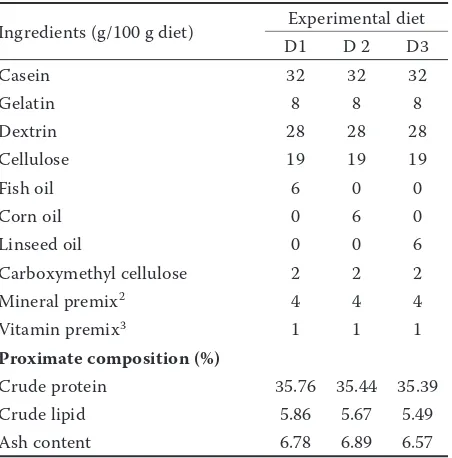
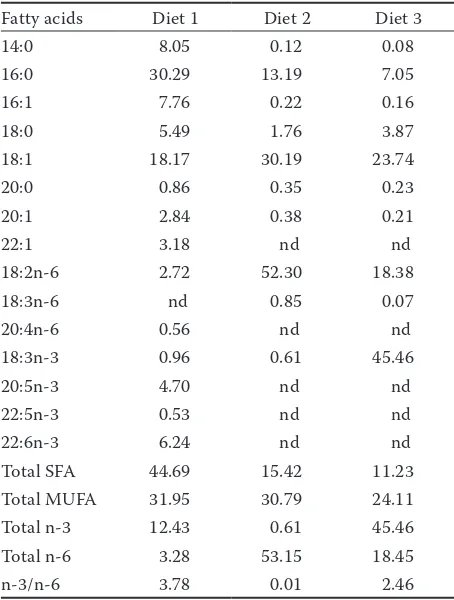
Experimental feed, animals and design. A formulated semi-purified feed is described in Table 1 was administered. Casein was used as a protein source; fish oil, corn oil, and flaxseed oil were used as sources of essential fatty acids. Iso-nitrogenous feeds included three different kinds of fatty acids. Diet 1 contained 2.70% LA, 0.96% LNA, 0.56% AA, 4.70% EPA and 6.24% DHA. Diet 2 contained 52.30% and 0.61% LA. Diet 3 contained 18.38% and 45.46% LNA (Table 2). Feed was pre-pared once a week, and amounts of 2–3% of the fish body weight were stored in a plastic bag in a refrigerator at –18 °C. Fish were fed twice daily at 08:00 and 14:00 h by mixing with water and forming a small cake. Uneaten feed and faeces were siphoned before each feeding.
The experimental fish weighed 45–50 g and were collected from a local common carp breeding farm in Mengjin county in Luoyang City, Henan prov-ince, China, and all carps coming from the same pond shared the same genetic background. The fish were randomly allocated into three treatment groups, with 3 replications of 20 fishes each, and
180 test fishes were stocked in nine glass tanks of 100 × 80 × 60 cm in size. The growth experi-ment was conducted indoors with the tempera-ture controlled at 20 ± 2 °C. The recirculating culture system maintained water with pH 6.5 ± 0.2, ammonia nitrogen at less than 0.5 mg/L, and dissolved oxygen at more than 5 mg/L; the light cycle was controlled at 12 h light/12 h darkness. The fish were acclimated for 2 weeks before the 6-week feeding experiment.
[image:2.595.306.532.125.354.2]Sample preparation. Six experimental fishes were randomly selected at the beginning of the experiment and their livers and muscles were removed. All livers were mixed together, imme-diately frozen in liquid nitrogen and stored in a refrigerator at –80 °C as the initial samples for
Table 1. Ingredients and composition of the experimen-tal diets (D1, D2 and D3) for common carp1
Ingredients (g/100 g diet) Experimental diet
D1 D 2 D3
Casein 32 32 32
Gelatin 8 8 8
Dextrin 28 28 28
Cellulose 19 19 19
Fish oil 6 0 0
Corn oil 0 6 0
Linseed oil 0 0 6
Carboxymethyl cellulose 2 2 2
Mineral premix2 4 4 4
Vitamin premix3 1 1 1
Proximate composition (%)
Crude protein 35.76 35.44 35.39
Crude lipid 5.86 5.67 5.49
Ash content 6.78 6.89 6.57
1all the ingredients and chemicals used were purchased
from Sangon and East China Pharmaceuticals Company, Shanghai, China; 2mineral premix consisted of (g/kg of
premix): aluminum chloride, 0.45; cobalt chloride, 0.2; copper sulphate, 2.0; ferrous sulphate, 19.5; potassium iodide, 0.5; potassium chromium sulphate, 0.3; magnesium sulphate, 300.0; manganese sulphate, 7.5; sodium selenite, 0.02; zinc sulphate, 37; cellulose, 632.5; 3vitamin premix
mRNA determination of Δ6-Fad and Elovl5 genes. On days 3 and 14 and at the end of the experiment, three fishes were taken randomly from each tank, and their livers and muscles were dissected; these tissues were mixed into one sample and imme-diately frozen in liquid nitrogen and stored in a refrigerator at –80 °C for the determination of fatty acids and for the quantitative analysis of genes.
RNA extraction and real-time quantitative PCR (RT-qPCR). Total RNA was extracted using a TRIzol Reagent Kit (TaKaRa, Japan), and 2 μg of total RNA was reversely transcribed into cDNA using a PrimeScript RT-PCR Kit (TaKaRa). Ex-pression of the genes was measured by real-time quantitative PCR (RT-qPCR) (SYBR Green II) on a Thermal Cycler Dice TP800 sequence detection
system (TaKaRa), using β-actin as a
housekeep-ing gene. Primers for gene expression analysis (Table 3) were designed based on the full-length of Δ6-desaturase cDNA. Each sample was run in triplicate, and PCR reaction without the addition of the template was used as negative controls. The
relative mRNA expression levels of Δ6-desaturase in each sample were normalised with β-actin ex-pression and calculated by the comparative thresh-old cycle (Ct) method.
Fatty acid analysis.Total lipid was extracted from muscle tissue by homogenisation in chloro-form/methanol (2 : 1, v/v), which contained 0.01% butylated hydroxytoluene as an antioxidant. The lipid extracts were washed according to the Folch procedure (Folch et al. 1957), and methylated in 1% sulphuric acid in methanol at 70 °C for 3 h to pre-pare fatty acid methyl esters (FAMEs). FAMEs were extracted in heptanes and analysed using a gas chro-matograph GC-2010 (Shimadzu, Japan) equipped with an autosampler and a hydrogen flame ioniza-tion detector. The GC was fitted with a 30 m × 0.25 mm × 0.25 μm capillary column VF-23ms
(Varian, USA). The carrier gas was N2, and the
combustion-supporting gases were air and H2.
The injector and detector temperatures were both 250 °C. The column temperature was initially held at 120 °C for 3 min, followed by an increase at a rate of 10 °C/min to 190 °C. The temperature was then increased at a rate of 2 °C/min to final 220 °C and maintained for 15 min. Individual fatty acids were identified by comparison against commercial standards (Sigma, USA) and quantified using the CLASS-GC10 GC workstation (Shimadzu).
Statistical analysis.The results were analysed by one-way ANOVA in SPSS Version 17.0, and Tukey’s multiple comparisons were conducted when the differences were significant (P < 0.05).
RESULTS
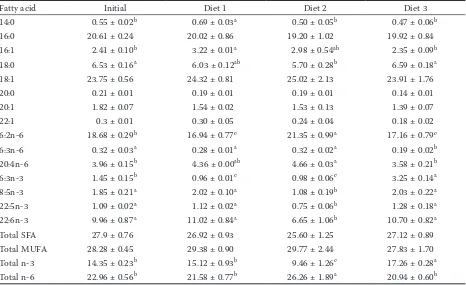
[image:3.595.63.290.125.425.2]Effect of dietary fatty acids on fatty acid com-position. The composition of fatty acids in diet significantly affected the composition of fatty acids in carp muscle (Table 4). The content of LA in muscle of the Diet 2 group (containing higher
Table 2.Fatty acid composition (percentage of total fatty acids) of the experimental diets
Fatty acids Diet 1 Diet 2 Diet 3
14:0 8.05 0.12 0.08
16:0 30.29 13.19 7.05
16:1 7.76 0.22 0.16
18:0 5.49 1.76 3.87
18:1 18.17 30.19 23.74
20:0 0.86 0.35 0.23
20:1 2.84 0.38 0.21
22:1 3.18 nd nd
18:2n-6 2.72 52.30 18.38
18:3n-6 nd 0.85 0.07
20:4n-6 0.56 nd nd
18:3n-3 0.96 0.61 45.46
20:5n-3 4.70 nd nd
22:5n-3 0.53 nd nd
22:6n-3 6.24 nd nd
Total SFA 44.69 15.42 11.23
Total MUFA 31.95 30.79 24.11
Total n-3 12.43 0.61 45.46
Total n-6 3.28 53.15 18.45
n-3/n-6 3.78 0.01 2.46
SFA = saturated fatty acids; MUFA = monounsaturated fatty acids; nd = not detected
Table 3. Primers for determining mRNA content of
Δ6-Fad and Elovl5
[image:3.595.305.533.126.226.2]LA) at the end of 6-week feeding was significantly higher than that in the groups of Diet 1, Diet 3 and at the beginning of the trial (P < 0.05). After 6 weeks of feeding, the content of LNA in muscle of the Diet 3 group was significantly higher than that in the groups of Diet 1, Diet 2, and at the beginning of the trial (P < 0.05). The contents of EPA and DHA in muscle of the diet group with high HUFA content were significantly higher than those of the Diet 2 group after 6 weeks (P < 0.05). The results showed that carp can efficiently convert LA to
AA, LNA to EPA, then to docosapentaenoic acid
(DPA) and DHA. The content of HUFA (AA, EPA
and DHA) in the muscle of common carp is closely related to the content of LA and LNA in feed.
Effects of dietary fatty acids on gene expression of Δ6-Fad and Elovl5 in common carp. After 3, 14 and 42 days of feeding, the expression of Δ6-Fad
and Elovl5 genes in the liver of the test fish showed significant differences between the treatment groups, as well as between different stages of the trial (Figure 1). Compared to the beginning of the experiment, the expression of Δ6-Fad gene in the
group of Diet 2 increased, and the expression of
[image:4.595.65.531.126.411.2]Δ6-Fad gene on days 14 and 42 of the experiment was higher than that at the beginning of the trial (P < 0.05). However, the level of Δ6-Fad gene ex-pression in the group of Diet 3 was significantly
Table 4.Fatty acid composition (percentage of total fatty acids) of muscle from common carp fed experimental diets for 6 weeks (mean ± SEM)
Fatty acid Initial Diet 1 Diet 2 Diet 3
14:0 0.55 ± 0.02b 0.69 ± 0.03a 0.50 ± 0.05b 0.47 ± 0.06b
16:0 20.61 ± 0.24 20.02 ± 0.86 19.20 ± 1.02 19.92 ± 0.84
16:1 2.41 ± 0.10b 3.22 ± 0.01a 2.98 ± 0.54ab 2.35 ± 0.09b
18:0 6.53 ± 0.16a 6.03 ± 0.12ab 5.70 ± 0.28b 6.59 ± 0.18a
18:1 23.75 ± 0.56 24.32 ± 0.81 25.02 ± 2.13 23.91 ± 1.76
20:0 0.21 ± 0.01 0.19 ± 0.01 0.19 ± 0.01 0.14 ± 0.01
20:1 1.82 ± 0.07 1.54 ± 0.02 1.53 ± 0.13 1.39 ± 0.07
22:1 0.3 ± 0.01 0.30 ± 0.05 0.24 ± 0.04 0.18 ± 0.02
6:2n-6 18.68 ± 0.29b 16.94 ± 0.77c 21.35 ± 0.99a 17.16 ± 0.79c
6:3n-6 0.32 ± 0.03a 0.28 ± 0.01a 0.32 ± 0.02a 0.19 ± 0.02b
20:4n-6 3.96 ± 0.15b 4.36 ± 0.00ab 4.66 ± 0.03a 3.58 ± 0.21b
6:3n-3 1.45 ± 0.15b 0.96 ± 0.01c 0.98 ± 0.06c 3.25 ± 0.14a
8:5n-3 1.85 ± 0.21a 2.02 ± 0.10a 1.08 ± 0.19b 2.03 ± 0.22a
22:5n-3 1.09 ± 0.02a 1.12 ± 0.02a 0.75 ± 0.06b 1.28 ± 0.18a
22:6n-3 9.96 ± 0.87a 11.02 ± 0.84a 6.65 ± 1.06b 10.70 ± 0.82a
Total SFA 27.9 ± 0.76 26.92 ± 0.93 25.60 ± 1.25 27.12 ± 0.89
Total MUFA 28.28 ± 0.45 29.38 ± 0.90 29.77 ± 2.44 27.83 ± 1.70
Total n-3 14.35 ± 0.23b 15.12 ± 0.93b 9.46 ± 1.26c 17.26 ± 0.28a
Total n-6 22.96 ± 0.56b 21.58 ± 0.77b 26.26 ± 1.89a 20.94 ± 0.60b
in the same row, values with no letter or the same superscripts mean no significant difference (P > 0.05), while those with different superscripts mean a significant difference (P < 0.05)
0 0.5 1.0 1.5 2.0 2.5 3.0
Initial 3 days 14 days 42 days
Relative expression of
Δ6-Fad
Diet 1 Diet 2 Diet 3
* *
*
Figure 1.Expression of Δ6-Fad relative to β-actin in the liver of common carp at the start of the experiment (Ini-tial) and after feeding Diets 1–3 for 3, 14 and 42 days
[image:4.595.304.533.539.681.2]higher than that at the beginning of the experiment (P < 0.05) only on day 3 of the experiment. Later in the experiment, the expression of Δ6-Fad gene in the Diet 2 group was significantly higher than in the other groups (P < 0.05).
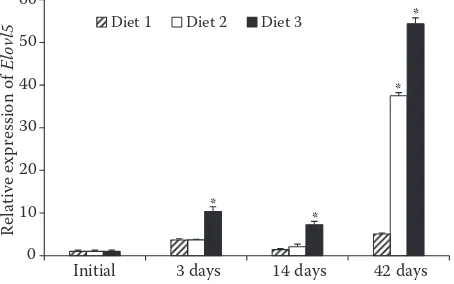
The expression of Elovl5 gene in the treatment groups of Diet 2 and Diet 3 showed an obvious upward trend compared to that at the beginning
of the experiment, and the expression of Elovl5
gene in the treatment groups of Diet 2 and Diet 3 increased significantly on day 42 compared to the beginning of the experiment (P < 0.05) (Figure 2).
DISCUSSION
It is generally believed that herbivorous or om-nivorous freshwater fish have the capability to convert LA and LNA into AA, EPA and DHA (Sargent et al. 2002), but different fish species differ in their ability to extend their fatty acid de-saturase and fatty acid chains (Tocher et al. 2006). However, marine fish are mostly carnivorous and are considered to have a lower capacity to syn-thesise HUFA, so HUFA must be added through the feed (Mourente et al. 1994). However, as for the freshwater benthic carp, it is a fish species whose diet is omnivorous including partially meat in the artificial culture environment, some food comes from benthic organisms, while HUFA may directly come from aquatic organisms in marine fish. However, there are few reports about the characteristics of HUFA synthesis and the mecha-nism of Δ6-Fad and Elovl5 genes involved in HUFA
synthesis. In this experiment, the contents of EPA, DPA and DHA in the muscle of the Diet 3 group were higher than those of the Diet 2 group, indi-cating that carp can meet their requirements for essential fatty acids (EFA) by using LA and LNA in diet. In common carp, AA, EPA and DHA can be obtained in two ways: firstly, AA, EPA and DHA are directly incorporated into feed; secondly, AA, EPA and DHA are synthesised by LA and LNA, respectively, under the action of key enzymes. In this experiment, due to different composition of LA and LNA in diet, AA, EPA and DHA levels in the body of the test fish were different at the end of 6-week feeding. As a freshwater fish species, carp has the ability to synthesise HUFA; differ-ent fat sources in diet have obvious effects on the body fatty acid composition. Therefore, it can be concluded that the composition of fatty acids in diet significantly affects the composition of fatty acids in the muscle of carp. The Δ6-Fad and Elovl5
genes, the key enzymes involved in HUFA synthesis, were expressed in carp liver. The levels of Diet 2 and Diet 3 were significantly higher than those of Diet 1, and were also higher than those at the beginning of the experiment. The results showed that the Δ6-Fad and Elovl5 genes were involved in the regulation of HUFA synthesis in common carp due to the difference of fatty acids in diets.
In recent years, some studies have reported on the genes regulating fatty acid desaturase and fatty chain elongation enzymes by dietary fatty acids, such as the replacement of fish oil with vegetable oil in the diets of freshwater fish, which can enhance the expression of fatty acid desaturase (Zheng et al. 2005a, b). The results have shown that the expression of Δ6-Fad was significantly higher in rainbow trout fed olive oil than when they received fish oil (Buzzi et al. 1996). However, some stud-ies suggest that HUFA inhibit the expression of
Δ6-Fad in freshwater fish (Ulmann et al. 1992). The results of the present study showed that LA and LNA in diet promoted the expression of the
[image:5.595.65.292.102.244.2]Δ6-Fad fatty acid desaturase enzyme, while HUFA inhibited its expression. In the early stage of the experiment, the ability of LNA to promote the high expression of Δ6-Fad was stronger than that of LA, but in the later stage of the experiment, LA was stronger than LNA (Li et al. 2008). However, in this study, too much LNA was found to inhibit the expression of Δ6-Fad in the experiment, and the same results were found in the studies of sea
Figure 2. Expression of Elovl5 relative to β-actin in the liver of common carp at the start of the experiment (Ini-tial) and after feeding Diets 1–3 for 3, 14 and 42 days
values are mean ± SEM (n = 6); *significant differences (P < 0.05) between the column’s dietary treatment and the Initial
0 10 20 30 40 50 60
Initial 3 days 14 days 42 days
Relative expression of
Elovl5
Diet 1 Diet 2 Diet 3
*
*
*
bream (Izquierdo et al. 2008); it was suggested that excessive LNA inhibited not only the expression of Δ6-Fad, but also the desaturation of LA (Bell et al. 1993). Some studies on Atlantic salmon sug-gest that diets containing a high proportion LA/ LNA from fish oil produce more LA desaturated products than those containing LNA. However, excessive LA in vegetable oil can also inhibit the desaturation of LNA (Ruyter et al. 2000).
Currently, Elovl5 has been reported in some fish which can extend C18 and C20 PUFA (Alimud-din et al. 2008; Zheng et al. 2009). The study of Atlantic salmon showed that replacing fish oil with linseed oil significantly increased the expres-sion of the Elovl5 gene in Atlantic salmon (Zheng et al. 2004). In our study, the group on Diet 2 contained higher LA, and LA could synthesise only AA, but not EPA and DHA, and dietary EPA and DHA were also very low. EPA and DHA are essential fatty acids for carp, so Δ6-Fad, a key fatty acid synthesis enzyme, always shows a high expression level. The Diet 2 group and the Diet 3 group produced a lot of intermediate products in the early stage of feeding due to the action of fatty acid desaturase, which required higher fatty acid elongase to extend the fatty chain in the later stage. However, there were differences between Diet 2 and Diet 3 because of the differences in synthetic substrates, and the total amount of the Diet 3 group was obviously higher than that of the Diet 2 group, including AA, EPA and DHA. These results may be related to the preference of Elovl 5
to n-3 substrate (Gregory et al. 2010).
Based on the results of this study, we can con-clude that the carp can biosynthesise HUFA, the content and type of fatty acids in the diet can affect the composition and content of fatty acids in carp muscle, as well as the level of Δ6-Fad and Elovl5
gene expression involved in the biosynthesis of HUFA. Feeding diets which contain high levels of n-3 HUFA is beneficial to increase EPA and DHA in carp. This study also suggested that fish oil in carp feed can be replaced by vegetable oil in carp culture. This study provided a theoretical basis for selecting suitable fat sources for carp feed.
REFERENCES
Ackman RG. Freshwater fish lipids – an overlooked source of beneficial long-chain n-3 fatty acids. Eur. J. Lipid Sci. Tech. 2002;104:253-254.
Alimuddin KV, Satoh S, Takeuchi T, Toshio T, Goro Y. Clon-ing and overexpression of a masu salmon (Oncorhynchus masou) fatty acid elongase-like gene in zebrafish. Aqua-culture. 2008;282:13-18.
Bell JG, Dick JR, Vicar MC, Sargent JR, Thompson KD. Di-etary sunflower, linseed and fish oils affect phospholipid fatty acid composition, development of cardiac lesions, phospholipase activity and eicosanoid production in At-lantic salmon (Salmo salar). Prostaglandins Leukot. Essent.
Fatty Acids. 1993;49:665-673.
Buzzi M, Henderson RJ, Sargent JR. The desaturation and elongation of linolenic acid and eicosapentaenoic acid by hepatocytes and liver microsomes from rainbow trout (Oncorhynchus mykiss) fed diets containing fish oil or olive oil. Biochim. Biophys. Acta. 1996;1299:235-244.
Cook HW. Fatty acid desaturation and chain elongation in eukaryote. In: Vance DE, Vance JE, editors. Biochemistry of Lipids, Lipoproteins and Membranes. Amsterdam, the Netherlands: Elsevier; 1996. pp. 129–152.
Donmez M.Determination of fatty acid compositions and cholesterol levels of some freshwater fish living in Porsuk
Dam, Turkey. Chem. Nat. Compd. 2009;45:4-17.
Eilander A, Hundscheid DC, Osendarp SJ, Transler C, Zock PL. Effects of n-3 long chain polyunsaturated fatty acid supplementation on visual and cognitive development throughout childhood: A review of human studies.
Pros-taglandins Leukot. Essent. Fatty Acids. 2007;76:189-203.
Folch J, Lees M, Sloane Stanley GH. A simple method for the isolation and purification of total lipides from animal tissues. J. Biol. Chem. 1957;226:497-509.
Gregory MK, See VH, Gibson RA, Schuller KA. Cloning and functional characterisation of a fatty acyl elongase from southern bluefin tuna (Thunnus maccoyii). Comp. Biochem. Physiol. B Biochem. Mol. Biol. 2010;155:178-185. Guler GO, Kiztanir B, Aktumsek A, Citil OB, Ozparlak H.
Determination of the seasonal changes on total fatty acid composition and ω3/ω6 ratios of carp (Cyprinus carpio L.) muscle lipids in Beysehir Lake (Turkey). Food Chem.
2008;108:689-694.
Izquierdo MS, Robaina L, Juarez-Carrillo E, Oliva V, Hernan-dez-Cruz CM, Afonso JM. Regulation of growth, fatty acid composition and delta-6 desaturase expression by dietary lipids in gilthead seabream larvae (Sparus aurata). Fish Physiol. Biochem. 2008;34:117-127.
Jakobsson A, Westerberg R, Jacobsson A. Fatty acid elongases in mammals: their regulation and roles in metabolism. Prog. Lipid Res. 2006;45:237-249.
Li YY, Hu CB, Zheng YJ, Xia XA, Xu WJ, Wang SQ, Chen
WZ, Sun ZW, Huang JH. The effects of dietary fatty acids
on liver fatty acid composition and delta-6 desaturase expression differ with ambient salinities in Siganus cana-liculatus. Comp. Biochem. Physiol. B Biochem. Mol. Biol. 2008;151:183-190.
Liu YF. Analysis of fatty acid composition of five freshwater fishes in China. J. Fish. China. 1991;15:169-171.
Luo YK. Fatty acid composition of muscle and guts in seven freshwater fishes. J. China Agri. Univ. 2001;4:108-111. Monroig O,·Kabeya N. Desaturases and elongases involved
in polyunsaturated fatty acid biosynthesis in aquatic invertebrates: A comprehensive review. Fisheries Sci. 2018;84:911-928.
Mourente G, Tocher DR. In vivo metabolism of [1-14C]
linolenic acid (18:3n−3) and [1-14C] eicosapentaenoic
acid (20:5n-3) in marine fish: Time-course of the de-saturation/elongation pathway. Biochim. Biophys. Acta. 1994;1212:109-118.
Prchal M, Vandeputte M, Gela D, Dolezal M, Buchtova H, Rodina M, Flajshans M, Kocour M. Estimation of genetic parameters of fatty acids composition in flesh of market size common carp (Cyprinus carpio L.) and their relation to performance traits revealed that selective breeding can indirectly affect flesh quality. Czech J. Anim. Sci. 2018;63:280-291.
Ruyter B, Rosjo C, Masoval K, Einen O, Thomassen MS. Influence of dietary n-3 fatty acids on the desaturation and elongation of [1-14C] 18:2n-6 and [1-14C] 18:3n-3
in Atlantic salmon hepatocytes. Fish Physiol. Biochem. 2000;23:151-158.
Sargent JR, Tocher DR, Bell JG. The lipids. In: Halver JE, Hardy RW, edtors. Fish Nutrition. San Diego, USA: Aca-demic Press; 2002. pp 181-257.
Shaliutina-Kolesova A, Xian M, Nian R. Antioxidant defence system in protein fractions of common carp (Cyprinus car-pio) seminal plasma. Czech J. Anim. Sci. 2019;64:265-271. Tocher DR. Fatty acid requirements in ontogeny of marine
and freshwater fish. Aquac. Res. 2010;41:717-732.
Tocher DR, Bell JG, McGhee F, Dick JR, Fonseca-Madrigal J. Effects of dietary lipid level and vegetable oil on fatty acid metabolism in Atlantic salmon (Salmo salar) over the entire production cycle. Fish Physiol. Biochem. 2003;29:193-209. Tocher DR, Zheng X, Schlechtriem C, Hastings N, Dick JR, Teale AJ. Highly unsaturated fatty acid synthesis in marine fish: Cloning, functional characterization, and nutritional regulation of fatty acyl Δ6-desaturase of Atlantic cod (Ga-dus morhua L.). Lipids. 2006;41:1003-1016.
Ulmann L, Bouzianne M, Mimouni V, Belleville J, Poisson JP. Relationship between rat liver microsomal Δ6- and Δ5-desaturase activities and fatty acid composition: Com-parative effects of coconut and salmon oils during protein restriction. J. Nutr. Biochem. 1992;3:188-193.
Zhao Y, Wang LK, Gao J. Effects of dietary highly unsaturated fatty acid levels on growth, fatty acid profiles, antioxidant activities, mucus immune responses and hepatic lipid me-tabolism related gene expressions in loach (Misgurnus an-guillicaudatus) juveniles. Aquac. Res. 2019;50:2486-2495. Zheng X, Tocher DR, Dickson CA, Bell JG, Teale AJ. Ef-fects of diets containing vegetable oil on expression of genes involved in polyunsaturated fatty acid biosynthesis in liver of Atlantic salmon (Salmo salar). Aquaculture. 2004;236:467-483.
Zheng X, Tocher DR, Dickson CA, Bell JG, Teale AJ. Highly unsaturated fatty acid synthesis in vertebrates: New insights with the cloning and characterization of a Δ6-desaturase of Atlantic salmon. Lipids. 2005a;40:13-24. Zheng X, Torstensen BE, Tocher DR, Dick JR, Henderson RJ,
Bell JG. Environmental and dietary influences on highly un-saturated fatty acid biosynthesis and expression of fatty acyl desaturase and elongase genes in liver of Atlantic salmon (Salmo salar). Bioch. Biophys. Acta. 2005b;1734:13-24. Zheng X, King Z, Xu Y, Monroig O, Morais S, Tocher DR.
Physiological roles of fatty acyl desaturases and elongases in marine fish: Characterisation of cDNAs of fatty acyl Δ6-desaturase and Elovl5 elongase of cobia (Rachycentron canadum). Aquaculture. 2009;290:122-131.
![Bis{2,4 dibromo 6 [(E) (4 fluorobenzyl)iminomethyl]phenolato κ2N,O}zinc](data:image/gif;base64,R0lGODlhAQABAIAAAP///wAAACH5BAEAAAAALAAAAAABAAEAAAICRAEAOw==)