© 2019, IRJET | Impact Factor value: 7.211 | ISO 9001:2008 Certified Journal | Page 7715
AN EXPERIMENTAL STUDY ON STABILIZATION OF BLACK COTTON SOIL
BY USING BURNT BRICK DUST
1
G.Vigneswari,
2K.Manoj Kumar,
3R.Jeevprakash,
4G.Mathan Kumar
1Assistant Professor, Department of Civil Engineering, Anna University.
Final year department of civil engineering, Anna University, Sethu institute of technology, pulloor – 626 115, kariapatti, virudhunagar, India
---********---Abstract
- The black cotton soil is known as expansive type of soil which expands suddenly and starts swelling when it comes in contact with moisture. Due to this property of soil the strength and other properties of soil are very poor. To improve its properties it is necessary to stabilize the soil by different stabilizers. Expansive type of soil shows unpredictable behaviour with different kind of stabilizers. Soil stabilization is a process to treat a soil to maintain, alter or improve the performance of soil. In this study, the potential of burnt brick dust as stabilizing additive to expansive soil is evaluated for the improving engineering properties of expansive soil. The evaluation involves the determination of the swelling potential, atterberg’s limits, compaction, cbr & ucs test of expansive soil in its natural state as well as when mixed with varying proportion of burnt brick dust (10, 15 & 20%). The research result shows considerable reduction in swelling of expansive soil .With increasing amount of stabilizer swelling decreases. Maximum dry density of soil is improving and optimum moisture content is decreasing with increasing stabilizing content. For increasing content of stabilizing agent brick dust atterberg’s limit values are also decreasing.Key Words– Aggregate, California bearing ratio(CBR), compressive strength, unconfined compressive strength(UCS).
I. INTRODUCTION
Over the past few decades several factors have led to an increase in the number of people migrating to large cities. Consequently these large cities are getting over populated and quite expectedly necessity of business, residential construction has increased the civil engineering projects located in areas with unsuitable soil is one of the most common problems in many parts of the world. The unsuitable soil (Black cotton Soil) can be stabilized by performing soil stabilization.
In India black soil is the most problematic soil when it comes to construction. In rainy season black cotton soil swells and become sticky. Whereas in summers the
moisture present in the soil evaporates and soil shrinks resulting in the crack of approximate 10 to 15 cm wide and up to 1 meter deep. The percentage covered by black cotton soil in geotechnical areas of India is 16.6%, which says huge amount of soil in India needs stabilization. Mechanical, chemical, electrical, thermal and other methods are in practice to improve the engineering properties of soil. Chemical stabilization is the best method used for highways and air-field . The black cotton soil is known as expansive type of soil which expands suddenly and start swelling when it comes in contact with moisture. Due to this property of soil the strength and other properties of soil are very poor. To improve its properties it is necessary to stabilize the soil by different stabilizers. Expansive type of soil shows unpredictable behaviour with different kind of stabilizers. Soil stabilization is a process to treat a soil to maintain, alter or improve the performance of soil. In The study the results are compared of potential of burnt brick dust as stabilizing additive to expansive soil is evaluated for the improving engineering properties of expansive soil.
II. MATERIAL USED
A. Soil used
Soil sample is collected from the proposed construction site in pulloor Madurai.
Standard test were conducted to determine the physical properties of the soil and the results are given in Table 1.
TABLE 1
Physical properties of soil
S.no Test conducted Result
1 Sieve analysis It is a mixed grained soil
2 Liquid limit 29%
3 Plastic limit 13
© 2019, IRJET | Impact Factor value: 7.211 | ISO 9001:2008 Certified Journal | Page 7716
5 Standard proctorOMC
12%
MDD
1.93 kg/cm3
6 CBR 4.02
7 UCC 4.1
B. Classification of soil sample
Based upon the test performed in laboratory for soil sample and according to the results, obtained, the soil sample is classified By using the sieve analysis our soil is conformed as the mixed grain soil.
C. Brick dust
Red brick dust is a traditional magical ingredient that has been used for many centuries. When used at the entrance of a home or place of business, red brick dust is thought to offer spiritual protection for those residing in the building while warding off enemies. Red brick dust is also used on baseball fields, dugouts and outdoor pathways. Red brick dust can be purchased from several places or made by hand.
III. Laboratory studies
The Various tests conducted on the black cotton soil samples included determination of the physical and chemical properties of soils at their natural state. On the other hand, the testing was conducted on the clayey soil samples mixed with different percentages of brick dust included the standard proctor , unconfined compressive strength and California bearing ratio.
A. Swelling index test
Take two representative oven dried soil samples each of 10 grams passing through 425 micron sieve. Pour each soil sample in to each of the two glass graduated cylinders of 100ml capacity. Fill one cylinder with kerosene and the other with the distilled water up to the100ml mark. Remove the entrapped air in the cylinder by gentle shaking and stirring with a glass rod. Sample kept for free swell index. Allow the samples to settle in both the cylinders. Sufficient time, not less than 24 hours shall be allowed for soil sample to attain equilibrium state of volume without any further change in the volume of the soils. Record the final volume of the soils in each of the cylinders. Repeat the experiment with 10,15 & 20% of brick dust
.
B. Liquid limit
Liquid limit is the test procedure used to determine the liquid limit of different type of soil and the properties of
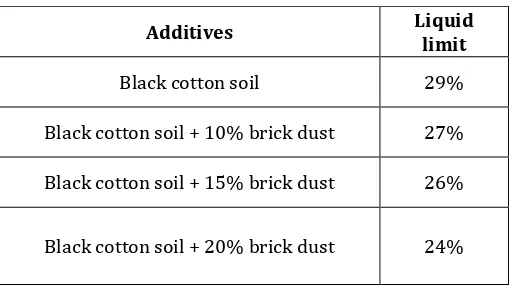
soil with a change in moisture content. For increasing content of stabilizing agent brick dust, liquid limit values are decreasing.
C. Plastic limit
This is used to determine the plastic limit of the soil sample for varying percentage of brick dust (0% ,10%,15% &20%).Take representative soil sample of approximately 20g from the portion of the material passing 425 micron IS sieve and mix thoroughly with distilled water in an evaporating dish till the soil mass becomes plastic enough to be easily molded with fingers. Form a ball with about 8 grams of this soil mass and roll between the fingers and the glass plate as shown in with just sufficient pressure to roll the mass into a thread of uniform diameter throughout its length. The rate of rolling shall be between 80 and 90 strokes/minute counting the strokes one complete motion of the hand forward and back to the starting position again. Continue the rolling till the thread crumbles exactly at 3mm diameter. Continue this process of alternate rolling and kneading until the thread crumbles under the pressure exactly at 3mm diameter. Collect the pieces of crumbled soil thread in an airtight container and determine its moisture content. Determine the plastic limit for at least two points of the soil passing 425 micron IS sieve.
D. Standard proctor test
Standard proctor is the test used to determine the compaction of different types of soil and the properties of soil with a change in moisture content. And this is also used to determine the optimum moisture content(OMC) and maximum dry density(MDD).
E. California bearing ratio
The CBR is a penetration test for evaluation of the mechanical strength of natural ground, subgrades and base courses beneath new carriage construction. The CBR can also be used for measuring the load-bearing capacity of unimproved airstrips or of soils under paved airstrips. The harder the surface, the higher the CBR rating. The test is performed in CBR apparatus by measuring the pressure required to penetrate a soil sample at 2.5mm & 5mm with a plunger. The measured pressure in the dial gauge is then divided by the pressure required to achieve an equal penetration on a standard sample.
F. Unconfined compressive strength
© 2019, IRJET | Impact Factor value: 7.211 | ISO 9001:2008 Certified Journal | Page 7717
which is an unconsolidated untrained test where the lateral confining pressure is equal to zero.UCS test is performed in accordance with the IS Standards in (1973). The sample sizes will be of 38 mm diameter and 76 mm length. At the optimum moisture content (OMC) and maximum dry density(MDD) the tests were performed.
IV. RESULTS AND DISCUSSION
A. Swelling index test
Table 2
Swelling test result on soil sample
Additives Free swell index
Black cotton soil 55.5%
Black cotton soil + 10% brick dust 50%
Black cotton soil + 15% brick dust 44.4%
Black cotton soil + 20% brick dust 30%
B. Liquid limit test
Table 3
Liquid limit test result on soil sample
Additives Liquid limit
Black cotton soil 29%
Black cotton soil + 10% brick dust 27%
Black cotton soil + 15% brick dust 26%
Black cotton soil + 20% brick dust 24%
C. Standard proctor test (SPT)
The SPT test is conducted in the laboratory on soil sample with addition of different percentage of brick dust. The table 4 which explains the optimum moisture
content (OMC) and maximum dry density(MDD) of the different soil samples.
Table 4
SPT test result on soil samples.
Additives OMC MDD
Black cotton soil 12% 1.93
Black cotton soil + 10% brick
dust 10% 1.68
Black cotton soil + 15% brick
dust 12% 1.53
Black cotton soil + 20% brick
dust 10% 1.55
D. Unconfined compressive strength
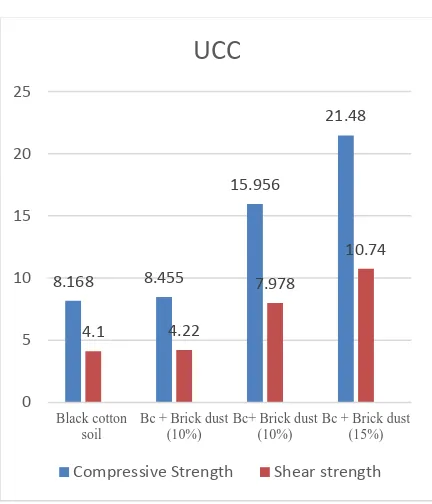
[image:3.595.309.539.420.574.2]The purpose of this laboratory is to determine the unconfined compressive strength of a soil sample and the cohesion of the soil. By using the table 5, and the figure 1 shows the graph for UCC as given below.
TABLE 5
UCC test results on soil samples
Additives Compressive
strength strength Shear
Black cotton soil 8.168 4.1 Black cotton soil +
10% brick dust 8.455 4.22
Black cotton soil +
15% brick dust 15.956 7.978
Black cotton soil +
20% brick dust 21.480 10.74
[image:3.595.31.288.527.670.2]© 2019, IRJET | Impact Factor value: 7.211 | ISO 9001:2008 Certified Journal | Page 7718
Figure 1 UCC test results for soil samplesC. California bearing ratio
CBR test was conducted in laboratory on soil sample with addition of different percentages of brick dust and the results are obtained in the table 6.
Table 6
CBR test results for soil samples
Additives 2.5mm penetration CBR ratio(%) for
Black cotton soil 4.02 Black cotton soil +
10% brick dust 5.65
Black cotton soil +
15% brick dust 6.03
Black cotton soil +
20% brick dust 7.94
[image:4.595.36.252.90.342.2]Figure 2 shows the graph for the CBR test which is conducted for different proportions of soil samples with the value of 10%, 15% & 20% of brick dust which is mixed and treated with the black cotton soil.
Figure 2 CBR test results for soil samples
V. CONCLUSION
Based on the UCC comparison addition of 20% of brick dust which gives higher compression strength of 21.480 to the clay soil. And the shear strength will be increased by 10.74.
CBR test was performed based on the addition of (10%, 15% & 20%) of brick dust. When the additive brick dust is added to it the CBR value increased. So based on the respective results, quality of soil is increasing from bad condition to excellent condition based on CBR test values.
It can be concluded that the soil treated with Brick dust can be utilized as a soil stabilizer which minimize the settlement problems and the same can reduce the environmental issues.
REFERENCE
[1] Karthik, S., Kumar, Ashok., Gowtham,P., Elango,G., Gokul,D., Thangaraj,S. (2014), “Soil Stabilization by Using Fly ash”, IOSR Journal of Civil and Mechanical Engineering, IOSR-JMCE, Vol. 10, pp 20-26.
[2] Ahmed, Afaf Ghais Abadi (2014), “Fly ash Utilization in Soil Stabilization”, International Conference on Civil, Biological and Environmental Engineering, CBEE, pp76-78.
8.168 8.455
15.956
21.48
4.1 4.22
7.978
10.74
0 5 10 15 20 25
Black cotton soil
Bc + Brick dust (10%)
Bc+ Brick dust (10%)
Bc + Brick dust (15%)
UCC
Compressive Strength Shear strength
4.02
5.65 6.03
7.94
0 1 2 3 4 5 6 7 8 9
Black cotton Soil
BC+ Brick dust (10%)
BC + Brick dust (15%)
BC + Brick dust (20%)
CBR
© 2019, IRJET | Impact Factor value: 7.211 | ISO 9001:2008 Certified Journal | Page 7719
[3] Gyanen, Takhelmayum., Savitha, A.L.,Krishna, Gudi.(2013), “Laboratory Study on Soil Stabilization Using Fly ash Mixtures ”, International Journal of Civil Engineering Science and Innovative Technology, vol. 2, pp 477-481.
[4] Mehta, Ashish., Parate, Kanak.,Ruprai,B. S. (2013) “Stabilization of Black Cotton Soil by Fly ash”, International Journal of Application or Innovative in Engineering and Management.
[5] Bhuvaneshwari, S., Robinson, R.G., Gandhi, S. R. (2005), “Stabilization of Expansive Soils Using Fly ash”, Fly Ash Utilization Programme , FAUP, TIFAC, DST, Vol. 8, pp 5.1-5.9.
[6] Robert M, Brooks. (2009), “Soil Stabilization with Fly ash and Rice Husk Ash”, International Journal of Research and Reviews in Applied Sciences, Vol. 1, pp 209-217.
[7] Singhal,Anil kumar and Singh,Sudhanshu shekhar (2014), “Laboratory Study on Soil Stabilization Using Fly ash and Rice Husk Ash”, International Journal of Research in Engineering and Technology, Vol. 3, pp 348-351.
[8] Shrivastava,Dilip., Singhai, A. k. and Yadav, R. K (2014), “Effect of Lime and Rice Husk Ash on Engineering Properties of Black Cotton Soil” . International Journal of Engineering Research and Science Technology, Volume 3.