Manifestation of cluster effects in the structure of actinides
T.M. Shneidman1,2,3,a, G.G. Adamian1, N.V. Antonenko1, R.V. Jolos1, and Shan-Gui Zhou3,4 1Bogoliubov Laboratory of Theoretical Physics, JINR, Dubna, 141980 Russia
2Kazan Federal University, Kazan 420008, Russia
3State Key Laboratory of Theoretical Physics, Institute of Theoretical Physics, CAS, Beijing 100190, China 4Center of Theoretical Nuclear Physics, National Laboratory of Heavy Ion Accelerator, Lanzhou 730000, China
Abstract. We developed a cluster model which allows to take into account both shape deformation parameters and cluster degrees of freedom. The model is based on the assumption that the wave function of nucleus can be treated as a superposition of a mononucleus and two-cluster configurations. The model is applied to describe the multiple negative-parity bands in deformed actinides. Special emphasis is made on the investigation of the recently measured positive parity 0+2 rotational band of reflection-asymmetric nature in240Pu. The results suggest that this band might be understood as the one built on the lowest excited state in mass asymmetry degree of freedom.
1 Introduction
In the even–even isotopes of actinides and also in the heavy Ba and Ce isotopes the low–lying negative parity states are observed together with the usually presented collective positive-parity states combined into rotational or quasirotational ground–state bands. Formation of the positive–parity rotational or quasirotational bands is con-nected in general to the quadrupole collective motion, while the lowering of the negative-parity states is a signa-ture of the presence of the reflection asymmetric collective mode.
There are several approaches to treat the collective mo-tion related to the reflecmo-tion asymmetric degrees of free-dom (see the review [1] and references therein). In present work, we exploit the dinuclear system (DNS) concept de-veloped in [2–4] that the collective oscillations of the nu-cleus in the mass asymmetry degrees of freedom lead to the formation with some probability of the cluster-type configurations. The contribution of the asymmetric clus-ter configurations to the intrinsic nuclear wave function leads to an appearance of a reflection-asymmetric defor-mation. The strength of this deformation is determined by the relative weight of the bicluster configurations. Al-though well established for light nuclei [5], the justifica-tion of the cluster approach to the descripjustifica-tion of the struc-ture of heavy nuclei is cumbersome. However, there exist the evidences which support the idea of clustering. First of all, the nuclei whose spectra exhibit the strong reflection-asymmetric correlations are good alpha-emitters. Thus, there is a significant probability to form anα–cluster in the surface region of the nucleus. It is also known from the Nillson-Strutinsky-type calculations for light nuclei that
ae-mail: [email protected]
nuclear configurations corresponding to the minima of the potential energy contain particular symmetries which are related to certain cluster structures [6, 7]. Several cal-culations performed for heavy nuclei [8–10] have shown that configurations with large quadrupole deformations and low-lying collective negative-parity states are strongly related to clustering. The energy of the cluster configura-tions with an alpha-particle are close to or even lower than the binding energy for these nuclei [2]. Therefore, the bi-cluster configurations with anα-particle are expected to be important in the structure of actinides.
In [2–4], only the lowest negative parity bands (Kπ=0−) have been considered. At the same time there are experimental evidences which indicate on a presence of the collective states related to the reflection asymmetric modes and characterized by non zero values ofK(see, for example, [11]). Moreover, the recent investigations [12] have indicated that the reflection-asymmetric degrees of freedom can also contribute significantly to the structure of positive parity rotational band built upon excited 0+2 state which are observed in the excitation spectra of many ac-tinides. To treat these collective excitations in the frame-work of our cluster approach we modify the model [2–4] to take into account the intrinsic excitations of clusters pro-duced by the motion of the nucleus in mass-asymmetry de-grees of freedom. In [13] we applied the modified model to treat the properties of220Th. This is peculiar case of the
nucleus characterized by the strong reflection-asymmetric deformation and relatively small quadrupole deformation. The aim of this work is to treat the situation when the nucleus has both strong quadrupole and strong reflection-asymmetric deformations. The model is applied for the description of the multiple-reflection asymmetric bands in heavy isotopes of actinides.
2 Model
2.1 The Hamiltonian
Instead of parametrization of the nuclear shape in terms of multipole deformation parameters, we use the degrees of freedom related to the DNS or cluster system [14]. The DNS is understood as the system of two nuclei (A1,Z1)
and (A2,Z2) kept together in touching configuration by the
nucleus-nucleus potential. As a mononucleus, we consider a unified nuclear system with charge Z1 +Z2 = Z and
atomic numberA1+A2 =A. The degrees of freedom
de-scribing the collective excitations are related to the rotation of the DNS as a whole, to the relative motion of the DNS fragments, to the intrinsic excitations of the fragments, and to the transfer of nucleons between the DNS frag-ments. The latter process is described here with the mass-asymmetry ξ = A2/A and charge-asymmetryξZ = Z2/Z
coordinates. The values of ξ =0 or ξ =1 correspond to the mononucleus configurations (A1 = A,A2 = 0) or
(A1 =0,A2 =A), respectively.
The motion in ξ destroys the reflection-symmetric shape of the nuclear system. The main idea of our ap-proach is that the intrinsic nuclear wave function can be described as a superposition of the mononucleus and dif-ferent dinuclear configurations, which are realized with certain probabilities. The mononucleus is taken to be quadrupole-deformed. The mass asymmetryξis described as a continuous variable.
We presume that the main source of the reflection asymmetric deformation is the contribution of the DNS
|α×|(A−4,Z−2)with an alpha-particle as a light cluster. This idea is supported by the observation that the actinides are goodα-emitters. Thus, there is a significant probabil-ity to form an α–cluster in the surface region of the nu-cleus. Moreover, our calculations show that the energy of the DNS with an alpha cluster (ξ=ξα), calculated as a sum of the binding energies of clusters and the energy of their interaction, are close to or even lower than the binding en-ergy for these nuclei while the energies of configurations with light cluster heavier than alpha rapidly increase withξ [2]. Therefore, in order to treat the ground-state properties of actinides, one can consider the region of mass asym-metry in the vicinity of the mononucleus and alpha-cluster DNS configuration. The contribution of the configurations withξ > ξαare negligibly small.
In the region of interest, the DNS, which are produced by the motion in mass-asymmetry, consist of a light spher-ical fragment (A2,Z2) and the heavy deformed (with an
axially-symmetric quadrupole deformation β20 = β0) or
spherical fragment (A1,Z1). In addition to the motion in
ξ, we consider the relative rotation of the DNS fragments, described by the anglesΩR =(θR, φR), and rotation of the
heavy fragment, described by the angles Ωh = (θh, φh).
Angles (θR, φR) and (θh, φh) are measured in the laboratory
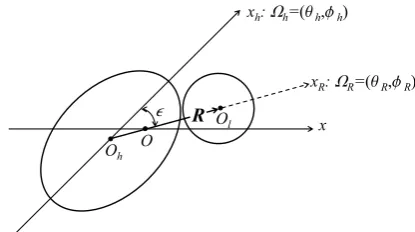
system (Fig. 1). One can introduce the plain angle be-tween the symmetry axis of the heavy fragment and the vector of the relative distanceR.
The classical expression for the kinetic energy of the system with the chosen degrees of freedom is written as
"#$#%#
"# $# %#
#
#
Figure 1. The schematic picture of the dinuclear system with the indicated degrees of freedom used. The orientation of the vectorRconnecting the centers of nuclei is defined by the angles
ΩR =(θR, θR) in the laboratory frameOxR. The orientation of
the intrinsic coordinate systemOhxh related to the quadrupole
deformed heavy fragment is defined by the anglesΩh=(θh, φh).
a sum of terms describing the motion in mass asymmetry, relative rotation of the DNS fragments, and rotation of the heavy fragment
T = 1
2B(ξ) ˙ξ
2+1
2μ(ξ)R
2
m(ξ)(˙θ2R+θ2Rφ˙2R)
+ h(ξ)(˙θ2h+θ2hφ˙2h). (1)
Here, μ = m0A1AA2 ≈ m0Aξ is the reduced mass of the
nuclear system (ξ 1) wherem0 is the nucleon mass.
The value of the relative distance R = Rm corresponds
to the touching configuration for the certain value of ξ. The quantities B(ξ) andh(ξ) are the effective mass for
the motion in mass asymmetry and the moment of inertia of the heavy fragment (or mononucleus). The method of calculation ofB(ξ) is described in Ref. [15]. In this work, however, we replace the effective mass parameter for the motion in mass asymmetry by its value B(ξ0) at average
mass asymmetryξ0, 0< ξ0< ξα
B(ξ)=B(ξ0). (2)
Becauseξ 1, in the quantization of the expression (1) we leave only the terms of the lowest order inξ. As a result, the following expression is obtained for the quan-tum kinetic energy operator
T =−
2
2B
1
ξ ∂ ∂ξξ
∂ ∂ξ +
2
2μ(ξ)R2 m(ξ)
L2R+
2
2h(ξ)L
2 h, (3)
where the angular momentum operators have the form
L2 i =−
1 sinθi
∂ ∂θi
sinθi∂θ∂ i −
1 sin2θi
∂2
∂φ2 i
,
(i=R,h). (4)
The potential energy of the nuclear system with the mass asymmetryξis written as
U(ξ, )=U0(ξ)+U(ξ) sin2, (5)
whereis related toΩRandΩhby the expression
sin2= 2 3
1− 4√π
5[Y2(Ωh)×Y2(ΩR)]00
The dependence of the potential onis approximated by the second order expansion. In (5), the potential energy has a minimum which corresponds to the pole-to-pole ori-entation (=0).
Using (3) and (5) for the kinetic and potential energies, respectively, and, the expression (6) we obtain Hamilto-nian of the model in the form
H=Hξ+Hrot+Vint(ξ,ΩR,Ωh),
Hξ=−
2 2B 1 ξ ∂ ∂ξξ ∂
∂ξ +U0(ξ)+
2 3U(ξ),
Hrot= 2
2μ(ξ)R2 m(ξ)
L2R+
2
2h(ξ)L 2 h
Vint=−
8π
3√5U(ξ){Y2(Ωh)×Y2(ΩR)}00, (7)
where Hξ describes the motion in mass asymmetry, Hrot
describes the rotational motion of the heavy fragment and the relative rotation of the fragments, andVint describes
the interaction between the rotational degrees of freedom. The Hamiltonian (7) is diagonalized on the set of basis functions
Φl1,l2,n
LM,π =Fn(ξ)Yl1(Ωh)×Yl2(ΩR)
LM, (8)
where n=0,1,2,· · ·, l1=0,2,4,· · ·, l2=0,1,2, · · ·. Because
the heavy fragment is assumed by the axially–symmetric quadrupole rotator, the quantum numberl1 can take only
even values. Thus, the wave function does not change un-der the transformation:θh→π−θh, φh→π+φh. The
an-gular part of the wave function (8) is given by the bipolar spherical harmonics which provide the proper transforma-tion with respect to the rotatransforma-tion and space inversion. The parity of the state is then determined asπ=(−1)l2.
The reduced transition probability for the transition from the initial state|ito the final state|fis calculated as
B(Eλ;i→ f)= 1
2Ii+1|f Qλ i|
2, (9)
where the multipole operatorQλμis defined as
Qλμ =
λ1,λ1+λ2=λ
4π(2λ+1)! (2λ1+1)!(2λ2+1)!
× qλ1λ2(ξ)Yλ1(Ωh)×Yλ2(ΩR)λμ, (10)
where
qλ1λ2 =
4π 2λ1+1
× A1
A λ2
Q(2)λ1 +(−1)λ2
A
2
A λ2
Q(1)λ1
Rλ2.
Here,Q(λi) (i = 1,2) are the intrinsic multipole operators of the DNS fragments. Because we assume that the light fragment (A2,Z2) is spherical and can not be excited in
the considered energy range, the only nonzero moment for it is Q(2)0 = Z2/
√
4π. The heavy fragment is quadrupole deformed and has nonzero moments: Q(1)0 =Z1/
√
4πand
Q(1)2 = Q0≈ 3Z1R201
4π β0.
The explicit expressions for the dipole and quadrupole operators of the DNS are written in the form
Q1μ = 1 √
4πA1Z2−A2Z1
A R{Y0(Ωh)×Y1(ΩR)}1μ,
Q2μ = 2 √
4πA
2
1Z2+A22Z1
A2 R
2{
Y0(Ωh)×Y2(ΩR)}2μ
+ 4√π
5Q0{Y2(Ωh)×Y0(ΩR)}2μ, (11) where i (i=1,2) are the effective charges introduced for
dipole and quadrupole transitions. The effective charge for
E2 transitions is set to be unity,2=e. For theE1
transi-tion, the effective charge is taken as1=0.1e. The reason
to introduce this renormalization is the following. As seen from (11), the results for the absolute values of the electric dipole moment are sensitive to the difference inZ/Aratios of the fragments. In the present calculations we do not consider the charge asymmetry as an independent coordi-nate. Instead, we take theZ/Aratio in the light fragment equal to 0.5 as in the alpha-particle. This consideration is, of course, oversimplified and requires the introduction of the effective charge.
3 Results of calculation
3.1 Excitation spectra of actinides
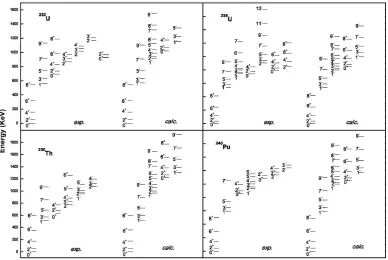
The results of the calculations of the energy spectra are presented in Fig. 2 together with available experimental data for230Th,232U,238U, and240Pu nuclei. These are
rep-resentatives of all considered nuclei. The experimental en-ergies and spin and parity assignments are taken from [16]. One can see that the structure of the calculated spectra are very similar for all considered nuclei. The explanation that elucidate the peculiarities of the calculated spectra can be obtained by examination what basis function from the set given by (8) contributes most to the wave functions of the states of a given rotational band.
For the ground–state rotational band the angular part of the wave–function of the state with angular momentum
Iis dominated by the functionYl1=I(Ωh)×Yl2=0(Ω0)
IM.
Since π = (−1)l2, the ground-state band contains only
states of positive parity and even angular momentum. The wave functions of the lowest negative parity states have the dominant contribution from the component
Yl1=I(Ωh)×Yl2=1(Ω0)
(I+1)M. Such a solutions form a
ro-tational band which contain the states of odd angular mo-mentum and negative parity. This band can be interpreted as Kπ = 0−band. One should note, however, that each eigenfunction of Hamiltonian (7) is superposition of states with different K values, thus K can be considered as a quantum number only approximately. The next lowest band of negative parity is formed from the states with main contribution of Yl1=I(Ωh)×Yl2=1(Ω0)
(I−1)M component
for odd angular momentum andYl1=I(Ωh)×Yl2=1(Ω0)
IM
Figure 2.Low-lying states of230Th,232U,238U,240Pu obtained by the diagonalization of the Hamiltonian (7). The states are gathered into the rotational bands according to their structure in terms of basis functions (8). Calculated results are compared with low-energy experimental spectra of the corresponding nuclei. Experimental energies, spin and parity assignments are taken from [16].
states of 0−band. The first excited 0+state is obtained as a lowest excitation in the mass-asymmetry coordinate.
From Fig. 2 it is seen that the agreement between the calculated excitation spectra and corresponding exper-imental rotational bands are rather good for all presented nuclei. One can notice, however, that some of the bands measured experimentally, namely,Kπ=0+,2+, and 2− rota-tional bands, are absent in the calculated spectra. The rea-son for the lack of these bands is that in the present version of the model we have considered the heavy fragment with stable axially-symmetric quadrupole deformation. Thus, we may expect, that if we add into consideration theβ− andγ−vibrations of the heavy fragment, the calculated spectra of actinides will contain additional 0+and 2+ ro-tational bands, which are build on theβandγ–vibrational excitations, respectively. We can also expect, the appear-ance of additional low–lying 0−and 2−bands, as a nega-tive parity doublets to theβandγ-vibrational bands. Note that the alternative explanation of the appearance of the low-lying 2−bands in actinides is based on the concept of tetrahedral deformation [17, 18].
3.2 Parity splitting
An important quantity which determines the strength of the reflection-asymmetric deformation is the parity split-ting [19] defined as the energy shift between the states of 0− and 0+ rotational bands. Dependence of the experi-mental and calculated values of a parity splitting in the
ground state and the first negative parity bands treated as a unified alternating parity band, on angular momentum is illustrated in Fig. 3. The parity splitting is
S(I−)=E(I−)−(I+1)E
+
(I−1)+IE+(I+1)
2I+1 , (12)
which provides zero value of parity splitting for the rota-tional band of a nucleus with rigid octupole deformation.
Having maximum value in the beginning of the band, the parity splitting tends to decrease with increase of angu-lar momentum. In our model the value of parity splitting is determined by the relative weights of the cluster compo-nents and the mononucleus in the wave function. Due to the larger moment of inertia than that of the mononucleus, the weight of α-particle DNS is increasing with angular momentum providing decrease of parity splitting.
3.3 Dipole transitions in240Pu
With the wave functions obtained one can calculate the re-duced transition matrix elements of the electric dipole and quadrupole transitions as defined in (11). In this contri-bution we present the results obtained in [20] for 240Pu.
The dipole momentsD0for the transitions between states
Figure 3. (Color online) Calculated (lines) and experimental (open circles of the same color) values of parity splitting (see (12)). Experimental values are taken from [16].
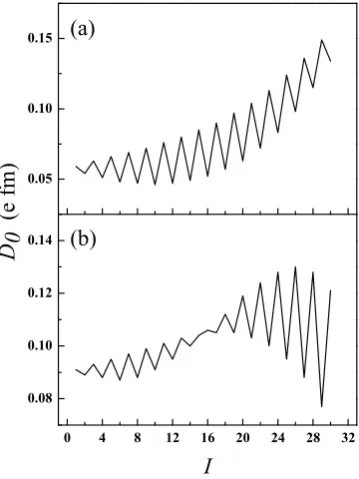
Figure 4. Transition dipole momentD0 for the transitions be-tween the first negative-parity band and the ground-state band (a), and between the first negative parity band and the second excited 0+band (b) as a function of the initial spinI.
of this effect. Due to different N/Z-ratios in the frag-ments, the dipole moment for the alpha-particle cluster system is large (for the pure alpha-particle DNS,D0 ≈4e
fm). With increasing angular momentum the weight of the cluster configuration with an alpha-particle increases as well as the dipole moment. As seen, at Ii < 10 the
dipole moment for the transition between the ground-state band and the first negative-parity band lies in the range
D0≈(0.05−0.08)efm. It increases with angular
momen-tum and achieves the value∼0.15efm forIi>20. This
re-sult is in good agreement with the experiment which sug-gestsD0∼0.2efm forI≥21 [21].
As seen in Fig. 4, the dependence of the dipole mo-ment on angular momo-mentum demonstrates staggering be-havior. The dipole moment for the transition from state
Figure 5. Ratio of transition dipole and quadrupole moments extracted from theE1 andE2 branching ratioB(E1,I−→(I− 1)+)/B(E2,I−→(I−2)−) as a function ofI. The experimental results are extracted from Ref. [21].
I of the ground-state band to state (I + 1) of the first negative-parity band is generally larger than for the tran-sition to state (I −1) of the same band. The reason of this staggering is the following. The basis functions (8), which mostly contribute to the stateI of the ground state band, have an angular partYl1=I(Ωh)×Yl2=0(ΩR)
IM.
For the states (I + 1) and (I − 1) of the first nega-tive parity band, the angular parts of the wave functions are mainly defined by Yl1=I(Ωh)×Yl2=1(ΩR)
(I+1)M and
Yl1=(I−2)(Ωh)×Yl2=1(ΩR)
(I−1)M, respectively. As follows
from expression (11), the dipole operator cannot change the angular momentum of the heavy fragment. Thus, the transitionI→(I−1) is hindered.
With increasing angular momentum the structure of the states becomes more complicated. For exam-ple, at I ≥ 15 the contribution of the basis states
Yl1=(I−2)(Ωh)×Yl2=2(ΩR)
IM to the wave functions of the
ground-state band cannot be neglected. Because of this, the hindrance mechanism described loses its significance. As seen in Fig. 4(a), the staggering ofD0decreases at large
values of angular momentum. One can expect that with further increase of angular momentum the spectrum ap-proaches its rotational limit and the staggering completely disappears.
The role of the structure of the wave functions is even more pronounced in the behavior of the dipole mo-ment for the E1 transitions from the excited 0+ band to the first negative-parity band. This behavior is illus-trated in Fig. 4 (b). The structure of the excited 0+band is more complicated than that of the ground-state band. Even in the beginning of the band the contribution of the basis function Yl1=(I−2)(Ωh)×Yl2=2(ΩR)
IM is
impor-tant. Thus, for small angular momentum the staggering ofD0is weak. However, with increasing angular
momen-tum the staggering starts to grow and change its pattern. The reason for this is the contribution of the basis state
Yl1=(I−3)(Ωh)×Yl2=3(ΩR)
IM to the wave function of the
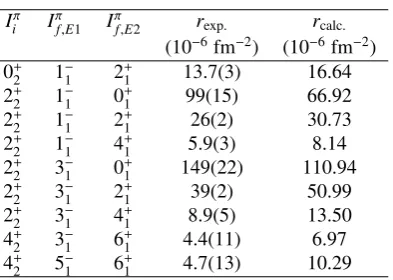
Table 1.Calculatedrcalc.=B(E1)/B(E2) ratios are compared with the experimental values (rexp.) for the low-spin members of the excited 0+rotational band in240Pu. The experimental values
are taken from Ref. [12].
Iπi Iπf,E1 Iπf,E2 rexp. rcalc.
(10−6fm−2) (10−6fm−2) 0+2 1−1 2+1 13.7(3) 16.64 2+2 1−1 0+1 99(15) 66.92 2+2 1−1 2+1 26(2) 30.73 2+2 1−1 4+1 5.9(3) 8.14 2+2 3−1 0+1 149(22) 110.94 2+2 3−1 2+1 39(2) 50.99 2+2 3−1 4+1 8.9(5) 13.50 4+2 3−1 6+1 4.4(11) 6.97 4+2 5−1 6+1 4.7(13) 10.29
For240Pu, the calculatedD
0/Q0-ratio is presented in
Fig. 5. One can see a good agreement with the available experimental data [21]. It is worth to note, that our model predict strong increase of D0/Q0-ratio at Ii ≥ 21. It is
presently hard to confirm this prediction because of the large experimental error-bars at large angular momentum. Recently, the branching B(E1)/B(E2)-ratios were measured for the transitions from states of excited 0+band to states negative-parity band and to the ground-state band [12]. As seen in Table 1, the calculated results are in over-all agreement with the experimental data.
4 Conclusion
We have suggested a cluster interpretation of the prop-erties of the multiple negative parity bands in deformed even–even actinides. The collective motion related to the cluster degree of freedom leads to the admixture of the very asymmetric cluster configurations to the intrinsic nu-cleus wave function. To treat the reflection asymmetric modes with nonzero values ofK, the rotational excitations of the heavy cluster is taken into account. The resulting energy spectrum consists of the ground state band, the ex-cited 0+band and several negative parity rotational bands which can be approximately interpreted asKπ = 0− and
Kπ = 1−bands. The angular momentum dependence of the parity splitting is described. As an example, the elec-tromagnetic transitions in240Pu were treated. The results
of calculations support the cluster feature of the low-lying negative-parity states and some excited 0+bands.
Acknowledgements
This work was supported by the RFBR (Moscow) and NSFC (Beijing). T.M.S. acknowledges the support from the CAS Fellowship for the the Young International Scientists (2013Y1JA0003) and Russian Government Subsidy Program of
the Competitive Growth of Kazan Federal University. S.G.Z. was partly supported by the 973 Program of China (Grant No. 2013CB834400), the NSF of China (Grants No. 11121403, No. 11120101005, and No. 11275248), and the Chinese Academy of Sciences (Grant No. KJCX2-EW-N01).
References
[1] P.A. Butler and W. Nazarewicz, Rev. Mod. Phys.68, 349 (1996)
[2] T.M. Shneidman, G.G. Adamian, N.V. Antonenko, R.V. Jolos, and W. Scheid, Phys. Rev. C67, 014313 (2003)
[3] G.G. Adamian, N.V. Antonenko, R.V. Jolos, and T.M. Shneidman, Phys. Rev. C70, 064318 (2004) [4] T.M. Shneidman, G.G. Adamian, N.V. Antonenko,
and R.V. Jolos, Phys. Rev. C74, 034316 (2006) [5] K. Wildermuth and Y.C. Tang,Unified Theory of the
Nucleus, Academic Press Inc (1977)
[6] W.D.M. Rae, Int. J. Mod. Phys. A3, 1343 (1988) [7] M. Freer and A.C. Merchant, J. Phys. G 23, 261
(1997)
[8] W. Nazarewicz, J.X. Saladinet al., Phys. Lett. B322, 304 (1994)
[9] S. Åberg and L.-O. Jonsson, Z. Phys. A349, 205 (1994)
[10] T.M. Shneidman, G.G. Adamian, N.V. Antonenko, S.P. Ivanova, and W. Scheid, Nucl. Phys. A671, 119 (2000)
[11] W. Reviolet al., Phys. Rev. C74, 044305 (2006) [12] M. Spiekeret al., Phys. Rev. C88, 031303(R) (2013) [13] T.M. Shneidman, G.G. Adamian, N.V. Antonenko, R.V. Jolos, and W. Scheid, Eur. Phys. J. A 47, 34 (2011)
[14] G.G. Adamian, N.V. Antonenko, and W. Scheid,
Clusters in Nuclei, ed. Ch. Beck, Vol.2, Lecture Notes in Physics848, (Springer-Verlag, Berlin, Hei-delberg, 2012) p. 165.
[15] G.G. Adamian, N.V. Antonenko, and R.V. Jolos, Nucl. Phys. A584, 205 (1995)
[16] http://www.nndc.bnl.gov/nndc/ensdf
[17] Y.S. Chen, Y. Sun, and Z.C. Gao, Phys. Rev. C77, 061305(R) (2008)
[18] J. Zhao, B.-N. Lu, E.-G. Zhao, and S.-G. Zhou, Phys. Rev. C86, 057304 (2012)
[19] R.V. Jolos and P. von Brentano, Phys. Rev. C 49, 2301(R) (1994)
[20] T.M. Shneidman, G.G. Adamian, N.V. Antonenko, R.V. Jolos, S.-G. Zhou, Phys. Rev. C 92, 034302 (2015)