Original citation:
Toye, Fran, Seers, Kate and Barker, Karen (2018) A meta-ethnography of health-care professionals’ experience of treating adults with chronic non-malignant pain to improve the experience and quality of health care. National Institute for Health Research. (Health Services and Delivery Research).
Permanent WRAP URL:
http://wrap.warwick.ac.uk/101664
Copyright and reuse:
The Warwick Research Archive Portal (WRAP) makes this work by researchers of the University of Warwick available open access under the following conditions. Copyright © and all moral rights to the version of the paper presented here belong to the individual author(s) and/or other copyright owners. To the extent reasonable and practicable the material made available in WRAP has been checked for eligibility before being made available.
Copies of full items can be used for personal research or study, educational, or not-for-profit purposes without prior permission or charge. Provided that the authors, title and full bibliographic details are credited, a hyperlink and/or URL is given for the original metadata page and the content is not changed in any way.
Publisher’s statement
© Queen’s Printer and Controller of HMSO 2018. This work was produced by Toye et al. under the terms of a commissioning contract issued by the Secretary of State for Health and Social Care. This issue may be freely reproduced for the purposes of private research and study and extracts (or indeed, the full report) may be included in professional journals provided that suitable acknowledgement is made and the reproduction is not associated with any form of advertising. Applications for commercial reproduction should be addressed to: NIHR Journals Library, National Institute for Health Research, Evaluation, Trials and Studies Coordinating Centre, Alpha House, University of Southampton Science Park, Southampton SO16 7NS, UK.
A note on versions:
The version presented in WRAP is the published version or, version of record, and may be cited as it appears here.
VOLUME 6 ISSUE 17 APRIL 2018 ISSN 2050-4349
A meta-ethnography of health-care professionals’
experience of treating adults with chronic
non-malignant pain to improve the experience
and quality of health care
professionals
’
experience of treating
adults with chronic non-malignant pain to
improve the experience and quality of
health care
Fran Toye,
1,2
* Kate Seers
3
and Karen Barker
1,2
1
Physiotherapy Research Unit, Nuffield Orthopaedic Centre, Oxford University
Hospitals NHS Foundation Trust, Oxford, UK
2
Nuffield Department of Orthopaedics, Rheumatology and Musculoskeletal
Sciences (NDORMS), University of Oxford, Oxford, UK
3
Royal College of Nursing Research Institute, Warwick Medical School, University
of Warwick, Coventry, UK
*Corresponding author
Declared competing interests of authors:Fran Toye, Kate Seers and Karen Barker authored two studies that are included in this qualitative evidence synthesis. Kate Seers is a Health Services and Delivery
Research board member and a Health Services Research Commissioning board member.
Published April 2018
DOI: 10.3310/hsdr06170This report should be referenced as follows:
ISSN 2050-4349 (Print)
ISSN 2050-4357 (Online)
This journal is a member of and subscribes to the principles of the Committee on Publication Ethics (COPE) (www.publicationethics.org/).
Editorial contact: [email protected]
The full HS&DR archive is freely available to view online at www.journalslibrary.nihr.ac.uk/hsdr. Print-on-demand copies can be purchased from the report pages of the NIHR Journals Library website: www.journalslibrary.nihr.ac.uk
Criteria for inclusion in theHealth Services and Delivery Researchjournal
Reports are published inHealth Services and Delivery Research(HS&DR) if (1) they have resulted from work for the HS&DR programme or programmes which preceded the HS&DR programme, and (2) they are of a sufficiently high scientific quality as assessed by the reviewers and editors.
HS&DR programme
The Health Services and Delivery Research (HS&DR) programme, part of the National Institute for Health Research (NIHR), was established to fund a broad range of research. It combines the strengths and contributions of two previous NIHR research programmes: the Health Services Research (HSR) programme and the Service Delivery and Organisation (SDO) programme, which were merged in January 2012.
The HS&DR programme aims to produce rigorous and relevant evidence on the quality, access and organisation of health services including costs and outcomes, as well as research on implementation. The programme will enhance the strategic focus on research that matters to the NHS and is keen to support ambitious evaluative research to improve health services.
For more information about the HS&DR programme please visit the website: http://www.nets.nihr.ac.uk/programmes/hsdr
This report
The research reported in this issue of the journal was funded by the HS&DR programme or one of its preceding programmes as project number 14/198/07. The contractual start date was in July 2015. The final report began editorial review in May 2017 and was accepted for publication in August 2017. The authors have been wholly responsible for all data collection, analysis and interpretation, and for writing up their work. The HS&DR editors and production house have tried to ensure the accuracy of the authors’report and would like to thank the reviewers for their constructive comments on the final report document. However, they do not accept liability for damages or losses arising from material published in this report.
This report presents independent research funded by the National Institute for Health Research (NIHR). The views and opinions expressed by authors in this publication are those of the authors and do not necessarily reflect those of the NHS, the NIHR, NETSCC, the HS&DR programme or the Department of Health and Social Care. If there are verbatim quotations included in this publication the views and opinions expressed by the interviewees are those of the interviewees and do not necessarily reflect those of the authors, those of the NHS, the NIHR, NETSCC, the HS&DR programme or the Department of Health and Social Care.
© Queen’s Printer and Controller of HMSO 2018. This work was produced by Toyeet al.under the terms of a commissioning contract issued by the Secretary of State for Health and Social Care. This issue may be freely reproduced for the purposes of private research and study and extracts (or indeed, the full report) may be included in professional journals provided that suitable acknowledgement is made and the reproduction is not associated with any form of advertising. Applications for commercial reproduction should be addressed to: NIHR Journals Library, National Institute for Health Research, Evaluation, Trials and Studies Coordinating Centre, Alpha House, University of Southampton Science Park, Southampton SO16 7NS, UK.
Health Services and Delivery Research
Editor-in-Chief
Professor Jo Rycroft-Malone Professor of Health Services and Implementation Research, Bangor University, UK
NIHR Journals Library Editor-in-Chief
Professor Tom Walley Director, NIHR Evaluation, Trials and Studies and Director of the EME Programme, UK
NIHR Journals Library Editors
Professor Ken Stein Chair of HTA and EME Editorial Board and Professor of Public Health, University of Exeter Medical School, UK
Professor Andrée Le May Chair of NIHR Journals Library Editorial Group (HS&DR, PGfAR, PHR journals)
Dr Martin Ashton-Key Consultant in Public Health Medicine/Consultant Advisor, NETSCC, UK
Professor Matthias Beck Professor of Management, Cork University Business School, Department of Management and Marketing, University College Cork, Ireland
Dr Tessa Crilly Director, Crystal Blue Consulting Ltd, UK
Dr Eugenia Cronin Senior Scientific Advisor, Wessex Institute, UK
Dr Peter Davidson Director of the NIHR Dissemination Centre, University of Southampton, UK
Ms Tara Lamont Scientific Advisor, NETSCC, UK
Dr Catriona McDaid Senior Research Fellow, York Trials Unit, Department of Health Sciences, University of York, UK
Professor William McGuire Professor of Child Health, Hull York Medical School, University of York, UK
Professor Geoffrey Meads Professor of Wellbeing Research, University of Winchester, UK
Professor John Norrie Chair in Medical Statistics, University of Edinburgh, UK
Professor John Powell Consultant Clinical Adviser, National Institute for Health and Care Excellence (NICE), UK
Professor James Raftery Professor of Health Technology Assessment, Wessex Institute, Faculty of Medicine, University of Southampton, UK
Dr Rob Riemsma Reviews Manager, Kleijnen Systematic Reviews Ltd, UK
Professor Helen Roberts Professor of Child Health Research, UCL Great Ormond Street Institute of Child Health, UK
Professor Jonathan Ross Professor of Sexual Health and HIV, University Hospital Birmingham, UK
Professor Helen Snooks Professor of Health Services Research, Institute of Life Science, College of Medicine, Swansea University, UK
Professor Jim Thornton Professor of Obstetrics and Gynaecology, Faculty of Medicine and Health Sciences, University of Nottingham, UK
Professor Martin Underwood Director, Warwick Clinical Trials Unit, Warwick Medical School, University of Warwick, UK
Please visit the website for a list of members of the NIHR Journals Library Board: www.journalslibrary.nihr.ac.uk/about/editors
Abstract
A meta-ethnography of health-care professionals
’
experience of treating adults with chronic non-malignant
pain to improve the experience and quality of health care
Fran Toye,
1,2* Kate Seers
3and Karen Barker
1,21Physiotherapy Research Unit, Nuffield Orthopaedic Centre, Oxford University Hospitals NHS Foundation Trust, Oxford, UK
2Nuffield Department of Orthopaedics, Rheumatology and Musculoskeletal Sciences (NDORMS), University of Oxford, Oxford, UK
3Royal College of Nursing Research Institute, Warwick Medical School, University of Warwick, Coventry, UK
*Corresponding author [email protected]
Background:People with chronic pain do not always feel that they are being listened to or valued by health-care professionals (HCPs). We aimed to understand and improve this experience by finding out what HCPs feel about providing health care to people with chronic non-malignant pain. We did this by bringing together the published qualitative research.
Objectives:(1) To undertake a qualitative evidence synthesis (QES) to increase our understanding of what it is like for HCPs to provide health care to people with chronic non-malignant pain; (2) to make our findings easily available and accessible through a short film; and (3) to contribute to the development of methods for QESs.
Design:We used the methods of meta-ethnography, which involve identifying concepts and progressively abstracting these concepts into a line of argument.
Data sources:We searched five electronic bibliographic databases (MEDLINE, EMBASE, Cumulative Index to Nursing and Allied Health Literature, PsycINFO and Allied and Complementary Medicine Database) from inception to November 2016. We included studies that explored HCPs’experiences of providing health care to people with chronic non-malignant pain. We utilised the Grading of Recommendations Assessment, Development and Evaluation Confidence in the Evidence from Reviews of Qualitative research (GRADE-CERQual) framework to rate our confidence in the findings.
Results:We screened 954 abstracts and 184 full texts and included 77 studies reporting the experiences of>1551 HCPs. We identified six themes: (1) a sceptical cultural lens and the siren song of diagnosis; (2) navigating juxtaposed models of medicine; (3) navigating the patient–clinician borderland; (4) the challenge of dual advocacy; (5) personal costs; and (6) the craft of pain management. We produced a short film,
Limitations:There are no agreed methods for determining confidence in QESs.
Conclusions:We highlight areas that help us to understand why the experience of health care can be difficult for patients and HCPs. Importantly, HCPs can find it challenging if they are unable to find a diagnosis and at times this can make them feel sceptical. The findings suggest that HCPs find it difficult to balance their dual role of maintaining a good relationship with the patient and representing the health-care system. The ability to support patients to live a valued life with pain is described as a craft learnt through experience. Finally, like their patients, HCPs can experience a sense of loss because they cannot solve the problem of pain.
Future work:Future work to explore the usefulness of the conceptual model and film in clinical education would add value to this study. There is limited primary research that explores HCPs’experiences with chronic non-malignant pain in diverse ethnic groups, in gender-specific contexts and in older people living in the community.
Funding:The National Institute for Health Research Health Services and Delivery Research programme.
Contents
List of tables ix
List of figures xi
List of boxes xiii
List of supplementary material xv List of abbreviations xvii Plain English summary xix Scientific summary xxi Chapter 1Background 1
Objectives 2
Chapter 2Methods 3
Stage 1: getting started 3
Stage 2: deciding what is relevant 3
Searching and screening 4
Quality appraisal 4
GRADE-CERQual 6
Stage 3: reading the studies 7
Stage 4: determining how studies are related to each other 7
Stage 5: translating studies into each other 8
Stage 6: synthesising translations 8
Stage 7: expressing the synthesis 8
Chapter 3Findings 9
Search results 9
Quality assessment and inclusion 9
Coding and conceptual categories 21
Assessment of confidence in findings (GRADE-CERQual) 34
Conceptual themes 34
A sceptical cultural lens and siren song of diagnosis 34
Navigating juxtaposed models of medicine 36
Navigating the patient–clinician borderland 38
The challenge of dual advocacy 40
Personal costs 41
The craft of pain management 42
Conceptual model 45
Opioid prescription 46
Discussion 53
A sceptical cultural lens and siren song of diagnosis 54
Navigating the patient–clinician health-care interface 54
Personal costs 55
Opioid prescription 56
Film outputs from qualitative research 56
Methodological issues 56
Are we constrained by a priori concepts? 56
How can we determine confidence in review findings? 57
Chapter 4Implications for education, policy and practice 63 Chapter 5Recommendations for research 65
Acknowledgements 67
References 69
Appendix 1Log of appraisal comments 85 Appendix 2Concepts included in and excluded from the analysis 91 Appendix 3Concepts included in the opioid concept analysis 103
List of tables
TABLE 1 Search syntax for electronic databases 5 TABLE 2 Themes developed from a qualitative study embedded in a previous
meta-ethnography funded by the HSDR programme 6
TABLE 3 Geographical setting, sample size, data collection method, analytical
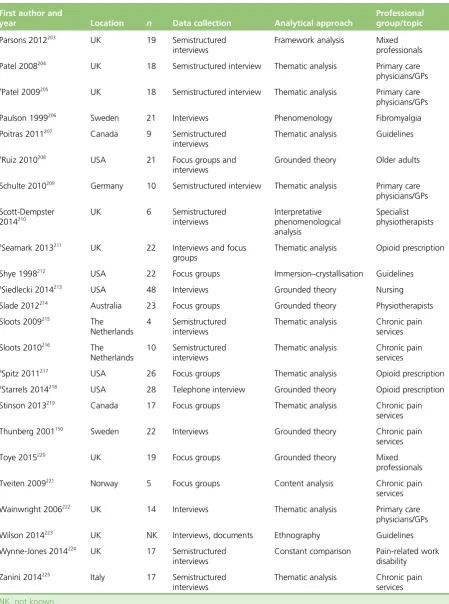
approach and professional group/topic of included studies 11
TABLE 4 Quality appraisal report 14 TABLE 5 Relevance and aim of included studies 18 TABLE 6 Concepts that did not fit the conceptual analysis 23 TABLE 7 Example of the conceptual category‘is the pain real?’and its concepts 24 TABLE 8 Forty-two conceptual categories included in conceptual analysis 25 TABLE 9 Conceptual categories underpinning each of the six overarching themes 29 TABLE 10 Studies and number of concepts for each theme organised by topic/
professional group 30
TABLE 11 Confidence in review findings: GRADE-CERQual assessment 35 TABLE 12 Conceptual categories: the experience of prescribing opioids to
patients with chronic non-malignant pain 47
List of figures
FIGURE a Conceptual model: complexity of providing health care to people with
chronic non-malignant pain xxiii
FIGURE 1 The stages of meta-ethnography 3 FIGURE 2 Systematic search results 10 FIGURE 3 Concepts that were included and excluded 22 FIGURE 4 Illustration of conceptual analysis with advisory group 28 FIGURE 5 Dualities of moral boundary work 35 FIGURE 6 Multiplicity of clinical decision-making: do I refer for a test? 44 FIGURE 7 Conceptual model: complexity of providing health care to people with
chronic non-malignant pain 46
FIGURE 8 Conceptual model: the ambiguity of prescribing opioids to patients
List of boxes
List of supplementary material
Report Supplementary Material 1 Video entitled‘Struggling to support people to live a valued life with chronic pain’
Supplementary material can be found on the NIHR Journals Library report project page (www.journalslibrary.nihr.ac.uk/programmes/hsdr/1419807/#/documentation).
List of abbreviations
AMED Allied and Complementary Medicine Database
CASP Critical Appraisal Skills Programme
CINAHL Cumulative Index to Nursing and Allied Health Literature
ConQual establishing confidence in the output of qualitative research synthesis
GP general practitioner
GRADE-CERQual
Grading of Recommendations Assessment, Development and Evaluation Confidence in the Evidence from Reviews of Qualitative research
HCP health-care professional
HSDR Health Services and Delivery Research
Plain English summary
C
hronic pain is pain that persists long after the time when one would expect to get better. People with chronic pain do not always feel that they are being listened to or valued by health-care professionals (HCPs). We wanted to understand and improve this experience by finding out how HCPs felt about providing health care to people with chronic non-malignant pain. We did this by bringing together the published qualitative research exploring HCPs’experiences. Qualitative research often uses in-depth interviews with individuals, or groups, to explore different perspectives. This study provides a distilled form of knowledge for practitioners, policy-makers and patients, which can help us to understand and improve the experience for patients with chronic pain. We worked alongside an advisory group that included a mix of patient representatives and HCPs. We also worked with a media agency to produce a short film of our findings, which can be watched online (seeReport Supplementary Material 1; URL: www.journalslibrary. nihr.ac.uk/programmes/hsdr/1419807/#/documentation; accessed 24 July 2017).Scientific summary
Background
A recent systematic review of population studies indicates that as many as 28 million adults in the UK are affected by chronic pain (Fayaz A, Croft P, Langford RM, Donaldson LJ, Jones GT. Prevalence of chronic pain in the UK: a systematic review and meta-analysis of population studies.BMJ Open2016;6:e010364). They do not always feel valued or believed by health-care professionals (HCPs) and can experience an adversarial struggle in health care. To improve this, we need to understand what it is like for HCPs to provide health care for people with chronic non-malignant pain and why this can develop into an adversarial relationship. There is a large body of qualitative research exploring HCPs’experience of providing health care to people with chronic pain, but there has been no attempt to systematically search for and integrate this knowledge in order to improve health care. Existing research highlights mismatches in patients’and clinicians’
experiences. We aimed to use this existing knowledge to help us to improve our understanding of this complex process of health care. Our findings allow us to understand some of the challenges of providing health care for people with chronic non-malignant pain and inform us of how to improve the experience for both HCPs and for people with chronic pain.
Objectives
l To undertake a qualitative evidence synthesis (QES) of qualitative research using meta-ethnography to increase our understanding of what it is like for HCPs to provide health care to people with chronic non-malignant pain and thus inform improvements in the experience and quality of health care. l To make our findings easily available and accessible through a short film.
l To contribute to the development of methods for QES that aim to bring together qualitative research findings so that health care can be improved.
Data collection
We searched five electronic bibliographic databases (MEDLINE, EMBASE, Cumulative Index to Nursing and Allied Health Literature, PsycINFO and Allied and Complementary Medicine Database) from inception to November 2016. We included studies that explore HCPs’experiences of providing health care to people with chronic non-malignant pain. We included a combination of medical subject heading and free-text terms adapted from the InterTASC Information Specialists’Sub-Group search filter resource. We screened the titles, abstracts and full texts of potential studies for relevance and used methods of quality appraisal to frame our discussions. We utilised the Grading of Recommendations Assessment, Development and Evaluation Confidence in the Evidence from Reviews of Qualitative research (GRADE-CERQual) framework to rate our confidence in the review findings.
Analysis
Patient and public involvement
The study design, analysis and dissemination plan were developed in collaboration with an advisory group that included patients and HCPs.
Research findings
We screened 954 abstracts and 184 full texts and included 77 published studies reporting the experiences of>1551 national and international HCPs, including doctors, nurses and allied health professionals. We abstracted six themes that help us to understand HCPs’experiences of providing health care to people with chronic non-malignant pain: (1) a sceptical cultural lens and the siren song of diagnosis; (2) navigating juxtaposed models of medicine; (3) navigating the patient–clinician borderland; (4) the challenge of dual advocacy; (5) personal costs; and (6) the craft of pain management. We produced a short film that presents these themes,‘Struggling to support people to live a valued life with chronic pain’, which is available on YouTube (YouTube, LLC, San Bruno, CA, USA) (seeReport Supplementary Material 1; URL: www. journalslibrary.nihr.ac.uk/programmes/hsdr/1419807/#/documentation; accessed 24 July 2017). We also developed a conceptual model that helps us to understand the complexity of providing health care to people with chronic non-malignant pain. The innovation of this conceptual model is to propose a series of tensions that are integral to the experience of providing health care to people with chronic non-malignant pain, between a dualistic biomedical model and an embodied psychosocial model; professional distance and proximity; professional expertise and patient empowerment; the need to make concessions to maintain therapeutic relationships and the need for evidence-based utility; and patient advocacy and health-care system advocacy.Figure aillustrates the tensions that underpin our conceptual model. This model may be transferable to other chronic conditions and potentially be useful for HCPs treating other conditions that do not comfortably fit the biomedical model (e.g. fatigue and unexplained symptoms). Our findings demonstrate that these tensions underpin HCPs’experience of providing health care to people with chronic non-malignant pain and can contribute to an adversarial relationship. Importantly, HCPs navigate towards the biomedical model and siren song of diagnosis. HCPs can find it challenging to provide health care to people with chronic non-malignant pain because they feel that they have failed in their professional duty to find and fix a
medical problem.
The biopsychosocial model is a model used in chronic pain management that recognises that the experience of pain is the result of a complex relationship between biological and psychosocial factors. Our findings indicate that even when HCPs advocate a biopsychosocial model, for some the model remains dualistic at its core. This can mean that HCPs make an abrupt shift towards psychosocial explanations when they cannot find a biomedical explanation. Our findings also indicate that, from the outset, during the first consultation, some HCPs utilise a more embodied biopsychosocial approach and focus on understanding the lived experience of pain alongside efforts to define pain in biomedical terms. Embodiment focuses on unique personal meaning that can be understood only in the individual’s social, cultural and historical context. At times, HCPs who focus on gaining an embodied understanding can feel
‘bombarded by despair’. However, there is a sense that, although it can impose a personal burden, this embodied approach can also be rewarding for both the patient and the professional. This embodied approach might also help to reduce the sense of professional failure that comes from the desire to find a medical solution. The findings also indicate the complexity of navigating the interface between the professional and the patient. HCPs can find it difficult to balance the dual role of representing the health-care system and at the same time maintain an effective therapeutic relationship with individual patients. The ability to successfully manage patients with chronic pain is described as a craft that is learnt through experience. At times, HCPs can feel underskilled in chronic pain management. We also identify themes to help us understand the experience of prescribing opioids. These themes are underpinned by the ambiguity surrounding opioid prescription for chronic non-malignant pain and they highlight the complexity for HCPs of managing chronic non-malignant pain.
We rate our confidence in the review findings as moderate to high and comment on the utility of GRADE-CERQual for determining confidence in qualitative syntheses. We also outline criteria that might help reviewers to consider which studies to include in future qualitative syntheses.
FIGURE a Conceptual model: complexity of providing health care to people with chronic non-malignant pain. Reproduced from Toye F, Seers K, Barker KL. Meta-ethnography to understand healthcare professionals’
experience of treating adults with chronic non-malignant pain.BMJ Open2017;7:e018411. This is an Open Access article distributed in accordance with the terms of the Creative Commons Attribution (CC BY 4.0) license, which permits others to distribute, remix, adapt and build upon this work, for commercial use, provided the original work is properly cited. See: http://creativecommons.org/licenses/by/4.0/).
Conclusions
This innovative meta-ethnography reveals, for the first time, that there are many complex tensions that HCPs have to navigate when working with people who have chronic non-malignant pain, and that this experience can be adversarial. Our findings can help us to consider the experience of health care from the perspective of HCPs and to understand the potential tensions that may contribute to this adversarial experience. HCPs can use our conceptual model to help them to think about their encounters with patients with chronic pain. For example:
l Am I making a sudden shift to psychosocial explanations? l Am I considering psychosocial factors at the outset?
l Do I understand this patient’s experience or am I too distant? l Am I trying to enforce my decisions?
l Am I making a concession and for whose benefit?
l What is the effect of dual advocacy on me and my patient? l What personal impact is this having on me?
We invite HCPs to use our‘mixing console’to help them to think about their encounters with patients. The poles are neither inherently good nor inherently bad, just as bass and treble are neither inherently good nor inherently bad. It is the correct mix within a context that contributes to the quality of music. Our console also incorporates the pitch or level of loss, both professional and personal, that can contribute to the harmony or dissonance of a therapeutic encounter. This console may be transferable to other chronic conditions.
Implications for health care
l The findings indicate an underlying scepticism that might contribute to an adversarial relationship between a patient and their HCP. Believing patients’experiences may provide a more secure foundation for an effective therapeutic relationship.
l The findings indicate a dualistic approach whereby HCPs make a sudden shift from biomedical to biopsychosocial explanations for the pain after exhausting attempts to decipher a diagnosis. This abrupt shift may exacerbate a sense of loss of credibility for patients.
l The findings indicate that some HCPs engage in judgements about what is real or not real that are underpinned by a cultural duality of real (biomedical) and not real (psychosocial).
l The findings suggest that an embodied, rather than a dualistic, biopsychosocial model that focuses on the personal meaning of pain from the outset might help to lessen the adversarial experience and also reduce the HCP’s sense of failure.
l The findings have clinical and educational implications. How can we enable HCPs to manage the tensions that underpin the experience of providing health care to people with chronic non-malignant pain? How do we recognise and support the complexity of skills and emotional cost of providing health care to people with chronic non-malignant pain?
l The findings highlight the benefits of reciprocity, mutuality and collaboration between HCPs and the benefits of being able to break down or cross professional boundaries and hierarchies.
l The findings highlight a need to consider the emotional costs to HCPs of providing health care to people with chronic non-malignant pain.
Funding
Funding for this study was provided by the Health Services and Delivery Research programme of the National Institute for Health Research.
Chapter 1
Background
A
recent systematic review1of population studies indicates that as many as 28 million adults in theUK are affected by chronic pain. Population estimates suggest that around 25% of adults around the world suffer with moderate or severe pain,2–6and for between 6% and 14% of these adults this pain is
disabling.6,7We know that living with chronic pain can be challenging and that patients do not always feel
valued or believed by health-care professionals (HCPs).8To improve these patients’experiences of health
care, we need to understand what is going on from the perspective of the HCP. In particular, we need to understand why it is that working with people with chronic non-malignant pain can result in patients experiencing this as an adversarial relationship. If we can understand what it is like to be a HCP providing health care to people with chronic non-malignant pain, and in particular its challenges and rewards, this understanding can facilitate improvements in the experience and quality of health care for this large group of people.
Chronic pain can be particularly challenging for HCPs to treat because it persists beyond the expected healing time and is not amenable to routine methods of pain control.9This is complicated by the finding
that pain is not always explained by a specific pathology.6HCPs find working with patients with chronic
pain very complex. For example, HCPs describe feeling‘bombarded by despair’under the pressure of not being able to fix the person in pain.10They can also find it a challenge to balance empathy with‘not
getting too involved’.10Allegretti and colleagues11describe the challenges for general practitioners (GPs)
and highlight mismatches in patients’and clinicians experiences of health care. Others report feelings of frustration and discord in the patient–clinician relationship.12It is not uncommon for patients to report
dissatisfaction with their HCP interaction and this is likely to influence their decisions and actions.13The
rationale for this study is underpinned by the need to facilitate‘patient-centred medicine’.14Mead and
Bower15identified five key dimensions of patient-centred medicine: (1) taking a biopsychosocial perspective;
(2) framing the‘patient-as-person’; (3) sharing power and responsibility; (4) therapeutic alliance, which hinges on an effective personal relationship; and (5)‘doctor-as-person’, which recognises the influence that HCPs’ personal characteristics and responses can have on care. Mead and Bower15indicate that patient-centred
care requires HCPs to be self-aware of their emotional responses and reactions:‘sensitivity and insight into the reactions of both parties can be used for therapeutic purposes’. Thus, understanding the experience of providing health care to people with chronic non-malignant pain from the perspective of the HCP can have important implications for delivery of health care, decision-making and health-care quality. The findings will allow HCPs and their managers to understand, in detail, the challenges of providing health care to this complex group of patients and, thus, facilitate improvements to the quality of health care. In addition, a mutual understanding of what it is like to provide and receive health care for chronic non-malignant pain can facilitate a therapeutic partnership from the perspective of both patients and their HCPs.
The aim of qualitative evidence synthesis (QES) in health care is to systematically review and integrate findings in order to increase our understanding of the complex processes of health care and, thus, improve the experience and quality of that care. The proliferation of qualitative studies can make it difficult to access and utilise qualitative knowledge to inform practice and policy.16The Cochrane Qualitative Research
Methods Group acknowledges the importance of including qualitative findings within evidence-based health care,17and insights from several meta-ethnographies have contributed to a greater understanding
of complex processes in health care, for example medicine-taking,18diabetes,19antidepressants,20chronic
musculoskeletal pain8and chronic pelvic pain.21There are various methods for synthesising qualitative
research.16,22–25An important distinction made in synthesis approaches is between (1) those that aim to
describe or‘aggregate’findings and (2) those that aim to interpret these findings and develop conceptual understandings or‘theory’.26Our aim is to develop conceptual understanding. We will use the methods
of meta-ethnography developed, refined and reported by Toye and colleagues8in a previous
Objectives
l To undertake a QES (meta-ethnography)26–28that will increase our understanding of what it is like for HCPs
to provide health care to people with chronic non-malignant pain and, thus, to inform improvements in the experience and quality of health care.
l To make our findings easily available and accessible through a short film.
l To contribute to the development of methods for QES that aim to bring together qualitative research findings so that health care can be improved.
Chapter 2
Methods
T
here are seven stages to meta-ethnography (outlined inFigure 1). Stage 1 incorporates the rationale, aims and protocol development. Stage 2 involves deciding what is relevant to the synthesis through a systematic search, screening and appraisal. The analytical stages in meta-ethnography involve overlapping research activities: reading the studies (stage 3), determining how the studies are related (stage 4), translating the studies into each other (stage 5) and synthesising the translations (stage 6). The final stage (stage 7) involves the output and dissemination of findings.Stage 1: getting started
This stage incorporates the background, rationale, aims and protocol development.
Stage 2: deciding what is relevant
In their original text on meta-ethnography, Noblit and Hare26do not advocate an exhaustive literature search,
and the number of studies included in meta-ethnographies ranges widely.22,24,27The aim of meta-ethnography
is not to perform statistical analyses but to draw on knowledge for conceptual development. Some argue that including too many studies makes the analysis‘unwieldy’.27,29However, we aimed to produce a conceptual
analysis with a weight of evidence that has resonance with the health research community and thus
undertook a systematic search of the published literature. Our previous meta-ethnography has demonstrated the value of undertaking a systematic search and including a larger number of studies into a QES.28
1. Getting started
Rationale, aims and protocol development
2. Deciding what is relevant
Search, screening and quality appraisal
3. Reading the studies
Upload findings onto NVivo software (QSR International,
Warrington, UK) for qualitative analysis
4. Determining how studies are related to each other
Identify ideas in each study
5. Translating studies into each other
Sort ideas into conceptual categories
7. Expressing the synthesis
Research output, including YouTube (YouTube, LLC, San Bruno, CA, USA) film
6. Synthesising translations
[image:30.595.129.506.423.755.2]Abstract conceptual categories into a conceptual model
Searching and screening
Inclusions
We included studies that explored HCPs’experiences of providing health care to adults with chronic non-malignant pain.
Exclusions
We excluded studies of acute pain, head pain, arthritis (including osteoarthritis and rheumatoid arthritis) or patient experience, and studies in which HCPs’experiences could not be disentangled from the experiences of others (e.g. patients, carers or family members).
We searched five electronic bibliographic databases [MEDLINE, EMBASE, Cumulative Index to Nursing and Allied Health Literature (CINAHL), PsycINFO and Allied and Complementary Medicine Database (AMED)] using terms adapted from the InterTASC Information Specialists’Sub-Group search filter resource.30–33
The InterTASC Information Specialists’Sub-Group is a group of information professionals supporting research groups producing technology assessments for the National Institute for Health and Care Excellence (URL: www.york.ac.uk/inst/crd/intertasc/; accessed 24 July 2017).
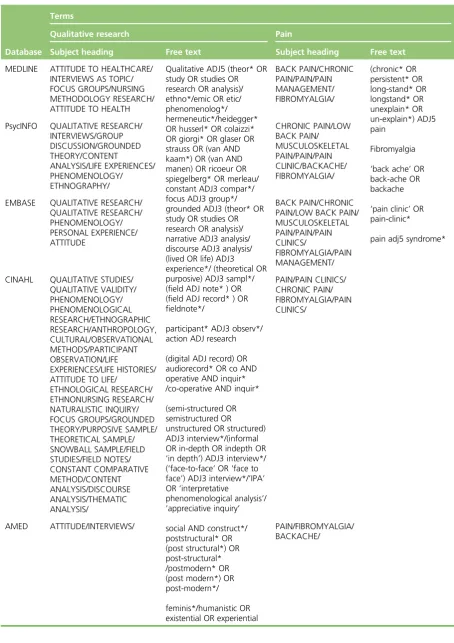
We developed the search strategy with an information specialist and used a combination of specific subject heading terms and free-text terms (Table 1). We did not use the‘clinical query limits’option for qualitative research in our searches, as we had found that this can filter out relevant qualitative studies. To ensure value for money, we did not include citation checks, hand-searching, grey literature or Doctor of Philosophy (PhD) searches. Previous experience has shown us that these strategies do not necessarily add significant conceptual value to large meta-ethnographies.28Two reviewers screened the titles, abstracts
and full texts of potential studies for relevance.
Quality appraisal
Although there are many frameworks suggested for appraising the quality of qualitative research, there is no consensus on what makes a study‘good’.27,34However, a growing number of researchers
are appraising studies for the purpose of QES.24
Although we did not intend to use rigid guidelines for determining inclusion, we used three methods of quality appraisal to frame our discussions:
1. The questions developed by the Critical Appraisal Skills Programme (CASP) for appraising qualitative research (Box 1).35We assigned a numerical score to each question to indicate whether we felt that the
CASP question (1) had not been addressed, (2) had been addressed partially or (3) had been extensively addressed, thus giving a possible score range of 10–30.8We used the CASP in this way in a previous
meta-ethnography of patients’experience of living with chronic non-malignant pain, in which we found that satisfactory papers scored at least 19.8
2. A list of seven themes (Table 2) developed from a qualitative study embedded in a previous
meta-ethnography funded by the Health Services and Delivery Research (HSDR) programme.36Unlike CASP, these
themes were developed specifically for meta-ethnography. For example, CASP does not focus specifically on conceptual clarity as a facet of quality, which is a distinguishing feature of meta-ethnography. 3. We categorised, as suggested by Dixon-Woods and colleagues,34a‘key paper’that was‘conceptually
rich and could potentially make an important contribution to the synthesis’; a‘satisfactory paper’; a paper that is irrelevant to the synthesis; and a paper that is methodologically fatally flawed.
Two reviewers appraised each paper, and if they were unable to reach an agreement the study was sent to a third reviewer for the final decision.
TABLE 1 Search syntax for electronic databases
Database Terms
Qualitative research Pain
Subject heading Free text Subject heading Free text
MEDLINE ATTITUDE TO HEALTHCARE/ INTERVIEWS AS TOPIC/ FOCUS GROUPS/NURSING METHODOLOGY RESEARCH/ ATTITUDE TO HEALTH
Qualitative ADJ5 (theor* OR study OR studies OR research OR analysis)/ ethno*/emic OR etic/ phenomenolog*/ hermeneutic*/heidegger* OR husserl* OR colaizzi* OR giorgi* OR glaser OR strauss OR (van AND kaam*) OR (van AND manen) OR ricoeur OR spiegelberg* OR merleau/ constant ADJ3 compar*/ focus ADJ3 group*/ grounded ADJ3 (theor* OR study OR studies OR research OR analysis)/ narrative ADJ3 analysis/ discourse ADJ3 analysis/ (lived OR life) ADJ3 experience*/ (theoretical OR purposive) ADJ3 sampl*/ (field ADJ note* ) OR (field ADJ record* ) OR fieldnote*/
participant* ADJ3 observ*/ action ADJ research
(digital ADJ record) OR audiorecord* OR co AND operative AND inquir* /co-operative AND inquir*
(semi-structured OR semistructured OR
unstructured OR structured) ADJ3 interview*/(informal OR in-depth OR indepth OR ‘in depth’) ADJ3 interview*/ (‘face-to-face’OR‘face to face’) ADJ3 interview*/’IPA’ OR‘interpretative
phenomenological analysis’/ ’appreciative inquiry’
social AND construct*/ poststructural* OR (post structural*) OR post-structural* /postmodern* OR (post modern*) OR post-modern*/
feminis*/humanistic OR existential OR experiential
BACK PAIN/CHRONIC PAIN/PAIN/PAIN MANAGEMENT/ FIBROMYALGIA/ (chronic* OR persistent* OR long-stand* OR longstand* OR unexplain* OR un-explain*) ADJ5 pain Fibromyalgia ‘back ache’OR back-ache OR backache ‘pain clinic’OR pain-clinic*
pain adj5 syndrome* PsycINFO QUALITATIVE RESEARCH/
INTERVIEWS/GROUP DISCUSSION/GROUNDED THEORY/CONTENT ANALYSIS/LIFE EXPERIENCES/ PHENOMENOLOGY/ ETHNOGRAPHY/ CHRONIC PAIN/LOW BACK PAIN/ MUSCULOSKELETAL PAIN/PAIN/PAIN CLINIC/BACKACHE/ FIBROMYALGIA/
EMBASE QUALITATIVE RESEARCH/ QUALITATIVE RESEARCH/ PHENOMENOLOGY/ PERSONAL EXPERIENCE/ ATTITUDE
BACK PAIN/CHRONIC PAIN/LOW BACK PAIN/ MUSCULOSKELETAL PAIN/PAIN/PAIN CLINICS/
FIBROMYALGIA/PAIN MANAGEMENT/ CINAHL QUALITATIVE STUDIES/
QUALITATIVE VALIDITY/ PHENOMENOLOGY/ PHENOMENOLOGICAL RESEARCH/ETHNOGRAPHIC RESEARCH/ANTHROPOLOGY, CULTURAL/OBSERVATIONAL METHODS/PARTICIPANT OBSERVATION/LIFE EXPERIENCES/LIFE HISTORIES/ ATTITUDE TO LIFE/
ETHNOLOGICAL RESEARCH/ ETHNONURSING RESEARCH/ NATURALISTIC INQUIRY/ FOCUS GROUPS/GROUNDED THEORY/PURPOSIVE SAMPLE/ THEORETICAL SAMPLE/ SNOWBALL SAMPLE/FIELD STUDIES/FIELD NOTES/ CONSTANT COMPARATIVE METHOD/CONTENT ANALYSIS/DISCOURSE ANALYSIS/THEMATIC ANALYSIS/ PAIN/PAIN CLINICS/ CHRONIC PAIN/ FIBROMYALGIA/PAIN CLINICS/
AMED ATTITUDE/INTERVIEWS/ PAIN/FIBROMYALGIA/
GRADE-CERQual
We also utilised the Grading of Recommendations Assessment, Development and Evaluation Confidence in the Evidence from Reviews of Qualitative research (GRADE-CERQual) framework37(URL: www.cerqual.org/;
accessed 24 July 2017), which aims to help reviewers to assess and describe how much confidence readers can place in review findings, in other words‘the extent to which the review finding is a reasonable representation of the phenomenon of interest’.37GRADE-CERQual proposes four distinct areas to rate for
each review finding before assessing overall confidence. We aimed to explore how these domains were useful in assessing the confidence in a conceptual QES.
Methodological limitations
In GRADE-CERQual, methodological limitations are the‘extent to which there are problems in the design or conduct of the primary studies that contributed evidence to a review’.37Reviewers are required to
provide an evaluation of the methodological quality of the studies supporting each of the review findings.
Relevance
In GRADE-CERQual, relevance is the‘extent to which the body of evidence from the primary studies supporting a review finding is applicable to the context specified in the review question’.37Reviewers are
[image:33.595.92.537.369.508.2]required to provide an evaluation of the relevance of the studies supporting each of the review findings.
TABLE 2 Themes developed from a qualitative study embedded in a previous meta-ethnography funded by the HSDR programme
Question Response
1. Is the background/rationale/aim described? Yes/no/not clear
2. Is the sample described? Yes/no/not clear
3. Is the researcher’s perspective clear Yes/no
4. Has the researcher challenged their own interpretation? Yes/no/not clear 5. Does the researcher’s interpretation come from the original data? Yes/not clear 6. Can you identify the ideas in this study (or do you find yourself recoding)? Yes/no/not always 7. Has this changed your thinking/made you think? (Describe in what way) Yes/no
BOX 1 Critical Appraisal Skills Programme questions35
1. Was there a clear statement of the aims of the research? 2. Is a qualitative methodology appropriate?
3. Was the research design appropriate to address the aims of the research? 4. Was the recruitment strategy appropriate to the aims of the research? 5. Were the data collected in a way that addressed the research issue?
6. Has the relationship between researcher and participants been adequately considered? 7. Have ethical issues been taken into consideration?
8. Was the data analysis sufficiently rigorous? 9. Is there a clear statement of findings? 10. How valuable is the research?
Reproduced from CASP.35This is an Open Access article distributed in accordance with the terms of the Creative
Commons Attribution (CC BY-NC-SA 3.0) license, which permits others to distribute, remix, adapt and build upon this work, for non-commercial use, provided the original work is properly cited. See: https://creativecommons.org/ licenses/by-nc-sa/3.0/.
Adequacy of data
In GRADE-CERQual, adequacy of data is an‘overall determination of the degree of richness and quantity of data supporting a review finding’.37Rich data provide‘sufficient detail to gain an understanding of the
phenomenon we are studying’.37Reviewers should describe the adequacy of data for each finding.
Coherence
In GRADE-CERQual, coherence considers whether or not the finding is well grounded in the primary studies. Reviewers should demonstrate that there has been no‘attempt to create findings that appear more coherent through ignoring or minimising important disconfirming cases’,37in other words demonstrate that
they are not cherry-picking evidence to support an a priori concept. They should describe consistency and inconsistency along with possible explanations for any variations found across studies or cases.
Overall confidence
Finally, GRADE-CERQual reviewers give an overall rating of confidence for each individual review finding. The suggested ratings are high, moderate, low or very low. Lewin and colleagues37indicate that‘it may be
difficult to achieve“high confidence”for review findings in many areas, as the underlying studies often reveal methodological limitations or there are concerns regarding the adequacy of the data’.
Stage 3: reading the studies
This stage of meta-ethnography involves thoroughly reading and re-reading the studies to identify and describe the ideas or concepts.26The raw data of meta-ethnography are ideas or concepts in the primary
studies. To allow us to refer to the original studies, we uploaded the study findings onto NVivo 11 software (QSR International, Warrington, UK) for qualitative analysis. NVivo is particularly useful for collaborative analysis as it allows the team to keep a record and compare the reviewers’unique interpretations. NVivo 11 also allows the researchers to write memos and link them to data in order to keep track of developing analysis. We maintained a Microsoft Excel®database (Microsoft Corporation, Redmond, WA, USA) of study
demographics, appraisal and decisions on inclusion or exclusion. We read the studies in batches related to the topic/professional group and in the order in which they were retrieved, and did not use an index paper. In other meta-ethnographies, for example those of Campbell and colleagues,27researchers have used an
index paper as a way of‘orienting the synthesis’.38In these examples, concepts from an early or index
paper are used for comparison with concepts from subsequent studies. However, we felt that there were methodological issues with using an index paper:
l How do we decide which paper to use as an index paper?
l How do we define a‘classic’paper with no consensus about what makes a study good? l An index paper can have a dramatic effect on the resulting interpretation.
l Using an index paper can mean that we become constrained by a priori concepts. This is important because we will not necessarily find the conceptually rich papers first. The process of searching and analysing is iterative and analysis does not start when the full body of data is collected but continues alongside data collection.
l When synthesising a large number of studies, comparing concepts across these studies from an index paper can become unwieldy.
Stage 4: determining how studies are related to each other
Determining how studies are related to each other involves creating‘a list of key metaphors, phrases, ideas and/or concepts’(p. 28).26The purpose of careful reading in meta-ethnography is to identify and describe
the‘metaphors’/ideas/concepts in each study and‘translate’or compare them to those found in other studies. This is fundamental to meta-ethnography because concepts are the raw data of the synthesis. However, at times it can be a challenge to decipher the concepts from primary studies.36Two reviewers
between (1) first-order constructs (the participants’ ‘common sense’interpretations in their own words) and (2) second-order constructs (the researchers’interpretations of first-order constructs). In meta-ethnography, the‘data’are second-order constructs that are further abstracted to develop third-order constructs (reviewer’s interpretations of second-order constructs). However, the distinction between first- and second-order
constructs is not clear-cut:40primary authors choose narrative exemplars to illustrate a second-order construct.
Meta-ethnography attempts to identify themes not from original narrative data but from the reported
concepts. We did not recode narrative data as any attempt to recode is not embedded in the primary research process. Rather, we excluded data from analysis if both reviewers could not decipher a clear concept.
Owing to the scale of the study and the potential number of second-order constructs, our interpretation of each concept needed to combine clarity, precision and brevity. We therefore used a combination of the author’s description of the second-order construct (which briefly and clearly described the construct), and our interpretation of the construct (if the original was unclear or lengthy). In some cases, we found that there was a section of narrative exemplar provided by the original authors that was enough to give the essence of the concept. Our aim was to compile a list of concise interpretations of second-order constructs that were grounded in the primary studies.
Stage 5: translating studies into each other
The next stage in meta-ethnography involves exploring how the concepts are related to each other and, thus, sorting concepts into conceptual categories.26All three reviewers organised, discussed and then
reorganised the concepts into categories.‘Translation’is achieved through the constant comparative method41through which the reviewers begin to see similarities and differences and organise concepts into
further abstracted conceptual categories.
Stage 6: synthesising translations
The next stage of meta-ethnography is to synthesise, or make sense of, the conceptual categories by developing overarching themes and integrating these themes into a conceptual model. This is part of an ongoing process in which findings are further abstracted to form a conceptual framework. We planned to develop a line-of-argument synthesis, which involves‘making a whole into something more than the parts alone imply’(p. 28).26
In our experience of performing large meta-ethnographies, a line of argument can incorporate reciprocity and refutation into a useful conceptual model. This is achieved by constantly comparing concepts and developing
‘a grounded theory that puts the similarities and differences between studies into interpretive order’(p. 64).26
We described and printed conceptual categories on postcards and sent these to our advisory group members to read and sort into thematic groups. Then, during the next advisory group workshop, members formed small groups to discuss and reorganise the postcards together. Each of the groups then chose a spokesperson to describe its themes. The complete advisory group then discussed and agreed on the final overarching themes. The aim of the workshop was to develop thematic groups that would underpin a conceptual model. Once the thematic groups had been finalised at the advisory group meeting, all three reviewers discussed and agreed on a conceptual model that they felt was greater than the sum of the individual themes.
Stage 7: expressing the synthesis
The final stage of meta-ethnography involves output and dissemination of findings. Our outputs included a short YouTube film (YouTube, LLC, San Bruno, CA, USA) (seeReport Supplementary Material 1; URL: www. journalslibrary.nihr.ac.uk/programmes/hsdr/1419807/#/documentation). The script for the film was woven together from narrative exemplars from the primary studies to illustrate each overarching theme. The reviewers worked closely alongside a media company, RedBalloon (URL: www.redballoon.co.uk/; accessed 24 July 2017), which specialises in outputs from qualitative research. The team had worked successfully together to produce a film from a previous HSDR-funded meta-ethnography that explores patients’experiences of living with chronic musculoskeletal pain (www.youtube.com/watch?v=FPpu7dXJFRI; accessed 24 July 2017).
Chapter 3
Findings
T
his is a full report of findings reported in Toye and colleagues42(Reproduced from Toyeet al.42This isan Open Access article distributed in accordance with the terms of the Creative Commons Attribution (CC BY 4.0) license, which permits others to distribute, remix, adapt and build upon this work, for
commercial use, provided the original work is properly cited. See: http://creativecommons.org/licenses/by/4.0/) and Toye and colleagues43(Reproduced from Toyeet al.43This is an Open Access article distributed in
accordance with the terms of the Creative Commons Attribution (CC BY 4.0) license, which permits others to distribute, remix, adapt and build upon this work, for commercial use, provided the original work is properly cited. See: http://creativecommons.org/licenses/by/4.0/).
Search results
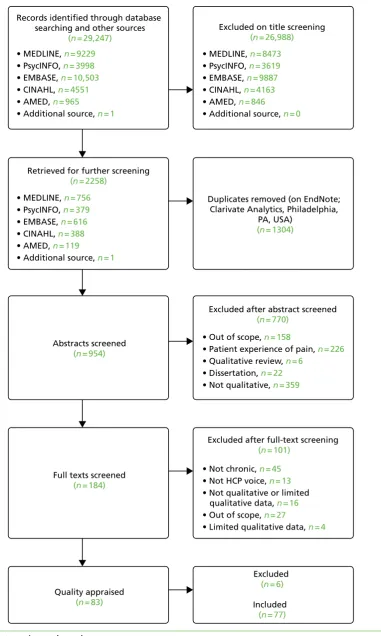
The results of the systematic search are shown inFigure 2. We screened 954 potentially relevant studies and excluded 770 after screening the abstracts. We retrieved 184 full-text articles and excluded 101 for the following reasons:
l not about chronic pain12,44–87
l did not include HCP voice88–100
l not qualitative, or limited qualitative data101–116
l out of scope117–143
Of the 83 potential studies, we unanimously excluded six on the grounds of methodological report.144–149
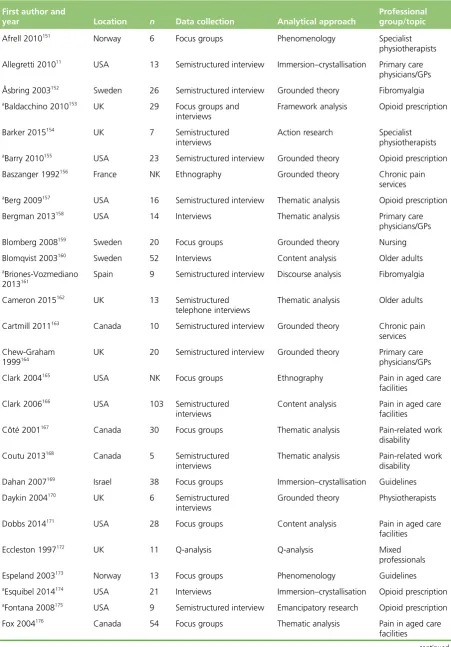
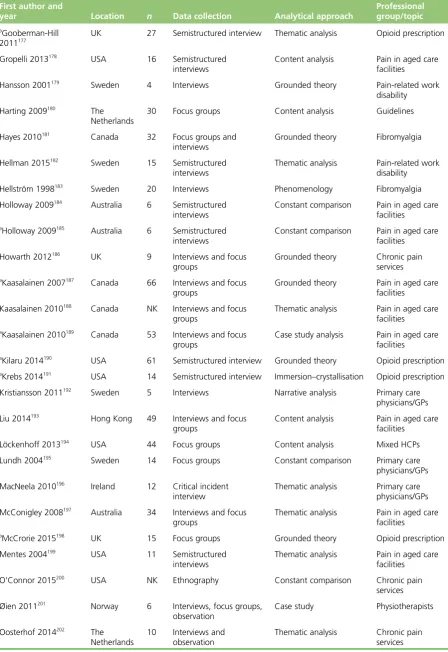
We included 77 published studies reporting the experiences of>1551 HCPs.11,150–225Table 3provides the
author, year of publication, professional/topic group, geographical context, number of participants, data collection and analytical methods for each study. HCPs included a diversity of doctors, nurses and allied health professionals in various contexts and geographical locations. Not all of the studies reported the number of participants from specific professional groups, which meant that it was not possible to give the exact sample number from each profession. The majority of studies were from the USA, the UK, Canada and Sweden. The sample size from the studies ranged from 6 to 103 (average 22). One focus group study165and three ethnographic studies156,200,223did not report their sample size.
Quality assessment and inclusion
Table 4provides the outcome of appraisal: the CASP score from each reviewer [from 10 (low) to 30 (high)]; the difference in CASP score between reviewers; the seven themes developed from a previous meta-ethnography;8
the global quality score (key, satisfactory, uncertain, irrelevant or fatal flaw); and reviewers’assessment of potential value based on CASP question 10 (‘how valuable is the research?’). The difference in CASP score between two reviewers ranged from–4 to 2 (a possible score of 10–30). They did not agree about the inclusion of four studies,172,178,196,201which were subsequently included by a third reviewer. Two reviewers
agreed that 89% of primary authors had reported their study aim and 84% had described their sample. They agreed that 89% of the authors had not reported their perspective and its potential influence on findings and 69% had not reported methods for challenging their interpretation. Reviewers also agreed that only 65% of authors had provided clear examples to demonstrate that their findings were drawn from the data and only 55% of authors had clearly described all their findings. Twenty-eight studies11,150,151,153,154,156,157,159,165–167,174,176,179, 187,190,195,204,207–209,211–214,221–223were reported as having‘changed the thinking’of at least one reviewer. However,
Duplicates removed (on EndNote; Clarivate Analytics, Philadelphia,
PA, USA)
(n = 1304)
• Out of scope, n = 158
• Patient experience of pain, n = 226
• Qualitative review, n = 6
• Dissertation, n = 22
• Not qualitative, n = 359
• Not chronic, n = 45
• Not HCP voice, n = 13
• Not qualitative or limited qualitative data, n = 16
• Out of scope, n = 27
• Limited qualitative data, n = 4
Excluded
(n = 6)
Included
(n = 77)
Quality appraised
(n = 83)
Full texts screened
(n = 184)
Abstracts screened
(n = 954)
• MEDLINE, n = 756
• PsycINFO, n = 379
• EMBASE, n = 616
• CINAHL, n = 388
• AMED, n = 119
• Additional source, n = 1
• MEDLINE, n = 9229
• PsycINFO, n = 3998
• EMBASE, n = 10,503
• CINAHL, n = 4551
• AMED, n = 965
• Additional source, n = 1
• MEDLINE, n = 8473
• PsycINFO, n = 3619
• EMBASE, n = 9887
• CINAHL, n = 4163
• AMED, n = 846
• Additional source, n = 0
Records identified through database searching and other sources
(n = 29,247)
Excluded on title screening
(n = 26,988)
Retrieved for further screening
(n = 2258)
Excluded after abstract screened
(n = 770)
Excluded after full-text screening
[image:37.595.126.508.66.703.2](n = 101)
FIGURE 2 Systematic search results.
TABLE 3 Geographical setting, sample size, data collection method, analytical approach and professional group/topic of included studies
First author and
year Location n Data collection Analytical approach
Professional group/topic
Afrell 2010151
Norway 6 Focus groups Phenomenology Specialist
physiotherapists Allegretti 201011
USA 13 Semistructured interview Immersion–crystallisation Primary care physicians/GPs Åsbring 2003152
Sweden 26 Semistructured interview Grounded theory Fibromyalgia
a
Baldacchino 2010153
UK 29 Focus groups and
interviews
Framework analysis Opioid prescription
Barker 2015154
UK 7 Semistructured
interviews
Action research Specialist physiotherapists
a
Barry 2010155
USA 23 Semistructured interview Grounded theory Opioid prescription Baszanger 1992156
France NK Ethnography Grounded theory Chronic pain
services
a
Berg 2009157
USA 16 Semistructured interview Thematic analysis Opioid prescription Bergman 2013158
USA 14 Interviews Thematic analysis Primary care
physicians/GPs Blomberg 2008159
Sweden 20 Focus groups Grounded theory Nursing
Blomqvist 2003160
Sweden 52 Interviews Content analysis Older adults
a
Briones-Vozmediano 2013161
Spain 9 Semistructured interview Discourse analysis Fibromyalgia
Cameron 2015162
UK 13 Semistructured
telephone interviews
Thematic analysis Older adults
Cartmill 2011163
Canada 10 Semistructured interview Grounded theory Chronic pain services Chew-Graham
1999164
UK 20 Semistructured interview Grounded theory Primary care physicians/GPs Clark 2004165
USA NK Focus groups Ethnography Pain in aged care
facilities Clark 2006166
USA 103 Semistructured
interviews
Content analysis Pain in aged care facilities Côté 2001167
Canada 30 Focus groups Thematic analysis Pain-related work
disability Coutu 2013168
Canada 5 Semistructured interviews
Thematic analysis Pain-related work disability Dahan 2007169
Israel 38 Focus groups Immersion–crystallisation Guidelines Daykin 2004170
UK 6 Semistructured
interviews
Grounded theory Physiotherapists
Dobbs 2014171
USA 28 Focus groups Content analysis Pain in aged care
facilities Eccleston 1997172
UK 11 Q-analysis Q-analysis Mixed
professionals Espeland 2003173
Norway 13 Focus groups Phenomenology Guidelines
a
Esquibel 2014174
USA 21 Interviews Immersion–crystallisation Opioid prescription
a
Fontana 2008175
USA 9 Semistructured interview Emancipatory research Opioid prescription Fox 2004176
Canada 54 Focus groups Thematic analysis Pain in aged care
facilities
TABLE 3 Geographical setting, sample size, data collection method, analytical approach and professional group/topic of included studies (continued)
First author and
year Location n Data collection Analytical approach
Professional group/topic
aGooberman-Hill
2011177
UK 27 Semistructured interview Thematic analysis Opioid prescription
Gropelli 2013178 USA 16 Semistructured
interviews
Content analysis Pain in aged care facilities
Hansson 2001179 Sweden 4 Interviews Grounded theory Pain-related work
disability Harting 2009180 The
Netherlands
30 Focus groups Content analysis Guidelines
Hayes 2010181 Canada 32 Focus groups and
interviews
Grounded theory Fibromyalgia
Hellman 2015182 Sweden 15 Semistructured
interviews
Thematic analysis Pain-related work disability
Hellström 1998183 Sweden 20 Interviews Phenomenology Fibromyalgia
Holloway 2009184 Australia 6 Semistructured
interviews
Constant comparison Pain in aged care facilities
aHolloway 2009185 Australia 6 Semistructured
interviews
Constant comparison Pain in aged care facilities
Howarth 2012186 UK 9 Interviews and focus
groups
Grounded theory Chronic pain services
aKaasalainen 2007187 Canada 66 Interviews and focus
groups
Grounded theory Pain in aged care facilities Kaasalainen 2010188 Canada NK Interviews and focus
groups
Thematic analysis Pain in aged care facilities
aKaasalainen 2010189 Canada 53 Interviews and focus
groups
Case study analysis Pain in aged care facilities
aKilaru 2014190 USA 61 Semistructured interview Grounded theory Opioid prescription aKrebs 2014191 USA 14 Semistructured interview Immersion–crystallisation Opioid prescription
Kristiansson 2011192 Sweden 5 Interviews Narrative analysis Primary care
physicians/GPs Liu 2014193 Hong Kong 49 Interviews and focus
groups
Content analysis Pain in aged care facilities
Löckenhoff 2013194 USA 44 Focus groups Content analysis Mixed HCPs
Lundh 2004195 Sweden 14 Focus groups Constant comparison Primary care
physicians/GPs MacNeela 2010196 Ireland 12 Critical incident
interview
Thematic analysis Primary care physicians/GPs McConigley 2008197 Australia 34 Interviews and focus
groups
Thematic analysis Pain in aged care facilities
aMcCrorie 2015198 UK 15 Focus groups Grounded theory Opioid prescription
Mentes 2004199 USA 11 Semistructured
interviews
Thematic analysis Pain in aged care facilities
O’Connor 2015200 USA NK Ethnography Constant comparison Chronic pain
services Øien 2011201 Norway 6 Interviews, focus groups,
observation
Case study Physiotherapists
Oosterhof 2014202 The
Netherlands
10 Interviews and observation
Thematic analysis Chronic pain services