SEPTEMBER
1960
•
VOL. 9
-
NO. 9
&
98
Computer Conversation Compared with Human Conversation
Why a
Small
Computer?
LGP-30 COMPUTER ABSTRACTS
(Application Report #10, from which the following is abstracted, is free upon re-quest from Royal McBee Corporation, Data Processing Division, Port Chester, N. Y. )
Subject: Design / User: Brown Fintube Company. Elyria, Ohio
THE PROBLEM:
rush quotation for heat exchanger
to potential customer. Determine best heat
ex-changer vs. cost combination. Perform necessary
computations to obtain values for total surface
area; total number of exchangers; area/exchanger;
velocity and pressure drop - shell and tube; film
coefficient; log mean temperature difference;
over-all transfer rate; clean rate; overover-all fouled rate;
surface actually required; duty; price.
METHOD:
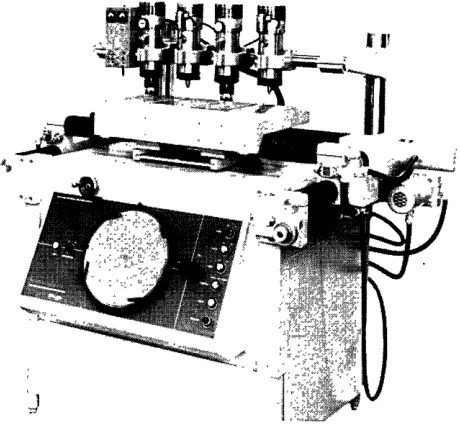
the compact, low-cost Royal Precision
LGP-30 Electronic Computer.
INPUT DATA:
except for special specifications
which are handled by design engineers,
non-techni-cal personnel fill in data directly from customer
inquiry sheets. This information is then punched
on tape.
SOLUTION:
the
en-gineer reads the
above data into
stor-age in specifically
assigned memory
lo-cations on the computer's magnetic drum. The set
of program instructions-also stored on the
drum-then directs the computer where to find the input
data and what mathematical operations to perform
inthe proper sequential order. The program then
further directs the computer to store the various
answers in specifically assigned memory locations.
Of notable interest is the incorporated test
fea-ture which allows any type and arrangement of
sec-tions to be tested by the computer. The program
not only compares calculated values, but provides
a corrective computation and recomputes all
con-ditions until satisfactory values are obtained. The
2
engineer need only type in the exact arrangement
desired to have the computer calculate his proposed
arrangement - assuring complete versatility and
control over the program.
OUTPUT:
all numbers required for the final
speci-fication sheet, including price, are provided - as
well as key inter-
t-~-.-- ",,,,
-.~--..
-~-- '--~--lmediate answers;
i
to enable the en-
i
gineer to exer-:
cise judgment.:
The computer'
automatically'
con troIs the type- ;
writer so that
.----all answers are printed out in the desired format.
CONCLUSIONS:
with the LGP-30, Brown Fintube
has reduced total time on typical heat exchanger
designs from one or two hours to approximately 3
minutes. Better design vs. cost combinations have
been obtained - with a resulting increase in
con-tract awards and the elimination of under-bidding.
According to company officials, "perhaps the most
significant contribution of the LGP-30 has been
the release of engineering manpower for more basic
and profound studies."
•
Royal Precision Corporation
Royal Precision is jointly owned by the Royal McBee and General Precision Equipment Corporations. LGP-30 sales and service are available coast-to-coast, in Canada and abroad through Royal McBee Data Processing offices. For your free copy of Application Report #10, as well as full specifications on the compact, mobile LGP-30, write today to ROYAL MCBEE CORPORATION, data processing division,PortChester,N.Y.
World's
fastest
sorting system
PH I LCD 2000 Data Processing System
• The majority of all data processing involves
sorting. Time saved on this operation is always
significant-the answers you need become
avail-able more quickly; the equipment itself is freed
for other use.
The inherent speed and capacity of the Phil co
2000 are your assurance of highest possible
sort-ing speed - faster than any other sortsort-ing system!
For example,
the Philco 2000 has sorted 100,000
80-character records, having a 16-character key,
in
18minutes!
Such high sorting speed can be obtained on any
Philco 2000, regardless of size, without
addi-tional sub-systems.
Call or write to arrange a test run of one of
your sort problems on the Philco 2000.
These Philco 2000 Features Assure Fast Sorting:
• A powerful SORT Generator Program-one of the many pro-gramming aids provided by Philco.
• High transfer rate on tapes-90,000 alphanumeric characters per second on each tape.
• Simultaneous reading and writing---:with up to four tapes
operating at the same time.
• Ability to read backward while writing forward-eliminating costly rewind time.
• Tremendous logical flexibility -plus eight or more index regis-ters in an ultra high-speed system.
Philco Corporation. Government and Industrial Group Computer Division, 3900 Welsh Road, Willow Grove, Pa.
PHILCQ
COMPUTERS
and
AUTOMATION
DATA PROCESSING
•
CYBERNETICS
•
ROBOTS
Volume 9
Number 9
SEPTEMBER,
1960
Established September 1951
EOMU~~ ~.' ~~~:~~~"J':"':~:":"<~::'::""":~';;:f~~:;~1~}}~>'"
NElL D. MACDONALD Assistant Editor
MOSES AI. J;3ERUN AssiJtant ; Eailor'
PATRICK
J.
McGOVERN ,Assistant EditorLINDA L. LOVElT Assistant Editor
CONTRIBUTING EDITORS,
ANDRnw D. BOOTH
NED CHAPIN '
JOHN W.
<:Au.
III ,AUTON S. HOUSEHOLDSR
ADVISORY COMMITIEE
.MORTON M. As'rllAHAN
HOWARD-T. ENGSTROM
GEORGE E. FORSYTHE
RICHARt? W. HAMMING
ALSTON S. HOUSEHOLDER
HERBERT F. MITCHELL.
JR.
SAMUEL B. WILLIAMS '
ADVERTISING REPRESENTATIVES
Middle Atlantic States ~f1LTON L. KAYE
535 Fifth Ave.' New York 17. N.Y. MUrray Hill 2.4'194
If!' aJh~ngton 6, D,C.
1519 Connecticut Ave.
San Francisco .5
'605 Market St.
Los Ange/es j
.439, S, Western Ave.
RoaERT CADE~ ,
C~lumbia )·9127 A. S. BABCOCK
YUkon Z~3954
W. F. GREEN
DUnkirk 7~8135
Elutllhere THE PUBL1SI1~ll.
. Berkeley Enterprises," Inc., , 815 Washington St.; Newtonville 60, Mass,
i,
.
DEcatur 2 .. 545~ or z-,j928,COMPUTERS and AUTOMATION is published 13 times a year (monthly except two issues in June) at 815 Wash-ington St., Newtonville 60, Mass., by Berkeley Enter-prises, Inc. Printed in U.S.A.
SUBSCRIPTION RATES: (United States) $7.50 for 1 year, $14.50 for 2 years; (Canada) $8.00 for 1 year, $15.50 for 2 years; (Foreign) $8.50 for 1 year, $16.50 for 2 years. Address all Editorial and Subscription Mail to Berkeley Enterprises, Inc., 815 Washington St., Newtonville 60, Mass. ENTERED AS SECOND CLASS MATTER at the Post Office at Boston, Mass.
POSTMASTER: Please send all Forms 3579 to Berkeley Enterprises, Inc., 815 Washington St., Newtonville 60, Mass. Copyright, 1960, by Berkeley Enterprises, Inc.
CHANGE OF ADDRESS: If your address changes, please send us both your new address and your old address (as it appears on the magazine address imprint), and allow three weeks for the change to be made.
4
Vol. 9, No. 9B
News of Computers and
Data
Processors:
ACROSS THE EDITOR'S DESK
inserted between pages 16 and 17
FRONT COVER
First International Conference on Automatic Control,
in Moscow, U.S.S.R. 1, 24
ARTICLES
Computer Conversation Compared With Human Con-versation, PATRICK J. MCGOVERN . 6 Can You Tell the Computer's Responses From the
Peo-ple's Responses?, P.
J.
MCGOVERN, M. 1. Sevenohfour,and Nine People, Anonymous . 12
Why a Small Computer? GEORGE A. HEDDEN, JR.. 17 Essential Special Terms in Computers and Data
Process-ing - Suggested List, and Definitions (Part 1) 19 Data Processing Training in California's Junior Colleges
(Part 2), ENOCH
J.
HAGA . 22READER'S AND EDITOR'S FORUM
High-Speed Data Transmission Group Organized in California .
Correction - Alwac Computer Div. of EI-Tronics
24
Expanding, P. JARVIE. 24
Computer Programming Courses at Santa Monica City
College, E. M. KREHBEL . 25
Computer Operation, Mode "Full Speed
Ahead and . . ." 2 5
REFERENCE INFORMATION
Calendar of Coming Events
Survey of Recent Articles, M. M. BERLIN . Books and Other Publications, M. M. BERLIN New Patents, RAYMOND R. SKOLNICK.
21 27
28 30
INDEX OF NOTICES
Advertising Index . Computer Directory Manuscripts
Reference and Survey Intormation Who's Who Entry Form .
30 16 see July, page 12
see Augl~n, page 2 see July, page 21
[Q)[E$)~@~ ~~1f[]{]
ffi\~~@[L[Q)
®1f
~@~[E$)
c c c'SAME·DAY SHIPMENT OF
STANDARD DELTAMAX CORE SIZES
Arnold 6T tape cores
(aluminum-cased and hermetically-sealed)
offer you three very important
de-sign advantages.
One: Maximum
com pactness, com parable to or
exceeding that previously offered
only by plastic-cased cores.
Two:
Maxim urn built-in protection
against environmental hazards.
Three: Require no supplementary
insulation prior to winding and can
be vacuum impregnated after
winding.
N ow we've added a fourth vital
advantage: Maximum availability.
An initial stock of approximately
1r
(Q)
~(Q)
[lJL R
~~@(x]1r
20,000 Deltamax 1, 2 and 4-mil
tape cores in the proposed EIA
standard sizes (See ALEE
Publica-tion No. 430) is ready on
ware-house shelves for your
conveni-ence. From this revolving stock,
you can get immediate shipment
(the same day order is received) on
cores in quantities from
proto-type lots to regular production
re-quirements.
Use Arnold 6T cores in your
designs for improved performance
and reduced cost. They're
guaran-teed against 1000-volt breakdown
... guaranteed to meet military
COMPUTERS and AUTOMATION for September, 1960
test specifications for resistance to
vibration and shock ... guaranteed
also to meet military specifications
for operating temperatures. The 6T
hermetic casing method is extra
rigid to protect against strains.
Let us supply
your requirements.
Full data (Bulletin TC-lOlA and
Supplements) on request . • Write
The Arnold Engineering Company, Main Office and Plant, Marengo, Ill.ADDRESS DEPT. CA-9
$~~J~1Q~~
BRANCH OFFICES and REPRESENTATIVES in PRINCIPAL CITIES • Find them FAST In the YELLOW PAGES
1539
Computer Conversation Compared
with Human Conversation
Patrick
J.
McGovernAssistant Editor, Computers and Automation
(Based on a thesis in partial fulfilment of the requirements for the degree of Master of Science, at Mass. lnst. of Technology, Cambridge, Mass., May, 1960) ,
1.
Can a computer think? The answer usually given to this question is expressed in the personal outlook of the person answering to the extent that the word "thinking" has a personal meaning for him.
If he is an intuitionist, and believes that "thinking" means all the emotional vibrations, intellectual nuances, and specula.tive gestures that he believes he is sometimes conscious of, then he would probably be very reluctant to admit that a piece of machinery, no matter how com-plex, could duplicate the physiological and psychological events that constructed his mental experiences.
If, on the other hand, he is a behaviorist, and defines "thinking" as those processes that lead an organism, particularly a human being, to perform those actions
ac-cepted by others as intelligent behavior, i.e., having some goal in sight that is beneficial to the organism, and having in at least, a crude way a systematic pattern of performance, such a person might be willing to admit that a computer was "thinking" if it was able to simulate one of these commonly accepted forms of intelligent be-havior.
This latter viewpoint led the famous English mathema-tician A. M. Turing twenty years ago to suggest that a computer could be said to be capable of thinking if it could carryon a conversation with a human being in another room in such a way that the human being could not tell whether he was conversing with a computer or with another person. Since that time this definition of computer "thinking" has stood as a challenge to com-puter workers that has not yet been satisfactorily answered.
This paper reports an approach to the satisfactory ap-plication of this criterion, presents a program that il-lustrates this approach, and analyzes the success of this program by a technique analogous to that suggested by Turing.
Characteristics of a Conversation
In examining the problem of conveying meaning in a conversation, we see that there are rules and regulations commonly known as grammar which do not permit a structureless jumble of words to comprise a conversa-tion. Similarly, there is a structure to individual word groups, sequences of word groups, and operations be-tween word groups that enable them to express meaning in a conversation.
Meaning in a conversation is a sequence of thoughts expressed by word groups, or symbol groups comprising a punctuation mark, a word, or a group of words. A thought, as defined here, is identified by:
(1) A key word or pattern of words which expresses the subject at hand.
(2) A modifying word or words which pinpoint what we wish to say about another thought group. (3) A word or pattern of words which operates on
the subject at hand.
(4) A key word or group of words which identifies an object, or the thing operated upon.
(5) A key word or group of words which identifies the modification to the object.
(6) A key word or group of words which identifies spatially and temporally, the modification of the operator thought.
With these thought groups defined, we can approach a working definition of a conversation as: an exchange of thought group sequences between two or more persons during which thought sequences are generated by the meaning of the remark that the person has listened to, the environment in which the remark is made, the know-ledge and experience of the person, and the emotional state of the person at the time. The interaction of these four factors is the control mechanism in the generation of conversa tional statements and replies.
Conversation Type to Be Used By the Computer
Clearly an attempt to program a computer such as the IBM 704 to carryon an intelligent, and responsive con-versation with a human being in a wide range of subjects is too complex a task to accomplish immediately. How-ever an effective beginning to the problem can be made by choosing a common everyday topic of conversation and preparing this for machine operation. A reasonable choice is the topic of the weather, for it is an aspect of life about which almost all people have personal know-ledge, and have the capacity to conduct conversational thought exchanges. The topic of the weather was chosen
for this computer-person conversation program.
Outline of a Complete Programmed Conversation
For a complete programmed conversation the comput-er must have the following abilities:
(1) Ability to take in the input remark as words.
(2) Ability to convert the input words into a "ma-chine language" which the ma"ma-chine can handle by its logical and arithmetical instructions.
(3) Ability to manipulate the word groups in such a way as to construct an image or representation of their meaning.
(4) Ability to search for, and choose one or more thought groups that are reasonably associated with the input remark.
(5) Ability to arrange the selected thought groups in the appropriate order so that they have a meaning that is pertinent to the input remark and to
express them in words, thus forming a reply; (6) Ability to print out this reply.
The only recorded effort to construct a program for conversation with a computer was presented in an article by L. E. S. Green, E. C. Berkeley, and C. C. Gotlieb in Computers and Automation for September, 1959, and in a paper at the Dec. 1959 conference of the A. A. A. S. (1,8). This attack on the problem ignored the grammati-cal implications of the input words, and their relations to thought groups. This approach treated each word as a slparate unit, 2.nd assigned to each word two numerical constants (q,d) which <;pecified the quality and the degree of each input word according to an arbitrary classification system constructed by the programmer. From the charac-ter of the input words they arranged for the machine to select a certain output frame out of a collection; each frame contained blank spaces for the insertion of specific output words. Upon selection of the appropriate reply frame by a successive comparison technique the comput-er would then consult its output vocabulary dictionary for the output words that would come closest to fitting both the class of input remark and the style of the out-put frame.
The authors stated that "the present program contains very limited recognition of many parts of English syn-tax." This they consider to be the major factor in the "crudity" of their results. They leave the problem with the statement that "an unsettled problem is how little additional syntax would have to be included so that the program would plausibly imitate a man."
Aspect of the Conversation Problem Covered in the Present Program
This last remark is the essence of the attack on the problem presented in this investigation.
The features of the present program are:
(1) Each input remark is broken down into thought groups similar to those defined above.
(2) Two numerical constants are assigned to each thought group, one specifying the grammatical character of the thought group, and the other specifying the quality or type of thought group with reference to a certain classification system. (3) Prepared output reply frames are provided to the
computer; one is selected depending on the char-acteristics of the operator thought group of the input remark.
(4) Each reply frame has self-contained instructions that modify the essential thought groups of the output frame in accordance with the thought groups of the input remark.
COMPUTERS and AUTOMATION for September, 1960
All the above routines are included in the present pro-gram with the following exception: The thought groups of each input remark were coded, according to the arbi-trary classification system used in this problem, by the human programmer himself before submission to the machine. In other words, the machine was presented with two numerical constants associated with each of the input thought groups, instead of having to search in a self-contained dictionary for the proper equivalent in the numerical bi-coded system. This procedure was followed because the preparation and use of a complete dictionary subroutine takes an enormous amount of time for the programmer, and consumes large amounts of machine time. Furthermore, the establishing of a one-to-one cor-respondence between input thought groups and machine-stored thought groups and associated numerical constants is not logically difficult. The present program is largely experimental in its handling of the logical relationships between thought groups in order to construct convincing convers3.tion; the dictionary therefore can be prepared later when a full demonstration of the conversational powers of the computer are required, and when the logic of the computer program has proven itself equal to the task. Also, finally, the problems associated with the con-struction of a large machine-stored dictionary are amply dealt with in the literature of the machine translation field. (See references 2,3,4,5,6,7.)
Sample Computer Response to An Input Comment
A sample computer response to one of the input state-ments is here presented to illustrate the operation of the program in the computer.
The input statement No. 17 is "June is the warmest month as all brides know." The computer receives the following octal information in its registers:
Subject registers: 604164452560
which is JUNE in BCD form.
Subject modifier register: 000000000000
Verb register: 300000000010
which indicates a verb of the "identity" type (which "is" truly is).
Adverb register: 000000000002
This is stored in adverb register if there is no negative word in the sentence. Object registers: 606621514425
626360444645 633060606060
which is THE WARMEST MONTH, stored in BCD form.
Object modifier register: 000000000000
This storing is accomplished by having the computer convert the alphabetic characters to binary coded decimal form, and by further steps.
After storing the above octal words in their appropri-ate registers, the machine searches the input words for the type of sentence the input comment is. The period in the sentence indicates to the machine that it is a "state-ment" comment; it then transfers to the statement sub-routine. The period is coded as 000000000003 (see block diagram).
The machine then extracts the value of the bits in Col-umns 30 to 32 of the verb register, which in this case is a one. The machine then transfers to the instructions for printing the reply frame No. 1.
This is the Control Memory, an exclusive feature of the Honeywell 800
Transistorized Data Processing System. It is only 234 inches long, 27:f inches
wide and
2Y.i
inches deep, but its capabilities are heroic. Its design logicem-powers Honeywell 800 to run off 8 major jobs simultaneously -- each one
starting and stopping independently. It supersedes the costly, complicated
master programs or schedule of priorities required by conventional
transistor-ized systems. To learn, more about its accomplishment (Automatic Parallel
Processing) and the many other design t~firsts" of Honeywell 800, just write to
Minneapolis - Honeywell, Datamatic Division, Wellesley Hills 81, Mass.
IHI(Dmn.®ymr®nn
This reply frame is of the form: "Well, (insert subject of the input comment) is certainly (insert object of the input comment) indeed. But that is the way I like it." When the inserts have been selected from the subject and the object registers respectively, the complete reply will read: "Well, June is certainly the warmest month indeed. But that is the way I like it."
All runs were made on the IBM 704 with the MIT Automatic Operator Program assembler and operator.
Checking the Adequacy of the Computer Program
Before proceeding to complete and run the program, we considered how to evaluate the success of a program of this type. This is a challenging problem.
A direct method of testing was sought. The following was finally decided upon:
(1) A group of 25 input statements selected more or less at random from a large set of weather conversations actually collected from human beings would be given to the machine. The input statements would include state-ments of preference, exclamations, questions, or com-mentary.
(2) The same group of input statements would be given to a more or less randomly selected group of 9 human beings, and they would be asked to give their verbal reaction to each of the input statements.
(3) The single reaction of the machine, and the 9 re-actions of the people, to each input statement, would be listed, but the order scrambled.
(4) A different group of people would then be shown the 25 input statements and the 250 replies (10 next to each input statement) and told the situation - that one of the 10 replies in each set had come from a computer, and that the others were from human beings. Each per-son in this group would then be asked to judge which one of the 10 replies for each of the 25 statements was from the computer.
(5) The degree of success of the latter group of judges in selecting the computer's replies would be taken as a measure of the failure ot the program to fulfill the conditions of the problem. Thus, if the latter group were unable to point out the computer replies with any better than a random correlation, then the present pl"Ograe1 could be considered a success; and a solution to the con-versation-with-a-computer problem in one field namely, weather conversation, would have been obtained.
II.
Computational Process
The steps in the computational procedure were as fol-lows:
(1) Write name and title of program (2) Print the input remark
(3) Analyze input thought groups, and place them in one of seven registers depending on their grammatical character.
(4) Analyze the ove;all meaning of the whole set of thought groups to see if it is a question, a statement, or an exclamation.
(5) Direct the computation process into the
ap-propri~te subroutine depending on the result of step (4).
COMPUTfRS and AUTOMATION for September, 1960
(6) Check the input statement for a thought group specifying a negative relationship.
(7) Direct the computational process into the nega-tive mood if answer to step (6) is yes.
(8) Analyze the character of the operator thought-group for quality.
(9) Direct the computation of output frame in ac-cordance with result of step (8).
(10) Select reply frame.
(11) Execute the self-contained instructions of the chosen reply frame.
(12) Assemble the output frame.
(13) Print the selected and assembled output frame. (14) Check for end-of-sequence of input statements.
(15) Go back to step (3) if more input statement~
are available.
(16) If no more input statements are available, print end of run, and halt and transfer.
Layout of Data in the Punched Card
The layout for ~torage of information in the punch card input about thought groups is summarized in the following:
Columns Information Stored
1-3
4-26 27-32
33-35
Constant indicating grammatical class of input thought-group, i.e., in binary storage
110: object modifier tho gpo
101: object tho gpo
100: operator modifier tho ,rrp
011: operator tho gpo
010: subject tho gpo
001: subject tho gpo
000: undefined Not used; blank.
Quality of thought group as numerical constant, i.e., for operator thought groups,
000110: desired, or wanted
000100: happening
000011: conception
000010: like or preference
000001: identity, tautology for operator modifier thought groups
000000: negative aspect
000001: positive aspect Constant denoting the class of meaning [or the
secluence of thought groups, i.e.,
001: question 011: statement
111: exclamation
Summary of Present Program Statistics
In the present program the degree of elaboration is a"i Follows'
(1) The number of input statements used was 25.
(2) The number of output frames available to the computer was 30.
(3) The number of self-contained instructions in tl~e output frames: 51.
groups: 10, including the ones defined by the negative modifier.
(6) The number of instructions in the program: 845. (7) The number of decisions for each input
statement: 9.
Each of the above is a first approximation. Each could be substantially increased, with improvement to be ex-pected in the performance of the program as a whole.
In the evaluation of the program results, the input statements were shown to nine people, and their respons-es to each statement collected. Their rrespons-esponsrespons-es were punched on IBM cards, arranged randomly with the com-puter responses, and the whole 250 statements listed by the IBM 407 tabulator. Then the entire listing was given as a questionnaire to 10 other people, who were each asked to point out the computer reply. The
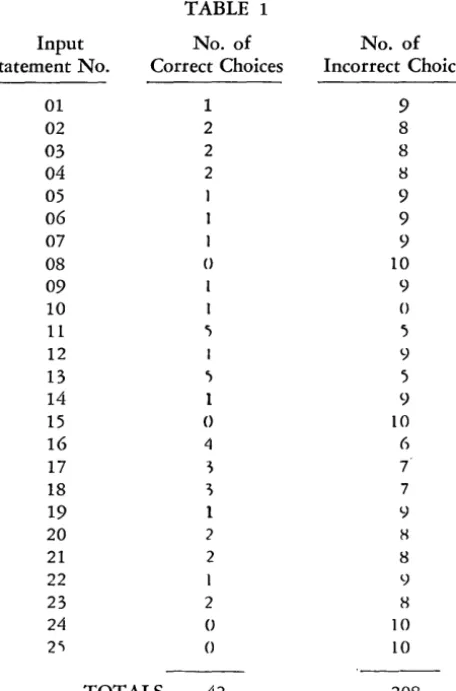
question-naire appears in this issue of Computers and Automation entitled "Can You Tell the Computer's Responses from the People's Responses?". The results of this procedure are shown in Table 1.
Input Statement No. 01 02 03 04 05 06 07 08 09 10 11 12 13 14 15 16 17 18 19 20 21 22 23 24 2)
TABLE 1
No. of Correct Choices 1 2 2 2
o
I "> I "> 1 () 4,
,
'2 2 2o
oTOTALS 42
No. of Incorrect Choices
9 8 8 ~ 9 9 9 10 9
o
'; I.) '; I.) 10 () 7' 7 I.) H ~ l) H 10 10 208The results in Table 1 mean that the judging ability of the people for the 25 cases of output of the conversation program was 42/250 or 0.168 or 16.8%. This compares with the 10% that would be expected with completely random guessing and the 100% that would be expected if their guessing was perfect. If we should exclude input statements No 11 and 13, which were guessed by half the judges. and therefore were rather obvious machine pro-duction, the experiment demonstrates that the computer can in the great fI,1ajority of instances generate conversa-tional responses that are practically indistinguishable from those generated by intelligent human beings.
10
III.
Discussion
Analysis of the results show some interesting defects in the present type of programming, and suggest several improvements that can be made to polbh the present ap-proach. For example, in statement No. 12, the input is "I enjoy nothing more than rainy day!' in April." The phrase "nothing" is taken by the machine to be a nega-tive, and the output reply comes in the negative mode.
("Neither did I," etc.) However here "nothing" is coup-led in the phrase "nothing more" which uses this negative word to reenforce a positive assertion. This confusion might be overcome in a modified program by inserting an additional subroutine which compares the negative thought group with its immediate surroundings to see if it fits into any of the frequently occurring combinations of "positive assertion by denial" phrases. Then these could be re-established in the positive mode. However, such a task is not a small assignment, and it would have to be accompanied by considerable analysis of patterns of expressions, and commonly occurring syntax, in order for it to function effectively.
Another limitation of the present program is that it incorporates no memory of previous statements; the pres-ent program cannot modify the output statempres-ent to avoid contradiction of previous replies. In order for the com-puter to carryon a continuous conversation with someone and to meet the full details of Turing's criterion, some form of memory would have to be available to the ma-chine so that it could not only modify its output state-ments on the basis of former output statestate-ments, but that it could also detect contradictions in the input remarks of the co-conversationalist. This additional ability would involve a great expansion of the present program, and many man-hours. However there is no reason to believe that no attempts will be made to accomplish this in the future.
The present program could be most readily improved by expansion in the number of categories that each gram-matical thought group can be placed. Also the number of output reply frames, presently quite limited, could be easily expanded to provide considerable variety to the output forms, and to make each frame more appropriate to the corresponding type of input statements.
A detailed analysis of the amount of time that the grammer spent in setting up the problem, and the pro-gramming and running of it is included in Appendix F.
Conclusion
It has been shown that by using a relatively simple ap-plication of logical syntactical analysis of English sen-tences concerning the subject of the weather, it is possible to provide an electronic computer with the cap-ability of creating respvnses in the form of English sentences which are largely indistinguishable from those expected of human beings.
The approach to the conversation-with-a-computer problem which has been presented in this paper is found to be successful by a statistical evaluation test, and to indi-cate that a grammatical attack is fruitful in solving the problem of programming a computer to handle thoughts with words.
[image:10.602.41.269.256.601.2]References
(1) E. C. Berkeley, 1. E. S. Green, and C. C. Gotlieb, Conver· sation with a Computer, Paper presented at the meeting of the American Association for Advancement of Science, on December 28, 1959.
(2) Ashby, 'William Ross, Design for a Brain, New York,
J.
Wiley, 1952.(3) Feldman, C. G., A Digital Computer Analysis Method For Simple English Sentences, MIT Mathematics Depart-ment Thesis, MS Thesis, 1959.
(4) Booth A. D., Brandwood, 1., and Cleave, J. P., Mechanical Resolution of Linguistic Problems, New York Academic Press, 1958.
(5) Harvard University Computation Laboratory, Mathemati-cal Linguistics and Automatic Translation, Report #NSF - 3 to NSF, 3 August 1959.
(6) Heller, G. G., Programming the IBM 704 for Language Translation, MIT Humanities Department Thesis, BS
Thesis, 1959.
(7) Locke, W., and Nash, W., Machine Translation of Lan-guages, in Machine Translation, edited by Locke, W., and
Booth, A.D., John Wiley and Sons, New York, 1955.
(,8) 1. E. S. Green, E. C. Berkeley, and C. C. GotIieb, Con-versation with a Computer, in Computers and Automation, Vol. 8, No. 10, Oct. 1959, pp 9-11.
Appendix
Reference 1 has not heretofore been printed. It consists of a short Section 1, a long Section 2 which consists of most of Reference 8, and a short Section 3. The paper is given below:
CONVERSATION WITH A COMPUTER
(Paper Presented at the Meeting of the American Associ-ation for Advancement of Science, on December 28, 1959,
by E. C. Berkeley, L. E. S. Green, and C. C. Godieb)
1. Introduction by E. C. Berkeley
First, let me say that I am reporting on work by three people, and two of them have not had an opportunity to
review what I am saying here. So please consider that my colleagues, Dr. C. C. Gotlieb, of the Computation Centre of the University of Toronto, and Mr. 1. E. S. Green, of K. C. S. Data Control, Toronto, are not necessarily fully committed to what I shall say here.
Can a computer carryon a conversation? The answer to this question is "Yes", and the proof is here exhibited. We are interested in this question, among other rea-sons, because, the English mathematician Turing, about
20 years ago, suggested that a machine could be said to be capable of thinking if it could carryon a conversation with a human being in another room, in such a way that the human being could not tell if he were conversing with a machine or with another human being. Since that time, this definition of a computer's thinking has stood as a challenge to computer people.
To make a beginning on the problem, it is clearly de· sirable to restrict it to some relatively simple and common subject such as the weather. About 1954 John W. Carr, III, now director of the computing center at the Universi-ty of North Carolina, in a course on computers for stu-dents at the University of Michigan, assigned as an op-tional problem for addiop-tional credit the problem of programming a machine to carryon a conversation about the weather. But no student took up the challenge.
COMPUTERS (wd AUTOMATION for September, 1960
In December, 1958, the problem (which I phrased and analyzed as a part of a study I was making on language, ideas, and computers) was discussed with the Computa-tion Centre of the University of Toronto. Dr. C. C. Got-lieb of the Centre classified it as a frontier problem hav-ing interest; and it was placed in the hands of 1. E. S. Green, mathematician and programmer, to analyze, program, and code.
The first preliminary program ran in April, 1959, and showed a surprising degree of success, but also some "stupid" or "deaf" replies. The second preliminary pro-gram ran in August, 1959, and was a good deal more satisfactory; but this program also contains some
unde-sirable responses for such reasons as failure to recognize certain English idioms, and incompleteness of syntactical analysis.
2. Report by 1. E. S. Green on the Computer Program and Some Examples
(This is the same as the portion of the October, 1959, article commencing with column 2, paragraph 2, on page 9 and running to the end of the article on page 11.)
3. Some Final Remarks by E. C. Berkeley
think that this experiment with an automatic com-puter provides convincing evidence for some very im-portant propositions about computers and about ideas. I will now state these propositions:
1. Theorem: A computer can operate reasonably with ideas.
2. Theorem: An idea for computer purposes is a specification of the meaning of a word or string of words. 3. Theorem: This specification of meaning can very often but not always be represented with a pair of sym-bols, one standing for a parameter such as "weather" or "emotion" and the second standing for a value of the parameter such as "rain" or "dislike".
After all, computers have been operating with ideas in the field of mathematics at least. Perhaps then we should not be too much surprised if a computer is also able to operate with ideas in all fields that can be talked about in language.
I will now make two predictions:
Prediction 1: It will not be many years - I would estimate hardly more than ten years - before the operat-ing of computers with ideas will be widespread.
Prediction 2: When computers do operate generally with ideas, it will be impossible for a human being in another room to tell whether he is conversing with a computer or with a human being.
Can You Tell The Computer's Responses
From The People's Responses?
Patrick
J.
McGovern,Assistant Editor, Computers and Automation; Mit Ibm Sevenohfour,
Cambridge, Mass.; and Nine People, Anonymous
~ote: To fully understand this questionnaire, see the article in this issue "Computer Conversation Compared with Human Conversation" by Pa-trick
J.
McGovern.For each one of the 25 comments in the following questionnaire, there are 10 responses. One response was generated by a computer. The other nine responses were generated by human beings. The ten responses for each comment were then scrambled; which one of the ten is the computer's response is randomly different from set to set. After scrambling the responses, the questionnaire was assembled and printed on an IBM Tabulator and presented to ten persons who acted as "judges" and who were asked to identify the computer's responses, dis-tinguishing them from those collected from the nine human beings.
The results of the choices of these ten judges are re-ported in Table 1 of the article mentioned above.
To I ry this questionnaire yourself, THE FIRST TIME that you read through this questionnaire, choose that one of the ten responses to each comment which you judge came from the computer. Record your choice for each one of the 25 comments. Then compare your choices with the key which will ,be published in the next issue of Computers and Automation. Note: It is not fair to com-pare the responses set by set, and apply smart reasoning'
QUESTIONNAIRE
Below are a series of comments made concerning the topic of the weather. Following each of these comments are a group of ten replies to these comments. One of these replies was made by the IBM 704 Computer at M.LT. Would you indicate which of the replies came from the computer in your estimation? Thank you very much for your cooperation in this conversation project. In these comment statements a 7 stands for a question mark and a 1 stands for an exclamation point. [In the following as printed, however, the 7 has been changed into a question mark and the 1 has been changed into an exclamation point.]
i2
This is the comment:
Look at those clouds! It is going to rain again? And these are the replies to the above comment:
1.1 ( ) Haven't we had enough? 1.2 ( ) I don~t think so.
1.3 ( ) I hope not.
1.4 ( ) Perhaps it will blow over and get sunny again.
1.5 ( ) Rain! Rain! Go away, and come back again some ether day.
1.6( 1.7( 1.8 ( 1.9( 1.10(
) So what! Bribe a witch doctor!
) If you think it will, then it won't! ) No, the sky is falling in.
) Possibly.
) Wel1, if rain comes, I won't be the only one to complain.
This is the comment:
What did you think of all the snow we had last winter!
And these are the replies to the above comment: 2.1 ( ) I don't think we had much snow last
2.2(
2.3( 2.4(
2.5 (
2.6( 2.7( 2.8 ( 2.9( 2.10(
winter. ) Let's forget it.
) Well, it melted, didn't it?
) I am one who believes in the sun, and in the need for time to enjoy it.
) Unexpressible.
) I thought it was hilarious. ) I didn't think of it.
) I did not mind it too much.
) What kind of stupid question is that? ) Hard to dig the car out.
This is the comment:
Would you mind if we had cloudy and windy weather now?
And these are the replies to the above comment: 3.1 ( ) Natch!
3.2( ) Yes.
3.3 ( ) Yes, I certainly would. 3.4( ) I like windy weather. 3.5( ) No.
3.6 ( ) I might mind, but I couldn't prevent it. 3.7 ( ) Rather not!
3.8 ( ) I usually do not mind windy weather if it is not too persistent.
3.9( ) Not after all this heat.
3.10 ( ) Any kind of weather in this region IS
bad.
This is the comment:
You really can't truthfully say you like hot weather? And these are the replies to the above comment:
4.1 ( ) I do like to go swimming when it's hot. 4.2 ( ) Why should I be truthful?
4.3 ( ) Do you want to bet?
4.4( ) I don't. Why, I can truthfully say I don't
4.5( 4.6( 4.7(
like hot weather. ) Why pot? ) Yes. ) I agree.
4.8( 4.9( 4.10(
) Neither do I, frankly. ) I do like it.
) No, I can't.
This is the comment:
I prefer the wintry blizzards to this dreary seaSUlJ. And these are the replies to the above commenr:
5.1 ( ) It's pretty difficult to get about in a
blIz-5.2 ( 5.3( 5.4( 5.5 ( 5.6( 5.7( 5.8( 5.9( 5.10(
zard, though.
) If I can curl up by the fire. ) So do I!
) ) ) ) )
Not me.
Anything is preferable to school. Go north.
So do I really.
To tell the truth, I do not enjoy wintry blizzards as much as you seem to. ) Schmuck!
) I don't!
This is the comment:
There is no time I like less than a hot day in July. And these are the replies to the above comment:
6.1 ( ) Not I, I love beach weather.
6.2 ( ) You can say that again. I do not like a hot day in July any more than you do. 6.3( ) Or August. . . .
6.4 ( ) Well, I like hot July days. 6.5 ( - ) Yea!
6.6 ( ) I don't like any hot days. 6.7 ( ) Or no person I like less than you. 6.8 ( ) Then you must like July often. 6.9( ) What do you like more? 6.10( ) As long as it's not humid.
This is the comment:
What kind of weather do you want this spring? And these are the replies to the above comment:
7.1( ) I would like warm, sunny days, but what I want and what we're likely to get are
7.2 ( 7.3( 7.4( 7.5 ( 7.6( 7.7( 7.8( 7.9( 7.10( ) ) ) )
quite different. Fair and cool. Warm, sunny days.
In May I like nothing better than a full day of sunshine and an evening shower. Hot!
) I hope it showers. ) Warm.
) Mild weather - the milder the better. ) Spring? I thought we just had spring.
) Warm.
This is the comment:
Look at that rain come down!
And these are the replies to the above comment:
8.1 ( ) If it doesn't stop soon, we are apt to
8.2( 8.3( 8.4 ( 8.5 ( 8.6( 8.7( 8.8 (
have flooding. ) Good for the grass!
) Thundershowers in June rain heavily. ) You look. I'm sick!
) Whee!
) Open your mouth. ) Who tells you to go out? ) Like a waterfall!
COMPUTEr~.s and AUTOMATION for September, 1960
8.9( Joy to the world. I could think of noth-ing better.
8.10( ) We needed it.
This is the comment: Some blizzard this is!
And these are the replies to the above comment: 9.1 ( ) I hope it won't last long.
9.2 ( ) Let's go south!.
9.3 ( ) The biggest in the last three years. 9.4( ) You're not kidding. It is a terrible
blizzard. 9.5 ( 9.6( 9.7 ( 9.8( 9.9(
) Can't even see your hand in front of you. ) Every time I have a final.
) So!
) Not as bad as last year.
) Remember the St. Pat's day blizzard In
1958.
9.10( ) What a disappointment.
This is the comment:
I have never seen it so hot!
And these are the replies to the above comment: 10.1 ( ) Oh, don't be such a sissy.
10.2( ) You probably have, but don't remembe.t.
10.3( ) I'm sure I say this several times a year. 10.4( ) Nor have 1. But it does not bother me.
10.5 ( ) Good day for a tan. 10.6( ) Because it's my vacation. 10.7 ( ) Turn a round.
10.8 ( ) You haven't been to lvladrid lately, have you?
10.9( ) Almost as bad as the Sahara on my last trip.
10.10( ) You're exaggerating.
This is the comment:
Snow, 10 inches deep, is my favorite weather. And these are the replies to the above comment:
11.1 ( ) You must be a ski enthusiast. 11.2( ) Not mine!
11.3 ( ) Yes, my favorite weather is certainly snow, indeed. But that is the way that I like it.
11.4( 11.5 ( 11.6( 11.7( 11.8( 11.9 ( 11.10(
) It is not mine. ) Yee Gads!
) Because it's no school. ) Stay in it.
) You must live on the second floor. ) You don't have to shovel it? ) You're crazy.
This is the comment:
I enjoy nothing more than rainy days in April. And these are the replies to the above comment:
12.1 ( ) I can think of more pleasant things to
12.2 ( 12.3( 12.4 ( 12.5 ( 12.6( enjoy.
) But not too many. ) Not really! ) You're crazy.
) April is the cruellest month.
) Neither· did 1. Everything about New England is so unpredictable.
12.7 ( ) Yes. In May and June too.
14
12.8 ( ) You must be having a very comfortable time.
12.9( ) Why April?
12.10( ) It's pleasant.
This is the comment:
I want this rain to stop immediately.
And these are the replies to the above comment: .
13.1 ( ) I'm afraid it's not up to you to controltt.
13.2( ) It would be nice to be able to turn it off.
13.3( ) So do all small boys.
13.4( ) Too bad!
13.5 ( ) Because it's drowning the bugs.
13.6( ) That's too bad.
13.7 ( ) Don't be too fussy in this part of the year.
13.8 ( ) I am hoping for the rain to stop.
13.9( ) Don't say it! It will last forty more days
13.10( ) If Canute couldn't do it, you certainly can't.
This is the comment:
When do you think our first real hot day will come? And these are the replies to the above comment:
14.1 ( ) It's usually around Memorial Day.
14.2 ( ) Never, I hope!
14.3( ) Not before June this year.
14.4( ) August maybe.
14.5 ( ) After I die.
14.6 ( ) I don't know.
14.7( ) All too soon for me.
14.8( ) It's hot enough for me right now.
14.9( ) I don't know.
14.10( ) Well, I enjoy a hot day if it is not too persistent.
This is the comment:
Snow usually arrives when you least expect it. And these are the replies to the above comment:
15.1 ( ) We should be prepared for it.
15.2 ( ) I expect it from December to March.
15.3 ( ) I disagree - you can predict snow often.
15.4 ( ) Not so. It arrives when you don't want it.
15.5 ( ) Like death.
15.6( ) Good.
15.7 ( ) All too often it does.
15.8( ) Well, I never miss snow, so I am not disappointed.
15.9 ( ) Yeah! Just when you take the snow tires off your car.
15.10( ) Listen to the weather report.
This is the comment:
I think that this fair weather will not last. And these are the replies to the above comment:
16.1 ( ) Who can tell?
16.2 ( ) What pessimism!
16.3( ) I don't think so either.
16.4( ) It certainly looks that way, doesn't it.
16.5 ( ) I hope you are wrong.
16.6( ) Who gives a damn?
16.7( ) Who cares!
16.8 ( ) In New England it never does.
16.9( ) No! We'll probably have a storm to-morrow.
16.10( ) I can't tell.
This is the comment:
June is the warmest month as all brides know. And these are the replies to the above comment:
17.1( ) Not necessarily.
17.2( ) Not because of the weather, though.
17.3( ) July and August are warmer.
17.4( ) Thanks for the advice.
17.5 ( ) April is the cruellest month.
17.6 ( ) I don't like brides.
17.7 ( ) But the frost usually comes in August.
17.8( ) Oh boy!
17.9( ) Yes, June is certaInly the warmest month indeed. But that is the way I like it.
17.10( ) They would!
This is the comment:
Skiing fans will certainly like today's blizzard. And these are the replies to the above comment:
18.1 ( ) It's not much fun for the non-skiers.
18.2 ( ) But, oh, my aching back.
18.3( ) Yes, they will.
18.4( ) I hate ski fans.
18.5 ( ) To tell the truth, I do not enjoy today's blizzard as much as you seem to.
18.6( ) But it will spoil the baseball game.
18.7 ( ) I don't ski.
18.8( ) Yes, but not the gardener.
18.9( ) I don't know! It'll be a while before the roads are opened.
18.10( ) You're right!
This is the comment:
April is not the month to be caught without an um-brella.
And these are the replies to the above comment:
19.1 ( ) It usually rains when I don't carry my umbrella.
19.2 ( )
19.3 ( ) 19.4( )
I'll take my chances. I surely don't like umbrellas.
I agree.
All months in Boston are such that you don't want to be caught without an
um-19.5 ( 19.6( 19.7( 19.8 ( 19.9( 19. 10(
brella.
) I really didn't look closely enough to tell. ) April is the cruellest month.
) Or without clothes.
) Yes, I was soaked to the skin yesterday. ) I've never used an umbrella.
) It rains so often!
This is the comment:
o
boy, last night'S frost covers all the windows. And these are the replies to the above comment:20.1 ( ) I wonder what the temperature was last night.
20.2 ( ) Too bad for the plants in the garden.
20.3 ( ) Yes, it is pretty cold.
20.4( ) Are you crazy?
20.5 ( ) The frost is memory.
20.6( ) Good for the orange crop.
20.7( ) Now we won't be able to watch you shovel snow.
20.8 ( ) It certainly looks that way, doesn't it?
20.9 ( ) Yeah, aren't they pretty!
20.10 ( ) I can't see.
WORKING
PARTNERS
ROCKETDYNE AND SOUNDCRAFT INSTRUMENTATION TAPES
At North American Aviation's Rocketdyne division, the re-cording of rocket engine perfOlmance on static stands, calls for the use of only the most reliable of instrumentation tapes, like Soundcraft. vVhy? Because Soundcraft Instrumentation Tapes combine exact physical and electrical properties so necessary to assure absolute reliability of performance-as a direct result of being manufactured in the world's most modern tape plant under the most advanced quality control system.
In short, experience has proven that Soundcraft Instrumenta-tion Tapes work best in recording of critical rocket testing operations. Why not let precision-made, error-free Sound-craft Instrumentation Tapes go to work for you? Complete literature on request.
This is the comment: It's raining cats and dogs!
And these are the replies to the above comment:
21.1 ( ) That old cliche!
21.2( ) I'll stay in and keep dry.
21.3 ( ) It sure is.
21.4( ) You can't be outside for a second or
21.5 ( 21.6( 21.7( 21.8( 21.9( 21.10(
you'll be drenched.
) And the puddles are barking. ) More experiments!
) You're not kidding. It is terribly raining. ) J don't give a bark.
) I hope my cellar doesn't flood. ) Really!
This is the comment:
No one wants to see snow in September. And the~e are the replies to the above comment:
22.1 ( ) That would be unusual for this part of the country.
22.2 ( ) I should say not!
22.3 ( ) Right!
22.4( ) Don't you think that snow must be good
22.5 ( 22.6( 22.7( 22.8( 22.9( 22.10(
for somebody. ) That's for sure! )
) ) ) )
Because snow is doubly symbolic. Or you for that matter.
Only a skiing fan that is. Who says?
It's welcome then.
This is the comment:
I want to go walking in the rain.
And these are the replies to the above comment:
23.1 ( ) I am hoping for walking in the rain just as much as you.
23.2( ) Everyone to his own taste!
23.3 ( ) I might, but it would have to be mist rather than heavy rain.
23.4 ( Often at college I went walking in the rain.
23.5 ( ) You'll catch cold.
23.6( 23.7 ( 23.8( 23.9( 23.10(
) It appeals to all five senses. ) Go ahead!
) Why? Haven't you taken a 'shower lately? ) I've always enjoyed that, too.
) So long as it's warm.
This is the comment:
Planes cannot fly well in snowy weather. And these are the replies to the above comment:
24.1 ( ) They are usually grounded when it snows.
24.2( I wouldn't want to take a chance of fly-ing in snow if they could.
24.3( ) Well, I never miss planes so I am not disa ppoi~1ted.
24.4( ) Not true. As soon as the snow is cleared off the airfields, the planes can fly again.
24.5 ( ) They freeze up.
24.6( ) Because they're incongruous with nature.
24.7( ) They should.
24.8( ) Too bad; that's the best time to fly on vacation.
24.9( ) Take a bus!
24.10( ) It's dangerous!
This is the comment:
The snow is turning into rain.
And these are the replies to the above comment:
25.1 ( ) That is obvious.
25.2 ( ) Good, no shoveling.
25.3( ) This will make driving very difficult.
25.4( ) Good!
25.5 ( ) Because the factories are lousing up the world.
25.6( ) So what!
25.7 ( ) Joy to the world. I could think of noth-ing better.
25.8 ( ) Boy, now we shall see slush aplenty.
25.9 ( ) The whole business may freeze tonight making tomorrow's driving fun.
25.10( ) I shouldn't have shovelled out my car. That is all. Thank you again.
THE COMPUTER
DIRECTORY
AND
BUYERS' GUIDE
1960
computers, data processors, accesso-ries, components, services, etc., pro-duced or offered / Approximate number of employees / Year
organi-ices in the computer field - useful -'to you the whole year.
Send for your own copy now
-6th Annual Issue,
the only full directory in the computer field,
a regular issue of Computers and Automation
CONTENfS:
Part 1, ROSTER OF ORGANI-ZA TIONS. Each entry gives:
Name of organization / Address / Telephone number / Types of
16
zation was established
(Over 700 organization entries) Part 2, BUYERS' GUIDE: ROSTER OF PRODUCTS AND SERVICES. Each expanded bold-face entry gives:
Name or identification of product or service / Brief description (20 to
50 words) / Uses / Price range, be-tween . . . and . . .
Other entries are cross-references.
(Over 2000 product and service entries in totaJ)
This is your indispensable guide to organizations, products, and
serv-. _ _ _ _ _ MAIL THIS COUPONserv-. _____ _ (or a copy of it)
To: Computers and Automation
,815 Washington St., R149
Newtonville 60, Mass. Please send us a copy of the 1960
Computer Directory. We enclose
$6.00.
Name ... ______ .. _._ .... ___ .
Ti tI e .. ___ ... _____ . ___ .... ______ . _________ . ___ ... __ ._ ... .
Organization __ .. ____ ._ .. _____ ... ___ ._ ... _ .. _ .. .
Address ... _. __ ... ___________ ... _ ... ______ ... .
NEWS
of
Computers and Data Processors
~~ACROSS
THE EDITOR'S DESK"
COMPUTERS AND AUTOMATION
Volume 9
Number 9B
SEPTEMBER
2,
1960
Established September 1951
Published by Berkeley Enterprises, Inc., 815 Washington St., Newtonville 60, Mass.
50 ELECTRONIC SORTER-READERS TO BE DELIVERED TO 25 BANKS TIllS YEAR
Burroughs Corp. Detroit 32, Mich.
This company will deliver nearly 50 elec-tronic sorter-readers (using magnetic ink character recognition) to some 25 banks before the end of the year. Banks in 7 states have received them already.
Equipment is being produced against a backlog of $6,500,000 of orders. Magnetic ink character recognition (MICR) equipment is being delivered also to handle dat~ pro-cessing tasks for hospitals, financial pub-lishing companies, an engineering institute, and other commercial businesses. Scores of commercial banks, savings banks, and savings and loan associations have already started encoding checks, deposit slips, and other doc-uments with MICR numbers and symbols, in pre-paration for reading and processing these items automatically.
The sorter-reader reads and processes checks, deposit slips, and other MICR-encoded items at speeds up to 26 per second. Items can be sorted 15 to 20 times faster than under a manual system. The machine accelerates checks or other items from a "standing start" to about 23 miles an hour in a distance o~
four inches. The machine reads each MICR dig-it or symbol in 32-millionths of a second. It processes intermixed documents of varying sizes and thicknesses, as well as items that have been folded, stapled or torn. It can be loaded and unloaded while operating at full speed, thus providing unlimited capacity.
COMPUTERS and AUTOMATION for September, 1960
I
<~...
~
Burroughs Corp. engineers and techni-cians are shown working on a portion of the production line set up by the company to produce MICR (magnetic ink character recognition) electronic sorter-readers. The $63,000 machine reads and processes bank documents at speeds up to 26 items a second.
100,000 BITS OF INFORMATION IN 6 OUNCES OF MEMORY DRUM
International Business Machines Corp. Federal Systems Division Laboratory
Owego, N. Y.
A way to put 100,000 bits of information Into a 6 ounce memory drum that can be held in the palm of a man's hand, has been found.
The information is recorded on the mag-netic surface of the tiny stainless steel drum, which' was designed for airborne com-puters. The new drum, 3 inches long and 3 inches in diameter, can hol~ as much inform-ation as a much heavier conventional drum 16 inches long and 4 inches in diameter --used on many larger earth-bound computers.
The new drum is only a thin steel shell. This construction was devised to withstand severe vibrations and shock. The "shell" de-sign concentrates the drum's mass at the sur-face, where it is most needed, IBM engineers explain. The construction, therefore, pro-vides maximum strength and rigidity with min-imum weight -- prime considerations in both aircraft and missiles.
Surrounding the rotating drum is a lightweight frame on which miniature magnetic pickup and recording heads are imbedded in rectangular blocks of plastic called "slider bearings". These bearings slide over the surface of the drum on a cushion of air, staying only 100 millionths of an inch away from the dr-um even-under the most severe vibration conditions.
2B
Total weight of the miniature drum as-sembly is 8 pounds, compared to about 235 pounds for conventional drum assemblies.
The shell design enables the drum to withstand stress more than 15 times the force of gravity. The tiny drum, which spins at 6000 rpm, is so rigid that it is not affected by even the high frequency vibrations found in missiles.
AUTO-CONTROL SYSTEM' FOR PHILCO COMPUTER
Philco Corp. Willow Grove, Pa.
A new programming and hardware control system for the PHILCO-200D electronic data processing system, has been developed. Called the "Auto-Control System", it provides an automatic interrupt feature and increases the efficiency of the computer in other ways.
The interrupt capacity of the "Auto-Control System" is completely under program control; it permits the programmer to deter-mine the system conditions that shall be checked, when these conditions shall be
checked, and the action to be taken when these conditions are present.
In addition to increasing the powers of the programmer, the "Auto-Control System" makes efficient use of program time by auto-matically monitoring computer operations.