DATAMATIe"~
\,NOVEMBER 1980/$4.00 U.S.A. VOLUME 26 NUMBER 11 This issue, 159,615 copies
FEATURES
33
IN FOCUS
In honor of the festive day, we serve wp a bountiful feast of "Turkeys in Dp."
88
EXPERIMENTALISTS:
A DYING BREED
Merrill Cherlin
Are we seeing the last of the
thinkers? Computer science PhDs are abandoning research for industry
jobs. '
99
TRACKING THE ELUSIVE
KOPS
Edward J. Lias
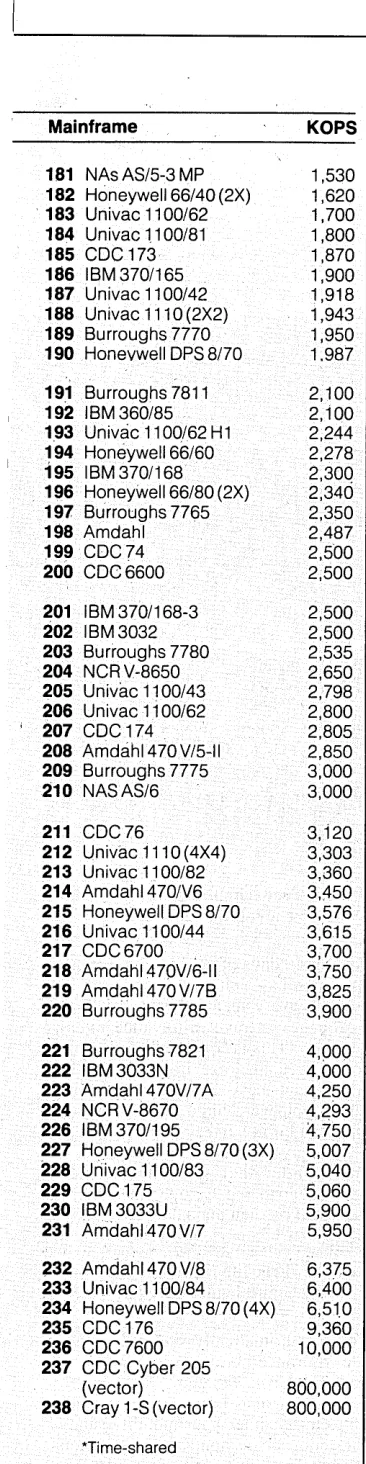
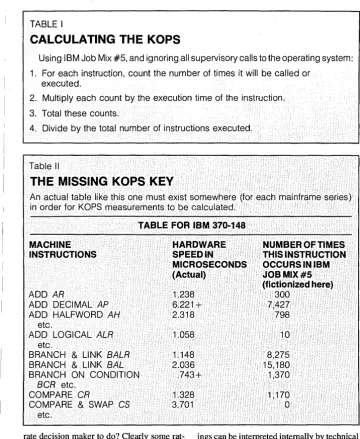
An explanation of KOPS and MIPS ratings. Computers are ranked by speed and by vendor.
109
MYTHS THAT MISS
David M. Farbman
Strong opinions held by computer s.Y§ltem development manag~s are quite otten wrong.
138
FOUR ROADS TO OFFICE
AUTOMATION
Roger W. Ketron
Planning for automation at the corporate level to increase profits.
144
ANNUAL MINICOMPUTER
SURVEY
32-bits minis increase the low-end families.
NEWS IN PERSPECTIVE
44 START-UPS, Apollo is launched Power to the people.
52 MANAGEMENT
Blumenthal takes the reins.
54 COMPANIES
~.
:to!
rc;~. ~CJ
DSC: geared for growth.
_vlq.
NTSC: getting in shape.62 BANKING
Race may be
t~
67 GOVERNMENT Too many cooks.
69 MEETINGS
Info on INFO '80. IBMby any other name.76 COMMUNICATIONS Datacom choices multiply.
80 BENCHMARKS
Braille wp; AT&T's Telpak woes; Honeywell speaks; Here to stay; Lower cost bubbles; Bell & Hughes working together; School days for CDC; A special interest.
DEPAilTMENTS
,8 LOOKING BACK'13 LOOK AHEAD
18 CALENDAR
23 LETTERS , , 31 EDITOR'$ READOUT. '
168 PEOPLE
172 HARDWARE
180 SOFTWARE,
8r
SERVICES188 MARKETPLACE '
192 ADVERTISERS' INDEX
197 READERS' FORUM
COVER ILLUSTRATION BY TOM NEWSOM
JCUS: the
user--oriented
decision support tool.
FOCUS, the total
English~languagesoftware resource, is the
source of in'stant answers. FOCUS can pinpoint any
informa~
tion you need ... when you need it ... in precisely the way you
want it ... for immediate reporting, statistical analysis and
graphic representation.
With FOCUS, users can test a variety of scenarios and can
U
FOCUS clearly organized our data.
My decision is
to goahead."
instantly retrieve
information which
is sorted, has all
calculations
per~formed, and is
for~
matted, ready for
use. The result?
Management has
accurate and.
ac~tionable data to
make decisions.
FOCUS
imple~ments entire applications on its own DBMS, or directly from
your current files OMS, IDMS, YSAM, etc.). Typical uses are
in: personnel, finance, general administration, marketing,
sales, research, results tracking, and customer service.
FOCUS operates interactively (CMS/TSO/CICS) on
IBM 370, 4300, or compatible mainframes.
Non~programmerscan learn to use it in
a day. FOCUS gives .
systems designers a
new analytical too I
which they can use
in as little as 1/10th
the time of
pro~cedurallanguages.
Over 400 major
companies,
institu~tions and
govern~ment facilities are
using FOCUS to sharpen up their data analysis. Among them
are:
J.
C. Penney, ITT-Continental Baking, Merrill Lynch,
. United Airlines, Yale University and the U. S. Army Corps
of Engineers.
Put FOCUS' decision support capabilities to work for you.
For more information, call or write for our brochure.
~
FOCUS·
Information Builders, Inc.,
1250 Broadway, New York, New York 10001 (212)
736~4433FOCUS is also available on a service bureau basis through the international network of Tymshare Inc.
CIRCLE 6 ON READER CARD 4 DATAMATION
C R T R M R T I C N
Editor John L. Kirkley
Articles Editor Wendy Reid Crisp News Editor Becky Barna International Editor Linda Runyan Managing Editor, Europe Andrew Lloyd Products Editor Bili Musgrave Copy Editor Florence Lazar Editorial Assistants Deborah Sojka,
Don Rosenthal Bureau Managers
San Francisco Edward K. Yasaki Los Angeles Edith D. Myers Boston Yin McLellan New York Ralph Emmett
Technology Editor, Europe Fred Lamond Correspondents
Washington Willie Schatz London Malcolm Peltu
Sydney, Australia Norman Kemp Telecommunications Editor Ronald Frank Editorial Advisor Robert L. Patrick . Technical Advisor Lowell Amdahl
Contributing Editors Ralph G. Berglund, Howard Bromberg, Philip H. Dorn, John M. Eger, David Hebditch, Angeline Pantages, Russell Pipe, Carl Reynolds, F. G. Withington, Amy D. Wohl. EDITORIAL OFFICES
Headquarters: 666 Fifth Ave., New York, NY 10103. Phone (212) 489-2588. New England: 161 High St., Bos-ton, MA 02110, (617) 482-4606. Western: 1801 S. La Cienega Blvd., Los Angeles, CA '90035, (213) 559-5111 ; 2680 Bayshore Frontage Rd., Suite 401, Mountain View, CA 94043, (415) 965·8222. International: 6605 Burling-ton PI., Springfield, VA 22152, (703) 569·3383. Foreign: 221 Blvd. Raspail, 75014 OOParis, France, (331) 322-7956. New York, N.Y. TELEX 640-229.
Art Director Kenneth Surabian Production Manager Robert Gaydos Art/Production Coordinator Susan M. Rasco Asst. Production Mgr. Kathleen Monaghan CIRCULATION
666 Fifth Avenue, New York, NY 10103 Circulation Manager Joseph J Zaccaria Director of Marketing Deborah Dwelley Publisher James M. Morris
Technical pubhshlng
DB
a company of The Dun&"Bradstn:ct corporahon .WBPA
~ABP
Circulation audited
by Business Publications Audit
Member American Business Press, Inc.
,
'-:-"Our NCR operating
software makes our
programmers,·.
more effective!'
Richard Shurley, Capital City Press,
Publishers of STATE-TIMES and MORNING ADVOCATE
SHURLEY:
We've come a long way in a short time. With NCR's advanced software we've gone from a simple batch system to an online virtual memory system that gives us direct access to the I, data base. In less than two
years. We now have the system we need to respond quickly to the needs of our management.
NCR's MILLER:
You were one of our soft-ware pioneers, too.
SHURLEY:
We were NCR's 11th VRX site. And the first to install VRX TOTAL, VRX TRAN-PRO and VRXTRAN-QUEST.
NCR's MILLER:
It's very unusual for one user to step out front so often.
SHURLEY:
We kept coming back for just one reason: it kept paying off. It's hard for any-one with data processing experience to believe what
Richard Shurley (right) is Data Processing Manager of
Capital City Press, Baton Rouge, Louisiana. Thomas Miller is the NCR representative.
we have accomplished with a small, efficient staff and NCR's versatile basic software. Our program-mers have really
broadened their potential.
* * *
VRX (for Virtual Resource Executive) is NCR's most. sophisticated operating system. TOTAL is the data base management system. TRAN-PRO simplifies transaction processing. And communications pro-gramming. TRAN-QUEST makes it easy for anyone to get exactly what he needs to know out of the data base. But only if he is authorized to pass through the security barrier.
In inflationary times, pro-gramming efficiency is a particularly important ob-jective. To find out how NCR can help you keep your costs down, phone your local NCR representa-tive. Or write to EDP Sys-tems, NCR Corporation, Box 606, Dayton, Ohio
45401.
Complete Computer Systems
An NCR computer can make it happen for you, too.
CIRCLE 7 ON READER CARD
•
•
oglca eSlgns
or in ormation
management.
c::)
From discoveries as fundamental as floating point arithmetic
I ,
By applying the same innovative thinking to your business
needs, we design new configurations to manage information more
productively.
We offer the latest advances in data transmission. Our
Dataphone® digital service is the nation's most extensive end ... to ... end digital
network. Our ,Dataphone
II
service transmits over dedicated telephone
lines at 2400, 4800 or 9600 bps, and has three levels of self ... diagnostic
capability. Our Dataspeed® 4540 communications terminals complement
either service, and have 3270 ... compatibility. And our 43 teleprinter is
compatible with virtually all time ... sharing networks.
<>
Applying our knowledge to your information management
needs is a process that begins with one call to your Bell Account
Executive.
c:::::)The knowledge business
Loued.
For lis
,'ull paaas
01
mamoru.
Allha prlca
01
1.
If you've always recognized thevalue of four full pages of memory, 96 8O-character lines - for use in storing lengthy forms, programs or text, and easily accessing them by scrolling forward or backward, a line or a page at a time - but couldn't Justify the extra cost, you'll love the new concept series display terminal.
Because Human Designed Systems has made the technology of the 80s work to your benefit: making it possible to eliminate the additional charge for four full pages of memory, and make this important capability available to you for the standard one-page price. It adds up to more pages, more capabilities ... at less cost than any terminal in the industry today!
HDS
1}JJl.J-',XtD]Q
~~1®R::qJ
~~JtlJiJR,
3700 Market Street Philadelphia, PA 19104215-382-5000
Boaton - (617) 329-3510; New York City
Area-Infocon: (201) 624-1372; New York State - Naco
Electronics: Syracuse: (315) 699-2651, Rochester:
(716) 223-4490; Delaware - Infocon:
(302) 239-2942; WaShington, DC - International
Systems Marketing: (301) 986-0773; San Francisco
- (415) 692-4184; Canada - CAlL Systems: Toronto: (416) 782-1151; Switzerland - 0'
Mitek AG: 01 66 22 52.
DISTRIBUTORSHIP INQUIRIES INVITED.
CIRCLE 9 ON READER CARD
8 DATAMATION
Twenty Years Ago/T en Years Ago
LOOKING
BACK
NOVEMBER/DECEMBER 1960
Frank Cole, Douglas Aircraft, Missiles & Space Systems Engineering, sang the praises of using "Small Computers in a Large Computer Environment. " Cole's de-partment, responsible for seven of the 45 Douglas computers, was the largest depart-mental user within the company. The seven computers ranged from an IBM 709 system (a 7090 was on order) down to four Bendix G-15Ds. Cole stated, "There is a mistaken impression that small. problems belong on small machines and large problems belong on large machines. Actually, all problems belong on the largest machines available-if cost is a primary concern. " He then asks, "Why provide the small direct access com-puter at.all?" and.answers his own query with three reasons why small computers should be in an engineering organization. First, for immediate access for small prob-lems requiring rapid service; secondly, since the small machine is no more expen-sive per hour than the engineer, halting the machine and on-line monitoring are per-missable; and, thirdly, certain design prob-lems should be located at the engineer's fingertips-and this may include the com-puting phase. Douglas Aircraft had trained nearly 300 engineers and technical employ-ees to use the G-15 by means of an initial eight-hour, in-plant course. The company had anticipated the number of potential users requesting instruction to diminish, but as it turned out, the more people who com-pleted the course, the longer the waiting list became. Douglas had also expected the G-15s to be in use about 80% of the time. After a year and a half, usage ran about 125%.
NOVEMBER 1970
IBM'S three key 360 architects-Fred Brooks, Gerrit Blaauw, and Gene Amdahl -had all left IBM by November 1970. Am-dahl was the last to leave; an alleged "con-flict of interest" was said to have prompted his departure. The problem arose when IBM
perceived Amdahl's position on the board of Compata (a company run by Lowell Am-dahl, Gene's brother) as a conflict. This was difficult to understand since Compata was not a financial threat to IBM, pulling in
roughly $1 million in revenue during 1969
while IBM came close to $7.2 billion that year. Gene had also been with IBM for about 12 years, and served on the Compata board for only five years. It was rumored that Gene, who was vacationing at the time the November 1970 issue was written, would soon be forming his own company.
The U.S.S.R. was negotiating to buy computers from Siemens (West Germa-ny) and Olivetti, and had placed orders with ICL. Nevertheless, Thomas J. Watson, IBM
chairman, returned emptyhanded after his two-day Moscow visit. His report to the press was simply that he didn't think there was a market for computers in Russia at the time. Meanwhile whispers continued that the Belgrade secret police were installing a 360/40-presumably for nonmilitary use.
Featured in this issue was "Anato-my of a Merger, " by W. David Gardner. The article detaih~d the preacquisition plan-ning, actual negotiations, and long-term predictions for the Honeywell-GE computer operations merger. It is reported that prior to the merger, GE was at a make-or-break point with its Information Systems Group (ISG). The group's overall picture was not profitable, nor could Hilliard W. Paige, vp and group executive, predict when it ex-pected to cross over into the black. Project Shangri-La, a three-month, intensive think tank, was arranged in Florida for the entire ISG. The purpose was to develop a master plan for an advanced product line that would eventually boost GE into the number two spot in the industry. The advanced product line was planned to compete direct-ly with IBM, stressing compatibility. Had the plans been implemented,Project Shangri-La would have cost approximately $450 million to $500 million (speculators had much higher estimates) and could con-ceivably have catapulted GE into the number two place. However, the GE group in charge of giving the necessary go-ahead, known as "The Three Wise Men" (Reginald Jones, vp of finance; Robert Estes, vp of legal ser-vices; and John McKetterick, vp of ad-vanced planning) kept hedging until the whole plan crumbled. Within a couple of months, GE was looking for a buyer for the ISG and found Honeywell.
Introducing the
Spinwriter
3500Q.
A new30cps,high-MTBFcharacter·
printer for the word processing industry.
It's here. The new Spinwriter Model 3500Q
medium-speed solid character printer from NEC.
The Model 3500Q sets new cost-of-ownership
stan-dards for today's most demanding office printing tasks.
New design standards. New durability standards. New
cabinetry standards. While maintaining functional
com-patibility with current Spinwriter models.
The Model 3500Q uses a single circuit-card and .
approximately 60 per cent fewer parts than current
Spin-writer models. Thus, its physical size and weight are
reduced by a third-making it easier to incorporate in
any office system. And it sets a new industry durability
standard: 3000 hours MTBF.
Add a 30-minute MTTR, 30-million character print
thimble life, 360,000-character film ribbon and a new
eco-nomical price, and you attain cost-of-ownership
advan-tages unparalleled in character printer history. Operation
and maintenance are further simplified because the
Model 3500Q requires no factory or field adjustments or
lubrication. And just three major spare parts are needed
to support the printer hardware.
. The NEC Spinwriter Model 3500Q has an average
pnnt speed of 30 CPS, handles forms up to 16" wide, and
uses all existing NEC thimbles, with up to 128-character
versatility. It also comes with an industry-standard
inter-face, numerous ease-of-use features including an
opera-tor display panel. and a range of forms handling options
that include sheet feeder options, document inserter,
forms tractors, bottom feed, and cut-sheet guide with
sensor.
The NEC Model 3500Q Spinwriter. It's here just when
you need it most.
To find out more, call your nearest NEC sales office
today.
NEC. Goingaiter theperfectprinter.
NEe
NEe InformationSystems,/nc.
Head Office: 5 Militia Drive, Lexington, MA 02173, (617) 862·3120 Eastern Office: 36 Washington Street, Wellesley, MA 02181, (617) 431·1140 Central Office: 3400 South Dixie Drive, Dayton, OH 45439, (513) 294·6254 West Coast Office: 8939 S. Sepulveda Blvd., Los Angeles, CA 90045 (213) 670·7346 Southern Office: 2945 Flowers Road South, Atlanta, GA 30341, (404) 458·7014
I
'The
3805 Supercharger
I . '
Your system races ahead with Intel's Native Mode
FAST-380S semiconductor disk.
Supercharged. That's Intel's
new Native Mode option for the
FAST,3805, our high perfor,
mance semiconductor disk.
The only one of its kind,
Native Mode FAST,3805 offers
unmatched speed, reliability
and capacity for unleashing
IBM 370, 303x, 4300 and
compatible CPUs.
Set new track records.
FAST,3805's Native Mode
revs up your operation by allow,
ing your CPU to work at
full potential. With per,
formance up to ten times
faster than traditional disks,
Intel's semiconductor paging
device triples disk traffic-and
without adding channel or
controller capacity.
Native Mode FAST,3805 im,
proves mainframe performance by
reducing by an average of 70 percent
the number of CPU instructions
required to set up a paging
110.
This
reduction greatly extends the life of
your present computer by giving you
back substantial amounts of your
CPU resources.
Native Mode FAST,3805 takes
advantage of the inherent characteris,
tics of semiconductor random access
memory to achieve a paging rate of
up to 530 4k,pages per second per
controller. That's almost double the
maximum paging rate of a 2305-and
triple that of the 3350-while using
less than half the CPU cycles.
Native Mode utilizes Fixed Block
Architecture-a simple and highly
efficient addressing scheme - which
further increases the semiconductor
disk's already exceptional perfor,
mance. Data transfer is started with
a sequence of only two commands
(in contrast to six commands for
a rotating disk).
FAST,3805 gives you a standard
transfer rate of 1.5 to 2.0 megabytes per
second per channel. Our two, byte wide
option yields transfer rates of 3.0 to
4.0 megabytes per second per channel.
Boost capacity.
By putting all storage into produc,
tive use with Fixed Block Architec,
ture, Native Mode boosts FAST,3805
storage in most environments
by 30 percent and
more. There's
no loss
from interrecord
gaps and other format'
ting inefficiencies associated
with rotating disks.
further ensure accuracy and relia,
bility, it has its own computer based
on the 8086, Intel's powerful new
16,bit microprocessor. Making the
FAST,3805 "self,healing:' this
on,board computer:
• automatically performs sophis,
-ticated error detection and correc,
tion functions (including the
first commercial application of
double,bit ECC),
• records in its own memory, the
board and device location of any
errors, and
• automatically relocates data to
spare storage. '
It also maintains diagnostic logs
which pinpoint the devices in need
of replacement.
Head for the FAST track.
Whether your needs require
emulating an IBM
2835/2305
or
taking a fixed,block approach
with Native Mode, you'll be
heading in the right direCtion
with Intel's FAST,3805.
To get on the FAST track,
clip the coupon below or call
512/258,5171.
ime
adelivers
solutions.
And with storage capacity incre,
Europe: Intel International, Commercial Systems Division, Rue du Moulin a Papier, 51-Boite 1, B-1160 Brussels,mentally expandable from 12 to 72
Belgium, 02/6603010, Telex 24814Canada: Intel Semiconductor of Canada, Ltd., Commercial
megabytes, you can increase the
Systems Division, 201 Consumers Road, Suite 200,paging capacity and,
__________________
~~~~~:~~,_~~~~~~~~~~?_8.:_~~!~:~:~~~~________________
jtherefore, the work load
Please forward details on FAST,3805 and Native Mode:
on your present system
without upgrading your
CPU, memory, and
channel/control devices.
No pit stops.
The FAST,3805 utilizes
proven state,of,the,art
semiconductor tech,
no logy throughout. To
Name ______________________
~________ _
Company ____________________________ ___
Mailing address _ _ _ _ _ _ _ _ _ _ _ _ _
_
City, State, Zip ________________________ ___
Telephone (
Return to: FAST,3805 Marketing
D
Intel Commercial Systems Division
P.O. Box 35900, Phoenix, AZ 85069
BTl 8000
32-bitmultiprocessorsystem
Now you
can
grow
by
pluggingi.nresources
instead
of
changing
computers
Finally, there's a computer system thatJets
yoti grow by plugging in resources, instead of
by changing models--- the BTl 8000.
The· secret is Variable Resource Architecture
(VRA): a flexible mix of hardware resources
controlled by a single,
self~regulating.operatingsystem.
Hardware resourcesconsistofmultiple
processors, memories,and input·output
channels operating· in parallel without the
complexinternalnet\V?rking normally .
ass()ciated with such arrangements. TheresuIt
iSfi1ainframe perfonnanceat . substantially
lower costs,plus unequalled flexibility.
You can tailor the BTl 8000 to serve dver200
on-line, interactive
u~ers.Orto
handle large
. batch loads.
Or
todoa lotofeach.
Furthermore, you can vary
proc~ssingcapability over
atenfoldra1tgebymerely
adding
or .·deleting hardware. modules .... Differences.in
configuration are invisible to user software, and
no reprogramming or· recompilation is· required.
Key features of each BTl. 8000 system include:
~
From one to eight 32-bit CPUs controlled and
coordinated. by one shared operating system.
-Upto16 megabytes of main memory.'
-Fail soft architecture.
- Secure. multi -user operations.
-Demand-paged virtual memory.
---Simultarieous use of ANS COBOL 74, ANS
FORTRAN
77,
PASCAL/8000, and
BASIC/8000.
Asforreliability and support, they're
estab-lished BTl traditions, proven by over 2,500
other BTlcoIllputers operating in the U.S;,
Canada and Europe. For full details about the
BTl 8000, contact the BTl office nearest you.
I-BTl
COMPUTER
SYSTEMS
CorporateOffices:870 West Maude Avenue, Sunnyvale,CA (408) 733~1122RegionalOffices: Piscataway, NJ(20l) 457-0600; Palatine,IL(312} 397-9190; DaUas,rX; (214) 630-2431; SunnYVale, CA(408)733~1122. . Sales Offices in major U.S. cities. In the United Kingdom: Birmingham·· (021)-477·3846 BTl is a registered trademarkof BTl Computer Systems
OF BIRDS AND
BOOB TUBES
THE MIPS
RACE IS ON
THE LAST OF
THE DINOSAURS?
DATAPOINT
DEBUT
THE BACK-END
APPROACH
LOOK AHEAD
Rumor has i t that Satellite Business Systems has
been quietly buying up as much available bandwidth
as i t can on cable television franchises in major
metropolitan areas across the country.
The firm
has acquired long-term leases (we hear 30 years
mentioned) in areas ranging from Manhattan to
Southern California.
Cable is of course one
an-swer to the dilemma of what you do with all that
data once i t comes down from the big bird.
With the announcement of a 29 MIPS machine, the
Acos 1000, Nippon Electric has served notice that
it, tbo, is active in the large-scale mainframe
market.
But we hear that the other two
competi-tors who were there earlier, Fujitsu and Hitachi,
are
wor~ingseparately on scientific
supercomput-ers that will be faster than the current champ,
the Controi Data Cyber 205.
The 205, yet to be
shipped, is said to run at 800 million floating
point operations per second, a peak rate achieved
on long vector runs.
But the Japanese hope to
exceed that, and do i t on short vectors.
Amdahl's success with the VIS, the potential of
National's ASC 9000 from Hitachi, and -- probably
the most painful
-~Siemens' sales of the big
Fujitsu machines in Germany, have all sparked'
rumors of a 3034 introduct·ion.
The definition of
the H Series, unless IBM gets more explicit about
it~
may be
debate~even, after IBM makes its
ex-pected big machine arinouncement.
Some analysts
who
exp~ctto see H,evolved
r~therthan unveiled
predict one more 303X, albeit with more moderti
innards, to stave off the challenge of the
bar-barians.
Watch for Datapoint to announce a, new 32-bit
pro-cessor this month.
As mentioned earlier in these
columns, the new machine, code named Cedar, is
ex-pected to function with the ARC.
Also coming with
Cedar, we hear, is
a
new "high-tech" operating
system.
Could IBM have already introduced. the back-end
p~ocessor
of the future?
The file processor for
the HSeries?
Some analysts, like ADL's Frederic
G. Withington, argue that the possibilities of
the 4341 Group 2 with 8 megabytes of cheap memory
and big disks behind the 3380 controllers might
prove very exciting in file processing.
Sophis-ticated vendors may move into i t before IBM starts
talking about it.
The 4341 can support data
I •
THAT'S
LOGIC
A
3705
SUCCESSOR?
PINNING
DOWN XTEN
VOICE IS.
WHERE IT'S
AT14 DATAMATION
LOOK AHEAD
streaming at 3 megabytes per second into memory
and, managing the memory as a buffer, i t can link
with a primary host through channel adapters.
Reci~nt disclo~ure
that IBM
te6hnician~
had
imple-mented the logic poftion of the 370/138 dn a 5,000
circuit bipolar chip using gate array technology
created
a
stir among the circuit mavens and others
-- more because of the chip. (Sqhottky-claIriped TTL)
than the 379 implementation.
Yet, in the whispers
heard from other R&D labs, i t seems that others
--Honeywell, at least -- have created comparable
chips in' advanced VLSI development.
IBM may. finally announce its. long-awaited' succes...;
sor to the 3705
front~endcommunications
proces-sor,probably
~nthesecgnd quarter of.next year.
Strange how IBM rieverseems
t6,~etas
~xcit~dabout getting mugged in one little cOrner of the·
~arket (her~t
by Tandem and bomteh) as many
indus-try analysts expect.
Xte~,
the elusive Xerox network, . now plans to
begiri
6peratin~ in20cit~es·.iri Janu~ry1982,
ex-pandin~
to 50 cities by the end cif that year.
Ap~lott.est
of localmicrowave.distribution links
will begin in 10. ci ties wJ. th "a handful of users"
inJul~
'81, we
hea~~' The;~irstXten offering.
will
be
volume sensitive digital data using
cir-cuitswitch~d
technology at speeds from 300 bps to
56 Kbps.Operating at 10 dHz, Xten repottedly has
signed agreements for fixed. antenna locations in
21 ciities and has
te~te~~citerttialinterference
problems at the higher frequency . .
Other network
services ·will include document distribution and
teleconferencing, which will
b~limited to slow
scan applications that will run on the 56 Kbps
channels.
Xten is expected to offer direct. links
to Ethernet local data networks from the cellular
microwave loops for use in downtown locations.
A
number of industry forecasters have said that
the real potential in'electronic message systems
rests with voice messages rather than electronic
mail~
A small company in Dallas cailed ECS
Tele~'cqmmunications, Inc. apparently agrees.
The
two~year~old
venture start-up firm is about to begin
major deliveries of its Voice Message Exchahge
(VMX) system and.expects to have 20 in-house
ver-sioris installed by the end of 1981.
The first VMX system was installed· several
months ago at 3M
co.,
and.since theh ECS has
~etescalating demands by using two of. its systems to
establish voice mail services in New York and
Think what your programmers could do
if your users did their own reports.
Answer/DB, the latest Implementation System from Informatics, is the new on-line software tool for report generation. It lets non-DP people develop their own report requests at a terminal- in an English like·language-with as few as four simple statements.
That means much faster
report
turnaround, wider smiles from non-DP people in your organIzation, and greatly increased programmer productivity. .Answer /DBhas made old-fashioned batch reporting systems obsolete because it's designed to handle the :problems you'll be facing in the data base and data communicatIOns world.
Answer/DB operates with your standard as/DOS files and IMS data bases. And it offers completely interactive, on-line query entry with syntax checking and editing capabilities for creating error-free report requests.
For more information on Answer/DB and other information retrieval systems, just complete the coupon. Or, call us at (213) 887-9121.
r---~---l
Infonnatics Inc., 21050 Vanowen Street, Canoga Park, CA 91304 . I
Tim Corey, Product Manager :
(213) 887-9121 Telex: 69-8473 • :
o
Send me complete details on Answer!DB.informatics inc
! .:
Send me complete details on:o
Other Infonnatics report writers ® •o
Inquiry systemso
Have a salesman call me.Name _ _ _ _ _ _ _ _ _ _ _ _ Title _ _ _ _ _ _ _ _ _ COmpany _ _ _ _ _ _ _ _ _ _ _ _ _ _ _ _ _ _ _ _ _ Address _ _ _ _ _ _ _ _ _ _ _ _ _ _ _ _ _ _ _ _ _ City _ _ _ _ _ _ _ _ _ _ State _ _ _ _ _ _ Zip _ _ _ _ Telephone--'('--_-'-_ _ _ _ _ _ _ _ _ _ _ _ _ _ _ _ _ Computer Operating System: 0 DOS/VS 0 OS/VS TP Monitor: DIMS/DC 0 CICS/VS· 0 TSO AD-D-1180
L _ _ _ _ _ _ _ _ _ _ _ ~ _ _ _ _ _ _ _ _ _ ~ _ _ _ _ _ _ _ _ _ _ _ _ _ _ _ _ _ _ _ _ _ _ J
Introducing
Answer/DB"
by
Informatics:
••
_._...'--. WELL-INFO '--.'--.
ED
Transaction processing is .
keeping The Reserve Fund, Inc.
in-the-know.
~utualfiIndsreqillre
. an extraordinary degree of
information control.
The Reserve Fund, Inc. is
rio ex.ception.
This 2 billion dollar money
market fund handles more
than 5,000 transactions a day.
Brokers and customers are
calling constantly to check
the status of their accounts
to make certain that their
temporary cash balances
are always working.
In order to meet this
de-mand for data, Reserve Fund
has turned to Honeywell's
transaction processing
system, TPS-6.
Together with four Level 6
computers, TPS-6 makes it
possible to do immense
amounts of production work
while simultaneously
develop-ing new programs.
Their four Level 6 Systems
give Reserve Fund all the
flexibility and back-up they
need. Information flows easily ..
For example, terminals are
used to enter purchase orders
and to provide quick answers
to customer inquiries.
At the same time, the system
is also maintaining an on-going
record of all transactions.
As you'd expect, security is
a great concern. But thanks to
features built into TPS-6,
Reserve Fund has developed
effective safeguards.
Every operator has an ID
number, a password, and a
specific security clearance.
Access is carefully regulated.
As a further precaution, the
system has a built-in time-out
Honeywell
CIRCLE 14 ON READER CARD
feature that automatically
clears the screen after a
specified period.
Thanks to capabilities like
screen data formatting and
multiple key access to files,
Reserve Fund has been able
to tailor a system that's both
effective and efficient.
Current information is
always available. When it's
needed. Where it's needed.
Reserve Fund invested
in information control. And
their investment is paying
off big.
For more information,
write Honeywell, 200 Smlth
Street (MS 487), Waltham,
MA02154.
NOVEMBER
Canadia,nComputer Show
&
Conference,
November 11-13, Toronto, Ontario.
The second largest computer show held in North America is spon-sored by the Canadian Information Processing Society. Products to be displayed include minicomputers, peripheral hardware and soft-ware, consulting and contract programming, time-sharing, etc. Contact Reg Leckie, Industrial Trade Shows of Canada, 36 Butter-ick Rd., Toronto, Ontario, Canada, M8w3z8.
Pacific '8Q Conference on Distributed,
Processing, November 11-14, San Francisco.
Cosponsored by the ACM and its chapters of the Pacific region, the conference will hold tutorials on N'ov. 11, with conference meet-ings on the 12th through the 14th. Contact Robin Williams, IBM, K55-282, 5600 Cottle Rd., San Jose, CA 95193.
INFO/MFG, November 18-20, Chicago.
The first show devoted entirely to the information needs of manu-facturing companies. A "Guide to INFO/MFG," listing exhibitors and products to be demonstrated, is available. Contact Clapp &
Poliak, Inc., 245 Park Ave., New York, NY 10017.
Western Educational Computing Conference,
November 20-21, San Diego.
Conference will feature the use of computing in education for in-struction, administration, and research. Luncheon speeches will be given by Grace Hopper and Bernard Luscombe. Contact Rein Lang-ley, Director, Computer Center, California State University, Long Beach, 1250 Bellflower Blvd., Long Beach, CA 90840, (213) 498-5459.
DECEMBER
IWP Canadian Conference, December 2-4, Toronto,
Ontario.
Office automation from the Canadian perspective will be discussed in this, the fourth annual Canadian Conference. Contact Mark Hert-zog, International Word Processing Assoc., Mayland Rd., Willow Grove, PA 19090, (215) 657-3220.
Fourth International
Online Information Meeting,
December 9-11, London, England.
The conference will offer a varied program, addressing current problems and opportunities that arise when providing information to business, industry, government, and academic institutions. Con-tact Organising Secretary, Online Review, Learned Information, (Europe) Ltd., Besselsleigh Rd. , Abingdon, Oxford ox 13 6EF, En-gland.
Computer Networking Symposium, December
lO-11, Gaithersburg, Maryland.
The symposium highlights computer networking and covers proto-col applications, distributed data bases, and local networks.
Con-18 DATAMATION
CALENDAR
tact Harry Hayman, IEEE, P.O. Box 639, Silver Spring, MD 20901, (301) 589-3386 ..
JANUARY
Winter Conference of the Optical Character
Recognition {OCR} Users Association, January
11-14, Atlanta.
The conference features sessions on OCR applications in health care, remittance processing, government, retail, general data entry man-agement, etc. Contact OCR Users Assn., 10 Banta PI., Hackensack,
NJ 07601, (201) 343-4935.
HISSG Winter Seminar, January 20-23, Long Beach,
Caiiforriia.
The theme for the Hospital Information Systems Sharing Groups seminar is ' 'Cost Containment-The Legislative and Voluntary As-pects and Their Effect on Hospital Information Systems. " Contact W.V. Rosqvist, Hospital Information Systems Sharing Group, 2415 South 2300 West, Salt Lake City, UT 84119, (801) 972-6099.
Telecommunications/China '81, January 17-25,
Beijing, Peking.
,
"
The second of its kind, this exhibition is limited entirely to U.S. companies; it introduces American products in China and explains the products' uses. Contact Expoconsul, a Division of Clapp &
Poliak, Inc. , Princeton-Windsor Office Park, P.o. Box 277, Prince-ton Junction, NJ 08550, (609) 448-3200.
FEBRUARY
NEPCON West '81, February 24-26, Anaheim,
California.
The conference is directed toward all persons involved in the manu-facture and test of printed circuits, multilayers, microelectronic circuitry, semiconductors, and other devices. Contact Industrial & Scientific Conference Management, Inc., 222 West Adams St., Chicago, IL 60606, (312) 263-4866.
International Solid State Circuit Conference,
February 18-20, New York City.
The ISSCC is sponsored by the IEEE and is currently running in its 28th year. Contact Lewis Winner, 201 Almeria Ave., Box 343788, Coral Gabies, FL 33134, (305) 446-8193-4.
COMPCON Spring '81, February 23-26, San
Francisco.
The theme for the spring conference is VSLI and its future effects on design systems. Contact Harry Hayman, IEEE, P.O. Box 639, Silver Spring, MD 20901, (301) 589-3386.
CSC '81, February 23-26, St. Louis.
A whole world. Because our parent company,
C.
Itoh Co., Ltd. (pronounced "C. Eetoe") is a
multi-national organization with resources and
subsid-iaries located in every corner of the globe.
As C. Itoh Electronics, Inc., we're fortunate to
be part of this international network. It lets us seek
out quality materials and technologies wherever
they can be found. And for a company that
special-izes in computer peripherals for the OEM, thafs just
as important as price or the capability to deliver.
Today, we're offering the latest designs in dot
matrix and daisy wheel printers, card readers, CRT
monitors, floppy disk drives, and a lot more.
ates repair and refurbishment stations nationwide.
So when you deal with us, you can be sure you're
doing business with people who are dedicated to
the OEM. And a company whose parent organization
has been around since 1858.
Our goal? To become the best OEM peripheral
source in the country. Because with all our
inter-national connections, we haven't forgotten what our
motto promises: One world of quality.
For information on our product lines for the OEM
computer systems manufacturer, contact·c. Hoh
Electronics, Inc., 5301 Beethoven St., Los Angeles,
CA 90066, Tel. (213) 390-7778; Midwestern Regional
We're also seeing to it that our
OEM customers get all the support
they need. The engineering support
to solve their system integration
problems. Plus complete
documenta-tion and a service network that
oper-. ;;_oper-.,,--" "oper-. Office: 240 East Lake Stoper-., Suite
'-""--....;...;.;.;.f~f!l '~~r;:D
301-A, Addison, Illinois 60101,
. 1!1I;':!W
Tel. (312) 941-1310; Eastern
.• ",>,··:· ••. "0... i?'~;~~>:":J ... ~...Regional Office: 666 Third
, At Digital, network teclulology has
just taken another giant step.
'
Announcing Phase III
net-working: a host of new capabilities,
that will make your computer
power easier to allocate, easier to
control, and easier than ever
to justify to your management.
With Phase III, your options
have never been greater .. Or more
cost-effective. As always, you can
match the right
Digital system to
the right local
job. But now, you can
network those systems
virtually wherever,
whenever, and however
you want. Even· when your
mix includes another
manufacturer's mainframe.
And no matter how
you network, you'll be doing
it
in
the most economical way possible.
Just consider these new capabilities.
SNA Protocol Emulator.
Now Digital systems can talk to
and support IBM·mainframes
using the SNA protocol. Thus, you
can protect an investment in
hier-archical networks, even as you
commit to more flexible distributed
systems.
Adap-tive Routing. Now
Digital networks, can automatically
,find the least expensive path
between two nodes. Not only that,
they automatically re-route
infor-mation around problem areas.
Your line costs are held down.
And your data is never held up.
Multip-oint Communications.
Now one communication line
can serve several Digital nodes
simultaneously, reducing your
line costs considerably.
MMNrtIAMt::
MINICOMI"l.Jf'ti.H
Network Command Terminals.
Now a central management
group can program and control
an entire network
thus cutting the cost of
program-ming individual nodes in widely
dispersed locations.
Enhanced Network Management.
Now you can add on systems,
change communication links, gather
operating statistics, and detect
problems, all without shutting down
the network. Imagine the savings
on downtime and expansion costs.
X.25 Packetnets. Digital is
firmly committed to supporting
public packet switching networks
using the
X.2S
protocol.
Digital Packetnets are
currently being tested
and certified in the U.S.,
Canada, and France .
. More flexibility. More control.
And the most. cost -effective ways
to achieve them. Add these new
Phase TIl capabilities to the already
formidable array of Digital
networking options, and
you have the elements of
an awesome network.
But then, that's
just what you'd expect from
Digital. Innovative technology.
And the leadership to put it to work.
r---l
Digital Equipment Corporation, 146 Main Street, Maynard, Massachusetts 01754. Attn: Communication Services, NR-2/2 or Digital Equipment Corporation International, 12 avo des Morgines, 1213
Petit-Laney, Geneva, Switzerland. In Canada, Digital Equipment·of Canada, Ltd.
I am interested in Digital's Phase III. Tell me more.
o
Send me the brochure, 0 Send me the hand-"Distributed Data book, "Introduction toProcessing and Networks:' DECnef'
Name __________________________ _
Company ________________________ _
Street' -__________________________ _
City State Zip, ______ _
DX146
. _ - - - _ . - --_ ..
_--_
.... _. __ .. -_ ...Meet the
first
family of
compatible computers.
The Prime 50 Series is the first family of 32-bit
computers to feature total compatibility. It's a
unique feature. And if you intend to grow,
you won't want to be without it.
No growing pains. Compatibility is a
word we don't use loosely. It applies across
the line to, every computer system we make.
In fact, all Prime computers use the same
operating system, the same file structure, and
the same communication system. So no
mat-ter what level system you start with, you can
easily and economically expand capacity by
upgrading your current system or adding
another member of the family.
First and foremost. Prime means first.
And we've had a lot of them. We were first
with a family of compatible 32-bit computers.
CIRCLE 17 ON READER CARD
First to put mainframe capabilities -like large
on-line disk storage and DMBS-on a mini.
First with a single operating system and a
common file structure across an entire
prod-uct line. First with virtual memory on a mini.
And first to open an X.25 transatlantic
com-munications link.
At Prime, being first has become a habit.
Meet the family. In a time when the
rela-tionship between price and performance has
become vitally important, you should make it
a point to meet our family. In the
U.S., write to us at Prime Park, MS 15-60,
Natick, Massachusetts 01760. In Europe, write
Prime Europe, 6 Lampton Road, Hounslow,
Middlesex, 1W3 1)1, England. Telephone:
01-570-8555.
PRIME
UMBRAGE
Re: "A New Set of Ground Rules" (Aug., p. ,92) and "After the FCC'S DecIsion" (Aug., p. 99), without arguing the pros a~d cons, I take exception to the manner in which the Communications Act of 1980 will corne into,being.
When HR 6121, the Communica-tions Act of 1980, carne out of SubCOinmit-tee to the full House CommitSubCOinmit-tee on Commerce, it did so without proper consid-eration. Representative Lionel Van Deerlin [D.-Calif.] strong..;arrned the bill through the committee, making derogatory com-ments to people in our industry trying to understand and comment on the l~gislation, even to the extent of claiming that lack of passage would favor foreign competition, which is patently ridiculous; The earlier version, HR 3333, failed in committee, after supposedly 22 days of discussion of which no living human being can' produce a
tran-script; ,
The Administration pushed the bill with the pop~list appeal of ' 'deregulation, ' , citing lower costs in the airline industry. As an economist by training, and 'as a business-man, I can tell you thai it is not at all analo-gous ,to compare deregulation of a highly competitive industry with a monopoly. I, know of no other case where, a, monopoly has been deregulated and the economics are not at all clear. There are many irregular-ities in the bill, including language on sen-iority and job security, which are unusual in that a legislative body is concerning itself with union contracts.
The bottom line is that regaidlessof merits, this represents political railroading in an election year. We've lived with the Communications Act of 1934 for the past 46
~ years, so there is absolutely no timing
ur-~ gency except for the fact of an election year.
b
That does not justify not giving the industry~ adequate time to scrutinize and comment on
~ this legislation that we may have to live with
s:
for another 46 years.;n
LESTER M. GOTILIEBLETTERS
FOOTNOTE TO HISTORY
Re: "A ~asteJ;" of Understatement" (May,
p.
84); the author, Linda Runyan, claimed· that Dr. Atanasoff was the true inventor of the .electronic computer, and tried to sup-port her claim by quoting from the findings of the court for the Honeywell-Sperry Uni-vac trial (1971-73).c History is not necessarily recorded accurately in the court record, as I can show from documents that were not entered into the trial. By presenting excerpts from three
letters written by Dr. Mauchly it should be-come more evident that he developed the electronic computer concept by himself, without the aid o/Dr. Atanasoff, during the 1930s. Dr. Mauchly had always contended
that he experimented and successfully bUIlt base five and base two c~unters during the 1930s (while he was at Ursinus College); and these letters verify that he had success-fully built a high speed electronic comput-ing circuit before he visited Dr. Atanasoff in
Iowa for three days.
Before ever meeting Dr. Atanasoff, Dr. Mauchly had built a "digital comput-er," without vacuum tubes, to perform cryptographic encryption. He built this ma-chine by using "matrices of nonlinear de-vices-neon diodes." (The quotes reflect Dr. Mauchly's own language.) Although this was presented during the trial, the judge chose to ignor~ it.
The article gives the erroneous im-pression that the judge found Dr. Atanasoff to be the true inventor of the computer. On the contrary, he rejected that argument and supported Dr. Eckert and Dr. Mauchly as the inventors of the electronic computer.
The court's decision was that Dr. Mauchly and Dr. Eckert were the only inventors of the ENIAC, but that the patent was invalid because the patent was applied for by Dr. Mauchly and Dr. Eckert more than a year after the judge considered the
ENIAC to be in public use.
6
President~ Data Dimensions, Inc. "How could they dump me, Martha? I've always been a loyal party man!"
a: Norwalk, Connecticut © DATAMATION
~
L -_ _ _ _ _ _~---~---~---~
LETTERS
The judge, in ruling that Dr. Mauch-ly and Dr. Eckert were the inventors of the electronic computer ENIAC, expressed his skepticism of Dr. Atanasoff's position in phrase 4.3.28 of the court's findings:
"The failure of an alleged inventor or co-inventor to make a claim of co-inventorship at the time Eckert and Mauchly were being publicized as the inventors is evidence per-mitting the inference that the alleged inven-tors or co-inveninven-tors' assertions are not sus-tainable. "
The judge's decision to invalidate the ENIAC patent should be looked at
cau-tiously since the ENIAC patent had been de-clared valid by two prior courts.
Honeywell took Sperry Univac to court in an attempt to have the ENIAC patent invalidated so that it could avoid paying royalties to Sperry Univac for the ENIAC pat-ent. Neither Dr. Mauchly nor Dr. Eckert was one of the principals in the court case; they had assigned their patent rights on the
ENIAC to Sperry Univac during the 1950s. Honeywell, in its attempt to have the ENIAC patent declared invalid, argued that "Dr. Mauchly derived his ideas on electronic computing from Dr. Atanasoff. "
Graphics Machine Ont:f
programmable digitizer system
Low-cost solution to graphic problems;
complete with basic digitizing software,
ready for your sophisticated programming
A complete programmable digitizing system, the GM One can be used stand-alone or as an intelligent terminal.
The microprocessor-based system features user-programmable, menu-driven software so that even untrained operators can immediately put it to work.
Standard software includes standard digitizing software, full CP/M Operating System, Micro-soft BASIC. All system peripherals are completely supported by BASIC language commands. Available optional packages include geometric analysis, strip charts and graphics, as well as communications. Entering your own application programs in BASIC makes the GM One easily adaptable to your particular needs.
Hardware includes CPU with 48K RAM, alphanumeric CRT, flexible mini-disk, any Summagraphics digitizer, a detachable full-ASCII keyboard and printer interface.
Our Graphics Machine One product data sheet has all the details. It's yours' for the asking.
.~:
35 Brentwood Ave.,Box 781, Fairfield, Connecticut 06430 (203) 384-1344 • Telex: 96-4348
TM Graphics Machine One is a trademark of the Summagraphics Corporation
CIRCLE 18 ON READER CARD 24 DATAMATION
My assumption is that the judge accepted Honeywell's argument because he did not understand the difference between an elec-tronic computer and a electromechanical computer.
Even if he lacked the technical expertise heeded to differentiate between these types of computers, the judge's deci-sion would have been different had he been able to read the letters presented here. These letters are from Dr. Mauchly's private col-lection to which I, as his son-in-law, have access. The letters aredated 15 Nov. 1940, 4 Dec. 1940, and 7 June 1941.
The first two letters were written be-fore Dr. Mauchly ever knew Dr. AtanasofL He had met Dr. Atanasoff in late December of 1940 during a meeting in Philadelphia. Dr. Atanasoff had introduced himself to Dr. Mauchly after Dr. Mauchly 's talk on weath-er analysis and the harmonic analyzweath-er he had built to speed up the computation of 27-day Fourier coefficients that he encountered as part of his weather research. Remember that these three letters were not submitted as evidence in the Honeywell-Sperry Univac trial. Neither Sperry Univac nor Honeywell performed an exhaustive search of Dr. Mauchly's private collection, and, subse-quently, neither p~y found these letters. These letters should prove that Dr. Mauchly planned an electronic computer well before he ever knew Dr. Atanasoff.
An excerpt from Dr. Mauchly's let-ter to Mr. H. Helm Clayton, dated the 15 Nov. 1940, reads:
"In a week or two my academic work will not be quite, so heavy, and I shall begin to give some thought to the construc-tion of computing devices.
We
have further simplified the design of our proposed 27-ordinate analyzer. In addition, we are now considering the construction of an electrical computing machine to obtain sums, of squares and cross-products as rapidly as the numbers can be punched into the machine. The machine would perform its operations iIi about 1/200 second, using vacuum tube relays, and yielding mathematically exact, not approximate, results. That is, its accura-cy would not be limited to the accuraaccura-cy with which one can read a meter scale, but could be carried to any number of places if one cared to construct the machine with that many parts; with conventional tubes, it would be rather bulky, but tubes ,could be designed to make it very compact. "The second letter, dated the 4 Dec. 1940, was written to Mr. John Dewire. An excerpt from this letter reads:
TEDS INSTRUMENTS
SILENT 700* USERS:
WE'RE NASHUA. WE MAKE
THERMAL PAPER FOR T.I:
NOW YOU
CAN
BUY
DIRECT FROM US.
HERE'S WHY YOU SHOULD:
. . " . ..
D Nashua ® thermal paper is
com-patible with all TI Silent 700 data terminals and meets all machine manufacturer's specs. D Paper is prime quality, has
bond-like appearance. No waxy coating.
D Lower your cost. Buy direct from us, eliminate middleman and enjoy price advantage. D Fast delivery. We ship promptly,
within 24 hours of order re- . ceipt. Majorstocking locations east and west.
D With Nashua paper, you get black print on white back-ground for superior legi:-bility and excellent con-trast for best quality photocopies.
D Paper meets TI residue and abrasion specs for longer print head life, fewer service calls. Equip-ment warranty remains valid. D Available in 100 and
300-foot rolls.
-Trademark of Texas Instruments.
...
• Nashua Corporation • .
• 44 Franklin Street •
Nashua, NH 03061 '
• DYes.
I'm interested in saving money • • on thermal paper for my TI Series 700 • • printers. Please send me price and •ordering information.
•
Name ____________________ __•
•
Title ____________________ _•
•
•
• Co. Name •
• City •
• State Zip ."," •
'.
Placey.our order today or send for further information and price list
NASHUA
CORPORATION
Chart Division 44 Franklin Street
Nashua, New Hampshire 03061 603-880-2664
LETTERS
The third letter, dated the 7 June 1941, was written to Mr. George W. Bailey (chairman of the Radio Section of the Office of Scientific Personnel of the National Re-search Council). Mr. Bailey had written to many colleges in an attempt to recruit young men for the Signal Corps and Dr. Mauchly was responding to one such letter. This let-ter was written several days before Dr. Mauchly left on his trip to Iowa to visit Dr. Atnaasoff. An excerpt from this letter reads: "If it is not out of place, I should like to raise the question as to whether there is any place in which my own varied
train-ing would fit. I have already filled out the Specialization Personnel check list in Physics, Statistics, and Meteorology; in each of these I indicated my interest in elec-trical computing devices, and electronic de-vices particularly. Perhaps I did not place sufficient emphasis on that aspect of iny ac-tivities. I don't think I qualify as ·an "ex-pert" in radio engineering, but my deep interest in electronic computing and control devices is accompanied by practicallabora-tory work, leading now to the construction of a high speed electronic' computing cir-cuit. Incidentally, during the next week I
THE COMPLETE
PRINTER LINE:
800 243-9054-1:
Digital Associates offers the widest selection of line printer systems plug-compatible with virtually any minicomputer manufactured. For drum, chaintrain, band, belt or matrix technologies, just call our toll-free number and our experts will help you pick the printer that meets your exact require-ments. Digital Associates has 27 different models to choose from so you don't have to settle for second best.
With prices of up to 40% off the minicomputer manufac-turer's list, delivery in 30 to 40 days, installation by factory-trained technicians and a nationwide ~'ervice network, it's easy to see why Digital Associates is the largest independent supplier of minicomputer printer systems.
DigitalAssocia~es
Corporation
1039 E. Main Street, Stamford, CT 06902 TWX 710-474-4583 ~'In Connecticut call (203) 327-9210
CIRCLE 200N READER CARD
26 DATAMATION
am going to Ames, Iowa, to visit Dr. Atanasoff of the low'a State Physics Dept. and to discuss with Dr. Atanasoff the pros and cons of his electronic computer versus mine. "
What was extraordinary about Dr. John Mauchly was his genius for finding new solutions to pressing problem's; he did not just come up with solutions that were re-finements of an existing technolqgy.
CORRECTIONS
JAMES MCNULTY A~bler, Pennsylvania
Re: "The Top 50 Datacomm" (June, p. 112), you did not include one of the Top 50. Us. Multi-Tech is a 'manufacturer of data modems. In the fiscal year ending Dec. 31, 1979 we had sales over $2.3 million, which would have placed us no. 48 in your chart.
THOMAS E. HEIMERMAN Director of Sales/Marketing . Multi-Tech Systems, Inc. New Brighton, Minnesota
Re: "Computer Graphics" (Aug., p. 43), while I greatly appreciate the excellent de.:. scription of the Domestic Information Di's-play System (DIDS) , I must point out a minor error. The exemplary work done by 'Har-vard's "software wizards" in developing the Odyssey system certainly served as a model for some DIDS features. However, Harvard did not directly contribute to the DIDS software development. DIDS was de-veloped by NAsAiGoddard Space Flight Center· and the Bureau of the Census to demonstrate the potential of a satellite image analysis system for the rapid display of federal statistics. The capability of this system to rapidly manipulate high volume satellite imagery led to the highly interac-tive capabilities of DIDS. .
JOHN T. DALTON Inter~ctive SysteJIls Development Branch . Goddard Space Flight Center Greenbelt, Maryland
Re: "The Datamation 100" (July, p. 140), there are some errors about our products.
FORETAX is a corporate tax compli-ance and planning system, not a corporate planning system. Our financial analysis, pl~nning, and modeling system is called FORESIGHT.
Our traditional accounting systems are the INFONATIONAL accounting systems. We offer general ledger , accounts payable, purchase order, accounts receivable, sales analysis, and fixed assets' systems. You stated that we had a single accounting sys-tem called "InformationaL" .
- -
.. -.-.-... _.-.---... '" . _-•
Avery announces self-adhesive labels now
available for the IBM 3800 printing subsystem.
A major breakthrough in label technology!
Avery invented the self-adhesive label in
1935. The data processing label in 1954.
Always first with the solution to your label
problem. Again and Again.
Out
commitment to innovation, problem
solving and superior performance has made
Avery the world's largest label producer.
For the distributor in your area contact:
Avery Label, Business Systems Division,
P.O. Box R, Azusa, CA 91702. (213) 357-7031
Avery Label
An Avery International Company
There can only be
one leader.
CIRCLE 21 ON READER CARD
Most multiplexers can improve
network efficiency. Now there's an
advanced statistical multiplexer
that can improve the efficiency
of your data network. And your
own efficiency. It's designed to
be a working member of your
management team.
Omnimux gives you the tools
to manage. You get real-time status
information on channel
utilization-cumulative and channel bychannel-so you
can maximize data flow. Plus, you can
accumu-late statistical data for analysis and planning.
Omnimux has a wide range of management
oriented features. Extensive monitoring and test
capabilities, local and remote control, convenient front
panel operation and compatibility with network
manage-ment systems are just some of them.
Please let us show you how much
more than a mUltiplexer Omnimux can be.
Send
for our illustrated brochure.
~~;;~!li~='~f] ~~@c@~c~JJo~([j«)TM []]2JjTsZ~j[j]
!II!!
On-line around the world The Electronics GroupRacal-Milgo Information Systems, Inc.
8600 N.W. 41st Street Miami, Florida 33166 Telephone (305) 592-8600 TWX: 810-848-6588