© 2019, IRJET | Impact Factor value: 7.211 | ISO 9001:2008 Certified Journal
| Page 114
Blended Learning Method for Medium Power Transmission Line
Performance Study
Ramamurthy Srinivasan
1, Abdullah Suleiman Khalifa Al-Omairi
2, Velmurugan Muppidathi
3,
Ahmed Mohammed Issa Al-Balushi
41
Department of Electrical and Electronics Engineering, MCE, Anna University, Chennai 600078
3
Department of Engineering, HCT, Dubai
2,4
Department of Engineering, NCT, Nizwa
---***---Abstract -
In a blended learning method of instruction,multiple approaches to learning or delivery methods are combined. In this paper, a medium power transmission line study experiment is designed with an experimental component in line performance through simulation of medium transmission line with verification through experiments on a hardware circuit model. Measurements are done on the hardware for the parameters and the equivalent circuit model is simulated using a hardware trainer module and the results compared with that of the analytical calculations and software simulation of the model based on measurements using MATLAB/SIMULINK. A medium line is considered and nominal π Model of the line is used.
A 100km line is simulated using an SLE/2 Energy transmission line simulator and the results verified with analytical and simulation results. Efficiency and regulation for voltage level 220kV are obtained at nominal load and compared with that of simulation results. Ferranti effect during capacitive loading is also observed. The experimentation involves analytical calculations by students without teacher’s assistance with students in a group, simulation with teacher’s supervision in a computer network environment and experiment in a power lab with instructor assistance. The lesson is designed for diploma, advanced diploma and undergraduate e degree level students.
Key Words: Power system laboratory, Learning methods, power line simulation, medium power transmission line, Ferranti effect.
1. INTRODUCTION
In a blended learning method of education, multiple approaches to learning or delivery methods are combined [1] [2]. Important and challenging tasks include teaching power system engineering laboratory to students specializing in electrical power. New and more effective methods of laboratory instruction are to be developed, for hands on experiments in a modernized educational laboratory and are a challenge to academic staff [3]. High voltage power lines are usually studied by simulating the models of them [4]. So it is important for power system engineers to be thorough with its mathematical modeling. Power system engineering deals with the transmission of
electrical power from one particular place to another, like substations or distribution units with maximum efficiency. Power engineers are to be thorough with the analysis of these systems.
Experimentation part in a typical power system course involves mathematical model of a power transmission line simulated using a digital or an analog computer. There are dedicated packages developed for studying power systems by simulating the models of power lines [5]. The students should also be able to visualize a high voltage line and get a feel of doing an experiment on it. For this, power laboratories include circuit simulators. They consist of circuit models that are reduced equivalents of a high voltage line of various lengths. Experiments on them give a feel of working on the actual line almost due to a line diagram on the panel with contactors or isolators mimicking circuit breakers and line isolators. Actual outcome depends purely on the learners' imagination while doing the experiment, unlike in the case of experiments on machines or engines. It is more so when only MATLAB simulation of the model of the line is involved. Even though experiments on circuit simulators give the students a feel of experimenting on the line to some extent, the scope is limited. Also computer simulation cannot effectively replace hands-on experiment wholly [6]. A blended course with a combination of circuit simulation and mathematical modeling with computer simulation is suggested with analytical part and programming as group activity [7] [8]. A medium line of length between 80 km to 250 km can be modeled as a nominal network and considered here.
1.1 Nominal
Model
© 2019, IRJET | Impact Factor value: 7.211 | ISO 9001:2008 Certified Journal
| Page 115
Fig -1: Nominal π representation of a medium line1.2 ABCD Constants
[image:2.595.53.264.306.388.2]The transmission system can be simplified to a two port network as shown in Fig.2.
Fig -2: Transmission system as two port network
A two port network consists of an input port PQ and an output port RS. Each port has two terminals to connect itself to the external circuit and hence it is a four terminal circuit, having a sending end voltage of VS and a sending end current of IS at the input port P Q, The receiving end voltage is VR and receiving end current is IR at the output port R S.
Assuming the circuit elements to be linear, ABCD or the transmission line parameters, link the supply and receiving end voltages and currents as
VS= AVR + BIR (1)
IS = CVR + DIR (2)
A, B, C & D can be obtained by imposing the circuit conditions in different cases [9]. A&C can be obtained with receiving end open circuited i.e., with IR = 0, and B&D can be obtained with receiving end short circuited i.e., with VR = 0.
1.3 Efficiency and Regulation
Efficiency and regulation are important characteristics of transmission lines. Poor efficiency and regulation result in maintenance and reliability problems apart from losses and other limitations. An over voltage can reduce life of electronic devices and lamps.
Under well loaded conditions, probable under voltage levels lead to inadequate illumination, starting problems, and overheating in induction motors.
Efficiency-
Power efficiency is defined as the ratio of the output power divided by the input power:
%η = (PR / PS) 100% · (3)
PS is the sending end real power in watts (W). PR is the receiving end real power in watts (W).
1.4 Simulation with MATLAB/SIMULINK
MATLAB contains sophisticated toolboxes and can easily perform array and matrix manipulations. It is a language for technical computing, which allows interfacing with programs written in other languages. Typical applications include computation, algorithm development, modeling, simulation, and scientific and engineering graphics application development. MATLAB is intended primarily for numerical computing and an additional package, SIMULINK, adds graphical simulation for dynamic systems. Simpowersystems toolbox can be used for simulation of power system networks.
1.5 Energy transmission line simulator
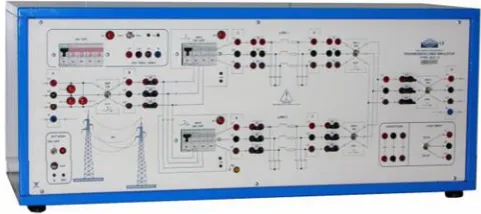
The SLE/2 Energy Transmission Line module can be used for experiments on single or double circuit medium transmission line [10]. The equipment is provided with switches and breakers to work with single or parallel lines. It has facilities for measurements at sending and receiving end. It also includes power supply with two reduced voltage levels corresponding to 120kV and 220kV and inductive and capacitive loads and hence it can be used as standalone equipment.
Fig -3: Energy transmission line module SLE/2
[image:2.595.314.555.551.658.2]© 2019, IRJET | Impact Factor value: 7.211 | ISO 9001:2008 Certified Journal
| Page 116
ABCD constants and analytical results of the transmissionline considered are included in II. Simulation results are included in III. Results of hardware simulation using SLE/2 Energy Transmission line module is included in IV.
2. TRANSMISSION LINE MODELING
2.1 Analytical
[image:3.595.320.541.102.191.2]A transmission line of length 100km is modelled as a nominal network. For a line length of 100km, the resistance is neglected and the inductance and capacitance of the line are based on the details of the hardware simulator. Measurements are first done on the simulator to obtain the line inductance L and capacitance C. These measurements are taken to be that of a transmission line with a length of 100km. The line data is provided in Table 1. All values correspond to reduced model of a high voltage transmission line to laboratory level KVA and Voltage levels built in, including simulations, through per unit calculations not elaborated here.
Table -1: Transmission line parameters
Quantity Value Quantity Value
Length 100 km Resistance 0.16
Ω/ph/km
Inductance 0.85
mH/ph/km Capacitance
0.0033 µF/ph/km
Frequency 50Hz ω 314 rad/S
Xc 965
KΩ/ph/km xL Ω/ph/km 0.267
(4)
(5)
ABCD constants are calculated using
(6)
(7)
(8)
(9)
A = D = 1, C = j0.104X10-3 S, B = (16+j26.7) Ω
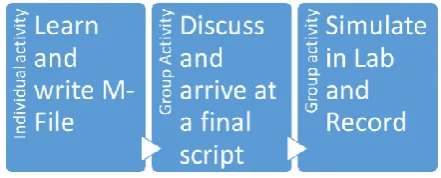
A MATLAB m-file is written by students to calculate the ABCD constants and the analytical results are verified as per the diagram below in Fig 3. The program takes resistance, inductance and capacitance per unit length per phase and the length of the line to calculate ABCD parameters.
Fig -3: Typical blended leaning process
2.2 Experimental - Determination of ABCD
parameters with SLE/2
SLE/2 transmission line module is used to simulate loaded and unloaded line with and without capacitance load. All experiments are done with line 1 of the two transmission lines provided in the module. Measurements are done at the sending and receiving ends using energy analyzers. The measurements are taken to be for a line with a length of 100km. With these measurements the ABC&D parameters are determined. Measurements were carried out with line receiving end open circuited to get A&C and with line short circuited to get B&D. An external source is used to set the sending end voltage and current as per the requirement.
With receiving end open circuited
Vs = 120.5 V, Is = 0.026 A, Vr = 121 V and Ir = 0 A
With receiving end short circuited Vs = 5.6 V, Is = 0.211 A, Ir = 0.212 A
1. When open circuit Vs = AVr
A = Vs /Vr = 120.5 / 121 = 1
C = Is / Vr = 0.013 / 121 = 0.107X10⁻³ S
2. With receiving end short circuited B = Vs /Ir = 5.6 /0.212 = 26.4 Ω D = Is / Ir = 0.211 / 0.212 = 1
Summarizing,
A = 1, B = 26.4 Ω, C = 0.107X10⁻³ S, D = 1
ABCD parameters through analytical calculations and through measurements in SLE/2 are summarized in Table 2.
Table -2: Transmission line parameters
A B C D
Analytical 1 26.7 Ω 0.104X10⁻³S 1
[image:3.595.33.281.362.687.2]© 2019, IRJET | Impact Factor value: 7.211 | ISO 9001:2008 Certified Journal
| Page 117
Fig -3: Measurements are done on the simulator to obtainthe line inductance L and capacitance C.
3. LINE PERFORMANCE
3.1 Analytical:
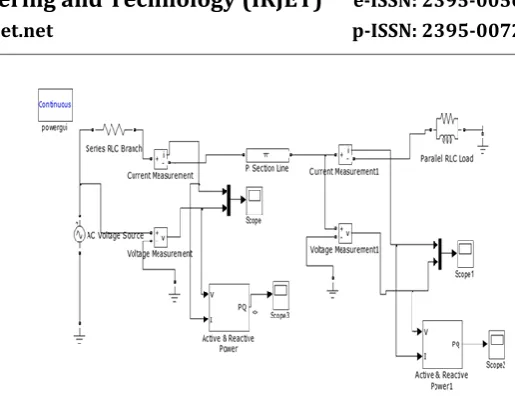
Analytical calculations are performed to obtain the voltage regulation and efficiency of the line at a nominal voltage of 220 kV. Voltage, current and power factor are chosen to be equal to measured values in SLE/2 module. Sending end values are given and receiving end values calculated using an m-file for the nominal π model and the results verified using SIMULINK model as shown in Fig 3. From the result % Voltage regulation and % Efficiency are obtained.
Percent voltage Reg. = 11.8 Percent efficiency = 94
3.2 Line Module SLE/2:
Switch, on the receiving end, is kept closed for load and the sending end voltage is selected for a nominal 220kV position. Measurement at point B corresponds to sending end and at G corresponds to receiving end. VL1, AL1, W∑, Var∑ and P.F∑ are line voltage, current, real power, reactive power and power factor respectively. The measured values are shown in table 3.
Table -3: 220kV line on load
Point VL1 AL1 W∑ Var∑ P.F∑ VL1
B 240.6 0.48 153 133.6 0.75 240.6
G 216.9 0.5 140 128.7 0.73 216.9
[image:4.595.35.291.56.285.2]% Efficiency = 91.7 % % R = 12.6 %
Fig -3: Typical SIMULINK line model simulation for performance.
3.3 Line at 220KV with phasing:
Switch, on the receiving end, is kept closed for load and the sending end voltage is selected for a nominal 220kV position. Measurement at point B corresponds to sending end and that at G corresponds to receiving end. Capacitor bank is connected at the receiving end to note the improved regulation. The receiving end voltage without load was found to be 244.3, which is higher than the sending end voltage at 241.5. This phenomenon is known as Ferranti effect [11].
Table -4: Line with capacitor load at the receiving end
Point VL1-2 AL1 W∑ Var∑ P.F∑ Point
B 241.5 0.49 177 -94.27 0.88 B
G 237.4 0.48 165 -96.68 0.86 G
% Efficiency = 93 % % R = 3 %
Regulation has improved from 12.6% to 3% and the efficiency also improved from 91.7% to 93%.
4. CONCLUSIONS
© 2019, IRJET | Impact Factor value: 7.211 | ISO 9001:2008 Certified Journal
| Page 118
Efficiency and regulation are obtained at nominal load andcompared with that of simulation results. The hardware and software simulation results agreed with the analytical results satisfactorily. The efficiency was found to be 92% and the regulation around 12% and improved to 93% and 3% respectively with a capacitor load end and the Ferranti effect during capacitive loading was also demonstrated.
REFERENCES
1) Shepstone N. M., ‘Innovation in engineering and technology education’, 3rd UICEE Annual Conference on Engineering Education, Hobart, Australia, 2000
2) Shepstone, N. M., "Teaching Electrical Power Systems Using Computer Simulations", International Journal of Electrical Engineering Education, Vol 40 no 1, 2003, pp 72-78.
3) Raju Kumar, “Convergence of ICT and Education ", PROC WRLD ACAD SCI E, WASET, vol 2, no 4, 2008 pp 300-303
4) R V Krivickas and J Krivickas,"Laboratory Instruction in Engineering Education", Global J. of Engg. Educ., Vol.11, No.2, 2007, pp 191-196
5) Stephanie Hay, Anna Ferguson,” A Review of Power System Modelling Platforms and Capabilities”, A Report, The Institution of Engineering & Technology 2015
6) Suraj Pawar et al, "Experimental Determination and analysis of Transmission line performance" International journal of innovations in engineering research and technology [IJIERT] , vol 2, no 3 2015
7) D. Jegelevičius, D. Pagodinas, V. Dumbrava,” Laboratory Experiments in Circuit Theory: Link between Theoretical Concepts and Practical Examples”, ELEKTRONIKA IR ELEKTROTECHNIKA, Vol 6(102), 2010.
8) S.Surenderkumar, K.M.Priya,"Strategies to Improve Engineering Education and Teaching-Learning Pedagogy in India",International Journal of Advanced Engineering Research and Technology (IJAERT),Vol.04 Issue 08,2017 pp 816-820.
9) Emerole Kelechi C, Matthew Gabriel Chinedum, “A-B-C-D PARAMETER MODEL FOR TWO-PORT NETWORKS”, International Journal of Advanced Engineering Research and Technology (IJAERT),vol.3 issue 10, 2015 pp. 334-339.
10)SLE/2 Energy transmission Module User’s Manual, Samar, Italy.