e2li'
36e2 ..
EIS2£i2!l
.---
...
-
January,19p8
.;:.., -~~
..
CD
puters
and automation
A
Glimpse at The
Future in
Computer
Centers
TUT0R 1
9:49
WED.
09/06/67
t
C0PYRIGHT
1966
F0RD M0T0R C0MPANY - ENGINEERING STAFF
WELC~ME
T0 THE FaRO TIME SHARING SERVICE. WE WILL TRY T0 TEACH Y0U
EN0UGH A80UT THE SYSTEM IN THIS SITTING S0 THAT Y0U WILL BE ABLE
1'
it
-wRll
£...
y.a
UR
aWN
C0MPUTER ?R0GRAMS.
N
WRITE A PR0GRAM WE NEED T0 REVIEW THE SYMB0LS
VERY G00D. I
WI TH THE VAR
H0W MUCH IS
N0. REMEMBER
Hf2lW MUCH IS
SURE
4+
tIN
3*4+7
Y0U ARE.
H0W MUCH IS 3*[1+5]/2
G00D
THAT LEAVES t
WH
:J
I
ia
~
~
ICATE SQUARES, CU
t
3 F0R Y* y* Y, ETC
, C0SINE, ETC.,
SUCH AS Xt2 F0R
WE ALS0 CAN USE
Y0U CAN EVEN
0
AN
f2l~1:{ER LESS.0N
.
INE Y0UR 0WN, B
WE'L
L
US
E
SQR [SQUA
R
E R00Tl IN
E WILL BE C0VERED
~URC0
M
ING
N
Perry Publications
is making headlines
with this system
The system was designed so Perry's 26 daily
Florida newpapers could use one computer
cen-. ter in West Palm Beachcen-.
Every day the Perry papers send their display
advertising and editorial matter to the center to
be prepared for typesetting machines.
Since speed is essentia I, Perry set up 14
trans-mitting-receiving centers where newspaper
copy is put on paper tape. The tapes are sent via
Type 2 Dataspeed
*Service (at 1050 words per
minute) to West Palm Beach.
At the center, tapes are read into the
com-toelectric readers. The computers have a 50,000
word dictionary programmed into them, so that
copy can be prepared in newspaper column
widths and words hyphenated, where necessary.
The output of the computer isa new tape
which is returned by Dataspeed service and fed
directly into typesetting machines.
If moving information in a hurry will help you
make more efficient use of your computer
instal-lation, talk with our Communications
Consul-4.
AT&T
system to beat any deadline.
@
tant. He'll help you plan a
m
Dataspeed[BJ Service
And we know where it is to an
ac-curacy of a thousandth of a degree in
azimuth and elevation, on this frame,
and the next, and the next - as long
as the theodolite follows it.
The positional information is on the
film, in those dials at the upper
cor-ners. But getting the information off
of the film into useable form -
auto-matically - is a task so formidable
that only our Programmable Film
Reader -3 does
it.(Some other pretty
big outfits are still trying.)
Think for a moment what is involved.
First the computer-controlled
scan-ning system has to locate the dials
(they're not always in the same
posi-tion on the film). Then
ithas to find
Hey,
you dropped
something!
and recognize two sets of arabic
numbers. Then it has to determine
where a tiny marker is on the linear
scale and convert this into a number
of three place accuracy. The last step
is to find the parachute and correct
for theodolite aiming error.
Sophistication fit for a human, but
our Programmable Film Reader -3 is
faster, more accurate and more
reliable.
This kind of capability -
to find,
recognize, analyze, and convert visual
information -
can be applied to any
problem, because the Programmable
Film Reader -3 is just that:
program-mable. And the ultra -precise CRT in
the optical system can record on film,
Designate No. 14 on Reader Service Card
tOQ,
with the same sophistication.
Other exciting new ideas in visual
information processing are taking
form at Information International.
Ifyou want to drop something yourself,
how about in for an honest to
good-ness demonstra tion?
Information International Inc.
545 Technology Square, Cambridge,
Massachusetts 02139 (617) 868-9810
11161 West Pico Boulevard,
Los Angeles, California 90064
(213) 478-2571
©©
[f[R)
CQ)
(1JJ~
@
o~§
6l
[ill~
SJ
(U]\i::;@uuu6]'U;UC!:Duu
JANUARY, 1968, Vol. 17, No.1
Sl Across the Editor's Desk
Computing and Data
Process-ing Newsletter
66 Advertising Index
41 Calendar of Coming Events
50 C&A Problem Corner
8 letters to the Editor
64 Monthly Computer Census
62 New Contracts
63 New Installations
66 New Patents
Special Feature,'
T1'ends and Projections in the Compttter Field
15 PROSPECTS IN MUNICIPAL INFORMATION SYSTEMS: THE EXAMPLE OF LOS ANGELES, by Takuji Tamaru
How the City of Los Angeles - which currently includes 2.7 million residents served by 47 separate departments and bureaus with a staff of 32,000 employees - has pioneered in developing a centralized data processing system designed to assist all levels of municipal government in their operating and planning functions.
20 A GLIMPSE AT THE FUTURE IN COMPUTER CENTERS - THE TECHNICAL COMPUTER CENTER AT FORD MOTOR COMPANY, by the Ford Technical Computer Services Dept.
How one of the largest technical computer complexes in the world operates: a look at equip-ment, organization, techniques, and projects.
44 THE TREND IN SIMULATION, by John E. Cremeans
A thorough investigation of what simulation is and how it should be used • . . with a warn-ing against oversellwarn-ing simulation as a technique for solvwarn-ing problems.
6
Editorial,
by Edmund C. BerkeleyAccess to Information, and a Mailing List of All Computer People
24
Market Report
Government Seeks New Data on Competition in the Computer Industry, by Stanley Penn
27
Jobs and Careers in Data Processing
The Changing Nature of Programming, by Dr. Paul S. Herwitz
43
World Report -
Great Britain,
by Ted SchoetersMinistry of Technology tries to limit number of small computers manufactured in UK; first concrete move made toward Anglo-French cooperation in computer technology; English Electric may be suffering from production delays.
49
15
Years Ago in C&A
Gypsy, Model VI, Claude Shannon, Nimwit and the Mouse, by George A. W. Boehm
40
Ideas: Spotlight
There is a Crying Need for Improvement in the Technique of Education, by Dick H. Brandon Computer-Assisted Instruction is Expanding
Multi-Access Forum
10 Any Protests and Objections to Computers Should Be Directed at the Men Who Use Them, Not by Raymond R. Sl<olnick at the Computers, by James E. Harrison
11 Soviet Lags in Use of Business Computers, But Plans Network That Will Run Entire Economy
11 Immediate Nationwide Information About Job Vacancies in England
12 Automated Teaching in Biology Saves Money at Fraser University
12 DPMA 1968 Research Grants Available
12 Fifth Annual Computer Programming Contest for Grades 7 to 12
13 ACM SIGPLAN to Set Up Registry for Software Names
13 American Society for Information Science is Created
13 International Group for Administrative Data Processing is Formed
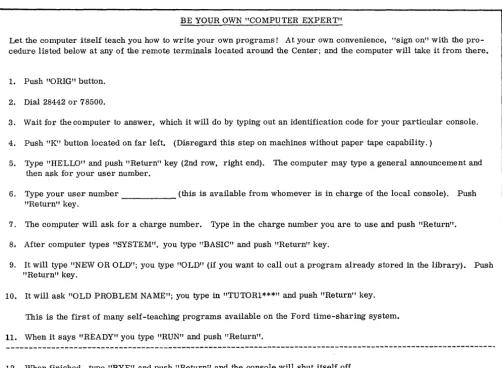
On the front cover appears the beginning of a lesson designed to teach a neUJcomer the use of the BASIC programming language and fundamental programming techniques at the Ford Motor Company in Dearborn, Michigan. The
back-ground picture shoUJs one of the computer rooms at Ford. For more information, see "A Glimpse at the Future in Computer Centers - The Technical Computer Center at Ford Motor Company," beginning on page 20.
ACROSS THE EDITOR'S DESK
Computing and Data Processing Newsletter
APPLICATIONS
51 Analog Computer at Rutgers University Simu-lates Fruit Trees to Determine Reactions to Varying Forces
51 C-E-I-R's Multi-Access Com'puting Service Used for Poison Control
52 Computers Playa Major Role in Massive Heart Disease Study
52 Computer's Electronic Voice Serves Customers of the Wisconsin Telephone Company 53 Unemployment Checks Prepared "On-the-Spot"
for Waiting Claimants in Massachusetts Pro-gram
53 Small Computer Helps Grade Giant Timber in Tacoma, Washington
ORGANIZATION NEWS
53 Data Documents Purchases Four Data Card Plants From Sperry Rand
53 Compagnie Generale de Geophysique to Open Seismic Processing Center in Calgary, Al-berta, Canada
54 Control Data Acquires C-E-I-R, Inc.
54 Computing and Software, Inc. Acquires West Coast Schools, Inc. of los Angeles
54 Computer Industries Inc. Has Announced a New Graphics Systems Division
54 Recognition Equipment Inc. Has Acquired Tele-trans Corporation
54 Charles Bruning Company to Market Auto-mated Drafter for Mergenthaler linotype Co. 54 Japan's Foreign Investment Council Approves license Agreement Between Nippon Calcu-lating Machine Co. and Wyle laboratories 54 University of Rhode Island Establishes
Depart-ment of Computer Science
55 Software Resources Corp. to Market Gener-alized Retrieval System (GRS)
55 Elliott Process Automation and Compagnie Generale D'Automatisme to Pool Experience
NEW PRODUCTS Digital
55 EAI 8400 Mod II, Scientific Digital Computing System Developed
Memories
55 Ferroxcube Announces Compact, low-Cost Memory System With Random Access 56 Data Products Announces New Discfile, Model
5065
56 Smoother Surfaced Magnetic Discs Introduced by Data Disc, Inc.
56 Small Capacity Core Memory System from Elec-tronic Memories, Inc.
Software
56 Autodiagrammer - ARIES Corp. 57 Cogent II - Computer Sciences Corp. 57 Data Acquisition Multiprogramming System
(DAMPS) - IBM Corp.
57 General Comprehensive Operating Supervisor III (GECOS III) - General Electric Co. 57 Omega - Sperry Rand Corp.
57 RPG listing Aid - Computer Results Corp. 57 SCORE (Selection COpy and REporting System)
- Programming Methods Inc.
57 Vehicle Scheduling Program - IBM Corp.
Peripheral Equipment
57 Potter Adlogic Makes 50% Storage Capacity Increases Possible for All Disc Packs and 1,600 BPI Tape Handlers
58 "Diginet Series" is GE's Entry into the Digital Communications Business
58 IBM 2680 CTR Printer Sets Type Six Times Faster 59 Control Data Develops High Performance
Mag-netic Tape Transport
59 Midwestern's Tape Transport is Plug-to-Plug Replacement for IBM 2401 Tape Drive 59 Optimat - Automated System for Circuitry
Artwork
59 CC-30 Communications Station - Portable Sys-tem Uses a Standard Television Set 60 IKOR's New Approach to Keyboards Reduces
Coding Errors
Data Processing Accessories
60 Extreme Environment Tape Makes Computer Operation Possible in Extremes of Heat and Cold
AUTOMATION
61 R~mote Control Equipment Used to Run Trains of Unusual lengths
61 First Supersonic Airport Gets First Driverless, Trackless Passenger Train
Editor and Publisher: Edmund C. Berkeley
Assistant Editors: Moses M. Berlin, Charlene J. Hofer, Linda Ladd Lovett, Neil D. MacDonald
Contributing Editors: John Bennett, Andrew D. Booth, Dick H. Brandon, John W. Carr, III, Ned Chapin, Alston S. Householder, Peter Kugel, Rod E. Packer
Advisory Committee: T. E. Cheatham, Jr., James J. Cryan, Richard W. Hamming, Alston S. Householder, Victor Paschkis
Art Director: Ray W. Hass
Fulfillment Manager: William J. McMillan, 815 Washington St., Newtonville, Mass. 02160 617-332-5453 Advertising Representatives: NEW YORK 10018, Bernard Lane, 37 West 39 St., 212-279-7281
CHICAGO 60611, Cole Mason Deming, 737 N. Michigan Ave., 312-787-6558 LOS ANGELES 90005, Wentworth F. Green, 300 S. Kenmore Ave., 213-387-8135 SAN FRANCISCO 94123, Richard C. Alcorn, 2152 Union St., 415-897-1620
ELSEWHERE, The Publisher, 815 Washington St., Newtonville, Mass. 02160, 617-332-5453
:~.-. COMPUTERS AND AUTOMATION IS PUBLISHED MONTHLY AT 815 WASHINGTON ST., NEWTONVILLE, MASS. 02160, BY BERKELEY ENTERPRISES, INC. PRINTED IN U.S.A. SUBSCRIPTION RATES: UNITED
:.~:: ~b~;~i'I:~ ~~ODF~~B~C~~A~o~2~~~L F~~ ;E:~tL~~ ~~~~~~~~~s~7~d.~~~5 D:!~~?~ciTg~U~~.~~~~~~N~~~E~~~S~E~:1 !~Rs~~6~ADG~;L!~:~g~i:O~Dp!~~~
¢
B"c;:T~~~~~~;: AGE. ADDRESS ALL POSTMASTER: PLEASE SEND ALL FORMS 3579 TO BERKELEY ENTERPRISES, INC., 815 WASHINGTON ST., NEWTONVILLE, MASS. 02160. © COPYRIGHT, 1968, BY BERKELEY ENTERPRISES, INC. CHANGE OF ADDRESS: IF YOUR ADDRESS CHANGES, PLEASE SEND US BOTH YOUR NEW ADDRESS AND YOUR OLD ADDRESS (AS IT APPEARS ON THE MAGAZINE ADDRESS IMPRINT), AND ALLOW THREE WEEKSFOR THE CHANGE TO BE MADE.
EDITORIAL
Access to Information and a Mailing Llist of
All Computer People
In 1946 in the spring - year 2 of the computer revolu-tion - some conversation went' on in the Harvard Com-putation Laboratory, in Cambridge, Mass., then under the direction of Commander Howard Aiken U.S.N.R. (later Professor) . Some of the younger computer people there were not very happy about the lack of opportunities they had for access to information about the booming computer field. For example, Dr. John von Neumann visited our laboratory, but Commander Aiken did not introduce him to any of the young people there, who of course would also have liked to talk with him for just a couple of minutes. So there was a restlessness and a desire to have access to more information - to news about computer installations, computer people, computer meetings, etc. I know - I was there.
In 1947 in the spring - year 3 - there was more rest-lessness and more desire for intercommunication and for a computer society. The logical organization to take action to form a society seemed to be the National Research Coun-cil Committee on Large Scale Calculation, which had five members, Dr. Howard Aiken, Professor R. C. Archibald, Dr. Derrick Lehmer, Dr. John von Neumann, and Dr. George Stibitz.
I went to the Prince George Hotel in N ew York one evening in April 1947, the day before the scheduled annual meeting. There I talked with Dr. Lehmer and Dr. Archibald, urging that the time was ripe for forming a society in the computer field; I begged them to bring up the subject the next day at the meeting, and seek a favorable decision. They agreed. I found out a few days later that V\:'hen the subject was brought up, Aiken and von Neumann declared they saw no need for "still another society - there were too many already," and Stibitz did not say much, and so the proposal was tabled, to be brought up again at their next meeting a year away.
This outcome made me angry; so, after talking with some friends of mine, together we sent out by mail a notice pro-posing to form the Eastern Association for Computing Machinery. The names of the senders of the notice were:
E. C. Berkeley Prudential Insurance Co. of America, Newark, N.J.
R. V. D. Campbell Raytheon Mfg. Co., Waltham, Mass.
J.
H. Curtiss Bureau of Standards, Washington,H. E. Goheen
J.
W. MauchlyT.
K.
SharplessC. B. Tompkins
D.C.
Office of Naval Research, Boston, Mass.
Electronic Control Co., Philadel-phia, Pa.
Moore School of E I e c t ric a I
Engrg., Philadelphia, Pa. Engineering Research Associates,
Washington, D.C.
This new group held its first meeting in September 1947 at Columbia University; 75 people were present. I know -I was there. Shortly afterwards the name was changed, and the newly formed organization became the Association for Computing Machinery.
In 1947 it was decided that the dues of the Association would be $2 a year. It was believed then that this annual amount would be enough to maintain up to date a mailing list of computer people which would send out 3 or 4 times a year a brief mimeographed bulletin of notices of informa-tion and lists of interested persons. In this way, even a new-comer with almost no financial resources would have as much access to crucial information in the computer field as the old timers would have.
The dues of the ACM have now become $25 a year. Many of us feel that. this is far too much. We feel it is not right to tax every member to provide those things that only some members want. Many of us object to such decisions made by those few members who gravitate into the ruling bodies of a professional association. Many of us feel that the time has come to go back to the simple concept of a mailing list for all computer people costing not more than $2 a year, less if possible.
Computers and Automation has decided to start a
mailing list of all persons interested in the field of computers and data processing.
C&A invites everybody who is interested in the field to send us their name and address, for inclusion in this list,
Computers and Automation's Universal Mailing List, CAUML.
We plan that the rules covering this universal mailing list will be as follows:
1. Anybody who wishes to mail information that bears some reasonable relation to the interests of people in the computer field will automatically have per-mission to mail to this list.
2. The mailing list rental fee will be $20 per thousand pieces addressed.
3. After deducting from income the reasonable and necessary expenses for updating and maintaining the list on some suitable automatic medium like metal plates, the net income will be contributed .to worthy causes for improving education in the ~omputer field.
4. An audited accounting will be published in
Com-puters and Automation once a year.
Air.
Air instead of electricity. Plastic
tubes instead of wiring.
These are the components of fluidics,
a new kind of circuitry that employs a
stream of air (or other gas or liquid)
rather than electrical current to operate
a machine.
UNIVAC
pioneering resulted in the
world's first all-fluidic computer in 1964.
Now it's three years later, and
research is still in its beginning stages,
because there's so much left to explore.
Particularly in the areas of
relia-bility and endurance of conventional
computer input and output devices,
because they have moving parts which
can wear out and malfunction.
The beauty of fluidic devices is
that they have almost nothing in the
way of moving parts.
No parts to get stuck or slowed by
extremes of temperature, vibration or
radiation.
This makes them ideal for nuclear
re-actor controls and for space exploration.
A t this very moment
UNIVACis completing work on an experimental
model for the U. S. Army's Electronics
Command, Fort Monmouth, New Jersey.
It's a
UNIVAC@all-fluidic peripheral
device for processing unit records.
With conventional equipment,
cards get damaged through mechanical
handling.
UNIVACfluidic systems
gi ve cards nothing more to contend
wi th than air.
We're exploring many other
advanced ideas in
UNIVACresearch
and development laboratories: new
thin film memories, plasma displays,
photochromic storage, to name a few.
No one knows where it will all end. But,
as with many other advanced projects,
we do know where a lot of it began.
UNIVAC
U
ni vac is saving a lot of people a lot of time.
{=SPCR'<Y RAI\D
Designate No. lOon Reader Service Card
The idea behind the most advanced
computer research goes something like this.
Computer
Program Design
(Southern California)
HUGHES GUidance and Controls Division has several openings for qualified persons who have the ability to create complex digital computer programs-and the desire to do the job thoroughly and effi-ciently. Satisfaction of current commitments on such systems as: PHOENIX, IRAM, VATE and ASG-18 requires experience in the design of real-time command and control programs, . or of software programs for execution on an IBM 7094 or GE 635 computer.
Responsibilities include: specifica-tion, design, implementaspecifica-tion, check-out and support of computer programs for a wide variety of applications including:
• Airborne Navigation & Fire Control
• Digital Simulation of Airborne Computer and its environment • Automatic In-Flight & Depot
System Testing
• Assemblers & Compilers • Automation of Electronic
Equipment Design
Requires: an accredited degree in Engineering or Mathematics, a mini-mum of three years of professional experience and U.S. citizenship.
Please airmail your resume to: Mr. Robert A. Martin
Head of Employment
HUGHES Aerospace Divisions 11940 W. Jefferson Blvd. Culver City S4, California
;---;
: HUGHES
L _________ ~ ________ Ji
HUGHES AIRCRAFT COMPANY
AEROSPACE DIVISIONS
An equal opportunity employer - M & F
Letters
To
The
Editor
Simulation Story
Sir:
Would you please give us a quotation on 200 reprints of the Computed Dis-play (cover story, November issue)?
We are delighted with the way you handled this story.
HUBERT M. SNIDER
GE Electronics Park Syracuse, N.Y.
Printing Error
Sir:
Page 13 of your November, 1967 issue contains an admission that the September, 1967 cover photo was reversed in error. You excuse this error with the comment: "This was a printer's error, and we had no way of stopping it. But the procedure is being improved and it
should not happen again."
I'm glad you said should rather than will not happen again. The right-most
mi~iature in the second row of your November cover is indeed reversed.
R. F. MICHAELS
Toledo, Ohio
Problems
Sir:
Problem 6710 which appeared in the "Problem Corner" of your October, 1967 issue ends with the question: "What does the program compute?" My solution is that it computes how many readers will detect that the FORTRAN coding was omitted from the problem state-ment!
W. PRESTON HAUPT
Chincoteague, Va.
( Ed. Note - We regret our error. The problem was reprinted in the Nove.mber issue so as to include the FORTRAN
program~)
Better Insight
Sir:
I recently saw a copy of your maga-zine in the public library, and I enjoyed it very much. I am presently a student at Mercer County Community College in the Business/Data Processing Curric-ulum, and I appreciate your gIvmg me a better insight into the computer world through your· magazine.
SALVATORE M. ZULLA
Trenton, N.J.
Reapportionment Cases
Sir:
In the September issue of C&A (page
12) you mentioned a New York Court of Appeals decision re reapportionment. Could you supply me with a citation to that decision, or the names of the parties involved?
MICHAEL A. DUGGAN
Durham, New Hampshire
(Ed. Note - The cases are No. 254, Jerry Iannucci vs. The Board of Super-visors of the County of Washington and the State of New York; and No. 255, The Saratogian, Inc. vs. Board of Super-visors of the County of Saratoga and The State of New York and Harry D.
Snyder, Jr., Supervisor of the City of Saratoga Springs, Intervenor-Defendant-Respondent. Both cases were tried in the Court of Appeals of the State of New York.)
Social Implications Group
Sir:
I have been informed that you have formed a Special Interest Group on the Social Implications of Computers. I wLluld like very much to become a part of this group.
I would also appreciate having the names of others in the field who are doing work in this area, as I plan to write to them and organize a list of ongoing projects.
WILLIAM BAURIEDEL
Chicago, Ill.
(Ed. Note - The organization that has the special interest group on social im-plications of computers is the Association for Computing Machinery~ 211 East 43rd St., New York, N.Y. We discuss the sub-ject often, but do not have an organiza-tion. )
Truthful Facts into Computers
Sir:
I just want to express my agreement with the point made in your letter on page 13 of the October, 1967 issue of C&A: computer people do have a re-sponsibility to see that truthful facts are put into computers.
LEON DAVIDSON
White Plains, N.Y.
Art Reproduction
Sir:
I am writing for permission to reprint three pictures from the "Annual Com-puter Art Contest" which appeared on pages 8, 10 and 11 of your August, 1967 issue. The photos will be used in IN-BUSMAG, the IBM employee magazine published in India. The pictures we want to use are: "Sine Curve Man, 1967", "Boxes", and "Seeing Stars." We will, of course, include your standard credit line.
H. A. MENDELSOHN
IBM World Trade Corp. New York, N.Y.
Move
W~'[h
Advanceo1
Compu'ij:e~ 1"echU1o~ogy
A'( NCR
lE~ec'(ronncs
DivHsnorn
SYSTEMS FORMULATION
Analysis and development of advanced systems specifications; consultation on systems design, hardware configuration, software trade-ofts; analysis of competitive·systems. Applicant should have familiarity with very high speed memories, large-scale integration, disc files, drum files, communications and time sharing plus related BS degree and 3 to 5 years' experi-ence in one or more areas mentioned.
SOFTWARE SYSTEMS
Programmers to develop executive and operating systems for third-generation computer systems. Desire experience with medium- and large-scale general-purpose systems employing high speed peripheral units, tapes, random-access files, disc files, drum files, on-line, time sharing and multi-programming. Requires related BS degree and 3 to 5 years' directly related experience_ Posi-tions also open for hardware-oriented program-mers to do systems diagnostic work_
EDP ANALYST/PROGRAMMERS
Analyst position entails systems analysis in financial and administrative areas_ One year of EDP experience required, degree desirable. Pro-gramming positions involve accounting and manufacturing systems. Degree and recent experience on medium- to large-scale systems desired.
OPTICAL SYSTEMS
To do computer-aided design of specific elements in complex optical systems, such as field and condenser, as well as image-forming elements.
NCR Electronics Division is the largest com-mercial computer manufacturing facility in Southern Cal ifornia and one of the most advanced in the world. The Los Angeles plant and laboratories have recently been doubled, and an additional manufacturing facility is now under construction in San Diego. At NCR you will enjoy stable, non-defense activity in a
Activity includes optical-electronic lab work, sys-tems layout and design, technical liaison. Involves geometrical and physical optics_ Requires BS in physics or optics plus 2-5 years' directly related experience.
MEMORIES RESEARCH
To design high-speed magnetic memory circuits. Requires knowledge of nanosecond pulse tech-niques and magnetic memory organization. Familiarity with plated-wire and mass-storage memory concepts desirable. Requires BSEE plus five years' experience.
SYSTEMS ENGINEER
For systems design on advanced computers. Requires extensive knowledge of memory tech· nology, systems logic and large-scale integration as applied to medium- to large-scale general-purpose computing systems. Minimum of BSEE and five years' direct experience required.
LOGIC DESIGN
Several positions available for EE's with 2-5 years' experience in logic design on either special- or general-purpose equipment. Positions require thorough knowledge of logic as related to real-time hardware development or automatic test equipment.
CIRCUIT DESIGN
Positions for both systems· and device-oriented circuits men to work either in developmental projects or standard circuits group. BSEE required plus 3-5 years' design experience and thorough understanding of IC technology. Knowl-edge of large-scale integration concepts and
thoroughly professional environment. Your job and your future: the creation of advanced busi-ness automation for NCR markets in 121 coun-tries.
Challenge, opportunity and Southern California are waiting for you. Look into these opportuni-ties now.
ramifications desirable. Projects include thin-film memories, IC utilization and development, project/vendor liaison, systems applications.
FACILITIES/LAYOUT
Work entails projecting needs of expanding divi-sion, development of proposals, program imple-mentation. Requires three years of facilities and layout experience, preferably in electronics industry; BSIE orequivalent; ability to deal effec-tively with all levels of personQel. Knowledge of safety codes desirable.
MACHINE DESIGN
Creative mechanical engineer capable of design· ing sophisticated manufacturing hardware and of developing machines to do jobs which here-tofo re h ave not been en cou nte red. Req u ires BSM E and minimum of two years' experience.
CHEMICAL PROCESSES
Positions in both engineering and manufactur-ing for man with BSChe and 2-5 years' experi-ence in electroplating and electrodeposition in thin and thick films. Thorough knowledge of related materials, pre-plating surfaces, plating equipment required. Work entails development of advanced processes and techniques for com-puter development and production_
QUALITY ASSURANCE ENGINEERS
Q.C. assignments include process capability studies, failure analysis, design reviews, estab-lishment of inspection standards. Position requires 2-3 years' experience with EDP equip-ment, knowledge of magnetic materials, BSM E degree. Reliability positions involve planning, conducting and reporting reliability tests of electronic components, assemblies and units. BSEE required plus experience with reliability mathematics, computer circuitry, Positions also available in systems test_
TO ARRANGE A CONFIDENTIAL INTERVIEW
send resume including salary history to: STEVE WILLIAMS
The National Cash Register Company
ELECTRONICS DIVISION
®
2838 W. EI Segundo Blvd., Hawthorne, Calif. Telephone: (213) 777-7344
An equal-opportunity employer
MULTI-ACCESS FORUM
ANY PROTESTS AND OBJECTIONS TO COMPUTERS SHOULD BE DIRECTED AT THE MEN
WHO USE THEM, NOT AT THE COMPUTERS
James E. Harrison Arlington, Va.
Mr. Warburton's study of the philosophical sources of man's sometime 'Objection to computers is interesting [See Com-jmte.rs and Automation, Oct., 1967, page 12.] First, he goes
off into the classical refuge of learned discussion about Dar-win, Freud, Copernicus, etc., and then he proceeds to analyze why men have objected to the uses to which some computers are put.
I believe that there is a basic flaw in his discussion, that he ignores some important facts which surround man's view of the electronic beasts he has created. It is all very well to investigate the nature of man and his "soul," man and his relation to "nature," and 'to write learnedly about their phil-osophical bases. \Vhat Mr. Warburton seems to be doing is to analyze the analysts, both historical and present, and come up with many words about criticisms of critics, distrust versus trust of computers, and whether or not computers can "think."
The facts which I believe he has ignored are these:
1. Computers are made and controlled by men. They cannot operate for long without human intervention.
2. Few intelligent men are really worried about
com-jmters. They are worried about what other supposedly
intelligent men are doing and may do in the future
with these sophisticated machines.
3. Historical research seems to have largely failed to en-lighten modern man. Our current social condition, except for material wealth, bears out the fact that we are in approximately the same condition as early barbaric tribes warring against each other.
4. Computers are being used by men to destroy human
beings on a mass scale. Those same computers are being used also to improve man's lot. Both uses are planned, directed, controlled, and can be stopped or started by men.
It is pleasant to spend one's time reflecting 'On why man views his computers or other creations in one way or the other. Philosophical vagaries have occupied man in his spare time for centuries. But if such pastimes have led us to pur present world condition, then I propose to abandon such pleas-antries. I need to think instead about curbing and controlling the men who use computers to try and destroy the world into
which I and my son were born.
I have never seen a computer that made me afraid. If my "soul," or any other part of my being, felt fears, it was be-cause I looked "long and hard at the jJeofJle surrounding that
machine. I sensed, from other informational inputs, that they were out to use that machine to irradiate, napalm, bomb, or otherwise destroy me: just as they are doing to the less
for-tunate citizens of another country, and with help from scores
of computers. I could be close to top on their list (stored in a machine memory) of those they will destroy - when con-venient. All I have to do in order to raise my priority is to write a little more against those men, talk a little more,
re-sist the ugly and historically-based plans for destroying human beings made by the military-industrial complex, and it could
be not very long before my name is tagged with the fatal binary mark. I can't tell where, philosophically, my self-protective feelings originated; I really don't care. If Robert Ardry in "The Territorial Imperative" is correct, and I am simply a rather advanced species of animal, still I am not barred from sensing danger, seeing beauty, or wanting to save my life. I am perfectly willing to be called an animal. Who cares about the semantics of whether I am human or animal? Perhaps my "dignity" or "meaning" is simply to want to live peacefully until my body will no longer function because of cellular breakdown.
On the other hand, I have seen dedicated men who use
computers to help people reach old age with minimal pain and problems .. I am not afraid of those men. They are trying to. save my life, not take it, by using computers. But again, the computer is simply a tool. PeojJle make it work toward a
positive or negative effect on my life.
In sum, I have absolutely no objection to computers, phil-osophical or otherwise: only to the destructive uses to' which man is putting them. Minds as fertile as Mr. Warburton's could better be directed to the question, "Is there a real basis for human objections to certain computer uses? and should we do something about these adverse uses?" The traditional Christianity he refers to has failed miserably. Christian phil-osophy has bred the "moral war" supported by some Catholic Cardinals; theology and Christian philosophy defends it on a seemingly logical basis. A friend of mine receives a statement of his contributions toward the work of God each month, and it is prepared on a computer by those same Christians.
My concern, unlike Mr. Warburton's, is not whether my nature is two-part or one-part, but whether we can control the computer-users who have produced what seems a near-Fascist government in the United States: whether we can direct the use of computers toward helping mankind instead of destroying it. But the tension in my "conceptual frame-work" is not caused by computers. It is caused by animal or human fear (whichever you choose) generated by observing the direct action, direct result, and immediate death of some of those opposing some powerful American computer users.
fear and jerked your finger and probably your whole body away from the flame. Only then can you afford the luxury of activity analysis: after you have done something about the immediate danger.
Each time I go near the Pentagon, I think about the com-puters whirring away inside. I have inside myself a fear gen-erated by the organization, and the men inside at their con-soles, and it makes hackles rise up on the back of my neck. Dogs and other animals show the same reaction when
threatened. Animal or human, the basic instinct of self-preser-vation operates.
If we can find a way to control certain classes of computer
users (people), then I think computers as machines will cease
to worry anybody.
I would like to invite Mr. Warburton to discuss the rela-tive merits or objections of using computers for war or for mankind's benefit.
SOVIET LAGS IN USE OF BUSINESS COMPUTERS, BUT PLANS NETWORK THAT WILL RUN
ENTIRE ECONOMY
(Based on an interview with Richard' Judy, Professor of Economics and Computer Sciences, University of Toronto, reported by the Toronto
Globe and Mail,
October 28, 1967.)
The Soviet Union is at least a decade behind North America in computer applications for general business. The Soviets have developed sufficient computer capability to make Sputnik possible, build a strong anti-missile defense system, and carry out advanced work in nuclear physics. Yet Soviet offices still rely on the abacus' and desk calculator to carry out normal accounting operations, such as payroll preparation. The Soviet is now trying to develop a mathematical model of the entire economy that would allow optimal planning and control of the economy. Soviet managers have been debating for some time the role the computer should play in the economy. The complexities of managing a vast, centralized state pose basic problems in paperwork and communica tions.
Two years ago a Soviet economist warned that by 1980 the country would require at least 100 million people simply to do the state's paperwork, unless widespread use was made of computer systems.
And beyond this, the Soviet looks upon cybernetics --basically the science of control and communications between man and machine - as part of the basic philosophy of the state.
Most Soviet computer work to date has been directed toward the needs of mathematicians and scientists. Soviet programming, input-output units, and supporting equipment is weak and unreliable. While North Americans are blase about print-out units that produce mountains of paper at the rate of several" hundred lines a minute, the Soviet has
only recently developed units capable of prIntmg in alpha-betical or numerical characters. These a~e not yet reliable.
There are serious reliability and quality problems with tapes and tape drives, too. One Soviet scientist has said it is impossible to store -anything on a Soviet tape and expect it to last longer than a month.
The Soviet has serious programming difficulties, but is trying to develop software libraries. Until recently, it was still programming in machine language, and had no equiva-lent of computer languages such as FORTRAN or COBOL.
It has now been agreed that ALGOL will be the standard computer language in the Soviet Union, but it is only start-ing to be used.
One reason for Soviet computer difficulties has been poor organization. Whereas in North America the computer manu-facturer is responsible for installing the computer, developing supporting programming, and putting the system in dperation, this has not been the case in the Soviet Union. There the manufacturer until recently was responsible for making the computer only, and in large measure the assembled com-ponents were supplied by other industries. Now the Soviet Government has put design production and programming all under one roof, in the Ministry of Radio Industry.
National planning right now is being done on a rough and ready basis, with many errors. But once the Soviets decide to give high priority to something, they have the power to mobilize remarkable resources. That is exactly what is hap-pening in the Soviet computer world today.
IMMEDIATE NATIONWIDE INFORMATION ABOUT JOB VACANCIES IN ENGLAND
Based ona report
byRichard Wagner in The Times
London, England, Nov. 6, 1967
The Ministry of Labour is to spend £500,000 on computer facilities for handling Selective Employment Tax calculations and which will be the first stage of what could become a £lm complex linked to every employment exchange in Britain, to provide immediate information about job vacancies.
If the scheme comes to fruition, it will be by far the largest multi-access installation in Europe. It is seen by the Minis-try of Labour as a further development in shaking off the "dole queue" picture of employment exchanges. With the computer, the Ministry hopes to match man and job system-atically, and provide better labour market information for both employers and workers.
COMPUTERS and AUTOMATION for January, 1968
The 970 exchanges in England, Scotland, and Wales place 1,500,000 able-bodied adults each year, and provide other aids .to mobility and replacement at an amiual cost of about £8m.
Using the computer will not replace individual judgment by Ministry officers, but it should make it easier and quicker to match vacancies and applicants, especially where applicants are mobile.
Similar schemes have already been tried in several European countries, but have so far failed to achieve their full potential because of technical difficulties.
AUTOMATED TEACHING IN BIOLOGY SAVES MONEY AT FRASER UNIVERSITY
(Based on a report in the Winnipeg Free Press,Win-nipeg, Manitoba, Canada, October 11, 1967.)
Officials at Simon Fraser University in Burnaby, British Columbia (a suburb of Vancouver) have discovered that modern, automated teaching methods are not only effective, but also save money.
The University contains a laboratory where first-year biology students receive their instructions from a combina-tion of tape recorders, slide projectors, film loop projectors, models, and specimens, rather than teachers. Students sit in booths and listen to taped lectures on aspects of biology which are keyed to a slide or film presentation. Assignments and lab exercises also are given by tape.
Students can go for lab instruction when they please, and take as long as they want going over it. They meet once a week in groups with a professor for discussion.
The approach is based on recognition that different kinds
DPMA 1968 RESEARCH GRANTS AVAILABLE
Data Processing Management Association505 Busse Highway Park Ridge, III. 60068
The Data Processing Management Association (DPMA) will again sponsor a Research Grant program for doctoral candidates. A number of individual awards of up to $2000 will be made to candidates who perform the necessary re-search and prepare doctoral dissertations in the .field of data processing systems and management. The research should be directed toward methods of management planning, con-trol, organization, and decision-making with regard to auto-matic data processing technology.
of learning occur through different sensory organs. For ex-ample, persons don't learn how to operate sophisticated scien-tific equipment just through a visual description, because this is too fast. They need to hear instructions. When a variety of signals are "sent" to the student - and the student has control over his own rate of learning - he learns faster and better.
There's not much saving on personnel costs, for while fewer professors are required, more technical support people are needed. But less money is spent on equipment at Simon Fraser than at a regular university, because equipment is utilized to a greater degree. It is estimated that under con-ventional methods, it would have cost the University $500,000 for microscopes for first-year biology, but with the auto-mated lab it cost only $100,000.
Applicants must be doctoral candidates at accredited gradu-ate schools. The doctoral committee must have already been appointed by the university, and the proposed research, in-cluding content and methodology, must have been approved. A copy of the accepted manuscript is to be submitted to the Association, which will have first option to publish.
Applications for 1968-69 grants must be received at DPMA International Headquarters no later than March 1, 1968. Additional information and application forms can be ob-tained by writing to the address above.
FIFTH ANNUAL COMPUTER PROGRAMMING CONTEST FOR GRADES 7 TO 12
Association for Educational Data SystemsProgramming Contests
Computer Instruction Network 607 Chemeketa N.E.
Salem, Oregon 97301
A contest designed to stimulate inventive interest among young students in the computer programming field is being sponsored for the fifth year by the Association for Educa-tional Data Systems (AEDS). April 8, 1968 is the deadline for entries. Students in grades 7 through 12 are eligible to enter.
The grand prize winner will receive a $150 U.S. Savings Bond, plus an all-expense-paid trip to the 1968 AEDS Con-vention in Fort Worth next spring. The winning pupil's teacher also will receive an all-expense-paid trip to the convention.
Second prize awards of $50 U.S. Savings Bonds will be given, and students who submit projects are also eligible
to receive a one-year subscription to a professional pub-lication.
A project may be submitted by an individual or by a team of two or more students. In the event that the project win-ning the grand prize is submitted by a team, the team must select one of its members to make the trip to Fort Worth. Students wishing more details and an application blank should write to the AEDS Programming Contest at the above address.
ACM SIGPLAN TO SET UP REGISTRY FOR SOFTWARE NAMES
Arnold D. Sobol
SIGPLAN Registry Subcommittee
Lockheed-California Co.
0/83-13, Bldg. 66, Plant A-l
P. O. Box 551
Burbank, Calif. 91503
With the explosive growth of computing, and especially computer programming, the problem of duplication among software names and acronyms is growing ever more acute. To tackle this problem, the Special Interest Group on Pro-gramming Languages (SIGPLAN) of the Association for Computing Machinery (ACM) has established a Registry Subcommittee to maintain a registry for the names of computer programming languages, and for major, publicly-reported software packages, where inadvertent duplication of names could cause confusion in the computing literature.
The services to be provided by the SIGPLAN Software Registry will include the following:
1. Register submitted names and acronyms. Duplicates would be registered, but submitters would be in-formed of previous registrations and their legal status, and advised to cancel their entry and make .some other choice.
2. Answer queries regarding registered names and acronyms.
3. Annually solicit and regularly accept revisions to existing entries.
4. Annually publish the c?mplete register.
It is expected that the creation and maintenance of the SIGPLAN Software Register will be a considerable under-taking. A retrospective literature search is under way to compile> an initial version of the register, and a continuing literature search will be conducted for reports of new pro-gramming languages and software packages. These would be entered in the register, and the authors would be sent a copy of the entry, and also a form letter inviting them to complete, revise, or validate it. Should a name or acronym thus uncovered be already registered, the author would be informed of this and advised to consider a change.
AMERICAN SOCIETY FOR INFORMATION SCIENCE IS CREATED
Dr. Bernard M. Fry, President
American Society for Information Science
2000 PSt. NW
Washington, D.C. 20036
A new professional society was created in October, 1967 at the National Convention of the American Documentation Institute, when that group voted to reconstitute itself as the American Society for Information Science.
This change reflects great development in information science, and the next 30 years are certain to witness further tremendous developments in information science. The
Amer-ican Society for Information Science aims to provide leader-ship in this field.
Information science deals with the diverse fields that com-prise communication: recording, microfilming, indexing, ab-stracting, translating, filing, storing, retrieving, publishing, and disseminating the ever-growing output of research data in all fields of knowledge.
INTERNATIONAL GROUP FOR ADMINISTRATIVE DATA PROCESSING IS FORMED
American Federation of Information Processing
Soci-eties
345 East 47th St.
New York, N.Y. 10017
A special-interest group on administrative data processing (ADP) has been organized under the auspices of the Interna-tional Federation for Information Processing (IFIP). Called the "IFIP ADP Group" (lAG), the new organization has as its basic aim the international interchange of information in the field of data processing as applied to public and busi-ness administration. Up to this time, there has been no international organization specifically concerned with the ad-ministrative field.
The lAG has begun publication of a bi-monthly bulletin (in English) containing news of international activities, in-cluding reports on special projects un~ertaken by the group itself. It also publishes a monthly journal of documentation abstracts (in English, French and German) of important papers in the field of ADP. Several special technical reports have been produced in English, including a survey on N et-work Analysis and another on Automatic Literature
Pro-COMPUTERS and AUTOMATION for January, 1968
cessing. A quarterly technical journal, which will make available in English original papers and papers that have previously had limited distribution in other languages, is planned for the near future. The Group will also sponsor occasional international symposia on subjects of broad inter-est in the ADP field.
Subscription to the publications and other services of the lAG are provided automatically to "partners" of the Group. Any company, computer center, interested organization, or individual may become a "partner" by application to the Group and payment of a $100 annual fee.
Further information and partnership applications forms may be obtained from AFIPS Headquarters at the above address. Organizations outside the United States may write directly to lAG Headquarters, 6, Stadhourderskade, Amsterdam W. 1, Netherlands.
ACM NATIONAL CONFERENCE IN AUGUST 1968 - CALL FOR PAPERS
Marvin W. Ehlers, Program Comm. Chrmn.
Ehlers, Maremont & Co., Inc.
57 West Grand Ave. Chicago, III. 60610
The 1968 National Conference and Exposition of the Association for Computing Machinery will be held in Las Vegas, Nevada, August 27·29, 1968. Papers are in\-'lted for presentation at sessions. Areas of interest are suggested be-low as a guide for submission of papers:
On-line Automatic Indexing and Classification
Simulation of Continuous, Discrete and Combined Systell1S New Applications of Simulation Techniques
Selection and Training of Computer Personnel Administrative Applications in the University Computatioi.1al Techniques in Civil Engineering Data Management for Urban Planning
Techniques for Symbolic and Algebraic Manipulation Computer Graphics
Computer Assisted Instruction Design Automation
Language Implementation Tables and Techniques Artificial Intelligence
Data Transmission for On-Line Terminals Certification of Numerical Routines Interactive Numericat' Analysis
General Purpose Mathematical Programming Systems
On-line Programming Languages: Alternative Approaches General Purpose Languages
Development and Operation of Remote Access Utilities Priciilg Strategies for Computing Centers
Real-time Systems - Operations and Applications Testing and Conversion of Real-Time Systems Systems Acceptance Criteria
Evaluation of Computer Installations
Only papers which have not been presented or published previously should be submitted. Each paper must ~nclude
an abstract of 100-150 words, and a text not to exceed 7,500 words.
Five copies of the abstract and of the entire paper must be submitted to me at the above-address by March 1, 1968.
DECEMBER EDITORIAL - CORRECTION
The hypothesis that the word "hypotenuse" is spelled "hypothenuse" is incorrect - we regret the uncorrected error in our editorial last month, Computers and Automation,
December, 1967, page 6, eighth paragraph.
Help stamp out
dropouts
Clean
tape heads
with
MS-200*
Oxide dust on tape heads is a frequent
source of dropouts. Some computer
operators still clean heads with swabs, but
many have found a better way: MS-200
Magnetic Tape Head Cleaner. MS-200
sprays away dust and dirt in seconds. You
can save even more time by applying
it while tape is running. Finally, computer
users report more than twice as many
passes of tape between cleanings with
MS-200 as with swabs. Recommended by
leading computer and tape manufacturers.
Write on letterhead for literature
and prices.
~
miller-stephenson
~
chemical co., inc.
Prospects in Municipal Information Systems:
THE EXAMPLE OF LOS ANGELES
Takuji Tamaru
General Manager
Data Service Bureau
Los
Angeles~Calif.
"Los A ngeles' move to centralized data processing is provi1ng its worth.
The Data Service Bureau budget is a little higher today than the cost
of the separate data processing facilities existing four years ago -
but
for the modest cost increase, the Bureau is handling a workload that
has more than doubled."
The City of Los Angeles, which currently includes 2.7 mil-lion resIDents served by 47 separate departments and bureaus with a staff of 32,000 employees, is considered one of the pio-neers in the application of automatic data processing tech-niques to municipal government. As early as 1922, the Los Angeles Police Department mechanized tabulation and anal-ysis of crime statistics and developed novel search techniques. This was followed in 1925 by the first automatic operation for utility billing in the world, inaugurated by the L.A. De-partment of Water and Power.
In the 1940's the city's Civil Service Department began scoring examinations and preparing eligible lists by ma-chine, and the City Controller and City Clerk started using ADP systems for processing payrolls, sales taxes, business licenses, and the like. When first and second generation elec-tronic computers and tape systems became available in the 1950's, Los' Angeles was one of the first municipalities to install them.
Thus it is hardly surprising that in late 1963, when it was decided to halt proliferation and dispersion of data process-ing facilities, the City had 12 installations in various depart-ments, ranging in size from an EAM system with a machine rental of $9,000 per year to a complex EDP facility compris-ing three computers and extensive associated equipment.
An earlier study and an Administrative Services Review Committee had established that centralization of all data processing was required to eliminate wasteful overlapping and duplication of data processing applications in various City departments, and to achieve maximum economy, efficiency, coordination, and control. Moreover, only a centralized DP facility would make possible the later implementation of a unified municipal information system designed to assist all City levels in their operational and planning functions.
In December 1963, the City Council passed an ordinance
Takuji Tamaru was appointed General Manager of the City of Los Angeles Data Service Bureau in the spring of 1966, after a nationwide, competitive examination. He is assisted by a staff of 200 analysts, programmers, systems specialists, operators, and clerical personnel, who are divided into three major divisions: Systems, Operations, and Data Control.
COMPUTERS and AUTOMATION for January, 1968
that established a Data Service Bureau (DSB) for centraliz-ing all data processcentraliz-ing functions of the City except those of the Department of Water and Power. These were considered too large and specialized to be advantageously consolidated. Interim control and management of the Data Service Bureau was to reside in the City Controller. Final control of the DSB was to pass to a seven-man Board of Administration, in which various City elective and appointive officers were to be represented under the chairmanship of the City Adminis-trative Officer.
Three Phases to LAMIS
The ultimate objective of centralization - the development of a Los Angeles Municipal Information System (LAMIS, for short) - is to be achieved through an eight-year Master
Plan, which is divided into three major phases. Phase I con-sisted of overall plans and implementation schedules; specifi-cations, selection of, and training for new-generation comput-ing. ~~uipment, .. and physical consolidation of existing ADP faCIhtIes. Phase II comprised installation and implementa-tion of IBM System/360 Models 30 and 40, the necessary
sy~te~ redesign and conversion of existing punched card ap-plIcatIOns and computer programs, and also the conceptualiza-tion of new applicaconceptualiza-tions. Phase III covers reconceptualiza-tion and redesign of the various applicareconceptualiza-tions and subsystems into a coordinated municipal information system. The entire plan is to be completed by 1972.
The planning phase (Phase I), resulting in physical con-solidation of the City's ADP facilities under the roof of City Hall, was completed in late 1964. By that time the Data Ser-vice Bureau was running 450 applications for 44 separate departments or offices, with the jobs ranging from payrolls to engineering computations.
The decision to install the medium-scale System/360 Models 30 and 40, each with a full Operating System, was arrived at through extensive study and analysis by a special task force. The decision not only provided Los Angeles with a new generation data processing potential equal to or ahead of that of any governmental organization of similar size, but also yielded a number of significant additional advantages:
• The system was compatible with existing computers and programs such as the IBM 1401. Planned expan-sion would not require a change in program logic or new input/output devices.
• The 1401 Emulator (delivered with Model 30) would permit a smooth transition of existing EDP applica-tions to the new computer, with reprogramming to follow.
• System/360's capacity to perform binary and decimal arithmetic operations concurrently would permit pro-cessing of scientific, engineering, and accounting appli-cations On the same system with good efficiency.
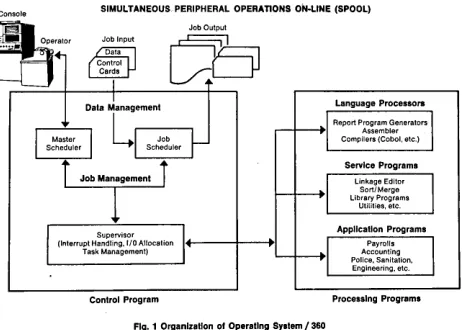
The use of the full Operating System - though one of the smaller operating systems could have been used initially-was anticipated to yield an immediate increase in system throughput and continuous processing of a vast number of jobs written in a variety of source languages. It was also expected to provide the DSB staff with the necessary experi-ence for phasing in multi-programming and a number of on-line and real-time applications. Further it was hoped that OS/360 would materially lighten the programming effort for future applications through program segmentation and better diagnostics, and would provide a consistent job priority sched-uling and job accounting system.
The System/360 Model 30 was delivered and installed in December 1965, and the basic programming became available in January 1966. The equipment consists of the 2030 central processing unit with 65K bytes storage, two selector and one multiplexor channels, four 2402 nine-track dual-drive mag-netic tape units, one 2404 tape unit and control with a seven-track drive, a 2311 disk drive and control unit, the 1403 printer and 2540 card read/punch with their control unit, and 1052 printer-keyboard and 1051 control unit. The latter are part of a 1050 data communications system with eight remote terminals which are presently used off-line. The computer also was equipped with the 1401 Emulator.
The Model 40 was delivered and installed in November 1966. Its configuration is similar to that of the Model 30 but the 2040 central processing unit has more than 13LK bytes storage capacity and there are an additional five 2400 series magnetic tape units and three 2311 disk drives. The 1401 Emulator was not needed, since the Model 40 is used primarily for implementing new applications.
Redesign, Re'programming and Emulation
At the time of System/360 installation, the Los Angeles Department of Public Works had 197 separate punched card (407-EAM) applications requiring over 7000 hours per year of 407 running time. The redesign and conversion of these applications into a unified information system, capable of running efficiently on the new co.mputers, is a major undertak-ing still in process. Also requirundertak-ing conversion were the more than 560 1401 programs and 240 SPS programs. Three tech-niques are being utilized for this purpose:
1. Use of the Emulator as a transitional aid;
2. Redesign and reprogramming in System/360 COBOL or FORTRAN IV for engineering and scientific pro-grams;
3. Reprogramming in System/360 Assembler Language.
Emulation has proved successful. Actual running time of most programs on the Model 30, using the compatibility fea-ture, was on the average two times faster than on the existing 1401 computers. Successful Emulation permitted the return of one of the 1401's as early as December 1965.
Reprogramming of 1401 programs written in AUTO-CODER language (as well as new applications) into Sys-tem/360 COBOL language ran into some difficulties. Most were due to the use of the relatively small E-Ievel compiler-the only one available at compiler-the time - in conjunction with the highly sophisticated full OS/360 Operating Systf'm. The fact
~that our then understaffed Data Service Bureau had to learn to cope quickly with this complex operating system did not help matters any.
However, by the middle of 1966, the operating system and the COBOL compiler were operating in a satisfactory manner and the huge task .)f program conversion has now been more than half completed. A number of 1620 scientific programs have also been successfully converted to the OS/360 FOR-TRAN IV Compiler. In a few cases, where running efficiency was highly important, conversion to the Assembler language was carried through.
To run the vast and highly diversified applications of a city the size of Los Angeles on computers without an effective operating system is virtually unthinkable, if not impossible. This is true not so much because of the advanced features-multiprogramming, real-time on-line processing, time-sharing, etc. - which some operating systems can provide, but pri-marily because of such fundamental capabilities as smooth, programmed job flow, priority job scheduling, data manage-ment, file maintenance, and flexible, automatic allocation of system resources. Operating System/360 maintains the flow of DSB services around the clock, virtually without operator intervention, and provides extensive job accounting, along with a complete log of Data Service Bureau activities. This,