warwick.ac.uk/lib-publications
Original citation:
Haselmayr, Werner, Aejaz, Syed Muhammad Haider, Asyhari, A. Taufiq, Springer, Andreas
and Guo, Weisi. (2017) Transposition errors in diffusion-based mobile molecular
communication. IEEE Communications Letters .
Permanent WRAP URL:
http://wrap.warwick.ac.uk/88751
Copyright and reuse:
The Warwick Research Archive Portal (WRAP) makes this work by researchers of the
University of Warwick available open access under the following conditions. Copyright ©
and all moral rights to the version of the paper presented here belong to the individual
author(s) and/or other copyright owners. To the extent reasonable and practicable the
material made available in WRAP has been checked for eligibility before being made
available.
Copies of full items can be used for personal research or study, educational, or not-for profit
purposes without prior permission or charge. Provided that the authors, title and full
bibliographic details are credited, a hyperlink and/or URL is given for the original metadata
page and the content is not changed in any way.
Publisher’s statement:
© 2017 IEEE. Personal use of this material is permitted. Permission from IEEE must be
obtained for all other uses, in any current or future media, including reprinting
/republishing this material for advertising or promotional purposes, creating new collective
works, for resale or redistribution to servers or lists, or reuse of any copyrighted component
of this work in other works.
A note on versions:
The version presented here may differ from the published version or, version of record, if
you wish to cite this item you are advised to consult the publisher’s version. Please see the
‘permanent WRAP url’ above for details on accessing the published version and note that
access may require a subscription.
Transposition Errors in Diffusion-Based
Mobile Molecular Communication
Werner Haselmayr
†,
Member, IEEE,
Syed Muhammad Haider Aejaz
†,
Member, IEEE,
A. Taufiq Asyhari,
Member, IEEE,
Andreas Springer,
Member, IEEE,
and Weisi Guo
∗,
Member, IEEE
Abstract—In this work, we investigate diffusion-based molecular communication between two mobile nano-machines. We derive a closed-form expression for the first hitting time distribution, by characterizing the motion of the information particles and the nano-machines via Brownian motion. We validate the derived expression through a particle-based simulation. For the infor-mation transfer we consider single particles of different types, where transposition errors are the dominant source of errors. We derive an analytical expression for the expected bit error probability and evaluate the error performance for the static and the mobile case by means of computer simulations.
Index Terms—Brownian motion, double random walk channel, first hitting time, mobile molecular communication, transposition error.
I. INTRODUCTION
Molecular communication (MolCom) broadly defines the transmission of information using chemical signals [1]. The information can be encoded in the number of particles, the release time of particles and the type of particles. Diffusion-based MolCom is a promising approach due to its ultra-high energy efficiency [2] and biocompatibility. Since the potential applications of MolCom are in the area of nano-medicine or nano-sensing (e.g., communicating nano-robots for targeted drug delivery [1]), it is likely that the communication takes place between mobile nano-machines.
Mobile MolCom has been considered in [3]–[10]. A clock synchronization scheme between a static and a mobile nano-machine is proposed in [3]. A protocol for mitigating inter-symbol interference for diffusion-based mobile MolCom is presented in [4]. Similarly, the work in [5] investigates dif-ferent coding strategies for mitigating transposition errors for flow-induced diffusion mobile MolCom. In the works [3]–[5] the mobility of the nano-machines is modeled through a time-varying distance (e.g., distance increases with equal dif-ference [3]). Mobile bacteria networks are proposed in [6], applying an i.i.d. mobility model. That is, in each time-slot a network node chooses its new position independently and identically distributed over the entire network. Mobile ad-hoc nano-networks are considered in [7] and [8], where the mobile nano-machines freely diffuse in a three-dimensional (3D) environment via Brownian motion. In [7] the information transfer is accomplished through neurospike communication after collision and adhesion of the nodes and in [8] it based
Manuscript received Jan. 17, 2017; revised Apr. 28, 2017; ac-cepted May 28, 2017. †The first two authors contributed equally to this work. ∗Corresponding author. W. Haselmayr, S. M. H. Ae-jaz, A. Springer are with the Johannes Kepler University Linz, Aus-tria (email: {werner.haselmayr, haider.aejaz, andreas.springer}@jku.at). A. T. Asyhari is with the Centre for Electronic Warfare, Information and Cyber, Cranfield University, United Kingdom (email: [email protected]). W. Guo is with the School of Engineering, University of Warwick, United Kingdom (email: [email protected]).
on Förster resonance energy transfer if the nodes are in close proximity of each other. A mathematical model of non-diffusive mobile MolCom networks is presented in [9], describing the two-dimensional mobility of the nano-machines through the Langevin equations. Recently, a systematic ap-proach for modeling time-variant channels for diffusive mo-bile MolCom systems is proposed in [10]. Similar to [7] and [8], the mobility of the nano-machines is characterized by a 3D Brownian motion model. But in contrast to [7]–[9], the information transfer is accomplished through freely diffusing particles. The channel impulse response of the time-variant channel is derived by modifying the diffusion coefficient of the information particles.
In this letter, we derive a closed-form expression for the first hitting time distribution for diffusion-based mobile MolCom. Similar to [10], we characterize the movement of the nano-machines by Brownian motion. However, unlike [10] we incorporate the variation of the transmitter position in the derivation of the first hitting time distribution. We consider MolCom systems that use single particles of different types to transfer information. In such systems, transposition errors are the dominant source of errors and, thus, fundamentally limit the performance [11]. We derive an analytical expression for the expected bit error probability and evaluate the error performance for the static and mobile case by means of computer simulations.
II. SYSTEMMODEL
We consider a semi-infinite one-dimensional (1D) fluid envi-ronment, whereby the length of propagation is large compared to width dimensions. We assume constant temperature and viscosity. A point source transmitter nano-machine (TX) and a point receiver nano-machine (RX) are placed in a row at a certain distance. We assume that the TX sendsKinformation bitsb= [b0, . . . , bK−1]Tto the RX, wherebk∈ {0,1}denotes
the transmitted bit in the kth bit interval. As modulation scheme, we adopt binary molecule shift keying [1]. At the beginning of an interval, the TX releases a single type-A or type-B particle to send bit 0 or bit 1, respectively. Each re-leased particle propagates independently via Brownian motion. The RX detects the type of the particle and removes it from the environment, referring to a fully absorbing receiver [12]. The transmitted bits are estimated based on the particle type and their order of arrival [11]. We assume no background noise, i.e. no other particles than type-A and type-B are in the environment. Due to the stochastic nature of the channel, the particles arrive at the RX at random time. The arrival time of a particle released at time Txk = kT, i.e. at the
arrival is denoted byTn, which is hereafter referred to as first
hitting time. In the next section, we discuss the distribution of the first hitting time for non moving as well as moving TX and RX.
III. FIRSTHITTINGTIMEDISTRIBUTION
In this section, we first revisit the first hitting time distribution for fixed TX and RX and then we derive a closed-form expression for the first hitting time distribution, considering a moving TX and RX.
A. Fixed Transmitter and Receiver
Assuming a fixed TX and RX, the first hitting time for 1D diffusion-based channels with no flows follows a Lévy distribution. Its probability density function (PDF) is given by [13]
fTn(tn) = R0
p
4πDpt3n
exp
− R
2 0
4Dptn
, tn>0, (1)
whereR0denotes the Euclidean distance between TX and RX
andDpis the diffusion coefficient of the information particles.
B. Mobile Transmitter and Receiver
We now assume that TX and RX diffuse with diffusion coeffi-cientsDtx andDrx, respectively, and that the movement does not disrupt the diffusion process of the information particles. We model the movement of TX and RX as 1D Gaussian random walk (cf. motion of the information particles [1]). We assume that TX and RX move independently of each other and that they cannot pass through each other. Possible collisions between TX and RX are considered by exploiting the equivalence between interacting and noninteracting par-ticles presented in [14]. In particular, it is shown in [14] that except for the particle labeling the space-time trajectories of two interacting particles are equivalent to the space-time trajectories of the non-interacting particles. In other words, the distance between TX and RX after collision is equivalent to the distance if they walk through each other. In the following, we first derive a closed-form expression for the first hitting time distribution taking into account a moving TX and RX and then we evaluate the derived expression for different parameters and verify it through a particle-based simulation.
1) Derivation: First we consider the case of a moving RX and a static TX. To obtain the first hitting time distribution we apply the concept of relative diffusion from [15]. It states that the absorption of information particles by a moving RX can be accurately described by assuming a static RX and particles diffusing with an effective diffusion coefficient defined by the summation of the individual diffusion coefficients. Thus, the first hitting time distribution for a mobile RX and a fixed TX is given by (1), substitutingDp byDp,eff=Dp+Drx. Next we consider the relative movement of TX and RX and determine the distribution of the Euclidean distance between them at certain intervals. We define the initial position of TX and RX at time t= 0 by the x-coordinates x0,tx and x0,rx, respectively. Hence, the initial Euclidean distance is given by
R0=
p
(x0,tx−x0,rx)2(cf. (1)). The motion of TX and RX is
described by a sequence ofx-coordinatesxk,txandxk,rx, each coordinate representing the position at the timet =kT (kth
interval) [1]. Hence, the Euclidean distance between TX and RX at the time t=kT is given by
Rk =
q
(xk,tx−xk,rx)2=
q d2
k, (2)
with xk,u = x0,u + P k
i=1∆xu, u ∈ {tx,rx}, and dk = (xk,tx−xk,rx). The random displacement of TX and RX during the interval duration T is denoted by ∆xu and
follows a Gaussian distribution with zero mean and variance
σ2u= 2DuT [1]. Thus, the actual position xk,u and the
dis-tancedk follow a Gaussian distribution
xk,u ∼ N(x0,u, kσ2u) (3) dk ∼ N(d0, σk2), (4)
with d0 =x0,tx−x0,rx and σk2 =k(σ 2
tx+σrx2). To determine the distribution of the Euclidean distance Rk the following
definitions are helpful.
Definition 1. IfXis a Gaussian random variable with meanµ
and varianceσ2, the random variableY =p
X2/σ2 follows
a noncentral chi distribution with one degree of freedom. The PDF is given by
fY(y) =e−
y2+λ2
2 pλy I−1/2(λy),
with the noncentrality parameter λ = pµ2/σ2 and the
modified Bessel function of the first kindI−1/2(y).
Property 1. IfX has the PDFfX(x)and Y =aX, thenY
has the PDFfY(y) = 1/|a|fX(y/a).
With Definition 1 and Property 1, we can obtain the PDF of the Euclidean distance Rk as follows.
Theorem 1. Since the distancedk follows a Gaussian
distri-bution, the Euclidean distance Rk=
p σ2 k p d2 k/σ 2
k follows a
scaled noncentral chi distribution. The PDF is given by
fRk(rk)=
1 p σ2 k e− rk √ σ2 k 2 +λ2
2
s
λprk σ2
k
I−1/2 λ
rk p σ2 k ! , (5)
withλ=pd2 0/σk2.
Proof. Multiplying the numerator and denominator of the Euclidean distance Rk defined in (2) with
p σ2
k results in
Rk =
q σ2 k s d2 k σ2 k = q σ2
kR˜k.
withR˜k =
p d2
k/σ2k. Using Definition 1, the random variable
˜
Rk follows a noncentral chi distribution with the PDF
fR˜k(˜rk) =e− ˜
r2k+λ2
2 pλr˜kI−1/2(λr˜k),
and the noncentrality parameter λ = pd2
0/σk2. The PDF of
the Euclidean distance Rk =
p σ2
kR˜k can be found using
Property 1
fRk(rk) =
1
p σ2
k fR˜k
We are now interested in the distribution of the first hitting time for a particle released at timet=Txk =kT, taking into
account the mobility of TX and RX. This is accomplished by considering the relative motion of the RX and the particles as well as the relative movement of TX and RX. Formally, we derive the PDF of the first hitting time for the mobile case from the first hitting time PDF for the static case defined in (1), withDpsubstituted byDp,eff, and by considering the distance between TX and RX as random variable distributed according to (5). The resulting PDF is parametrized by the discrete time stepk and can be calculated fortn>0as
fTn(tn;k) =
∞
Z
rk=0
fTn|Rk(tn|rk)fRk(rk)drk,
=
p
kT DtotDp,eff
π√tn(kT Dtot+Dp,efftn) e
−R20
4kT Dtot
+fTn(tn+kT Dtot/Dp,eff)
×erf R0 2
s
Dp,efftn
kT Dtot(kT Dtot+Dp,efftn)
!
,
(6)
with Dtot = Dtx+Drx and fTn(tn) corresponds to the first
hitting time PDF for fixed TX and RX defined in (1). The error function erf(x)is defined by erf(x) = 2/√πRx
0 e −t2dt.
Note that when Dtx =Drx = 0m2/s, i.e. fixed TX and RX, the PDF in (6) turns into the PDF of a Lévy distribution as given in (1).
2) Evaluation: We adopt the parameters1 proposed in [10] for evaluating the PDF of the first hitting time defined in (6):
R0= 1µm, Dp= 5×10⁻¹⁰m2/s,T = 0.3ms and K= 10. Figs. 1 and 2 show the impact of different TX and RX mobility as well as the influence of transmitting at different intervalsk, on the first hitting time. If the mobility of TX and RX and the interval numberkincreases, we observe a non-zero probability for a small first hitting time. This is because, in this case the variation of the distance between TX and RX becomes larger (cf. (4)), which results in a non-zero probability that they are in close proximity. It is important to note that for low mobility and a small interval number the second term on the right hand side of (6) mainly determines the PDF, whereas the first term (6) is dominant in case of high mobility and a large interval number. The transition between these two regions can be observed in Fig. 2 forDrx= 5×10⁻¹¹ m2/s. We verified the formulation of the first hitting time distribution in (6), through simulating the movement of TX and RX as well as the motion of the information particles using Brownian motion [1] and determining the relative frequency of the first particle arrivals. From Figs. 1 and 2 we observe a good match between analytical and simulation results.
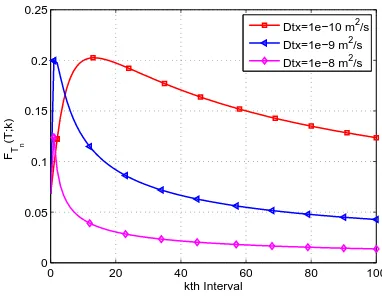
Fig. 3 shows the probability of a particle arrival during the interval duration T = 0.3ms, when the particle is released at different intervals k, i.e. FTn(T;k) =
RT
0 fTn(tn;k)dtn. We
observe that the arrival probability decreases as the interval numberkincreases. Similarly, for a certain interval numberk, the arrival probability decreases as the mobility increases. This is because, the probability for a large distance between TX and RX becomes higher if the interval number k and/or
1We assume a similar diffusion coefficient for type-Aand type-Bparticles,
i.e.Dp=Dp,A=Dp,B.
0 0.3 0.6 0.9 1.2 1.5 0
200 400 600 800 1000
fTn (tn
;k)
t
n [ms]
Dtx=Drx=0 m2/s k=1, Dtx=1e−10 m2/s
k=5, Dtx=1e−10 m2/s k=1, Dtx=1e−9 m2/s k=5, Dtx=1e−9 m2/s
Dtx=1e−10 m2/s
[image:4.595.329.517.62.208.2]Dtx=1e−9 m2/s
Fig. 1. Evaluation of the PDFfTn(tn;k)for different values ofDtxandk,
withDrx = 0.5×10⁻¹²m2/s. The results of the particle-based simulation
are indicated by◦.
0 0.3 0.6 0.9 1.2 1.5 0
200 400 600 800 1000
fTn (tn
;k)
t
n [ms]
Dtx=Drx=0 m2/s
k=1, Drx=5e−11 m2/s k=5, Drx=5e−11 m2/s k=1, Drx=5e−10 m2/s k=5, Drx=5e−10 m2/s
Drx=5e−11 m2/s
[image:4.595.48.292.187.307.2]Drx=5e−10 m2/s
Fig. 2. Evaluation of the PDFfTn(tn;k)for different values ofDrx andk,
withDtx= 1×10⁻¹²m2/s. The results of the particle-based simulation are
indicated by◦.
0 20 40 60 80 100
0 0.05 0.1 0.15 0.2 0.25
FT
n
(T;k)
kth Interval
Dtx=1e−10 m2/s Dtx=1e−9 m2/s Dtx=1e−8 m2/s
Fig. 3. Probability of a particle arrival during the interval durationT= 0.3ms, when the particle is released at the time t = kT, i.e. FTn(T;k) =
RT
0 fTn(tn;k)dtn.
[image:4.595.326.517.488.636.2]IV. IMPACT OFMOBILITY ONTRANSPOSITIONERRORS
In this section, we investigate the impact of mobility on the performance of MolCom systems that use single particles for the information transfer (cf. Section II). Due to the random arrival time of the particles, they may arrive out of order and, thus, particle transpositions occur. Since we assume no background noise, transposition errors are the dominant source of errors and fundamentally limit the performance of such systems [11]. The expected bit error probability for a transmission ofK bits can be calculated as [16]
Pb=
X
π∈P
Pperm(π)Pb(π), (7)
whereP represent the set of all possible permutations on K
released particles. The probability that a certain permuta-tionπ∈ P arrives at the receiver is given by
Pperm(π) =
∞
Z
0
tyπ(K−1)
Z
−∞
· · ·
tyπ(1)
Z
−∞
K
Y
i=1
fTn(tyπ(K−i)−Txπ(K−i);i)dtyπ(0)· · ·dtyπ(K−1),
(8)
where fTn(tn;k) denotes the PDF of the first hitting time
defined in (6). The release time of thekth particle is denoted byTxk=kT (cf. Section II) andπ(i)denotes theith element
of the permutationπ. The expected bit error probability for a certain permutation can be obtained as follows
Pb(π) =
disp(π)
2K , π∈ P, (9)
where we denote the number of displacements of a permuta-tionπby disp(π) =PK
i=1d|π(i)−i|/Keanddxecorresponds
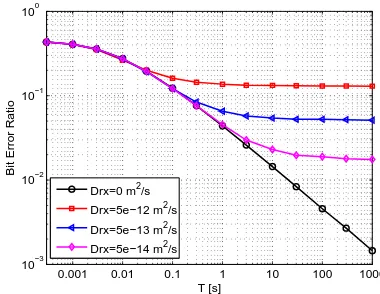
[image:5.595.328.518.62.209.2]to the mapping to the smallest following integer number. Fig. 4 shows the bit error ratio (BER) versus the bit interval durationT for different mobility levels of TX and RX2. For the BER simulations, we used the parameters from Section III-2). As expected, for the static case the BER degrades if the interval durationT increases. This is also the case if TX and RX are moving, but only up to a certain interval durationT. Then, we observe an error floor, that becomes lower when the mobility decreases.
V. CONCLUSIONS
We derived a closed-form expression for the first hitting time distribution for diffusion-based mobile MolCom. For this, we modeled the movement of the nano-machines by a Gaussian random walk and considered the relative motion of the RX and the particles as well as the relative movement of TX and RX. Moreover, we investigated the impact of mobility on the error performance of MolCom systems that employ single particles of different types to transfer information. In such systems, transposition errors are the dominant source of
2Please note that the calculation of the expected bit error probability in (7)
is only possible for small values ofK, sincePhasK!elements. Thus, we did not include analytical results in Fig. 4. However, a good match between analytical and simulation results was shown in [16] for small values ofK
and static TX and RX.
0.001 0.01 0.1 1 10 100 1000 10−3
10−2 10−1 100
T [s]
Bit Error Ratio
Drx=0 m2/s Drx=5e−12 m2/s
[image:5.595.45.293.258.338.2]Drx=5e−13 m2/s Drx=5e−14 m2/s
Fig. 4. Bit error ratio versus the bit interval durationT withDtx=Drx.
errors. We derived an analytical expression for the expected bit error probability and computer simulation showed that due to mobility the performance degrades and an error floor appears.
REFERENCES
[1] N. Farsad, H. B. Yilmaz, A. W. Eckford, C. Chae, and W. Guo, “A comprehensive survey of recent advancements in molecular communi-cation,”IEEE Commun. Surveys Tuts., vol. 18, no. 3, pp. 1887–1919, thirdquarter 2016.
[2] C. Rose and I. Mian, “A fundamental framework for molecular com-munication channels: Timing and payload,” in Proc. IEEE Int. Conf. Communications, June 2015, pp. 1043–1048.
[3] Z. Luo, L. Lin, and M. Ma, “Offset estimation for clock synchronization in mobile molecular communication system,” in Proc. IEEE Wireless Communications and Networking Conference, April 2016, pp. 1–6. [4] Y. Sun, M. Ito, and K. Sezaki, “Adaptive code width protocol for
mitigating intersymbol interference in diffusion-based molecular com-munication with mobile nodes,” in Proc. IEEE Int. Conf. e-Health Networking, Applications and Services, Sept. 2016, pp. 1–6.
[5] S. Qiu, T. Asyhari, and W. Guo, “Mobile molecular communications: Positional distance codes,” inProc. IEEE Workshop Signal Processing Advances Wireless Communications, July 2016, pp. 1–6.
[6] W. K. Hsu, M. R. Bell, and X. Lin, “Carrier allocation in mobile bacteria networks,” inProc. Asilomar Conference on Signals, Systems and Computers, Nov. 2015, pp. 59–63.
[7] A. Guney, B. Atakan, and O. B. Akan, “Mobile ad hoc nanonetworks with collision-based molecular communication,” IEEE Trans. Mobile Comput., vol. 11, no. 3, pp. 353–366, Mar. 2012.
[8] M. Kuscu and O. B. Akan, “A communication theoretical analysis of FRET-based mobile ad hoc molecular nanonetworks,”IEEE Trans. Nanobiosci., vol. 13, no. 3, pp. 255–266, Sept. 2014.
[9] S. Iwasaki, J. Yang, and T. Nakano, “A mathematical model of non-diffusion-based mobile molecular communication networks,”IEEE Commun. Lett., vol. PP, no. 99, pp. 1–1, 2017.
[10] A. Ahmadzadeh, V. Jamali, A. Noel, and R. Schober, “Diffusive mobile molecular communications over time-variant channels,”IEEE Commun. Lett., vol. PP, no. 99, pp. 1–1, 2017.
[11] P. J. Shih, C. H. Lee, P. C. Yeh, and K. C. Chen, “Channel codes for reliability enhancement in molecular communication,”IEEE J. Sel. Areas Commun., vol. 31, no. 12, pp. 857–867, Dec. 2013.
[12] H. B. Yilmaz, A. C. Heren, T. Tugcu, and C. B. Chae, “Three-dimensional channel characteristics for molecular communications with an absorbing receiver,”IEEE Commun. Lett., vol. 18, no. 6, pp. 929–932, June 2014.
[13] N. Farsad, W. Guo, C. B. Chae, and A. Eckford, “Stable distributions as noise models for molecular communication,” inProc. IEEE Global Telecommunications Conference, Dec. 2015, pp. 1–6.
[14] T. E. Harris, “Diffusion with “collisions” between particles,”Journal of Applied Probability, vol. 2, pp. 323–338, 1965.
[15] H. Kim and K. J. Shin, “Exact solution of the reversible diffusion-influenced reaction for an isolated pair in three dimensions,”Phys. Rev. Lett., vol. 82, pp. 1578–1581, Feb. 1999.