The new·
Varian Data
dual-environment
52
Tag this one to upset the present balance of power and price.
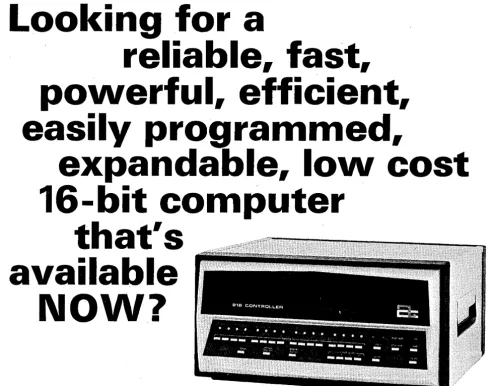
We've hung some other powerful attractions on this They allow the 520/i to run dual programs. A single 1.5 J-ts system-oriented computer besides that price tag. Two com- instruction transfers control between programs, or be-plete sets of hardware registers, including index registers. tween processing and I/O programs. Data may be manipu-lated in multiple 8-bit bytes- it'll do arithmetic in 8, 16, 24 or 32-bit lengths within the same program. Program pre-cision is €hangeable any time.
Hardware includes two 32-bit accumulators, two 16-bit index registers, two program counters, and two overflow registers. Eleven interrupt lines with four hardware priority levels. Expandable 4K to 32K 1.5 J-ts memory. IC construc-tion. 50 basic instructions. Interface modules for I/O de-vices. Proven software. Current delivery: 60 days.
If you're comparing price/performance ratios, 520/i is the new power to be reckoned witt) - write for you r brochure.
varian data machines
@
a varian subsidiary2722 Michelson Drive/Irvine/California 92664 (714) 833-2400
SALES OFFICES: U.S., Santa Monica and San Francisco, California; Vernon and Westport, Connecticut; Chicago, Illinois; Houston, Texas; Fort Washington, Pennsylvania; Washington, D.C.; Waltham, Massachusetts; Fort Lauderdale, Florida. INTERNATIONAL: Australia, Belgium, Canada, France, Germany, Indfa, Italy, South Africa, Sweden, Switzerland, United Kingdom and Ireland.
~I
!
1
I
'Of'
Tally
movesmo
ata
Nlarch 1969
faaaaster
for less.
Tally makes the broadest line of data communications
equipment on the market today. Our systems take source
data from perforated tape, 'magnetic tape, or punched
cards and transmit it at
1200words per minute
(12times
faster than TWX) over ordinary telephone lines. The new
Tally Serial Printer prints out hard copy data at
60characters per second. The
4031"stand alone" send/receive
Digital Tape Terminal operates with any of our
transmission systems to provide computer compatible
1/2"magnetic tape for IBM 7 and 9 track formats.
Our Seattle Test Center works with our nationwide network
of service stations to solve any maintenance problem
quickly and economically.
For full information, please write or call Tally Corporation,
1310Mercer Street, Seattle, Washington
98109:Phone:
(206) 624-0760.Or contact one of the regional offices:
New York: 45 N.Village, Rockville Centre 516-678-4220 Chicago: 33 N. Addison Rd., Addison, Ill. 312-279-9200 Los Angeles: 1222 'E. Pomona, Santa Ana 714-542-1196 Seattle: 1310 Mercer St., Seattle" Wash. 206-624-0760
Washington, D.C.: 1901 Ft. Myer Dr., Arlington, Va. 703-525-8500 England: 6a George St., Croydon, Surrey (Ol) 686-6836
And,
~incethis is a key on the NA VeOR
Model
1050
keyboarq,
it
has a life expectancy of over lOO-million operations. That's
reliability . .'. NAVCOR reliability!
But NAVCOR is not just
keyboard~.It's tape punches and readers, logic
modules and electro/mechanical peripheral systems . . . most of all.
NAVCOR is ideas! Ideas on how to help you turn the "weak" peripheral
equipment link in your computer system into one of the strongest most
rehab
Ie
parts
o~
the operation. Here are a few of the'items that can
elimi-nate costly downtime.
We've got a
~
>.;..:.~.
-:". ' " .fl···::·"
. ',." ","'Y ,: .. ~ :; < ' " ,, . : ' ... .,i'
;, '.~:
. : ••..•...
··~
... d
Corporate
Name~KYBE*cORPORATION
4
(formerly CYBETRONICS Inc.)
~
l!EJ
K YB
E*CORPORATION
132 Calvary Street, Waltham, Mass. 02154 (617) 899-001Z
CIRCLE 6 ON READER CARD
march
1969
volume 15 number 3
Publisher
Editor GARDNER F. LANDON ROBERT B. FOREST
Managing Editor & Art Director
Associate Editors CLEVE MARIE BOUTEll WILLIAM J. ROLPH AUBREY DAHL JANET EYLER RICHARD A. MclAUGHLIN
f. BARRY NELSON ANGELINE PANTAGES PHil HIRSCH EDITH GOODMAN PEARCE WRIGHT HOWARD BROMBERG
Assistant Editors
Eastern Editors
Midwestern Editor European Editor Contributing Editors
Washington Reporter Editorial Adviser Technical Consultant Production Manager
Director of Circulation Circulation Fulfillment
ROBERT
v.
HEADPHILIP H. DORN PHIL HIRSCH ROBERT· l. PATRICK LOWELL AMDAHL MARilEE PITMAN FRANK DeCARLO·
AlGENE TRAINA
ADVERTISING OFFICES
Eastern District Manage,.
New England District Manager
& Vice. President
Midwest District Manager
Western District Manager
& Senior Vice President
JAMES M. MORRIS WARREN A. TIBBETTS A. TREAT WALKER
35 Mason Street, Greenwich, Conn. 06830 (203) 661-5400
WARREN A. TIBBETTS
112 West Haven Rd., Manchester, N.H., 03104 (603) NAtional 5-9498
JOHN BRENNAN
205 West Wacker Drive, Chicago, III. 60606 (312)' Financial 6-1026
HAMilTON S. STYRON
94 So. Los Robles Ave., Pasadena, CaL, 91101 (213) 795-9721 (213) 681-8486-from Los Angeles
EDITORIAL OFFICES 94 So. Los Robles Ave. Pasadena, Calif. 91101
. Circulation audited by Business Publications Audit
CIRCULATION OFFICES 35 Mason Street Greenwich, Conn. 06830
Member, American Business Press, Inc.
DATAMATION is published monthly on or about the tenth day of every month by F. D. Thompson Publications, Inc., Frank D. Thompson, Chairman; Gardner F. landon, Pres-'ident; Gilbert Thayer, Senior Vice President. Executive, Circulation and Advertising offices, 35 Mason Street, Greenwich{ Conn. 06830 (203) 661-5400. Editorial offices, 94 So. los Robles Ave., Pasadena, Ca ifornia 91101. Published at Chicago, III. DATAMATION is circulated without charge by name and title to certain qualified individuals who are employed by companies involved with automatic information han-dling equipment. Available to others by subscription at the rate of $15.00 annually; Single issues (when available) $1.50. Reduced rate for qualified students. Foreign sub-scriptions are on a paid basis only at a rate of $25.00 annually. No subscription a~ency is authorized by us to solicit or take orders for subscriptions. Controlled CIrCulation paid at Columbus, O. and Form 3579 to be sent to F. D. Thompson Publica· tions, Inc., P.O. Box 2000, Greenwich, Conn. 06830. Copyright 1969, F. D. Thompson Publications, Inc. MicrOfilm copies of DATAMATION may be obtained from University Microfilms, Inc., 313 No. First St., Ann Arbor, Michigan.
Printed by Beslow Associates, Inc.
This issue 87,622 copies
(
GOOD NE
Badger adds new
capabilities to PDP-10 system
And you can lease it ...
The PDP-10 computer system, time-tested .and
eco-nomical, can now do more jobs than ever before.
To the basic system, Badger has added remote
batch capability and business-oriented software.
COBOl,.. Sort/merge. And RPG.
But we didn't stop there. Here's the clincher:
You can lease the expanded PDP-10 system
through Badger. The cost? A bargain in any
lan-guage. Less than $15,000 per month* for the
sys-tem configuration shown below.
What does this PDP-10 system include? A basic
processor with 65 K words of core memory, plus
Badger peripheral subsystems. These include
high-5-4-69
speed swapping drum, disk storage drives,
mag-netic tape transports, and the full line of other
peripheral equipment.
Check the diagram below for a better idea of
the full capabilities of this expanded data system.
For additional information, write to:
Systen1S Division.
Badger Meter
Manufacturing Company
4545W. Brown Deer Rd. • Milwaukee, Wis. 53223
PDP is a registered trademark of Digital Equipment Corporation
• Plus state and local taxes.
KA 10 PROCESSOR
OPTIONS
~---~---~I---
__
---~~----I/OBUS
FAST REGISTERS EXTENDED ORDER CODE MEMORY PROTECTION AND RELOCATION
--MEMORY
BUS
Nlarch 1969
65K CORE MEMORY
DRUM CONTROLLER
DISK STORAGE
DRIVE CONTROLLER
TAPE TRANSPORT CONTROLLER
()
(5
MAGNETIC TAPE TRANSPORTS
n
1,048,576 I WORDS
\J DRUM
-
--
~,
)
J
LINE PRINTER CONTROLLER
I
LINE PRINTER 1000 LPM
~
-,
. J -29.17 29.17 t - - - - I MILLION - MILLIONBYTES BYTES
...
-
"'---DISK DRIVES
CIRCLE 7 ON READER CARD
CARD READER. CONTROLLER
r
CARD READERI
600 CPMCARD PUNCH CONTROLLER
r
CARD PUNCHI
120 CPMDATAMATION
CIRCLE 8 ON READER CARD
march
1969
volume 15 number 3
automatIc
information
processIng
for business
industry &science
March 1969
I
®
22 AIRLINE CHALLENGES FOR THE FUTURE, by
Stuart
G.Tipton.
The president of the Air Transport Association of America gives a broad outline of the problems that will accompanu the new jets.
24 THE OUTLOOK FOR IMPROVED PASSENGER SYSTEMS, by
George A. Buchanan.
A brief description of how the airlines plan to handle reservations, check-in, baggage, aircraft loading and other ground problems in the 1970's.
26 DYNAMIC SYSTEMS DESIGN FOR AIRLINES, by
Walter
H.
Bran-denburg.
The airlines seem happu with their progress, but they may be neglecting the fun-damental problems of moving people from one place to another.
29 AIRLINE RESERVATION SYSTEMS, by
William E. Jenkins.
A look at the historical development of reservation systems, with a description of Eastern Air Lines' newest version.
34 CONVERSATIONAL COMPUTING FOR HOUSEWIVES, by
George
U.Hubbard.
When the man/machine relationship is taken care of, what about the woman/ machine interface?
39 MINI-COMPUTERS FOR REAL-TIME APPLICATIONS, by D.
J.
Theis and L. C. Hobbs.
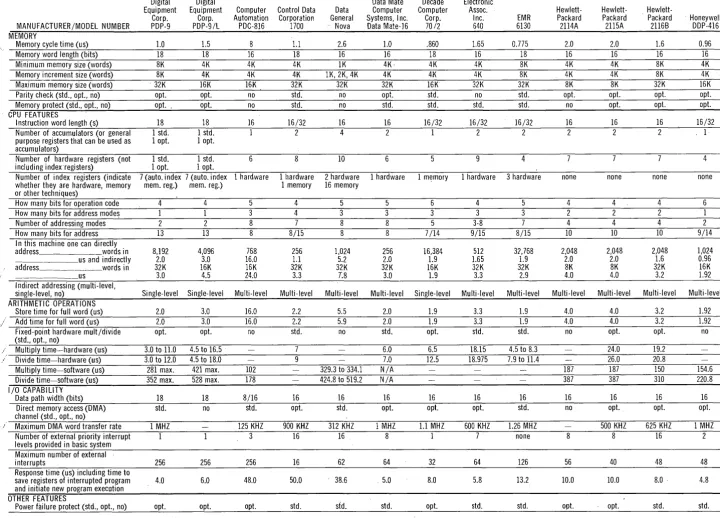
An analysis of the features of small control computers of interest to users, plus a comprehensive chart tabulating characteristics and prices.
71 COMPUTER GRAPHICS IN ELECTRONIC DESIGN, by
Franklin
F. Kuo, Waldo
G. Magnuson, Jr., and Willia"m
J.
Walsh.
Although not yet Widely used, on-line design is now feasible through input/output graphics.
90 THE RCA SPECTRA 70/60, by
R. A. McLaughlin.
RCA, in keeping with its practice of filling the slots in the IBM line-up, offers their newest and largest, which looks like a healthy step up from a 360/50.
99 NEWS SCENE
148
The Justice Department levies IBM's third antitrust suit and competitors wonder whether they're really happy . .. MISCO plans charwes to turn it into a $100 million time-sharing network by 1973 . . . . A "super final" version of ASCII just might possibly get approval . . . And the Justice Department thinks· the FCC made a mistake on AT&T's foreign attachment tariff.
SYSTEM SPOTLIGHT
An IBM 360/50 system linked to 200 crt terminals and six IBM 2314 disc drives provides immediate access to more than 11 million credit history files for Credit Datd Corp., Anaheim, Calif.
datamation departments
9 Calendar
7 7 Letters to the Editor 77 Look Ahead 27 The Editor's Readout 95 Poem
709 News Briefs 757 New Products 787 New Literature
797 Books 795 People 205 World Report 277 Washington Report 225 Datamart
237 Index to Advertisers 237 The Forum
There's more
to interactive
graphics than
way
out
hardware
8
If you're using computer graphics for engineering or scientific simulation, for data analysis, or for machine-aided design, then you need the rig ht ki nd of software to make you r investment really payoff - no matter how great the display-systenl hardware. You need a resident monitor that was designed specifically for on-line man /machine interaction. You need a full set of graphics operators so that you can display, construct, manipulate, and store CRT images. You need routines for communicating with the central computer facility, and I/O utilities for peripherals and graphics devices. You need a FORTRAN compiler, and a macro assembler, and an editor.
This is the software package we deliver our customers with every Adage Graphics Terminal. It turns on our way-out hardware. For a brochure describing our standard software, write
D. R. Sud kin, Marketing Services Manager, Adage, Inc., 1079 Commonwealth Avenue, Boston, Massachusetts 02215.
:IRCLE 9 ON READER CARD
CRTRMRTICN
calendar
DATE
Mar. 24-27
Apr. 8
Apr. 8-10
Apr. 28-30
Apr.30-May 2
May 5-8
May 14-16
May 19-2.1
June 10-12
June 16-19
Aug. 19-22
Aug. 26-28
Sept. 1-5
Sept. 15-17
Oct. 6-10
,\larch ]969
TITLE
Int'l Convention and Exhibition
LOCATION
New York City
Symposium: Techniques Philadelphia for Evaluating Data·
Processing Systems
Int'l Symposium on New York City Computer Processing
in Communications
Conference on Madison Statistical Computation
Electronics Components Washington, Conference D.C.
SPONSOR/CONTACT
IEEE, 345 E. 47th St., New York, N.Y. 10017
ACM, DPMA/
Saul Stimler, RCA-lSD, Bldg. 204-2,
Cherry Hill, N.J. 08101
Polytechnic Inst. of Brooklyn, 333 Jay St., Brooklyn, N.Y. 11201
Univ. of Wisconsin Computing Center 1210 W. Dayton St., Madison, Wis. 53706
EIA, 2001 Eye St. N.W., Washington, D.C. 20006
Design Engineering Conference
New York City ASME/Clapp & Poliak, 245 Park Ave.,
Spring Joint Computer Boston Conference
National Aerospace Dayton Electronics Conference
Int'l Communications Boulder Conference
Int'l DP Conference Montreal & Business Exposition
Western Electronic, San Francisco Show and ConvenHon
National Conference San Francisco & Exposition
Int'l Congress on London, England Cybernetics
Joint Conf. on Rome, Italy Programming Languages
for Numerically Controlled Machine Tools
2nd Int'l Congress on Project Planning by Network Analysis
A~sterdam,
Neth.
New York, N.Y. 10017
AFIPS, 210 Summit Ave., Montvale, N.J. 07645
NAECON, 124 E.
Monument Ave., Dayton, Ohio 45402
IEEE/ A. J. Estin, Radio Standards Engrg. Div., NBS, Boulder, Colo. 80302
DPMA, 505 Busse Hwy., Park Ridge, III. 60068
WESCON, 3600 Wilshire Blvd., Los Angeles, Calif. 90005
ACM 69, P.O. Box 2867, San Francisco, Calif. 94126
The Inst. of Computer Sciences/ J. Rose, College of Technology and Design, Blackburn, BB2 1 LH, Lancashire, England
IFIP-IFAC/E. L. Harder, R&D Center, Westing-house Electric Corp., Beulah Rd., Pittsburgh, Pa. 15235
INTERNET Foundation/ Holland Organizing Centre, 16 Lange Voorhout, The Hague,
Netherlands
Plotting
Speed up ...
Costs
Down!
The new TSP-12 Plotter-Controller is designed to reduce your initial cost, your terminal time, and your CPU time. Time-sharing enters a new, fast, economical phase with the TSP-12. Here is a Piotter-Con-troller that curves and angles pen or CRT display with a facility and accuracy you once had to pay more than twice the price to achieve. Easy to use, simple to plug in, the TSP-12 interfaces with Teletypes or 2741 Terminals equipped with 103 Series "Oata-ph 0 n e s," 1 01 C d a t a set s 0 r
acoustical couplers. Sub-routines ready to go in FORTRAN and BASIC. Ask us - we'll show you how to share computer time fast, frequently and for far less.
ITJ~~
CORP.
TIME SHARE PERIPHERALS CORPORATION Box 361, Wi Iton, Connecticut 06897
CIRCLE 10 ON READER CARD
10 CIRCLE 11 ON READER CARD
366 is PDP-lO
PDP-lO has a cool 366 instruc-tions. All different. Three times more than most computers of its size. For easier programming. More efficient code. Faster running programs. With 366 instruc'tions, you can apply: Full computing power to run both remote and local batch processing tasks at the same time. Power to carryon several large real-time jobs at once, without cutting off anyone else. Power to time-share 64 users. In BASIC, FORTRAN, AID, MACRO, DDT, TECO and EDITOR. Any language. Any mode. All simultaneously. PDP-lO is the only computer now available that does batch processing, real-time and
time-sharing simultaneously. PDP-lO. Pours the power on!
PDP-10
~DmDDmD
COMPUTERS' MOOUL'ES DIGITAL EQUIPMENT
CORPORATION
Maynard, Massachusetts
~
letters
me first
Sir:
Mr. J. O. Duhamel's (Dec. Letters, p. 205) explanation that Spear & Staff, Inc., was not the first to analyze secu-rity data from the New York Stock Ex-change on-line in real time misses a basic point.
.Spear & Staff's on-line, real-time sys-tem (Oct. p. 116) is designed for stock
analysis, not merely as a security moni-tor system as in the Jesup & Lamont example cited by Mr. Duhamel. It was the fact that an on-line, real-time anal-ysis was being achieved before the next trade that Spear & Staff felt they had achieved a first. At this writing, no one else, to our knowledge, has an analysis system functioning in real time.
ROBERT A. SYKES
Spear & Staff, Inc.
Babson Park, Massachusetts
unreal people
Sir:
I would like to congratulate Mr. George Glaser for that excellent article "Computers in the World of Real Peo-ple" in your December 1968 issue.
This article should be required read-ing for all edp personnel, but partiCll-larly the academic edp community. Unfortunately, there are far too many purely theoretical courses taught un-der the guise of computer or informa-tion science that assume the existence of the "unreal people" that Mr. Glaser describes.
Let's have more articles like this one that "tell it like it really is."
ER\VIN M. DANZIGER
Chapel Hill, North Carolina
basically honest people
Sir:
'\Ir. Nathan Partos' letter (Feb., '69), regarding my article "TACT Will Im-prove Your Input Data'; (Dec. '68) is appreciated. His analysis of TACT re-flects expertise.
There has been no evidence of em-ployee resentment to being rated by a machine. As he has already presumed, however, this rating must be impartial and accurate. In fact, mv observation has been that many employees prefer
'larch 1969
leaving their chances for advancement to an unbiased computer, rather than a prejudiced human. The key, of course, is accuracy in rating.
Employment of TACT has been a stimulus to improved morale. He men-tioned that personnel might "become very upset if their chances for ad-vancement or possibly their jobs were jeopardized by a grade from a com-puter." The computer is only a tool for decision making, and such a decision as personnel management would come under the close scrutiny of managers. The computer can be used to pinpoint the areas contributing to the errors but the managers must analyze the reasons and determine the action.
In my relationship with the individ-uals that create the input data, I have found them to be fair. My philosophy of life-that people are basically honest -has been vindicated by TACT. Admit-tedly, we have experienced personnel who attempt to place the blame on the program, the computer and/or the sys-tem. Each allegation must be re-searched and explained to the satisfac-tion of the "alleged offended." I have not had any employee blaming isolated bugs for his poor performance. This is due primarily to the fact that our per-sonnel who initiate the input are some-what awed by the capability of the computer and hesitate to challenge its accuracy. Also, insofar as unions are concerned, union officials are reluctant to inst~gate a complaint unless, in their opinion,· the evidence is in favor of the employee (which, in our experience, has not been the case) .
We have never discovered "an un-scrupulous employee resubmitting old data." We have controls to check dupli-cate data on our systems; however, each system must have special controls designed for its input. For example, in a payroll system, one would not accept duplicate time cards, or time cm'ds in excess of the authorized work hours (usually eight), without printing the data out for management review. In order to be specific on this, I would have to review each system and the in-put for it to determine how to avoid resubmission of old data. It is possible and it does work.
CORMACK P. HEARN
Midwest City, Oklahoma
you can1t pI/I everybody
Sir:
In his article, "PL/I for C & C?", in the December issue, Mr. Christopher Shaw says, "There are presently only two practical alternatives to PL/I for command and control programming: assembly language and JOVIAL." How-ever, the CS-I language (which he
mentions in the article) is very well suited to C & C programming. CS-I has outstanding capabilities in all the areas he marks as important: text pro-cessing, bit propro-cessing, arbitrary data origins, etc. In addition, there are CS-I compilers -which generate code with effiCiency comparable to that duced by most assembly language pro-grammers.
The language's simple, English-like source format, powerful features, and tight target code have made it many friends.
Name withheld by request.
Mr. Shaw replies: let's face it. In this world, a programming language needs more than anonymous friends; it needs influential advo-cates. Whatever its technical merits, CS·' seems to be just one more unsung language.
Sir:
In the News Briefs section (p. 136) of your December issue, there was an ar-ticle about the "long-awaited" PL/I version of Scientific Subroutine Pack-age for system/360, where you stated that SSP /360 is available only in FORTRAN at the moment. This may be true if we only consider the language in which the routines are programmed. However, if, under OS, the SSP / 360 is arranged as a library of load modules, this library may be regarded as an extension of both PLILIB and
FORTLIB (and any other library of load modules') by a simple concatenation. Passing arguments from a PL/I pro~
gram to a FORTHAN subroutine is very simple. At our installation, the SS.p / 360 is used by both PL/I users and FORTHAN users, and if no new routines are· available in the PL/I version of SSP /360, this version represents· in fact no extension of our user spectra. SVERRE STOR~Y
Univ. of Bergen Bergen, Norway Sir:
Your series of articles in December 011
PL/I was quite informative. Of partic-ular interest was Mr. Richard L. Gauthier's article "PL/I Compile Time Facilities." Reference to compile time facilities as " . . . relatively new
12
If you transport people, cargo or data, DSA's
automated-systems
services can help you
increase profits!
Increasing profits by serving customers better is a
major goa/ of every business. And more efficient utilization of equipment, facilities and people is the best way to reach that goal. If you move people, cargo or data, we can help you operate more effec-tively. DSA's services have assisted many organiza-tions in the international aviation community. Among them airlines, airports and the Federal Aviation Administration. Our credentials:
KLM's AIRLORD (Passenger/Baggage Check-in Sys-tem, Schiphol Airport, Amsterdam) and SITA (Mes-sage Switching Network, London and Paris) program design and implementation for Philips Telecommuni-cations Industries
FAA's AFTN (Aeronautical Fixed Telecommunication Network) and WMSC (Weather Message Switching Center) system engineering and programming im-plementation for North American Philips
COMMUNICATIONS INTERFACE for Burroughs' TWA System
DSA's AIMS concept (Airport Information Manage-ment System)
DSA's aviation capabilities also include systems de-sign and implementation for airline communications, air cargo handling, airport design, flight scheduling and traffic simulation (people, cargo and aircraft). But you don't have to be in the aviation industry to benefit from our services. Our capabilities have been applied to solving problems in almost every industry. Our expertise in message switching, on-line order entry systems, hardware evaluation and selection consultation will help increase your profits by en-abling you to serve your customers better.
For more information about DSA's services, call Irwin J. Fredman, Vice Presid~nt, collect, at 609/665-6088. Or write him on your letterhead.
DATA
SYSTf~~S Ar~Al
VSlS, IfJC.
3::JSII
N. Park Drive, Pennsauken, N.
J.
08109
Phones: 609/665-6088 • 215/925-9550
Other offices in River Edge, N. J.; Washington, D. C.; Phoenix, Ariz.; Paris, France; Amsterdam, The Netherlands
,.
letters
cepts ... " is perhaps a little mislead-ing, however; those familiar with the Univac II GPX "compiler" (by today's' standards an assembler with a highly sophisticated library facility) will rec-ognize the compile time facility as a somewhat rudimentary approach to the generative capabilities illherent in GPX "set parts" and "interpolators." The GPX system is about ten years old. Perhaps each generation of compiler writers is condemned to rediscover the wheel. For those language implemen-tors who wish to build on past achievements, an intensive study of volume 2 of the GPX manual is highly recommended.
PAUL L. LUJANAC
Camp Hill, Pennsylvania
computer sex
Sir:
NIr. McKune's witty article (Jan. '69) on the gender of computers contained an inaccuracy which should be cor-rected. In the banking industry at least, feminine names have been and are applied to computers.
One example of this is the Electron-ic Recording Machine Accounting sys-tem developed about 15 years ago by the 'Bank of America, NT&SA with the aid of Stanford University and others. This large scale system was called Erma-a decidedly feminine acronym. At about the same time, the Chase Na-tional Bank (now merged with the Bank of the Manhattan Company to form The Chase Manhattan Bank, N .A. ) commissioned the design and construction of a special purpose com-puter to be called "Diana" (goddess of the Chase).
Several banks have installed audio response systems in recent years which invariably have feminine voices in their vocabulary and are consequently given feminine names by their users. This may tell you more about bankers than it does about computers.
I want to wish Mr. McKune much luck in his drive for sexual clarifica-tion. Maybe, we could make a rule: If in doubt, call it Tiny Tim.
EDISON L. SPECK
Chase Manhattan Bank Nrw York, New York
praternity
Sir:
I just finished reading the interpreta-tion of the United States Court of Cus-toms and Patent Appears decision In re Prater and Wei November 20, 1968 iUarch 1969
by one of your editors, which appears on page 78 of your January issue. Upon completing the first. paragraph of this interpretation, I was at first amazed and then somewhat frustrated. To quote this paragraph: "The ban on computer program patents was loos-ened and possibly broken last Novem-ber when a federal appeals court ruled that 'mental processes' may be patent-able." \Vhile the holding in the Prater
case does break the ban on computer program patents, the case does not, in allY way, indicate that "mental pro-cesses" are patentable.
It is common knowledge that a rag-ing controversy exists with regard to the patentability of computer pro-grams. The basis of much of this con-troversy is confusion as to the nature of stored programs and what rights one acquires if he is allowed a patent for a program. Since your periodical is so widely read by those connected with the field of data processing, it can be of great service in eliminating the con-fusion. However, it is imperative that statements made by your editors which relate to the controversy be fac-tually correct. If they are not correct, they merely iIlcrease existing cOllfusioll and mislead manv individuals who will ultimately be ~ffected by the reso-lution of the controversy. For this rea-son, it seemed necessarv to write this rather lengthy letter pointing out that your analysis of the Prater case is not altogether accurate.
As a patent attorney who is actively engaged in attempting to obtain pat-ent protection for computer programs, I was very pleased with the Prater de-cision and I have read it numerous times. Additionally, I have discussed the decision with a number of my col-leagues who are also active in attempt-ing to patent computer programs. I must say that both my views and my colleagues' views of the holding in
Prater difl'er substantially from those put forth by your editor.
Even though it is apparent that the late Judge Smith took great pains to make the rationale and holding clear .in the Prater decision, your
interpreta-tion indicates there are still individuals who, for one reason or another, fail to understand the decision.· This misun-derstanding may be due, at least in part, to both an unfamiliarity with le-gal writing and the patent law.
If one reads the Prater decision carefully, it is abundantlv clear that the patentability of "ment::;l processes" was not an issue in the case: The key issue in Prater was as follows: Are pro-cesses carried out completely on ma-chines, to the exclusion of human in-tervention, mental processes?
In answering this question in the negative, the Court merely states that
a sequence of operations carried out exclusively on a machine are, in that context, not mental. More simply, the Court's holding is, essentially, that a process cannot be mental unless some human activity is required in its per-formance. This is quite different from saying that mental processes are pat-entable. In fact, the Court implicitly recognizes the existence of a class of unpatentable mental processes and holds that performance of the Prater
method or a machine does not fall within this class.
The Prater case makes no new law in the area of mental processes. It merely restates and clarifies existing law in the area. Prior to Prater, the mental process cases had always in-volved methods which were per-fonned, at least in part, by human beings. The Court merely distinguishes the Prater method from these cases on the basis that no human being is re-quired to carry out Prater's method. Since the claims in Prater were al-lowed on the basis of their claiming a process carried out physically on' a ma-chine, these claims cannot be used to enjoin a human being from mentally performing the method by means of pencil and paper. In the patent law, a method claim covers performance of the method on all apparatus that is equivalent to the apparatus disclosed by the inventor in his application. However, the human mind is not con-sidered the equivalent of apparatus. Consequently, the allowed claims in
Prater cannot be used as a basis for monopolizing the manual performance of his method by an individual.
Had the Court held as your editor indicates, the foregoing limitation would not exist and the question be-comes much more difficult. In other words, if the Court had held that men-tal processes were patentable, the Court would obviouslv have had to consider whether su'ch a holding would be in violation of the First Amendment to the Constitution of the United States as abridging freedom of thought. Surely, no Federal Appellate Court would resolve a question so ob-viously involving constitutional issues without ever addressing itself to these issues.
NOHl\fAN MCCLASKEY
Plainfield, Nell; Jerse!J
stalking the giant
Sir:
On behalf of my own company, and if
I may boldly present myself as a spokesman for a few other terminal manufacturers (NCB, Burroughs, Oli-vetti) , I feel I mllst chide vou for vour News Brief "IBJ\1 Medts Banbng
(Continued on p. 187)
The only disk pack as good
as the new CERTUS VI is shown
on the opposite page.
Send for particulars about the most extraordinary guarantee in the industry.
~
::~~~: InC.~6;~~I~~:?sa::~~:!~~33FR~~a~es~e:~~.
Atlanta (404) 233-2244; Chicago (312) 234-9050; Dallas (214) 526-3662; Los Angeles (714) 525-5317; New York (201) 461-6313; San Francisco (415) 347-7077; Washington, D. C. (301) 654-0883.16
Strike.
Bull.
Bear.
Discounts.
Contracts.
Competition.
Introducing an
inventory management system
that helps you respond to the unexpected.
BICS. Burroughs "real world" inventory control system.
more accurate one.
You can develop economic order quantities and re-order points which include day-to-day changes.
o·
o 10 20 30 40 50 60 70
It gives you a wider range of responses (from less-than-normal to panic) for any inventory situation. And as a result, you can develop a more responsive forecast. Or a
You can simulate "real" condi-tions, test alternate strategies and make your move.
With BICS, you can do all this not only for groups of items. But for each item.
For more about this exclusively Burroughs system, call our local office or write us in Detroit 48232. And get a jump on the rest of the world.
BurrOUghS~
mp
-lity the
E - - - ,
a
R8
a
R
8
a
A
H
a
CI)
E co
Z
(I) (I)
~ "'C "'C
~
~
i:3
~ Q)
Q).~
"C +-'
C ro
::J"t:
- Q) ·en = Q )
ro ....
E
g.
c ........ 0
.a
c~"C
>.c
.oro
Q) C ::J 0
00·-o~
- 0 0 ro._ +-' -ro.o
U 0
Q) 0
~ C -en
...
-::J
c.
N
~ co CI)
o Q)
>. ....
Q)~",:
E+-'(ij
"C"CU
c c _
~~~
~
look~ahead
IBM DENIES GENERATION
GAP;-coMPATIBILITY
NOT GOING TO POT
The report by a computer weekly that IBM's fourth
generation systems may be so incompatible with 360's
as to require total reprogramming (yaaagh), is an "out
of context" interpretation of comments made by
vp George Bietzel, says an IBM spokesman.
In an internal IBM publication in December,
Bietzel said the following:
"When we announced. System
360, we asked the data processing community to 'reset
to zero.'
We did this because of the proliferation
of languages, machine architecture, and input/output
devices.
Incompatibility and proliferation meant
customers were paying a premium price to go much
further in computing.
That was our judgment.
It has
been more than vindicated by System 360's reception
in the marketplace.
"Where do we go from here? We have a great debt
to ourselves and to our customers to maintain some
conSistency between where they a're today and where they
are going to be in the future.
But I don't think we
will do this at any price.
If something comes along
we think is a substantially better way to get
price/performance into the market, we would not
hesitate to change."
Those last two sentences opened Bietzel to
interpretation "at will." But IBM claims they were
not intended to imply total reprogramming--"reset to
zero"--but rather were meant to assure IBM developers
that stiff compatibility requirements would not
stifle all advances either.
The real impetus for 4th generation compatibility
lies in what one source estimates is a $500
million-$1 billion IBM investment in 360 software.
Further
fortification comes in the report that IBM's unannounced
supercomputer work at San Jose originally produced
360-incompatible design, scrapped last summer in favor
of a compatible model.
The leaders of the project
were also changed, and Gene Amdahl, a father of the
360, is now at the helm.
BROOKS WANTS FACTS OF
LIFE FROM DEAR OLD DOD
Congressman Jack Brooks has asked DOD to answer several
questions regarding the management and design of the
Wimmicks buy.
Assuming the answers aren't fully
responsive, which is probable, award of a Wimmicks
contract could be delayed significantly.
Last month, in a letter to Defense Secretary
Melvin Laird, Brooks asked: what Pentagon office· has
responsibility for overall coordination of the Wimmicks
procurement; what studies have been made to support
"the immediate need for acquisition of new hardware" ;
why hardware is apparently being selected and acquired
before completion of the system design; what evidence
supports the expectation that the Wimmicks buy will
produce a system "Significantly better in capability
or versatility" than the present one, and whether the
system won't be at least partly obsolete by the time
it is fully installed.
Instant software
company
anyone?
Call it Acme Software, All American Software, World-wide Computer Technology. No matter what you call it, you are part of the rage of the late sixties-the software syn-drome. A couple of desks, a smat-tering of jargon, a rough knowledge of what it's all about, some borrowed money-and you're in business.
Reminds us of the semiconductor spin-off binge of not so long ago. Anybody with a nanosecond's edge on R&D or a new wrinkle in a pas-sivation technique rented a garage and had a go at it.
Son'e of them made it. More went down the tubes. Not because they didn't have talent and
technic~l
knowledge. But for a lot of other reasons that sum up thusly: they failed to convince the market place that they were around to stay. And customers didn't want to take the risk of trusting them with impor-tant business.And that elusive goal of gaining the customer's trust becomes even more difficult to achieve in today's software industry. Customers are getting continuously more sophis-ticated and enlightened. You can dazzle them with mystique com-bined with a cheap solution. But before they sign on the dotted line, they're likely to ask some searching questions. Such as-why do you think these cost estimates are real-istic? Or-do you really have enough good people so that we can count on continuous talent, not just warm bodies? And -will your company be around not only to complete the work but to give us support with the results?
Does the increasingly tough cus-tomer attitude mean an end of new company growth in the software field? We doubt it. Freedom to take a risk is what drives many an excel-lent mind out of the cool, restricted corporate offices into the hot little loft above the candy store. We know that. We did that once upon
a time. But it's no
longer the same ball game.
We've seen the software industry grow, change in structure, and grow some more. Getting established in this business was difficult enough six vears ago. It is many more times as difficult today. Not only because of the thousands of small compet-ing companies. But because of the performance records of the leaders. You may deem it self-serving, but let's look at our own record: We've worked on such projects as simulating the moon mission of Surveyer E for Jet Propulsion Lab-oratories; assisting the Michigan Department of Public Health to implement Project ECHO; imple-menting an election reporting sys-tem for CBS; and launching Atars, the fully automated airline reserva-tion system for travel agents. And many others.
And along the way we've gathered financial strength, management skill, experience, organizational structure. Important customers can place their trust in us. And they know it. A few years ago there weren't any firms like ours. And tha t made it a lot easier to get started.
Today, there's a handful. We tend to think they'll continue to draw the most challenging work and the most demanding customers. And we think they'll continue to offer software talent its best opportunities. So whether you're a potential cus-tomer or a potential employee, please drop in. To our cool corpo-rate offices. But bring your own candy. The nearest store is now two blocks down the street. •
informatics
inc~
I
5430 Van Nuys Boulevard • Sherman Oaks, California 91401
CIRCLE 15 ON READER CARD
18 DRTRMRTION
We know you want Datamation to follow you. If you're changing your business address, please use the card at the right and mail it to us now. We need your old address label, too. Paste it on the card (see Instructions) to facilitate handling.
NEW A[
Name-Title_
City _ _ Your Sigr
DATAM.i
INFORMA'l
Whatever your work in infon ADP Glossary. It gives you cc daily EDP use. It covers the 1 tronics, communications, syst This glossary has provided students as a ref~rence to St
familiari ty with the specializ venience for customer, prospl preparing or evaluating propo
P lease use the attached
COUP(62 pages cross-referenced
$1
00
,
each
75c
in lots 0110 to
49copies
50c
in lots of 50 or more copies
D
35 Me
Please
Name
Addre
look ahead
FRANCHISING SPREADS TO
EDP RECRUITMENT HOUSES
NEW OMNITEC GEAR MAY
BROADEN T-S
HBRYZONS
GAO REPORT SPANKS
-DOD AND GSA ON
THEIR pERIPHERALS
MarcfL 1969
Brooks implied strongly that hardware procurement
should be put off until DOD has: a) decided what data
management system it needs, and b) found a way of
exploiting technological breakthroughs that occur
while new Wimmicks hardware is" being installed (this
will take five years, under present plans).
One
Hil~source says the letter notifies DOD that
"Brooks has doubts about the adequacy of Wimmicks
planning, is watching developments closely, and expects
DOD to resolve the doubts before making any final
commitments, or face the consequences." What
consequences? Hearings before the Brooks subcommittee
are one possibility, a Phase "II-type GAO investigation
is another.
A" former software firm executive with extensive
personnel agency experience hopes to combine that
unusual combination with the hottest marketing
gimmick--franchising--to establish a nationwide chain
of franchised edp recruitment houses.
He's Dave Greenberg, who left Time Share Services
after it was acquired by Coburn's Computer Methods.
Seeking experienced computer salesmen, he'll provide
three-month training (with a draw.), then set them up
in business, paying all expenses, including selling
and national advertising.
Free training is also
provided placement counselors hired by the
fr~nchise.There's no entrance fee, and Greenberg's
company--Federated Agencies of America, in L.A.--gets
50%
of
the
g~oss.If the guy doesn't gross $30K a year, he
loses the franchise.
Greenberg has already signed up six
franchises--in NYC, LA, and Boston--and expects to be the IBM
of edp personnel placement within 12 months.
We hear that Omnitec Corp., manufacturer of acoustical
couplers and conversational terminals, will demonstrate
eight new products at the SJCC in May.
The rumble is
that the line will be extended to offei standard and
portable terminal links to IBM-compatible and %-inch
tape
~assettes••• and to couplers as well.
A
cassette-portable terminal hookup could open up" a host of
applications built around remote data capturing on
cassettes, which could be read over phone lines or
delivered to computer centers.
Add a coupler and you
have on-line,
real~timedata acquisition.
Refusing to comment on the rumors, Omnitec admits
it has a healthy percentage of the acoustical coupler
market and a big backlog of conversational terminals
••• plus a $1 million order for portable terminals
from Realtronics of Denver (not to be confused with
the Struthers Wells subsidiary), which will install
them for the Cleveland Board of Realtors, for on-line
acquisition of multiple listings.
A GAO report aimed at changing federal dpe procurement
practices is nearly ready to be issued." It will
probably generate considerable interest in Congress.
The report offers specific recommendations for
increasing federal use of independently made peripheral
devices.
It chastizes DOD and GSA, at least by
implication, for not thinking of similar ideas on
their own.
GSA should be regularly telling federal dpe users
what independently made peripherals are plug-plug
compatible with what cpus, says the GAO report; the
agencies could then take advantage of the independents'
(Continued on page 215)
If you can't afford an extra Sigma,
fake it.
Get remote batch.
Most companies that need an extra Sigma, but can't
afford it, get a Volkswagen.
The VW picks up stacks of punched cards at
out-stations, runs them back to your computer, then
back to the boondocks. It's a big waste of time. A
programmer away from headquarters gets only a
few passes through your computer each day.
Our remote batch lets the boondocks transmit
directly to your computer. Programs get queued
im-mediately, instead of being held up by traffic jams.
The system is unique in the industry: it doesn't
cost
a~arm ,or a leg. :\You can have the 7670 card
reader~punch/line/printer
for $810 a month on a
four year lease. Communications equipment for
your center runs $196 per terminal each mOl1th, for
the same length of time. But we'll toss in the
pro-gram for free. Or if your comptroller prefers, buy
the system.
The only other item needed to give small stations
large computing ability is a telephone line for each
station. You'll be able to
trans-mit data as fast as a voice grade
line will permit.
It's slightly slower than being
there. But an awful lot faster
than a Volkswagen.
50S
Scientific Data Systems,EI Segundo, California
fl,farch 1969
FURLING THE UMBRELLA
For almpst 20 years now the information processing industry has writhed and
thriv~d under the umbrella of IBM, a huge and magnificently managed company which undoubtedly represents the greatest success story in the history of free enterprise.
And while that umbrella has shielded from the cold rain of financial disaster most of the companies in the indq.stry, it h'as also to a large extent blocked off the healthy sunny rays of prosperity. '
In effect IBM has more or less dictated the pace of progress: it has established the essentially financial nature of the business through its purchase:rental ratios; it has drawn the «free" services line competitors have found difficult to toe. With at least 75% of the market, IBM has pretty much ~haped the announcement cycle, created de" facto standards for packing densities, collating sequences, pro-gramming languages ... to name only three.
That's the way it has been. Now, within one brief five-week period, we have se"en three antitrust suits filed against Number One by Control Data, Data Pro-cessing Financial and General and the Just~ce Department. Each, in essence,
seeks to break up the Yankees. "
It would be presumptuous of us to disC]lss the validity of these cases, to set ourselves up as the judge and/or jury in cases which will be pursued, defended and judged by people with far more information and sagacity than we com-mand. "
But we hope that the people involved 1..J.nderstand the gravity of their indi-vidual and organizational responsibilities to the industry. And we'd like to hum-bly suggest that it is not simply a question of breaking up a monopoly, but of restructuring an industry which has known only the structure of JBM domi-nance.
In' other words, we hope that the final decisions will be ba~ed not only upon sound legal and economic principles, but upon the nature of an essentially imma~ ture industry. Hasty decisions based on narrow, short-range economics or upon revenge could create chaos. DATAMATION'S Angie Pantages suggests in her News Scene story on the Justice suit (p. 99), that the industry may be ready to don its first pair of long pants. We hope so. At stake is a huge industry vital to the
nation's p r o g r e s s . ' "
The question of how to restructure the i~dustry is the single most important issue the industry will ever face. For this reason, we urge those of you with information, ideas, a tYPewriter, and a command of the language to submit to this magazine's Forum brief articles discussing this vital topic.
We hope in tpis way to make available to the industry and the powers who will decide the fate of the industry ideas which might not otherwise be available. As the old motto goes, "Think." Then write.
You owe it to your industry, your nation and yourself.
-R.B.F.
AIRLINE
CHALLENGES
FOR THE FUTURE
by STUART G. TIPTON
0
'
In the past 10 years, a whole new era of trans-portation has evolved-the jet era. During that time the airline industry has experienced ex-traordinary growth. Passenger traffic has tripled, freight traffic is up five times and mail volume is six times as great as it was a decade ago.Last year, the airlines carried more than 150 million pas-sengers and about 4.2 billion ton-miles of cargo, while ac-counting for some $8 billion in operating revenues. In terms of revenues, the airline industry is now larger than all do-mestic regulated transport carriers combined just prior to World War II, including railroads, trucks, oil pipe lines, water carriers, freight forwarders, REA express and bus companies.
The nation's economy is expected to continue to expand at a rapid pace. The gross national product will reach well over 1 trillion annually by 1975 compared to some $860 billion today, The population of the United States, about 200 million today, will increase to 225 million by 1975. Disposable income will jump from $585 billion to over $800 billion by 1975 and consumer expenditures will be in excess of $700 billion compared to $530 billion today.
All this means an increasing volume of airline traffic. While the number of airline passengers has more than trip-led in the past 10 years, it is expected to double again by 1975 and triple by 1980. The airline industry now accounts for about 70% of U.S. intercity common carrier travel. By 1975 it is predicted that the proportion will be more than 90%.
What are the airlines doing to meet the challenges impli-cit in this growth outlook-to prepare themselves for the second decade of the civil jet age?
the new fleet
First and foremost, they are investing in a new genera-tion of large capacity aircraft. For the years 1968 through 1972 and beyond, they have committed in the neighbor-hood of $8 billion for 1058 subsonic planes. In addition, they have reserved delivery positions for just under 100 supersonic aircraft-the British/French Concorde and the U.S. SST, the Boeing 2707. These new aircraft will require an investment of another $3 billion.
By late 1969 or early 1970, the first of the so-called jum-bo jets, the Boeing 747, will be operating and will be capa-ble of transporting up to 490' passengers or 100 tons of cargo. A few years later the 1400-mile-an-hour Concorde is
22
bigger and bigg·er
scheduled to begin operation. The same period will see en-tering service the Douglas DC-I0 and the Lockheed L-1011, . capable of carrying 250 to 300 passengers on short and medium runs and designed to penetrate the mass market. Then, in the mid-seventies, the U.S. SST, is expected to be operative, with passenger capacity of some 300 and £lying about 1850 mph.
on the ground
The airlines' investment program to meet the demands of the traveling and shipping public does not stop with the aircraft. The airlines must match their improvements in the air with improvements on the ground.
It is common knowledge that the inadequacy of the na-tion's airports could become a major constraint to the con-tinued growth of air transportation. The current airways/ airport congestion problem points up the need to expand the nation's airport system at an accelerated rate. Figures from the federal government indicate that the expansion program between now and 1975 will cost some $6 billion. A recent survey of 18 major airlines indicated that they will spend $1.5 billion in airport improvements throughout the United States during the period 1968-1971 and another billion dollars from 1972 through 1975, most of which will
Mr. Tipton joined the Air
Transport Association in 1944
as general counsel and was
elected president in 1955. He was previously assistant
gen-eral counsel for the Civil Aero-nautics 8oard .. He has a 8S from Wabash College and a
law degree from Northwestern
Un;v.
go for passenger and cargo terminals and maintenance ~nd overhaul facilities.
While this investment by the airlines will represent a considerable part of the funding required, additional sources must be found. To help provide these funds, the airlines have proposed an Airport Development Trust Fund, similar to the present Highway Trust Fund and based on the same idea that those who use a transportation system help pay for it.
The trust fund would be maintained from the proceeds of a 2% tax on airline passengers within the United States and from a $2 fee on those departing to a foreign point. The funds raised in this way would be used to help amortize local airport bond obligations through payment of annual debt service. It is estimated that this procedure would per-mit issuance of over $3 biliion by the end of the fifth year of the program. Both large and small airports would be elig-ible for financial assistance under the plan. The smaller air-ports serve a vital purpose in relieving the major airair-ports of general aviation traffic.
equipment / airport compatibility
Realistic airport planning is directly related to the type of aircraft that will be using it. In this regard, a ,special airline working group has undertaken the development and publi-cation of a series of documents entitled "Recommended Standard Format of Aircraft Characteristics for Airport Planning." These airport planning documents will include the operational characteristics of each commercial aircraft Bown by the airline industry. The data assembled will es-tablish the airport compatibility requirements for each air-craft under review and will provide necessary guidelines for airport planning purposes. The documents will be updated as revisions, new model series and technical advances are developed for aircraft.
Documents on the 747, I0ll, Concorde, and the L-500 have already been completed and distributed to airport management and the Federal Aviation Administration. The , L-500, which is being designed to carry a 300,000-pound payload, will be far and away the highest-capacity cargo aircraft in existence when it goes into commercial produc-tion in the early 1970's. Similar documents are in process for the DC-I0, as well as for all turbojet aircraft presently in airline service.
air traffic control
Just as important as an airport development program is an improved and updated airways system to overcome the air traffic control inadequacies which were the root cause of the congestion crisis during the summer of 1968. The na-tional air traffic control system is the responsibility of the federal government-specifically the FAA.
To enable the airways system to keep pace with the so-phistication of airline equipment, for some time the airlines have supported efforts to modernize the airways and have publicly urged the FAA to do more and to doit faster. The airlines themselves continue to offer positive programs to accomplish the necessary modernization. Again'last July, the industry went to FAA and the Congress to reemphasize the need for improvement and expansion of air traffic con-trol facilities,including an increase ih the number and an improvement in the pay and working conditions of air traffic controllers. To help accomplish this, the airlines have urged that FAA's budget be increased by $150 million a year and sustained at that level for four or five years. The airlines, of course, expect to pay their fair share of the cost of the system. Through a 5% ticket tax recognized by Con-gress as a user charge, airline traffic generates $250 million annually for the government-just about equal to the 45% of the airways' cost the FAA says is the airlines' share.
As the new generation of expanded-capacity subsonic
March 1969
jets enters airline service-to be followed in the mid-1970's by supersonic aircraft-the airlines must be prepared to handle the greatly increased volume of passengers and bag-gage these aircraft will generate.
The first steps have been taken to develop a push-button ticketing system that would vastly reduce passenger con-gestion at ticket counters. To help reduce terminal conges-tion and speed the Bow of baggage, an automatic baggage-handling system is now under development. Recent tests have proved that airports closed by warm fog could be opened to airline operations by seeding chemicals into the fogged areas. Significant progress is being made towards developing an airborne collision avoidance system (CAS). The use of a communications satellite to transmit data on passengers and cargo from one country to g~)Vernmerit in-spectors of another to facilitate customs clearance has been tried experimentally and proved feasible.
A major technological breakthrough of the next 10 years could be development of an airborne maintenance comput-er that would give advance notice of needed repairs or re-placement of aircraft components. This would benefit not only the carrier but the passenger by reducing delays or cancellation of Bights because of mechanical problems.
Probably one of the most exciting potential developments on the horizon is the application of computer technology to an entire airline complex. Often referred to as "Data-Link," such a system would make available at one place all infor-mation relating to the operations of an airline. For example, the system would be able to pinpoint the location of every plane in an airline's Beet-report on its status and all the factors that affect its utilization.
The implications for management decision-making are tremendous. With this and other information all in a single management information system, an airline president could get up from his desk, walk a few feet and, as an airline electronics expert puts it, "know precisely how everything is ticking."
government support
The airlines are greatly encouraged that their concern for the problems facing the nation's air transport system will be shared by the new administration. President Nixon recently
~ stated: "In the next several years, many of our cities will require additional airports.' Several thousand airports are in need of runway lengthening, parallel air carrier runways, a parallel light aircraft runway, a heliport, or a STOL runway,
in order that all aviation interests may be accomplished without rationing.
"The Republican platform recognizes that new and addi-tional equipment, modern facilities including the use of computers, and additional personnel must be provided without further delay. It advances the trust fund concept, so successful in promoting our magnificent national high-way system in the Eisenhower administration."
Finally, he said, "Free enterprise has given to our citizens the best commercial and military aircraft in the world, and the world's best air carrier transportation system. Our na-tion's air commerce must not be permitted to stagnate through government neglect and inattention. I pledge my full support to those, measures necessary to permit our na-tion's air commerce to Bourish and prosper."
Implicit in these words is recognition of the government's responsibility to keep pace with the multimillion-dollar in-vestment the airlines are making in new equipment and related facilities.
They mean that by helping to provide the necessary air-port and air traffic control facilities so vital to the nation's transportation system our government intends that the spectacular achievement m~de by the air transport industry during the first decade of the jet age will be continued in
the second. •