In 1709, Giovanni Poleni
had a wild idea.
Poleni's passion. Wind it up, and you could automatically compute the four fundamental
arithmetic operations to three figures.
The Varian Data
620/i
is the latest word in 1969.
It m'ay give you some even wilder ideas.
Imagine a system-oriented computer that takes only 10V2 inches of rack space, yet will out-data any machine in its class. A computer with hardware indexing, over100 instruc-tions, 1.8 JLsec cycle time, 16/18 bit words, easy interfacing
capability, optional multilevel priority interrupts, a 4 to 32K memory, and is available in a ruggedized version.
Congratulations. You've just imagined Varian Data's 620/i computer. Now you know why there are over 500 delivered.
Now here's something else that may boggle your imagi-nation. The 620/i costs only $13,900 with ASR 33 TT.
Write for your- brochure today. Then tomorrow you can start figuring the money you'll save.
@
varian
.
data machines
a varian subsidiaryl
2722 Michelson Drivel Irvinel California 92664 (714) 833-2400
SALES OFFICES: U.S., Downey, San Diego and San Francisco, California; Vernon and Westport, Connecticut; Chicago, Illinois; Houston, Texas; Fort Washington, Pennsylvania; Washington, D.C.; Waltham, Massachusetts. INTERNATIONAL: Australia, Belgium, Canada, France, Germany, India, Italy, South Africa, Sweden, Switzerland, United Kingdom and Ireland,
CIRCLE I ON READER CARD
You don't have to upset your present paper tape data preparation routine to take advantage of a high speed data communications system. The low cost, easy to use, Tally data terminal shown above transmits paper tape data over the ordinary dial-up telephone network at 72 characters per second.
Cost is low. Lease or buy. Ready to deliver. Collect digital data from any number of remote locations for computer processing.
Features include automatic error correction capabil-ity during transmission and unattended operation so that the data site can be polled at convenient and low cost line charge times.
Other Tally send/ receive/ duplicate data terminals are available at· operating speeds up to 1200 words per minute. Choose from the broadest, most complete line of punched card, magnetic tape or perforated tape data terminals on the market today. For complete in-formation, please write or call Tally Corporation, 8301 South 180th Street, Kent, Washington '98031. Phone 206-251-5500. TWX 910-423-0895.
Or contact one of the regional offices:
New York: 45 N. Village, Rockville Centre, N. Y. 516-678-4220 Chicago: 33 N. Addison Rd., Addison, III. 312-279-9200 Seattle: 8301 South 180th St., Kent, Wa. 206-251-5500
Washington, D. C.: 1901 Ft. Myer Dr., Arlington, Va. 703-525-8500 England: 6a George St., Croydon, Surrey (01) 686-6836
IS
---. om
uter
~.-
oes
't ..
com
ute . ....
•
~
.
,C0rnrnunlca~es.
Is your EDP system in real time? Orgoing into it?Don'tbugthe main frame by using core space for a communica-tions job it wasn't designed to do.
The Sanders SANDAC* 200 is a Programmable Communications Pro..; cessor. That's exactly what it was de-signed to be.
A SANDAC 200 lets you start with what you need now. You can add I/O channels as required. Up to 256, all simultaneously active. And you can . multi-drop terminals on each channel if desired.
Interface a remarkable variety of peripherals. Lbwspeedor high speed. You tell us and we'll make them fit. Theres a choice·of single bit, serial or parallel character, and parallel word buffers.
Expand from 4K t065K (131,072 bytes) of directly addressable core memory. With memory parity and pro-tection bit for each location.
Software includes diagnostics. as-semblers, debugging and utility rou-tines. A real-time supervisor offers dynamic core allocation.
Put a SANDAC 200 in front of your EDP system, a System/360 or any other. You'll be able to do more com-puting with a smaller computer. And you'll end up with a more efficient data
communications system.
For information, contact Marketing Manager, Data Communications Systems Group, Sanders Associates. Inc., Daniel Webster
1"*
Highway South, Nashua,SA
A
New Hampshire 03060. . ' Or telephone (603)SANDERS
'FO
()
The Hexadder is an all-aluminum pocket-sized, precision calculator for adding and subtracting six-digit hexa-decimals in seconds with 100% accu-racy. $15.00 each for prepaid orders. In Texas, add 3% tax.
CIRCLE 211 ON READER CARD
4
september
1969
volume 15 number 9
Publisher Editor
Managing Editor CLEVE MARIE BOUTELL
& Art Director
Senior Associate Editor WILLIAM J. ROLPH
Associate Editors AUBREY DAHL RICHARD A. McLAUGHLIN
Assistant Editors
Eastern Editors
Midwestern Editor
European Editor
Washington Editor
JANET EYLER F. BARRY NELSON ANNE WILKS ANGELINE PANTAGES JOHN WESSLER LAWRENCE RAGAN PEARCE WRIGHT PHIL HIRSCH
GARDNER F. LANDON ROBERT B. FOREST
Editorial Assistants MERRIL YN CHEW DORIS M. JUNGER
Contributing HOWARD BROMBERG
Editors ROBERT V. HEAD
Editorial Adviser
PHILIP H. DORN LOUIS B. MARIENTHAL DANIEL D. McCRACKEN ROBERT L. PATRICK
Technical Consultant LOWELL AMDAHL
Production Manager MARILEE PITMAN
Production Assistant GLORIA CASTAGNA
Director of Circulation FRANK DeCARLO
Circulation Manager MAE VAN RENNES
ADVERTISING OFFICES
Eastern District Managers JAMES M. MORRIS
New England District Manager
& Vice President
Sales Manager & Vice President Midwest District Manager
WARREN A. TIBBETTS A. TREAT WALKER
35 Mason Street, Greenwich, Conn. 06830 (203) 661 -5400
WARREN A. TIBBETTS
112 West Haven Rd. Manchester, N.H., 03104 (603) NAtional 5-9498
JOHN BRENNAN JOHN M. GLEASON
205 West Wacker Drive, Chicago, [[I. 60606 (312) FInancial 6-1026 Western Manager & Senior Vice President HAMILTON S. STYRON
94 So. Los Robles Ave., Pasadena, Cal. 91101 (213) 795-9721 (213) 681-8486-from Los Angeles
District Manager JAMES E. FILIATRAULT
260 Sheridan Ave. Palo Alto, Calif. (415) 321-1440
EDITORIAL OFFICES 94 So. Los Robles Ave. Pasadena, Calif. 91101
CIRCULATION OFFICES 35 Mason Street Greenwich, Conn. 06830 Circulation audited by
Business Publications Audit American Business Press, Inc. Member,
DATAMATION is published monthly on or Jlbout the tenth day of every month by F. D. Thompson Publications, Inc., Gardner F. Landon, Chairman and President; Gilbert Thayer, Senior Vice President. Executive, Circulation and Advertising offices, 35 Mason Street, Greenwich, Conn. 06830 (203) &61-5400. Editorial offices, 94 So. Los Robles Ave., Pasadena, California 91101. Published at Chicago, III.
DATAMATION is circulated without charge by name and title to certain qualified individuals who are employed by companies involved with automatic information handling equipment. Available to others by subscription at the rate of $15.00 annually; single issues (when available) $1.50. Reduced rate for qualified students. Foreign subscriptions are on a paid basis only at a rate of $25.00 annually. No subscription agency is authorized by us to solicit or take orders for subscriptions. Controlled circulation paid at Columbus, O. and Form 3579 to be sent to F. D. Thompson Publications Inc., P.O. Box 2000, Greenwich, Conn. 06830. Copyright 1969, F. D. Thompson Publications, Inc. Microfilm copies of DATAMATION may be obtained from University Microfilms, Inc., 313 No. First St., Ann Arbor, Michigan.
Printed by Beslow Associates, Inc.
This issue 98,448 copies
PRINCETON, N.J .• Route 206 Center, Prince· ton, N.J . • 609 921·8550
WASHINGTON, D.C. • 2425 Wilson Blvd., Arlington, Va . • 703524·9650
LOS ANGELES, CALIF . • 15720 Ventura Blvd., Encino, Calif . • 213783·3500
SAN FRANCISCO, CALIF . • 420 Market St., Sa"n Francisco, Calif . • 415981·4740 DENVER, COLORADO • 701 S. Logan St., Denver, Colorado •
BOSTON, MASSACHUSrnS • Lakeside Office Park, Wakefield, Mass . • 617 245·9212 NEW YORK, N.Y . • 450 Seventh Ave., New York, N.Y . • 212244·5700
DATA & INFORMATION PRODUCTS, INC. (Sales Representatives)
ATLANTA, GA. • 3127 Maple Drive, N.E., Atlanta, Ga • • 404 233·3087
CHICAGO, ILL. • 10 West Main Street, Park Ridge, III. • 312692·7153
APPLIED DATA RESEARCH, INC.
CINCINNATI, OHIO. c/o Associated Offices, Inc. Rm. 617, 5 W. Fourth Street, Cincinnati, Ohio. 513621·2452
CLEVELAND, OHIO. 21330 Center Ridge Rd., Cleveland, Ohio. 216331·1608
DALLAS, TEX. • 400 Tower So., 2720 Stem· mons Freeway, Dallas, Tex . • 214638·3890 DETROIT, MICH . • 3049 East Grand Blvd., DetrOit, Mich . • 313 875·5721
KANSAS CITY, MO . • 4643 Wyandotte Ave., Suite 208, Kansas City, Mo . • 816753·5372 MILWAUKEE, WIS . • 2433 North Mayfair Rd., " Wauwautosa, Wis . • 414771·7880 .
MINNEAPOLIS, MINNESOTA • 1153 Ply· mouth Building, Minneapolis, Minn. • 612 333·6050
PHILADELPHIA, PA. • 215 Ford Road, Bala Cynwyd, Pa . • 215 835·2088
ROCHESTER, N.Y . • 871 Monroe Ave., Roch· ester, New York ! . .!16 442·0420
ST. LOUIS, MO . • 7811 Carondelet Avenue, St. Louis, Mo . • 314 862·2120
HOUSTON, TEXAS • (Sales Representative) Shaw Systems Associates, Inc., 1010"" East Holcombe Blvd., Houston, Texas 77025 • 713 747·7010
EAST HARTFORD, CONN . • 1128 Main Street, East Hartford, Conn. 06108 • 203 289·2154 FOREIGN OFFICES
CANADA • (Sales Representative) Dearborn Computer of Canada, 250 University Ave., Toronto, Ontario, Canada. 416368·8477 TOKYO, JAPAN • (Sales Representative) Japan Office Supplies Co., Limited. No. 15· 11 2·Chome Honhaneda, Ota·Ku. Tokyo, Japan EUROPEAN. (France, England, Belgium, Hoi· land and Switzerland) (Sales Representative) CENTRE D'ANALYSE ET DE PROGRAMMATION 21 Rue Leriche, Paris, 15e France
EUROPEAN • (Sweden, Denmark, Norway and Finland) (Sales Representative) SYSTEMATIK AB Benergatan 37, Stockholm, Sweden
september
1969
volume 15 number 9
datamation departments
23 Calendar
27 Letters to the Editor 33 Look Ahead 37 The Editor's Readout 145 News Briefs
September 1969
I
®
38
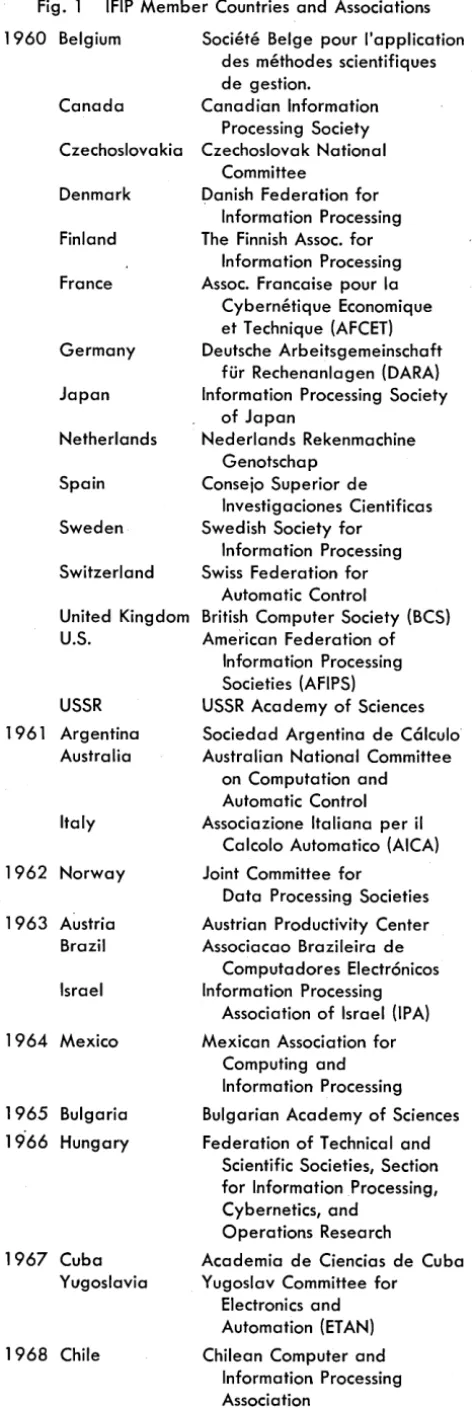
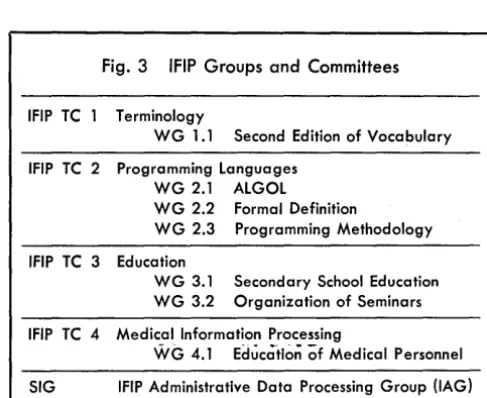
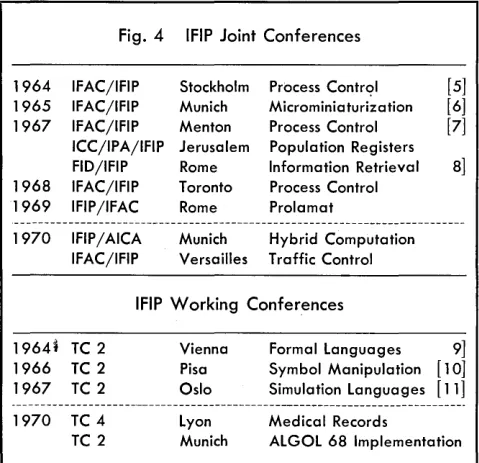
IFIP: EXPERIENCES AND POSSIBILITIES,
by
H.
Zemanek.
43
A FUTURE FOR ECMA?,
by Don Crayford.
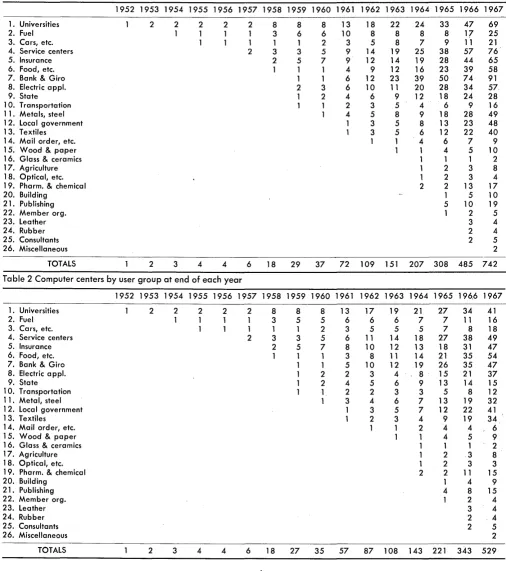
45 COMPUTER USE IN THE NETHERLANDS,
by
W.
K. de
Bruiin.
49
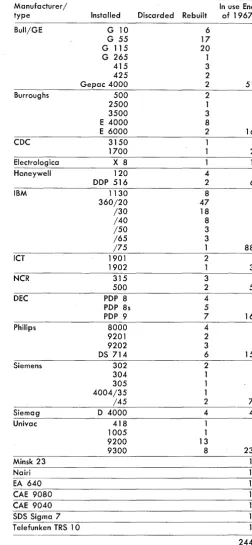
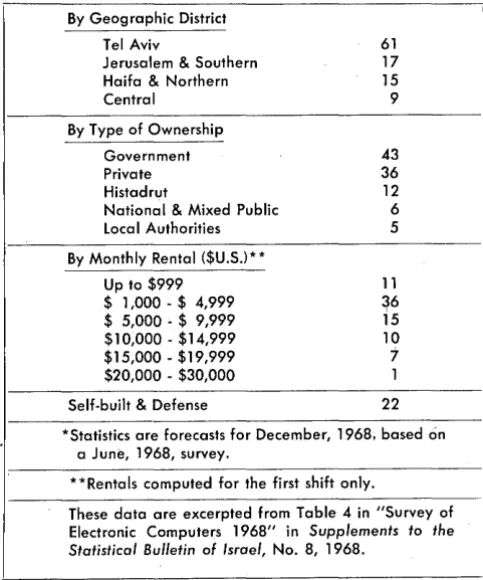
INFORMATION PROCESSING IN ISRAEL,
by Rowena
W.
Swanson.
55
SOVIET COMPUTING, 1969: A LEAP INTO THE THIRD
GENERATION?,
by Wade
B.
Holland.
61
SOFTWARE PACKAGES IN EUROPE-WHAT DO USERS
THINK?,
by John
J.
Hampton.
64
PERIPHERAL EQUIPMENT IN EUROPE,
by Donald
W.
Willis.
66
COMPUTING IN CANADA,
by
G. S.
Glinski.
73
THE MANAGEMENT SYSTEM-A NEW SPECIES OF
SOFTWARE?,
by M.
V.
Wilkes and
D.
F.
Hartley.
76 TEACHING MIS AT A BRITISH UNIVERSITY,
by
R.
I.
Tricker.
(This group of articles from authors both here and abroad provides some examples of current computer activity in other countries.)
81
A CHURL'S GARDEN OF VERSE,
by
VliIIi"'m
J.
vvi/son.
85
TWO APPROACHES TO THE SEVENTIES,
by Richard A.
McLaughlin.
Working from very similar definitions of user needs, Standard Comyuter Corp. and Systems Engineering Laboratories produced very different computer systems, the IC 7000 and the SEL 86.
89 AVTOMATIZATSIYA 69.
A report on the Moscow exhibition.
95
TRENDS
& TANGENTS OF EAST-WEST TRADE,
by
Hed-ley Voysey.
.
103 MiCROFilM RETRIEVAL IN AN AIRLINE RESERVATION
SYSTEM,
by Robert
B.
Parsons.
To relieve some of the burden on the computers in its real-time reserva-tion system, Eastern Airlines is Using a complementary microfilm re-trieval and display system for the relatively static information. .
109 A PRACTICAL APPROACH TO INFORMATION
RE-TRIEVAL,
by William
H.
Minor.
The VEREAD retrieval system allows remotely located individuals with common interests to develop and query their own data bank.
131
NEWS SCENE
SDC will cut out the "freebies" and try to make a few dollars . .. The FCC might take over jurisdiction of data services now controlled by state bodies . .. Keypunches and a 1401 arid Barbados and reasonable labor
... Sharp saves peripherals firm in nick of time.
178 SYSTEM SPOTUGHT
The Canadian National Resource Council decided that the best way to study the St. Lawrence River would be to build a 750-foot model of it using an EAI 640 as a controller.
(This group of articles from authors both here and abroad provides some examples of current computer activity in other countries.)
189 New Products 221 New Software 231 New Literature 237 World Report 241 Washington Report
249 People
257 Index to Recruitment Advertisers 261 Books
8
f2J~
/
]
o
o
It says: Pardon my prognostication ... but pandiculation
as applied to your present computer is problematic.
provide peripheral paraphernalia permitting more proficient,
profitable performance ... preferably the
MUDS
7
500
SYSlIIEM\
In plain English, there's a limit to how far your computer's
on-line capabilities can be stretched. Svvitch your slovv-dovvn
operations to the off-line MDS 7500 SYSTEM.
The MDS 7500 System provides a "flexibility pa,ckage," with multiple off-line capabilities that take the squee~e off your computer. We call it the "Computer-Stretcher." It works equally well adjacent to your computer, or in a remote location.
The 7500 is an off-line data conversion system presently offering five different types each of input and output devices. The complete 7500 System consists of the 7505 Magnetic Tape Handler/ Controller and Keyboard; 7517 Punched Card Reader; 7526 Card Punch; 7515 Paper Tape Reader; 7525 Paper Tape Punch; 1320 Buffered Line Printer.
Units in the system are cable-connected. With the addition of a modem, the sy~tem can communicate with another 7500 System, or an 1103 or 6403 Data-Recorder. Switches permit selection of an input and an output device.
A minimum 7500 System consists of the Magnetic Tape Handler/Controller and one of the other units.
The 7505 CONTROLLER is the primary component. It accepts data from magnetic tape, from a data communications module, from cards, paper tape or the keyboard. Data then is channeled to a selected
MDS 7505 MAGNETIC TAPE HANDLER/CONTROLLER
7500
output unit to produce either magnetic tape records, punched cards, paper tape records, communication messages, or printout. The 1320 Buffered Line Printer can operate simultaneously with any of the other output devices.
OTHER COMPONENT UNITS
7505 MAGNETIC TAPE HANDLER: Input/output medium ... reads or writes at 800 bpi density on either 7 or 9-channel magnetic tape ... a 7-channel 7505 also can read 200 bpi tape ... max. record length, 180 characters ... BCD, EBCDIC 0& USASCII tape codes.
7515 PAPER TAPE READER: Reads 5,7 and 8-channel tapes. 7525 PAPER TAPE PUNCH: Punches data in 5, 7 or 8-channel codes (paper, mylar or mylar-combination tapes).
BUFFERED LINE PRINTER
7526 CARD PUNCH: Rated speed-200 fully punched 80 column cards per minute ... maximum speed-300 cards per minute, punching 16 columns ... Hopper/Stacker capacity 1000 cards each.
7517 CARD READER (standard): Reads 80-coiumh cards, face down, at 1000 cards per minute ... Hopper/Stacker capacity 1000 cards each ... effective throughput rate approx. 550 cpm. 7516 CARD READER (optional): Reads 51 or 80-column cards, face up (face down optional) at 400 cards per minute ... Hopper/Stacker capacity 500 cards each.
1320 BUFFERED LINE PRINTER: Prints 132 columns, operating at a nominal rate of 300 lines per minute. It can operate in Edit, List or Line Edit mode.
If your computer is up tight, investigate the computer-stretching possibilities of the MDS 7500 System. Ask for full details. YOUR COMPUTER'S BEST FRIEND
M 0 HA\NKnnr"
"1"1")DATA SCIENCES CORPORATIONLWB ®
September 1969
P. O. Box 630 • Palisade St., Herkimer, N.Y. 13350 • Tel. 315/866-6800 MDS CANADA LTD . • 26 Lesmill Road, Don Mills, Ontario. Tel. 416/445-2740
Wne re-invented the
name is the .
same.
The unmechanical marvel.
We've uncomplicated the keyboard by getting rid of the mechanical linkages, the electromechanical parts, the moving contacts. And came up with a virtually trouble-free, all solid state design.
10
~
Bye-bye bounce.
The bounce-free output of the integrated circuit eliminates the need for any special interface circuitry to adapt it to your equipment. Just plug it in.
Pick a code.
We supply any 8-bit code (or less); hexaqecimal; Baudot, BCD; USASCII mono-mode, dual-mode and
tri-furiction; plus EBCDIC and custom codes.
DATAMRTICN
keyboard. Only the
Solid state C!,II the way.
The re-inventing started with the world's first application of an integrated circuit as a keyboard switching element. Actuated by a magnet on the key plunger, the integrated circuit delivers a digital output which is fed into the encoding matrix of the keyboard.The $100 understanding.
We agreed with you that a one hundred dollar volume price for an all solid state, assembled and encoded keyboard was ideal. And realistic. If we could get rid of the hundreds of moving parts and the big black box of buffer circuitry.A good start.
Our handy "Condensed Keyboard Guide" briefly discusses key-boards and options to give you an idea of the broad offering that we already have available. MICRO SWITCH application engineers are ready to work with you in develop-ing the most economical keyboard designs to meet your precise format and encoding needs.
MICRO SWITCH
FREEPORT, ILLINOIS 61032 A DIVISION OF HONEYWELL
12
If she types, she's
already
tra~ned
to use a
COMPAT
T• M
.
88-23
Data Terminal
0 0 0
and!
Y({))ll1l
get
3
ltnmmes
her value
for
lhltalnif
Ilnerr
m({))nn1l:1hlly payo
o 50,000 CHARACTER DATA STORAGE
• 1200 BAUD TRANSMISSION RATE
o PROGRAMMABLE FLEXIBILITY
o COMPLETELY FLEXIBLE FORMATTING
o ANYTIME EDITING-0.5 SEC. DATA RETRIEVAL o AUTOMATIC SEND/RECEIVE ERROR CONTROL
o SIMULTANEOUS HARD COpy
COMPAT 88-23 data terminal contains a 4K x 16 stored-program computer with a powerful instruction set ... capable of handling parallel keyboards or performing peripheral tasks. And the unique tape loop completely empties in six minutes with vertical and horizontal parity assigned each message block and automatic retransmission of blocks with transmission errors.
The keyboard in this designer-housed unit is identical to the "selectric"typewriter. Low operational costs become even lower when idle WATS lines are used for transmission.
Other COMPAT terminals are:
COMPAT 88-13 batch terminal with 50,000 character data storage; unattended transmission at 1200 Baud; error control; format control; and other features.
COM PAT 88-03 conversational mode terminal with ASCII code; simultaneous hard copy production using "selectric" typewriter. Off-line duty as office machine.
COMPAT 88-23 or our other terminals can be leased or purchased with 90 day delivery. For fast, complete information, call our Systems Engineering Department. Or visit our plant.
177 Cantiague Rock Road, Westbury, N.Y. 11590 (516) 822-1320, TWX 510-221-1821.
CIRCLE 216 ON READER CARD
The SYSTEMS approach to
CCI already provides everythin·
We began with the CC-30 Communications Station,
a low-cost, portable input/output terminal based
aroond the powerful CC-301 station controller with
a 1024 character random access core memory (for
high-speed man/machine interaction). In its most
basic form, the CC-30 adds a CRT (which can be
any standard television set or monitor depending on
specific viewing requirements") and a keyboard
func-tionally designed to resemble a conventional electric
typewriter (but without the noise).
Then, because we wanted a terminal that was
uni-versal (most others are not), wp built· everything
necessary to tie the CC-30 to phone lines, to
switch-ing devices, and to computers:
• Standard communications interfaces for all 100-,
200-, and 300-series data sets (dial-in, dedicated, or
multi-drop lines), serial hardwire at speeds up to
50,000 bps, and for parallel connection at speeds up
to 500,000 char/sec. We have delivered, and
smooth-ly installed, many installations with all of these
communications connections.
• Standard multiplexers, concentrators and
switch-ing devices allow multiple stations to share a sswitch-ingle
transmission line or direct connection with a
com-puter, or provide a complete communications
pro-cessing and message queuing "front-end" to a
central computer system. Our CC-72 remote
multi-_ plexer is in use on many systems; our soon-to-be
delivered CC.:70 will provide high speed buffered
multiplexing at the computer site.
• Standard channel interfaces permit CC-30
Com-munications Stations to communicate with almost
all of the most popular computers and operate in
conjunction with the system as local peripheral
de-vices or as remote terminals over phone lines. Our
channel interfaces are in use with a number of IBM
1130 and System 360 installations, on CDC 3000
and 6000 series .computers, and in a number of SDS
Sigma Series and PDP-8 installations.
From the computer I/O channel on out to the
ter-minal, the emphasis has been on flexibility,
univer-sality, and ease of operation. The result of this
emphasis has been that networks using CCI
stan-dard building blocks can be -
and have been -
in-stalled smoothly, quickly, and efficiently on almost
any computer over almost any transmission network
computer-communications ...
· g
but. the computer mainframe
conceivable. In short, we have a standard,
field-proven
product line that helps our engineers and
programmers apply our total systems capability to
satisfy just about any computer-communications
network application.
The same principles apply in the operation of the
terminal. The CC-301 Display Controller, heart of
the station, displays alpha'numeric or graphic data
on the CRT (we were the first to offer both
capa-bilities in a single low-cost unit). The CC-301
con-trols up to seven local peripheral
devic~(which can
include card readers, line printers, magnetic tape
and disc drives) and a light pen. And for the
sys-tems programmer, powerful but simple
to
use
con-trol features are made available in the CC-301 which
give complete flexibility in all 'aspects of system
operation.
Other terminals in CCl's family of communication
stations are designed for specific requirements. The
CC-33 Teletype Compatible Display Station is fully
code and transmission compatible with Model 33
and" 35 Teletype units. With the CC-33, users of
time-sharing systems can update their terminals to
the new generation of remote display stations
with-out any change in existing Teletype-oriented
soft-ware.
The CC-36 Televideo Conversational/Batch Station
is a surprisingly low cost family of integrated
con-sole systems designed for use as remote batch
ter-minals, as remote on-line conversational stations,
or for off-line peripheral operations. A typical
ver-sion of the CC-36 includes a keyboard, CRT, a card
reader, a line printer, and control electronics for
specified batch operations.
Continued ...
Communications,
Inc.
Hardware / Software / Systems
. WE DELIVER. NOW .
. What we've been saying here about our system
ap-proach and product line building blocks is not a
drawing-board concept. It's been done. And done
successfully. CCI communications terminals and
their related products are in use now in business
and industry, at hospitals, government agencies,
universities and research labs throughout the
coun-try. Installations range from sophisticated
single-station dedicated applications to complex
multi-station on-line or time-shared networks where CCI
provided everything but the computer mainframe.
Optional software packages such as CAP 1130 and
CAP 360 provide powerful network and display
drivers for installations wishing to program terminal
. applications using FORTRAN. CCI has also
sup-ported users in every type of programming -
from
engineering diagnostics, through special drivers, to
complete operating systems and applications
pro-grams.
Since all CCI equipment is modular and standard,
reliability and maintenance is simple and routine.
We have a nationwide service and installation
or-ganization and systems centers in key cities around
the country for field analytical and engineering
support.
CIRCLE 145 ON READER CARDWe believe it's the
total system
that counts: in power
and convenience of operational characteristics, in
rapid delivery and installation, in system use and
programmability, and in price. We have a company
that can and has combined superior systems design,
systems engineering, and systems programming with
superior "building block" systems products to get
customers with complex applications and networks
on the air quickly.
We've delivered. We're delivering now.
VRC BUILDS DRUMS
. . . BY THE HUNDREDS
Vermont Research Corporation is a volume
producer of drum memories. Now operating in
three plant facilities, we're growing faster than
at any point in our 9 years of drum production.
The reasons? VRC's broad line of drum
ca-pacities, from 2.6 to 67 megabits . . . a standard,
interchangeable, digital interface for all models .. .
complete documentation and customer support .. .
outstanding reliability . . . and the ability to fill
your order for drums by the hundreds.
We've had several like that recently.
Computers are known
by
their MEMORIES . ..
I
I
i I
I
.
... so
lS
DRUM MEMORIES • SYSTEMS • DISK PACKS
Box20d, Precision Park, North Springfield, Vermont 05150 • Telephone 802/886-2256 • TWX 710-363-6533
We know our
optical
mm
readers
can save
you
money.
Just one
is
saving us
$32,000
a
year.
We did it by cutting out the keypunch bottleneck at our Palo Alto plant.
Instead of slow, costly keypunching, we now use one of our optical mark readers. And we're already saving more than $32,000 a year on payroll proces~ing alone.
The reader handles 12'),000 job cards turned in by 3000 employees each month. Everyone writes his own work record on a simple tabulating card, using an
ordinary pencil. The process is so easy and efficient, payroll accounting is ready three days earlier than before.
And we don't build our optical mark readers just to handle payrolls in plush offices. They're rugged enough to work in machine shops, warehouses, even on construction sites. In fact, you can put them just about anywhere you need important information fast. Information on material movement, order entry, quality assurance, inventory control.
New design techniques are the key to our readers' reliability. For example, we've developed a special feed system that virtually eliminates card jamming and mutilation. And a unique mark detection feature assures accurate reading of even poorly marked cards.
All our optical mark readers cost less than $3000.
That's another reason they make it so easy for you to save. Your local HP computer specialist can show you just how easy. Call him. Or write to Hewlett-Packard, Palo Alto, Calif. 94304; Europe: 1217 Meyrin-Geneva, Switzerland.
HEWLETTWWPACKARD
DIGITAL COMPUTERS
80 lines per second I
Clevite's new
hardcopy electrostatic printer
zipped out the facing page
in 1.8 seconds flat.
That's up to seven times
faster than most printers
on the market.
Eighty lines per second ... 41 2,000 characters per minute ... 4800 lines per minute. No matter how you fig-ure print-out speed, dollar for dollar Clevite 4800 is far and away the fastest and most economical. It's four to seven times faster than most line printers ... ten to twenty times faster than usual photographic hard-copy techniques. No other print-"out system is even in the same ball park.
Words. And pictures.
Clevite 4800 handles both alphanu-merics and graphics. Simultane-ously. It will reproduce words, num-bers, drawings, charts and graphs. Paper is an easy-to-file 8~" wide and page height is infinitely variable up to the full 300' length of the paper supply roll!.More
of the fonts you
want..
Clevite 4800 generates a' wide variety of fonts from the smallest
matrix on up. In an equally wide variety of weights, sizes a nd styles.
Ar.chival quality.
Clevite 4800 uses a special, high-contrast paper. The electrostatic print-out won't smear. And the paper won't curl. yellow or get brittle in storage. You can write on it with ball point pen, pencil. felt-tip or whatever.
The sound of silence.
Clevite 4800 is an electrostatic print-er. So it is quiet. (Think about that next time you're trying to make your-" self heard above a chorus of impact-line printers.) And no impact means less wear and tear on the printer, less maintenance and downtime.
CIRCLE 174 ON READER CARD
Beyond the computer.
Clevite 4800 has uses beyond the computer. In communications it can replace banks of teletypes and prints out data transmitted qy telemetry, radio microwave and/or land lines. And it prints out graphic displays from CRT's using a TV raster display memory. The Clevite 4800 whips out full pages of alphanumerics and graphics as fast as signal sources can feed it. You may have other applica-tion ideas. Let's kick them around.A word from the sponsor.
Clevite 4800 is based on proprietary eq u ipment and proprieta ry paper. There is nothing else quite like it. It's faster, more versatile, quieter and more dependable. Yet. the Clevite 4800 printer's low price will sur-prise you. Let's talk soon. Clevite Corporation, Graphics Dept., 37th and Perkins, Cleveland, Ohio 44114.
CLEVITE
.
:l
:()
1
:l
R-101 20 K fl 1 .5 K i
1
+3
1-40 V C - 102 C-104
30-151.)
~
+2·(··· ..
···r
···r··· ..
···l
~~10001
~
+
1
./.···1····\···1··· ..
···j
r J - - t - - - - + - - '
S
0 ...
1
... \ ...
1
...
..1
....--'
I
-1
···I···i· .. ··· .. /·
1
-
!
l l l .... / j
6
:
~ ~ --~ ~
~
4
~
I
4800
I
!
3
I
I
ABCDEFGHIJ
2
I
i
KLMN0PQRST
1
i
UVWXYZ
1234567890
1~357
5:3
59
61]
6'1
62
ABCDEFGHIJKLt·'1t·~0PQR5
TUI.)IJJ:><YZ
'1234567890
Ii7r
'J [ ] .~.: -") },$'
II 1.1"r- +_'T'".: •
= ,(
'too. '('.1) r· IJ ... : . ' " • ".
abcdef ghijklmnopqrs tu ...
wxyz
'1234567890
.)j:%()[]+_*
:/?=
'><$'#
~l}J X A B CDE F G HI.JK L t'1 NO F' QF~ S T 1I1,J W;:-rr
12.345€,7890
.~;:%O[']+-. /';':) $& .... ) ) x
THESE CHARACTERS ARE N0MINALLY
10
ur···HTS HIGH BY 7 UNITS IlIiDE.
5EU"'-lE
CHAF-~RCTERS RF.~E1
ur"~ITUJIOE
Rr'~D
0THERS ARE
9
ut'HTS
LUIDE.
THESE CHARACTERS ARE N0MINALLY
10 Ut'-HTS HIGH BY 6 ur'·HTS WIDE. THE
HEIGHTS UARY FR0t"1 6 T0
'14
UNITS.
THE 11IIDTHS
t)AF.~YFREHvl
'1T0 9 UHITS.
THE=SiE CHARACTERS ARE NOt11NALL Y 6 UNiTS HIGH BY 5 UNITS WIDE. THE WIDTHS I.,JARY
FR0t1 1 TO 7 UNITS.
The newest Adage graphics terminal yet.
TheAGT/5.
$40,000. Four months delivery.
Get the picture?
~m~~!!Ie
. Graphics
If you need help, contact Marketing Services, Adage, Inc., 1079 Commonwealth Ave., Boston, Mass. 02215 (617) 783-1100
*
Tel-calendar
Tech's
DATE TITLE LOCATION SPONSOR/CONTACT
MULTIPLEXER
Oct. 1-5 32nd Annual San Francisco ASIS
Meetingl 2011 Eye St. N.W., Washington; D.C. 20006
Oct. 6-9 Fall Conference Los Angeles EIA
First
2011 Eye St. N.W.,Washington, D .. C. 20006
it pays for
Oct. 6-10 2nd Int'l Congress Amsterdam, INTERNET IHoHand on Project Planning Neth. Organizing Centre,
by ~etwork Analysis 16 Lange Voorhout,
itself.
The Hague, Netherlands
Oct. 22-24 Systems Science Philadelphia IEEEI J. E. Kienle
& Cybernetics UNIVAC, Box 500,
Conference Blue Bell, Pa. 19422
Then
Oct. 24 4th Annual Symp. New York City
ACMI
Jessica Hellwig Computers & Columbia U.it really
Urban Society Computer Center New York, N. Y. 10027
Oct. 26-29 EASCON Washington, D.C. IEEE
starts
345 E. 47th St.,
New Yor~, N. Y. 10017
Oct. 26-30 Joint Conference Anaheim, Calif. ACM, IEEE, SIAM
making you
Math & Computer 33 S. 17 Street,Aids to Design Philadelphia, Pa. 19103
Oct. 27-29 DP OCR New York City DPSA/T. R. Evans
money!
I/O Technology P. O. Box 1333Meeting Stamford, Conn. 06904
The TTC-1000 is far ahead in Oct. 27-30 24th Annuall Houston ISA technology and behind in price.
Conference & Exhibit 530 William Penn Pl., You pay less for the TTC-1 000 when Pittsburgh, Pa. 15219 you buy or lease it, less when you add channels, much less for spare parts.
Oct. 27-31 11th Annual New York City BEMA And because of its simplicity and Exposition 235 E. 42nd Street, integrity, you plug it in and forget it.
New York, N. Y. 10017 No adjustments.
You can multiplex 2 to 38 channels Nov. 5-7 12th Annual Conf. New York City APICS, Suite 504 into a single voice grade phone circuit
Production & 2600Virginia Ave. N.W., terminal disconnects ... connect to ... intermix data speeds ... eliminate Inventory Control Washington, D.C. 20037 any terminal ... and choose from
Nov. 10-15 Ger. Sci. Res. Ministryl
a host of industry-first options. Systems '69 Munich, If the TTC-1 000 is so good, why isn't Congress Germany Kallman Assoc. it No.1? It is!
30 Journal Sq., Jersey City, N. J. 07306
Nov. 18-20 Fall Joint Computer Las Vegas AFIPS/P. O. Box
.~
TEL-TECH
Conference 49672, Los Angeles,
Calif. 90049
CORPORATION
TELECOMMUNICATIONS
Dec. 8-11 Computer Munich, lAG TECHNOLOGY
Management Germany 6 Stadhouderskade, 9170 Brookville Road '69 Illt'l Conference Amsterdam W; 1, Neth. Phone: (301) 589-6035 Silver Spring, Maryland 20910
CIRCLE 55 ON READER CARD
We pay System/360 users
100 percent compounded
Incredible? Not when they use Boole & Babbage SMS/ 360T
t . I -the first commercially available Systems
Meas-urement Software. In a typical installation, it routinely reduces System/360 program run time 20 to 30 percent. The system often saves enough during the first week to pay for itself. From then on, savings compound as SMS/360 continues measuring performance ... striving to perfect both programs and system efficiency.
Boole & Babbage developed Systems Measurement Software because we are unabashedly dedicated to cut-ting costs for the entire data processing world. Call us old-fashioned if you dare, but we believe constantly improving profits is every user's ultimate goal. Knowl-edgeable computer managers in many businesses and industries agree: A system which lets you see in real time what's actually going on, and gives precise measurement analysis of every step, must supply the critical ingredients
for optimum efficiency. As a result, they have more inter-esting profit pictures to show.
The price of software is going up
Considering what's happening to the price of software fol-lowing policy revisions within the industry, your need to reduce operating costs is now more pressing than ever. Boole & Babbage invites you to start evaluating at once. We make matters as simple as possible by offering SMS/360 for immediate purchase, installation, and fast employee take-over. Additionally, we provide a full range of product-oriented services supported by competent ad-visory personnel. Both are available now from our re-gional offices. Write today.
George Boole, algebraist, and Charles Babbage, inven-tor, were the innovators of the computer movement. Let their names remind you - We are the innovators in soft-ware and systems management.
Boole
&
Babbage Inc.
1121 San Antonio Rd., Palo Alto, Calif. 94303 (415) 961-4440SMS /360 available throughout the United States and Internationally
The Data Communications People
Our Sebit-72 Data Set operates at 7200 bps. And if that isn't quick enough, how about a Sebit-96 at 9600 bps? Both operate over voice grade circuits. And they have integral fully automatic con-tinuously adaptive equalization. All for $9,950. • Our data sets operate in fast company. Like an IBM 360/20. Or a Univac 1108 . . , And a host of others. • Want to increase core-to-core transmission rate? Want to improve throughput in remote batch applications? Want to bring several medium speed circuits from remote terminals into a remote multiplexer to produce one 9600 bps signal for your computer? • No gimmicks. No deals. No secrets. No strings attached. We'll put them on your line and you tell us how great they are. • Experience counts. It
means you can count on Rixon.
111111
Hixon Electronics, Incorporated I a subsidiary of United Utilities, (nc., 2120 Industrial Pkwy., Silver Spring, Md. 20904 I (301) 622-2121 RIXON,111111
· PDP-IS is a Picasso at a
House Painters Union Hall.
26
Nothing against house painters. Or unions. But in the world of middle size,
middle-priced computers, PDP-15 is different. It is monitor controlled. It comes
in 4 versions to fit appl ications and budgets. It is expandable. And its software is
complete -
i ncl udi ng an advanced package -
and proven in 400 computers
already in the field. Write.
mamaama
COMPUTERS· MOOULES
Digital Equipment Corporation Maynard, Mass. (617) 897-5111
*
letters
the sins of ibm Sir:
Those who accuse IBM of malfeasance have failed to identify more flagrant premeditated acts IBM has com-mitted. Surely I am not alone in rec-ognizing IBM's following sins:
-Get~!ng th~, customer to buy what he knows he wants.
-Hiring and training good people in their products, personal rela-tions, and company loyalty. -Serving existing markets and
ex-ploiting new ones. -Servicing what they sell.
-Dealing at a higher echelon than the competition.
-Selling conceptually imperfect hardware with similar software . thus allowing hundreds of new
companies to prosper.
-Staffing these new companies with well trained ex-IBM personnel. (This charge may be· dropped since the only evidence suggest-ing IBM directly supports forma-tion of new companies is that IBM still accepts resignations.)
If the current trend in critique of IBM's capability to get business is well founded, then we now have a new American dream, "prosper as best you can, but don't be too prosperous."
Assuming that the purpose of anti-trust considerations is to maintain a fair competitive climate, some IBM detractors seem to have "lost sight of the objective and redoubled the effort" through spotlighting a worthy oppo-nent's attributes.
GORDON G. HILL Anaheim, California
the name game Sir:
In his June article (p. 83) concerning the naming of new edp firms, Mr. James McCrohan did not consider the field of religious edp. May I suggest Datamen for a firm serving church groups, while synagogues can
pe
served by Cybergogue, Inc.N ORMAN BENOWITZ
North Hollywood, California
excelsior Sir:
As a graduate student in computer science who has been watching the industry, and as one who has worked for both manufacturer and user, who has participated in both hardware and
September 1969
software design, and in manufactur-ing, I would like to share with you my perspective concerning the current rash of suits against IBM.
Among certain members of my gen-eration, there is cynicism concerning the operations of the capitalist system. These people feel that capitalists are
~ntirely self-serving, to the detriment
of other people and to society. We in the industry are cursed with the age-old problems of greed and lust for power. According to B. C. Forbes, business was originated to produce happiness, not to pile up millions; what is our view? We seem to think that "all's fair in love and war" also applies to business; but even war is limited today. We may take the atti-tude that "If it costs $1 million to sue, that's only 3¢ a share!" Thus, a lawsuit is only an investment; anything we can get out of it, we will. It is not really a matter of whether we were wronged or not. And if one thing is really wrong, we wiJI invent ten others to go along with it in the hopes that we will score on at least one count. Unfortunately, our adversary legal tradition encour-ages this kind of extremism.
Who among us would operate his business as did Henry Royce under the motto "Quidvis recte factum quamvis humile praeclarum," "Whatever is rightly done, however humble, is no-ble"? The Rolls-Royce is still the sym-bol of quality today. Will our indus-tries survive in good reputation or will we make our fast buck and fly by night? Are we willing and interested in making "better mousetraps" or are we only trying to prevent the other guy from doing so? There are a lot of mice running loose, and we can all help catch them. Business is not a football game. Certainly today, at least in the computer business, there exist whole fields of technical problems to tackle; we needn't go after each other. Unfor-tunately, it is too easy to lose sight of the whole picture; too hard under pressures to sit back and think about what's going on .. In our day to day struggles we become victims of the "corporate truth," as John Kenneth Galbraith has described it. But of course there is no IBM truth, or CDC truth, or DPF&G truth, or ADR truth, or any other kind but the one Truth.
As an individual, I cannot speak for
a:
generation. But· I for one am not impressed by opportunists. I am im-pressed by a job well done and by a product well made. We have the abil-ity to provide not only qualabil-ity prod-ucts but also quality in our lives; I appeal to all men, young and old, to learn the value of cooperation and to strive to see tpat what is good for ourselves and our companies is also good for our industries and forman-kind. United We Stand; Divided We Fall. Let us not put ourselves in a position to kill the goose that lays the golden eggs.
ARCH C. DAVIS Princeton, New] ersey
making a decimal point Sir:
In Look Ahead, July, 3% of $13K is $390, not $3900. Watch those decimal points, bub!
The corrected figure indicates that only 2 days of SE charged time could wipe out a month's rental reduction.
DP Managers will have to control all calls for systems help since charges can be incurred without a purchase order. Oh, my aching budgetl
JERRY FRAENKEL Associated Press New York, New York
sour grapes of wrath Sir:
In your July issue, a letter appeared (p. 27) from a Mr. R. T. Sullivan taking systems analysts to task for not knowing how to code. It seems to me that Mr. Sullivan may have been guil-ty of an overgeneralization (if not "sour grapes") in condemning those analysts who do not learn program-ming. While it may be true that sys-tems analysis may cloak a multitude of nonspecialized sins for some individ-uals, I consider it an injustice to cate-gorically denounce the whole lot.
In a sense, systems analysts-vs-pro-grammers is analogous to systems en-gineers-vs-design engineers and tech-nicians. In each case, the systems man. does what his title implies: he ensures the adequacy of system design, the meeting of overall requirements, the interfacing of multiple complex oper-ating units, and performs other tasks somewhat out of the province (and in many cases the capabilities)' of tech-nicians and programmers who cannot
at
COMPUTER INDUSTRIES
it happens for $2,304* per month
And there are no special format re-quirements to play your tape, no reprogramming costs. Just put your tape on our Computer-Out-put-Microfilm (COM) System and it will play. Dual input format pro-vides for either computer line printer (1403) simplicity or high speed (MICROMATION) mode. There are no additional rental requirements for input tape decks or engineering interface to your computer. Our systems are off-line, will read 7 or 9-track tapes, recorded at 556, 800, or 1600 bpi, and can be
located inside or outside the computer· room for ready access to all users.
Computer. Industries COM systems are built with op-tional capabilities that include MICROFICHE Camera; re-trieval coding; and expandable character sets for special symbols, upper case letters, numeric, algebraic, or other unique characters.
*Standard Model 180 Microfilm Printer-price includes camera, tape deck, forms projection, horizontal and ver-tical tab capability, parity checking and automatic re-read feature (maintenance not included).
For more information on the best performance per dollar COM systems, write or call: (213) 781-7100.
COMPUTER INDUSTRIES INC
GRAPHIC SYSTEMS DIVISION
14761 Califa Street I Van Nuys, California 914011 A Subsidiary of University Computing Company
letters ...
with a coding sheet, a pencil and a keypunch. Also, coders can ( and should) learn about input and output requirements, system timing character-istics, failure probability and redun-dancy implications, by osmosis, if not by formal training.
Probably the ideal mix is one who sports a technical degree (possibly in mathematics) and has' also taken courses in machine coding, then worked both as a programmer and as an analyst to gain generalized and specialized experience. Since such combinations are somewhat hard to come by, however, I suggest that Mr. Sullivan spend less time criticizing sys-tems people and begin working with them, just as they must sometimes grit their teeth and work with program-mers.
R. W. BILEK
Thousand Oaks, California
doesn't need coaxing Sir:
"COAX: A Preprocessor for COBOL" (July, p. 69) demonstrates once more how far removed the theoreticians of the ACM are from the world of busi-ness data processing. Not. that their removal is in itself necessarily a bad thing, but some of them now apparent-ly want to get their hands on COBOL with little or no knowledge of the needs of the people who use this much abused language.
For the Information of the authors, many business data processing COBOL programs . are not 61 card, 20 data name "quickies," but large, complex, constantly changing, multifile con-glomerations of six' to twelve months work by several analysts and program-mers. I for one would not relish the idea of being called upon to take over a large partially coded program writ-ten in COAX (and despite the authors' contention to the contrary, COAX is a separate language). Nor do I think that very many keypunch departments would leap for joy at the prospect of punching a 3,000 card Procedure Di-vision with 8-10 special characters per line. Does it not occur to our authors that such a program would contain innumerable keypunch and coding er-rors, many of which would slip by the preprocessor and merely create incor-rect source statements? The probabil-ity of errors in an initial compilation is already high and if a programmer is further restricted and required to keep track of the rules for 2 compilers the probability of errors is substantially in-creased. He must also keep track of 2 sets of reserved words and 2 sets of
September 1969
programmer supplied words. What COAX does is cause more programmer headaches, longer debugging times, and extra computer time usage. Also, I do not think that many programmers are eager to maintain and change COBOL programs with sentences be-ginning on the same card as the pre-vious sentence.
I do not maintain that COBOL is per-fect, by any means. I simply believe that of the three difficulties mentioned at the beginning of the article, the one concerned with the amount of writing necessary to initially code a program is the least important. I object to the statement that the long compilation times have been nearly eliminated. I suspect that compilation times are lower because of increased internal machine speed and the improvements in direct access storage devices rather than in better compiler coding. I war-rant 'that the statement, "The ineffi;. cient code generated by early compil-ers is a thing of the past . . . " is not only objectionable but patently false.
It is the comment of a FORTRAN or' PL/I programmer who has never looked at his generated coding or couldn't read it even if he did. Mr. Teague or Dr. Brady should see some of the examples I have on my desk right now! I suggest that if they are serious about improving COBOL, they should' look first to creating efficient object code.
JOHN L. TURNER Lombard, Illinois
conversion reduction Sir:
In answer to the question in June's "Editor's Readout"-Who knows of an installation that reduced its data pro-cessing cost after converting to new equipment?-I have found that instal-lation. I believe there are many more, so why slander the whole industry for the sake of a few incompetent people running inferior and inefficient instal-lationsfiWe go back .to that word "planning," and if that is done correct-ly and completecorrect-ly, no one can lose.
In our installation, we upgraded from a 1401 to a 5-tape GE 415 sys-tem nearly two years ago. We are, at the present time, doing more-faster and more efficiently-and all at less cost, which is reflected in our budgets each year. In addition, more is planned to be implemented than was put on the system in the six months of conversion.
So I ask that data processers every-where sit up and start planning effec-tively instead of dreaming about the days of exotic operating systems when your own system is not efficient-forget the fourth generation (?) as an excuse to get yourself out of a jam and start
planning to make your current instal-lation a money-maker, even in those "unglamorous" installations that pro-cess information for concerned man-agement.
In summary, I would like to sa y that, as in every installation, we have some of the problems mentioned in the article, but let's try and eliminate those at the same time as we create a decent image to the public and, most impor-tant, to management.
J. D. COOPER
Columbia Records of Canada, Ltd. Ontario, Canada
Sir:
Regarding the editorial, "Let's Hear It for the User," in the June issue, I couldn't agree with you more.
I have addressed myself to these problems as both a guest lecturer and course chairman for the American Management Association. Unfortu-nately, there is no easy solution.
In second generation days the com-puter industry was so young that the new breed "whiz" programmer, by his own technological expertise, ran the show to his own pleasing. By the time management began to understand some of the ramifications involved and could' begin to apply some common management principles to the data processing function, the third genera-tion was upon us-a whole new ball game with a different set of rules. Now the corporation does indeed find itself even more at the mercy of the "whiz kid" who in many cases, thru seniority, technical expertise, etc., became the data processing manager-unable to communicate adequately with top management, because in the process of becoming a technical expert he hadn't the time to learn management.
Now that the third generation is middle-aged and a new generation is rapidly approaching, the problems be-come even more critical, particularly so for those users you mentioned to whom edp is a support activity and not a way of life.
Much of the blame can indeed be laid at the feet of the data processing industry, but I think it also behooves the user to examine his criteria. For example, how to build a management information system now if the basic ground work was not long ago accom-plished through applications imple-mentation that did indeed justify themselves through solid "return on investment" criteria, and once justi-fied, how many companies perform a post-audit a year later to see that the ROI is actually there?
How many companies devote rela-tively the same amount of effort to on-going application and hardware eval-(Continued on page; 267)
That's right, small.
We're introducing a brand new computer.
A computer that uses a small punch card that can
soak up more informatiqn than one three times its size.
A computer that's especially designed for the small
businessman.
It's System/3. The small business computer.
The day of the small punch card begins.
IT18BEL T SANDER
• I J • , I 7 • , 10 II II 13 ,4 IS " 17 I, " 10 21 2Z U U ZS ZI l7 21 2. 10 " 32
672 1725 1750 647EA
5250 682 34500 51369 15
"H"~~mm~m~~~~~mm~~~~m~~~m~mm~mw~
B... ...
B
A • • • • • • • A
e . . e '
4 • • • • 4
2 • • • • 2
1 • • • • • • • • • • . 1 B ' Z 3 .. S • ., • • 10 11 12 13 ,. '5 M "
l'
It 20 21 12 2J ~. U II 21 Z. I t If ~ 32 BA • • • A
e 8
4 • • • • • • • • • • 4
2 • • • • • • • • 2
1 • • • • • • • • • • 1
B 3J l4 3S 31 J7 3. " .0 .1 '2 U ... . , • • • ., AI .t 50 " SZ SS , . 55 " 57 5' 51 10 II 12 " . . B
A . • • A
8 • • 8
4
2 '
•
•
•
•
•
•
•
••
. .'
••
• 4 2 1 IS . . 17
:t "
~ 71 72 73 7~ 7S 71 77 7t 7' ~ II rz 13 " "t.
~t.
I t :t II tz u .. " ' " 111M 3700
This is it! Our tiny punch card. Actual size. It can soak up 20
percent more information than one three times its size.
With System/3, you'll use a new punch card that's
one-third the size of the regular card.
And for good reason.
It's easier to handle. Easier to store. And easier to
process through your machine.
Instead of 80 columns, it has 96 columns.
Which means it can actually absorb 20 percent more
information than the 80-column card you're used to
seeing.
30
Cutting it down to size.
There's one thing you'll notice immediately about
System/3.
Its size.
System/3 is small. In fact, it's a lot smaller than any
business computer we've ever made.
If you have a 350-square-foot room, you have room
enough for System/3.
We've been able to cut
itdown to size because we've
been able to use improved circuit families and the small
card which lets you do more computing in less space.
But although it's small in size, System/3 is big in
memory. You can have as much as 32,768, bytes of
core storage.
More with less.
With System/3, you don't have to have a lot of
Our card handling machine. It
reads, punches, sorts, collates, and prints on your cards. Also has a
spe-cial compartment for housing the
disk drives.
machines handling your cards.
Because our multi-function card unit can do as many as six different jobs.
It can read up to 500 cards a minute.
And it can also be used to punch, sort, print, collate and reproduce your cards.
For off-line work there are two new separate units you can use with System/3. A card sorter. And a data recorder for card punching and verifying.
Your choice: disk or card. System/3 isn't just one computer. It's your choice.
If
you've got a small business, you might already beusing some business machines. So for you the card system is wor'th considering.
If
you have a lot of records to store, you might wantto choose the disk system.
It gives you direct access to your files.
Which means you can update your inventory or bill-ing records in minutes.
If
you run a big business, you might find iteconomi-cal to put System/3 in everyone of your factories. Or
in every warehouse. .
Ifll manage the paperwork.
No matter what system you use, System/3 can make running your business a lot easier.
You can keep tabs on whatever you have (or don't have) in stock. And reorder only what needs reordering.
You can spot a project in trou-ble. Track vendor shipments. And discover how your salesmen are doing this year compared to last. In short, System/3 can manage the paperwork while you manage the business.
September 1969
Our long-playing disks. Each one can give you direct access to 2.45 million bytes of data. As your business gets bigger, just add more disks. Up to four in all.
Easy does it.
And listen to this. System/3 is easy to put in your office. No cables to lay.
No special wiring. Just plug it into any
220-volt line.
The growth computer.
If
System/3 makes sense now, it'll make more senseas your business grows.
Because as you grow, it grows.
For example, you can change printing speeds from
100 to 200 lines per minute. Or increase the size of
your core storage.
Or let's say you've got the card system and you want to upgrade to the disk system.
It's easy.
Because we pull out a drawer and install the disk system. All the· work is done right on your own premises, right on your own machine.
Find out what it can do for you.
We've only told you a little about System/3. There are many more exciting things to find out.
Wi Call your IBM representative today.
..
System/3. The small business computer.
Announcing ...
32
urroughs omputer-
utput-to-
icrofilm
BCOM reduces the volume of business data that your computer
stores
:,-~:r~~of
magnetic tape
~
or on 2300 full pages of
printo,:!! ..
~~
..
~
(printing time:
2
hrs.,
7
min.)
to a compact 4 x 4 inch
~
... r::Jb
cartridge of microfilm
le~~:~,
I
(recording time:
4
min.).
Later, you can locate
a record, view it, even make an 8
1/2
x 11 inch dry copy in
seconds!
BCOM-for records you refer to frequently,
or distribute, or put in the archives. Ask us about
it.
CIRCLE 9 ON READER CARD