arXiv:1602.07588v3 [hep-ex] 14 Jun 2016
Evidence for a
B
0s
π
±state
V.M. Abazov,31B. Abbott,67 B.S. Acharya,25 M. Adams,46 T. Adams,44 J.P. Agnew,41 G.D. Alexeev,31
G. Alkhazov,35 A. Altona,56 A. Askew,44 S. Atkins,54 K. Augsten,7 V. Aushev,38 Y. Aushev,38 C. Avila,5
F. Badaud,10 L. Bagby,45B. Baldin,45D.V. Bandurin,74S. Banerjee,25 E. Barberis,55P. Baringer,53 J.F. Bartlett,45
U. Bassler,15V. Bazterra,46 A. Bean,53M. Begalli,2 L. Bellantoni,45 S.B. Beri,23 G. Bernardi,14 R. Bernhard,19
I. Bertram,39M. Besan¸con,15R. Beuselinck,40 P.C. Bhat,45 S. Bhatia,58 V. Bhatnagar,23 G. Blazey,47 S. Blessing,44
K. Bloom,59 A. Boehnlein,45D. Boline,64 E.E. Boos,33 G. Borissov,39M. Borysoval,38 A. Brandt,71 O. Brandt,20
M. Brochmann,75R. Brock,57 A. Bross,45 D. Brown,14X.B. Bu,45M. Buehler,45 V. Buescher,21 V. Bunichev,33
S. Burdinb,39 C.P. Buszello,37E. Camacho-P´erez,28B.C.K. Casey,45 H. Castilla-Valdez,28 S. Caughron,57
S. Chakrabarti,64K.M. Chan,51 A. Chandra,73 E. Chapon,15 G. Chen,53 S.W. Cho,27 S. Choi,27B. Choudhary,24
S. Cihangir‡,45 D. Claes,59 J. Clutter,53 M. Cookek,45 W.E. Cooper,45 M. Corcoran,73 F. Couderc,15
M.-C. Cousinou,12J. Cuth,21 D. Cutts,70 A. Das,72 G. Davies,40 S.J. de Jong,29, 30 E. De La Cruz-Burelo,28
F. D´eliot,15 R. Demina,63D. Denisov,45S.P. Denisov,34S. Desai,45 C. Deterrec,41 K. DeVaughan,59 H.T. Diehl,45
M. Diesburg,45 P.F. Ding,41 A. Dominguez,59 A. Drutskoyp,32A. Dubey,24 L.V. Dudko,33A. Duperrin,12 S. Dutt,23
M. Eads,47D. Edmunds,57 J. Ellison,43 V.D. Elvira,45Y. Enari,14H. Evans,49A. Evdokimov,46 V.N. Evdokimov,34
A. Faur´e,15L. Feng,47 T. Ferbel,63 F. Fiedler,21 F. Filthaut,29, 30 W. Fisher,57 H.E. Fisk,45 M. Fortner,47
H. Fox,39 J. Franc,7 S. Fuess,45 P.H. Garbincius,45 A. Garcia-Bellido,63J.A. Garc´ıa-Gonz´alez,28V. Gavrilov,32
W. Geng,12, 57 C.E. Gerber,46Y. Gershtein,60 G. Ginther,45 O. Gogota,38G. Golovanov,31 P.D. Grannis,64
S. Greder,16 H. Greenlee,45 G. Grenier,17Ph. Gris,10 J.-F. Grivaz,13 A. Grohsjeanc,15 S. Gr¨unendahl,45
M.W. Gr¨unewald,26 T. Guillemin,13 G. Gutierrez,45 P. Gutierrez,67 J. Haley,68 L. Han,4K. Harder,41A. Harel,63
J.M. Hauptman,52 J. Hays,40 T. Head,41 T. Hebbeker,18 D. Hedin,47H. Hegab,68 A.P. Heinson,43 U. Heintz,70
C. Hensel,1 I. Heredia-De La Cruzd,28 K. Herner,45G. Heskethf,41 M.D. Hildreth,51 R. Hirosky,74 T. Hoang,44
J.D. Hobbs,64B. Hoeneisen,9 J. Hogan,73M. Hohlfeld,21 J.L. Holzbauer,58 I. Howley,71Z. Hubacek,7, 15 V. Hynek,7
I. Iashvili,62Y. Ilchenko,72 R. Illingworth,45A.S. Ito,45 S. Jabeenm,45 M. Jaffr´e,13 A. Jayasinghe,67 M.S. Jeong,27
R. Jesik,40P. Jiang‡,4 K. Johns,42 E. Johnson,57M. Johnson,45 A. Jonckheere,45 P. Jonsson,40 J. Joshi,43
A.W. Jungo,45 A. Juste,36 E. Kajfasz,12D. Karmanov,33I. Katsanos,59 M. Kaur,23 R. Kehoe,72 S. Kermiche,12
N. Khalatyan,45A. Khanov,68 A. Kharchilava,62 Y.N. Kharzheev,31 I. Kiselevich,32 J.M. Kohli,23A.V. Kozelov,34
J. Kraus,58A. Kumar,62 A. Kupco,8 T. Kurˇca,17 V.A. Kuzmin,33 S. Lammers,49P. Lebrun,17 H.S. Lee,27
S.W. Lee,52 W.M. Lee,45 X. Lei,42 J. Lellouch,14D. Li,14 H. Li,74 L. Li,43 Q.Z. Li,45J.K. Lim,27 D. Lincoln,45 J. Linnemann,57V.V. Lipaev‡,34 R. Lipton,45H. Liu,72Y. Liu,4A. Lobodenko,35M. Lokajicek,8 R. Lopes de Sa,45
R. Luna-Garciag,28 A.L. Lyon,45A.K.A. Maciel,1 R. Madar,19 R. Maga˜na-Villalba,28S. Malik,59 V.L. Malyshev,31
J. Mansour,20 J. Mart´ınez-Ortega,28R. McCarthy,64 C.L. McGivern,41 M.M. Meijer,29, 30 A. Melnitchouk,45
D. Menezes,47 P.G. Mercadante,3 M. Merkin,33 A. Meyer,18 J. Meyeri,20 F. Miconi,16 N.K. Mondal,25
M. Mulhearn,74 E. Nagy,12M. Narain,70R. Nayyar,42H.A. Neal,56 J.P. Negret,5 P. Neustroev,35H.T. Nguyen,74
T. Nunnemann,22 J. Orduna,70 N. Osman,12 A. Pal,71 N. Parashar,50V. Parihar,70S.K. Park,27R. Partridgee,70
N. Parua,49A. Patwaj,65 B. Penning,40 M. Perfilov,33 Y. Peters,41 K. Petridis,41G. Petrillo,63 P. P´etroff,13
M.-A. Pleier,65 V.M. Podstavkov,45 A.V. Popov,34 M. Prewitt,73D. Price,41 N. Prokopenko,34 J. Qian,56
A. Quadt,20 B. Quinn,58 P.N. Ratoff,39 I. Razumov,34 I. Ripp-Baudot,16F. Rizatdinova,68 M. Rominsky,45
A. Ross,39 C. Royon,8 P. Rubinov,45 R. Ruchti,51 G. Sajot,11 A. S´anchez-Hern´andez,28 M.P. Sanders,22
A.S. Santosh,1 G. Savage,45 M. Savitskyi,38L. Sawyer,54T. Scanlon,40 R.D. Schamberger,64 Y. Scheglov,35
H. Schellman,69, 48 M. Schott,21 C. Schwanenberger,41R. Schwienhorst,57J. Sekaric,53H. Severini,67E. Shabalina,20
V. Shary,15S. Shaw,41 A.A. Shchukin,34V. Simak,7P. Skubic,67 P. Slattery,63G.R. Snow,59 J. Snow,66S. Snyder,65
S. S¨oldner-Rembold,41 L. Sonnenschein,18 K. Soustruznik,6 J. Stark,11 N. Stefaniuk,38 D.A. Stoyanova,34
M. Strauss,67L. Suter,41P. Svoisky,74M. Titov,15 V.V. Tokmenin,31 Y.-T. Tsai,63D. Tsybychev,64B. Tuchming,15
C. Tully,61 L. Uvarov,35 S. Uvarov,35 S. Uzunyan,47 R. Van Kooten,49 W.M. van Leeuwen,29N. Varelas,46 E.W. Varnes,42 I.A. Vasilyev,34 A.Y. Verkheev,31 L.S. Vertogradov,31 M. Verzocchi,45 M. Vesterinen,41
D. Vilanova,15P. Vokac,7 H.D. Wahl,44 M.H.L.S. Wang,45J. Warchol,51 G. Watts,75 M. Wayne,51 J. Weichert,21
L. Welty-Rieger,48 M.R.J. Williamsn,49 G.W. Wilson,53 M. Wobisch,54 D.R. Wood,55 T.R. Wyatt,41 Y. Xie,45
R. Yamada,45S. Yang,4 T. Yasuda,45 Y.A. Yatsunenko,31W. Ye,64 Z. Ye,45H. Yin,45 K. Yip,65 S.W. Youn,45
(The D0 Collaboration∗)
1LAFEX, Centro Brasileiro de Pesquisas F´ısicas, Rio de Janeiro, RJ 22290, Brazil
2Universidade do Estado do Rio de Janeiro, Rio de Janeiro, RJ 20550, Brazil
3Universidade Federal do ABC, Santo Andr´e, SP 09210, Brazil
4University of Science and Technology of China, Hefei 230026, People’s Republic of China
5Universidad de los Andes, Bogot´a, 111711, Colombia
6Charles University, Faculty of Mathematics and Physics,
Center for Particle Physics, 116 36 Prague 1, Czech Republic
7Czech Technical University in Prague, 116 36 Prague 6, Czech Republic
8Institute of Physics, Academy of Sciences of the Czech Republic, 182 21 Prague, Czech Republic
9Universidad San Francisco de Quito, Quito, Ecuador
10LPC, Universit´e Blaise Pascal, CNRS/IN2P3, Clermont, F-63178 Aubi`ere Cedex, France
11LPSC, Universit´e Joseph Fourier Grenoble 1, CNRS/IN2P3,
Institut National Polytechnique de Grenoble, F-38026 Grenoble Cedex, France
12CPPM, Aix-Marseille Universit´e, CNRS/IN2P3, F-13288 Marseille Cedex 09, France
13LAL, Univ. Paris-Sud, CNRS/IN2P3, Universit´e Paris-Saclay, F-91898 Orsay Cedex, France
14LPNHE, Universit´es Paris VI and VII, CNRS/IN2P3, F-75005 Paris, France
15CEA Saclay, Irfu, SPP, F-91191 Gif-Sur-Yvette Cedex, France
16IPHC, Universit´e de Strasbourg, CNRS/IN2P3, F-67037 Strasbourg, France
17IPNL, Universit´e Lyon 1, CNRS/IN2P3, F-69622 Villeurbanne Cedex,
France and Universit´e de Lyon, F-69361 Lyon CEDEX 07, France
18III. Physikalisches Institut A, RWTH Aachen University, 52056 Aachen, Germany
19Physikalisches Institut, Universit¨at Freiburg, 79085 Freiburg, Germany
20II. Physikalisches Institut, Georg-August-Universit¨at G¨ottingen, 37073 G¨ottingen, Germany
21Institut f¨ur Physik, Universit¨at Mainz, 55099 Mainz, Germany
22Ludwig-Maximilians-Universit¨at M¨unchen, 80539 M¨unchen, Germany
23Panjab University, Chandigarh 160014, India
24Delhi University, Delhi-110 007, India
25Tata Institute of Fundamental Research, Mumbai-400 005, India
26University College Dublin, Dublin 4, Ireland
27Korea Detector Laboratory, Korea University, Seoul, 02841, Korea
28CINVESTAV, Mexico City 07360, Mexico
29Nikhef, Science Park, 1098 XG Amsterdam, the Netherlands
30Radboud University Nijmegen, 6525 AJ Nijmegen, the Netherlands
31Joint Institute for Nuclear Research, Dubna 141980, Russia
32Institute for Theoretical and Experimental Physics, Moscow 117259, Russia
33Moscow State University, Moscow 119991, Russia
34Institute for High Energy Physics, Protvino, Moscow region 142281, Russia
35Petersburg Nuclear Physics Institute, St. Petersburg 188300, Russia
36Instituci´o Catalana de Recerca i Estudis Avan¸cats (ICREA) and Institut
de F´ısica d’Altes Energies (IFAE), 08193 Bellaterra (Barcelona), Spain
37Uppsala University, 751 05 Uppsala, Sweden
38Taras Shevchenko National University of Kyiv, Kiev, 01601, Ukaine
39Lancaster University, Lancaster LA1 4YB, United Kingdom
40Imperial College London, London SW7 2AZ, United Kingdom
41The University of Manchester, Manchester M13 9PL, United Kingdom
42University of Arizona, Tucson, Arizona 85721, USA
43University of California Riverside, Riverside, California 92521, USA
44Florida State University, Tallahassee, Florida 32306, USA
45Fermi National Accelerator Laboratory, Batavia, Illinois 60510, USA
46University of Illinois at Chicago, Chicago, Illinois 60607, USA
47Northern Illinois University, DeKalb, Illinois 60115, USA
48Northwestern University, Evanston, Illinois 60208, USA
49Indiana University, Bloomington, Indiana 47405, USA
50Purdue University Calumet, Hammond, Indiana 46323, USA
51University of Notre Dame, Notre Dame, Indiana 46556, USA
52Iowa State University, Ames, Iowa 50011, USA
53University of Kansas, Lawrence, Kansas 66045, USA
54Louisiana Tech University, Ruston, Louisiana 71272, USA
55Northeastern University, Boston, Massachusetts 02115, USA
56University of Michigan, Ann Arbor, Michigan 48109, USA
57Michigan State University, East Lansing, Michigan 48824, USA
59University of Nebraska, Lincoln, Nebraska 68588, USA
60Rutgers University, Piscataway, New Jersey 08855, USA
61Princeton University, Princeton, New Jersey 08544, USA
62State University of New York, Buffalo, New York 14260, USA
63University of Rochester, Rochester, New York 14627, USA
64State University of New York, Stony Brook, New York 11794, USA
65Brookhaven National Laboratory, Upton, New York 11973, USA
66Langston University, Langston, Oklahoma 73050, USA
67University of Oklahoma, Norman, Oklahoma 73019, USA
68Oklahoma State University, Stillwater, Oklahoma 74078, USA
69Oregon State University, Corvallis, Oregon 97331, USA
70Brown University, Providence, Rhode Island 02912, USA
71University of Texas, Arlington, Texas 76019, USA
72Southern Methodist University, Dallas, Texas 75275, USA
73Rice University, Houston, Texas 77005, USA
74University of Virginia, Charlottesville, Virginia 22904, USA
75University of Washington, Seattle, Washington 98195, USA
(Dated: June 15, 2016)
We report evidence for a narrow structure, X(5568), in the decay sequenceX(5568) →B0
sπ±,
B0
s →J/ψφ,J/ψ→µ
+ µ−,φ
→K+
K−. This is evidence for the first instance of a hadronic state
with valence quarks of four different flavors. The mass and natural width of this state are measured to be m = 5567.8±2.9 (stat)+0.9
−1.9(syst) MeV/c
2 and Γ = 21.9
±6.4 (stat)+5.0
−2.5(syst) MeV/c 2. If
the decay is X(5568) → B∗
sπ± → B
0
sγπ± with an unseen γ, m(X(5568)) will be shifted up by
m(B∗
s)−m(Bs0)∼49 MeV/c2. This measurement is based on 10.4 fb−1 ofppcollision data at√s
= 1.96 TeV collected by the D0 experiment at the Fermilab Tevatron collider.
PACS numbers: 14.40.Rt,13.25.Gv,12.39.Mk
During the last few years several resonant states that cannot be conventional quark-antiquark mesons or three-quark baryons have been observed [1–8]. Taking into ac-count the decay modes and charges of these states they may be interpreted as four-quark or five-quark states. These states have one common feature: they consist of a combination of heavy and light quarks. These discoveries open up a new era of multi-quark hadron spectroscopy. Various combinations of heavy and light mesons may be tested. One such system is the combination of the heavy
B0
s or B
0
s meson and the light π± meson. Such sys-tems are composed of two quarks and two antiquarks of four different flavors: b, s, u, d, which might be a
∗with visitors from aAugustana College, Sioux Falls, SD 57197, USA, bThe University of Liverpool, Liverpool L69 3BX, UK, cDeutshes Elektronen-Synchrotron (DESY), Notkestrasse 85, Ger-many,dCONACyT, M-03940 Mexico City, Mexico,eSLAC, Menlo Park, CA 94025, USA,fUniversity College London, London WC1E 6BT, UK, gCentro de Investigacion en Computacion - IPN, CP 07738 Mexico City, Mexico,hUniversidade Estadual Paulista, S˜ao Paulo, SP 01140, Brazil,iKarlsruher Institut f¨ur Technologie (KIT) - Steinbuch Centre for Computing (SCC), D-76128 Karlsruhe, Ger-many,jOffice of Science, U.S. Department of Energy, Washington, D.C. 20585, USA,kAmerican Association for the Advancement of Science, Washington, D.C. 20005, USA,lKiev Institute for Nuclear Research (KINR), Kyiv 03680, Ukraine,mUniversity of Maryland, College Park, MD 20742, USA,nEuropean Orgnaization for Nu-clear Research (CERN), CH-1211 Geneva, Switzerland, oPurdue University, West Lafayette, IN 47907, USA, andpLebedev Physi-cal Institute of the Russian Academy of Sciences, Moscow, 119991, Russia. ‡Deceased.
tightly bound di-quark anti-diquark pair such as [bu][ds], [bd][su], [su][bd], or [sd][bu], or a “molecule” of the loosely bound B and K mesons. This Letter presents a study of theB0
sπ± invariant mass spectrum using a data sam-ple of 10.4 fb−1 collected with the D0 detector at the
Fermilab Tevatron collider.
The D0 detector consists of a central tracking system, calorimeters, and muon detectors [9]. The central track-ing system comprises a silicon microstrip tracker (SMT) and a central fiber tracker (CFT), both located inside a 1.9 T superconducting solenoidal magnet. The tracking system is designed to optimize tracking and vertexing for pseudorapidities|η|<3, whereη=−ln[tan(θ/2)], andθ
is the polar angle with respect to the proton beam direc-tion. The SMT can reconstruct the pp interaction ver-tex (primary verver-tex) for interactions with at least three tracks with a precision of 40µm in the plane transverse to the beam direction. The muon detector, positioned outside the calorimeter, consists of a central muon sys-tem covering the pseudorapidity region |η| < 1 and a forward muon system covering the pseudorapidity region 1 < |η| < 2. Both central and forward systems con-sist of a layer of drift tubes and scintillators inside 1.8 T iron toroidal magnets with two similar layers outside the toroids.
4.8 5 5.2 5.4 5.6 5.8 6 0
500 1000 1500 2000
]
2
) [GeV/c
φ ψ
/
J
(
m
2
N events / 20 MeV/c
-1
[image:4.612.68.274.57.201.2]D0 Run II, 10.4 fb
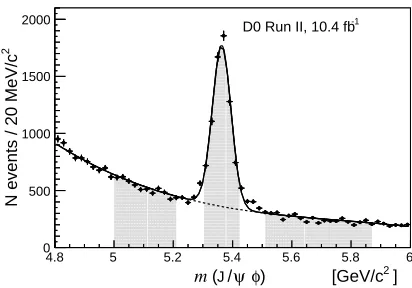
FIG. 1: Invariant mass distribution ofJ/ψφcandidates. The
signal region and two sideband regions are indicated. The solid curve presents the fit results to the function, modeled by a sum of a third order polynomial to describe combinatorial
background and a Gaussian to describe theB0
s signal. The
dotted curve shows the combinatorial background.
are required to penetrate the toroid.
Candidate events are required to include a pair of op-positely charged muons both withpT >1.5 GeV/cin the invariant mass range 2.92 < m(µ+µ−) < 3.25 GeV/c2,
consistent with J/ψ decay, accompanied by two addi-tional particles of opposite charge assumed to be kaons, each with pT > 0.7 GeV/c, with an invariant mass of 1.012< m(K+K−)< 1.030 GeV/c2, consistent with φ
decay, and a third charged particle withpT >0.5 GeV/c assumed to be a pion.
In the event selection, both muons are required to be detected in the muon chambers inside the toroidal mag-net, and at least one of the muons is required to be also detected outside the iron toroid. Each muon candi-date [10] is required to match a track found in the central tracking system, and each of the five final-state tracks is required to have at least one SMT hit and at least one CFT hit. The dimuon invariant mass is constrained to the world-averageJ/ψ mass [11], and the four tracks forming aJ/ψφcandidate are required to satisfy a fit to a common vertex that is displaced from the primary vertex in the plane perpendicular to the beam direction by at least three times the standard deviation of the measure-ment uncertainty. The pion candidate is required to be consistent with originating from the primaryppcollision vertex.
To form a B0sπ± combination, we select the Bs0 candidates in the mass range 5.303 < m(J/ψφ) <
5.423 GeV/c2, corresponding to an interval of±2
stan-dard deviations around the mean value of the recon-structed B0
s mass. Them(J/ψφ) distribution is shown in Fig. 1. The fit, including a third-order polynomial describing the combinatorial background and a sian function describing the signal, yields the Gaus-sian signal parameters m(B0
s) = 5363.3 ±0.6 MeV/c2,
σ(B0
s) = 31.6 ± 0.6 MeV/c2 and the number of
sig-nal events Nev = 5582 ± 100. To improve the
reso-lution of the invariant mass of the B0
sπ± system and to remove the measured B0
s mass bias, we define it as
m(B0
sπ±) = m(J/ψφ π±)−m(J/ψφ) + 5.3667 GeV/c2, where m(J/ψ) is not constrained to the nominal value. We study events as a function of mass in the range 5.5< m(J/ψφ)<5.9 GeV/c2.
Background in the B0
sπ± invariant mass spectrum re-sults from random combinations of selected B0
s can-didates with low momentum charged particles coming mostly from the primary vertex. To suppress background theB0
sπ± system is required to havepT >10 GeV/c. To further reduce background, we impose a limit on the dif-ference between the directions of theB0
s candidate and the pion to be ∆R = p∆η2+ ∆φ2 < 0.3, where η is
the pseudorapidity andφis the azimuthal angle. In ad-dition to increasing the signal-to-background ratio this “cone cut” limits backgrounds that are not included in available simulations.
TheB0
scandidates include genuineBs0mesons and the combinatorial background under the B0
s signal, as seen in Fig. 1. TheB0
sπ± background with a realBs0 meson is modeled using a Monte Carlo (MC) simulation [12] of events containing aB0
s meson and additional pions tuned to reproduce theB0
s transverse momentum distribution in data.
The background with a falseB0
s meson is modeled us-ing the sideband events obtained from data. The chosen sideband regions 5.0< m(J/ψφ)<5.21 GeV/c2and 5.51 < m(J/ψφ)<5.87 GeV/c2 are indicated in Fig. 1. The
sidebands are separated by ∼5σ from the B0
s nominal mass. The left and right sideband ranges are chosen to provide a large event sample and to have an average mass ofm(B0s).
The two background components are found to have similar shapes [13]. The fraction of the realB0
s events in the signal region is obtained from the fit to theB0
smeson in them(J/ψφ) distribution and is found to be (70.9 ±
0.6)%. MC events and the sideband events are mixed in this proportion to obtain the combined background that includes pions from both sources. The event selection re-sults in pions that mainly come from the primary vertex, although pions originating from heavy flavor decays are also present in the sample.
Multiple entries for a single event may occur when more than one pion candidate passes the event selection and they are retained in the sample. The rate of duplicate entries in the mass range 5.5< m(B0
sπ±)<5.6 GeV/c2 (∼5%) is lower than for masses above 5.7 GeV/c2(∼8%). The combined background is modeled by a function of the parameterm0 =mBπ−∆, where mBπ≡m(B0sπ±) and ∆ = 5.5 GeV/c2, of the form:
Fbgr(m0) =P4(C1=0)×exp (P2). (1)
HereP4(C1=0)andP2are fourth- and second-order
5.5 5.55 5.6 5.65 5.7 5.75 5.8 5.85 5.9 0 100 200 300 400 500 600 700 ] 2
) [GeV/c
± π S 0 (B m
N events / 8 MeV
[image:5.612.328.541.54.495.2]Background model w/o cone cut Background model with cone cut Fits to background function
FIG. 2: The combined background for the m(B0
sπ±)
distri-bution described in the text and the fit to that distridistri-bution
with the ∆R <0.3 cone cut and without the cone cut.
to zero. This empirical function gives a good description of the combined backgrounds, as seen in Fig. 2.
The B0
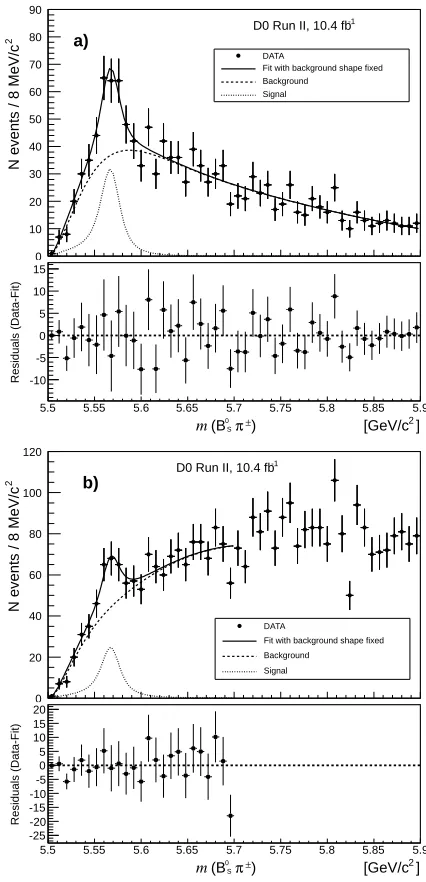
sπ± invariant mass spectrum is shown in Fig. 3(a) with the cone cut and (b) without the cone cut. An enhancement is seen near 5.57 GeV/c2. To extract
the signal parameters, the distributions are fitted with a function F (Eq. 2) that includes two terms: the back-ground termFbgr(mBπ) with fixed shape parameters as
in Fig. 2 and the signal termFsig(mBπ, MX,ΓX), mod-eled by a relativistic Breit-Wigner function convolved with a Gaussian detector resolution function and with the mass-dependent efficiency of the cone cut [13]. Here
MX and ΓX are the mass and the natural width of the resonance. The Gaussian width parameter σres =
3.8 MeV/c2is taken from simulations.
The fit function has the form:
F=fsig×Fsig(mBπ, MX,ΓX) +fbgr×Fbgr(mBπ), (2)
wherefsig andfbgr are normalization factors.
We use the Breit-Wigner parametrization appropriate for anS-wave two-body decay near threshold:
BW(mBπ)∝ M
2
XΓ(mBπ) (M2
X−m2Bπ)2+MX2Γ2(mBπ)
. (3)
The mass-dependent width Γ(mBπ) = ΓX ·(q1/q0) is
proportional to the natural width ΓX, where q1 and q0
are three-vector momenta of the B0
s meson in the rest frame of theBs0π±system at the invariant mass equal to
mBπ andMX, respectively.
In the fit shown in Fig. 3a, the normalization pa-rameters fsig and fbgr and the Breit-Wigner
parame-ters MX and ΓX are allowed to vary. The fit yields the mass and width of MX = 5567.8±2.9 MeV/c2, ΓX = 21.9±6.4 MeV/c2, and the number of signal events
ofN = 133±31. As the measured width is significantly larger than the experimental mass resolution, we infer
5.5 5.55 5.6 5.65 5.7 5.75 5.8 5.85 5.9
0 10 20 30 40 50 60 70 80 90 2
N events / 8 MeV/c
-1
D0 Run II, 10.4 fb
DATA
Fit with background shape fixed Background
Signal
a)
5.5 5.55 5.6 5.65 5.7 5.75 5.8 5.85 5.9
-10 -5 0 5 10 15 ] 2 ) [GeV/c
± π S 0 (B m Residuals (Data-Fit)
5.5 5.55 5.6 5.65 5.7 5.75 5.8 5.85 5.9
0 20 40 60 80 100 120 2
N events / 8 MeV/c
-1
D0 Run II, 10.4 fb
DATA
Fit with background shape fixed
Background
Signal
b)
5.5 5.55 5.6 5.65 5.7 5.75 5.8 5.85 5.9
-25 -20 -15 -10 -5 0 5 10 15 20 ] 2 ) [GeV/c
± π S 0 (B m Residuals (Data-Fit)
FIG. 3: Them(B0
sπ±) distribution together with the
back-ground distribution and the fit results (a) after applying the ∆R <0.3 cone cut and (b) without the cone cut.
thatX(5568)→B0
sπ± is a strong decay. The statistical significance of the signal is defined asp−2 ln(L0/Lmax),
where Lmax andL0 are likelihood values at the best-fit
signal yield and the signal yield fixed to zero. The ob-tained local statistical significance is 6.6σ for the given mass and width values. With the look-elsewhere effect [14] taken into account, the global statistical significance is 6.1σ. The search window is taken as the interval be-tween theB0
sπ±threshold (5506 MeV/c2) and theBd0K± mass threshold (5774 MeV/c2).
[image:5.612.68.278.56.203.2]5.5 5.55 5.6 5.65 5.7 5.75 5.8 5.85 5.9 0
20 40 60 80 100 120 140
]
2
) [GeV/c
±
π
S 0
(B
m
2
) / 20 MeV/c
S
0
N (B
-1
[image:6.612.68.277.58.202.2]D0 Run II, 10.4 fb
FIG. 4: Them(B0
sπ±) distribution resulting from fits of the
B0
s signal to m(J/ψφ) in twenty mass intervals of (B
0
sπ±)
candidates described in the text. The solid line shows the result of the fit. The dashed line shows the contribution of
events due toB0
s background from simulations. There is no
non-B0
s background.
exceed background for m(Bsπ±) > MX [13]. We per-form a fit in the restricted rangem(B0
sπ±)<5.7 GeV/c2 (Fig. 3b) and find the fitted number of signal events to be 106±23, with a corresponding local statistical significance of 4.8σ. The difference in yields with and without the cone cut is not fully explained by statisti-cal fluctuations. In a subsidiary study we used empiristatisti-cal functions [15] for the background fitted to the sidebands in data below the X(5568) region and above the signal region up to 5.9 GeV/c2 and found signal yields that
are greater than those with the default background func-tion and comparable to or greater than that found in the cone cut analysis. These results confirm that using a background function that agrees with data for masses above 5.7 GeV can increase the fitted signal yield above that obtained using the default background model. Addi-tional background processes not present in our MC such asBc→Bsnπwithn >1, or other new states at higher mass, would thus have the effect of reducing theX(5568) yield for the no-cone cut case.
As a cross-check, we extract a pure B0
sπ± signal by performing fits of the number ofB0
s events in the J/ψφ mass distribution in 20 MeV intervals in the range 5.5< m(B0
sπ±)<5.9 MeV/c2. Results of those fits are shown in Fig. 4. A fit to the dependence of resultingB0
syields on
m(B0
sπ±), with the mass and natural width fixed to the previously obtained values, gives 118±22 signal events. This result confirms that the observed signal is due to
B0
sπ±candidates with genuineBs0mesons and thus elim-inates the possibility of non-B0
s processes mimicking the signal.
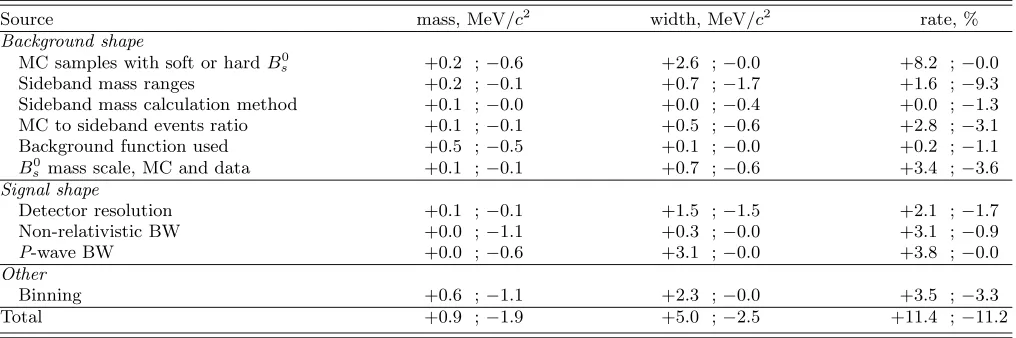
We obtain the systematic uncertainties for the mea-sured values of the X(5568) state mass, natural width, and the number of events. The dominant uncertainties are due to the background and signal shapes. We eval-uate the systematic uncertainties due to the background
shape by a) using different models of bottom pair pro-duction in generating theB0
s MC samples, b) varying the sideband mass intervals, c) changing the way theB0
smass constraint is applied in the calculation of m(B0
sπ±) for the sideband events by replacing the mass difference de-fined in the text by the kinetic energy obtained by forcing
m(J/ψφ) to the world-averageB0
s mass, d) changing the ratio of the MC to the sideband events within 1σ, e) using different background functions by replacing the fourth-order polynomial in Eq.1 with a third- or fifth-fourth-order poly-nomial or replacing the second-order polypoly-nomial in the exponential with the first- or third-order polynomial, and f) varying the nominal B0
s mass within ±1 MeV/c2 in the background samples, both for the sideband data and simulated events. The systematic uncertainties due to the signal shape are evaluated by a) varying the detec-tor resolution within±1 MeV/c2around the mean value,
b) using a non-relativistic Breit-Wigner function, and c) using aP-wave relativistic Breit-Wigner function.
Additionally, we estimate the systematic uncertainties due to the binning by changing the bin size to 5 MeV/c2
and to 10 MeV/c2instead of 8 MeV/c2, and shifting the
lower edge of the mass scale by 1/3, 1/2 and 2/3 of the bin size. All systematic uncertainty sources are summarized in Table 1. The uncertainties are added in quadrature separately for positive and negative values to obtain the total systematic uncertainties for each measured parame-ter and are treated as nuisance parameparame-ters to construct a prior predictive model [11, 16] of our test statistic. When the systematic uncertainties are included, the significance of the observed signal including the look-elsewhere effect is reduced to 5.1σ. For the analysis without the ∆Rcut (Fig. 3b) we obtain a significance including the system-atic uncertainty and the look-elsewhere effect of 3.9σ.
The stability of the result is checked by examining sub-samples with a) different signs of theπ± meson, b)
dif-ferent ranges of the azimuth and rapidity, c) the distance between theBs0vertex and the primary vertex changed to five standard deviations, d) different B0
s mass windows (1.7σ, 1.5σ, 1.2σ), e) different B0
sπ± momentum inter-vals (pT > 9 GeV/c, pT > 12 GeV/c), and f) different cone cuts (∆R <0.2, ∆R <0.15). Taking into account the efficiencies of these cuts, no unexpected behaviors are observed in these tests.
The invariant mass spectra of B0
s candidates and charged tracks with kaon or proton mass hypotheses, are checked and no resonant-like enhancements in these dis-tributions are found.
We measure the ratio ρof the yield of the new state
X(5568) to the yield of the B0
s meson in two kinematic ranges, 10< pT(Bs0)<15 GeV/cand 15< pT(B0s)<30 GeV/c, by repeating them(B0
sπ) fits with free mass and width parameters for theX(5568) signal [13]. The results forρare (9.1±2.6±1.6)% and (8.2±2.7±1.6)%, re-spectively, with an average of (8.6± 1.9 ±1.4)%. The systematic uncertainties due to B0
TABLE I: Systematic uncertainties for the observedX(5568) state mass, natural width and number of events.
Source mass, MeV/c2
width, MeV/c2
rate, % Background shape
MC samples with soft or hardB0
s +0.2 ;−0.6 +2.6 ;−0.0 +8.2 ;−0.0
Sideband mass ranges +0.2 ;−0.1 +0.7 ;−1.7 +1.6 ;−9.3
Sideband mass calculation method +0.1 ;−0.0 +0.0 ;−0.4 +0.0 ;−1.3
MC to sideband events ratio +0.1 ;−0.1 +0.5 ;−0.6 +2.8 ;−3.1
Background function used +0.5 ;−0.5 +0.1 ;−0.0 +0.2 ;−1.1
B0
s mass scale, MC and data +0.1 ;−0.1 +0.7 ;−0.6 +3.4 ;−3.6
Signal shape
Detector resolution +0.1 ;−0.1 +1.5 ;−1.5 +2.1 ;−1.7
Non-relativistic BW +0.0 ;−1.1 +0.3 ;−0.0 +3.1 ;−0.9
P-wave BW +0.0 ;−0.6 +3.1 ;−0.0 +3.8 ;−0.0
Other
Binning +0.6 ;−1.1 +2.3 ;−0.0 +3.5 ;−3.3
Total +0.9 ;−1.9 +5.0 ;−2.5 +11.4 ;−11.2
and selection efficiency is obtained from a simulated sam-ples of events with a spinless particle of mass equal to 5568 MeV/c2 decaying to B0
s and a charged pion. The pion efficiency increases withpT(Bs0) from (26.1±3.2)% to (42.1±6.5)% for the twopT(Bs) ranges. The system-0 atic uncertainty due to a potential difference of the soft pion reconstruction efficiency in MC and data of±5% is accounted for in systematics. Within uncertainties, the production ratioρdoes not depend onpT(Bs0).
A possible interpretation of the observed structure is a four-quark state made up of a diquark-antidiquark pair. With the B0
sπ+ produced in an S wave, its quantum numbers would be JP = 0+. Thus, the state may be a
heavy analogue of the isotriplet scalar statea(980), with ansquark replaced by abquark. Such open charm and open bottom scalar mesons are predicted in Ref. [17]. On the other hand, the state can decay through the chain
B∗
sπ±, B∗s → Bs0γ, where the low-energy photon is not detected. In this case, the quantum numbers of this state would be JP = 1+ that would make it a counterpart to
other heavy tetraquark candidates. The mass of the new state would be shifted by addition of the nominal mass differencem(B∗
s)−m(B0s), while its width would remain unchanged. The large difference between the mass of this state and the sum of theBdandK± masses implies [18] that X(5568) is unlikely to be a molecular state com-posed of loosely boundBdandK± mesons.
In summary, a structure is seen in the B0
sπ± invari-ant mass spectrum near threshold with a statistical sig-nificance, including the look-elsewhere effect, of 6.1σ. When the systematic uncertainties are included, the sig-nificance of the signal is 5.1σ. For the alternate analysis without the ∆R cut, we find the corresponding signif-icance of 3.9σ. This structure may be interpreted as a tetraquark state with four different valence quark flavors,
b, s, u, d. The mass and natural width of the X(5568) state arem= 5567.8±2.9 (stat)+0−1..99(syst) MeV/c2 and
Γ = 21.9±6.4 (stat)+5−2..05(syst) MeV/c2.
We thank E. Gross and O. Vittels for useful discus-sions. We thank the staffs at Fermilab and collaborating institutions, and acknowledge support from the Depart-ment of Energy and National Science Foundation (United States of America); Alternative Energies and Atomic En-ergy Commission and National Center for Scientific Re-search/National Institute of Nuclear and Particle Physics (France); Ministry of Education and Science of the Rus-sian Federation, National Research Center “Kurchatov Institute” of the Russian Federation, and Russian Foun-dation for Basic Research (Russia); National Council for the Development of Science and Technology and Carlos Chagas Filho Foundation for the Support of Research in the State of Rio de Janeiro (Brazil); Department of Atomic Energy and Department of Science and Tech-nology (India); Administrative Department of Science, Technology and Innovation (Colombia); National Council of Science and Technology (Mexico); National Research Foundation of Korea (Korea); Foundation for Funda-mental Research on Matter (The Netherlands); Science and Technology Facilities Council and The Royal Soci-ety (United Kingdom); Ministry of Education, Youth and Sports (Czech Republic); Bundesministerium f¨ur Bildung und Forschung (Federal Ministry of Education and Re-search) and Deutsche Forschungsgemeinschaft (German Research Foundation) (Germany); Science Foundation Ireland (Ireland); Swedish Research Council (Sweden); China Academy of Sciences and National Natural Science Foundation of China (China); and Ministry of Education and Science of Ukraine (Ukraine).
[1] S.-K. Choiet al. (Belle Collaboration), “Observation of
a Resonancelike Structure in theπ±ψ′Mass Distribution in ExclusiveB→Kπ
142001 (2008).
[2] R. Mizuk et al. (Belle Collaboration), “Observation of
two resonancelike structures in theπ+χc
1mass
distribu-tion in exclusiveB0→K−π+
χc1 decays”, Phys. Rev. D
78, 072004 (2008).
[3] T. Aaltonen et al.(CDF Collaboration), “Evidence for
a Narrow Near-Threshold Structure in the J/ψφ Mass
Spectrum inB+
→J/ψφK+ Decays”, Phys. Rev. Lett.
102, 242002 (2009).
[4] A. Bondar et al. (Belle Collaboration), “Observation of
Two Charged Bottomoniumlike Resonances in Υ(5S)
De-cays”, Phys. Rev. Lett.108, 122001 (2012).
[5] M. Ablikimet al.(BESIII Collaboration), “Observation
of a Charged Charmoniumlike Structure in e+
e− →
π+π−J/ψ at √s = 4.26 GeV”, Phys. Rev. Lett. 110,
252001 (2013).
[6] Z. Q. Liuet al.(Belle Collaboration), “Study ofe+
e−
→
π+π−J/ψ and Observation of a Charged
Charmonium-like State at Belle”, Phys. Rev. Lett.110, 252002 (2013).
[7] M. Ablikimet al.(BESIII Collaboration), “Observation
of a Charged Charmoniumlike Structure in e+e−
→
(D∗D¯∗±π∓ at √s = 4.26 GeV”, Phys. Rev. Lett. 112,
132001 (2014).
[8] R. Aaij et al. (LHCb Collaboration), “Observation of
J/ψpResonances Consistent with Pentaquark States in
Λ0
b → J/ψK−pdecays”, Phys. Rev. Lett. 115, 072001
(2015).
[9] V. M. Abazovet al.(D0 Collaboration), “The upgraded
D0 detector”, Nucl. Instrum. Methods Phys. Res. A565,
463 (2006).
[10] V. M. Abazovet al. (D0 Collaboration), “Muon
recon-struction and identification with the Run II D0 detector”,
Nucl. Instrum. Methods Phys. Res. A737, 281 (2014).
[11] K. A. Olive et al., (Particle Data Group), “Review of
Particle Physics”, Chin. Phys. C38, 090001 (2014).
[12] T. Sj¨ostrand et al., “High-energy-physics event
genera-tion with PYTHIA 6.1”, Comp. Phys. Commun. 135,
238 (2001). We use versions 6.323 and 6.409.
[13] See the supplemental material at http:xxx[/to be
supplied by PRL/].
[14] E. Gross, O. Vitells, “Trial factors for the look elsewhere
effect in high energy physics”, Eur. Phys. J.,C70, 525
(2010).
[15] One alternate background function is a third order Chebychev polynomial. The second is that employed in a previous study of exotic heavy flavor mesons,
V. M. Abazovet al.(D0 Collaboration), “Inclusive
pro-duction of theX(4140) state inppcollisions at D0”, Phys.
Rev. Lett.115, 232001 (2015).
[16] C. Giunti, “Treatment of the background error in the statistical analysis of Poisson processes”, Phys. Rev. D
59, 113009 (1999).
[17] L. Maiani, F. Piccinini, A. D. Polosa, and V. Riquer,
“New Look at Scalar Mesons”, Phys. Rev. Lett. 93,
212002 (2004).
[18] M. Karliner, “Doubly Heavy Tetraquarks and Baryons”,