Statistical modelling and optimization of Cr(VI)
Bacterial strains using
Rachna Bhateria* and Rajesh
Department of Environmental Sciences, M.D.University, Rohtak
ARTICLE INFO ABSTRACT
The present study utilizes two indigenous bacterial strains
Cr(VI) into Cr(III). The interactive effect of three crucial operating parameters via pH, temperature and initial Cr(VI) ion concentration were studied. The experiments were designed using Box
surface methodology. For the construction of quadratic model, total seventeen experiments were conducted for the two bacterial strains. The coefficient of determination (R
14.26 and its low P
fitness of response surface quadratic model. The regression equation coefficients were calculated and the data fitted to second order polynomial equation in both
INTRODUCTION
Industrialization is often accepted as a hallmark of civilization. Since then, progressive metallurgy and use of metals and chemicals in numerous industries have resulted in generation of large quantities of liquid effluent loaded with tremendous amount of heavy metals, often as bioavailable, mobile and thus toxic ionic species (
2003; Peakall and Burger, 2003). Thus metal as a kind of resource is becoming shortage and also brings about serious environmental pollution, threatening human health and ecosystem. Heavy metals are elements having atomic weight between 63.5 and 200.6 and a specific gravity greater than 5.0 (Srivastava and Majumder, 2008; Fu and Wang, 2011). Due to their elemental non-degradable nature, heavy metals always and regardless of their chemical form, pose serious risk, when released into the environment. Various physicochemical and biological processes are usually employed to remove pollutants from industrial wastewaters before discharging into the environment (Hai et al., 2007). Treatment of adsorptive pollutants
precipitation or coagulation is less effective and more expensive when the adsorbents are in low concentration range (
2010; Crini, 2005; Crini, 2006). Moreover, the cost of setting up the required method and to operate these processes is prohibitively high for large scale treatment.
Hexavalent chromium is one of such serious pollutant which is discharge as a result of the wide use of chromium compounds in industries such as leather tanning, chrome plating, pigment production and thermonuclear weapons manufacture (
Thakur, 2012). Chromium, a steel grey, lustrous, hard and brittle metal, occurs in nature in the bound form that constitutes 0.1 mg/Kg of the Earth’s crust. It has several oxidation states ranging from (-II) to (+VI), the trivalent and hexavalent states being the most stable (Pulane et al., 2008). Its high solubility in aqueous systems, its permeability through biological membranes and subsequent interaction with intracellular proteins and nucleic acids
Hasnain, 2005; Garavaglia et al., 2010) together with carcinogenic
*Corresponding author: [email protected]
ISSN: 0975-833X
Article History:
Received 11th November, 2012
Received in revised form
25th December, 2012
Accepted 30th January, 2013
Published online 14th February, 2013
Key words:
Salmonella sp., Cr (VI), Response surface methodology, Box-Behnken model.
RESEARCH ARTICLE
Statistical modelling and optimization of Cr(VI) Biotransformation
strains using response surface methodology
Rachna Bhateria* and Rajesh Dhankhar
Department of Environmental Sciences, M.D.University, Rohtak-124001, Haryana, India
ABSTRACT
The present study utilizes two indigenous bacterial strains Salmonella sp.
Cr(VI) into Cr(III). The interactive effect of three crucial operating parameters via pH, temperature and initial Cr(VI) ion concentration were studied. The experiments were designed using Box
surface methodology. For the construction of quadratic model, total seventeen experiments were conducted for the two bacterial strains. The coefficient of determination (R2) value 0.9452 and 0.9483, model F
14.26 and its low P-value (F < 0.0012 and F < 0.0010) in Salmonella sp.
fitness of response surface quadratic model. The regression equation coefficients were calculated and the data
fitted to second order polynomial equation in both Salmonella sp. S1 and S2.
Copy Right, IJCR, 2013, Academic Journals
hallmark of civilization. Since then, progressive metallurgy and use of metals and chemicals in numerous industries have resulted in generation of large quantities of liquid effluent loaded with tremendous amount of heavy metals, often ile and thus toxic ionic species (Calderon et al.,
). Thus metal as a kind of resource is becoming shortage and also brings about serious environmental pollution, threatening human health and ecosystem. Heavy metals are ts having atomic weight between 63.5 and 200.6 and a specific
Srivastava and Majumder, 2008; Fu and
degradable nature, heavy metals always and regardless of their chemical form, pose serious risk, when released into the environment. Various physicochemical and biological processes are usually employed to remove pollutants from industrial wastewaters before discharging into the environment ). Treatment of adsorptive pollutants with chemical precipitation or coagulation is less effective and more expensive when the adsorbents are in low concentration range (Park et al.,
). Moreover, the cost of setting up the cesses is prohibitively high
Hexavalent chromium is one of such serious pollutant which is discharge as a result of the wide use of chromium compounds in industries such as leather tanning, chrome plating, pigment thermonuclear weapons manufacture (Srivastava and
). Chromium, a steel grey, lustrous, hard and brittle metal, occurs in nature in the bound form that constitutes 0.1-0.3 mg/Kg of the Earth’s crust. It has several oxidation states ranging II) to (+VI), the trivalent and hexavalent states being the most ). Its high solubility in aqueous systems, its permeability through biological membranes and subsequent interaction with intracellular proteins and nucleic acids (Sultan and
) together with carcinogenic [email protected],
and mutagenic effects on living organisms (
makes industrial effluents receive specific treatments for Cr(VI) elimination. Microbial uptake and reduction of toxic Cr(VI) have practical importance because biological strategies provide green technology that is cost effective (
Sarkar, 2011).
In recent years, applying biotechnology in controlling and removing metal pollution has been paid much attention and gradually becomes hot topic in the field of metal pollution control because of its potential application. It involves the use of certain natural materials of biological origin including bacteria, fungi, yeast, algae etc. These biomaterials can effectively sequester dissolved metal ions out of dilute complex solution with high efficiency and quickl
is an ideal candidate for the treatment of high volume and low concentration complex wastewaters (
and Chen, 2009).
Biotransformation of Cr(VI) can occur by microbial metabolism mediated by enzymatic process. A wid
bacterial isolates have been reported and the mechanism of resistant to this compound may be encoded either plasmid or by chromosomal genes (Cervantes and
Campos-potential to transform Cr(VI) to both soluble Cr(III) and insoluble Cr(III). The soluble Cr(III) is probably complexes with organic ligands by enzymatic and chemical reductions in the presence of cellular organic compounds, to form stable and soluble organo Cr(III) complexes (Puzon et al., 2005; Puzon
mechanisms for Cr(VI) reduction through chromate reductase enzymes are of paramount importance because they convert toxic, mobile element into less toxic, immobile form (
al., 2004). Microbial treatments based on biotransformation of Cr(VI) to Cr(III) which is easily immobilized as Cr(OH)
with low Cr(VI) amounts (Garavaglia
offer an economical as well as eco detoxification and bioremediation (
International Journal of Current Research
Vol. 5, Issue, 02, pp.303-312, February, 2013
INTERNATIONAL
Biotransformation by indigenous
surface methodology
124001, Haryana, India
Salmonella sp. S1 and S2 for biotransformation of Cr(VI) into Cr(III). The interactive effect of three crucial operating parameters via pH, temperature and initial Cr(VI) ion concentration were studied. The experiments were designed using Box-Behnken matrix and Response surface methodology. For the construction of quadratic model, total seventeen experiments were conducted for the ) value 0.9452 and 0.9483, model F- value 13.39 and
Salmonella sp. S1 and S2 respectively confirmed the fitness of response surface quadratic model. The regression equation coefficients were calculated and the data
1 and S2.
, Academic Journals. All rights reserved.
and mutagenic effects on living organisms (Megharaj et al., 2003) makes industrial effluents receive specific treatments for Cr(VI) elimination. Microbial uptake and reduction of toxic Cr(VI) have practical importance because biological strategies provide green technology that is cost effective (Sundar et al., 2010; Panda and
In recent years, applying biotechnology in controlling and removing metal pollution has been paid much attention and gradually becomes hot topic in the field of metal pollution control because of its application. It involves the use of certain natural materials of biological origin including bacteria, fungi, yeast, algae etc. These biomaterials can effectively sequester dissolved metal ions out of dilute complex solution with high efficiency and quickly, therefore it is an ideal candidate for the treatment of high volume and low concentration complex wastewaters (Wang and Chen, 2006; Wang
Biotransformation of Cr(VI) can occur by microbial metabolism mediated by enzymatic process. A wide variety of chromate resistant bacterial isolates have been reported and the mechanism of resistant to this compound may be encoded either plasmid or by chromosomal
-Garcia, 2007). Bacteria have the to both soluble Cr(III) and insoluble Cr(III). The soluble Cr(III) is probably complexes with organic ligands by enzymatic and chemical reductions in the presence of cellular organic compounds, to form stable and soluble
organo-., 2005; Puzon et al., 2008). Microbial mechanisms for Cr(VI) reduction through chromate reductase enzymes are of paramount importance because they convert toxic, mobile element into less toxic, immobile form (Garcia-Arellano et
eatments based on biotransformation of Cr(VI) to Cr(III) which is easily immobilized as Cr(OH)3, are still efficient Garavaglia et al., 2010). These methods offer an economical as well as eco-friendly option for chromate detoxification and bioremediation (Pal et al., 2005).
The efficiency of biotransformation depends upon many factors: pH, temperature and initial metal ion concentration. The variability of these factors in real waste water makes it necessary to know how they influence biotransformation performance. The influence of parameters should be investigated to achieve the optimum experimental conditions for biotransformation of Cr(VI) to Cr(III) from aqueous solution. Optimizing the medium parameters applying “one variable at a time” method is laborious, time consuming and did not provided accurate optimum conditions between two or factors furthermore, if several factors play a role, their interaction would be discernable if they were dominated. Response surface methodology (RSM) essentially a particular set of mathematical and statistical techniques for experimental design and evaluating the effects of variables to predict targeted responses (Gu et al., 2005; Senthilkumar et al., 2005; Cui et al., 2010). It is used to evaluate the relative significance of several affecting factors even in the presence of complex interactions. There is no report on optimization of biotransformation process for Cr(VI) with bacterial strains
Salmonella sp. S1 and Salmonella sp. S2 using response surface
methodology. RSM was applied to Box-Behnken design (Box and Draper, 1987). The Box-Behnken model was based on statistical evaluation of following tests: root-mean-square (RMSE), bias Index and accuracy factor and the lack-of-fit test. Present study deals with isolation and characterization of two indigenous bacterial strains
Salmonella sp. S1 and Salmonella sp. S2. Both the strains were
optimized using response surface methodology (RSM) to study interactive effects of various parameters. Box-Behnken design matrix have been used for the optimization of Cr(VI) biotransformation using bacterial strains Salmonella sp. S1 and Salmonella sp. S2. Three important process parameters pH, temperature and initial Cr(VI) ion were optimized for the evaluation of single and interactive effects of variables.
MATERIAL AND METHODS
Study area
Soil and effluent samples were collected from Electroplating industry Lakshmi Precision Screws Ltd., Rohtak District, Haryana, India in the month of February, 2011. Rohtak district is located in Southeastern part of Haryana State. The climate of the sampling site is semi-arid with extreme temperature conditions in summer and winter. The soil samples were collected in sealed plastic bags and stored at 40C. The industry mainly uses chromium, nickel and zinc for metal plating process.
Physicochemical characterization of effluent and soil samples
Various physico-chemical parameters of the effluent sample were analyzed - color, temperature, pH, conductivity, oil and grease, TDS, TSS, BOD, COD, Sulfate, Phosphate, total chromium, hexavalent chromium and other metals. The physico-chemical characterization of soil sample included organic matter, potassium, sodium and total chromium.
Scanning electron micrographs and energy-dispersive X-ray (SEM-EDX) analysis of soil sample
The SEM-EDX of the soil sample contaminated with chromium was performed to observe the morphological and elemental composition of the soil particles along with their density. The SEM-EDX analysis was done using computer controlled field emission SEM equipped with EDX detection system from All India Institute of Medical Sciences, New Delhi. EDX spectrometer revealed the chemical composition of the soil.
Isolation and characterization of chromium resistant bacterial strains
Two bacterial strains Salmonella sp. S1 and Salmonella sp. S2 were isolated from the effluent of electroplating industry. The bacterial
bacteriological agar -5.0; sodium chloride -8.0; beef extract- 3.0, Yeast extract – 2; agar -2% and pH 7.0. Purification of the bacterial strains was done through repeated streaking on basal agar medium using serial dilution technique. The growths of bacterial cells were observed after incubation of 48 h at 300C. Pure colonies obtained, were identified from Microbial Type Culture Collection (MTCC), Institute of Microbial Technology, Chandigarh. The identification tests involved the morphological, physiological and biochemical characterization of bacterial strains.
RESPONSE SURFACE METHODOLOGY
Biotransformation of Cr(VI) is significantly affected by process parameters such as initial pH, incubation temperature and initial Cr(VI) ions concentration. The optimization study was conducted in batch mode using nutrient broth media. The Box- Behnken factorial design, which is standard RSM, was established on the basis of Design Expert Factorial design (Stat Ease, 8.0 trial version) for the optimization of Cr(VI) biotransformation process. Three independent variables via pH (4 – 8), incubation temperature (250C – 350C) and initial Cr(VI) ions concentration (10- 40 mg/L) were studied at three different levels to obtain response i.e. biotransformation of Cr(VI) ions. The experiment design was obtained after the selection of three independent variables (maximum and minimum values). Box Behnken design is a spherical, revolving design, it consists of a central point and the middle points of the edges of the cube circumscribed on the sphere (Evans, 2003). The present study utilized three- level, three-factorial Box-Behnken experimental design which was constituted of 17 experiments. The initial 12 experiments were organized in a factorial design and the experimental trials from 13 to 17 involved the replication of the central point. The repeated observations at the central point were used for the estimation of experimental error involved in the study.
The Cr(VI) biotransformation percentage by bacterial strains was calculated using the equation as follows:
% Cr(VI) biotransformation = (C0 – Cf )*100/ C0
Where, C0 is the initial concentration of C(VI) ions (mg/L) and Cf is
the final concentration of metal ion (mg/L)
To confirm the phenomenon of biotransformation, the initial and final concentration of total chromium and Cr(III) was also recorded in all the bacterial batch cultures.
Statistical Analysis
Statistical testing of the model was performed with F-test to obtain the mathematical relationship between response i.e. Cr(VI) biotransformation and the process variables. In order to ensure a good model, the test for significance of regression model was performed by applying the analysis of variance (ANOVA). Following quadratic equation was obtained by varying three parameters:
Yi = ao + ∑ai Xi + ∑ aiiX2ii + ∑aijXiXj + e
Where, Yi (i = 3) is predicted response i.e. biotransformation of
Cr(VI) ions using bacterial strains, ao is the constant coefficient, ai is ith linear coefficient or slope, aii is the ith quadratic coefficient and aij
is different interaction coefficients of the model; Xi, Xj are the
independent variables and e is the residual error of the model. The independent variables are coded as A, B and C in the present study. The second order polynomial function was fitted to correlate the relationship between independent variables and the response for prediction of the optimum point conditions.
Y = ao + aiA + aiB + aiC + aiA2 + aiB2 + aiC2 + aijA*B + aijA*C +
aijB*C
carried out in triplicates. T-test was used to find the significance of the regression coefficients. The residual error, pure error and lack of fit were calculated from the repeated measurements (Reddy et al., 2008; Myers and Montgomery, 2002). The desirable response was selected as maximum % Cr(VI) biotransformation at optimum pH, temperature and initial Cr(VI) ions concentration. The relationship between response and experimental levels for each of the factors could be observed as fitted polynomial equation in form of surface plots.
Quantification of total Chromium and Cr(VI)
Hexavalent chromium was determined spectrophotometrically using s-diphenyl carbazide method (APHA, 1998). The absorbance was measured at 540 nm using UV-Visible spectrophotometer UV-2450 Shimadzu. Total chromium was quantified using Atomic absorption spectrophotometer after digestion of microbial culture samples with sulfuric acid and nitric acid on hot plate.
RESULTS AND DISCUSSION
Physico-chemical analysis of electroplating effluent and contaminated soil samples
[image:3.595.85.518.257.475.2]Physicochemical parameters of electroplating effluent and soil samples were analysed. The results were summarised in Table 1 and 2 respectively. The pH of the electroplating effluent was 5.6 which indicated that soil was acidic in nature. The concentration of Cr(VI) in the electroplating effluent was estimated to be 25 mg/L. The total chromium in the effluent and soil were observed to be 48 mg/L and 6.0 mg/L respectively. The maximum permissible limit for total chromium and Cr(VI) in the effluent is 2 and 0.1 mg/L (EPA, 1987). Hence the effluent sample showed many folds increase in Cr(VI) concentration.
Table 1. Concentration of Physico-chemical parameters in Electroplating waste water samples
Parameters Concentration Standards*
Color
Temperature(0C)
pH(1:2)
Conductivity (millimoh/cm2)(1:2)
Oil and grease Total dissolved solids Total suspended solids Biochemical oxygen demand Chemical oxygen demand Sulfate
Phosphate Total chromium Hexavalent chromium Cadmium
Copper Iron Nickel Lead Zinc
Dull green 18.90±0.06
5.66±0.61 59.2
20 480±0.62 58±0.93 58±0.93 675±0.45 199 0.79 48±0.186 25±0.823 16.85±0.914 0.354±0.01 3.31±0.31 27.713 0.66±0.094 40.54 ±0.26
-
Shall not exceed 5oC above ambient temperature of receiving
water body 6.0 to 9.0 -
10 2100
30 250
2.0 0.1 2.0 3.0 3.0 3.0 0.1 0.5
All values are expressed in mg/L, otherwise stated; values are mean ±SD (n=3) *Source- Environmental Protection Agency Notification, 1987
[image:3.595.153.452.501.737.2]Scanning electron microscopy and energy-dispersive X-ray microanalysis spectrum of soil sample –
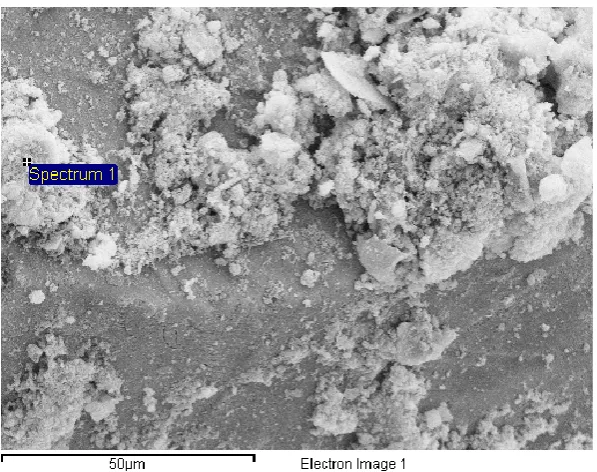
The morphological characteristics of the soil sample was observed using SEM analysis as shown in Fig 1. The results showed that the Cr(VI) contaminated soil sample was heterogeneous in texture and consisted of various small and large size particles. EDX of the soil sample was performed along with SEM which showed that chromium is present in the soil sample along with other heavy metals such as iron, Aluminium and Silicon. The result of EDX is shown in Fig 2.
Table 2. Physiochemical characteristics of soil collected from electroplating industry
Parameters Concentration
Soil organic matter (%) Total Chromium (mg/g) Potassium (1:2) (mg/L) Sodium (1:2) (mg/L)
1.85±0.5 6.00±2.5 112.50±5.6 61.60±3.21
Isolation and characterisation of chromium resistant bacterial strains
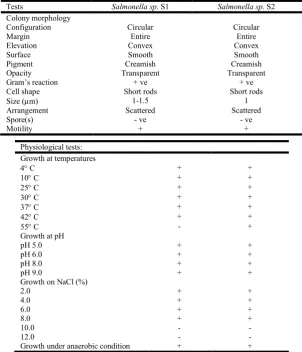
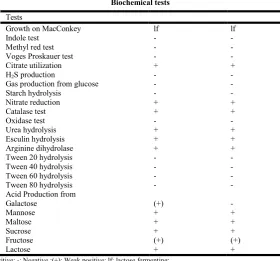
[image:4.595.66.497.190.414.2]Bacterial strains were isolated from the soil sample collected from electroplating industry by using culture medium Composition of culture medium (Jeyasingh and Philip, 2005) used is as follows: Peptone- 10 g, Beef extract- 2 g, Yeast extract -1 g, sodium chloride- 5 g. The pH of the culture medium was maintained at 7. Double distilled water was used for the preparation of the medium. Bacterial isolation was done in solidified culture medium (2% agar) using standard serial dilution technique. Through repeated streaking on basal agar medium, purification of species was done. The morphological, physiological and biochemical characteristics of the two isolated species are shown in Table 3. Based on the studied characteristics, the two isolated species were identified as Salmonella sp. S1 and S2 respectively.
[image:4.595.153.456.439.792.2]Fig. 2. EDX of the Electroplating effluent contaminated soil
Table 3: Morphological, physiological and biochemical characteristics of Salmonella sp. S1 and S2
Morphological tests
Tests Salmonella sp. S1 Salmonella sp. S2
Colony morphology
Configuration Circular Circular
Margin Entire Entire
Elevation Convex Convex
Surface Smooth Smooth
Pigment Creamish Creamish
Opacity Transparent Transparent
Gram’s reaction + ve + ve
Cell shape Short rods Short rods
Size (m) 1-1.5 1
Arrangement Scattered Scattered
Spore(s) - ve - ve
Motility + +
Physiological tests: Growth at temperatures
4 C + +
10 C + +
25 C + +
30 C + +
37 C + +
42 C + +
55 C - +
Growth at pH
pH 5.0 + +
pH 6.0 + +
pH 8.0 + +
pH 9.0 + +
Growth on NaCl (%)
2.0 + +
4.0 + +
6.0 + +
8.0 + +
10.0 - -
12.0 - -
Biochemical tests
Tests
Growth on MacConkey lf lf
Indole test - -
Methyl red test - -
Voges Proskauer test - -
Citrate utilization + +
H2S production - -
Gas production from glucose - -
Starch hydrolysis - -
Nitrate reduction + +
Catalase test + +
Oxidase test - -
Urea hydrolysis + +
Esculin hydrolysis + +
Arginine dihydrolase + +
Tween 20 hydrolysis - -
Tween 40 hydrolysis - -
Tween 60 hydrolysis - -
Tween 80 hydrolysis - -
Acid Production from
Galactose (+) -
Mannose + +
Maltose + +
Sucrose + +
Fructose (+) (+)
Lactose + +
[image:5.595.159.440.53.314.2]+: Positive; -: Negative ;(+): Weak positive; lf: lactose fermenting;
Table 4. The experimental domain factor and level for the Box-Behnken design
Code Name of factor Range and levels (coded)
-1 0 +1
A B C
pH
temperature (0C)
[image:5.595.44.549.409.583.2]Initial concentration (mg/L) 4 25 10 6 30 25 8 35 40
Table 5. The Box-Behnken design matrix for experimental design and observed response for Cr(VI) biotransformation with Salmonella sp. S1
Experimental Run pH (A) Temperature (oC) (B) Initial Concentration (mg/L) (C) % Biotransformation Growth (OD 620 nm)
1 2 3 4 5 6 7 8 9 10 11 12 13 14 15 16 17 4.00 8.00 4.00 8.00 4.00 8.00 4.00 8.00 6.00 6.00 6.00 6.00 6.00 6.00 6.00 6.00 6.00 25.00 25.00 35.00 35.00 30.00 30.00 30.00 30.00 25.00 35.00 25.00 35.00 30.00 30.00 30.00 30.00 30.00 25.00 25.00 25.00 25.00 10.00 10.00 40.00 40.00 10.00 10.00 40.00 40.00 25.00 25.00 25.00 25.00 25.00 17 53 14 73 20 75 13 49 75 53 50 43 79 60 75 75 79 0.09 0.49 0.19 1.75 0.18 1.92 0.11 0.50 1.88 0.59 0.51 0.93 2.19 1.66 1.92 1.99 2.25
Table 6. The Box-Behnken design matrix for experimental design and observed response for Cr(VI) biotransformation with Salmonella sp. S2
Experimental Run pH (A) Temperature (oC) (B) Initial Concentration (mg/L) (C) % Biotransformation Growth (OD 620 nm)
[image:5.595.43.543.608.783.2]Response surface methodology and statistical analysis
The Box–Behnken design matrix and RSM experiments were used to determine the effect of three significant variables: pH, temperature and initial concentration of Cr(VI) ions on response, i.e. biotransformation of Cr (VI) ions. The domain factor and level selected for designing the box-behnken design is presented in Table
4. The box-behnken design and observed response for
biotransformation of Cr(VI) ions by Salmonella sp. S1 and S2 are shown in Table 5 and 6 respectively. The relationship between independent variables and response was drawn by second-order polynomial equations. The regression equation coefficients calculated were also fitted to the second-order polynomial equation.
% Biotransformation of Cr(VI) by Salmonellasp S1 = +73.60 + 23.25*A 1.50*B 8.50 *C + 5.75*A*B 4.75*A*C + 3.75*B*C -25.18*A2 - 9.17*B2 - 9.18*C2 (1)
% Biotransformation of Cr(VI) by Salmonella sp S2 = +72.40 + 21.75*A - 1.25*B - 8.75*C + 6.25*A*B - 5.25*A*C + 5.25*B*C - 22.32*A2 - 9.82*B2 - 10.33*C2 (2)
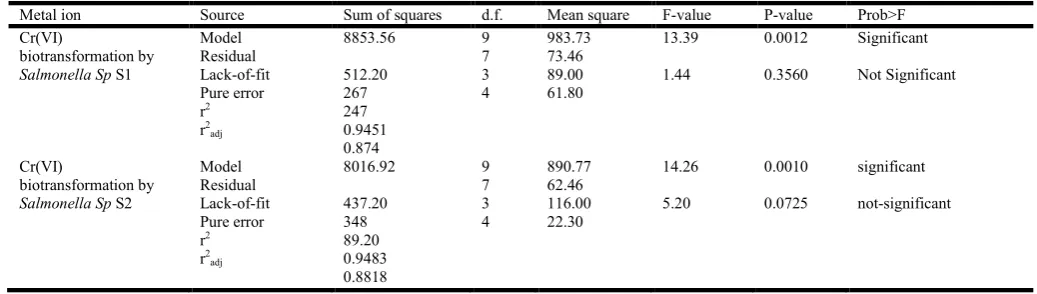
Significance of each coefficient was determined by Student t-test and P values. The T value is used to determine the significance of the regression coefficients of the parameters and the P value is the smallest level of significance leading to rejection of null hypothesis. Statistical significance of above equations (1) and (2) was checked with F-test and the analysis of variance (ANOVA) for the second order polynomial model. The result of ANOVA for Cr(VI) biotransformation by Salmonella sp. S1 and S2 are summarised in Table 7. F value and low probability value (P) in the model suggests that the model terms are highly significant for Cr(VI) biotransformation process. Values of Probability greater than F and less than 0.0500 indicated that model terms are significant for biotransformation of Cr(VI) ions. The value of non-significant lack of fit (more than 0.05) showed that quadratic model is valid in the present study. The predicted r2 0.9451 and adjusted r2 of 0.8745 for Cr (VI) of Salmonella sp. S1, predicted r2 0.9483 and adjusted r2 0.8818 for Cr (VI) of Salmonella sp. S2 is quiet in agreement with the value of r2, which is closer to 1.0 indicated that experimental data fits in the studied model. The greater value of parameters estimate for variables A, B, C, AB, AC, BC, A2, B2, C2 showing a high level of significance indicated the importance of these variables in the biotransformation process. The variable A (pH) showed positive relationship whereas the variables B (Temperature) and C (initial concentration of metal ions) have negative relationship in biotransformation of Cr (VI) ions in both the bacterial strains
Salmonella sp. S1andS2 respectively.
Optimization of variables for biotransformation of Cr (VI)
The effect of interactive parameters: pH, temperature and initial concentration of Cr(VI) ions on the biotransformation of Cr (VI) ions on the basis of quadratic polynomial equation of response surface
could be analysed from the equations (Eq. 1 and 2) that pH was an important parameter (P>0.0012 and P>0.0010 in bacterial strains
Salmonella sp. S1 andS2 respectively) and had a positive effect in
biotransformation of Cr (VI) ions in both the bacterial strains. It showed that pH influenced the rate of Cr (VI) biotransformation which increased with increase in pH. The pH of medium affects the solubility of metals and ionization state of the functional groups (carboxylate, phosphate and amino groups) of the microbial cell (Bishnoi and Garima, 2005). Effect of temperature: Temperature (P>0.0012 and P>0.0010 in bacterial strains Salmonella sp. S1and S2 respectively) also played significant role and affects the process of biotransformation of Cr (VI) ions. Temperature had a positive effect on Cr (VI) biotransformation showing that it decreased when temperature got increased as shown in Eqs.1 and 2.Effect of initial
Cr(VI) ion concentration: Initial Cr(VI) ion concentration (P>0.0012
and P>0.0010 in bacterial strains Salmonella sp. S1 and S2 respectively) also had a significant role in biotransformation of Cr (VI) ions. Initial Cr(VI) ions concentration showed negative effect on biotransformation of Cr (VI) ions (Eq. 1 and 2). The percent biotransformation was decreased as the initial concentration of Cr(VI) ions increased because at low initial concentration more
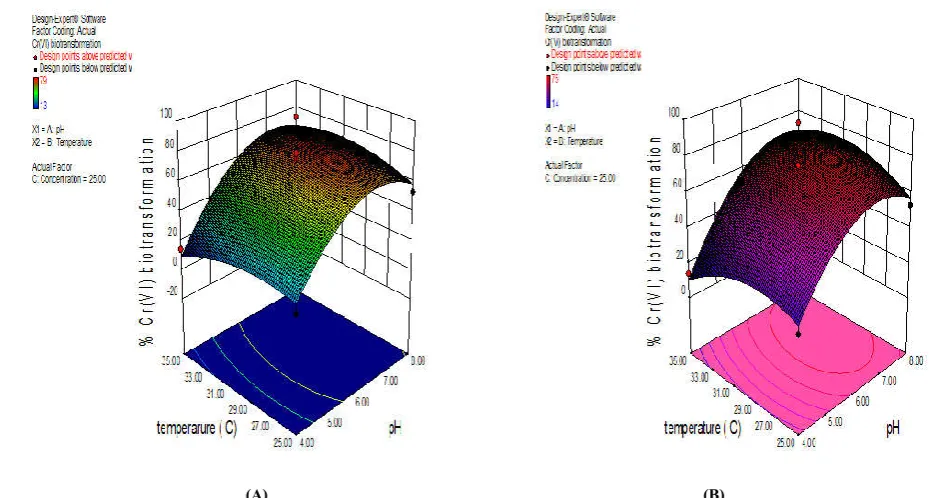
binding sites were available for complexation of Cr(VI) ions and as the concentration increased, the number of ions competing for the available binding sites increased. The combined effect of two independent variables with another variable being at fixed level on the biotransformation of Cr(VI) bacterial strains were shown in 3D surface plots (Figs.3–5(A–B)). Effect of pH and temperature: Fig.3A–B shows the interactive effect of two variables pH (A) 4.0– 8.0 and temperature (B) 25–35◦C on biotransformation of Cr (VI) ions. Fig.3A shows the biotransformation of Cr (VI) ions were increased with increased pH from 4.0 to 6.0 and temperature from 25◦C to 31◦C and after that biotransformation of Cr (VI) ions decreased with increased pH and temperature. In the present study, chromium cations at pH 6 was found to be interacted more strongly with the negatively charged binding sites of bacterial strains due to ionic attraction. Since Cr (VI) reduction is enzyme-mediated, variation in pH will affect the degree of ionization of the enzyme, changing the protein's conformation and affecting the enzyme activity (Farrell and Ranallo, 2002). In the present study, maximum biotransformation of Cr (VI) was observed 79% at pH 6.0 and temperature 30oC for Salmonella sp S1. Fig.3B shows that
biotransformation of Cr (VI) ions were increase with increased pH 4.0 to 6.0 and temperature 25 to 300C and after that biotransformation
of Cr (VI) ions decreased with increased pH and temperature in
Salmonella sp S2. It is observed that biotransformation of Cr (VI) is
high at pH 6.0. Cr3O10
and Cr4O13 2-
[image:6.595.43.562.288.435.2]species are formed at lower pH values (pH > 2.0). Thus decrease in solution pH causes the formation of more polymerised chromium oxide species. As pH increased, the number of negatively charged sites increased and the number of positively charged sites decreased. A negatively charged surface site on bacteria does not favour the formation of anions due to electrostatic repulsion. Biotransformation of Cr (VI) ions was increased with increase of pH as well as solution. Maximum
Table 7. Analysis of variance for RSM variables fitted to quadratic model
Metal ion Source Sum of squares d.f. Mean square F-value P-value Prob>F
Cr(VI)
biotransformation by
Salmonella Sp S1
Model Residual Lack-of-fit Pure error r2
r2 adj
8853.56
512.20 267 247 0.9451 0.874
9 7 3 4
983.73 73.46 89.00 61.80
13.39
1.44
0.0012
0.3560
Significant
Not Significant
Cr(VI)
biotransformation by
Salmonella Sp S2
Model Residual Lack-of-fit Pure error r2
r2 adj
8016.92
437.20 348 89.20 0.9483 0.8818
9 7 3 4
890.77 62.46 116.00 22.30
14.26
5.20
0.0010
0.0725
significant
temperature 300C in Salmonella sp S2. The results are in good agreement with the results obtained by Zahoor and Rehman, 2005 who reported that Bacillus sp. JDM-2-1 and S. capitis showed optimum growth at pH 6 and 7 respectively. Sultan and Hasnain, 2012 reported that optimum pH for Ochrobacterum anthropi was observed to be 7.0. Effect of pH and initial Cr(VI) ion concentration:
Fig 4A-B shows interactive effects of pH and initial concentration on biotransformation of Cr(VI) by Salmonella sp S1 and Salmonella sp
S2. Fig 4A showed that biotransformation of Cr(VI) ions were increased when pH was increased from 4.0 to 6.0, after that it decreased till pH 8 while the biotransformation of Cr(VI) increased with initial increase of initial concentration of Cr(VI) ions upto 25 mg/L, after that biotransformation of Cr(VI) ions decreased with increased metal ion concentration. Maximum biotransformation was observed 79 % at pH 6 and initial concentration of Cr (VI) ions at 25 % in Salmonella S1.
Fig 4B showed the biotransformation of Cr(VI) ions was increased with increase of pH from 4.0 to 6.0 and concentration from 10 mg/L to 25 mg/L after which the biotransformation of Cr(VI) ions decreased from pH 6.0 to 8.0 and concentration 25 mg/L to 40 mg/L. Maximum biotransformation was observed 75% at pH 6.0 and initial concentration 25 mg/L in Salmonella sp S2. Slight increase in pH in moderately acidic condition of the solution increases the density of negative charges on the cell surface of the bacteria. The moderate pH affects the solubility of metals and state of ionization of the various functional groups (carboxylate, phosphate and amino groups) located on the bacterial cell wall. Several studies have shown that the presence of Cr(VI) at levels of 0-50 ppm in the microorganism’s cells does not interfere with the cell growth of microorganisms (Jianlong et al., 2003; Gao et al., 2006; Rahman et al., 2007) because besides growth, the microorganism will make side product of hydrogen sulfide (H2S). The increase in the number of cells of microorganisms
(A) (B)
Fig. 3(A-B) Three dimensional surface plot showing the interactive effect of temperature and pH on Cr(VI) biotransformation by Salmonella sp. S1
andS2respectively.
(A ) (B)
[image:7.595.61.528.54.303.2] [image:7.595.56.539.345.582.2]will increase the speed of H2S production that will enhance the
process of Cr(VI) biotransformation. Hydrogen sulfide which is produced by the bacteria will react with chromium to form chromium sulfides that are not stable in solution and quickly gets deposited to form Cr(OH)3 i.e. Cr(III) which has lower toxicity than Cr(VI)
(Fatmawati and Sajidan, 2009). Effect of temperature and initial
Cr(VI) ion concentration: (Fig 5A–B) showed interactive effect
between temperature and initial concentration on biotransformation of Cr (VI) ions. The biotransformation of Cr (VI) ions increased first with the increase of initial metal ions concentration and reached a saturated value and after that removal of Cr (VI) ions were decreased with increase of concentration in Salmonella sp. S1 and Salmonella sp. S2 as shown in Fig. 5A and 5B respectively. However, with increase of temperature from 25◦C to 35◦C, biotransformation of Cr (VI) ions increased with the increase of concentration up to 30 mg/L and after that transformation of Cr(VI) ions decreased with the increase in concentration of Cr(VI) ions. The increase in biotransformation with increase of temperature is due to either higher affinity of sites for metal or increases in binding sites on bacterial surface. Maximum biotransformation of Cr(VI) was observed 79% and 75% at 30◦C and initial concentration 25mg/L in Salmonella sp.
S1 and S2 respectively. Das and Mishra, 2010 from their
experimental investigation reported that maximum specific chromium uptake occurred at temperature 300C by Brevebacterium casei.
Quantification of total Chromium and Cr(III) ions
During optimisation of pH, the concentration of total chromium and Cr(III) was also observed in all the batch cultures during 24 hours of incubation time period as shown in Fig 6. It was observed from the present study that total chromium concentration in both the studied bacterial cultures remained almost constant. The total chromium was recorded to be 10 mg/L. The concentration of Cr(III) was found to increase during the incubation time period. The initial Cr(III) concentration was 0.64 and 0.23 mg/L in the bacterial cultures of S1 and S2 at time period zero. After 24 hours, Cr(III) concentration was recorded as 6.23 and 6.25 mg/L in Salmonella sp. S1 and S2 respectively. Moreover, it was observed that the pH at the end of the experiments was recorded between 7 and 8 that seem to be adequate for the precipitation of the hydroxide. During optimisation of initial Cr(VI) ion concentration, the concentration of total chromium and Cr(III) was also recorded in all the batch cultures during 24 hours of incubation time period as shown in Fig 7. It was observed that total chromium concentration in both the bacterial strains remained almost constant. The total chromium was recorded to be 25 mg/L. However, the concentration of Cr(III) was found to increase during the incubation time period. The initial Cr(III) concentration was 0.4 and 1.23 mg/L in the cultures of Salmonella sp. S1andS2 at time period zero.
(A) (B)
Fig. 5 (A-B) Three-dimensional surface plot showing the interactive effect of initial Cr(VI) ion concentration and temperature on Cr (VI)
[image:8.595.58.538.311.527.2]biotransformation by Salmonella sp. S1andS2 respectively.
[image:8.595.106.502.561.725.2]After 24 hours, Cr(III) concentration was recorded as 20.12 and 19.55 mg/L in Salmonella sp. S1and Salmonella sp. S2 respectively.
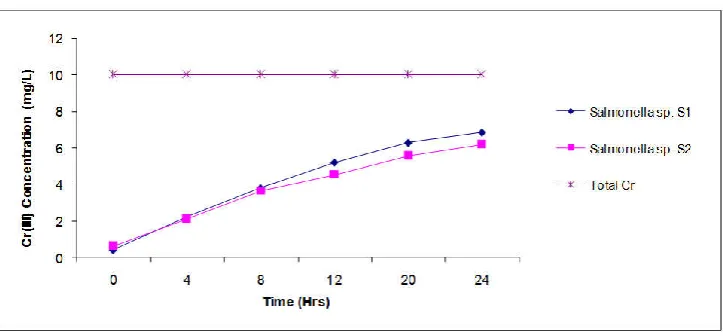
The pH at the end of the experiments was observed between 7 and 8 that is adequate for the precipitation of the hydroxide. During optimisation of temperature, the concentration of total chromium and Cr(III) was also observed in all the batch cultures during 24 hours of incubation time period as shown in Fig 8. It was observed that total chromium concentration in all the studied bacterial cultures remained almost constant. The total chromium was recorded to be 10 mg/L. However, the concentration of Cr(III) was found to increase during the incubation time period. The initial Cr(III) concentration was 0.4 and 0.63 mg/L in the cultures of Salmonella sp. S1and S2 at time period zero. After 24 hours, Cr(III) concentration was recorded as 6.82 and 6.19 mg/L in case of Salmonella sp. S1and Salmonella sp. S2 respectively. The pH at the end of the experiments was recorded between 7 and 8 that seem to be adequate for the precipitation of the hydroxide.
Conclusions
The present study includes the use of two indigenous bacterial strains
Salmonella sp. S1 and S2 which were isolated from electroplating
industrial effluent irrigated soil. Since these strains were well adapted to the local environment of the industry, they could be employed for the treatment of chromium contaminated effluents. In the present study, response surface methodology is employed to observe the interactive influence of three important process variables: pH, temperature and initial concentration of Cr(VI) ions for biotransformation of Cr (VI) ions using two bacterial strains
Salmonella sp. S1andS2. This design helped to locate the optimum
levels of the significant parameters which contributed in maximum Cr(VI) transformation. Moreover, RSM also proved to be simple, efficient, and time and saving tool. On the basis of RSM using box-behnken design, it was found that combination of pH, temperature and concentration of metal ions have significant effect on biotransformation of Cr (VI) ions. Values of “Prob>F” less than
0.0500 indicated that model terms have significant effect on biotransformation of Cr(VI) ion in the two studied bacterial strains. Maximum biotransformation of Cr(VI) was observed as 79% and 75 % at pH 6, temperature 30◦C and initial concentration of ions 25 mg/L by Salmonella sp. S1andS2 respectively. From the significant model and mathematical evaluation, RSM approach proved useful and accurate for the optimisation process due to time saving and to be most realistic where a large number of variables influence the process and need to apply at pilot scale for industrial wastewater treatment. Moreover, use of indigenous bacterial strains reduces the dependence on outside resource and technology for Cr(VI) biotransformation process.
Acknowledgements
The authors are thankful to All India Institute of Medical Sciences, New Delhi, India, for providing the SEM-EDX facility. The financial support for the investigation provided by University Grant Commission, New Delhi is gratefully acknowledged. We also thank Microbial Type Culture Collection (MTCC), Institute of Microbial Technology, Chandigarh for providing facility for bacterial identification.
REFERENCES
American Public Health Association (APHA) Standard methods for the examination of water and wastewater, 20th ed. Clesceri LS, Greenberg AE, and Eaton, AD, (Eds); American Public Health Association: Washington, DC, 1998.
Bishnoi, N.R., Garima 2005. Fungus- an alternative for bioremediation of heavy metal containing wastewater: a review., Journal of Science Industrial Research. 65:93-100. Box, N., Draper 1987. Empirical Model Building and Response
[image:9.595.113.493.54.200.2]Surfaces, John Wiley & Sons, New York.
Fig. 7. Quantification of total chromium and Cr(III) during optimization of initial conc.
[image:9.595.119.481.226.394.2]Calderon, J., Ortiz-Perez, D., Yanez, L., Diaz-Barriga, F. 2003. Human exposure to metals. Pathways of exposure, biomarkers of effect and host factors. Ecotoxiciol Environ Saf. 56:193-103. Cervantes, C., Campos-Garcia, J. 2007. Reduction and efflux of
chromate by bacteria. In Nies DH, Silver S (eds) Molecular Microbiology of heavy metals. Springer-Verlag, Berlin. 407-420.
Crini, G. 2005. Recent developments in polysaccharides-based materials used as adsorbets in wastewater treatment. Prog Polym Sci. 30:38-70.
Crini, G. 2006. Non-conventional low cost adsorbents for dye removal: A review. Biores Technol. 97:1061-1085.
Cui, F.J., Li, Y., Xu, Z.H., Xu, H.Y., Sun, K., Tao, W.Y. 2010. Optimization of the medium composition for production of mycelial biomass and exo-polymer by Grifola frondosa
GF9801 using response surface methodology. Bioresour Technol. 97:1209–1216.
Das, A.P., Mishra, S. 2010. Biodegradation of the metallic carcinogen hexavalent chromium Cr(VI) by an indigenously isolated bacterial strain. Journal of Carcinogenesis. 9:6. DOI: 10,4103/1477-3163.63584
Environmental Protection Agency 1987 Health assessment document for chromium Final report, EPA-600/8-83-014F. OSHA Cr (VI) Docket Office Exhibit 19, Item 19-1.
Evans, M. 2003. Optimization of manufacturing processes: A Response Surface Approach, Maney Publishing, London. Farrell, S.O., Ranallo, R.T. 2002. Experiments in biochemistry. A
hands-on approach. Saunders College Publ, Orlando, FL. Fatmawati, U., and Sajidan, S. 2009. Protein expression on Cr
resistant microorganism using electrophoresis method. Bioscience. 1(1), 31-37.
Fu, F., Wang, Q. 2011. Removal of heavy metal ions from wastewaters: A review. J Env Man. 92:407-418.
Gao, J., Zhang, Y., Ntoni, J., Begonia, M.F.T., Lee, K.J., Hicks, L., Hwang, W.W., Hwang, H.M. 2006. Effects of selected by-products of an acid hydrolyzate on cell growth and ethanol fermentation by Saccharomyces cerevisiae. J Mississippi Acad Sci. www.accessmylibrary.com/article-1G1-156274382/effects-selectedproducts-acid.html
Garavaglia, L., Cerdeira, S.B., Vullo, D.L. 2010. Chromium (VI) biotransformation by β- and Ƴ- Proteobacteria from natural polluted environments: A combined biological and chemical treatment for industrial waste. J Hazard Mater. 175:104-110. Garavaglia, L., Cerdeira, S.B., Vullo, D.L. 2010. Chromium (VI)
biotransformation by b- and c Proteobacteria from natural polluted environments: a combined biological and chemical treatment for industrial wastes., J Hazard Mater. 175:104–110. Garcia-Arellano, H., Arellano, M., Ballesteros, A. 2004. Use and
improvement of microbial redox enzymes for environmental purposes., Microbial Cell Factories. 3:10-14.
Gu, X.B., Zheng, Z.M., Yu, H.Q., Wang, J., Liang, F.L., Liu, R.L. 2005. Optimization of medium constituent for a novel lipopeptide production by Bacillus subtilis MO–O1 by a response surface method., Process Biochem. 40:3196–3201. Hai, F.I., Yamamoto, K., Fukushi, K. 2007. Hybrid treatment system
for dye wastewater., Crit Rev Environ Sci Technol. 37:315-377.
Jeyasingh, J., Philip, L. 2005. Bioremediation of chromium contaminated soil: optimization of operating parameters under laboratory conditions., Journal of Hazardous Materials. B118:113-120.
Jianlong, W., Zeyu, M., Xuan, Z. 2003. Response of Saccharomyces cerevisiae to chromium stess., Process Biochem. 39(10):1231-1235.
Megharaj, M., Avudainayagam, S., Naidu, R. 2003. Toxicity of hexavalent chromium and its reduction by bacteria isolated from soil contaminated with tannery waste., Curr Microbiol. 47:51-54.
Myers, R.H., Montgomery, D.C. 2002. Response Surface Methodology. Wiley, New York.
Pal, A., Dutta, S., Paul, A.K. 2005. Reduction of hexavalent chromium by cell free extracts of Bacillus sphaericus AND 303 isolated from serpentine soil., Current Microbiol. 51 (5):327-330.
Panda, J., Sarkar, P. 2011. Bioremediation of chromium by novel strains Enterobacter aerogenes T2 and Acinetobacter sp. PD 12 S2., Environ Sci Pollut Res. DOI 10.1007/s11356-011-0702-2 Park, D., Yun, Y.S., Prak, J.M. 2010. The past, present and future
trends of biosorption., Biotechnol Bioeng. 15: 86-102.
Peakall, D., Burger, J. 2003. Methodologies for assessing exposure to metals: speciation, bioavailability of metals and ecological host factors., Ecotoxiciol Environ Saf. 56:110-121.
Pulane, E.M., Kakonge, C.M., Nkhalambayausi-Chirwa, E.M. 2008. Chromium (VI) reduction in activated sludge bacteria exposed to high loading: brits culture (South Africa)., Wat Res. 42:4538-4548.
Puzon, G.J., Roberts, A.G., Kramer, D.M., Xun, L. 2005. Formation of soluble organochromium(III) complexes after chromate reduction in presence of cellular organics., Environ Sci Technol. 39(8):2811-2817.
Puzon, G.J., Tokala, R.K., Zhang, H., Yonge, D., Peyton, B.M., Xun, L. 2008. Mobility and recalcitrance of organo-chromium (III) complexes., Chemoshphere. 70(11):2054-2059.
Rahman, M.U.R., Shereen, G.U.L., Mohammad, H.A.Q., Zahoor, U.L. 2007. Reduction of Chromium(VI) by Locally isolated
Pseudomonas sp. C-171., Turk J Biol. 31:161-166.
Reddy, L.V.A., Young-Jung, W., Jong-Sun, Y., Hwa-Won, R. 2008. Optimization of alkaline protease production by batch culture
of Bacillus sp. RKY3 through Plackett Burman and response
surface methodological approaches., Bioresour Technol. 99:2242–2249.
Senthilkumar, S.R., Ashokkumar, B., ChandraRaj, K., Gunasekaran, P. 2005. Optimization of medium composition for alkali-stable xylanase production by Aspergillus fischeri Fxn1 in solid-state fermentation using central composite rotary design., Bioresour Technol. 96:1380–1386.
Srivastava, S., Thakur, I.S. 2012. Biosorption and biotransformation of chromium by Serratia sp. Isolated from tannery effluent., Environ Technol. 33(1):113-122.
Srivatava, N.K., Majumder, C.B. 2008 Novel biofilteration methods for the treatment of heavy metals from industrial waste-water., J Hazard Mater. 151:1-8.
Sultan, S., Hasnain, S. 2005. Chromate reduction capability of gram positive bacterium isolated from effluent of dying industry., Bull Environ Contam Toxicol. 75:699-706.
Sultan, S., Hasnain, S. 2012. Chromium (VI) reduction by cell free extract of Ochrobactrum anthropic isolated from tannery effluent., Bull Environ Contam Toxicol. DOI 10.1007/s00128-012-0648-1.
Sundar, K., Vidya, R., Mukherjee, A., Chandrasekaran, N. 2010. High chromium tolerant bacterial strains from Palar River Basin: impact of tannery., Res J Environ Earth Sci. 2:112–117. Wang, J., Chen, C. 2006. Biosorption of heavy metals by
Saccharomyces cerevisiae: a review. Biotechnol Adv.
24:427-51.
Wang, J., Chen, C. 2007. Biosorbents for heavy metals removal and their future., Biotechnol Adv. 27:195-226.
Zahoor, Rehman, A. 2005. Isolation of Cr(VI) reducing bacteria from industrial effluents and their potential use in bioremediation of chromium containing wastewater., J of Environmental Sciences. 21:814-820.