Relation-Aware Entity Alignment for Heterogeneous Knowledge Graphs
Abstract
Entity alignment is the task of linking entities with the same real-world identity from different knowl-edge graphs (KGs), which has been recently dom-inated by embedding-based methods. Such ap-proaches work by learning KG representations so that entity alignment can be performed by measur-ing the similarities between two entity embeddmeasur-ings. While promising, prior work in the field often fails to properly capture complex relation information that commonly exists in multi-relational KGs, leav-ing much room for improvement. In this paper, we propose a novel relation-aware dual-graph convo-lutional network (RDGCN) to incorporate relation information via attentive interactions between the knowledge graph and its dual relation counterpart, and further capture neighboring structures to learn better entity representations. Experiments on three real-world cross-lingual datasets show that our ap-proach delivers better and more robust results over the state-of-the-art alignment methods by learning better KG representations.
1
Introduction
Knowledge graphs (KGs) transform unstructured knowledge into simple and clear triples ofhhead, relation, tailifor rapid response and reasoning of knowledge. KGs are the building blocks for many applications like information retrieval [Dal-ton et al., 2014], recommendation systems [Catherine and Cohen, 2016], question-answering [Cui et al., 2017], etc. To support various applications, there is considerable work on knowledge representation learning to construct distributed representations for both entities and relations. Exemplary works for embedding-based approaches are the so called trans-family methods like TransE [Bordes et al., 2013], TransH [Wanget al., 2014], TransR [Linet al., 2015b] and PTransE [Linet al., 2015a], which interpret a relation as the translation operating on the embeddings of its head entity and tail entity.
However, KGs are usually incomplete, and different KGs are often complementary to each other. This makes a com-pelling case to design a technique that can integrate hetero-geneous knowledge among different KGs. An effective way
(b) [in
flu en
ce] 4
v
6
v
5v
[inf luen
[image:1.612.326.544.210.315.2]ce]
[influence]
b
r
[C_sharp]b
r
b
r
[Rust] [Swift]
(a) [su
cces so
r] 1
v
3
v
2v
[suc cess
or]
[successor] [Arthur_Fadden]
a
r
a
r
a
r
[John_Curtin] [Ben_Chifley]
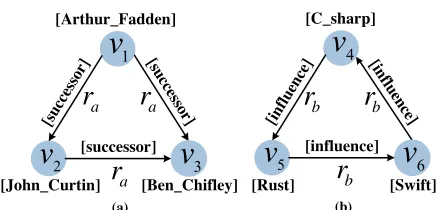
Figure 1: Examples of triangular structures.
for doing this is Entity Alignment. There have been ex-isting efforts devoted to embed different KGs towards en-tity alignment. Most of them, like JE [Hao et al., 2016], MTransE [Chen et al., 2017], JAPE [Sunet al., 2017], IP-TransE [Zhu et al., 2017] and BootEA [Sun et al., 2018], rely ontrans-familymodels to learn entity representations ac-cording to a set of prior alignments. The most recent work [Wanget al., 2018], takes a different approach by utilizing the Graph Convolutional Networks (GCNs) [Kipf and Welling, 2017] to jointly represent multiple KG entities, showing a new, promising direction for entity alignment.
Compared with conventional feature based methods [Wang et al., 2017], embedding-based methods have the advantage of requiring less human involvement in feature construction, allowing entity alignment methods to be scaled to large KGs. However, there are still several hurdles that prevent a wider adoption of embedding-based approaches. First, as men-tioned above, most existing methods usetrans-familymodels as the backbone to embed KGs, which are constrained by the assumptionhead+relation≈tail. This strong assumption makes it inefficient for the model to capture more complex relation information in multi-relational graphs.
As a motivation example, Figure 1 shows a real-world ex-ample from theDBP15KZH−EN [Sunet al., 2017] (one of
the real-world KGs used in our experiments). Prior study [Li et al., 2018b] shows that trans-family methods cannot cap-ture the triangular struccap-tures depicted in the diagram. For instance, for the structure of Figure 1(a), TransE requires the forms ofv1+ra ≈v2,v2+ra≈v3andv1+ra≈v3to hold
at the same time. However, to satisfy the former two equa-tions, we would havev1+ 2ra ≈v3, which is contradictory
to the third equationv1+ra ≈ v3. Accordingly, the
representations are learned with the trans-family, since more complex structures such as triangular ones frequently appear in multi-relational graphs.
GCN-based model [Wanget al., 2018] represents a leap forward for embedding-based entity alignment. However, this approach is also unable to properly model relation infor-mation. Since the vanilla GCN operates on the undirected and unlabeled graphs, GCN-based model would ignore the useful relation information of KGs. Although the relational graph convolutional networks (RGCNs) [Schlichtkrullet al., 2017] could be used to model multi-relational graphs, a RGCN sim-ply employs one weight matrix for each relation and would require an excessive set of parameters for real-world KGs that often contain thousands of relations, making it extremely dif-ficult to learn an effective model. Dual-Primal Graph Con-volutional Networks (DPGCNN) [Monti et al., 2018] offer a new solution for the problem. DPGCNNs alternate con-volution operations on the graph and its dual graph, whose vertices correspond to the edges of the original graph, and it-eratively apply an graph attention mechanism to enhance pri-mal edge representations using its dual graph. Compared with GCN and RGCN, DPGCNN can better explore complex edge structures and produce better KG presentations.
Inspired by DPGCNN, in this paper, we propose a novel relation-aware dual-graph convolutional network (RDGCN) to tackle the challenge of proper capturing and integration for relation information. While DPGCNN serves a good start-ing point, applystart-ing it to learn KG representations is not triv-ial. Doing so requires us to find a way to better approximate relation representations and characterize the relationship be-tween different KG relations. We address this by extend-ing the DPGCNN to develop a weighted model, and explore the head/tail representations initialized with entity names as a proxy to capture relation information without excessive model parameters that are often hard to train.
As a departure from GCNs and RGCNS, our RDGCN al-lows multiple rounds of interactions between the primal entity graph and its dual relation graph, enabling the model to ef-fectively incorporate more complex relation information into entity representations. To further integrate neighboring struc-tural information, we also extend GCNs with highway gates. We evaluate our RDGCN on three real-world datasets. Experimental results show that RDGCN can effectively ad-dress the challenges mentioned above and significantly out-performs 6 recently proposed approaches on all datasets. The key contribution of this work is a novel DPGCNN-based model for learning robust KG representations. Our work is the first to extend DPGCNNs for entity alignment, which yields significantly better performance over the state-of-the-art alternatives.
2
Related Work
Graph Convolutional Networks. Recently, there has been an increasing interest in extending neural networks to deal with graphs. There have been many encouraging works which are often categorized as spectral approaches [Bruna et al., 2013; Henaff et al., 2015; Defferrard et al., 2016; Kipf and Welling, 2017] and spatial approaches [Atwood
and Towsley, 2016; Hamiltonet al., 2017; Veliˇckovi´cet al., 2018]. The Graph Convolutional Networks (GCNs) [Kipf and Welling, 2017] have recently emerged as a powerful deep learning-based approach for many natural language process-ing tasks like semi-supervised node classification [Kipf and Welling, 2017], semantic role labeling [Marcheggiani and Titov, 2017] and neural machine translation [Bastingset al., 2017]. Furthermore, as an extension of GCNs, the rela-tional graph convolurela-tional networks (RGCNs) [Schlichtkrull et al., 2017] have recently been proposed to model rela-tional data and have been successfully exploited in link pre-diction and entity classification. Recently, the graph atten-tion networks (GATs) [Veliˇckovi´c et al., 2018] have been proposed and achieve the state-of-the-art performance. The DPGCNN [Montiet al., 2018] discussed in Section 1 gener-alizes GAT model and achieves better performance on vertex classification, link prediction, and graph-guided matrix com-pletion tasks.
Inspired by the capability of DPGCNN on determin-ing neighborhood-aware edge features, we propose the first relation-aware multi-graph learning framework for entity alignment.
Entity Alignment. Previous approaches of entity alignment typically follow a labour-intensive and time-consuming pro-cess to tune model features. For example, the work presented in [Wanget al., 2017] requires one to collect network seman-tic labels like category labels, attribute labels and unstruc-tured text keywords of the entity entries to build the align-ment model. Recently, embedding-based methods [Haoet al., 2016; Chenet al., 2017; Sunet al., 2017; Zhuet al., 2017; Sun et al., 2018; Wanget al., 2018] have been proposed to address this issue. In addition, NTAM is a non-translational approach that utilizes a probabilistic model for the alignment task [Liet al., 2018a]. KDCoE is a semi-supervised learning approach for co-training multilingual KG embeddings and the embeddings of entity descriptions [Chenet al., 2018].
As a departure from prior work, our approach directly models the relation information by constructing the dual re-lation graph. As we will show later in the paper, doing so improves the learned entity embeddings which in turn lead to more accurate alignment.
3
Problem Formulation
Formally, a KG is represented as G = (E, R, T), where
E, R, T are the sets of entities, relations and triples, respec-tively. LetG1 = (E1, R1, T1)andG2 = (E2, R2, T2)be
two heterogeneou KGs to be aligned. That is, an entity inG1
may have its counterpart inG2in a different language or in
different surface names. As a starting point, we can collect a small number of equivalent entity pairs betweenG1andG2
as thealignment seedsL={(ei1, ei2)|ei1 ∈E1, ei2 ∈E2}. We define the entity alignment task as automatically finding more equivalent entities using the alignment seeds. Those known aligned entity pairs can be used as training data.
4
Our Approach: RDGCN
GCNs
Add _
r init
X
X
Input Layer
Dual _Att Layer_1
1
G
e2
G
e1
G
r2
G
r_ e init
X
r
X
Dual _Att Layer_2
e
X
Primal _Att Layer_1
Primal _Att Layer_2
ˆ
eX
AddInput Layer
Dual _Att Layer_1
Dual _Att Layer_2
……
……
……
1 2
( , )
d e e
Multiple rounds ofinteraction
…
_ e init
X
r
X
_ r init
X
rX
rX
r
X
rX
r
X
e
X
r
X
ˆ
eX
ˆ
eX
ˆ
eX
ˆ
eX
Highway gates
1
G
e2
[image:3.612.76.533.54.233.2]G
eFigure 2: Overall architecture of our RDGCN.Gr
1andGr2are the dual relation graphs ofGe1andGe2, respectively. In our RDGCN model,Ge consists ofGe1andG
e 2, andG
r
consists ofGr1andG r 2.
we first construct its dual relation graph whose vertices de-note the relations in the original primal graph, and then, we utilize a graph attention mechanism to encourage interactions between the dual relation graph and the primal graph. The resulting vertex representations in the dual graph are then fed to GCN [Kipf and Welling, 2017] layers with highway gates to capture the neighboring structure information. The final entity representations will be used to determine whether two entities should be aligned. Figure 2 provides an overview ar-chitecture of our model.
4.1
Constructing the Dual Relation Graph
Without loss of generality, we putG1andG2together as the
primal graphGe= (Ve,Ee), where the vertex setVe=E
1∪ E2is the union of all vertices inG1andG2, and the edge set
Ee = T
1∪T2is the union of all undirected edges/triples in G1andG2. Note that we do not connect the alignment seeds
inGe, thusG
1andG2are disconnected inGe.
Given the primal graphGe, itsdual relation graphGr = (Vr,Er)is constructed as follows: 1) for each type of relation rinGe, there will be a vertexvrinVr, thusVr=R
1∪R2; 2)
if two relations,riandrj, share the same head entities or tail
entities inGe, then we create an edgeur ijinG
rconnectingvr i
andvr j.
Different from the original design of dual graph, here we expect the dual relation graph can be more expressive about the relationship between differentvrs inGe. We thus weight
each edgeurijinGrwith a weightwr
ijaccording to how likely
the two relationsvr
i andvjrshare similar heads or tails inGe,
computed as:
wrij =H(ri, rj) +T(ri, rj) (1)
H(ri, rj) =
Hi∩Hj Hi∪Hj
, T(ri, rj) = Ti∩Tj Ti∪Tj
(2)
whereHi is the set of head entities for relationriinGeand Tiis the set of tail entities forriinGe.
4.2
Interactions between Dual and Primal Graphs
Our goal of introducing dual relation graph is to better incor-porate relation information into the primal graph represen-tations. To this end, we propose to apply a graph attention mechanism (GAT) to obtain vertex representations for the dual relation graph and the primal graph iteratively, where the attention mechanism helps to prompt interactions between the two graphs. Each dual-primal interaction contains two layers, the dual attention layer and the primal attention layer. Note that we can stack multiple interactions for mutual improve-ment on both graphs.
Dual Attention Layer. Let Xr ∈ Rm×2d denote the
in-put dual vertex representation matrix, where each row cor-responds to a vertex in the dual relation graphGr. Different
from the vanilla GAT [Veliˇckovi´cet al., 2018], we compute the dual attention scores using the primal vertex featuresXˆe (computed by Eq. 8) produced by the primal attention layer from the previous interaction module:
˜
xri =σr(X j∈Nr i
αrijWrxrj), (3)
αrij =
exp(wijrar[WrcikWrcj])
P
k∈Nr i exp(w
r ikar[W
rcikWrc k])
, (4)
where˜xri denotes thed0-dimensional output representation at dual vertexvir(corresponding to relationri∈ Ge);xrjdenotes
the dual representation of vertexvr
j;Niris the set of neighbor
indices ofvri;αrij is the dual attention score; Wr ∈ Rd
0×2d is a linear transformation applied to every vertex; ar is a
fully connected layer mapping the2d0-dimensional input into a scalar;σris the activation function, ReLU;kis the
concate-nation operation;ciis the relation representation for relation riinGeobtained from the previous primal attention layer.
tail entity representations inGeas:
ci= [
P
k∈Hiˆx e k |Hi| k
P
l∈Tiˆx e l
|Ti| ], (5)
whereˆxek andˆxel are the output representations of the k-th head entity andl-th tail entity of relationrifrom the previous
primal attention layer.
A special case is when the current dual attention layer is the first layer of our model, we do not havexrjin Eq. 3 produced by the previous dual attention layer, therefore, use an initial dual vertex representation produced by Eq. 5 with the initial primal vertex representations Xe init. Similarly, ci will be
obtained with the initial primalXe initas well.
Primal Attention Layer. In this layer, when applying GAT on the primal graph, we can compute the primal attention scores using the dual vertex representations inGr, which
ac-tually correspond to the relations in the primal graphGe. In
this way, we are able to influence the primal vertex embed-dings using the relation representations produced by the dual attention layer.
Specifically, we useXe∈Rn×dto denote the input primal
vertex representation matrix. For an entityeq in primal graph Ge, its representation˜xe
q can be computed by:
˜
xeq =σe(X t∈Ne q
αeqtWexet), (6)
αeqt=
exp(ae(˜xr qt))
P
k∈Ne qexp(a
e(˜xr qk))
, (7)
where˜xrqtdenotes the dual representation forrqt(the relation
between entityeqandet) obtained fromGr;αeqtis the primal
attention score;Ne
q is the set of neighbor indices of entityeq
inGe; We
∈ Rd˜×d is a matrix of learnable weights;aeis a
fully connected layer mapping thed0-dimensional input into a scalar andσeis the primal layer activation function, ReLU.
In our model, the initial representation matrix for the pri-mal vertices, Xe init, can be initialized using entity names, which provide important evidence for entity alignment. We therefore preserve the evidence explicitly by mixing the ini-tial representations with the output of primal attention layer:
ˆ
xeq =βs∗˜xeq+x e init
q , (8)
whereˆxeq denotes the final output representation of the inter-action module for entityeqinGe;βsis a weighting parameter
for thes-th primal attention layer.
4.3
Incorporating Structural Information
After multiple rounds of interaction between the dual relation graph and the primal graph, we are able to collect relation-aware entity representations from the primal graph. Next, we apply two-layer GCNs [Kipf and Welling, 2017] with high-way gates to the resulting primal graph to further incorporat-ing evidence from their neighborincorporat-ing structures.
In each GCN layer l with entity representations X(l) as input, the output representationsX(l+1)can be computed as:
X(l+1)= ReLU( ˜D−12A˜D˜−12X(l)W(l)), (9)
whereA˜=A+Iis the adjacency matrix of the primal graph
Ge with added self-connections andI is an identity matrix; ˜
Djj = PkA˜jk andW(l) ∈ Rd
(l)×d(l+1)
is a layer-specific trainable weight matrix.
In addition, to control the noise accumulated across layers, we introduce layer-wise gates between GCN layers, which is similar in spirit to the highway networks [Srivastava et al., 2015]:
T(X(l)) =σ(X(l)WT(l)+b(Tl)), (10)
X(l+1)=T(X(l))·X(l+1)+ (1−T(X(l)))·X(l), (11)
whereX(l)is the input to layerl+ 1;σis a sigmoid
func-tion; ·is element-wise multiplication;WT(l)andb(Tl)are the weight matrix and bias vector for the transform gateT(X(l)), respectively.
Alignment.With the final entity representationsX¯ collected from the output of GCN layers, entity alignment can be per-formed by simply measuring the similarity or distance be-tween two entities. Specifically, the distance,d(e1, e2),
be-tween two entities,e1fromG1ande2fromG2can be
calcu-lated as:
d(e1, e2) =k¯xe1−x¯e2kL1. (12)
One can definitely use more complex decision functions.
4.4
Training
For training, we expect the distance between aligned entity pairs to be as close as possible, and the distance between neg-ative entity pairs to be as far as possible. We thus utilize a margin-based scoring function as the training objective:
L= X
(p,q)∈L
X
(p0,q0)∈
L0
max{0, d(p, q)−d(p0, q0) +γ}, (13)
whereγ >0is a margin hyper-parameter;Lis our alignment
seeds andL0is the set of negative instances.
Rather than random sampling, we look for challenging negative samples to train our model. Given a positive aligned pair(p, q), we choose theK-nearest entities ofp(orq) ac-cording to Eq. 12 in the embedding space to replaceq(orp) as the negative instances.
5
Experimental Setup
Datasets. We evaluate our approach on three large-scale cross-lingual datasets from DBP15K [Sun et al., 2017]. These datasets are built upon Chinese, English, Japanese and French versions of DBpedia. Each dataset contains data from two KGs in different languages and provides 15K pre-aligned entity pairs. Table 1 gives the statistics of the datasets. We use the same training/testing split with previous works [Sunet al., 2018], 30% for training and 70% for testing.
Datasets Entities Relations Rel. triples
DBP15KZH−EN ChineseEnglish 66,46998,125 2,8302,317 153,929237,674
DBP15KJ A−EN JapaneseEnglish 65,74495,680 2,0432,096 164,373233,319
[image:5.612.316.559.54.200.2]DBP15KF R−EN FrenchEnglish 105,88966,858 1,3792,209 192,191278,590
Table 1: Summary of the DBP15K datasets.
Model Variants. To evaluate different components of our model, we provide four implementation variants of RDGCN for ablation studies, including (1) GCN-s: a two-layered GCN with entity name initialization but no highway gates; (2) RGCN-s: a two-layered RGCN [Schlichtkrullet al., 2017] with entity name initialization; (3) HGCN-s: a two-layered GCN with entity name initialization and highway gates; (4) RD: an implementation of two dual-primal interaction mod-ules, but without the subsequent GCN layers.
Implementation Details. The configuration we used is:
β1 = 0.1,β2 = 0.3, andγ = 1.0. The dimensions of
hid-den representations in dual and primal attention layers are
d = 300, d0 = 600, and d˜ = 300. All dimensions of hidden representations in GCN layers are 300. The learn-ing rate is set to 0.001 and we sample K = 125 negative pairs every 10 epochs. In order to utilize entity names in dif-ferent KGs for better intilialization, we use Google Trans-late to transTrans-late Chinese, Japanese, and French entity names into English, and then use pre-trained English word vectors glove.840B.300d 1 to construct the input entity representa-tions for the primal graph. It is worth noting that Google Translate can not guarantee accurate translations for named entities without any context. We manually check 100 En-glish translations for Japanese/Chinese entity names, and find around 20% of English translations as incorrect, posing fur-ther challenges for our model.
Metrics. We use Hits@k, a widely used metric [Sunet al., 2018; Wanget al., 2018] in our experiments. A Hits@k score (higher is better) is computed by measuring the proportion of correctly aligned entities ranked in the topklist.
6
Results and Discussion
6.1
Main Results
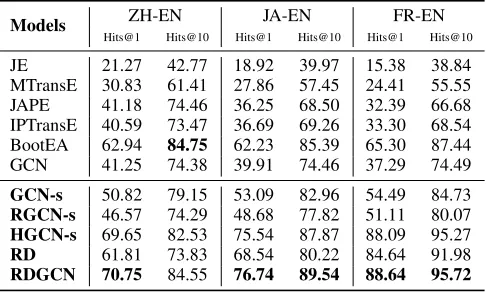
Table 2 shows the performance of all compared approaches on the evaluation datasets. By using a bootstrapping pro-cess to iteratively explore many unlabeled data, BootEA gives the best Hits@10 score onDBP15KZH−ENand clearly
out-performs GCN and other translation-based models, such as JE, MTransE, JAPE, and IPTransE. It is not surprising that GCN outperforms most translation-based models, i.e., JE, MTransE, JAPE and IPTransE. By performing graph con-volution over an entity’s neighbors, GCN is able to capture more structural characteristics of knowledge graphs, espe-cially when using more GCN layers, while the translation assumption in translation-based models focuses more on the relationship among heads, tails and relations.
1
http://nlp.stanford.edu/projects/glove/
Models ZH-EN JA-EN FR-EN
Hits@1 Hits@10 Hits@1 Hits@10 Hits@1 Hits@10 JE 21.27 42.77 18.92 39.97 15.38 38.84 MTransE 30.83 61.41 27.86 57.45 24.41 55.55 JAPE 41.18 74.46 36.25 68.50 32.39 66.68 IPTransE 40.59 73.47 36.69 69.26 33.30 68.54 BootEA 62.94 84.75 62.23 85.39 65.30 87.44 GCN 41.25 74.38 39.91 74.46 37.29 74.49
GCN-s 50.82 79.15 53.09 82.96 54.49 84.73
RGCN-s 46.57 74.29 48.68 77.82 51.11 80.07
HGCN-s 69.65 82.53 75.54 87.87 88.09 95.27
RD 61.81 73.83 68.54 80.22 84.64 91.98
RDGCN 70.75 84.55 76.74 89.54 88.64 95.72
Table 2: The overall alignment performance for all models on the DBP15K datasets. Numbers in bold indicate the best performance.
We observe that RDGCN gives the best performance across all metrics and datasets, except for Hits@10 on DBP15KZH−EN where the performance of RDGCN is
sec-ond to BootEA with a marginally lower score (84.55 vs 84.75). While BootEA serves a strong baseline by show-ing what can be achieved by exploitshow-ing many unlabeled data, our RDGCN has the advantage of requiring less prior align-ment data to learn better representations. We believe that a bootstrapping process can further improve the performance of RDGCN, and we leave this for future work. Later in Sec-tion 6.3, we show that RDGCN maintains consistent per-formance and significantly outperforms BootEA when the training dataset size is reduced. The good performance of RDGCN is largely attributed to its capability for learning relation-aware embeddings. Keep in mind that our RDGCN is initialized using machine translated entity names, but still achieves the best performance in almost all settings, demon-strating the effectiveness and robustness of the proposed method for entity alignment.
6.2
Ablation studies
GCN-s vs. GCN:As shown in Table 2, GCN-s considerably improves GCN in all datasets, resulting in a 17.2% increase on Hits@1 onDBP15KF R−EN. As mentioned in Section 5,
the three lingual datasets require us to handle cross-lingual data through rough machine translations, which is likely to introduce lots of noise (∼80% accuracy in our pilot study). But our improvement over GCN shows that although noisy in nature, those rough translations can still provide use-ful evidence to capture, thus should not be ignored.
GCN-s vs. RGCN-s: RGCN is an extension of GCN by ex-plicitly modeling the KG relations, but in our experiments, we observe that GCN-s achieves better performance than RGCN-s on all dataRGCN-setRGCN-s. ARGCN-s diRGCN-scuRGCN-sRGCN-sed in Section 1, RGCN uRGCN-sually requires much more training data to learn an effective model due to its large number of parameters, and the available train-ing data in our evaluation might be not sufficient for fully unlocking the potential of RGCN.
[image:5.612.58.292.55.131.2]Figure 3: (a), (b) and (c) show the performance of RDGCN and BootEA using different proportions of prior entity alignments on the DBP15K datasets. The x-axes are the proportions of prior alignments, and the y-axies are Hits@1 scores. (d) shows the performance of RDGCN and BootEA on triangular structures. The x-axis is the datasets and y-axis is the number of correctly predicted pairs.
over 30% improvement of Hits@1 onDBP15KF R−EN. This
is mainly due to their capability of preventing noisy vertices from driving the KG representations.
HGCN-s vs. RDGCN :When comparing HGCN-s with our RDGCN, we can see that the interaction modules performing on the dual relational graph and primal graph are crucial to the performance: removing the dual and primal attention layers leads to a drop of 1.1% on Hits@1 and 2.02% on Hits@10 on DBP15KZH−EN. The interaction modules in our framework
can explore the relation characteristics of KGs by introduc-ing the approximate relation information and fully integrate the relation and entity information after multiple interactions between the dual relation and the primal graphs. The results show that effective modeling and use of relation information is beneficial for entity alignment.
RD vs. RDGCN :Comparing RD with RDGCN, there is a sig-nificant drop in performance when removing the GCN layers from our model, e.g., the Hits@1 of RD and RDGCN differ by 8.94% onDBP15KZH−EN. This is not surprising,
be-cause the dual-primal graph interactions are designed to in-tegrate KG relation information, while the GCN layers can effectively capture the neighboring structural information of KGs. These two key components are, to some extent, com-plementary to each other, and should be combined together to learn better relation-aware representations.
6.3
Analysis
Triangular structures: Figure 3(d) shows the performance of RDGCN and BootEA, the state-of-the-art alignment model, on the testing instances with triangular structures. We can see that the alignment accuracy of our RDGCN for enti-ties with triangular structures is significantly higher than that of BootEA in all three datasets, showing that RDGCN can better deal with the complex relation information.
Impact of available prior alignments: We further com-pare our RDGCN with BootEA by varying the proportion of pre-aligned entities from 10% to 40% with a step of 10%. As expected, the results of both models on all three datasets gradually improve with an increased amount of prior align-ment information. According to Figure 3(a-c), our RDGCN consistently outperforms BootEA, and seems to be insensi-tive to the proportion of prior alignments. When only using 10% of the pre-aligned entity pairs as training data, RDGCN still achieves promising results. For example, RDGCN us-ing 10% of prior alignments achieves 86.35% for Hits@1 on DBP15KF R−EN. This result translates to a 17.79% higher
rela tive
s
[蒋孝章] [宋美龄]
[Chiang_Kai-shek] spou
se
[Soong_Mei-ling] [蒋经国]
pare nts
[Chiang_Ching-kuo]
ch ildre
n rela
tives
[毛福梅] [Mao_Fumei]
sp ou
se
[Weng_Wenhao] prem
ier
[蒋方良]
pare nts
… vZH vEN …
1
v
v
23
v
4
v
5
v
v
67
v
8
v
1
r
r
24
r
r
35
r
r
68
[image:6.612.66.556.52.137.2]r
r
7Figure 4: An example inDBP15KZH−EN, where the blue dash lines indicate the connected entities are aligned.
Hits@1 score over BootEA when BootEA uses 40% of prior alignments. These results further confirm the robustness of our model, especially with limited prior alignments.
Case Study: Figure 4 shows an example in DBP15KZH−EN and the target entity pair,(vZH andvEN),
that should not be aligned. The competitive translation-based models, including BootEA, gives lower distance scores for
(vZH and vEN), suggesting that these two entities should
be aligned. This is because those models fail to address the specific relation information associated with the three aligned neighboring entities. For this example, both v1and v5 indicate the person Chiang Ching-kuo, but v1 has the
relationparentswithvZH, whilev2has the relationchildren
withvEN. Utilizing such information, a better alignment
model should produce a larger distance score for the two entities despite they have similar neighbors. By carefully considering the relation information during the dual-primal interactions, our RDGCN gives a larger distance score, leading to the correct alignment result.
7
Conclusions
[image:6.612.327.547.190.281.2]References
[Atwood and Towsley, 2016] James Atwood and Don Towsley. Diffusion-convolutional neural networks. In NIPS, pages 1993–2001, 2016.
[Bastingset al., 2017] Joost Bastings, Ivan Titov, Wilker Aziz, Diego Marcheggiani, and Khalil Sima’an. Graph convolutional encoders for syntax-aware neural machine translation. arXiv preprint arXiv:1704.04675, 2017.
[Bordeset al., 2013] Antoine Bordes, Nicolas Usunier, Alberto Garcia-Duran, Jason Weston, and Oksana Yakhnenko. Translating embeddings for modeling multi-relational data. InNIPS, pages 2787–2795, 2013.
[Brunaet al., 2013] Joan Bruna, Wojciech Zaremba, Arthur Szlam, and Yann LeCun. Spectral networks and lo-cally connected networks on graphs. arXiv preprint arXiv:1312.6203, 2013.
[Catherine and Cohen, 2016] Rose Catherine and William Cohen. Personalized recommendations using knowledge graphs: A probabilistic logic programming approach. In Proceedings of the 10th ACM Conference on Recom-mender Systems, pages 325–332. ACM, 2016.
[Chenet al., 2017] Muhao Chen, Yingtao Tian, Mohan Yang, and Carlo Zaniolo. Multilingual knowledge graph embeddings for cross-lingual knowledge alignment. In IJ-CAI, 2017.
[Chenet al., 2018] Muhao Chen, Yingtao Tian, Kai-Wei Chang, Steven Skiena, and Carlo Zaniolo. Co-training embeddings of knowledge graphs and entity descrip-tions for cross-lingual entity alignment. arXiv preprint arXiv:1806.06478, 2018.
[Cuiet al., 2017] Wanyun Cui, Yanghua Xiao, Haixun Wang, Yangqiu Song, Seung-won Hwang, and Wei Wang. Kbqa: learning question answering over qa corpora and knowledge bases. InVLDB, pages 565–576, 2017.
[Daltonet al., 2014] Jeffrey Dalton, Laura Dietz, and James Allan. Entity query feature expansion using knowledge base links. InSIGIR, pages 365–374. ACM, 2014.
[Defferrardet al., 2016] Micha¨el Defferrard, Xavier Bres-son, and Pierre Vandergheynst. Convolutional neural net-works on graphs with fast localized spectral filtering. In NIPS, 2016.
[Hamiltonet al., 2017] William L. Hamilton, Rex Ying, and Jure Leskovec. Inductive representation learning on large graphs. InNIPS, 2017.
[Haoet al., 2016] Yanchao Hao, Yuanzhe Zhang, Shizhu He, Kang Liu, and Jian Zhao. A joint embedding method for entity alignment of knowledge bases. InCCKS, 2016.
[Henaffet al., 2015] Mikael Henaff, Joan Bruna, and Yann LeCun. Deep convolutional networks on graph-structured data.arXiv preprint arXiv:1506.05163, 2015.
[Kipf and Welling, 2017] Thomas N. Kipf and Max Welling. Semi-supervised classification with graph convolutional networks. InICLR, 2017.
[Liet al., 2018a] Shengnan Li, Xin Li, Rui Ye, Mingzhong Wang, Haiping Su, and Yingzi Ou. Non-translational alignment for multi-relational networks. InIJCAI, 2018. [Liet al., 2018b] Xin Li, Huiting Hong, Lin Liu, and
William K Cheung. A structural representation learn-ing for multi-relational networks. arXiv preprint arXiv:1805.06197, 2018.
[Linet al., 2015a] Yankai Lin, Zhiyuan Liu, Huanbo Luan, Maosong Sun, Siwei Rao, and Song Liu. Modeling rela-tion paths for representarela-tion learning of knowledge bases. arXiv preprint arXiv:1506.00379, 2015.
[Linet al., 2015b] Yankai Lin, Zhiyuan Liu, Maosong Sun, Yang Liu, and Xuan Zhu. Learning entity and relation embeddings for knowledge graph completion. In AAAI, volume 15, pages 2181–2187, 2015.
[Marcheggiani and Titov, 2017] Diego Marcheggiani and Ivan Titov. Encoding sentences with graph convolu-tional networks for semantic role labeling. arXiv preprint arXiv:1703.04826, 2017.
[Montiet al., 2018] Federico Monti, Oleksandr Shchur, Aleksandar Bojchevski, Or Litany, Stephan G¨unnemann, and Michael M Bronstein. Dual-primal graph convolu-tional networks.arXiv preprint arXiv:1806.00770, 2018. [Schlichtkrullet al., 2017] Michael Schlichtkrull, Thomas N
Kipf, Peter Bloem, Rianne van den Berg, Ivan Titov, and Max Welling. Modeling relational data with graph con-volutional networks. arXiv preprint arXiv:1703.06103, 2017.
[Srivastavaet al., 2015] Rupesh Kumar Srivastava, Klaus Greff, and J¨urgen Schmidhuber. Highway networks.arXiv preprint arXiv:1505.00387, 2015.
[Sunet al., 2017] Zequn Sun, Wei Hu, and Chengkai Li. Cross-lingual entity alignment via joint attribute-preserving embedding. InISWC, pages 628–644, 2017. [Sunet al., 2018] Zequn Sun, Wei Hu, Qingheng Zhang, and
Yuzhong Qu. Bootstrapping entity alignment with knowl-edge graph embedding. InIJCAI, pages 4396–4402, 2018. [Veliˇckovi´cet al., 2018] Petar Veliˇckovi´c, Guillem Cucurull, Arantxa Casanova, Adriana Romero, Pietro Li`o, and Yoshua Bengio. Graph Attention Networks. In ICLR, 2018.
[Wanget al., 2014] Zhen Wang, Jianwen Zhang, Jianlin Feng, and Zheng Chen. Knowledge graph embedding by translating on hyperplanes. InAAAI, 2014.
[Wanget al., 2017] Xuepeng Wang, Kang Liu, Shizhu He, Shulin Liu, Yuanzhe Zhang, and Jun Zhao. Multi-source knowledge bases entity alignment by leveraging semantic tags.Chinese Journal of Computers, 40(3):701–711, 2017. [Wanget al., 2018] Zhichun Wang, Qingsong Lv, Xiaohan Lan, and Yu Zhang. Cross-lingual knowledge graph align-ment via graph convolutional networks. InEMNLP, pages 349–357, 2018.