
© 2019, IRJET | Impact Factor value: 7.34 | ISO 9001:2008 Certified Journal
| Page 35
Design, Analysis and Performance Testing of a Diesel Engine as a
Portable Electrical Generator
Joshi B.M.
11
Student, Mechanical Engineering, Savitribai Phule Pune University
---***---Abstract - The objective of this paper is to present a detailed case study of Vertical water-cooled Diesel Engine by testing its performance using Willan’s Line method. Internal combustion engines have been widely used in many fields from Automotive engineering to power generation. However, the efficiency of the IC engines is affected by a variety of factors which ultimately lead to the reduction in the efficiency and power output. The unaccounted heat losses occurring in the IC engine, used in automobiles or in stationary applications, leads to a significant effect on the performance of the engine. The paper is aimed at designing a Stationary, Diesel Engine from foundation and present a definitive understanding of all the parameters that affect the engine’s performance. The paper shall include the detailed design calculations of the vital components of the IC engine as per the standards. The design will be followed by CAD models which help to illustrate the functional design of the engine. The structural and thermal analysis of the engine components will be done on ANSYS workbench and the results would be included in the paper. The performance testing will be done by comparing Brake power and mass flow rate.
Key Words: Design, Cylinder, Piston, Connecting rod, Crankshaft, Diesel, Performance
1. INTRODUCTION
Internal combustions engines are classified into two types namely, Rotary engines and Reciprocating engines. The reciprocating type of the engine has been designed in the following paper. Internal combustion engines consists of a variety of components out of which the vital components include the cylinder, cylinder liner, Piston, connecting rod, crankshaft, camshaft and valve gear mechanism. The engine design begins with the requirement for the application. The engine designed below is used for the stationary application with a certain power requirement at a rated speed. The design of the engine includes the functional design taking into account the mechanical, thermal and overall efficiency of the engine. The standards and formulae used for the design have been cited and the references as and when required have been provided in the design. The need for this paper arises from the fact that the performance dictated by the theoretical design of the engine is not always in correspondence with the actual performance of the engine. This difference between the theoretical and actual performance parameters can be studied by using some of the performance testing methods.
The gaseous pressure that is exerted on the piston from above during the exhaust stroke and from below during the intake, introduces a pumping loss in the engine. The friction loss occurs, as stated, due to the relative motion between the moving components of the engine and these losses are inevitable. However, certain methods of lubrication can help to reduce the frictional losses occurring in the engine. This frictional loss is the actually termed as ‘friction power’ which is obtained by the difference between indicated power (input) and brake power (output). The designer of the IC engine should aim at reducing these losses to a minimum amount for optimum engine performance. The Willan’s line method is one such test which can be conducted on the engine and it enables to determine the friction power of the engine to estimate its performance.
2. PROBLEM STATEMENT
The objective is to Design a Diesel Engine as a portable electrical generator for a stationary application.
Engine Type: Four Stroke, Vertical. Cooling Method: Water cooled
Rated Power: 3.6KW
Rated RMP: 1500
Compression ratio: 16:1
The performance testing of the Engine is done using Willan’s line method after the functional design of all components is completed.
2.1 Functional Design
© 2019, IRJET | Impact Factor value: 7.34 | ISO 9001:2008 Certified Journal
| Page 36
Modern diesel engines have the conversion efficiency of about 35% and efforts are being made for improving the conversion efficiency and air handling capacity of the engine.
Table -1: Engine Design Data
Sr.
No Parameter Value Adopted Value
1 Specific Heat of Fuel (MJ) 43 43 2 Compression Ratio 16 to 22 16 3 Volumetric Efficiency (%) 70 to 90 80 4 Maximum Gas Pressure
(MPa) 6 to 10 6
5 Mechanical Efficiency (%) 75 to 85 80 6 Brake Mean Effective
Pressure (MPa) 0.5 to 0.9 0.55 7 Mean Piston Speed (m/s) 5 to 7 6 8 Stroke/Bore ratio 1.2 to 1.6 1.5
9 Length/Radius 4 to 6 4.5
By using the values from Table-1 we can calculate the swept volume and bore and stroke of the engine to be used.
Power = PbmLAnk (1)
where,
Pbm = Brake mean effective pressure
L = Stroke Length
A = Cross Section Area
n = Speed (N/2 for four stroke engines)
Speed (N for two stroke engines)
k = No. of cylinders
By substituting values from Table 1 in Eq. (1) we get the swept volume as
LAn = 0.5236 x 10⁻⁴ m3/cycle
From Table 1, mean piston speed is taken as 6 m/s.
2LN = 6 (2)
By substituting the values of speed we get the stroke length as 0.12 m.
The stroke to bore ratio as given in Table-1 is taken as 1.5. Hence the diameter of the bore from Eq. (2) would be 0.08 m. Substituting these values in Eq. (1) we get the value of ‘k’ (No. of cylinders) to be 0.86. This means that the engine adopted requires only one cylinder and hence the engine to be designed is a Single cylinder diesel engine.
Fuel Rate = Power / (ƞc x CV) (3)
Where, ƞc = Conversion Efficiency and CV = Calorific value of diesel. From Eq. (3) and Table 1 we arrive at the fuel rate of 0.8611 kg/hr. The brake specific fuel consumption (bsfc) = Fuel rate / Power = 240 gm/kWh
Thus the general engine data has been determined and can be used for the design of engine components.
2.2 Technical Specifications:
Type : Single cylinder, Water cooled, 4S Fuel : High speed Diesel
Stroke : 120 mm (0.12 m)
Bore : 80 mm (0.08m)
Speed : 1500 RPM
bsfc : 240 gm/kWh
3. DESIGN OF CYLINDER
The following cylinder design is based on insert technology using a dry cylinder liner. The use of cylinder liner offers various advantages like replacement of the liner instead of the entire cylinder when worn out, freedom in the selection of materials by using better grade material only for the liner instead of the entire block which saves the cost of production and allowing longitudinal expansion. Hence the better grade material selection is done for the cylinder liner and the remaining of the block can be made of a feasible material of lower cost. The material selected for the cylinder liner is the gray cast iron, ASTM class 40 SAE 121 [3]. Sut for the material selected is 293 MPa [3]. The FOS adopted for the entire design procedure will be 6 unless otherwise mentioned.
3.1 Design of Cylinder Liner Thickness
The cylinder thickness can be calculated by taking the cylinder as a thin cylinder subjected to internal pressure similar to a thin walled pressure vessel.
t = (pmaxD/ 2σc) + C (4)
pmax = Maximum gas pressure inside cylinder (MPa)
D = Cylinder bore (mm)
σc = Circumferential stress (MPa) = Sut/FOS
C = reboring allowance (mm)
The reboring allowance standard values are given in [1] (Table 25.1) and after interpolation it turns out to be 1.7
© 2019, IRJET | Impact Factor value: 7.34 | ISO 9001:2008 Certified Journal
| Page 37
allowance is the additional metal thickness above that is required to withstand gas pressure inside cylinder [1] [2].
3.2 Design of Cylinder Head
The cylinder head is encompasses the inlet and exhaust valves, Air and gas ports and the injector in the case of CI engines. The cylinder head dimensions and its design become somewhat complicated due to the various components. Usually it is designed as a box with a certain thickness. In the preliminary stage, the cylinder is designed as a flat circular disc with a thickness which is calculated by the formula given below [1],
t = D(Kpmax / σc)1/2 (5)
where, t = thickness of cylinder head (mm)
K = Constant (K = 0.162)
σc = Allowable circumferential stress (N / mm2)
Substituting the values and rounding off to the nearest integer we get t = 11 mm.
3.3 Design of Studs
The Studs are subjected to the tensile stresses due to the gas pressure force acting on cylinder head. The studs are used to achieve a leak proof joint between the cylinder head, cylinder and the gasket. [1][2]The studs are also subjected to fatigue loading and should be designed for the same. The material selected for the studs should be a high tensile strength steel alloy. Hence, material selected for the studs is 40Cr4Mo3 alloy steel. It has the yield strength of 800 MPa and tensile strength of 1075 MPa [3].
Maximum number of studs (zmax) = 0.02D + 4 = 5.6
Minimum number of studs (zmin) = 0.01D + 4 = 4.8
Hence, the number of studs selected is 5 (z) [1].
Maximum force due to gas pressure = (π/4)D2pmax = (π/4)(0.082)(8 x 106) = 30.159 kN.
The tightening force should be greater than gas force by about 50% [2], hence the tightening force is given, Tightening force = 1.5 x 30.159 = 45.238 kN.
Fmax = Initial tightening force + Gas pressure force = 75.397 kN. [2]
Fmin = Initial tightening force = 45.238 kN
Fmean = (Fmax + Fmin)/2 = 60.317 kN
Fvary = (Fmax - Fmin)/2 = 15.0795 kN. By using the Soderberg equation, we can determine the core area and hence the diameter of the studs [2].
1/FOS = (Fmean/Ac)/Sy + (Fvary/Ac)/Se (6)
Where, Ac = core area of studs (mm2)
Sy = Yield strength of the material (MPa)
Se = Corrected endurance limit for fatigue loading = (1/3)Sut
FS = Factor of safety selected is 2.
Substituting the values into Eq. (6) we get the core area as 2.3456 x 10⁻⁴ m2
The core diameter can be calculated from the equation given below,
dc = (4Ac / z π)1/2 (7)
The core diameter of studs (dc) after substituting the values turns out to be 7.73 mm. The nominal diameter of studs (d) is calculated as dc/0.8 which turns out to be 9.66 mm. Hence, the stud of M10 is selected [3].
Pitch of studs
The pitch of studs is obtained from the following empirical relationship [1], the pitch of studs (Dp) = D + 3d = 80 +3(10) = 110 mm. The pitch is given as (πDp) / z = 69.115 mm. Minimum pitch = 19 (d)1/2 = 60.08 mm. Maximum pitch = 28.5 (d)1/2 = 90.12 mm. Since the calculated pitch of 69.115 is within the limits the pitch of the studs is correct to be considered for design.
4. DESIGN OF PISTON ASSEMBLY
The piston is one of the prime components of the IC engine. The piston transmits the force obtained by the gas pressure to the connecting rod by the assembly design and the reciprocating motion is converted into rotary motion of the crankshaft. The piston also dissipates the heat generated during combustion to the cylinder wall. The piston seals the inside portion of cylinder from crankcase by means of piston ring. [1] The materials used for the piston are aluminum alloys, Al –Si alloys, Al –cu alloys and light weight alloy bonded materials. The material selected for the following design is Al – Si alloy. Included in this group of pistons is the most frequently used is MAHLE 124. It is ideal on account of its physical, mechanical and technological properties. It is the Al –Si alloy with greater proportion of Copper and Nickel. The tensile strength of the material is at 350 C is 40 to 65 MPa. Select 60 MPa (σb) [4].
4.1 Design of Piston
© 2019, IRJET | Impact Factor value: 7.34 | ISO 9001:2008 Certified Journal
| Page 38
dissipation [2]. The heat generated during the combustion the combustion chamber is dissipated by the piston hence the heat dissipation consideration should also be done. The thickness of the piston head is also calculated by using Grashoff’s law as follows,
th = D (3pmax / 16σb) (8)
By substituting the values in Eq. (8) and rounding off to the nearest integer, we get the value of the piston head thickness as 11 mm. The next step is to design the piston as per the heat dissipation criteria [1]. The formula for thickness by heat dissipation is given,
th = [H / (12.56kΔT)] x 103 (9)
th = thickness of the piston head (mm)
H = Amount of heat conducted through the piston head (W)
K = Thermal conductivity factor (W /m / C)
Tc = Temperature at the Centre of the head ( C)
Te = Temperature at the edge of the head ( C)
For Aluminum alloy, the value of k is taken as 175 W /m / C [1]. The value of ΔT = (Tc – Te) for Al alloy is taken as 75 C.
H = [C x HCV x m x BP] x 103 (10)
HCV = Higher calorific value of fuel (kJ/kg) = 44000 kJ/kg (Diesel) [1]
C = ratio of heat absorbed to total heat developed = 0.05 [1]
m = mass of fuel used per brake power per second = [(0.24 to 0.3)/3600] kg/kW/s = 0.27/3600 (assumed) [1]
By substituting all values in Eq. (10) and then substituting the value obtained from Eq. (10) in Eq. (9) we get the thickness of piston head as 4 mm. From the values obtained by strength criteria (11 mm) and heat dissipation criteria (4 mm) it is clear that the strength is taken as the criterion for piston head thickness. Hence final value of piston head thickness is given as 11 mm.
4.2 Design of Cup
If the inlet and exhaust valves open and close at angles near TDC then it is possible that either of the two valves may strike the piston surface. Hence in order to avoid this, a spherical cavity is provided called cup [1].
The piston cup is provided on the piston in order to facilitate the proper combustion of the fuel. The cup provides a swirl to the air which increases the turbulence of the air. The increase in the turbulence provides better atomization of the
fuel and air particles which results in a better mixture and hence results into improved performance. [5] As stroke to bore ratio is 1.5 as stated in Table 1. The cup is required. The radius of the cup is usually 70% of the bore. Hence, radius of the cup for the current piston design is taken as 56 mm.
4.3 Design of Piston Rings
Piston rings are metallic gaskets whose functions are to seal the combustion chamber against the crankcase/cylinder block, to transmit heat from the piston to the cylinder wall, and to regulate the amount of oil present on the cylinder sleeve, a function of the oil control ring in particular [4]. section 7.3 of the book. For the current design procedure, two types of piston rings are used namely the compression rings and the oil scraper rings. The oil scraper rings provide proper lubrication to reduce frictional losses.
The materials normally used for piston rings include flaked graphite non-hardened cast iron, cast iron with flaked graphite alloyed and hardened, spheroidal graphite cast iron and Steel. In the current design of the piston rings cast iron with flaked graphite (non-hardened) is used. [4] The grade of the cast iron is AFG Ni15Cu6Cr2. The Sut is between 700 to 840 MPa. In stationary diesel engines generally 5 to 7 compression rings are used and 1 to 3 oil scraper rings. The radial wall pressure is generally between 0.025 to 0.042 MPa [1]. The assumed wall pressure for the design is taken as 0.042. The dimensions of the cross section are given by,
b = D (3Pw / σt)1/2 (11)
where, b = radial width of the ring (mm)
Pw = Allowable radial wall pressure (MPa)
σt = Permissible tensile stress of the ring material = Sut/FOS
= 700 / 6 = 116.67 MPa
By substituting the values in Eq. (11), we get the radial with of the ring as 2.7 mm. By using empirical relationships, axial thickness of the ring is taken as (0.7) b to b [1]. For the current design, the axial thickness is taken as 2.5 mm.
4.4 Design of gap
© 2019, IRJET | Impact Factor value: 7.34 | ISO 9001:2008 Certified Journal
| Page 39
The gap can be designed as 3.5b to 4b before the assembly. The gap is calculated as 10 mm. The ring gap after assembly is taken as 0.002D to 0.004D and turns out to be 0.25 mm. The top land of the piston is taken as th to 1.2th and is assumed to be 11.5 mm existing between the given limits. The distance between two consecutive ring grooves is calculated as 0.75h to h and is taken between limits as
[image:5.595.82.242.212.351.2]1.6mm. The Fig. 1 shows the CAD model of the ring. The model is done on CATIA V5 part modelling.
Fig. -1: Piston Ring
4.5 Design of Barrel
It is the cylindrical portion of the piston below the piston head. The thickness of the piston barrel at the top end is given by [1],
t3 = (0.03D + b +4.9) = 10 mm (12)
where, t3 = thickness of the barrel (mm)
b = radial width of the ring (mm)
The thickness of the barrel at the lower end is given by [1],
t4 = (0.25t3 ) to (0.35t3) = 3mm (13)
4.6 Design of Skirt
Once the section of the ring corresponding to the width of the gap has been removed, the ring exhibits the uncompressed shape that will develop the desired degree of radial pressure distribution once it has been inserted into the cylinder. It acts as the bearing surface of the side thrust. In high speed engines, the bearing pressure up to 0.5MPa is allowed to reduce the weight of the reciprocating piston [1].
Max. Gas force = (π/4)D2pmax (14)
Side thrust = μ(π/4)D2pmax (15)
Since μ is the coefficient of friction and is taken 0.1. The side thrust taken by the skirt is given by pbDls
Side thrust = pbDls (16)
Where, pb = allowable bearing pressure (MPa)
ls = length of skirt (mm)
Now equating the Eq. (16) and Eq. (15) we can find out the length of the skirt.
0.1(π/4)(802)6 = 0.45 (80)ls
ls = 83.77 mm.
Total length of piston = top land + length of ring section + length of skirt = 11.5 + 83.77 + 20 = 115.27 mm ~ 116 mm
This length lies between limits by empirical relationships of D to 1.5D i.e., between 80mm to 120 mm. Hence the length of the piston is correct. The Fig. 2 given below shows the CAD model of the piston designed above. The cup is also drawn in the model.
Fig.- 2: Piston
4.7 Design of Piston Pin
The piston pin also called gudgeon pin is the link that connects the connecting rod and the piston. The pin is fitted into the bosses provided in the piston. In order to reduce its weight the piston pin is made of hollow cross section. The piston pin is subjected to forces that may cause the lateral movement of the pin which is why the circlips are provided. [1].The materials selected for the pin primarily include 17Cr3 and 16MnCr5 case hardened steels. Nitrated steel alloy 31CrMoV9 can be used where higher loading is anticipated. [4] The material selected for the pin in design is alloy steel heat treated. AISI No is 1340, VNS No. is G13400. The steel is heat treated by normalizing. The tensile strength is 836.3 MPa [3]. The permissible tensile strength is given as 139.33 MPa.
[image:5.595.342.525.319.516.2]© 2019, IRJET | Impact Factor value: 7.34 | ISO 9001:2008 Certified Journal
| Page 40
The maximum total length of the pin can be 0.9D which is equal to 72 mm. For the current design it is taken as 62 mm. The force acting on the piston is already calculated as 30.159kN. The bearing pressure at the bushing of the small end is taken as 25 MPa.
Force on piston = (Pb)1 x d0 x l1 (17)
(Pb)1 = bearing pressure at the bushing of small end (MPa)
d0 = Outer diameter of the piston pin (mm).
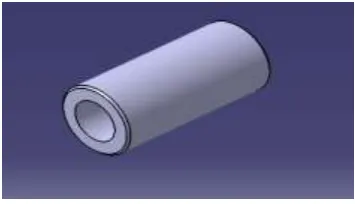
[image:6.595.72.250.336.438.2]Bu substituting the values in Eq. (17) and rounding off to the nearest integer we get the diameter of the piston pin as 34 mm. The inner diameter of the pin is taken as 0.6d0 which turns out to be 20 mm [1]. The mean diameter of the piston bosses for Al alloy piston is taken as 1.5 d0 which is 1.5 x 34 ~ 50 mm. The CAD model of the pin has been provided in the Figure 3 below. The pin is designed as a hollow cross section is shown in the model given below.
Fig. – 3: Piston Pin
The below Figure shows the dimensions and details of the piston assembly in the preceding section. The drawing shows the roughness values as well as the fits and tolerances as per the standards. The details about the geometrical and dimensional tolerances can be further verified in detail from [3].
Fig.-4: Details of Piston Assembly
4.8 Analysis of components
The figures given below show the analysis of all the components of the piston assembly. The total deformation and the equivalent Von-Mises stress have been determined from ANSYS workbench 16.0. The CAD model of all the components was imported to design modeller in ANSYS and the geometry cleaning was done in order to achieve precise results. Figure 5 shows the piston of the engine. A tetrahedral fine mesh has been applied to the piston apart from some of the regions. The regions like the ring grooves and the top portion of the piston head have been given face meshing. A refinement has been provided on the top land and the piston cup since those regions will be subjected to gas pressure force. Refinement increases the number of nodes but it also provides a refined mesh which helps in getting accurate results. The meshing is followed by static structural analysis which includes applying loads like pressure on the piston head equal to the maximum gas pressure. Cylindrical supports have been provided to the piston barrel.
[image:6.595.31.550.350.754.2]Fig.-5: Von-Mises Stress
© 2019, IRJET | Impact Factor value: 7.34 | ISO 9001:2008 Certified Journal
| Page 41
The Figure 7 shows the analysis of the gudgeon pin where the pin is checked against the bending stress. The pin is subjected to bending moment at the central plane.
Mb = (PD) /8 (18)
[image:7.595.307.569.96.424.2]Mb = Bending moment (N-mm). The value of the bending moment from Eq. (18) comes out to be 301,592.8 N-mm. The figure given below shows the analysis. Piston pin can be treated as a sweep-able body for meshing. A medium mesh is applied on the pin and both the ends of the pin are given face meshing. The bending moment is applied at the central plane in static structural analysis. The end surfaces of the pin are taken as fixed supports as the pin actually forms a tight fit with the bushing and in turn with the piston. The piston cannot have a lateral movement because of the circlips provided at both ends.
Fig.-7: Stress Analysis of Gudgeon Pin
Fig.-8: Total Deformation
The thermal analysis is also done on the piston in order to determine the total heat flux and temperature distribution. The piston head is subjected to a high thermal load in the combustion chamber. From Eq. (10), the heat dissipated by the piston head is determined to be 594W. The following Figure 9, gives the total heat flux while Figure 10 gives the temperature distribution.
Fig.-9: Total Heat Flux
5. DESIGN OF CONNECTING ROD
The connecting rod is another important part of the engine. The connecting rod is the link between the piston and the crankshaft. It converts the reciprocating motion of the piston into the rotary motion of the crankshaft. It is subjected to tensile and compressive forces due to the reciprocating and rotary motions of various elements. [1]
The connecting rod consists of a small end which is fitted over the piston pin bush in the piston and the big end is fitted over the crankshaft bushing. The big end of the rod is split perpendicular to the length in order to permit assembly on the crankshaft and is held together with two bolts. The middle section called shank is designed as I or H section. Connecting rods are manufactured by drop forging, sintering and casting. The entire component is casted/forged as a single piece [1][4].
[image:7.595.308.572.100.241.2]The casting materials used most widely for connecting rods are nodular cast iron (GGG-70) and black malleable cast iron (GTS-70). The large majority of all conrods are manufactured from steel in the drop forge process. New developments in steel have reached tensile strengths—even in materials used for cracking—of up to 1300 MPa at 0.2 offset limits in excess of 700 MPa. These steels are identified with the designation C70+. Syt = 750 MPa and the corrected endurance limit (Se) =
[image:7.595.36.292.305.433.2] [image:7.595.35.293.467.598.2]© 2019, IRJET | Impact Factor value: 7.34 | ISO 9001:2008 Certified Journal
| Page 42
125 MPa. If the cross sectional area is assumed as ‘A’ then from [1], A = 11t2, Kxx = 1.78t, a = (1/7500) where, A = cross sectional area (mm2).
K = radius of gyration (mm)
a = constant for steel material
The crippling stress for the connecting rods made of mild steel or plain carbon steel, the crippling stress (σc) is 330 MPa. The crippling load is given as Pcr = Pc x (FOS). Pc is the maximum force acting on connecting rod and from analysis it is revealed to be the maximum gas force. The value of factor of safety is already assumed as 6 for the entire design unless mentioned. The maximum force is already determined from Eq. (14) which is 30,159.28 N. Hence the crippling load as given above by the relationship is equal to (30,159.28 x 6) = 180,955.68 N. The length of the connecting rod is determined by taking ( l/r) ratio from Table 1. as 4.5. The crank radius is (l/2) which is 60 mm. Hence the length of the connecting rod is (4.5 x 60) = 270 mm. The thickness of the ‘I’ section of the connecting rod is determined from crippling load by using Rankine’s formula [1]
Pcr = (σc x A) / [ 1 + (1/7500)(L/Kxx)2] (19)
[image:8.595.104.215.439.569.2]By substituting the values in Eq. (19) and rounding off to the nearest integer, we get the value of thickness as 8 mm. The I section is represented below [1],
Fig.-11: I-section of the Connecting Rod [1]
Hence by determining the dimensions as given in the above Figure 10, the width of the connecting rod (B) is 32 mm. The height (H) is 40 mm and the thickness is 8 mm. The empirical relationships can be used to determine the height of the ‘I’ section of the shank near the small end and near the big end. The height varies from big end to small end as, At small end, H1 = 0.75H to 0.9H = 34 mm and at big end, H2 = 1.1H to 1.25H = 48mm. The width is kept constant throughout the length. Hence the dimensions are finally given as,
At small end = (32 x 34) mm
At mid-section = (32 x 40) mm
At big end = (32 x 48) mm
5.1 Design of Small End
The small end of the connecting rod is fitted over the piston push whose outer diameter is 38mm. The general assumption for the thickness of the eye is 3 mm. The small end eye will have inner diameter of 38 mm and outer diameter of (38 + 3 + 3 ) = 44 mm. The thickness of the eye that has been adopted is safe against tensile loading as will be verified later.
5.2 Design of Big End
The construction of the big end of the connecting rod is done based on bearing consideration. The big end of the rod is fitted over the crankpin.
Pc = dc lc (pb)c (20)
dc = diameter of crankpin or inner diameter of bush on crankpin (mm)
lc = Length of the crankpin or length of bush on crank pin (mm)
(pb)c = Allowable bearing pressure for the crankpin bush (MPa)
The lc / dc ratio is generally taken from the range 1.25 to 1.5. For the current design, the ratio of 1.25 is adopted. The allowable bearing pressure for the crankpin bush is usually taken from 5MPa to 10 MPa. For the current design, we assume a value between these limits as 7.7 MPa. The crippling load is already calculated as 30159.16 N. After substituting these values into the Eq. (20) and rounding off to the nearest integer, we get the value of dc as 56mm. The length as per the ratio of 1.25 will be 70 mm. The crank pin bush outer diameter can be calculated by taking the thickness of bush as 3 mm. Hence diameter of crank pin bush is 62 mm.
5.3 Design of Big end cap and bolts
The big end cap bolts for the split end will be subjected to a tensile loading due to inertia forces of the reciprocating parts. Hence the force acting on the bolts is calculated as,
Pi = mrω2r (cosθ + cos2θ/n1) (21)
Where, Pi = inertia force acting on cap bolts (N)
mr = mass of reciprocating parts (kg)
ω = Angular velocity of crank (rad/s)
© 2019, IRJET | Impact Factor value: 7.34 | ISO 9001:2008 Certified Journal
| Page 43
θ = angle of inclination of crank from top dead centre position
mr = [Mass of piston assembly + 1/3(Mass of connecting
rod)] (22)
The mass of reciprocating parts consists of mass of piston assembly and mass of connecting rod. The piston assembly consists of piston and hollow gudgeon pin. The mass of piston assembly is calculated as 1.0063 kg [1][2]. The mass of connecting rod is calculated as 0.59 kg [1][2]. By substituting these values in Eq. (22) we get the mass of reciprocating parts as 1.21 kg. The value of angular velocity of crank is calculated as 157.07 rad/s. Crank radius (r) is 0.06 m. The ratio of length to crank radius is already taken as 4.5 from Table 1. By substituting these values in Eq. (21) we get the value of inertia force as 2189.13 N. In order to find out the core diameter of the cap bolts the following relationship can be used,
Pi = 2(π/4)dc2σt (23)
where, dc = core diameter of the cap bolt. (mm)
σt = Tensile stress acting on the bolt (MPa)
The material for the cap bolts can be taken as C70S6BY [4]. The tensile strength is 750 MPa and hence ‘σt’ is obtained as 125 MPa. By substituting the above values, we get the core diameter of the bolt as 4.089 mm. The nominal diameter of the bolt is obtained as (dc/0.8) which is equal to 5.111 mm.
Hence, M6 bolts have been selected for the current design [3].
Thickness of the big end caps:
The cap is treated as a beam which is freely supported at the bolt centres. The load is uniformly distributed and centrally applied and hence the bending moment will be (Wl/6). The equation can thus be written as,
Mb = (Pi x l)/6 (24)
where, l = distance between bolt centres (mm) = 84 mm
By substituting values, we get the bending moment as 153,239.1 N mm.
σb = Mby/ I (25)
where, y = tc/2
I = moment of inertia
σb = Bending stress (N/mm2) = 125 MPa
I = (bctc3)/12 (26)
Where, tc = thickness of the cap (mm)
By substituting the value of bending moment from Eq. (24) and the bending stress value in to Eq. (25) we get the value of thickness of the cap as 10.03 which can be approximated to 11 mm. The details of all the dimensions of the connecting rod are given below. The analysis for various components of the connecting rod can be done. The bolts are subjected to tensile loading and the shank of the connecting rod is subjected to buckling stress.
Fig.-12: Connecting rod assembly
© 2019, IRJET | Impact Factor value: 7.34 | ISO 9001:2008 Certified Journal
| Page 44
Fig.-14: Big End Cap
Fig.-15: Cap Bolts
Fig.-16: Deformation in C.R. with deformed and un-deformed shapes
Fig.-17: Stress Analysis
6. DESIGN OF CRANKSHAFT
The crankshaft should have enough strength to withstand the bending and twisting moments. It should keep lateral and angular deflections within permissible limits. It is subjected to fluctuating stress and it should have sufficient endurance limit stress. [1] It should also have resistance to flexural loading, alternating torsion and wear resistance at main bearings.
Crankshafts are manufactured by casting or forging process. However, forging is suitable for the current design than casting because cast crankshafts have lower Young’s Modulus and are less stiff and exhibit different vibration properties. [4] The material selected for the crankshaft for the current design is alloy forging steel 35Ni5Cr2. [3] The yield strength is 540 MPa. It is heat treated alloy steel.
From Eq. (20), we have already calculated the diameter of crank pin as 56 mm and the length of the pin as 70 mm. The crank web thickness can be obtained from empirical relationship as t = 0.7dc = 0.7(56) = 40 mm [1]. The width of the crank web is given as w = 1.14dc = 1.14(56) = 64 mm [1]. The distance between the bearing centres have been adopted as = (1.25 to 1.75)x Piston diameter = 1.75(80) =
140 mm. Let A and B be the bearing centres. The bearings will have reaction forces as follows,
RB = (80/140) x gas force = (80/140) x (30.159 x 103) = 17233.71 N = 17.2337 kN.
The (l/d) ratio is taken as 0.75. Allowable bearing pressure at the pin is taken as 8 MPa.
Pb = RB/(0.75d2) (27)
where, d = diameter of bearing (mm)
PB = Allowable bearing pressure (MPa)
Hence diameter of bearing is calculated as 53.59 which can be taken as 54 mm. Hence length of the bearing is 0.75d= 40.5 mm. Consider bearing at A also of the same dimensions.
RA = (60/140) x 30.159 x 103 = 12.925 kN.
The gas pressure at maximum torque is 40% of its maximum value. Hence gas pressure = 0.4 x 30.159 = 12.063 kN. The force on connecting rod is 12.063/(cos12.46) = 12.35 kN. Hence Torque = 0.6 x 12.35 = 0.741 KN-m = 741 Nm. The safe shear stress can be taken as 75 MPa. [1] Z = (π/16)d3 = Torque / shear. The diameter of the shaft is calculated as 36.92 mm which can be rounded off to 37 mm. From [3], the next standard shaft size is selected and taking into consideration the mounting of flywheel, the diameter selected is 45 mm.
© 2019, IRJET | Impact Factor value: 7.34 | ISO 9001:2008 Certified Journal
| Page 45
Fig.-18: Crankshaft
6.1 Design of Key for crankshaft
The flywheel is mounted on the crankshaft and hence a key needs to be designed. As per the current design, adopt a key of 14 x 9 with 100 mm key length [3]. The key is checked for shear force. The key dimensions are adopted by using standard values from Machine design data from IS 2048, 1962. The figure given below shows the model of key. The figures succeeding also show the details of crankshaft assembly.
Fig.-19: Key
The Modal analysis of the crankshaft is performed on ANSYS Workbench. The modal analysis reveals six modes and the frequency calculated at each mode. The total deformation for every mode is given. Refer to the figures given below to see the graph of the frequency calculated at each mode.
Fig.-20: Details of Crankshaft
Fig.-21: Total Deformation mode 1
Fig.-22: Total Deformation mode 2
Fig.-23: Total Deformation mode 3
© 2019, IRJET | Impact Factor value: 7.34 | ISO 9001:2008 Certified Journal
| Page 46
Fig.-25: Total Deformation mode 5
Fig.-26: Total Deformation mode 6
7. PERFORMANCE TESTING
The performance testing is done by comparing the brake power and the mass flow rate of the fuel. The engine specifications have been given below,
Engine Type: Vertical Diesel
Rated Power: 3.6 kW
Rated RPM: 1500
C.R.: 16:1
Dynamometer type: Rope Brake
Brake Drum Radius: 0.185
Brake Rope Radius: 0.012
Hanger Mass: 0.15
Orifice Diameter: 14 mm
Coefficient of Discharge: 0.62 Calorific Value of Fuel: 43.5 MJ/kg Fuel Specific Gravity: 0.83 Ambient Temperature: 27 C
Fig.-27: Observations and Measurements
Fig.-28: Results
Chart -1: Brake Power vs Mass flow rate
The above graph when extended in a straight line taking the mean of all points, we get the friction power of the engine.
8. CONCLUSION
© 2019, IRJET | Impact Factor value: 7.34 | ISO 9001:2008 Certified Journal
| Page 47
The future scope of the project may include design of a turbocharger or supercharger in order to increase the pressure in the inlet manifold to increase the power output. The graph shows the increase the brake power with the mass flow rate which can be improved by installing Turbochargers of the suitable specifications. The emissions of the diesel engine can be controlled by using Exhaust Gas recirculation system to keep it within limits.
REFERENCES
[1] V.B. Bhandari. Design of Machine Elements, 3rd ed, Mcgraw Hill companies, p843 – 895
[2] S.P. Patil. Mechanical System Design, 2nd ed, 2008. ISBN 81- 7992-315-0. Jaico publishing house.
[3] Machine Design Data book, Digital Engineering Library @ McGraw-Hill (www.digitalengineeringlibrary.com) Copyright © 2004
[4] Internal combustion engine handbook: basics, components, systems, and perspectives / edited by Richard van Basshuysen and Fred Schäfer. SAE International, Warrendale, Pa. eISBN: 978-0-7680-7196-2


![Fig.-11: I-section of the Connecting Rod [1]](https://thumb-us.123doks.com/thumbv2/123dok_us/9304093.431576/8.595.104.215.439.569/fig-i-section-of-the-connecting-rod.webp)
