In the Mediterranean area, the local weather is characterized by mild winters, limited rainfall from autumn to spring, and hot summers. The exposure of ewes to elevated ambient temperatures induces an increase in the dissipation of excess body heat in order to negate the excessive heat load. Adaptation to hot summers in the absence of cold winters is likely to have resulted in enhanced thermoregu-latory mechanisms of heat loss at the expense of mechanisms for heat conservation (Piccione et al., 2002). It is well known that to maintain the con-stant body temperature, an animal has to satisfy the condition of stationary equilibrium, in which the metabolic production of heat is equal to its loss. In these conditions an increase in the metabo-lism allows the animal’s adaptation to the various environmental conditions (Piccione et al., 2002). Thermal regulation in ewes is also influenced by the
characteristics of their fleeces. Studies of shorn and unshorn ewes, exposed to extreme environmental conditions, have long demonstrated the importance of the fleece for the maintenance of homoeothermy (McFarlane, 1968; Whittow, 1971). The ewe’s fleece is an insulating layer protecting the animal against both heat and cold. It is related to breed, age, sex and environmental conditions like temperature, relative humidity and wind (Moule, 1954; Hafez et al., 1956; Sleiman and Abi Saab, 1995). It has an extremely low thermal conductivity (3810.17 W/m/K) and it maintains easily, both in winter and in summer, a high thermal gradient between atmosphere and skin (Weast, 1969; Manunta, 1973).
Many studies have been carried out to evalu-ate the role played by the fleece in maintaining thermal equilibrium in ewes (Piccione et al., 2003; Pennisi et al., 2004) and the effect of shearing on
Effect of shearing on some haematochemical
parameters in ewes
G. Piccione
1, S. Casella
1, F. Fazio
1, P. Pennisi
21Depatment of Experimental Science and Applied Biotechnology, Messina University, Messina, Italy 2Department of Agronomic, Agrochemical Science and Animal Productions, Catania University,
Catania, Italy
ABSTRACT: The aim of the present paper was to study the effect of shearing on some haematochemical parameters in ewes. Forty Valle del Belice ewes, clinically healthy and well-fed, were divided into two groups of twenty subjects each. Twenty ewes were let unshorn as a control group (Group A) and twenty ewes were shorn (Group B). After the blood collection by means of jugular venipuncture, some haematochemical param-eters were assessed for each subject in the following experimental conditions: before shearing, 1st, 15th, 30th,
45th, 60th and 75th day after shearing. We studied the course of the following haematochemical parameters:
glucose, β-hydroxybutyrate, NEFA, triglycerides, total cholesterol, total protein, urea and creatinine. Two-way repeated measures analysis of variance (ANOVA), followed by Bonferroni’s test, was used to determine significant differences between the two groups in the studied parameters. The statistical analysis showed statistical differences (P < 0.05 was considered statistically significant) in β-hydroxybutyrate, NEFA, total protein and urea. Data analysis of variance showed a significant effect of time, with P < 0.0001, on all stud-ied parameters. These results suggest that shearing induces adaptive metabolic responses in the ewes and exposure to elevated ambient temperature induces modifications of some haematochemical parameters.
the energy metabolism of pregnant ewe (Symonds et al., 1986, 1988, 1989): the authors showed that the shearing of the fleece of ewe lambs resulted in a lower heat stress during summer while thermal homeostasis was not influenced; moreover, the ef-fects of shearing on energy metabolism in the ewe are discussed in relation to the nutrient supply for the developing foetus.
On the basis of such considerations we studied the behaviour of some haematochemical param-eters in ewes with the aim to evaluate the effect of shearing on maintaining thermal equilibrium during the summer season in ewes since the tra-ditional shearing time is spring and early summer. The course of the following haematochemical pa-rameters was studied: glucose, β-hydroxybutyrate, NEFA, triglycerides, total cholesterol, total protein, urea and creatinine.
MATERIAL AND METHODS
The study that started in June and ended in September was carried out on a farm located in Sicily (38° 7’ N; 13° 22’ E) at an altitude of 300 me-tres above sea level. Forty two-years-old, clinically healthy and well-fed Valle del Belice ewes were used in the experiment. As concerned the feeding condi-tions, groups A and B were fed daily on hay (2 kg), wheat straw (1 kg), wheat concentrate (0.5 kg) and water ad libitum.
The following experimental protocol was used: the animals were divided into two groups (Group A and Group B), each of twenty animals. The ewes in Group A were let unshorn as a control group while the ewes in Group B were shorn.
Before shearing the animals of each group were subjected to the measurement of body condition score (BCS, 0 to 5 scale). The ewes’ BCSs were also measured 45 and 75 days after shearing.
Blood samples were collected by means of a jug-ular venipuncture. Samples were centrifuged at 3 000 rpm for 10 min and sera were stored at –4°C until being assayed for parameters. In each individual sample serum concentrations of β-hydroxybutyrate, NEFA, triglycerides, total cholesterol, total protein, urea and creatinine were assessed. Sera were ana-lysed with commercially available kits by means of a UV spectrophotometer (Slim SEAC model, Firenze, Italy). Moreover, in blood samples, collected using vacutainer tubes (Terumo Corporation, Japan) with K3-EDTA, glucose was assessed by means of blood
glucose meter (Glucotrend 2, Roche) immediately after the collection.
The studied parameters were assessed for each subject on day 0 (before shearing) and the assess-ments were repeated on day 1, 15, 30, 45, 60 and 75 after shearing.
The statistical analysis of data was based on the average values obtained. To compare overall pa-rameters studied, two-way repeated measures anal-ysis of variance (ANOVA) was used to determine significant differences. Two-way ANOVA with repeated measures was used for the assessment of effects due to shearing and time. P < 0.05 was considered statistically significant. Bonferroni’s test was applied for post-hoc comparison. Data were analyzed using Statistica 5.5 (StatSoft Inc.) software package.
RESULTS
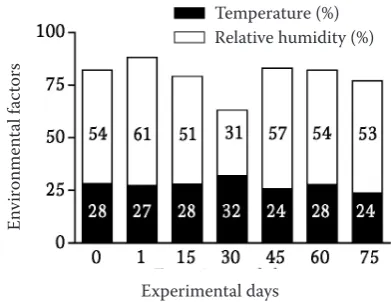
The environmental temperatures and relative hu-midity levels on the experimental days are present-ed in Figure 1. The average value of environmental temperature was 27.57°C while the average value of relative humidity was 59.71%. Environmental temperature peaked at 32°C and relative humidity level, while the mean relative humidity level was 51.5%, showed an inverse relationship to ambient temperature.
[image:2.595.312.508.580.731.2]Table 1 shows the average values of the parame-ters considered, together with their standard devia-tions of the means (SD), in different experimental conditions in the ewes of Group A and B.
Figure 1. Air temperature (°C) and relative humidity (%) during the experimental period
Temperature (%) Relative humidity (%)
Experimental days
En
vir
onmen
tal f
ac
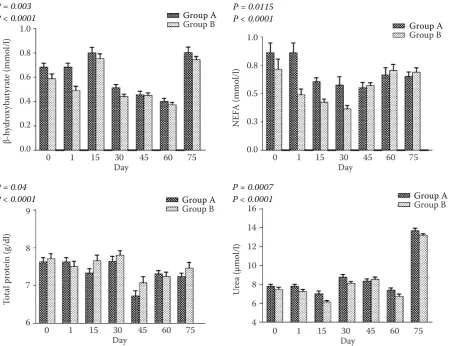
Figure 2 illustrates the relationship between un-shorn and un-shorn ewes in which the effect of shear-ing is considered significant.
The effect of shearing is considered very sig-nificant on β-hydroxybutyrate (F(1.228) = 10.03,
P = 0.003); NEFA (F(1.228) = 7.05, P = 0.0115); total
protein (F(1.228) = 4.45, P = 0.04); urea (F(1.228) = 13.63, P = 0.0007). Two-way ANOVA does not show a statistically significant effect of shearing on trig-lycerides, total cholesterol, glucose and creatinine; however the values obtained were within the range for ewes (Kaneko, 1989).
The effect of time is considered significant on all parameters: glucose (F(6.228) = 44.81, P < 0.0001); β-hydroxybutyrate (F(6.228) = 51.84, P < 0.0001); NEFA (F(6.228 = 9.07, P < 0.0001); triglycerides (F(6.228) = 25.50, P < 0.0001); total cholesterol (F(6.228) = 21.08, P < 0.0001); total protein (F(6.228) = 9.96,
P < 0.0001); urea (F(6.228) = 214.37, P < 0.0001) and
creatinine (F(6.228) = 37.86, P < 0.0001).
Two-way ANOVA was also applied to determine the body condition score, showing that BCS does not change. Table 2 shows the average values and standard deviations (SD) of the body condition score in Group A (unshorn ewes) and in Group B (shorn ewes) before shearing, 45 days and 75 days after shearing.
DISCUSSION
The analysis of the results indicates the influence of shearing in some haematochemical parameters studied in ewes.
[image:4.595.71.521.84.430.2]Ewes share with all mammals their capacity to keep the body temperature within certain limits. With respect to the thermal dispersion system in farm animals, ewes are in an intermediate posi-tion between horses and cattle (species in which sweating prevails) and swine and dogs (in which
Figure 2. The pattern of mean values of β-hydroxybutyrate (mmol/l), NEFA (mmol/l), total protein (g/dl) and urea (µmol/l), with SD obtained in different experimental conditions in the ewes of Groups A and B
P = 0.003 P < 0.0001
P = 0.04 P < 0.0001
P = 0.0115 P < 0.0001
P = 0.0007 P < 0.0001
Group A
Group B Group A
Group B
Group A Group B Group A
Group B 0 1 15 30 45 60 75
Day 1.0
0.8
0.6
0.4
0.2
0.0
1.0
0.8
0.5
0.3
0.0
9
8
7
6
16 14 12 10 8 6 4
β-h
ydr
oxy
buty
ra
te (mmol/l)
Tot
al pr
ot
ein (
g/dl)
N
EF
A (mmol/l)
U
re
a (
µmol/l)
0 1 15 30 45 60 75 Day
0 1 15 30 45 60 75 Day
polypnea is the main means of defence against heat) (Ruckebusch, 1986).
The ewes in environments with high tempera-tures are subjected to different stressful climate conditions than sheep in temperate zones (Johnson, 1987).
In hot climates, high ambient temperatures, and high direct and indirect solar radiation, wind speed and humidity are the main environmental stress-ing factors that impose strain on animals (Finch, 1984; Silanikove, 2000). In our study the effect of current climatic conditions on the observed haema-tochemical parameters can be considered a stress factor.
According to other authors who reported a de-crease in the concentration of blood β-hydroxy-butyrate during lactation compared to the dry period in goats (Zumbo et al., 2007), the results of this study show a decrease in this parameter in shorn ewes compared to unshorn ones. Shearing, like lactation and pregnancy, may be considered a metabolic stress which determines a variation of biochemical parameters such as β-hydroxybu-tyrate.
In shorn ewes a decrease in total protein was observed; these changes in plasma protein may be due to the fluid shift between the compartments of the organism that assume an important role in the physical protection in comparisons of the temperature. Therefore it is possible to evidence a haemoconcentration characterized by an increase in total proteins (Piccione et al., 1994).
Significant values of urea concentration are prob-ably due to the metabolic complexity of the rumi-nants that use various substrates to energetic scope (Demignè et al., 1988).
NEFA also supply usable energetic quotas in con-ditions of thermal stress (Demignè et al., 1988). As previously observed by Symonds et al. (1989), there is a significant correlation between shearing and NEFA. The effect of shearing on NEFA is
consid-ered significant; initially the shorn ewes had lower values probably due to stress caused by the direct effect of solar radiation that affects the biologi-cal functions, but after day 30 the shorn ewes had higher values. These differences might be due to an increase in the plasma concentrations of thyroid hormones in shorn animals as Symonds et al. (1989) found in a previous study.
There is a statistically significant effect of time on all parameters considered. The variation in time is not probably due to the phenomena of thermoregu-lation but rather to chronophysiological modifi-cations of the parameters. Further investigations need to be carried out in order to gain a better understanding of these modifications.
In conclusion it can be affirmed that the shearing, to which the ewes were subjected, induced adaptive metabolic responses in the organism. Both shorn and unshorn ewes are subject to a heat stress, but the higher sensitivity of shorn ewes to heat stress is evident in comparison with unshorn ones. So, shearing induces modifications of some haemato-chemical parameters; in fact in the hot environ-ment unshorn ewes were found to be more tolerant than shorn ewes (Piccione et al., 2006).
REFERENCES
Demignè C., Yacoub C., Morand C. (1988): Findings on intermediate metabolism in ruminants. Reprod. Nutr. Dev., 28, 1–17.
Finch V.A. (1984): Body temperature in beef cattle: its control and relevance to production in the tropics. J. Anim. Sci., 62, 531–542.
Hafez E.S.E., Badreldin A.L., Sharafeldin M.A. (1956): Heat tolerance studies of fat-tailed sheep in the sub-tropics. J. Agr. Sci., 47, 280–286.
[image:5.595.66.531.115.189.2]Johnson H.D. (1987): Bioclimatology and the Adaptation of Livestock. Elsevier, Amsterdam, Oxford, New York, Tokyo.
Table 2. Average values and standard deviations (SD) of the body condition score in Group A (unshorn ewes) and in Group B (shorn ewes) before shearing, 45 days and 75 after shearing
Body condition score Group A Group B
mean SD mean SD
Before shearing 2.62 0.10 2.61 0.09
45 days after shearing 2.66 0.10 2.65 0.07
Manunta G. (1973): La termoregolazione in Fisiologia degli animali domestici. Libreria Universitaria Tin-arelli. Bologna, Italy.
McFarlane W.V. (1968): Adaptation of ruminants to trop-ics and desert in adaptation in domestic animals. Phil-adelphia, USA, 164–182.
Moule G.R. (1954): Observations mortality amongst lambs. Queensland. Aust. Vet. J., 30, 153–171. Pennisi P., Costa A., Biondi L., Avondo M., Piccione G.
(2004): Influence of the fleece on the thermal homeos-tasis and body condition in Comisana ewe lambs. Anim. Res., 53, 13–19.
Piccione G., Fazio E., Giofrè F., Caola G. (1994): Anda-mento di alcuni metabolici energetici nel corso della tosatura nella pecora. In: Atti XIII Congresso Nazion-ale S.I.P.A.O.C., Italy, 21–24.
Piccione G., Caola G., Refinetti R. (2002): Effect of shearing on the core body temperature of three breeds of Mediterranean sheep. Small Rumin. Res., 46, 211–215.
Piccione G., Biondi L., Borruso M., Costa A., Pennisi P. (2003): Influenza del microclima su alcuni parametri fisiologici nella pecora tosata. Arch. Vet. Ital., 54, 248–258.
Piccione G., Grasso F., Fazio F., Giudice E., Pennini P. (2006): Evaluation of some physiological and haema-tological parameters in the ewes: influence of shearing and sheltering. Folia Vet., 50, 13–16.
Ruckebusch Y. (1986): Fisiologia, Farmacologia e Terapia Veterinaria. ed. Essegivi, Piacenza, Italy.
Silanikove N. (2000): Effects of heat stress on the welfare of extensively managed domestic ruminants. Livest. Prod. Sci., 67, 1–18.
Sleiman F.T., Abi Saab S. (1995): Influence of environment on respiration, heart rate and body temperature of filial crosses compared to local Awassi sheep. Small Rumin. Res., 16, 49–53.
Symonds M.E., Bryant M.J., Lomax M.A. (1986): The ef-fect of shearing on the energy metabolism of the preg-nant ewe. Brit. J. Nutr., 56, 635–643.
Symonds M.E., Bryant M.J., Shepherd A.L., Lomax M.A. (1988): Glucose metabolism in shorn and unshorn pregnant sheep. Brit. J. Nutr., 60, 249–263.
Symonds M.E., Bryant M.J., Lomax M.A. (1989): Lipid metabolism in shorn and unshorn pregnant sheep. Brit. J. Nutr., 62, 35–49.
Weast R.C. (1969): Handbook of Chemistry and Physics, 50th ed. Chemical Rubber. Cleveland. Comp.
Whittow G.C. (1971): Ungulates. In: Whittow G.C. (ed.): Comparative Physiology of Thermoregulation. Aca-demic Press, New York, USA, 2, 191–281.
Zumbo A., Di Rosa A.R., Casella S., Piccione G. (2007): Changes in some blood haematochemical parameters of Maltese goats during lactation. J. Anim. Vet. Adv., 6, 706–711.
Received: 2007–07–19 Accepted after corrections: 2007–10–23
Corresponding Author
Prof. Giuseppe Piccione, Faculty of Veterinary Medicine, Messina University, Polo Universitario dell’Annunziata, 981 68 Messina, Italy