The essential trace mineral, selenium, is of fun-damental importance to human health (Rayman, 2000, 2004). Selenium is known to have important roles in reproductive functions and development, immunocompetence and ageing. As a constituent of selenoproteins, selenium has structural and en-zymic roles, in the latter context being best-known as an antioxidant and catalyst for the production of an active thyroid hormone. Selenium is a com-ponent of the cell enzyme glutathione peroxidase (Mills, 1957). The Se content of animal feed ingre-dients is dependent on the Se concentration in soil. The Se reserve in soils was depleted in the Czech Republic (Pavlata et al., 2000). Se intake is lower
than the recommended daily allowance: 55–70 µg (Velíšek, 2002). Therefore there is a need to in-crease Se consumption in the general population and selenium should be supplemented in the form in which it naturally occurs in foods.
The amount of Se available for assimilation by the tissues is dependent on the form and concentration of the element while organic selenium is deposited in the breast muscle more efficiently than inorganic selenium (Choct et al., 2004). Inorganic and organic forms of Se (selenite, selenate, selenide, selenom-ethionine, selenium enriched yeast, selenium en-riched alga) may be used as supplements. Selenate is the major inorganic selenocompound found in Supported by the Ministry of Agriculture of the Czech Republic (Project No. MZe 0002701403) and by the Ministry of Education, Youth and Sports of the Czech Republic (Project No. MSM 6046070901).
The effect of selenium source on the performance
and meat quality of broiler chickens
S. Ševčíková
1, M. Skřivan
1,2, G. Dlouhá
1, M. Koucký
11Research Institute of Animal Production, Prague-Uhříněves, Czech Republic 2Czech University of Agriculture, Prague-Suchdol, Czech Republic
ABSTRACT: The effect of dietary supplementation of selenium in an organic form on performance, carcass traits and selenium content in tissues of broiler cockerels Ross 308 was studied. The soya-wheat-maize diet contained 50 mg vitamin E/kg. The experiment was conducted on 810 straight-run broiler cockerels randomly divided into 3 groups: group I – control, without selenium supplement; experimental group: II – 0.3 mg Se/kg, Se-enriched yeast was applied as a Se source; III – 0.3 mg Se/kg, Se-enriched alga Chlorella as a Se source. The broiler chick-ens were slaughtered at 42 days of age. In performance traits higher (P ≤ 0.05) live weight of broiler chickens was recorded in the experimental groups (II – 2 430.6 g and III – 2 425.2 g). There were no significant differences between the groups in feed conversion and mortality. Se-enriched alga had the best feed conversion, and selenium supplementation slightly increased mortality in both experimental groups. No significant differences between the groups were found out in carcass traits and dressing percentage. The content of selenium in breast and thigh muscle, feathers and excrements increased (P ≤ 0.05) in both experimental groups compared to the control group. Higher values in breast and thigh muscle and in feathers were measured in the group supplemented with sele-nium from Se-enriched yeast, also in comparison with the group supplemented with selesele-nium from Se-enriched alga Chlorella. The broiler chickens receiving Chlorella had a higher (P ≤ 0.05) selenium content in excrements compared to the group with Se-enriched yeast. The selenium concentration in liver was higher (P ≤ 0.05) in both experimental groups compared to the control. The supplement of selenium from Se-yeast and Chlorella in the diet for broiler chickens increased the microelement concentration in muscle.
both animal and plant tissues. Selenocysteine is the predominant selenoamino acid in the tissue when inorganic selenium is given to animals. Se-methionine contents increased with increasing soil Se concentrations until Se-Met accounted for > 50% of the total Se content of the plant (Guo and Wu, 1998). In seleniferous maize, wheat and soybeans, Se-Met contents ranged from 81 to 82% of total Se in the form of L-Met (Schrauzer, 1998). Se-yeast is capable of increasing the activity of the selenoenzymes and its bioavailability was found to be higher than that of inorganic Se sources in all but one study. Se-yeast is a product derived from the fermentation of specific strains of yeast incubated in high selenium levels during their growth phase. Being biochemically similar to sulphur, Se replaces the sulphur molecule in the normal biosynthetic pathways of the yeast cell and is absorbed actively across the intestine by the same amino acid carrier (Kim and Mahan, 2003).
Selenium is an essential micronutrient required for normal growth and maintenance in poultry. The recommended selenium concentration in broiler diet is from 0.1 mg/kg (Mahan, 1995) to 0.15 mg/kg (NRC, 1994). Selenium in poultry nutrition was de-scribed in reviews by Surai (2002a,b). Schwarz and Foltz (1957) found out that selenium was a compo-nent of factor 3 and prevented liver necrosis in rats and exudative diathesis in broiler chickens.
The effects of selenium sources on the perform-ance of broiler chickens, carcass characteristics and meat quality were studied by Echevarria et al. (1988), Todorovič et al. (1999), Downs et al. (2000), Payne and Southern (2005). In the current study of Choct and Naylor (2004) the source of Se at 0.1 ppm did not affect the performance of broilers. In an-other experiment Choct et al. (2004) found out that male broilers receiving selenium at 0.1 mg/kg consumed more feed than those on 0.25 mg/kg se-lenium. However, feed intake was not influenced (P ≤ 0.05) by the source of selenium, mortality was not affected by the level and source of selenium in the feed. Edens et al. (2001) reported no dif-ferences in body weight or feed efficiency when broiler chickens were fed diets containing 0.2 ppm Se from sodium selenite or selenium yeast. The utilization of selenium added as sodium selenite in slow-growing laying-type chickens and in fast-growing broiler hybrids was examined by Zelenka and Fajmonova (2005). The supplementation of selenium, especially organic selenium, might im-prove meat quality and shelf life by reducing a drip
loss from poultry meat (Edens, 1996). Increasing dietary selenium improved the Se status of the muscle (Choct et al., 2004). Prakash et al. (2000) and Ryu et al. (2005) investigated the effect of di-etary supplementation of selenium and vitamin E on the performance of broiler chickens and oxida-tion stability of fats. Swain et al. (2000) reported the maximum daily weight gain and highest feed conversion in chickens that received 0.50 mg Se/kg and 300 IU/kg vitamin E. Pappas et al. (2005) stated that the selenium concentration in eggs might be increased with an increasing selenium amount in broiler breeder diets. The results of the study of Utterback et al. (2005) indicated that the use of Se-yeast in laying hen diets was very effective for increasing the Se content of eggs. Skřivan et al. (2006) investigated the effect of dietary sodium selenite, Se-enriched yeast and Se-enriched alga Chlorella on Se concentration in eggs, physical pa-rameters of eggs and laying hen production. They reported higher utilization of the organic form of selenium from Se-enriched yeast and Se-enriched alga Chlorella in laying hens compared to the in-organic form of selenium (Na2SeO3). Chlorella is a freshwater alga, containing a twofold amount of proteins (60%) compared to all species of legumes, 20% of polysaccharides and 10% of fats. It does not produce any toxic metabolites and its biomass con-tains many biologically active compounds. Little information on the selenium form in Se-enriched Chlorella is available for the time being. Selenium is assumed to be built into the protein structure similarly like it is into Se-enriched yeast (Machát et al., 2005); so selenium-enriched Chlorella may be used as a potential form of organic selenium sup-plement to poultry diets. The biomass of Chlorella was also tested and used as a vector of organically bound iodine in sow nutrition (Kotrbáček et al., 2004).
The present study was conducted to determine and to compare the effects of various organic forms of dietary supplemental Se on the performance, carcass traits, breast and leg muscle Se concentra-tion of broiler chickens.
MATERIAL AND METHODS
Diets and husbandry
chickens were obtained from a commercial hatch-ery at 1 day of age. Straight-run cockerels were ran-domly divided into 9 subgroups and 3 experimental groups; each subgroup comprised 90 chickens (270 chickens per group). Broiler cockerels received a loose feed mixture consisting of wheat, maize and soybean, supplemented with 50 mg/kg vita-min E, and organic form of selenium: 0.3 mg Se/kg in the form of Se-enriched yeast (group II) and 0.3 mg Se/kg in the form of Se-enriched alga
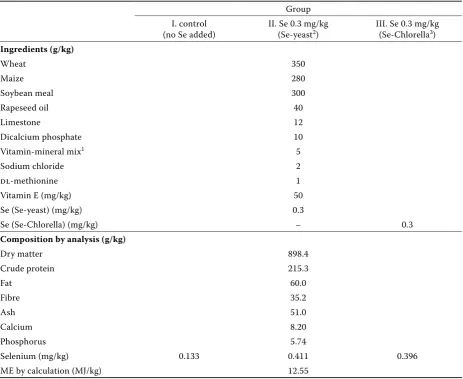
[image:3.595.67.531.101.480.2]Chlorella (group III). Control group (group I) was not supplemented with selenium. Thus, the dietary se-lenium contents were 0.133, 0.411 and 0.396 mg/kg. The feed mixture contained 214 g of CP and 12.55 MJ of ME. Se-enriched Chlorella was prepared in the Institute of Microbiology, Academy of Sciences of the Czech Republic, Třeboň; Se-enriched yeast was produced by Alltech Inc. Comp., USA. Vitamin E, Se-yeast and Chlorella supplements were includ-ed in the premix. Table 1 shows the formulation Table 1. Composition of the diets
Group I. control
(no Se added) II. Se 0.3 mg/kg (Se-yeast2) III. Se 0.3 mg/kg (Se-Chlorella3)
Ingredients (g/kg)
Wheat 350
Maize 280
Soybean meal 300
Rapeseed oil 40
Limestone 12
Dicalcium phosphate 10
Vitamin-mineral mix1 5
Sodium chloride 2
dl-methionine 1
Vitamin E (mg/kg) 50
Se (Se-yeast) (mg/kg) 0.3
Se (Se-Chlorella) (mg/kg) – 0.3
Composition by analysis (g/kg)
Dry matter 898.4
Crude protein 215.3
Fat 60.0
Fibre 35.2
Ash 51.0
Calcium 8.20
Phosphorus 5.74
Selenium (mg/kg) 0.133 0.411 0.396 ME by calculation (MJ/kg) 12.55
1the vitamin-mineral premix provided per kg of diets: vitamin A 12 000 i.u., vitamin D
3 500 i.u., vitamin K3 3 mg, vitamin B1
3 mg, vitamin B2 5 mg, vitamin B6 4 mg, vitamin B12 0.04 mg, niacinamid 40 mg, Ca pantothenate 12 mg, biotin 0.15 mg,
folic acid 1.5 mg, choline-Cl 250 mg, ethoxyquin 100 mg, Mn 80 mg, Zn 60 mg, Fe 50 mg, I 1 mg,Cu 12 mg
2Se-yeast contained 1 000 mg Se/kg and it was supplemented to the diet at an amount of 0.3 g/kg feed mixture
Se-yeast provided per kg of diets: selenium 0.3 mg, sulphur 1.56 mg, phosphorus 2.76 mg, potassium 3.45 mg, magnesium 0.69 mg, calcium 0.87 mg, iron 0.0534 mg, manganese 0.0285 mg, copper 0.0132 mg, zinc 0.0987 mg
3the alga Chlorella Kessleri contained 380 mg Se/kg and it was added to the diet at an amount of 0.7895 g alga/kg feed
and chemical composition of feed mixture. An ad libitum feeding regime and automatic drink-ers were used. Broiler chickens were kept in boxes 2 m × 3.3 m on bedding (wooden chips) separated with wire partitions 1 m in height. Each box was equipped with 7 nipple drinkers, 3 pan feeders and a feed hopper. Each box was heated with gas radia-tor with regularadia-tor, ventilation was provided with temperature-controlled fan. The broiler chickens were kept under a 24-h constant lighting sched-ule with lighting intensity control according to the technological procedure. Feed consumption, live weight and mortality were examined during the experiment. At the age of five weeks samples of excrements and feathers were collected for the analysis of selenium content. Feather samples were taken from the pectoral and ventral region from the same number of chickens per group. When the experiment terminated at 42 days of age, 10 broiler chickens of average live weight of the group were selected from each group and slaughtered conven-tionally at a slaughtering plant and the carcasses were sacrificed to carry out carcass analysis and breast and thigh muscle analyses.
Analyses
Meat samples were finely ground before the anal-ysis. Water content was determined after desicca-tion to constant weight at a temperature of 105°C; protein content was measured after mineralisation (Digestion System 20) and distillation with Kjeltec Auto 1030 Analyser; ash content – after complete ashing in a muffle furnace at a temperature 550°C; total lipids of breast and thigh meat were extracted with 2:1 chloroform-methanol according to the method of Folch et al. (1957). Selenium was
de-termined by atomic absorption spectrophotometry: the samples were mineralised in a closed system by microwave digestion in the presence of HNO3 and H2O2 in a Milestone Ethos TC equipment with temperature and pressure sensors (US EPA Method 3052). After mineralisation Se was determined by electrothermic atomisation ET-AAS in a graphite cuvette. We used a Solaar M-6 atomic absorption spectrometer with GF 90 Zeeman graphite cuvette and FS 95 furnace autosampler. All analyses were carried out in the Research Institute of Animal Production at Prague-Uhříněves.
Statistical analyses
The data were analysed by one-way ANOVA. Significant treatment effects were detected by Duncan’s multiple range test. Differences were considered significant at P ≤ 0.05. The results were expressed as means with their standard errors.
RESULTS AND DISCUSSION
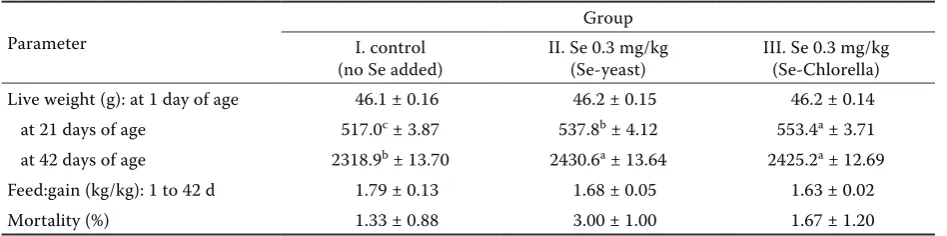
[image:4.595.63.537.617.735.2]Table 2 shows the effect of dietary selenium sup-plementation on performance traits and mortality. The dietary selenium supplement increased the live weight of chickens significantly (P ≤ 0.05). Broiler chickens of experimental group with Se-enriched alga reached higher live weight at the age of 21 days compared to control group and group with Se-enriched yeast; the final live weight at 42 days was higher in both experimental groups in com-parison with the control group. No significant differences in feed conversion were determined between the groups. Se-enriched alga had the best feed conversion.Chicken mortality was low in all
Table 2. Effect of dietary Se supplementation on broiler performance (mean ± SE)
Parameter
Group I. control
(no Se added) II. Se 0.3 mg/kg (Se-yeast) III. Se 0.3 mg/kg (Se-Chlorella) Live weight (g): at 1 day of age 46.1 ± 0.16 46.2 ± 0.15 46.2 ± 0.14 at 21 days of age 517.0c ± 3.87 537.8b ± 4.12 553.4a ± 3.71
at 42 days of age 2318.9b ± 13.70 2430.6a ± 13.64 2425.2a ± 12.69
Feed:gain (kg/kg): 1 to 42 d 1.79 ± 0.13 1.68 ± 0.05 1.63 ± 0.02 Mortality (%) 1.33 ± 0.88 3.00 ± 1.00 1.67 ± 1.20
groups. The mortality rate was highest in Se-en-riched yeast. There were no significant differences between groups. The results are in agreement with the findings of other authors (Spears et al., 2003; Payne and Southern, 2005; Ryu et al., 2005). Spears et al. (2003) reported no difference in gain or feed efficiency of broiler chickens fed diets containing 0, 0.05, or 0.15 ppm Se from sodium selenite or selenomethionine. On the other hand, in poults at the age of 28 days Cantor et al. (1982) recorded higher live weight and increased feed intake after dietary Se supplementation in the form of sodium selenite or selenomethionine (0.04 to 0.12 ppm Se). In Japanese quail kept under a heat stress Sahin and Kucuk (2001) also reported higher performance and dressing percentage after the application of a dietary supplement of 250 mg vitamin E and 0.2 mg Se in the form of Na2SeO3. Downs et al. (2000) did not observe a significant effect of the addition of 0.3 mg/kg Se in the form of selenite and Se-en-riched yeast on performance traits of broiler
chick-ens. Todorovič et al. (1999) supplemented sodium selenite at the amounts of 2, 5, 10, 20 and 30 mg/Se to a diet for broiler chickens. The supplementation of 2 mg/kg Se did not influence the live weight of chickens, 5 mg/kg Se decreased daily weight gain and the amounts of 15, 20 and 30 mg/kg Se re-sulted in up to 80% mortality of broiler chickens. Echevarria et al. (1988) reported a decrease in feed intake and live weight gain after the addition of 6 and 9 mg/kg Se in the form of Na2SeO3.
[image:5.595.67.536.100.231.2]Table 3 shows the results of carcass analysis. The values do not prove any significant differences be-tween the groups in the weight of breast and thigh muscle, liver and abdominal fat. The results are in agreement with Downs et al. (2000) and Payne and Southern (2005). Choct and Naylor (2004) also reported that vitamin E and Se source at 0.1 ppm did not have a significant influence on eviscerated weight, dressed weight, breast fillet yield or average maryland weight at processing. But in the previous trials Choct et al. (2004) found that birds receiving Table 3. Carcass characteristics of broilers (mean ± SE)
Parameter
Group I. control
(no Se added) II. Se 0.3 mg/kg (Se-yeast) III. Se 0.3 mg/kg (Se-Chlorella) Breast muscle (g) 350.3 ± 7.79 374.7 ± 10.63 351.4 ± 10.54 Thigh muscle (g) 338.3 ± 6.94 330.0 ± 7.39 320.8 ± 8.03 Liver (g) 48.7 ± 2.06 50.2 ± 1.05 51.3 ± 2.47 Giblets (g) 105.1 ± 3.84 104.7 ± 2.05 100.2 ± 2.13 Abdominal fat (g) 13.2 ± 0.49 15.5 ± 0.62 15.0 ± 1.15 Carcass yield (%) 74.17 ± 0.31 74.40 ± 0.48 75.12 ± 0.48
Table 4. Concentration of dry matter, crude protein and intramuscular fat in breast and thigh muscle (mean ± SE)
Parameter
Group I. control
(no Se added) II. Se 0.3 mg/kg (Se-yeast) III. Se 0.3 mg/kg (Se-Chlorella)
Breast muscle
Dry matter (g/kg) 251.13 ± 1.61 249.11 ± 1.27 249.63 ± 1.88 Crude protein (g/kg) 215.20 ± 1.34 214.60 ± 0.77 214.72 ± 1.70 Intramuscular fat (g/kg) 9.78b ± 0.45 9.90b ± 0.20 10.93a ± 0.26
Thigh muscle
Dry matter (g/kg) 247.44 ± 2.19 246.04 ± 1.51 247.67 ± 2.47 Crude protein (g/kg) 181.34 ± 0.52 181.19 ± 0.56 182.01 ± 0.81 Intramuscular fat (g/kg) 50.79 ± 1.50 47.35 ± 1.51 47.53 ± 1.91
[image:5.595.66.532.584.734.2]organic Se in their diets had improved eviscerated weight, breast yield and reduced drip loss. The av-erage weight of breast skin was highest (P ≤ 0.05) in Se-enriched alga Chlorella compared to group II receiving Se-enriched yeast. These differences were probably influenced by higher variability in this trait. No significant differences were determined in the weight of skin from the thigh. Average dressing percentage was 74.2–75.1%. Downs et al. (2000) reported the average dressing percentage of 71% after an addition of 0.3 mg/kg Se in the form of selenite and Se-enriched yeast while the carcass and deboned parts yield was not influenced.
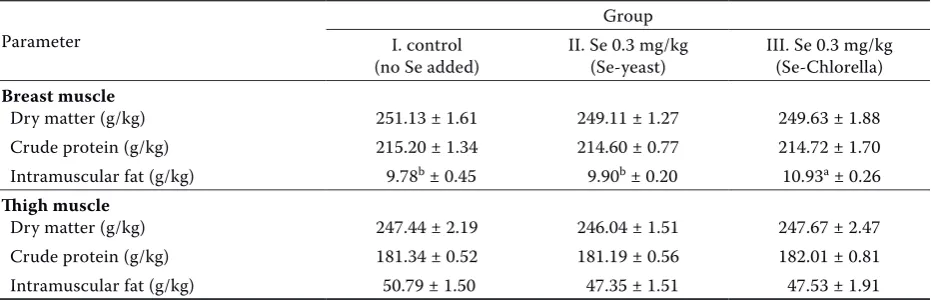
The content of selected basic nutrients – dry mat-ter, proteins and intramuscular fat in breast and thigh muscle is shown in Table 4. The highest value (P ≤ 0.05) of intramuscular fat in breast muscle (10.9 g/kg) was measured in the Chlorella-selenium supplemented group while in thigh muscle there were no significant differences between the groups. As Se-enriched Chlorella is used as a new source of selenium, no literature data is available on its effect on some nutrition characteristics involving the content of intramuscular fat. For this reason it is difficult to prove the higher content of intramus-cular fat in breast muscle. The intramusintramus-cular fat in thigh muscle was found to be 4 to 5 times higher (max. 50.8 g/kg) than in breast muscle. Because chicken meat is usually recommended as a dietary food, its content in thighs is questionable because it may reach the values given for pork; so breast meat should be recommend as dietary.
Selenium concentrations in breast and thigh muscle, liver, excrements and feathers are shown in Table 5. The content of selenium in breast and thigh muscle, liver, excrements and feathers increased (P ≤ 0.05) in both experimental groups compared to the control. The results are consistent with other
[image:6.595.64.537.612.727.2]reports showing increased Se retention in muscle tissue when Se is supplemented. Choct et al. 2004 reported that an increasing supplementation rate from 0.1 to 0.25 mg/kg increased the breast muscle selenium concentration from 0.232 to 0.278 mg/kg and both the selenium source and the concentration significantly influenced (P ≤ 0.05) the selenium con-tent of the excreta at day 28. Birds receiving inorganic selenium retained less selenium (4.25 mg/kg) than those on the selenium yeast treatment (1.32 mg/kg). Mahan and Parrett (1996) reported that inorganic Se (sodium selenite) was retained at a much lower concentration in muscle tissue, was less efficiently absorbed and was excreted at a higher rate than or-ganic Se due to their different metabolic pathways. This is probably due to different absorption mecha-nisms for organic and inorganic forms of selenium. Inorganic selenium is passively absorbed from the intestine by a simple diffusion process, whereas organic selenium is actively absorbed through the amino acid transport mechanisms (Wolfram et al., 1989a,b). Spears et al. (2003) reported that broiler chickens fed 0.15 ppm Se-Met had increased breast Se concentrations compared with those fed sodium selenite. Downs et al. (2000) found out that the Se content of the breast fillet tissue revealed 2.1 and 2.2 times less Se in samples from the control and inorganic Se treatment, respectively, versus the or-ganic Se treatment. Echevarria et al. (1988) stated that the Se concentration in tissues, particularly in kidneys and liver, increased linearly with the in-creasing Se content in the diet. Muscle Se increased (P ≤ 0.01) from an average of 0.42 in control birds to 1.07 mg/kg for birds fed 9 mg/kg Se. The increased Se concentration in breast muscle and plasma was also determined by Payne and Southern (2005) in broiler chickens supplemented with 0.3 ppm Se/kg in Se-enriched yeast. Choct and Naylor (2004) Table 5. Selenium concentrations in breast and thigh muscle, liver, excrements and feathers (mean ± SE)
Parameter (µg/kg)
Group I. control
(no Se added) II. Se 0.3 mg/kg (Se-yeast) III. Se 0.3 mg/kg (Se-Chlorella) Selenium in breast muscle 52.11c ± 2.03 217.39a ± 9.67 123.21b ± 6.36
Selenium in thigh muscle 70.95c ± 1.32 247.87a ± 28.42 147.61b ± 17.95
Selenium in liver 185.37b ± 5.63 424.23a ± 16.74 393.23a ± 12.91
Selenium in excrements 117.17c ± 1.97 140.87b ± 7.36 197.65a ± 5.96
reported a significant interaction in the Se con-centration in excreta between the vitamin E level and the Se source in the diet (P = 0.05). Increasing the vitamin E supplementation in birds receiving inorganic Se reduced Se excretion from 4.39 ppm to 3.04 ppm, but it increased Se excretion from 1.04 ppm to 1.94 ppm for the organic Se group. The increasing vitamin E level reduced the Se con-centration in excretion by 1.4 ppm in the broiler chickens receiving inorganic Se and increased it by 0.9 ppm in those receiving organic Se.
A comparison of the sources of Se from Se-en-riched yeast and Se-enSe-en-riched alga indicated that the group supplemented with selenium from Se-enriched yeast had higher values of the microelement concen-tration in breast and thigh muscle and in feathers. We did not observe a significant difference in Se content in liver between the experimental groups. The broiler chickens receiving the alga had a higher (P ≤ 0.05) selenium content in excrements compared to enriched yeast. Selenium in the form of Se-enriched yeast has better utilisation efficiency than Se-alga, as indicated by the high Se concentration in breast and thigh muscle and low Se concentration in the excreta.The content of selenium in muscle may be influenced by the method of its determination (ICP, hydride system, atomic absorption spectro-photometry). The utilisation efficiency of selenium from organic compounds is likely to be influenced by the content of selenomethionine. Selenomethionine (Se-Met) can be the major selenocompound in se-lenium-enriched yeast (Whanger, 2002). According to literature data selenium yeast contains 54–74% of selenomethionine, and Rayman (2004) reported 60–84% of Se-Met and 0.1–15% of selenite. L-iso-mer of selenomethionine is a major natural food form of selenium, synthetic L-Se-Met or enriched food sources thereof such as selenium yeast are ap-propriate supplemental forms of Se for humans; for animals, DL-Se-Met is acceptable (Schrauzer, 2000). Ingested Se-Met is either metabolized directly to reactive forms of selenium or stored in place of me-thionine in body proteins. Selenomeme-thionine passes the brush border membrane via the same amino acid route as its sulphur analogue, methionine. Amino acids and small peptides are absorbed very efficiently by the small intestine, thus the organic mineral is effectively “smuggled” across the intestinal lumen. This higher utilisation efficiency may also explain the more significant improvement of drip-loss by or-ganic Se in the current and previous study by Choct et al. (2004).
CONCLUSION
We did not prove the effect of selenium supple-ment in the diet of broiler cockerels on perform-ance traits and mortality except for the higher live weight of broilers that was reached. Carcass evalu-ation and dressing percentage did not indicate any significant differences between the groups. The supplement of selenium from Se-enriched yeast and Chlorella in the diet of broiler chickens in-creased the microelement concentration in muscle; selenium-enriched Chlorella may be used as a new source of selenium supplementation of feed mix-tures for poultry.
REFERENCES
Cantor A.H., Moorehead P.D., Musser M.A. (1982): Com-parative effects of sodium selenite and selenome- thionine upon nutritional muscular dystrophy, selenium-dependent glutathione peroxidase, and tissue selenium concentrations of turkey poults. Poult. Sci.,
61, 478–484.
Choct M., Naylor A.J. (2004): The effect of dietary sele-nium and vitamin E levels on performance of male broil-ers. Asian-australas. J. Anim. Sci., 17, 1000–1006. Choct M., Naylor A.J., Reinke N. (2004): Selenium
sup-plementation affects broiler growth performance, meat yield and feather coverage. Brit. Poult. Sci., 45, 677–683.
Downs K.M., Hess J.B., Bilgili S.F. (2000): Selenium source effect on broiler carcass characteristics, meat quality and drip loss. J. Appl. Anim. Res., 18, 61–72.
Echevarria M.G., Henry P.R., Ammerman C.B., Rao P.V., Miles R.D. (1988): Estimation of the relative bioavail-ability of inorganic selenium sources for poultry. 1. Effect of time and High dietary selenium on tissue se-lenium uptake. Poult. Sci., 67, 1295–1301.
Edens F.W. (1996): Organic selenium: from feathers to muscle integrity to drip loss: five years onward: no more selenite! Biotechnology in the Feed Industry. In: Pro-ceedings of Alltech’s 12th Annual Symposium
(Not-tingham, Nottingham United Press). 165–185. Edens F.W., Parkhurst C.R., Havenstein G.B., Sefton A.E.
(2001): Housing and selenium influences on feathering in broilers. J. Appl. Poultry Res., 10, 128–134.
Folch J.M., Lees M., Sloane-Stanley G.H. (1957): A simple method for the isolation and purification of total lipids from animal tissues. J. Biol. Chem., 226, 497–509. Guo X., Wu L. (1998): Distribution of free seleno-amino
selenium-laden soils. Ecotoxicol. Environ. Saf., 39, 207–214.
Kim Y.Y., Mahan D.C. (2003): Biological aspects of sele-nium in farm animals. Asian-australas. J. Anim. Sci.,
16, 435–444.
Kotrbáček V., Doucha J. Offenbartl T. (2004): Use of Chlo-rella as a carrier of organic-bound iodine in the nutri-tion of sows. Czech J. Anim. Sci., 49, 28–32.
Machát J., Čmelík J., Doucha J., Otruba V. (2005): Selenem obohacené řasy Chlorella – frakcionace forem selenu. In: Mikroelementy 2005. 2THETA, Český Těšín, 71– 75.
Mahan D.C. (1995): Selenium metabolism in animals: what role does selenium yeast have? Biotechnology in the Feed Industry. In: Proceedings from Alltech’s 11th
Annual Symp., Nottingham, Nottingham Unites Press. 257–267.
Mahan D.C., Parrett N.A. (1996): Evaluating the efficacy of selenium-enriched yeast and sodium selenite on tis-sue selenium retention and serum glutathione peroxi-dase activity in grower and finisher swine. J. Anim. Sci.,
74, 2967–2974.
Mills G.C. (1957): Hemoglobin metabolism I. Glutathione peroxidase, an erythrocyte enzyme which protect hae-moglobin from oxidative damage. J. Biol. Chem., 229, 189–197.
National Research Council (1994): Nutrient Require-ments of Poultry. 9th ed. Washington, DC, National
Academy Press. 27–31.
Pappas A.C., Acamovic T., Sparks N.H.C., Surai P.F., McDevitt R.M. (2005): Effects of supplementing broiler breeder diets wits organic selenium and polyunsatu-rated fatty acids on egg quality during storage. Poult. Sci., 84, 865–874.
Pavlata L., Pechová A., Illek J. (2000): Direct and indirect assessment of selenium status in cattle - a comparison. Acta Vet. Brno, 69, 281–287.
Payne R.L., Southern L.L. (2005): Comparison of inor-ganic and orinor-ganic selenium sources for broilers. Poult. Sci., 84, 898–902.
Prakash K., Umakantha B., Devegowda G., Gowdh C.V., Krishnappa G. (2000): Effect of individual and com-bined supplementation of vitamin E and selenium on the performance of broiler chicks fed ochratoxin-A. Indian J. Anim. Sci., 70,197–199.
Rayman M.P. (2000): The importance of selenium to hu-man health. Lancet, 356, 233–241.
Rayman M.P. (2004): The use of high-selenium yeast to raise selenium status: how does it measure up? Brit. J. Nutr., 92, 557–573.
Ryu Y.C., Rhee M.S., Lee K.M., Kim B.C. (2005): Effects of different levels of dietary supplementation
sele-nium on performance, lipid oxidation, and colour stability of broiler chicks. Poult. Sci., 84, 809–815. Sahin K., Kucuk O. (2001): Effects of vitamin E and se-lenium on performance, digestibility of nutrients, and carcass characteristics of Japanese quails reared under heat stress (34 degrees C). J. Anim. Physiol. Anim. Nutr., 85, 342–348.
Schrauzer G.N. (1998): Selenomethionine and selenium yeast: appropriate forms of selenium for use in infant formulas and nutritional supplements. J. Med. Foods,
1, 201–206.
Schrauzer G.N. (1998): Characterization of selenium yeast for nutritional selenium supplementation. In: Palmieri Y. (ed.): Proceedings of the 6th International.
Symposium on the Uses of Selenium and Tellurium. Scottsdale, AZ.
Schrauzer G.N. (2000): Selenomethionine: A review of its nutritional significance, metabolism and toxicity. J. Nutr., 130, 1653–1656.
Schwarz K., Foltz C.M. (1957): Selenium as an integral part of factor 3 against dietary necrotic liver degen-eration. J. Am. Chem. Soc., 79, 3292.
Skřivan M., Šimáně J., Dlouhá G., Doucha J. (2006): Effect of dietary sodium selenite, enriched yeast and Se-enriched alga Chlorella on egg Se concentration, phys-ical parameters of eggs and laying hens production. Czech J. Anim. Sci., 51, 163–167.
Spears J.W., Grimes J., Lloyd K. and Ward T.L. (2003): Efficacy of a novel organic selenium compound (zinc-l-selenomethionine, Availa Se) in broiler chicks. In: Proceedings of the 1st Latin American Congress of
Animal Nutrition, Cancun, Mexico. 197–198. Surai P.F. (2002a): Selenium in poultry nutrition 1.
Anti-oxidant properties, deficiency and toxicity. Worlds Poult. Sci. J., 58, 333–47.
Surai P.F. (2002b): Selenium in poultry nutrition 2. Re-production, egg and meat quality and practical applica-tions. Worlds Poult. Sci. J., 58, 431–450.
Swain B.K., Johri T.S., Majumdar S. (2000): Effect of sup-plementation of vitamin E, selenium and their different combinations on the performance and immune re-sponse of broilers. Brit. Poult. Sci., 41, 287–292. Todorovič M., Mihailovič, M., Hristov S. (1999): Effects
of excessive levels of sodium selenite on daily weight gain, mortality and plasma selenium concentration in chickens. Acta Vet. (Beograd), 49, 313–320.
Utterback P.L., Parsons C.M., Yoon I., Butler J. (2005): Effect of supplementing selenium east in diets of laying hens on egg selenium content. Poult. Sci., 84, 900– 1901.
Whanger P.D. (2002): Selenocompounds in plants and animals and their biological significance. J. Am. Coll. Nutr., 21, 223–232.
Wolfram S., Berger B., Grenacher B., Scharrer E. (1989a): Transport of seleno amino acids and their sulphur analogues across the intestinal brush border mem-brane. J. Nutr., 119, 706–712.
Wolfram S., Berger B., Scharrer E. (1989b): Transport of selenomethionine and methionine across the intestinal
Corresponding Author
Ing. Světlana Ševčíková, Ph.D., Research Institute of Animal Production, Přátelství 815, 104 01 Prague 10-Uhříněves, Czech Republic
Tel. +420 267 009 620, fax +420 267 711 448, e-mail: [email protected]
brush border membrane. In: Wendal A. (ed.): Selenium in Biology and Medicine. Proceedings of the 4th
Inter-national Symposium on Selenium in Biology and Med-icine. Springer-Verlag, Berlin. 109-113.
Zelenka F., Fajmonova E. (2005): Effect of age on utili-zation of selenium by chickens. Poult. Sci., 84, 543–546.