Security and Law
Security and Law
Volume 12 Number 1
Article 9
3-31-2017
Compression of Virtual-Machine Memory in Dynamic Malware
Compression of Virtual-Machine Memory in Dynamic Malware
Analysis
Analysis
James E. Fowler Ph.D.
Mississippi State University, [email protected]
Follow this and additional works at: https://commons.erau.edu/jdfsl
Part of the Computer Engineering Commons, Computer Law Commons, Electrical and Computer Engineering Commons, Forensic Science and Technology Commons, and the Information Security Commons
Recommended Citation
Recommended Citation
Fowler, James E. Ph.D. (2017) "Compression of Virtual-Machine Memory in Dynamic Malware Analysis," Journal of Digital Forensics, Security and Law: Vol. 12 : No. 1 , Article 9.
DOI: https://doi.org/10.15394/jdfsl.2017.1437
Available at: https://commons.erau.edu/jdfsl/vol12/iss1/9
This Article is brought to you for free and open access by the Journals at Scholarly Commons. It has been
accepted for inclusion in Journal of Digital Forensics, Security and Law by an authorized administrator of Scholarly Commons. For more information, please contact [email protected].
COMPRESSION OF VIRTUAL-MACHINE
MEMORY IN DYNAMIC MALWARE ANALYSIS
James E. Fowler
Department of Electrical and Computer Engineering Distributed Analytics and Security Institute (DASI) Mississippi State University, Starkville, Mississippi, USA
ABSTRACT
Lossless compression of memory dumps from virtual machines that run malware samples is considered with the goal of significantly reducing archival costs in dynamic-malware-analysis applications. Given that, in such dynamic-analysis scenarios, malware samples are typically run in virtual machines just long enough to activate any self-decryption or other detection-avoidance maneuvers, the virtual-machine memory typically changes little from that of the baseline state, with the difference being attributable in large degree to the loading of additional executables and libraries. Consequently, delta coding is proposed to compress the current virtual-machine memory dump by coding its differences with respect to a predicted memory image formed by loading the same executables and libraries into the baseline memory. Experimental results reveal a significant improvement in compression efficiency as compared to straightforward delta encoding without such predictive executable/library loading.
Keywords: compression, malware analysis, virtual machine, delta coding
1.
INTRODUCTION
Malware—malicious computer code of all types, in-cluding viruses, worms, bots, and trojans—is an ever-increasing threat to personal, corporate, and government computing systems alike. Particularly in the corporate and government sectors, the attri-bution of malware—including the identification of the authorship of malware as well as potentially the malefactor responsible for an attack—is of growing interest. Such malware attribution is often enabled by the fact that malware authors build on the work of others through the use of generators, libraries, and borrowed code. Determining malware phylogeny— the evolutionary history of and the derivative rela-tions between malware—is consequently an endeavor of increasing importance. In some cases, it may be possible to simply analyze the source code or binary executable program of a malware sample; however, such static analysis is easily defeated by more so-phisticated code that actively avoids detection. Such malware often employs self-modifying code (Egele, Scholte, Kirda, & Kruegel, 2012), as in the case of an encrypted malware file that self-decrypts upon exe-cution in memory. Consequently, there is a growing focus on thedynamic analysis of malware which
in-volves executing a malware sample and determining the actions it takes after some period of operation (Egele et al., 2012). In most cases, such dynamic analysis occurs in a virtual machine, or “sandbox,” in order to confine the malware to an environment in which it can do no harm to real systems (Farmer & Venema, 2005).
In sandbox-driven dynamic analysis of malware, a virtual machine is typically run starting from some known, malware-free baseline state. The malware is injected into the virtual machine, and the machine is allowed to run for some period of time during which the malware presumably activates. The machine is then suspended, and the current machine memory is dumped to disk. The process may then be repeated for other malware samples, each time starting from the baseline state. Subsequent analysis procedures may then attempt to identify, classify, or otherwise analyze the malware based on the dumped memory image.
repeated analysis—as is likely to be required in or-der to determine a phylogeny for a large database of malware samples—lossless compression of the mem-ory dumps is necessary to prevent explosive disk us-age. For example, the VirusShare project1maintains a database of over 19 million malware samples; run-ning these in a virtual machine with 512 MB of mem-ory would require of 9 petabytes (PB) of storage to retain the memory dumps.
In this paper, we develop a scheme for the lossless compression of memory dumps resulting from the repeated execution of malware samples in a virtual-machine sandbox. Rather than compress each mem-ory dump individually, we capitalize on the fact that memory dumps stem from a known baseline virtual-machine state and code with respect to this baseline memory. Additionally, to further improve compres-sion efficiency, we exploit the fact that a significant portion of the difference between the baseline mem-ory and that of the currently running machine is the result of the loading of known executable programs and shared libraries. Experimental results on a col-lection of virtual-machine memory dumps demon-strate a significant improvement over the straight-forward compression of each memory dump indepen-dently. We detail our proposed compression scheme in the remainder of the text.
2.
BACKGROUND
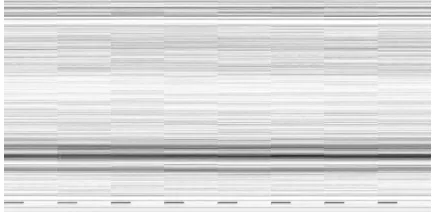
Any number of generic lossless compression al-gorithms could be applied to a virtual-machine memory-dump file to significantly reduce its size. Some obvious choices include algorithms from the Lempel-Ziv (Ziv & Lempel, 1977, 1978) and Burrows-Wheeler (Burrows & Wheeler, 1994) fam-ilies of algorithms, as implemented by programs such asgzip(LZ77) andbzip2(Burrows-Wheeler). However, given the short amount of time that the virtual machine has typically been run in a dynamic-malware-analysis scenario—effectively just enough time for the malware under analysis to activate it-self (including any it-self-extraction, it-self-decrypting, or self-decompression)—it is likely that memory has changed little from the baseline state. While there may have been a few new processes started and a few libraries loaded—along with corresponding mem-ory allocations and data initializations—overall, the dumped memory file will likely have most mem-ory locations unchanged from the baseline machine’s memory. Indeed, Fig. 1 depicts a map of all memory locations that have changed when an example mal-ware sample is run in a 512-MB virtual machine;
1http://virusshare.com/
specifically, we see that only 15% of the memory has changed, although we do observe that the dif-ferences between the current and baseline memories are widely distributed throughout the entire mem-ory space. In such a situation,delta encoding—the compression of the differences between two files—is likely to significantly outperform any single-file com-pression approach.
Although there have been a number of lossless delta-encoding algorithms proposed in the past, per-haps those that are in the most widespread use are based on the VCDIFF (Korn, MacDonald, Mogul, & Vo, 2002) standard. Effectively, the VCDIFF standard prescribes delta encoding using an LZ77 variant in which the reference (or “source” dataset), which is available to both the encoder and the de-coder, prepends the dataset to be encoded (the “target” dataset), such that LZ77 string matching can reference into the source dataset. More specif-ically, the target dataset is partitioned into non-overlapping target windows, and each target win-dow is encoded by prepending a source winwin-dow and performing LZ77-style string matching on the con-catenated string starting from the beginning of the target dataset. The source window can come from either the source dataset or earlier in the target dataset; since the VCDIFF standard specifies only a file format, specific methodology for string match-ing and window selection are left to the encoder im-plementation to determine. Here, we focus on the open-sourcexdelta32 implementation of VCDIFF.
The xdelta3 encoder relies on a substantial de-gree of similarity between the source and target datasets in order to outperform the LZ77 compres-sion of the target dataset alone. As is evident from Fig. 1, we expect that, in our malware-analysis appli-cation,xdelta3encoding of a virtual-machine mem-ory dump using the baseline machine’s memmem-ory as the source dataset will result in a compressed file sig-nificantly smaller than that ofgzipapplied directly to the memory dump by itself. Indeed, for the spe-cific dataset considered in Fig. 1, gzip produces a compressed file of size 139 MB, whilexdelta3yields a 25-MB file. In the next section, we consider steps that may be taken to improve the performance of
xdelta3 in our malware-analysis application even further.
3.
PROPOSED APPROACH
Some of the differences between the memory dump after a period of malware execution and the start-ing baseline memory state can be attributed to data
Figure 1. Map of differences between the baseline memory map and the current memory map after malware execution (baseline virtual machine #41, malware dataset #139992); number of bytes of dif-ference = 80,661,129 (15.0% of the 512-MB mem-ory). White = byte unchanged from baseline; black = byte different from baseline.
that was effectively created by the various processes, including the malware, running on the system. How-ever, some of the memory differences are due to the loading of additional executable and shared-library files into the system. On Windows-based systems, such executable programs (EXEs) and dynamic-link libraries (DLLs) are stored in the Portable Exe-cutable (PE) format (Microsoft, 2013), a modifica-tion of Unix’s Common Object File Format (COFF). We can make the memory of the baseline machine more closely resemble that of the currently run-ning machine—thereby increasing the efficiency of
xdelta3coding—by simulating the loading of these PEs into the baseline memory, a process that can be done identically in both the encoder and the de-coder.
Specifically, the open-source tool for memory forensics, volatility3 (Ligh, Case, Levy, & Wal-ters, 2014), is used to determine the running EXEs and loaded DLLs in both the baseline and current memory dumps. Parsing the process and library lists produced byvolatility, an encoder can determine which programs and libraries are new to the cur-rent machine memory with respect to the baseline, load these new PEs into the baseline memory, and finally use this updated memory as the source for
xdelta3 coding of the current memory dump. De-tailed operation of the resulting encoder and decoder is described below.
3.1
Encoder
The encoder compresses the memory dump (the cur-rent memory) from the currently running virtual
3http://www.volatilityfoundation.org/
machine using delta encoding with respect to the
predicted memory, the latter of which is produced by loading new PEs into the baseline virtual ma-chine’s memory dump (thebaseline memory). The
new PEs are those that are in the current mem-ory but not in the baseline memmem-ory. The new PEs are loaded from the virtual disk which is the vir-tual hard drive shared by both the baseline and cur-rent virtual machines; the loading is accomplished by copying virtual-memorypages from the PE file into physical-memory pages in the baseline memory. More specifically, the encoder follows the following steps:
1. Run volatility commands pslist and
dlllist on the baseline memory to determine lists of baseline EXEs and DLLs, respectively. 2. Run volatility commands pslist and
dlllist on the current memory to determine lists of current EXEs and DLLs, respectively. 3. Parse the EXE/DLL lists to determine the new
PEs that are in the current memory but not in the baseline memory.
4. To produce the predicted memory from the baseline memory, for each new PE (EXE or DLL) do:(a) Determine the ID of the process corre-sponding to the new PE (for a DLL, this is the process into which the DLL has been loaded; for an EXE, it is the process as-signed to the EXE itself) along with the base address where the new PE is loaded into the virtual-memory address space of the corresponding process.
(b) For the process corresponding to the new PE, run thevolatilitycommandmemmap
on the current memory to extract the virtual-to-physical memory map of the process.
(c) Copy the new PE from its correspond-ing file on the virtual disk into the base-line memory; specifically, for each virtual-memory page in the PE file:
i. If the page is resident in the current memory, copy the page from the PE file to the baseline memory using the virtual-to-physical mapping retrieved in Step 4(b).
ii. Record the source page location in the PE file, the destination page loca-tion in physical memory, and the page length (thepage copy information).
6. Perform xdelta3 coding using the current memory as the target and the predicted mem-ory as the source.
In Step 4(c), we assume that the virtual disk used for both the baseline as well as the currently running virtual machine is available to the encoder so that it can access the PEs to perform the page copies. Normally, this virtual disk will be a file stored at some known location alongside the baseline-memory and current-memory dumps. For the VMware vir-tual machines used here, the encoder employs the
vmware-mount command to mount the VMDK-format virtual disk via a loopback device, permitting the encoder to read PE files from the Windows 7 in-stallation resident on the virtual disk.
3.2
Decoder
The decoder produces the same predicted memory as used by the encoder by loading the new PEs into the baseline memory. While the decoder has access to the baseline memory, it does not know the current memory, or, consequently, the virtual-to-physical map of the processes corresponding to the new PEs. Therefore, to duplicate the page copies that the en-coder used to produce the predicted memory, the decoder relies on the list of page copies stored in the header of the compressed file. Like the encoder, the decoder loads the new PEs from the virtual-disk file stored alongside the baseline memory. The specific process is as follows:
1. Read the header from the compressed file. 2. To produce the predicted memory from the
baseline memory, for each new PE (EXE or DLL) do:(a) Copy the new PE from its corresponding
file on the virtual disk into the baseline memory; specifically, for each page copy listed in the header, do:
i. Copy the corresponding page in the PE file into the designated location in the baseline memory.
3. Performxdelta3decoding of the current mem-ory (the target) using the predicted memmem-ory as the source.
3.3
Implementation
Both the encoder and decoder of the proposed ap-proach, which we call VMMZ, are implemented pri-marily in C with a small portion written in Perl to handle parsing of output from volatility. In ad-dition to dependence on volatility andxdelta3, VMMZ is built on QccPack4 (Fowler, 2000).
4http://qccpack.sourceforge.net/
4.
EXPERIMENTAL
RESULTS
Our test dataset consists of 14 different baseline vir-tual machines, each possessing 512 MB of RAM and installed with a 32-bit version of Windows 7. Us-ing thecuckoomalware-analysis sandbox5, each vir-tual machine was run for approximately 4 minutes with a malware sample injected into the virtual ma-chine. Afterwards, the virtual-machine memory was dumped as a 512-MB file to disk for malware analysis at some subsequent time. Our test dataset consists of a total of 67 memory dumps corresponding to 67 different malware samples, with between 3 and 8 dif-ferent samples being run in each of the 14 baseline machines. Total storage required for the resulting 67 memory dumps is 33.5 GB.
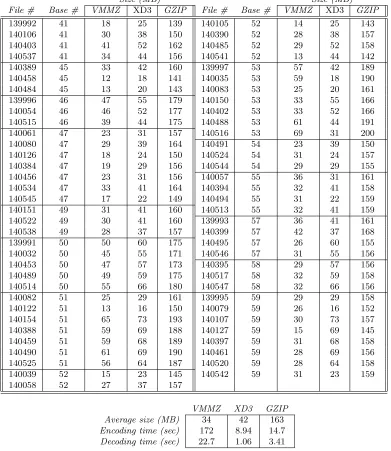
Table 1 tabulates the results of various compres-sion approaches applied to these memory dumps. The memory dumps are given a 6-digit number (“File #”) corresponding to which malware sample was run in the virtual machine; Table 1 also indi-cates the number (“Base #”) of the corresponding baseline machine which served as the starting point for the malware execution.
Table 1 indicates the sizes of files output by vari-ous compression algorithms applied to the virtual-machine memory dumps. In these results, gzip
is simply applied directly to the memory dump in question, while the proposed approach (VMMZ) and
xdelta3, both being delta encoders, compress each memory dump with respect to its corresponding baseline virtual-machine memory. Table 1 also in-dicates the average compressed-file size across all 67 memory dumps as well as execution times for both encoding and decoding. We see that, while the pro-posed VMMZ approach is slower, it significantly out-performs the other two compressors in terms of com-pression: at 34 MB, the average file size for VMMZ is approximately 20% smaller than that of xdelta3
(42 MB on average), and 79% smaller than that of
gzip(163 MB on average).
5.
RELOCATABLE CODE
AND FIXUPS
Typically, PE files are divided into multiple sections, some of which have special meanings that are recog-nized by linkers and loaders (Microsoft, 2013). By convention, these special sections are designated by known section names in the PE header, for example, the.datasection (initialized data), the.rdata sec-tion (read-only initialized data), the .text section
Table 1. Compressed-file sizes and execution times for the proposed algorithm (VMMZ) as well asxdelta3
(XD3) andgzip(GZIP). Results conducted on a 2.1-GHz i7-4600U system with 8 GB memory.
Size (MB) Size (MB)
File # Base # VMMZ XD3 GZIP File # Base # VMMZ XD3 GZIP
139992 41 18 25 139 140105 52 14 25 143
140106 41 30 38 150 140390 52 28 38 157
140403 41 41 52 162 140485 52 29 52 158
140537 41 34 44 156 140541 52 13 44 142
140389 45 33 42 160 139997 53 57 42 189
140458 45 12 18 141 140035 53 59 18 190
140484 45 13 20 143 140083 53 25 20 161
139996 46 47 55 179 140150 53 33 55 166
140054 46 46 52 177 140402 53 33 52 166
140515 46 39 44 175 140488 53 61 44 191
140061 47 23 31 157 140516 53 69 31 200
140080 47 29 39 164 140491 54 23 39 150
140126 47 18 24 150 140524 54 31 24 157
140384 47 19 29 156 140544 54 29 29 155
140456 47 23 31 156 140057 55 36 31 161
140534 47 33 41 164 140394 55 32 41 158
140545 47 17 22 149 140494 55 31 22 159
140151 49 31 41 160 140513 55 32 41 159
140522 49 30 41 160 139993 57 36 41 161
140538 49 28 37 157 140399 57 42 37 168
139991 50 50 60 175 140495 57 26 60 155
140032 50 45 55 171 140546 57 31 55 156
140453 50 47 57 173 140395 58 29 57 156
140489 50 49 59 175 140517 58 32 59 158
140514 50 55 66 180 140547 58 32 66 156
140082 51 25 29 161 139995 59 29 29 158
140122 51 13 16 150 140079 59 26 16 152
140154 51 65 73 193 140107 59 30 73 157
140388 51 59 69 188 140127 59 15 69 145
140459 51 59 68 189 140397 59 31 68 158
140490 51 61 69 190 140461 59 28 69 156
140525 51 56 64 187 140520 59 28 64 158
140039 52 15 23 145 140542 59 31 23 159
140058 52 27 37 157
VMMZ XD3 GZIP
Average size (MB) 34 42 163
Encoding time (sec) 172 8.94 14.7
(executable code), and the .reloc section (image relocations). While sections hold special meaning for linkers and loaders, the proposed VMMZ com-pression framework as described above is agnostic to section type, loading every physically resident page from every section into the baseline memory. How-ever, in the case of relocatable executable code, such section-agnostic loading causes some compression in-efficiency.
Specifically, PEs are rarely loaded at the virtual-memory addresses for which they are compiled, re-quiring a .reloc section that lists all the memory addresses (or “fixups”) in the executable code (the
.textsection) which must be relocated during load-ing before the PE is executed. In our delta-encodload-ing application, performing these fixups when loading a PE into baseline memory would result in a predicted memory that would be closer to the current memory, resulting in improved xdelta3 encoding. Unfortu-nately, while the decoder has access to the fixups in the .reloc section of the PE file, these fixups are expressed in terms of virtual-memory addresses which must be translated to physical-memory ad-dresses during loading. Permitting the decoder to be able to perform these fixups would consequently require storing the virtual-to-physical mapping for the fixups in the header of the compressed file. Our empirical investigations have revealed that this ad-ditional header overhead would likely outweigh any improvement in xdelta3 encoding that would re-sult from including the fixups in the predicted mem-ory. Consequently, our proposed VMMZ coder loads executable-code .text sections as is without per-forming the fixups that would be done in a real sys-tem by a linker/loader.
6.
CONCLUSIONS
In this paper, we have considered the lossless com-pression of virtual-machine memory dumps for a tar-get application of dynamic malware analysis. Typ-ically, in such dynamic analysis, malware samples are run in a virtual machine just long enough to activate; consequently, memory dumps from the currently running virtual machine are substantially identical to that of the baseline machine, with the difference being attributable in a large degree to the loading of various executable programs and dynam-ically linked libraries. By duplicating the loading of these executables and libraries into the baseline memory, our proposed approach produces a predic-tion of the current memory from which delta encod-ing is performed, resultencod-ing in a significant improve-ment in compression performance over
straightfor-ward delta coding alone. In experimental results for a body of malware samples, the proposed approach outperformed the widely used xdelta3delta coder by approximately 20% and the popular genericgzip
coder by 79%.
REFERENCES
Burrows, M., & Wheeler, D. J. (1994, May). A block-sorting lossless data compression algo-rithm (Technical Report No. 124). Digital Equipment Corporation.
Egele, M., Scholte, T., Kirda, E., & Kruegel, C. (2012, February). A survey on automatic dy-namic malware-analysis techniques and tools.
ACM Computing Surveys, 44(2).
Farmer, D., & Venema, W. (2005).Forensic discov-ery. Addison-Wesley.
Fowler, J. E. (2000, August). QccPack: An open-source software library for quantization, com-pression, and coding. In A. G. Tescher (Ed.),
Applications of digital image processing xxiii
(p. 294-301). San Diego, CA.
Korn, D. G., MacDonald, J. P., Mogul, J. C., & Vo, K.-P. (2002, June). The VCDIFF generic dif-ferencing and compression data format. RFC 3284.
Ligh, M. H., Case, A., Levy, J., & Walters, A. (2014). The art of memory forensics: Detect-ing malware and threats in Windows, Linux, and Mac memory. Wiley.
Microsoft. (2013, February). Microsoft portable ex-ecutable and common object file format speci-fication. (Rev. 8.3)
Ziv, J., & Lempel, A. (1977, May). A universal algo-rithm for sequential data compression. IEEE Transactions on Information Theory, 23(3), 337-343.