C RC PR E S S
Boca Raton London New York Washington, D.C.
The
Counterterrorism
Handbook
Frank Bolz, Jr.
Kenneth J. Dudonis
David P. Schulz
This book contains information obtained from authentic and highly regarded sources. Reprinted material is quoted with permission, and sources are indicated. A wide variety of references are listed. Reasonable efforts have been made to publish reliable data and information, but the author and the publisher cannot assume responsibility for the validity of all materials or for the consequences of their use.
Neither this book nor any part may be reproduced or transmitted in any form or by any means, electronic or mechanical, including photocopying, microfilming, and recording, or by any information storage or retrieval system, without prior permission in writing from the publisher.
The consent of CRC Press LLC does not extend to copying for general distribution, for promotion, for creating new works, or for resale. Specific permission must be obtained in writing from CRC Press LLC for such copying.
Direct all inquiries to CRC Press LLC, 2000 N.W. Corporate Blvd., Boca Raton, Florida 33431.
Trademark Notice: Product or corporate names may be trademarks or registered trademarks, and are used only for identification and explanation, without intent to infringe.
© 2002 by CRC Press LLC
No claim to original U.S. Government works International Standard Book Number 0-8493-0964-6
Library of Congress Card Number 2001035374 Printed in the United States of America 1 2 3 4 5 6 7 8 9 0
Printed on acid-free paper
Library of Congress Cataloging-in-Publication Data Bolz, Frank, 1930–
The counterterrorism handbook : tactics, procedures, and techniques / Frank Bolz, Jr., Kenneth J. Dudonis, David P. Schulz.— 2nd ed.
p. cm. — (Practical aspects of criminal and forensic investigations (Series)) Includes index.
ISBN 0-8493-0964-6 (alk. paper)
1. Terrorism—Prevention. I. Title: Counterterrorism handbook. II. Dudonis, Kenneth J. III. Schulz, David P. IV. Title. V. Series. Practical aspects of criminal and
forensic investigations
HV6431 .B65 2001
363.3¢2—dc21 2001035374
Table of Contents
Foreword
Acknowledgments
Section I: Pre-Incident
1
Common Elements of Terrorism
The Meaning of Terrorism Nature of Terrorism Terrorism by the Numbers Purpose of Terrorism Characteristics of Terrorists Counterterrorist Response Counterterrorist Operations Weapons of Mass Destruction Role of the Military
Role of the Federal Aviation Administration Financial Terrorism
Counterterrorist Capabilities Counterterrorist Tactics Investigative Techniques
Local Law Enforcement Capabilities Interagency Liaison
Local Significance
Private Sector Cooperation
2
Pre-Incident Planning
Introduction to Risk Assessment Structuring a Defense Plan Information-Gathering Target Analysis
Training
Terrorist Tactics Risk Analysis Risk Avoidance
Hostage/Kidnap Defense
3
Bomb Defense Planning
Types of Bomb Incidents The Bomb Threat
Rationale of Bomb Threats A Note of Warning
Warning or Hoax?
Responding to the Bomb Threat Evacuation Options
Evacuation Procedures Putting Out the Message Planning Issues
The Role of Police in Handling a Bomb Threat Why Terrorists Bomb
Types of Bombers Motivations of Bombers
4
Hostage Situations
A Rare Occurrence Who Takes Hostages? Panic Reaction Suicide by Cop
Why Hostages Are Taken The Magic Triangle Munich, 1972 Deadlines
Killing on Deadline Evaluation
Responsibilities of the First Responding Officers The Mobilization Point
Location of the Mobilization Point Decision-Makers
Evacuation
Tactical Units Communications First-Response Review Summary
5
Defining Terrorism
What Is Terrorism?
A Brief History of Terrorism Terrorism as a Political Statement Modern Terrorist Groups
Terrorist Actions Other Terrorist Actions
Intimidation and Use of Threats Disinformation and Propaganda Assassinations
Success of Terrorists
6
Threat of Weapons of Mass Destruction
Introduction The Threat Today Aum Shinrikyo Incident Chemical and Biological Agents Response to a WMD Incident
Section II: Incidents
7
Kidnapping
Kidnapping as a Weapon Risks Involved
Differences between Hostage-Taking and Kidnapping Uses of Kidnapping
Types of Kidnappers
Post-Cold War Political Kidnapping Private Industry’s Role
The Police Role
Police Response to Residence or Workplace of Victim Response to the Kidnap/Extortion Threat
“Do Not Contact the Police” Hoax
What the Individual Can Do What the Family Can Do One Man’s Ordeal
What the Corporation Can Do On Becoming a Victim
8
Bomb Incidents
The Mechanics Search Overview Building Searches Exterior Searches Interior Searches Search Teams
Setting Up a Program Alternative to Search Teams Mechanics of the Search Searching a Room
Common Bomb Placement Locations Precaution
Vehicle Searches
Antipersonnel Car Bombs Vehicle-Borne Explosive Devices Aircraft Searches
Pre-Incident VIP Search Explosive-Detection Canines Suspicious Packages
Identifying Improvised Explosive Devices Explosives
Initiation Systems Summary
9
Hostage Incidents
What Is Involved
Communicating with the Hostage-Taker The Making of a Hostage Incident The Announcement
Reaction of Law Enforcement Professional Criminal Role
Public Role Containment
Why Police Do the Negotiating
Post-Incident Crisis Intervention Teams Controlling the Environment
Dynamics of Hostage Negotiation A Note on Weapons
Saying “No”
The Art of Negotiation Courses of Action
The Surrender and Suicide Ritual Thought Interruption
Never Take a Weapon from the Hand of a Surrendering Perpetrator
Special Qualifications
Section III: Post-Incident
10
Post-Blast Environment
Getting Back to Normal The Incident
First Responder Investigative Phase Seat of the Explosion Gathering Physical Evidence Examining Fragments Evidence Recovery Physical Evidence
Post-Blast Investigation Process Case Studies
11
Hostage/Kidnapping Aftermath
The Dangers Involved
The Immediate Reaction of Victims Long-Term Reactions
The Family
Police Handling of the Incident The Stockholm Syndrome Transference
When an Incident May End in the Use of Deadly Physical Force Ransom: To Pay or Not to Pay?
The Recovery Victimology
Post-Incident Effects on Rescue Officers
12
Interviewing Victims
By Dr. Frank Ochberg
Intrusive Recollections
Emotional Anesthesia: Constricting Life Activity Lowered Threshold for Anxiety and Arousal PTSD Is Not Always the Same
Who Gets PTSD? Other Difficulties A Guide to Interviewing Timing
Setting the Stage Eliciting Emotion Informed Consent Stages of Response
The Humanitarian Role of the Investigator Secondary Traumatic Stress Disorder
13
Role of the Commander
Who’s in Charge?
Pre-Incident: Developing Guidelines Make-Up of the Team
Maintenance of Manpower and Equipment
Keeping Up-to-Date on New Techniques and Strategies Evaluate and Update
Liaisons with Other Agencies
During the Incident: Intelligence-Gathering Evaluate Alternatives
Sharpshooter Chemical Agents Food
Alcohol and Drugs Contain and Negotiate
Impact of the Event on the Public Post-Incident Debriefing
Formal Debriefing
14
The Command Post
The Nerve CenterStaffing the Command Post Bomb Incident Command Post Log and Situation Map
Equipment and Supplies Communications Concealment vs. Cover Handling the Media
Epilogue
Foreword
By
Dr. Robert Kupperman Stephanie Lanz
Terrorism is a form of warfare that relies principally upon fear to deliver its message. The target of the violence often goes beyond the immediate victim. Its ultimate goal is theatrical, the Broadway of villainous acts. This holds especially true today with television news programs broadcasting images of the terrorist event even before senior officials have had time to assess the situation. This, together with the advent of cell phones, has led to just-in-time decision making, a new phenomenon in managing a crisis.
In recent years, we have witnessed a staccato of bombings, assassina-tions, and hostage-taking incidents, with every new threat spawning a new countermeasure and every new countermeasure resulting in new threats. While terrorists are unlikely to give up the truck bombs or spectacular suicide missions that afford them instant gratification and notoriety, a new cadre of terrorists exists that may look to nontraditional tactics and weapons. The young terrorist of today is often computer savvy and well educated, bringing a whole new level of sophistication to the table. Computers and the Internet are increasingly being used for planning terrorist activity, recruiting, and fundraising. And, while terrorists can afford the latest tech-nological equipment, law enforcement and other officials more often than not find themselves lagging behind, making it difficult for them to keep up with the terrorists.
Further complicating terrorism warfare calibrations is the possibility that cyberattacks against critical infrastructures may be used as a force multiplier to extend the deadliness of an incident. Furthermore, the target of the attack, the critical infrastructure, currently is owned and operated primarily by the private sector, bringing a whole new group of players into the counterterrorism game.
they need to justify their actions to is God, in whose name they carry out the violence. Politically motivated groups traditionally looked for targets of symbolic value: a soldier, a government official, etc. Religious groups, on the other hand, feel that any mode of attacking the infidel is legitimate, even if it means killing innocent civilians. Anyone, anywhere, anytime can become a target.
What we end up with is an unholy marriage between advances in technol-ogy and indiscriminate targeting, an extremely lethal combination. Many experts in the emerging field of counterterrorism refuse to believe that terror-ism will escalate to a level involving weapons of mass destruction even though the technology and expertise are readily available. This holds true despite the sarin gas attack in Tokyo subways in March 1995 by the religious cult Aum Shinrikyo that killed 12 people and injured thousands of others; it is often regarded as an anomaly — even by the Japanese.
The question is not so much whether or not there is a real probability of a terrorist incident involving weapons of mass destruction (WMD), but whether one can afford to not be prepared. The consequences of any incident involving WMD are so devastating that even if there is only an infinitesimal chance of one occurring, the framework has to be in place to swiftly and efficiently deal with the crisis.
So far, the United States’ counterterrorism strategy, while impressive in appearance and number of acronyms, could in fact be a recipe for disaster should a grievous terrorist attack occur on American soil. The byzantine bureaucracy comprising the U.S. response, for example, could easily result in a delay in the deployment of the right tools to a local community dealing with an attack never before envisaged by its townspeople.
The Counterterrorism Handbook is among the first serious efforts to lay out a comprehensive strategy of how to deal with a whole gamut of possible terrorist incidents in a language that a first responder (policeman, fireman, medic, etc.) can understand. The book covers everything from bombings and hostage-taking, to nuclear terrorism and what needs to be done before, during, and after an event. The handbook combines what minimally needs to be understood about counterterrorism by the Washington-level policy-maker while at the same time helping first responders who are planning to cope with what must at least initially seem like an overwhelming attack.
Acknowledgments
S
ECTIONI
Common Elements
of Terrorism
The Meaning of Terrorism
The word terror derives from the Latin word terrere, meaning “to frighten.” The word and its derivatives have been applied in a variety of contexts — from a sobriquet for a vicious despot (as in Ivan the Terrible), to eras of violent political turbulence (as in the Reign of Terror during the French Revolution), to the sporadic outbursts of violence the world knows today as international terrorism. Violence is not the key characteristic, however, since such violent confrontations as World Wars I and II are not considered ter-rorism. Rather than being an end in itself, violence is a means to instill fear into (i.e., to terrify) whole populations.
Instilling fear can be purposeful for criminal or political ends malevolent in nature. Yet populations can be frightened without terrorism being involved, for example, the cause may be disease, such as the west Nile-type avian virus that plagued the northeastern United States, the “mad cow” virus that struck England and continental Europe, and the deadly ebola epidemics in sub-Saharan Africa in the late 1990s and early 21st century. There are those who believe that the outbreaks of those diseases were not entirely natural but were intentionally spread by human intervention; in which case, they would be acts of bio-terrorism.
Since the intention of all terrorists is to instill fear into the population at large, there is a common motivation to the criminal acts they perpetrate. Because there is a common element to terrorism, counterterrorism has a foundation on which to base defensive strategies and tactics. Anything that can be done to reduce fear and anxiety among the general population is an effective defense against terrorism.
Nature of Terrorism
Brian Jenkins of the Rand Corporation has said terrorism is “the use or threatened use of force designed to bring about political change,” while the Federal Bureau of Investigation (FBI) has defined terrorism as “the unlawful use of force or violence against persons or property to intimidate or coerce a government, the civilian population, or any segment thereof, in furtherance of political or social objectives.”
Jenkins has identified the three most serious types of conflict short of nuclear war:
1. Conventional warfare 2. Guerrilla warfare 3. International terrorism
In the first two types of conflicts, noncombatants are usually able to distin-guish themselves from combatants. This is not to say that noncombatants are never killed, because they are. It is just that these are isolated or unusual incidents, because in both guerilla and conventional warfare the major focus of killing is one armed force against another. Conflicts can be either high intensity, or low intensity in nature, such as the more than 90 confrontations currently taking place around the globe involving everything from former republics of the Soviet Union and former colonies of European countries to ages-old ethnic hatreds and narcotics trafficking.
However, the exploitation of noncombatants (i.e., their suffering and death) is the essence of international terrorism. Because of the covert nature of the activity, terrorist attacks are carried out by a small cohort of operatives who receive financial and logistical support from radical political and activist organizations, which can include governments of rogue nations. Political and other activist groups may be suspected of acting in support of terrorist goals, if not actually fostering and furthering those goals. Questions have been raised, and continue to be, concerning the integrity of some persons and groups or whether, in fact, they are being exploited or misused.
The U.S. Department of Defense has described terrorism as a phenom-enon in transition and indicated that the nature of the terrorist threat has changed dramatically. The Defense Department attributed these changes to five factors:
1. Collapse of the Soviet Union 2. Changing motivations of terrorists
3. Proliferation in technologies of mass destruction
4. Increased access to information and information technologies 5. Accelerated centralization of vital components of the national
infra-structure, which has increased vulnerability to terrorist attack
Terrorism by the Numbers
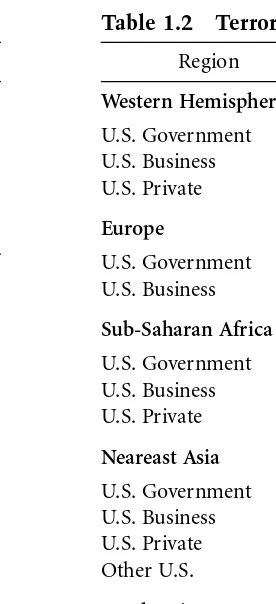
According to the U.S. Department of State, in the last year of the 20th century, more than 135 terrorist attacks were directed at U.S. targets (Table 1.1 and 1.2).
Purpose of Terrorism
Terrorism for political purposes is usually a form of theater, and as such there are a number of elements which are almost universal in modern terrorist activities.
1. The use of violence to persuade, where bombings or other attacks are employed to “make a point” with target victims. The target victims are not necessarily those who are injured or killed. Rather, the attack may have been carried out to influence a government, or a group of
Table 1.1 Areas of Incidents
Regions Incidents
Western Hemisphere 93
Europe 22
Sub-Saharan Africa 7
Neareast Asia 6
South Asia 3
East Asia and the Pacific 3
Table 1.2 Terrorists’ Targets
Region Incidents
Western Hemisphere 93 U.S. Government 4
U.S. Business 86
U.S. Private 3
Europe 22 U.S. Government 7
U.S. Business 15
Sub-Saharan Africa 7 U.S. Government 3
U.S. Business 2
U.S. Private 2
Neareast Asia 7 U.S. Government 3
U.S. Business 1
U.S. Private 1
Other U.S. 2
South Asia 3
U.S. Business 3
East Asia and the Pacific 18 U.S. Government 3
[image:18.666.240.378.81.383.2]governments, to take a certain course of action or perhaps to terminate or cease a course of action.
2. Selection of targets and victims for maximum propaganda value means choosing targets and victims which will assure the heaviest possible media coverage. This consideration was particularly evident with terror-ist attacks such as the World Trade Center bombing in New York City in 1993 and the hostage-taking of Israeli athletes during the 1972 Olympic Games in Munich. These were followed by terrorist activity including the bombing of the Murrah Federal Office Building in Oklahoma City and U.S. Embassies in Nairobi, Kenya, and Dar es Salaam, Tanzania. 3. The use of unprovoked attacks, which, truth be told, is just about any
terrorist attack, because they were “provoked” is only the convoluted rationale offered by the terrorists themselves.
4. Maximum publicity at minimum risk is the principle behind many terrorist actions, particularly those involving explosive devices. Bomb-ings typically generate a good deal of publicity, depending upon time and placement, so targets are usually selected for symbolic value, such as embassies, internationally known tourist attractions, and similar facilities. The use of sophisticated timing elements allows detonation to be programmed well in advance, reducing the risk to the bomber or bombers, who can be long gone by the time the devices are discov-ered or exploded. Moving up on the list of favored terrorist activities, kidnapping or assaults and assassinations may generate greater or pro-longed publicity, but they also present a higher risk for the attackers. There is something of a cyclical pattern to terrorist activities. That is, if there has been a rash of kidnappings, the public may become some-what inured, and subsequent abductions may not generate the same degree of front-page coverage, television news exposure, or Internet buzz. Bombings, just because they have been less frequent during the same period, may well generate more publicity than another kidnap-ping. A change in tactics, then, would produce more publicity than another kidnapping. Terrorists always want to remain in the forefront, so they will switch tactics in order to maximize publicity.
6. Threats, harassment, and violence are tools terrorists use to create an atmosphere of fear. On occasion terrorists have planted small bombs or incendiary devices in public locations, such as department stores and movie theaters. In recent years, anti-government terrorists in Egypt have attacked groups of tourists visiting the Pyramids and other monuments. To the public, there is no rhyme or reason to the time or placement of the devices, and soon the mere threat of such activity is sufficient to send waves of fear through the populace.
7. Disregarding women and children as victims, often to the extent that locations with innocent victims are selected specifically to heighten the outrage, and fear, at the boldness of the terrorists’ actions. This is yet another tactic to garner wider publicity and media coverage of the suffering and death of noncombatants. This characteristic differen-tiates the terrorist from a soldier or guerrilla. A soldier fights with the authority of a government for the protection of that government. A guerrilla fights the same kind of warfare as the soldier in technique and code of behavior, i.e., women and children are not specifically targeted. A terrorist, on the other hand, will focus on women and children, specifically, just to create a greater atmosphere of fear. Thus, the ethnic cleansing evidenced in Bosnia and Kosovo involving various population factions of the former Yugoslavia crossed the line from warfare to terrorism by militia.
8. Propaganda is used to maximize the effect of violence, particularly for economic or political goals. To carry out a particular operation with-out getting any publicity with-out of the action would be wasteful to a terrorist’s cause. Thus, Black September, at the Olympic Games in Munich in 1972, and all those groups that mimicked that hostage-taking by claiming responsibility for attacks in other high-profile circumstances, wanted worldwide publicity for both political and eco-nomic goals. From a political standpoint, a group wants to show that it is a viable organization, a power to be reckoned with, and a force to be feared. On the economic level, the group shows sympathetic governments and others who support different terrorist groups that it, too, is worthy of funding. Even when terrorists do not publicly claim responsibility for an attack, many leave a signature or obvious clues during the action.
cause. For the most part, however, second- and third-generation terrorists have diminished loyalty to the original cause, the sense of pride associated with it, and a reduced vision of the original goal. Many of them engage in terrorism as a form of gratification and perpetuate criminal activity as an end in itself. They have thus become nihilistic and interested primarily in financial remuneration for themselves.
Terrorism of the 1960s and 1970s was carried out, for the most part, by college-age individuals and educated political activists. Now much of the low-intensity conflict and terrorist actions is being perpetrated by child sol-diers, children, many of whom have not even reached puberty, who have become inured to violence and human emotion.
Characteristics of Terrorists
Terrorist groups are organized in many different ways, including the tradi-tional pyramidal power chart with a leader or small clique at the top and ever-widening tiers of authority moving down the chain of command. Vari-ous other configurations for depicting the organization of terrorist groups include circles, squares, and bullseye target designs. One thing they all have in common is hardcore leadership surrounded by an active cadre; then, moving further from the center, a broader group of active supporters, and outside that, an even broader level of passive support.
In the shifting nature of terrorist groups — or at least the vocal justifi-cation they provide for their actions — religion and ethnicity seem to have replaced politics as the driving force toward their stated goals. Hiding behind the shield of accepted religious organizations, support groups are free to operate with virtual impunity, particularly in Western democracies. In addi-tion to fundraising, religious and ethnic front groups provide cover for covert activities of more militant representatives of terrorist organizations.
Actions and characteristics of terrorist groups do change over time; for example, kneecapping was used as a signal or scar to demonstrate the wide reach of a terrorist organization. In Italy, they shot the victim in the knee; in Ireland, an electric drill was used to mutilate the knee. In both cases, victims walking the rest of their lives with a limp was a constant reminder to the populace of the terrorist group’s power and omnipresence in the region.
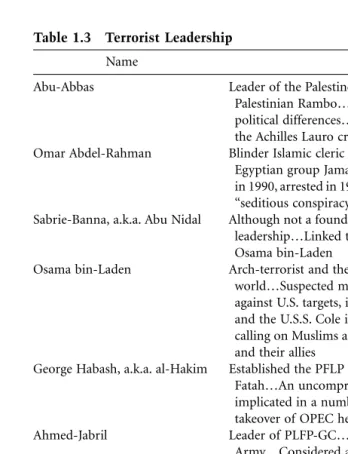
Table 1.3 Terrorist Leadership
Name Organization
Abu-Abbas Leader of the Palestine Liberation Front…Known as the Palestinian Rambo…Broke away from PFLP-GC over political differences…Responsible for the hijacking of the Achilles Lauro cruise ship
Omar Abdel-Rahman Blinder Islamic cleric and spiritual leader of the deadly Egyptian group Jamaat al-Islamaya…Came to the U.S. in 1990, arrested in 1995…Sentenced to life in prison for “seditious conspiracy to wage urban war”
Sabrie-Banna, a.k.a. Abu Nidal Although not a founder, a prominent member of Fatah’s leadership…Linked to Black September, Hamas, and Osama bin-Laden
Osama bin-Laden Arch-terrorist and the most sought after terrorist in the world…Suspected mastermind of a number of attacks against U.S. targets, including embassies in East Africa and the U.S.S. Cole in Yemen…Has issued a “fatwa” calling on Muslims around the world to slay Americans and their allies
George Habash, a.k.a. al-Hakim Established the PFLP in 1967 as an alternative to Fatah…An uncompromising Marxist-Leninist implicated in a number of airplane hijackings…Led takeover of OPEC headquarters in Vienna in 1977 Ahmed-Jabril Leader of PLFP-GC…Trained with Syrian
Army…Considered an expert bombmaker…Suspected of helping bomb Pan Am Flight 103 over Lockerbie, Scotland
Hassan Nasrallah Active with Hezbullah and believed to be the head of its military arm, Islamic Resistance…Keeps in close contact with Hamas leadership
Ahmed Yassin Known as Sheikh or the Intifada…Founding member and spiritual leader of Hamas…Active in Damascus, Syria…Released by Israelis in 1985 in a prisoner exchange
[image:22.666.47.395.79.532.2]In Africa, terrorists use a machete to chop off a hand or hands of victims, even children, accomplishing a similar effect on villagers and urban popula-tions alike.
Counterterrorist Response
The United States has dramatically enhanced its counterterrorist response capability over the last decade in order to address the widening threat of global terrorism reaching domestic targets and U.S. interests abroad. The President sets the overall policy for counterterrorism, with the assistance of a special coordinating committee of the National Security Council. Presidential Directive 39, entitled United States Policy on Counterterrorism, recognizes that there must be rapid and decisive capability in defeating terrorism. The report spells out the need to protect U.S. citizens, arrest terrorists, respond to sponsors of terrorism, and provide assistance to the victims. As a result, the problems encountered in combating global terrorism are too complex to expect a single agency to deal with them successfully. As a result, in organizing the response to terrorism, the effort is divided into two broad phases: the crisis, or pre-incident, phase and the consequence, or post-incident, phase.
In response to the bombings of U.S. embassies in East Africa, Congress established a blue-ribbon panel to consider new approaches to combating the threat and actual acts of terrorism. The Advisory Panel to Access Domestic Response Capabilities for Terrorism Involving Weapons of Mass Destruction, familiarly referred to as the Gilmore Commission, was named for the chair-person, Virginia Governor James S. Gilmore. The commission addressed inci-dents involving weapons of mass destruction (WMD) against the U.S. home territory. In a departure from past policy, the commission suggested that the U.S. military assume the lead role in dealing with weapons of mass destruction.
Major points of U.S. counterterrorism policy include
• Make no concessions to terrorists and strike no deals. • Bring terrorists to justice for their crimes.
• Isolate and apply pressure on states that sponsor terrorism to force them to change their behavior.
• Bolster the counterterrorism capabilities of those countries that work with the U.S. and that require assistance.
including presidential candidates of major parties, President-elect and Vice President-elect and selected other senior government officials. The Secret Service and the U.S. Department of State share responsibility for protecting heads of foreign states and other international dignitaries visiting the United States. As a practical matter, these federal agencies coordinate their efforts with local law enforcement departments, particularly on such matters as crowd and traffic control, building security, and uniformed police presences. The response to a terrorist action is addressed on three discrete levels:
1. Local: In a terrorist attack, such as a bombing or the taking of hostages, the first responders are typically local public safety and medical per-sonnel. Unless the attack has occurred in a major municipality, local assets are usually not sufficient to meet the emergency, particularly when weapons of mass destruction are used.
2. State: If local authorities require help in responding to major terrorist activity, assistance can be requested through a state Office of Emer-gency Services, or similar aEmer-gency. The state’s substantially greater resources, including selected elements of the National Guard, can readily be dispatched to the affected area or location.
3. Federal: Contingency plans for most crisis and consequence interven-tion have been developed and refined in recent years. The Federal Bureau of Investigation (FBI) is the lead agency for crisis management involving domestic acts of terrorism. The FBI’s role includes active measures for prevention, and immediate incident and post-incident response. In addition, in most cases, the FBI will utilize the assistance of local and state law enforcement officials.
The Federal Emergency Management Agency (FEMA) is the lead agency for consequence management for both preparedness and dealing with ter-rorist incidents. State and local governments are still the controlling agencies in rescue and medical functions during terrorist incidents. In an incident where weapons of mass destruction are used, the response capability of rescue and medical units may be impaired. In extraordinary cases, active military units garrisoned in the vicinity of the incident may be called upon for imme-diate deployment in order to save lives, prevent human suffering, and assist in protecting physical property.
Counterterrorist Operations
Counterterrorist operations usually involve a blend of law enforcement agen-cies and the nation’s military resources, particularly when terrorist activity occurs overseas. The National Security Council oversees the effort involving domestic terrorism. Among the agencies operating under the umbrella of the Counterterrorism Security Group are the departments of State, Justice (through the FBI), Treasury, Transportation (primarily the Federal Aviation Administration), and Energy, as well as the CIA and Joint Chiefs of Staff.
In all domestic terrorist actions and in many of those directed against U.S. government facilities abroad, the FBI is charged with being the lead agency in handling the crisis and post-incident investigation. As an example, in the after-math of the 1998 bombings of the U.S. embassies in Kenya and Tanzania, the FBI sent investigators to the two countries along with evidence processing teams. No single agency can be expected to successfully combat the multifaceted challenges of dealing with terrorist threats and activity. Joint operations involving federal, state, and local law enforcement agencies, coupled with military assistance when appropriate, are now the standard in combating terrorists. The threat of weapons of mass destruction has persuaded the federal government to adopt a more aggressive approach to the potential threat.
The Defense Authorization Act, also called the Nunn Luger Domenici Act, enhanced the nation’s defense against attacks involving biological and chemical weapons. The legislation authorized the Department of Defense to provide initial training for “first responders” in major urban centers and other areas of likely attacks.
Counterterrorism is a challenge not just for the United States, but for most western European nations and industrialized states around the world. In most countries, the military plays a major role in combating terrorism through units such as the Delta Force in the United States, the United Kingdom’s S.A.S., France’s G.I.G.N. unit, and Germany’s GSG-9 unit.
Weapons of Mass Destruction
weapon in a terrorist attack was by a Japanese religious cult which in the 1990s unleashed sarin gas in the Tokyo subway system.
In an effort to deal with such threats, the FBI operates the National Domestic Preparedness Office, which acts as a clearing house on weapons of mass destruction for federal, state, and local authorities. The NDPO facilitates and coordinates efforts of various government agencies in providing the emergency response community with detection, protection, analysis, and decontamina-tion equipment, as needed, in dealing with weapons of mass destrucdecontamina-tion.
When an attack, or suspected attack, involves nuclear terrorism, the U.S. Energy Department becomes involved. Nuclear threats can involve more than surprise attacks. In the low-intensity conflict that for decades has involved India, Pakistan, and Bangladesh, the participant states have developed nuclear capabilities, raising the likelihood that nuclear weapons could be involved in a first-strike, or in a retaliatory response to terrorism.
Role of the Military
The Department of Defense has been assigned a much greater role than previously in dealing with terrorist attacks, both on U.S. and foreign soil or at sea. DOD supports local, state, and federal agencies in planning for, and responding to, emergencies, particularly those involving weapons of mass destruction. In the event a major incident occurs and the President, Secretary of Defense, or his executive agent declares an emergency condition exists, that individual may direct the military to assist.
For a number of traditional and pragmatic reasons, the military plays a greater role in combating terrorism overseas than it does on the domestic front; even after such attacks as the bombing of the World Trade Center in New York and the Murrah Federal Building in Oklahoma City. However, in the aftermath of the bombings of U.S. Embassies in East Africa in the late 1990s, Congress established the National Commission on Terrorism (Gilmore Commission) which proposed an increase in the role of the U.S. military in combating terrorism. Such units as the explosive ordinance teams, the Army’s Technical Escort Unit, and the Marine Corps’ Chemical Biological Incident Response Force have been involved in planning and establishing procedures for expanded counterterrorist operations.
Role of the Federal Aviation Administration
The Federal Aviation Administration (FAA) is the lead agency in dealing with the hijacking of airplanes and in airport security, even though the FBI, in all probability, coordinates the operation. There is a “memorandum of under-standing” between the FBI and FAA which indicates that should a skyjacking be attempted and the doors of the aircraft are open, the FBI has primary responsibility for the situation. If the doors of the aircraft are closed, however, the FAA assumes responsibility. In practice, though, the FAA does not have a full law-enforcement arm and, in most such situations, the agency will usually defer to the FBI.
In addition to airplane hijacking incidents, the FAA also monitors airport security involving both local police departments and private security com-panies under contract.
Financial Terrorism
Money laundering can lead to financial terrorism and many well-known finan-cial institutions have had officers involved in moving money in and out of off-shore banks. Some manipulation and movement of money are done for the purpose of avoiding taxes or other regulations, but often it has been done to legitimize illgotten funds of illegal businesses or criminals. Major financial institutions and even governments of countries both large and small have been brought down as a result of money manipulations. More recently, there are reports of wholesale counterfeiting of U.S. currency by nations such as Iran and Iraq in an effort to destabilize U.S. and possibly European currencies.
Counterterrorist Capabilities
The tactical arm of the HRT has carried out a number of rescues, and the negotiating part of the unit also enjoyed success in several hostage incidents, notably in federal prisons in Georgia and Louisiana. The HRT was also involved in Waco, Texas, in 1993. ATF agents from the Bureau of Alcohol, Tobacco and Firearms were involved with the religious sect known as the Branch Davidians outside Waco. The FBI became involved after four ATF agents were killed and several others injured in a poorly executed attempt to serve search warrants covering illegal weapons and an arrest warrant for sect leader David Koresh. In a siege that lasted more than 50 days, the HRT, its policies, and procedures were the subject of much scrutiny and, afterward, severe criticism.
The HRT negotiators were able to secure the exit of a large number of Davidian members and their children from the Koresh-controlled com-pound. The negotiators were also successful in getting the cooperation of Koresh himself on several issues. During the drawnout siege, the lines of communication and coordination with the tactical portion of the HRT team deteriorated significantly. A series of miscommunications between tactical team members and negotiators resulted in improper or incorrect actions to positive responses Koresh and the Davidians had given negotiators. The tactical team engaged in psychological activity that was at odds with the efforts of negotiators. These conflicts would be brought to the attention of the whole country in the months and years afterward via Congressional testimony, investigative journalism, and statements from retiring FBI agents. The siege ended April 19, 1993 after the use of tear gas was followed by a fire which destroyed the Davidian compound and resulted in the death of 74 men, women, and children who were inside.
In the wake of the adverse publicity and subsequent inquiries, the FBI revamped and renamed the HRT. The newly launched Crisis Intervention Response Group (CIRG) is charged with placing a greater emphasis on negotiation and cooperation. Not withstanding the decision by a jury in a civil action brought by survivors and family members of individuals killed in the conflagration at the Branch Davidian compound, and the exoneration of FBI agents by a special investigative commission, public opinion is divided on the activities and responsibility of the government agents involved.
Counterterrorist Tactics
In combating terrorism, there are four major components that are utilized in addressing the threat: intelligence, antiterrorism, counterterrorism, and consequence management.
Intelligence-gathering is critical in combating any criminal activity, terror-ist or otherwise. The gathering of information, on some occasions, may come up against privacy and other civil liberty concerns, particularly in protecting innocent parties. Major components of intelligence are collection, analysis, and dissemination to relevant parties. Intelligence can be collected in diverse ways, from old-fashioned legwork to sophisticated electronic voice and data capture. The use of human operatives is irreplaceable, and the ability of the CIA was severely restricted in 1995 when strict guidelines were adopted regarding the recruitment of terrorist informants. On the domestic front, FBI activity is subject to the Foreign Intelligence Surveillance Act, which allows agents to conduct electronic surveillance and physical searches of non-citizens, including individuals suspected of engaging in international terrorism.
Antiterrorism involves programs aimed at deterring potential activity by addressing security awareness, enhancing physical security, and actively pur-suing individuals responsible for terrorism. Measures adopted to protect, or “harden,” potential targets, is an effective step in deterring attack. Cooperation between private corporations and government agencies is another component of antiterrorism. In addition, virtually every law enforcement organization of any size has an antiterrorism program keyed to specific potential targets or individuals within its jurisdiction.
Counterterrorism efforts have been enhanced in recent years at all levels of government. This is particularly true where there are professionally trained units dealing with hostage, bombing, and kidnapping cases. In the case of the military, the United States maintains the vaunted and secretive Delta Force based at Fort Bragg, North Carolina. In almost all domestic terrorist incidents, local law enforcement personnel are first on the scene. Federal responder teams are at minimum a couple of hours away. For this reason, in recent years, there has been a heavy emphasis directed to the training of first responders. Virtually every major and mid-sized police department has spe-cially trained hostage negotiators and special weapons and tactics (SWAT) teams, as well as explosives disposal personnel.
There are a number of sources for private security professionals to access such intelligence, including relevant committees of the American Society for Industrial Security and Jane’s Information Service.
Investigative Techniques
For a long time after its establishment in the 1920s, the FBI maintained an amicable but distant relationship with local law enforcement agencies, work-ing together only when specific circumstances demanded it or legislation required it, as in the case of kidnappings or interstate commerce. In the late 1970s, however, the FBI began establishing a number of Joint Bank Robbery Task Forces in larger cities. This effort combined the technical capabilities and nationwide resources of the FBI with the street smarts of local police officers and detectives. Another positive factor in the success of these joint task forces was the Federal money available to pump into major investigations.
As cases were broken, those arrested were tried in federal courts under federal statutes, where violations are easier to prove than in state courts adjudi-cating state statutes. In addition, federal courts typically mete out greater pen-alties.
The success of the bank robbery task forces led to the creation of other joint efforts, including the innovative NYPD/FBI Joint Terrorist Task Force in New York City. This unit has been on the cutting edge in dealing with domestic terrorist activity. Since the FBI is the lead agency in dealing with domestic terrorist attacks on American territory, New York City police offic-ers are sworn U.S. deputy marshals in addition to their NYPD ranks and titles. The federal rank allows them to have jurisdiction anywhere in the country and to cross state lines to travel to investigate activities of terrorist groups and suspected terrorists.
To illustrate just one advantage of combining federal and local law enforcement resources in counterterrorism, the FBI has trained specialists who respond to bomb scenes to organize and direct collection of physical evidence. Even when the State Department is the lead agency in dealing with attack, particularly overseas, the FBI is usually deferred to during the inves-tigative stage of the incident.
Local Law Enforcement Capabilities
covered by established procedures. In bombing incidents, unless intelligence provides foreknowledge, local police will be dealing with a suspected bomb or in a consequence investigation. In both instances, however, good liaison with the private sector on the part of local police and, conversely, good cooperation by private industry with local police will have the effect of hardening the target against terrorist activity.
Today, nearly all major police departments and many smaller agencies have hostage and barricaded situation procedures in place. Past events, even nonterrorist incidents such as the shootings at Columbine High School in Littleton, Colorado, illustrated the need for cooperative training between police agencies responding to a mutual aid call. The techniques that local law enforcement uses in responding to such a situation could just as easily be used during the opening stages of a terrorist attack or investigation or both. How the first responding officer or officers establish contact, seal off the affected area, conduct an evacuation, and/or protect the crime scene will greatly influence how the incident is played out.
Interagency Liaison
Interagency liaison involves cooperation from every type of law enforcement, ranging from local departments in contiguous jurisdictions to local or state-and-local relationships with the FBI, as well as cooperation between the FBI and such federal agencies as the Secret Service, Drug Enforcement Agency, Bureau of Alcohol, Tobacco and Firearms, Immigration and Naturalization, Customs et al.
By its nature, liaison implies contact prior to an incident or emergency conditions; for example, many smaller police agencies maintain a mutual response agreement with counterparts in adjacent jurisdictions. The importance of such contacts cannot be over-emphasized. Not only is it important for local authorities to maintain contact with each other, but with state and federal agencies as well. These contacts range from formal training sessions to conferences, workshops, joint practice emergency drills, and informal networking.
Local Significance
An important component of counterterrorism is intelligence-gathering. Much of the intelligence is not difficult to find, although assessing its impor-tance and significance can be. One area in which this is especially true involves the names of people, location of places, and lists of dates which have partic-ular significance locally.
on World Trade. April 19 is the date of the conflagration at the Branch Davidian compound outside Waco, Texas, and the bombing of the Murrah Federal Building in Oklahoma City two years later.
In coastal areas, dates of whale migrations could bring about activity by radical environmental groups. Dates of uprising and revolutions “in the old country” may have symbolic importance to ethnic or national groups living in a community.
There are many dates marked by terrorists that transcend local impor-tance. May 19, for example, has double significance; it is the birthday of both Ho Chi Minh, who led North Vietnam during its war with South Vietnam, and Malcolm X, the Black Muslim. November 6 marks the date of the birth of Mohammed the Prophet, founder of Islam, while four days later, Novem-ber 10, the U.S. Marine Corps celebrates its birthday. Any of these, and numerous other dates, could elicit some sort of terrorist action in an effort to garner publicity on a significant occasion.
Private Sector Cooperation
In order to harden a potential target against terrorist attack, a good deal of cooperation is required between private industry and law enforcement. The contacts by the private sector should also extend to emergency service agen-cies as well as state and federal agenagen-cies. As a matter of practical fact, in some areas, the security force of a private company may be significantly larger than the local police force. Many railroads are privately owned, but have sworn officers with multi-state commissions, giving them wider jurisdiction than municipal, county, and state police. Private industry has been a frequent supporter and sponsor of training programs that involve local and state agencies in a variety of emergency response scenarios. This cooperation may extend to allowing facilities to be used in practice drills for first responders. The private sector has also contributed toward the purchase of specialized equipment for emergency services or law enforcement agencies for which no municipal funds had been budgeted. Such purchases have included tactical robots for remote entry in bomb and hostage situations as well as state-of-the-art bomb suits for explosive disposal personnel. Privately supported police foundations in a number of areas have provided funds for the purchase and training of horses for mounted units, dogs for bomb detection squads, and similar expenditures.
Pre-Incident
Planning
Introduction to Risk Assessment
In today’s world of high stakes terrorism, there are few individuals or organi-zations in either the private sector or law enforcement who will question the need for planning to meet the threats terrorism presents. In fact, there is no other area in which there is greater need for cooperation between law enforce-ment and the private sector than in the area of terrorism defense. When questions do arise, they generally are about costs and potential benefits resulting from these expenditures. It must be remembered, however, that the moral obligation to protect people’s lives cannot be evaluated in dollars. For law enforcement’s consideration, there is a legal obligation to protect lives. It is the foundation of the police mandate. On the part of the private sector, the obligation can be derived from what the courts have called “foreseeability” in vicarious liability suits.
Thus, in the private sector, an incident such as a hostage-taking could be considered a foreseeable occurrence under vicarious liability statutes and case law, particularly if the company is doing business with a country or group that has been or is known to be a focal point of terrorist activity. In effect, such a company is a potential target of violent action and is under some obligation to protect its employees and property. Although terrorists are the most identifiable source of such violent action, disgruntled employees are also potential perpetrators of violence, as are common criminals, and courts have held companies liable for failure to react appropriately when such incidents occur. By way of illustration, there was an item in the Wall Street Journal that noted, “Business-executive kidnapping is on the rise as compa-nies expand markets to unstable regions. The Hiscox Group, a London spe-cialty insurer, says reported world-wide kidnappings for ransom last year hit a record 1789, up 6% from 1998.”1
A defense plan is a guide to dealing with terrorist threats on a pragmatic level. Whether developed by a law enforcement agency or private security or, ideally, through a joint effort between the two, a defense plan is a living — rather than archival — document. It must be reviewed periodically and updated or altered as necessary. Terrorist defense planning can be divided into three component areas: pre-incident, incident, and post-incident.
Pre-incident involves all the planning, anticipation, and “what if ” modeling and intelligence-gathering that can be done in advance. Cooperation between the police and private sector is especially crucial here, since information and intelligence can be shared and the most efficient use of resources can be made. Incident planning involves the development of a course of action in the event a terrorist action, or suspected or potential terrorist action, should occur or even be threatened. Again, communication between the private sector target company or organization and law enforcement and public safety officials is essential.
Post-incident planning is concerned with handling events in the after-math of a bomb threat, explosion, hostage-taking, or other attack, and deals with emergencies, physical damage, and the need to get operations back to normal as quickly and safely as possible. Continued cooperation between the private and public sectors is essential in this stage, too. Many companies maintain disaster recovery plans (DRPs) that will enable minimal operations to be relocated to a satellite location within a short period, before addressing long-term effects of an attack.
Structuring a Defense Plan
Pre-incident planning involves preparing for an occurrence that everyone hopes will never come to pass. The planning involves information-gathering, risk analysis, organization, training, determining logistical needs, and pur-chasing necessary supplies and equipment. What is the purpose of planning? First, it establishes the amount or level of potential risk to which a commu-nity, corporation, government entity, property, building, or other facilities, or an individual executive or group of individuals may be exposed vis-à-vis terrorist operatives. Once the risk is assessed, policy and procedures must be in place to implement the policy and adhere to procedures.
The incident segment of a defense plan is an operations manual for handling the initial phases of a terrorist attack of any nature. It should explain what actions are to be taken, when they should be taken, who should take them, and how these actions should be carried out.
Information-Gathering
Although this might seem contradictory, information-gathering is at once the easiest and yet the most difficult of tasks. It is easy because much infor-mation already exists — in files, letters, official documents, in the records of municipal and other governmental agencies, libraries, databases, and similar sources. The difficult part of information-gathering is that there is no cer-tainty as to what kind of information will be most useful. Likewise, there are no guidelines for how much information is enough. One thing that is certain, new information will be flowing constantly, altering previous assumptions and conclusions, as well as opening whole new areas of concern.
There is a host of resources at the disposal of the security professional, including specialized repositories on everything from terrorist activity to secu-rity hardware. The Internet has made such information easily available to the security professional, although the same information is also accessible to terrorist operatives. A word of caution: information overload can easily occur, so the appropriate level of data gathering, both in amount and periodicity of updates, should be ascertained early in the process. For the most part, private security does not require the amount and depth of information that the law enforcement community requires. On the other hand, corporate security offi-cials may require more geographically focused data, particularly when foreign operations are involved, than would a local police department. In either event, there is a tendency to gather so much information that it can be difficult to process and evaluate — almost to the point of rendering it worthless — not to mention organize and retrieve when needed in a timely fashion.
Whatever the sources, and however the data are collected, there are three general categories of information:
targets should be listed or inventoried, if you will, and major charac-teristics identified. Individuals have personnel files with home addresses, medical histories, dependents’ names, and name of next of kin. Buildings have blueprints, floor plans, drawings of electrical, heat-ing, ventilation and air-conditioning systems, as well as fire alarm and other security systems. Vehicles have operating and repair manuals. Real estate has site descriptions and dimensions in the deed and title files. All this information must be gathered so it can be assessed, filed, updated, copied, stored, or handled by whatever policy is decided upon during the risk analysis phase. Target identification should include rankings of vulnerability, and information on what it would take to get them up and running again after an emergency situation. Needless to say, all information on targets should be given the highest security priority, and should be backed up with copies off premises, but in a relatively easily accessible location.
2. Target Profile. This refers to subjective information dealing with peo-ple’s perceptions of all the identified potential targets. If a municipality is involved, likely targets include city hall and all schools, primarily because of their high profile for media interest. The same goes for law enforcement facilities, which have prime symbolic value. If a corporate target is being examined, considerations encompass evaluating the company’s image in the local community, the country, and perhaps even the world. Who are the company’s suppliers, its customers, even its investors? Individuals within the company should be evaluated as to symbolic or strategic importance to terrorist operatives. An electric utility may provide excellent security for corporate headquarters and the main generating plants, but leave substations, service trucks, pay-ment stations, and transmission lines with minimal protection. Even if the decision is made not to protect the miles of transmission lines, cost analysis must be done to justify the decision. In devising a target profile, it is imperative to include the quality of responding emergency services: the local police, fire, medical, and other emergency agencies. Questions should cover whether the response teams are volunteer or professional and if there are specialists such as bomb technicians or hostage negotiators. What is the response time for emergency situa-tions? What are the cooperative agreements with agencies that provide support or supplemental backup? Are local hospital facilities adequate? How long does it take local power and gas companies to respond to emergencies? These subjective and qualitative questions will help in evaluating the risk potential for possible terrorist targets.
enforcement agencies, but a surprisingly large amount can also be gleaned from professional security publications and their archives and databases, newsletters, and even well-circulated publications available in any large library. The Internet allows access to a variety of governmental and private resources, including the FBI, Department of State, and Central Intelligence Agency, to name just a few. There are also helpful sites maintained by such organizations as the American Federation of Scientists and similar groups. Terrorist groups or their sympathizers may also maintain Web sites providing clues to current activities and specific references to enemies of their cause. The Earth Liberation Front and Animal Liberation Front are two of many such organizations.
Radicals and terrorist groups often disseminate tracts and manifestos during quiet periods when they may be engaged in proselytizing. For security professionals in the private sector, questions to be asked of local law enforce-ment officials are the same questions police should be asking themselves. What are the current trends in terrorism? Which, if any, terrorist or radical groups are active in the area? Terrorists come in a wide variety of political and activist stripes and ethnic backgrounds. Just because a group is not on the front page or the evening news does not mean that it is not capable of perpetrating a terrorist act. Local police should be aware of militant groups, political cadres, or ethnic populations from areas where there is conflict in the former homeland. A relatively easy tactic in information-gathering on groups that might cause problems is to monitor protest letters from the group or individuals associated with it. Almost every radical group, within and outside the U.S., started out as a concerned citizens organization that was subsequently radicalized or spawned radical splinter groups.
The information-gathering process of terrorist defense planning can be likened to collecting jigsaw puzzle pieces from an almost infinite variety of sources while not knowing how many pieces there are supposed to be or whether they fit one, two, or several different puzzles. And no one provides a picture of the finished puzzle, either.
Target Analysis
Target or threat analysis includes not only the likelihood of becoming a target, but also whether or not offered defenses are sufficient to discourage potential attacks or to protect individuals and organizations in liability suits. Many terrorist attacks today, especially in the international arena, are directed at U.S. government facilities, but U.S. private sector organizations sustain the largest number of attacks, even if they are not of the same magnitude as those against official government facilities. According to the 1999 Report on Global Terrorism, U.S. interests sustained 196 terrorists attacks the previous year, which was a 52% increase from the year before. The largest number of attacks, 53, were directed at U.S.-owned or U.S.-based businesses.
In conducting an analysis, any business entity should consider these concepts and determine where it fits into the equation:
1. A company heavily involved in the military-industrial complex. This could include any company or subcontractor with a defense contract and anyone supplying goods or services or both to the defense sector of the economy.
2. Financial institutions, especially those involved in programs that finance programs (or are co-sponsored with the government) that are antithetical to various terrorist organizations and their causes; for example, a bank holding government-backed loans to countries where terrorist organizations are active.
3. Businesses that are working with advanced technologies, particularly if they are weapons or defense systems oriented or both.
4. Companies involved in the processing or use of petrochemicals or other environmentally sensitive products. This is especially applicable in South America, where oil pipelines and refinery operations are located in remote regions.
5. Utilities, particularly those whose service disruption would have a dramatic impact on the public.
6. Companies with manufacturing operations in the third world or developing countries, especially where low wage rates could leave the companies open to charges of exploitation.
7. Companies with operations in politically sensitive countries: tradi-tionally, Israel, Sri Lanka, Spain (particularly in Basque areas), and current hot spots such as Colombia, Greece, Nigeria, and Yemen. Terrorist activity is fluid and subject to ebbs and flows, and thus can crop up almost anywhere, or recur after years of relative calm. 8. Companies, which by virtue of ever-changing political winds may find
products, researchers who use live animals in their testing process, con-sumer product manufacturers, food processors, real estate developers, and manufacturers or users of nuclear power products.
9. Corporations which because of their size, history, marketplace dom-inance, or status as cultural icons have become symbolic of America or capitalism or both, such as Coca-Cola, McDonalds, Microsoft, IBM, and virtually any international commercial bank.
Law enforcement officials with companies or organizations located in their jurisdictions that may be potential terrorist targets could ask such questions as:
1. Has the company or organization ever been the target of a terrorist attack? 2. Has the company or organization’s name ever been mentioned in a derogatory manner in any radical oratory, literature, on Web sites or online chat rooms, or in any other communication medium? This includes whether the company has been the target of demonstrations locally, or at facilities outside the local jurisdiction.
3. Is the entity in any way affiliated with a company or organization that would have answered in the affirmative to either of the first two questions? 4. Does the company supply raw material, packaging, or any other goods
or services to such a company or organization?
5. Does the company or organization receive materials from or ship goods to or through “sensitive” countries or territories?
Organization
The organization of a defense plan requires the assignment of authority and responsibility for everybody, from the highest level of management down to the rank and file who must know whose orders to follow. The prime com-ponents of organizing are establishing levels of responsibility and structuring a chain of command. Individuals assigned to decision-making positions in a defense plan structure should be chosen for their ability to act under pressure. Bureaucrats, drones, slow-but-steady functionaries, or impulsive hunch players should be passed over in favor of those who possess the ability to keep their wits about them in difficult circumstances. This, of course, is a best-case scenario and reality may precipitate deviations from the ideal.
Any organization, whether a law enforcement agency, private company, or public institution such as a school or hospital, has established lines of authority and a chain of command for normal day-to-day operations. During emergency situations, such as might be precipitated by a terrorist attack, special operating rules go into effect. A terrorist defense plan could well call for a variation in the routine and a crisis team taking over control from the usual hierarchy. Such a change could include transferring the seat of power from the chief administrator’s office to a command center that is better pro-tected, has more space, or has better communications, at least until the arrival of public safety officials who will then assume command of the situation.
The structure of the chain of command — with lines of communications as short and direct as possible — can take many forms, depending upon the nature of the target and the type of emergency. More important than how the chain of command is structured is the fact that such a chain has been planned, exists, is in place, and everyone is aware of it. The changeover to crisis management can be effected rapidly and orderly as long as everyone knows who is in charge, who has what authority and what responsibility. Only then can the challenge of dealing with, and resolving, the emergency conditions proceed with any reasonable expectation of success.
Defining levels of responsibility is an important component in the chain of command. Each person in a decision-making or leadership role should be fully aware of, and well-schooled in, his or her responsibilities and extent of authority. The limits of that authority must also be well understood. Training for these individuals should include drills and quizzes as to who must make what decisions, as well as “what if ” modeling in hypothetical situations.
be in place, such as a first-aid squad or a fire brigade. Other teams which should be formed, if they are not already in place, are an evacuation team which, as we shall see later, is not the same group as the wardens who conduct fire drills; a bomb search team; and a consequence management unit to aid in such things as medical emergencies, evaluating the condition of the area where the incident occurred, and assisting authorities with their investiga-tions. There should also be a risk assessment team that meets to plan defenses as well as to evaluate threats and situations as they arise.
In organizing a crisis team and its sub-units, every attempt should be made to eliminate overlap of duties among the members. In the event of an actual emergency, it is likely that each individual would be occupied with specified tasks and unable to handle multiple assignments. The amount of personnel available may be a limiting factor, but eliminating overlap as much as possible should be part of initial planning considerations.
In evaluating potential team members, there is an important distinction to be made between maintenance people and janitorial or clean-up crews. Janitorial staff is often composed of part-time or contract employees, and thus may not be available during an emergency.
The composition of an evacuation team should include supervisory and management personnel. People in positions of authority are more likely to be listened to in times of emergency. As a practical matter, more wardens will probably be needed for an evacuation team than, say, a search team, since every staircase and exit must be covered during an evacuation. Evacu-ation personnel will report to the same locEvacu-ation each and every drill, or in the event of an actual emergency, so employees who are on the premises every day, all day, are preferred.
Training
Training in terrorist defense plan responsibilities must be addressed to all participants at all levels of involvement, since these people are members of a coordinated unit in which teamwork is required. The foundation for coor-dinated teamwork is a thorough understanding of individual assignments. Training of search teams can be accomplished without the necessity of outside assistance; however, local and state police agencies as well as specialized security consultants can provide assistance or supplemental training.
Once the simulation has been conducted and evaluated, regular testing of plan components should be scheduled, at least as regularly as fire drills. A full-scale mock crisis drill should be conducted annually, at the minimum, unless local conditions dictate greater frequency.
Perhaps the biggest deficiency in terrorist defense planning and crisis management comes in the area of replacing and training personnel. When a plan is adopted initially, there usually are sufficient enthusiasm and commit-ment to assure well-trained teams. As individuals are promoted, transferred, or replaced within the organization, large gaps can develop in the defense plan’s organization and/or personnel. Familiarizing newcomers with their responsibilities in the plan and regular simulations of crises and disasters — even just selected phases of the whole plan — is just good management. Such drills not only school newcomers, they also reacquaint experienced personnel with their roles and duties. The whole effort presents opportunities for reviewing the plan, and altering or updating where required.
Terrorist Tactics
To establish a meaningful defense plan requires knowledge of what is being defended. The four most important tactical operations involving terrorists are, in order of relative frequency:
1. Bombings
2. Assassinations and assaults 3. Kidnapping
4. Hostage-taking/skyjacking/barricade situations
Bombings are the most frequent, accounting for as much as 80% of terrorist-related violence. Currently popular are massive vehicle-borne explosive devices, frequently involving a suicide attack, which result in a large number of casualties. Although skyjackings and hostage-takings are relatively infrequent, they are the most spectacular in terms of garnering publicity for terrorist groups. Assassinations and assaults tend to be more selective in order to include symbolic targets, such as those in the 1980s involving the use of assault weapons by Arab terrorists in European airport passenger terminals during the Christmas season. In Spain, Euskadi ta Askatasuna, ETA or Freedom for the Basque Homeland, has favored assas-sination as a major instrument of terror.
of foreign countries in an effort to embarrass local governments. Business executives and their families have also been targets of terrorist operatives.
Hostage-taking, skyjacking, and barricade situations include incidents by well-trained multinational hijack teams during the 1970s and 1980s. More recently, Shining Path terrorists in Peru attacked the Japanese ambassador’s residence in Lima in late 1996 and held hostages for several days into 1997. Whatever form the terrorist attacks take, a favorite tactic is to use multiple coincidental events in an effort to separate the defense’s resources. The counter-tactic is to try to sever the terrorists’ lines of communication, thus dividing and, eventually, conquering. Although the geography, location, type of tactic, and time involved may change, the terror remains the same.
Risk Analysis
Target analysis was discussed earlier, with guidelines for assessing whether or not a potential target is, in fact, a likely target. In risk analysis, an attempt is made to evaluate that likelihood and assign a degree of risk to it. The questions asked are more