Key Fact as Pivot: A Two-Stage Model for Low Resource
Table-to-Text Generation
Shuming Ma,1,3Pengcheng Yang,1,2Tianyu Liu,1Peng Li,3Jie Zhou,3Xu Sun1,2 1MOE Key Lab of Computational Linguistics, School of EECS, Peking University
2Deep Learning Lab, Beijing Institute of Big Data Research, Peking University 3Pattern Recognition Center, WeChat AI, Tencent Inc, China
{shumingma,yang pc,tianyu0421,xusun}@pku.edu.cn {patrickpli,withtomzhou}@tencent.com
[image:1.595.308.526.220.385.2]Abstract
Table-to-text generation aims to translate the structured data into the unstructured text. Most existing methods adopt the encoder-decoder framework to learn the transformation, which requires large-scale training samples. How-ever, the lack of large parallel data is a ma-jor practical problem for many domains. In this work, we consider the scenario of low resource table-to-text generation, where only limited parallel data is available. We propose a novel model to separate the generation into two stages: key fact prediction and surface re-alization. It first predicts the key facts from the tables, and then generates the text with the key facts. The training of key fact prediction needs much fewer annotated data, while surface re-alization can be trained with pseudo parallel corpus. We evaluate our model on a biogra-phy generation dataset. Our model can achieve
27.34 BLEU score with only 1,000 parallel data, while the baseline model only obtain the performance of9.71BLEU score.1
1 Introduction
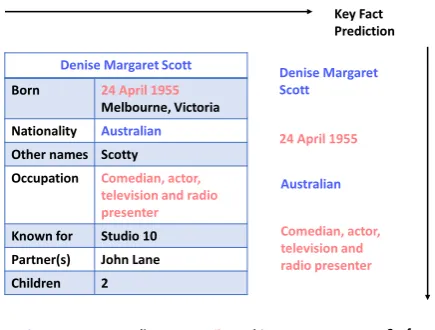
Table-to-text generation is to generate a descrip-tion from the structured table. It helps readers to summarize the key points in the table, and tell in the natural language. Figure 1 shows an exam-ple of table-to-text generation. The table provides some structured information about a person named “Denise Margaret Scott”, and the corresponding text describes the person with the key information in the table. Table-to-text generation can be ap-plied in many scenarios, including weather report generation (Liang et al., 2009), NBA news writ-ing (Barzilay and Lapata,2005), biography gener-ation (Dubou´e and McKeown,2002;Lebret et al.,
2016), and so on. Moreover, table-to-text
genera-1The codes are available athttps://github.com/
lancopku/Pivot.
Denise Margaret Scott
Born 24 April 1955 Melbourne, Victoria Nationality Australian
Other names Scotty
Occupation Comedian, actor, television and radio presenter
Known for Studio 10 Partner(s) John Lane Children 2
Denise Margaret Scott (born 24 April 1955) is an
Australiancomedian, actor and television presenter.
Denise Margaret Scott
24 April 1955
Australian
Comedian, actor, television and radio presenter
Key Fact Prediction
Surface Realization
Figure 1: An example of table-to-text generation, and also a flow chart of our method.
tion is a good testbed of a model’s ability of un-derstanding the structured knowledge.
Most of the existing methods for table-to-text generation are based on the encoder-decoder framework (Sutskever et al., 2014; Bahdanau et al.,2014). They represent the source tables with a neural encoder, and generate the text word-by-word with a decoder conditioned on the source ta-ble representation. Although the encoder-decoder framework has proven successful in the area of natural language generation (NLG) (Luong et al.,
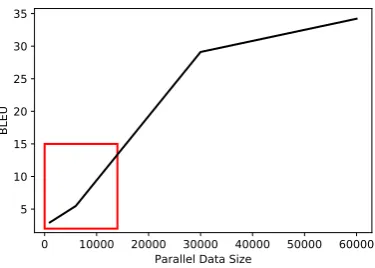
2015;Chopra et al., 2016;Lu et al.,2017; Yang et al.,2018), it requires a large parallel corpus, and is known to fail when the corpus is not big enough. Figure2shows the performance of a table-to-text model trained with different number of parallel data under the encoder-decoder framework. We can see that the performance is poor when the par-allel data size is low. In practice, we lack the large parallel data in many domains, and it is expensive to construct a high-quality parallel corpus.
This work focuses on the task of low resource table-to-text generation, where only limited
0 10000 20000 30000 40000 50000 60000 Parallel Data Size
5 10 15 20 25 30 35
[image:2.595.82.270.76.210.2]BLEU
Figure 2: The BLEU scores of the a table-to-text model trained with different number of parallel data under the encoder-decoder framework on the WIKIBIO dataset.
lel data is available. Some previous work ( Pudup-pully et al., 2018;Gehrmann et al.,2018) formu-lates the task as the combination of content se-lection and surface realization, and models them with an end-to-end model. Inspired by these work, we break up the table-to-text generation into two stages, each of which is performed by a model trainable with only a few annotated data. Specifi-cally, it first predicts the key facts from the tables, and then generates the text with the key facts, as shown in Figure 1. The two-stage method con-sists of two separate models: a key fact prediction model and a surface realization model. The key fact prediction model is formulated as a sequence labeling problem, so it needs much fewer anno-tated data than the encoder-decoder models. Ac-cording to our experiments, the model can obtain
87.92%F1 score with only1,000annotated data. As for the surface realization model, we propose a method to construct a pseudo parallel dataset with-out the need of labeled data. In this way, our model can make full use of the unlabeled text, and allevi-ate the heavy need of the parallel data.
The contributions of this work are as follows:
• We propose to break up the table-to-text gen-eration into two stages with two separate models, so that the model can be trained with fewer annotated data.
• We propose a method to construct a pseudo parallel dataset for the surface realization model, without the need of labeled data.
• Experiments show that our proposed model can achieve27.34 BLEU score on a biogra-phy generation dataset with only1,000
table-text samples.
2 PIVOT: A Two-Stage Model
In this section, we introduce our proposed two-stage model, which we denote asPIVOT. We first give the formulation of the table-to-text generation and the related notations. Then, we provide an overview of the model. Finally, we describe the two models for each stage in detail.
2.1 Formulation and Notations
Suppose we have a parallel table-to-text datasetP
withN data samples and an unlabeled text dataset
U with M samples. Each parallel sample con-sists of a source table T and a text description
y={y1, y2,· · · , yn}. The tableT can be
formu-lated asK recordsT ={r1, r2, r3,· · · , rK}, and
each record is an attribute-value pairrj = (aj, vj).
Each sample in the unlabeled text dataset U is a piece of texty¯={y¯1,y¯2,· · ·,y¯n}.
Formally, the task of table-to-text generation is to take the structured representations of ta-ble T = {(a1, v1),(a2, v2),· · · ,(am, vm)} as
input, and output the sequence of words y =
{y1, y2,· · ·, yn}.
2.2 Overview
Figure 3 shows the overview architecture of our proposed model. Our model contains two stages: key fact prediction and surface realization. At the first stage, we represent the table into a se-quence, and use a table-to-pivot model to select the key facts from the sequence. The table-to-pivot model adpots a bi-directional Long Short-term Memory Network (Bi-LSTM) to predict a bi-nary sequence of whether each word is reserved as the key facts. At the second stage, we build a sequence-to-sequence model to take the key facts selected in the first stage as input and emit the ta-ble description. In order to make use of the un-labeled text corpus, we propose a method to con-struct pseudo parallel data to train a better surface realization model. Moreover, we introduce a de-noising data augmentation method to reduce the risk of error propagation between two stages.
2.3 Preprocessing: Key Fact Selection
𝑥1
𝑥2
…
𝑥3
ℎ1
ℎ2
ℎ3
…
Denise Margaret Scott Born 24 April 1955
Melbourne, Victoria
Nationality Australian
Other names
Scotty
Occupation Comedian, actor, television and radio presenter
Known for Studio 10
Partner(s) John Lane
Children 2 𝑥𝑚 ℎ𝑚
1
0
1
…
0
Denise Margaret Scott Born 24 April 1955 Melbourne, Victoria
Nationality Australian
Occupation Comedian, actor, television and radio presenter
ҧ𝑥 1
ҧ𝑥 2
ҧ𝑥 𝑘 …
ℎ1
ℎ2
…
ℎ𝑘
A
tt
en
ti
on
𝑠1
𝑠2
𝑠𝑛
…
𝑦1
𝑦2
…
𝑦𝑛
Denise Margaret Scott (born 24 April 1955) is an Australian comedian, actor and television presenter.
[image:3.595.74.526.67.250.2]Key Fact Prediction Surface Realization
Figure 3: The overview of our model. For illustration, the surface realization model is a vanilla Seq2Seq, while it can also be a Transformer in our implementation.
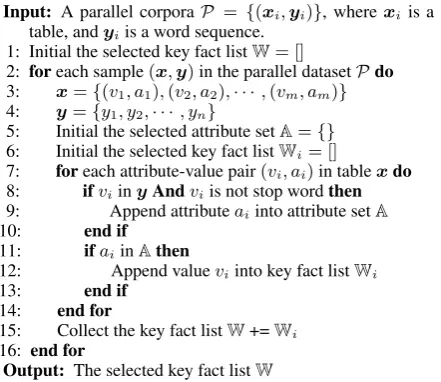
text as the key facts, so we can label the key facts automatically. Algorithm1illustrates the process of automatically annotating the key facts. Given a table and its associated text, we enumerate each attribute-value pair in the table, and compute the word overlap between the value and the text. The word overlap is defined as the number of words that are not stop words or punctuation but appear in both the table and the text. We collect all val-ues that have at least one overlap with the text, and regard them as the key facts. In this way, we can obtain a binary sequence with the 0/1 label de-noting whether the values in the table are the key facts. The binary sequence will be regarded as the supervised signal of the key fact prediction model, and the selected key facts will be the input of the surface realization model.
2.4 Stage 1: Key Fact Prediction
The key fact prediction model is a Bi-LSTM layer with a multi-layer perceptron (MLP) classifier to determine whether each word is selected. In or-der to represent the table, we follow the previous work (Liu et al.,2018) to concatenate all the words in the values of the table into a word sequence, and each word is labeled with its attribute. In this way, the table is represented as two sequences: the value sequence{v1, v2,· · ·, vm}and the attribute
sequence {a1, a2,· · · , am}. A word embedding
and an attribute embedding are used to transform
Algorithm 1Automatic Key Fact Annotation
Input: A parallel corporaP = {(xi,yi)}, wherexi is a
table, andyiis a word sequence.
1: Initial the selected key fact listW= []
2: foreach sample(x,y)in the parallel datasetPdo
3: x={(v1, a1),(v2, a2),· · ·,(vm, am)}
4: y={y1, y2,· · ·, yn}
5: Initial the selected attribute setA={} 6: Initial the selected key fact listWi= []
7: foreach attribute-value pair(vi, ai)in tablexdo
8: ifviinyAndviis not stop wordthen
9: Append attributeaiinto attribute setA
10: end if
11: ifaiinAthen
12: Append valueviinto key fact listWi
13: end if
14: end for
15: Collect the key fact listW+=Wi
16: end for
Output: The selected key fact listW
two sequences into the vectors. Following ( Le-bret et al., 2016; Liu et al., 2018), we introduce a position embedding to capture structured infor-mation of the table. The position inforinfor-mation is represented as a tuple (p+w, pw), which includes the positions of the tokenwcounted from the be-ginning and the end of the value respectively. For example, the record of “(Name, Denise Margaret Scott)” is represented as “({Denise, Name, 1, 3},
{Margaret, Name, 2, 2}, {Scott, Name, 3, 1})”.
[image:3.595.308.529.366.557.2]embedding, and the position embedding are con-catenated as the input of the modelx.
Table Encoder: The goal of the source table en-coder is to provide a series of representations for the classifier. More specifically, the table encoder is a Bi-LSTM:
ht= BiLSTM(xt, ~ht−1, ~ht+1) (1)
where~htand ~htare the forward and the backward
hidden outputs respectively, ht is the
concatena-tion of~ht and ~ht, and xt is the input at the t-th
time step.
Classifier:The output vectorhtis fed into a MLP
classifier to compute the probability distribution of the labelp1(lt|x)
p1(lt|x) = softmax(Wcht+bc) (2)
where Wc and bc are trainable parameters of the
classifier.
2.5 Stage 2: Surface Realization
The surface realization stage aims to generate the text conditioned on the key facts predicted in Stage 1. We adpot two models as the implementation of surface realization: the vanilla Seq2Seq and the Transformer (Vaswani et al.,2017).
Vanilla Seq2Seq: In our implementation, the vanilla Seq2Seq consists of a Bi-LSTM encoder and an LSTM decoder with the attention mecha-nism. The Bi-LSTM encoder is the same as that of the key fact prediction model, except that it does not use any attribute embedding or position em-bedding.
The decoder consists of an LSTM, an attention component, and a word generator. It first generates the hidden statest:
st=f(yt−1, st−1) (3)
wheref(·,·)is the function of LSTM for one time step, and yt−1 is the last generated word at time stept−1. Then, the hidden statestfrom LSTM
is fed into the attention component:
vt= Attention(st,h) (4)
where Attention(·,·) is the implementation of global attention in (Luong et al.,2015), andhis a sequence of outputs by the encoder.
Given the output vector vt from the attention
component, the word generator is used to compute
the probability distribution of the output words at time stept:
p2(yt|x) = softmax(Wgvt+bg) (5)
whereWg andbg are parameters of the generator.
The word with the highest probability is emitted as thet-th word.
Transformer: Similar to vanilla Seq2Seq, the Transformer consists of an encoder and a decoder. The encoder applies a Transformer layer to encode each word into the representationht:
ht= Transformer(xt,x) (6)
Inside the Transformer, the representation xt
at-tends to a collection of the other representations
x = {x1, x2,· · · , xm}. Then, the decoder
pro-duces the hidden state by attending to both the en-coder outputs and the previous deen-coder outputs:
vt= Transformer(yt,y<t,h) (7)
Finally, the output vector is fed into a word gen-erator with a softmax layer, which is the same as Eq.5.
For the purpose of simplicity, we omit the details of the inner computation of the Trans-former layer, and refer the readers to the related work (Vaswani et al.,2017).
2.6 Pseudo Parallel Data Construction
The surface realization model is based on the encoder-decoder framework, which requires a large amount of training data. In order to aug-ment the training data, we propose a novel method to construct pseudo parallel data. The surface re-alization model is used to organize and complete the text given the key facts. Therefore, it is pos-sible to construct the pseudo parallel data by re-moving the skeleton of the text and reserving only the key facts. In implementation, we label the text with Stanford CoreNLP toolkit2to assign the POS tag for each word. We reserve the words whose POS tags are among the tag set of{NN, NNS, NNP,
NNPS, JJ, JJR, JJS, CD, FW}, and remove the
re-maining words. In this way, we can construct a large-scale pseudo parallel data to train the surface realization model.
2https://stanfordnlp.github.io/
2.7 Denoising Data Augmentation
A problem of the two-stage model is that the er-ror may propagate from the first stage to the sec-ond stage. A possible solution is to apply beam search to enlarge the searching space at the first stage. However, in our preliminary experiments, when the beam size is small, the diversity of pre-dicted key facts is low, and also does not help to improve the accuracy. When the beam size is big, the decoding speed is slow but the improvement of accuracy is limited.
To address this issue, we implement a method of denoising data augmentation to reduce the hurt from error propagation and improve the robust-ness of our model. In practice, we randomly drop some words from the input of surface realiza-tion model, or insert some words from other sam-ples. The dropping simulates the cases when the key fact prediction model fails to recall some co-occurrence, while the inserting simulates the cases when the model predicts some extra facts from the table. By adding the noise, we can regard these data as the adversarial examples, which is able to improve the robustness of the surface realization model.
2.8 Training and Decoding
Since the two components of our model are sepa-rate, the objective functions of the models are op-timized individually.
Training of Key Fact Prediction Model: The key fact prediction model, as a sequence labeling model, is trained using the cross entropy loss:
L1 =− m X
i=1
logp1(li|x) (8)
Training of Surface Realization Model: The loss function of the surface realization model can be written as:
L2=− n X
i=1
logp2(yi|x¯) (9)
where x¯ is a sequence of the selected key facts at Stage 1. The surface realization model is also trained with the pseudo parallel data as described in Section2.6. The objective function can be writ-ten as:
L3=− n X
i=1
logp2(¯yi|xˆ) (10)
wherey¯is the unlabeled text, andxˆis the pseudo text paired withy¯.
Decoding: The decoding consists of two steps. At the first step, it predicts the label by the key fact prediction model:
ˆ
lt= arg max lt∈{0,1}
p1(lt|x) (11)
The word withˆlt= 1 is reserved, while that with
ˆ
lt = 0is discarded. Therefore, we can obtain a
sub-sequencex¯after the discarding operation. At the second step, the model emits the text with the surface realization model:
ˆ
yt= arg max yt∈V
p2(yt|x¯) (12)
where V is the vocabulary size of the model. Therefore, the word sequence {yˆ1,yˆ2,· · · ,yˆN}
forms the generated text.
3 Experiments
We evaluate our model on a table-to-text gener-ation benchmark. We denote the PIVOT model under the vanilla Seq2Seq framework as PIVOT -Vanilla, and that under the Transformer framework as PIVOT-Trans.
3.1 Dataset
We use WIKIBIO dataset (Lebret et al., 2016) as our benchmark dataset. The dataset contains
728,321articles from English Wikipedia, which uses the first sentence of each article as the de-scription of the related infobox. There are an av-erage of26.1words in each description, of which
9.5words also appear in the table. The table con-tains 53.1 words and 19.7 attributes on average. Following the previous work (Lebret et al.,2016;
Liu et al., 2018), we split the dataset into 80%
training set, 10%testing set, and 10%validation set. In order to simulate the low resource scenario, we randomly sample 1,000 parallel sample, and remove the tables from the rest of the training data.
3.2 Evaluation Metrics
Following the previous work (Lebret et al.,2016;
3.3 Implementation Details
The vocabulary is limited to the20,000most com-mon words in the training dataset. The batch size is 64 for all models. We implement the early stopping mechanism with a patience that the per-formance on the validation set does not fall in 4
epochs. We tune the hyper-parameters based on the performance on the validation set.
The key fact prediction model is a Bi-LSTM. The dimensions of the hidden units, the word em-bedding, the attribute emem-bedding, and the position embedding are500,400,50, and5, respectively.
We implement two models as the surface real-ization models. For the vanilla Seq2Seq model, we set the hidden dimension, the embedding di-mension, and the dropout rate (Srivastava et al.,
2014) to be500,400, and0.2, respectively. For the Transfomer model, the hidden units of the multi-head component and the feed-forward layer are
512 and 2048. The embedding size is 512, the number of heads is 8, and the number of Trans-former blocks is6.
We use the Adam (Kingma and Ba, 2014) optimizer to train the models. For the hyper-parameters of Adam optimizer, we set the learn-ing rate α = 0.001, two momentum parameters
β1 = 0.9 andβ2 = 0.999, and = 1×10⁻⁸. We clip the gradients (Pascanu et al.,2013) to the maximum norm of5.0. We half the learning rate when the performance on the validation set does not improve in3epochs.
3.4 Baselines
We compare our models with two categories of baseline models: the supervised models which ex-ploit only parallel data (Vanilla Seq2Seq, Trans-former, Struct-aware), and the semi-supervised models which are trained on both parallel data and unlabelled data (PretrainedMT, SemiMT). The baselines are as follows:
• Vanilla Seq2Seq (Sutskever et al., 2014) with the attention mechanism (Bahdanau et al., 2014) is a popular model for natural language generation.
• Transformer (Vaswani et al., 2017) is a state-of-the-art model under the encoder-decoder framework, based solely on attention mechanisms.
• Struct-aware (Liu et al.,2018) is the state-of-the-art model for table-to-text generation.
Model F1 P R
PIVOT(Bi-LSTM) 87.92 92.59 83.70
Model BLEU NIST ROUGE
Vanilla Seq2Seq 2.14 0.2809 0.47 Structure-S2S 3.27 0.9612 0.71
PretrainedMT 4.35 1.9937 0.91 SemiMT 6.76 3.5017 2.04
PIVOT-Vanilla 20.09 6.5130 18.31
Model BLEU NIST ROUGE
Transformer 5.48 1.9873 1.26
PretrainedMT 6.43 2.1019 1.77 SemiMT 9.71 2.7019 3.31
[image:6.595.317.516.67.270.2]PIVOT-Trans 27.34 6.8763 19.30
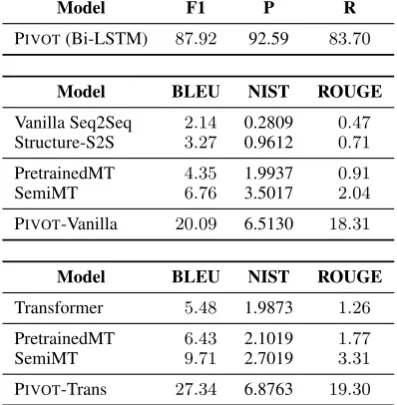
Table 1: Results of our model and the baselines. Above is the performance of the key fact prediction compo-nent (F1: F1 score, P: precision, R: recall). Middle is the comparison between models under the Vanilla Seq2Seq framework. Below is the models imple-mented with the transformer framework.
It models the inner structure of table with a field-gating mechanism insides the LSTM, and learns the interaction between tables and text with a dual attention mechanism.
• PretrainedMT (Skorokhodov et al., 2018) is a semi-supervised method to pretrain the decoder of the sequence-to-sequence model with a language model.
• SemiMT (Cheng et al., 2016) is a semi-supervised method to jointly train the sequence-to-sequence model with an auto-encoder.
The supervised models are trained with the same parallel data as our model, while the semi-supervised models share the same parallel data and the unlabeled data as ours.
3.5 Results
We compare our PIVOT model with the above baseline models. Table 1summarizes the results of these models. It shows that our PIVOTmodel achieves87.92%F1 score,92.59%precision, and
83.70% recall at the stage of key fact predic-tion, which provides a good foundation for the stage of surface realization. Based on the selected key facts, our models achieve the scores of20.09
0 1000 6000 30000 60000 300000 Parallel Data Size
0 10 20 30 40
BLEU
Vanilla Pivot Vanilla
(a) Vanilla Seq2Seq v.s PIVOT-Vanilla
0 1000 6000 30000 60000 300000 Parallel Data Size
0 10 20 30 40
BLEU
Transformer Pivot Trans
[image:7.595.305.525.65.208.2](b) Transformer v.s PIVOT-Trans
Figure 4: The BLEU measure of our Pivot model and the baselines trained with different parallel data size.
the vanilla Seq2Seq framework, and27.34BLEU,
6.8763NIST, and19.30ROUGE under the Trans-former framework, which significantly outperform all the baseline models in terms of all metrics. Fur-thermore, it shows that the implementation with the Transformer can obtain higher scores than that with the vanilla Seq2Seq.
3.6 Varying Parallel Data Size
We would like to further analyze the performance of our model given different size of parallel size. Therefore, we randomly shuffle the full parallel training set. Then, we extract the first K sam-ples as the parallel data, and modify the remaining data as the unlabeled data by removing the tables. We set K = 1000,6000,30000,60000,300000, and compare our pivot models with both vanilla Seq2Seq and Transformer. Figure 4 shows the BLEU scores of our models and the baselines. When the parallel data size is small, the pivot model can outperform the vanilla Seq2Seq and Transformer by a large margin. With the increase-ment of the parallel data, the margin gets narrow because of the upper bound of the model capacity.
1000 6000 30000 60000 300000 Parallel Data Size
80.0 82.5 85.0 87.5 90.0 92.5 95.0 97.5 100.0
F1-score
Figure 5: The F1 score of the key fact prediction model trained with different parallel data size.
Model BLEU NIST ROUGE
Vanilla Seq2Seq 2.14 0.2809 0.47
+ Pseudo 10.01 3.0620 6.55
Transformer 6.43 2.1019 1.77
+ Pseudo 14.35 4.1763 8.42
w/o Pseudo 11.08 3.6910 4.84
PIVOT-Vanilla 20.09 6.5130 18.31
w/o Pseudo 14.18 4.2686 7.10
[image:7.595.80.273.75.382.2]PIVOT-Trans 27.34 6.8763 19.30
Table 2: Ablation study on the 1k training set for the effect of pseudo parallel data.
Figure5shows the curve of the F1 score of the key fact prediction model trained with different paral-lel data size. Even when the number of annotated data is extremely small, the model can obtain a satisfying F1 score about88%. In general, the F1 scores between the low and high parallel data sizes are close, which validates the assumption that the key fact prediction model does not rely on a heavy annotated data.
3.7 Effect of Pseudo Parallel Data
[image:7.595.81.272.78.219.2] [image:7.595.308.527.257.406.2]Model BLEU NIST ROUGE
PIVOT-Vanilla 20.09 6.5130 18.31
w/o denosing 18.45 4.8714 11.43
PIVOT-Trans 27.34 6.8763 19.30
w/o denosing 25.72 6.5475 17.95
Table 3: Ablation study on the 1k training set for the effect of the denoising data augmentation.
Transformer:a athletics -lrb- nfl -rrb- .
SemiMT: gustav dovid -lrb- born 25 august 1945 -rrb- is a former hungarian politician , who served as a member of the united states -lrb- senate -rrb- from president to 1989 .
PIVOT-Trans:philippe adnot -lrb- born august 25 , 1945 -rrb- is a french senator , senator , and a senator of the french senate .
Reference:philippe adnot -lrb- born 25 august 1945 in rhges -rrb- is a member of the senate of france .
Table 4: An example of the generated text by our model and the baselines on 1k training set.
models can outperform the baselines with pseudo data, mainly because it breaks up the operation of key fact prediction and surface realization, both of which are explicitly and separately optimized.
3.8 Effect of Denoising Data Augmentation
We also want to know the effect of the denoising data augmentation. Therefore, we remove the de-noising data augmentation from our model, and compare with the full model. Table3 shows the results of the ablation study. It shows that the data augmentation brings a significant improvement to the pivot models under both vanilla Seq2Seq and Transformer frameworks, which demonstrates the efficiency of the denoising data augmentation.
3.9 Qualitative Analysis
We provide an example to illustrate the improve-ment of our model more intuitively, as shown in Table4. Under the low resource setting, the Trans-former can not produce a fluent sentence, and also fails to select the proper fact from the ta-ble. Thanks to the unlabeled data, the SemiMT model can generate a fluent, human-like descrip-tion. However, it suffers from the hallucination problem so that it generates some unseen facts, which is not faithful to the source input. Although
the PIVOTmodel has some problem in generating repeating words (such as “senator” in the exam-ple), it can select the correct key facts from the table, and produce a fluent description.
4 Related Work
This work is mostly related to both table-to-text generation and low resource natural language gen-eration.
4.1 Table-to-text Generation
Table-to-text generation is widely applied in many domains. Dubou´e and McKeown (2002) pro-posed to generate the biography by matching the text with a knowledge base. Barzilay and Lapata
(2005) presented an efficient method for automat-ically learning content selection rules from a cor-pus and its related database in the sports domain.
Liang et al.(2009) introduced a system with a se-quence of local decisions for the sportscasting and the weather forecast. Recently, thanks to the suc-cess of the neural network models, more work fo-cused on the neural generative models in an end-to-end style (Wiseman et al., 2017; Puduppully et al., 2018; Gehrmann et al., 2018; Sha et al.,
2018;Bao et al.,2018;Qin et al., 2018). Lebret et al.(2016) constructed a dataset of biographies from Wikipedia, and built a neural model based on the conditional neural language models. Liu et al.
(2018) introduced a structure-aware sequence-to-sequence architecture to model the inner struc-ture of the tables and the interaction between the tables and the text. Wiseman et al. (2018) fo-cused on the interpretable and controllable gener-ation process, and proposed a neural model using a hidden semi-markov model decoder to address these issues. Nie et al. (2018) attempted to im-prove the fidelity of neural table-to-text generation by utilizing pre-executed symbolic operations in a sequence-to-sequence model.
4.2 Low Resource Natural Language
Generation
The topic of low resource learning is one of the re-cent spotlights in the area of natural language gen-eration (Tilk and Alum¨ae,2017;Tran and Nguyen,
approach to share lexical and sentence level repre-sentations across different languages.Cheng et al.
(2016) proposed a semi-supervised approach that jointly train the sequence-to-sequence model with an auto-encoder, which reconstruct the monolin-gual corpora. More recently, some work ex-plored the unsupervised methods to totally remove the need of parallel data (Lample et al., 2018b,a;
Artetxe et al.,2017;Zhang et al.,2018).
5 Conclusions
In this work, we focus on the low resource table-to-text generation, where only limited parallel data is available. We separate the generation into two stages, each of which is performed by a model trainable with only a few annotated data. Besides, We propose a method to construct a pseudo paral-lel dataset for the surface realization model, with-out the need of any structured table. Experiments show that our proposed model can achieve27.34
BLEU score on a biography generation dataset with only1,000parallel data.
Acknowledgement
We thank the anonymous reviewers for their thoughtful comments. This work was supported in part by National Natural Science Foundation of China (No. 61673028). Xu Sun is the correspond-ing author of this paper.
References
Mikel Artetxe, Gorka Labaka, Eneko Agirre, and Kyunghyun Cho. 2017. Unsupervised neural ma-chine translation. CoRR, abs/1710.11041.
Dzmitry Bahdanau, Kyunghyun Cho, and Yoshua Bengio. 2014. Neural machine translation by jointly learning to align and translate. CoRR, abs/1409.0473.
Jun-Wei Bao, Duyu Tang, Nan Duan, Zhao Yan, Yuan-hua Lv, Ming Zhou, and Tiejun Zhao. 2018. Table-to-text: Describing table region with natural lan-guage. In Proceedings of the Thirty-Second AAAI Conference on Artificial Intelligence, (AAAI-18), the 30th innovative Applications of Artificial Intel-ligence (IAAI-18), and the 8th AAAI Symposium on Educational Advances in Artificial Intelligence (EAAI-18), New Orleans, Louisiana, USA, February 2-7, 2018, pages 5020–5027.
Regina Barzilay and Mirella Lapata. 2005. Collective content selection for concept-to-text generation. In
HLT/EMNLP 2005, Human Language Technology Conference and Conference on Empirical Methods
in Natural Language Processing, Proceedings of the Conference, 6-8 October 2005, Vancouver, British Columbia, Canada, pages 331–338.
Anja Belz and Ehud Reiter. 2006. Comparing auto-matic and human evaluation of NLG systems. In
EACL 2006, 11st Conference of the European Chap-ter of the Association for Computational Linguis-tics, Proceedings of the Conference, April 3-7, 2006, Trento, Italy.
Yong Cheng, Wei Xu, Zhongjun He, Wei He, Hua Wu, Maosong Sun, and Yang Liu. 2016. Semi-supervised learning for neural machine translation. InProceedings of the 54th Annual Meeting of the As-sociation for Computational Linguistics, ACL 2016, August 7-12, 2016, Berlin, Germany, Volume 1: Long Papers.
Sumit Chopra, Michael Auli, and Alexander M. Rush. 2016. Abstractive sentence summarization with at-tentive recurrent neural networks. InNAACL HLT 2016, The 2016 Conference of the North American Chapter of the Association for Computational Lin-guistics: Human Language Technologies, pages 93– 98.
Pablo Ariel Dubou´e and Kathleen R. McKeown. 2002. Content planner construction via evolutionary al-gorithms and a corpus-based fitness function. In
Proceedings of the International Natural Language Generation Conference, Harriman, New York, USA, July 2002, pages 89–96.
Sebastian Gehrmann, Falcon Z. Dai, Henry Elder, and Alexander M. Rush. 2018. End-to-end content and plan selection for data-to-text generation. In Pro-ceedings of the 11th International Conference on Natural Language Generation, Tilburg University, The Netherlands, November 5-8, 2018, pages 46–56.
Jiatao Gu, Hany Hassan, Jacob Devlin, and Victor O. K. Li. 2018. Universal neural machine translation for extremely low resource languages. In Proceed-ings of the 2018 Conference of the North American Chapter of the Association for Computational Lin-guistics: Human Language Technologies, NAACL-HLT 2018, New Orleans, Louisiana, USA, June 1-6, 2018, Volume 1 (Long Papers), pages 344–354.
Diederik P Kingma and Jimmy Ba. 2014. Adam: A method for stochastic optimization. CoRR, abs/1412.6980.
Guillaume Lample, Alexis Conneau, Ludovic Denoyer, and Marc’Aurelio Ranzato. 2018a. Unsupervised machine translation using monolingual corpora only. InInternational Conference on Learning Represen-tations (ICLR).
R´emi Lebret, David Grangier, and Michael Auli. 2016. Neural text generation from structured data with ap-plication to the biography domain. In Proceed-ings of the 2016 Conference on Empirical Meth-ods in Natural Language Processing, EMNLP 2016, Austin, Texas, USA, November 1-4, 2016, pages 1203–1213.
Percy Liang, Michael I. Jordan, and Dan Klein. 2009. Learning semantic correspondences with less super-vision. In ACL 2009, Proceedings of the 47th An-nual Meeting of the Association for Computational Linguistics and the 4th International Joint Confer-ence on Natural Language Processing of the AFNLP, 2-7 August 2009, Singapore, pages 91–99.
Chin-Yew Lin and Eduard H. Hovy. 2003. Auto-matic evaluation of summaries using n-gram co-occurrence statistics. InHuman Language Technol-ogy Conference of the North American Chapter of the Association for Computational Linguistics, HLT-NAACL 2003.
Tianyu Liu, Kexiang Wang, Lei Sha, Baobao Chang, and Zhifang Sui. 2018. Table-to-text generation by structure-aware seq2seq learning. In Proceed-ings of the Thirty-Second AAAI Conference on Ar-tificial Intelligence, (AAAI-18), the 30th innovative Applications of Artificial Intelligence (IAAI-18), and the 8th AAAI Symposium on Educational Advances in Artificial Intelligence (EAAI-18), New Orleans, Louisiana, USA, February 2-7, 2018, pages 4881– 4888.
Jiasen Lu, Caiming Xiong, Devi Parikh, and Richard Socher. 2017. Knowing when to look: Adaptive at-tention via a visual sentinel for image captioning. In
2017 IEEE Conference on Computer Vision and Pat-tern Recognition, CVPR 2017, Honolulu, HI, USA, July 21-26, 2017, pages 3242–3250.
Thang Luong, Hieu Pham, and Christopher D. Man-ning. 2015. Effective approaches to attention-based neural machine translation. In Proceedings of the 2015 Conference on Empirical Methods in Natural Language Processing, EMNLP 2015, pages 1412– 1421.
Feng Nie, Jinpeng Wang, Jin-Ge Yao, Rong Pan, and Chin-Yew Lin. 2018. Operation-guided neural net-works for high fidelity data-to-text generation. In
Proceedings of the 2018 Conference on Empirical Methods in Natural Language Processing, Brussels, Belgium, October 31 - November 4, 2018, pages 3879–3889.
Kishore Papineni, Salim Roukos, Todd Ward, and Wei-Jing Zhu. 2002. BLEU: a method for automatic evaluation of machine translation. In Proceedings of the 40th Annual Meeting of the Association for Computational Linguistics, pages 311–318.
Razvan Pascanu, Tomas Mikolov, and Yoshua Bengio. 2013. On the difficulty of training recurrent neural networks. InProceedings of the 30th International
Conference on Machine Learning, ICML 2013, At-lanta, GA, USA, 16-21 June 2013, pages 1310–1318.
Ratish Puduppully, Li Dong, and Mirella Lapata. 2018. Data-to-text generation with content selection and planning. CoRR, abs/1809.00582.
Guanghui Qin, Jin-Ge Yao, Xuening Wang, Jinpeng Wang, and Chin-Yew Lin. 2018. Learning latent se-mantic annotations for grounding natural language to structured data. InProceedings of the 2018 Con-ference on Empirical Methods in Natural Language Processing, Brussels, Belgium, October 31 - Novem-ber 4, 2018, pages 3761–3771.
Lei Sha, Lili Mou, Tianyu Liu, Pascal Poupart, Su-jian Li, Baobao Chang, and Zhifang Sui. 2018. Order-planning neural text generation from struc-tured data. In Proceedings of the Thirty-Second AAAI Conference on Artificial Intelligence, (AAAI-18), the 30th innovative Applications of Artificial In-telligence (IAAI-18), and the 8th AAAI Symposium on Educational Advances in Artificial Intelligence (EAAI-18), New Orleans, Louisiana, USA, February 2-7, 2018, pages 5414–5421.
Ivan Skorokhodov, Anton Rykachevskiy, Dmitry Emelyanenko, Sergey Slotin, and Anton Ponkratov. 2018. Semi-supervised neural machine translation with language models. InProceedings of the Work-shop on Technologies for MT of Low Resource Lan-guages, LoResMT@AMTA 2018, Boston, MA, USA, March 21, 2018, pages 37–44.
Nitish Srivastava, Geoffrey E. Hinton, Alex Krizhevsky, Ilya Sutskever, and Ruslan Salakhutdi-nov. 2014. Dropout: a simple way to prevent neural networks from overfitting. Journal of Machine Learning Research, 15(1):1929–1958.
Ilya Sutskever, Oriol Vinyals, and Quoc V. Le. 2014. Sequence to sequence learning with neural net-works. InAdvances in Neural Information Process-ing Systems 27: Annual Conference on Neural Infor-mation Processing Systems 2014, pages 3104–3112.
Ottokar Tilk and Tanel Alum¨ae. 2017. Low-resource neural headline generation. In Proceedings of the Workshop on New Frontiers in Summariza-tion, NFiS@EMNLP 2017, Copenhagen, Denmark, September 7, 2017, pages 20–26.
Van-Khanh Tran and Le-Minh Nguyen. 2018. Dual latent variable model for low-resource natural lan-guage generation in dialogue systems. In Proceed-ings of the 22nd Conference on Computational Nat-ural Language Learning, CoNLL 2018, Brussels, Belgium, October 31 - November 1, 2018, pages 21– 30.
Information Processing Systems 2017, 4-9 Decem-ber 2017, Long Beach, CA, USA, pages 6000–6010.
Sam Wiseman, Stuart M. Shieber, and Alexander M. Rush. 2017. Challenges in data-to-document gener-ation. In Proceedings of the 2017 Conference on Empirical Methods in Natural Language Process-ing, EMNLP 2017, Copenhagen, Denmark, Septem-ber 9-11, 2017, pages 2253–2263.
Sam Wiseman, Stuart M. Shieber, and Alexander M. Rush. 2018. Learning neural templates for text gen-eration. InProceedings of the 2018 Conference on Empirical Methods in Natural Language Process-ing, Brussels, Belgium, October 31 - November 4, 2018, pages 3174–3187.
Pengcheng Yang, Xu Sun, Wei Li, Shuming Ma, Wei Wu, and Houfeng Wang. 2018. SGM: sequence generation model for multi-label classification. In
Proceedings of the 27th International Conference on Computational Linguistics, COLING 2018, Santa Fe, New Mexico, USA, August 20-26, 2018, pages 3915–3926.