Authorization Management for Pervasive Computing
Patroklos Argyroudis
A thesis submitted to the University of Dublin, Trinity College
in partial fulllment of the requirements for the degree of
Doctor of Philosophy
Declaration
I, the undersigned, declare that this work has not previously been submitted to this or any
other University, and that unless otherwise stated, it is entirely my own work.
Patroklos Argyroudis
Permission to Lend and/or Copy
I, the undersigned, agree that Trinity College Library may lend or copy this thesis upon
request.
Patroklos Argyroudis
Acknowledgements
The are certain people that I would like to thank for their support during the course of my postgraduate studies and the completion of this dissertation. First of all, I would like to thank my supervisor, Prof Donal O'Mahony. His advice and guidance have been invaluable, not only in research matters but also in my general academic life. He helped me to concisely formulate my ideas and identify their strong and weak points, even when they were outrageous. I can only hope to some day be half the supervisor he has been to me.
One of the most inuential and supportive people during my studies has been Ioanna Stamouli. Her constant moral support, especially during all those times that self-doubt almost took over, gave me courage and kept me going.
Dr Linda Doyle has also been very helpful throughout my research studies. Her insight-ful comments led me to appreciate areas not directly related to my work but nonetheless very important. I would like to thank her for this.
I have been very lucky to conduct my research among the extremely talented people of the Networks and Telecommunications Research Group (NTRG). Hitesh Tewari, Diego Doval, Stephen Toner and Raja Verma, among others, were always happy to discuss techni-cal topics, ideas and help me enhance my understanding of areas outside my main research focus.
I wish to thank the Embark Initiative, operated by the Irish Research Council for Science, Engineering and Technology (IRCSET), for providing nancial support for my studies.
Finally, I would like to dedicate this work to my family. My parents, Georgios and Stavroula, and my sister, Thomi-Niki, supported me in countless ways. Their unconditional love helped me to make it through all the tough times in my life. I wholeheartedly thank them.
Patroklos Argyroudis
Contents
Acknowledgements iv
List of Figures xi
List of Tables xiv
Abstract xv
Chapter 1 Introduction 1
1.1 Requirements . . . 3
1.2 Summary of Goals . . . 4
1.3 Key Contributions . . . 4
1.4 Dissertation Outline . . . 5
1.5 Publication Record . . . 6
Chapter 2 Background and Related Work 8 2.1 Pervasive Computing . . . 8
2.2 Context and Context-awareness . . . 11
2.3 Service Discovery . . . 14
2.4 Pervasive Computing Systems . . . 17
2.4.1 Oxygen . . . 18
2.4.2 EasyLiving . . . 19
2.4.3 Cooltown . . . 20
2.4.4 Active Systems . . . 21
2.5.1 Secret Key Cryptography . . . 24
2.5.2 Public Key Cryptography . . . 25
2.5.2.1 Digital Signatures . . . 27
2.5.2.2 Public Key Certicates . . . 27
2.5.3 Identity and Authentication . . . 28
2.5.4 Authorization . . . 29
2.6 Computer Security Systems and Models . . . 30
2.6.1 Role-Based Access Control . . . 30
2.6.2 X.509 and the X.509 Attribute Certicate Prole . . . 36
2.6.3 Pretty Good Privacy . . . 39
2.6.4 Kerberos . . . 41
2.6.5 KeyNote . . . 43
2.6.6 SPKI/SDSI . . . 45
2.6.7 Trust Establishment . . . 46
2.6.8 PERMIS . . . 48
2.6.9 XACML . . . 50
2.7 Pervasive Computing Security Systems . . . 51
2.7.1 Resurrecting Duckling . . . 51
2.7.2 Talking to Strangers . . . 52
2.7.3 Bluetooth Security . . . 53
2.7.4 Distributed Key Management . . . 57
2.7.5 Self-organized Public Key Infrastructure . . . 58
2.7.6 Ad hoc Group Key Agreement . . . 59
2.7.7 Proxy-based Security Protocols . . . 59
2.7.8 Personal PKI . . . 61
2.7.9 Cerberus . . . 62
2.7.10 Environment Roles . . . 64
2.8 Secure Service Discovery Systems . . . 65
2.8.1 Jini . . . 65
2.8.3 Universal Plug and Play . . . 66
2.8.4 Secure Ad hoc Service Discovery . . . 67
2.9 System Classication . . . 68
Chapter 3 Pervasive Computing Threat Model 71 3.1 Context-sensitivity Threats . . . 73
3.1.1 Context Fabrication Threats . . . 75
3.1.2 Context Consumption Threats . . . 76
3.2 Unauthorized Action Threats . . . 77
3.3 Eavesdropping Threats . . . 78
3.4 Service and Device Discovery Threats . . . 80
3.5 Denial of Service Threats . . . 81
3.6 Stolen Device Threats . . . 82
3.7 Secure Transport Layer Threats . . . 83
3.7.1 Trac Analysis . . . 84
3.7.2 Protocol Bugs . . . 84
3.7.3 Credential Threats . . . 85
3.7.3.1 Username/Password/PIN Threats . . . 85
3.7.3.2 Symmetric Shared Secret Threats . . . 86
3.7.3.3 Certicate Threats . . . 87
3.7.4 Anonymous Die-Hellman Threats . . . 89
Chapter 4 ÆTHER Architecture 91 4.1 ÆTHER Threat Model . . . 92
4.2 General ÆTHER Model . . . 94
4.2.1 User-based Authorization Management . . . 94
4.2.2 ÆTHER Model . . . 95
4.2.3 Dual Interface and Policy Distribution . . . 102
4.2.4 Policy Statements . . . 104
4.2.5 Authority Revocation . . . 109
4.3.1 Management Model . . . 112
4.3.2 Policy Statements . . . 116
4.3.3 Policy Distribution . . . 116
4.3.4 Authority Revocation . . . 119
4.3.5 Service Discovery and Access . . . 120
4.3.5.1 Normal Device to Alpha-pad . . . 122
4.3.5.2 Normal Device to Normal Device (Same Alpha-pad) . . . . 123
4.3.5.3 Alpha-pad to Alpha-pad . . . 124
4.3.5.4 Normal Device to Alpha-pad (Dierent Alpha-pad) . . . 124
4.3.5.5 Normal Device to Normal Device (Dierent Alpha-pad) . . 125
4.3.6 Inference Engine . . . 127
4.3.7 Security Considerations . . . 129
4.4 ÆTHER1 . . . 129
4.4.1 Management Model . . . 130
4.4.2 Policy Statements . . . 133
4.4.3 Policy Distribution . . . 134
4.4.4 Authority Revocation . . . 137
4.4.5 Service Discovery and Access . . . 138
4.4.5.1 Eager . . . 139
4.4.5.2 Lazy . . . 142
4.4.6 Inference Engine . . . 142
4.4.7 Secure Interdomain Interactions . . . 143
4.4.8 Security Considerations . . . 146
4.5 Usability . . . 147
4.6 Maintainability . . . 149
4.7 Privacy Considerations . . . 151
4.8 Comparison . . . 152
Chapter 5 ÆTHER Implementation 155 5.1 The NTRG Ad hoc Networking Stack . . . 156
5.1.2 The Network Layer . . . 158
5.1.3 The Application Layer . . . 160
5.2 The ÆTHER Layer . . . 160
5.3 Performance Analysis . . . 164
5.3.1 ÆTHER0 . . . 165
5.3.1.1 Mutual Binding . . . 165
5.3.1.2 Access Protocols . . . 167
5.3.1.3 Policy Evaluation . . . 168
5.3.2 ÆTHER1 . . . 169
5.3.2.1 Binding . . . 170
5.3.2.2 Attribute Certicate Acquisition . . . 171
5.3.2.3 Access Protocol . . . 172
5.3.2.4 Policy Evaluation . . . 173
5.4 Memory Requirements . . . 175
5.5 Applications . . . 177
5.5.1 Location Sensor . . . 177
5.5.2 Pervasive Light Switch . . . 180
5.5.3 Building Access Control . . . 182
5.5.4 Pervasive Car . . . 183
5.5.5 Web Services . . . 185
Chapter 6 Conclusions and Future Work 187 6.1 Summary of Contributions . . . 189
6.2 Future Work . . . 190
Appendix A The ÆTHER Policy Language 192
Appendix B Performance Analysis of Cryptographic Primitives 196
List of Figures
1.1 Typical insecure pervasive computing scenario. . . 2
2.1 Secret key cryptography. . . 25
2.2 Public key cryptography. . . 26
2.3 Authorization model. . . 29
2.4 Basic Role-Based Access Control (RBAC) model. . . 30
2.5 The core Ferraiolo-Kuhn RBAC model. . . 34
2.6 Push authorization method. . . 35
2.7 Pull authorization method. . . 35
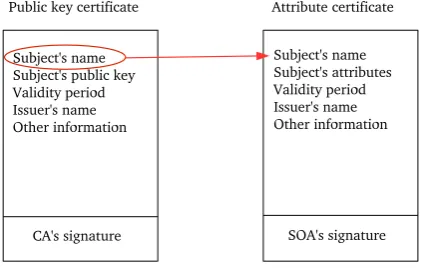
2.8 Public key certicate and attribute certicate binding. . . 38
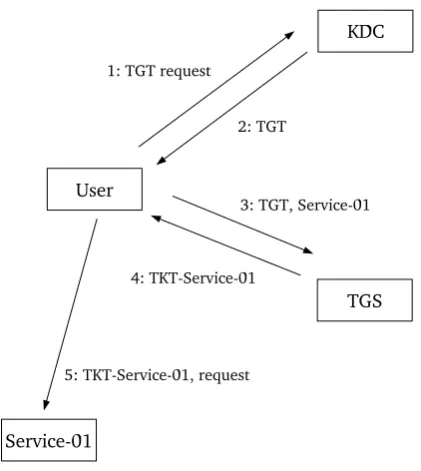
2.9 The Kerberos authentication protocol. . . 42
2.10 The KeyNote trust management system. . . 44
2.11 The Trust Establishment system. . . 47
2.12 The privilege verication subsystem of PERMIS. . . 49
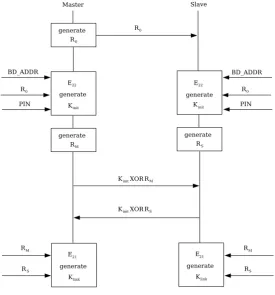
2.13 Bluetooth pairing process. . . 54
2.14 Bluetooth authentication process. . . 55
2.15 Bluetooth explicit service authorization request. . . 56
2.16 Proxy-based security protocols. . . 60
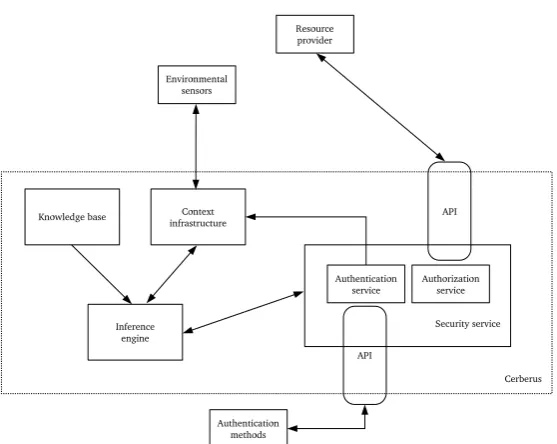
2.17 The Cerberus system. . . 64
3.1 Pervasive computing threat model. . . 74
3.2 Use of context categories and novelty of attack avenues. . . 75
3.4 Context consumption threats. . . 77
3.5 Unauthorized action threats. . . 78
3.6 Eavesdropping threats. . . 80
3.7 Service and device discovery threats. . . 80
3.8 Denial of service threats. . . 81
3.9 Stolen device threats. . . 82
3.10 Trac analysis threats. . . 84
3.11 Protocol bug threats. . . 85
3.12 Username/password and PIN threats. . . 86
3.13 Symmetric shared secret threats. . . 87
3.14 Certicate threats. . . 87
3.15 Anonymous Die-Hellman threats. . . 90
4.1 ÆTHER threat model. . . 93
4.2 Traditional vs. user-based authorization management. . . 95
4.3 The ÆTHER model. . . 99
4.4 Context-sensitive permissions. . . 101
4.5 Overview of the ÆTHER0 management model. . . 115
4.6 Binding of device B by alpha-pad A over a location-limited channel. . . 117
4.7 Mutual binding of alpha-pads A and B over a location-limited channel. . . . 118
4.8 Service discovery in ÆTHER0. . . 121
4.9 Normal device to its alpha-pad service access request protocol. . . 122
4.10 Normal device to normal device (same alpha-pad) protocol. . . 124
4.11 Normal device to normal device (dierent alpha-pad) protocol. . . 126
4.12 Access control decision owchart of the ÆTHER0 inference engine. . . 128
4.13 A dynamic Authority Attribute Set (AAS). . . 132
4.14 Binding of device B by device A over a location-limited channel in ÆTHER1.135 4.15 Attribute certicate acquisition protocol in ÆTHER1. . . 136
4.16 Eager service discovery and access protocol of ÆTHER1. . . 141
4.17 Lazy service discovery and access protocol of ÆTHER1. . . 143
5.1 The NTRG ad hoc networking stack. . . 157
5.2 The ÆTHER layer as part of the NTRG stack. . . 158
5.3 The ÆTHER layer and its components. . . 161
5.4 High-level example involving two ÆTHER1 layers. . . 165
5.5 ÆTHER0 mutual binding timing measurement. . . 166
5.6 Timing measurements for the ÆTHER0 access protocols. . . 168
5.7 Timing measurements for the ÆTHER0 inference engine. . . 169
5.8 Timing measurements for the ÆTHER1 binding process. . . 170
5.9 Timing measurements for the ÆTHER1 ACAP. . . 171
5.10 Timing measurements for the ÆTHER1 access protocol. . . 172
5.11 Impact of number of authority attributes on the ÆTHER1 inference engine. 174 5.12 Delegation depth example. . . 174
5.13 Impact of delegation depth on the ÆTHER1 inference engine. . . 176
5.14 A pervasive light switch implemented using a phidget. . . 180
5.15 WebÆTHER system components. . . 186
B.1 Timing measurements of cryptographic primitives on an iPAQ H6340. . . . 197
List of Tables
2.1 Example Access Control List (ACL). . . 32
2.2 PGP trust levels. . . 40
2.3 Bluetooth trust levels. . . 56
2.4 System classication according to requirements. . . 69
2.5 Service discovery system classication. . . 70
4.1 Comparison of ÆTHER0 and ÆTHER1. . . 154
5.1 Delegation depth and required number of verications for MTV 2. . . 175
5.2 Object code size for the ÆTHER components on the OMAP 1510 processor. 176 5.3 Storage space required for the ÆTHER policy language statements. . . 178
5.4 Authority and context attributes for a pervasive car. . . 184
Abstract
The technological developments of the last decade, particularly in the eld of mobile mi-croprocessor design, have enabled the integration of information processing capabilities in small everyday devices and appliances. This trend is leading the computing world to a paradigm shift; the computer is no longer a personal dedicated device used for specic operations, but it is woven into the surrounding environment providing its services in a transparent manner. The pervasive computing paradigm approaches computing from a human-centric, non-intrusive viewpoint. However, its extremely dynamic and open nature raises security and privacy concerns that need to be addressed in a coherent manner along with the development of the required infrastructure. Although the traditional security requirements remain the same, this new approach to computing has introduced additional challenges.
required administrative tasks. Existing security management approaches fail to capture the complete set of these requirements.
In this dissertation we propose ÆTHER, a novel authorization management framework designed specically to address trust establishment and access control in pervasive com-puting environments. ÆTHER directly extends the traditional RBAC model to support decentralized administration, disconnected operation and context-awareness. Furthermore, we use the well-dened concept of location-limited channels to specify an unobtrusive us-age model for the required administrative tasks. Based on this general framework we have instantiated two dierent systems. The rst one, ÆTHER0, has been designed to address
the authorization requirements of small pervasive environments which consist of particu-larly constrained devices. The second, ÆTHER1, addresses the authorization requirements
Chapter 1
Introduction
The pervasive computing paradigm predicts that in the near future we are going to be surrounded by countless wireless devices capable of providing services transparently. Com-puting devices are being embedded into everyday appliances and become part of our envi-ronment. Interactions with such devices must be integrated with the purpose a user aims to achieve in a natural, graceful way in order to feel ubiquitous. However, the open na-ture of such environments raises security concerns that need to be addressed in a coherent manner along with the development of the required underlying infrastructure. Although the traditional security requirements remain the same, this new approach to computing has introduced additional challenges.
The main problem in addressing the security requirements of pervasive computing en-vironments is the large number of ad hoc interactions among previously unknown entities1,
guration tasks. Contextual information perceived by the devices from the environment should be employed in order to enable such communication needs.
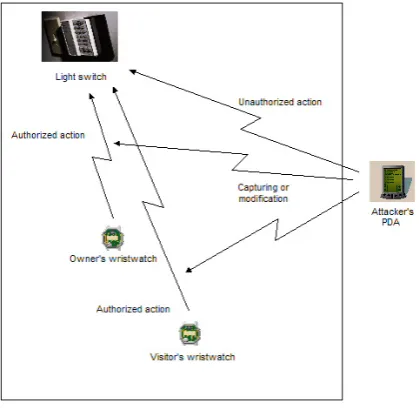
[image:18.595.208.418.375.579.2]According to our vision the global pervasive computing infrastructure will be built in a non-hierarchical manner by connecting dierent autonomous domains via the existing mobile and xed communication networks. The security considerations associated with this vision must be addressed in parallel with the development of the architecture designs that are going to support its employment. Consider the following simple but typical scenario in a pervasive computing environment (illustrated in Fig. 1.1). The owner wishes to control a light switch through her wristwatch via a wireless transmission medium and also wants to allow a trusted visitor in the house to do the same. However, in both cases she wants to be sure that a malicious party who walks outside the house will not be able to control the light switch and capture or modify any of the above wireless transmissions. Additionally, the necessary administrative actions should be kept to an absolute minimum.
Figure 1.1: Typical insecure pervasive computing scenario.
In this dissertation we propose ÆTHER2, an authorization management framework
and global centralized trust registers cannot be assumed. The basis of our work is the Role-Based Access Control (RBAC) model [FK92], according to which entities are as-signed to roles and roles are associated with permissions. ÆTHER extends RBAC in order to support decentralized administration, disconnected operation and context-awareness. Furthermore, we use the well-dened concept of location-limited channels to specify an unobtrusive usage model for the required administrative tasks.
Based on this general framework we have instantiated two dierent systems:
1. ÆTHER0 has been designed to address the authorization needs of small pervasive
environments whose management requirements are simple. It utilizes only symmetric key cryptography in order to provide security services. Consequently, it is appropri-ate for devices that have particularly limited processing capabilities (such as simple sensors).
2. ÆTHER1 addresses the authorization requirements of large pervasive computing
do-mains that have multiple owners with complicated security relationships. It relies on asymmetric cryptography and therefore is more tting to domains that consist of devices that have sucient information processing capabilities.
1.1 Requirements
In order to specify and build an authorization management framework that is able to support pervasive computing, a number of requirements must be taken into consideration:
• Decentralized management. The dynamic nature and the great number of
partic-ipating devices in pervasive computing imply the need for frequent establishments of communication channels between entities that belong to dierent administrative domains. Centralized architectures are not able to support the autonomous non-hierarchical building of a secure pervasive computing infrastructure. Furthermore, external centralized entities constitute a single point of attack/failure and it is not realistic to assume that they can be universally trusted.
• Disconnected operation. This requirement is closely related to the previous one.
establishment of secure relationships between devices that are not able, due to phys-ical location, network partitions, or other reasons, to connect to a third party for mutually authenticating and authorizing each other.
• Unobtrusiveness. Human intervention for the required administrative tasks should
be naturally and gracefully integrated with the physical workow of users in order to facilitate the unobtrusive nature of pervasive computing.
• Context-awareness. The use of contextual information such as physical location,
activity and others, should be utilized to allow the dynamic adaptation of the man-agement framework to a variety of situations and applications. Moreover, context-awareness minimizes human intervention and user distractions for conguration pur-poses alleviating unobtrusiveness.
1.2 Summary of Goals
Our goals for the work presented in this dissertation are summarized below:
• The identication and analysis of the requirements of authorization management in
pervasive computing. Furthermore, the examination of existing security models and systems with regard to the previously identied requirements.
• The denition of a pervasive computing threat model that will allow us to identify
the specic attacks and avenues of attack that we will try to oer protection against.
• The development of an authorization management framework for pervasive
comput-ing based on the identied requirements and the formulated threat model.
• The demonstration of the developed system's feasibility through a real-world
imple-mentation and evaluation.
1.3 Key Contributions
can identify our signicant contributions within this scope in the following ve areas:
1. The theoretical ÆTHER framework that extends the traditional RBAC model to in-clude support for decentralized management, disconnected operation, context-awareness and unobtrusive administration.
2. Our extensions to the concept of location-limited channels to use them as part of users' physical actions to state their intent regarding authorization while being in-tegrated gracefully with the primary task, thus achieving unobtrusive security man-agement.
3. Our enhancements to the KeyNote trust management system to allow its use in realizing both the traditional RBAC authorization model and our extensions to it. Specically, we have modied KeyNote's policy language, and extended its inference engine to include support for dynamic attribute authorization decisions, dynamic values for the utilized attributes, and integer delegation control.
4. The ÆTHER0management model that relies exclusively on symmetric cryptography
to instantiate our general framework.
5. The ÆTHER1 instantiation and its novel RBAC delegation model based on the
concept of dynamic Authority Attribute Sets (AASs).
1.4 Dissertation Outline
The rest of this dissertation is structured as follows: This chapter briey introduces the pervasive computing paradigm and the associated security challenges. It also summarizes the requirements for a pervasive computing authorization management architecture and presents our goals for the rest of the work.
been published in the literature. The related open research problems are identied by presenting a thorough classication of the examined projects.
Chapter 3 presents a comprehensive threat model for pervasive computing. A threat model is required in order to clearly dene attack avenues, specic attacks and the related assumptions. This analysis helps us to gain a better understanding of a pervasive comput-ing environment from the attacker's viewpoint and directly leads to the formulation of a security model.
Chapter 4 introduces a novel authorization management framework that has been de-signed to address the requirements of pervasive computing environments. The general framework is then instantiated into two distinct systems that address the security and the user demands of dierent pervasive authority domains. Moreover, usability and maintain-ability aspects are analyzed focusing on the needs of the end users. The chapter ends by oering a detailed comparison of the two instantiations and an examination of which one is applicable to which pervasive computing scenario.
Chapter 5 presents the implementation of two prototypes for the two instantiations of the ÆTHER framework and examines their feasibility using modern handheld devices as the development hardware platform. Furthermore, the chapter demonstrates that both implemented solutions perform more than adequately well without introducing signicant computation overhead or user distractions.
The nal chapter discusses the conclusions of the work presented in the dissertation and summarizes the contributions. Finally, it identies areas that future research on the subject should focus on.
1.5 Publication Record
Towards the completion of the work presented in this dissertation we have published subsets of the produced research in refereed international journals, conferences and workshops:
• Patroklos Argyroudis and Donal O'Mahony, Secure Routing for Mobile Ad hoc
• Patroklos Argyroudis and Donal O'Mahony, Towards Flexible Authorization
Man-agement, In Proceedings of 10th IEEE International Symposium on Computers and Communications (ISCC'05), IEEE Press, pp 421-426, 2005.
• Ioanna Stamouli, Patroklos Argyroudis and Hitesh Tewari, Real-time Intrusion
De-tection for Ad hoc Networks, In Proceedings of 6th IEEE International Symposium on a World of Wireless, Mobile and Multimedia Networks (WOWMOM'05), IEEE Press, pp 374-380, 2005.
• Patroklos Argyroudis and Donal O'Mahony, Towards a Context-aware Framework
for Pervasive Computing Authorization Management, 3rd UK-UbiNet Workshop: Designing, Evaluating and using Ubiquitous Computing Systems, 2004.
• Jean-Marc Seigneur, Patroklos Argyroudis, David O'Callaghan and Joerg
Aben-droth, The REL Project: Mobile-based Reliable Relations, 1st Workshop on Friend of a Friend, Social Networking and the Semantic Web, 2004.
• Patroklos Argyroudis, Raja Verma, Hitesh Tewari and Donal O'Mahony,
Perfor-mance Analysis of Cryptographic Protocols on Handheld Devices, In Proceedings of 3rd IEEE International Symposium on Network Computing and Applications (NCA'04), IEEE Press, pp 169-174, 2004.
• Patroklos Argyroudis and Donal O'Mahony, Securing Communications in the Smart
Home, In Proceedings of 2004 International Conference on Embedded and Ubiquitous Computing (EUC'04), LNCS 3207, Springer-Verlag, pp 891-902, 2004.
• Patroklos Argyroudis and Donal O'Mahony, ÆTHER: an Authorization
Manage-ment Architecture for Ubiquitous Computing, In Proceedings of 1st European PKI Workshop: Research and Applications (EuroPKI'04), LNCS 3093, Springer-Verlag, pp 246-259, 2004.
We have also contributed to the following Computer Science Department Technical Report:
• Jean-Marc Seigneur, Anselm Lambert, Patroklos Argyroudis and Christian D. Jensen,
Chapter 2
Background and Related Work
The main goal of this chapter is to survey the existing research work in the area of pervasive computing authorization systems, identify their strengths and shortcomings, and consider whether they satisfy the requirements of the human-centered computing paradigm. Con-sequently, we rst analyze the properties of pervasive computing in general and the related enabling technologies, such as context-awareness and service discovery. To gain a more clear understanding of our target area, we also examine several existing ubiquitous com-puting systems and identify possible security threats associated with the functionalities they oer. We then oer a brief overview of computer security and its conventional goals that are relevant to our research area, as well as traditional computer security systems and the reasons they fail to address pervasive computing requirements. The main focus of the chapter is the survey of pervasive computing security systems that have been published in the literature. The chapter ends with a thorough classication of the examined projects and an identication of the related open research problems.
2.1 Pervasive Computing
generic operations, but it is woven into the surrounding environment providing its services in a transparent and unobtrusive manner. The ubiquitous, or pervasive (as it has been known since the mid-1990s) computing paradigm envisioned by Mark Weiser [Wei91] ap-proaches computing from a human-centric, non-intrusive viewpoint: The most profound technologies are those that disappear. They weave themselves into the fabric of everyday life until they are indistinguishable from it. According to Weiser's vision, future com-puting environments would be composed of cheap and disposable devices interconnected via wireless media. These devices would either be embedded into the environment itself or worn by people. As it is clearly obvious, this part of Weiser's vision is already a real-ity. Embedded computing has indeed become pervasive. In our homes we have countless devices that use microprocessors for management and controlling functions. Furthermore, the number of information processing devices that we carry with us is also increasing. Sophisticated mobile phones, MP3 players and PDAs are quickly becoming a necessity for supporting modern human activities. Even the interconnection requirement is a reality. Wireless technologies such as IEEE 802.11 and Bluetooth enable the interconnection of our mobile phones with headphones and our PDAs with nearby printers.
However, the main characteristic of Weiser's vision that concerns the usage model of ubiquitous computing systems has yet to be engineered. Future computing environments will not be comprised of traditional dedicated computers, but rather of everyday devices and appliances with information processing and communication capabilities. Users will operate these devices according to usage models that integrate naturally with the actions they perform in order to complete their objectives. Thus, computing will become ubiqui-tous as it will support the activities of the users without being a distraction. The design of such computing usage models, often called calm computing [WB96], will allow a user to change her focus from the system to another activity in a uid and natural way. Accord-ing to previous research eorts [PRM99], [SAW94], [KF02], in order to allow ubiquitous computing systems to be unobtrusive to the user and adaptive to his ongoing activities the ability to sense, collect and process context is fundamental.
1. Extremely open and dynamic nature. Pervasive computing environments are com-prised of countless devices that are able to process information, interconnect with others, oer and consume services. These devices are not bound to a specic physical area; people carry them around as they roam among administrative domains. This suggests large number of interactions among unknown entities, that is entities that do not belong to the same administrative domain and have not communicated before, or have done so but the state of their relationship has not been maintained. Two related important requirements of computing systems designed for open and dynamic envi-ronments are disconnection and decentralization. Connectivity between devices in pervasive computing must be established without the need to contact online central servers for conguration, security or other reasons.
2. Graceful and unobtrusive usage models. The interaction interfaces of the devices specically, and more generally the usage models of pervasive computing systems, should be integrated naturally with the goals the users are trying to achieve in order to minimize human distraction and make ubiquitous computing feel ubiquitous.
3. Context-awareness. Pervasive computing systems and applications should be able to discover and utilize contextual information (like user location, current activity, and time of day). This will allow them to dynamically adapt to usage scenarios and sup-port the users' information processing requirements without becoming a distraction.
These properties in essence lead to human-centered computing. Instead of having the user interact with a dedicated machine and focus all his attention on it, handheld or embedded devices will perform the user's requests, and more importantly the user's will, without requiring constant concentration and extensive manual tasks.
is constantly increasing enabling pervasive computing programmers and system designers to worry less and less about cache sizes and storage requirements.
Another critical goal, but not necessarily a key property, of pervasive computing is pro-grammability. Integrated smart spaces should allow application programmers to perceive them as space-specic software libraries to be used from a high-level language [Hel05]. The devices, sensors and actuators of the smart space should be represented as services that can easily be accessed and used by developers. In this service-oriented view of pervasive computing every available information gathering or processing resource could be composed with every other, with which is compatible, enabling rapid prototype development. Thus, a pervasive computing developer could create applications that for example adjust the light level of the room when the TV is on by composing the access interfaces of the room-light sensor service, a window-blind sensor service and the TV [Hel05]. Service discovery frame-works can facilitate the standardization of access interfaces as well as of the protocols for the location of these services in dynamic environments.
2.2 Context and Context-awareness
As we have seen in the previous section, the ability to discover and adapt to contextual information is one of the key properties of ubiquitous computing systems. For humans, context recognition and adaptation is a natural process that happens frequently during daily activities. When we want to divulge a secret to a trusted colleague we are careful to note the people in our vicinity and lower our voice. However, in computer science the term context is usually vague and overloaded with many dierent meanings. For the purpose of this thesis we will ignore context as dened in other areas of computer science, and focus only on context that is or can be utilized by ubiquitous computing systems.
There have been many attempts in the literature to give a formal denition of context. Instead of trying to include them all here, we will focus on the most representative ones. In [DA99] context is dened as:
inter-action between a user and an application, including the user and applications themselves.
Chen and Kotz give the following denition [CK00]:
Context is the set of environmental states and settings that either determines an application's behavior or in which an application event occurs and is inter-esting to the user.
As it is obvious from the given denitions, context is dicult to be dened generally since it is highly relevant to the situation and system use case under investigation. In order to give a denition of context that is more appropriate and useful for systems development, Adelstein et al. [AGRS05] based on work by Schilit [SAW94] and Chen [CK00], divide context into two categories. The enumeration-based category denes context by employing ve categories, as follows:
1. Computing context, which includes information regarding network connectivity, com-munication costs, available bandwidth, and nearby accessible resources such as print-ers, le servers and others.
2. User context, such as proles with user dened settings, current location, and other users within the vicinity of the user.
3. Physical context includes level of lighting and noise at the current location, temper-ature, etc.
4. Temporal context, such as time of day, week, month, season of the year.
5. Context history, which are the data collected across a time span according to the above four context categories.
enhancing her understanding of the environment, it is not used for application adaptation [AGRS05]. The enumeration and role based categories are clearly not mutually exclusive; Room temperature, being a physical context, can be used by an application as active context in order to adapt the settings of an air conditioner.
Another important aspect of context is its ability to be aggregated in order to form more complete representations and understanding of the current user environment. Low-level contexts provided directly by sensors, such as location, time, temperature, and others, can be aggregated into other higher-level sources of contextual data. For example, by aggre-gating a user's current time and location, along with her calendar, a pervasive computing application can derive the user's current activity, like attending a meeting, or sitting in class [CK00]. Service-orientation, as explained in the previous section, can facilitate con-text aggregation by composing the state of several sensors available in a smart space.
Context denitions are useful for knowing what types and categories of contexts are available to pervasive computing applications. However, the problem of eectively utilizing these to respond to changes in the user's environment to enhance her understanding or to minimize conguration tasks still presents challenging research questions. Context-awareness includes the following four capabilities according to Pascoe [Pas98]:
1. Contextual sensing, which is the capability of detecting environmental states and settings. This also includes the way that this information is presented to the user.
2. Contextual adaptation, the capability of an application or system to dynamically adapt its behavior according to sensed context.
3. Contextual resource discovery, refers to the discovery of available and accessible re-sources that can be used by the application in order to facilitate better adaptation to the user's needs.
4. Contextual augmentation, which is the capability of associating digital data with a user's current context.
adaptation of the application's behavior according to sensed context data, and presentation of the context data to the user (or storing for later retrieval). Thus, context-awareness can be divided into the following two categories:
1. Active context-awareness, according to which an application dynamically adapts to sensed context and changes its behavior.
2. Passive context-awareness, in which an application stores or presents sensed context information to the user.
In pervasive computing active context-awareness can be used to develop adaptive appli-cations. The optimum goal is to minimize the need of extensive manual conguration tasks and naturally integrate the ones that are required to the physical world actions the users perform to achieve their objectives. In our developed architecture we only focus on active context-awareness, as it can be directly used to develop adaptive security policies and minimize the need for reconguration.
2.3 Service Discovery
As a result, service discovery is an enabling technology for pervasive computing. For example, the lights of a room may be automatically turned o as the user leaves the room and storage space on a le server can be requested when a PDA cannot accommodate its user's needs. Service discovery frameworks, such as Jini [ASW+99], Universal Plug
and Play (UPnP) [UPn03], and the Service Location Protocol (SLP) [GPVD99], aim to standardize software interfaces and protocols for service discovery creating interoperability and making their implementation straightforward. When a device has support for service discovery it usually means that it is able to support a subset of the following capabilities:
• Standardization of service denitions. In order for a provided service to be discovered
and used dynamically it must be dened according to a universally agreed way. A service denition includes attributes or textual messages that describe what exactly is provided, the access interface and the operations it supports, the utilized protocols, as well as other related information.
• Search and location protocols. A service discovery framework must provide the
abil-ity to locate required services on demand. This is usually done by allowing users to specify in textual descriptions what are they looking for. User input may be com-pletely free-form, such as color printer, or structured in attribute name-value pairs, for example device:printer, capability:color.
• Advertisement of services. The capability of service advertising allows the dynamic
in pervasive computing implement a more dynamic model according to which avail-able information may be inserted or deleted from the network with no or minimal intervention by regular users without special authority over the system.
• Service registration. As mentioned above, when a service advertisement is generated
it can either be broadcasted into the network where it can reach possible service con-sumers directly, or it can be sent to a dedicated precongured device that catalogs all available services. In the latter case, clients locate required services by querying the catalogs instead of broadcasting queries in the network. Although service cata-logs require precongured infrastructure, they oer certain advantages to a pure ad hoc service discovery approach. For example, the overhead of broadcast trac in the network is signicantly reduced. Also, the synchronization of service availability among dierent networks is greatly simplied by just processing the catalog of the dedicated device responsible for each network. However, the need for conguration and maintenance of the service cataloging devices introduces an additional adminis-tration burden to a user. Therefore in pervasive computing environments where the minimization of human intervention is fundamental, ad hoc approaches to service advertisement and location are preferred.
Since service discovery in pervasive computing is inherently dynamic and free of globally accessible registries that are always online and reachable, the provided services must adhere to certain properties. These properties are used to enable the identication, location and standardization of services in such volatile environments.
UUIDs is not a feasible design choice. Although Media Access Control (MAC) addresses have been suggested as a basis for self-generated UUIDs, their use may lead to security problems [GWF+99]. One way to generate UUIDs without relying on any kind of global
infrastructure has been proposed as part of the Jini framework [ASW+99].
Service standardization is another important property of service discovery systems. When a service consumer wishes to locate a certain service, she must be able to dene in an unambiguous way either the name or the attributes of the required service. More importantly, when the service is located the requester must be able to access its func-tionality. In order for these problems to be addressed in the context of the inherently heterogeneous pervasive computing paradigm, service descriptions and programming in-terfaces have to be standardized. There are currently two approaches for standardizing provided services. The rst one uses textual descriptions and the second one interfaces1 of
a programming language. Textual service descriptions have to be structured according to a clear and well-dened language in order to facilitate ecient and precise discovery. As an example, UPnP uses the eXtensible Markup Language (XML) which creates structured descriptions, is easily parsed and, as a pure text language, is platform independent. The other approach, adopted by Jini, is to standardize a service with a programming interface that service instances implement. The interface is used to dene the high-level protocol that a service consumer can use to access the functionality of the service. This method provides the advantage of shielding underlying implementation details and choices, making possible future changes transparent.
2.4 Pervasive Computing Systems
In the previous sections we have analyzed some of the fundamental properties of pervasive computing along with the technologies that enable its deployment. In order to gain a better understanding of this new computing paradigm and the requirements of its intended target users, this section will focus on presenting practical implementations. Our goal is to present the most representative existing systems, and not to do an exhaustive survey of every pervasive computing project. This analysis is also helpful to infer the associated
security implications that will form the foundation of the detailed threat model presented in the next chapter.
2.4.1 Oxygen
The goal of the Oxygen project is to provide a complete pervasive human-centered com-puting environment. As its name suggests, computation is to be available everywhere around the user responding to natural language commands instead of requiring manual interaction. Hence, Oxygen's two general research areas are speech and vision recognition, for enabling users to communicate with the system as if interacting with another human being, and automation and collaboration technologies to perform the required computation tasks [MIT05]. A general overview of the Oxygen project can also be found in [Der99].
In more detail, the technologies involved in the Oxygen project can be divided into the following ve categories:
1. Device technologies. There are two kinds of devices in the Oxygen vision, embedded devices named E21s, and handheld devices, named H21s. E21s are considered to be powerful computation devices playing the role of servers in a smart space. They directly interface typical household appliances, such as air conditioners, TVs, and lighting switches, and expose them to the user through natural language recognition and gesture capturing without oering any specic physical interaction interfaces. H21s are PDAs, universal remote control devices, cellphones and other similar devices that oer mobile access points for users both in and out of the smart space controlled by E21s [MIT05]. H21s can conserve power and computation resources by ooading operations onto nearly located E21s.
2. Network technologies. Networks, which are referred to as N21s by Oxygen, are responsible to create dynamic connections between the mobile and stationary devices of a smart space in order to enable the engineering of collaboration protocols. N21s oer naming, location and service discovery mechanisms.
user creates a new prole as he interacts with the applications of the environment. Applications remain anonymous between user sessions.
4. Perceptual technologies. The main modes of interaction between users and appli-cations in Oxygen are speech and vision instead of keyboards and mice. Speech recognition is enhanced by visual identication of facial expressions, lip movement, and gaze.
5. User technologies. These include automation, collaboration, and knowledge access control. Automation allows users to create scripts and control devices according to their needs. Collaboration is used to accommodate mobility and form links between data collected from the environment and user input. Finally, knowledge access en-ables users to create their own knowledge bases, customize information access and create semantic connections between data that are meaningful to them.
An important project of Oxygen is the Cricket location-support system [PCB00]. Cricket utilizes radio and ultrasonic signals in order to measure distance and from that to deter-mine location. It allows mobile or static applications to learn their physical location by listening to and analyze information from beacons installed throughout a building. In-stead of explicitly tracking user location, Cricket allows devices to learn where they are in a building and leaves the decision of where to advertise this information to the user. This design approach allows a device to know its location, while everybody else including the beaconing system does not.
Example applications developed as part of Oxygen include an answering machine that is able to dierentiate between calls based on the contents of incoming messages and forward the urgent ones to the handheld the user is currently using. Also, applications that are able to recognize and answer questions such as Where did I put my glasses? since cameras are employed to record and locate physical objects.
2.4.2 EasyLiving
to develop an integrated system architecture for supporting a coherent experience for the users as they interact with the handheld or embedded devices that exist in a smart space [BMK+00]. The devices of the environment are divided into input and output devices.
The rst part of the architecture consists of software components that encapsulate and represent these devices. Another part of the architecture is the lookup service which registers and catalogs all the software components and exposes their provided services to other components and to applications. In order to support communication between the components, EasyLiving employs a distributed middleware which uses asynchronous messages. XML is used to encode these messages and achieve interoperability between heterogeneous hardware platforms.
Another important element of the EasyLiving architecture is its physical geometry modelling component. By achieving an as accurate as possible model of the smart space, the system allows the physical relationships that exist between users, devices and the environment itself to be used in developing location-aware applications. At this point we must note that EasyLiving provides no other support for storing, interpreting or using any other kind of context2. Some example applications of the EasyLiving project include
teleporting of active applications between displays of the environment to follow the user as she moves and universal remote controls that locate and provide access to services that are within the vicinity of users.
2.4.3 Cooltown
data and provided services. The two main advantages of Cooltown are its usage model and its adoption of WWW standardized protocols. As a user moves through the space she simply points her PDA to a device she wants to access or wants to learn more about its contextual state. The device's URL is scanned by the PDA and the corresponding WWW page is requested, parsed and presented on the PDA's display to the user. By adopting the web model Cooltown manages to be simple, robust and scalable. The WWW is one of the most well-researched application areas of internetworking, therefore many existing technologies, like web services, can be directly used. Referring back to our discussion on context-awareness, Cooltown follows the passive context-aware computing paradigm. Al-though each device collects context information about itself, this is only presented to an interested user after a query. It is not used for dynamic behavior adaptation, recongura-tion, or automatic task execution.
Example application scenarios of Cooltown include users that visit new environments and by capturing the space's URL on their PDAs learn of all the services oered. Also, a speaker that wishes to make a presentation to a conference receives the projector's URL with a PDA, visits the corresponding page that implements the projector service's access interface and uploads his presentation les. The projector can then be controlled through the PDA via the web-based exposed user interface [Sta02].
2.4.4 Active Systems
paradigm. Practical applications of sentient computing include the Active Badge, Active Floor, and Active Bat systems, referred to collectively here as active systems. These, as well as some of their applications, are presented briey in the following paragraphs.
Active Badge is an indoors location system with a spatial resolution of room scale. A building is equipped with xed infrared sensors, one in each room. Every person in the building wears a device, like a badge hence the name of the system, which has an infrared transmitter that periodically beacons the device's identier. Since infrared signals are not able to penetrate walls, a room's sensor is able to receive the beaconed message and register the person that corresponds to the received identier as being in the same room as itself. This basically means that sensors are congured at installation time with a string that identies their location, i.e. room number, in the building. All the sensors of a building report the identiers they receive to a central system server which then is able to know where individual badges are. The Active Badge system has been used in many applications, both of social, like locating colleagues, and technical nature. Examples of the latter include the Call Forwarding [WHFG92] and the Teleporting [BRH94] systems. Call Forwarding uses Active Badge in order to nd the location of the recipient of an incoming telephone call, then with a help of a Private Branch eXchange (PBX) system it forwards the call to the destination user's nearest phone. One of the limitations of the Call Forwarding system was that users wanted more control over when calls are forwarded to them based on their context. For example, unexpected calls were not welcome during a meeting [CK00]. The Teleporting system tracks the location of users as they move in the building and maps the user interfaces of the active applications on a user's home machine onto his nearby computer facilities.
system cannot be reliably used as a location system.
Active Bat is the location tracking system that replaced Active Badge. In order to achieve higher position granularity than the room, Active Bat uses ultrasonic signals in-stead of infrared beaconing. Active Bat receivers are placed at known locations in the building and transmitters are attached to objects or people. As with the badges, Active Bat transmitters have a unique identier that they transmit with an ultrasonic pulse. The pulses are picked up by the receivers in the environment and by measuring dierent ight times depending on their relative location to the transmitter, the location of the transmit-ter is calculated with respect to the known positions of the receivers [WJH97]. This way the Active Bat system achieves an accuracy of about 3 centimeters. In order for this low-level context information to be utilized, a spatial indexing middleware has been developed that allows the generation and dissemination of events [SWH98]. Application developers are able to dene the spatial events in which they are interested in and receive notications when they happen. Thus, the Active Bat middleware supports the development of active context-aware computing applications. The higher resolution location information that the system provides can be used for creating new usage interaction patterns in pervasive computing, for example a user can activate a certain functionality simply by pointing his transmitter to specic place in the smart space [Sta02]. Researchers at AT&T Laboratories Cambridge have used this to create virtual buttons; an application developer is able to register a region in the smart space and associate it with a specic action. A user can then use her transmitter to select this region as if using a mouse in a three-dimensional environment and activate the related functionality. Another application is the recording of which user is using which devices. By placing transmitters on objects as well as on users, the system knows which user was using which object at a specic time.
2.5 Computer Security Foundations
used. We then concentrate on the traditional requirements of computer security that are relevant to our work, namely identication, authentication, and authorization3. Although
the other three conventional requirements of computer security (condentiality, integrity, availability) need to be addressed as well in a complete security solution, we do not focus our main eorts on them. The reason for this is that if the problems of authentication and authorization have been addressed and some key material have been established between two communicating parties, the protection of the condentiality and the integrity of the channel with strong secret key cryptography is a trivial problem nowadays. On the other hand we consider availability, which concerns itself with the problem of enabling systems to perform their advertised services in a timely manner, outside the scope of our research area. Availability is a complex requirement which aims to address denial of service attacks from users that have already been authorized to access a service [Gli84], while our focus is on the process of authorization itself.
2.5.1 Secret Key Cryptography
Secret key cryptography allows two parties that wish to communicate with each other (we call them Alice and Bob according to cryptographic tradition4) to do so without the fear of
someone that is eavesdropping (Eve) on the communication channel learning the contents of the exchanged messages. In order for Alice and Bob to protect their messages they must have agreed beforehand on a quantity, called a secret key and denoted byS, known only to
the two of them. The agreement on the secret key must take place over a channel that is guaranteed to be condential as well as authenticated. After the establishment of the key
S, Alice can encrypt a message M to Bob with it. The encryption operation is denoted as
C=ESAB(M), where SAB is the secret key shared by Alice and Bob,E is the encryption
function, M is the message (also called plaintext), and C is the result of the operation
(also called ciphertext). Alice transmits C to Bob over the unprotected communication
channel. Bob decryptsC using a decryption function (which must be based on the same
3In this dissertation we treat the terms authorization and access control as synonymous.
algorithm asE) and the shared key; the decryption is denoted by M = DSAB(C). Eve,
who does not know the secret key shared by Alice and Bob (SAB), is not able to decrypt
C (see Fig. 2.1).
Figure 2.1: Secret key cryptography.
Secret key cryptography algorithms are also known as symmetric key algorithms. A lot of them have been proposed in the literature. The American National Institute of Stan-dards and Technology (NIST) has selected Rijndael [DR02] as the Advanced Encryption Standard (AES) in 2000.
2.5.2 Public Key Cryptography
The main problems with secret key cryptography are key distribution and management. As we have seen, the parties that need to communicate have to have exchanged, in the past, a secret key. However, this cannot take place over the channel they use for their normal com-munications as this is unprotected and an eavesdropper is able to learn any key material exchanged over it. Therefore, they need another channel that is secure for key distribu-tion. Furthermore, symmetric schemes suer from complex management procedures and increased storage requirements for the shared keys as the number of participants grows. Specically, in a network ofnnodes the total number of dierent symmetric keys needs to
be at least n(n−1)
2 , assuming that each pair of nodes shares a common key. One of the most
Rivest, Shamir and Adleman soon afterwards developed the RSA scheme [RSA78] which was the rst full implementation of a public key system.
Public key cryptosystems rely on two dierent keys for each entity, known as the key pair. An entityA (possibly Alice) generates a key pair according to a specic algorithm,
and the result consists of the public keyKA and the private key KA−1. A then publishes
the public key and keeps the private one secret. WhenB (for example Bob) wants to sent
a message to A he has to nd KA and then use it along with the encryption algorithm
E to encrypt a message M; we denote the encryption operation by C = EKA(M). The
resulting ciphertextC is then sent to Awho uses her private keyKA−1 and the decryption
algorithmDto decrypt it and getM, the decryption process is denoted byM =DK−1 A (C),
see Fig. 2.2.
Figure 2.2: Public key cryptography.
Obviously, in public key cryptosystems, also known as asymmetric key cryptosystems, it should not be possible to calculate the private key from the corresponding public key. An-other property that has to be satised is that for all possible messagesM the following has
to hold: DK−1
A (EKA(M)) = M. The main advantages of asymmetric cryptosystems over
2.5.2.1 Digital Signatures
Digital signatures are constructs of public key cryptosystems that provide non-repudiation. When Alice sends a message to Bob she uses her private key to sign it (we denote a signed message M with Alice's private key KA−1 as [M]K−1
A ). Bob, or any other party
that knows Alice's public key KA, is able to verify the message and be sure that it has
been signed with Alice's private key and that it has not been modied in transit. In order to avoid creating digital signatures on arbitrarily large messages, a process which is particularly computationally expensive, it is common practice to pass the message as input to a cryptographic one-way hash function and sign the output message digest.
2.5.2.2 Public Key Certicates
which in turn certify user keys.
Revocation of public key certicates is required when the information contained in a certicate is no longer valid, possibly because of key material compromise, even though the expiration period has not elapsed. There have been several proposals in the literature to address the problem of revocation, like Certicate Revocation Lists (CRLs) [AF99], delta CRLs [HFPS99], the Online Certicate Status Protocol (OCSP) [MAM+99], short term
certicates [Riv98] and windowed revocation [MJ98]. These methods provide dierent tradeos in terms of stored and transmitted information, window of vulnerability and online availability requirements. Consequently, there is no single method applicable to all scenarios; the design of a revocation mechanism should be driven by the application environment it is supposed to support [MR00].
Although we will thoroughly analyze PKI-based solutions to security management in following sections, it should be noted here that PKI does not solve all problems. For example, the requirement that a CA principal must be trusted by all system participants cannot always be satised in all application scenarios. Also, the introduction of a CA creates a single point of attack and failure in the system; if it gets compromised all secure communication channels can be compromised as well.
2.5.3 Identity and Authentication
authentication can be dened in terms of a principal and the identity it claims to have [For94]: authentication relates to a scenario where some party has presented a principal's identity and claims to be that principal. Therefore, we can view an identity as the name of a principal that is presented during a security process in the system, and the corresponding principal can prove that it legitimately holds it through the process of authentication.
2.5.4 Authorization
Lampson [Lam74] denes authorization as the process according to which a reference mon-itor determines whether a principal is allowed to perform a certain action it requests on a resource. Authentication is performed before authorization in order to verify that the requesting principal legitimately holds the identity it claims to have when it requests ac-cess to a resource. Moreover, the proac-cess of authorization depends on an authorization (or access control) policy which refers to the access rules enforced by the reference moni-tor. Based on the above, we can divide the process of authorization as performed by the reference monitor into the following three steps (summarized in Fig. 2.3):
Figure 2.3: Authorization model.
1. Determine the identity of the principal that makes an access request.
2. Authenticate the identity of the requesting principal.
The traditional method for dening access control policies is Access Control Lists (ACLs). They are used by the reference monitor to determine the appropriate access rights to a given resource given certain aspects of the requester, principally its identity. An ACL is usually implemented as a table containing entries that specify the rights a principal has over specic system resources.
2.6 Computer Security Systems and Models
This section presents traditional computer security systems that address the problems of authentication and authorization in networking environments. Our examination focuses on their basic characteristics and the reasons they fail to satisfy the requirements of autho-rization in pervasive computing. Although we examine these systems with regard to the previously identied requirements, we do not expect them to fully satisfy all the pervasive computing requirements since they were not designed for such a purpose.
2.6.1 Role-Based Access Control
The Role-Based Access Control (RBAC) model [FK92] provides the ability to specify and enforce domain-specic access control policies and simplies the process of authorization management in computing environments with a great number of users. This is achieved by associating roles with access permissions and users with roles. In essence, RBAC denes all access rights through roles. A role is an entity that acts as a collection of permissions. Users are assigned to roles, usually by an administrator on a central system, and receive access permissions only based on the roles they have been assigned to (illustrated in Fig. 2.4).
Ferraiolo and Kuhn, extending a large body of previous research work, proposed the rst generalized RBAC model which formally described the sets, relations and mappings required to dene roles [FK92]. They dened the terms user, subject, object, operation and permission as follows:
• A user is a human operator of a computer system.
• A computer process that acts on behalf of a user is called a subject.
• An object is a resource available on a computer system, for example a le, an entry
in a database, or a printer.
• An operation is dened as an active process invoked by a subject. It should be noted
that a subject and an operation are distinct entities; A user can invoke a subject which can then invoke operations itself.
• A permission is an authorization to perform some action on a computer system and
is dened as a combination of an operation and an object.
According to their model, RBAC requires the three following rules:
1. Role assignment. A subject can perform an operation only if it has been assigned to a role.
2. Role authorization. A role that a subject has been assigned to must be authorized for the particular subject. The rules of role assignment and role authorization ensure that a user can only have active roles she is authorized to have.
3. Operation authorization. An operation can be performed by a subject only if the specic operation is authorized for the subject's active role (or roles).
allow a user to assume the roles Treasurer and Payroll Ocer at dierent times but not both simultaneously.
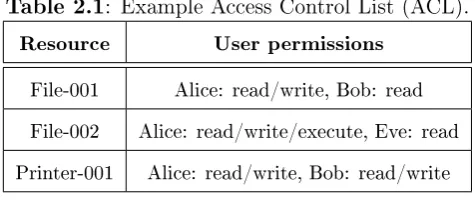
[image:48.595.194.432.486.586.2]The advantages of RBAC when compared to other access control mechanisms such as ACLs are obvious. An organization can dene a set of roles that can remain unmodied from that point on, and can dene volatile permissions for these roles according to the functions that need to be performed as part of its ongoing operation. Users are then assigned to roles receiving the related access permissions. These assignments do not have to be permanent, but they follow the organization's human resources management procedures. For example, if an employee's job changes then only two changes have to be performed; one to remove the association between the employee and the employee's current role, and one to add a new association between the employee and her new role. On the other hand in the ACL model all available computing resources have a list of the users that are authorized to access them (see Table 2.1). In environments with many users the process of enumerating each user's identier along with the permissions that this user has comes at a great administrative cost. This cost increases even more when the set of participating users changes frequently. As we have already seen, pervasive computing environments are inherently dynamic and therefore not compatible with the use of ACLs as a security mechanism.
Table 2.1: Example Access Control List (ACL).
Resource User permissions
File-001 Alice: read/write, Bob: read File-002 Alice: read/write/execute, Eve: read Printer-001 Alice: read/write, Bob: read/write
Sandhu et al. have extended the core Ferraiolo-Kuhn RBAC model to four dierent conceptual models [SCFY96]. RBAC0 is their base model, which is equivalent to the core
Ferraiolo-Kuhn model, and denes the minimum requirements for any system that aims to support RBAC. RBAC1 adds the concept of role hierarchies to RBAC0, which basically
allows roles to inherit permissions from other roles. RBAC2 adds constraints to RBAC0
Finally, RBAC3 includes the basic RBAC0 model as well as RBAC1 and RBAC2. The
core Ferraiolo-Kuhn RBAC model and the RBAC0 model are composed of the following
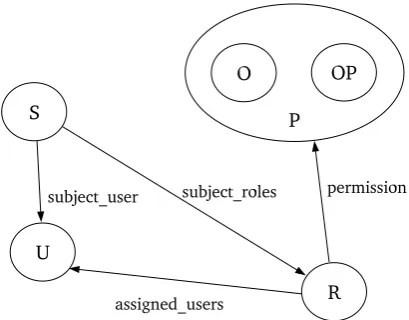
components (a graphical representation of which is shown in Fig. 2.5):
• A set of users: U • A set of roles: R • A set of subjects: S • A set of objects: O • A set of operations: OP
• A set of permissions: P =P(OP ×O)5
• User to role assignment: U A⊆U×R • Permission to role assignment: P A⊆P ×R
• The mapping of a role to a set of users: assigned_users(r :R) → P(U), or more
formally: assigned_users(r:R) ={u∈U |(u, r)∈U A}
• A function mapping a subject to the subject's associated user: subject_user(s :
S)→U
• A function mapping a subject to a set of roles: subject_roles(s : S) → P(R), or
more formally: subject_roles(s:S)⊆ {r∈R|(subject_user(s), r)∈U A}
• A function mapping a role to a set of permissions: permission:R→ P(P), or more
formally: permission(r:R) ={p∈P |(p, r)∈P A}
• Access authorization: A subject s can perform an operation op on object o only
if there exists a role r that is included in the subject's active role set and there
exists a permission p that is assigned to r such that the permission authorizes the
performance of op on o: access : S ×OP ×O → BOOLEAN, s : S, op : OP, o :
Figure 2.5: The core Ferraiolo-Kuhn RBAC model.
The model has a special kind of permissions, called administrative permissions, which allow the roles that have them to modify the sets U, R, and P as well as the relations
U A and P A. The term authorization management refers to the problem of managing
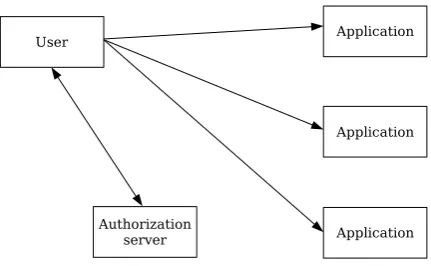
these administrative permissions and their assignment. Although there have been many solutions proposed in the literature to address this problem in RBAC systems, all of them rely on centralizing authorization information on a server that is always assumed to be online and readily accessible in order to provide the needed data. Furthermore, a human security administrator is required to manually congure the system and assign permissions to roles and roles to end users. This centralized management process is supported by two dierent methods that facilitate access to applications and services [FKC03]. According to the rst one, named push, a user is authenticated by the central authorization server and obtains some sort of credential to access applications. The user then presents (or pushes) these credentials to the applications as proof of authorization (illustrated in Fig. 2.6).
The second method, called pull, requires applications to perform user authentication and query the central authorization server about the user's permissions, pulling them for local access (shown in Fig. 2.7). Thus, the functions of authentication and authorization are performed by two dierent conceptual entities in the pull method; authentication is done by applications and authorization by the central server.
Figure 2.6: Push authorization method.
[image:51.595.190.443.501.617.2]ministrator must congure the required permissions, create associations between roles and these permissions, and nally assign roles to users. Although RBAC is far more exible in management and in detail of control when compared to other access control management mechanisms, such as Mandatory Access Control (MAC) and Discretionary Access Control (DAC), it still requires centralized management via an online server and direct human intervention, as proposed by the National Institute of Standards and Technology (NIST) RBAC specication [FSG+01]. According to MAC, access to resources is dened based on
the specic resource's sensitivity as it is dened by a central authority. Therefore, RBAC relates to MAC in the sense that end users have no control over the permissions dened by the security administrator and enforced by the central authorization server. On the other hand, DAC permits the granting and the revocation of permissions to be left to the discretion of the individual end users of a system. A user that controls certain resources is able to assign and revoke rights for them without the need to contact a central server, or be authorized to do so by an administrator. Consequently, the NIST proposed RBAC stan-dard is a non-discretionary access control model. Role assignment remains a centralized operation and requires the manual intervention from an administrative authority. This requirement as well as the requirement of having an always accessible online central server prohibit RBA