Thesis by
Andrew Rosenberg Chatto
In Partial Fulfillment of the Requirements
for the Degree of
Doctor of Philosophy
California Institute of Technology
Pasadena, California
2006
ii
c
2006
Andrew Rosenberg Chatto
Acknowledgements
There are a number of people I would like to thank for their contributions to this thesis. My advisor
David Goodstein was insightful, encouraging, and patient throughout the many challenges of
per-forming a low-temperature experiment. Our conversations were always helpful because David has
an extraordinary ability to make complicated concepts seem simple and intuitive. I had two mentors
in the lab, Peter Day and Richard Lee, who taught me everything I know about performing
exper-iments in low-temperature physics. My first lab experience was working with Peter. He provided
me with the cryostat I used throughout my graduate career, answered hundreds of questions, and
patiently showed me the techniques I needed. Richard returned to Caltech as my thesis experiment
was taking shape. He was also an excellent resource for the tricks and techniques of low-temperature
physics. (Plus, he made B.O.B.2, the electrical filtering system on this cryostat). However, what
helped me most was that he patientlyaskedhundreds of questions, which forced me to think through
all the details of my experiment. It is with his help that I avoided many pitfalls.
There are a number of other physicists who made significant contributions to this work.
Partic-ularly helpful were the members of the DYNAMX team from the University of New Mexico (Rob
Duncan, Dimitri Sergatskov, Alex Babkin, and Steve Boyd). They provided material help with the
cryo-valve system and the construction of the experimental cell. In addition, they provided a lot of
expertise on performing experiments on the SOC state of 4He. In particular, I would like to thank
Rob Duncan, who served as a secondary thesis advisor during a critical time in the experiment as
David Goodstein recovered from an injury. Also helpful were discussions with two theorists, Peter
Weichman and Rudolf Haussmann, who helped give meaning to my results.
I would like to thank my parents for many many years of encouragement and support, and not
asking me too often when I was going to get my degree.
I would also like to thank my wife Avital, who provided an enormous amount of support and,
through an intricate dance of prodding and patience, helped guide me through this endeavor. Lastly,
I thank my son Jacob, whose arrival helped destroy the illusion that maybe, just maybe, I could be
iv
Abstract
When a heat flux is applied downwards through a sample of4He near the superfluid transition
tem-peratureTλ, the gradient in the temperature self-organizes to the gradient inTλcaused by gravity.
This creates the Self-Organized Critical (SOC) state. Previous experiments have observed the state,
measured the self-organization temperatureTSOC vs. heat flux, and investigated a remarkable wave
that only travels upwards against the flow of the heat flux [1, 2, 3].
We report the first results of the heat capacity of the SOC state,C∇T, for heat fluxes 60nW/cm2<
Q <13µW/cm2and corresponding temperatures 9 nK> T
SOC−Tλ>−1.1µK. We find thatC∇T
tracks the static (i.e., zero heat flux) unrounded (i.e., in zero gravity) heat capacity C0 with two
exceptions. The first is that within 250 nK ofTλ,C∇T is depressed relative toC0 and the maximum
inC∇T is shifted to 50 nK belowTλ. The second difference is that at high heat flux,C∇T is again
depressed relative toC0with the departure starting at about 650 nK belowTλ.
We present the most extensive measurements of the speed and attenuation of the SOC wave to
date. We report wave speed measurements taken over our full experimental range 30 nW/cm2 <
Q <13µW/cm2and attenuation results over the limited range that produced enough attenuation
Contents
Acknowledgements iii
Abstract iv
Table of Contents v
List of Tables vii
List of Figures viii
1 Introduction 1
1.1 The SOC State . . . 1
1.2 The SOC Heat Capacity . . . 3
1.3 The SOC State Wave . . . 5
1.4 Summary . . . 8
2 Apparatus 9 2.1 Cryogenic System . . . 9
2.2 Thermometry . . . 11
2.3 Auxiliary Stages . . . 11
2.4 Cell Stage . . . 13
2.4.1 Mounting Platform . . . 13
2.4.2 Cell Construction . . . 14
2.4.3 Fill Line and Bubble Chamber . . . 15
2.4.4 Cryo-Valve and3He Actuation System . . . . 15
2.4.5 HRT Mounting . . . 15
2.4.6 GRT Mounting . . . 16
2.4.7 Heaters . . . 16
2.5 Data Acquisition and Experiment Control . . . 16
vi
2.5.2 Data Acquisition and Control . . . 17
2.5.3 Computer Inputs and Outputs . . . 18
2.5.4 Computer Software . . . 18
2.5.4.1 General Overview . . . 18
2.5.4.2 Flux Counting . . . 19
3 Calibration 21 3.1 Thermal Network . . . 21
3.2 Heater Calibrations . . . 21
3.3 Endplate Heat Capacity . . . 22
3.4 Filling the Cell . . . 23
3.5 Cavitating the Bubble . . . 24
3.6 HRT Calibration . . . 27
3.7 HRT Noise and Drift . . . 29
3.8 Kapitza Resistance . . . 31
3.9 Heater Response Times . . . 31
3.9.1 The Problem . . . 31
3.9.2 The Solution . . . 33
3.10 Heat Leaks . . . 33
3.10.1 The Problem . . . 35
3.10.2 The Solution . . . 36
3.11 Static Heat Capacity . . . 37
3.12 Emptying the Cell . . . 39
3.13 Summary . . . 41
4 SOC Heat Capacity 43 4.1 Procedure . . . 43
4.1.1 Procedure Overview . . . 43
4.1.2 Maintaining the Balance . . . 45
4.2 Analysis . . . 46
4.2.1 SOC Temperature Change . . . 46
4.2.2 Ramping HeatδH . . . 47
4.2.3 Time Interval . . . 47
4.2.4 The Uncorrected Heat Capacity . . . 48
4.2.5 Heater Response Time Correction . . . 50
4.2.6 Foil Heat Leak . . . 50
4.2.8 Effect of Different Experimental Parameters . . . 55
4.2.9 Maintaining the Balance, Revisited . . . 55
4.3 Results and Conclusion . . . 58
4.3.1 Results . . . 58
4.3.2 Comparison with Theory . . . 60
4.3.3 Conclusion . . . 61
5 The SOC Wave 63 5.1 Procedure . . . 63
5.2 Analysis . . . 64
5.2.1 Phase and Amplitude . . . 64
5.2.2 SOC Layer Height . . . 67
5.2.3 Speed . . . 67
5.2.4 Attenuation . . . 69
5.3 Results and Conclusions . . . 70
5.3.1 Speed . . . 70
5.3.2 Attenuation . . . 71
5.4 Conclusion . . . 76
6 Summary 79 6.1 TSOC vs.Q . . . 79
6.2 SOC Heat Capacity . . . 79
6.3 SOC Wave . . . 82
Bibliography 85
viii
List of Tables
3.1 Resistances of the thermal network . . . 21
3.2 Heater calibrations . . . 22
3.3 Heat capacities of the endplates . . . 23
3.4 HRT calibrations . . . 27
3.5 HRT noise . . . 29
3.6 Kapitza resistances . . . 31
3.7 Moles in helium sample . . . 41
4.1 Parameters for SOC heat capacity runs . . . 58
List of Figures
1.1 Profiles of the SOC state . . . 2
1.2 Schematic of the staircase SOC state profile . . . 3
1.3 Haussmann’s prediction forC∇T compared to the static heat capacity . . . 4
2.1 Schematic of the cryostat . . . 10
2.2 Schematic detail of the stages . . . 12
2.3 Mounting platform schematic . . . 13
2.4 Schematic of the heater control . . . 17
3.1 Top endplate response to heat pulse . . . 22
3.2 Bottom endplate response to heat pulse . . . 23
3.3 Cell temperature profiles when the bubble is inside the cell . . . 26
3.4 Calibration of HRTT. . . 27
3.5 Calibration of HRTM . . . 28
3.6 Calibration of HRTB . . . 28
3.7 Noise of HRTT . . . 29
3.8 Noise of HRTM . . . 30
3.9 Noise of HRTB . . . 30
3.10 Heater response time . . . 32
3.11 Measurement of cell heater response time . . . 34
3.12 Dependence of GRT bottom on heat flux . . . 35
3.13 Midplane temperature offset . . . 37
3.14 Pulse heat capacity results . . . 38
3.15 Temperature step oscillation . . . 39
3.16 Heat capacity results with a 3.98µJ pulse size . . . 40
3.17 Volume calibration schematic . . . 40
4.1 Schematic of the temperature profiles during the SOC state heat capacity measurement 44 4.2 SOC heat capacity time series data . . . 44
x
4.4 SOC heat capacity results for different foil heats . . . 51
4.5 SOC heat capacity results to determine the foil heat factorγ . . . 52
4.6 TSOC vs.Q . . . 53
4.7 TSOC vs.Qfit residuals . . . 54
4.8 SOC heat capacity with different temperature steps ∆TSOC . . . 55
4.9 SOC heat capacity with different ramping heatsδH . . . 56
4.10 The effect of imbalance on the SOC heat capacity . . . 57
4.11 SOC heat capacity . . . 59
4.12 Log-log plot of SOC heat capacity . . . 60
4.13 SOC heat capacity results compared to Haussmann’s prediction . . . 61
4.14 Log-log plot of SOC heat capacity results compared to Haussmann’s prediction . . . . 62
5.1 Comparison of HRTTto a reference sine wave . . . 64
5.2 Amplitude vs. reference sine wave phase shift . . . 65
5.3 HRTTphase delay and HRTM phase delay vs. HRTT . . . 66
5.4 Second sound correction of HRTTphase delay . . . 68
5.5 Attenuation of the SOC wave amplitude . . . 69
5.6 Wave speed vs. heat flux . . . 70
5.7 TSOC vs.Qfit residuals using a fourth-degree polynomial . . . 71
5.8 Wave speed vs. heat flux results compared to theory . . . 72
5.9 Attenuation . . . 73
5.10 Extracting thermal conductivity fromTSOC vs.Qfit residuals . . . 74
5.11 Scaled attenuation length vs. heat flux . . . 76
5.12 Scaled attenuation length vs. the attenuation length . . . 77
5.13 Incorrectly scaled attenuation length vs. heat flux . . . 78
6.1 TSOC vs.Q . . . 80
6.2 TSOC vs.Qfit residuals . . . 80
6.3 SOC heat capacity . . . 81
6.4 Wave speed vs. heat flux . . . 82
6.5 Scaled attenuation length vs. attenuation length . . . 83
A.1 A photo of the cell stage . . . 88
A.2 A CAD rendering of the cell stage . . . 89
A.3 The bottom endplate . . . 90
A.4 The top endplate . . . 91
A.6 The middle piece of the Vespel sidewall . . . 93
A.7 The top piece of the Vespel sidewall . . . 94
A.8 The sidewall foil . . . 95
A.9 The cap for attaching the fill line to the sidewall . . . 96
A.10 The titanium mounting plate . . . 97
A.11 The heat sinking foil . . . 98
A.12 The heat conduction foil . . . 99
A.13 The bubble chamber . . . 100
A.14 The cap for the bubble chamber . . . 101
A.15 Vespel thermal standoff for the bubble chamber and cryo-valve . . . 102
A.16 Vespel mount for the bubble chamber and cryo-valve . . . 103
Chapter 1
Introduction
The Self-Organized Critical (SOC) state in4He is a peculiar phenomenon arising when a heat flux
is applied downwards through a sample of helium near the superfluid phase transition. Below the
superfluid transition, helium has virtually no gradient under an applied heat flux as long as the
heat flux does not exceed some critical value. Above the transition, the helium conducts heat as a
typical fluid, although near the transition the thermal conductivity is significantly enhanced. Under
certain conditions, when a heat flux is applied downwards, the helium self-organizes to a gradient
of 1.273µK/cm independent of the heat flux. This state is phenomenally robust; it has been seen
over more than 2 orders of magnitude in heat flux (from 40 nW/cm2to 6.5µW/cm2) [1].
1.1
The SOC State
The superfluid transition temperature,Tλ, is depressed from its value at SVP by an imposed pressure.
Therefore, a sample of helium on the surface of the Earth always has a gradient in the transition
temperature ofdTλ/dz= 1.273µK/cm. AboveTλbut near the transition, the thermal conductivity
is determined by the proximity to Tλ [4]. Therefore, if we define the reduced temperature t(z) = T−Tλ(z)
Tλ , regions with the same reduced temperature will have the same conductivity.
Suppose we have a heat flux flowing downwards through a sample of helium. While in the
superfluid, there will be no thermal gradient as in profileAof fig. 1.1. If we allow the entire sample
to slowly warm, eventually the temperature at the bottom of the sample will passTλ(z = 0) and
will begin to form a gradient.1 As the sample warms, the gradient will continue to get larger until
it matches the gradient inTλ as shown by profileB. The region of the helium where the gradient
matches the gradient inTλis in the SOC state. As the sample continues to warm, more helium will
transition into the SOC state and profileCwill be reached. When profile Dis reached, the entire
sample is in the SOC state and has the same reduced temperaturet. As the sample warms further,
a region of high gradient normal fluid will be created at the top of the sample as in profileE. The
1Actually, the gradient starts to form when the temperature passesT
C(Q, z)≃Tλ(z)−Tλ Q/784 W/cm2
0.813
2
Figure 1.1. Profiles of the SOC state.
process continues as less and less helium remains in the SOC state and the high gradient normal
fluid occupies more and more of the sample. Eventually, if we allow the sample to continue to warm,
the arrangement will become unstable as the very warm helium at the top of the sample becomes
more dense than the helium in the SOC state and convection disturbs our quasi-equilibrium.
The SOC state for normal He-I as described above was predicted by Onuki in 1987 [5].
Exper-iments to observe the state were conducted at the University of New Mexico by Moeur et al. and
published in 1997 [1]. They saw the expected self-organization at low heat fluxes, but continued to
see the SOC state for higher heat fluxes, with a self-organization temperature belowTλ. They
pre-sented a phenomenological model that treated the SOC state helium both above and belowTλas a
normal fluid with a thermal conductivity that diverged not atTλbut at a temperatureTC(Q)< Tλ.
They gave the thermal conductivityκas
κ(T, Q) =κ0
T
−TC(Q)
Tλ
−x
(1.1)
withTC(Q) =Tλ−Tλ(Q/Q0)0.813. In the SOC state, the temperature gradient equals the gradient in Tλ, giving κ = ∇Tλ/Q. They used this to extract the following values for the parameters:
κ0 = 294 nW/cm K, x= 0.664, and Q0 = 638 W/cm2. One can make an extrapolative leap and
propose that thisTC(Q) is actually a depressedTλ(Q) and a true critical point. As we go to larger
and larger heat flux, we need a higher thermal conductivity so the SOC temperature moves closer
and closer to this critical point. We already have evidence that the conductivityκis diverging here.2
2
In this instance, we have actually definedTC(Q) as the temperature whereκ diverges. A previous experiment
Figure 1.2. Schematic of the staircase SOC state profile in the Weichman and Miller model [7].
If we could examine other quantities as we approachedTC(Q), such as the heat capacity, we could
test the hypothesis thatTC(Q) is a critical point.
Following these interesting experimental results, Weissman and Miller examined the SOC state
below Tλ through a one-dimensional mean-field model [7]. They calculated that it was possible to
have an superfluid SOC state below Tλ through a regular series of slips of the phase of the order
parameter. These phase slips lead to a staircase-like temperature profile that, when viewed on a
macroscopic scale, appears as a smooth temperature gradient. This is represented schematically in
fig. 1.2. The main difference of this model contrasted with the proposal of a depressedTλ(Q) is that
the helium is essentially a superfluid. Viewed as a whole, the helium appears as normal fluid with a
uniform gradient. However, viewed on small length scales, the majority of the helium is a superfluid
with no gradient.
1.2
The SOC Heat Capacity
Near the superfluid phase transition temperatureTλ, the static heat capacity (i.e., the heat capacity
without a heat flux, SOC inducing or not) is dominated by the energy contribution of the random
fluctuations between the two phases of helium, He-II (superfluid) and He-I (normal fluid).3 Since
there is no latent heat for the phase transition, the free energy difference between the two phases
goes to zero as one approachesTλand the fluctuations between them get larger and more numerous.
These fluctuations give rise to a singularity in the heat capacity ofC∼t−αwhereα≃ −0.13.
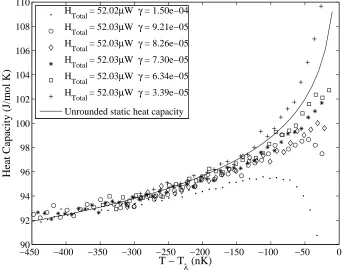
Rudolf Haussmann used dynamic renormalization group theory to calculate the heat capacity of
the SOC state, C∇T [9]. A plot of his results close to Tλ are given in fig. 1.3. More than 100 nK
3For more details on the critical point phenomena nearT
4
−600
75
−500
−400
−300
−200
−100
0
100
80
85
90
95
100
105
110
T − T
λ(nK)
Heat Capacity (J/mol K)
Unrounded static heat capacity
Haussmann C
∇T
Figure 1.3. Haussmann’s prediction forC∇T compared to the zero-gravity static heat capacity.
away from Tλ, the heat capacity is the same as in the zero-gravity static case. Very close to Tλ,
however, the heat capacity is significantly depressed and the maximum is shifted to 50 nK below
Tλ.
Another prediction forC∇T comes from the suggestion thatTC(Q) might be the depressed critical
point Tλ(Q) with a thermal conductivity of the form given in eq. (1.1). Under this assumption,
TSOC(Q) for low Qis far from the critical point. As Q is increased, however,TSOC(Q) gets closer
and closer to TC(Q). Therefore, as we approach the critical point TC(Q) from above, we would
expect the heat capacity to diverge as in the static case.
It is also possible that dynamic effects of the two-fluid model could play a role in the heat capacity.
In traditional helium under a heat flux, there is predicted a contribution to the heat capacity from
the kinetic energy of the flow of the superfluid [10], which has been observed experimentally in a
“heat-from-below” configuration [11]. However, it is unclear whether this mechanism would apply
1.3
The SOC State Wave
In investigating the SOC state for temperatures aboveTλ, Weichman and Miller also predicted the
existence of a thermal wave that would travel only upstream against the flow of the heat flux [7].
However, this wave has been seen experimentally by Sergatskov et al. both above and belowTλ [2].
To understand the nature of this wave, we will treat the helium as a normal fluid with a conductivity
κthat is a function of both the temperature and the heat flux. This appears to be in contradiction
to the work of Weichman and Miller who treated the high heat flux SOC state as a superfluid with
a regular occurrence of phase slips. Nevertheless, we will press on and defer judgment as to the
validity of this approach until its predictions are compared with experimental measurements. This
calculation roughly follows the calculation that Sergatskov et al. provided with their experimental
paper [2].
We start with the regular heat transfer equations,
C∂T
∂t =−∇ ·~ Q~ (1.2)
and
~
Q=−κ~∇T. (1.3)
Since the wave travels upwards and the nominal heat flux is downwards, we restrict ourselves to the
z axis. We define the heat flux to be positive by settingQ~ =−Qzˆand defineQSOC as the nominal heat flux of the SOC state. We combine eqs. (1.2) and (1.3) to get
C∂T ∂t = ∂ ∂z κ∂T ∂z . (1.4)
Next, we transform to the reduced temperatureǫ= (T−Tλ)/Tλ. First, we compute the derivative
∂T ∂z =Tλ
∂ǫ
∂z+α (1.5)
whereα= dTλ
dz = 1.273µK/cm. Then we convert eq. (1.4) to get
CTλ∂ǫ
∂t = ∂ ∂z κ
Tλ∂ǫ
∂z +α
(1.6)
At this point, we will avoid making the assumption thatκis of the form given in eq. (1.1). We
will, however, assume that the thermal conductivity is a function of onlyǫandǫ′
= ∂z∂ǫ. This leads
to
CTλ∂ǫ
∂t = ∂κ ∂ǫ ∂ǫ ∂z + ∂κ ∂ǫ′ ∂ǫ′ ∂z Tλ
∂ǫ ∂z+α
+κTλ∂
2ǫ
∂z2. (1.7)
6
are squared to get
CTλ
∂ǫ ∂t =α
∂κ ∂ǫ ∂ǫ ∂z+ α∂κ ∂ǫ′ +κTλ
∂2ǫ
∂z2. (1.8)
We guess that there is a wave of the form
ǫ(z, t) = ǫ0+δ(z, t) (1.9)
= ǫ0+δ0e
−Dk2
teik(z−vt). (1.10)
Putting in the trial solution gives
CTλ −Dk2−ikv=α∂κ
∂ǫ(ik) +
α∂κ ∂ǫ′ +κTλ
(ik)2. (1.11)
From the real parts, the attenuation is given by
D= κ
C + α CTλ
∂κ
∂ǫ′. (1.12)
(Note, if we had ignored theǫ′
dependence ofκwe would have gottenD= Cκ.) From the imaginary
parts, the velocity is given by
v=−CTα
λ
∂κ
∂ǫ. (1.13)
It is important to note that since ∂κ∂ǫ <0, v is positive and the wave travels upstream against the
heat flux that maintains the SOC state.
We can transform the expression for the velocity into a more easily measured quantity by using
the simple expression for the SOC state thermal conductivity,κ= QSOC
α , whereQSOCis the nominal
heat flux of the SOC state. This is, of course, not strictly true in the case where there is a traveling
wave, but any correction will be small becauseTλ∂z∂ǫ ≪α. Taking the derivative gives
∂κ ∂ǫ =
Tλ
α
∂QSOC
∂T , (1.14)
where ∂QSOC
∂T is easily extracted by measuringTSOC as a function ofQ. Substituting into eq. (1.13) gives an alternate expression for the velocity
v=−C1 ∂Q∂TSOC. (1.15)
We cannot explore the thermal conductivity as a function of the temperature gradient because
the gradient is fixed by gravity. Instead, we will need to make additional assumptions to make any
assume the thermal conductivity is of the form
κ=κ0θ−x (1.16)
where
θ=ǫ+ (Q/Q0)y. (1.17)
Remembering that the heat flux is given by
Q=κ∂T ∂z =κ
α+Tλ∂ǫ
∂z
, (1.18)
we take the derivative with respect toǫ′
to get
∂κ
∂ǫ′ = − xκ
θ ∂θ
∂ǫ′ (1.19)
= −xκθ Qy
Q Q0
y
∂Q
∂ǫ′ (1.20)
= −θαxy
Q Q0
y
α∂κ ∂ǫ′ +Tλ
∂ǫ ∂z
∂κ ∂ǫ′ +Tλκ
. (1.21)
We drop the second term in the rightmost grouping because it is much smaller than the first, given
Tλ∂z∂ǫ ≪α. This gives us
∂κ ∂ǫ′ =−
xy θ Q Q0 y ∂κ ∂ǫ′ +
Tλκ
α
. (1.22)
We solve for ∂κ ∂ǫ′ to get
∂κ ∂ǫ′ =−
Tλκ
α
1 + θ xy
Q Q0
−y. (1.23)
This give us a model-dependent expression for the attenuation of
D= κ
C
1−
1
1 + θ xy Q Q0 −y
. (1.24)
It is worth exploring both the low and highQlimits before we have the data to plug in actual values
forx,y, and θ(Q). In the lowQlimit,Q−y
grows very large and we obtain
lim
Q→0D=
κ C ≃
Q
αC. (1.25)
In the highQlimit,κbecomes large and thereforeθis small, giving
lim
8
It is not immediately apparent whether this grows or shrinks as Q becomes large. Therefore, we
substituteθ= (κ/κ0)−1/xandκ=Q/αto get
lim
Q→∞D = Q αC 1 xy Q ακ0
−1/x
Q Q0
−y
(1.27)
= (ακ0) 1/xQ
0y
αCxy Q
(1−1/x−y)
. (1.28)
Therefore, ify+ 1/x >1, the dissipation of the SOC wave will go to zero for high heat flux. Since
a previous experiment gavey= 0.813 andx= 0.663 [1], we expect little to no attenuation for high
heat flux. If, instead, we had ignored the dependence ofκon the temperature gradient, we would
have predicted thatD= αCQ and that the dissipation would grow larger with heat flux.
Our answers differ from those of the calculation by Sergatskov et al. for two reasons. First,
they modeledκas we did in eqs. (1.16) and (1.17). However, they computed ∂κ ∂ǫ
Q, treatingQas
constant. This gave them a wave speed v ∼Q3.3. However, a change in κ results in a change in heat flux. Therefore, the derivative cannot be taken keeping the heat flux constant. We avoided
this problem by transforming our derivative from ∂κ∂ǫ to Tλ
α ∂QSOC
∂T . If we assume, as they did, that
ǫSOC∼Q0.813, we getv∼Q0.167. Second, in the Sergatskov paper, they ignored the dependence of the thermal conductivityκon the gradient in reduced temperature. As noted above, this causes an
overestimate in the dissipation, especially for high heat flux. With these modifications, we calculate
a very different velocity and attenuation for the SOC wave at all but the lowest heat fluxes.
1.4
Summary
Some of the questions brought up in this introduction are the following:
• Is TSOC(Q) a true critical point?
• Is Haussmann’s calculation of C∇T accurate?
• Can a treatment of the SOC state thermal conductivity as a function of reduced temperature and its derivative accurately predict the speed and attenuation of the SOC wave?
In order to answer these questions, we have measured C∇T, TSOC vs. heat flux Q, and the speed
and attenuation of the SOC wave. Before discussing those measurements, it is necessary to describe
Chapter 2
Apparatus
The requirements for doing experiments on the SOC state are similar to those of most other 4He
lambda point experiments. We need an experimental platform with a very stable temperature and
heat flux at the lambda point. We want to investigate heat fluxes in the range of 30 nW/cm2 to
10µW/cm2. The range in SOC state temperatures of these heat fluxes is only 1µK. We therefore
need subnanokelvin temperature measurement precision and subnanowatt heat flux stability.
2.1
Cryogenic System
A schematic of the dewar and probe insert is presented in Fig 2.1. It is a typical cryostat for this
application. The dewar has a waist to give a long hold time between transfers of approximately six
days for a relatively short dewar only four feet tall. It is surrounded by aµ-metal shield to screen out
magnetic fields. The dewar is attached at the top to an aluminum platform (not pictured), which is
supported from the floor by three air legs to reduce vibration. Ironically, the aluminum plate that
is so carefully isolated from vibration has three large cavities that act as organ pipes and vibrate
sympathetically with the noises in the lab. It was not until my ear happened to be close to one end,
and I heard the clear tone, that I discovered the source of some of our vibrational noise. Once the
cavities were filled with foam, this vibration was significantly reduced.
The probe insert is composed of a brass top plate, stainless steel support tubes and an aluminum
vacuum can. There are copper baffles to limit radiative and convective warming. Just inside the
vacuum can there is a 1 K pot to provide cooling of the experiment below 4 K. It has a
high-impedance inlet that passes through a filter. In addition, there is a pump line for the vacuum can,
a pump line for the 1 K pot and conduits for the four SQUID leads.
The probe has 56 manganin wires arranged in twisted pairs. At the top of the probe, these
wires pass through a custom filter box. This box has two chambers with commercial pi-filters (3 dB
cutoff at 0.8 MHz) mounted on the dividing wall. This prevents the RF electromagnetic noise from
10
from the filter box down the probe to a glass-sealed connector at the top of the vacuum can. All
inlets to the vacuum can are hermetically sealed with indium. From there, the wires go down to
their respective stages, getting heat-sunk at each stage they pass. In order to reduce the heat load,
the wires are switched to CuNi-clad superconducting NbTi wire as they travel from stage 3 to the
experiment stage.
2.2
Thermometry
Two types of thermometers are used in this experiment: Germanium Resistance Thermometers
(GRTs) and High Resolution Thermometers (HRTs). The GRTs are used for coarse measurements
as well as for a calibrated measure of temperature. We use the calibration charts provided with the
GRTs by LakeShore.
An HRT is formed with a paramagnetic material, operating very close to its Curie temperature,
that is inductively coupled to a superconducting loop that is attached to a SQUID. The
paramag-netic material is subjected to a very stable magparamag-netic field and shielded from any external magparamag-netic
disturbances by a superconducting shield. The SQUID then measures the magnetization of the
material, which is strongly temperature dependent. The noise of these thermometers is frequently
better than 1 nK/√Hz [12].
Our HRTs are inherited prototypes from the MISTE project [13]. The paramagnetic material
for at least one of the HRTs is PdMn, but the specifics of the materials and concentration ratios
are not known to us. The sensor is composed of the sensing material wrapped with approximately
20 loops of NbTi wire, sandwiched between two permanent magnets, and shielded by a Nb housing.
The superconducting leads, shielded by a NbTi capillary, travel from the sensor to the SQUID that
is mounted on the SQUID stage, shown in fig. 2.2. We have three RF SQUIDs and one DC SQUID
providing a total of four HRTs.
2.3
Auxiliary Stages
A schematic of the thermal stages inside the vacuum can is shown in fig. 2.2. Stages 1, 2, and 3 serve
to provide a stable temperature platform for the experiment. The thermal resistance between the
stages and the heat capacity of each stage provide a passive filter to temperature oscillations and
thermal noise. Stages 2 and 3 each have a thermal ballast of compressed helium to increase their
heat capacity and improve the filtering. In addition, each of these stages was actively controlled
with PID control algorithms. The SQUID stage serves as the mounting location for the four SQUIDs
that control the HRTs. While this stage has a GRT and heater, it was not temperature controlled.
12
Figure 2.3. Schematic of the mounting platform and the placement of the copper foils, HRTs, and cell.
an HRT in addition to the GRT and heater. During all data runs, the stage was thermally controlled
with the HRT to a temperature precision of better than 100 nK. The gold-plated aluminum radiation
stage is mounted and thermally anchored to this stage. A more sophisticated experiment would have
the shield stage outside of the thermal path so that it could be maintained at the same temperature
as the experiment. In our setup, the radiation stage was usually regulated approximately 10 mK
colder than the experiment.
2.4
Cell Stage
The cell stage, which houses the experimental sample of 4He, is thermally isolated from stage 3
by a large (>1000 K/W) thermal resistance and shielded from thermal radiation by a gold-plated
aluminum radiation shield.
2.4.1
Mounting Platform
The mounting platform for the experiment stage is a titanium plate. Titanium was chosen for its
strength and low heat capacity relative to stainless steel. Annealed copper foils are attached to the
top of the mounting plate to increase the thermal conductivity. They are drawn schematically in
fig. 2.3. There are two types of foils, each intended to serve a different purpose. There are three foils
to conduct the heat flux from the cell bottom plate to the mounting legs where the heat is extracted.
Three other foils are used to create heat sinking points that are at the same temperature as the cell
bottom plate. Unfortunately, as will be seen in the next chapter, too much of the heat goes through
14
The mounting platform is attached to stage 3 by three titanium legs. The titanium tubing wall
thickness was 0.025”, but the half of the tubing closer to the cell was reamed to approximately
0.012”. To ensure the proper thermal resistance between stage 3 and the cell stage, approximately
4000 K/W, each leg is coiled with 30 cm of 0.012” copper wire.
All nuts and bolts on the mounting platform are titanium to reduce the heat capacity. Dow
Corning 340 silicone heat sinking compound was used to reduce the thermal contact resistance of
all joints.
2.4.2
Cell Construction
The experimental cell is composed of two Oxygen-Free High-Conductivity (OFHC) copper endplates
with an insulating Vespel sidewall. The copper endplates are 2.286 cm in diameter at their face and
are 2 cm and 3.3 cm tall for the bottom and top endplates, respectively. The endplates were annealed
to further increase their thermal conductivity. The faces were polished to a mirror finish with 0.3µm
alumina powder and the entire endplate was gold plated. The drawings for the two endplates and
the rest of the experiment stage are included in App. A.
The sidewall was made from three 0.64 mm thick Vespel sleeves with 2.301 cm inner diameter
(ID) and two OFHC copper foils with holes of the same ID. The sleeves and foils were assembled on
a Teflon mandril with a copper foil between each pair of sleeves. One copper foil is 165µm thick and
the other is 90µm thick. The assembly was glued together using TraCon epoxy (TraBond BA-2151)
to form one sleeve with two penetrating foils. A Dremel tool was used to remove excess epoxy that
prevented the copper foils from penetrating all the way inside.
The copper endplates were epoxied into the Vespel sidewall sleeve. Care was taken to ensure
that the gap between the top endplate and the sidewall was filled with epoxy, since there is a heat
flux dependent Kapitza resistance when helium is allowed to penetrate between the endplate and
the sidewall [14, 15]. However, because the bottom endplate was epoxied last, we were unable to
examine its gap.
From caliper measurements, there is an interior cell height of 2.585±0.005 cm at room temper-ature. From the cell drawings, the interior diameter of the cell is 2.301±0.005 cm. This gives an interior volume of 10.75±0.05 cm. The differential contraction of Vespel from room temperature to experimental temperatures is ∆L/L= 5.1×10⁻³ [16]. This gives a cryogenic volume of
2.4.3
Fill Line and Bubble Chamber
A 0.005” ID capillary fill line is epoxied into the hole on the Vespel sidewall. The hole in the Vespel
starts at a larger diameter, 0.2 cm, in the hopes of maintaining a superfluid link between the main cell
volume and the bubble chamber, despite the thin capillary. The capillary then connects to the bubble
chamber, which is mounted higher than the main volume of helium in order to gravitationally aid
bubble cavitation. The bubble chamber, with an internal height of 1.35 cm and diameter of 0.318 cm,
has a volume of 0.107 cm3. This was designed to accommodate up to a 1% helium vapor bubble in
order to maintain the helium sample at SVP. The bubble chamber is attached to a high thermal
resistance,≈106K/W, Vespel holder, which is attached to a heat-sinking foil on the mounting plate.
2.4.4
Cryo-Valve and
3He Actuation System
The cryo-valve in this experiment was designed by the University of New Mexico for the now canceled
NASA flight experiment DYNAMX. Its advantages are that it has a very small mass, has a tiny dead
volume, and is available for purchase fully assembled from EMD Machining. Its major disadvantage
is that it is a normally open valve that requires a very large closing pressure, on the order of 600 psi.
At such high pressures,4He is a solid at our experimental temperatures, so this valve is designed to
use3He as the actuating medium.
The3He was concentrated in a charcoal trap cooled in a dewar of4He. Upon warming, the proper
pressure to close the valve was reached, and the actuation line was isolated. Unfortunately, with
each transfer of helium to cool our experiment, the actuation line near the top of the probe insert
would cool sufficiently to cause the total actuator pressure to fall from its nominal value of 580 psi to
420 psi; this is despite having a 4 cm3ballast volume that we included on the room temperature end
of the actuator line. We recommend a larger ballast volume or thinner actuator line to reduce this
effect. However, due to the hysteretic nature of these valve’s opening and closing, the low pressure
was not sufficient to cause our valve to open, but it may have contributed to the small fill-line leak
we experienced.
The cryo-valve is mounted on the same Vespel holder as the bubble chamber. The fill line and
actuator capillaries first travel down to the heat sinking foil on the mounting platform where they
are heat sunk. Here, the fill line has a filter to ensure that no foreign matter gets into the
cryo-valve. The two capillaries then go up, being heat sunk on each stage before heading up to room
temperature.
2.4.5
HRT Mounting
The three HRTs on the experiment stage are mounted in Vespel holders. These holders have very
16
low heat leak. Each Vespel holder is mounted on the heat sinking foil of the mounting platform
-see fig. 2.3. The NbTi capillary leaving each HRT is also heat sunk to the same foil, as well as to
stage 3, before heading up to the SQUID stage.
Each of the self-contained HRTs has a copper protrusion for thermal anchoring. These tabs are
indium soldered to an annealed OFHC copper bar. Each bar travels to its thermal mounting point
(either a sidewall foil or copper endplate) where an indium to indium pressure joint is formed. The
HRT that is attached to the DC SQUID is mounted to the top endplate. Two RF SQUIDS are used
for the HRTs on the bottom endplate and the lower of the two penetrating sidewall foils.
2.4.6
GRT Mounting
The GRTs, which are cylindrical, were slid into holes in copper mounts with G.E. Varnish to ensure
good thermal contact. One GRT is attached to the cell top plate and the other is attached to one of
the heat sinking foils on the mounting plate. Again, Dow Corning heat sinking compound was used
for good thermal contact.
2.4.7
Heaters
Commercial surface-mount metallic-film resistors are used as heaters on the cell. A small piece of
cigarette paper was stuck to the heater location with GE Varnish for electrical isolation. The heater
was then stuck to the paper with GE varnish and held down with a small pressure until it dried.
Two four-wire heaters are mounted on the top endplate, and one four-wire heater is attached to
the bottom endplate. A two-wire heater is mounted on the bubble chamber to aid bubble nucleation,
and another one is placed on the copper bar connecting the HRT to the penetrating sidewall foil
for sidewall heating diagnosis. All heaters, whether they are two- or four-wire heaters at the room
temperature end, have two superconducting leads from stage 3 down to the cell. The leads are heat
sunk to the heater location, as well as to a heat sinking foil on the mounting plate.
2.5
Data Acquisition and Experiment Control
2.5.1
Cryo-Probe Inputs and Outputs
A shielded cable of twisted pairs connects the filter box at the top of the cryo-probe to a breakout
box. This breakout box has connectors for each of the heaters and GRTs. The only other outputs
from the probe are the leads for the four HRTs. Three of the HRTs are connected to RF SQUIDs
and are read with Quantum Design RF SQUID controllers. The last HRT is connected to a DC
SQUID, which is read by a Star Cryo Controller. This SQUID was manufactured by Quantum
Figure 2.4. Schematic of the heater control.
Design controller was slightly nonlinear for reasons we could not determine and the Star Cryo is
immune to this effect. Therefore, the Star Cryo is used in this experiment.
2.5.2
Data Acquisition and Control
The heaters and GRTs on stage 1 and 2 are controlled with a bridge, lock-in amplifier and a
temperature controller. The resistances are measured with the combination of a Stanford SR510
lock-in amplifier and custom resistance bridge. A resistance decade box is placed opposite the sensor
GRT in the bridge, so that any resistance could be dialed up. The voltage across the bridge is input
to a Linear Research LR-130 temperature controller whose output is fed to a heater.
A Linear Research LR-700 Resistance Bridge is used to read the GRT resistance of whichever
sensor is of interest for a particular experiment. During normal procedures, the LR-700 monitors
either the cell top or cell bottom GRT in order to make sure the cell does not get warm enough to
rupture. If the cell were to warm past a preset limit, then the experimental control programs would
turn off all heating to the cell.
The HRT controllers output a voltage proportional to the flux. The RF controllers have two
outputs, one filtered and one unfiltered. The filter is set to 100Hz and both outputs are input into
an ADC connected to the computer. The DC controller has no internal filter so the output is split
and one end is run through a simple RC low-pass filter with a 3 dB point of 100Hz. Again, both the
filtered and unfiltered inputs are input into the ADC.
18
computer. The voltage is applied through a large series resistor to limit the current. The heaters
on the experiment stage, however, need to be powered in a careful fashion to precisely account for
the heat applied. The schematic for this setup is shown in fig. 2.4. The DAC output is input into
a Howland current source circuit. We have two different types of channels available. The first uses
precision resistor valuesR1=R2= 500 kΩ andR3=R4= 50 kΩ and gives 20µA at 10 volts. The
second uses precision resistor valuesR1=R2= 100 kΩ and R3 =R4= 10 kΩ and gives 100µA at
10 volts. The current is given byI=VIn/R2and can be set by applying the appropriate voltage using
the DAC. The output from the current source is passed through a series 10 kΩ precision resistor to
the appropriate heater. A Fluke 8802 Multimeter measures the voltage across the precision resistor
to measure the actual current applied.
In addition we have a Keithley 263 Calibrator/Source that we use for some experiments to apply
a fixed current to a heater.
2.5.3
Computer Inputs and Outputs
The computer for this experiment uses three National Instruments (NI) cards for input and output.
There is a GPIB card, a 64-channel Analog to Digital Converter (ADC) card with two Digital
to Analog Converts (DACs) with waveform output capabilities, and a 6 channel DAC card with
(unused) digital IO.
The GPIB card is used to retrieve the voltage measurements from the Fluke Multimeters as well
as the resistance from the LR-700. The calibration from LakeShore is then used to convert this
resistance into a temperature. We also use the GPIB to set the output current of our Keithley
Calibrator.
The ADC samples only one channel at a time and rapidly scans over the total number of channels.
The ADC reads both the unfiltered and filtered outputs of the four SQUIDS, and perhaps two other
voltages, depending on the experiment being performed. It should be noted that the voltage sensed
by the ADC exponentially relaxes from the previously sampled channel’s voltage to the new channel’s
voltage. Therefore, depending on how long the ADC samples each channel, there can be a settling
time error. We sample each of the ten channels 500 times a second. We find this to be a nice
compromise for exceeding the Nyquist frequency of the filtered channel while being slow enough
that the settling time does not cause any additional noise in the data.
2.5.4
Computer Software
2.5.4.1 General Overview
The experimental software used to run this experiment was written in Java. The algorithms for flux
a small bit of code written in C to communicate with the NI cards, as there are no Java drivers. The
core component of the software runs on the same computer that has these cards. It is responsible
for data acquisition, controlling the DACs, logging the data and doing simple PID control. However,
most of the code makes use of the Java’s Remote Method Invocation (RMI), so algorithms to run
specific experiments are often run remotely.
2.5.4.2 Flux Counting
We use a simple flux counting algorithm done entirely in software. The computer takes in 500
samples a second for both the filtered and unfiltered value for each HRT. All flux counting is done
on the unfiltered channel because we do not want to smooth over the sharp sawtooth when the
SQUID controller resets. Each reset results in the output changing by some integral number of Φ0,
the voltage of one flux. A sample that falls outside of 0.2 Φ0 of the previous sample is considered
“bad” and not included in any averaging. However, if a “good” point (i.e., one that fell within
0.2 Φ0 of the previous sample) is more than 0.5 Φ0 away from a previous “good” point, then the
flux count is adjusted as necessary so that the final value is within 0.5 Φ0. This reconstructs the
HRT controller output, with its discontinuities resulting from the resets, into a continuous curve.
The filtered value for all “good” points are averaged together to give the required experimental
samples per second. This is 2 Hz during typical time insensitive runs, while for more time critical
Chapter 3
Calibration
3.1
Thermal Network
Before introducing any helium into the fill and actuator lines, the thermal network as drawn in
fig. 2.2 was measured. We thermally controlled stage 1 as described in sec. 2.5.2. We applied heat
to the cell top heater and measured the temperatures of all the stages using the LR-700 once the
system reached equilibrium. We did this for a few different heats between 20 and 40µW and found
a moderate temperature dependence on the resistances. The values listed below, therefore, represent
estimates for the resistance at the temperatures used in the experiment. This gave a total thermal
resistance of 7800 K/W between the cell and stage 1, which allowed us to apply a maximum heat
flux of 13µW/cm2 through the cell and still thermally control all of the stages. R
Sidewall is the
thermal resistance from the top endplate to the bottom endplate through the Vespel sidewall.
Table 3.1. Resistances of the thermal network
RSidewall 15000 K/W
R3,4 4300 K/W
R2,3 2900 K/W
R1,2 560 K/W
3.2
Heater Calibrations
The three heaters that were used for precision work on the cell stage, HT,1, HT,2, and HB, are
all wired with four wires. During the calibration, the current sources were attached as shown in
fig. 2.4. However, the two other wires of the heater were also attached to another Fluke multimeter.
Therefore, we had independent measurements ofIandV. We took a table of measurements over the
entire range of heats used in the experiment for each heater and fitV vs.Iwith a cubic polynomial.1
1Our measurements in sec. 3.9 make us suspect that the heaters were not well thermally anchored to the cell. This
22
−50 0 50 100 150 200 250 300 350 400 450 −200
0 200 400 600 800 1000
Time (s)
Top Plate Temperature (
µ
K from 2.13215K)
GRT Top Fit to decay R = 14,000 K/W C = 10.34 mJ/K
Figure 3.1. Top endplate response to heat pulse.
[image:34.612.120.458.73.339.2]In table 3.2 we show the calibration values used to computeV = aI3+ bI2+ RI+ d.
Table 3.2. Heater calibrations
a b R d
HT,1 0 −1.1052 106 10192 −2.2135 10−6 HT,2 3.4857 109 −1.0018 106 10154 2.7235 10−5 HB 3.153 109 −8.0146 105 10161 1.6587 10−5
3.3
Endplate Heat Capacity
Since we are doing a high-fidelity heat capacity measurement of the liquid helium in our cell, we
need to measure the heat capacity of the empty cell in case we have to subtract it to get the true
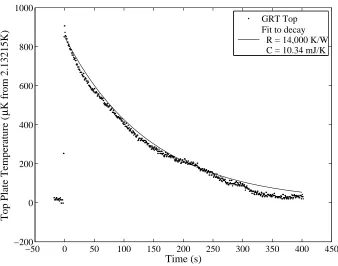
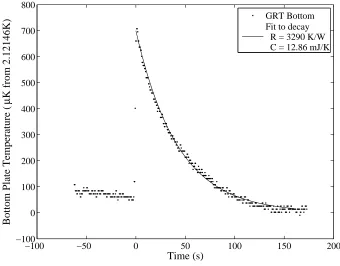
value for the helium. We measured the heat capacity of each endplate separately. We applied a 9µJ
pulse to the endplate while measuring the temperature with a GRT. We used the initial temperature
step to determine the heat capacity and then monitored the decay back to the original temperature.
The results for the cell top are shown in fig. 3.1 and those for the cell bottom in fig. 3.2.
The exponential decays were fit using the just measured end plate heat capacity and the
previ-ously measured thermal resistances. For the cell top, we needed to use a sidewall thermal resistance
combi-−100 −50 0 50 100 150 200 −100
0 100 200 300 400 500 600 700 800
Time (s)
Bottom Plate Temperature (
µ
K from 2.12146K)
[image:35.612.154.494.76.342.2]GRT Bottom Fit to decay R = 3290 K/W C = 12.86 mJ/K
Figure 3.2. Bottom endplate response to heat pulse.
nation ofR3,4= 4300 K/W and RSidewall= 14000 K/W. The good agreement between fit and data
confirms that we have properly measured the heat capacities and thermal resistances. The final
results for the heat capacities are given in table 3.3.
Table 3.3. Heat capacities of the endplates CT 10.3 mJ/K
CB 12.9 mJ/K
3.4
Filling the Cell
While the cell bottom endplate was thermally controlled to 2.7 K, we applied 915 torr of isotopically
pure4He (with a3He concentration of less than one part in 107) to the cell fill line and waited for
the cell to fill. We then closed the cryo-valve by applying 580 psi of3He to the actuator line using
the concentrator described in sec. 2.4.4.
We removed the remaining helium in the fill line and then pumped on the line with a leak
detector to achieve a good vacuum and therefore good thermal isolation. The leak rate settled to
approximately 10−7atm cm3/s. Given our 4 month cooldown, the estimated total volume of liquid
24
safely ignored. In order to maintain a good vacuum, we attached a charcoal cryo-pump to the line,
which we periodically cleaned. During transfers, it is possible that, when the actuator pressure fell
to 420 psi, the leak rate could have increased. However, the total time that the valve was at the
reduced pressure over the lifetime of the cooldown was not more than 10 hours.
3.5
Cavitating the Bubble
Once the cell was full, we cooled it to the lambda transition. As the helium contracted, we estimate
that 0.2% of the sample was vapor. The molar volume at SVP and 2.7 K is 27.860 cm3/mol, and
at Tλ it is 27.386 cm3/mol [17]. The compressibility at 2.7 K is 1.87×10⁻⁵torr−1 [18]. Finally, at
2.7 K, SVP is 111 torr [19]. From this we compute the bubble size as
Vgas
Vliq =
27.86 cm3/mol 1−(915 torr−111 torr) 1.87×10⁻⁵torr−1
−27.386 cm3/mol
27.386 cm3/mol (3.1)
= 0.002. (3.2)
We can use the cell and bubble chamber volumes computed in sec. 2.4.2, the molar volume of helium,
and the size of the bubble to compute the number of moles in our sample.
n = 0.998 V/Vm= 0.998 10.59 cm3+ 0.107 cm3/(27.386 cm3/mol)
= 0.390±0.002 mol (3.3)
Unfortunately, we could not be sure that the bubble would form inside the bubble chamber. We
cooled down to 1.8 K in order to collapse the bubble and then warmed the cell with the heater
attached to the bubble chamber to encourage the bubble to nucleate there. We carefully monitored
the temperature during this procedure, hoping to see evidence of bubble collapse or formation as
seen by others [20]. However, due to our large volume of helium and lack of thermometer on the
bubble chamber, we never saw such a signature.
We do have circumstantial evidence of when the bubble was inside the bubble chamber. On
a couple of occasions, we accidentally applied too large a heat to the cell top, causing the cell to
warm well past the lambda point. Upon cooling back to the lambda point, and investigating the
SOC state, we noticed that the SOC temperature now seemed to be dependent on the temperature
at the top of the cell. A set of data showing this effect is shown in fig. 3.3. At t = 0, the SOC
state is established in the bottom of the cell, and a small amount of superfluid still exists at the top
(as in profile A of fig. 1.1). Then, the heat added to the cell top heater is increased and the top
warms until normal fluid forms and the SOC/normal interface slowly moves down the cell. When
In fig. 3.3(b), however, we can see the SOC temperature falling as the cell top warms. Each time
normal fluid enters at the top of the cell (between 100 and 155 s and between 185 and 220 s), the
temperature recorded by the bottom thermometer drops. The midplane thermometer (not shown)
shows the same drop in temperature.
When a small bubble is at the top of the cell and the liquid helium is in the superfluid phase,
the heat flows around the bubble through the superfluid liquid, preventing any temperature or
pressure gradient in the bubble. When superflow breaks down, the top endplate warms quickly
and evaporates some of the helium which increases the pressure in the bubble. Using the SVP fit
from Donnelly [19], the 35000 nK temperature rise that we see in fig. 3.3(a) increases the pressure
in the bubble by 0.442 Pa. Given the 1.273µK/cm gradient in Tλ and the liquid helium density
of 0.14 g/cm3, the pressure increase causes a 41 nK drop inT
λ. Of course, there is a pressure and
temperature gradient across the bubble because the warm helium gas is condensing at the bottom
of the bubble which is colder. Therefore, the pressure at the bottom surface of the bubble will be
less than the full 0.442 Pa and the drop in Tλ will be less than 41 nK. We see a drop of 22 nK in
fig. 3.3(b).
On the occasions where we observed this phenomenon, we repeated the procedure of cooling
down to 1.8 K and warming with the bubble heater. We then confirmed that the SOC temperature
was once again independent of the cell top temperature and therefore assumed that the bubble was
26
0 50 100 150 200 250 300 −0.5
0 0.5 1 1.5 2 2.5 3 3.5
4x 10
4
Time (s)
Top Temperature (nK, arbitray org.)
(a) Cell top temperature as heat is added and removed.
0 50 100 150 200 250 300 −25
−20 −15 −10 −5 0 5
Time (s)
Bottom Temperature (nK, arbitray org.)
(b) Cell bottom temperature shows the effect onTλof warming and cooling the bubble at the top of the cell.
−4000 −3000 −2000 −1000 0 1000 2000 2.1747
2.1748 2.1749 2.175 2.1751 2.1752 2.1753 2.1754 2.1755 2.1756
GRT Top Temperature (K)
HRT Top (flux)
Slope: 1.8055e−07
Figure 3.4. Calibration of the top HRT to the top GRT during a ramp down of 1 mK from just below the superfluid transition.
3.6
HRT Calibration
With the entire cell just below the superfluid transition, we slowly ramped (150 nK/s) the cell
downwards in temperature about 1 mK while recording the cell top HRT and GRT. The results are
shown in fig. 3.4. We fit the top HRT flux to the top GRT temperature to get a calibration for the
cell top HRT.
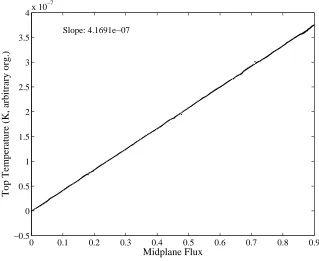
To get calibrations for the other two cell HRTs, we did a slow drift (0.1 nK/s) of about 350 nK
close to Tλ, and calibrated each of these thermometers to the cell top HRT. The results are shown
in fig. 3.5 and fig. 3.6. On a previous cooldown, we had calibrated the HRT on stage 3 near Tλ.
However, since this HRT now operates over a different temperature range, the calibration is only
approximate for the current cooldown. Each HRT does not necessarily have the same paramagnetic
material nor permanent magnets of the same strength. Therefore, the calibrations vary widely
among the HRTs. The results are summarized in table 3.4.
Table 3.4. HRT calibrations HRTT 180.6±0.9 nK/Φ0 HRTM 416.9±2.1 nK/Φ0 HRTB 81.85±0.41 nK/Φ0
28
0 0.1 0.2 0.3 0.4 0.5 0.6 0.7 0.8 0.9 −0.5
0 0.5 1 1.5 2 2.5 3 3.5
4x 10
−7
Slope: 4.1691e−07
Midplane Flux
Top Temperature (K, arbitrary org.)
Figure 3.5. Calibration of the midplane HRT to the top HRT during a drift of 350 nK.
0 0.5 1 1.5 2 2.5 3 3.5 4 4.5 5 0
0.5 1 1.5 2 2.5 3 3.5
4x 10 −7
Slope: 8.1845e−08
Bottom Flux
[image:40.612.128.447.85.346.2]Top Temperature (K, arbitrary org.)
150 155 160 165 170 175 180 185 190 195 200 −0.3
−0.2 −0.1 0 0.1 0.2 0.3 0.4
Time (s)
Top Temperature (nK)
Noise: 0.13 nK/√Hz
Figure 3.7. Noise of the top HRT.
3.7
HRT Noise and Drift
To obtain a value for the HRT noise, we measured each HRT while the helium sample was in
the superfluid state with minimal temperature drift. The results, averaged to 1 Hz, are shown in
Figs. 3.7, 3.8, and 3.9. The standard deviation from the three data sets was used to compute the
thermometer noise given in table 3.5.
Table 3.5. HRT noise HRTT 0.13 nK/
√
Hz HRTM 0.18 nK/
√
Hz HRTB 0.11 nK/
√
Hz
In analyzing our longer data files, we matched measurements of TSOC(Q) for the same heat
flux Qthat were taken many hours apart and found we had a thermometer drift of approximately
30
150 155 160 165 170 175 180 185 190 195 200
−0.3 −0.2 −0.1 0 0.1 0.2 0.3 0.4
Time (s)
Midplane Temperature (nK)
Noise: 0.18 nK/√Hz
Figure 3.8. Noise of the midplane HRT.
150 155 160 165 170 175 180 185 190 195 200 −0.25
−0.2 −0.15 −0.1 −0.05 0 0.05 0.1 0.15 0.2 0.25
Time (s)
Bottom Temperature (nK)
[image:42.612.119.456.86.352.2]Noise: 0.11 nK/√Hz
3.8
Kapitza Resistance
Well into the superfluid (20µK or so) we took a quick measurement of the regular Kapitza resistance.
This is the thermal boundary resistance that arises due to a phonon mismatch across a boundary
between two different materials. We lowered the applied heat on the top endplate by about 2µW
and increased the heat on the bottom to compensate. The helium temperature stayed roughly the
same (see sec. 3.9 for the caveat to this), but the top and bottom endplates changed temperature,
allowing us to compute Kapitza resistances across these endplates. They are presented in table 3.6.
Table 3.6. Kapitza resistances
RK,T 0.31 K/W
RK,B 0.25 K/W
There is another component to the thermal boundary resistance from the endplate into the
helium. The superfluid portion of the helium is suppressed near a boundary. Near Tλ, the region
over which the superfluid is suppressed gets large and causes a significant increase in the thermal
boundary resistance. This has been measured previously in “heat-from-below” configurations [21]
and we attempted to measure this singular component of the Kapitza resistance in our
“heat-from-above” configuration. Unfortunately, we measured a heat-flux-dependent resistance. This is
caused by having helium in the gap between the endplate and the sidewall [14, 15]. As discussed in
sec. 2.4.2, we suspected this might be the case during cell construction. Also, the fact that we see a
lower regular Kapitza resistance for the bottom endplate, despite a surface preparation identical to
the top, suggests there may be a sidewall gap.2
3.9
Heater Response Times
Our heat capacity measurements, which will be described in the next chapter, are very sensitive to
any lag time between applying a voltage to the current source and heat being deposited into the
experiment. At one moment in the experiment, the power dissipated in one heater is decreased by
the same amount as the increase in another cell heater. If there is no significant lag in the response,
or if the lag is equal for both heaters, then no energy will be gained or lost by the helium as this
switch between the heaters occurs.
3.9.1
The Problem
By measuring the voltage across two wires of the 4-wire heater when a pulse of current was applied,
we found that any lag was less than one millisecond. This means there are no problems with the
32
−400 −200 0 200 400 600 800 1000 1200 1400
−40 −35 −30 −25 −20 −15 −10 −5 0
Time (ms)
Temperature (nK, arbitrary org.)
Figure 3.10. Temperature response of the top endplate HRT caused by swapping heat from one heater to another heater with a different time constant.
DAC or current source. However, with the sample entirely in the superfluid, swapping heat from
HT,2 to HB resulted in a small but noticeable change in the helium temperature. The small cell
temperature drift was the same before and after the swap.
To confirm that this effect was due to a time lag problem and not some exotic properties of the
helium, we repeated the same experiment, except we swapped heat from HT,2to HT,1, heaters that
are on the same endplate. In fig. 3.10, we see the temperature response of HRTT to the swap at
t= 0 with very little data averaging. Obviously, the heater that was reduced responded faster than
the heater that was increased. The output is complicated by both the time constant of the copper
endplate relaxing to the thermal bath of the helium sample and the time constant of the HRT coming
into equilibrium with the endplate. The end result, only seen with more data averaging for lower
noise, is that the helium cooled about 1 nK. When we reverse the swap, the response is identical,
but in the reverse direction. Since we are swapping between two heaters on the same endplate, there
is no change in heat flux through the sample, so no helium properties could cause this effect.
We hypothesize that this time constant is caused by the heaters being poorly attached to their
locations resulting in an appreciable thermal contact resistance. When a voltage is applied, the
heater responds immediately. However, the heater, with its heat capacity and thermal resistance
resistance, so the time constant is different for each one. A further complication is that this time
constant appears to change with heat flux. This could be due to either the heater’s heat capacity
or thermal contact resistances changing as the heater changes temperature.
3.9.2
The Solution
Our solution was to calibrate and quantify the size of this error by performing the same experiment
where we first saw the effect. We cool well below the superfluid transition and swap the heat from
the top heater to the bottom and observe the temperature change of the helium. Using the heat
capacity of the helium, it is possible to extract how much energy was lost or gained in the swap. We
need to perform this experiment with the same pair of heaters for the same heat fluxes that we use
in our heat capacity measurements for the calibrations to be helpful.
To improve the calibrations, the actual procedure worked as follows. For each pair of heat flux
values, we swapped back and forth while intentionally delaying the change of the faster heater by a
time, τ. We started with small delays and then gradually increased their length. We then plotted
the temperature change of the helium vs. the delay. Fig. 3.11 is an example of this. We fit the
results to a line. The zero crossing of this line tells us how much time delay is necessary so that no
energy is gained or lost. If the faster heater was changed by an amount of heatA∆Q, whereA is
the cell cross-sectional area, then the energy ∆E gained for no delay is ∆E=τ A∆Q. We did not
perform this experiment for every pair of heat flux values, but instead changed the heat flux through
the cell from 0 to 1 µW/cm2, from 1 to 2 µW/cm2, from 2 to 3µW/cm2, and so on. We then fit
the resulting curve to a parabola (or a line if there were fewer than four points) which allowed us to
scale ∆E for any heat flux swap.
3.10
Heat Leaks
Unfortunately, in the design and construction of the experimental cell, we made a miscalculation
of the size and arrangement of the copper foils that are placed on the mounting plate. One set
of foils was intended to conduct away the heat flux, and the other set of foils was to maintain a
heat sinking location close in temperature to the cell bottom endplate. Either through high contact
resistance, higher than expected conductivity of titanium, or some other unexpected reason, the
temperature of the heat-sinking foils was significantly different from the cell bottom endplate. This
gave us relatively large heat leaks (a few nanowatts) through the HRTs and their Vespel mounts
34
0 5 10 15 20 25 30 35 40 45 50
−2 −1 0 1 2 3 4 5
Time (ms)
Helium Temperature Change (nK)
10 15 20 25 30 35 40 2.1715
2.172 2.1725 2.173 2.1735 2.174 2.1745 2.175
Bottom Plate Servo Power (µW)
Bottom GRT Temperature (k)
Figure 3.12. Dependence of GRT bottom on heat flux.
3.10.1
The Problem
To quantify the effect, we performed a simple experiment. We controlled the cell bottom HRT with
a servo to a set flux value and then ramped the stage 3 temperature up and down. Since the heat
flux extracted from the cell is determined by the temperature difference between the cell and stage 3,
the servo power went down and up to compensate. In fig. 3.12, we plot the cell bottom GRT versus
the servo power. Since the cell bottom GRT is mounted on the heat sinking foil and not on the cell
bottom endplate itself, we can see the magnitude of the problem. Despite the cell bottom endplate
remaining constant in temperature, the heat-sinking foil is changing in temperature by over 1 mK.
Therefore the foils which we had hoped would be at the cell bottom temperature are actually offset
in temperature due to a resistance of over 100 K/W.
With just a couple of exceptions, all the experiments we performed in this cooldown kept the
temperature difference between the cell and stage 3 nearly constant. When that is the case, the heat
leaks will be constant during the experiment. The first exception is HRT calibration, where we were
careful and used the top HRT and top GRT, which are immune from this type of heat leak. The
second exception is the experiments described in this section.
In a typical configuration, the total power flowing from the cell to stage 3 was 20µW. Given an
36
A heat leak causes two problems. The first is the leak could reduce or distort the heat flux.
Our experiments are not particularly sensitive to these effects since our heat fluxes are relatively
large. Only at our smallest heat fluxes, 30 nW/cm2, will leaks on the order of 1 nW be noticeable.
The second effect is caused by the heat leak flowing across a thermal resistance through the HRT
and out the HRT support. This causes the HRT to read a temperature that is offset from the
true temperature. As long as the thermal resistance remains the same, however, the offset will be
constant. Therefore, the heat leak through HRTT and HRTB can be ignored. However, the heat
leak through the foil HRT flows across a helium/copper boundary which has a Kapitza resistance.
The singular component of the Kapitza resistance is strongly dependent on the helium temperature
close toTλand therefore HRTMhas a variable temperature error that prevents it from reading the true helium sample temperature.
3.10.2
The Solution
Luckily, we mounted a heater on the copper bar connecting HRTMwith the penetrating sidewall foil.
Therefore, if we could properly compute how large the heat leak was, we could apply exactly the