CognitiveCharge: Disconnection Tolerant Adaptive
Collaborative and Predictive Vehicular Charging
Milena Radenkovic
University of NottinghamNottingham NG8 1BB United Kingdom
Adam Walker
University of NottinghamNottingham NG8 1BB United Kingdom
ABSTRACT
Electric vehicles (EVs) are rapidly becoming more common and ownership is set to rise globally in coming years. The potential impacts of increased EVs on the electrical grid have been widely investigated and in its current state, existing grid infrastructure will struggle to meet the high demands at peak charging hours. The limited range of electric cars compounds this issue. We therefore propose CognitiveCharge, a novel approach to predictive and adaptive disconnection aware opportunistic energy discovery and transfer for the smart vehicular charging. CognitiveCharge detects and reacts to individual nodes and network regions which are at risk of getting depleted by using implicit predictive hybrid contact and resources congestion heuristics. CognitiveCharge exploits localised relative utility based approach to adaptively offload the energy from parts of the network with energy surplus to depleting areas with non-uniform depletion rates. We evaluate CognitiveCharge using a multi-day traces for the city of San Francisco, USA and Nottingham, UK to compare against existing infrastructure across a range of metrics. CognitiveCharge successfully eliminates congestion at both ad hoc and infrastructure charging points, reduces the time that a vehicle must wait to charge from the point at which it identifies as being in need of energy, and drastically reduces the total number of nodes in need of energy over the evaluation period.
CCS CONCEPTS
• Networks → Mobile ad hoc networks • Human-centered computing → Collaborative and social computing • Computer systems organization → Self-organizing autonomic computing
KEYWORDS
DTNs, VANETs, smart energy
1 INTRODUCTION
As the popularity of electronic vehicles (EVs) increases, demand on the existing electrical grid is set to rise leading to more frequent power surges [1]. There are multiple research, government and industry initiatives which aim to make electric vehicles more sustainable and scalable. For example, proposals for Smart Grids (SGs) integration with EVs [10,12,14,15] by supporting two way
energy flows and two way communication flows (e.g. V2G) is a promising way forward. However, most of the current Smart Grid proposals focus is on centralized SG management and optimization via SDNs and centralized scheduling. Social vehicle charging [13] is another approach which aims to enable V2V charging, however it also encompasses centralized decision making and optimization which assumes a priori global knowledge of vehicle schedules and coordinates.
We argue that centralized decision making and assumption of a priori knowledge do not allow for distributed real time responsive adaptation and fairness of distributed dynamic charging supply and demand patterns. Centralized decision making about vehicular charging does not perform well in dynamic distributed scenarios due to limited scalability, responsiveness, adaptability and fairness which this paper aims to address by proposing a novel multi-layer disconnection tolerant, adaptive and predictive distributed GV2V and V2G collaboration. Previous research has shown that centralized optimization and global optimum are not suitable for highly dynamic disconnection prone topologies which vehicular networks form and that attaining a global optimum often disadvantages some parties e.g. nodes may be unfairly exploited [6,7] and collaborative approaches in temporally changing complex graph topologies usually outperform both locally and centrally optimized algorithms [7].
In this paper we propose fully distributed multi-layer cognitive charging, CognitiveCharge, approach which enables two-way vehicle-to-vehicle and vehicle-to-grid information and energy flows in order to allow nodes to collaborate and adaptively share distributed energy resources across trusted collaborators in disconnection tolerant dynamic topologies. CognitiveCharge is able to predict and adapt in real time to local dynamically changing mobility topologies and dynamically varying energy supply and demand topologies while minimising delays. At the core of our approach is distributed edge based collaborative charging which consists of several multidimensional predictive analytics that build multi-attribute complementary predictive heuristics and utilities in real time. We use principles of dynamic predictive relative utilities and propose a collaborative algorithm which allows individual nodes to achieve greater utility compared to when they do not collaborate.
localized and ego-network (temporal and geographical node clusters) energy resources because the nodes exchange predictive connectivity and resources analytics of each node as well as their ego networks to allow responsive and adaptive fully distributed charging decisions in real time. Through such fully distributed multi-layer predictive energy resource collaborative decision making Cognitive Charge is able to avoid regional and local surplus and depletion of energy. None of the current techniques achieve such kind of fairness in both geographical and temporal domains over heterogeneous mobility patterns.
CognitiveCharge comprises real-time, localized decision processing from multiple multi-layer utilities to support adaptive and predictive responses to transient current and future energy availability and demand. EVs equipped with CognitiveCharge balance dynamic trade-offs between several multi-dimensional predictive analytics which are each derived locally and in real-time from multi natured, hybrid multi-layer complex graphs including social connectivity temporal networks and physically distributed energy supply. In doing this, CognitiveCharge permits opportunistic energy sharing at locations with and without infrastructure energy supply.
We identify and propose core criteria factoring into the CognitiveCharge decision process to include nodes and their ego network which span: (i) the rate of energy depletion, (ii) the rate of congestion, (iii) receptiveness, (iv) retentiveness, and (v) price. These utilities are further combined with ego-network resources and contact analytics (such as contact frequency and duration) to permit nodes to make faster and more informed predictions regarding whether to acquire or share energy. Consider a node which in need of energy late in the afternoon but does not have immediate or foreseeable access to an infrastructure charge point. Using CognitiveCharge, another node can choose to share its surplus energy with the node in need of energy by utilising its awareness of multi-dimensional real time analytics and also the knowledge that it is not likely to deplete itself in offering charge (as it has high likelihood of forthcoming opportunity for resupply at a point which has low levels of congestion).
The remainder of this paper is structured as follows. An overview of related work is provided in Section II. In Section III we describe the CognitiveCharge distributed multi-layer collaborative adaptive architecture, identify and describe its multiple complementary predictive heuristics, and provide its pseudo-code. In Section IV, we discuss extensive evaluation of CognitiveCharge protocol in two real world mid-size cities (San Francisco, USA and Nottingham, UK) with real world distribution of charging points (i.e. as per government proposals), realistic modelling of charging and depletion for the cars, real world and realistic geo-mobility patterns and network ranges. We consider a range of criteria such as: delays from the time when energy is needed until the vehicle starts charging, prices cars pay and vehicles with critically low energy. We show significant improvement over vehicle to grid charging strategies across all criteria. Concluding remarks and future work are given in Section V.
2 RELATED WORK
In the Danish Edison project [16], significant range of research and experimental activities were conducted on the island of Bornholm to evaluate how a large fleet of EVs can help in the grid operation as well as provide benefits to the EV car owners. [19] focused on the ICT aspects, i.e., how to efficiently integrate the distributed software in the deployed system and proposed a VPP architecture referred to as Edison electric vehicle virtual power plant (EVPP). The goal of the EVPP was to use fleets of EVs to balance the energy supply provided by variable wind energy resources.
Energy as a resource which can be shared amongst socially compatible mobile nodes has been investigated by a number of works. In [11] authors demonstrate the advantages of envisioning energy as a tradable commodity in a system which enables opportunistic energy harvesting amongst mobile social edge nodes for battery powered devices. The proposed energy sharing model improves multiple criteria when compared with nodes maintaining isolated energy stores.
Specifically targeting vehicle energy management in opportunistic networks, several works have investigated vehicle-to-vehicle charging, proposing systems which take advantage of the social nature of vehicle mobility to increase energy availability. A vehicle-to-vehicle social charging system is proposed in [13] which takes advantage of in-network surplus energy to increase the availability of energy to motorists and reduce range-anxiety. A distributed marketplace then permits acquisition of energy from peers through a spatial, temporal, social network service.
Recent research has explored utilizing combined opportunistic vehicular and social communications for data processing, information processing and services and has shown that vehicles can collaborate over multiple dimensions and adapt to temporal dynamic networks. Café and CafRep [8] propose multi-layer adaptive congestion aware protocols which combine social metrics with predictive analytics to direct network traffic away from congested areas of the network. Both protocols successfully reduce congestion whilst remaining considerate of resources and avoiding node overloading. CafRepCache [9] builds upon Cafe and CafRep, adding support for latency aware collaborative caching. Cafe, CafRep and CafRepCache are all evaluated over diverse, dynamic temporal network topologies which include multiple real-world vehicular traces.
We build upon the existing state of the art research by investigating the performance of a novel predictive and collaborative energy localization and transfer protocol with distributed dynamic pricing as an incentive for collaboration.
3 COGNITIVECHARGE PROPOSAL
builds upon Cafe [8], CafRep [8], and CafRepCache [9] and combines multi-layer, multi-dimensional analytics with spatial and temporal heuristics to provide fully distributed real-time, collaborative, predictive energy management. Each individual CognitiveCharge node maintains both its own and its Ego Network multi dimension predictive analytics which are derived spatially, socially, temporally as well as via localized communication with encountered neighbours.
[image:3.612.317.554.165.359.2]CognitiveCharge nodes have two types of flows: two-way energy flows and way information flows [3], [4]. The concept of two-way energy flows means that energy can be given to any node with less energy from the node with more energy (either a vehicle or the Grid). The concept of two-way information flows means that utilities have access to real-time information and at the same time nodes control dynamic energy flows and collect various power and connectivity related parameters. Information flows refer to transport information (data) for monitoring the status and collecting various types of information in the Smart Grid (SG) and vehicular grid (VG) as well as for controlling the dynamic energy flows. CognitiveCharge enables efficient distributed energy flow which will avoid unfair energy distribution i.e., situations where vehicles or the grid will not able to meet the local electricity demands while other nodes and regions have surplus of energy.. More specifically, when power plants are unable to meet the peak demand, local load shedding or complete black-outs will happen. CogntiveCharge utilities can provide fair and balanced energy utilization across different temporal and geographical areas.
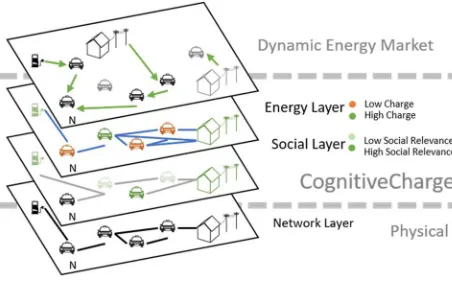
[image:3.612.55.281.395.537.2]Figure 1. Multi-layer CognitiveCharge overview
Figure 1 shows distributed multi-layer collaborative CognitiveCharge architecture overview in which each CognitiveCharge node spans physical network graph, the social connectivity/ego network complex temporal graph, and the supply and demand time varying graphs. At the network level are interconnected vehicles and the grid which opportunistically and locally communicate through wireless communication. The social temporal graph for each node concerns a given vehicles regular and irregular contacts which are derived through multiple complementary utilities such as contact duration and contact frequency. Separate to each of these layers is the availability of energy, e.g. which vehicles have surplus energy that they are willing to share and which are in need of energy. Each of these
layers is complementary and only through combining predictive utilities from these dimensions with peer information can a node make informed decisions based on the current state and predicted future state of each layer. CognitiveCharge adaptively manages trade-offs between these multiple dimensions through multiple utility functions which are combine to yield the CognitiveCharge utility.
Figure 2. CognitiveCharge node
The control energy flow for a single node in a dynamically changing disconnection tolerant complex network is shown in Figure 2 which illustrates multiple types of the inputs obtained through contacts with neighbours as well as the derived predictive analytics which are used to decide on the course of action to take at any given time. Congesting rate, depleting rate and predictive in-network delays (receptiveness) are all calculated by the node based on historical encounters.
In the following subsections we define the node and ego network utilities which together form the CognitiveCharge utility. Our CognitiveCharge utility is used to determine a nodes suitability for energy transfer through combination of multi-dimensional predictive aggregate analytics so as to make adaptive real-time decisions in response to dynamic conditions. CognitiveCharge nodes make use of local and locally exchanged ego network analytics for (i) depletion rate, (ii) congesting rate, (iii) receptiveness, (iii) retentiveness, and (iv) pricing.
3.1. Node and Ego Network Depletion Rate
=
∙
∙∑ (1)
3.2 Node and Ego Network Congesting Rate
The congestion rate [8] of a CognitiveCharge node refers to the rate at which the queue for energy from that node is increasing. A given node is limited in the number of peers it can simultaneously exchange energy with (e.g. a fuel station has only a limited number of outlets) however nodes can ‘queue’ for energy from both static and mobile nodes whilst others engage in transfer. By identifying nodes with high congestion rates, a node in need of energy can better identify underutilized nodes with surplus from which it can charge both immediately and at future opportunities.
=
∙
∙∑ (2)
3.3 Receptiveness for Node and Ego Network
Receptiveness [8] refers to the predictive delay of a node to its next charging opportunity. For predicting whether to charge at any time, CognitiveCharge nodes estimate the availability of a potential future neighbours based on energy level data from past encounters. CognitiveCharge nodes track receptiveness of nodes over encounters
!" # = $ !"%&' # + 1 − $ !"+,-- ./ # (3)
3.4 Node and Ego Network
Retentiveness/Energy Level
The retentiveness/energy level of a node refers to its ability to maintain charge beyond that which it requires for itself. Retentiveness is distinct from depletion rate because it focuses on the withholding of surplus energy. Whilst a node may deplete rapidly it may still have a high level of retentiveness given that it might only seek to use a fraction of its charge for movement.
!0 # = 1234526 (4)
3.5 Dynamic Pricing
The price of a given neighbour’s energy is dynamic and related to implicit dynamically changing parameters which can be monitored and predicted in real time, as is the case for receptiveness. Dynamic pricing may be considered as an incentive for maintaining energy levels beyond need as well as permitting nodes to enforce a different preferences regarding with whom, when, and how they choose to share energy. For example, a node may be well suited to providing energy but can negotiate through
price to prefer providing energy to node it is friendly with, even if that node is in a less urgent energy state. We consider multiple additional criteria for pricing based on cost of acquisition from diverse charge points. The pricing formula in (5) is further weighted per node when aggregated in the CognitiveCharge utility to account for additional criteria such as the nodes availability to charge. In this way lower prices are offered to nodes with less availability than nodes with greater availability.
789:5!;3:"! # =
10<0:";3:"! + =>// -?% . +A, , B . . (5)
3.6 Ego Network CognitiveCharge Utilities
Ego Network depletion rate, retentiveness, receptiveness and congesting rate (ENdr, ENcr, ENret, ENrec, ENcr) refer to resource heuristics of the node’s ego network. Ego network (EN) is defined here as a network consisting of a single node together with the nodes they have encountered and gives each node their own perspective of the network. CognitiveCharge allows nodes to aggregate resource observations disseminated by encountered nodes in order to form an ego-network perspective of the network. Ego-network information can be aggregated in many different ways and we have explored a number of models for weighting the contacts within a nodes ego-network in order to improve the accuracy of prediction of the EN cognitive charging levels. Different weighing is highly important as it leads to better performance for charging optimizations and making the nodes less selfish. More specifically, we have considered techniques such as simple average, weighted moving average (EWMA) and social weighting of the nodes ego network congestion heuristics. Our experiments have shown that EWMA gives better performance than the simple weighting and the social weighting across diverse heterogeneous network topologies. We use EWMA to aggregate resource heuristic information in order to allow the short-term fluctuations to be smoothed out and longer-term trends to be highlighted making it suitable for forecasting. This is updated at each new encounter for each charging heuristic.
3.7 CognitiveCharge Utility
The decision as to whether or not to charge from a given node n at time t is based on the predicted depleting rate, congesting rate, receptiveness, retentiveness, and price of nodes and their ego networks. Where Utils is the set of utilities for each of the given criteria we define the CognitiveChargeUtility for a given node n at time t. For a node actively seeking energy, over the set of potential connections which have a contact duration suitable for charging the highest will be selected for energy transfer.
8C#0:D! ℎ<3C!F0:5 #, 0 = ∑I/J&J/?I/J&J/? K I/J&J/J F0:5:0H #, 0 (6)
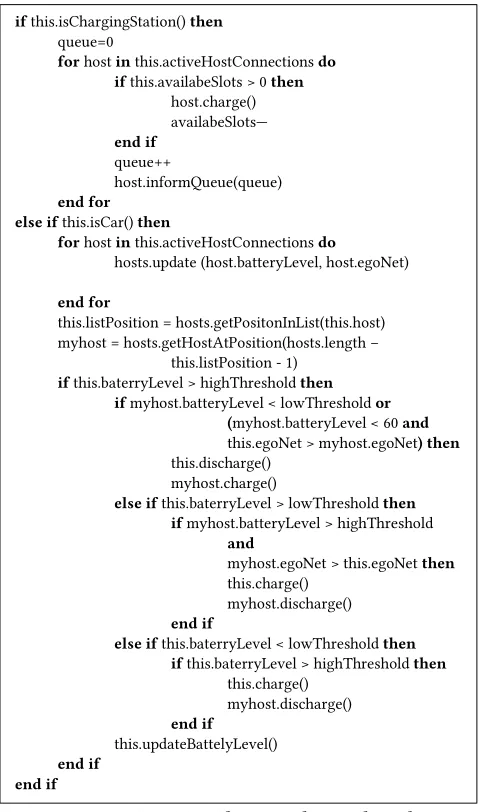
connectivity, energy and price. We identify two dynamically changing battery levels thresholds: Lower which signals Depletion Risk and Higher which signals willingness to offer energy to other nodes. When the node detects that it is between Depletion Threshold and Charging Threshold, it will aim to charge from a neighbour only if the neighbour ego network utility is better than its own (i.e. better chances of them being able to charge soon). This determination enables fairness across a network comprising CognitiveCharge nodes as it prevents both regions and individual nodes depleting at the expense of an expedited charge for the node. When the node detects that it is at or below depletion threshold, the node would seek to change at the first opportunity it has. CognitiveCharge allows adaptive and dynamic pricing in the following way:
Figure 3. CognitiveCharge node pseudo-code
Charging node monitors its remaining battery capacity and the waiting queue size (the number of immediate neighbours needing charge) in order to determine the price of the battery charge and
keep it inversely proportional to its remaining resources and directly proportional to the demand This allows charging nodes to respond to the dynamically changing local charging demands while discouraging others to user their resources when they are scarce. When there are multiple buying and selling nodes in the neighbourhood, they all compile a dynamically changing list of all nodes sorted by their battery level and ego network strength. As every node uses the same calculation formula, all nodes will have a consistent view of the nodes list among them. CognitiveCharge enables the nodes to be paired, the best with the worst, the second best with the second worst, etc., to ensure that the node with greatest need will have access to the best resources. This further facilitates the fairness of CognitiveCharge across both individual nodes and network regions.
4 EVALUATION
This section discusses multi criteria evaluation of CognitiveCharge over two different cities: San Francisco, USA and Nottingham, UK, and two different mobility patterns (real world taxi cabs and urban work pattern).
The EVs in our experiments are modelled on current consumer electric vehicles, namely the 2017 Smart ForTwo Electric Drive. Our EVs therefore have a total 17.6 kWh capacity yielding an urban range of approximately 100 km. Battery charge times and depletion rates are further derived from the specification sheets for these vehicles and we model two tiers of charging speed. These charging speeds are representative of current real world charging points.
Per an EU legislative proposal [17], we presume the number of EV charging points to be 10% of the total number of vehicles in the experiment.
We compare CognitiveCharge against the existing real-world set-up of EV charging infrastructure. Approximately half of existing EV drivers opportunistically recharge whenever an opportunity is available [5]. We therefore compare CognitiveCharge against a greedy energy seeking scheme representative of the behaviour of current EV drivers. Thus, whenever an EV encounters a static charging point and does not have a full battery it will seek to ‘top-up’ its energy until capacity is reached. Energy pricing is fixed for static charge points for our baseline scenario. This scheme is compared against the scenario when CognitiveCharge support is added to the nodes and the performance of each protocol compared across multiple criteria.
4.1 CognitiveCharge in San Francisco, USA
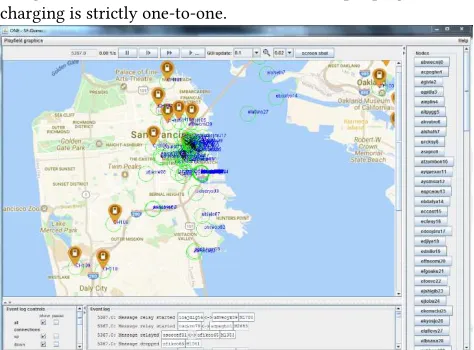
To evaluate CognitiveCharge, we use San Francisco trace and assume vehicles are EVs. We use 100 cars over a 5-day period. We overlay the charging points at locations closest to where cars are observed to congregate. A snapshot of the scenario with vehicular mobility and static charge points is shown in Figure 4.
Whilst CognitiveCharge is adaptive to the number of points actively charging from or to, to better model current real-world cases we consider only bidirectional charging of EVs in our scenario. In line with real-world EV charging infrastructure, a if this.isChargingStation() then
queue=0
for host in this.activeHostConnections do if this.availabeSlots > 0 then
host.charge() availabeSlots—
end if
queue++
host.informQueue(queue)
end for else if this.isCar() then
for host in this.activeHostConnections do
hosts.update (host.batteryLevel, host.egoNet)
end for
this.listPosition = hosts.getPositonInList(this.host) myhost = hosts.getHostAtPosition(hosts.length –
this.listPosition - 1)
if this.baterryLevel > highThreshold then if myhost.batteryLevel < lowThreshold or
(myhost.batteryLevel < 60 and
this.egoNet > myhost.egoNet) then
this.discharge() myhost.charge()
else if this.baterryLevel > lowThreshold then if myhost.batteryLevel > highThreshold
and
myhost.egoNet > this.egoNet then
this.charge() myhost.discharge()
end if
else if this.baterryLevel < lowThreshold then if this.baterryLevel > highThreshold then
this.charge() myhost.discharge()
end if
this.updateBattelyLevel()
charge station in our scenario can have multiple plugs but V2V charging is strictly one-to-one.
Figure 4. Static charging points deployed in San Francisco
To focus our evaluation on the effectiveness of CognitiveCharge and to avoid centring this work on a specific battery or charging technology we assume that the batteries powering vehicles in our scenario charge and expend energy uniformly through both mobility and direct transfer. In-depth modelling of battery and charging technologies are beyond the scope of this paper and so we do not consider there to be a degradation in charging performance at increasing distances between vehicles, up to a maximum range of 10 meters. A remaining battery capacity of under 40% is considered by over 90% of EV drivers to be low and in need of recharging [5]. For realistically modelling driver behaviour we consider this value as the threshold for determining when EVs are in need of recharging.
The average number of nodes identifying as being in urgent need of recharging is shown for the duration of the experiment in Figure 5. Peak energy demand times at static charging points occur towards the end of the day as vehicles lower on charge seek energy. For existing infrastructure average of 22% peaking at 37% of nodes are in urgent need of energy at peak times as greedy energy acquisition prevents nodes with greater need from taking advantage of the limited charging opportunities available. The overwhelming majority of the time for CognitiveCharge, an average of just 7% of nodes identify as having a low battery threshold. This peaks at 14%, which is still below the average for the existing infrastructure charging setup. Whilst some CognitiveCharge nodes identify as being below the defined energy need threshold, they do not reach the level of criticality of nodes reliant on infrastructure charging points and are never fully depleted. Furthermore, CognitiveCharge nodes spend notably less time identifying as being in need of energy whereas EVs in the infrastructure charging scenario continue to expend energy without charging, reaching critically low depletion levels for sustained durations. Due to the collaborative,
[image:6.612.326.552.231.360.2]real-time, predictive analytics comprising the CognitiveCharge utility, depleting CognitiveCharge nodes with limited future charging opportunities will be prioritised over an identical node which will imminently encounter an available infrastructure charge point. This is the result of the predictive receptiveness and retentiveness utilities which allow nodes to determine the future availability of charging opportunities. Only nodes who are in need or predict that the availability of energy to them will be poor in future will seek to charge. This is reinforced by the dynamic pricing incentive which discourages greedy charging in times of low electricity availability.
Figure 5. Average number of vehicles with critically low battery levels
fluctuation between minimum and maximum wait times seen in the current real-world charging setup.
Figure 6. Average time a node must wait for energy since it identifies being in urgent need
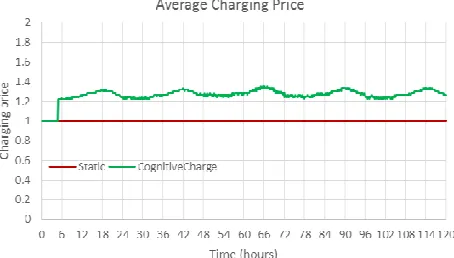
The price of energy during the experiment is shown in Figure 7 and for CognitiveCharge clearly fluctuates over time as the price adjusts in response to the dynamic energy supply and demand. Although the pricing strategy employed by CognitiveCharge increases the cost of energy paid by each node, the cost is less than 50% more than the original cost. The increased price of energy from neighbouring vehicles versus from infrastructure is beneficial to the network as it incentivizes sharing of surplus energy with nodes making a small profit each time they share energy with a node in need. With dynamic pricing applied to the existing infrastructure we could expect worse prices compared to CognitiveCharge as demand during peak hours more sharply drives up prices, particularly in response to the long wait times seen in Figure 6. For CognitiveCharge the shallow fluctuation in dynamic pricing shows that energy need is amortized over time and the pricing scheme has helped towards incentivising fair, opportunistic energy acquisition and dispensing.
[image:7.612.59.286.562.691.2]For CognitiveCharge these peak prices show that energy need is amortized over time.
Figure 7. Average price of energy during the experiment
4.2 CognitiveCharge in Nottingham, UK
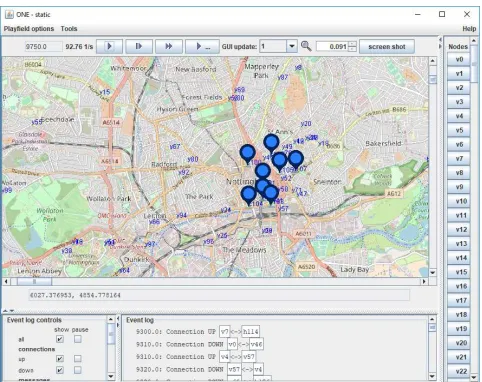
To evaluate CognitiveCharge in Nottingham, we devise a scenario which models EVs in an urban area over typical working days with commuter traffic. Our experiments are conducted in ONE using Nottingham, UK with implementation parameters shown in Table I. The Nottingham trace is pseudo-realistic and models 100 cars over a 5-day period. Purely stochastic mobility models have been shown to be unrepresentative of the mobility patterns of real-world motorists and the movement of vehicles demonstrates clear social attributes. We therefore use an adapted version of the vehicular geo-social mobility model [15]. A screenshot of the scenario highlighting infrastructure, publically accessible ‘fast-charge’ points is shown in Figure 8.
Table1: Location Efficiency
Parameter Value
Nodes 100
Duration 120 hours
Start Time 06:00
Energy Transfer Range 10 m
Mobility Model Geo-Social Movement
Runs 10
Wi-Fi Transfer Range 100 m
Node Speed Range 0-30 mph
Movement Area Nottingham City
The geo-social mobility model used in our evaluation is derived from multiple data sources, resulting in a detailed, geo-temporal trace suitable for modelling the movement of electric vehicles in the Nottingham city during working days. Interconnectivity is determined using Facebook data [16] with context provided to temporal location anchors using real-world locations including homes, places of work, and shopping centres, amongst others. A snapshot of the scenario with vehicular mobility and static charge points is shown in Figure 8.
Figure 8. Static charging points deployed at City Council car parks in Nottingham city centre for the experiment
The average number of nodes identifying as being in need of recharging is shown for the duration of the experiment in Figure 9. Similar to the San Francisco scenario, peak energy demand times at static charging points occur towards the end of the day as vehicles lower on charge seek energy.
[image:8.612.54.295.72.263.2]For existing infrastructure, we see that an average of 15% of EVs are in need of energy. This climbs to 35% at peak times as energy acquisition by non-critical nodes prevents nodes with greater need from taking advantage of the limited charging opportunities available. For CognitiveCharge we see an average of 4% of nodes identifying as being in need of energy over the 5-day period, rising to 14% during peak times. As was the case for San Francisco, the worst case for CognitiveCharge outperforms the average for existing charging infrastructure. For nodes using CognitiveCharge who reach the low energy threshold, the severity of energy depletion is light and only for brief time periods. Under the infrastructure scenario nodes in need of energy reach highly critical levels for extended periods. For CognitiveCharge nodes the predictive receptiveness and retentiveness utilities ensure only nodes in urgent need and with limited energy availability will seek energy when there is a cheaper, near-future opportunity to charge, such as at a residence. Without predictive analytics and distributed predictive analytics allowing for real-time, adaptive decision making – such as is the case for the current real-world setup – EV energy acquisition can impede the fair distribution of energy across heterogeneous network regions.
Figure 9. Average number of nodes below the ‘low’ energy threshold
Figure 10 shows the delay between the time of identifying as being in urgent need of energy and being able to charge.
[image:8.612.325.552.80.213.2]Over the five consecutive days under existing infrastructure we see a node must wait on average 41 minutes before it can start charging. Given the nature of electrical charging the vehicles have to wait considerable time to be able to charge, even when we consider that the scenario included ‘fast-charge’ points with higher rates of energy supply to EVs compared to home charging. Wait time for access to energy from infrastructure points rises considerably throughout the day until EVs are able to access home charge points. Towards the end of the day many nodes reliant on existing charging infrastructure alone were waiting over 2 hours for access to energy supply. CognitiveCharge greatly increases the opportunities for charging due to the social and ego-network analytics which dynamically respond to calculated peer utilities. As such, there is a sharply reduced wait time for nodes to acquire energy. CognitiveCharge further reduces the time that a node is in a low energy state and reduces the fluctuations in wait time over each day to an average of 16 minutes, around three times lower than the infrastructure approach. The congestion at static charging points is mostly eliminated at all hours as predictive in-network energy availability analytics permit pre-emptive charging when queues are expected. The congesting rate utility of CognitiveCharge deters unnecessary queueing and optimizes energy acquisition.
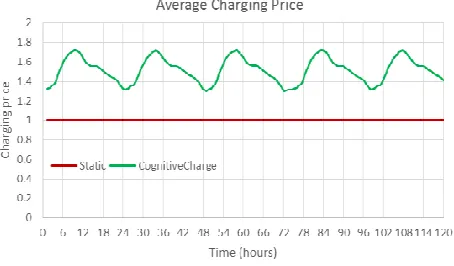
[image:8.612.324.549.546.677.2]The maximum price of energy during the experiments is shown in Figure 11. Similarly to San Francisco scenario, the price fluctuates over time adjusting itself to the dynamic energy supply and demand which incentivises sharing and collaboration. Under CognitiveCharge the fluctuations in energy price for Nottingham are marginally greater than for San Francisco, suggesting isolated islands of nodes with limited V2G opportunities relying upon V2V energy exchange to satisfy the demand of both themselves and their ego-network. Despite the slight increase at peak times, price levels for CognitiveCharge in the Nottingham scenario remain consistently within acceptable limits and successfully incentivise proactive acquisition and dissemination of energy to regions with limited access to infrastructure charge points.
Figure 11. Average price of energy fluctuation during the experiment.
5 CONCLUSIONS
We proposed a novel disconnection-tolerant, adaptive collaborative, charging protocol, CognitiveCharge, which combines multi-layer, multi-dimensional, opportunistic mobile geo-temporally changing social networks with future, ubiquitous, bi-directional, inter-device, energy transfer technology for smart vehicular grids. CognitiveCharge enables predictive discovery of dynamically changing supply and demand of nodes and local supply possibilities in order to allow nodes to `top-up' their batteries opportunistically (i.e. whenever possible and appropriate) as opposed to a delaying full charge and deplete cycle until meeting the infrastructure services or fitting the predetermined schedule. Each criteria that CognitiveCharge utilizes allows for nodes to adapt and respond rapidly to dynamic conditions such as non-uniform levels of congestion and fluctuating energy availability. In doing so, nodes avoid depleting or under-utilising both themselves and regions of the network. CognitiveCharge was investigated using two distinct 5-day scenarios, a real-world trace of taxicabs in San Francisco, USA and a pseudo-realistic scenario of commuter vehicles in Nottingham, UK. In each case we modelled EVs and charging points according to real-world data and compared Cognitive charge against existing infrastructure charge points. CognitiveCharge outperformed infrastructure based charging across a number of criteria including EV depletion levels and the time that a node
must remain depleted until it is able to charge. Across both scenarios infrastructure reliant nodes which became low on energy continued to deplete and remained at critical battery levels for extended periods of time. CognitiveCharge nodes showed significantly less depletion and the few low energy periods experienced by nodes were brief due to the predictive, real-time, collaborative, adaptive decision making increasing energy availability and fairness of energy exchange.
In future work we will give significant consideration to the security of multi-layered, predictive, in-network energy sourcing and transfer schemes. Vehicles which behave selfishly, maliciously, or are malfunctioning can have a severe impact on the network and attacks. Attacks on the smart grid could have significant wide-ranging impacts and so we will seek to address both attack vectors and mitigation strategies in a future work.
REFERENCES
[1] S. W. Hadley and A. A. Tsvetkova, "Potential impacts of plug-in hybrid electric vehicles on regional power generation," The Electricity Journal, vol. 22, pp. 56-68, 2009. [2] C. Thiel, A. Alemanno, G. Scarcella, A. Zubaryeva and G.
Pasaoglu, "Attitude of European car drivers towards electric vehicles: a survey," JRC report, 2012.
[3] J. Neubauer and E. Wood, "The impact of range anxiety and home, workplace, and public charging infrastructure on simulated battery electric vehicle lifetime utility," Journal of Power Sources, vol. 257, pp. 12-20, 2014.
[4] T. Franke, I. Neumann, F. Bühler, P. Cocron and J. F. Krems, "Experiencing Range in an Electric Vehicle: Understanding Psychological Barriers," Applied Psychology, vol. 61, pp. 368-391, 2012.
[5] L. Bunce, M. Harris and M. Burgess, "Charge up then charge out? Drivers’ perceptions and experiences of electric vehicles in the UK," Transportation Research Part A: Policy and Practice, vol. 59, pp. 278-287, 2014.
[6] S. Saha, A. Lukyanenko and A. Yla-Jaaski Cooperative caching through routing control in nformation-centric networks. Proc. IEEE INFOCOM 2013, p. 100–104, 2013 [7] D. Bertsimas, V. F. Farias and N. Trichakis. The price of
fairness. Operations Research. v. 59, n. 1, 2011
[8] M. Radenkovic and A. Grundy, "Efficient and adaptive congestion control for heterogeneous delay-tolerant networks," Ad Hoc Networks, vol. 10, pp. 1322-1345, 2012. [9] M. Radenkovic and V. S. H. Huynh, "Collaborative
Cognitive Content Dissemination and Query in Heterogeneous Mobile Opportunistic Networks," in Proceedings of the 3rd Workshop on Experiences with the Design and Implementation of Smart Objects, New York, NY, USA, 2017.
[10] H. Farhangi, “The path of the smart grid,” IEEE Power and Energy Magazine, vol. 8, no. 1, pp. 18–28, January 2010. [11] E. Bulut and M. Kisacikoglu, "Mitigating range anxiety via
vehicle-to-vehicle social charging system," in Proceedings of Vehicular Technology Conference (VTC Spring), IEEE, 2017.
[13] E. Bulut and M. Kisacikoglu, "Mitigating range anxiety via vehicle-to-vehicle social charging system," in Proceedings of Vehicular Technology Conference (VTC Spring), IEEE, 2017.
[14] C. F. Calvillo, A. Sanchez-Miralles, and J. Villar, “Synergies of electric urban transport systems and distributed energy resources in smart cities,” IEEE Transactions on Intelligent Transportation Systems, vol. PP, no. 99, pp. 1–9, 2017. [15] Software Defined Networks based Smart Grid
Communication: A Comprehensive Survey Mubashir Husain Rehmani, Alan Davy, Brendan Jennings, and Chadi Assi
[16] C. Binding, D. Gantenbein, B. Jansen, O. Sundstr ¨om, P. B. Andersen, F. Marra, B. Poulsen, and C. Træholt, “Electric vehicle fleet integration in the Danish EDISON project–a virtual power plant on the island of Bornholm,” in Proc. IEEE PES General Meeting, 2010, pp. 1–8.
[17] P. H. Committee on the Environment and F. Safety, Proposal for a directive of the European Parliament and of the Council amending Directive 2010/31/EU on the energy performance of buildings, 2017.
[18] G. Whelan, "Modelling car ownership in Great Britain," Transportation Research Part A: Policy and Practice, vol. 41, pp. 205-219, 2007