Contents lists available atScienceDirect
Journal
of
Mathematical
Analysis
and
Applications
www.elsevier.com/locate/jmaa
Abstract
Swiss
cheese
space
and
classicalisation
of
Swiss
cheeses
J.F. Feinstein∗, S. Morley1, H. Yang2
SchoolofMathematicalSciences,UniversityofNottingham,UniversityPark,Nottingham,NG72RD,UK
a r t i cl e i n f o a b s t r a c t
Articlehistory:
Received15September2015 Availableonline9February2016 SubmittedbyN.Young
Keywords: Swisscheeses
Rationalapproximation Uniformalgebras Boundedpointderivations RegularityofR(X)
Swiss cheese sets are compact subsets of the complex plane obtained by deleting a sequence of open disks from a closed disk. Such sets have provided numerous counterexamples in the theory of uniform algebras. In this paper, we introduce a topological space whose elements are what we call “abstract Swiss cheeses”. Working within this topological space, we show how to prove the existence of “classical” Swiss cheese sets (as discussed in [6]) with various desired properties. We first give a new proof of the Feinstein–Heath classicalisation theorem [6]. We then consider when it is possible to “classicalise” a Swiss cheese while leaving disks which lie outside a given region unchanged. We also consider sets obtained by deleting a sequence of open disks from a closed annulus, and we obtain an analogue of the Feinstein–Heath theorem for these sets. We then discuss regularity for certain uniform algebras. We conclude with an application of these techniques to obtain a classical Swiss cheese set which has the same properties as a non-classical example of O’Farrell [5].
© 2016 The Authors. Published by Elsevier Inc. This is an open access article under the CC BY license (http://creativecommons.org/licenses/by/4.0/).
1. Introduction
Throughout,we use theterm compactplane set to mean anon-empty, compact subset ofthe complex plane.LetXbeacompactplaneset.ThenC(X) denotesthesetofallcontinuous,complex-valuedfunctions onX,andR(X) denotestheset ofthosefunctionsf ∈C(X) whichcanbeuniformly approximatedonX byrationalfunctions withnopoles onX. Both R(X) and C(X) are uniformalgebras onX. Wereferthe readerto[1,2,8,13]forfurtherdefinitionsandbackgroundconcerninguniformalgebrasandBanachalgebras. ASwisscheesesetisacompactsubsetofCobtainedbydeletingasequenceofopendisks fromaclosed disk.Suchsets havebeen usedas examplesinthetheoryof uniformalgebras and rationalapproximation.
* Correspondingauthor.
E-mailaddresses:[email protected](J.F. Feinstein),[email protected](S. Morley), [email protected](H. Yang).
1 ThisauthorissupportedbyEPSRCGrantEP/L50502X/1. 2
ThisauthorissupportedbyaChinaTuitionFeeResearchScholarshipandtheSchoolofMathematicalSciencesattheUniversity ofNottingham.
http://dx.doi.org/10.1016/j.jmaa.2016.02.004
SwisscheesesetswereintroducedbyRoth[12],whereshegavethefirstknownexampleofacompactplane setX suchthatR(X)=C(X) butX hasemptyinterior.Sincethentherehavebeennumerousapplications of Swisscheesesets intheliterature.
One notable exampleof a Swisscheeseconstruction is due toMcKissick [11].He gavean exampleof a Swiss cheeseset X suchthatR(X) isregular butR(X)=C(X).(Wewill define regularity inSection7.) The sequence of open disks used to construct this Swiss cheese set may touch or overlap, which means thattheset X mighthaveundesirabletopological properties.Toimprovethetopologicalpropertiesofthe resulting Swiss cheese set,while preserving the properties of the uniform algebra, aprocess that we call
classicalisation wasdeveloped[6].
We may consider a pair consisting of a closed disk and a collection of open disks in the plane, from whichwe obtainthedesiredSwisscheeseset (seeDefinition 2.1below).Wecall suchapairaSwisscheese
and say it isclassical if thecollection ofopen disks and the complementof theclosed disk have pairwise disjoint closuresand the sumof theradii of allopen disks is finite.Note that,in theliterature, theterm ‘Swiss cheese’ traditionally refers to what we call a Swiss cheese set. Feinstein and Heath[6] considered Swiss cheeses inwhich thesumof theradii ofthe opendisks is strictly lessthanthe radiusof thelarger, closed disk.Theyproved,usingZorn’slemma, thatforsuchaSwisscheese,theassociatedSwisscheeseset contains aSwiss cheeseset associated to a classical Swiss cheese. Later, Mason [10] gave a proof of this theorem usingtransfiniteinduction.
ClassicalSwisscheesesetshavemanydesirabletopologicalproperties.Forexample,DalesandFeinstein
[3]provedthatgiventwopointsx,yinaclassicalSwisscheesesetthereisarectifiablepathconnectingx,y andsuchthatthelengthofthispathisnomorethanπ|x−y|;infact,theconstantπcanbereplacedbyπ/2 here. Afterthis observationitiseasy tosee thataclassicalSwiss cheesesetis pathconnected(and hence connected), locallypath connected(andhencelocally connected),anduniformly regular,as definedin[3]. Also as aconsequence of connectedness,we see thataclassical Swiss cheeseset cannot haveany isolated points. In[6]itwasnotedthateveryclassicalSwisscheesesetwithemptyinteriorishomeomorphictothe Sierpińskicarpet asaconsequenceofatheoremofWhyburn [14].
Browder[1]notesthatifX isaclassicalSwisscheesesetthenR(X) isessential(seealso[6]).Inparticular, R(X) =C(X),as originally provedby Roth[12]. It follows from the Hartogs–Rosenthaltheorem that X must have positive area. A direct proof that every classical Swiss cheese set has positive area is due to Allard,asoutlined in[1,pp. 163–164].
WhereexistingexamplesofSwisscheesesetsintheliteraturearenotclassical,itisofinteresttoconstruct classicalSwiss cheesesets whichsolvethesameproblems. Aspartof ageneralclassicalisationscheme, we discuss somenewtechniques forconstructingsuchclassicalSwisscheesesets.
In this paper we consider what we call abstract Swiss cheeses, which are sequences of pairs consisting of acomplexnumber andanon-negative real number.Each pairinthis sequence corresponds to acentre and radiusof adiskintheplane. Wegivetheset ofallabstract Swisscheeses anaturaltopologyanduse this topology to giveanew proofof the Feinstein–Heaththeorem.We showthat, undersomeconditions, we canclassicaliseSwiss cheesesetswhile onlychangingopen diskswhichlie incertainregions.Weprove ananalogueoftheFeinstein–Heaththeoremforannuli.Wegivesomeresultsregardingregularityof R(X) forunionsofcompactplanesets,whichwillbeusedinthefinal section.Finally,wegiveanexampleofthe applicationofacombinationoftheseresultstoconstructanexampleofaclassicalSwisscheesesetX such thatR(X) isregularandadmitsanon-degenerateboundedpointderivationofinfiniteorder(asdefinedin Section8),whichimprovesanexampleofO’Farrell[5].Thisfitsinto ourgeneralclassicalisationscheme.
2. SwisscheesesandabstractSwisscheesespace
Wedenote theset ofallnon-negativereal numbersbyR+, thesetof positiveintegersbyNandtheset
a byB(a,r) andthe corresponding closed diskby B(a,¯ r). Wealso set B(a,¯ 0)={a}and B(a,0) =∅. We sayadiskwithradiuszeroisdegenerate.Foranon-degenerateopenorcloseddiskDintheplane,letr(D) denote the radius of D; for a degenerate disk D we define r(D)= 0. The following is thedefinition of a Swisscheeseusedin[6].
Definition 2.1. Let Δ ⊆ C be a non-degenerate open disk and let D be a countable collection of non-degenerate,opendisksintheplane.ThentheorderedpairE= (Δ,D) isaSwisscheese.Wealsodefinethe following.
(a) TheSwiss cheesesetXE associated withtheSwiss cheeseE isdefinedby
XE= Δ\
D∈D
D. (1)
(b) Thediscrepancy δ(E) ofE isdefinedby
δ(E) =r(Δ)−
D∈D
r(D).
(c) The Swiss cheese E is semiclassical if δ(E) > −∞, for each D ∈ D we have D ⊆ Δ, and for each D ∈ D withD =D wehaveD∩D =∅.In thiscasewe saytheSwiss cheesesetassociated to E is
semiclassical.
(d) The SwisscheeseE isclassical ifδ(E)>−∞, foreach D∈ D wehave D⊆Δ,and foreach D ∈ D withD=D wehaveD∩D=∅.InthiscasewesaytheSwisscheesesetassociated toE isclassical. (e) TheSwiss cheeseE isfinite ifthecollectionDisfinite andinfiniteotherwise.
Theconditionδ(E)>−∞isequivalentto thesumoftheradiioftheopen disksbeingfinite.
WenotethatwithoutsomeconditiononthedisksinDwecanobtaineverycompactplanesetasaSwiss cheesesetwiththisdefinition.
Throughoutthispaper,wewillworkinwhatwecallabstractSwisscheesespaceF,whereF = (C×R+)N0
withtheproducttopology.
Definition2.2.LetA= ((an,rn))∞n=0∈ F.Wecall AanabstractSwisscheese,andwedefinethefollowing.
(a) The significant indexset of A is SA :={n∈N:rn >0}.We saythatA isfinite ifSA is afinite set,
otherwiseA isinfinite.
(b) Theassociated Swisscheeseset XAisdefinedby
XA= ¯B(a0, r0)\ ∞
n=1
B(an, rn)
. (2)
(c) WesaythatAissemiclassical if∞n=1rn <∞, r0>0 andforallk∈SA thefollowinghold:
(i) B(ak,rk)⊆B(a0,r0);
(ii) whenever∈SAhas=k,wehaveB(ak,rk)∩B(a,r)=∅.
(d) WesaythatAisclassical if∞n=1rn <∞,r0>0 andforallk∈SAthefollowinghold:
(i) ¯B(ak,rk)⊆B(a0,r0);
Forα≥1 wedefinethediscrepancyfunctionof order α,δα:F →[−∞,∞) by
δα(A) =rα0 − ∞
n=1
rαn (A= ((an, rn))∞n=0∈ F). (3)
Note thatin(2)wecouldinsteadwrite
XA:= ¯B(a0, r0)\
n∈SA
B(an, rn)
.
If Ais semiclassicalor classical,thenπδ2(A) istheareaof theSwisscheeseset XA.Wewill usuallywrite
A= ((an,rn)) foranabstractSwisscheese.Allsequences,unlessotherwisespecified,willbeindexedbyN0.
Wealsodefine thefollowingfunctionsonF.
Definition 2.3.Theradiussum functionisthemapρ:F →[0,∞] definedby
ρ(A) =
∞
n=1
rn (A= ((an, rn))∈ F).
Thecentre boundfunctionisthemap μ:F →[0,∞] definedby
μ(A) = sup
n∈N|
an| (A= ((an, rn))∈ F).
Let E ⊆C. For an abstract Swiss Cheese A= ((an,rn)) we define HA(E) tobe theset of those n ∈SA
such thatB(a¯ n,rn)∩E =∅.The local radius sum functionon E is thefunctionρE : F →[0,∞] defined
by
ρE(A) =
n∈HA(E)
rn (A= ((an, rn))∈ F).
It is easy to see that ρand μ are both lower semicontinuous from F to [0,∞]. (For ρ, this is an easy consequenceofFatou’slemmaforseries.)
WenowexplaintheconnectionbetweenSwisscheeses,asinDefinition 2.1,andabstractSwisscheeses.We constructamany-to-onesurjectionofasubsetofFontothecollectionofallSwisscheesesasinDefinition 2.1. LetA= ((an,rn)) beanabstract Swisscheesewithr0>0.Thenwecanobtainanassociated Swisscheese
EAbysetting
EA:= ( ¯B(a0, r0),{B(an, rn) :n∈SA}).
TheassociatedSwisscheesesetsofAandEAareequal,andδ(EA)≥δ1(A).Moreover,ifAisfinitethenEA
is finite;ifAissemiclassicalthen EAis semiclassical;andifAisclassicalthenEA isclassical.Conversely,
ifE isafiniteSwisscheesethenthereisafiniteabstract SwisscheeseA suchthatEA=E.
Let E= (Δ,D) beaSwisscheese. IfE is (semi)classicalthenthere is anabstract SwisscheeseA with EA =E such thatA is (semi)classical.Moreover, when the sum of theradii of open disks in Dis finite,
we canfind an abstract Swiss cheeseA= ((an,rn)) with ρ(A) <∞ and E =EA suchthatthe sequence
(rn)∞n=1is non-increasing.
We denote the collection of all abstract Swiss cheeses A = ((an,rn)) with ρ(A) < ∞ and (rn)∞n=1
N(M,R) isnotitselfcompact, aclosedsubset S ofN(M,R) iscompactifandonlyifthe0-thcoordinate projection maps S to a bounded subset of C×R+. Note that, for A = ((a
n,rn)) ∈ N(M,R) we have
rn≤R/nforalln∈N.
Lemma2.4. LetM,R >0.Forα≥1,thefunctionδα:F →[−∞,∞)isuppersemicontinuous.Forα >1,
thefunctionδα|N(M,R):N(M,R)→Riscontinuous.
Proof. As for the lower semicontinuity of ρ, it is an easy consequence of Fatou’s lemma for series that δα:F →[−∞,∞) isanuppersemicontinuousfunctionforeachα≥1.
Fixα >1.Foreachm∈N0letA(m)= ((a(nm),rn(m)))∈ N(M,R) and supposeA(m)→A∈ N(M,R) as
m→ ∞.Wehave|rn(m)|α≤Rα/nαfor alln∈N.Since ∞n=1Rα/nα<∞,bythedominated convergence
theorem,wehave
δα(A) =rα0 − ∞
n=1
rnα= lim
m→∞
(r(0m))α−
∞
n=1
(r(nm))α
= lim
m→∞δα(A
(m)).
Soδαiscontinuousfrom N(M,R) toR. 2
Weremarkthatthereareexamplesshowingthatδ1 isonlyuppersemicontinuous,butnotcontinuous.
Definition2.5. LetA= ((an,rn)) beanabstractSwiss cheese.
(a) Leta∈Cand r >0 andletm∈N0.Wesayanabstract SwisscheeseB= ((bn,sn)) isobtainedfrom
Aby inserting adisk B(a,r) atindex m if,for 0≤n< m, wehavebn =an, sn =rn;for n> mwe
havebn=an−1,sn =an−1,andbm=a,sm=r.
(b) Letm∈N0.Wesayanabstract SwisscheeseB= ((bn,sn)) isobtainedfrom Abydeleting thediskat
indexmif,for0≤n< m,wehavebn=an,sn =rn and foralln≥m wehavebn=an+1,sn =rn+1.
(c) Suppose A ∈ N. Let a ∈ C and r > 0 and k, ∈ N with k = . We say an abstract Swiss cheese B= ((bn,sn)) isobtainedfrom Abyreplacing thedisksB(ak,rk),B(a,r) byB(a,r) ifB isobtained
bydeletingthe disksat indicesk,and insertingthediskB(a,r) atthefirstindex inNsuchthatthe sequence(sn)∞n=1 isnon-increasing.
Notethat,ifA∈ N,thentheabstractSwisscheeseBobtainedbydeletingorreplacingdisks,asdefined inDefinition 2.5,isalsoinN.
3. Some geometricresults
Throughout, we shall require the following elementary geometric lemmas. The first is probably well-known,andtheproofiselementary.
Lemma3.1. Letz,w∈Candr,s∈R+,thenB(z,¯ r)⊆B(w,¯ s)ifandonlyif |z−w|≤s−r.If r >0,then B(z,r)⊆C\B(w,¯ s)if andonly if|w−z|≥s+r.
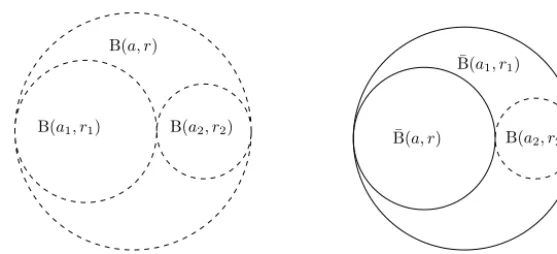
Thefollowingtwoelementarylemmasare essentiallythose usedin[6,10], butincludingsomeadditional information distilledfromtheoriginal proofs.These lemmasare summarisedinFig. 1. Inthefirstlemma, weallowforthelinesegmenttobe degenerate.
Lemma3.2.Leta1,a2∈Candr1,r2>0.Thenthereexistsauniquepair(a,r)∈C×R+withrminimalsuch
thatB(a1,r1)∪B(a2,r2)⊆B(a,r).Moreover,aliesonthelinesegmentjoininga1 anda2.Supposefurther
Fig. 1.Elementary lemmas for combining and pulling in disks.
Fig. 2.Extreme cases in the combining and pulling in lemmas.
Lemma 3.3. Let a1,a2 ∈ C and r1 > r2 > 0 with B(a¯ 2,r2) B(a1,r1). Then there exists a unique pair
(a,r) ∈ C×R+ with B(a,¯ r) ⊆ B(a¯ 1,r1) and B(a2,r2)∩B(a,¯ r) = ∅ such that r is maximal. Moreover, r≥r1−r2 andequalityholds ifandonly if B(a2,r2)⊆B(a1,r1).
Thecasesinwhichequalityholds inLemmas 3.2 and3.3areillustratedinFig. 2.
4. ClassicalisationofSwisscheeses
We aim to give a topological proof of the Feinstein–Heath classicalisation theorem (Theorem 4.1), as described intheintroduction,statedbelowinthelanguageofabstractSwisscheeses.
Theorem 4.1. LetA= ((an,rn))be anabstract Swiss cheesewith δ1(A)>0. Thenthere existsa classical,
abstract SwisscheeseB ∈ F such thatXB⊆XA and δ1(B)≥δ1(A).
Wewill seebelowthatitisenoughto provethis theoremforabstract Swisscheeses where some redun-dancyhasbeeneliminated,asthegeneralcasethenfollows.Wefirstintroducethefollowingterminology.
Definition 4.2.LetA= ((an,rn)) beanabstract Swisscheese.ThenAisredundancy-free if,forallk∈SA,
we haveB(ak,rk)∩B(a¯ 0,r0)=∅,andforall∈SAwith k=wehaveB(ak,rk)B(a,r).
[image:6.561.126.405.225.352.2]Lemma 4.3. Let A = ((an,rn)) ∈ F with ρ(A) < ∞. Then there exists a redundancy-free abstract Swiss
cheeseB = ((bn,sn))∈ N withXB =XA,μ(B)<∞ andB(b¯ 0,s0)= ¯B(a0,r0) suchthat ρE(B)≤ρE(A)
foreach subsetE⊆C.Inparticular, ρ(B)≤ρ(A).
Note that,sinceB(b¯ 0,s0)= ¯B(a0,r0) and ρ(B)≤ρ(A) in theabovelemma wehaveδ1(B)≥δ1(A),as
we claimed before. It is clear, byLemma 4.3, thatto prove Theorem 4.1 it is enoughto consider A such thatδ1(A)>0 andAisredundancy-free.
We now define arelation onF which will helpus to construct acompact subsetof F.Then we prove theexistenceofclassicalabstract Swisscheeses withdesiredpropertiesinthiscompactsubset.
Definition4.4.LetA= ((an,rn)) andB= ((bn,sn)) beabstractSwisscheeses.WesayB ispartiallyabove
AifB(b¯ 0,s0)⊆B(a¯ 0,r0),and,foreachn∈N,eitherB(an,rn)⊆C\B(b¯ 0,s0),or thereexists m∈Nsuch
thatB(an,rn)⊆B(bm,sm),orboth.
ItisclearthatAispartiallyaboveitselfandthatifB ispartiallyaboveA,then XB⊆XA.
Fix aredundancy-free abstract Swiss cheeseA= ((an,rn))∈ N with δ1(A)>0.Note that ρ(A) <∞
and,sinceAisredundancy-free, μ(A)<∞.WesetR=ρ(A) andM =μ(A).
LetS(A) bethecollectionofallB = ((bn,sn))∈ N(M,R) suchthatB ispartiallyaboveA.Recallthat,
sinceB∈ N(M,R),wehavesn≤R/nforalln∈SB sothat
n≤ R
rn
(n∈SB). (4)
ByourconditionsonAitisclearthatA∈ S(A).Wenow provethatS(A) iscompact.
Lemma4.5. The setS(A) isacompactsubsetof F.
Proof. Asnotedearlier,itisenoughtoprovethatS(A) isclosedinN(M,R) andthatthe0-thcoordinate projection is bounded on S(A). The latter is clearfrom the definitionof S(A), so we provethat S(A) is closedinN(M,R).
For each m ∈ N0, letA(m) = ((a(nm),rn(m)))∞n=0 be an abstract Swiss cheese inS(A), and suppose the
sequence(A(m)) convergestoB = ((b
n,sn))∈ N(M,R).ItremainstoshowthatB ispartiallyaboveA.
Itiseasytosee(byLemma 3.1,forexample)thatB(b¯ 0,s0)⊆B(a¯ 0,r0).Fixk∈N.Weshowthateither
B(ak,rk)⊆ C\B(b¯ 0,s0) or there exists ∈ SB with B(ak,rk)⊆ B(b,s). If rk = 0 then B(ak,rk) = ∅
and the result is trivial, so we may assume that k ∈ SA. First assume that there exists n0 ∈ N0 such
that,for all m≥n0 we haveB(ak,rk)⊆C\B(a¯ (0m),r (m)
0 ).Then we have |ak−a0(m)| ≥rk +r(0m) for all
m ≥ n0 by Lemma 3.1. Letting m → ∞, we obtain |ak−a0| ≥ rk+r0, and so, by Lemma 3.1 again,
B(ak,rk)⊆C\B(b¯ 0,s0).
Otherwiseforeachn0∈N0,there existm≥n0 andm∈Nsuchthat
B(ak, rk)⊆B(a (m) m , r
(m)
m ). (5)
By passing to a subsequence of A(m) if necessary, we canassume (5) holds for all m ∈ N
0. For each m,
since r(mm) ≥ rk, by (4) we have m ≤ R/rk. Thus there must be a p ∈ N thatappears infinitely many
timesinthesequence(m)m.Passingtoasubsequenceagainifnecessary,wemayassumem=pforallm.
SinceA(m)→B asm→ ∞and B(a
k,rk)⊆B(a(pm),rp(m)),itisagaineasyto show,usingLemma 3.1,that
Since δ1 isupper semicontinuousand S(A) is compactand non-empty,δ1 attains amaximum valueon
S(A) andthisvalueisatleastδ1(A)>0.Let
S1:={A ∈ S(A) :δ1(A) = sup B∈S(A)
δ1(B)},
whichisalso compactandnon-empty.
Lemma 4.6.LetB = ((bn,sn))∈ S(A).
(a) Supposethatk,∈SB withk=suchthatB(b¯ k,sk)∩B(b¯ ,s)=∅.IfwehaveB(bk,sk)∩B(b,s)=∅
then there exists B ∈ S(A) such that δ1(B) > δ1(B). Otherwise, there exists B ∈ S(A) such that
δ1(B)=δ1(B)andδ2(B)< δ2(B).
(b) Supposethat k∈SB with sk< s0 suchthat B(b¯ k,sk)B(b0,s0).If wehave B(bk,sk)B(b0,s0)then
thereexistsB∈ S(A)suchthatδ1(B)> δ1(B).Otherwise,thereexistsB∈ S(A)withδ1(B)=δ1(B)
andδ2(B)< δ2(B).
Proof. (a)LetB(b,s) betheopendiskobtainedbyapplyingLemma 3.2tothedisksB(bk,sk) andB(b,s).
LetB = ((bn,sn)) beobtainedbyreplacing thedisksB(bk,sk) andB(b,s) byB(b,s).
IfB(bk,sk)∩B(b,s)=∅thenwehaves< sk+sandsoδ1(B)> δ1(B).Otherwise,wehaves=sk+s
and hences2> s2
k+s2.Inthis case,wehaveδ1(B)=δ1(B) andδ2(B)< δ2(B).
We nowshow thatB∈ S(A). ClearlyB ∈ N by ourdefinitionofreplacing disksinanabstract Swiss cheese. Since b lies on the line segment connecting bk and b, it follows that μ(B) ≤ μ(B) and since
s≤sk+s wehaveρ(B)≤ρ(B).ThusB ∈ N(M,R).ItremainstoshowthatB ispartially aboveA.
We haveB(b¯ 0,s0)= ¯B(b0,s0) sothatB(b¯ 0,s0)⊆B(a0,r0).Fixp∈N.Since B is partiallyaboveA, we
haveB(ap,rp)⊆B(bm,sm) forsomem∈SBorB(ap,rp)⊆C\B(b¯ 0,s0).IfB(ap,rp)⊆C\B(b¯ 0,s0) thenwe
also haveB(ap,rp)⊆C\B(b¯ 0,s0).Otherwise,letm∈SB withB(ap,rp)⊆B(bm,sm).Ifm=kor m=,
then, withq astheindex where B(b,s) wasinserted,we haveB(ap,rp)⊆B(bq,sq). Ifm=k,,thenthere
exists q∈SB suchthatB(bq,sq)= B(bm,sm). ThusB(ap,rp)⊆B(bq,sq). HenceB is partially aboveA,
and soB ∈ S(A) asrequired.
(b) LetB(b,¯ s) bethecloseddisk obtainedbyapplying Lemma 3.3to thedisks B(b0,s0) and B(bk,sk).
Let B = ((bn,sn)) be the abstract Swiss cheese obtained by deleting the disks at indices 0 and k and insertingthediskB(b,¯ s) atindex 0.
IfB(bk,sk)B(b0,s0) thenwehaves> s0−sk so thatδ1(B)> δ1(B).Otherwise,wehaves0=s+sk
and s2
0> s2+s2k sothatδ1(B)=δ1(B) andδ2(B)< δ2(B).
TheproofthatB∈ S(A) issimilartotheproof inpart(a). 2
Wearenow readytoprovethemainresultsofthissection.
Theorem 4.7.All abstractSwiss cheesesin S1 aresemiclassical.
Proof. LetB = ((bn,sn))∈ S1.SupposeforcontradictionthatBisnotasemiclassicalabstractSwisscheese.
Consider firstthecasewhere there are distinctk,∈SB with B(bk,sk)∩B(b,s)=∅. ByLemma 4.6(a)
there existsB ∈ S(A) withδ1(B)> δ1(B),whichisacontradiction.
Theremainingcaseiswherethere isak∈SB withB(bk,sk)B(b0,s0).Wehaveδ1(B)≥δ1(A)>0 so
thatsk < s0.ByLemma 4.6(b)thereexistsB ∈ S(A) withδ1(B)> δ1(B),whichisacontradiction. 2
Since S1iscompactand non-empty,δ2 attainsbothmaximumand minimumvaluesonS1.Let
S2:={A∈ S1:δ2(A) = inf B∈S1
Fig. 3.The two cases in the proof ofTheorem 4.9.
whichisagainnon-emptyandcompact.Sincealltheabstract SwisscheesesinS1aresemiclassical,πδ2(B)
istheareaofXB forallB∈ S1,andhenceforallB ∈ S2.SotheabstractSwisscheesesinS2areobtained
byfindingthoseB∈ S1forwhichtheareaofXB is minimalonS1.
Theorem4.8. All abstractSwiss cheesesinS2 are classical.
Proof. Let B = ((bn,sn)) ∈ S2. Suppose for contradiction that B is not classical. If there are distinct
k, ∈ SB with B(b¯ k,sk)∩B(b¯ ,s) =∅ then, by Lemma 4.6(a), there exists B ∈ S(A) suchthat either
δ1(B) > δ1(B) or δ1(B) = δ1(B) and δ2(B) < δ2(B). In either case we obtain a contradiction since
B∈ S2.
Otherwise there exists k ∈ SB with B(b¯ k,sk) B(b0,s0). Note that sk < s0 since δ1(B) > 0. By
Lemma 4.6(b)thereexistsB∈ S(A) suchthateitherδ1(B)> δ1(B) orδ1(B)=δ1(B) andδ2(B)< δ2(B).
Ineithercaseweobtainacontradiction sinceB ∈ S2. 2
Inthenexttheorem,we showthatifXA hasemptyinteriorthen wedonothaveto minimise δ2on S1
tofindclassicalabstract Swisscheeses.
Theorem4.9. If intXA=∅theneach abstractSwiss cheesein S1 isclassical.
Proof. LetB= ((bn,sn))∈ S1.Then,byTheorem 4.7,Bissemiclassical.SupposeforcontradictionthatB
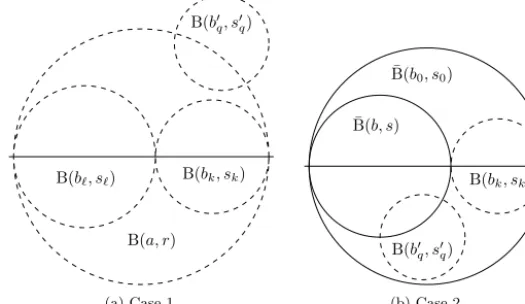
isnotclassical.ThentherearetwocasessummarisedinFig. 3.Firstsupposethere existdistinctk,∈SB
withB(b¯ k,sk)∩B(b¯ ,s)=∅.ThenbyLemma 3.2,sinceB(bk,sk)∩B(b,s)=∅,thereexists anopendisk
B(a,r)⊇B(bk,sk)∪B(b,s) withr=sk+s.ByreplacingthedisksB(bk,sk) andB(b,s) withB(a,r) we
obtainanewabstract Swiss cheeseB = ((bn,sn)) such thatB ∈ S1 (following theproof ofLemma 4.6).
LetpbetheindexatwhichthediskB(a,r) wasinserted.SinceXB hasemptyinterior,thereexistsm∈SB
with m=psuchthatB(a,r)∩B(bm,sm)=∅.Letq∈SB be suchthatB(bq,sq)= B(bm,sm).Note that
p=q. ApplyingLemma 4.6(a)to p,q∈SB andB, weobtainanabstract SwisscheeseB∈ S(A) which
hasδ1(B)> δ1(B).Butthisisacontradiction.
Now suppose thereexists k ∈SB with B(b¯ k,sk)B(b0,s0).Let B(b,¯ s) be theclosed diskobtained by
applyingLemma 3.3tothedisksB(b¯ 0,s0) andB(bk,sk).SinceB issemiclassical,wehaves=s0−sk (asin Fig. 2b).Bydeletingthedisksatindices0 andkandinsertingB(b,s) atindex0,weobtainanewabstract Swiss cheese B = ((bn,sn)) ∈ S1 such that δ1(B) = δ1(B) (again following the proof of Lemma 4.6).
Since XB hasempty interior, there exists q ∈SB suchthat B(bq,sq)B(b,¯ s). Applying Lemma 4.6(b)
to q and B, we obtain an abstract Swiss cheese B ∈ S(A) which has δ1(B) > δ1(B). But this is a
LetBbeanabstractSwisscheesesatisfyingδ1(B)>0,sothatBsatisfiestheconditionsofTheorem 4.1.
Then we canapply Lemma 4.3to obtain aredundancy-freeabstract Swiss cheeseA∈ N with XA=XB
and such that δ1(A) ≥ δ1(B). We can then apply the above constructions to A. Each abstract Swiss
cheeseA from thecorresponding non-empty setS2 is classicalbyTheorem 4.8and hasXA ⊆XA =XB
and δ1(A) ≥δ1(A) ≥δ1(B). So we obtain theFeinstein–Heath classicalisation theorem as acorollary of
Theorem 4.8.
5. Controlledclassicalisation
InthissectionwediscusssomesituationsinwhichitispossibletomakeaSwisscheeseclassicalwithout changingcertain disks.Thisprocesswe call“controlledclassicalisation”.
Recallthat,forE⊆CandanabstractSwisscheeseA= ((an,rn)),thesetHA(E) isthesetofalln∈SA
suchthatB(a¯ n,rn)∩E =∅.
Lemma5.1. Let U be anon-empty open subset of C.Foreach m∈N0,letA(m)= ((a(nm),r(nm)))∈ F and
suppose that A(m)→A= ((a
n,rn))∈ F asm→ ∞.ThenρU(A)≤lim infm→∞ρU(A(m)).
Proof. SinceU isopenand A(m)→Aas m→ ∞,foreachk∈HA(U) thereexistsm0∈N0suchthat,for
allm≥m0, wehavek∈SA(m) and
¯
B(ak(m), rk(m))∩U =∅.
Let χm denote the characteristic function of HA(m)(U)∩HA(U). Then χm converges pointwise to the
function χ:=χHA(U) as m→ ∞. Sincerk(m)→rk asm→ ∞for eachk, byFatou’slemma forseries, we
have
ρU(A) = ∞
n=1
χ(n)rn≤lim inf
m→∞
∞
n=1
χm(n)r(nm)≤lim infm→∞ ρU(A(m)),
as required. 2
For the rest of this section A = ((an,rn)) ∈ N will be a fixed redundancy-free abstract Swiss cheese.
Note thatboth ρ(A) andμ(A) arefinite andrn≤ρ(A)/nforalln∈N.Wedefinethe(classical) errorset
of Ato be
E(A) :=
m,n∈SA m=n
¯
B(am, rm)∩B(a¯ n, rn)
∪
n∈SA
((C\B(a0, r0))∩B(a¯ n, rn)).
Note that if E(A) ⊆ B(a0,r0) then B(a¯ n,rn) ⊆ B(a0,r0) for all n ∈ SA. We aim to prove that, under
suitableconditions,wecanclassicaliseA whileleavingmanyof theopen disksunchanged.
AsinSection4,weseektoconstructacompactsubsetofF onwhichthefunctionδ1 canbemaximised
and thenthefunctionδ2 minimisedtogiveasuitableclassicalabstractSwisscheese.
In the rest of this paper, we will frequently need to consider indexed collections of pairsof sets of the followingform.LetI⊆Nbenon-empty.LetC= ((Kn,Un))n∈I,whereeachKn isacompactplanesetand
each Un is anopenset with Kn ⊆Un.We callsuch anindexed collectionacontrolling collection of pairs.
Definition5.2. LetC= ((Kn,Un))n∈I beacontrollingcollectionofpairs.Define
V(C) :=
n∈I
Un, F(C) :=
n∈I
Kn.
LetLA(C) denotethesetofallB= ((bn,sn))∈ N(μ(A),ρ(A)) suchthat:
(a) foreach(K,U)∈ C wehaveρU(B)≤ρU(A);
(b) ¯B(b0,s0)= ¯B(a0,r0);
(c) forallk∈SA withB(a¯ k,rk)∩V(C)=∅there exists∈SB suchthatB(b,s)= B(ak,rk);
(d) for eachn∈Iand forallk∈SA withB(a¯ k,rk)∩Un =∅:
(i) thereexists ∈SB withB(b,s)= B(ak,rk);or
(ii) thereexists ∈HB(Kn) withB(ak,rk)⊆B(b,s).
NotethatA∈ LA(C),andifB∈ LA(C) thenB ispartiallyaboveA.ThusifB∈ LA(C) thenXB⊆XA.
Theproperties (a)–(d)reflectthe propertieswedesirefor thefinal abstract Swiss cheese.Wewill use the opensetsU toboundtheerrorsetE(A).Undersometechnicalassumptions,conditions(c)and(d)ensure thatabstractSwisscheesesmaximisingδ1inLA(C) havethepropertythatanyopendiskwhichliesoutside
V(C) isthesameasanopen diskfromA.
We first require some preliminary lemmas. The following lemma is probably well-known and can be provedusing aHausdorffmetricargument,butwe includeanelementaryprooffor theconvenience ofthe reader.
Lemma 5.3. LetK bea compactplane set. Let(zn)be a sequencein C,andlet (tn) be asequencein R+.
Supposethat B(z¯ n,tn)∩K=∅foralln,andthatzn →z andtn →t asn→ ∞.ThenB(z,¯ t)∩K=∅.
Proof. Foreachn∈N0thereexistsapointwn∈B(z¯ n,tn)∩K.Nowsince(wn) isasequenceinKthereis
aconvergentsubsequence(wnk) convergingtoapointw∈K.Foreachk∈N0, wehavewnk∈B(z¯ nk,tnk)
so that|wnk−znk|≤tnk.Hence,taking thelimitas k→ ∞, wehave|w−z|≤t sothatw∈B(z,¯ t)∩K
asrequired. 2
Wenow provethatthespaceLA(C) isacompactsubspaceof F foran arbitrarycountablecollectionC
ofpairs(K,U) whereK isacompactplanesetandU anopenneighbourhoodofK.
Lemma5.4.LetC:= ((Kn,Un))n∈I beacontrollingcollectionofpairs.ThenthesetLA(C)⊆ F iscompact.
Proof. It is sufficientto show thatLA(C) isclosed inN(μ(A),ρ(A)),since the0-thcoordinate projection
is clearlybounded on LA(C). For eachm∈N0, letA(m)= ((an(m),r(nm)))∞n=0 ∈ LA(C). LetB = ((bn,sn))
andsuppose thatA(m)→B ∈ N(μ(A),ρ(A)) asm→ ∞;we needtoshowthatB∈ LA(C).
ByLemma 5.1wesee thatB alsosatisfies (a),anditisimmediatethat(b)isalsosatisfied.
It remains to prove (c) and (d) hold for B. Fix k ∈ SA. Suppose that B(a¯ k,rk)∩V(C) = ∅. Since,
for each m ∈ N0, we haveA(m) ∈ LA(C) it follows that for each m there exists an integerm such that
B(ak,rk)= B(a(mm),r (m)
m ). Nowsincer (m)
k =rk foreachm wehave1≤m≤ρ(A)/rk forallm.Butthen
there mustexistaninteger1≤p≤ρ(A)/rk suchthatk=pinfinitelyoftensowecanfindasubsequence
(A(mj))
j suchthatmj =pfor allj.SinceB(ak,rk)= B(a (mj)
k ,r
(mj)
k ) forallj andA(mj)→B as j → ∞,
itfollowsthatB(ak,rk)= B(bp,sp).Thisprovesthat(c)holdsforB.
Now suppose that B(a¯ k,rk)∩U =∅ for some(K,U) ∈ C. As above,for each m ∈N0 there exists an
integerm suchthatB(ak,rk)⊆B(a(mm),r (m) m ) and r
(m)
m ≥rk.Wechoosem as follows:if inA
(m) thereis
to be theindexof anopendisk B(a,r) that properlycontainsB(ak,rk) andB(a,¯ r)∩F(C)=∅.Hencewe
have1≤m≤ρ(A)/rk forallmandsothereexistsaninteger1≤p≤ρ(A)/rk suchthatm=pinfinitely
often. By considering a subsequence we can assume thatm = p for all m. If B(a(pm),rp(m)) = B(ak,rk)
holds forinfinitely manymthen thereis asubsequence(A(mj))
j such thatB(ak,rk)= B(ap(mj),r(pmj)) for
allj. SinceA(mj)→B asj → ∞itfollowsthatB(a
k,rk)= B(bp,sp).IfB(ak,rk)= B(a(pm),r(pm)) foronly
finitely manymthenwemusthave
B(ak, rk)⊆B(ap(m), rp(m)) and B(a¯ (pm), rp(m))∩K=∅
for infinitelymanym.Then thereexists asubsequence(A(mj))
j suchthatB(ak,rk)⊆B(ap(mj),r(pmj)) and
¯ B(a(mj)
p ,r(pmj))∩K = ∅for all j. But then B(ak,rk) ⊆B(bp,sp) and, by Lemma 5.3, B(b¯ p,sp)∩K =∅.
This provesthat(d)holdsforB.
Thuswe haveprovedthatB ∈ LA(C) andhenceLA(C) iscompact. 2
WeareinterestedinthoseabstractSwisscheesesBinaspaceLA(C) onwhichthediscrepancyfunctionδ1
ismaximised.Theseabstract Swisscheeseshavesomedesirableproperties.LetL∗A(C) denotethesubsetof
LA(C) ofallabstractSwisscheeseswhereδ1achievesitsmaximum.SinceLA(C) isnon-emptyandcompact,
L∗
A(C) isnon-emptyandcompact. RecallthatA∈ N isassumed toberedundancy-free.
Lemma 5.5. Let C:= ((Kn,Un))n∈I be a controlling collection of pairs. LetB = ((bn,sn))∈ L∗A(C).Then
B has thefollowingproperties.
(a) Forallk,∈SB withk=,wehaveB(bk,sk)= B(b,s).
(b) Foreach k∈SB,there exists∈SA suchthat B(a,r)⊆B(bk,sk).Moreover, ifB(b¯ k,sk)∩F(C)=∅
then this∈SA isunique,andwe haveB(bk,sk)= B(a,r).
(c) Let E be a fixed subset of C.Let H1 :=HB(E)\HB(V(C))and let H2 :=HA(E)\HA(V(C)).There
existsabijection σ:H1→H2 satisfying thefollowingcondition: foreachk∈H1 and∈H2,we have
σ(k)= if andonlyif B(bk,sk)= B(a,s).In particular,
n∈H1
sn =
n∈H2
rn.
Proof. (a) If k, ∈ SB with k = such thatB(bk,sk) = B(b,s) then we canobtain an abstract Swiss
cheeseBbydeletingthediskatindexwhichhasδ1(B)> δ1(B).ItiseasytoseethatB ∈ LA(C),which
is acontradiction.
(b) Letk∈SB.Assume, forcontradiction,there doesnotexist ∈SA suchthatB(a,r)⊆B(bk,sk).
Then wecandeletethediskatindexkfrom B toobtainanabstract SwisscheeseB withδ1(B)> δ1(B).
It isclearthatB ∈ LA(C),whichcontradicts themaximalityofδ1(B).Thusthere exists∈SA suchthat
B(a,r)⊆B(bk,sk).
Now suppose, in addition, that B(b¯ k,sk)∩F(C) = ∅. We show that the ∈ SA found above with
B(a,r) ⊆ B(bk,sk) is unique and that we have B(a,r) = B(bk,sk). Assume, for contradiction, that
B(a,r)= B(bk,sk).Then,sinceAisredundancy-free,wemusthaveB(am,rm)= B(bk,sk) forallm∈SA.
WeclaimthattheabstractSwisscheeseBobtainedbydeletingthediskatindexkfromB hasB∈ LA(C);
this willleadtoacontradiction.
ClearlyB ∈ N(μ(A),ρ(A)) anditisalsoclearthatBsatisfiesconditions(a)and(b)ofDefinition 5.2(a). Since B(am,rm) = B(bk,sk) for all m ∈ SA, it follows that 5.2(c) remains true for B. Similarly, since
¯
B(bk,sk)∩F(C)=∅,5.2(d)remainstrueforB.This provesourclaim.
But now δ1(B) > δ1(B), which contradicts the maximality of δ1(B). Thus B(a,r) = B(bk,sk). The
(c) Note thatif,for somek∈SB and ∈SA, B(bk,sk)= B(a,r) thenk∈H1 ifand onlyif ∈H2.
Combining this with (b), for each k ∈ H1 there exists a unique ∈ H2 such that B(bk,sk) = B(a,r).
Thuswe maydefine σ(k)= forsuchk,. Wemust showthatσ isabijection. By(a),σ isinjective. Let ∈ H2. By5.2(c), there exists k∈ SB with B(bk,sk)= B(a,r). Bythe remark above,k ∈ H1, and so
σ(k)=.Thisprovesthatσissurjective.Itisnowimmediatethatn∈H1sn =n∈H2rn.Thiscompletes
theproof. 2
We shall see that by imposing some additional technical conditions on C we can obtain a controlled classicalisationtheorem.Recall thatifE ⊆Cis non-emptyand z∈Cthen wedefine thedistance ofz to E bydist(z,E):= inf{|z−x|:x∈E}.Foranon-emptycompact setK ⊆CandpositiverealnumberM wedefineU(K,M):={z∈C: dist(z,K)< M}.
Lemma5.6.LetI⊆Nbenon-empty.Let(Kn)n∈I beacollectionofcompactplanesetsandlet(Mn)n∈I bea
collectionof positiverealnumbers.Foreachn∈I,letUn:=U(Kn,Mn).Supposethat ρUk(A)< Mk/2and
Uk ⊆B(a0,r0)forallk∈I andsuppose that Uk∩U=∅foralldistinct k,∈I.LetC be thecontrolling
collection ((Kn,Un))n∈I. Let B = ((bn,sn)) ∈ LA(C) and fix m ∈ I. Suppose there exist k, ∈ SB with
k= suchthat B(b¯ k,sk)∩Km=∅andB(b¯ k,sk)∩B(b¯ ,s)=∅.Then there existsB ∈ LA(C) suchthat
either δ1(B)> δ1(B)orδ1(B)=δ1(B)andδ2(B)< δ2(B).
Proof. LetB(b,s) bethediskobtainedbytheapplicationofLemma 3.2tothedisksB(bk,sk) andB(b,s).
LetB = ((bn,sn)) beanabstractSwisscheeseobtainedfromB byreplacingthedisksat indicesk,with thediskB(b,s).SinceB∈ LA(C) wehaveρUm(B)≤ρUm(A)< Mm/2,so thats≤sk+s< Mm/2.Since
¯
B(bk,sk)∩Km= ∅,wemusthaveB(b,¯ s)⊆Um andhenceB(b,¯ s)∩Un=∅foralln∈Iwithn=m.
Itisclearthateitherδ1(B)> δ1(B),whens< sk+s,orwehaveδ1(B)=δ1(B) andδ2(B)< δ2(B),
when s =sk +s, so it remainsto show thatB ∈ LA(C). Byconstruction, and since B(b,¯ s)⊆ Um and
¯
B(b,s)∩Un =∅forn∈Iwithn=m,wehaveB ∈ N(μ(A),ρ(A)) andsatisfies(a)and(b)inDefinition 5.2.
Fix j ∈ SA. If B(a¯ j,rj)∩V(C)= ∅, then there exists p∈ SB with p= k, and B(bp,sp) = B(aj,rj).
Hencethereisap∈SB suchthatB(bp,sp)= B(aj,rj) andB satisfies(c)inDefinition 5.2.
Suppose that B(a¯ j,rj)∩V(C) = ∅. Let n ∈ I such thatB(a¯ j,rj)∩Un = ∅. Since B ∈ LA(C), there
exists p∈SB such thatB(aj,rj)⊆B(bp,sp), where equalityholds unless B(b¯ p,sp)∩Kn =∅. Ifp=k,,
then there exists q∈ SB such thatB(bq,sq)= B(bp,sp). ThusB(aj,rj)⊆B(bq,sq) andequality holds if
¯
B(bq,bq)∩Kn =∅. Ifn =m then wecannot have p=k or p= sinceB(b,¯ s)⊆Um and Un∩Um =∅.
If n = m and either p = k or p = , then there exists q ∈ SB such that B(bq,sq) = B(b,s), so that B(aj,rj)⊆B(bq,sq) andB(b¯ q,sq)∩Kn =∅.Moreover,B(b¯ q,sq)∩Ui=∅foralli∈I withi=m.Itfollows
thatB satisfies5.2(d)andhenceB ∈ LA(C).This completestheproof. 2
Similar geometric reasoning and induction shows that, under the conditions of the lemma, given n1,. . . ,np∈SAand m∈I suchthat
¯
B(an1, rn1)∩Km=∅ and B(a¯ nj−1, rnj−1)∩B(a¯ nj, rnj)=∅
forj= 2,. . . ,pwehaveB(b¯ nj,rnj)⊆Umforeachj= 1,. . . ,p.
Wearenowreadyto provethecontrolledclassicalisationtheorem.
Theorem5.7. LetI⊆Nbenon-empty. Let(Kn)n∈I be acollection ofcompact plane setsand let(Mn)n∈I
bea collectionof positivereal numbers.Foreach n∈I,let Un:=U(Kn,Mn).Supposethat Uk⊆B(a0,r0)
and ρUk(A) < Mk/2 for all k ∈ I and suppose that Uk ∩U = ∅ for all distinct k, ∈ I. Let C be the
controlling collection ((Kn,Un))n∈I and suppose E(A)⊆F(C). Then there existsB = ((bn,sn))∈ L∗A(C)
Proof. WeknowthatL∗A(C) isnon-emptyandcompactsoδ2obtainsitsminimumonL∗A(C).LetB∈ L∗A(C)
such thatδ2 isminimised on L∗A(C) at B. We first show thatB(b¯ k,sk)⊆ B(b0,s0) forall k∈ SB. Let C
be the complement of the disk B(a0,r0) = B(b0,s0). Let k ∈ SB and assume, for contradiction, that
C∩B(b¯ k,sk)=∅.Ifthereexists u∈SAsuchthatB(au,ru)= B(bk,sk) then
∅ = ¯B(bk, sk)∩C= ¯B(au, ru)∩C⊆C∩E(A) =∅,
which is impossible. Otherwise, by Lemma 5.5, there exists u ∈ SA with B(au,ru) ⊆ B(bk,sk). Since
B ∈ L∗A(C),itfollowsthatthere existsm∈IsuchthatB(b¯ k,sk)∩Km=∅,and so
¯
B(bk, sk)⊆Um⊆B(a0, r0) = B(b0, s0),
whichcontradicts thefactthatC∩B(b¯ k,sk)=∅.
Wemustnowshowthattheredonotexistdistinctk,∈SBsuchthatB(b¯ k,sk)∩B(b¯ ,s)=∅.Suppose,
for contradiction,thatsuchapairexists.IfB(b¯ k,sk)∩F(C)=∅andB(b¯ ,s)∩F(C)=∅then thereexist
u,v∈SA withB(au,ru)= B(bk,sk) andB(av,rv)= B(b,s),whichisacontradictionsinceE(A)⊆F(C).
Thus atleastoneof thesediskshasnon-emptyintersectionwithatleastonecompactsetKm.
We mayassume, without loss of generality, that B(bk,sk)∩Km = ∅ for some m ∈ I. It follows that
sk,s < Mm/2 andB(b¯ k,sk)⊆Um and B(b¯ ,s)∩Um = ∅. Let B(b,s) be theopen disk obtainedby an
applicationofLemma 3.2tothedisksB(bk,sk) andB(b,s).Then,byLemma 5.6,theabstractSwisscheese
B ∈ LA(C) obtainedbyreplacing thedisks B(bk,sk) andB(b,s) with B(b,s) has eitherδ1(B)> δ1(B)
or δ1(B) =δ1(B) and δ2(B) < δ2(B). Both of these casesare impossible since weassumed that δ1 was
maximised on B and δ2 was minimised on B. It follows that no such pair k, canexist and hence B is
classical.
It remains to show that XB \V(C) = XA \V(C). Since B ∈ LA(C), we have XB ⊆ XA, and so
XB\V(C)⊆XA\V(C).LetUA:= (C\XA)∪V(C) andUB := (C\XB)∪V(C).Letz∈UB,weshowthat
z ∈UA. If z is outsideof B(b¯ 0,s0) thenit is also outsideof B(a¯ 0,r0) since the closed balls are thesame.
If z is inB(b¯ 0,s0),there exists k∈SB suchthatz∈B(bk,sk).Note thatB(b¯ k,sk)∩F(C)=∅, otherwise
¯
B(bk,sk)⊆V(C). ByLemma 5.5, there exists ∈SA such thatB(a,r) = B(bk,sk). Thus z ∈ B(a,r)
and UB⊆UA.It followsthatC\UB⊇C\UA andhenceXB\V(C)=XA\V(C). 2
Note herethattheclassical,abstractSwisscheeseB obtainedfromthistheorem isanelement ofL∗A(C) and thereforesatisfies properties(a)–(d) of Definition 5.2, and the conclusionof Lemma 5.5 holds for B. Notealsothat,incontrasttotheFeinstein–Heathclassicalisationtheorem,δ1(B) maybenegativehere.We
canobtainsimilarresultsusingtransfiniteinduction.
Taking I to have just oneelement inTheorem 5.7, we obtainthe following corollary, whichwe usein Section8.
Corollary 5.8. Let K be a compact plane set and let M be a positive real number. Let U = U(K,M)
and let C be the controlling pair (K,U). Suppose that ρU(A) < M and E(A) ⊆ K. Then there exists
B = ((bn,sn))∈ L∗A(C) suchthatXB\U =XA\U andB is classical.
6. Annularclassicalisation
In this section we give some resultsabout Swiss cheese like sets obtainedby deleting open disks from a closed annulus, rather than a closed disk. Let K be a closed annulus in the plane. Then we can write K = ¯B(a0,r0)\B(a1,r1) for some a0 = a1 ∈ C and r0 > r1 > 0 real. We say an abstract Swiss cheese
A= ((an,rn)) is annular ifa0 =a1 and0< r1 < r0 and letKA denote theannulusB(a¯ 0,r0)\B(a1,r1).
Weshallusuallyomit‘abstract’from thestatementA isanannular abstractSwiss cheese.
Lemma6.1. Leta∈Candr0> r1>0andlet K:= ¯B(a,r0)\B(a,r1).Letb∈C and0< s<(r0−r1)/2
such that B(b,¯ s)∩C\K = ∅. Then there exist r0,r1 > 0 such that K := ¯B(a,r0)\B(a,r1) ⊆ K with
K∩B(b,s)=∅andr0−r1≥r0−r1−2s.
Proof. SetD = B(b,s).If D⊆C\K thenthere isnothingto proveso suppose not.Sinces<(r0−r1)/2
thereareonlytwo possiblecases.WemusthaveeitherD∩B(a,¯ r1)=∅or D∩C\B(a,r0)=∅.
Inthefirstcase, whereD¯∩B(a,¯ r1)=∅,letr0=r0 and r1 =|b−a|+s. Wehave|b−a|> r1−sand
|b−a|≤r1+s.Hencer1 > r1−s+s=r1 andr1≤r1+ 2s< r1+r0−r1=r0 and
r0−r1=r0−(|b−a|+s)≥r0−s−r1−s=r0−r1−2s.
Sinceforeachz∈D wehave|b−a|−s<|z−a|<|b−a|+sitfollows immediatelythatD⊆C\K. Inthesecond case,where D∩C\B(a,r0)=∅,letr0 =|b−a|−sandr1 =r1.Wehave|b−a|< r0+s
and|b−a|≥r0−s.Hencer0< r0+s−s=r0 and
r0 > r0−s−s > r0−(r0−r1) =r1
andso
r0−r1 =|b−a| −s−r1≥r0−r1−2s.
Similarly,for allz ∈D wehave|b−a|−s<|z−a|<|b−a|+sand so D⊆C\K.This completes the proof. 2
Definition6.2. Theannular radiussum functionρann:F →[0,∞] isdefinedby
ρann(A) := ∞
n=2
rn (A= ((an, rn))∈ F),
andtheannular discrepancyfunction δann:F →[−∞,∞) isgivenby
δann(A) =r0−r1−2ρann(A) (A= ((an, rn))∈ F).
Notethatifδann(B)>0 then r0> r1.WeaimtoproveananalogueoftheFeinstein–Heathclassicalisation
theorem(Theorem 4.1)forannularSwisscheeses byconstructingasuitablecompactsubsetofF.
ItiseasyforthereadertocheckthatthefollowinganalogueofLemma 4.3holdsforannularSwisscheeses.
Lemma6.3.LetAbeanannularSwisscheesewithρann(A)<∞.ThenthereexistsanannularSwisscheese
B = ((bn,sn)) with the following properties: ρann(B) ≤ρann(A), XB =XA and KB = KA; μ(B) < ∞;
the sequence (sn)n≥2 is non-increasing; for each j ∈ SB\ {1}, we have B(bj,sj)∩KB = ∅ and, for all
Note that,inthepreviouslemma,thepropertiesKB=KAand ρann(B)≤ρann(A) togetherimplythat
δann(B)≥δann(A).
For the rest of thissection, let A= ((an,rn)) bean annularSwiss cheese withδann(A)>0, suchthat
μ(A)<∞and (rn)∞n=2 isnon-increasing.
Lemma 6.4.LetA bethefamily ofallB= ((bn,sn))∈ F suchthat
(a) thesequence(sn)n≥2 isnon-increasing,
(b) ρann(B)≤ρann(A),
(c) μ(B)≤μ(A),
(d) B ispartiallyabove A,and
(e) b0=b1=a0,andr0≥s0≥s1≥r1.
Then A is compact in F, each abstract Swiss cheese B ∈ A with δann(B) > 0is annular. Moreover, the
function δann|A:A→Risuppersemicontinuousand thefunctionδ2|A:A→Ris continuous.
Proof. Itiseasytosee thatthefamilyAispointwiseboundedbyproperties(b),(c)and (e) soitremains only to prove that A is closed. For each m ∈ N0, let A(m) = ((a(nm),rn(m)))∞n=0 ∈ A and suppose that
A(m) → B ∈ F as m → ∞. It is clear that B satisfies (a)–(d) (as in the proof of Lemma 4.5). Since
convergence ispointwise,wehaveb0=a0 andb1=a1. SinceAwasannular,itfollowsthatb0=b1.
Since eachA(m)∈ Awehaver0≥r(0m)≥r (m)
1 ≥r1,bytakingm→ ∞wehave
r0≥s0≥s1≥r1.
HenceAisclosedand pointwiseboundedandisthereforecompact byTychonoff’stheorem.
Let B= ((bn,sn))∈ Awith δann(B)>0.Then wehaveb0=b1 and δann(B)>0 and thisimpliesthat
s0> s1 anditfollowsthatB isannular.
The proof thatδann is upper semicontinuous is animmediate consequence ofFatou’s lemma for series,
similar totheuppersemicontinuityofδ1.
To prove that the restriction of δ2 to A is continuous note that, for n ∈ N with n ≥ 2, we have
s2
n ≤ ρann(B)2/n2 for each B = ((bn,sn)) ∈ A. The resultthen follows from the dominated convergence
theorem asintheproofofLemma 2.4. 2
It is clear thatA ∈ A and so A is non-empty. Forall B ∈ A we also haveXB ⊆XA. We requireone
additionallemma beforeweprovethemain theorem.
Lemma 6.5. Let A be as in Lemma 6.4. Let B = ((bn,sn)) ∈ A be an annular Swiss cheese such that
δann(B)≥δann(A).Suppose there existsk∈SB\ {1} suchthat B(b¯ k,sk)∩C\KB =∅.Thenthere exists
B= ((bn,sn))∈ Awith δann(B)≥δann(B).Moreover, ifδann(B)=δann(B) thenδ2(B)< δ2(B).
Proof. We begin by setting b0 = b1 = b0. Then, as in Lemma 6.1, we can find s0 > s1 > 0 such that
KB := ¯B(b0,s0)\B(b1,s1)⊆KB,KB∩B(bk,sk)=∅and
s0−s1≥s0−s1−2sk.
Let b =b and s =s if2≤< k, b =b+1 ands =s+1 ifk < , weobtainanabstract Swisscheese
B= ((bn,sn)).
δann(B) =s0−s1−2 ∞
n=2
sn ≥s0−s1−2sk−2 ∞
n=2
sn+ 2sk =δann(B).
Sinces0≤s0 ands1≥s1wemust haveρann(B)≤ρann(B)≤ρann(A),so (b)issatisfied.
WenowshowthatBispartiallyaboveA.Fixj∈SA.IfB(aj,sj) liesinthecomplementofB(b0,s0),then
itliesinthecomplementof B(b0,s0) andifB(aj,sj)⊆B(b1,s1) thenB(aj,sj)⊆B(b1,s1).Supposethere
existsm∈SBsuchthatB(aj,sj)⊆B(bm,sm).Ifm=kthereexists∈SBsuchthatB(b,s)= B(bm,sm),
and soB(aj,sj)⊆B(b,s). Ifm=kthen eitherB(aj,rj)⊆B(b1,s1) orB(aj,sj) lies inthe complement
of B(b0,s0). It follows that B is partially above A, and satisfies 4 and hence B ∈ A. Since we have δann(B)≥δann(A)>0,itfollowsthatB isannular.
It remains to show that ifδann(B)= δann(B) then δ2(B)< δ2(B).Assume thatδann(B) =δann(B).
Theneithers0=s0+ 2sk ors1=s1+ 2sk.Inthefirstcasewe have(s0)2< s20−4s2k< s20−s2k andinthe
second casewe have(s1)2 > s2
1+s2k. Inthefirst casewehave s20>(s0)2+s2k, and inthesecond casewe
have(s1)2> s2
1+s2k.Ineithercase,wehaveδ2(B)< δ2(B).Thiscompletes theproof. 2
Notethat,asforarbitraryabstractSwisscheeses,ifBisasemiclassical,annularSwisscheesethenπδ2(B)
istheareaofXB.
Theorem6.6. LetAbe asinLemma6.4.Thenthereexistsaclassical,annularSwiss cheeseB= ((bn,sn))
in A such that δann(B) ≥ δann(A) and XB ⊆ XA. Moreover, we have r0−2ρann(A) ≤ s0 ≤ r0 and
r1≤s1≤r1+ 2ρann(A).
Proof. Since δann is upper semicontinuous on A and A is compact and non-empty, it follows that δann
achievesitsmaximumonA.LetA1denotethenon-empty,compactsubsetofAonwhichδannismaximised.
Thenδ2,whichiscontinuous onA1,achieves itsminimum.LetA2 denotethenon-empty,compact subset
ofA1 onwhichδ2 isminimisedandletB= ((bn,sn))∈ A2.
Sinceδann(B)≥δann(A)>0 itfollowsthatB isannularandXB⊆XA.Suppose,forcontradiction,that
B isnon-classical.There aretwopossiblecases.
Firstsupposethatthere arek,∈SB\ {1}withk > suchthatk,∈SB andB(b¯ k,sk)∩B(b¯ ,s)=∅.
Then,byLemma 3.2thereexist b∈Cand s>0 suchthat
B(bk, sk)∪B(b, s)⊆B(b, s)
ands≤sk+s.Let B= ((bn,sn)) betheabstract Swiss cheeseobtainedbydeletingthedisks atindices
k,from B andinsertingthedisk B(b,s) at thefirstindex inN\ {1}such that(sn)∞n=2 isnon-increasing. Itiseasyto seethatB∈ Aand
ρann(B)≥ρann(B)−sk−s+s=ρann(B), (6)
so that δann(B) ≥ δann(B). By the maximality of δann(B), equality must hold here and in (6). Thus
s=sk+sands2= (sk+s)2> s2k+s2 sothatδ2(B)< δ2(B).Thiscontradictstheminimalityofδ2(B).
Itfollows thatnosuchk,exist.
Now suppose there exists k ∈ SB\ {1}such that B(b¯ k,sk)∩C\KB = ∅and sk >0. By Lemma 6.5
thereexists anannularSwisscheeseB∈ Awithδann(B)≥δann(B) suchthat,ifδann(B)=δann(B) then
δ2(B)< δ2(B).Thisisacontradiction,sonosuchkcanexist.ItfollowsthatB isclassical.
SinceB∈ A,wehaver0≥s0≥s1≥r1.Wealsohave
s0−s1≥δann(B)≥δann(A) =r0−r1−2ρann(A)