How Much Collocation Knowledge Do L2 Learners Have?
The Effects of Frequency and Amount of Exposure
Abstract
Many scholars believe that collocations are difficult to learn and use by L2 learners.
However, some research suggests that learners often know more collocations than
commonly thought. This study tested 108 Spanish learners of English to measure
their productive knowledge of 50 collocations, which varied according to corpus
frequency, t-score, and MI score. The participants produced a mean score of 56.6% correct, suggesting that our learners knew a substantial number of collocations.
Knowledge of the collocations correlated moderately with corpus frequency (.45), but
also with everyday engagement with English outside the classroom, in activities like
reading, watching movies/TV, and social networking (composite correlation = .56).
Everyday engagement also had a stronger relationship with collocation knowledge
than years of English study (.45).
Introduction
It is now well established that formulaic language provides processing advantages
and is essential for using language fluently and idiomatically, both for native and
non-native speakers (for overviews, see Schmitt, 2004; Wray, 2002, 2008, and
Annual Review of Applied Linguistics 32, 2012). Further, it has been suggested that if second language learners aim to achieve nativelike mastery, they need to know
formulaic language and use it accurately and appropriately (Ellis et al. 2008; Nattinger & DeCarrico, 1992; Pawley & Syder, 1983). However, despite the
importance and value of learning such formulae, research has demonstrated that it is
a difficult aspect for even advanced L2 learners (Granger, 1998; Howarth, 1998;
Nesselhauf, 2003, 2005), and that their knowledge of formulaic sequences lags
behind their general language and vocabulary knowledge (Bahns and Eldaw, 1993;
Irujo, 1993). Hence, even though formulaic language has been found to be important
for the processing, production and acquisition of natural language, there are still
many questions about how formulaic language is acquired by L2 learners.
It has been proposed that extensive exposure is a key factor necessary for this
acquisition (Nattinger and DeCarrico, 1992; Durrant and Schmitt, 2010; Martinez and
Schmitt, 2012). Presumably this extensive exposure will largely be driven by the
frequency of each formulaic sequence in naturally-occurring language, with more
words respond to the effects of frequency, so that learners generally acquire
higher-frequency words before lower-higher-frequency ones (Nation and Waring 1997; Leech et al., 2001; Nation, 2001; Ellis, 2002). However, can this finding for single words also be applied to formulaic language, specifically collocations? Furthermore, although
frequency counts are currently derived from very large corpora such as the COCA
(Corpus of Contemporary American English – 450 million words (Davies, 2008)) or
the BNC (British National Corpus - 100m), no corpus can replicate the exposure any
individual person has, especially L2 learners. So the question remains whether the
approximate exposure information (i.e. frequency) available from corpora can
indicate learner knowledge of formulaic sequences. Perhaps an equally useful
predictor is the degree to which learners engage with and use the L2 (e.g. when
studying an L2, or using an L2 in social networking or watching films and television)?
This study will explore how both collocation frequency and measures of language
usage relate to knowledge of collocations by Spanish learners of English.
A Focus on Collocations
Approaches to Definition and Identification
Formulaic language consists of a number of different categories, each with their own
characteristics, behaviors, and problems, such as idioms, lexical bundles, phrasal
verbs, and phrasal expressions. But perhaps the most studied category in applied
linguistics is collocation.1 Collocation refers to the idea of lexical patterning, and
co-occur in discourse”. Broad definitions of collocation such as this have been
operationalized through two main approaches. The first is phraseological, where
collocations are seen as word combinations with various degrees of fixedness (e.g.
Cowie, 1998). The second more common approach is statistical, where various
formulas are used to search corpora and identify the words which pattern together
(e.g. Sinclair, 2004).
However, different statistics can identify quite different sets of collocations, although
there will always be some overlap. Three commonly used statistical measures are
frequency, t-score, and MI. Frequency of occurrence in a corpus identifies collocations which are common and are often meaningful across a wide range of
contexts (e.g. last night - 17,214 instances in the COCA, long ago – 8,455, hard work
– 4,763). T-score weights frequency highly in its calculations, and so also identifies
collocations which are frequent in use. MI identifies collocations which are typically not very frequent, but which have a particularly strong bonding when they do occur
(e.g. commit suicide, resist temptation). Unfortunately, it is not clear which of these (or other) measures is the best to use in research, and to date, the selection of one
or another seems to be somewhat arbitrary. Knowing how these methods relate to
learner knowledge might be helpful for researchers when selecting a method.
L2 Knowledge and Use of Collocations
Formulaic language in general is widely employed by native-speakers, and provides
Linguistics 32, 2012). The same is true for collocations more specifically, and it seems clear that knowledge of collocations can greatly benefit second language
learners in their attempts to achieve high proficiency in an L2. Indeed, lack of
collocation knowledge has been shown to be problematic. Receptively, this lack can
lead to miscomprehension (Martinez and Murphy, 2011).2 Productively, the lack of
use of collocations, as well as the over-, under- or mis-use of them, lead to L2
speakers being judged as odd, unnatural or non-nativelike (e.g. Granger, Paquot, &
Rayson, 2006; Barfield & Gyllstad, 2009), while use of formulaic sequences is
related to higher ratings of learner proficiency (e.g. Boers, et al., 2006). Therefore, it is widely accepted that if L2 learners want to use language accurately and fluently,
they need to know and use collocations.
But how many collocations do L2 learners use, and how well? In recent decades,
research has begun to address these questions. Unsurprisingly, it has been shown
that knowledge of collocations by L2 learners is lower than that of native speakers,
with L2 learners often misusing these combinations and making many mistakes (e.g.
Granger, 1998; Bahns and Eldaw, 1993; Howarth, 1998; Laufer & Waldman, 2011).
Some researchers believe the knowledge of collocations by L2 learners lags behind
their general language and vocabulary knowledge (Bahns and Eldaw, 1993; Wray,
2002). Others, like Farghal and Obeidat (1995) believe that, in general, L2 learners
do not know collocations because they were not made aware of them, so they have
to make use of strategies, such as the use of synonyms, paraphrasing or avoidance.
However, just asking learners to pay attention to collocations does not seem to be
that effective, and focusing learners’ attention on target items seems to require some
(Peters, 2012). Regardless of the underlying cause, L2 learners seem to lack the
range of collocations available to natives.
However, the evidence also shows that L2 learners can produce numerous correct
collocations. For example, Siyanova and Schmitt, (2008) extracted 810 adjective–
noun collocations from the ICLE sub-corpus written by Russian learners of English
(Granger, Meunier, Paquot, n.d.), and found that around 45% were appropriate,
based on frequency and Mutual Information (MI) scores. When the L2 results were compared to those from native speakers, very little difference was found based on
these criteria. Nesselhauf (2005) also found that German learners of English made
extensive use of collocations in her corpus research. However, she also reported
that they often used them in an inappropriate manner, which suggests that what is
problematic for L2 learners regarding collocation use is not so much knowing which
words co-occur, but rather when and how to employ those combinations
appropriately. This is congruent with research which shows that L2 learners tend to
adhere to and overuse some collocations they feel more confident with (what
Hasselgren (1994:237) called “teddy bears”), and underuse native-like collocations,
making use of atypical, idiosyncratic ones (Granger, 1998; Howarth, 1998; Lorenz,
1999; De Cock, 2000). Laufer and Waldman (2011) found that, independently from
their proficiency level, learners produced non-standard, idiosyncratic collocations
when compared to natives. Similarly, Millar (2011) showed that L2 learners made
more use of non-conventionalized collocations, and that, when this happened,
natives required more time to process them.
This contradiction between learners having problems with collocations, while at the
same time demonstrating the ability to use many appropriately, can partially be
that learners know the kind of collocations identified by frequency/t-score better than those identified by MI. Durrant and Schmitt (2009) analyzed a corpus composed of written academic output from Turkish and Bulgarian university EFL students and a
mixed group of international university students studying in the UK. They found that
these students tended to use frequent premodifier-noun collocations identified by t -score (good example, long way) at a rate similar to native students. However, the learners produced many fewer MI collocations (low-frequency but tightly-bound, e.g.
densely populated and preconceived notions). Because of their strong ties, and relative infrequency, MI collocations are likely to be especially salient for natives, and so their absence in nonnative output is particularly noticeable. The authors conclude
that the lack of these MI collocations is one key feature which distinguishes native from nonnative production.
In sum, research on the collocations used by L2 learners found that, even though
learners do use them, they differ in their use compared to natives, both in quantity (using fewer of them) and quality (diversity, accuracy and appropriacy). However,
this research has focused on learner output (quite often written compositions), which
cannot indicate the whole range of collocations a learner might know. Alternatively,
studies have used a small set of collocations which were chosen for their particular
characteristics (e.g. opaqueness or syntactic construction (e.g. Adjective+Noun)),
and may not be representative of the larger population. Neither approach really had
the purpose (or the methodology) to obtain a measurement of overall collocation
knowledge. Thus, we are still left with the question of how much collocation
wider range of collocations which has not been captured by previous research
methodologies?
The Acquisition of Collocations
The Role of Frequency in the Acquisition of Collocations
Usage-based theories of language maintain that frequency of co-occurrence of
linguistic items in the input is the main determining factor of the acquisition of these
items. Therefore, knowledge of a language is related to the language exposure and
the frequency of use of specific constructions (Ellis, 2002). Psycholinguistic research
has demonstrated that both native and nonnative speakers are sensitive to the
frequency of a wide range of linguistics forms, from phonemes to formulaic language
(Bybee and Hopper, 2001; Ellis, 2002). In the case of vocabulary, it is thought that
learners tend to know high-frequency lexical items better because they encounter
them more often. In fact, frequency of occurrence has been widely recognized as
one of the best predictors of usefulness and acquisition of individual words (Leech et al. 2001; Nation, 2001; Schmitt, 2010). According to Nation and Waring (1997), there is no reason to believe that formulaic sequences like collocations would behave
differently in this respect.
Indeed, L2 learners seem to be able to acquire and use the collocations which
appear frequently, but do not seem to pick up as many non-frequent collocations,
whose individual component words may also be infrequent in themselves. This is
highly suggestive of the role of frequency in the acquisition process. At the very initial
word combination led to a small, but significant, facilitation of collocation completion
in a priming experiment. However, they found that two repetitions of word
combinations led to a large facilitation effect. In a study of incidental acquisition from
a graded reader, Taiwanese university students generally learned more collocations
as the frequency of exposure increased up to 15 (Webb, Newton, and Chang, 2013).
Webb (2007) exposed learners to nonwords in reading texts once, three times,
seven times, and 10 times. He found that 10 exposures led to significant gains in
both receptive and productive knowledge of collocation. Likewise, Peters (2014)
found that increased repetition in an explicit learning task improved learning of the
target collocations. These results are indirectly supported by a study into 3-, 4-, and
5-word academic formulas, where Ellis, et al (2008) found that for natives, it is predominately the MI of a formulaic sequence which determines processability, while for nonnatives, it is predominately the frequency.
So it seems that frequency of exposure does affect the acquisition of collocations to
some extent. This is fine in tightly-controlled experiments, but in most learning
contexts it is impossible to either know or control for the number of exposures any
learner receives. This leaves corpora as the main indicator of frequency. But does
corpus frequency really indicate the likelihood of collocation acquisition? There are
some reasons to think not. Assuming that the frequency of collocations in a corpus
like the COCA represents the input received by learners is unrealistic. The input that
those participants have been most exposed to is the language of instruction in a
classroom. That language is largely different from that which can be found in a
natural native environment, making expressions that are not that frequent in natural
language in general, and collocations in particular, have been claimed to present a
challenge for even very advanced L2 speakers. As the majority of ELT teachers are
(hopefully advanced) L2 speakers themselves, their students’ exposure to
collocations can be limited (Meunier, 2012). Even when they use collocations, they
may not use them like natives do, overusing some that are well-known to them even
if they are not that frequent in native language.
So the question remains of how well frequency, as indicated by large native corpora,
relates to the collocation knowledge of L2 learners. We found only one study where
corpus frequency and knowledge of formulaic language were directly compared.
Schmitt and Redwood (2011) investigated the learners’ productive and receptive
knowledge of phrasal verbs and the effect of their frequencies on this knowledge.
They found that, for the productive test, frequency only explained 20% of the
variance (r2) in the scores when correlated with the frequency scores taken from the BNC, and 18% when compared to the frequencies of those phrasal verbs in the
COCA. For receptive knowledge, the co-variance was even lower at 9% (BNC) and
13% (COCA). Overall, there was a general trend of higher frequency leading to a
greater chance of learning phrasal verbs to productive degree of mastery. The
relationship was not strongly linear, but higher frequency phrasal verbs were clearly
learned by a greater number of participants than lower frequency phrasal verbs. But
The Role of Communicative Engagement with Language in the Acquisition of Formulaic Language and Collocations
Frequency is one factor that emerges from acquisition research, but another is the
facilitative value of using language for communicative purposes. Perhaps learners’
engagement with language through activities like watching movies and spending
time on social networking sites relates to the acquisition of L2 collocations. Most
research on this question has not focused specifically on collocations, but usually on
a mixed variety of formulaic language. In L1 acquisition, Nelson (1973) found that
children who had referential preferences (naming things or activities and dealing with
individual word items) usually learned more single words, particularly nouns.
Conversely, children who had more expressive tendencies (having interactional
goals; focusing on the social domain) were more likely to learn whole expressions
which were not segmented. This suggests a link between the need and desire to
interact and the use of formulaic sequences. This has also been demonstrated in L2
contexts. Wong-Fillmore (1976) found that formulaic sequences were relied on
initially as a quick means of being communicative (albeit in a limited way) by five
young Mexican children trying to integrate into an English-medium school
environment. With older L2 learners, Adolphs and Durow (2004) found that the
degree of social integration into the L2 community (with presumably a
commensurate need to be communicative in the L2) was linked to the amount of
3-word sequences produced in the speech of L2 postgraduate students. Siyanova and
Schmitt (2008) showed that spending a year in an English-speaking country (with
presumably a great increase in the amount of L2 interaction) lead to better intuitions
engagement with an L2 (extensive reading, watching films and television)
differentiated higher and lower knowledge of phrasal verbs.
However, it may not be just the amount of input that is crucial, but also the quality.
Siyanova and Schmitt (2007) found that the amount of exposure to native-speaking
environments did not have an effect on the likelihood of using the multi-word verbs.
This, however, might be explained by Adolphs and Durow’s (2004) findings that
socio-cultural integration was the key to their case study learner’s acquisition.
Similarly, Burdelski & Cook (2012) suggest that socialization can lead to the learning
of formulaic language: as ideas which are important in the society are constantly
stressed (e.g. politeness, honouring elders), the formulaic sequences attached to
these ideas become not only frequent, but also highly salient. Bardovi-Harlig (2012)
makes a similar case for pragmatics and formulaic language. Pragmatics entail using
the most effective language to achieve communicative purposes, and formulaic
language realizes many of these common functional objectives. Thus formulaic
language should be relatively salient as it is connected with personal functional
need. This all suggests that it may not be exposure per se that is important, but the
kind of high-quality engagement with language that presumably occurs in a
socially-integrated environment, where learners wish to use the L2 for meaningful and
pleasurable communication. As Dörnyei, Durow, and Zahran (2004: 105) summarize:
Hence, we might conclude that learners who engage in greater amounts of
meaningful language use will learn more formulaic sequences, especially as learners
are thought to be more likely to learn sequences they find useful and meaningful for
their daily lives (Ellis, 2005). This suggests that more out-of-class exposure like
reading English books, watching English films/TV, and social networking in English
would facilitate learning. While this seems reasonable for formulaic language in
general, there is yet little evidence to demonstrate that it is also true for collocations.
In sum, there remain a number of questions regarding L2 learners’ overall
knowledge of collocations and what factors relate to their acquisition. Basing our
research on a design intended to measure general collocation knowledge, we asked
the following questions:
1. How well do Spanish learners productively know a diverse set of English
collocations sampled from the COCA?
2. Do Spanish learners acquire collocations in frequency order?
3. Which method of collocation identification best relates to the collocation
knowledge of Spanish learners (frequency, t-score, or MI)?
4. How do individual differences and amount of L2 instruction relate to
productive collocation knowledge?
5. Does the degree of personal language use relate to productive collocation
Methodology
Participants
The participants in this study were 108 Spanish speakers living in Spain (35 males
and 73 females) with some knowledge of English as an L2. The age range was
18-64 (average 31.1). In order to study various degrees of collocation knowledge, we
recruited participants from a wide range of proficiency levels, which ranged from
beginner to advanced. Some of the participants were receiving formal instruction in
English at the time of data collection (36), while 72 others were not. They had an L2
learning history of between 1 and 30 years (average 13.67). Only Spanish
participants were chosen to control for L1 transfer effects (as evidenced by
Nesselhauf, 2003, 2005).
Target Collocations
We wished to develop a sample of collocations which were as representative as
possible of English collocations in general. We recognize that the nature of
collocations makes it very difficult to construct a representative sample in the first
place, and that no small sample can ever be truly representative of the vast domain
of collocations in general. Nor is there a comprehensive list of collocations in
existence to work from. Nevertheless, we feel that a sample based a primarily
statistical approach (including a wide range of frequency, t-score, and MI scores) can give some indication of the wider range of possible collocations. Another reason for
learner knowledge. To begin the sampling process, we sampled 96 target
collocations which varied widely along the three statistical parameters (based on the
COCA), as well as meeting the following criteria:
i. All collocations had to be 2-gram, lexical collocations (e.g. leave work, not do work).
ii. The word pairs had to be considered natural English collocations by the native
speakers in the piloting.
iii. Their constituent words had to be frequent (all within the most frequent 5,000
words of English, except clockwise (7,000)).
iv. They needed to be dispersed in their frequency, t-score, and MI rank ordering. v. They could not be directly equivalent translations to their Spanish
counterparts (e.g. break the rules is a direct translation of romper las reglas).
Materials – Collocation Test
The research instrument consisted of two sections. To obtain a measure of learner
knowledge of the target collocations, a productive collocation test was developed for
the first section. A productive (form recall) test format3 was chosen to avoid guessing
effects typical in multiple-choice test formats (Stewart & White, 2011). Ninety-six
potential target collocations of diverse frequency were inserted into an off-line
pen-and-paper productive test that took the form of a fill-in-the-gap task. After instructions
in Spanish, participants were required to provide the 2-word English collocations
given by the first Spanish statement. Each English sentence contained two gaps,
which corresponded to each of the 2 words which formed the collocations tested. To
help the participants and constrain the range of potential collocations elicited, the
first letter of each of the 2 words was given.
28. Mi tía está siguiendo una dieta muy estricta porque el vestido que se compró
para la boda de mi hermana le queda pequeño, y quiere entrar en él.
She wants to l___________ some w____________ by next month.
In this example, the Spanish context means “My aunt is following a very strict diet
because the dress that was bought for my sister's wedding is small, and she wants to wear it”, and so the is answer is ‘lose weight’.
A pilot test with the 96 items was originally written in English and then translated into
Spanish by the first author, and was checked by a second native Spanish teacher of
English. A series of three pilot studies was conducted to check the validity of the test
for the participants and purposes of the research. In the first stage, three native
speakers of English were asked to review the item pool with only the English
sentences. The aims were 1) to make sure that the English used was clear, simple,
and sounded natural, and 2) to check that the English sentences did not give enough
context so that the blanks could be correctly answered simply by inserting individual
words which might make sense, even though the pilot participants did not know
which target collocations we were prompting. At this stage, some changes were
were answered easily were removed or changed in accordance with participants´
comments.
In the second phase, six Spanish speakers who had been living in the UK between
10 months and 6 years (average 1.93 years) completed the test with the English
sentences alone, in the same way the English natives had done. The few
successfully answered items were removed from the instrument. After that, the same
six participants were asked to answer the remaining items in the near-final version of
the test (i.e. with the Spanish context and then the English sentence), to ensure that
the items were not ambiguous. A few additional items were removed at this stage.
In the last phase, the near-final version of the test was piloted with six participants
who were similar to the target population in every way (Spanish speakers living in
Spain). An item was deleted afterwards because it was found to be confusing for 5 of
the 6 participants. After the piloting, the remaining well-performing items were
examined, and the 50 items with the best spread of frequency, t-score, and MI
scores were selected for the final test. The final target collocations (with their
frequency and collocation scores) are given in Appendix 1. The statistical range of
the 50 target items was: frequency (11-17,214 occurrence in the COCA), t-score (-2.23-130.06), and MI scores (0.05-45.00). The final productive test is in Appendix 2.
Materials – Questionnaire
The second section of the instrument was a questionnaire designed to collect
information about the degree to which participants engaged with and used the L2. It
proficiency). We then explored the amount of input learners had received in an
instructed context, asking about the number of years of each participant had studied
English. We also asked about the amount of input which learners had received
through their personal weekly use of English outside the classroom. This ‘language
use’ factor was made up of several personal types of usage. The first type of
language use was reading in English. Reading facilitates the learning of individual
words (e.g. Horst, Cobb, & Meara, 1998), and this may be true of formulaic language
as well, as Schmitt and Redwood (2011) found that the amount of reading related to
knowledge of phrasal verbs. Input can also come in the form of audio/video input,
and so our second type of language usage was watching English films, video, or TV,
and the third type was listening to English language music.
Social networks, such as Twitter, Facebook, Skype or MySpace have recently grown
extremely popular in all developed countries, and people of all ages use them daily
to communicate and socialize with others. English is often the lingua franca of this
type of communication, and so for the fourth type of language activity, we were
interested in discovering whether Spanish participants use social networking to
communicate in English and, if so, how often, with the purpose of evaluating its
influence in the acquisition of collocations. For each of the above four personal
language use activities, we asked participants to indicate how many hours per week
they participated in the activity: 0-1, 1-2, or more than 2 hours a week.
The most intensive type of language use usually comes with immersion in
English-speaking countries. It is widely recognized that the immersion in an L2 environment
improves general language learning and facilitates the process (Pawley and Syder,
most efficiently unless the learner is immersed in the L2 culture and involved in the
life of the L2 community (Dörnyei et al. 2004:87). As a fifth type of language use, we asked participants whether they had spent three months or more in English-speaking
countries. See Appendix 3 for the complete language background and use
questionnaire.
Procedure
The administration of the test was carried out in Spain. No time limits were set, and
the completion time ranged from 25 to 50 minutes (average 42.5). The test was
administered either individually or in small groups, and all participants were offered
the version of the test they felt more comfortable with, the Spanish or the English.
The tests were conducted face to face (including the few that were administered via
Skype) and supervised by the first author. Instructions for completion were provided,
and participants made aware of the confidentiality and voluntary nature of the test,
as well as the general purpose of the study.
The language use variables were marked as follows: participants who engaged in
the language use activity 0-1 hours were coded as 1, those who engaged 1-2 hours
coded as 2, and those who engaged more than 2 hours coded as 3. Three everyday
activity types (reading, films/TV and social media) were also merged into a
composite ‘exposure to language’ variable. The ordinal scale results from each of
these variables were correlated with the collocation knowledge scores with a
Results and Discussion
To What Degree Do Spanish Speakers Know Collocations?
It is worth noting that our productive test format was not amenable to either guessing
or translation from the L1 Spanish. Also, target items included a number of quite
low-frequency collocations: clockwise direction – only 33 instances in the 450-million
word COCA, overcome (a) difficulty – 25 instances, and exploit resources – 11
instances. With this in mind, Table 1 shows that the mean score is 28.29 out of a
possible 50 (56.6%). This shows that many of the Spanish participants knew a
substantial number of the target collocations, although the large standard deviation
shows that there was considerable variation across the sample. This variation is also
shown by the range, with the number of correct answers varying from a minimum of
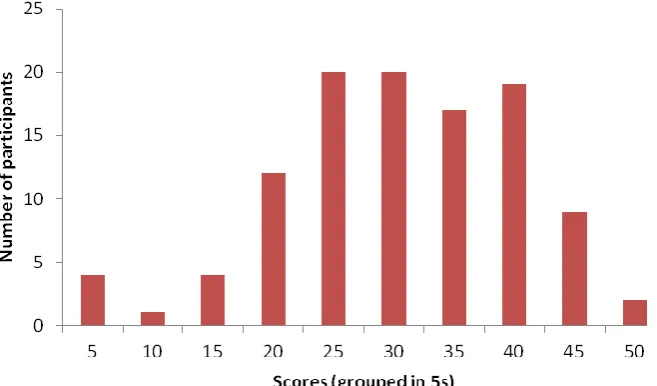
1 to a maximum of 46 out of 50. The participant performance is graphically illustrated
in Figure 1, which shows that very few participants scored less than 15 (9 people) or
more than 40 (11 people), with the vast majority (70%) scoring between 21 and 40
(76 people). Clearly, this Spanish group of participants have considerable collocation
knowledge, and are able to produce the written form of a substantial number of
collocations, at least as indicated by this test format. However, it is a matter of
speculation the degree to which the participants would be able to employ this
knowledge in their own free writing and speaking.
Table 1 Descriptive statistics of the participants’ test performance (N=108)
M SD Min Max
Participant scores 28.29 9.74 1 46
Figure 1 Distribution of collocation test scores
Which Method of Collocation Identification Best Relates to Collocation
Knowledge?
Our Spanish learners acquired collocations to a substantial degree. We next
investigated which statistical method of collocation identification best relates to this
knowledge. In particular, we explored corpus frequency, t-score and MI. That is, does L2 acquisition of collocations mainly relate to those collocations’ frequency of
occurrence (raw frequency or t-score) or their strength of association (MI)?
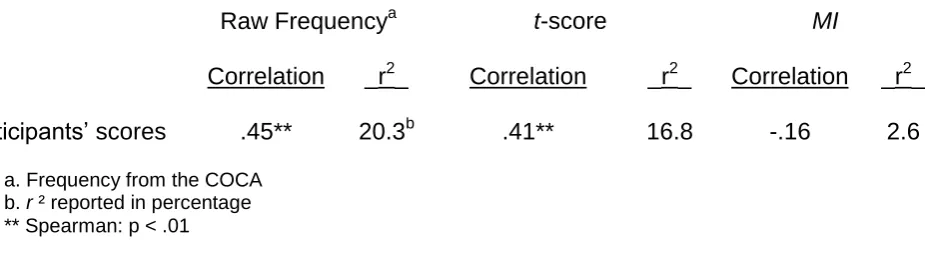
The percentage of correct answers by our Spanish participants for each collocation
was correlated with each of the three collocation measures (Table 2). Raw corpus
of just over 20%. T-score was just less than this, with a correlation of .41 and rs
2 of
just below 17%. The similar results are not surprising, as t-score is heavily weighted towards frequency in its calculations. This means raw frequency was related slightly
more strongly to the learners’ knowledge of the target collocations than t-score was,
and has the advantage of not requiring a calculation. Conversely, MI score did not show any significant relationship with collocation knowledge. This indicates that
increasing the ‘tightness’ of the combinational bonding does not seem related to
collocation learning. Rather, in line with Durrant and Schmitt (2009) and Ellis, et al. (2008), it seems that the frequency of the collocation as a whole is the more
important factor for second language learning of collocations, although our results
[image:22.595.70.533.485.613.2]show that the relationship is only a moderate one with 20% co-variance.
Table 2 Correlations between knowledge of collocations and three methods of collocation
identification
Raw Frequencya t-score MI
Correlation _r2_ Correlation _r2_ Correlation _r2_
Participants’ scores .45** 20.3b .41** 16.8 -.16 2.6
a. Frequency from the COCA b. r ² reported in percentage ** Spearman: p < .01
As corpus frequency was the variable that best related to acquisition, it is useful to
further explore what the 20% covariance tells us. The relationship between
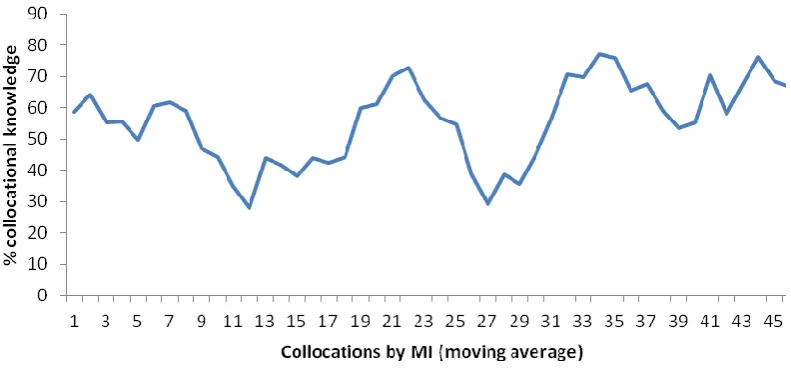
collocation knowledge and frequency can be best appreciated graphically. Figure 3
effect of individual item variation. This can be compared to the apparently random
[image:23.595.86.490.219.376.2](non)relationship between collocation knowledge and MI score (Figure 4).
Figure 3 Knowledge and frequency of collocations (moving average of 5)
Figure 4 Knowledge and MI score (moving average of 5)
It is clear from the curve in Figure 3 that collocation knowledge is not strongly
[image:23.595.86.482.460.647.2]influence. This is quite different to the knowledge of individual words, where
frequency has been shown to be a strong determining factor (e.g. Schmitt, Schmitt,
and Clapham, 2001). The figure shows a jagged, but slightly downward trend, with a
noticeable trailing off of knowledge for the least frequent collocations, and a cluster
of relatively well-known collocations at the 10-20 frequency rank order. Overall, we
cannot say that collocations are learned in frequency order, and that the highest
frequency collocations are learnt better, but it seems clear that very infrequent
collocations are learnt worse.
The above reports whole-group findings, but such summative descriptions often hide
interesting information. Looking beyond the whole group scores, we wondered
whether the behavior of learners with relatively better collocation knowledge was
similar to or different from learners with relatively weaker knowledge. In order to
explore this, we divided the participants in thee groups according to their total
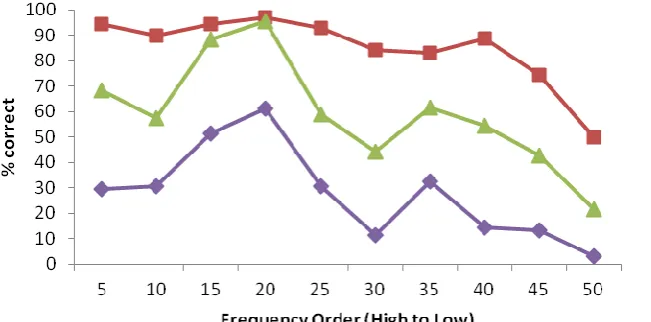
collocation scores: low (1-20, N=21), medium (25-35, N=40), and high (40+, N=14).4 Given the results from Figure 3, we might expect that the high group would know
most of the high- and mid-frequency collocations, and would only tail off at the
lowest-frequency ones. We might also expect that the low learners would only know
the highest-frequency collocations, and very few others. The mid group would be
somewhere in between, and might be expected to know the highest frequency
collocations best, with a tail-off at the lowest frequency ones. These hypothetical
expectations might be visualized as something like Figure 5 (ordered by frequency,
The actual results in Figure 6 show that frequency does not have a similar effect on
the three groups. The high group behaves roughly as expected: the vast majority of
high proficiency group knew almost all of the 40 highest-frequency collocations, but
this tailed off badly over the last 10 least-frequent ones. Thus, frequency certainly
seems to explain this knowledge profile. The medium- and low-knowledge groups
have a similar tailing off, but in contrast also show a great deal of variation across
the profile. Interestingly, the medium and low groups have nearly identical curves. If
a collocation was relatively easy or difficult for the mid-proficiency group, it was as
well for the low-frequency group, and vice versa. The undulating profiles suggest that
the knowledge of high- and mid-frequency collocations do not depend greatly on the
corpus frequency of those collocations for the learners in these groups.
These results indicate that although frequency seems to have some relationship with
the acquisition of collocations, this effect is slight and cannot be used as the major
predictor of collocation learning, but only as one factor of influence. This is in
Figure 5 Hypothetical knowledge profile of high-, mid-, and low-knowledge groups
according to frequency order
Figure 6 Actual knowledge profile of high-, mid-, and low-knowledge groups
[image:26.595.87.413.486.647.2]Does Individual Differences and Language Study Relate to the Knowledge of
Collocations?
If the combinationality of collocations (MI) does not relate to collocation knowledge, and frequency does so only to a limited degree, what does relate to collocation
knowledge? In order to answer this question we examined the relationships of a
number of factors with the collocation knowledge of our participants. We first looked
at the individual difference factors of gender, age, and proficiency. There was no
effect for gender (Male vs. Female: t (106) = -.40, p =.70) and age had only a very weak relationship (.20, r2 = 4.0, Pearson: p<.05). We asked participants to self-rate their L2 proficiency according to a three-part categorization: beginner, intermediate,
or advanced, and the correlation between this self-rating and collocation knowledge
was strong: .73, r2=53.3, Kendall’s tau: p<.001. However, as proficiency self-ratings can be rather subjective, this result needs to be treated with caution.
It has been suggested that collocations can be taught, although most textbooks do
not give them much time or attention (Brown, 2011). If so, one would expect that the
amount of study and formal instruction would have an effect on collocation learning.
This proved to be the case here, as the correlation between the years of study that
the participants had engaged in and the correct answers they gave to the test was
.45, r2 = 20.3, Pearson: p<.001. Therefore, the results indicate that the amount of language study and instruction related to collocation knowledge, although rather
Does Use of Language Relate to the Acquisition of Collocations?
It has been suggested that the amount and type of informal exposure learners have
to English outside the classroom can affect the degree to which collocations are
learned. We asked the participants about their personal engagement with English
through a number of activities they might carry out in their daily lives: reading,
watching TV or films, listening to music, using social media, and visiting an
English-speaking country. Correlation analysis showed that all of these variables did indeed
relate to collocation knowledge, with the exception of listening to music (Table 3):
immersion .64, reading .61, TV/films .38, social media .33, and listening to music ns. Some of these correlations were higher than the .45 we found for corpus frequency.
Combining the everyday exposure variables of reading, TV/films, and social media,5
we find that composite informal exposure to the target language correlates at .56,
explaining over 31% of the collocational knowledge that participants showed,
meaning that the more language input learners receive, the more likely they are to
Table 3 Correlations between language use and knowledge of collocations
Knowledge of collocations
Correlation _r2_
Reading .61** 37.2a
Watching films, video, or TV .38** 14.4 a
Listening to music .14 1.96 a
Social networking .33** 10.9 a
Immersion in English-speaking countries .64*** 41.0 a
Composite exposure to Englishb .56** 31.4 a
** Kendall’s tau: p < .001 *** Biserial: p < .001 a. r ² reported in percentage
b. Composite score includes Reading, Watching films/TV, and Social networking
General Discussion
Our results indicate that our Spanish participants did know a substantial percentage
of collocations, as evidenced by an average of over 56% correct answers on a
prompted productive collocation knowledge test. Furthermore, these figures are
likely to be a good representation of their knowledge, as the answers could not easily
be the result of guessing or L1 transfer. This result runs counter to the assertion of
some researchers who have claimed that the knowledge that NNSs have of
Waldman, 2011). However, it is interesting to consider whether 56% should be
considered ‘good’ knowledge or not. On one hand, the collocation sample included a
range of collocations including some of quite low frequency (e.g. exploit resources: 11 instances in the 450-million word COCA; clockwise direction: 33 instances). This would suggest the participants’ performance is relatively strong. Conversely, the
mean number of years which participants reported studying English was 13.67
years. From this point of view, one might expect much higher scores, and would thus
conclude that collocations are indeed difficult to pick up from language study.
Ultimately, a reasonable conclusion seems to be that our Spanish learners did
demonstrate knowledge of a sizeable number of collocations, although falling short
of what might be expected from native, or very proficient nonnative, speakers.
An interesting research direction for the future would be to explore how the level of
collocation knowledge required by our test relates to the ability to use English
skillfully and appropriately in the four skills. Laufer and Waldman’s (2011) very low
collocation results when analyzing Israeli student compositions suggest that it might
be much easier to produce collocations when prompted on a test like ours, than to
freely produce collocations in one’s own writing, and that there is a big difference
between knowing a collocation and being able to use it. However, this remains speculation, because although Laufer and Waldman’s study included a range of L2
proficiency levels (just as ours did with Spanish participants), it is impossible to know
how the participant proficiency levels of the two studies compare.
The study has also revealed that, unlike for the acquisition of individual words,
collocation knowledge, although it is still a better predictor than the MI or t-score. It showed that even though corpus frequency seems to relate to some degree to the
acquisition of collocations, it only explains just over 20% of the collocation
knowledge tested here, mainly indicating that the lowest-frequency collocations were
poorly known.
Furthermore, the findings of this study are in line with a recent study by Schmitt and
Redwood (2011), which showed the same moderate effect of frequency on the
acquisition of phrasal verbs. Taken together, it seems that frequency of occurrence
is not an adequate predictor of formulaic language acquisition. This leads us to
believe that the acquisition of formulaic language (at least collocations and phrasal
verbs) relies on more than just frequency of exposure, or at least frequency as
derived from a corpus of native English. The results from our usage questionnaire
suggest that engagement with collocations in everyday communicative situations
(reading, watching TV/films, social networking, and immersion) may well be just as
important a factor. As might be expected, immersion had a high correlation (.64), but
even the everyday composite correlation was higher (.56) than the correlation for
corpus frequency (.45). Therefore, if collocation learning is facilitated by everyday
use in communication, teachers and material designers would do well to incorporate
these types of activities into their syllabuses and materials as much as possible.
Overall, we propose that the results of this study have the following implications for
language teaching. First, we found that our L2 learners knew a substantial
percentage of the collocations tested. Therefore, these findings suggest that there is
hope for collocation learning, and that collocations (and formulaic language in
in language instruction. The amount of study was shown to have a positive
relationship (r2=20%), even though language instruction in Spain seldom highlights the notion of collocation. Moreover, research focusing on explicit instruction of
collocations (e.g. Laufer & Girsai, 2008; Peters, 2014) shows that it can be effective,
especially if there is enough learner engagement and repetition. Even if the
instruction only improves general language proficiency, our self-report data suggests
that proficiency itself seems to relate strongly to collocation knowledge (r2=53%).
Second, a large number of our participants knew a sizeable number of the target
collocations. This suggests in any class group, there will be a considerable number
of collocations known by some students, but not by all. The implication is that group
activities might be useful where students do tasks designed to elicit and use the
combined collocation resources of the group. Newton (1995) found that learners
could learn new words which were used by other members of their group in the
process of completing group tasks. This approach may well also work for collocation
learning.
Third, usage-based theories posit that acquisition is essentially linked to the amount
of language exposure (e.g. Ellis, 2002). Extensive reading is often recommended as
a way of maximizing this exposure outside the classroom (e.g. Day and Bamford,
1998). This study indicates that consistent reading is also useful for collocation
acquisition (r2=37%). But our results show that there are many other kinds of exposure that are also useful beyond reading. Teachers should strongly encourage
their students to take advantage of any English-exposure opportunities that are
available. Our research demonstrated that watching English TV/films and using
social networking sites were useful. Indeed, students may well be doing these things
worksheets based on movies, or setting up ‘penpal-type’ relationships on social
networking sites.
Fourth, corpus frequency (as indicated by the COCA) relates to collocation
acquisition, but only moderately. However, our participants knew the target
collocations better if they used English in everyday situations. This is congruent with
Ellis´s (2001) claim that frequent collocations which fulfill a useful and meaningful
communicative function will be more salient to learners, and therefore more likely to
be learnt than those with less useful functions. Likewise, Slobin (1997) claimed that
there are many other determinant factors in the acquisition of language other than
frequency, like semantic basicness, salience, communicative intent or relevance.
This suggests that L2 learners might better know those collocations which are likely
to be encountered in daily situations, and therefore to have a more useful
communicative function, compared to collocations whose function is more restricted
to specific contexts, such as the most ‘academic’ collocations. For example, 99
participants knew the collocation social networks (frequency 899) because, independently of its frequency, it is an everyday reality everyone is familiar and
involved with, while only 50 knew human being (frequency 5,737). Therefore, frequency based on general English native speaker corpora may not be the best way
of sequencing collocations in instruction, as it may not reflect actual learner exposure
very well. This makes us wonder whether frequency as derived from specialized
corpora better representing learner usage might be a superior way to predict
collocation knowledge. For example, future research could derive frequency figures
from corpora of social networking language or films, and explore whether these
figures might prove useful as a means of selecting collocations in a principled
manner for future teaching materials.
Finally, all of the findings above must be interpreted in light of the inevitable
limitations of this study. We used a statistical approach to collocation identification,
and a sample of collocations identified with a different method (e.g. a phraseological
approach) might be known to a greater or lesser degree. Our study is also limited by
only using 50 collocations to represent the vast range possible, and only having
Spanish participants. Lastly, our c-test format shows whether collocations could be
produced upon prompting, but we do not know whether participants could produce
them in their free writing or speaking. Despite these limitations, we feel that our study
still provides useful initial insights into the amount of collocation knowledge that L2
learners might amass, and the role of frequency and input into that acquisition.
Conclusion
Our study shows that L2 learners typically know a substantial number of collocations,
providing some evidence to counteract the notion that collocations are too hard for
learners. Given the importance of collocations for accurate and appropriate language
use, this is good news, and will hopefully encourage both researchers and
practitioners to renew their interest in how to best facilitate collocation learning. The
approach will almost certainly need to include a component which encourages
Notes
1. In contrast, psycholinguistics has tended to investigate idioms
(Siyanova-Chanturia, 2013).
2. Although Martinez and Murphy (2011) worked with multiword expressions rather
than collocations in particular, many of their instrument items appear to be
collocations.
3. Webb (2008) argues that c-test formats which provide the initial letters of target
words, although used to measure productive vocabulary knowledge, may in fact
measure receptive knowledge to some degree.
4. In order to ensure the groups were clearly distinct form each other, we deleted
participants with scores between 21 and 24 collocations (17 people) and between 36
and 39 (16 people).
References
Adolphs, S. & Durow, V. (2004). Social-cultural integration and the development of
formulaic sequences. In N. Schmitt (Ed.), Formulaic sequences: Acquisition, processing and use (pp. 106-126). Amsterdam: Benjamins.
Annual Review of Applied Linguistics. (2012). Vol. 32: Formulaic language.
Bahns, J. & Eldaw, M. (1993). Should We Teach EFL Students Collocations?
System, 21,101-114.
Bardovi-Harlig, K. (2012). Formulas, routines, and conventional expressions in
pragmatics research. Annual Review of Applied Linguistics, 32, 206-227.
Barfield, A. and Gyllstad, H. (Eds.). (2009). Researching collocations in another language: Multiple interpretations. Basingstoke: Palgrave Macmillan.
Boers, F., Eyckmans, J., Kappel, J., Stengers, H., & Demecheleer, M. (2006).
Formulaic sequences and perceived oral proficiency: Putting a Lexical Approach to
the test. Language Teaching Research 10, 245–261.
Brown, D. (2011). What aspects of vocabulary knowledge do textbooks give attention
to? Language Teaching Research, 15, 83-97.
Burdelski, M. & Cook, H.M. (2012). Formulaic language in language socialization.
Bybee, J.L. & Hopper, P. (2001). Frequency and the emergence of language
structure. Amsterdam: John Benjamins.
Cowie, A. P. (Ed.). (1998). Phraseology: theory, analysis, and applications. Oxford:
Oxford University Press.
Cummins, J. (1998). Immersion education for the millennium: What we have learned
from 30 years of research on second language immersion. In M.R. Childs and R.M.
Bostwick (Eds.), Learning through two languages: research and practice. Second
Katoh Gakuen International Symposium on Immersion and bilingual education (pp.
34-47). Japan: Katoh Gakuen.
Davies, M. (2008-) The Corpus of Contemporary American English: 450 million
words, 1990-present. Available online at http://corpus.byu.edu/coca/. [Accessed
from June to August, 2013].
Day, R. R. & Bamford, J. (1998). Extensive reading in the second language classroom. Cambridge: Cambridge University Press.
De Cock, S. (2000). Repetitive phrasal chunkiness and advanced EFL speech and
writing. In C. Mair and M. Hundt (Eds.), Corpus linguistics and linguistic theory
(pp.51-68). Amsterdam: Rodopi.
Dörnyei, Z., Durow, V., & Zahran, K. (2004). Individual differences and their effects
Durrant, P. & Schmitt, N. (2009). To what extent do native and non-native writers
make use of collocations? International Review of Applied Linguistics 47, 157–177.
Durrant, P. & Schmitt, N. (2010). Adult learners’ retention of collocations from
exposure. Second Language Research, 26, 163-188.
Ellis, N.C. (2001). Memory for language. In P. Robinson (Ed.), Cognition and second language instruction. Cambridge: Cambridge University Press.
Ellis, N.C. (2002). Frequency effects in language processing: A review with
implications for theories of implicit and explicit language acquisition. Studies in Second Language Acquisition, 24, 143-188.
Ellis, N.C. (2005). At the interface: Dynamic interactions of explicit and implicit
language knowledge. Studies in Second Language Acquisition, 27, 305–352.
Ellis, N.C., Simpson-Vlach, R. & Maynard, C. (2008). Formulaic Language in Native
and Second Language Speakers: Psycholinguistics, Corpus Linguistics and TESOL.
TESOL Quarterly, 42, 375-396.
Farghal, M. & Obiedat, H. (1995). Collocations: A Neglected Variable in EFL. IRAL, 33, 315-331.
Freed, B.F., Segalowitz, N. & Dewey, D.P. (2004). Context of learning and second
language fluency in French: Comparing regular classroom, study abroad, and
Granger, S. (1998). Prefabricated patterns in advanced EFL writing: Collocations and
formulae. In A.P. Cowie (Ed.), Phraseology: Theory, analysis, and applications (pp. 79–100). Oxford: Oxford University Press.
Granger S., Paquot M. & Rayson P. (2006). Extraction of multi-word units from EFL
and native English corpora: The phraseology of the verb 'make'. In Häcki Buhofer, A.
and H. Burger (eds.), Phraseology in Motion I: Methoden und Kritik. Akten der Internationalen Tagung zur Phraseologie (Basel, 2004). Baltmannsweiler: Schneider Verlag Hohengehren. pp. 57-68.
Hasselgren, A. (1994). Lexical teddy bears and advanced learners: A study into the
ways Norwegian students cope with English vocabulary. International Journal of Applied Linguistics, 4, 237–260.
Horst, M., Cobb, T., & Meara, P. (1998). Beyond a clockwork orange: Acquiring
second language vocabulary through reading. Reading in a Foreign Language, 11, 207–223.
Howarth, P. (1998). The phraseology of learners’ academic writing. In A.P. Cowie
(Ed.), Phraseology: Theory, analysis, and applications (pp. 161–186). Oxford: Oxford University Press.
Laufer, B. & Girsai, N. (2008). Form-focused instruction in second language
vocabulary learning: A case for contrastive analysis and translation. Applied Linguistics, 29, 1-23.
Laufer, B. & Waldman, T. (2011). Verb-noun collocations in second-language writing:
A corpus analysis of learners´ English. Language Learning, 61, 647-672.
Leech, G., Rayson, P., & Wilson, A. (2001). Word frequencies in written and spoken English based on the British National Corpus. Longman.
Lorenz, G. (1999). Adjective intensification – learners versus native speakers: A corpus study of argumentative writing. Amsterdam: Rodopi.
Martinez, R. & V. Murphy. (2011). Effect of frequency and idiomaticity in second
language reading comprehension. TESOL Quarterly 45, 267-290.
Martinez, R. & Schmitt, N. (2012). A Phrasal Expressions List. Applied Linguistics 33, 299-320.
Meunier, F. (2012). Formulaic language and language teaching. Annual Review of Applied Linguistics, 32, 111-129.
Millar, N. (2011). The processing of malformed formulaic language. Applied Linguistics 32, 129–48.
Nation, I. S. P. & Waring, R. (1997). Vocabulary size, text coverage and word lists. In
N. Schmitt and M. McCarthy (Eds.), Vocabulary: Description, acquisition and pedagogy (pp. 6–19). Cambridge University Press.
Nattinger, J.R. & DeCarrico, J.S. (1992). Lexical phrases and language teaching. Oxford: Oxford University Press.
Nelson, K. (1973). Structure and strategy in learning to talk. Monographs of the Society for Research in Child Development, Serial no. 149, nos 1-2.
Nesselhauf, N. (2003). The use of collocations by advanced learners of English and
some implications for teaching. Applied Linguistics, 24, 223–242.
Nesselhauf, N. (2005). Collocations in a learner corpus. Amsterdam: John Benjamins.
Newton, J. (1995). Task-based interaction and incidental vocabulary learning: A
case study. Second Language Research 11, 159-177.
Pawley, A. & Syder, F. (1983). Two puzzles for linguistic theory: Nativelike selection
and nativelike fluency. In J. Richards and R. Schmidt (Eds.), Language and communication (pp.191-226). London: Longman.
Peters, E. (2012). Learning German formulaic sequences: The effect of two
Peters, E. (2014). The effects of repetition and time of post-test administration on
EFL learners’ form recall of single words and collocations. Language Teaching
Research, 18, 75-94.
Schmitt, N. (2000). Vocabulary in language teaching. Cambridge: Cambridge University Press.
Schmitt, N. (2004) (Ed.). Formulaic sequences: Acquisition, processing and use.
Amsterdam: Benjamins.
Schmitt, N. (2010). Researching vocabulary: a vocabulary research manual. Basingstoke: Palgrave McMillan.
Schmitt, N., Dörnyei, Z., Adolphs, S., and Durow, V. (2004). Knowledge and
acquisition of formulaic sequences: A longitudinal study. In N. Schmitt (Ed.),
Formulaic Sequences: Acquisition, Processing, and Use. Amsterdam: John Benjamins Press. pp. 55-86.
Schmitt, N. & Redwood, S. (2011). Learner knowledge of phrasal verbs: a
corpus-informed study. In F. Meunier, S. De Cock, G. Gilquin, and M. Paquot (Eds.), A taste for corpora: In honour of Sylviane Granger (pp.173-209). Amsterdam: John Benjamins.
Schmitt, N., Schmitt, D. & Clapham, C. (2001). Developing and exploring the
behaviour of two new versions of the Vocabulary Levels Test. Language Testing 18, 1: 55-88.
Siyanova-Chanturia, A. (2013). Eye-tracking and ERPs in multi-word expression
research. Mental Lexicon, 8, 245-268.
Siyanova, A. & Schmitt, N. (2007). Native and nonnative use of multi-word vs.
one-word verbs. International Review of Applied Linguistics, 45, 119-139.
Siyanova, A. & Schmitt, N. (2008). L2 learner production and processing of
collocation: A multi-study perspective. Canadian Modern Language Review, 64, 429-458.
Slobin, D.I. (1997). The origins of grammaticizable notions: Beyond the individual
mind. In: D.I. Slobin (Ed.), The crosslinguistic study of language acquisition: Vol. 5
(pp. 265–323). Mahwah, NJ: Erlbaum.
Stewart, J., & White, D. A. (2011). Estimating guessing effects on the Vocabulary
Levels Test for differing degrees of word knowledge. TESOL Quarterly, 45, 370-380.
Webb, S. (2007). The effects of repetition on vocabulary knowledge. Applied Linguistics 28, 46-65.
Webb, S. (2008). Receptive and productive vocabulary sizes of L2 learners. Studies in Second Language Acquisition, 30, 79-95.
Webb, S., Newton, J. & Chang, A. (2013). Incidental learning of collocation.
Language Learning, 63, 91-120.
Wray, A. (2002). Formulaic language and the lexicon. Cambridge: Cambridge University Press.
Appendix 1 List of target collocations (with frequency, t-score and
MI information)
Collocation Raw
frequency
Frequency of individual wordsa
T-score
MI
1 Last night 17,214 Last: 357,284
Night: 194,531
130.0 6
6.85
2 Long ago 8,455 Long: 277,641
Ago: 143,237
91.02 6.62
3 Nuclear weapons 7,364 Nuclear: 41,511
Weapons: 36,130
85.78 11.15
4 Interest rates 7,026 Interest: 76,183
Rates: 43,539
83.74 9.94
5 Human being 5,737 Human: 123,875
Being: 309,533
74.65 6.12
6 To spend time 4,875 Spend: 154,443
(lemma)
Time: 735,882
66.31 16.98
7 Hard work 4,763 Hard: 136,530
Work: 361,432
67.47 5.48
8 Wide range 4,653 Wide: 42,179
Range: 50,815
68.15 9.98
9 Vast majority 4,421 Vast: 20,266
Majority: 41,255
66.46 11.26
10 To commit suicide 2,500 Commit: 31,154
(lemma)
Suicide: 16,507
49.98 45.00