1
This article was accepted for publication in Disability and Rehabilitation on 27 February 2016
Evaluation of a group acceptance commitment therapy intervention for people with knee or hip osteoarthritis: a pilot randomized controlled trial
1,2 Clarke, Simon P., 1,3 Poulis, Nektaria, 1,3 Moreton, Bryan J., 1.4 Walsh, Dave A. and 1,3Lincoln, Nadina B.
1Arthritis Research UK Pain Centre, University of Nottingham, Nottingham, UK; 2School of Psychology, University of Lincoln, Lincoln, UK; 3Division of Rehabilitation and Ageing, University of Nottingham, Nottingham, UK; 4Academic Rheumatology, University of Nottingham, Nottingham, UK
Abstract
Objectives: The aim was to evaluate an Acceptance Commitment Therapy (ACT) intervention for people with knee or hip osteoarthritis; a related aim was to compare treatment effects from Rasch-transformed and standard scales. Methods: Participants were recruited from a research database and outpatient rheumatology and orthopaedic clinics at two hospitals. Eligible participants were randomly allocated to either intervention or usual care. Intervention comprised six-sessions of group ACT. Outcomes were assessed two and four months after randomisation. Rasch-transformed and standard self-report measures were compared. Qualitative interviews also explored the acceptability of the intervention. Results: Of 87 people assessed for eligibility, 31 (36%) were randomised. The main reason for non-randomisation was that participants received surgery. Of the 16 participants randomised to intervention, 64% completed ≥50% of the scheduled group sessions. Follow-up data was complete for 84% participants at two months and 68% at four months. Outcome analysis demonstrated important differences between the Rasch-transformed and standard scales. There were significant differences between the groups in pain. Qualitative interviews with 7 participants suggested the intervention was acceptable. Conclusions: ACT for
2 Introduction
Osteoarthritis (OA) is one of the major causes of disability in older people [1]. Chronic pain is a common problem and people with OA often report high levels of pain [2], which is associated with psychological comorbidities, such as anxiety and depression [3,4]. Additionally, people with OA often experience difficulties adjusting to the presence of ongoing pain, particularly in terms of being able to accept the aspects of their illness (e.g. pain) that are beyond their control [5,6]. Low levels of acceptance can aggravate pain, frustrate people in their pursuit of functional goals and exacerbate levels of psychological distress [7-9].
Acceptance Commitment Therapy (ACT) is a development of cognitive behavioural therapy (CBT), which includes a unique set of techniques under the theoretical umbrella of ‘psychological flexibility’ [8,9]. Psychological flexibility is defined as “the capacity to persist with or change behaviour in a context of personal goals, psychological influence and situational
prospects” [10]. Unlike traditional CBT, which aims to change the content of negative thoughts through cognitive
restructuring, ACT aims to change the function of the experience so that it no longer cause distress or entanglement [9]. In this way, it is likely that ACT targets different processes from CBT [11].
ACT helps patients tolerate the more noxious aspects of chronic pain and minimises the impact of the pain experience on functional life goals, through the process of psychological flexibility [9]. In ACT, acceptance is a process of responding with openness to moments of undesirable experience when this helps goal achievement and this is facilitated through the development of mindfulness-based strategies and diffusion activities [8]. Achieving functional goals is therefore aided by re-engagement with meaningful activities based on an assessment of values, despite the ongoing presence of pain [12]. There is evidence for the effectiveness of CBT in people with chronic pain [13,14] and, more recently, for ACT [15,16]. Direct comparisons between CBT and ACT suggest they are of similar effectiveness [17] and ACT may target multiple psychological mechanisms concurrently, including psychological flexibility and pain-related anxiety [18-20]. However, despite the evidence for the effectiveness of ACT for people with generalised chronic pain and the incorporation of many forms of ACT in pain coping-skills training, few trials using an explicitly ACT framework have been conducted with people with OA, especially in a group format.
In the current study we aimed to evaluate an ACT group intervention for people with OA as an external pilot study. The purposes of the trial were to assess process issues including recruitment and retention rates, refusal rates, adherence (i.e. attendance rates for the intervention) and rates of completion of follow-up measures. A related aim was to establish any clinically meaningful treatment effects from the intervention and to establish the utility of using Rasch-transformed scales as measures of outcome.
Rasch analysis is a psychometric technique, which can be applied to both newly developed and existing questionnaires, enabling the advanced analysis of different measurement issues [21-22]. Data on an outcome measure are tested against the predictions of the Rasch model [24]. Given fit to the model, it permits a linear transformation of raw scores to interval-level data. This may enable greater measurement precision for evaluating outcome scores [25] and thus be better able to detect meaningful treatment effects.
Method
The study was approved by Nottingham Research Ethics Committee 1. All participants were informed of study aims and consented to take part.
Participants in previous research studies who had OA of the knee, agreed to be contacted for future research, and had high levels of pain and low levels of acceptance, were invited to participate by letter from their original research team.
3
Sherwood Forest Hospitals NHS Foundation Trust with radiological confirmed diagnosis knee or hip OA, who also had high pain and low acceptance (see criteria below), were invited to take part by a letter from the consultant responsible for their care.
Invitation letters were accompanied by a participant information sheet, consent form and two questionnaires, an 11 point Numerical Rating Scale (NRS) [26] to assess pain (participants were asked: “Please rate your current amount of knee/hip pain in a scale of 0-10 by circling the number that applies to you. Number 0 represents no pain at all and number 10 represents the highest amount of pain”) and the Chronic Pain Acceptance Questionnaire (CPAQ) [6]. Those who scored 5 or more on the NRS and less than 75 on the CPAQ total score were invited to take part. The cut-off was derived from the distribution of scores of a large sample of people with OA knee [25]. Predefined exclusion criteria were unable to speak or understand English; were deaf; were under 18 years of age; had joint surgery within the previous three months; had planned joint surgery within the next 4 weeks; had rheumatoid arthritis, psoriatic arthritis, gout or other diagnosis of inflammatory arthritis.
Eligible participants were asked to complete further baseline assessments. These were the Intermittent and Constant Osteoarthritis Pain (ICOAP) scale [27] to assess pain; General Health Questionnaire-12 (GHQ-12) [28] to assess mood, and Pain Anxiety Symptoms Scale-20 (PASS-20) [29] to assess pain-related fear.
Clusters of 4-6 people, based on their availability for group sessions, were randomly allocated to intervention or usual care by a researcher who was blinded to participants’ clinical details and questionnaire responses using a randomisation sequence prepared in advance.
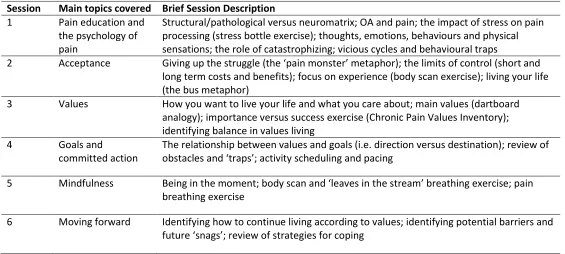
Those allocated to intervention were invited to undertake six weekly 1.5-hour group sessions of ACT delivered by a UK doctoral-trained clinical psychologist. The sessions took place on university or hospital premises. The clinical psychologist had been trained to an advanced level in CBT and ACT (postgraduate diploma), had several years’ post-qualification experience working with patients with both physical and mental health problems and was currently working in a local pain management clinic. The programme was designed from a manual developed for a previous ACT trial [30], along with
consultation with psychologists working at in a local pain management service, and from the University of Lincoln, who used ACT and CBT in their clinical practice. A clinical psychologist working in a local pain management service trained in ACT provided clinical supervision of the therapist. The content of the intervention is shown in Table 1.
[Insert Table 1 about here]
Outcome questionnaires were sent to participants at 2 and 4 months after randomisation. They included the ICOAP, CPAQ, NRS, GHQ-12 and PASS-20.
The process of the pilot was assessed by examining the percentages of people who agreed to take part in the study; the number (%) of participants who completed the intervention; number (%) of treatment sessions attended by participants; proportion of missing data on questionnaire items; and number (%) of participants who completed outcome measures at the two and four month follow-up.
4
GHQ-12 and PASS-20, as Rasch-transformed scales have not yet been published for these measures with people with osteoarthritis.
All outcome analyses were carried out on an intention to treat basis. Data were analysed using SPSS version 21. A member of the research team entered the outcome data blind to group allocation. Differences were analysed using Mann-Whitney U tests.
Participants who were allocated to the treatment condition and had completed four months’ follow-up were invited for interview about their experience of taking part. Interviews were conducted face-to-face. Each interview was audio recorded and then transcribed. Interviews took place 6-9 months after treatment had finished. A semi-structured interview format was used. Participants were asked questions about their experiences of being part of the group, what they found helpful about the group and whether being part of the group had enhanced their coping with pain. Although the questions were planned in advance, the semi-structured format allowed participants freedom to talk about experiences that were important to them.
The interview data were analysed using thematic analysis [31], employing an inductive approach in which latent themes were allowed to emerge from the data without pre-existing theoretical assumptions being imposed on the data. The analysis proceeded along a set of guidelines proposed by Braun and Clarke [31] and Boyatzis [32], namely:
1. Transcription of the data;
2. Familiarisation with the text, through reading and re-reading accounts, which also included taking notes and
reflecting on the data;
3. The generation of initial codes from the data on the basis that a code was the most basic segment of the raw
data or information that can be assessed in a meaningful way regarding the phenomenon [32] which were then cross-examined with each interview transcript;
4. Searching for themes, in which the codes for each participant were clustered according to how they formed
overarching themes. The labels for the themes were assigned on the basis of whether it represented an important aspect of the participants’ experience and if it showed a pattern across the whole data-set;
5. Reviewing themes, whereby the clusters of themes were then organised across the entire data-set according to
overarching themes and related subthemes;
6. Defining and naming themes, whereby the formulated themes/subthemes were re-examined across the entire
data-set and checked for accuracy, with a concise label and brief description assigned to each theme.
Results Process
The flow of participants through the study is shown in Figure 1. Of the 384 people invited to take part, 87 (23%) returned the initial questionnaires. Of these, 5 (6 %) declined consent and 51 (59%) were not eligible, as 31 (36%) had or were due to have surgery, 7 (8%) had pain NRS<5, 10 (11%) had CPAQ scores>75 and 3 (3%) had both pain NRS<5 and a CPAQ score>75. Thus, 31 (8%) took part in the study.
The mean age for excluded participants was 67 (SD=9) years, 22 (43%) were men, and 32 (63%) had OA of the knee and 19 (37%) had OA of the hip. Included and excluded participants were similar with respect to age (t = 3.57, p = 0.72), gender (Χ2
5
[Insert Figure 1 about here]
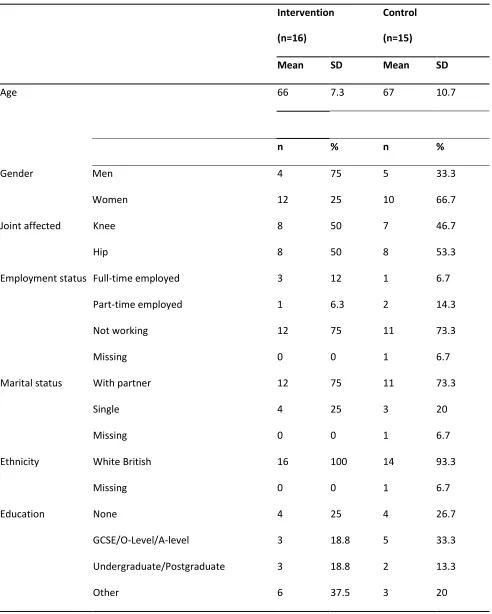
Baseline characteristics of participants are shown in Table 2. Of those included, 16 were randomly allocated to intervention and 15 to control. Demographic and baseline measures did not differ significantly between intervention and control groups, although there was a higher proportion of men in the intervention group (75% vs 33%).
[Insert Table 2 about here]
The mean number of group treatment sessions attended was 3.0 (SD=2.1, range 0-6). In previous studies, 3 sessions of ACT were considered sufficient to have had exposure to the main processes of ACT [19]. Eight (50%) of participants randomised to intervention attended at least 4 sessions of the intervention. The reasons for non-attendance were that surgery dates were brought forward (n=2); travel (n=2); and other personal commitments (n=3). One participant did not respond to contact from the research team after being randomised to intervention. Two participants attended all six sessions; 3 attended five sessions; 2 attended four sessions; 3 attended three sessions; and 3 did not attend any of the scheduled sessions.
Outcome data
Outcome measures were completed by 26 (84%) participants at two months, and 21 (68%) at four-months. A higher
proportion of participants randomised to the intervention group completed outcome measures at follow-up compared with those randomised to usual care at 2 months (48% vs 36%) and at 4 months (42% vs 26%).
Outcome results are shown in Table 3. There were some missing data on items from all questionnaires. The proportion of missing items was ICOAP 0.1%, CPAQ 1.2 %, PASS-20 0.7% and GHQ12 0.5%. Missing items were replaced with the mean of every other item on that questionnaire, at the same time point.
None of the participants in the intervention group who were recruited from orthopaedic clinics had joint replacement surgery prior to completing follow-up questionnaires.
[Insert Table 3 here]
The intervention group demonstrated significantly lower Numerical Pain Ratings at 4 months (p=.016). On the standard scoring of the ICOAP, the intervention group showed significantly lower constant (p=.046) and intermittent (p=.037) pain scores at 4 months. For the Rasch-transformed measures, there were significant differences in constant pain score at both 2 months (p=.01) and 4 months (p=.037) but no significant differences (p>.05) in the Rasch transformed intermittent pain scores. In addition, there was a significant difference in the newly created sleep and well-being subscale of the ICOAP at 4 months (p=.002).
There were significant differences on the CPAQ Activity Engagement scale using both the standard (p=.03) and Rasch
6
Please see Supplementary Table in Appendix 1 for Mean and Standard Deviations for all outcomes at two and four months follow-up.
Acceptability of the Intervention
Seven participants who took part in the group intervention agreed to be interviewed. The thematic analysis resulted in the identification of two overarching themes (group processes and change mechanisms) and 8 subthemes (emotional
atmosphere, skills distribution, positive therapist qualities, accepting limitations / committing to activities, setting goals / pacing, training attention / mindfulness, knowledge / understanding of pain and illness, changing mind-set).
Group processes covers the participant’s experience of what they identified as the positive aspects of the group. This theme
includes three main subthemes: emotional atmosphere of the group, skills distribution and therapist qualities.
Emotional atmosphere concerns the participants’ experience of the relational and emotional benefits of being part of the
group. The participants described being able to express emotions freely in a non-judgemental atmosphere, and feeling a sense of solidarity with other OA patients that were “in the same boat” as them. Participants also described the experience of feeling emotionally supported by other group members, particularly in terms of having their difficulties validated by other group members. Overall, this theme encompassed both the group’s containment of difficult feelings, as well as the active emotional support offered by individual group members. For example:
We’re all in the same boat aren’t we one degree or another, so you’ve got a common bond (P1)
It’s really good that you can come and talk what the problem is. I mean, how many places can you complain about what’s the matter with you and get away with it? (P11)
Skills distribution covers the benefits experienced by participants from sharing with one another the best ways of managing
their condition. This content of skills distribution included both practical strategies of self-management (e.g. medication, how to speak to medical staff, use of technology etc.) and specific pain management strategies (e.g. TENS machines, massage, pacing, ice-packs etc.). This subtheme also included the processes by which group members helped one another. For example:
Listening to all the others and hearing and what they do to combat what’s the matter with them and I thought that was beneficial as well (P3)
They were very helpful to me, with things they had learned…places to go and how to get there and what was the best way (P11)
Therapist qualities incorporated several aspects of the participants’ experience of the therapist’s role as group facilitator. These aspects include the therapist’s emotional attitude (relaxed, non-judgemental and understanding) and the therapist’s specific use of techniques and adaptions to help the group understand and apply core concepts (e.g. the use of metaphors and stories). This subtheme also covered the therapist’s ability to manage group dynamics effectively, including both ensuring that all members felt able to participate and that more assertive group members did not dominate. For example:
7
He always asked us if we understood where was going and sometimes we said no and then he would do in a different way. (P9)
He was very good at managing the group because you very quickly learn that there’s one or two that maybe are going to take over and dominate and there’s one or two that are not going to give anything. (P11)
Change mechanisms was the other overarching theme relating to the range of skills and knowledge that participants
acquired during the process of being part of the group that contributed to their perceptions of increased self-management of their condition. The theme also identifies aspects of the intervention that may be related to change processes. There were five subthemes in total relating to this overarching theme: accepting limitations / committing to activities, setting goals / pacing, training attention / mindfulness, knowledge / understanding of pain and illness and changing mind-set.
Accepting limitations / committing to activities describe the participants’ development of a dual attitude towards their pain
following participation in the group. This dual-attitude combined an acceptance of the ongoing presence of pain and the limitations that it will cause, but at the same time committing to keeping as active and mobile as possible. All of the
participants interviewed mentioned this attitude as key to their self-management but was acquired through participation in the group. Such examples include:
Keep doing things despite the pain… putting the pain to one side (P1)
I think it’s all about learning your limitations and if you can learn your limitations you can get through it (P6)
So it’s really accepting that but then dealing with what you can do…lowering your expectations but now lowering them completely (P11)
It’s going to be there anyway so I mean…you’ve got to sort of do, take up other things that you can’t do (P12)
Setting goals / pacing relate to the participants’ realisation that they needed to set themselves consistent goals in order to keep themselves as active as possible. However, many of the participants also noted the need to make these goals realistic and use pacing skills to achieve it. Such examples include:
The ladder to me was the best thing…if we went up two rungs and found we couldn’t do it, we could always come back (P9)
I sit down for 5, 10 minutes, it goes off, and then after a bit if I’m doing it again, it’ll come back again (P6)
Don’t stop doing it, but just chop it into bite-sized pieces (P11)
Training attention / mindfulness relates to the participants’ development of the use of mindfulness strategies especially in
terms of learning how to train their attention to become more attuned to the present moment. This subtheme also includes the development of psychological flexibility in terms of orientating their attention consistently away from the pain and onto other things they were interested in. For example:
8
Try and think that your knee is like a balloon and as the balloon is going down slowly, so you’re knee is getting less swollen and less tight…and it really worked (P9)
I couldn’t believe it…everything just went…and the pain just disappeared…just sitting there with my eyes closed and it all crept up…just went…and it was wonderful (P13)
Knowledge / understanding of pain and illness relates to the participants learning more about their pain and how pain
related to their OA condition. This subtheme concerned the aspect of the intervention that used psychoeducational techniques to illustrate the neuropsychological processes behind pain expression. For many of the participants, the
identification of psychological factors was helpful in giving them confidence to become more active and to decatastrophise the impact of pain on their thinking and mood.
A lot of pain is in the mind anyway (P1)
Some people think that if they feel something they are doing some damage…but he taught us that this is not always necessarily so…you are telling yourself something for one
reason…it’s not always what you think it is (P13)
Changing mind-set relates to the participants’ experience of the group helping them develop a different perspective on their
pain and disability. It included recognising the importance of taking a biopsychosocial approach to self-management and encouraging a more positive perspective. This subtheme also related to how the group helped participants identify areas they were not coping and needed to develop. For some, the group presented a “wake-up call” to help them challenge negative thinking patterns or identify ways they had become “stuck”. For example:
It gave you a different outlook on the pain…that was the main thing, the different outlook (P12)
It makes you look at things much more holistically at how you’re going to do things…there are ways round it and that’s the important part from my perspective (P11)
I am saying to myself something can be done. I don’t have to have this awful pain, because I didn’t handle it and I’ve got an idea to handle it now (P13)
Discussion
The study investigated the feasibility of an ACT group intervention for people with OA with high levels of pain and low levels of acceptance. An acceptable number of participants were recruited into the trial within the timescales planned. Attendance at intervention was good and compared with other similar studies [30] and outcome questionnaires were returned for the majority of participants. There were significant differences at follow up on many of the outcomes between the intervention and control group suggesting an improvement following the intervention.
Overall, the findings provide encouraging results and suggest that conducting a definitive trial for people with OA would be both feasible and worthwhile. However, several aspects need to be considered in planning a definitive trial.
9
replacement surgery. Two main solutions to this difficulty are suggested. The first is that a shorter, quicker and more
intensive treatment may be required for those on the surgery pathway. Such trials are already under way using CBT [33] and so therefore a similar style of ACT intervention may be more appropriate. The second suggested solution is that the
intervention may be better targeted to patients with OA who have not been referred for surgery, or are not considered eligible for joint-replacement surgery. Psychological treatment could thus be considered as an intervention to increase self-management at an early stage of disease progression. For the definitive trial therefore, outcome measures should include an evaluation of whether psychological intervention leads to delay in patients’ transition to the surgery pathway.
Only 23% of those invited returned the screening questionnaires. Therefore the proportion of people who agreed to participate in the trial was low. Our recruitment method may have led to self-selection of participants who had lower levels of acceptance, or who considered psychological therapy as being of potential use to them. Such participants may be more likely to complete the intervention. Our data suggest that this form of psychological intervention may be suitable for only a selected subgroup of people with knee or hip OA, and further qualitative work may be required to better characterise those patient who would be most likely to engage with this form of treatment. The question of what constitutes usual care for people with OA is still uncertain and it is possible that care is inconsistent and patchy [34]. Therefore, for the definitive trial, the study design should incorporate recording of usual care in order to assess how much support patients with OA receive in their coping with this condition.
Many of the measures (e.g. CPAQ, ICOAP and GHQ) included items related to physical and occupation functioning. However, a possible limitation of the current study was that idiosyncratic goals and social functioning were not recorded. As the focus of ACT is mainly on improving performance, physical and social functioning, and goal achievement [5] the inclusion of such measures for the definitive trial would be warranted.
Although demographic details between intervention and control groups did not differ significantly, a higher proportion of women were recruited overall compared with men (n=22 compared to n=9). Although these figures reflect prevalence studies for OA in which women in general are considered higher risk of developing OA than men [35], in practice this meant the intervention group had a significant gender imbalance (12 compared to 4). Empirical studies of gender differences in CBT-orientated pain management programmes suggest that women respond better than men [36]; therefore, any future studies may need to consider how treatment could be better tailored to the needs of both genders.
Analysis of the ICOAP showed differences between the Rasch-transformed and standard scales. Specifically, the significant difference between intervention and control groups in intermittent pain at four months on the standard scales was not present with the Rasch-transformed scales. This suggests that the differences between groups on the standard intermittent scales were due to the inclusion of two items reflecting sleep and well-being rather than pain. When these items were examined separately they showed significant differences between the groups, further supporting the proposal based on empirical data that the items should be treated separate to the intermittent and constant ICOAP subscales [21]. The
difference in findings between the standard and Rasch-transformed scales suggests some of the differences between groups observed may indicate differences in sleep disturbance rather than in intermittent pain, and using Rasch transformed scales may facilitate the valid interpretation of treatment effects [24]. Sleep is a potentially important dimension of the patient experience that might be improved by psychological treatment, and a separate measure of sleep should be included in a definitive trial.
10
The results of the qualitative study also suggest that this type of intervention may be acceptable for people with OA. The participants were generally very positive about the intervention in terms of both the processes of being part of the group and the outcomes that the intervention helped change for them. Such experiences are not uncommon in ACT interventions for pain [19] and also map onto factors known to influence outcomes in psychotherapy research, such as giving people mastery and control of their symptoms and shifting patient’s attributions of change from external to internal agency [37]. However, these results need to be interpreted with caution for two main reasons. The first reasons is that only 7 of the 11 participants randomised to treatment were interviewed. The second is that some comments in the interviews (e.g. “lowering expectations”, “orienting attention consistently away from the pain” etc.) and some pain management strategies (e.g. TENs machines, ice-packs etc.) suggested avoidance rather than acceptance. In may be more appropriate therefore to collect qualitative data during, as well as after, treatment to see to what degree an understanding of the intervention has really become imbedded within participants’ behaviour.
Finally, outcomes in OA may differ to those in other chronic pain states because of differences in available treatments, treatment pathways and expectations. Specifically, people with severe, unremitting pain from OA despite conservative treatments such as medications and exercise, might yet achieve cure from joint pain following total joint replacement surgery. However, many people will continue to live with pain despite surgery, due to involvement of multiple joints or to persistent pain in the operated joint. ACT might therefore help people with OA, despite the availability of other treatment options.
Conclusion
This study provides some evidence that a randomised controlled trial of an ACT group psychological intervention for people with knee or hip osteoarthritis could be conducted. However, results suggest that the intervention should be targeted at people at a stage other than immediately prior to surgery. In addition, the study design should incorporate recording of usual care in order to assess how much support patients with OA receive in their coping with this condition. Outcome measures should also include assessment whether intervention leads to delay in their transition to the surgery pathway, Rasch-transformed scales should be used where available in order to aid valid interpretation of results, and the trial should include a measure of sleep.
Acknowledgments
This research was supported via funding from Nottingham University Hospitals NHS trust. The authors would like to thank Jane Healy and Maggie Wheeler for their administrative support in conducting the research.
Declaration of Interest
11 References
1. Arden N, Nevitt M. Osteoarthritis: epidemiology. Best Practice and Research: Clinical Rheumatoogy 2006;20:3-25. DOI: http://dx.doi.org/10.1016/j.berh.2005.09.007
2. Brooks P. Impact of osteoarthritis on individuals and society: how much disability? Social consequences and health economic implications. Current Opinion in Rheumatology 2002;14(5):573-77. DOI: 10.1097/00002281-200209000-00017
3. Dieppe P, Lohmander L. Pathogenesis and management of pain in osteoarthritis. The Lancet 2005;365(9463):965. DOI: http://dx.doi.org/10.1016/S0140-6736(05)71086-2
4. Linton S, Shaw W. Impact of psychological factors in the experience of pain. Physical therapy 2012;91(5):700-11. DOI: 10.2522/ptj.20100330
5. McCracken L, Vowles K. Acceptance of chronic pain. Current Pain and Headache Reports 2006;10(2):90-4. DOI: 10.1007/s11916-006-0018-y
6. McCracken L, Vowles K, Eccleston C. Acceptance of chronic pain: component analysis and a revised assessment method. Pain 2004; 107(1-2):159-66. DOI: 10.1016/j.pain.2003.10.012
7. Thompson M, McCracken L. Acceptance and related processes in adjustment to chronic pain. Current Pain and Headache Reports 2011;15(2):144-51. DOI: 10.1007/s11916-010-0170-2
8. McCracken L, Zhao-O'Brien J. General psychological acceptance and chronic pain: there is more to accept than the pain itself. European Journal of Pain 2010;14(2):170-5. Doi: 10.1016/j.ejpain.2009.03.004
9. McCracken LM, Morley S. The psychological flexibility model: a basis for integration and progress in psychological approaches to chronic pain management. J Pain 2014;15(3):221-34. doi: 10.1016/j.jpain.2013.10.014.
10. McCracken LM. Committed Action: An Application of the Psychological Flexibility Model to Activity Patterns in Chronic Pain. Journal of Pain 2013;14(8):828-35
11. Vowles K, McCracken L. Comparing the role of psychological flexibility and traditional pain management coping strategies in chronic pain treatment outcomes. Behaviour Research and Therapy 2010;48(2):141-6
12. McCracken L, Gauntlett-Gilbert J, Vowles K. The role of mindfulness in a contextual cognitive-behavioral analysis of chronic pain-related suffering and disability. Pain 2007; 131(1-2):63-9.
13. Dixon KE, Keefe FJ, Scipio CD, Perri LCM, Abernethy AP. Psychological interventions for arthritis pain management in adults: A meta-analysis. Health Psychology2007;26(3):241-50.
14. Morley S, Williams A, Eccleston C. Examining the evidence about psychological treatments for chronic pain: Time for a paradigm shift? Pain 2013;154(10):1929–31.
15. Pull CB. Current empirical status of acceptance and commitment therapy. Current Opinion in Psychiatry 2009;22(1):55-60
16. Veehof M, Oskam M, Schreurs K, Bohlmeijer E. Acceptance-based interventions for the treatment of chronic pain: a systematic review and meta-analysis. Pain 2011;152(3):533-42.
17. Wetherell JL, Afari N, Rutledge T, Sorrell JT, Stoddard JA, Petkus AJ, Solomon BC, Lehman DH, Liu L, Lang AJ, Atkinson JH. A randomized, controlled trial of acceptance and commitment therapy and cognitive-behavioral therapy for chronic pain. Pain 2011;152(9):2098-107.
18. Ang DC, Jensen MP, Steiner JL, Hilligoss J, Gracely RH, Saha C. Combining Cognitive-Behavioral Therapy and Milnacipran for Fibromyalgia A Feasibility Randomized-controlled Trial. Clinical Journal of Pain 2013;29(9):747-54. 19. McCracken LM, Sato A, Taylor GJ. A Trial of a Brief Group-Based Form of Acceptance and Commitment Therapy (ACT)
for Chronic Pain in General Practice: Pilot Outcome and Process Results. The Journal of Pain 2013;14(11):1398-406. 20. Vowles K, McCracken L, O’Brien JZ. Acceptance and values-based action in chronic pain: a three-year follow-up
12
21. Moreton BJ, Wheeler M, Walsh DA, Lincoln NB. Rasch analysis of the intermittent and constant osteoarthritis pain (ICOAP) scale. Osteoarthritis and Cartilage 2012;20(10-3):1109-15.
22. Tennant A, Conaghan P. The Rasch measurement model in rheumatology: what is it and why use it? When should it be applied, and what should one look for in a Rasch paper? Arthritis Rheum 2007;57:1358-62.
23. Ko Y, Lo NN, Yeo SJ, Yang KY, Yeo W, Chong HC. Rasch analysis of the Oxford Knee Score. Osteoarthritis Cartilage 2009;17:1163-9.
24. Pallant JF, Tennant A. An introduction to the Rasch measurement model: an example using the Hospital Anxiety and Depression Scale (HADS). British Journal of Clinical Psychology 2007;46:1-18.
25. Moreton BJ, Wheeler M, Walsh DA, Lincoln NB. Acceptance of chronic pain in knee osteoarthritis: A rasch analysis of the Chronic Pain Acceptance Questionnaire Revised. Journal of Rehabilitation Medicine 2015;47(7):655-661.
26. Farrar JT, Young JPJ, LaMoreaux L, Werth JL, Poole RM. Clinical importance of changes in chronic pain intensity measured on an 11-point numerical pain rating scale. Pain 2001;94:149-58.
27. Hawker GA, Davis AM, French MR, Cibere J, Jordan JM, March L, Suarez-Almazor M, Katz JN, Dieppe Pl. Development and preliminary psychometric testing of a new OA pain measure – an OARSI/OMERACT initiative. Osteoarthritis and Cartilage 2008;16(4).
28. Goldberg D. General Health Questionnaire (GHQ-12). Windsor, UK: NFER-Nelson, 1992
29. McCracken LM, Zayfert C, Gross RT. The Pain Anxiety Symptoms Scale: development and validation of a scale to measure fear of pain. Pain 1992;50(1):67-73.
30. Vowels KE, Wetherell JL, Sorrell JT. Targeting acceptance, mindfulness, and values-based action in chronic pain: findings of two preliminary trials of an outpatient group-based intervention. Cognitive and Behavioral Practice 2009; 16:49-58
31. Braun V, Clarke V. Using thematic analysis in psychology. Qualitative Research in Psychology 2006;3:77-101. DOI: 10.1191/1478088706qp063oa
32. Boyatzis R. Transforming Qualitative Information. 1998; London: Sage.
33. das Nair R, Anderson P, Clarke S, Leighton P, Lincoln NB, Mhizha-Murira JR, Scammell BE, Walsh DA. Home-administered pre-surgical psychological intervention for knee osteoarthritis (HAPPiKNEES): study protocol for a randomised controlled trial. Trials. 2016; 17(1): 54. doi: 10.1186/s13063-016-1165-z.
34. Pouli N, Das Nair R, Lincoln NB, Walsh D. The experience of living with knee osteoarthritis: exploring illness and treatment beliefs through thematic analysis. Disabil Rehabil 2014; 36(7): 600–607
35. Srikanth VK, Fryer JL, Zhai G, Winzenberg TM, Hosmer D, Jones G. A meta-analysis of sex differences prevalence, incidence and severity of osteoarthritis. Osteoarthritis and Cartilage 2005; 13(9): 769–781
36. Pieh C, Altmeppen J, Neumeier S, Loew T, Angerer M, Lahmann C. Gender differences in outcomes of a multimodal pain management program. Pain 2012; 153(1): 197-202.
13 Table 1. Session outline and intervention description
Session Main topics covered Brief Session Description 1 Pain education and
the psychology of pain
Structural/pathological versus neuromatrix; OA and pain; the impact of stress on pain processing (stress bottle exercise); thoughts, emotions, behaviours and physical sensations; the role of catastrophizing; vicious cycles and behavioural traps
2 Acceptance Giving up the struggle (the ‘pain monster’ metaphor); the limits of control (short and long term costs and benefits); focus on experience (body scan exercise); living your life (the bus metaphor)
3 Values How you want to live your life and what you care about; main values (dartboard analogy); importance versus success exercise (Chronic Pain Values Inventory); identifying balance in values living
4 Goals and
committed action
The relationship between values and goals (i.e. direction versus destination); review of obstacles and ‘traps’; activity scheduling and pacing
5 Mindfulness Being in the moment; body scan and ‘leaves in the stream’ breathing exercise; pain breathing exercise
14 Table 2. Baseline characteristics by group.
Intervention
(n=16)
Control (n=15)
Mean SD Mean SD
Age 66 7.3 67 10.7
n % n %
Gender Men 4 75 5 33.3
Women 12 25 10 66.7
Joint affected Knee 8 50 7 46.7
Hip 8 50 8 53.3
Employment status Full-time employed 3 12 1 6.7
Part-time employed 1 6.3 2 14.3
Not working 12 75 11 73.3
Missing 0 0 1 6.7
Marital status With partner 12 75 11 73.3
Single 4 25 3 20
Missing 0 0 1 6.7
Ethnicity White British 16 100 14 93.3
Missing 0 0 1 6.7
Education None 4 25 4 26.7
GCSE/O-Level/A-level 3 18.8 5 33.3
Undergraduate/Postgraduate 3 18.8 2 13.3
15
Table 3. Median, IQR and P-values for all outcomes and two and four months follow-up.
Baseline Two months follow-up Four months follow-up
Intervention n=16 Control n=15 Intervention n=15 Control n=11
Comparison* Intervention n=13
Control n=18
Comparison*
Med IQR Med IQR Med IQR Med IQR p Med IQR Med IQR p
ICOAP - constant 10 7-14 12 9-14 8 6-10 11 8-12 0.07 6 3-7 10.5 6-13 0.05
ICOAP – intermittent 12 11-16
13
10-16
10
10-12
12
10-15
0.11 6 5-8 11.5 6-14 0.04
ICOAP - constant Rasch 9.1 7-12 10.9 9-12 8.1 7-9 10.1 8-10 0.01 6.1 3-7 9.6 6-11 0.04
ICOAP – intermittent Rasch
8 7-11 7.5 7-11 6.7 6-8 7.5 7-8 0.44 4.1 3-6 7 3-8 0.10
ICOAP – sleep and well-being
5 3-7 6 4-7 4 3-6 6 5-8 0.05 3 2-4 6 5-7 0.002
CPAQ Activity Engagement
39.5 30-43
42
30-47
47
39-50
37
25-42
0.03 44
41-51
37..5 30-49
0.10
CPAQ Pain Willingness 19 `5-22 19 13-27
25
18-27
19 9-27 0.36 25
18-29
20.5 11-29
0.28
CPAQ Activity Engagement Rasch
16
11-19
16.5 10-19
19
17-20
13.5 8-19 0.05 19
17-19
15
10-20
0.14
CPAQ Pain Willingness Rasch
7 1-9 3 2-9 8 6-10 6.5 2-9 0.13 9 7-10 6.5 5-1- 0.28
Pain rating (0-10) 8 6-9 7 7-8 6 6-6 7 5-8 0.20 4 4-6 7 6-7 0.02
PASS-20 36.5
30-56
58
41-69
36
29-50
57.5 43-70
0.04 30
24-45
62
43-72
0.02