439 | P a g e
ROBUST DATA ALLOCATION WITH MULTI USER
ALTERATION BY FEDERAL PRINCIPLE CHECK
1
Neerudu Bharath
,
2Mahesh Akuthota,
3Dr. Bhaludra Raveendranadh
Singh
1Pursuing M.tech (CSE), 2 Associate Professor, 3Professor & Principal
Visvesvaraya College of Engineering and Technology,M.P Patelguda, Ibrahimpatnam (M),Ranga Reddy (D) , Telangana,India
ABSTRACT
The coming of the distributed computing makes stockpiling out- sourcing turn into a rising pattern, which advances the safe rebut information examining a hotly debated issue that showed up in the exploration literature. As of late some examination consider the issue of secure and efficient open information uprightness inspecting for shared element information. However, these plans are still not secure against the arrangement of uproarious capacity server and renounced bunch clients amid client revocation in pragmatic distributed storage framework. In this paper, we make sense of the arrangement assault in the leaving conspire and give an efficient open uprightness examining plan with secure gathering client revocation based on vector duty and verifier-neighborhood repudiation bunch signature. We plan a solid plan taking into account our plan definition. Our plan bolsters people in general checking and proficient client revocation furthermore some pleasant properties, for example, unquestionably, efficiency, count ability and traceability of secure gathering client revocat particle. At long last, the security and test examination demonstrate that, thought about with its pertinent plans our plan is likewise secure and productive.
Index Terms: -Public integrity auditing, dynamic data, victor commitment, group signature, cloud
computing.
I. INTRODUCTION
440 | P a g e
Rabin's information scattering plan are a long way from down to earth application. The formers are not handy on the grounds that a late IDC report recommends that information era is outpacing stockpiling accessibility. The later conventions guarantee the accessibility of information at the point when a majority of vaults, for example, k-out - of- n of shared information, is given. Be that as it may, they don't give confirmations about the accessibility of every vault, which will constrain the confirmation that the conventions can give to depending parties. For giving the trustworthiness and accessibility of re- bit cloud store, a few arrangements and their variations have been proposed. In these arrangements, when a plan bolsters information adjustment, we call it dynamic plan, something else static one (or constrained element plan, if a plan could just proficiently bolster some specified operation, for example, affix). A plan is freely unquestionable implies that the information uprightness check can be performed by information proprietors, as well as by any outsider evaluator. Notwithstanding, the dynamic plans above spotlight on the situations where there is an information proprietor what's more, just the information proprietor could adjust the information.
Recently, the development of cloud computing boosted a few programs, wherein the cloud service is used as a collaboration platform. In these software development environments, multiple users in a collection need to proportion the source code, and they want to get admission to, regulate, collect and run the shared source code at any time and region. The new cooperation community version in cloud makes the faraway records auditing schemes grow to be infeasible, in which simplest the facts owner can replace its information. Obviously, trivially extending a scheme with a web information proprietor to update the records for a set is inappropriate for the records proprietor. It’s going to purpose exceptional verbal exchange and computation overhead to information owner, so as to result in the unmarried factor of data owner. To support more than one user information operation, Wang et al. proposed a facts integrity based on ring signature. in the scheme, the user revocation problem isn't always taken into consideration and the auditing price is linear to the organization size and statistics length. To further beautify the previous scheme and help institution consumer revocation, Wang et al designed a scheme based on proxy re-signatures. But, the scheme assumed that the personal and authenticated channels exist between each pair of entities and there is no collusion amongst them. Also, the auditing cost of the scheme is linear to the institution size. every other try and enhance the preceding scheme and make the scheme efficient, scalable and collusion resistant is Yuan and Yu , who designed a dynamic public integrity
auditing scheme with group consumer revocation. The authors designed polynomial authentication tags and undertake proxy tag replace techniques of their scheme, which make their scheme support public checking and deficient consumer revocation. However, in their scheme, the authors do not keep in mind the records secrecy of institution users. It approach that, their scheme should efficiently guide plaintext statistics update and integrity auditing, while not cipher text facts. In their scheme, if the statistics owner trivially shares an institution key among the institution users, the defection or revocation any institution consumer will pressure the group customers to replace their shared key. Additionally, the facts owner does not participate in the user revocation segment, where the cloud itself could behavior the person revocation section. In this example, the collusion of revoked user and the cloud server will provide chance to malicious cloud server where the cloud server could replace the data as many time as designed and provide a prison data finally. To the best of our knowledge, there
441 | P a g e
The insufficiency of above plans inspires us to explore how to plan an effective and dependable plan, while accomplishing secure gathering client renouncement. To the end, we propose a development which not just bolsters bunch information encryption and decoding during the information adjustment preparing, additionally genuineizes proficient and secure client renouncement. Our thought is to apply vector responsibility plan oer the database. At that point we influence the Asymmetric Group Key Agreement (AGKA) and bunch marks to bolster cipher text information base overhaul among bunch clients and effective gathering client renouncement re- supportively. In particular, the gathering client utilizes the AGKA convention to scramble/decode the offer database, which will promise that a client in the gathering will be capable to scramble/decode a message from some other gathering clients. The gathering mark will keep the agreement of cloud and disavowed bunch clients, where the information proprietor will partake in the client denial stage and the cloud couldn't renounce the information that last altered by the renounced client.
.
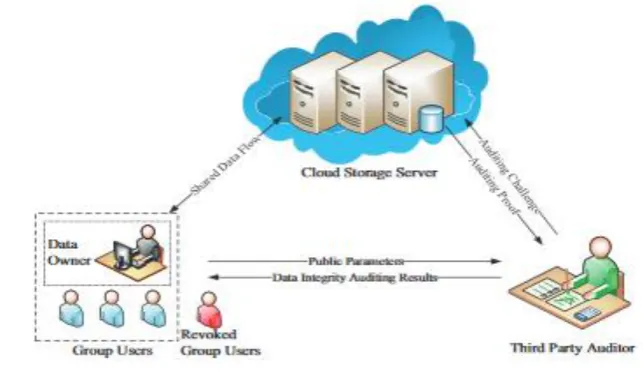
Figure 1. The cloud storage model
In this paper, we assist contemplate the issue of construing open respectability inspecting for shared element information with gathering client renouncement. Our commitments are three folds:
1) We investigate on the safe and effective shared information coordinate inspecting for multi-client operation for cipher text database.
2) By fusing the primitives of victor commitment, uneven gathering key understanding and bunch signature, we propose effective information evaluating plan while in the meantime providing some new elements, for example, traceability and count ability.
3) We give the security and productivity examination of our plan, and the examination results demonstrate that our plan is secure and productive.
II. RELATED WORK
Inside the cloud carport model as demonstrated in guardian 1, there are 3 substances, particularly the distributed
storage server, foundation clients and a third part Auditor (TPA). Establishment clients incorporate a data
442 | P a g e
records proprietor. The distributed storage server is semi-trusted, who gives measurements stockpilingadministrations to the establishment clients. TPA will be any element inside the cloud, with an end goal to be
equipped for behavior the data uprightness of the mutual data spared inside the cloud server. In our machine, the
data proprietor could scramble and add its insights to the faraway cloud carport server. Moreover, he/she shares
the benefit comprising of get passage to and change (unite and execute if critical) to various establishment
clients. The TPA ought to efficiently check the respectability of the spared inside the distributed storage server,
even the truths is frequently a la mode with the guide of the association clients. The truths proprietor isn't the
same as the inverse organization clients, he/she may need to safely deny a gathering client when an
accumulation shopper is discovered noxious or the agreement of the purchaser is lapsed.
A lot of scientists have dedicated significant attention to the issues on the best way to safely outsource nearby
store to remote cloud server. Among which, the issue of remote information respectability and accessibility
examining assaults the authentication of numerous specialists. The ideas and arrangement Provable Data
Possession (PDP) and Proofs of Retrieve ability (PoR) were first proposed by Ateniese et al. and Juels et al. . In
their plan, the homomorphic validation technique was embraced to diminish both the correspondence what's
more, calculation expense. Later, various variations of PDP and PoR plans are intended to enhance the
effectiveness and upgrade the capacity of fundamental plans, for example, permitting open evaluating and
supporting information upgrade to improve the past works, Wang et al. composed a plan to bolster offer
information uprightness reviewing, whose plan embraced ring mark to ensure the security of clients. The
restriction of the plan is that it does no bolster dynamic gathering furthermore experiences a computational
overhead straight to the gathering size and the quantity of information inspecting. To further bolster client
denial, Wang et al. outlined another plan in light of the supposition that no conspiracy happens between cloud
servers and repudiated client. Actually, they accepted that the private and confirmed channels exit between
every pair of substances and agreement between invalid clients and cloud servers will prompt the divulgence of
mysteries of all other substantial clients. As of late, Yuan furthermore, Yu composed a dynamic open
trustworthiness examining plan with secure gathering client denial. The plan depends on polynomial verification
labels and receives intermediary label redesign methods, which makes their plan bolster open checking and
effective client denial. In any case, the creators do not consider the cipher text store. Likewise, to make the plan
effective, the information proprietor (the information proprietor's private key is a bit much) does not participate
in the client disavowal stage, where the cloud could direct some malignant operation of client's information
when it colludes with the denied clients.
Gennaro et al.formalized the idea of verify capable calculation which permits a customer to outsource the
calculation of a self-assertive capacity. Be that as it may, it is wasteful for down to earth applications because of
the complicated completely homomorphic encryption strategy. Additionally, another disservice of the plans in
light of completely homomorphic encryption is that, the customer must rehash the costly pre-handling stage in
the event that the pernicious server tries to cheat and take in a bit of data. Benabbas et al. proposed the to start
with useful evident database plan taking into account the hardness of the subgroup participation issue in bilinear
gatherings with composite request. In any case, the plan does not bolster people in general unquestionable status
property. Catalano and Fiore proposed a handy answer for fabricate certain database (VDB) from vector
443 | P a g e
database ought to be settled and the customer can know the outsourcing capacity ahead of time. As of late,Backes et al. exhibited an adaptable VDB plan with two extra properties that disposes of the suspicion. Bunch
mark is presented by Chaum and Heyst. It gives obscurity to endorsers, where each bunch part has a private key
that empowers the client to sign messages. Notwithstanding, the subsequent signature keeps the character of the
endorser mystery. For the most part, there is an outsider that can lead the signature namelessness utilizing an
exceptional trapdoor. Some systems bolster denial, where bunch enrollment can be impaired without influencing
the marking capacity of unrevoked clients. Boneh and Shachamproposed an effective gathering signature with
verifier-nearby renouncement. The plan gives the properties of gathering mark, for example, caring secrecy and
traceability. Additionally, the plan is a short mark plan where client repudiation just requires sending
repudiation data to signature verifiers. Libert et al. proposed another versatile denial strategy for gathering mark
based on the show encryption structure. Be that as it may, the plan presents vital capacity overhead at bunch
client side. Later,Libert et al. composed a plan to upgrade the previous plan which could get private key of
consistent size. In their plan, the unrevoked individuals still don't have to upgrade their keys at every disavowal.
2.1 Motivation
We first describe the cloud storage model of our system. Then, we provide the threat model considered and
security goals we want to achieve. The decadency of above schemes motivates us to explore how to design an
efficient and reliable scheme, while achieving secure group user revocation.
2.2 Objectives
We explore on the secure and efficient shared data integrate auditing for multi-user operation for cipher text
database. By incorporating the primitives of victor commitment, asymmetric group key agreement and group
signature, we propose an efficient data auditing scheme while at the same time providing some new features,
such as traceability and count ability. We provide the security and efficiency analysis of our scheme, and the
analysis results show that our scheme is secure and efficient.
2.3 Problem Definition
In current strategies that assist multi-user change. Batch auditing of a couple of duties. Best the records owner
holds secret keys can alter the records and all other users who percentage data with the records proprietor
handiest have examine permission. If those solutions are trivially extended to aid multiple writers with facts
integrity assurance, the information owner has to live on-line, collecting changed information from different
customers and regenerating authentication tags for them. Glaringly, this kind of trivial extension will introduce a
superb workload This kind of situation happens typically, being it internationally or now not, with present cloud
garage platforms. As our layout successfully supports batch auditing, we are able to audit all improvement files
at the equal time to store value. for this reason, our scheme can be without problems implemented to current
444 | P a g e
2.4 EXISTING SYSTEM
In current techniques that help multi-client change. Bunch inspecting of a few obligations. Best the records owner holds mystery keys can change the records and every other client who rate information with the records proprietor handiest have look at authorization. On the off chance that those arrangements are insignificantly reached out to help numerous scholars with certainties honesty confirmation, the data proprietor needs to live on-line, gathering changed data from various clients and recovering verification labels for them. Incredibly, this sort of inconsequential expansion will present a wonderful workload This sort of circumstance happens normally, being it globally or now not, with present cloud carport stages. As our format effectively underpins clump examining, we can review all change records at the equivalent time to store esteem. consequently, our plan can be without issues executed to current VCSs to green help uprightness ensure without changing their valid design.
2.5 Disadvantages
Within the Wang et al. plan, the client disavowal issue isn't generally thought about and the reviewing cost is direct to the foundation size and data length.
But, the plan accepted that the non-open and verified channels exist among every pair of substances and there is no arrangement amongst them. Furthermore, the inspecting expense of the plan is straight to the association size.
However, in Yuan and Yu plan, the creators don't remember the records mystery of gathering clients. It strategy that, their plan may need to effectively help plaintext records supplant and respectability reviewing, while now not cipher text records. in their plan, if the measurements proprietor insignificantly shares a gathering key among the association clients, the absconding or disavowal any foundation client will compel the establishment clients to supplant their mutual key. Furthermore, the actualities proprietor does now not partake inside the client renouncement area, wherein the cloud itself could conduct the shopper repudiation stage. In this circumstance, the conspiracy of repudiated individual and the cloud server will offer risk to noxious cloud server in which the cloud server ought to upgrade the data the same number of time as outlined and offer a jail records at last.
2.6 Proposed System
445 | P a g e
Our thought is to utilize vector responsibility plan over the database. At that point we influence the awry foundation Key assertion (AGKA) and gathering marks to bolster cipher text certainties base upgrade amongst gathering clients and effective association client denial separately.
Mainly, the gathering individual uses the AGKA convention to scramble/unscramble the extent database, with the goal to guarantee that a buyer inside the gathering can have the capacity to encode/decode a message from another association clients. The association mark will spare you the plot of cloud and repudiated association clients, where the records proprietor will partake in the client renouncement portion and the cloud couldn't disavow the information that last changed by method for the denied individual.
2.7 Advantages of Proposed System
We investigate on the safe and effective shared information incorporate examining for multi-client operation for cipher text database.
By consolidating the primitives of victor duty, hilter kilter bunch key understanding and gathering mark, we propose an effective information reviewing plan while in the meantime giving some new components, for example, traceability and countability.
We give the security and effectiveness investigation of our plan, and the examination results demonstrate that our plan is secure and proficient.
III. CONCLUSION
The primitive of obvious database with productive upgrades is an imperative approach to take care of the issue of obvious outsourcing of capacity. We propose a plan to acknowledge proficient and secure information trustworthiness examining for offer element information with multi-client modification. The plan vector duty, Asymmetric Group Key Agreement (AGKA) and bunch signatures with client denial are embrace to accomplish the information honesty inspecting of remote information. Next to the general population information inspecting, the consolidating of the three primitive empower our plan to outsource cipher text database to remote cloud and backing secure gathering clients repudiation to shared element information. We give security investigation of our plan, and it demonstrates that our plan give information privacy to gathering clients, furthermore, it is additionally secure against the agreement assault fromthe distributed storage server and disavowed bunch clients. Additionally, the execution investigation demonstrates that, looked at with its important plans, our plan is likewise effective in various stages.
IV. FUTURE ENHANCEMENT
446 | P a g e
data in the cloud with dynamic group we can share the information to multiple users. That can be implemented by in feature by adding the extra module.
REFERENCES
[1] Amazon. (2007) Amazon simple storage service (amazon s3).Amazon.[Online]. Available: http://aws.amazon.com/s3/
[2] Google. (2005) Google drive. Google.[Online].Available: http://drive.google.com/
[3] Dropbox. (2007) A file-storage and sharing service.Dropbox.[Online]. Available: http://www.dropbox.com/
[4] Mozy. (2007) An online, data, and computer backup software.EMC. [Online]. Available: http://www.dropbox.com/
[5] Bitcasa. (2011) Inifinite storage.Bitcasa.[Online].Available: http://www.bitcasa.com/ [6] Memopal. (2007) Online backup. Memopal. [Online].Available: http://www.memopal.com/
[7] M. A. et al., “Above the clouds: A berkeley view of cloud computing,” Tech. Rep. UCBEECS , vol. 28, pp. 1–23, Feb. 2009.
[8] M. Rabin, “Efficient dispersal of information for securety,” Journal of the ACM (JACM), vol. 36(2), pp. 335–348, Apr. 1989.
[9] J. G. et al. (2006) The expanding digital universe: A forecast of worldwide information growth through 2010. IDC. [Online]. Available: Whitepaper
[10] G. Ateniese, R. Burns, R. Curtmola, J. Herring, L. Kissner, Z. Peterson, and D. Song, “Provable data possession at untrusted stores,” in Proc. of ACM CCS, Virginia, USA, Oct. 2007, pp. 598–609.
[11] A. Juels and B. S. Kaliski, “Pors: Proofs of retrievabiity for large files,” in Proc. of ACM CCS, Virginia, USA, Oct. 2007,pp. 584–597.
[12] K. D. Bowers, A. Juels, and A. Oprea, “Proofs of retrievability: theory and implementation,” in Proc. of CCSW 2009, llinois, USA, Nov. 2009, pp. 43–54.
[13] Y. Dodis, S. Vadhan, and D. Wichs, “Proofs of retrievability via hardness amplification,” in Proc. of TCC 2009, CA, USA,Mar. 2009, pp. 109–127.
[14] Q. Wang, C. Wang, J. Li, K. Ren, and W. Lou, “Proofs ofretrievability via hardness amplification,” in Proc. of ESORICS 2009, Saint-Malo, France, Sep. 2009, pp. 355–370.
[15] C. Erway, A. Kupcu, C. Papamanthou, and R. Tamassia, “Dynamic provable data possession,” in Proc. of ACM CCS,Illinois, USA, Nov. 2009, pp. 213–222.
[16] C. Wang, Q. Wang, K. Ren, and W. Lou, “Privacy-preserving public auditing for data storage security in cloud computing,” in Proc. of IEEE INFOCOM 2010 , CA, USA, Mar. 2010, pp. 525– 533.
[17] J. Yuan and S. Yu, “Proofs of retrievability with public verifiability and constant communication cost in cloud,” in Proc. of International Workshop on Security in Cloud Computing, Hangzhou, China, May
2013, pp. 19–26.
447 | P a g e
[19] Cloud9. (2011) Your development environment, in the cloud. Cloud9. [Online]. Available: https://c9.io/ [20] Codeanywhere. (2011) Online code editor. Code anywhere.[Online]. Available:
https://codeanywhere.net/
AUTHOR DETAILS
N. BHARATH KUMAR
Pursuing M.Tech in Visvesvaraya College of Engineering and Technology, M.P Patelguda, Ibrahimpatnam (M), Ranga Reddy (D), and India.
MR. MAHESH AKUTHOTA
Working as Asst. Professor (CSE) in Visvesvaraya College of Engineering and Technology, M.P Patelguda, Ibrahimpatnam (M), Ranga Reddy (D), and India.
SRI. DR. BHALUDRA RAVEENDRANADH SINGH
M.Tech,Ph.D.(CSE),MISTE,MIEEE(USA),MCSI
Professor & Principal. He obtained M.Tech, Ph.D(CSE)., is a young, decent, dynamic Renowned Educationist and Eminent Academician, has overall 23 years of teaching experience in different capacities. He is a life member of CSI, ISTE and also a member of IEEE (USA). For his credit he has more than 50 Research papers published in Inter National and National Journals. He has conducted various seminars, workshops and has participated several National Conferences and International Conferences. He has developed a passion towards building up of young Engineering Scholars and guided more than 300 Scholars at Under Graduate Level and Post Graduate Level. His meticulous planning and sound understanding of administrative issues made him a successful person.