A Parenting Intervention for Childhood Behavioral Problems: A Randomised Controlled Trial in Disadvantaged Community-based Setting*
Authors:
Sinead McGilloway1, Grainne Ni Mhaille1, Tracey Bywater2, Mairead Furlong1, Yvonne Leckey1, Paul Kelly1, Catherine Comiskey3, Michael Donnelly4.
1
Department of Psychology, National University of Ireland, Maynooth; 2 Institute for Effective Education, University of York; 3 School of Nursing and Midwifery, University of Dublin, Trinity College; 4 Centre for Public Health, Queen’s University, Belfast
Date of submission: 13/09/2011
*
Objective: A community-based Randomised Controlled Trial (RCT) was conducted to test the effectiveness of the Incredible Years BASIC parent training program (IYBP) for children with behavioral problems. The trial was conducted in urban areas characterised by high levels of disadvantage. Potential moderators of intervention effects on child behavioral outcomes were also explored. Methods: Families were included if the child (aged 32-88 months) scored above a clinical cut-off on the Eyberg Child Behavior Inventory (ECBI). Participants (n=149) were randomly allocated on a 2:1 ratio to an intervention group (n=103) or a
waiting-list control group (n=46). Child behavior, parenting skills and parent well-being were assessed at baseline and six months later using parent-report and independent observations. An intention-to-treat analysis of covariance (ANCOVA) was used to examine
post-intervention differences between groups. Results: There were statistically significant differences in child disordered behavior which favored the intervention group on the EBBI Intensity (effect size=0.7, p<0.001) and Problem subscales (effect size=0.75, p<0.001). Intervention effects on child hyperactive-inattentive behaviors and social competence, as well as parent competencies and well-being were also found. Moderator analyses showed that the effects of the IYBP intervention on the primary child outcomes were not moderated by child/family demographic characteristics or risk factors.Conclusion: The results illustrate the effectiveness of the IYBP in alleviating problem behavior amongst children and in improving well-being amongst families living in disadvantaged areas. The findings also highlight the importance of parental intervention in early childhood for those parents and children who are most in need of support. Trial Registration: ISRCTN29121945.
Introduction
Conduct problems (e.g. aggressive, oppositional and hyperactive-inattentive type behaviors) are common in early childhood and are becoming more prevalent (Collishaw, Maughan, Goodman & Pickles, 2004). Early childhood behavioral difficulties are highly predictive of a range of difficulties, including poor scholastic achievement (Reid, Gonzalez, Nordness, Trout & Epstein, 2002), anti-social behavior and peer-rejection (Ladd, Birch & Buhs, 1999), as well as poor outcomes in adulthood such as criminal behavior, poor employment prospects and mental ill health (Colman et al., 2009; Fergusson, Horwood & Ridder, 2005).
Low levels of parental supervision/involvement and harsh and inconsistent discipline are particularly strongly associated with the development of conduct problems (Shaw & Winslow, 1997). Parental mental illness and disrupted family life, which may affect the quality of parent-child interactions, have also been associated with behavioral deviancy (Trapolini, McMahon & Ungerer, 2007). Parent behavior may also mediate the link between risk factors such as difficult child temperament, and the likelihood of developing conduct disordered behavior (Paulussen-Hoogeboom, Stams, Hermanns, Peetsma & van den Wittenboer, 2008). All of these factors may be further compounded by exposure to high levels of socioeconomic disadvantage which have been shown to increase the risk of
developing childhood behavioral difficulties (Frick & Morris, 2004; Wasserman et al., 2003). Evidence-based parenting programs have been identified as an important early
parenting programs can improve parenting competency, whilst also benefiting parental psychosocial health and overall family adjustment (Hutchings et al., 2007a).
Recent evidence suggests that parenting programs can be effectively incorporated into community-based services (Gardner, Burton & Klimes, 2006; Hutchings, Bywater & Daley, 2007b). However, to date, most trials of parenting programs have been conducted in clinical settings (e.g. Larsson et al., 2008). Furthermore, reviewers have pointed out that only a small number of parenting program trials meet the methodological (Serketich & Dumas, 1996) or clinical criteria for inclusion in meta-analyses aimed at exploring the clinical effectiveness of parenting programs (Furlong et al., 2010). For example, many trials in this area do not use adequate randomisation procedures (e.g. Scott, Spender, Doolan, Jacobs & Aspland, 2001) and/or appropriate methods for dealing with incomplete or missing outcome data (e.g. Braet et al., 2009; Larsson et al., 2008); other studies do not include children with clinically
significant conduct problems (e.g. Dionne, Davis, Sheeber & Madrigal, 2009; Patterson et al., 2002). These limitations may compromise our understanding of the clinical effectiveness of parenting interventions under ‘real world’ conditions.
Exploring the factors and/or conditions which may facilitate or attenuate the outcomes of parent training programs is also critical for intervention research and program
optimal outcomes may be achieved in the delivery of community-based interventions (Gardner, Hutchings, Bywater & Whitaker, 2010).
This study involved a Randomised Controlled Trial (RCT) evaluation of the effectiveness of the Incredible Years Basic Parenting Program (IYBP; Webster-Stratton, 2005) for Irish parents of children who were displaying significant and persistent behavioral difficulties. Recent findings have indicated that 15% of Irish children experience considerable socioemotional and/or behavioral adjustment difficulties (Williams et al., 2009); this figure is comparable to figures from the wider literature which suggest a prevalence of 10 to 20% (Attride-Stirling, Davis, Markless, Sclare, & Day, 2001; Emerson & Einfield, 2010). Additional research suggests that almost one-quarter of parents use harsh or coercive disciplinary strategies with their children (Halpenny, Nixon & Watson, 2009). This is important because children of parents who report more frequent use of physical and harsh forms of punishment, are more likely to display problematic behaviors (Halpenny et al., 2009; Larzelere, Cox & Smith, 2010). Thus, a substantial proportion of families in Ireland and elsewhere may benefit from parent training interventions.
recommended protocol or dosage (C.S. Webster-Stratton, personal communication, June 8, 2011).
The principal aim of this study was to assess the effectiveness of the IYBP for
improving child behavioral and social adjustment, as well as parental competencies and well-being in disadvantaged community-based service settings. We hypothesised that: (1) parent training would lead to improvements in the intensity and frequency of child behavioral problems, including child conduct disordered and hyperactive-inattentive behaviors; (2) there would be positive changes in children’s social skills; and (3) that the intervention would lead
to improvements in parenting practices and parental stress and well-being. Potential
moderators of parent training outcomes were also explored by assessing the role of key child, family and social characteristics in influencing child response to treatment.
Method Participants and Study Setting
Families were recruited to the study using existing service systems including public health service waiting lists, local schools, community-based agencies and self-referral. Participants were eligible if the primary caregiver rated their child (aged 32–88 months) above the clinical cut-off on either the Intensity subscale (Intensity score ≥ 127) or the Problem subscale (Problem score ≥11) of the Eyberg Child Behavior Inventory (ECBI; Eyberg & Pincus, 1999). This cut-off has been used in similar research and is considered to indicate potentially significant psychopathology (Hutchings et al., 2007a). Parents also had to be willing and able to attend the program. In total, 149 families were eligible and agreed to participate in the research. At follow-up, 137 parents were retained in the trial (Figure 1).
isolation, mental health issues, substance misuse, community conflict and domestic violence. Facilities include talks, activities, workshops, children's groups, individual advice and
support, assessments and childcare for pre-school children. These centres are located in four urban areas which are designated as ‘disadvantaged’ according to information on
demographic profile, social class composition and labour market situation (Haase & Pratschke, 2008).
[Figure 1 about here] Randomisation, Allocation Concealment and Blinding
Participants were blindly allocated on a 2:1 basis using a computer-generated random number sequence, to a parent training intervention group (n=103) or a waiting-list control group (n=46). This ratio results in a small reduction in statistical power, but allows for the inclusion of a larger intervention group, which is ethically desirable in effectiveness evaluations conducted in community-based settings. The unit of randomisation was the parent-child dyad and participants were block randomised by area to ensure that parents attended the program in their locality.
Randomisation was carried out by an independent statistician who was not involved in data collection. Participant allocation was subsequently conveyed through private
correspondence to an administrator who informed participants of their treatment allocation. Child age and gender were not restricted in randomisation. Post-hoc analyses revealed no significant differences between intervention and control groups with respect to age (p=0.19). Whilst there were proportionately more boys in the control group (31/46; 67%) when
Researchers were blinded to group allocation and parents were asked not to inform
researchers at follow-up assessment as to whether or not they had taken part in the program. Procedure
Information sheets were administered to referred families and written informed consent was provided by parents and guardians of participating children. Two cohorts of parents were recruited during a six-month period. Baseline assessments for the first cohort of parents (n=53) were carried out in February/March 2008 with six-month post-baseline follow-up assessments undertaken in July/August of the same year. The second cohort (n=96 parents) was interviewed in July/August 2008 with subsequent follow-up assessments in January/February 2009. At both time points, data were collected from one parent only, most of whom were mothers (143 mothers, 6 fathers). Parents in the intervention group received the IYBP following baseline assessment. The six-month follow-up assessments took place approximately three months after intervention completion. The assessment of treatment effects at this time point did not allow insight into how participants fared immediately post-treatment. However, the intervening period provided reasonable time for parents to
implement new parenting skills and to allow any child behavior changes to emerge. Control group parents were offered the IYBP after the six-month follow-up. Participants were provided with a small payment after both the baseline and follow-up assessments as a token of thanks for completing assessments. There was no financial incentive associated with taking part in the program itself.
Measures
on baseline data using Cronbach’s α. Measures were administered by researchers (blinded to
allocation) either in participants’ homes, or in a local family centre.
Child behavior measures. The Eyberg Child Behavior Inventory (ECBI; Eyberg & Pincus, 1999) was used as the primary outcome measure of child problem behavior. This screening tool, which is widely employed in clinical practice and intervention studies, consists of two subscales that elicit parents’ perceptions of 36 problem behaviors. The ‘Intensity’ subscale comprises a 7-point Likert scale which measures how frequently each
behavior occurs; the ‘Problem’ subscale elicits information on the number of problem
behaviors exhibited by the child, as well as a ‘Yes-No’ response on whether or not the parent considers the child’s behavior to be problematic(α=0.89 and 0.87 for the Intensity and Problem subscales respectively). ECBI normative data, based on a sample of children in a south-eastern region of the US (n=798), indicate a mean score on the Intensity scale of 96.6 (35.2) and 7.1 (7.7) on the Problem scale (Eyberg & Pincus, 1999).
Respondents are asked to rate the extent to which this statement reflects their child’s behavior on a five-point Likert scale.
Parental well-being measures. Levels of parental psychopathology and
dysfunctional parent-child interactions were assessed to determine whether the intervention had led to any changes in parental distress and competency. The Parenting Stress Index-Short Form (PSI-SF; Abidin, 1995) was used to obtain an overall measure of parent stress and
functioning (α=0.93). The scale comprises 36 items which measure the distress experienced by parents in their parenting role as well as dysfunctional parent-child interactions. The 21-item Beck Depression Inventory (BDI; Beck, Ward, Mendelson, Mock & Erbaugh, 1961) was also used to assess the overall prevalence and severity of depressive symptoms and behaviors amongst parents (α=0.93).
Observational measure. The Dyadic Parent-Child Interactive Coding System-Revised (DPICS-R; Robinson & Eyberg, 1981) provided an independent observational
measure of parent-child interactions and behaviors based on a 30-minute observation period (in 5 minute intervals). The coding system comprises 21 parent behavior categories (e.g. commands, questions, praise, positive affect and physical behaviors) and 7 child behavior categories (e.g. destructive and physically negative behaviors, smart talk, crying and positive affect). Coding is continuous and is based on the frequency of a given behavior during parent-child interaction.
Summary variables of observational data were created for analysis. ‘Child Problem Behavior’ represents the aggregate of frequency counts for aversive child behaviors including destructive and aggressive behaviors (e.g. throwing items or hitting, shouting, crying,
encouragement and positive physical behaviors towards the child (e.g. displays of affection). ‘Critical Parenting’ comprises three parent behavior categories including the use of negative
commands, critical statements, and physically negative behaviors (e.g. snatching an item away from the child).
Observation procedure. Live observations were carried out mainly in the participants’ homes while the parent and child engaged in play (e.g. doing a jigsaw puzzle, painting a picture, playing with toys). Parents were instructed not to interact with the observer and to continue with normal activities for the duration of the observation. They were also asked not to view television or play computer games. A number of observations were carried out in a community centre (n=22; 12 at baseline and 10 at follow-up) to facilitate parental
participation. Observations were conducted at both baseline and follow-up, for the second cohort of parent participants only (i.e. 54% (80/149) of the total sample; 56 intervention, 24 control). It was not possible to conduct observations during the first wave of participant recruitment due to observational training and service delivery timetabling constraints. Observers were blind to participant treatment allocation and all received five days of
intensive training. Once reliability with the primary coder was achieved, it was subsequently maintained by means of team coding meetings, coding videotaped parent-child interactions and practice observations in order to ensure standardised coding of parent-child interaction. In total, 20% of all home/centre observation visits were attended by two coders who coded simultaneously in order to assess agreement and inter-rater reliability. Reliability checks were conducted at both baseline and follow-up; an average inter-rater agreement of 70% is deemed reliable according to the DPICS manual (Robinson & Eyberg, 1981).
Power Analysis
score on the ECBI Intensity subscale were considered significant, in line with previous studies(Hutchings et al., 2007a). Therefore, in order to achieve an effect size of 0.8 and
allowing for a drop out rate of 18%, a total sample size of 144 participants was recommended. The Intervention
The IYBP is a collaborative-based intervention which uses group discussions and role plays in combination with video material to illustrate various parenting and discipline
strategies.Program topics include play, attention and involvement, listening, problem-solving, praise and incentives, and limit setting and other non-aversive discipline strategies. The
program promotes positive parenting techniques such as child-directed play and
encouragement to foster child cooperation, and strengthen parent-child relationships. Child problem behaviors are addressed by encouraging parents to reinforce positive pro-social behavior and to use non-aversive discipline strategies (e.g. time-out) in order to tackle aversive or inappropriate behaviors. Parents practise the new tasks and techniques at home and provide feedback at the next weekly session.
Treatment delivery. Nine intervention groups, each with approximately 11-12
participants, were delivered in weekly two-hour sessions in several locations in a mid-eastern region of Ireland. Both participant cohorts received the 14-session intervention. However, due to time constraints, the 14 sessions were delivered over a 12-week period for the first cohort. Group sessions were held at a time and location that suited the participants. Parents also received a weekly support call from the group leader throughout the course and follow-up sessions were delivered in the event that parents were unavailable to attend on any
were supported financially by Archways, a charitable community-based organization that supports the implementation and roll-out of Incredible Years (IY) training and other
evidence-based family interventions in Ireland. Two Archways staff are also fully accredited IY group facilitators/leaders.
Treatment integrity/fidelity. The treatment groups were facilitated by two persons who had received a minimum of three days training in the context and techniques of the intervention. Group facilitators worked in the centres where the program was being delivered and had varied backgrounds including psychology, counselling, education or related fields. All 11 group facilitators/leaders had prior experience in delivering the IYBP in community-based settings; three had achieved full accreditation in delivering the IYBP, whilst the remainder were working towards accreditation during the course of the study. The accreditation process involves rigorous independent assessments and regular reviews of delivery performance. During course delivery, all group facilitators received weekly supervision and support from a certified independent IY trainer and attended weekly
meetings to assess progress and address issues which may have arisen during group sessions. Group sessions were videotaped and randomly reviewed by a certified trainer to evaluate treatment delivery.
Implementation fidelity was monitored by means of facilitator-completed self-evaluation checklists. A Leaders’ Weekly Checklist (Webster-Stratton, Kolpacoff &
Hollinsworth, 1988) was completed by group facilitators after each weekly session in order to check and record that they had covered all prescribed material (e.g. showed vignettes,
been reported elsewhere (e.g. Kling, Forster, Sundell & Melin, 2010). The group facilitators further reported that, of those parents who attempted to implement the skills at home, 80% did so with ‘some success’ on a weekly basis whereas 21% did so with ‘total or most success’. There was no validated independent measure of facilitator adherence to the intervention protocol and neither was the quality of program delivery objectively assessed.
Treatment attendance. Approximately three-quarters (76%) of the first cohort of participants attended 7 or more sessions (mean attendance=10.8 sessions) compared to half (52%) of the second cohort (mean attendance=6.6 sessions). In total, 31% of participants attended three or fewer sessions. The reasons for lack of program engagement were explored in a separate qualitative sub-study that ran in parallel to the main RCT and which included a small sub-sample of parent participants (n=8) who attended fewer than five sessions. Reasons for non-engagement included mainly practical or circumstantial barriers to program
attendance (e.g. illness, change in employment status), although a small number of parents expressed dissatisfaction with the ethos of the course (n=2) and concerns around an intrusion of privacy (n=2) (Furlong & McGilloway, 2011).
Analysis
A strict intention-to-treat analysis was carried out whereby all participants were included in the analysis regardless of program attendance. No change from baseline was assumed for participants who were lost to follow-up. An analysis of covariance (ANCOVA) was carried out to examine post-intervention differences between conditions on parent-report and observational measures, controlling for baseline score and intervention status. In this study, participants were nested within parent training groups. Group effects, such as
variances at the group level (Varnell, Murray, Janega & Blitstein, 2004). A ‘per protocol’ analysis was undertaken in parallel; this excluded only those participants who were lost to follow-up (no parents were excluded on the basis of intervention attendance).
Observational data were analysed using the last observation carried forward for those who did not complete observations at follow-up. A secondary analysis of observational data was also carried out, excluding only those who were lost to follow-up. Inter-rater reliability, as measured by intra-class correlation coefficients (ICCs) for summary variables, showed high consistency (child problem behavior=0.88; child positive behavior=0.97; positive parenting=0.94; critical parenting=0.90). Square root transformations were used for purposes of analysis as observational variables were not normally distributed. Effect sizes for the ANCOVA were calculated using Cohen’s guidelines whereby an effect size of 0.2 denotes a small effect, 0.5 a medium effect and 0.8 a large effect of the intervention (Cohen, 1988).
Results Participant Characteristics
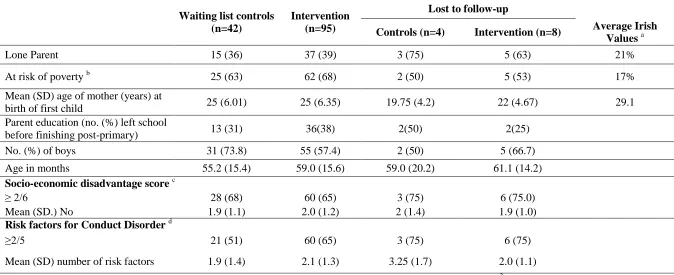
Baseline and attrition analyses. The baseline characteristics of families, including those who were lost to follow-up, are shown in Table 1. Most participants were socially and economically disadvantaged when compared to average Irish norms (Central Statistics Office, 2006a; 2006b). At baseline, a constellation of co-occurring child difficulties was reported by parents including externalising, aggressive and oppositional behaviors, high levels of
calculated on the basis of the above factors; 60% of participants (90/149) obtained a risk factor score of two or more.
Statistical analyses (Chi-Square and two sample t-tests) indicated no significant differences between intervention and control group participants with respect to all baseline characteristics. Further analyses were conducted to examine differences between those retained in the study and those lost to follow-up. No significant differences were found between the two groups with the exception that children of parents lost to follow-up obtained statistically significantly higher scores on the Social Competence Scale.
[Table 1 about here] Intervention Outcomes
The intention-to-treat analysis revealed statistically significant differences in child problem behavior. A large effect of the intervention on child behavioral adjustment was found on both the ECBI Intensity and Problem subscales. Between-group, post-intervention differences in child behavior were also found in the analyses of our secondary measures. The results of the ANCOVA indicated significant intervention-control group differences on the SDQ ‘total difficulties’ scores. Significant intervention effects were also found at follow-up on parent reported levels of hyperactivity and inattention as measured by the Conners scale, and on pro-social behavior as measured by the Social Competence Scale. Analysis of observed child positive behavior did not show a statistically significant effect of the
intervention, although there was a significant difference in observed child problem behavior for the intervention condition when compared to the control condition (Table 2).
[Table 2 about here]
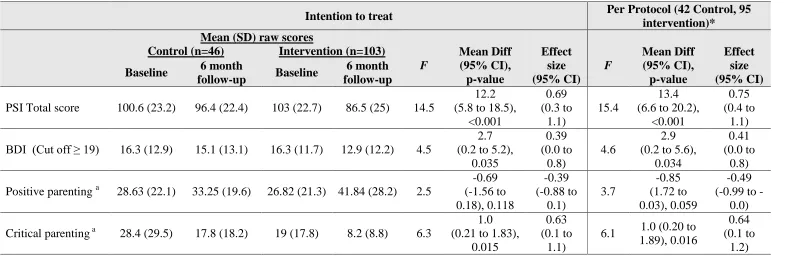
counterparts. Significant effects of the intervention on parental stress levels (as measured by the PSI) and on parental depression levels (as measured on the BDI) were also found when compared to control group parents (Table 3)
[Table 3 about here] Moderator Analysis
Discussion
The findings support the study hypotheses and highlight the effectiveness of the IYBP as an intervention for the early onset of behavioral problems in young children when
implemented in community-based services. Although almost two-thirds (63%) of the families in the current study were exposed to multiple risk factors, the parenting intervention had a positive impact on child conduct problems, hyperactive behaviors and social skills. Baseline mean scores on behavioral measures indicated that children were classified as ‘at risk’ for future conduct disorder and delinquency, but at follow-up the children in the intervention group were, on average, below the cut-off for clinical concern on the ECBI, the primary outcome measure.
Encouragingly, child behavior outcomes were not moderated by child characteristics, risks for conduct disorder, or socioeconomic risks/disadvantage. Previous research has indicated that family adversity, in particular, can diminish the outcomes of parent training (Lundahl et al., 2006; Reyno & McGrath, 2006). However, the current study findings indicate that children of families who experience adversity derived considerable benefits from parent training. These results are in keeping with a small number of studies which have found that the IYBP intervention positively influenced child behavior across a range of moderating variables (e.g. Beauchaine, Webster-Stratton & Reid, 2005; Gardner et al., 2010).
Previous research has identified changes in positive parenting as a key mediator of improved child behavior (e.g. Gardner et al., 2006; Gardner et al., 2010) although the findings from the current study were non-significant in this respect. However, prior research has highlighted reductions in critical parenting as a significant lever for improvement in child behavior (e.g. Beauchaine at al., 2005). Likewise, our findings show that there were
Intervention effects on parent-reported stress and levels of depression were also found, thereby suggesting improvements in parental psychosocial functioning.
These findings support the general utility of parenting programs in real-world, community-based settings/services as a means of promoting parenting competency and overall family adjustment. Moreover, parenting programs can assist families who experience high levels of socioeconomic disadvantage, whilst promoting positive behavior in children who are at risk of poorer outcomes into adolescence and adulthood. The cost implications of these programs are also an important additional consideration and a separate cost-benefit analysis of the IYBP program, carried out in parallel to the current study, is reported elsewhere (O’Neill, McGilloway, Donnelly, Bywater and Kelly, in press).
Comparison with other research. This study is the first RCT evaluation of an updated version of the IYBP intervention. Previous research has evaluated shorter 9- and 12-session interventions (Hutchings et al., 2007a; Reid, Webster-Stratton & Baydar, 2004), whilst a smaller number of studies have evaluated a longer 20- to 22-session program (Webster-Stratton et al., 2004). Despite these differences in treatment length, the effects of the intervention in the current study are consistent with effect sizes reported in other IYBP trials. The findings from our study, which was carried out in urban settings, are comparable with those of a rural-based study in Wales (Hutchings et al., 2007a) and clinical-based work in Norway (Larsson et al., 2008). The Welsh team reported moderate and large effect sizes of 0.63 and 0.89 on the ECBI Problem and Intensity subscales respectively (Hutchings et al., 2007a). Comparable effect sizes, indicating a consistent benefit of parenting intervention for child conduct problems, are reported here. Our study further indicates more substantial effects of the IYBP intervention for child hyperactivity and social competence. Notably, some of the above studies were undertaken within the context of integrated,
Start in the US). However, the current trial was carried out in disadvantaged areas in Ireland, in the absence of any such national initiatives and within a context where other family services were limited, thereby reinforcing the potential utility of ‘stand-alone’ parenting programs for at-risk families in the longer term.
Study Strengths
The key strengths of this study, which was the first to assess the effectiveness of the new 14-week IYBP, include the use of mixed methodologies and close adherence to the high quality practices recommended for RCTs (Schulz, Altman & Moher, 2010). A sample size calculation was conducted to ensure adequate statistical power and strict randomisation and blinding procedures were also applied. An intention-to-treat principle for incomplete or missing data was implemented to ensure that the clinical effectiveness of the program, when implemented in a real-world/community-based setting, was not overestimated (Hollis & Campbell, 1999). A comprehensive error audit, conducted to ensure high quality data, yielded an error rate for data input of less than 0.1%. Subjective parental report was supplemented and amplified with more objective ‘live’ observations of behavior which were carried out by
trained researchers and inter-rater reliability on this component of the study was also very high. Study attrition was low and those who were lost to follow-up did not differ from those who remained in the study in terms of demographic characteristics or child problem
behaviors.
Study Limitations
The number of boys in the control group in this study marginally outweighed those in the intervention group. These differences, though statistically non-significant, may have had a biasing effect on outcomes and may compromise, to some extent, the generalisability of findings.
Although a number of procedures were put in place to support intervention fidelity and facilitator self-reported fidelity was satisfactory, no independent verification of treatment adherence or assessment of the quality of program delivery was carried out (e.g. by clinicians or raters/observers). The relatively low program attendance of 60%, when compared to 83% in Hutchings and colleagues (2007a) and 88% in Webster-Stratton (1998), was unexpected, although families who experience greater social and economic adversity are generally
considered more difficult to engage in intervention and prevention programs (Baydar, Reid & Webster-Stratton, 2003). Therefore, it is likely that the attendance rates in the current study may have been negatively affected by the large proportion of participants who were
experiencing significant socioeconomic disadvantage, and especially the second cohort which included parents from a particularly highly disadvantaged inner city area. Study Implications and Directions for Future Research
This study, one of the first within a European context, focused on a high-risk sample recruited from ‘real world’ urban settings and showed significantly improved child and parent
outcomes following a parenting intervention delivered by regular, community-based service staff. The findings from the current trial support the importance of early childhood
governments and practitioners who are considering investing in and/or delivering the IYBP program for children with behavioral problems in disadvantaged communities across different geographical and cultural contexts.
Participants in the current trial were referred to the IYBP by means of self-referral and existing service systems; this indicates, at least in part, the potential for program
sustainability into the future. However, if evidence-based parenting programs, such as the IYBP, are to be widely available and successful in the longer term, a number of other factors need to be in place, including the availability of willing and appropriately trained facilitators, ongoing monitoring of intervention delivery and the availability of adequate administrative and financial support for program implementation. Thus, future research should continue to explore the effectiveness of parenting programs in community-based services, as well as the long-term outcomes for service users. Factors which contribute to program attendance in community settings and mediators of treatment response should also be explored. Such research would help to highlight ways in which highly vulnerable parents might be
References
Abidin, R.R. (1995). Parenting Stress Index (3rd Ed). Odessa: Psychological Assessment Resources.
Attride-Stirling, J., Davis, H., Markless, G., Sclare, I. & Day, C. (2001). ‘Someone to talk to who'll listen’: Addressing the psychosocial needs of children and families. Journal of
Community & Applied Social Psychology, 11, 179–191.
Barlow, J., Smailagic, N., Ferriter, M., Bennett, C. & Jones, H. (2010). Group-based parent-training programs for improving emotional and behavioral adjustment in children from birth to three years old. Cochrane Database of Systematic Reviews Issue 3. Art. No.: CD003680. DOI: 10.1002/14651858.CD003680.pub2
Baydar, N., Reid, J.M. & Webster-Stratton, C. (2003). The role of mental health factors and program engagement in the effectiveness of a preventive parenting program for Head Start mothers. Child Development, 74, 1433 – 1453.
Beauchaine, T.P., Webster-Stratton, C. & Reid, J.M. (2005). Mediators, moderators, and predictors of 1-Year outcomes among children treated for early-onset conduct problems: A latent growth curve analysis. Journal of Consulting and Clinical Psychology, 73, 371-388.
Beck, A.T., Ward, C.H., Mendelson, M., Mock, J. & Erbaugh, J. (1961). An inventory for measuring depression. Archives of General Psychiatry, 4, 561–571.
Braet, C., Meerschaert, T., Merlevede, E., Bosmans, G., van Leeuwen, K. & de Mey W. (2009). Prevention of antisocial behavior: Evaluation of an early intervention program. European Journal of Developmental Psychology, 6, 223-240
Brestan, E.V. & Eyberg, S.M. (1998). Effective psychosocial treatments of
Central Statistics Office [CSO] (2006a). Census 2006 Reports. Dublin: Stationery Office. Central Statistics Office (2006b). EU Survey on Income and Living Conditions. Dublin:
Stationery Office.
Cohen, J. (1988). Statistical Power for the Behavioral Sciences. Hillsdale, NJ: Erlbaum. Collishaw, S.B., Maughan, B., Goodman, R. & Pickles, A. (2004) Time trends in adolescent
mental health. Journal of Child Psychology and Psychiatry, 45, 1350-1362. Colman, I., Murray, J., Abbott, R.A., Maughan, B., Kuh, D., Croudace, T.J. & Jones, P.B.
(2009). Outcomes of conduct problems in adolescence: 40 year follow-up of national cohort. British Medical Journal, 338, 208-211.
Conners, C.K. (1994). The Conners Rating Scales: Use in clinical assessment, treatment planning and research. In M. Maruish (Ed.), Use of Psychological Testing for
Treatment Planning and Outcome Assessment (pp. 550-578). NJ: Erlbaum Associates. Corrigan, A. (2002). Social Competence Scale – Parent Version, Grade 1 /Year 2 (Fast Track
Project Technical Report). Available from: http://www.fasttrackproject.org. Dionne, R., Davis, B., Sheeber, L. & Madrigal, L. (2009). Initial evaluation of a cultural
approach to implementation of evidence-based parenting interventions in American Indian communities. Journal of Community Psychology, 37, 911-921.
Eyberg, S. & Pincus, D. (1999). Eyberg Child Behavior Inventory and Sutter-Eyberg Student Behavior Inventory-Revised: Professional Manual. Florida: Psychological
Assessment Resources, Inc.
Emerson, E. & Einfield, S. (2010). Emotional and behavioural difficulties in young children with and without developmental delay: A bi-national perspective. Journal of Child Psychology & Psychiatry, 51, 583-593.
adulthood. Journal of Child Psychology, Psychiatry, and Allied Disciplines, 46, 837-849.
Frick, P.J., & Morris, A.S. (2004). Temperament and developmental pathways to severe conduct problems. Journal of Clinical Child and Adolescent Psychology, 33, 54-68. Furlong, M., McGilloway, S., Bywater, T., Hutchings, J., Donnelly, M., Smith, S.M. &
O'Neill, C. (2010). Behavioral/cognitive-behavioral group-based parenting interventions for children age 3-12 with early onset conduct problems (Protocol). Cochrane Database of Systematic Reviews 2010, Issue 1. Art. No.: CD008225. DOI:
10.1002/14651858.CD008225.
Furlong, McGilloway, S., Bywater, T., Hutchings, J., Donnelly, M., Smith, S.M. & O'Neill, C. (2011). Behavioral/cognitive-behavioral group-based parenting interventions for children age 3-12 with early onset conduct problems. Manuscript submitted for publication.
Furlong, M. & McGilloway, S. (2011). The Incredible Years Parenting Program in Ireland: A qualitative analysis of the experience of parents living in disadvantaged areas.
Clinical Child Psychology and Psychiatry. In press.
Gardner, F., Burton, J. & Klimes, I. (2006) Randomised controlled trial of a parenting intervention in the voluntary sector for reducing child conduct problems: outcomes and mechanisms of change. Journal of Child Psychology and Psychiatry, 47, 23-32. Gardner, F., Hutchings, J., Bywater, T. & Whitaker, C. (2010). Who benefits and how does it
work? Moderators and mediators of outcomes in an effectiveness trial of a parenting intervention. Journal of Clinical Child and Adolescent Psychology, 39, 568-580. Goodman, R. (1997). The Strengths and Difficulties Questionnaire: A research note. Journal
Haase, T. & Pratschke, J. (2008). New Measures of Deprivation for the Republic of Ireland. Dublin: Pobal.
Halpenny, A.M., Nixon, E. & Watson, D. (2009). Summary Report on Parents' and
Children's Perspectives on Parenting Styles and Discipline in Ireland. Dublin: Office
of the Minister for Children and Youth Affairs.
Hollis, S. & Campbell, F. (1999). What is meant by intention to treat analysis? Survey of published randomised control trials. British Medical Journal, 319: 670-674. Hutchings, J., Bywater, T., Daley, D., Gardner, F., Whitaker, C., Jones, K., Eames, C. &
Edwards, R.T. (2007a). Parenting intervention in Sure Start services for children at risk of developing conduct disorder: pragmatic randomised controlled trial. British Medical Journal, 334, 678-685.
Hutchings, J., Bywater, T. & Daley, D. (2007b). Early prevention of conduct disorder: how and why did the North and Mid Wales Sure Start study work? Journal of Children’s
Services, 2, 4-14.
Jaccard, J., & Turrisi, R. (2003). Interaction Effects in Multiple Regression (2nd Ed). Thousand Oaks, CA: Sage.
Kaminski, J. W., Valle, L. A., Filence, J. H., & Boyle, C. L. (2008). A meta-analytic review of components associated with parent training program effectiveness. Journal of Abnormal Child Psychology, 36, 567-589.
Kling, A., Forster, M. Sundall, K., & Melin, L. (2010). A Randomised Control effectiveness trial of parent management training with varying degrees of therapist support.
Behaviour Therapy, 41, 530-542.
Ladd, G.W., Birch, S.H., & Buhs, E.S. (1999). Children’s social and scholastic lives in
Larsson, B., Fossum, S., Clifford, G., Drugli, M, Handegård, B. & Mørch, W. (2009).
Treatment of oppositional defiant and conduct problems in young Norwegian children. European Child & Adolescent Psychiatry, 18, 42-52
Larzelere, R.E., Cox, R.R. & Smith, G.L. (2010). Do non-physical punishments reduce antisocial behaviour more than spanking? A comparison using the strongest previous causal evidence against spanking. BMC Paediatrics, 10, 10-17.
Loeber, R. and Farrington, D. P. (Eds.) (2001). Child Delinquents: Development, Intervention and Service Needs. Thousand Oaks, CA: Sage.
Lundahl, B., Risser, H.J. & Lovejoy, C. (2006). A meta-analysis of parent-training: moderators and follow-up effects. Clinical Psychology Review, 26, 86 – 104.
Mihalic, S., Fagan, M., Irwin, K., Ballard, D. & Elliot, D. (2002). Blueprints for Violence Prevention: Factors for Implementation Success. University of Boulder, Colorado:
Centre for the Study and Prevention of Violence.
National Institute for Health and Clinical Excellence [NICE] (2007).
Parent-Training/Education Programs in the Management of Children with Conduct
Disorders. London: Author.
O’Neill, D., McGilloway, S., Donnelly, M., Bywater, T. and Kelly, P. A Cost-Effectiveness
Analysis of the Incredible Years Parenting Program in Reducing Childhood Health Inequalities. European Journal of Health Economics. In press.
Patterson, J., Barlow, J., Mockford, C., Klimes, I., Pyper, C. & Stewart-Brown, S. (2002). Improving mental health through parenting programs: Block randomised controlled trial. Archives of Disease in Childhood, 87, 472- 477.
emotionality and problematic behavior in early childhood. Journal of Genetic Psychology, 169, 209-226.
Reid, J.M., Webster-Stratton, C.S. & Baydar, N. (2004). Halting the development of conduct problems in Head Start children: The effects of parent training. Journal of Clinical Child and Adolescent Psychology, 33, 279 – 291.
Reid, J.M., Webster-Stratton, C.S. & Hammond, M. (2003). Follow-up of children who received the Incredible Years intervention for Oppositional Defiance Disorder: Maintenance and prediction of 2 year outcome. Behaviour Therapy, 34, 471 – 491. Reid, R., Gonzalez, J., Nordness, P.D., Trout, A. & Epstein, M.H. (2004). A meta-analysis of
the academic status of students with emotional/behavioral disturbance. Journal of Special Education, 38, 130-143.
Reyno, S.M. & McGrath, P.J. (2006). Predictors of parent training efficacy for child externalising behavior problems: A meta-analytic review. Journal of Child Psychology and Psychiatry, 47, 99 – 111.
Robinson, E.A. & Eyberg, S.M. (1981). The dyadic parent-child interaction coding system: Standardisation and validation. Journal of Consulting and Clinical Psychology, 49, 245–250;
Scott, S., Spender, Q., Doolan, M., Jacobs, B., & Aspland, H. (2001). Multicentre controlled trial of parenting groups for child antisocial behaviour in clinical practice. British Medical Journal, 323(28), 1-5.
Serketich, W.J. & Dumas, J.E. (1996). The effectiveness of behavioral parent training to modify antisocial behavior in children: A meta-analysis. Behavior Therapy, 27, 171 – 186.
Shaw, D. S., & Winslow, E. B. (1997). Precursors and correlates of antisocial behavior from infancy to preschool. In D.Stoff, J.Breiling, & J.D. Maser (Eds.). Handbook of Antisocial Behavior (pp.148-158). NY: John Wiley & Sons, Inc.
Trapolini, T., McMahon, C. & Ungerer, J.A. (2007). The effect of maternal depression and marital adjustment on young children’s internalising and externalising behavior
problems. Child; Care, Health and Development, 33, 794 – 804.
Varnell, S.P., Murray, D.M., Jenega, M.S. & Blitstein, J.L. (2004). Design and analysis of group-randomised trials: A review of recent practices. American Journal of Public Health, 94: 393 – 399.
Wasserman, G.A., Keenan, K., Tremblay, R.E., Coie, J.D., Herrenkohl, T.I., Loeber, R., et al. (2003). Risk and protective factors of child delinquency (NCJ 193409). Washington, DC: U.S. Department of Justice, Office of Justice Programs, Office of Juvenile Justice and Delinquency Prevention.
Webster-Stratton, C.S. (1998). Parent training with low income families: Promoting parental engagement through a collaborative approach. In J. R. Lutzker (Ed.). Handbook of Child Abuse Research and Treatment: Issues in Clinical Child Psychology (pp. 183–
210). New York: Plenum Press.
Webster-Stratton, C.S., Kolpacoff, M. & Hollinsworth, T. (1988). Self-administered
videotape therapy for families with conduct-problem children: Comparison with two cost-effective treatments and a control group. Journal of Consulting and Clinical Psychology, 56, 558-66.
Webster-Stratton, C. S., Reid, M. J., & Hammond, M. (2004). Treating children with early-onset conduct problems: Intervention outcomes for parent, child, and teacher training. Journal of Clinical Child and Adolescent Psychology, 33, 105–124.
Webster-Stratton, C., & Reid, M. J. (2010). The Incredible Years Parents, Teachers and Children Training Series: A multifaceted treatment approach for young children with conduct problems. In J. Weisz & A. Kazdin (Eds.), Evidence-based psychotherapies for children and adolescents, 2nd edition (pp. 194-210). New York: Guilford Publications.
Table 1: Demographic Characteristics at Baseline. Numbers are Frequencies (%).
Waiting list controls (n=42)
Intervention (n=95)
Lost to follow-up
Controls (n=4) Intervention (n=8) Average Irish Values a
Lone Parent 15 (36) 37 (39) 3 (75) 5 (63) 21%
At risk of poverty b 25 (63) 62 (68) 2 (50) 5 (53) 17%
Mean (SD) age of mother (years) at
birth of first child 25 (6.01) 25 (6.35) 19.75 (4.2) 22 (4.67) 29.1
Parent education (no. (%) left school
before finishing post-primary) 13 (31) 36(38) 2(50) 2(25)
No. (%) of boys 31 (73.8) 55 (57.4) 2 (50) 5 (66.7)
Age in months 55.2 (15.4) 59.0 (15.6) 59.0 (20.2) 61.1 (14.2)
Socio-economic disadvantage score c
≥ 2/6 28 (68) 60 (65) 3 (75) 6 (75.0)
Mean (SD.) No 1.9 (1.1) 2.0 (1.2) 2 (1.4) 1.9 (1.0)
Risk factors for Conduct Disorder d
≥2/5 21 (51) 60 (65) 3 (75) 6 (75)
Mean (SD) number of risk factors 1.9 (1.4) 2.1 (1.3) 3.25 (1.7) 2.0 (1.1)
Note: No significant differences between intervention families who remained in the study and those lost to follow-up with χ2 and two sample t-test
a Data from 2006 Census (Central Statistics Office)
b The EU survey of income and living conditions classes equivalised income of €202.49/week as the threshold for risk of poverty (Central Statistics Office, 2006) c Employment status; parental status (lone versus married/co-habiting); size of family; parental education; quality of housing; and levels of criminality in the
participants’ area of residence.
d
Table 2: Summary of Child Measures at Baseline and Follow-up using ANCOVA
Intention to treat Per Protocol (42 Control, 95
intervention)* Mean (SD) raw scores
Control (n=46) Intervention (n=103)
F
Mean Diff (95%
CI),p-value
Effect size
(95% CI) F
Mean Diff (95%
CI),p-value
Effect size (95% CI) Baseline 6 month
follow-up Baseline
6 month follow-up
ECBI Intensity subscale
(Cut off ≥ 127) 159.1 (31.7) 144.9 (33.2) 156.5 (30.0) 121.3 (40.7) 15.6
21.5 (10.7 to 32.2),
<0.001
0.70
(0.4 to 1.1) 17.9
24.1 (12.9 to 35.4),
<0.001
0.79 (0.4 to 1.2)
ECBI Problem subscale
(Cut off ≥ 11) 20.5 (6.7) 17.6 (8.4) 20.3 (7.0) 11.6 (9.0) 18.1
5.9 (3.2 to 8.7),
<0.001
0.75
(0.4 to 1.1) 20.8
6.7 (3.8 to 9.6),
<0.001
0.85 (0.5 to 1.2)
Conners Hyperactivity
(Cut off ≥ 15) 28.5 (7.1) 27.7 (7.1) 28.4 (6.5) 22.7 (8.0) 26.7
4.96 (3.1 to 6.9),
<0.001
0.92
(0.6 to 1.3) 29.3
5.5 (3.5 to 7.5),
<0.001
1.01 (0.6 to 1.4)
SDQ ‘Total difficulties’ Score
(Cut off ≥ 17)
19.3 (6.9) 16.7 (6.3) 18.1 (5.8) 13.5 (6.8) 7.3
2.2 (0.6 to 3.9),
0.008
0.48
(0.1 to 0.8) 7.9
2.5 (0.7 to 4.2),
0.006
0.53 (0.2 to 0.9)
Social Competence
(Cut off ≤ 19) 16.8 (9.3) 19.1 (9.1) 16.7 (8.2) 25.1 (10.4) 21.1
-6.06 (-8.9 to -3.5),
<0.001
-0.83
(-1.2 to -0.5) 22.8
-6.63 (-9.4 to -3.9),
<0.001
-0.9 (-1.3 to -0.5)
Child Problem
Behavior a 21.21 (29.2) 24.71 (27.1) 10.38 (11.5) 6.05 (8.25) 18.0
2.0 (1.1 to 3.0),
<0.001
1.07
(0.6 to 1.6) 17.2
2 (1.0 to 2.96),
<0.001
1.07 (0.6 to 1.6)
Child Positive
Behavior a 20.13 (15.3) 32.5 (17.6) 24.7 (18.7) 39.48 (20.6) 1.2
-0.43 (-1.22 to 0.4),
0.28
-0.27 (-0.8 to 0.2)
1.1 -0.44 (-1.27 to 0.4),
0.3
-0.27 (-0.8 to 0.2)
* Note: Per-protocol analysis includes families for whom follow-ups were carried out regardless of program attendance levels; ECBI=Eyberg Child Behavior Inventory; SDQ=Strengths and Difficulties Questionnaire
a Frequency counts in 30 minutes using the DPICS-R. Analysis for observational data: 24 Control, 56 Intervention (23 and 51 respectively in secondary analysis). Analysis performed on
Table 3: Summary of Parental Measures at Baseline and Follow-up using ANCOVA
Intention to treat Per Protocol (42 Control, 95
intervention)* Mean (SD) raw scores
Control (n=46) Intervention (n=103)
F Mean Diff (95% CI), p-value Effect size (95% CI) F Mean Diff (95% CI), p-value Effect size (95% CI) Baseline 6 month
follow-up Baseline
6 month follow-up
PSI Total score 100.6 (23.2) 96.4 (22.4) 103 (22.7) 86.5 (25) 14.5
12.2 (5.8 to 18.5),
<0.001 0.69 (0.3 to 1.1) 15.4 13.4 (6.6 to 20.2),
<0.001
0.75 (0.4 to
1.1) BDI (Cut off ≥ 19) 16.3 (12.9) 15.1 (13.1) 16.3 (11.7) 12.9 (12.2) 4.5
2.7 (0.2 to 5.2),
0.035 0.39 (0.0 to 0.8) 4.6 2.9 (0.2 to 5.6),
0.034
0.41 (0.0 to
0.8) Positive parenting a 28.63 (22.1) 33.25 (19.6) 26.82 (21.3) 41.84 (28.2) 2.5
-0.69 (-1.56 to 0.18), 0.118 -0.39 (-0.88 to 0.1) 3.7 -0.85 (1.72 to 0.03), 0.059 -0.49 (0.99 to
-0.0) Critical parenting a 28.4 (29.5) 17.8 (18.2) 19 (17.8) 8.2 (8.8) 6.3
1.0 (0.21 to 1.83),
0.015
0.63 (0.1 to
1.1)
6.1 1.0 (0.20 to 1.89), 0.016
0.64 (0.1 to
1.2) * Note: Per-protocol analysis includes families for whom follow-ups were carried out regardless of program attendance levels
PSI=Parent Stress Index; BDI=Beck Depression Inventory
a Frequency counts in 30 minutes using the DPICS-R. Analysis for observational data: 24 Control, 56 Intervention (23 and 51 respectively in secondary analysis). Analysis performed on
Fig. 1: CONSORT Diagram: Flow of Sample Recruitment and Attrition
Parents with children (aged 32 - 88 months) referred to local organisations/health services for problem behaviour and contacted by research team (n=233)
Not eligible (n=46)
Child outside age range (n=15) Child below cut-off score (n=15) Parent outside catchment area (n=11)* Parent unable to attend group (n=2) Index no longer with parent (n=2) Incomplete data (n=1)
Parent interested in participating (n=195)
Parent contactable (n=223) Contact unsuccessful (n=10)
Parent declined to take part (n=28)
Eligibility criteria fulfilled (n=149)
2:1 randomisation (n=149)
Allocated to intervention group (n=103) Allocated to waiting list control (n=46)
Follow-up assessment achieved: 42 (91%) completed trial (2 formally withdrew before intervention, 1 could not be contacted at follow-up,
1 contact made but unable to schedule interview)
* Parents subsequently offered parent training within their locality
Follow-up assessment achieved: 95 (92%) completed trial (4 formally withdrew before intervention, 2 could not be contacted at follow-up,
2 contact made but unable to schedule interview)
Overall attendance rate: