COUNCIL, 1987 - 1988 *TOMAS F. 6 COFAIGH, President of the Institute. *P. LYNCH. M.A., M.R.I.A., Chairman of the Council.
D. J. BUCKLEY, Vice President and General Manager, Merck, Sharp and Dohme (Ireland)
Ltd., Co. Tipperary.
L. CONNELLAN, B.E., C.ENG., M.I.E.I., Director General, Confederation of Irish
Industry.
*SEAN CROMIEN, B.A., Secretary, Department of Finance.
MICHAEL P. CUDDY, M.AGR.SC., PH.D., Professor, Department of Economics,
University College, Galway.
G. DEAN, M.D., F.R.C.P.
MARGARET DOWNES, B.COMM., F.C.A., Consultant, Coopers and Lybrand. MAURICE DOYLE, Governor, Central Bank of Ireland.
P. W. FLANAGAN, Secretary, Department of Health.
N. J. GIBSON, B.SC.(ECON.), PH.D., Professor, Department of Economics,
Uuiversity of Ulster, Coleraine.
PATRICK A. HALL, B.E., M.S., DIP.STAT., Director of Research, Institute of Public
Administration.
MICHAEL F. KEEGAN, B.A., B.COMM., D.P.A., F.I.P.M., Secretary,
Depart-ment of Labour.
*KIERAN A. KENNEDY, M.ECON.SC., B.PHIL., PH.D., Director of the Institute. T. P. LINEHAN, B.E., B.SC., Director, Central Statistics Office.
*D. F. McALEESE, B.COMM., M.A., M.ECON.SC., PH.D., Whately Professor of
Political Economy, Trinity College, Dublin.
*EUGENE McCARTHY, M.SC.(ECON.), D.ECON.SC., Director, Federated Union of
Employers.
JOHNJ. McKAY, B.SC., D.P.A., B.COMM., M.ECON.SC., Chief Executive Officer,
Co. Cavan Vocational Education Committee.
*D. NEVIN, General Secretary, Irish Congress of Trade Unions.
REV. J. R. M. NOLAN, M.A., D.D., M.A.(Cantab.), Professor, Department of Logic
and Psychology, University College, Dublin.
JOYCE O’CONNOR, B.SOC.SC., M.SOC.SC., PH.D., Director, Social Research
Centre, College of Humanities, National Institute for Higher Education, Limerick.
MAURICE O’GRADY, M.SC(MGNT), Director General, Irish Management Institute. D. P. O’MAHONY, M.A., PH.D., B.L., Professor, Department of Economics,
University College, Cork.
S. SHEEHY, B.AGR.SC., PH.D., Professor, Department of Applied Agricultural Economics,
University College, Dublin.
J. SPENCER, B.SC. (ECON)., Professor, Department of Economics, The Queen’s
University, Belfast.
T. C. TONER, B.COMM., M.B.A., Managing Director, BWG Ltd.
*B. M. WALSH, B.A., M.A., PH.D., Professor, National Economics of Ireland and
Applied Economics, University College, Dublin.
T. WALSH, M.AGR.SC., PH.D., D.SC., M.R.I.A.
*REV. C. K. WARD, B.A., S.T.L., PH.D., Professor, Department of Social Science,
University College, Dublin.
*T. K. WHITAKER, M.SC.(ECON.), D.ECON.SC., LL.D.
P. A. WHITE, B.COMM., D.P.A., Managing Director, Industrial Development Authority,
Dublin.
Medium-Term
1987-1992
Review:
J. BRADLEY J. FITZGERALD R.A. STOREY
Copies of this paper may be obtained from the Economic and Social Research Institute (Limited Company No. 18269), (Registered Office) 4 Burlington Road, Dublin 4.
Price IR£15.00
J. Bradley and J. FitzGerald are Senior Research Officers and R.A. Storey is a Research Assistant at the Economic and Social Research Institute. The Review has been accepted for publication by the Institute, which is not responsible for either the content or the views expressed therein.
Table of Contents
ACKNOWLEDGEMENT iv
SUMMARY
SECTION 1 INTRODUCTION by T.J. Baker
1.1 Why A Medium-Term Review? 1.2 The 1986 Medium-Term Outlook 1.3 The Present Review
1.4 The Role of Econometric Models 1.5 The Structure Of This Review
SECTION 2 BASELINE ASSUMPTIONS
2.1 The World Economic Outlook 1987-92 2.2 Domestic Policy Assumptions 1987-92 2.3 Summary
9 12 15
SECTION 3 BENCHMARK PROJECTION 1987-1992
3.1 The Supply Side of the Economy 3.2 Prices and Wage Rates
3.3 Incomes
3.4 Expenditure on GNP 3.5 Balance of Payments
3.6 Employment and Unemployment 3.7 The Public Finances
3.8 Flow of Funds 3.9 Summary
17 22 24 26 3O 3O 31 32 34
SECTION 4 EXTERNAL AND DOMESTIC
VARIATIONS TO THE BENCHMARK ASSUMPTIONS
4.1 Introduction 35
4.2 Slower World Growth 36
4.3 Expenditure Cuts or Expenditure Indexation? 37 4.4 Incomes Policies or Free-for-All? 38
4.5 A Direct Tax Cut? 46
4.6 Lower World Inflation and Lower Interest
Rates 46
4.7 Uncertainty Concerning Foreign Interest Rates
and Exchange Rates 48
4.8 Uncertainty in the Determination of Domestic
Interest Rates 48
4.9 Effects of Interest Rate Changes on Savings 48 4.10 Effects of Falling Real Interest Rates on the Real
Economy 49 4.11 Alternative Allocation of Savings Over Financial
Assets 49 SECTION 5 CONCLUSIONS
5.1 The Economy in the 1990s 51
5.2 The Reasons for Recovery 51
5.3 Uncertainties and Risks 51
5.4 A Policy Agenda for the Future 52
REFERENCES 54
SPECIAL ARTICLES
Determinants of Profit Outflows from Ireland
by E. O’Malley and S. Scott 55
The Food Processing Industry
The authors would like to acknowledge the very valuable contribution made by D. Hurley and L. O’Sullivan of the Department of Finance for their assis-tance over the last year in developing the macro-economic model used in this Review. They are responsible for many of the new developments which the model contains. The authors, of course, remain solely responsible for the the way the model was used and, in particular, for the content of this publication. Major assistance was also received from colleagues in the ESRI, and others in the CSO and the Department of Finance. Finally, the authors would like to thank M. McEIhone for her assistance in the final production of the Review.
List of Tables and Figures
Table Table
Table Table Table Table Table Table Table
Table Table Table Table Table Table
2.1 Wage Rates (Hourly Earnings) In Major Economies
2.2 Public Service Pay Bill per Person Employed 1988-90
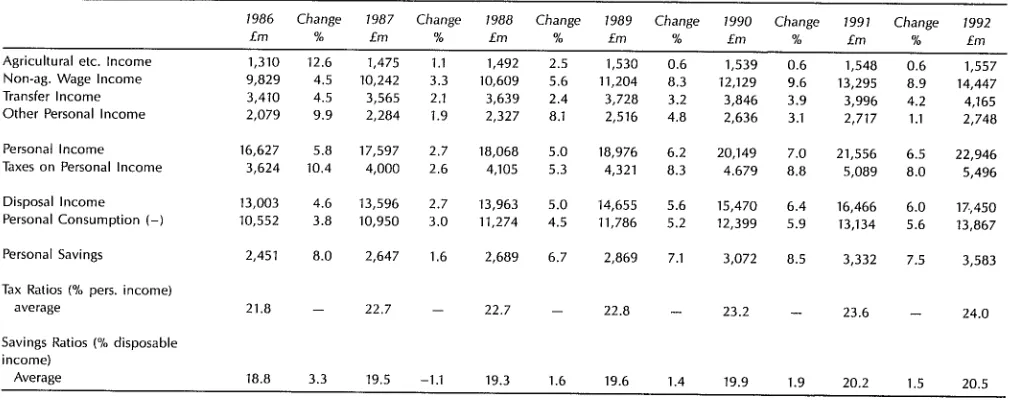
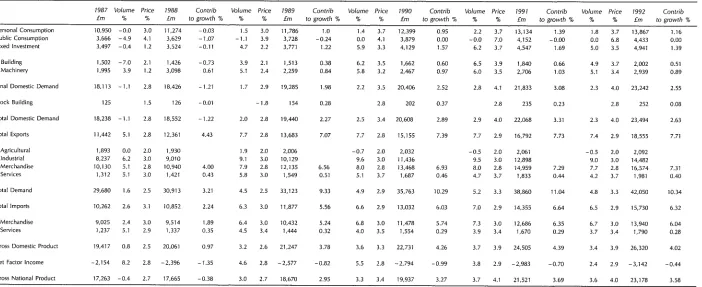
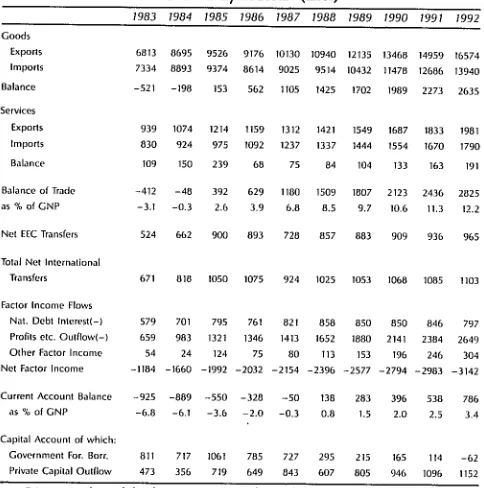
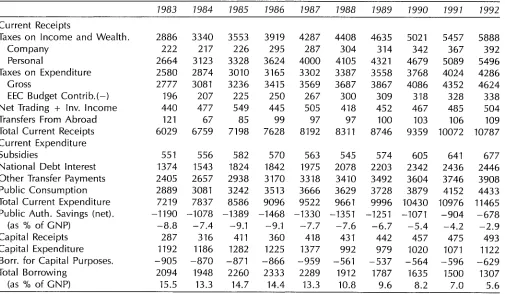
3.1 Industrial Sector Summary 3.2 Market Services Sector Summary 3.3 Public Authorities Sector Summary 3.4 Agricultural Sector Summary 3.5 Output GDP at Factor Cost 3.6 Price Deflators and Wage Rates 3.7 Personal Income and Personal
Expenditure 3.8 Expenditure on GNP 3.9 Balance of Payments (£m) 3.10 Employment and Unemployment 3.11 Public Authority Accounts (£m) 3.12 Flow-of-Funds Analysis (£m) 4.1 Tabulation of Variants on the
Benchmark Assumptions
11 14 19 21 21 22 23 23 25 27 29 31 33 33 36
Table 4.2 Table 4.3 Table 4.4 Table 4.5
Figure 2.1 Figure 2.2 Figure 3.1 Figure 4.1 Figure 4.2 Figure 4.3 Figure 4.4 Figure 4.5 Figure 4.6 Figure 4.7
Standard List of Variables 37 World Economic Growth Projections 37
Effects of a 1 per cent Fall in the
Savings Ratio 49
Effects of a 1.5 per cent Rise in
Capacity Industrial Output 49
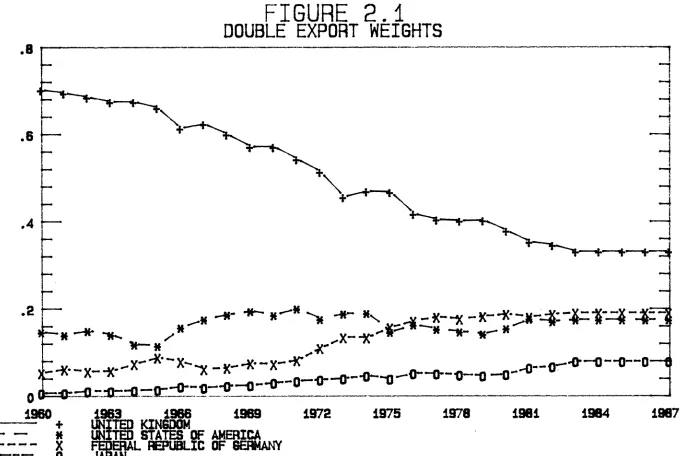
Double Export Weights 10
Exchange Rates: Index of Irish
Pounds per Unit of Foreign Currency 13 Rate of profit in Industry 18
Benchmark projection 39
Lower World Growth 40
Fiscal Indexation 41
Public Sector Pay Freeze 42 One per cent Economy Wide Pay Cut 44
Direct Tax Cut 45
MAIN FEATURES
The outlook for the Irish economy presented in this Review is for a return to a GNP growth rate of around 3.5 per cent by the early 1990s. The public finances will have been stabilised with a borrowing requirement of about 5.5 per cent of GNP by 1992 and the debt/GNP ratio in decline from 1989 onwards. The balance of payments will be increasingly in surplus. However, there will be no substantial reduction in the rate of unemployment over the forecast period. If realised, this would represent a major turnaround from the dismal experience of the 1980s.
The achievement of this performance depends critically on international and domestic factors. At the international level, it is assumed that there will be no world recession. Domestically, it is assumed that the 1988 expenditure cuts will be fully implemented; that there will be no volume increase in public expenditure thereafter; that no overall real tax reductions are conceded; that the public sector pay deal will be rigidly adhered to; and that a measure of pay restraint will prevail in the private sector.
SECTORAL DETAILS
The industrial sector initiates the resumption of growth with output growth of over 5 percent for the period 1989-92, accompanied by a recovery of investment and a considerably more modest recovery of employment. An important factor in this growth will be the effect of improved competitiveness, reflected in higher profits.
Growth in marketed services will suffer badly as an indirect result of the public expenditure cuts in 1988. However, recovery from the rate of just under 2 percent in 1988 will occur in 1989, and will average around 3.75 percent out to 1992. Investment growth will be boosted as a result of individual large-scale projects as well as by the general recovery. The magnitude of the employ-ment growth is more uncertain. We project aggregate employment to rise by 3,000 in 1988 increasing to over 4,000 per annum subsequently.
The agricultural sector, while showing a small fall in aggregate output, will have rising per capita incomes due to the secular decline in numbers in farming.
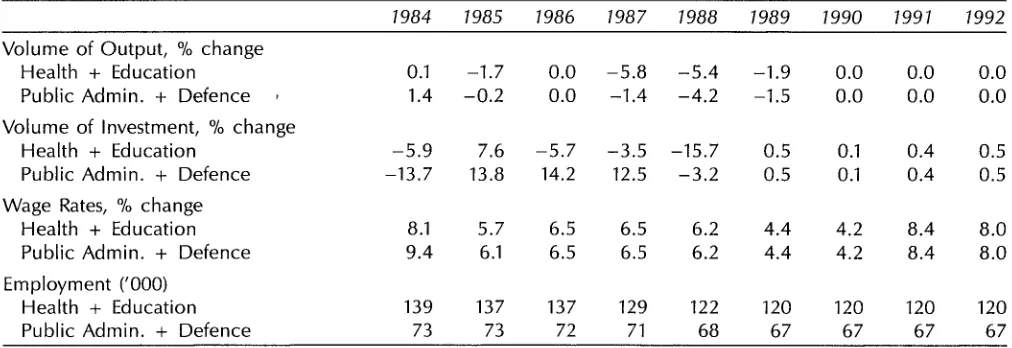
In the public sector the proposed cuts in expenditure and numbers employed dominate the picture for 1988, with carryover into 1989. From then out to 1992, we assume that services and employment will be maintained at the 1989 level. The evolution of wage costs in the public sector will be governed by the terms
of the recent pay agreement out to 1990. Beyond that, we assume that public sector wage costs will move in line with those in the private sector.
The return to a 3.5 per cent growth rate of the economy in the 1990s continues the improvement in the public finances which we see occurring as a result of the 1988 expenditure cuts. The growth leads to revenue buoyancy in the 1990s while also raising the value of GNP. The simultaneous effect of these two changes is to bring about a significant reduction in the public authorities’ borrowing requirement (from a level of 14.4 percent of GNP in 1986 to 5.6 percent of GNP in 1992). Borrowing for current purposes will fall from 9.1 percent of GNP in 1986 to just under 3 percent by 1992, while the total debt/GNP ratio will stabilise by 1989 and begin to fall in 1990. By 1992 it will be below the current 1987 level and, in subsequent years, the decline in the ratio would be even more rapid if these trends were to continue.
The balance of trade moved into surplus for the first time in 1985. This trend continued in 1986-87, and is expected to accelerate out to 1992, where it is projected to reach over 12 percent of GNP. However, profit repatriation outflows will also run at a high level if growth continues to depend on multinational companies based in Ireland to the extent that it has in the recent past. Other factor flows will improve with gradually declining foreign debt interest payments. The combination of these elements will result in a current account surplus rising to nearly 3.5 per cent of GNP by
1992. While our benchmark projection shows the public finances coming under control by the early 1990s and a growth rate closer to the experience of the 1960s and 1970s, the economy will still be faced with a very serious unemployment and emigration problem. The rate of unemployment rises sharply in 1988 as a result of the public sector cuts, to 19.5 percent of the labour force. This rise could be greater to the extent that numbers emigrating are lower than the 35,000 assumed for 1988. With the assumed cessation of public employ-ment cuts by 1989, and with gradually increasing employment in industry and marketed services, both the unemployment rate and numbers emigrating begin to fall. However, by 1992, the rate of unemployment is still only slightly lower than it is in 1987.
ASSUMPTIONS
2
average by just under 2.5 per cent per annum and world prices by an average rate of approximately 3 per cent per annum over the medium-term. Exchange rates are assumed to remain unchanged from their current values. Interest rates, while stable in nominal terms, will show some fall in real terms. However, world real interest rates in 1992. will still remain high by the standards of the 1950 -1980 period.
We have incorporated in our projection the effects of the government policy decisions announced in the Estimates volume and the Programme for National Recovery -- Pay Agreement for the Public Service. Our
projection has thus been prepared assuming that the public sector expenditure cuts over the period 1988-89 will be fully implemented in the form in which they were announced and that expenditure will be held
constant in real terms in subsequent years. In relation to taxation we assume simple indexation from 1988 onwards. Domestic interest rates are assumed to fall further in both real and nominal terms over the projection period.
Finally, the methodology of this Review is based on the application of a formal model of the Irish economy and seeks to examine and project possible developments within an analytical framework.
THE REASONS FOR RECOVERY
The return to a 3.5 per cent growth rate and the gradual restoration of stability to the public finances forecast from 1989 onwards are due to five main factors. (i) the modest but sustained growth assumed for the world economy
(ii) the effects expected to flow from the improved competitive position of the Irish economy over the period 1986-9.
(iii) the assumed absence of any further cuts in public expenditure after 1989.
(iv) the benefits flowing from the 1988 fiscal adjustment and continued tight fiscal stance to 1992 which results in falling debt interest payments over the five-year period.
(v) a very high personal savings rate and related growth in the balance of payments surplus.
UNCERTAINTIES AND RISKS
The benchmark projection is a ’best guess’ of the outcome but there is an obvious risk of some of the elements going wrong:
(i) the assumption for world growth is quite modest by past standards but the outturn could be even lower, with serious consequences. For example, a zero world growth assumption for 1988 and 1989 would reduce GNP by 5 per cent in 1992 relative to the benchmark projection, increase unemployment by over 23,000 and cause a deterioration in the borrowing requirement of 4 per cent of GNP.
(ii) a rise in world real interest rates in the medium-term. (ii) a fall in the world rate of inflation.
(iv) although the proportion of industrial profits repatriated is projected as continuing to rise, if
structural developments increase the rate of repatriation even above our assumptions, then growth and the public finances would suffer.
(v) major variations from exchange rate stability might have damaging effects, even within the context of steady world growth (e.g. reduced competitiveness, specifically with the UK, and the allied interest rate dangers for increased debt servicing).
(vi) the public sector expenditure cuts may not be implemented in full and it may not prove politically possible to hold the level of future real expenditures unchanged.
A POLICY AGENDA FOR THE FUTURE
In the short-run the policy implications of our benchmark projection are clear and unambiguous: the public sector expenditure and employment targets must be achieved if stability is to be restored to the public finances. Depending on the outturn for 1988, the crucial issue will be whether enough progress has been made to afford indexation of expenditures in 1989 (which would require tight control of expenditure and, indeed, some cuts in existing programmes) or whether further cuts on a major scale are needed. In the longer term we assume fiscal indexation and the indications are that any more expansionary policy would be likely to cancel the gains made in the cuts of 1988.
Experience from the first half of this decade indicates that it is wiser to plan the reform of the public finances assuming that the performance of the economy will be less satisfactory than predicted. While the time-path of adjustment in the public finances which we see for the medium-term assumes a neutral fiscal policy after 1988, it would be prudent to recognise that further major budgetary action may still be necessary in 1989. A decision on this matter will have to be made in the light of much more detailed short-term assessments of the 1988 and 1989 outlook, as they become available over the coming months.
A feature of our medium-term projection was the future behaviour of profit repatriation by multinational industries producing in Ireland. It is important to state clearly that these outflows are a normal feature of such foreign direct investment. Such firms tend to be fairly capital intensive, source most of their inputs abroad, have relatively weak downstream links with the rest of the economy and repatriate the major part of their
profits. The challenge for industrial policy in the coming years is to build on our existing industrial strengths and attempt to develop firms which will retain a greater portion of added-value within the economy, and to do this within a reduced budget.
no net addition to grants and subsidies is desirable in the immediate future.
If the actual outturn in the medium-term proves to be close to that of the benchmark forecast, it will be necessary to consider what policies can be deployed to deal with the continuing high rate of unemployment and the related problem of the distribution of income. We must examine how domestic costs can be contained
in order to achieve a reduction in unemployment. The pay guidelines laid down for the private sector in the recent National Programme address this issue, but it remains to be seen to what extent these guidelines are effective in containing wage costs. However, since
industrial employment is projected to be lower in 1992
than in 1984, it seems that we must either accept higher unemployment, increased maldistribution of income and wealth, and continuing high emigration or we must find other sources of employment to complement our present forms of industry.
INTRODUCTION
1.1 : WHY A MEDIUM-TERM REVIEW?
The role of the Medium-Term Review is complementary to the Institute’s other forecasting publication, the Quarterly Economic Commentary. The time horizon of the latter is generally some twelve to eighteen months into the future. Because of this relatively short time horizon, the Commentary concentrates primarily on the demand side of the economy (exports, private and public consumption, investment, stock changes, imports and factor flows) and the income generated by this expenditure. The productive capacity of the economy is taken essentially as fixed, or at most changing moderately in response to short-term factors. In terms of public policy, the Commentary concentrates on immediate issues, such as fiscal strategy in the coming year, and any discussion of
long-term problems tends to be strictly qualitative. The time horizon of this Medium-Term Review is set at five years. Given the inevitable instability of the external economic environment, well exemplified in the past five years with its exchange rate gyrations, price fluctuations, trade disequilibria and so on, there may be a temptation to believe that little is to be gained from trying to look five years into the future. Nevertheless, decisions have to be taken now, both with regard to corporate investment and to public policy, which will shape the future of the Irish economy well into the 1990s. Some view of trends has to be taken in reaching these decisions, and it is clearly useful to have available formalised and consistent projections, however conditional these may be.
The key difference between a one-year and a five-year time horizon in forecasting is that in the longer term it is developments on the supply side of the economy which are of prime importance. This renders the short-term, essentially Keynesian, income-expenditure frame-work of the Commentary inappropriate for a five-year forecast. Accordingly, this Review concentrates on the determinants of the productive capacity of the economy, such as investment, the capital stock, capacity utilisation and employment.
1.2 : THE 1986 MEDIUM-TERM OUTLOOK
The first Medium-Term Outlook published by The Economic and Social Research Institute was issued in February 1986, and covered the period from 1986 to 1990. Much of the analysis remains highly pertinent, and it is possible that by 1990 the economy might be quite close to many of the trend predictions made.
However, there can be no escaping the fact that, in the first two years of the period covered, the performance of the Irish economy has fallen well below the central benchmark projection. Thus real GNP at factor cost was projected to increase by 2.5 per cent in 1986 and 2.75 per cent in 1987. Latest estimates suggest that in fact there was a fall of about 1.5 per cent in 1986 and there will be a rise of only 1.75 per cent in 1987. The Public Sector Borrowing Requirement was projected to fall slightly from £2,444 million in 1985 to £2,375 million in 1986. Instead, it rose to £2,506 million, although the subsequent cut-back in 1987 will be greater than projected.
There are three main reasons for this disappointing performance. In the first place the evolution of the world economy has proved considerably less favour-able than was assumed on the basis of the then available projections of the major international agencies. Chronic trade imbalances, particularly between the US and Japan, have persisted with little or no improvement, there has been less progress than expected towards convergence in fiscal policies in the major countries, and the volatility of exchange rates has been much greater than anticipated. Largely as a consequence of these factors, world output and trade have grown about 1 per cent per year more slowly than predicted, with a resultant shortfall in the volume of productive investment, while real international interest rates have declined only slightly. Of particular relevance to Ireland, the rapid and unforeseen depreciation of sterling in the course of 1986 inhibited exports to the UK and forced up domestic interest rates to far above the predicted levels.
The second major factor, which tends frequently to be overlooked, was the recurrence of exceptionally bad weather in 1986. Through its effects on agriculture, and to a lesser extent on the balance of tourism expenditure, the abnormal weather reduced the level of GNP in 1986 by almost 1 per cent. This in turn had adverse conse-quences for the public finances.
6
can actually increase the volume of spending, unless immediate action is taken to reduce the limits. No such action was taken in 1986.
The net effect of these external shocks, climatic conditions and policy weaknesses is that the economy in 1986 moved further from equilibrium, rather than entering the corrective path projected in the 1986 Medium-Term Outlook. For a fuller discussion of why 1986 did not live up to the almost universally optimistic forecasts made early in that year, see the Quarterly Economic Commentary, October 1986. Developments in 1987, particularly the imposition of a much stricter fiscal policy, and a boom in industrial exports, have checked this incipient slide, so that in several respects the economy at the end of 1987 resembles that at the end of 1985.
1.3 : THE PRESENT REVIEW
Although it uses a macroeconomic framework similar to the previous Outlook, the methodology of this Review is not one of attempting simply to update the previous figures taking account of the delay in economic progress. Rather, it seeks to examine and project possible developments within a formalised analytical framework, and to explore in some detail the likely effects of alternative policy options.
The principal feature of this new approach is that it is based on the application of a formal comprehensive medium-term model of the Irish economy, which was not available when the previous Outlook was written. This medium-term model has been developed in the ESRI and it forms part of the EEC-wide system of linked macroeconomic models -- HERMES. Before pro-ceeding to outline the structure of this Review, it may be
useful to summarise some of the general characteristics of econometric models and their role in forecasting and
policy evaluation.
1.4 : THE ROLE OF ECONOMETRIC MODELS Essentially, macroeconomic models are an attempt to represent the pattern of actual economic relationships in a series of interlinked econometric equations. The structure of the model is determined in the first place by the view of economic theory adopted by the model builder. The ESRI model used in this Review is based on a small open economy approach, in which Ireland is viewed as taking its internationally traded prices from the rest of the world, and in which the pace of aggregate domestic growth depends primarily on the rate of industrial growth. This in turn depends in large part on the growth of world output, which creates the demand for worldwide investment, and in part on the relative profitability of Irish industry, which determines the share of world industrial investment and employment which locates in Ireland. The technological relationship between output, employment and investment (i.e., the production function), and the nature of the derived demands for labour and capital are assumed to follow fairly conventional neo-classical rules (e.g., employment and investment are sensitive to the relative
price of labour and capital).
In making such a model operational, its builders are constrained by the lack of availability of usable data series to represent the economic variables specified in the theoretical model. Even where series are eventually available, there may be a lag of several years before reliable figures appear. Thus it is frequently necessary to modify the model to take account of structural or temporal data gaps. The result is a compromise between what is theoretically desirable and what is practicable.
Values are placed on the coefficients in the equations by observing relationships over a long period, in this case from 1960 to 1984. The stability of the resulting estimates are examined, particularly their sensitivity to the more recent data. This process results in further modifications, as certain formulations of series or relationships turn out to work better than alternatives which seemed equally valid on theoretical grounds.
This brief summary of the nature of econometric model building is necessary to an understanding of the strengths and limitations of a model-based approach to economic forecasting.
One strength lies in the fact that the model is the expression of an explicit economic framework, and thus should be free of the conceptual inconsistencies which can creep into an ad hoc analysis. A more vital strength results from the full articulation of a comprehensive model. Both the direct and indirect effects of altering an independent variable are calculated simultaneously. This is particularly useful in policy evaluation, where the full consequences of, say, a change in income tax rates can be effectively simulated. Thus not only the immediate change in revenue, but also price and wage effects, alterations in expected levels of employment and imports, and the indirect impact on government revenue and expenditure can be calculated together with a reasonable degree of confidence.
The limitations of models in forecasting must also be acknowledged if optimum use is to be made of the approach. Obviously, any model, however complex, represents a simplification of the real world. Some of the factors omitted, either because they are inherently unpredictable or because their influence has not been observable in the past could in practice have a major impact on economic developments in the period being forecast. Moreover, in constructing the model and in the process of simplification parts of the theory adopted
may prove to be controversial and may, in the future, be shown to rest on an inappropriate analysis of how the economy really operates.
also, many of the series used contain actual errors in measurement, as is evidenced by the frequent revisions made to official economic statistics, sometimes many years after the initial estimates have been made.
Perhaps the most serious limitation, which is less obvious than those already mentioned, is the under-lying rationale of econometric analysis that observed relationships remain constant over time, or, at most, change at a steady rate. If behaviour changes between the period of observation and the period to be forecast
because of new institutions, altered tastes, different technology or any other reason exogenous to the model, then projections made purely on the basis of past observations can give a misleading picture of the futu re.
These various limitations do not prevent comprehensive econometric models from being useful tools in forecasting, particularly in the medium term.
Indeed, less formal methods and approaches are bedevilled by identical problems. However, they do mean that such models should not be applied mechanically. Judgement needs to be used in deciding to override the model in places where there are reasons to suppose that relationships might be changing, where there is serious doubt about the accuracy of the data input, or where some event extraneous to the model can be foreseen. The number of such adjustments
necessary in short-term analysis, where temporary disturbances often dominate underlying trends, tends to
restrict the usefulness of such models.
In constructing medium-term projections, as in this Review, the benefits of consistency are far greater than in short-term forecasting. Nevertheless, some adjust-ments to the ’pure’ model results do need to be made, so that the projections published reflect the authors’ judgement as well as the analytical knowledge incor-porated in the model. At the same time it is important to treat the projections with some caution since they merely show what the overall consequences would be if certain specified assumptions hold good and if past relationships continue to apply. Although every effort has been made to adopt reasonable assumptions for the benchmark projections, this conditional nature of the projection should be borne in mind.
Fortunately the great advantage of using a compre~ hensive model for medium-term forecasting is that it
does enable the approximate consequences of altering the assumptions or amending the policy variables to be calculated readily while maintaining an acceptable degree of consistency. Thus a greater range of possibilities or options can be explored than is possible using an ad hoc approach.
1.5 : THE STRUCTURE OF THIS REVIEW
The pattern of this Review is as follows. Section 2 sets out the baseline assumptions underlying the benchmark projection. With regard to the international economic environment, the latest forecasts of the major international agencies are taken as providing the best available analysis of likely movements in world output, costs and prices. The domestic policy assumptions are made within the context of the government’s stated policies with regard to the public finances and the national debt, and take account of the Programme for National Recovery and the 1988 Estimates. For 1987 and 1988 both the assumptions and the projected out-turns are broadly aligned with those published in the October 1987 Quarterly Economic Commentary.
Section 3 presents the benchmark projection for the period 1987-1992 on the basis of these assumptions. Working through from output to incomes and expendi-ture the major implications for employment, prices, and the public finances are discussed. As already outlined this benchmark projection is primarily model-based but has in parts been adjusted according to the authors’ judgement.
BASELINE ASSUMPTIONS
In preparing any forecast for the Irish economy the first and most important task is to spell out one’s assumptions concerning the external environment for the forecast period. Because of the extreme openness of the Irish economy, developments in the rest of the world generally play a bigger role in determining its pattern of growth than do most internal policy decisions. However, the pattern of growth is obviously also affected by the domestic stance of economic policy so that we must make assumptions concerning the direction of domestic fiscal and monetary policy over the forecast period.
2.1: THE WORLD ECONOMIC OUTLOOK 1987-92 Introduction
A wide range of sources has been used in forecasting future developments in the world economy. Generally the short-term forecasts for 1988 are more readily available and more detailed than those for the full period to 1992. The short-term forecasts for the international economy given in the OECD Economic Outlook, the Quarterly Economic Commentary, October 1987 of the ESRI and the Quarterly Bulletin of the Central Bank are used for 1988. The main data sources for the years 1989 to 1992 are the Medium-Term Projections of the European Commission (EEC, May 1987), the World Economic Outlook of the IMF (IMF, April 1987, updated September 1987), Economic Outlook 1987-1991 (LBS, 1987), and the National Institute Economic Review (NIER, September 1987).
In developing our assumptions concerning the world economy in the medium-term we have concentrated on their internal consistency. In some cases this has neces-sitated technical assumptions which may be unrealistic if considered in isolation. In particular, because some of the key sources of information base their forecasts on unchanged exchange rates for major currencies, we have found it easier to follow this practice. Otherwise it would be necessary to forecast independently the effects of changes in exchange rates on rates of inflation and growth in each of the major countries which is a task beyond our resources. In any case the effects on Ireland of shifts in the relative value of the major currencies are far from clear. The most relevant exchange rate assumption, that the IR£ will remain broadly unchanged in terms of the ECU, is itself not unrealistic.
The medium-term outlook for the Irish economy is strongly influenced by developments in those countries
with which Ireland has close trading links. In making assumptions about world economic developments in trade, prices, exchange rates and interest rates, special attention is paid to the developments in these countries. However, trade is not the only international linkage which is important in determining the growth of the economy. In particular, because of the importance to Ireland of investment by foreign multinational companies, developments in those countries from which such investment originates and trends in countries competing to attract such investment are especially relevant.
As a result, while prospects for the UK economy in the medium- term remain important for Ireland, they are generally of more limited influence than at any time in the past. Developments in the US, German and Japanese economies, on the other hand, are of increasing significance for Ireland. The weights we have used in taking account of forecasts for the future development of the other economies are shown in Figure 2.1 for the period from 1960 to 1987.(We have used the ’double export weights’ derived by the European Commission.) For the forecast period we use the latest available set of weights, i.e. those for 1984. The decline in importance of the UK economy over the period 1960-84 can be clearly seen, as can the rise in the significance of Germany.
Output
The Irish industrial sector is particularly open to influences from the outside world, with a high proportion of new industrial investments over the last thirty years being undertaken by foreign multinational corporations (see O’Malley, 1986). In the short run, a rise in the level of real activity in the ’world’ economy imparts a demand stimulus to the Irish economy. Irish firms experience a rise in the demand for their products and increase their output (and level of capacity utilisation) to meet the demand. Consequently, in short-term forecasting, the level of world real activity is crucial in determining likely developments in Irish industrial exports.
.8
FIGURE 2.1
DOUBLE EXPORT NEI6HTS
4
c
-H
po
CO -,4
We see the desired or planned long-run level of Irish industrial output as a function of world activity and the relative attractiveness of Ireland as a location for such output. Having decided on the planned output level firms then have to install the necesary plant to produce it. The choice of Ireland as a location for supplying the world economy naturally involves the growth of capacity by Irish firms as well as by multinationals. The desired level of output, determined by these factors, results in new investment to supply the output. It is only when the new capacity comes on stream that actual supply increases. This longer-term supply effect will be crucial in determining the growth of the industrial sector up to 1992 and beyond.
In our model-based analysis, Irish industrial output is driven by a measure of real industrial output in the OECD big-seven. In addition, the level of Irish competitiveness relative to foreign producers, appropriately measured (as discussed below), influences the decision to invest in Ireland. In the case of Irish firms an improvement in competitiveness will improve their profitability and encourage expansion. In the case of foreign firms an improvement in the competitive position" of the Irish economy will encourage larger numbers to locate part of their
production capacity here.
Within this framework we need to project trends in the general level of world economic activity. The latest IMF forecast for industrial output in the major world economies in the medium4erm suggests an average rate of growth of just under 2.5 per cent a year. This figure is broadly consistent with the most recent EEC prediction for export growth in the major industrial economies of 4 per cent per annum out to 1992. There will obviously be some fluctuations around this trend increase, although it is impossible to predict their timing and magnitude. Thus even if recent events lead to world trade growing by slightly less than 4 per cent in 1988 it
may be reasonable to assume that over the period as a whole this growth rate will be realised.
Prices
The Irish economy is also very open to international price inflation pressures. Given the assumption of fixed exchange rates (see below for further details), the Irish inflation rate largely mirrors that of its main trading partners. There are three crucial classes of external prices for the Irish economy: the price of world industrial output, the prices of energy and non- energy imports, and agricultural prices. A key assumption concerns the world industrial output price which we forecast to grow at the same rate as EEC predictions for export prices in the major industrial economies. This produces a forecast of an average rate of inflation of 3 per cent per annum from 1988 to 1992. Non-energy import prices are assumed to follow the export price forecasts for the twelve EEC countries, showing an average increase of 3 per cent per annum.
While predictions earlier this year suggested that oil prices could rise significantly in the medium-term, recent events suggest that world growth will be slower than previously predicted. This will ease the pressure on
demand and we have, as a result, assumed that oil prices rise in line with the price of industrial goods. This will involve a rise in the dollar price of oil to compensate for the recent substantial devaluation of that currency.
Finally, the prices of agricultural output and exports will be determined by developments in the Common Agricultural Policy, which are highly unpredictable. At the present time, average growth rates for agricultural prices of 2 per cent per annum seem plausible, against a background of continuing quota restrictions and ongoing reform of the CAP. This means that the terms of trade will continue to move against agriculture in the medium-term. As with output, actual price changes from year to year may diverge temporarily from this trend, but over the medium-term these fluctuations can be expected to cancel each other out.
Corn petitiveness
Ireland’s economic performance over the next five years will depend not only on world demand and world price levels but also on our competitiveness vis-a-vis our trading partners. Thus, we need to project the course of different competitiveness measures - in terms of output prices, hourly earnings, unit labour costs, and profit rates -- in these other countries. Output prices have already been discussed. World hourly earnings are forecast to increase in line with per capita wages in the EEC at an average rate of nearly 5 per cent per annum. Table 2.1 shows the latest trends for the major OECD economies together with the Quarterly Economic Commentary forecasts for 1988. World unit labour costs, on the basis of the same sources, are forecast to rise at an average rate of 2 per cent per annum. TABLE 2.1: Wage Rates (Hourly Earnings) In Major
Economies (percentage change on same period in previous year)
West United United
Germany Kingdom States Ireland
1985
Q1 3.5 8.9 4.0 8.0 Q2 6.0 10.0 4.0 8.9 Q3 4.2 9.2 3.1 7.7
Q4 5.1 8.4 3.9 7.0 1986
QI 4.2 7.9 3.1 7.7 Q2 1.6 7.6 2.3 7.0
Q3 4.1 7.1 2.3 7.1
Q4 4.0 8.0 1.5 6.8
1987
Q1 4.07.8 0.7 6.2
Q2 4.8 7.6 1.5
-Forecast
1987 3.5 7.5 3.5 5.3
1988 3.5 7.5 4.0 4.8
Sources: Quarterly data -- OECD Main Economic Indicators. Forecast
-- ESRI Quarterly Economic Commentary.
12
in the US, the UK and Germany, the economies which recent research found to be important. Future move-ments in international profit rates are not normally covered by the major bodies preparing medium-term forecasts for the world economy. As a benchmark, we assume that the international profit rates are fixed at their most recent published values. This is broadly consistent with forecasts for world wage costs and the price of world output.
Exchange Rates
The extreme volatility of exchange rates in the 1980s is apparent from Figure 2.2. The recent slide in the dollar compared to most other currencies is only one manifestation of this instability. However, in making medium-term projections international bodies, such as the EEC and the OECD, use the conventional technical assumption of unchanged exchange rates. This assump-tion is not intended to be realistic. However, provided that our interest rate and price assumptions are consistent with the projected time path for exchange rates, the effects of any lack of realism in this approach on the forecasts for the real sector of the world economy will be minimised. Because we require consistent world forecasts as a basis for the model-based projection for the Irish economy, it is necessary to adopt this convention as it is not feasible to prepare our own consistent world forecasts. Consequently, we assume that all rates of exchange against the US$ will remain fixed from the end of 1987. Even if exchange rates show some volatility in the future, it is possible that the path of the effective Irish exchange rate will be close to that assumed in this benchmark projection.
This has important consequences not only for domestic price inflation but also, given the high level of national debt denominated in foreign currencies, for net factor income flows in the medium term. This assumption of fixed exchange rates underlies our assumptions concerning the world rate of inflation and world interest rates over the period 1988 to 1992.
It may well be the case that there will be some further limited devaluation of the dollar and sterling together with a revaluation of the DM against the IR£ in the medium-term. Provided that real interest rates and world rates of inflation adjust to reflect this change the
net effect on our forecast for the Irish economy would be limited. However, if there were a further precipitate fall in either the dollar or sterling, or if the EMS were to
break up, there would be important implications for the Irish economy in the medium-term and the benchmark projection would have to be adjusted accordingly. Interest Rates
In the early 1980s international real interest rates (interest rates less the rate of inflation) rose rapidly to historically very high levels. While nominal interest rates have fallen back from their peak values in the mid-1980s, the fall in the rate of inflation worldwide has meant that real interest rates have remained very high. In the last few weeks changes in monetary policy in key industrial countries have led to limited further falls in nominal interest rates. However, the longer-term impli-cations for real interest rates remain unclear.
For the future we have assumed little change in the nominal interest rates of the major EMS currencies from their current (end November) levels. Given our forecast for inflation, this involves some further reduction in real interest rates in those countries. For the US we have assumed that the budgetary situation will be brought under control and that, as a result, by the end of 1992, dollar interest rates will be slightly lower than current levels. Clearly this assumption concerning the dollar interest rate must be considered very tentative. This approach assumes that with fixed exchange rates, the rates of inflation and real and nominal rates of interest in the major industrial countries will tend to converge in the medium-term. Of necessity, any change in the exchange rate assumption would have consequential effects for interest rates and inflation rates in the countries affected. However, if there is a world recession it may well be accompanied by a general fall in interest rates due to falling demand for funds. In terms of the domestic economy such a fall in interest rates would, to some extent, tend to offset the effect of the fall in world demand.
It is difficult to assess the effectiveness of the action recently taken by the US to deal with its budgetary problems and its implications for world growth. This factor remains a major source of instability in world financial markets and could seriously affect inter-national interest rates in the medium-term. Other major sources of uncertainty are the continuing debt problem of Third world countries and the possible effects of instability in the Middle East.
2.2: DOMESTIC POLICY ASSUMPTIONS 1987-92 Fiscal Policy
We now address the choice of fiscal policy in the benchmark projection to 1992. This projection takes into account the decisions already made by the government for next year, incorporated in the Book of Estimates and the Programme for National Recovery. In addition, an allowance has been made for the indexa-tion of social welfare benefits from the middle of 1988. For 1989 we take account of the carryover effects from 1988 of the policy decisions already announced for 1988. These affect both public service pay and employ-ment in 1989 and public service pay rates in 1990. For all other aspects of fiscal policy (e.g., taxation) indexation is assumed from 1989 onwards. Public service employment is held constant at the 1989 level to the end of 1992 and public sector pay rates after 1990 are linked to movements in industrial wage rates.
In what follows we first give a brief discussion of the implications of the Book of Estimates and the Programme for National Recovery for the government accounts in 1988. Following this we describe the under-lying methodology adopted in relation to fiscal policy indexation for the four years beyond 1988 and provide a summary description of the indexation rules used in the projection.
In launching the Estimates the Government made it clear that provision was made for a cut of 8,000 in the
FIGURE 2 2
authorities. For local authorities we have assumed that there will be a cut in numbers of 2,000, making a cut in total public service employment of 10,000 on average in 1988 compared to 1987. In addition, there are the carryover effects of the cuts in employment made in 1987 which will affect public service employ-ment in 1988. We have assumed that there will be no slippage from these figures. We would expect that because many of the cuts will take some time to come into effect there will be a significant carryover into 1989 resulting from the decisions announced in the Estimates. This will involve a further fall in public service employment in that year of over 3,000 compared to the 1988 level. The resulting trend in public service numbers is that there will be a fall from the 1987 figure of 200,000 to 190,000 in 1988 and 187,000 in 1989 and thereafter.
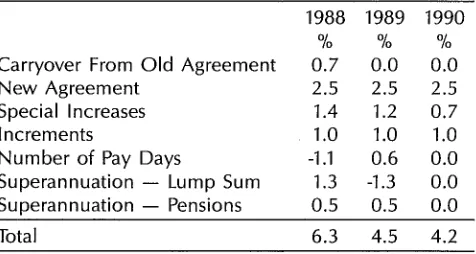
In considering the pay bill for the public sector it is very important to take account of the fact that, due to the traditional national accounting conventions, it also includes superannuation payments. As the costs of superannuation and redundancy will rise very considerably in 1988 this development will have an important effect on the rise in the pay bill (including superannuation costs) per person currently employed in the public sector. It is this figure which is normally, but inappropriately, quoted as the indicator of pay rates in the public sector. The Programme for National Recovery involves an increase of about 2.5 per cent on average in public service pay rates on the 1st of January in each of the three years 1988, 1989 and 1990. To this increase must be added the carryover into 1988 from the pre-vious pay agreement; the effects of special pay increases already agreed and due for payment on the
1st of December 1987 and 1st July 1988; an estimate for the effects of new special increases, still to be agreed, 40 per cent of which may be paid under the Government Programme from 1st July 1989; an allowance for an increase in pay due to increments; an allowance for an increase in the number of public service pensioners due to early retirements; the effects of changing numbers of pay days in the years 1987, 1988, and 1989. Finally, we have assumed that the lump sum costs of the early retirements will amount to £40 million, somewhat less than that implied by government statements. As with the provision for the increased number of pensioners, these payments are treated in this Review as part of the public service wage bill. The
resulting estimates for the increase in public service pay costs per person employed in the years 1988 to 1990 are shown in Table 2.2. For 1991 and 1992 these costs are assumed to rise in line with pay rates elsewhere in the industrial sector.
A final special factor whicl~ will affect public authorities’ consumption (which includes most of the pay bill) is our assumption that local authorities will cover part of the cutback in their grants from the exchequer by raising charges by £40 million. This serves to reduce the cost to the exchequer of public service consumption expenditure.
[image:18.583.305.543.72.199.2]In the case of public service expenditure on subsidies we have taken the figures implied in the Estimates. For
TABLE 2.2: Public Service Pay Bill per Person Employed 1988-90
1988 1989 1990
% % %
Carryover From Old Agreement 0.7 0.0 0.0
New Agreement 2.5 2.5 2.5
Special Increases 1.4 1.2 0.7
Increments 1.0 1.0 1.0
Number of Pay Days -1.1 0.6 0.0
Superannuation -- Lump Sum 1.3 -1.3 0.0 Superannuation -- Pensions 0.5 0.5 0.0
Total 6.3 4.5 4.2
transfers we have allowed for their indexation from 1st July 1988 as provided for in the National Programme. This increase is not provided for in the estimates. (Changes in the numbers unemployed also affect unemployment transfers in the model.) The Public Capital Programme figures for 1988 are used to project public authorities’ capital expenditure in 1988. (For 1989 we have assumed that no provision will be needed for house improvement grants.) The national accounts figure for public authorities’ spending in 1987 is increased by £150 million due to loans to the EEC intervention agency. This arises as a result of the EEC delaying payment for intervention costs for the last quarter of 1987. For 1988 and subsequent years we have assumed that the EEC pays four quarters costs of intervention but does not accelerate payment to repay the 1987 loan.
For taxation we have assumed indexation of the tax system from the end of 1987 to the end of 1992. This means that rates of specific indirect taxes (excise taxes) rise in line with prices while VAT rates remain unchanged. In the case of direct taxes it involves the indexation of bands and allowances to wage rates to keep the average rate of income tax unchanged. This assumption is not intended as a forecast of the 1988 budget but it is consistent with the Programme for National Recovery.
Government trading and investment income was boosted in 1987 due to a special payment to the Exchequer by Bord Telecom of £60 million. This payment will not be made in 1988. The resulting fall in trading and investment income is partially offset in 1988 by an assumed exceptional payment by the Central
Bank of £40 million to cover the cost of the public sector redundancy deal. The problems with Dublin Gas also affect these receipts. For the 1990s this item is indexed.
changes in the relevant base, e.g., the numbers unemployed.)
The assumption of indexation is not intended to have any normative implications. It conforms to standard definitions of real fiscal neutrality and is a convenient rule of thumb used by economists. It implies that the activity of the public sector after 1989 will have no net effect on the rest of the economy, i.e., it neither stimulates nor deflates the economy. In using it for the years 1989-92 (subject to the caveats specified above) it allows us to specify a benchmark projection against which the different policy variants discussed in Section 4 can be measured.
Interest Rates
In projecting interest rates into the medium term, the underlying assumption is that the gap between Irish and international interest rates will gradually close. By 1992 domestic long-term rates on government debt will be down to around 7.5 per cent, still somewhat above DM rates. This is in line with the EEC projection for long-term rates in the US and the EEC in 1992. The existing differentials between the various domestic interest rates, namely, deposit rates, the prime lending rate and bond rates, are maintained in the projections.
Labour Force
The potential rate of natural increase in the labour force continues high. In recent years there has been a substantial rise in emigration and a significant fall in labour force participation in the relevant age groups which has resulted in a small fall in the actual labour force. We anticipate that the fall in participation rates will continue in the medium-term, especially with the proposals for early retirement in the public sector. While data problems have made precise quantification of the effects of developments in the domestic labour market on emigration rather difficult, it is clear that they are important in the medium-term. As a result, in the projections described in Section 3, we have assumed that the level of emigration will move roughly in line with changes in domestic unemployment.
15 2.3: SUMMARY
In our benchmark real world industrial output is pro-jected to increase on average by just under 2.5 per cent per annum and world prices by an average rate of approximately 3 per cent per annum over the medium term. Exchange rates are assumed to remain unchanged. Interest rates, while stable in nominal terms, will show some fall in real terms. However, world real interest rates in 1992 will still remain high by the standards of the 1950-1980 period. Other inflows to the economy (e.g., from the EEC) are assumed to maintain their present real value.
While the world growth assumptions underlying the benchmark are modest by historical standards, they ignore threats to the world economy such as those posed by the rise of protectionism, by the US budgetary problem, by the continuing possibility of default on developing countries debt and and by the instability in the oil-producing regions of the Middle-East. In Section 4 we separately examine the consequences for Ireland of a substantial reduction in world growth and of some
reduction in the world rate of inflation.
SECTION 3
BENCHMARK PROJECTION 1987- 1992
The benchmark projection for the years 1988 to 1992 has been prepared with the assistance of the ESRI’s Medium-term Model of the Irish economy. The pro-jection for 1988, subject to some minor changes needed to fit into the model framework, is taken from the October ESRI Quarterly Economic Commentary. The projection takes the assumptions, set out in Section 2 and, with the help of the model, traces their likely impact on the domestic economy. While short-term forecasts focus on the expenditure side of the national accounts, the starting point for any medium-term projection of the economy must be the supply side. The major constraint on growth in the medium-term is the volume of output which can be successfully and profitably supplied by the productive sector.
This section begins by examining the prospects for each of the productive sectors of the economy in turn: industry and market services, the public sector and agriculture. The growth of output and the competitive-ness of the domestic productive sector will, in turn, determine the level of employment in the economy. We then examine the likely development of wage rates and prices in the economy. Once we have determined wage rates, prices and employment, we are in a position to project the development of domestic incomes. The volume of consumption and the expected development of the expenditure side of the national accounts are then described together with the prospects for the balance of payments. Given the assumptions concern-ing labour force participation, spelt out in Section 2, the rate of unemployment and the level of emigration are endogenously determined. Finally we consider the prospects for the exchequer borrowing requirement and the flow of funds in the economy.
3.1: THE SUPPLY SIDE OF THE ECONOMY The Industrial Sector
In the model the industrial sector covers transportable goods industries (primarily manufacturing industry), the building industry and utilities (e.g., the ESB). Of these, much the most important is transportable goods industries, the building industry share of total industrial output having fallen significantly in the 1980s.
Over the last thirty years the key to sustainable economic growth has been seen to lie in the development of the industrial sector, especially transportable goods industries. The growth in output has come disproportionately from foreign-owned firms and has been largely oriented towards supplying export
markets. With the constraints on the public finances in the medium term, the possibility of stimulating growth from domestic sources will be even more limited in the future than it was in the past. In particular, because of the action being taken to stabilise the public finances, the public sector will actually reduce its output in 1988 and 1989. As a result, the growth of the economy over the next five years will be more than ever dependent on developments in the private sector, especially in industry.
Research findings have emphasised two key factors determining the growth of Irish manufacturing output (Bradley and FitzGerald, 1988). First, there is the growth of world output which domestic industrial output has followed closely over the past twenty five years. When foreign firms are doing well they tend to expand their output and Ireland has attracted an increasing share of this growth in output over time. (On average the rate of growth of industrial output has been one percentage point higher than that of the rest of our trading partners, before allowance is made for changes in competitive-ness.)
While much of this growth has, in the past, come from foreign multinationals, many of the Irish firms which have prospered have also been geared to meeting a world rather than a domestic demand for their product. The prospects for world industrial output, discussed in Section 2, are for continuing moderate growth over the period.
A second major factor affecting the development of the Irish industrial sector is the change in the competitiveness of that sector. Because the Irish industrial sector is generally a price taker on world markets, the appropriate measure of competitiveness is one based on costs rather than the price of output. What is relevant for Irish industrial firms is whether they can produce profitably, given that they have little or no power to influence the price on their foreign markets. This competitiveness factor has been very important in the past in influencing the share of world industrial output which has been produced in Ireland. Because of its importance, and the fact that it is the primary way that we can directly or indirectly influence the development of the industrial sector in the future, we pay special attention to its likely time-path over the next five years.
FTGURE 3. i
.5
.45
.4
.35
.3
RATE OF PROFIT IN INDUSTRY
m
N
m
m
u
m
C -4
i980
1982 1984 i986
RATE OF PROFIT (PROFITS / VALUE ADDED)
case as profit per unit of value added). In so far as costs, especially wage rates, rise faster than output prices, this will be reflected in lower profits. For Ireland this indicator has the additional advantage (which more traditional cost of capital measures lack) of capturing the effects of the possibility of transfer pricing as a factor attracting foreign investment to Ireland.
Using this measure, the higher the potential profit per unit of output in Ireland compared to the rest of the world, the higher will be the growth of output located in Ireland. In Figure 3.1 we show the rate of profitability for the Irish industrial sector over the period 1980 to 1987 together with the projected rate for the forecast period. As can be seen from this graph, there has been a substantial improvement in the profitability of the industrial sector since 1984 and it is projected to continue improving until 1989.
We anticipate that the continued rise in unemploy-ment next year, and the very tight fiscal stance, will result in a fall in the rate of wage inflation. Experience suggests that the set of circumstances facing workers over the next two years will result in a significant moderation of recent trends in wage rates. While somewhat higher than the increases envisaged in the Programme for National Recovery, such a trend would represent a significant improvement in industrial costs. With the pick up in the growth rate of the economy from 1989 onwards, perceptions may change. The limited improvement in the labour market, with some fall in unemployment from its 1988 peak, is forecast to
raise substantially the rate of growth of real wages from 1990 onwards, well above the level envisaged in the Programme for National Recovery. This high rate of growth in wage rates would push the profit rate in 1992
back to its 1988 level.
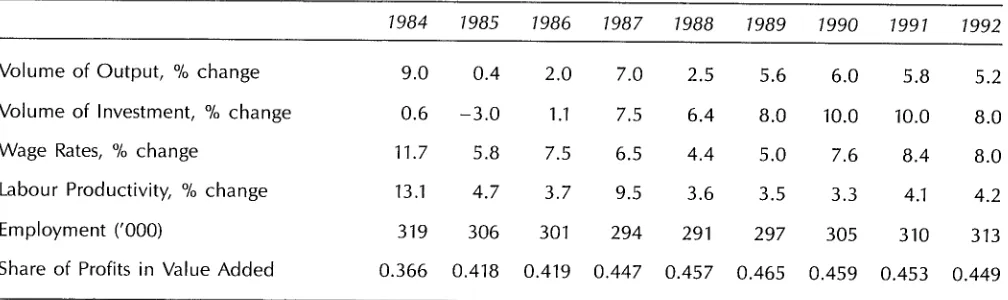
As can be seen from Table 3.1, we anticipate that there will be a continuing substantial increase in productivity in this sector throughout the period to 1992. The effect of this continued growth in productivity, combined with the albeit temporary moderation in the trend of real wage rates, is to reduce significantly the share of wages in value added in the
1988-89 period and thus increase profitability.
[image:22.587.40.544.620.770.2]The trend of profitability shown in Figure 3.1 to some extent underestimates the true rise in profitability as it takes no account of the effects of falling real and nominal interest rates (The standard national TABLE 3.1: Industrial Sector Summary
19 accounting definition of profits ignores all taxes and interest payments paid by firms.) This issue is discussed in more detail in Section 4.10.
In spite of the fall in oil prices in 1986 we feel that industry will continue to install energy efficient plant, believing that real oil prices will eventually rise. However, within the benchmark time horizon we have, as outlined in Section 2, assumed no change in the real price of oil. This means that profitability in Ireland and elsewhere will not be affected by this factor.
In considering the competitiveness of the Irish industrial sector it is not sufficient to consider the profitability of Irish industry in isolation from developments in the rest of the world. However, it is difficult to obtain firm forecasts for the profitability of the industrial sectors of our major trading partners. To the extent that world interest rates prove more favourable than we have assumed, the benefits are likely to be fully passed through to the domestic economy without any overall effect on the relative profitability of Irish industry. The one area where some forecasts for other countries are readily available is for wage rates. As discussed in Section 2, current trends suggest that labour costs in the UK will rise more rapidly than in Ireland. When adjusted for productivity the same is probably true for Germany in 1988. In both cases wage rates are likely to rise significantly faster than output prices. As a result, we have felt it plausible to assume that, over the next five years, the profitability of industry in our major trading partners will not show a major improvement on the current position. (In the past the changes in profitability in the major world economies have been small compared to the changes observed in the Irish economy.) This means that Irish profitability will improve relative to other major economies until 1989 and this will have a direct effect on domestic output.
So far we have considered the factors which will affect the output of domestic manufacturing industry. However, as discussed earlier, the industrial sector in the model includes the building industry. Therefore, it is necessary also to consider factors specifically affecting the building industry. The prospects for this segment of the industrial sector in the short term remain gloomy.
While a fall in interest rates will provide some stimulus to growth in the medium term, the weakness
1984 1985 1986 1987 1988 1989 1990 1991 1992
Volume of Output, % change Volume of Investment, % change Wage Rates, % change
Labour Productivity, % change Employment (’000)
Share of Profits in Value Added
9.0 0.4 2.0 7.0 2.5 5.6 6.0 5.8 5.2
0.6 -3.0 1.1 7.5 6.4 8.0 10.0 10.0 8.0
11.7 5.8 7.5 6.5 4.4 5.0 7.6 8.4 8.0
13.1 4.7 3.7 9.5 3.6 3.5 3.3 4.1 4.2
319 306 301 294 291 297 305 310 313
of demand, especially from the public sector, will retard progress. The high level of emigration will seriously affect the rate of household formation and, therefore, the demand for housing. The development of the Customs House Docks site and certain other major private sector contracts will only go some of the way to replacing the fall in public sector activity in 1988. However, from 1989 onwards, with public sector invest-ment remaining static at its very low 1988 level, a moderate pick up in private sector building activity will, according to our projections, result in some growth in total building investment. It must be recognised that the building industry now accounts for a decreasing share of total industrial output and, as such, has a smaller impact on the sector as a whole than at any time in the past twenty five years.
In the light of the above discussion we expect the growth of the industrial sector to be more buoyant from 1989 onwards than in the early part of the 1980s. The rapid growth of output in 1987 was partly achieved through the use of the extensive amount of spare capacity which existed in the industrial sector at the beginning of that year. However, growth through increased utilisation of existing capacity cannot con-tinue indefinitely. As a result we envisage somewhat slower growth in manufacturing industry output in 1988 than in 1987. When taken together with a major fall in the building industry, due to cutbacks in the Public Capital Programme, the forecast for the industrial sector as a whole in 1988 is for growth of only 2.5 per cent.
We anticipate that the improvement in competitive-ness in 1987, together with further improvements forecast for 1988 and 1989, will lead to growth in firms’ desired level of capacity. Firms react with a lag to changing conditions and they have to be convinced that any improvement in profitability is not ephemeral in nature. It also takes time to install new plant. On this basis, as shown in Table 3.1, we expect industrial output to react with a lag, growing by an average of over 5.5 per cent a year for the 3 years 1989-91. The growth rate is forecast to fall to around 5.2 per cent in 1992 due to the slight disimprovement in profitability consequent on rapid increases in industrial wage rates in the early 1990s. Overall, this would represent a satisfactory performance by the standards of the 1980s.
The bulk of the growth in new capacity is likely to come initially from multinational firms. Domestic firms may be slower to react to the effects of a fall in domestic interest rates on their profitability and overall competitiveness. They are still suffering from the trauma of the high interest rates of the last five years and it will probably take a prolonged period of lower interest rates to change their expectations and convince them that lower interest rates are here to stay. The effects of the fall in domestic interest rates may apply in particular to the commercial semi-state sector which has relied more on borrowings than the rest of the company sector. By 1989 one would expect that the cautionary experience of the last five or seven years should have been overcome and that domestic firms will join in the expansion of industrial capacity.
Falling domestic interest rates are likely to have a more beneficial impact on Irish firms than on multinationals operating in Ireland due to the Irish firms’ greater dependence on the Irish capital market. In addition, the opportunities for equity financing may well improve in the 1990s as a result of the falling demand for private sector funds from the public sector. As against this, the prospects for the building sector are less satisfactory, with the level of activity in 1992 remaining well below that of the early 1980s.
As can be seen from Table 3.1, we expect industrial sector investment to recover in the medium term, reflecting the projected improvement in profitability and resulting growth in the desired output of that sector. The projected increase in the share of world output which multinationals want to locate in Ireland will necessitate an increase in plant to produce that output. Similarly, domestic firms can be expected to expand their plant significantly from 1989 onwards.
As shown in Table 3.1, employment in industry is expected to fall again in 1988, mainly due to the problems of the building industry. However, the pick up in overall industrial growth in the period 1989 -- 1992 will lead to some employment gains in those years, in spite of a continued fairly high rate of growth in productivity in this sector. The growth in employment slows towards the end of the period as the acceleration in real industrial wage rates begins to have its effect. It is possible that, as discussed earlier, the more favourable climate for domestic firms could lead to a more widely based growth in the industrial sector with greater beneit for employment than we have shown in Table 3.1.
The Market Services Sector