Proceedings of the Thirteenth Workshop on Innovative Use of NLP for Building Educational Applications, pages 374–380
CLUF: a Neural Model for Second Language Acquisition Modeling
Shuyao Xu
Singsound Inc. Beijing, China [email protected]
Jin Chen
Singsound Inc. Beijing, China [email protected]
Long Qin
Singsound Inc. Beijing, China [email protected]
Abstract
Second Language Acquisition Modeling is the task to predict whether a second language learner would respond correctly in future ex-ercises based on their learning history. In this paper, we propose a neural network based system to utilize rich contextual, linguistic and user information. Our neural model con-sists of a Context encoder, a Linguistic fea-ture encoder, a User information encoder and a Format information encoder (CLUF). Fur-thermore, a decoder is introduced to combine such encoded features and make final predic-tions. Our system ranked in first place in the English track and second place in the Span-ish and French track with an AUROC score of 0.861, 0.835 and 0.854 respectively.
1 Introduction
Education systems that can adapt to the present-ing of educational materials accordpresent-ing to stu-dents’ personal learning needs have great poten-tial. Specifically, in the area of second language learning, we try to predict whether the learning materials are too easy or too hard for language learners. Therefore, we study the Second Lan-guage Acquisition Modeling (SLAM) task to build a model of the language learning process.
Bayesian Knowledge Tracing (BKT) (Corbett and Anderson,1994;Pardos and Heffernan,2010;
Pel´anek, 2017) that models students’ knowledge over time is a well-established problem. It takes a Hidden Markov Model (HMM) with binary hid-den states to represent knowledge acquisition for each concept separately. BKT had been success-fully applied to subjects like mathematics and pro-gramming, where a limited number of concepts can be predefined. However, in language learning, it’s difficult to define a small number of concepts, especially when the vocabulary size increases over time. Deep Knowledge Tracing (DKT) (Piech
et al., 2015;Wilson et al., 2016) is a recent im-plementation of knowledge tracing which uses Re-current Neural Networks (RNNs) to model stu-dent’s learning trace. Although RNNs and its commonly used variants, such as Gated Recur-rent Units (Cho et al.,2014) and Long Short-Term Memory (LSTM) (Hochreiter and Schmidhuber,
1997), are capable of exploring dynamic temporal behavior for a time sequence, it’s hard to model extremely long learning history that can range over months even years. Half-life Regression (Settles and Meeder, 2016) is a novel approach for the SLAM task, which combines a psycholinguistic model of human memory with modern machine learning techniques. It had demonstrated state-of-art performance for predicting student recall rates. Mapping symbols, such as characters or words, into a continuous space is a popular method in nat-ural language processing (Hinton,1986;Mikolov et al., 2013; Pennington et al., 2014; Mikolov et al., 2017). It achieved remarkable success in many tasks, for example, neural language model-ing (Bengio et al., 2003; Collobert and Weston,
2008;Mikolov et al., 2010), machine translation (Sutskever et al.,2014;Bahdanau et al.,2015), text classification (Lai et al.,2015;Zhang et al.,2015;
Conneau et al., 2017), sentiment analysis (dos Santos and Gatti,2014;Poria et al.,2015) and ma-chine reading comprehension (Xiong et al.,2017;
Hu et al.,2017). In this work, we introduce a sim-ilar neural approach for the SLAM task, where we use neural encoders to extract features from each exercise as well as metadata about student and ses-sion. To be specific, we build a Context encoder, a Linguistic feature encoder, a User information en-coder and a Format information enen-coder (CLUF) to calculate high-level representations from char-acters, words, part-of-speech (POS) labels, syn-tactic dependency labels, user id and country, ex-ercise type, client, etc.
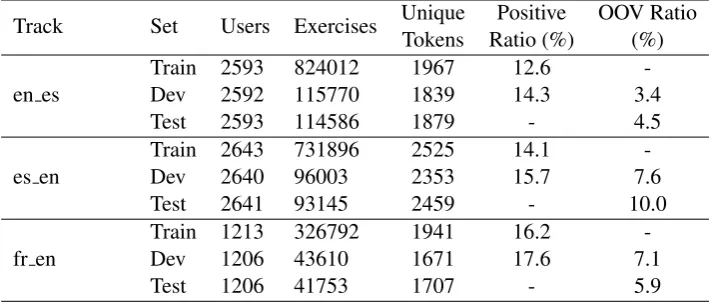
Track Set Users Exercises UniqueTokens Ratio (%)Positive OOV Ratio(%)
en es Train 2593Dev 2592 824012115770 19671839 12.614.3 3.4
-Test 2593 114586 1879 - 4.5
es en Train 2643Dev 2640 73189696003 25252353 14.115.7 7.6
-Test 2641 93145 2459 - 10.0
fr en
Train 1213 326792 1941 16.2
-Dev 1206 43610 1671 17.6 7.1
[image:2.595.121.477.63.214.2]Test 1206 41753 1707 - 5.9
Table 1: The SLAM dataset statistics
2 Dataset
The Duolingo SLAM dataset (Settles et al.,2018) is organized into three language tracks:
• en es: English learners (who already speak Spanish)
• es en: Spanish learners (who already speak English)
• fr en: French learners (who already speak English)
According to Table 1, most tokens (more than 80%) are perfect matches and are given the label 0 for “OK”. Tokens that are missing or spelled incorrectly (ignoring capitalization, punctuation, and accents) are given the label 1 denoting a mis-take. Across the three language tracks, en es has the lowest positive ratio, while es en has the high-est out-of-vocabulary (OOV) ratio.
Table 2 shows the features provided with the SLAM dataset. In our system, we used all fea-tures except the morphology feafea-tures and syntactic dependency edges, as we did not get any improve-ment during experiimprove-ments. Perhaps it is because that the neural networks already encoded similar information from characters, words and their syn-tactic dependency labels.
3 Method
We used in total four encoders to model the stu-dents’ learning behavior. Inputs to these encoders are embeddings learned from one-hot representa-tions of raw features. The context encoder consists of a character level LSTM encoder and a word level LSTM encoder. The linguistic feature en-coder is also a LSTM model, where POS and
syn-Category Features
Context word surface form
Linguistic
part of speech morphology features syntactic dependency edges syntactic dependency labels
User
user id countries days in course
Format
[image:2.595.319.510.256.436.2]client session type exercise format response time
Table 2: Features provided with the SLAM task
tactic dependency embedding are concatenated to-gether and then fed into a multilayer LSTM unit. At last, user encoder and format encoder are both fully-connected neural networks. The user en-coder takes account of user id, users’ national-ity and other user related information, while the format encoder encodes exercise format, session type, client type and time used for the exercise. The decoder combines the outputs of these en-coders and then makes predictions through a sig-moid unit.
3.1 Context Encoder
a cute cat
[image:3.595.304.523.59.233.2]Lookup layer BiLSTM layer Word encoder outputs
Figure 1: The Word Level Context Encoder
formation rules, therefore partially avoid the OOV problem.
The word level context encoder is a Bidirec-tional LSTM model. Given a sequence of words represented as one-hot vectors(w1, w2, ..., wN),
we can get the word embedding ofwtas
xt=Ew·wt,
whereEwis the word embedding matrix, which is
learned during training.
Given the input vector xt, the forward,
back-ward, and combined activations of the j-th hidden layer are computed as
ftj =LST M(ftj−1, ftj−1)
bjt =LST M(bjt+1, bjt−1)
gt= [ftK0, bKt 0],
whereK0is the number of layers of the network,
j= 1,2, ..., K0.
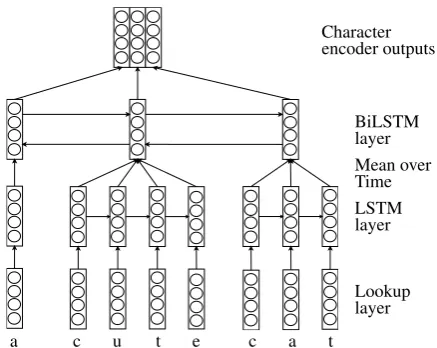
The character level context encoder is a hi-erarchical LSTM model. Given a sequence of one-hot representations of characters in wordwt, (c1, c2, ..., cM), we can get the embedding ofci
as
h0i =Ec·ci,
where Ec is the character embedding matrix,
which is learned during training.
The outputs of the lookup layer are then fed into a multilayer LSTM unit
hji =LST M(hij−1, hji−1)
Hwt = (hK11, h2K1, ..., hKM1),
where K1 is the number of layers of the LSTM,
j= 1,2, ..., K1.
a c u t e c a t
[image:3.595.72.287.62.211.2]Lookup layer LSTM layer Mean over Time BiLSTM layer Character encoder outputs
Figure 2: The Character Level Context Encoder
The mean-over-time (MoT) layer takesHwt as
inputs
hwt = 1 M
M
X
i=1
hK1
i ,
Then the outputs of the MoT layer (hw1,hw2, ...,
hwN) are inputs to a Bidirectional LSTM model,
ˆ
ftj =LST M( ˆftj−1, fˆtj−1) ˆ
bjt =LST M(ˆbjt+1, ˆbjt−1)
ˆ
gt= [ ˆftK2, ˆbKt 2],
whereK2is the number of layers of the BiLSTM,
j= 1,2, ..., K2.
The final outputs of the context encoder are computed as:
O= (o1, o2, ..., oN),
whereot=gt+ ˆgt.
3.2 Linguistic Feature Encoder
The linguistic feature encoder is also a LSTM model. Similar to the context encoder, we trained embedding representations of the POS labels and the syntactic dependency labels. The POS embed-dings and syntactic dependency embedembed-dings are concatenated together and then fed into a LSTM unit,
l0t = [post, dept]
ljt =LST M(ltj−1, ljt−1)
L= (lK3
wherepostis the POS embedding of wordwtand deptis the syntactic dependency label embedding
of wordwt. j is the layer index, and we haveK3
layers in this LSTM unit.
3.3 User Encoder
The user encoder is a one-layer fully-connected feedforward network. The encoder takes user metadata as inputs
µ0= [u, s, days]
µ1=tanh(Wµ·µ0 + bµ),
whereu is the embedding of the user id,sis the embedding of the user’s nationality and days is the time since the student started learning this lan-guage. Wµ, bµ are trained network parameters.
We used the tanh activation function for the user encoder.
3.4 Format Encoder
Similar to the user encoder, the format encoder is also a one-layer fully-connected feedforward net-work. The inputs are format, session, client, and the response time,
f0 = [f ormat, session, client, time]
f1 =tanh(Wf ·f0+ bf),
whereWf, bf are trainable parameters.
3.5 Decoder
The decoder takes the outputs (O, L,µ1,f1) of the
context encoder, linguistic encoder, user encoder and format encoder as inputs. The prediction for wordwtin the given sequence (w1, w2, ..., wN)
is computed as
ν=σ(Wν·[µ1, f1] + bν) γt=σ(Wγ·[lKt 3, ot] + bγ) pt=σ(Wp·(νγt) + bp),
where Wν, bν, Wγ, bγ, Wp, and bp are trainable
parameters. For decoding, we used the sigmoid activation functionσ.
3.6 Training
The model is trained to minimize the following loss function
Loss=−1
N N
X
t=1
(αyt·log(pt) +
(1−α)(1−yt)·log(1−pt)),
Team AUROC F1
SanaLabs 0.861 0.561
our model 0.861 0.559
alexrich 0.859 0.468
Masahiro 0.848 0.476
zz 0.846 0.414
Cam 0.841 0.479
btomosch 0.829 0.424
LambdaLearning 0.821 0.389
nihalnayak 0.821 0.376
... ... ...
[image:4.595.329.504.59.226.2]baseline 0.774 0.190
Table 3: Results of the en es track.
Team AUROC F1
SanaLabs 0.838 0.530
our model 0.835 0.524
alexrich 0.835 0.420
Masahiro 0.824 0.439
zz 0.818 0.390
Cam 0.807 0.435
btomosch 0.803 0.375
LambdaLearning 0.801 0.344
Grotoco 0.791 0.452
... ... ...
baseline 0.746 0.175
Table 4: Results of the es en track.
whereαis the hyper parameter to balance the neg-ative and positive samples andytis the label of the
time stept. In our experiment, we setαto 0.7.
4 Experiments and Results 4.1 Experiments
We considered the words that appear less than five times in the training data as unknown token. For students with more than one nationality, only the first one was used.
[image:4.595.329.502.266.433.2]Team AUROC F1
SanaLabs 0.857 0.573
our model 0.854 0.569
alexrich 0.854 0.493
zz 0.843 0.487
Masahiro 0.839 0.502
Cam 0.835 0.508
btomosch 0.823 0.442
LambdaLearning 0.815 0.415
Grotoco 0.813 0.502
... ... ...
[image:5.595.90.274.59.248.2]baseline 0.771 0.281
Table 5: Results of the fr en track.
Term en es es en fr en
Relative impr (%) 11.24 11.93 9.72
Table 6: The relative improvement over the base-line
encoder was a two-layer LSTM. Both of the user encoder and format encoder were one-layer fully-connected feedforward networks.
4.2 Results
The evaluation metrics for the SLAM task were the Area Under the Receiver Operation Character-istic (AUROC) curve and the F1 score.
As provided in Table3, Table4and Table5, our model achieved the AUROC score of 0.861, 0.835, and 0.854 and the F1 score of 0.559, 0.524 and 0.569 for the en es, es en, and fr en track, respec-tively. We ranked in first place in the en es track and second place in the es en and fr en track.
Table6shows that CLUF gained significant im-provements on all tracks compared to the baseline model. The improvement on the en es and es en track were close, while the improvement on the fr en track was a bit lower. We think this is be-cause the fr en (327k exercises) track has much less training data than the en es (824k exercises) and es en (732k exercises) track.
4.3 Discussion
Our intuition behind CLUF is to factorize raw fea-tures into four independent parts: 1) word surface form models the word formation rules; 2) the lin-guistic encoder is to provide linlin-guistic and syntac-tic dependency information; 3) the user part ex-plores students’ second language acquisition skills
Model AUROC F1
CLUF 0.846 0.554
LUF 0.775 0.446
CUF 0.843 0.552
CLF 0.813 0.501
[image:5.595.353.482.60.145.2]CLU 0.779 0.467
Table 7: Encoder analysis. LUF has no context encoder; CUF has no linguistic encoder; CLF has no user encoder; CLU is the model without format encoder.
over time; 4) the format encoder measures the difficulty level of different exercises on various clients.
Table 7 shows the performance of our CLUF model when excluding one of the context, linguis-tic, user and format encoder. We can see that the performance drops substantially if we don’t use the contextual or format features. On the other hand, excluding the linguistic features does not affect the performance much. At last, we can achieve fairly good performance even if we don’t use any user information.
5 Conclusion
We presented a neural network based model, CLUF, for the SLAM task. We encoded the con-textual, linguistic, user and format features sepa-rately. Our system achieved one of the best re-sults in this task. Moreover, our CLUF model was language invariant, as it performed approximately equally well across three language tracks. We fur-ther explored how effective each encoder was. We found that the context encoder was the most effec-tive one, while the linguistic encoder was the least effective one.
Acknowledgments
We thank Duolingo and Educational Testing Ser-vice for organizing this novel and interesting task and releasing the SLAM dataset.
References
Dzmitry Bahdanau, Kyunghyun Cho, and Yoshua Ben-gio. 2015. Neural machine translation by jointly learning to align and translate. international con-ference on learning representations.
lan-guage model. Journal of machine learning research, 3(Feb):1137–1155.
Kyunghyun Cho, Bart Van Merri¨enboer, Dzmitry Bah-danau, and Yoshua Bengio. 2014. On the properties of neural machine translation: Encoder-decoder ap-proaches. arXiv preprint arXiv:1409.1259.
Ronan Collobert and Jason Weston. 2008. A unified architecture for natural language processing: Deep neural networks with multitask learning. In Pro-ceedings of the 25th international conference on Machine learning, pages 160–167. ACM.
Alexis Conneau, Holger Schwenk, Lo¨ıc Barrault, and Yann Lecun. 2017. Very deep convolutional net-works for text classification. InProceedings of the 15th Conference of the European Chapter of the As-sociation for Computational Linguistics: Volume 1, Long Papers, volume 1, pages 1107–1116.
Albert T Corbett and John R Anderson. 1994. Knowl-edge tracing: Modeling the acquisition of procedural knowledge. User modeling and user-adapted inter-action, 4(4):253–278.
Geoffrey E Hinton. 1986. Learning distributed repre-sentations of concepts. InProceedings of the eighth annual conference of the cognitive science society, volume 1, page 12. Amherst, MA.
Sepp Hochreiter and J¨urgen Schmidhuber. 1997. Long short-term memory. Neural computation, 9(8):1735–1780.
Minghao Hu, Yuxing Peng, and Xipeng Qiu. 2017. Re-inforced mnemonic reader for machine comprehen-sion.CoRR, abs/1705.02798.
Diederik P Kingma and Jimmy Ba. 2014. Adam: A method for stochastic optimization. arXiv preprint arXiv:1412.6980.
Siwei Lai, Liheng Xu, Kang Liu, and Jun Zhao. 2015. Recurrent convolutional neural networks for text classification. In AAAI, volume 333, pages 2267– 2273.
Tomas Mikolov, Edouard Grave, Piotr Bojanowski, Christian Puhrsch, and Armand Joulin. 2017. Ad-vances in pre-training distributed word representa-tions. arXiv preprint arXiv:1712.09405.
Tom´aˇs Mikolov, Martin Karafi´at, Luk´aˇs Burget, Jan ˇCernock`y, and Sanjeev Khudanpur. 2010. Recur-rent neural network based language model. In Eleventh Annual Conference of the International Speech Communication Association.
Tomas Mikolov, Ilya Sutskever, Kai Chen, Greg S Cor-rado, and Jeff Dean. 2013. Distributed representa-tions of words and phrases and their composition-ality. In C. J. C. Burges, L. Bottou, M. Welling, Z. Ghahramani, and K. Q. Weinberger, editors, Ad-vances in Neural Information Processing Systems 26, pages 3111–3119. Curran Associates, Inc.
Zachary A Pardos and Neil T Heffernan. 2010. Mod-eling individualization in a bayesian networks im-plementation of knowledge tracing. InInternational Conference on User Modeling, Adaptation, and Per-sonalization, pages 255–266. Springer.
Radek Pel´anek. 2017. Bayesian knowledge tracing, lo-gistic models, and beyond: an overview of learner modeling techniques. User Modeling and User-Adapted Interaction, 27(3-5):313–350.
Jeffrey Pennington, Richard Socher, and Christopher Manning. 2014. Glove: Global vectors for word representation. InProceedings of the 2014 confer-ence on empirical methods in natural language pro-cessing (EMNLP), pages 1532–1543.
Chris Piech, Jonathan Bassen, Jonathan Huang, Surya Ganguli, Mehran Sahami, Leonidas J Guibas, and Jascha Sohl-Dickstein. 2015. Deep knowledge trac-ing. In C. Cortes, N. D. Lawrence, D. D. Lee, M. Sugiyama, and R. Garnett, editors,Advances in Neural Information Processing Systems 28, pages 505–513. Curran Associates, Inc.
Soujanya Poria, Erik Cambria, and Alexander Gel-bukh. 2015. Deep convolutional neural network textual features and multiple kernel learning for utterance-level multimodal sentiment analysis. In Proceedings of the 2015 conference on empiri-cal methods in natural language processing, pages 2539–2544.
Cicero dos Santos and Maira Gatti. 2014. Deep con-volutional neural networks for sentiment analysis of short texts. In Proceedings of COLING 2014, the 25th International Conference on Computational Linguistics: Technical Papers, pages 69–78.
B. Settles, C. Brust, E. Gustafson, M. Hagiwara, and N. Madnani. 2018. Second language acquisition modeling. InProceedings of the NAACL-HLT Work-shop on Innovative Use of NLP for Building Educa-tional Applications (BEA). ACL.
Burr Settles and Brendan Meeder. 2016. A trainable spaced repetition model for language learning. In Proceedings of the 54th Annual Meeting of the As-sociation for Computational Linguistics (Volume 1: Long Papers), volume 1, pages 1848–1858.
Nitish Srivastava, Geoffrey Hinton, Alex Krizhevsky, Ilya Sutskever, and Ruslan Salakhutdinov. 2014. Dropout: A simple way to prevent neural networks from overfitting. The Journal of Machine Learning Research, 15(1):1929–1958.
Ilya Sutskever, Oriol Vinyals, and Quoc V Le. 2014.
Kevin H Wilson, Xiaolu Xiong, Mohammad Khajah, Robert V Lindsey, Siyuan Zhao, Yan Karklin, Eric G Van Inwegen, Bojian Han, Chaitanya Ekanadham, Joseph E Beck, et al. 2016. Estimating student pro-ficiency: Deep learning is not the panacea. In In Neural Information Processing Systems, Workshop on Machine Learning for Education.
Caiming Xiong, Victor Zhong, and Richard Socher. 2017. Dynamic coattention networks for question answering. international conference on learning representations.