http://go.warwick.ac.uk/lib-publications
Original citation:
Gelsomini, Luca (2012) Public disclosure by ‘small’ traders. Working Paper. Coventry: Economics Department, University of Warwick. (Warwick economics research paper series (TWERPS), Vol.2012, No.998
Permanent WRAP url:
http://wrap.warwick.ac.uk/53083
Copyright and reuse:
The Warwick Research Archive Portal (WRAP) makes the work of researchers of the University of Warwick available open access under the following conditions. Copyright © and all moral rights to the version of the paper presented here belong to the individual author(s) and/or other copyright owners. To the extent reasonable and practicable the material made available in WRAP has been checked for eligibility before being made available.
Copies of full items can be used for personal research or study, educational, or not-for-profit purposes without prior permission or charge. Provided that the authors, title and full bibliographic details are credited, a hyperlink and/or URL is given for the original metadata page and the content is not changed in any way.
A note on versions:
The version presented here is a working paper or pre-print that may be later published elsewhere. If a published version is known of, the above WRAP url will contain details on finding it.
Public Disclosure by ‘Small’ Traders
Luca Gelsomini
No 998
WARWICK ECONOMIC RESEARCH PAPERS
Public Disclosure by ‘Small’Traders
Luca Gelsomini
IESEG School of Management (LEM CNRS); CRETA, University of Warwick
Abstract
We model strategic trading by a rent-seeking insider, who exchanges without being spotted, and propose a comprehensive theory of market non-anonymity. Several novel results are established. They depend on asset value proprieties, beliefs, inter-temporal choices, and investors’ characteristics. In equilibrium, under a regulation mandating public trade revelation, disclosures may shift prices. If they do, uninformed manipula-tions arise only in some instances. Speci…cally, insiders constrained on asset holdings earn more than they would without such a disclosure rule. Consequently, mandating disclosures is unnecessary, as informative trades will be revealed voluntarily. This re-sult reveals a previously unexplored link to the literature on (uncerti…ed/non-factual) announcements.
Keywords: Mandatory vs. voluntary public disclosure, securities regulation, insider trading, market manipulation.
JEL Classi…cation: D82,G12,G14,G38
I am grateful to Andres Carvajal, Jonathan Cave, Giovanni Cespa, Kose John, Herakles Polemarchakis, and Branko Uroševi´c for their fruitful discussions. Comments from Franklin Allen, Pablo Beker, Ekkehart Boehmer, Andrea Bu¤a, Gilles Chemla, Joao Cocco, Pasquale Della Corte, James Dow, Peter Hammond, Cars Hommes, Gur Huberman, Charles Jones, Boyan Jovanovic, Pete Kyle, Paulo Parente, Mieszko Mazur, Raghu Rau, Stefano Sacchetto, Mark Salmon, Pedro Santa-Clara, Lucio Sarno, Elvira Sojli, Dezsö Szalay, Pedro Teles, Giorgio Valente, and Dimitri Vayanos, as well as seminar participants at theWorld Congress of the Game Theory Society at the Kellogg School of Management, the 2008 EEA-ESEM meeting in Bocconi, the Workshop on Globalisation, Finance and Macro at the Centre for the Study of Globalisation and Regionalisation, theComplex Markets conference at the Warwick Finance Research Institute, the 2008 Spanish Economic Association Annual Congressin Zaragoza, Banque de France (Research Center), Birkbeck College (Department of Economics, Mathematics and Statistics), Católica-LISBON School of Business and Economics, Central Bank of Portugal (Research Center), IESEG School of Management (LEM CNRS), London Business School, Universidade NOVA de Lisboa, Queen Mary University of London (School of Economics and Finance), University of Warwick (Department of Economics), and Warwick Business School are also appreciated. I would also like to thank the National Bank of Serbia and the selection committee at the2012 NBS Annual Young Economist Conference— composed of Charles Engel, Boyan Jovanovic, and Branko Uroševi´c— for awarding the paper the 2012 Prize for Best Paper. The usual caveat applies.
Public disclosure of inside statements always receives great attention in capital markets. Para-doxically, following the seminal work of Benabou and Laroque (1992), hereafter BL, on market manipulation and credibility, where insiders may produce false announcements and trade on the mispricing, there have been few attempts to develop conceptual models that study these strategic disclosures. Nowadays, the extent to which an inside statement conveys information is, more than ever, the object of a considerable debate. This is also true for statements that certify the undertaken trade, which the SEC and various European regimes, among others, require to be made public soon after the trade has been made. On this latter issue, three in‡uential studies by Fishman and Hagerty (1995), John and Narayanan (1997), and Huddart et al. (2001), here-after FH, JN, and HHL respectively, advance our understanding by focusing on big traders; but small-sized investors must also disclose trades publicly.1
This paper considers small traders— i.e., traders whose transactions cannot be spotted— who are subject to a so called capital constraint or risk limit,2 and proposes a comprehen-sive theory of market non-anonymity. We examine public disclosure to interpret the e¤ects of
mandatoryandvoluntaryreports about undertakentrades,and establish several novel results, including: (1) Disclosures do not always a¤ect prices; (2) when they do, only in speci…c instances the investor, when uninformed, manipulates the market; and (3) for disclosure to be forthcom-ing, it does not have to be mandatory, as the investor will disclose informative trades voluntarily. The …rst two results depend on the asset value properties; on alternative (but correct) market beliefs associated with disclosure; on the weight assigned to present and future pro…ts (that is, on the inter-temporal discount factor); and on the trader’s characteristics, which translate into how likely he is to know about the real asset value today and to have inside information in the future. The third result not only tells us that regulators do not need to make laws against missed trade reporting and invigilate for it— rather, they need to identify who best should be allowed to report trades of a speci…c stock— it also represents the intermediate step to extend our study to the voluntary disclosure of(uncerti…ed/non-factual) announcements, which can be spread, for example, through the media in concert with journalists (e.g., see Sobel (2000), p. 248) or by starting rumors, with predictions in line with the …rst two points above. These predictions do not rely on the assumption of a trader that (with positive probability) reports information ‘honestly,’conversely imposed in previous models of inside announcements.
In order, let’s …rst consider mandatory trade disclosure, with each trade compulsorily re-vealed after it is executed, and before the next order can be placed. A small trader could use public disclosure as a lever to move the asset price and enhance pro…ts. Intuitively, while his or-ders do not a¤ect prices, their disclosure could. However, if he is constrained on asset holdings, for any properties of the asset value, even public disclosure has no price impact— in other words,
1E.g., the Market Abuse Directive (EU Directive 2003/6/EC) lists traditionally small investors, such as
man-agers, members of the supervisory board, employees/members of sta¤ that could have private information, and their spouses, partners, and relatives. The (US) Securities Exchange Act refers to big traders— the ‘principal stockholders’— but also to most …rms’o¢ cers and directors on one side (SEC(2004), Section 16), and to rela-tively big traders on the other (SEC(2004), Section 13), the latter disclosing if the change in ownership amounts to at least 1% of the …rm’s stock. The Securities and Exchange Board of India Act refers to all the investors listed above, mandating those owning less than the 5% of the …rm’s stock to disclose when the change exceeds a very small quantity (e.g., Rs. 5 lakh in value), while setting a high threshold for bigger stockholders.
2This constraint makes the maximum number of shares that they may exchange today dependent on
it is correctly believed to beuninformative. To see what would happen otherwise, we consider a standard two-round trading model, and show that, if prices reactedsomehowto disclosure (or its absence), when informed the trader wouldin probabilitydeceive other market participants com-pletely. Consequently, the market anticipates this behavior, ignoring disclosures, which makes our investor earn as much as under anonymity, where no signal is disclosed.
Indeed, only in some instances is a trader understood to possess private information just once, for contingent reasons. In general, because of his speci…c characteristics, he typically tends to be thought of as being in the position to acquire new private information again, at some (unknown, unless he is systematically informed with certainty) point in the future. To model this latter form of informational asymmetry, as in BL, we employ an in…nite-horizon repeated framework.3Focusing on a two-round repeated structure, suppose for instance that, at any point in time, current disclosures are believed to be informative— speci…cally, the dis-closure of a purchase is known to push the price just as far up as a sale disdis-closure pushes it down— unless (recent) past disclosures moved prices away from the real value.
As long as disclosures are known to a¤ect current prices, at that repetition a trader that turns out to be informed may pick (or alternate between) one of the following two strategies. He may trade up to his maximum (which can but does not have to be common knowledge) to
leadthe price toward the right direction, earning as much as under anonymity, and subsequently pro…ting once again by reversing his position completely, in the same repetition, if the disclosure causes the price to overshoot the real value. Otherwise, he maymisleadthe market, trading in the opposite direction and reversing his position afterwards. The latter strategy— which in JN may be of equilibrium when the asset value distribution displays unequal mass below and above its mean— allows our trader to earn more than from leading in the current repetition, but only as much as under anonymity in the (next) future, when disclosures start to be ignored. Indeed, as in Allen and Gale’s (1992) study, the market cannot determine if our investor is actually trading on information. Thus, when uninformed, he may manipulate, pretending to be informed— in jargon,blu¢ ng(Harris (2002))— that is, randomly disclosing that he has bought or sold, which moves the price up or down respectively, then reversing his initial position. This strategy— …rst examined in FH, where the trader manipulates whenever uninformed— in expectation allows the investor to earn more than from not trading in the current repetition; but, if prices are pushed by chance in the wrong direction, future pro…ts will be reduced. Hence, our trader may prefer to alternate between blu¢ ng andnot trading, or choose the latter.
The solution to this problem brings to the identi…cation of three regions corresponding to di¤erent equilibria, in two of which disclosures are (at least partially) informative— the conse-quences being price shifts— and one where disclosures are not at all informative. Prices never shift when the weight granted to future pro…ts is small, as if they did, the trader would system-atically mislead the market. Conversely, provided he weighs future pro…ts su¢ ciently, when (or as soon as) disclosures are believed to be informative, he prefers to lead the market whenever informed. Consequently prices react to disclosures. Speci…cally, the smaller the probability of acquiring information, the more he needs to weight future pro…ts to opt for a non-manipulative strategy when uninformed; otherwise prices react only partially— in proportion to how often he is informed— rather than fully, as he manipulates whenever uninformed.4Put di¤erently, there
3We make no reference to …nite repetitions, as trivial. If our trader acquired private information repeatedly,
with positive probability, only up to a certain moment in time— in other words, if he imagined that, at some future date, he was certainly not going to be informed any more— starting from the last repetition and solving backwards, the equilibrium in each repetition would coincide with that derived when no repetition occurs.
4The underlying structure is that of a new, important class of supergame— more precisely, of in…nitely
exists an equilibrium threshold in the likelihood that this trader is informed, which progressively increases as the weight given to future pro…ts shifts from high to medium.5For each discount fac-tor associated with this band of inter-temporal preferences, as the probability that he acquires information increases, uninformed manipulations occur less often, up to this threshold, above which he switches behavior, never trading when uninformed. Thus, a trader who is less likely to be informed (e.g., investors not directly involved in the …rm’s management) will manipulate, while one that is more likely to be informed (e.g., CEOs) will not.
Ever since Kyle (1985), an important strain of literature has focused on an insider that with positive probability leads prices towards the real value, undertaking reversals in case his strate-gic signal (e.g., the order ‡ow, trade disclosure) causes the price to overshoot the privately known quotation. To model price overshooting, in principle every class of asset value properties is ap-propriate, other than that of a random variable with two possible realizations assumed in BL, FH, and JN, as these two priors would otherwise systematically bracket equilibrium prices. For tractability, however, this literature, which includes HHL, generally assumes normality. In-stead, our predictions hold, whether or not the asset value distribution is continuous or (up to a certain degree) asymmetric, or its support unbounded. While overshooting isnotdue to the imprecision of the signal, the way the market interprets this signal plays a role. In fact, identical dynamics can be identi…ed, whether the trader has to disclose tradedirectionorsize, because a market response is to interpret any trade of the same direction identically. It follows that, when disclosures are believed to be informative, if the investor trades, he only exchanges up to his (un)observable maximum, which justi…es the market reaction in question.
When (or as soon as) prices react to trade revelation, the investor expects to earn as much or more than he would without such a disclosure rule. Consequently, mandating disclosures is unnecessary, as informative trades will be advertised voluntarily. In detail, the trader decides to disclose not only when he knows that the resulting price will overshoot the privately known asset value, but also when it willundershoot this value (and thus no pro…table reversal is possible). By doing so, he hidesthisinformation at no cost, so that the price following a disclosure turns out to shift the most (that is, as much as under mandatory disclosure), which ensures the highest occurrence of price overshooting, and the most pro…table associated reversal. Clearly, an asset value distribution not preventing price overshooting is required to model voluntary disclosure of informative signals; otherwise, when informed, no small trader has an incentive to disclose.
Even when this investor cannot disclose certi…ed trades, in principle he may still publicly pro-duce uncerti…ed announcements of any sort, provided he does not lie about relevant facts, which is forbidden under most regulations (e.g., SEC(2004), Section 10(b)). In this case, when (or as soon as) announcements are believed to be favorable/unfavorable, the equilibrium price follow-ing their disclosure shifts as it does when a certi…ed purchase/sale turns out to be informative. This is why an investor that acquires new information repeatedly— whose equilibrium trans-actions coincide with those undertaken under the voluntary disclosure of certi…ed trades— has all the incentives to produce these announcements after the initial purchase/sale. Speci…cally, his incentive to lead the market when informed, as well as his incentive not to manipulate when uninformed, turn out to be una¤ected with respect to the case of a certi…ed trade disclosure. Thus, three analogous regions of equilibria exist, in one of which manipulations arise. Indeed, a question exists in literature, whether requiring investors to publicly certify their trades pre-vents them from producing manipulative announcements (BL, p. 947). Our work suggests that, when mispricings are possible, this resolution makes traders indi¤erent about making announce-ments, but does not prevent equivalent trade-based manipulations.
5This band of inter-temporal preferences is the most relevant: Discount factors spanning from high to
There are at least three ways to justify why the transactions of our insider cannot be spotted: First, with a large market compared to the position he can undertake— in other words, his maxi-mum trading capacity is quantitatively negligible; second, with a market/trader of any size, and an indistinguishably large or low demand— indeed, in complex environments agents not process-ing all information turn to heuristic rules of thumb and weigh more salient information (Tversky and Kahneman (1974)); third, even a negligible trading pressure by a big insider can be justi-…ed, as BL do. They invoke the results in Kyle (1985, 1989) and La¤ont and Maskin (1990), who show that in imperfectly competitive markets the trader can limit the leakage of information into prices. In this latter case, our predictions hold when the time between the …rst of a series of purchases/sales and its public disclosure is su¢ cient for the trader to buy/sell up to the cap on total exposure, splitting up the order into several smaller chunks. For large caps, this is possible only under those regulations that allow for a su¢ cient delay in reporting trades.6 Conversely, this is always a possibility in case certi…ed trades cannot be noti…ed, whenever the insider pro-duces announcements, the timing of whose disclosure is at the sender’s discretion.
When a big investor, who is systematically informed (by assumption), has to disclose each tradebeforeplacing a new order, he reduces the dissemination of information dissimulating, that is adding a random component to his trades. This happens in HHL, where an investor with un-limited holdings earns substantially less compared to the case of no public disclosure, but one can conjecture that insiders with very large but…nitetotal exposure caps dissimulate too. If so, our study suggests that, when disclosure is mandatory, it is the imposition of avery tight dead-line to report trades that causes dissimulations. Ceteris paribus, when this trader— as well as one with a total exposure cap of any size— has enough time to place small orders, up to his max-imum capacity, before reporting their execution, he opts for the latter alternative, which makes big traders earn more than with (now unnecessary) dissimulations, and allows for the possibility of a pro…table reversal in case the price following these simultaneous disclosures overshoots the real value. The disappearance of this deceptive practice provides a rationale for allowing for long delays in reporting trades, or better, for making disclosures voluntary.
A regulatory concern relates to the tension between two elements implied by public disclo-sure. Advocates argue that higher transparency can increase price e¢ ciency; opponents, that it will increase the set of manipulative behaviors. While mere speculations enable earlier in-formation releases (Hart, 1977; Leland, 1992), the distortive e¤ect of manipulations on prices is clearly undesirable. Though forbidden (e.g., see SEC, 2004, Section 9a2), manipulations are hard to prosecute, which is why an understanding of when and how to prevent them is imper-ative. This paper shows that disclosure by small traders cannot reduce price e¢ ciency, only boost it or leave it una¤ected. However, when manipulations arise, a regulator that aims to prevent them should re…ne market rules. In this case, our model tells us that such illegal con-duct cannot be eliminated by suppressing the trade disclosure rule, unless the investor is also forbidden to produce announcements. On this front, this work examines whether two simple resolutions, the short-swing rule and public pre-trade non-anonymity, prevent manipulations without reducing price e¢ ciency. Both resolutions have an independent interest; to the best of our knowledge, we are the …rst to model these issues.
The short-swing rule— which is contained in Section 16(b) of the SEC Security Exchange Act, but not prescribed in any EU Directive— constrains a class of investors already obliged to disclose their trades, namely, the …rm’s o¢ cers and directors, because it forces them to give up
6Rather than the US one, which in 2002 drastically reduced the possible delay, from one that depended on
pro…ts from reversals if undertaken within 6 months from the …rst trade. For any properties of the asset value, this rule implies fully informative disclosures: On the one hand,di¤erentlyfrom the case of an identical, …nite quantity exchangeable per trading-date, it ensures that our trader does not manipulate when uninformed. On the other, it discourages this trader, when informed, from attempting deceptive strategies— conversely he leads, exchanging only in the beginning.7
To highlight the advantages and disadvantages of the US short-swing rule, which is imposed unconditionally, consider a trader who may acquire new inside information repeatedly. Even though in some instances this extra rule is ine¤ective— as deceptive strategies would have not been attempted anyhow— in others it prevents uninformed manipulation. However, there is an important drawback of SEC Section 16(b). In line with general concerns (Goldwasser (1999), p.48), a resolution discouraging manipulations can deter appropriate trading. In detail, pro-vided the trader weights future pro…ts heavily, the US short-swing rule is not only unnecessary but, when private information is su¢ ciently long-lived, also prevents the revelation of reversals (or of their absence), which would have shifted prices even closer to the fundamental value.
Pre-trade non-anonymity is a natural alternative to imposing trade disclosure. It consists of a public revelation of the forthcoming purchase or sale, together with the trader’s identity, just before execution. A rule that forces (at least) the disclosure of the submitted order direction prevents the insider from trading in the market. This general result holds for any properties of the asset value and the noise traders’demand, and depends neither on the position limit to which the trader is subject, nor on whether he is small or large. Because the obligation to reveal orders before execution implies the lowest price e¢ ciency level, this measure may be preferable only when the objective is to prevent an insider from pro…ting at the expense of other investors.
This paper continues as follows. Section I presents the assumptions. Section II studies the e¤ects of a regulation that, following each purchase or sale, mandates public disclosure of trade direction. Section III investigates the foundation of mandatory and voluntary trade disclosure. At the end of this section, the analysis is extended to the case of a voluntary production of announcements. Section IV focuses on market beliefs. Section V extends our analysis in di¤erent directions, including that of trade size disclosure. Section VI evaluates the short-swing rule and public pre-trade non-anonymity. Section VII concludes.
I. Assumptions
Trading is modelled as a sequence of auctions, structured to give the ‡avor of a sequential equilibrium (Kreps and Wilson (1982)). As in Kyle (1985), a risky asset is exchanged for a risk-less one among three kinds of traders. In a risk-neutral world, apotential insider(theleader, L) and noise traders submit orders to a market maker (M), that sets prices and clears the market. The ex-post liquidation value of the asset,v, is a random variable over[ b,b], whereb>0;
vhas zero mean;F(v)is absolutely continuous with respect to the Lebesgue measure; andf(v)
is symmetric (in Section III, the absolute continuity and symmetry requirements are relaxed). The timing is the following. Before v is exogenously revealed to the market at the end of theperiod, a sequence of two rounds (or auctions), n2 f1,2g, takes place. Roundn consists of three steps. In Step 1, a public disclosure occurs; in Step 2, noise traders and L submit quantities (or orders); and in Step 3, the price is …xed and quantities are executed by M.
Two main states of the world are possible:s2 fI; Ug. InIthe leader has information about
v, learning whetherv>0orv<0in roundn=1, and learningv=v inn=2. InU the leader does not knowv at any round. StateI occurs with probabilityq(for the case of a leader that, when
7As a result, if the short-swing rule were imposed when trade disclosure is not, this investor would have no
informed, already observesv=vin roundn=1, see Section V). From now on, for brevity, we refer to a potential insider as aninsider when, in a speci…c period, he actually possesses private infor-mation aboutv; conversely, when he privately knows thats=U, we say that he isuninformed.
The market maker’s task is to set the clearing price in roundn, pn, e¢ ciently; thus pn is
chosen to equal the asset expected value, conditional on the information available.
[See Fig. 1.]
At auction n the leader trades a quantityxn, positive for a purchase, negative for a sale,
and zero otherwise. The leader is constrained on asset holdings, in that he is restricted tohold xn2[ xL,xL], where xL, the cap on total exposure, is strictly positive and …nite, and x0 is
normalized, without loss of generality, to 0.8 Denote, with
n=xn(v pn), the portion of L’s
pro…ts attributable to the roundn 2 f1;2gtrade, and assume that the intra-period discount factor equals 1. Noise traders’ demand in n, the random variable un, avoids the no-trade
theorem problem (Milgrom and Stokey (1982)); un and v are independently distributed.
De…neP andX, which are vectors of function, byP=hP1; P2iandX=hX1; X2i, whereP is
M’s pricing rule, andXis L’s trading strategy. In detail,pn=Pn( n), where nis M’s
informa-tion set at aucinforma-tionn; X1:fUg [(fIg fv>0;v<0g)![ xL; xL]; x1=X1(v=sign(v); s=s);
X2:fUg [(fIg [ b; b])![ xL x1; xL x1]; andx2=X2(v=v; s=s).
De…nition 1 An equilibrium is de…ned as: (i) A strategy by L that maximizes the overall sum of his discounted expected payo¤s over time, given the price setting rule and the information L has when making each trade; (ii) a strategy by M that allows him to set each price equal to the asset expected value, given L’s strategy and the information available (market e¢ ciency condition); (iii) each player’s belief about the other player’s strategy is correct in equilibrium.
As a distinctive assumption in this model, the orders that the potential insider submits have no inferable impact on the order-‡ow— in other words, public disclosure is the only information M conditions on.9 To simplify the exposition, when this assumption holds, from now on we say (or imply, when not speci…ed) that the leader issmall (as opposed to large). Let’s also assume that, as soon as v=v is exogenously revealed at the end of the period, the price immediately adjusts, and that the initial price,p0, is normalized toE[v]=0.10
Mandatory post-trade non-anonymity (N) characterizes markets in which, at the very be-ginning of roundn, the identity of agents placing orders inn 1and whether they bought or sold are revealed (post-trade disclosure of submitted quantities and pre-trade non-anonymity are considered in Section V and VI.B respectively). Thus in n=2 the signal 2 f 1;0;1g is released: =1 implies that L bought in n=1; = 1 implies a sale; =0 implies no revela-tion in n=2 about the purchase or sale that L undertook in n=1. When disclosure is man-dated, this setting coincides with inactivity inn=1. Because 1=f?g, 2=f g, it follows that
8Other authors, before us, have assumed a symmetric upper- and lower-bound in the change of holdings
(e.g., van Bommel (2003), Brunnermeier and Pedersen (2005)).
9Of the three ways, adduced in the introduction to this analysis, to justify a non-informative order-‡ow,
un+xn, the …rst can be formalized with a distribution ofun,g(un), strictly positive for allun2[ 1;1], when
2xLis quantitatively negligible. Under this structure,E[xnjun+xn] E[xnjun]. The second— i.e., that of an
indistinguishably large or low demand— with a naïve market maker with di¤use priors aboutun: Ifg(un)is
unknown, thenE[xnjun+xn]cannot be computed. 10We can think of p
P1:f?g ![ b; b]andP2:f 1;0;1g ![ b; b]. Speci…cally, as long as trades get revealed after
the order execution, price-driven markets— in which prices are set, then quantities placed and executed at this price— are equivalent to order-driven ones.11 Anonymity (
A) characterizes markets in which no information is released.
II. Markets with post-trade mandatory disclosure
This section analyzes a regulation mandating disclosure of trade direction, …rst considering the benchmark case of a non-repeated sequence of two auctions, then a multi-period frame-work where this sequence is repeated up to in…nite.
II.A. Single-period equilibrium with post-trade mandatory disclosure
UnderA,in equilibrium the market clears at the same price,pn=0, at any auction. The
equi-librium behavior of an insider aware of v>0(or v<0) is such that Pnxn equalsxL (resp., xL)— in other words, such that he holdsxL (resp., xL) at the end of the period— while
that of an uninformed leader is such thatPnxn2[ xL; xL]. This means that each type of
leader can place any probability (also equal to0or1) on all roundn=1trade quantities (x1=0
included), no matter what information he observes. For instance, consider a trader that in
n=1 systematically buys (or sells, or does not trade)only when he observesv>0. Although in equilibrium M’s beliefs about L’s (pure or mixed) strategy are correct, absence of public sig-nals— i.e., n=f?g— implies no price shift. At these prices, an uninformed leader is indi¤erent
whether or not to trade at any round, as by purchasing or selling he earns0expected pro…ts. UnderN, in the standard two-round trading model, public trade disclosure by any small investor constrained on asset holdings is not informative. As under A, an initial trade by L does not a¤ect the short-run price, p1— that is, because 1=f?g, M sets p1=p0=0. Although
its subsequent public disclosure might alter the long-run price,p2, we show that in equilibrium
M ignores any signal in the second round and setsp2=0.
Proposition 1 For mandatory trade disclosure, in the single period the ‘unique beliefs’equi-librium is the following: M sets pn= 0; type s=I^v>0 and s=I^v<0 trade in such a way that Pnxn=xL and Pnxn= xL respectively, providing they disclose the same signal =
with equal probability (even0or1); types=U trades in such a way thatPnxn2[ xL; xL].12
Proof. See Internet Appendix A.
It follows that, both underAandN, theper-period equilibrium payo¤ of types=U equals
0, while that of the insider of typev>0(orv<0) equalsxL , where =E[vjv>0].
To see why public disclosure of trades (as well as disclosure of no undertaken trade) is not informative, consider any candidate equilibrium pricing rule such that either the signal = 1
or =0or =1causes the pricep2to shift frompn6=2=0. For each of these pricing rules, derive
L’s optimal response, under the assumption that, when informed, L already observesv=v in the …rst round. Holding this optimal trading strategy …xed, notice that the candidate pricing rule in question makes M reply toall types of insider belonging to either[ b;0)or(0; b]with
11This degree of generality is due to a structure not allowing for information extraction from the order-‡ow. 12Two remarks are in order: (i)Equilibrium beliefs uniqueness refers to a unique component of equilibria,
a price in the opposite partition of the support ofv.13 In particular, this wrong price shift follows an identical …rst round order,x1 (and thus an identical disclosure of trade direction).
Consequently, the optimal trading strategy is una¤ected when each of these types of insider only observes whetherv<0orv>0in roundn=1, which is why any of these candidate pricing rules still su¤ers from the same problem. Now recall that, sincef(v)is symmetric around0, the probability ofv being greater or smaller thanp0is the same. It follows that any of these
candidate pricing rules is (in expectation) wrong. In fact, at least half of the times, prices shift in the wrong partition ofv, regardless of whether inn=1 an insider knowsv=v orv?0. In conclusion, no pricing rule such thatp26=p0can be an equilibrium one.
Part of the result is in line with the one in …nitely repeated zero-sum games of incomplete information, in which it is impossible for the informed sender to mislead the uninformed receiver (Aumann and Maschler (1995)). Less intuitively, in the single period M does not make any use of the signal received, because L’s preferences over actions are completely opposed to what can be roughly de…ned as M’s preferences, which are to set prices e¢ ciently. If prices somehow reacted to the trade disclosure (or its absence), the pricing rule would not be justi…ed, and in this sense, M would be worse o¤ and consequently would deviate. Otherwise, regardless of whether L actually possesses information, with probability greater than a half prices would move in the opposite direction with respect to v=v, and in practice, M could do better by tossing a coin. This is mainly due to the position limit assumption (see Section III).
With respect to the equilibrium trading strategy depicted underA, the one underN is con-strained as follows. The probability that an insider of typev>0and one of typev<0place on roundn=1purchases is the same. Analogously, the probability that these types place on round
n=1sales is identical, as well as the probability placed onx1=0. In this way, they hide their
infor-mation completely and the pricing rulepn=0is justi…ed (in fact, even when types=U signals
di¤erently from what the informed types signal, M does not extract information from that). HHL shows that, when forced to disclose trades, a large insider dissimulates to reduce the rev-elation of his information. To do so, he plays a mixed strategy consisting of a …rst round trade that includes a random noise component. By contrast, in the present study the revelation of information following the …rst round trade is eliminated rather than reduced. To accomplish this, the insider can but does not have to employ mixed strategies, which is why dissimulation is not a driving force behind the present result. What matters is thatanytype of insider initially disregards his information and discloses (under probability) the same trade. By contradiction, suppose for example that the insider(s) of typev>0decided to signal = 1(or =0, or =1)less
13The result does not depend on the e¤ective size of the cap on total exposure,x
L. To make some o¤-the-path
manipulative attempts by a leader more explicit, consider the following candidate equilibrium pricing rules and the associated insider’s best responses. Holdingp1=0unchanged,…rst suppose thatP2( =1)— i.e., the price in response to a disclosed purchase— is positive,P2( =0)is non-negative, andP2( =1)is negative (this is caseC3 in the proof to Proposition 1). The roundn=1placed orders in response to these prices, as well as the disclosed trade directions, depend on the exact value thatP2( = 1),P2( =0), andP2( =1)assume. Speci…cally, not every type initially aware ofv=v>0prefers to disclose a …rst roundsale— which movesp2down, namely toward the wrong direction— unless bothP2( =1)and P2(2=0) are non-greater thanjP2( = 1)j. Nonetheless, when this latter condition on prices is not satis…ed, each type initially aware ofv=v<0…nds it optimal topurchase
often than the insider(s) of typev<0do(es). For each of them, the optimal trading plan associ-ated with this alternative signaling requirement implies a payo¤ that is equal to that achieved in equilibrium. However, this best reply is not an equilibrium response, because disclosure of a sale (resp., absence of disclosure; disclosure of a purchase) would shiftp2down, a pattern which
has been shownnotto be compatible with that of an equilibrium pricing rule.
None of the equilibria in Proposition 1 is robust to a probability that M exogenously learns
v=vat the end of the …rst rather than of the second auction. Even when this probability is small, an informed type is not indi¤erent any more about a …rst round trade or another. Instead, in response topn=0, an insider of type v<0prefers to sell inn=1, while one of typev>0prefers
to buy. These replies cause M to deviate. Speci…cally, because types=U now prefers inactivity, M setsp2( =0)=0andp2( =1)= p2( = 1)= . At these new prices, however, a leader aware
ofv<0(orv>0) buys (resp., sells) inn=1, which moves p2in the wrong direction, then
revers-ing his initial position in the very likely event of an exogenous revelation ofv=v to M only at the end of roundn=2. In this case, it seems reasonable to improve our de…nition of equilib-rium by adding a condition that makes M set prices e¢ ciently, in theweak sense,if no pricing rule is justi…ed otherwise. When this condition is added, since in equilibrium M turns out to be ‘required’ to ignore signals, and thus setspn=0, an insider of typev<0(orv>0) initially sells
(resp., buys). Thus, although the equilibrium trading strategy in Proposition 1 probably lacks of realism, the associated equilibrium prices and payo¤s do not. Conversely, for any case stud-ied in our work, other than that of a meremandatorytrade disclosure over a…nitehorizon, this extra equilibrium condition will not be necessary, because of the existence of equilibria that display robustness to a small probability ofv=vbeing exogenously available to M in advance.
II.B. Informative post-trade mandatory disclosure
This subsection investigates whetheralternative equilibria are possible, where disclosed trades become relevant. We will allow for an in…nite repetition of the single period and refer to an equilibrium as a sequence of history-contingent replies that satisfy certain sequential condi-tions. When analyzing a problem witht2Nperiods (whereNincludes0), additional assump-tions are needed. First, aninter-period discount factor, 2[0;1), is assumed. In particular, andqare drawn by Nature at timet=0(the only period in which L does not play), and do not vary over time. Second, the two active agents involved in the in…nite repetition are the same market maker and leader. L’s type changes over time: Immediately after the exogenous revelation ofv=vto the whole market at the end of periodt(but before periodt+1starts),s
andvare drawn again by Nature. Bothsandvare i.i.d. over periods. Third, for any repetition of the two auctions,p0 andx0are normalized to0.14
For an in…nite repetition of the two auctions, consider the following M’s strategy.
De…nition 2 Suppose M’s strategy is to setp1=0andp2=P2N( )in the …rst period, whereP2N:
=1!p2= ; = 1!p2= ; =0!p2=0, and 0is the magnitude of the second round
price shift. At the second round of the tth period, if the outcome of all t 1 preceding periods has been =1^v>0 or = 1^v<0or =0, then play P2N; otherwise, set p2=0.
The analysis is now restricted to what, for >0, we call trigger strategy, which consists of a generic history-contingent pricing rule and a punishment scheme that makes M ignore subsequent disclosures if Ldefects— that is, when L causes the price to go in the wrong direction with respect tov. The punishment refers to the decrease in per-period expected pro…ts su¤ered
14The amount of shares held at the end of periodt 1does not impact on periodtspace of actions. In
by L after defection. Speci…cally, De…nition 2 implies that, as soon as M observesvp2<0— i.e., a price manipulation occurs— at periodj, from periodj+1onwards prices at any auction equal0. Consequently, from periodj+1, L’s equilibrium trading strategy coincides with that undertaken underN, when the two-round period is not repeated. Depending on ,q, andf(v), sub-classes of this trigger strategy are part of an equilibrium.
In particular, M can be thought of as representing the behavior of a semi-strong e¢ cient market as a whole (BL), or as serving as an intermediary. Finally, as in Kyle (1985), M can be also interpreted as the reduced form of at least two competitive bidders per auction, where the winner— i.e., who posts the most attractive bid for L— clears the market at the winning price. In this case, to prevent multi-round collusion, Caldentey and Stacchetti (2010, p. 250) suggest imagining a large group of bidders, each of them bidding once and then quitting the market. Still, if prices were set by competitive bidders, a priori it is unclear whether a pun-ishment strategy is implementable. Section IV explains why the notion of a unique market maker breaking even in expectation via the selection of any trigger strategy, and therefore even a Grimtrigger— which applies a punishment consisting of M reverting to single period equi-librium behavior forever(see Friedman (1971))— is consistent with the idea of bidders setting prices competitively. Section IV also accounts for the multiplicity of equilibrium pricing rules.
II.B.1. Benchmark case (q=1)
In general, a trader can alternate (with some probability, even0or1) between trading some
non-negative quantity in one direction and in the other. In this respect, providing at a certain period prices shift positively as stated in De…nition 2,if an insider decides to incur the punish-ment, we say that hemisleads M. If an insider decides to push the price in the right direction, heleads M. De…ne, withM( )andL( ), how much L expects to earn per period from trading
optimally while aiming to mislead and lead respectively. These two new strategies identi…ed, let_2[0;1]be the probability with which he chooses the former rather than the latter.
Lemma 1 Consider mandatory disclosure of trades. Given the pricing rule in De…nition 2, by trading optimally a type s=I that decides to incur the punishment with probability _ earns _ M( )+(1 _)L( ) per period, where M( )>L( )>xL ,8 >0, and:
L( ) = 2xL
( R
0
(2 v)f(v)dv+ b
R
vf(v)dv
)
, (1)
M( ) = 2xL b
R
0
(2 +v)f(v)dv: (2)
Proof. See Internet Appendix A.
At each period, if an insider of typev>0(orv<0) decides to lead, it is optimal for him to tradex1=xL(resp., x1= xL), completely reversing this position afterwards by tradingx2=
2xL(resp.,x2=2xL) in casev=vlies betweenp2andp0, or not trading at all otherwise. As long
as is strictly positive, since the insider has the chance to bene…t from an additional price dif-ferential at the second round, the resulting per-period expected pro…ts are greater than those after defection— in other words, if >0, thenL( )>xL . If this type decides to optimally
mis-lead, he will initially sell (resp., buy) up to his cap on total exposure, always undertaking a com-plete reversal of the initial position afterwards. Only for =0we have thatM( )=L( )=xL ,
Given M’s trigger strategy, a leader informed with certainty chooses a level of _, _ I
, which maximizes his discounted expected pro…ts over periods. In this case, whether to defect at a certain point in time only depends on how much the trader weighs future pro…ts.
Proposition 2 For mandatory disclosure of trades, an in…nite repetition of the two-round trading period, and a leader acquiring new information every period (that is, when q = 1): (i) If r, where r=MM( = )( = )L( = )x
L , an equilibrium exists in which disclosures a¤ect prices.
Speci…cally, M undertakes the strategy in De…nition 2, setting = ; L trades optimally in such a way that he never incurs the punishment. (ii) If < r, at each repetition the equilib-rium coincides with that under N, when no repetition of the period takes place.
Proof. See Internet Appendix A.
Consider a situation in which >0. When the insider gives substantial weight to the pro…ts from persistently leading the market optimally— an alternative to earning even more only once by misleading optimally, but then earning less forever— he opts for the former option with certainty. Thus, prices are not manipulated at the equilibrium, which is in pure strategies. In detail, disclosures being fully informative, an equilibrium price shift equal to is justi…ed. Conversely, when L does not weigh future pro…ts enough, he would always mislead. However, M anticipates such misleading behavior, ignoring disclosures by setting =0. As a consequence, L e¤ectively trades as he does in a single repetition of the two-round period.
Finally notice that, when = r, for any positive value of , insiders are indi¤erent towards leading and misleading optimally. In this case, depending on the probability with which each insider is believed to lead, in…nite other equilibrium outcomes are possible, with price shifts that can assume any value between 0— when both insiders are believed to mislead with probability greater than or equal to 12— to included. Because r is a point in the continuum, we refer only to the more informative equilibrium.
II.B.2. Generalized case (q2(0;1]): The manipulative-equilibrium threat
Consider a leader that is not informed with certainty. Whenever uninformed, this trader cannot undertake any insider activity. Still, provided that, at a certain moment in time, prices positively shift as hypothesized in De…nition 2, with some probability the uninformed leader canpretend to be informed, that is, blu¤, disclosing a purchase or a sale to move p2 up
or down respectively. When he does so, by tradingoptimally he expects to earnP( )in that period, whether he opts for an initial purchase or a sale. Let
_
2[0;1]be the probability with which the uninformed leader decides to blu¤ as opposed to not blu¢ ng, the latter strategy implying no trade undertaken in the …rst auction.
In case 6= 0, an uninformed leader that decides to blu¤ …nds it optimal to either buy or sell initially up to the cap on total exposure and completely reverse this position afterwards. For an uninformed leader that decides to blu¤, let_z2[0;1]be the probability with which this type decides to do so by disclosing a purchase as opposed to disclosing a sale. Holding the price reaction in De…nition 2 …xed, he is indi¤erent to the two options. In fact, because of the symmetry of the pricing rule, the associated per-period payo¤s are identical. In addition, because of the symmetry of the punishment scheme and off(v), when 6= 0, this choice does not even impact on the likelihood that type s=U accidentally causes the price to be wrong— an event that occurs with probability
_
2. However, for this symmetric pricing rule to
be justi…ed, beliefs in response to a purchase and a sale are restricted to assigning the same probability to types=U. For this reason, if L blu¤s at the equilibrium, he chooses_z=1
If types=Udoes not blu¤, thenx1=0. No matter what his unobservable roundn=2trade is,
this type expects to earn0per-period pro…ts, that is less thanP( )whenever 6= 0. Only for =0we have thatP( )=0, case in which any strategy such thatPnxn=0is a best response.
Lemma 2 Consider mandatory disclosure of trades. Given the pricing rule in De…nition 2, by trading optimally a type s=U that decides to blu¤ with probability
_
—i.e., to defect with probability
_
2—expects to earn
_
P( ) in that period, where P( )=2 xL>0,8 >0.
Proof. See Internet Appendix A.
Whenqis not restricted to equal1, another dimension is added to the problem presented in the previous subsection. At any period in which prices are expected to shift, L can ran-domize with probability _ (or
_
) between misleading and leading (resp., blu¢ ng and not blu¢ ng) optimally when informed (resp., uninformed). In the subsequent period, this choice causes prices to shift again with probability1 _(resp.,1
_
2). As long as 6= 0, choosing
_ 6 = 0 or _ 6
= 0implies a positive probability of incurring the punishment, taken into account when determining L’s optimal strategy at the equilibrium, for every 2[0;1)andq 2(0;1).
Consider a leader that is informed with probabilityq. The inter-temporal problem that he has to solve di¤ers depending on whether or not in the current period— that is, periodt=1— he possesses private information. Given M’s trigger strategy, let_ I
and _ I
(or_ U
and _ U
) be the levels of_and
_
that maximizeE I (resp.,E U ), that is the discounted sum of pro…ts that L expects to earn over time when in periodt=1he is (resp., is not) informed.
The next lemma de…nes L’s best response.
Lemma 3 Consider mandatory trade disclosure, an in…nite repetition of periods, and a leader that acquires new information every period with probabilityq2(0;1). Given the pricing rule in De…nition 2, identify the pairs _ I
;
_ I
= arg max _
;
_ E
I and _ U ;
_ U
= arg max _
;
_ E
U , where
E I =_ M( ) + 1 _ L( ) +_
1 qxL + 1
_
S(q; ; ;_;
_
); (3)
E U =
_
P( ) +
(
1_
2
)
S(q; ; ;_
;
_
) +
_
2 1 qxL ; (4)
and
S = q[
_
M( ) + (1 _) L( )] + (1 q)
_
P( )+1 [q_+(1 q) _
2 ]qxL 1 2(1 q
_
)
_
(1 q) 2
: (5)
In the current period, the best response of a leader of types=I (or s=U)is _ I
(resp.,
_ U
) when 6= 0, and equals to the one in the single repetition of the period otherwise.
Derivation of S in Lemma 3. See Appendix.
the probability of acquiring new information, how much he weighs future pro…ts, and the consequences of each signal on the direction of present and future price shifts.15
The next lemma de…nes the level of at which the pricing rule in De…nition 2 is e¢ cient.
Lemma 4 Consider mandatory trade disclosure, an in…nite repetition of periods, and a leader that in every period acquires new information with probability q and trades op-timally given the pricing rule in De…nition 2. The market e¢ ciency condition holds for
=1(_ I
<12)[1 (1 q)
_
U
](1 2_ I
) , where 1( ) is the indicator function.
Before defection, beliefs formed in response to disclosed trades (or absence of disclosure) ac-count directly for the current and indirectly for the planned choices by a leader aware about prices being restricted to shift as prescribed in De…nition 2. Disclosures are informative— that is, is positive—only if a trader that is currently informed leads with probability greater than 12. In this case, provided L does not blu¤ when currently uninformed, a level of equal to1 2_ I
ensures e¢ cient pricing. This level has to be reduced— i.e., multiplied by1 (1 q)
_
U
— in case L blu¤s with positive probability when uninformed.
Below we propose the closed-form solution to the general problem in markets with manda-tory post-trade disclosure. More general conditions for this result to hold are presented in Corollary 3. In the next section the result is extended, and commentary provided.
Proposition 3 For mandatory disclosure of trades and an in…nite repetition of the two-round period, three regions over the space in 2[0;1)andq 2(0;1]can be identi…ed. They correspond to di¤erent equilibria in which M undertakes the strategy in De…nition 2. In de-tail, (1) if (q; = ), in every period M sets = , and L plays _ I
=
_ U
= 0; (2) if
r(q; =q ) < (q; = ), M sets =q , and L plays _ I = 0,
_ U
= 1 up to the jth rep-etition, wherejis the …rst period after which M observes vp2<0; and (3) if <r(q; =q ), at each repetition the equilibrium coincides with that underN, when no repetition of the period takes place. Speci…cally, (q; ) =P( )+qP( )
2[L( ) xL ]andr(q; ) =
M( ) L( )
1+q
2 M( ) 1 q
2 L( )+(1 q)P( ) qxL
.
For any distribution ofvsatisfying the initial conditions, these three regions always exist.
Proof. See Internet Appendix A.
When L repeatedly acquires information with probabilityq2(0;1], the equilibrium is de-rived as follows. Holding >0…xed, notice that: (1) For (q; >0), the pairs_ I
=0;
_
I
=0
and _ U
=0;
_
U
=0maximize the functionsE I andE U respectively. Thus, L’s best
re-sponse consists of leading when informed and not trading otherwise. For_ I
= _ U
=0, a level of equal to guarantees price e¢ ciency. Holding = …xed, L does not deviate from the original strategy. Consequently, when (q; = ), in equilibrium disclosures are fully informative and no manipulation arises. (2) Forr(q; >0) (q; >0), the pairs_ I
=0;
_
I
=1and _ U
=0;
_
U
=1maximizeE I andE U respectively. Hence, L’s best reply is to lead when
informed and blu¤ when uninformed. For_ I
=0;
_
U
=1, a level of equal toq guarantees price e¢ ciency. At this level of , no deviation by L from the initial strategy occurs. It follows that:
15For a leader that is currently informed (or uninformed), his best response today,_ I
(resp.,
_ U
(2.a) Whenq=1andr(q=1; = ) (q=1; = ), since no manipulation occurs, disclo-sures are again fully informative. (2.b) Whenq<1andr(q<1; =q ) (q<1; = ), dis-closures are partially informative until a manipulative attempt causes prices to shift in the wrong direction, an event that occurs by the end of thekthperiod with probability1 (1+q
2 )
k
.16 (3) For r(q; >0), the arguments maximizing the two functions do not always coincide. This has no implications for L’s strategic behavior because_ I
=_ U
=1. Put di¤erently, if prices shifted, L would always mislead the market as soon as he is informed. In equilibrium, M ignores disclosures and L trades as he does in the single period.
Notice that, over the segment = (q<1; >0)^q<1(or =r(q; >0)), any pair _ I
=0;
_
U
2[0;1](resp., _ I
2[0;1];
_
U
=1) is also a leader’s best reply. In this case, in…nite equilibria are possible, where the price shift varies from =q to = (resp., from =0to =q ). In line with the argument presented below Proposition 2, we refer only to the most informative one.
The three regions identi…ed in Proposition 3 always exist. In fact, the functionsr(q; )and
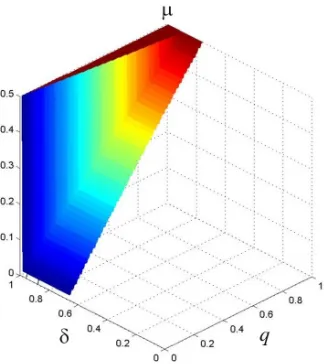
(q; )are continuous andr(q=1; = )< (q=1; = ). In particular,r(q=1; = )= r(as shown in the benchmark case),limq!0 (q; = )!1, and@( (q;@q= ))<0. Figure 2 contains an
example withv U[ 1;1]to provide a graphical idea of the closed-form solution to the issue.
[See Fig. 2.]
For any q<1, whenever assumes values just below (q<1; = ), the potential insider continues leading when informed, but starts blu¢ ng when uninformed. This is due to the fact that, for any pair andq2(0;1)and a positive , theoverall incentive that an informed leader has to mislead (rather than lead) optimally today is smaller than the one that the same leader has to blu¤ (rather than not to blu¤) optimally today when uninformed. On the one hand, per period the extra-payo¤ from misleading optimally,[M( ) L( )], is smaller than that from blu¢ ng optimally,[P( ) 0].17 On the other, while a misleading strategy implies a punishment with certainty, a blu¢ ng strategy implies a defection only with probability 1
2.
Hence, starting from any pair andq 2(0;1)associated with a non-manipulative outcome, by gradually decreasing , at some point a switch in the equilibrium occurs, to one where L has no incentive to mislead, but has incentive to blu¤.
III. Foundation of mandatory/voluntary disclosure
First we focus on mandatory and voluntary trade disclosure, then extend the study to the voluntary disclosure of (uncerti…ed/non-factual) announcements.
III.A. Voluntary vs. mandatory trade disclosure
To study the foundation of mandatory and voluntarytradedisclosure,and highlight the role of the position limit to which L is subject, together with the role of the asset value properties, we start with a comparison with FH. The corollaries refer to a leader constrained on asset holdings. In FH, for a disclosure to be forthcoming, it must be mandatory, the reason being that disclosures reduce the informed trader’s pro…ts. Given the single period made ofn 2 f1;2g
rounds, wherep0=0, suppose that a negligible leader, informed with probabilityq, can trade a
16Fork=1, the probability of a defection equals =1 q
2 . Fork=2, it equals + (1 ), that is the probability of defection today plus that of a defection in period t=2, provided a punishment has not yet occurred. By the end of periodt=ka defection occurs with probability + (1 ) +::+ (1 )k 1= 1 (1 )k
1 (1 )=1 ( 1+q
2 )
k.
17In fact,
(divisible) unitxLper round, and thatv2 f b; bghas equally likely priors.18Under mandatory
disclosure, when L initially sells (or buys), at the equilibriump1=0andp2= bq(resp.,p2=bq).
At these prices, an insider aware of v<0(orv>0) sells (resp., purchases)xLtwice, which is a
trading strategy that, however,is less pro…table than underA. Conversely, types=U random-izes with equal probability between trading x1=xL,x2= xLandx1= xL,x2=xL, earning a
per-period payo¤ equal toxLbq>0. Because the informed trader’s loss from disclosure equals
in magnitude the uninformed trader’s gain, L’sex-antepayo¤ is higher with disclosure ifq<1 2.
Conversely, in our model, under mandatory trade disclosure, the per-period payo¤ of any type of leader is equal or greater than underA. Speci…cally, provided disclosures a¤ect prices, the expected pro…ts of an informed leader are always higher. Thus, if L were to choose in which market to exchange,N orA, he would always at least weakly prefer the former.
Corollary 1 When disclosed trades a¤ect equilibrium prices, the leader prefers a system man-dating disclosure toA, and is indi¤erent otherwise.
Now, let’s consider a market in which L can voluntarily decide whether or not to disclose an undertaken purchase or sale. Since in this market the signal =0is more opaque than when disclosures are mandatory, the conditions for an equilibrium with informative trades to exist are clearly harder to satisfy. Nonetheless, within the in…nitely repeated structure, equilibria exist where the leader voluntarily discloses trades that shift prices.
Corollary 2 For voluntary trade disclosure, in the single period a unique beliefs equilibrium ex-ists, where type s=I^v>0and s=I^v<0disclose the same signal with equal probability, trad-ing in such a way thatPnxn=xLand Pnxn= xLrespectively; type s=U attaches any proba-bility to any signal, trading in such a way thatPnxn2[ xL; xL]; and pn=0.When the period is in…nitely repeated, alternative equilibria exist, where M undertakes the strategy in De…nition 2. Speci…cally, if (q, = ), type s=I^v>0(or s=I^v<0, or s=U) signals =1(resp.,
1;0), while M sets = . If r(q, =q ) < (q, = ), up to the jthrepetition, any type s=I signals and trades as before; with equal probability, type s=U signals as type s=I^v>0and s=I^v<0do, trading x1=xL,x2= 2xLand x1= xL,x2=2xL respectively; and M sets =q ; from period j+1on, the equilibrium coincides with that in the single repetition of the period.
Proof. See Internet Appendix A.
As far as the single period is concerned, no equilibrium exists such that prices at the second round shift following the voluntary disclosure of an undertaken transaction (or its absence). To see it, consider any of these o¤-the-path pricing rules and derive the optimal response from a leader that observesv=valready in roundn=1 and can— but does not have to— disclose trades. Given this leader’s best response, M turns out to reply to at least half of the types of insiders— those below or those above 0— with prices that shift in the wrong direction. For the same reasons adduced for the case of a mandatory disclosure, the pricing rule in question is not justi…ed, no matter whether an insider observesv?0orv=vin the …rst round. In equilibrium, unlike mandatory disclosure, the probability that an insider of type
v>0and one of typev<0place on a roundn=1purchase (or sale; or absence of disclosure) does not necessarily have to be the same. Nonetheless, the probability that these types signal =1(or 1, or0) is identical— and can take any value from0to1(included)— so that the
18When v2 f b; bg, assuming that in roundn=1 the insider learns only whether v?0 rather than v=v
information revelation is eliminated and the pricing rulepn=0is justi…ed. Indeed, holding this
latter pricing rule …xed, by trading as prescribed in equilibrium but signaling di¤erently, each type of insider earns identical pro…ts. However, they do not opt for any of these alternative strategies, since this would cause M to deviate and set an o¤-the-path pricing rule. Finally, consider those equilibria where no disclosure ever occurs and x1equalsxLor xLor0when s=I^v>0ors=I^v<0ors=Urespectively. These equilibria are robust to a small probability that M exogenously learnsv=vat the end of the …rst rather than of the second round.
Within the in…nitely repeated structure, when L weighs future pro…ts su¢ ciently, alter-native equilibria exist, where until defection (if any) prices and (voluntary) disclosures— as a function of the state of the world— are identical to those set in Proposition 3. The reason for this is that the ‘relevant payo¤ structure’19coincides with that analyzed when disclosures are mandatory. Suppose that, at a speci…c period, >0,and consider an insider who is aware, for instance, ofv>0(the case in which he is aware ofv<0is symmetric). If this trader does not aim to incur the punishment, he can choose between two options, disclosing a purchase (which re-quires him to submit an initial buy order) or not disclosing any trade (which does not prevent him from placing either a buy or a sell order). Clearly, the former option is better, provided the insider buys up the maximum in the …rst round and subsequently reverses the initial position ifv<p2. By doing so, he expects to earnL( >0)in that period. Conversely, the only way this
insider has to incur the punishment is to sell initially and disclose the undertaken sale. In particular, by trading optimally— selling as much as possible in roundn=1and buying back up to the total exposure cap inn=2— he expects to earnM( >0).Finally, an uninformed leader can pretend to be informed, disclosing either an undertaken purchase or sale. In either case, by trading optimally, he expects to earnP( >0)in that period. Alternatively, types=U
can avoid disclosure, which assures him that he will not incur the punishment at the end of the period. In this case, no matter what the quantity traded in each of the two rounds is, he expects to earn0pro…ts. For this reason, while forr(q, =q ) < (q, = )the pre-defection equilibrium trading outcome (as a function of the states of the world) coincides with that in Proposition 3, for (q, = ), types=U can trade di¤erently.
From a regulatory perspective, the model suggests that it is not essential to impose public disclosure, as long as an investor with a cap on total exposure can voluntarily communicate trades. This result relies on general asset value properties, generalized even further below. Con-versely, the length of punishment plays no role: The trader discloses voluntarily simply because he always earns at least as much as he does underA, both when informed and uninformed. Voluntary dissemination of information results from the investor’s will to communicate trades, which reveals a link to the literature on uncerti…ed/non-factual messages.
The next corollary highlights which asset value properties drive the results obtained so far, when L is constrained on asset holdings. To explain the corollary, we consider a situation where disclosures aremandatory and present, in sequence, two examples that refer to a symmetric distribution of v, centered around0(an event which, for the time being, is assumed not to be possible). The …rst example helps our understanding of the second, in which speci…c conditions onf(v)for an informed type to send meaningful signals are identi…ed.
The distinguishing feature of the …rst example is that, whenever L turns out to be informed aboutv>0(orv<0), he isforced to exchangex1=xL(resp.,x1= xL). Whether the two-round
period is repeated or not, in equilibrium types=U (who hasnotbeen constrained in the direc-tion of the initial trade) randomizes with equal probability between tradingx1=xL; x2= 2xL
19The termrelevant refers to the per-period payo¤ that the leader achieves— in case the market conditions
andx1= xL; x2=2xL. Because in this example the disclosure by an informed type is indirectly
assumed to be informative, the equilibrium pricep2following a purchase (resp., sale) shifts to
q (resp., q ), a value that allows type s=U to achieve a positive payo¤— rather than0, which is how much this type gets underA— from a reversal. In other words, the …rst round equilibrium orders by any type of leader and equilibrium prices coincide with those in FH. Nonetheless, and di¤erent from FH, mandatory disclosure allows an informed leader to earn either more than or as much as what he earns when disclosures are concealed, depending on the asset value properties. To see this, de…ne, withr>0, the realization ofv that is closest to
0from the right. Whenf(v)is such thatq r, rather than undertaking an unpro…table re-versal, the insider prefers not to trade inn=2, which is why his per-period payo¤ equals that achieved underA. Conversely, whenr<q , any insider aware ofjvj<jq jreverses the initial position, earning more than underA.
The second example refers to a leader who isnot forced to undertake any particular action in any …rst round. When (q, = ), at a speci…c period, if he turns out to be informed (or uninformed), he expects to earn more than (resp., as much as) under A, provided that disclosures are believed to be informative and at the same timef(v)is such thatr< . This latter condition ensures that L has an incentive to lead, in that those types of insider aware of <v<0(resp.,0<v< ) increase their pro…ts by reversing the initial position inn=2, ex-changing at a priceP2( = 1)= (orP2( =1)= ). Speci…cally, any symmetric distribution
ofvis such that the latter types …nd the reversal pro…table, unlessv2 f b; bg, in which case the reversal does not generate any additional revenue and thus there is no incentive to lead. Whenr(q; =q ) < (q; = ), at a speci…c period, any type of leader expects to earn more than underA, provided disclosures are believed to be informativeandf(v)is such that
r<q , a condition that allows any insider to increase his pro…ts by reversing his initial leading position, exchanging at a priceP2( = 1)= q (orP2( =1)=q ), whenever he learns about
q <v<0(resp.,0<v<q ). However,in this case the existence of two possible realizations of
v above (or below)0does not guarantee that the condition r<q is satis…ed. The intuition proposed in this second example is generalized here.
Corollary 3 Relax the assumptions of a symmetricf(v)and aF(v)being absolutely continu-ous w.r.t. the Lebesgue measure, and consider v2V <such thatE[v]is normalized to0and:
R1 : Pr(v<0)=Pr(v>0)=12; R2 : Pr( <v<0)=Pr(0<v< )6= 0;
R3 : E[vjb v ]= E[vj v b]; R4 : E[vj <v<0]= E[vj0<v< ];
whereb= minv 2V,b= maxv 2V, and equals (orq ) if (q, = )(resp.,r(q, =q ) < (q, = )). Under restrictions from R1 to R4, all the preceding results still hold. In partic-ular, those in the single period only require R1 to be satis…ed.
Notice thatjbjdoes not have to equalb. More generally, as is clear fromR3 andR4, even for the results in the in…nitely repeated framework, a symmetricf(v)is no longer required.R1
has two implications. On the one hand, it ensures an equal probability mass above and below
E[v], a restriction that is su¢ cient to guarantee that the results in the single period hold. For instance, the proof to Proposition 1 relies neither on the support ofvbeing continuous, nor on the number of types of insider above and belowp0 being equal, nor on the speci…c distance
between each type of insider and0, nor on whether a realization ofvabove (or below)0is more likely than another realization lying on the same side of the support. On the other hand,R1