Sensing Tree Automata as a Model of Syntactic Dependencies
Thomas Graf Department of Linguistics
Stony Brook University Stony Brook, NY, USA [email protected]
Aniello De Santo Department of Linguistics
Stony Brook University Stony Brook, NY, USA
Abstract
Various aspects of syntax have recently been characterized in subregular terms. However, these characterizations operate over very dif-ferent representations, including string encod-ings of c-command relations as well as tiers projected from derivation trees. We present a way to unify these approaches via sensing tree automata over Minimalist grammar pendency trees. Sensing tree automata are de-terministic top-down tree automata that may inspect the labels of all daughter nodes be-fore assigning them specific states. It is al-ready known that these automata cannot cor-rectly enforce all movement dependencies in Minimalist grammars, but we show that this result no longer holds if one takes into account several well-established empirical restrictions on movement. Sensing tree automata thus fur-nish a strong yet uniform upper bound on the complexity of syntactic dependencies. 1 Introduction
This paper proposes a novel, unified upper bound on the subregular complexity of syntactic depen-dencies. Since the merit of this result might be opaque to a reader who is not intimately familiar with the most recent developments in subregular complexity, we start out with a very detailed back-ground discussion.
The subregular program seeks to identify for-mal machinery that provides a tighter characteri-zation of natural language than the familiar classes of the Chomsky hierarchy. Subregular phonology took as its vantage point the well-known result that phonology is regular (Johnson,1972;Kaplan and Kay, 1994) and then identified proper subclasses that are still powerful enough for specific types of phonological dependencies. Among these sub-classes are SL, SP (Rogers et al., 2010), IBSP (Graf,2017,2018a), TSL (Heinz et al.,2011; Mc-Mullin,2016), and several extensions of the latter
(Baek,2018;Graf and Mayer,2018). The highly restrictive nature of these classes has allowed for new learning algorithms (Heinz et al.,2012; Jar-dine and McMullin,2017) and also furnishes com-putational explanations for typological gaps.
with constraints on MG derivation tree languages and shows that they belong to the tree analogue of the subregular string class TSL. This view is also adopted byVu(2018) andVu et al.(2019) in the analysis of negative-polarity items and case li-censing, respectively.Graf and Shafiei(2019) and Shafiei and Graf(2019), on the other hand, pursue a purely string-based perspective of syntactic de-pendencies. For each node they identify its string of c-commanders, the shape of which must fol-low the constraints imposed by, say, Principle A or NPI-licensing. When construed as such string constraints, syntactic licensing conditions not only turn out to be subregular, they also fit into classes that have been proposed for subregular phonology. The work so far thus has unearthed two distinct subregularity results: MG operations are subreg-ular over MG derivation trees, and licensing con-ditions are subregular over a specific string repre-sentation grounded in c-command (cf.Frank and Vijay-Shanker,2001).
Even though each perspective is worthwhile and has proven very fruitful, their apparent incom-mensurability raises the question how these two notions of subregularity can be brought to bear on each other. The central contribution of our paper is a uniform upper bound on syntax that encompasses both MG operations and licensing conditions. This upper bound takes the form of sensing tree automata (STAs) operating over de-pendency tree representations of MG derivations (these dependency trees are distinct from the MG dependency trees of Boston et al. 2010). STAs provide a minimal amount of look-ahead to de-terministic top-down tree automata: the automa-ton may inspect the labels of all daughter nodes before assigning them specific states. Far more than just a mathematical curiosity, limiting syntax to STA-recognizable constraints over MG depen-dency trees is very natural in several respects:
1. MG dependency trees are a natural encoding of head-argument relations.
2. STAs explain why licensing conditions are mediated by c-command instead of the many alternative command relations one could imagine (Barker and Pullum,1990).
3. In order for movement to be regulated by STAs, it must obey additional restrictions be-yond those of the standard MG formalism. These restrictions coincide with well-known
empirical phenomena such as the Specifier Island Constraint and the Coordinate Struc-ture Constraint.
4. As a single STA can handle movement and li-censing conditions at the same time, it is un-surprising that the two occasionally interact, e.g. when movement induces a licensing con-figuration or violates one.
5. Since STAs are deterministic top-down au-tomata with a minimal amount of look-ahead, they are a natural match for top-down pars-ing, which has been argued to play a central role in human sentence processing (Stabler, 2013;Kobele et al.,2013;Graf et al.,2017).
Hence our contribution does not merely unify the two existing approaches to subregular syntax, it also accounts for empirical aspects of syntax that the latter leave unexplained. At the same time, we do not intend for our perspective to supplant the existing ones. Each one provides useful insights and can now be safely pursued in the knowledge that there is a principled formal connection to the other approaches.
The paper is laid out as follows: Section 2 in-troduces our mathematical notation for trees and tree languages (§2.1), which form the basis for our definition of STAs (§2.2). We then define MGs and their dependency trees in§3. In order to simplify some of the subsequent proofs, we do not follow the standard definitions and instead adopt a for-mat that is partly inspired byKobele et al.(2007). Sections4and5cover the two core results of this paper: dependency trees of MGs with the Spec-ifier Island Constraint are STA-recognizable, and so are licensing conditions based on c-command. The last section briefly sketches some extensions of these results, including interactions of move-ment and c-command (§6.1), subcommand (§6.2), recognizability of MG derivation trees (§6.3), ad-junct islands and the coordinate structure con-straint (§6.4, §6.5), and connections to top-down parsing (§6.6).
2 Preliminaries
2.1 Trees and Tree Languages
σ has rankn. Given a ranked alphabetΣ, the set
T(Σ) of Σ-trees contains all σ(0) and all terms
σ(n)(t1, . . . , tn) (n ≥ 0) such that t1, . . . , tn ∈
T(Σ).
Example 1. Given Σ := a(0), b(0), c(2), d(2) ,
T(Σ)is an infinite sets that contains, among oth-ers, the termd(c(b, b), d(b, a)). This term corre-sponds to the tree below:
d
c
b b d
b a
If Σ consisted only of c(2) and d(2), then T(Σ)
would be empty. y
Given a termm(n)(s1, . . . , sn)where eachsiis a subtree with root di, we call m the mother of the daughters d1, . . . , dn (1 ≤ i ≤ n). If two distinct nodes have the same mother, they are sib-lings. We use the termproper dominancefor the transitive closure of the mother-of relation, and re-flexive dominancefor the reflexive, transitive clo-sure. A nodeais anancestorof nodeniffa prop-erly dominatesn.
Every nodeu in aΣ-tree has a unique address
g(u)as defined inGorn(1967). The subtree ofΣ -treet rooted in Gorn addressg(u) is denoted by
t/g(u). Given twoΣ-treessandtand nodeu in
t,t[g(u)←s]is the result of replacingt/g(u)int
bys. Throughout the paper, we writeuinstead of
g(u)so that t/uandt[u ← s]are shorthands for
t/g(u)andt[g(u)←s], respectively. 2.2 Sensing Tree Automata
A sensing tree automaton (STA; Martens et al., 2008) is a deterministic top-down tree automaton that may also take the labels of a node’s daugh-ters into account before assigning states to them. In other words, these automata have a finite look-ahead of 1. This intuition is reflected in our defini-tion ofsensing rulesbelow. Following the format of Comon et al. (2008, p. 38) for top-down tree automata, we deliberately define sensing rules in a tree transducer format. This is a marked devia-tion fromMartens et al.(2008), but it should make it easier for future work to extend our perspective from constraints to transformations.
LetΣbe some ranked alphabet and Qa set of symbols of rank 1 disjoint fromΣ. Members of
Qare calledstates. In addition, Xis a countably infinite set of variable symbols (X ∩Σ = X∩
Q =∅). For the rest of this section, we useσ~i as a shorthand forσi(xi1, . . . , xin), with σi ∈ Σ
(n)
andxi1, . . . , xin ∈X.
Definition 1 (Sensing rule). A sensing rule over alphabet Σ and state set Q is an ex-pression of the form q(σ(n)(σ1~ , . . . , ~σn)) →
σ(n)(q1(σ~1), . . . , qn(σ~n)) such that
σ, σ1, . . . , σn∈Σandq, q1, . . . , qn∈Q. y Note that for σ(0), sensing rules are of the form q(σ(0))→σ(0). Such sensing rules effectively re-move states from leaf nodes, whereas sensing rules forσ(≥1)remove the state ofσ and instead add a
state on top of each daughter ofσ.
Definition 2 (Sensing relation). Lettandt0be in
T(Σ∪Q), and supposeδis some sensing rule over ΣandQthat has the formq(σ(n)(σ1~ , . . . , ~σn))→
σ(n)(q1(σ1~ ), . . . , qn(σ~n)). Then the relation →δ holds between t and t0 (t →δ t0) iff t con-tains a subtree s := q(σ(n)(s1, . . . , sn)) such that each si (1 ≤ i ≤ n) is a Σ-tree with root
σi, and t0 is the result of replacing s in t with
σ(n)(q
1(s1), . . . , qn(sn)).
Given a set∆of sensing rules, we writet →∆ t0 iff t →δ t0 for some δ ∈ ∆. The reflexive, transitive closure of→∆is denoted by→∗
∆. y
Intuitively,t →∗∆ t0 iff t0 can be obtained fromt
by a sequence of sensing rules.
Definition 3 (Sensing tree automaton). A sens-ing tree automaton (STA) over Σ is a 4-tuple
A := hQ,Σ, qI,∆i such that Qis a finite set of states disjoint from alphabetΣ,qI ∈Qis the ini-tial state, and∆is a finite set ofsensing rulesover Σand Q. The tree language recognized by Ais
L(A) := {t∈T(Σ)|qI(t)→∗∆t}. The class of all tree languages that are recognized by at least
one STA is calledSTA. y
An STA thus recognizes a treetiff there is a se-quence of sensing rules that starts from the initial stateqI and passes states throughtuntil they are all removed again at the leaves of t. If the STA ever gets stuck because there is no suitable sens-ing rule,tis rejected.
Example 2. SupposeΣ :=
a(0), b(0), c(2), d(2) , and consider the STA withQ := {0,1}, where0 is the initial state. The automaton uses all sensing rules of the following form:
• 0(σ(σ~1, ~σ2))→σ(0(σ~1),0(σ~2)),
forσ∈ {c, d}andσ1, σ2 ∈ {a, b, d},
• 0(σ(σ1, ~~ σ2))→σ(q0(σ1~), q1(σ2~)),
for σ ∈ {c, d}, σ1, σ2 ∈ {a, b, c, d}, and qi := 1iffσ2−i :=c(wherei∈ {0,1}), • q(b)→b,
forq∈ {0,1}, • 1(a)→a.
The STA only accepts thoseΣ-trees where eacha
is c-commanded by somec(that is to say,cmust be the sibling of an ancestor ofa). It thus emulates a simplified version of Principle A. y
It will also be convenient in some proofs to em-ploy a substitution-based characterization of the tree languages that are recognized by STAs. The characterization capitalizes on the fact that every STA only has a look-ahead of 1. Consequently, the state it assigns to a nodendepends only on three components: I) the label ofnand its siblings, II) the states assigned to n’s ancestors, and III) the states assigned to the siblings of each ancestor. If all of those are kept constant,nwill always receive the same state no matter what the rest of the tree looks like.
Definition 4 (Spine closure). Given a node u of someΣ-treet, lsibt(u) is the string consisting of the label ofu’s left siblings (if they exist) followed by the label of u. Analogously, rsibt(u) is the string consisting of the label of u and the label of its right siblings (if they exist). Also, 5 and ⇓ are two distinguished symbols not in Σ.1 Let
u1, . . . , unbe the shortest path of nodes extending from the root ofttou. That is to say, each ui is the mother ofui+1(1≤i < n),u1is the root, and un = u. By spinet(u) we denote the string re-cursively defined byspinet(u1) = u1 5u1 and spinet(u1, . . . , un) = spinet(u1, . . . , un−1) ⇓ lsibt(un)5rsibt(un)A regular tree language L isspine-closediff it holds for all treess, t∈Land nodesu andvbelonging to sandt, respectively, that spines(u) = spinet(v) implies s[u ← t/
v]∈L. y
Theorem 1 (Martens 2006). A regular tree lan-guage L belongs to the class STA iff L is spine-closed.
1Martens et al.(2008) use # instead of⇓. We prefer the
latter as it emphasizes visually that this symbol marks the start of a string at the next lower level in the tree.
Example 3. Consider the left treel and right tree
r in Fig. 1. Let l0 and r0 be the left daugh-ter of the root in l and r, respectively. Then spinel(l0) = spiner(r0) = merge 5merge ⇓
merge 5merge merge. Hence a tree language that contains bothlandris an STA language iff it also containsr[r0←r/l0]. y
In linguistic terms, spine-closure tells us that two subtrees s/u and t/v with identical root la-bels can be freely exchanged whenever they have the same ancestors and the same c-commanders. This will be of great importance throughout this paper.
3 Minimalist Grammars
Minimalist grammars (MGs; Stabler, 1997) are a formalization of Minimalist syntax (Chomsky, 1995). Readers who are unfamiliar with the for-malism should consultStabler(2011a) for a more accessible introduction.
Every MG consists of a finite set of feature an-notated lexical items. Each lexical item is a pair of a phonetic exponent and a finite, non-empty string of features. There are four types of features, whose job it is to trigger the structure-building operations Merge and Move. Merge establishes head-argument relations and is triggered when a selector feature F+ on a head finds a matching category featureF− on an argument. For exam-ple, the nounguestcarries a featureN−, for which we also write guest :: N−. It can be merged with the :: N+D−to yield a DP, thanks to the match-ing category and selector features. Move displaces a subtree from its current position to a higher po-sition in the syntactic structure. Move takes place when a licensor features f+ on a head that pro-vides a landing site can be checked by a corre-spondinglicensee featuref−on a mover. The der of features on a lexical item determines the or-der in which the corresponding operations are trig-gered. Hence the determiner which:: N+D−wh− would first select a noun phrase, get merged with a head looking for a DP, and then undergo wh-movement.
merge merge
a:: A− a:: A+A−
merge
a:: A− a:: A+A+A−
merge merge
b:: B− b:: B+B−
merge
[image:5.595.105.490.66.126.2]b:: B− b:: B+B+B−
Figure 1: MG derivation tree languages are not recognizable by STAs because they are not spine-closed.
directly define MGs as sets of well-formed depen-dency trees, mirroring earlier definitions in terms of derivation trees (primarilyKobele et al. 2007).
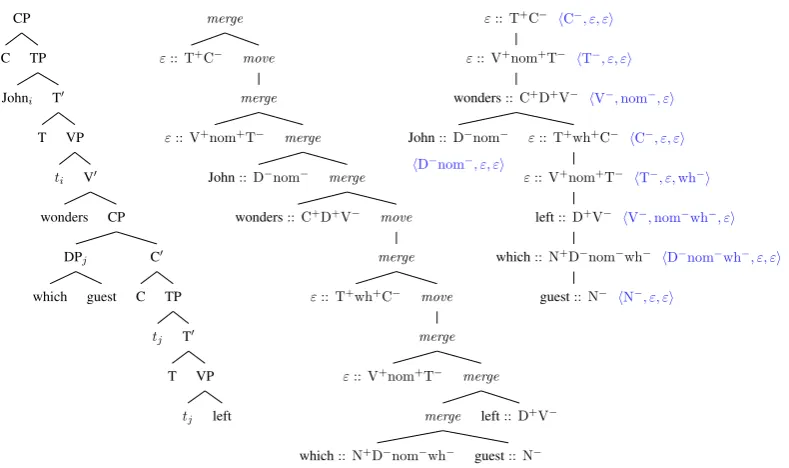
We pick a ranked alphabetΣsuch thatΣ(n) con-tains all lexical items of MG G, and only those, that carry exactlynselector features. For simplic-ity, we use G to also refer to this alphabet. Not every G-tree is a well-formed dependency tree, though, due to the constraints of the MG feature calculus. The calculus is illustrated in Fig. 2, where each node in the dependency tree is anno-tated with the feature configuration corresponding to its subtree. We formalize this calculus via a re-cursive function feat that computes these values based on more primitive functions for the feature checking steps that trigger Merge and Move.
Definition 5 (Dependency tree language). If G
is an MG withndistinct licensee features, then the setdep(G)of well-formed dependency trees ofG
is{t∈T(G)|feat(t) =hC−, ε1, . . . , εni}. y The remainder of this section defines feat in terms of feature checking operatorsM and⊗for Move and Merge, respectively. All operations ma-nipulate one or more sequences of feature strings. The Shortest Move Constraint (SMC) will be used to filter out illicit sequences.
Definition 6 (SMC). LetGbe an MG andLceits set ofnlicensee features. Given a sequences:= s1, . . . , sm (m ≥ 0) of strings in Lce∗, SMC : (Lce∗)∗ → (Lce∗)∗ is undefined forsif there are
si andsj (1 ≤ i 6= j ≤ m) that start with the same licensee feature. Otherwise,SMCmapssto
sitself. y
The SMC ensures that Move is unambiguous in the sense that there can never be more than one active mover of a specific type (wh, topicalization, and so on). It is an integral part of MGs, and removing it would greatly alter their expressivity (Salvati,2011).
Next we add a helper functionsort that orders SMC-approved sequences based on the first li-censee feature of each feature string.
Definition 7 (sort). Let G and Lce be as be-fore. Now fix some bijectionb betweenLceand {1, . . . , n}. Thensort maps s := s1, . . . , sm ∈ Lce∗to the sequences01, . . . , s0nsuch thats0i:=sj ifsj starts withfandb(f) =i; otherwise,s0i :=ε
(1≤i≤n,1≤j≤m). y
Now we can finally defineM for Move, which is also a crucial part of the Merge operator ⊗. Throughout we useγas a shorthand for any string of features, andδ for a (possibly empty) string of licensee features.
Definition 8 (Move). Suppose that expressioneis hf γ, δ1, . . . ,f−δi, . . . , δni for some licensee fea-turef−and1≤i≤n. Then
M(e) :=M(hγ,sort(SMC(δ1, . . . , δi, . . . , δn))i) iff is the licensor featuref+, andeotherwise. y
Definition 9 (Merge). Given two ex-pressions e := hf γ, δ1, . . . , δmi and
e0:=hf0δ, δm+1, . . . , δzi,e⊗e0 is
M(hγ,sort(SMC(δ, δ1, . . . , δm, δm+1, . . . , δz))i) iff is some selector featureF+andf0 the match-ing category feature F−. In all other cases,⊗ is
undefined. y
Note how Merge is always followed by an applica-tion of the Move operator, but this does not trigger any feature checking unlessγ starts with a licen-sor feature. Merge steps are thus interleaved with movement checks, not all of which may actually result in movement.
The operatorsMand⊗on their own do not nar-row down the set ofG-trees. They are invoked as part of a recursive functionfeatoverG-trees that computes the feature values of subtrees, as already expressed in Def.5.
Definition 10 (feat). The partial functionfeat re-cursively maps MG dependency trees to fea-ture expressions. For lexical items, feat(σ :: φ) := hφ, ε1, . . . , εni. If t := σ(σ1, . . . , σz), then feat(t) := ((feat(σ)⊗feat(σz))⊗ · · ·)⊗
CP
C TP
Johni T0
T VP
ti V0
wonders CP
DPj
which guest C0
C TP
tj T0
T VP
tj left
merge
ε:: T+C− move
merge
ε:: V+nom+T− merge
John:: D−nom− merge
wonders:: C+D+V− move
merge
ε:: T+wh+C− move
merge
ε:: V+nom+T− merge
merge
which:: N+D−nom−wh−
guest:: N−
left:: D+V−
ε:: T+C−
ε:: V+nom+T−
wonders:: C+D+V−
John:: D−nom− ε:: T+wh+C−
ε:: V+nom+T−
left:: D+V−
which:: N+D−nom−wh−
guest:: N−
hC−, ε, εi
hT−, ε, εi
hV−,nom−, εi
hC−, ε, εi
hT−, ε,wh−i
hV−,nom−wh−, εi
hD−nom−wh−, ε, εi
[image:6.595.102.497.60.294.2]hN−, ε, εi hD−nom−, ε, εi
Figure 2: X0-bar tree, corresponding MG derivation tree, and (feat-annotated) MG dependency tree
Two important lemmata follow immediately from the preceding definitions.
Lemma 1. LetGbe an MG andsaG-tree. Then it holds for every t ∈ dep(G) with node u that
t[u←s]∈dep(G)ifffeat(s) = feat(t/u). Lemma 2. Let G be an MG with n distinct li-censee features and s a subtree of some t ∈
dep(G). Then feat(s) must be of the form hF−δ, δ1, . . . , δnifor some category featureF−. Lemma2is apparent from the derivation tree ex-ample in Fig. 2. It is a minor extension of the well-known fact that a lexical item may occur in a well-formed MG derivation iff its feature string is of the form φF δ, where φis either ε or a se-lector feature followed by 0 or more sese-lector and licensor features,F is a category feature, andδis a (possibly empty) string of licensee features.
4 Merge and Move via STAs
With all the preliminaries in place, we can fi-nally turn to the core results regarding the STA-recognizability of MGs with respect to Merge and Move. The next sections then extend this to licens-ing conditions and some other special cases.
Graf (2012a) uses the argument from exam-ple 3 in §2.2 to prove that MG derivation tree languages are not STA languages. However, this proof does not carry over to MG dependency trees. Adopting the terminology ofGraf(2012a), we use
MDEP[merge,move]for the full class of MG
de-pendency tree languages andMDEP[merge]for the subclass of movement-free MGs (no lexical item carries any licensee features).
Theorem 2. MDEP[merge](STA
This is just a corollary of a more fundamen-tal property of MGs. For any arbitrary L ∈ MDEP[merge] and nodes u and v of s, t ∈ L, spines(u) = spinet(v) necessarily entails that feat(s/u) = feat(t/v), so that Theorem 2 im-mediately follows from Lemma1. We omit a full proof here as Lemma3will cover a more complex case that subsumes this one.
Even with the dependency tree format, though, STAs are too weak for standard MGs with both Merge and Move.
Theorem 3. MDEP[merge,move]andSTAare in-comparable.
ε:: T+wh+C−
does:: V+T−
like:: D+D+V−
a:: N+D−
teacher:: P+N−
of:: D+P−
who:: D−wh−
the:: N+D−
father:: P+N−
of:: D+P−
John:: D−
ε:: T+wh+C−
does:: V+T−
like:: D+D+V−
a:: N+D−
teacher:: P+N−
of:: D+P−
John:: D−
the:: N+D−
father:: P+N−
of:: D+P−
[image:7.595.162.435.63.224.2]who:: D−wh−
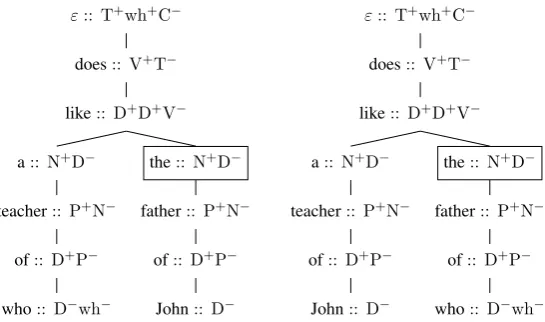
Figure 3: Even though the boxed nodes have the same spine, their subtrees cannot be exchanged.
rule out movement from within a specifier. This takes the form of an additional restriction onfeat that only allows complements to properly contain unchecked licensee features. Since the comple-ment of a head is its rightmost daughter in the de-pendency tree (rather than the leftmost one), the SpIC amounts to a restriction on all daughters ex-cept the last one.
Definition 11 (SpIC). Supposes1, . . . , smareG -trees andσ ∈G(m). Thenfeat(σ(s1, . . . , sm))is undefined if there is ani < mand1≤j ≤nsuch thatfeat(si)is of the formhγ, δ1, . . . , δj, . . . , δni andδj 6=ε.
Note that any licensee features on the head of a specifier are part of γ, not δj, so specifiers can still move without violating the SpIC. Only ex-traction of a proper subtree from within a speci-fier is not allowed. Also note that our version of the SpIC only bans extraction from base specifiers, but not from specifiers that are derived via move-ment. This is why it can be easily stated over de-pendency trees. Even so, this limited version of the SpIC greatly limits the weak generative capac-ity of MGs with the SMC, while still keeping them mildly context-sensitive (Michaelis, 2004, 2009; Kobele and Michaelis, 2011). For our purposes, though, the major contribution of the SpIC is that it also lowers the complexity of MG dependency trees intoSTA.
Lemma 3. Given an MGGthat obeys the SpIC, pick arbitrary nodesuandvofs, t∈dep(G), re-spectively. Ifspines(u) = spinet(v), thenfeat(s/ u) = feat(t/v).
Proof. Since s and t are well-formed, both feat(s/u) and feat(t/v) must be defined. By
Lemma 2 we may assume w.l.o.g. that feat(s/ u) := hF−δ, δ1, . . . , δni and feat(t/v) := hF0−δ0, δ01, . . . , δn0i. As u and v have identical spines, u and v themselves must be identical. Therefore bothF− = F0− andδ = δ0 hold. Now suppose thatδi 6= δ0i for some1 ≤ i ≤ n. Then eithers/uort/vis missing a licensee featuref− that is present in the other. Suppose it iss/uthat is missing a feature present int/v. Note that this immediately entails by the SpIC thatt/vis a com-plement, wherefores/uis also a complement be-causeuandv have identical spines. Since boths
andtare well-formed, whatever feature is missing ins/u must occur somewhere else insto match somef+ in the spine ofu. But by the SpIC,f− cannot occur properly inside any specifier. We al-ready know that s/uis a complement, sof− can only occur on an ancestor ofuor on one of its left siblings. But then it would occur on a node in the spine ofu, which contradicts our initial assump-tion that spines(u) = spinet(v). Henceδi = δi0 after all, whereforefeat(s/u) = feat(t/v). 2 Theorem 4. For every MGGthat obeys the SpIC, it holds thatdep(G)∈STA.
Proof. Lemma1and3jointly imply thatdep(G) is spine-closed, which guarantees that it can be
recognized by an STA (Thm.1). 2
are not among them must be embedded deeper in the tree. Due to the SpIC, though, they can only reside in the complement, i.e. the subtree rooted in the rightmost daughter ofn.
The SpIC is just one way of creating such an elsewhere case. STA-recognizability would also hold if movers could only escape from the left-most argument, or if the label of the selecting head decides which one of its arguments can be extracted from. Extraction from arguments could also be parameterized for each feature so that wh-movers may only leave complements whereas top-icalization is only allowed from the last but one argument, if it exists. Or the STA could switch between these four constraints depending on the number of ancestors of the current node modulo 4. STA-recognizability holds as long as distribut-ing the head’sδi across its arguments is fully de-terministic based on the information available to a sensing rule (current state, label of selecting head, labels of selected heads). Hence the class of STA-recognizable MG dependency tree languages is larger than what is allowed by the SpiC.
This does not change the fact, though, that the initial finding of Graf (2012a) regarding the in-sufficiency of STAs is incomplete. In the case of Merge, the insufficiency disappears with the more compact representation format of MG de-pendency trees. Alternatively, one could also keep the derivation tree format while increasing the STA look-ahead beyond just one level — this is a point we will revisit soon in §6.2 and §6.3, for very different reasons. With respect to Move, the choice of representation format is immaterial. Neither derivation trees nor depen-dency trees make movement as defined in MGs STA-recognizable. However, the SpIC does make movement STA-recognizable because specifiers do not need to be probed deeper than their head. For MG dependency trees, this coincides with the 1-level look-ahead of STAs, whereas derivation trees once again require a more generous look-ahead window. The choice of representation thus has an impact on the amount of required look-ahead, but the essence of our STA-recognizability result for MGs rests on the SpIC, not the tree for-mat.
5 STAs and C-Command Conditions
The previous section has successfully established that the central operations of MGs can be
han-dled by STAs, assuming that I) they are con-strued as constraints on MG dependency trees, andII) movement is subject to the SpIC. But the structure-building operations Merge and Move are just one part of syntax. Licensing conditions also play a major role, in particular those rooted in c-command. This section shows that these condi-tions are also captured by STAs.
Licensing conditions based on c-command are ubiquitous in the syntactic literature. They were recently studied from a subregular perspective by Graf and Shafiei (2019) and Shafiei and Graf (2019). Both papers use similar ideas, but define them very differently. We adopt the formalism of Graf and Shafiei(2019) because it defines all es-sential concepts directly in terms of dependency trees.
Definition 12 (C-string). Let tbe some MG de-pendency tree. For every node n oft in config-uration m(d1, . . . , di, n, di+1, . . . , dj) , its imme-diate c[ommand]-string is ics(n) = d1· · ·di n. The augmented c[ommand]-stringacs(n) ofnis recursively defined as shown below, where↑ is a distinguished symbol:
acs(n) := (
ics(n) ifnis the root oft acs(m)↑ics(n) ifmisn’s mother
y
Example 4. The c-string of the:: N+D−in Fig.3 is ε :: T+wh+C− ↑ does :: V+T− ↑ like :: D+D+V−↑a:: N+D−the:: N+D− y
Licensing conditions are then formalized as constraints on the shape of permissible c-strings. This is comparable to restricting a tree via its path language, except that paths are now replaced by c-strings.
Definition 13 (C-string constraints). A c-string constraintC is some string languageLoverΣ∪ {↑}. A Σ-treetis well-formed with respect toC
iffacs(n)∈Lfor every nodenoft. y
point. Intuitively, IO-TSL treats local dependen-cies as primitive and reduces non-local constraints to local ones over enriched representations. IBSP, on the other hand, takes all constraints to be non-local and then uses non-locality domain to prune down their reach. Either way there is ample evidence that all attested conditions that can be correctly stated over c-strings are at most regular. That’s all we need to show that they can be enforced by an STA.
Before we proceed, the reader should take note that c-strings as defined inGraf and Shafiei(2019) do not quite capture the standard notion of c-command over phrase structure trees. First of all, movement is factored out, so that c-strings only capture the c-command relations between the base positions where arguments enter the deriva-tion. Graf and Shafiei (2019) point out several options for adding movement, but they do not ex-plore them in depth. We will provide our own STA account for movement interactions later on (§6.1). Another, less important deviation from standard c-command pertains to the status of heads and spec-ifiers. If one interprets linear precedence in com-mand strings as c-comcom-mand, then specifiers do not c-command their selecting head even though they c-command the head’s object. At the same time, the head c-commands the specifier. While there seem to be no cases in the syntactic liter-ature where this difference to c-command mat-ters, it nonetheless highlights that c-strings only approximate the standard notion of c-command.
This approximation of c-command is very con-venient for our purposes, though. The construc-tion of a node’s c-string closely mirrors the def-inition of a node’s spine, so it is perhaps unsur-prising that every regular c-string constraint can be enforced by an STA. The construction of an STA automaton for this purpose is remarkably straight-forward.
First, we simplify c-string constraints by con-sidering only constraints that generate prefix-closed sets of c-strings. The lemma below estab-lishes that this assumption is innocuous for deter-mining tree well-formedness.
Lemma 4. Let L be some regular language of well-formed c-strings, and let Lp be the largest subset of L such that u /∈ Lp entails uv /∈ Lp for allu∈(Σ∪ {↑})+andv∈(Σ∪ {↑})∗. Then a Σ-tree is well-formed with respect toL iff it is well-formed with respect toLp.
Proof. We only consider c-strings that do not start or end with↑as these never occur in any trees to begin with. SinceLp ⊆Land, by Def.13, a tree is well-formed with respect to c-string setCiff all its c-strings are members of C, two entailments follow immediately:I) iftis well-formed with re-spect to Lp, it is well-formed with respect toL, andII) iftis ill-formed with respect toL, it is ill-formed with respect toLp.
Next, supposetis well-formed with respect to
L. Since it contains no illicit c-string, t could only be ill-formed with respect toLp if it contains some licit c-stringuv such that u /∈ Lp, where-foreuv /∈ Lp. But ifuvis a c-string oft, then so is every non-empty prefix ofuv that does not end in↑. By our initial assumption,tis well-formed, and hence every non-empty prefix ofuvis a mem-ber of L. It then must also be a member of Lp because, by definition,Lp must be largest among the prefix-closed subsets ofL. It follows thattis well-formed with respect toLp, too.
Finally, consider the case wheretis ill-formed with respect toLp. Then there is some c-stringu
oft such that u /∈ Lp but every non-empty pre-fix of u (that does not end in ↑) is a member of
Lp. In this case it must also hold thatu /∈ L, for otherwiseLp is either not largest or violates pre-fix closure. Consequently,tis also ill-formed with
respect toL. 2
Intuitively, Lemma4capitalizes on the fact that whenever a tree contains at least one unlicensed node, the status of other nodes no longer matters because the tree is already ill-formed. Hence we may freely assume that the c-string of node nis illicit as soon as a prefix of that c-string is illicit, even in cases wherenitself would be licensed.
Now let D := hΣ∪ {↑}, Q, qI, F, δi be the complete, deterministic finite-state string automaton that recognizes Lp as defined in Lemma 4. As D is deterministic, it has a unique initial state qI. Its transition relation
δ : (Q × Σ) × Q is a function. We ex-pand δ to strings such that δ(q, σ1σ2· · ·σn) :=
δ(· · ·δ(δ(q, σ1), σ2)· · · , σn). Since Lp is prefix-closed, it also holds that Q = F ∪ {s}, where
s /∈Fis some sink state from which no other state can be reached exceptsitself. Prefix closure also entails that qI ∈ F, so that empty c-strings are always allowed (since by definition c-strings are never empty, this is innocuous).
AD := hΣ, Q, qI,∆i. Forn ≥ 1, each sensing rule in∆is of the form
q(σ(n)(σ~1, ~σ2, . . . , ~σn))→
σ(δ(q, σ↑)(σ1~ ), δ(q, σ↑σ1)(σ2~ ),
. . . ,
δ(q, σ↑σ1σ2· · ·σn−1)(σ~n)))
whereq ∈F and, as previously defined at the be-ginning of §2.2, the use of σ~i with some symbol
σi(n) is a shorthand forσi(xi1, . . . , xin). For leaf
nodes, we require q(σ(0)) → σ(0) ∈ ∆iff both
q∈F andδ(q, σ)∈F.
This construction effectively simulates runs of the string automatonD over c-strings. The only complication is that the process of assigning a state to σi does not consider σi itself. But σi does affect the states of its right siblings and all its daughters. And ifσi is a leaf, it indirectly de-termines whether the state can be removed so that the tree may be accepted.
Theorem 5. LetLbe a regular language of well-formed c-strings. Then there is some STAAsuch that L(A) is the set of all Σ-trees that are well-formed with respect toL.
Proof. Following Lemma4, we replaceLby Lp and consider the complete, deterministic automa-tonDthat generatesLp. We constructAfromD in the manner described above. We then give a proof by induction on the depth ofΣ-trees.
Pick some Σ-treetand supposet ∈ Σ(0). The only c-string of t is t. Then A recognizes t iff
qI ∈ F andδ(qI, t) ∈ F. The former holds by definition, sot∈L(A)ifft∈L(D). This estab-lishes the base case.
Next, consider any arbitrary configuration
q(σ(n)(σ1, . . . , σn)). By our induction assump-tion, q = δ(qI, u) with acs(σ) = uσ. Sup-pose acs(σi) ∈/ Lp for some 1 ≤ i ≤ n. Then
δ(qI,acs(σi)) = δ(q, σ ↑ σ1· · ·σi) ∈/ F. If
i < n,Awill assign some non-final state toσi+1.
Ifi = n andσi is not a leaf, Aassigns the non-final state to the leftmost daughter of σi. In both cases,tnow contains some node with a non-final state. But there is no sensing rule with a non-final state on its left-hand side, so that A cor-rectly rejects t. If i = n andσi is a leaf, then
δ(δ(q, σ↑σ1· · ·σi−1), σi)is not final and conse-quently there is no suitable leaf rewrite rule. As
this covers all possible configurations forσi, we conclude thatArejects every tree that is ill-formed with respect toLp.
In the other direction, suppose A rejects
t. Then there must be some configuration
σ(q1(σ1), . . . , qi(σi), . . . , qn(σn)) such that qi is not a final state. But thenacs(σi−1) ∈/ Lp, as
de-sired. 2
Theorem 5 establishes that the same subreg-ular machinery of STAs can be used for both the structure-building operations Merge and Move and the c-command licensing conditions that deeply permeate syntax. The STA perspective also provides a new answer as to why c-command should play such an important role in syntax. How an STA treats a given node depends solely on the spine of that node. The spine contains the node itself, all its ancestors, and the sib-lings of all the nodes in the spine. This imme-diately precludes generalized notion of command like the S-command relation of Barker and Pul-lum(1990), which in modern terminology would be CP-command:xCP-commandsyiffxdoes not reflexively dominate y (or the other way round) and every CP that properly dominatesx properly dominates y. Asx andy can be arbitrarily deep within distinct subtrees while S-commanding each other, this is not an STA-recognizable command relation. C-command, on the other hand, stays within the narrow confines of STAs.
Admittedly STAs could also selectively ignore some commanders, operate with “inverse c-command” where a complement c-commands into its specifiers, or switch between different notions of c-command based on some modulo counting condition. So just as with the SpIC, the power of STAs goes quite a bit beyond what is desir-able for command. Still, it is striking that c-command is a very natural relation from STA per-spective, whereas more global notions of com-mand are correctly ruled out. As long as one is willing to accept dependency structures as a natu-ral representation that arises from head-argument relations, c-command is a natural companion of STA-recognizability.
depen-dencies they enforce, STAs are overly powerful. Hence STAs can only act as an upper bound.
At the same time, our current STA approach is too limited. In cases where licensing condi-tions interact with movement, the licensing ele-ment might not be part of the c-string of a node. Our STA construction, which is based purely on c-strings, will necessarily fail in these cases. In addition, some cases of licensing involve general-ized notions of c-command that go beyond what STAs can handle. We are confident, though, that these issues can be addressed in future work. The next section briefly sketches the solutions we have in mind.
6 Expanding the Core Results
6.1 Interactions of Movement and Licensing
Linguists have identified many cases where move-ment obfuscates licensing configurations by dis-placing the licensed element. A simple example would be [which book about himself]i does John like ti, where the reflexive is not c-commanded by its antecedentJohnin the corresponding phrase structure tree. These cases are entirely unproblem-atic for STAs since the MG dependency trees fully factor out movement, so which book about him-self remains in the object position where it is c-commanded by the subjectJohn. The problematic cases are much rarer, to such a degree that con-vincing examples are hard to come by: I) move-ment of a licensed elemove-ment bleeding licensing, and
II) movement of a licensing element feeding li-censing.
The first case covers configurations where a li-censed element — or a subtree containing it — moves to a position above the element’s licensor and where the subsequent change in c-command relations does make licensing impossible (in con-trast to the binding example above, where licens-ing holds nonetheless). In MGs with the SpIC this can be captured by an STA. The states of the STA would ben-tuples similar to the output of thefeat -function we defined for MGs. The first compo-nent records c-string states in the usual fashion, whereas each other componentirecords the most recent headhwith anfi+-feature, plus the state that was assigned toh. When anfi-movermis found, the information in the i-th component is used to compute the state formas ifmwere a left daugh-ter ofh. In this case,mis also excluded from the state computation of its siblings in the dependency
tree. The details remain to be worked out, but movement of a licensee should be easy enough to handle because the STA can separately keep track of the c-command configurations for each position that is targeted by a mover.
The second option is more complicated. Here some phrase must move into a higher position from where it can c-command the element that must be licensed. In combination with the SpIC, this means that the licensing of a node can be con-tingent on the nodes contained by its rightmost sibling. An STA can still handle this, but it re-quires a very different construction from the one described in this paper. As in the bleeding case, a state consists of multiple components, each one of which corresponds to a movement feature. Com-ponentirecords all the types of licensing condi-tions that still must be met for nodes that are c-commanded from the most recent head with licen-sor featurefi+. The states also keep track of the c-command relations between the heads hosting the relevant licensor features. When a mover withfi− is encountered, the STA checks if the mover can satisfy any of the licensing requirements in com-ponenti. If so, those are removed from compo-nentiand all other components whose heads are c-commanded by the head for component i. At the end, no state may contain any non-empty com-ponents. This strategy reimplements licensing as a mechanism where the STA accrues “licensing debt” while moving through the tree. This debt has to be paid off by movers at a later point. The strat-egy works because the SpIC allows us to correctly synchronize the licensing debt across the states of all daughter nodes.
right way, which complicates the construction of the STA even more.
6.2 Subcommand
It has been argued that some cases of long-distance binding involve subcommand instead of c-command (see Tang 1989 and Huang and Liu 2001, a.o.). A node x subcommands y iff x c-commandsy orxis a specifier of somez that c-commandsy. From the perspective of c-strings,x
c-commandsy iff there is somez in the c-string of y such that x = z or x is the left sibling of a daughter of z. For instance, if Principle A in English allowed for subcommand instead of just c-command, then John’s picture pleases himself would be well-formed asJohnis a specifier of the subject DP and thus subcommandshimself.
Subcommand is beyond the reach of STAs be-cause it makes the status of a nodendependent on the daughters of n’s left siblings. Similar to the case of movement interactions, there are two pos-sible replies to this. One could point out the rarity of subcommand, and that in the few cases where it arises, it serves as a means to furnish additional antecedents for reflexives beyond those that are al-ready provided via c-command. Hence subcom-mand might be limited to the syntax-semantics in-terface and may not directly factor into licensing. Alternatively, one could simply increase the look-ahead of STAs from 1 to 2 so that the daughters of daughters are also taken into account. Sub-command then is just a more demanding case of c-command.
6.3 Extension to MG Derivation Trees
Once one equips STAs with a more powerful look-ahead mechanism to handle subcommand, MG derivation trees once again become a viable alter-native to MG dependency trees. All the results in this paper extend from dependency tree to deriva-tion trees if one generalizes STAs to determinis-tic top-down tree automata with finite look-ahead. That is not surprising because dependency trees can be converted to derivation trees by a linear tree transduction. This shows that derivation trees are the result of separating mothers and daughters in a dependency tree by a finitely bounded amount of material (Merge and Move nodes). Finite look-ahead is a means to reconstruct the relations of the dependency tree that have been obfuscated by this additional material.
It remains to be seen which one of the two rep-resentation formats ultimately provides for more insightful characerizations. One issue that deriva-tion trees might shed some light on is the mono-tonic nature of c-command. With an STA over de-pendency trees, the daughters could be evaluated in any order to determine the states for a c-string constraint. While our current model proceeds left-to-right, we could have just as well gone right-to-left, inside out, or switched between those options based on the label of the mother. Yet only the first option corresponds to c-command as we know it. In a derivation tree, all information is conveyed via dominance. A specifier is not a sibling of the complement but rather resides in a structurally higher position (cf. the positions of Johnand the CP-complement in Fig. 2). Among all the com-mand variants we just described, the empirically attested one in the form of c-command is the only one that is monotonic with respect to dominance.
6.4 Adjuncts
Another problem of dependency trees is the sta-tus of adjuncts. In order to obtain the correct c-command relations, an adjunct of node n would have to be treated as a left sibling of all the speci-fiers ofn. But since adjunction is unbounded, this would mean that a node can have arbitrarily many daughters, whereas STAs are usually defined for trees with a finitely bounded arity. Adjuncts in derivation trees, on the other hand, do not create such issues because each adjunct grows the tree vertically rather than horizontally.
Either way, adjuncts must be subject to the same restriction as specifiers to preserve recognizability by STAs or a suitably generalized variant: even though an adjunct may move on its own, nothing may move out of an adjunct. This is of course a well-established property of adjuncts, known as the Adjunct Island Constraint. Once again, then, our specific subregular perspective derives a well-known limitation of movement.
The Adjunct Island Constraint has some prin-cipled exceptions such as [which car]i did John drive Mary crazy while trying to fixti (Truswell, 2007). It remains to be seen how these exceptions can be reconciled with our approach.
6.5 Across-the-Board Movement
enough to enforce with an STA. It is the excep-tion to the CSC that is of interest here: extracexcep-tion from a conjunct is permitted if extraction takes place from all conjuncts in the same coordination. Hence which beer did Ed buy and Greg drinkis well-formed even though which beer did Ed buy wine and Greg drink is illicit. This is known as across-the-board movement (ATB).
Curiously, the ATB-exception is very natural from the STA perspective. STAs fail if one can-not clearly tell from the local configuration which one of several subtrees a move feature should be passed into. The SpIC and the Adjunct Is-land Constraint address this by excluding speci-fiers and adjuncts from this equation, leaving the complement as the only subtree that might con-tain additional movers. ATB-movement consti-tutes the opposite solution where the feature is in-stead passed into every subtree. This, too, is a fully deterministic process and thus within the lim-its of STAs. If even one conjunct did not need to contain a mover, then STAs would be faced with a non-deterministic choice that they cannot handle. While this has to be explored in greater detail based on a proper formalization of ATB-movement (e.g. Torr and Stabler 2016), it is re-markable that the abilities of STAs closely line up with the attested movement configurations.
6.6 Connection to Parsing
The preceding discussion shows that STAs not only furnish a tighter upper bound on syntactic complexity, they also explain core aspects of syn-tax: the importance of island constraints, the avail-ability of ATB-movement, and the central role of c-command, which merely co-opts mechanisms that are independently needed for movement. But this in turn raises the fundamental question why STA-recognizability should be a relevant concept in syntax. We conjecture that STAs exhibit two properties that are attractive for parsing: top-down recognition, and determinism.
The highly predictive nature of human sentence processing suggests that some top-down strategy is employed, either directly in the form of recur-sive descent parser, or as a top-down filter of a left-corner parser. Given a choice between bottom-up or top-down recognition, the latter is a much more natural match for such parsing algorithms. Pre-compiling a top-down filter into the parse schema of an MG parser like the one in Stabler (2011b)
orStanojevi´c and Stabler(2018) is not trivial, but feasible. Determinism ensures that this precom-pilation does not explode the parse space, which would slow down the parser. Hence STAs are a good match for current MG models of human sen-tence processing (Kobele et al.,2013;Gerth,2015; Graf et al.,2017).
Of course a deterministic top-down automaton would also exhibit these properties, but these au-tomata cannot even handle Merge, let alone Move. STAs are a minimal extension of deterministic top-down automata while also furnishing plenty of power for syntactic dependencies. They require some restrictions on movement, but each one of them also improves parsing performance by expo-nentially reducing the search space (see the discus-sion of the SpIC’s impact on parsing performance inStabler 2013).
If one assumes that the grammar is but a high-level description of the parser, the restriction to STAs may be an abstract counterpart to various parser constraints that are meant to improve effi-ciency. Subregular complexity in syntax may thus be closely connected to parsing.
7 Conclusion
We have shown that all current results on the subregular complexity of syntax are insightfully subsumed by sensing tree automata operating over MG dependency trees. The limits of STA-recognizability line up closely with well-established restrictions on movement and syntac-tic licensing conditions. A lot of issues remain to be formally worked out, but we are confident that the perspective developed in this paper will greatly expand our understanding of subregular syntax.
Acknowledgments
References
Rolf Backofen, James Rogers, and K. Vijay-Shanker. 1995. A first-order axiomatization of the theory of finite trees. Journal of Logic, Language and
Infor-mation, 4:5–39.
Hyunah Baek. 2018. Computational representation of unbounded stress: Tiers with structural features. In
Proceedings of CLS 53, pages 13–24.
Chris Barker and Geoffrey K. Pullum. 1990. A theory of command relations. Linguistics and Philosophy, 13:1–34.
Patrick Blackburn, Claire Gardent, and Wilfried Meyer-Viol. 1993. Talking about trees. In Proceed-ings of the Sixth Conference of the European
Chap-ter of the Association for Computational Linguistics,
pages 30–36.
Marisa Ferrara Boston, John T. Hale, and Marco Kuhlmann. 2010. Dependency structures derived from Minimalist grammars. In Christian Ebert, Ger-hard J¨ager, and Jens Michaelis, editors,MOL 10/11, volume 6149 ofLecture Notes in Computer Science, pages 1–12. Springer, Berlin.
Noam Chomsky. 1995.The Minimalist Program. MIT Press, Cambridge, MA.
H. Comon, M. Dauchet, R. Gilleron, C. L¨oding, F. Jacquemard, D. Lugiez, S. Tison, and M. Tom-masiK. 2008. Tree automata: Techniques and
applications. Published online: http://www.
grappa.univ-lille3.fr/tata. Release from November 18, 2008.
Thomas Cornell and James Rogers. 1998. Model
the-oretic syntax. In The Glot International State of
the Article Book, volume 1 ofStudies in Generative
Grammar 48, pages 101–125. Mouton de Gruyter.
Robert Frank and K Vijay-Shanker. 2001. Primitive c-command.Syntax, 4(3):164–204.
Sabrina Gerth. 2015. Memory Limitations in Sentence Comprehension. A Structure-Based Complexity
Met-ric of Processing Difficulty. Ph.D. thesis, University
of Potdsam.
Saul Gorn. 1967. Explicit definitions and linguis-tic dominoes. In Systems and Computer Science, Proceedings of the Conference held at University
of Western Ontario, 1965, Toronto. University of
Toronto Press.
Thomas Graf. 2012a. Locality and the complexity of
Minimalist derivation tree languages. In Formal
Grammar 2010/2011, volume 7395 ofLecture Notes
in Computer Science, pages 208–227, Heidelberg.
Springer.
Thomas Graf. 2012b. Movement-generalized
Mini-malist grammars. InLACL 2012, volume 7351 of
Lecture Notes in Computer Science, pages 58–73.
Thomas Graf. 2017. The power of locality domains in
phonology.Phonology, 34:385–405.
Thomas Graf. 2018a. Locality domains and
phonolog-ical c-command over strings. InNELS 48:
Proceed-ings of the Forty-Eighth Annual Meeting of the North
East Linguistic Society, volume 1, pages 257–270,
Amherst, MA. GLSA.
Thomas Graf. 2018b. Why movement comes for free once you have adjunction. InProceedings of CLS 53, pages 117–136.
Thomas Graf and Connor Mayer. 2018. Sanskrit n-retroflexion is input-output tier-based strictly local.
InProceedings of SIGMORPHON 2018, pages 151–
160.
Thomas Graf, James Monette, and Chong Zhang. 2017.
Relative clauses as a benchmark for Minimalist
pars-ing.Journal of Language Modelling, 5:57–106.
Thomas Graf and Nazila Shafiei. 2019. C-command dependencies as TSL string constraints. In Proceed-ings of the Society for Computation in Linguistics
(SCiL) 2019, pages 205–215.
Jeffrey Heinz, Anna Kasprzik, and Timo K¨otzing. 2012. Learning in the limit with lattice-structured
hypothesis spaces. Theoretical Computer Science,
457:111–127.
Jeffrey Heinz, Chetan Rawal, and Herbert G. Tanner. 2011.Tier-based strictly local constraints in
phonol-ogy. In Proceedings of the 49th Annual Meeting
of the Association for Computational Linguistics,
pages 58–64.
Cheng-Teh James Huang and Cheng-Sheng Luther Liu. 2001. Logophoricity, attitudes andzijiat the inter-face. In Peter Cole, Gabrielle Herman, and Cheng-Tea James Huang, editors,Long Distance Reflexives, volume 33 ofSyntax and Semantics, pages 141–195. Academic Press, New York.
M. A. C. Huybregts. 1984. The weak adequacy of context-free phrase structure grammar. In Ger J. de Haan, Mieke Trommelen, and Wim Zonneveld, editors,Van Periferie naar Kern, pages 81–99. Foris, Dordrecht.
Adam Jardine and Kevin McMullin. 2017. Efficient learning of tier-based strictlyk-local languages. In
Proceedings of Language and Automata Theory and
Applications, Lecture Notes in Computer Science,
pages 64–76, Berlin. Springer.
C. Douglas Johnson. 1972. Formal Aspects of
Phono-logical Description. Mouton, The Hague.
Ronald M. Kaplan and Martin Kay. 1994. Regular
models of phonological rule systems.
Computa-tional Linguistics, 20(3):331–378.
Gregory M. Kobele, Sabrina Gerth, and John T. Hale. 2013. Memory resource allocation in top-down
Minimalist parsing. InFormal Grammar: 17th and
18th International Conferences, FG 2012, Opole, Poland, August 2012, Revised Selected Papers, FG
2013, D¨usseldorf, Germany, August 2013, pages 32–
51, Berlin, Heidelberg. Springer.
Gregory M. Kobele and Jens Michaelis. 2011. Dis-entangling notions of specifier impenetrability. In
The Mathematics of Language, volume 6878 of
Lec-ture Notes in Artificial Intelligence, pages 126–142,
Berlin, Heidelberg. Springer.
Gregory M. Kobele, Christian Retor´e, and Sylvain Sal-vati. 2007. An automata-theoretic approach to Min-imalism. In Model Theoretic Syntax at 10, pages 71–80.
Wim Martens. 2006. Static Analysis of XML
Transformation- and Schema Languages. Ph.D.
the-sis, Hasselt University.
Wim Martens, Frank Neven, and Thomas Schwentick. 2008. Deterministic top-down tree automata: Past, present, and future. In Proceedings of Logic and
Automata 2008, pages 505–530.
Kevin McMullin. 2016. Tier-Based Locality in
Long-Distance Phonotactics: Learnability and Typology.
Ph.D. thesis, University of British Columbia. Jens Michaelis. 2004. Observations on strict
deriva-tional minimalism. Electronic Notes in Theoretical
Computer Science, 53:192–209.
Jens Michaelis. 2009. An additional observation on strict derivational minimalism. In FG-MOL 2005, pages 101–111.
Jens Michaelis and Marcus Kracht. 1997. Semilin-earity as a syntactic invariant. In Logical Aspects
of Computational Linguistics, volume 1328 of
Lec-ture Notes in Artifical Intelligence, pages 329–345.
Springer.
Uwe M¨onnich. 2006. Grammar morphisms. Ms. Uni-versity of T¨ubingen.
Frank Morawietz. 2003. Two-Step Approaches to Nat-ural Language Formalisms. Walter de Gruyter, Berlin.
James Rogers. 1998. A Descriptive Approach to
Language-Theoretic Complexity. CSLI, Stanford.
James Rogers. 2003. Syntactic structures as multi-dimensional trees. Research on Language and
Com-putation, 1(1):265–305.
James Rogers, Jeffrey Heinz, Gil Bailey, Matt Edlef-sen, Molly Vischer, David Wellcome, and Sean Wibel. 2010.On languages piecewise testable in the strict sense. In Christan Ebert, Gerhard J¨ager, and Jens Michaelis, editors, The Mathematics of
Lan-guage, volume 6149 ofLecture Notes in Artificial
Intelligence, pages 255–265. Springer, Heidelberg.
Sylvain Salvati. 2011. Minimalist grammars in the
light of logic. In Sylvain Pogodalla, Myriam
Qua-trini, and Christian Retor´e, editors,Logic and Gram-mar — Essays Dedicated to Alain Lecomte on the
Occasion of His 60th Birthday, number 6700 in
Lecture Notes in Computer Science, pages 81–117. Springer, Berlin.
Nazila Shafiei and Thomas Graf. 2019. The subregular complexity of syntactic islands. Ms., Stony Brook University.
Stuart M. Shieber. 1985.Evidence against the context-freeness of natural language. Linguistics and
Phi-losophy, 8(3):333–345.
Edward P. Stabler. 1997. Derivational Minimalism. In Christian Retor´e, editor,Logical Aspects of
Compu-tational Linguistics, volume 1328 ofLecture Notes
in Computer Science, pages 68–95. Springer, Berlin.
Edward P. Stabler. 2011a. Computational perspectives
on Minimalism. In Cedric Boeckx, editor, Oxford
Handbook of Linguistic Minimalism, pages 617–
643. Oxford University Press, Oxford.
Edward P. Stabler. 2011b. Top-down recognizers for MCFGs and MGs. InProceedings of the 2nd Work-shop on Cognitive Modeling and Computational
Linguistics, pages 39–48.
Edward P. Stabler. 2013. Two models of minimalist, incremental syntactic analysis. Topics in Cognitive
Science, 5:611–633.
Miloˇs Stanojevi´c and Edward Stabler. 2018. A sound and complete left-corner parser for Minimal-ist grammars. InProceedings of the 8th Workshop on Cognitive Aspects of Computational Language
Learning and Processing, pages 65–74.
Chih-Chen Jane Tang. 1989. Chinese reflexives.
Natu-ral Language and Linguistic Theory, 7:93–121.
John Torr and Edward P. Stabler. 2016. Coordination in Minimalist grammars: Excorporation and across the
board (head) movement. InProceedings of the 12th
International Workshop on Tree Adjoining
Gram-mars and Related Formalisms (TAG+12), pages 1–
17, D¨usseldorf, Germany.
Robert Truswell. 2007. Extraction from adjuncts and the structure of events.Lingua, 117:1355–1377. Mai Ha Vu. 2018. Towards a formal description of
NPI-licensing patterns. InProceedings of the
Soci-ety for Computation in Linguistics (SCiL) 2018,
vol-ume 1, pages 154–163. Article 17.
Mai Ha Vu, Nazila Shafiei, and Thomas Graf. 2019.
Case assignment in TSL syntax: A case study. In
Proceedings of the Society for Computation in