Unsupervised Sparse Vector Densification for Short Text Similarity
Yangqiu Song and Dan Roth
Department of Computer Science University of Illinois at Urbana-Champaign
Urbana, IL 61801, USA
{yqsong,danr}@illinois.edu
Abstract
Sparse representations of text such as bag-of-words models or extended explicit semantic analysis (ESA) representations are commonly used in many NLP applications. However, for short texts, the similarity between two such s-parse vectors is not accurate due to the small term overlap. While there have been multiple proposals for dense representations of words, measuring similarity between short texts (sen-tences, snippets, paragraphs) requires combin-ing these token level similarities. In this paper, we propose to combine ESA representations and word2vec representations as a way to gen-erate denser representations and, consequent-ly, a better similarity measure between short texts. We study three densification mecha-nisms that involve aligning sparse representa-tion via many-to-many, many-to-one, and one-to-one mappings. We then show the effective-ness of these mechanisms on measuring simi-larity between short texts.
1 Introduction
Bag-of-words model has been used for many ap-plications as the state-of-the-art method for tasks such as document classifications and information re-trieval. It represents each text as a bag-of-words, and computes the similarity, e.g., cosine value, be-tween two sparse vectors in the high-dimensional space. When the contextual information is insuffi-cient, e.g., due to the short length of the document, explicit semantic analysis (ESA) has been used as a way to enrich the text representation (Gabrilovich and Markovitch, 2006; Gabrilovich and Markovitch,
2007). Instead of using only the words in a doc-ument, ESA uses a bag-of-concepts retrieved from Wikipedia to represent the text. Then the similarity between two texts can be computed in this enriched concept space.
Both bag-of-words and bag-of-concepts model-s model-suffer from the model-sparmodel-sity problem. Becaumodel-se both models use sparse vectors to represent text, when comparing two pieces of texts, the similarity can be zero even when the text snippets are highly related, but make use of different vocabulary. We can expect that these two texts are related but the similarity val-ue does not reflect that. ESA, despite augmenting the lexical space with relevant Wikipedia concepts, still suffers from the sparsity problem. We illustrate this problem with the following simple experiment, done by choosing a documents from the “rec.autos” group in the 20-newsgroups data set1. For both
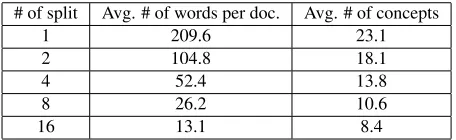
doc-uments and the label description “cars” (here we fol-low the description shown in (Chang et al., 2008; Song and Roth, 2014)), we computed 500 concepts using ESA. Then we identified the concepts that ap-pear both in the document ESA representation and in the label ESA representation. The average sizes of this intersection (number of overlapping concepts in the document and label representation) are shown in Table 1. In addition to the original documents, we also split each document into 2, 4, 8, 16 equal length parts, computed the ESA representation of each, and then the intersection with the ESA representation of the label. Table 1 shows that the number of concepts shared by the label and the document representation decreases significantly, even if not as significantly
1http://qwone.com/˜jason/20Newsgroups/
Table 1: Average sizes of the intersection between the ESA concept representations of documents and label-s. Both documents and label are represented with 500 Wikipedia concepts. Documents are split into different lengths.
# of split Avg. # of words per doc. Avg. # of concepts
1 209.6 23.1
2 104.8 18.1
4 52.4 13.8
8 26.2 10.6
16 13.1 8.4
as the drop in the document size. For example, there are on average 8 concepts in the intersection of two vectors with 500 non-zero concepts when we split each document into 16 parts.
When there are fewer overlapping terms between two pieces of texts, it can cause mismatch or biased match and result in less accurate comparison. In this paper, we propose to use unsupervised approaches to improve the representation, along with a corre-sponding similarity approach between these repre-sentations. Our contribution is twofold. First, we incorporate the popular word2vec (Mikolov et al., 2013a; Mikolov et al., 2013b) representations into ESA representation, and show that incorporating se-mantic relatedness between Wikipedia titles can in-deed help the similarity measure between short texts. Second, we propose and evaluate three mechanism-s for comparing the remechanism-sulting repremechanism-sentationmechanism-s. We verify the superiority of the proposed methods using three different NLP tasks.
2 Sparse Vector Densification
In this section, we introduce a way to compute the similarity between two sparse vectors by aug-menting the original similarity measure, i.e., co-sine similarity. Suppose we have two vectorsx = (x1, . . . , xV)T andy = (y1, . . . , yV)T where V is the vocabulary size. Traditional cosine similarity computes the dot product between these two vec-tors and normalizes it by their norms: cos(x,y) =
xTy
||x||·||y||. This requires each dimension of x to be aligned with the same dimension of y. Note that for sparse vectorsxandy, most of the the elements can be zero. Aligning the indices can result in zero similarity even though the two pieces of texts are re-lated. Thus, we propose to align different indices of
xandytogether to increase the similarity value. We can rewrite the vectors x and y as x =
{xa1, . . . , xanx}andy={yb1, . . . , ybny}, whereai
andbj are indices of the non-zero terms inxandy (1 ≤ai, bj ≤V). xai andybi are the weights
asso-ciated to the terms in the vocabulary. Suppose there are non-zero termsnxandny inxandy respective-ly. Then cosine similarity can be rewritten as:
cos(x,y) =
Pnx
i=1Pnj=1y δ(ai−bj)xaiybj
||x|| · ||y|| , (1) where δ(·) is the Dirac function δ(0) = 1 and
δ(other) = 0. Suppose we can compute the simi-larity between termsai andbj, which is denoted as φ(ai, bj), then the problem is how to aggregate the similarities between allai’s andbj’s to augment the original cosine similarity.
2.1 Similarity Augmentation
The most intuitive way to integrate the similarities between terms is averaging them:
SA(x,y) = nx||x|| ·1n y||y||
nx X
i=1 ny X
j=1
xaiybjφ(ai, bj).
(2) This similarity averages all the pairwise similarities between terms ai’s and bj’s. However, we can ex-pect a lot of the similaritiesφ(ai, bj)to be close to zero. In this case, instead of introducing the relat-edness between nonidentical terms, it will also in-troduce noise. Therefore, we also consider an align-ment mechanism that we implealign-ment greedily via a maximum matching mechanism:
SM(x,y) = ||x|| · ||1 y|| nx X
i=1
xaiybjmaxj φ(ai, bj).
(3) We choose j as argmaxj0φ(ai, bj0) and substitute the similarityφ(ai, bj) between termsai andbj in-to the final similarity between x andy. Note that this similarity is not symmetric. Thus, if one needs a symmetric similarity, the similarity can be com-puted by averaging two similarities SM(x,y) and SM(y,x).
(a)rec.autos vs. sci.electronics (full doc.) (b)rec.autos vs. sci.electronics (1/16 doc.) (c) rec.autos vs. rec.motorcycles (full doc.) (d)rec.autos vs. rec.motorcycles (1/16 doc.)
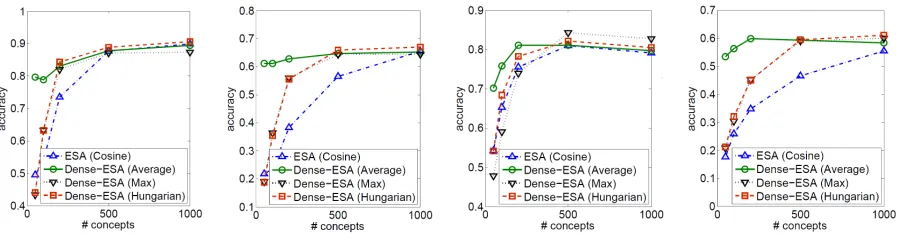
Figure 1: Accuracy of dataless classification using ESA and Dense-ESA with different numbers of concepts.
SM(x,y) uses only one-to-many term mapping. SA(x,y) can introduce small and noisy similarity values between terms. WhileSM(x,y) essentially aligns each term inxwith it’s best match iny, we run the risk that multiple components ofxwill se-lect the same element in y. To ensure that all the non-zero terms inxandyare matched, we propose to constrain this metric by disallowing many-to-one mapping. We do that by using a similarity metric based on the Hungarian method (Papadimitriou and Steiglitz, 1982). The Hungarian method is a combi-natorial optimization algorithm that solves the bipar-tite graph matching problem by finding an optimal assignment matching the two sides of the graph on a one-to-one basis. Assume that we run the Hungari-an method on the the pair{x,y}, and leth(ai) =bj denote the outcome of the algorithm, that is ai is aligned with bj. (We assume here, for simplicity, thatnx =ny; we can always achieve that by adding some zero weighted terms that are not aligned). The we define the similarity as:
SH(x,y) = ||x|| · ||1 y|| nx X
i=1
xaiyh(ai)φ(ai, h(ai)).
(4)
2.2 Term Similarity Measure
To evaluate the term similarity φ(·,·), we use lo-cal contextual similarity based on distributed rep-resentations. We adopt the word2vec (Mikolov et al., 2013a; Mikolov et al., 2013b) approach to ob-tain a dense representation of words. The represen-tation of each word is predicted based on the context word distribution in a window around it. We trained word2vec on the Wikipedia dump data using the de-fault parameters (CBOW model with window size
as five). For each word, we finally obtained a 200 dimensional vector. If the term is a phrase, we sim-ply average words’ vectors of each phrase to obtain the representation following the original word2vec approach (Mikolov et al., 2013a; Mikolov et al., 2013b). We use two vectorsaandbto represent the vectors for the two terms. To evaluate the similarity between two terms, for the average approach as E-q. (2), we use the RBF kernel over the two vectors
exp{−||a−b||2/(0.03·||a||·||b||)}as the similari-ty for all the experiments, since this will have a good property to cut the terms with small similarities. For the max and Hungarian approach as Eqs. (3) and (4), we simply use the cosine similarity between the two word2vec vectors. In addition, we cut off all simi-larities below thresholdγ and map them to zero.
3 Experiments
We experiment on three data sets. We use dataless classification (Chang et al., 2008; Song and Roth, 2014) over 20-newsgroups data set to verify the cor-rectness of our argument of short text problems, and use two short text data sets to evaluate document similarity measurement and event classification for sentences.
3.1 Dataless Classification
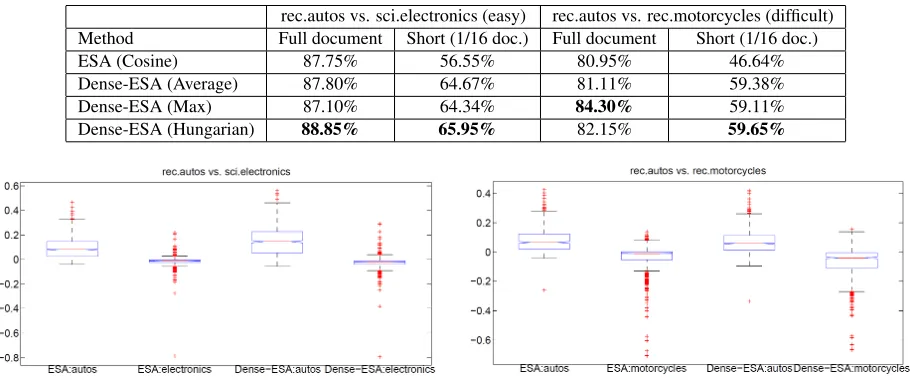
Table 2: Accuracy of dataless classification using ESA and Dense-ESA with 500 dimensions. rec.autos vs. sci.electronics (easy) rec.autos vs. rec.motorcycles (difficult) Method Full document Short (1/16 doc.) Full document Short (1/16 doc.)
ESA (Cosine) 87.75% 56.55% 80.95% 46.64%
Dense-ESA (Average) 87.80% 64.67% 81.11% 59.38%
Dense-ESA (Max) 87.10% 64.34% 84.30% 59.11%
Dense-ESA (Hungarian) 88.85% 65.95% 82.15% 59.65%
Figure 2: Boxplot of similarity scores for “rec.autos vs. sci.electronics” (easy, left) and “rec.autos vs. rec.motorcycles” (difficult, right). For each method of ESA and Dense-ESA with max matching in Eq. (3), we com-puteS(d, l1)andS(d, l2)between a documentdand the labelsl1andl2. Then we computeS(d) =S(d, l1)−S(d, l2).
For each ground truth label, we draw the distribution ofS(·)with outliers in the figures. For example, “ESA:autos” shows theS(·)’s distribution of the data with label “rec.autos.” The t-test results show that the distributions of different labels are significantly different (99%). We can see that Dense-ESA pulls apart the distributions of different labels and that the separation is more significant for the more difficult problem (right).
baseline method. To demonstrate how the length of documents affects the classification result, we used both full documents and the 16 split parts (the part-s are apart-spart-sociated with the part-same label apart-s the origi-nal document). To demonstrate the impact of den-sification, we selected two problems as an illustra-tion: “rec.autos vs. sci.electronics” and “rec.autos vs. rec.motorcycles.” While the former problem is relatively easy since they belong to different super-classes, the latter problem is more difficult since they are under the same super-class. The value of thresholdγ for max matching and Hungarian based densification is set to 0.85 empirically.
Figure 1 shows the results of the dataless clas-sification using ESA and ESA with denclas-sification (Dense-ESA) with different numbers of Wikipedia concepts as the representation dimensionality. We can see that Dense-ESA significantly improves the dataless classification results. As shown in Table 2, while the max matching and Hungarian matching based methods are typically the best metrics the most significant results, the improvements are more significant for shorter documents, and for more diffi-cult problems. Figure 2 highlights this observation.
Table 3: Spearman’s correlation of document similarity using ESA and Dense-ESA with 500 concepts.
Method Spearman’s correlation
ESA (Cosine) 0.5665
Dense-ESA (Average) 0.5814
Dense-ESA (Max) 0.5888
Dense-ESA (Hungarian) 0.6003
3.2 Document Similarity
We used the data set provided by Lee et al.2(Lee et
al., 2005) to evaluate pairwise short document simi-larity. There are 50 documents and the average num-ber of words is 80.2. We averaged all the human annotations for the same document pair as the sim-ilarity score. After computing the scores for pairs of documents, we used Spearman’s correlation to e-valuate the results. Larger correlation score mean-s that the mean-similarity imean-s more conmean-simean-stent with human annotation. The best word level based similarity re-sult is close to 0.5 (Lee et al., 2005). We tried the cosine similarity between ESA representations and
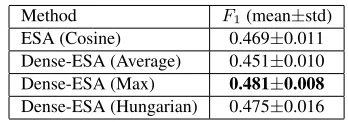
Table 4: F1 of sentence event type classification using
ESA and Dense-ESA with 500 concepts.
Method F1(mean±std)
ESA (Cosine) 0.469±0.011 Dense-ESA (Average) 0.451±0.010 Dense-ESA (Max) 0.481±0.008
Dense-ESA (Hungarian) 0.475±0.016
also Dense-ESA. The value ofγ for max matching based densification is set to 0.95, and for Hungari-an based densification it is set to 0.89. We cHungari-an see that from Table 3, ESA is better than the word based method, and that all versions of Dense-ESA outper-form the original ESA.
3.3 Event Classification
In this experiment, we chose the ACE20053data set
to test how well we can classify sentences into even-t even-types wieven-thoueven-t any even-training. There are eigheven-t even- type-s of eventtype-s: life, movement, conflict, contact, etc. We chose all the sentences that contain event infor-mation as the data set. Following the dataless clas-sification protocol, we compare the similarity be-tween sentences and label descriptions to determine the event types. There are 3,644 unique sentences with events, including 2,712 sentences having on-ly one event type, 421 having two event types, and 30 having three event types. The average length of the sentences is 23.71. Thus, this is a multi-label classification problem. To test the approaches, we used five-fold cross validation to select the thresh-olds for each class to classify whether the sentence belongs to an event type. The value of thresholdγ
for both max matching and Hungarian based densifi-cation is also set to 0.85 empirically. Then we report the mean and standard derivation over five runs. The results are shown in Table 4. We can see that Dense-ESA also outperforms Dense-ESA.
4 Related Work
ESA (Gabrilovich and Markovitch, 2006; Gabrilovich and Markovitch, 2007) and dis-tributed word representations (Ratinov and Roth, 2009; Turian et al., 2010; Collobert et al., 2011; Mikolov et al., 2013a; Mikolov et al., 2013b; Pen-nington et al., 2014) are popular text representations
3http://www.itl.nist.gov/iad/mig/tests/ace/2005/
that encode world knowledge. Recently, several representations were proposed to extend word representations for phrases or sentences (Lu and Li, 2013; Hermann and Blunsom, 2014; Passos et al., 2014; Kalchbrenner et al., 2014; Le and Mikolov, 2014; Hu et al., 2014; Sutskever et al., 2014; Zhao et al., 2015). In this paper, we evaluate how to combine two off-the-shelf representations to densify the similarity between text data.
Yih et al. also used average matching and a dif-ferent maximum matching for QA problem (Yih et al., 2013). However, their sparse representation is still at the word level while ours is based on ESA. Interestingly, related ideas to our average matching mechanism have been proposed also in the comput-er vision community, which is the set kcomput-ernel (or set similarity) (Smola et al., 2007; Gretton et al., 2012; Xiong et al., 2013).
5 Conclusion
In this paper, we study the mechanisms of com-bining two popular representations of text, i.e., E-SA and word2vec, to enhance computing short text similarity. Furthermore, we proposed three differ-ent mechanisms to compute the similarity between these representations, and demonstrated, using three different data sets that the proposed method outper-forms the traditional ESA.
Acknowledgments
References
M. Chang, L. Ratinov, D. Roth, and V. Srikumar. 2008. Importance of semantic representation: Dataless clas-sification. InAAAI, pages 830–835.
R. Collobert, J. Weston, L. Bottou, M. Karlen, K. Kavukcuoglu, and P. P. Kuksa. 2011. Natural language processing (almost) from scratch. J. Mach. Learn. Res., 12:2493–2537.
E. Gabrilovich and S. Markovitch. 2006. Overcoming the brittleness bottleneck using Wikipedia: Enhancing text categorization with encyclopedic knowledge. In
AAAI, pages 1301–1306.
E. Gabrilovich and S. Markovitch. 2007. Computing mantic relatedness using Wikipedia-based explicit se-mantic analysis. InIJCAI, pages 1606–1611.
A. Gretton, K. M. Borgwardt, M. J. Rasch, B. Sch¨olkopf, and A. Smola. 2012. A kernel two-sample test. J. Mach. Learn. Res., 13:723–773.
K. M. Hermann and P. Blunsom. 2014. Multilingual models for compositional distributed semantics. In A-CL, pages 58–68.
B. Hu, Z. Lu, H. Li, and Q. Chen. 2014. Convolutional neural network architectures for matching natural lan-guage sentences. InNIPS, pages 2042–2050.
N. Kalchbrenner, E. Grefenstette, and P. Blunsom. 2014. A convolutional neural network for modelling sen-tences. InACL, pages 655–665.
Q. V. Le and T. Mikolov. 2014. Distributed represen-tations of sentences and documents. InICML, pages 1188–1196.
M. D. Lee, B. Pincombe, and M. Welsh. 2005. An empir-ical evaluation of models of text document similarity. InCogSci, pages 1254–1259.
Z. Lu and H. Li. 2013. A deep architecture for matching short texts. InNIPS, pages 1367–1375.
T. Mikolov, I. Sutskever, K. Chen, G. S. Corrado, and J. Dean. 2013a. Distributed representations of words and phrases and their compositionality. InNIPS, pages 3111–3119.
T. Mikolov, W.-t. Yih, and G. Zweig. 2013b. Linguistic regularities in continuous space word representations. InHLT-NAACL, pages 746–751.
C. H. Papadimitriou and K. Steiglitz. 1982. Combinato-rial Optimization: Algorithm und Complexity. Engle-wood Cliffs, NJ: Prentice-Hall.
A. Passos, V. Kumar, and A. McCallum. 2014. Lexicon infused phrase embeddings for named entity resolu-tion. InCoNLL, pages 78–86.
J. Pennington, R. Socher, and C. D. Manning. 2014. Glove: Global vectors for word representation. In
EMNLP, pages 1532–1543.
L. Ratinov and D. Roth. 2009. Design challenges and misconceptions in named entity recognition. In CoN-LL, pages 147–155.
A. J. Smola, A. Gretton, L. Song, and B. Sch¨olkopf. 2007. A hilbert space embedding for distributions. In
ALT, pages 13–31.
Y. Song and D. Roth. 2014. On dataless hierarchical text classification. InAAAI, pages 1579–1585.
I. Sutskever, O. Vinyals, and Q. V. Le. 2014. Sequence to sequence learning with neural networks. InNIPS, pages 3104–3112.
J. Turian, L. Ratinov, and Y. Bengio. 2010. Word rep-resentations: A simple and general method for semi-supervised learning. InACL, pages 384–394.
L. Xiong, B. P´oczos, and J. G. Schneider. 2013. Efficient learning on point sets. InICDM, pages 847–856. W. Yih, M. Chang, C. Meek, and A. Pastusiak. 2013.
Question answering using enhanced lexical semantic models. InACL, pages 1744–1753.
Y. Zhao, Z. Liu, and M. Sun. 2015. Phrase type sensitive tensor indexing model for semantic composition. In