*SEM 2012 Shared Task: Resolving the Scope and Focus of Negation
Roser Morante
CLiPS - University of Antwerp Prinsstraat 13, B-2000 Antwerp, Belgium
Eduardo Blanco Lymba Corporation Richardson, TX 75080 USA
Abstract
The Joint Conference on Lexical and Compu-tational Semantics (*SEM) each year hosts a shared task on semantic related topics. In its first edition held in 2012, the shared task was dedicated to resolving the scope and focus of negation. This paper presents the specifica-tions, datasets and evaluation criteria of the task. An overview of participating systems is provided and their results are summarized.
1 Introduction
Semantic representation of text has received consid-erable attention these past years. While early shal-low approaches have been proven useful for several natural language processing applications (Wu and Fung, 2009; Surdeanu et al., 2003; Shen and La-pata, 2007), the field is moving towards analyzing and processing complex linguistic phenomena, such as metaphor (Shutova, 2010) or modality and nega-tion (Morante and Sporleder, 2012).
The *SEM 2012 Shared Task is devoted to nega-tion, specifically, to resolving its scope and focus. Negation is a grammatical category that comprises devices used to reverse the truth value of proposi-tions. Broadly speaking, scope is the part of the meaning that is negated and focus the part of the scope that is most prominently or explicitly negated (Huddleston and Pullum, 2002). Although negation is a very relevant and complex semantic aspect of language, current proposals to annotate meaning ei-ther dismiss negation or only treat it in a partial man-ner.
The interest in automatically processing nega-tion originated in the medical domain (Chapman et al., 2001), since clinical reports and discharge
summaries must be reliably interpreted and indexed. The annotation of negation and hedge cues and their scope in the BioScope corpus (Vincze et al., 2008) represented a pioneering effort. This corpus boosted research on scope resolution, especially since it was used in the CoNLL 2010 Shared Task (CoNLL ST 2010) on hedge detection (Farkas et al., 2010). Negation has also been studied in sentiment analy-sis (Wiegand et al., 2010) as a means to determine the polarity of sentiments and opinions.
Whereas several scope detectors have been de-veloped using BioScope (Morante and Daelemans, 2009; Velldal et al., 2012), there is a lack of cor-pora and tools to process negation in general domain texts. This is why we have prepared new corpora for scope and focus detection. Scope is annotated in Conan Doyle stories (CD-SCOcorpus). For each negation, the cue, its scope and the negated event, if any, are marked as shown in example (1a). Focus is annotated on top of PropBank, which uses the WSJ section of the Penn TreeBank (PB-FOCcorpus). Fo-cus annotation is restricted to verbal negations an-notated with MNEG in PropBank, and all the words belonging to a semantic role are selected as focus. An annotated example is shown in (1b)1.
(1) a. [John had]never[said as much before] b. John had never said{as much}before
The rest of this paper is organized as follows. The two proposed tasks are described in Section 2, and the corpora in Section 3. Participating systems and their results are summarized in Section 4. The approaches used by participating systems are de-scribed in Section 5, as well as the analysis of re-sults. Finally, Section 6 concludes the paper.
1Throughout this paper, negation cues are marked in bold letters, scopes are enclosed in square brackets and negated events are underlined; focus is enclosed in curly brackets.
2 Task description
The *SEM 2012 Shared Task2 was dedicated to re-solving the scope and focus of negation (Task 1 and 2 respectively). Participants were allowed to engage in any combination of tasks and submit at most two runs per task. A pilot task combining scope and focus detection was initially planned, but was can-celled due to lack of participation. We received a total of 14 runs, 12 for scope detection (7 closed, 5 open) and 2 for focus detection (0 closed, 2 open).
Submissions fall into two tracks:
• Closed track. Systems are built using exclusively the annotations provided in the training set and are tuned with the development set. Systems that do not use external tools to process the input text or that modify the annotations provided (e.g., simplify parse tree, concatenate lists of POS tags, ) fall under this track.
• Open track. Systems can make use of any external resource or tool. For example, if a team uses an ex-ternal semantic parser, named entity recognizer or obtains the lemma for each token by querying ex-ternal resources, it falls under the open track. The tools used cannot have been developed or tuned us-ing the annotations of the test set.
Regardless of the track, teams were allowed to submit their final results on the test set using a sys-tem trained on both the training and development sets. The data format is the same as in several pre-vious CoNLL Shared Tasks (Surdeanu et al., 2008). Sentences are separated by a blank line. Each sen-tence consists of a sequence of tokens, and a new line is used for each token.
2.1 Task 1: Scope Resolution
Task 1 aimed at resolving the scope of negation cues and detecting negated events. The task is divided into 3 subtasks:
1. Identifyingnegation cues, i.e., words that express negation. Cues can be single words (e.g., never), multiwords (e.g.,no longer, by no means), or affixes (e.g.lim-, -less). Note that negation cues can be discontinuous, e.g.,neither [. . . ] nor.
2. Resolving thescope of negation. This subtask ad-dresses the problem of determining which tokens within a sentence are affected by the negation cue. A scope is a sequence of tokens that can be discon-tinuous.
2
www.clips.ua.ac.be/sem2012-st-neg/
3. Identifying thenegated event or property, if any. The negated event or property is always within the scope of a cue. Only factual events can be negated.
For the sentence in (2), systems have to identify
noandnothing as negation cues, after his habit he saidandafter mine I asked questionsas scopes, and
saidandaskedas negated events.
(2) [After his habit he said]nothing, and after mine I asked no questions.
After his habit he said nothing, and [after mine I asked]no[questions].
2.1.1 Evaluation measures
Previously, scope resolvers have been evaluated at either the token or scope level. The token level eval-uation checks whether each token is correctly la-beled (inside or outside the scope), while the scope level evaluation checks whether the full scope is cor-rectly labeled. The CoNLL 2010 ST introduced pre-cision and recall at scope level as performance mea-sures and established the following requirements: A true positive (TP) requires an exact match for both the negation cue and the scope. False positives (FP) occur when a system predicts a non-existing scope in gold, or when it incorrectly predicts a scope exist-ing in gold because: (1) the negation cue is correct but the scope is incorrect; (2) the cue is incorrect but the scope is correct; (3) both cue and scope are incorrect. These three scenarios also trigger a false negative (FN). Finally, FN also occur when the gold annotations specify a scope but the system makes no such prediction (Farkas et al., 2010).
As we see it, the CONLL 2010 ST evaluation requirements were somewhat strict because for a scope to be counted as TP, the negation cue had to be correctly identified (strict match) as well as the punctuation tokens within the scope. Addi-tionally, this evaluation penalizes partially correct scopes more than fully missed scopes, since partially correct scopes count as FP and FN, whereas missed scopes count only as FN. This is a standard prob-lem when applying the F measures to the evaluation of sequences. For this shared task we have adopted a slightly different approach based on the following criteria:
• Punctuation tokens are ignored.
measure requires that only one cue token is cor-rectly identified, instead of all cue tokens.
• To count a negated event as TP we do not require correct identification of the cue.
• To evaluate cues, scopes and negated events, partial matches are not counted as FP, only as FN. This is to avoid penalizing partial matches more than missed matches.
The following evaluation measures have been used to evaluate the systems:
• Cue-level F1-measures (Cue).
• Scope-level F1-measures that require only partial
cue match (Scope NCM).
• Scope-level F1-measures that require strict cue
match (Scope CM). In this case, all tokens of the cue have to be correctly identified.
• F1-measure over negated events (Negated),
com-puted independently from cues and from scopes. • Global F1-measure of negation (Global): the three
elements of the negation — cue, scope and negated event — all have to be correctly identified (strict match).
• F1-measure over scope tokens (Scope tokens). The
total of scope tokens in a sentence is the sum of to-kens of all scopes. For example, if a sentence has two scopes, one of five tokens and another of seven tokens, then the total of scope tokens is twelve. • Percentage of correct negation sentences (CNS).
A second version of the measures (Cue/Scope CM/Scope NCM/Negated/Global-B) was calculated and provided to participants, but was not used to rank the systems, because it was introduced in the last period of the development phase following the request of a participant team. In the B version of the measures, precision is not counted as (TP/(TP+FP)), but as (TP / total of system predictions), counting in this way the percentage of perfect matches among all the system predictions. Providing this version of the measures also allowed us to compare the results of the two versions and to check if systems would be ranked in a different position depending on the version.
Even though we believe that relaxing scope eval-uation by ignoring puncteval-uation marks and relaxing the strict cue match requirement is a positive feature of our evaluation, we need to explore further in order to define a scope evaluation measure that captures the impact of partial matches in the scores.
2.2 Task 2: Focus Detection
This task tackles focus of negation detection. Both scope and focus are tightly connected. Scope is the part of the meaning that is negated and focus is that part of the scope that is most prominently or explic-itly negated (Huddleston and Pullum, 2002). Focus can also be defined as the element of the scope that is intended to be interpreted as false to make the over-all negative true.
Detecting focus of negation is useful for retriev-ing the numerous words that contribute to implicit positive meanings within a negation. Consider the statement The government didn’t release the UFO files{until 2008}. The focus isuntil 2008, yielding the interpretationThe government released the UFO files, but not until 1998. Once the focus is resolved, the verbrelease, its AGENTThe governmentand its THEME the UFO filesare positive; only theTEMPO -RALinformationuntil 2008remains negated.
We only target verbal negations and focus is al-ways the full text of a semantic role. Some examples of annotation and their interpretation (Int) using fo-cus detection are provided in (3–5).
(3) Even if that deal isn’t{revived}, NBC hopes to find another.
Int: Even if that deal is suppressed, NBC hopes to find another.
(4) A decision isn’t expected{until some time next year}.
Int: A decision is expected at some time next year.
(5) . . . it told the SEC it couldn’t provide financial statements by the end of its first extension “{without unreasonable burden or expense}”. Int: It could provide them by that time with a huge overhead.
2.2.1 Evaluation measures
Task 2 is evaluated using precision, recall and F1.
Submissions are ranked by F1. For each negation,
the predicted focus is considered correct if it is a per-fect match with the gold annotations.
3 Data Sets
WL2 108 0 After After IN (S(S(PP* After
WL2 108 1 his his PRP$ (NP* his
WL2 108 2 habit habit NN *)) habit
WL2 108 3 he he PRP (NP*) he
WL2 108 4 said say VBD (VP* said said
WL2 108 5 nothing nothing NN (NP*))) nothing
WL2 108 6 , , , *
WL2 108 7 and and CC *
WL2 108 8 after after IN (S(PP* after
WL2 108 9 mine mine NN (NP*)) mine
WL2 108 10 I I PRP (NP*) I
WL2 108 11 asked ask VBD (VP* asked asked
WL2 108 12 no no DT (NP* no
WL2 108 13 questions question NNS *))) questions
[image:4.612.85.527.60.227.2]WL2 108 14 . . . *)
Figure 1: Example sentence from CD-SCO.
3.1 CD-SCO: Scope Annotation
The corpus for Task 1 is CD-SCO, a corpus of Co-nan Doyle stories. The training corpus containsThe Hound of the Baskervilles, the development corpus,
The Adventure of Wisteria Lodge, and the test corpus
The Adventure of the Red CircleandThe Adventure of the Cardboard Box. The original texts are freely available from the Gutenberg Project.3
CD-SCO is annotated with negation cues and their scope, as well as the event or property that is negated. The cues are the words that express nega-tion and the scope is the part of a sentence that is affected by the negation cues. The negated event or property is the main event or property actually negated by the negation cue. An event can be a pro-cess, an action, or a state.
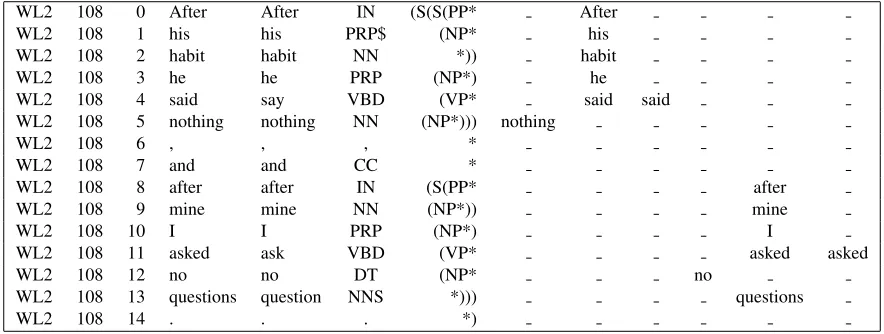
Figure 1 shows an example sentence. Column 1 contains the name of the file, column 2 the sentence #, column 3 the token #, column 4 the word, column 5 the lemma, column 6 the PoS, column 7 the parse tree information and columns 8 to end the negation information. If a sentence does not contain a nega-tion, column 8 contains “***” and there are no more columns. If it does contain negations, the informa-tion for each one is encoded in three columns: nega-tion cue, scope, and negated event respectively.
The annotation of cues and scopes is inspired by the BioScope corpus, but there are several differ-ences. First and foremost, BioScope does not an-notate the negated event or property. Another
im-3http://www.gutenberg.org/browse/
authors/d\#a37238
Training Dev. Test # tokens 65,450 13,566 19,216
# sentences 3644 787 1089
# negation sent. 848 144 235 % negation sent. 23.27 18.29 21.57
# cues 984 173 264
# unique cues 30 20 20
# scopes 887 168 249
[image:4.612.322.531.261.374.2]# negated 616 122 173
Table 1: CD-SCO Corpus statistics.
portant difference concerns the scope model itself: in CD-SCO, the cue is not considered to be part of the scope. Furthermore, scopes can be discontinu-ous and all arguments of the negated event are con-sidered to be part of the scope, including the subject, which is kept out of the scope in BioScope. A final difference is that affixal negation is annotated in CD-SCO, as in (6).
(6) [He] declares that he heard cries but [is]un[{able} to state from what direction they came].
Statistics for the corpus is presented in Table 1. More information about the annotation guidelines is provided by Morante et al. (2011) and Morante and Daelemans (2012), including inter-annotator agree-ment.
The corpus was preprocessed at the University of Oslo. Tokenization was obtained by the PTB-compliant tokenizer that is part of the LinGO En-glish Resource Grammar.4
4
Apart from the gold annotations, the corpus was provided to participants with additional annotations:
• Lemmatization using the GENIA tagger (Tsuruoka and Tsujii, 2005), version 3.0.1, with the ’-nt’ com-mand line option. GENIA PoS tags are comple-mented with TnT PoS tags for increased compati-bility with the original PTB.
• Parsing with the Charniak and Johnson (2005) re-ranking parser.5 For compatibility with PTB con-ventions, the top-level nodes in parse trees (‘S1’), were removed. The conversion of PTB-style syntax trees into CoNLL-style format was performed using the CoNLL 2005 Shared Task software.6
3.2 PB-FOC: Focus Annotation
We have adapted the only previous annotation effort targeting focus of negation for PB-FOC (Blanco and Moldovan, 2011). This corpus provides focus an-notation on top of PropBank. It targets exclusively verbal negations marked with MNEG in PropBank and selects as focus the semantic role containing the most likely focus. The motivation behind their ap-proach, annotation guidelines and examples can be found in the aforementioned paper.
We gathered all negations from sections 02–21, 23 and 24 and discarded negations for which the fo-cus or PropBank annotations were not sound, leav-ing3,544instances.7 For each verbal negation, PB-FOC provides the current sentence, and the previous and next sentences as context. For each sentence, along with the gold focus annotations, PB-FOC con-tains the following additional annotations:
• Token number;
• POS tags using the Brill tagger (Brill, 1992); • Named Entities using the Stanford named
en-tity recognizer recognizer (Finkel et al., 2005); • Chunks using the chunker by Phan (2006); • Syntactic tree using the Charniak parser
(Char-niak, 2000);
• Dependency tree derived from the syntactic tree (de Marneffe et al., 2006);
ErgTokenization, http://moin.delph-in.net/ ReppTop
5
November 2009 release available from Brown University. 6
http://www.lsi.upc.edu/˜srlconll/ srlconll-1.1.tgz
7
The original focus annotation targeted the3,993negations marked with MNEG in the whole PropBank.
Train Devel Test
1 role 2,210 515 672
2 roles 89 15 38
3 roles 3 0 2
All 2,302 530 712
Semantic
roles
focus
belongs
to
A1 980 222 309
AM-NEG 592 138 172
AM-TMP 161 35 46
AM-MNR 127 27 38
A2 112 28 36
A0 94 23 31
None 88 19 35
AM-ADV 78 23 26
C-A1 46 6 16
AM-PNC 33 8 12
AM-LOC 25 4 10
A4 11 2 5
R-A1 10 2 2
[image:5.612.338.514.59.291.2]Other 40 8 16
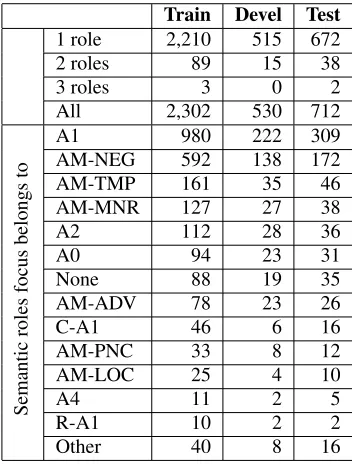
Table 2: Basic numeric analysis for PB-FOC. The first 4 rows indicate the number of unique roles each negation belongs to, the rest indicate the counts for each role.
• Semantic roles using the labeler described by (Punyakanok et al., 2008); and
• Verbal negation, indicates with ‘N’ if that token correspond to a verbal negation for which focus must be predicted.
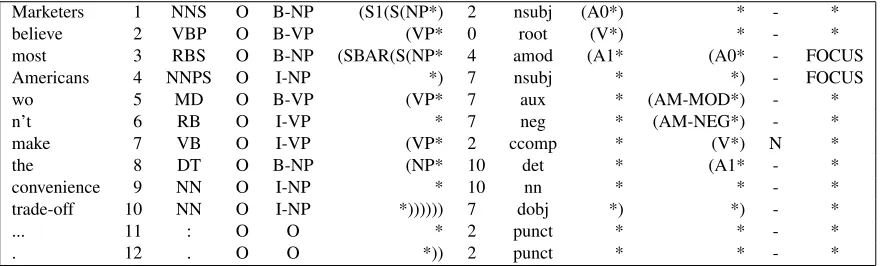
Figure 2 provides a sample of PB-FOC. Know-ing that the original focus annotations were done on top of PropBank and that focus corresponds to a sin-gle role, semantic role information is key to predict the focus. In Table 2, we show some basic numeric analysis regarding focus annotation and the automat-ically obtained semantic role labels. Most instances of focus belong to a single role in the three splits and the most common role focus belongs to is A1, followed by AM-NEG, M-TMP and M-MNR. Note that some instances have at least one word that does not belong to any role (88 in training, 19 in develop-ment and 35 in test).
4 Submissions and results
Marketers 1 NNS O B-NP (S1(S(NP*) 2 nsubj (A0*) * - *
believe 2 VBP O B-VP (VP* 0 root (V*) * - *
most 3 RBS O B-NP (SBAR(S(NP* 4 amod (A1* (A0* - FOCUS
Americans 4 NNPS O I-NP *) 7 nsubj * *) - FOCUS
wo 5 MD O B-VP (VP* 7 aux * (AM-MOD*) - *
n’t 6 RB O I-VP * 7 neg * (AM-NEG*) - *
make 7 VB O I-VP (VP* 2 ccomp * (V*) N *
the 8 DT O B-NP (NP* 10 det * (A1* - *
convenience 9 NN O I-NP * 10 nn * * - *
trade-off 10 NN O I-NP *)))))) 7 dobj *) *) - *
... 11 : O O * 2 punct * * - *
[image:6.612.86.527.60.193.2]. 12 . O O *)) 2 punct * * - *
Figure 2: Example sentence from PB-FOC.
Team Prec. Rec. F1
Open
UConcordia, run 1 60.00 56.88 58.40 UConcordia, run 2 59.85 56.74 58.26
Table 3: Official results for Task 2.
Some participants showed interest in the second task and expressed that they did not participate because of lack of time. In this section, we present the results for each task.
4.1 Task 1
Six teams (UiO1, UiO2, FBK, UWashington, UMichigan, UABCoRAL) submitted results for the closed track with a total of seven runs, and four teams (UiO2, UGroningen, UCM-1, UCM-2) sub-mitted results for the open track with a total of five runs. The evaluation results are provided in Ta-ble 4, which contains the official results, and TaTa-ble 5, which contains the results for evaluation measures B.
The best Global score in the closed track was ob-tained by UiO1 (57.63 F1). The best score for Cues
was obtained by FBK (92.34 F1), for Scopes CM
by UiO2 (73.39 F1), for Scopes NCM by
UWash-ington (72.40 F1), and for Negated by UiO1 (67.02
F1). The best Global score in the open track was
ob-tained by UiO2 (54.82 F1), as well as the best scores
for Cues (91.31 F1), Scopes CM (72.39 F1), Scopes
NCM (72.39 F1), and Negated (61.79 F1).
4.2 Task 2
Only one team participated in Task 2, UConcordia from CLaC Lab at Concordia University. They sub-mitted two runs and the official results are summa-rized in Table 3. Their best run scored 58.40 F1.
5 Approaches and analysis
In this section we summarize the methodologies ap-plied by participants to solve the tasks and we ana-lyze the results.
5.1 Task 1
To solve Task 1 most teams develop a three module pipeline with a module per subtask. Scope resolu-tion and negated event detecresolu-tion are independent of each other and both depend on cue detection. An exception is the UiO1 system, which incorporates a module for factuality detection. Most systems ap-ply machine learning algorithms, either Conditional Random Fields (CRFs) or Support Vector Machines (SVMs), while less systems implement a rule-based approach. Syntax information is widely employed, either in the form of rules or incorporated in the learning model. Multi-word and affixal negation cues receive a special treatment in most cases, and scopes are generally postprocessed.
The systems that participate in the closed track are machine learning based. The UiO1 system is an adaptation of another system (Velldal et al., 2012), which combines SVM cue classification with SVM-based ranking of syntactic constituents for scope resolution. The approach is extended to identify negated events by first classifying negations as fac-tual or non-facfac-tual, and then applying an SVM ranker over candidate events. The original treat-ment of factuality in this system results in the high-est score for both the negated event subtask and the global task.
tation for scopes and negated events, where tokens are assigned a set of labels that attempts to de-scribe their behavior within the mechanics of nega-tion. After unseen sequences are labeled, in-scope and negated tokens are assigned to their respective cues using simple post-processing heuristics.
The FBK system consists of three different CRF classifiers, as well as the UMichigan. A character-istic of the cue model of the UMichigan system is that tokens are assigned five labels in order to rep-resent the different types of negation. Similarly, the UWashington system has a CRF sequence tagger for scope and negated event detection, while the cue de-tector learns regular expression matching rules from the training set. The UABCoRAL system follows the same strategy, but instead of CRFs it employs SVM Light.
The resources utilized by participants in the open track are diverse. UiO2 reparsed the data with Malt-Parser in order to obtain dependency graphs. For the rest, the system is the same as in the closed track. The global results obtained by this system in the closed track are higher than the results obtained in the open track, which is mostly due to a higher per-formance of the scope resolution module. This is the only machine learning system in the open track and the highest performing one.
The UGroningen system is based on tools that produce complex semantic representations. The sys-tem employs the C&C tools8for parsing and Boxer9 to produce semantic representations in the form of Discourse Representation Structures (DRSs). For cue detection, the DRSs are converted to flat, non-recursive structures, called Discourse Representa-tion Graphs (DRGs). These DRGs allow for cue de-tection by means of labelled tuples. Scope dede-tection is done by gathering the tokens that occur within the scope of the negated DRSs. For negated event detec-tion, a basic algorithm takes the detected scope and returns the negated event based on information from the syntax tree within the scope.
UCM-1 and UCM-2 are rule-based systems that rely heavily on information from the syntax tree. The UCM-1 system was initially designed for
pro-8
http://svn.ask.it.usyd.edu.au/trac/ candc/wiki/Documentation
9http://svn.ask.it.usyd.edu.au/trac/
candc/wiki/boxer
cessing opinionated texts. It applies a dictionary ap-proach to cue detection, with the detection of affixal cues being performed using WordNet. Non-affixal cue detection is performed by consulting a prede-fined list of cues. It then uses information from the syntax tree in order to get a first approximation to the scope, which is later refined using a set of post-processing rules. In the case of the UCM-2 system an algorithm detects negation cues and their scope by traversing Minipar dependency structures. Fi-nally, the scope is refined with post-processing rules that take into account the information provided by the first algorithm and linguistic clause boundaries.
If we compare tracks, the Global best results ob-tained in the closed track (57.63 F1) are higher than
the Global best results obtained in the open track (54.82 F1). If we compare approaches, the best
re-sults in the two tracks are obtained with machine learning-based systems. The rule-based systems participating in the open track clearly score lower (39.56 F1 the best) than the machine learning-based
system (54.82 F1).
Regarding subtasks, systems achieve higher re-sults in the cue detection task (92.34 F1the best) and
lower results in the scope resolution (72.40 F1 the
best) and negated event detection (67.02 F1the best)
tasks. This is not surprising, not only because of the error propagation effect, but also because the set of negation cues is closed and comprises mostly sin-gle tokens, whereas scope sequences are longer. The best results in cue detection are obtained by the FBK system that uses CRFs and applies a special proce-dure to detect the negation cues that are subtokens. The best scores for scope resolution (72.40, 72.39 F1) are obtained by two machine learning
compo-nents. UWashington uses CRFs with features de-rived from the syntax tree. UiO2 uses CRFs mod-els with syntactic and lexical features for scopes, to-gether with a set of labels aimed at capturing the behavior of certain tokens within the mechanics of negation. The best scores for negated events (67.02 F1) are obtained by the UiO1 system that first
clas-sifies negations as factual or non-factual, and then applies an SVM ranker over candidate events.
are much lower than when using the Scope To-kens measure, which does not reflect the ability of systems to deal with sequences. Another observa-tion is related to the difference in precision scores between the two versions of the evaluation mea-sures. Whereas for Cues and Negated the differ-ences are not so big because most cues and negated events span over a single token, for Scopes they are. The best Scope NCM precision score is 90.00 %, whereas the best Scope NCM B precision score is 59.54 %. This shows that the scores can change considerably depending on how partial matches are counted (as FP and FN, or only as FN). As a final remark it is worth noting that the ranking of systems does not change when using the B measures.
5.2 Task 2
UConcordia submitted two runs in the open track. Both of them follow the same three component ap-proach. First, negation cues are detected. Second, the scope of negation is extracted based on depen-dency relations and heuristics defined by Kilicoglu and Bergler (2011). Third, the focus of negation is determined within the elements belonging to the scope following three heuristics.
6 Conclusions
In this paper we presented the description of the first *SEM Shared Task on Resolving the Scope and Fo-cus of Negation, which consisted of two different tasks related to different aspects of negation: Task 1 on resolving the scope of negation, and Task 2 on detecting the focus of negation. Task 1 was di-vided into three subtasks: identifying negation cues, resolving their scope, and identifying the negated event. Two new datasets have been produced for this Shared Task: the CD-SCO corpus of Conan Doyle stories annotated with scopes, and the PB-FOC cor-pus, which provides focus annotation on top of Prop-Bank. New evaluation software was also developed for this task. The datasets and the evaluation soft-ware will be available on the web site of the Shared Task. As far as we know, this is the first task that fo-cuses on resolving the focus and scope of negation.
A total of 14 runs were submitted, 12 for scope detection and 2 for focus detection. Of these, four runs are from systems that take a rule-based
ap-proach, two runs from hybrid systems, and the rest from systems that take a machine learning approach using SVMs or CRFs. Most participants designed a three component architecture.
For a future edition of the shared task we would like to unify the annotation schemes of the two cor-pora, namely the annotation of focus in PB-FOC and negated events in CD-SCO. The annotation of more data with both scope and focus would allow us to study the two aspects jointly. We would also like to provide better evaluation measures for scope reso-lution. Currently, scopes are evaluated in terms of F1, which demands a division of errors into the
cat-egories TP/FP/TN/FN borrowed from the evaluation of information retrieval systems. These categories are not completely appropriate to be assigned to se-quence tasks, such as scope resolution.
Acknowledgements
We are very grateful to Vivek Srikumar for pre-processing the PB-FOC corpus with the Illinois se-mantic role labeler, and to Stephan Oepen for pre-processing the CD-SCO corpus. We also thank the *SEM organisers and the ST participants. Roser Morante’s research was funded by the University of Antwerp (GOA project BIOGRAPH).
References
Eduardo Blanco and Dan Moldovan. 2011. Semantic Representation of Negation Using Focus Detection. In Proceedings of the 49th Annual Meeting of the Asso-ciation for C omputational Linguistics: Human Lan-guage Technologies, pages 581–589, Portland, Ore-gon, USA. Association for Computational Linguistics. Eric Brill. 1992. A simple rule-based part of speech tag-ger. InProceedings of the third conference on Applied natural language processing, ANLC ’92, pages 152– 155, Stroudsburg, PA, USA. Association for Compu-tational Linguistics.
Wendy W. Chapman, Will Bridewell, Paul Hanbury, Gre-gory F. Cooper, and Bruce G. Buchanan. 2001. A simple algorithm for identifying negated findings and diseases in discharge summaries. J Biomed Inform, 34:301–310.
Eugene Charniak. 2000. A maximum-entropy-inspired parser. In Proceedings of the 1st North American chapter of the Association for Computational Lin-guistics conference, NAACL 2000, pages 132–139, Stroudsburg, PA, USA. Association for Computational Linguistics.
Marie-Catherine de Marneffe, Bill MacCartney, and Christopher D. Manning. 2006. Generating Typed Dependency Parses from Phrase Structure Parses. In Proceedings of the IEEE / ACL 2006 Workshop on Spoken Language Technology. The Stanford Natural Language Processing Group.
Rich´ard Farkas, Veronika Vincze, Gy¨orgy M´ora, J´anos Csirik, and Gy¨orgy Szarvas. 2010. The CoNLL-2010 Shared Task: Learning to Detect Hedges and their Scope in Natural Language Text. In Proceedings of the Fourteenth Conference on Computational Natural Language Learning, pages 1–12, Uppsala, Sweden. Association for Computational Linguistics.
Jenny Rose Finkel, Trond Grenager, and Christopher Manning. 2005. Incorporating non-local informa-tion into informainforma-tion extracinforma-tion systems by gibbs sam-pling. InProceedings of the 43rd Annual Meeting on Association for Computational Linguistics, ACL ’05, pages 363–370, Stroudsburg, PA, USA. Association for Computational Linguistics.
Rodney D. Huddleston and Geoffrey K. Pullum. 2002. The Cambridge Grammar of the English Language. Cambridge University Press.
Halil Kilicoglu and Sabine Bergler. 2011. Effective bio-event extraction using trigger words and syntactic de-pendencies. Computational Intelligence, 27(4):583– 609.
Roser Morante and Walter Daelemans. 2009. A met-alearning approach to processing the scope of nega-tion. InProceedings of the 13th Conference on Natu-ral Language Learning, pages 21–29, Boulder, CO. Roser Morante and Walter Daelemans. 2012.
ConanDoyle-neg: Annotation of negation cues and their scope in Conan Doyle stories. In Proceedings of LREC 2012, Istambul.
Roser Morante and Caroline Sporleder. 2012. Special is-sue on modality and negation: An introduction. Com-putational Linguistics.
Roser Morante, Sarah Schrauwen, and Walter Daele-mans. 2011. Annotation of negation cues and their scope. guidelines v1.0. Technical Report Series CTR-003, CLiPS, University of Antwerp, Antwerp, April. Xuan-Hieu Phan. 2006. Crfchunker: Crf english phrase
chunker.
Vasin Punyakanok, Dan Roth, and Wen-tau Yih. 2008. The importance of syntactic parsing and inference in semantic role labeling. Computational Linguistics, 34(2):257–287, June.
Dan Shen and Mirella Lapata. 2007. Using Semantic Roles to Improve Question Answering. In Proceed-ings of the 2007 Joint Conference on Empirical Meth-ods in Natural Language Processing and Computa-tional Natural Language Learning (EM NLP-CoNLL), pages 12–21.
Ekaterina Shutova. 2010. Models of Metaphor in NLP. InProceedings of the 48th Annual Meeting of the Asso-ciation for Computational Linguistics, pages 688–697, Uppsala, Sweden. ACL.
Mihai Surdeanu, Sanda Harabagiu, John Williams, and Paul Aarseth. 2003. Using Predicate-Argument Struc-tures for Information Extraction. InProceedings of the 41st Annual Meeting of the Association for Computa-tional Linguistics, pages 8–15, Sapporo, Japan. Asso-ciation for Computational Linguistics.
Mihai Surdeanu, Richard Johansson, Adam Meyers, Llu´ıs M`arquez, and Joakim Nivre. 2008. The conll-2008 shared task on joint parsing of syntactic and se-mantic dependencies. InCoNLL 2008: Proceedings of the 12th Conference on Computational Natural Lan-guage Learning, page 159177, Manchester.
Yoshimasa Tsuruoka and Jun’ichi Tsujii. 2005. Bidi-rectional inference with the easiest-first strategy for tagging sequence data. In Proceedings of of Human Language Technology Conference and Conference on Empirical Methods in Natural Language Processing, pages 467–474, Vancouver.
Erik Velldal, Lilja Øvrelid, Jonathon Read, and Stephan Oepen. 2012. Speculation and negation: Rules, rankers, and the role of syntax. Computational Lin-guistics.
Veronika Vincze, Gyorgy Szarvas, Richard Farkas, Gy-orgy Mora, and Janos Csirik. 2008. The Bio-Scope corpus: biomedical texts annotated for uncer-tainty, negation and their scopes. BMC Bioinformat-ics, 9(Suppl 11):S9+.
Michael Wiegand, Alexandra Balahur, Benjamin Roth, Dietrich Klakow, and Andr´es Montoyo. 2010. A sur-vey on the role of negation in sentiment analysis. In Proceedings of the Workshop on Negation and Specu-lation in Natural Language Processing, pages 60–68, Uppsala, Sweden. University of Antwerp.