Inference of Fine-Grained Event Causality from Blogs and Films
Zhichao Hu, Elahe Rahimtoroghi and Marilyn A Walker Natural Language and Dialogue Systems Lab
Department of Computer Science, University of California Santa Cruz Santa Cruz, CA 95064, USA
[email protected],[email protected],[email protected]
Abstract
Human understanding of narrative is mainly driven by reasoning about causal relations between events and thus recog-nizing them is a key capability for com-putational models of language understand-ing. Computational work in this area has approached this via two different routes: by focusing on acquiring a knowledge base of common causal relations between events, or by attempting to understand a particular story or macro-event, along with its storyline. In this position pa-per, we focus on knowledge acquisition approach and claim that newswire is a relatively poor source for learning fine-grained causal relations between everyday events. We describe experiments using an unsupervised method to learn causal relations between events in the narrative genres of first-person narratives and film scene descriptions. We show that our method learns fine-grained causal rela-tions, judged by humans as likely to be causal over 80% of the time. We also demonstrate that the learned event pairs do not exist in publicly available event-pair datasets extracted from newswire.
1 Introduction
Computational models of language understand-ing must recognize narrative structure because many types of natural language texts are narra-tively structured, e.g. news, reviews, film scripts, conversations, and personal blogs (Polanyi,1989; Jurafsky et al., 2014; Bell, 2005; Gordon et al., 2011a). Human understanding of narrative is driven by reasoning about causal relations be-tween the events and states in the story
(Ger-We packed all our thingson the night before Thu (24 Jul) except for frozen food. We brought a lot of things along.We woke upearly on Thu and JS startedpacking the frozen marinatinated foodinside the small cooler... In the end, we decided the best place to set up the tent was the squarish ground that’s located on the right. Prior to setting up our tent,we placed a tarp on the ground. In this way, the underneaths of the tent would be kept clean. After that,we set the tent up.
Figure 1: Part of a blog story about camping
rig, 1993; Graesser et al., 1994; Lehnert, 1981; Goyal et al.,2010). Thus previous work has aimed to learn a knowledge base of semantic relations between events from text (Chklovski and Pantel, 2004; Gordon et al., 2011a; Chambers and Ju-rafsky, 2008; Balasubramanian et al., 2013; Pi-chotta and Mooney, 2014;Do et al., 2011), with the long-term aim of using this knowledge for un-derstanding. Some of this work explicitly models causality; other work characterizes the semantic relations more loosely as “events that tend to co-occur”. Related work points out that causality is granular in nature, and that humans flexibly move back and forth between different levels of granu-larity of causal knowledge (Hobbs, 1985). Thus methods are needed to learn causal relations and reason about them at different levels of granular-ity (Mulkar-Mehta et al.,2011).
One limitation of prior work is that it has primarily focused on newswire, thus have only learned relations about newsworthy topics, and likely the most frequent, highly common (coarse-grained) news events. But news articles are not the only resource for learning about relations between events. Much of the content on social media in personal blogs is written by ordinary people about their daily lives (Burton et al., 2009), and these blogs contain a large variety of everyday events (Gordon et al., 2012). Film scene descriptions
are also action-rich and told in fine-grained detail (Beamer and Girju,2009;Hu et al.,2013). More-over, both of these genres typically report events in temporal order, which is a primary cue to causal-ity. In this position paper, we claim that knowl-edge about fine-grained causal relations between everyday events is often not available in news, and can be better learned from other narrative genres.
For example, Figure 1 shows a part of a per-sonal narrative written in a blog about a camping trip (Burton et al.,2009). The major event in this story is camping, which is contingent upon sev-eral finer-grained events, such as packing things the night before, waking up in the morning, pack-ing frozen food, and later on at the campground, placing a tarp andsetting up the tent. Similarly film scene descriptions, such as the one shown in Figure2, typically contain fine-grained causality. In this scene from Lord of the Rings, grabbing leads to spilling, and pushing leads to stumbling andfalling.
We show that unsupervised methods for mod-eling causality can learn fine-grained event rela-tions from personal narratives and film scenes, even when the corpus is relatively small com-pared to those that have been used for newswire. We learn high-quality causal relations, with over 80% judged as causal by humans. We claim that these fine-grained causal relations are much closer in spirit to those motivating earlier work on scripts (Lehnert,1981;Schank et al.,1977; Wilen-sky, 1982;de Jong,1979), and we show that the causal knowledge we learn is not found in causal knowledge bases learned from news.
Section 2 first summarizes previous work on learning causal knowledge. We then present our experiments and results on modeling event causal-ity in blogs and film scenes in Section3. Conclu-sions and future directions are discussed in Sec-tion4.
2 Background and Related Work
Cognitive theories of narrative understanding de-fine narrative coherence in terms of four differ-ent sources of causal inferences between evdiffer-ents A and B (Trabasso and van den Broek,1985;Warren et al.,1979;Trabasso et al.,1989;Van den Broek, 1990). (1) Physical: A physically causes event B. (2) Motivational: A happens with B as a motiva-tion. (3) Psychological: A brings about emotions expressed by event B. (4) Enabling: A creates a
Pippin, sitting at the bar, chatting with Locals. Frodo leaps to his feet and pushes his way towards the bar. Frodo grabsPippin’s sleeve,spillinghis beer. Pippinpushes Frodo away...he stumbles backwards, and falls to the floor.
Figure 2: Film Scene from Lord of the Rings, Fan-tasy Genre
state or condition for B to happen.
There has been a great deal of interest in learn-ing narrative relations or narrative schema in an unsupervised or weakly supervised manner from text. Here we focus on work where the resulting knowledge bases have been made publicly avail-able, allowing us to compare the learned knowl-edge directly.
The VerbOcean project learned five different semantic relations between event types (verbs) from newswire, with the HAPPENS-BEFORE
re-lation defined as “indicating that the two verbs refer to two temporally disjoint intervals or in-stances”. WordNet’s cause relation, between a causative and a resultative verb (as in buy::own) is tagged as an instance of HAPPENS-BEFORE in
VerbOcean, consistent with the heuristic that tem-poral ordering is a major component of causal-ity. Other examples of the HAPPENS-BEFORE
relation in the VerbOcean knowledge base include marry::divorce, detain::prosecute, en-roll::graduate, schedule::reschedule, and tie::untie (Chklovski and Pantel,2004).
Balasubramanian et al. (2013) generate pairs of event relational tuples, calledRel-grams. The Rel-grams are publicly available through an on-line search interface1. Rel-gram tuples are
ex-tracted using a co-occurrence statistical metric, Symmetric Conditional Probability (SCP), which combines Bigram probability in both directions as follows:
SCP(e1, e2) =P(e2|e1)×P(e1|e2) (1)
Their evaluation experiments directly compared the knowledge learned in Rel-grams to the pre-vious work on narrative schemas (Chambers and Jurafsky, 2008, 2009), showing that they achieve better results, thus our work compares directly to the tuples available in Rel-grams.
Other work focuses more directly on learning
causal orcontingency relations between events.
Beamer and Girju (2009) introduced a distribu-tional measure called Causal Potential to assess the likelihood of a causal relation holding between two events. This measure is based on Suppes’ probabilistic theory of causality (Suppes,1970).
CP(e1, e2) =PMI(e1, e2) + logPP((ee1 →e2) 2 →e1) (2) wherePMI(e1, e2) = logPP(e(e1, e2)
1)P(e2) where the arrow notation means ordered event pairs, i.e. event e1 occurs before event e2. CP consists of two terms: the first is pair-wise mutual information (PMI) and the second is relative order-ing of bigrams. PMI measures how often events occur as a pair (without considering their order); whereas relative ordering accounts for the order of the event pairs because temporal order is one of the strongest cues to causality (Beamer and Girju, 2009; Riaz and Girju, 2010, 2013). This work explicitly links their definitions to research using the Penn Discourse Treebank (PDTB) definition ofCONTINGENCY.
Beamer and Girju(2009) applied the CP mea-sure to 173 film scripts, resulting in a high cor-relation between human-judged causality and the CP measure. Their paper provides a list of 90 verb pairs, selected from the high, middle and low CP ranges in their learned causal pairs. We compare their 30 highest CP events with causal event pairs that we learn from film.
Riaz and Girju (2010) apply a similar measure to topic-sorted news stories about Hurricane Kat-rina and the Iraq War and present ranked causality relations between events for these topics, suggest-ing that topic-sorted corpora can produce better causal knowledge. Other work has also used CP to measure the contingency relation between two events, reporting better results than achieved with PMI or bigrams alone (Hu et al., 2013; Rahim-toroghi et al.,2016).
3 Methods and Evaluations
Our primary goal is simply to show that fine-grained causal relations can be learned from film scripts and blogs, and that these are not found in causal knowledge bases learned from newswire. In this section we describe our datasets and meth-ods, and the present two evaluations. First, we evaluate whether the relations learned are causal
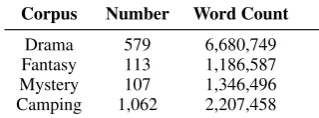
[image:3.595.335.495.64.123.2]Corpus Number Word Count Drama 579 6,680,749 Fantasy 113 1,186,587 Mystery 107 1,346,496 Camping 1,062 2,207,458
Table 1: Number of documents and word count for each dataset
using human judgment HITs on Amazon Me-chanical Turk. Second, we directly compare to event pair collections from other publicly available sources learned from news genre.
3.1 Datasets
Topical coherence and similarity of events within the corpus used for learning event relations can be as important as the size of the corpus (Riaz and Girju, 2010;Rahimtoroghi et al., 2016). We use two datasets for learning causal event pairs: first-person narratives from blogs (Burton et al.,2009; Rahimtoroghi et al.,2016), and film scene descrip-tions (excluding dialogs because dialogs are not as action-rich) (Walker et al.,2012;Hu et al.,2013). Our experiment on blogs learns causal relations from a topic-sorted corpus of∼1000 camping sto-ries. We also posit that the genre of a film may select for similar types of events. However genres can be defined broadly or narrowly, e.g. the Drama genre overlaps with many other genres. We thus compare two narrow film genres of Fantasy and Mystery with the Drama genre from an existing corpus (Walker et al.,2012;Hu et al.,2013). The raw numbers for each subcorpus are shown in Ta-ble1. Note that Camping corpus consists of blog posts which are much shorter compared to movie scripts. Thus their word count is much smaller compared to films corpus despite the larger num-ber of documents.
3.2 Methods
Camping Event Pairs
person - pack up→person - go - home
person - wake up→person - pack up - backpack person - eat - breakfast→person - pack up - camp-site
person - head→hike up
person - pack up - car→head out Fantasy Event Pairs
person - slam - something→shut send - something→fly - something person - watch→something - disappear
person - pick up - something→carry - something person - turn→face - person
Mystery Event Pairs bind→gag
person - reach→touch - something
person - pull - something→reveal - something person - look→confuse
person - come→rest Drama Event Pairs
person - slam - something→shut
person - offer - something→something - decline person - rummage→person - find - something send - something→something - fly
[image:4.595.81.282.68.366.2]send - something→sprawl
Table 2: High-CP pairs from Camping, Fantasy and Mystery datasets
films we use a variant of CP measure, shown in Eq. 3, that accounts for different window sizes and punishes event pairs from larger window sizes (Riaz and Girju,2010,2013;Do et al.,2011; Pichotta and Mooney,2014).
CPvariant(e1, e2) = wXmax
i=1
CPi(e1, e2)
i (3)
wherewmax is the max window size (how many events after the current event are paired with the current event). CPi(e1;e2) is the CP score for event paire1;e2calculated using window sizei.
3.3 Experiments and Results
We process the data in each dataset and calcu-late causal potential score for each extracted event pair, resulting in a rank-ordered list of causal event pairs. We evaluate the top 100 event pairs for camping, and the top 684 event pairs for films. We take a number of event pairs from each film genre (proportional to the number of films in that genre, see Table 1 and 3), then remove duplicate event pairs, which result in the 684 event pairs from film. Table 2presents examples of learned
high-Genre # High-CP Pairs % Causality
Drama 655 82.6
Fantasy 127 90.7
Mystery 122 87.7
Table 3: Percentage of high-CP pairs labeled as causal by AMT worker, comparing with low-PC pairs, in film genres Drama, Fantasy and Mystery.
CP event pairs from each corpus. In our follow-ing Mechanical Turk experiments, Turkers have to pass qualification tests similar to the actual HITs to be able to participate in our task.
In a study on each genre of films, we compare high-CP pairs to a random sample of low-CP pairs on Mechanical Turk to see if pairs with high CP score more strongly encode causal relations that ones with low CP. For every event pair in the 684 high pairs, we randomly select a low pair in order to collect human judgments on Mechanical Turk. The task first defines events and event pairs, then gives examples of event pairs with causal rela-tions. Turkers are asked to select the event pair that is more likely to manifest a causal relation. The results, summarized in Table3, show that humans judge a large majority of the high-CP pairs to have a causal relation and the results vary by genre. The causality rate is achieved for more focused gen-res, Fantasy (90.7%) and Mystery (87.7%), de-spite their smaller size, and the lowest for Drama (82.6%). We believe this result is further evi-dence that topical coherence improves causal rela-tion learning (Rahimtoroghi et al.,2016;Riaz and Girju,2010).
Mechani-cal Turk HIT described above. Table4shows Me-chanical Turk evaluation results for our method on films vs. Rel-grams: in 81% questions, humans judge the high-CP pairs to be more likely to man-ifest a causal relation. We believe this is because the fine-grained event pairs we learn do not exist in the Rel-gram collections and thus the Rel-gram tuples that matched our first events are not highly coherent, despite the filtering we applied.
Dataset Film Rel-gram Tuples Percentage of
causal relation 81 % 19 %
Table 4: Percentage of pairs judged as causal by AMT workers. Film vs. Rel-Grams.
For event pairs from camping blogs, we eval-uate all 100 high-CP pairs in a Mechanical Turk study where Turkers are asked to choose whether an event pair has causal relation or not. We also evaluate Rel-gram tuples using the same task. However, Rel-grams are not sorted by topic. To find tuples relevant to Camping Trip, we use our top 10 indicative events and extracted all the Rel-gram tuples that included at least one event corre-sponding to one of the Camping indicative events, e.g. go camp. We remove any tuple with fre-quency less than 25 and sort the rest by the total symmetrical conditional probability. The evalua-tion results presented in Table 5 show that 82% of the blog paurs were labeled as causal, where as only 42% of the Rel-gram pairs were labeled as causal. We argue that this is mainly due to the limitations of the newswire data which does not contain the fine-grained everyday events that we have extracted from our corpus.
Dataset Camping Rel-gram Tuples Percentage of
causal relation 82 % 42 %
Table 5: Percentage of pairs judged as causal by AMT workers. Camping blogs vs. Rel-Grams.
Next, we compare our results to the event pairs in VerbOcean (learned from newswire) with the
HAPPENS-BEFORE relation (Chklovski and
Pan-tel,2004). We use all 6497 event pairs from Ver-bOcean, comparing with our 684 event pairs from films and 100 event pairs from camping blogs with high CP scores. Our result shows that there are 12 event pairs that exist in both VerbOcean and
films, e.g. turn - leaveandslow - stop, and there is only one event pair that exist in both VerbOcean and camping blogs: pack - leave. This confirms that most causal relations learned from other nar-rative genres do not exist in the currently avail-able knowledge bases extracted from newswire. A number of event pairs from these collections share the first event, e.g. dig - findandscan - spot from films vs.dig - repairandscan - uploadfrom Ver-bOcean;drive - parkandpick - eatfrom blogs vs. drive - dragandpick - plunkfrom VerbOcean.
Finally, we compare our high-CP pairs learned from film to the high-CP event pairs fromBeamer and Girju (2009), learned from only 173 films. There is no public release of Beamer and Girju’s event pairs, thus we take the 29 event pairs with high CP score presented in the paper. A total of 14 of their 29 pairs are also in our top 684 film pairs. These include pairs such asswerve - avoid, leave - standandunlock - open. However on our larger genre-sorted corpus we also learn pairs such asgrab - haul,scratch - clawandsaddle- mount that do not exist in their collection.
4 Conclusions and Future Work
Causality is often granular in nature with major events related to the occurrence of finer-grained events. In this position paper, we argue that the focus on newswire has inhibited attempts to learn fine-grained causal relations between every-day events, and that other narrative genres better support such learning. We use unsupervised meth-ods to extract fine-grained causal event relations from films and blog posts about camping.
We show that more than 80% of the relations we learn are evaluated as causal, and that topical co-herence plays an important role in modeling event relations. We also show that the causal knowl-edge we learn from other narrative genres does not exist in current event collections induced from newswire. We plan to expand our genre-specific experiments on the films corpus in future, as well as using other narrative datasets, like restaurant reviews, to extract fine-grained causal knowledge about events.
References
Niranjan Balasubramanian, Stephen Soderland,
Mausam, and Oren Etzioni. 2013. Generating
coherent event schemas at scale. InEMNLP. pages
Brandon Beamer and Roxana Girju. 2009. Using a bigram event model to predict causal potential. In
Computational Linguistics and Intelligent Text Pro-cessing, Springer, pages 430–441.
Allan Bell. 2005. News stories as narratives. The Lan-guage of Time: A Readerpage 397.
Kevin Burton, Akshay Java, and Ian Soboroff. 2009.
The ICWSM 2009 Spinn3r dataset. InProceedings
of the Third Annual Conference on Weblogs and So-cial Media (ICWSM 2009).
Nathanael Chambers and Dan Jurafsky. 2008.
Unsu-pervised learning of narrative event chains.
Pro-ceedings of ACL-08: HLTpages 789–797.
Nathanael Chambers and Dan Jurafsky. 2009. Unsu-pervised learning of narrative schemas and their
par-ticipants. InProceedings of the 47th Annual
Meet-ing of the ACL. pages 602–610.
Timothy Chklovski and Patrick Pantel. 2004. Verbo-cean: Mining the web for fine-grained semantic verb
relations. InEMNLP. volume 4, pages 33–40.
G. F. de Jong. 1979. Skimming Stories in Real Time:
An Experiment in Integrated Understanding. Ph.D. thesis, Computer Science Department, Yale Univer-sity.
Quang Xuan Do, Yee Seng Chan, and Dan Roth. 2011. Minimally supervised event causality
identifi-cation. InProceedings of the Conference on
Empir-ical Methods in Natural Language Processing. As-sociation for Computational Linguistics, pages 294– 303.
R.J. Gerrig. 1993. Experiencing narrative worlds: On
the psychological activities of reading. Yale Univ Pr.
Andrew Gordon, Cosmin Bejan, and Kenji Sagae. 2011a. Commonsense causal reasoning using mil-lions of personal stories. InTwenty-Fifth Conference on Artificial Intelligence (AAAI-11).
Andrew S Gordon, Cosmin Adrian Bejan, and Kenji Sagae. 2011b. Commonsense causal reasoning us-ing millions of personal stories. InAAAI.
Andrew S Gordon, Christopher Wienberg, and Sara Owsley Sood. 2012. Different strokes of dif-ferent folks: Searching for health narratives in
we-blogs. In Privacy, Security, Risk and Trust
(PAS-SAT), 2012 International Conference on and 2012 International Confernece on Social Computing (So-cialCom). IEEE, pages 490–495.
Amit Goyal, Ellen Riloff, and Hal Daum´e III. 2010. Automatically producing plot unit representations for narrative text. InProceedings of the 2010 Con-ference on Empirical Methods in Natural Language Processing. pages 77–86.
Arthur C Graesser, Murray Singer, and Tom Trabasso. 1994. Constructing inferences during narrative text
comprehension. Psychological review101(3):371.
Jerry R Hobbs. 1985. Granularity. InProceedings of
the 9th international joint conference on Artificial intelligence-Volume 1. Morgan Kaufmann Publish-ers Inc., pages 432–435.
Zhichao Hu, Elahe Rahimtoroghi, Larissa Munishkina, Reid Swanson, and Marilyn A Walker. 2013. Un-supervised induction of contingent event pairs from
film scenes. InProceedings of Conference on
Em-pirical Methods in Natural Language Processing. pages 370–379.
Dan Jurafsky, Victor Chahuneau, Bryan R Routledge, and Noah A Smith. 2014. Narrative framing of con-sumer sentiment in online restaurant reviews. First Monday19(4).
Wendy G Lehnert. 1981. Plot units and narrative
sum-marization.Cognitive Science5(4):293–331.
Rutu Mulkar-Mehta, Christopher Welty, Jerry R Hoobs, and Eduard Hovy. 2011. Using granularity
concepts for discovering causal relations. In
Pro-ceedings of the FLAIRS conference.
Karl Pichotta and Raymond J Mooney. 2014. Sta-tistical script learning with multi-argument events.
EACL 2014page 220.
Livia Polanyi. 1989. Telling the American Story: A
Structural and Cultural Analysis of Conversational Storytelling. MIT Press.
Elahe Rahimtoroghi, Ernesto Hernandez, and Mari-lyn A. Walker. 2016. Learning fine-grained knowl-edge about contingent relations between everyday
events. In Proceedings of SIGDIAL 2016. pages
350–359.
Mehwish Riaz and Roxana Girju. 2010. Another look at causality: Discovering scenario-specific
contin-gency relationships with no supervision. In
Seman-tic Computing (ICSC), 2010 IEEE Fourth Interna-tional Conference on. IEEE, pages 361–368. Mehwish Riaz and Roxana Girju. 2013. Toward a
better understanding of causality between verbal events: Extraction and analysis of the causal power of verb-verb associations. InProceedings of the an-nual SIGdial Meeting on Discourse and Dialogue (SIGDIAL). Citeseer.
R Schank, Robert Abelson, and Roger C Schank. 1977.
Scripts Plans Goals. Lea.
Patrick Suppes. 1970.A probabilistic theory of
causal-ity. North-Holland Publishing Company
Amster-dam.
Tom Trabasso and Paul van den Broek. 1985. Causal thinking and the representation of narrative events.
Journal of Memory and Language24:612–630. Tom Trabasso, Paul Van den Broek, and So Young Suh.
1989. Logical necessity and transitivity of causal
relations in stories. Discourse processes 12(1):1–
25.
Paul Van den Broek. 1990. The causal inference maker: Towards a process model of inference
gen-eration in text comprehension. Comprehension
pro-cesses in readingpages 423–445.
Marilyn Walker, Grace Lin, and Jennifer Sawyer. 2012. An annotated corpus of film dialogue for learning and characterizing character style. InLanguage Re-sources and Evaluation Conference, LREC2012. William H Warren, David W Nicholas, and Tom
Tra-basso. 1979. Event chains and inferences in un-derstanding narratives. New directions in discourse processing2:23–52.