R E S E A R C H
Open Access
Analysis of syntactic and semantic features for
fine-grained event-spatial understanding in
outbreak news reports
Hutchatai Chanlekha
*, Nigel Collier
* Correspondence: [email protected]. jp
National Institute of Informatics, Hitotsubashi 2-1-2, Chiyoda-ku, Tokyo, Japan
Abstract
Background:Previous studies have suggested that epidemiological reasoning needs
a fine-grained modelling of events, especially their spatial and temporal attributes. While the temporal analysis of events has been intensively studied, far less attention has been paid to their spatial analysis. This article aims at filling the gap concerning automatic event-spatial attribute analysis in order to support health surveillance and epidemiological reasoning.
Results:In this work, we propose a methodology that provides a detailed analysis on each event reported in news articles to recover the most specific locations where it occurs. Various features for recognizing spatial attributes of the events were studied and incorporated into the models which were trained by several machine learning techniques. The best performance for spatial attribute recognition is very promising; 85.9% F-score (86.75% precision/85.1% recall).
Conclusions:We extended our work on event-spatial attribute recognition by focusing on machine learning techniques, which are CRF, SVM, and Decision tree. Our approach avoided the costly development of an external knowledge base by employing the feature sources that can be acquired locally from the analyzed document. The results showed that the CRF model performed the best. Our study indicated that the nearest location and previous event location are the most important features for the CRF and SVM model, while the location extracted from the verb’s subject is the most important to the Decision tree model.
Background
The spread of infectious diseases such as Avian H5N1 influenza and Pandemic A(H1N1) influenza, has drawn public concern for strengthening public health monitoring techni-ques for the speedy and precise detection of disease outbreaks. Nevertheless, the under-development of public health systems in many parts of the world has caused a significant barrier for developing an effective global indicator-based health surveillance system [1,2]. This situation has underscored the importance of report-based surveillance systems [1,3-7] as another crucial source of epidemic information to fill this gap.
One of the key information in which all of the report-based health surveillance systems are interested in is the place where the outbreak occurred, i.e. the spatial information of the outbreak events. However, for automatic encoding, systems tend to adopt ad-hoc stra-tegies, generally in the form of detecting the first disease and location pair that match
predefined criteria or similar heuristics. Although these strategies are effective for reducing the computational time and pruning out locations that are irrelevant to the outbreaks, they may lead to under-reporting of the outbreak or issuing reports at sub-optimal levels of granularity. Moreover, they also cause difficulties when extending the functionality of the health surveillance system to abstract the spatial attributes of every event reported in text, which is reported to be necessary for epidemiologic reasoning [8].
In order to tackle these limitations, a more sophisticated approach for analyzing the entire document is necessary. For the spatial attribute analysis, previous works on the spatial analysis of text have focused on, for example, location name identification [9,10], geographical grounding [11,12], extracting spatial attributes of specific, prede-fined events [3,13,14], and analysis of the geographic focus of web pages [15]. However, to our knowledge, less attention has been paid to event-spatial association.
The work presented in this paper builds on our previous studies [16]. Here, we extend our implementation of machine learning techniques for recognizing the spatial attributes of events. We also report an analysis of features’contribution and their com-bination to evaluate their impact on the recognition performance.
The remainder of this article is organized as follows. We first define the events consid-ered in our work. Next, the details concerning our experimental data are explained. Then, the features and methodologies used for the spatial attribute annotation are discussed. In addition, the results of the experimentation are reported and analyzed. Finally, we discuss the limitations and problems with our methodologies and our future works. Note that most of the examples used for illustration were drawn from the BioCaster corpus [17].
Event definition
In this work, events are considered predicates describing the state or circumstance in which something changes or holds true and which can be located in time. Linguisti-cally, real-world events can be expressed through various grammatical constituents, such as using the noun phrase “Bird flu outbreak” to describe the sudden spread of bird flu, or using the verb phrase“report”to describe the act of communication or“is sick”to describe the state of people affected with a disease. We focus mainly on the events that are expressed through verb phrases; for example:
- Verbs, such as“die”,“occur”, and“spread”
- Copula verbs with adjectives, such as“is underway”and “was ill”
- To be + prepositional phrases, such as “is on board”or“is in progress”, or“was in Indonesia”.
In the following example, the expressions bold-marked represent an event as described above.
Seventeen people have died and41 have been admitted to hospitals in Sichuan, China,
suffering from an undiagnosed disease.
Difficulties in spatial attribute annotation
Human T-cell Lymphotropic Virus, Type1 (HTLV-1) occurs mostly in Japan, Carib-bean countries and Africa. Doctors saymost people who contract it will show no symptoms.
The events marked in boldface can be regarded as referring to generic knowledge. However, while one annotator considered these events as world knowledge, selecting the spatial attribute as “World”, another annotator considered them as information about specific locations and selected Japan, Caribbean countries, and Africa as the spa-tial attribute.
Impact of event class on spatial attribute annotation
As we mentioned earlier, there are some classes of event expressions that usually cause difficulties in spatial attribute annotation for human annotators. Therefore, we hypothesize that other spatially-irrelevant information, such as the class of event, may have an impact on the spatial attribute annotation. According to this observation, we decided to classify events according to the following spatial characteristics.
•Spatially locatable events
Events in this class truly occur in the world, and therefore, can be geographically located. For example:
The ministry said the boy might have been infectedby sick chickens near his home.
Five days after returning to her hometown of Khon Kaen, she fell ill with Sars-like symptoms.
Among the expressions that represent events in this class, there is a certain set of verbs that are often found in news reports. These verbs have a communicative func-tion, and they are commonly referred to as reporting verbs [18]. Reporting verbs that refer to the same event are often scattered throughout a news story. In recognizing the locations of these verbs, it is important to collectively recognize these verb expressions as they refer to the same event; that is, all occur in the same place. Given this observa-tion, we believe that it is advantageous to separate reporting events from other spatially locatable events. We decided to further classify spatially locatable events into two sub-classes: 1) reporting events and 2) normal events.
•Generic information
Generic information is usually shown by non-eventive expressions, events that can not be positioned in space (or time), or generic events [19]. The following are examples of general information:
- General knowledge that is always true - Imperative and interrogative sentences
- Sentences whose subjects are linked to their predicates (e.g., characteristics, attri-bute, etc.) via a copula verb
Examples of sentences that represent generic information are:
The victim is a 12-year-old boy.
Enteric fever is caused by bacteria called Salmonella typhi, Salmonella paratyphi A, or Salmonella paratyphi B.
•Hypothetical events
If the virus mutates it could create a pandemic
Since there is no off-the-shelf tool that is specifically tailored for this task, we decided to develop a system that is capable of classifying event expressions in terms of the above classes. For event classification, we used the Conditional Random Fields (CRF) [20] machine learning technique. To create the training corpus, human annota-tors were asked to classify a collection of event expressions into one of the four classes previously mentioned. The performance of the event classification based on n-fold cross validation strategy was 89.2% F-score. This was then used as input recognizing event classes for automatic spatial attribute annotation. Clearly, differences in perfor-mance across event classes make comparisons difficult between these classes but should allow direct comparisons to be made between spatial attribute features.
Methods Experiment data
The corpus for the spatial attribute annotation task consisted of 100 news reports about disease outbreak events, randomly selected from the BioCaster gold standard corpus [17]. All of the news articles were manually marked-up with named entity tags [21], which includes diseases, viruses and person types. All the event expressions were pre-annotated by hand. The process used for this is as follows. All documents were shallow parsed for verb phrases. Then, we manually checked and marked-up the verb phrases that conformed to the event definition. There were 1326 clauses/sentences, with 1994 events in the experimental corpus.
In recognizing the spatial attribute of the events, apart from the named entity, other linguistic information, such as the grammatical dependency, or co-reference, might also be useful. To provide such information to the system, we passed the experimen-ting corpus through the pre-processing steps, which included:
1) dependency parsing [22]; to provide grammatical dependency information, such as the subject, object, etc., and
2) manual co-reference annotation; to identify the noun phrases, including pronoun, that are co-referents of the same real-world entity
Our corpus covered news articles published from 1996 to 2007. They reported out-breaks of 44 diseases in 45 countries. In some articles, one disease outbreak was reported in multiple countries. There are also some articles that reported the spread of multiple diseases within one country.
Features for spatial attribute recognition
An“object”refers to the direct or indirect object of the verbal expression representing the action or state.
F1:Location of subject
This feature represents the (possible) geographical location of the subject. They can be the location name in the subject modifier, the location name in the subject apposi-tive, and the location name in the subject’s relative clause among others.
F2:Location of subject’s co-reference
This feature refers to the location names that appear in or modify the noun phrase that corefers to the same real-world entity as the subject of the in-focus verb.
F3:Location of object
This feature represents the (possible) geographical location of the object. It can be a location name in the object modifier, a location name in the object appositive, or a location name in the object’s relative clause.
F4:Location of object’s co-reference
This feature refers to the location names that appear in or modify the noun phrase that corefer to the same real-world entity as the object of the in-focus verb.
F5:Location of verb
We consider the location of the verb to be the location names that appear in the phrase that modifies directly the verb, such as the location name in prepositional phrases.
F6:Location of verb’s coreference
In this work, verb coreference means a pair of verbs that have the same meaning (or the same sense) and the subjects of both verbs refer to the same real-world entity.
F7:Inference or co-reference of locations that appear in verb modifier
In some cases, there is no information about the event’s geographical location appearing in the clause or sentence. However, human readers can infer the geographi-cal location from the story.
F8:News agency location
The location of a news agency, especially the local news, can sometimes be used as a default location of the situation reported in the news article.
F9:Nearest location names
Previously mentioned location(s) that is closest to the event expression can usually be used as a clue for recognizing the actual location of that event. In this work, the nearest locations were considered according to the following heuristic:
For representing nearest location names, we created two sub-features, which are the country-level nearest location and the sub country-level nearest location. Both sub-features use the same heuristic for extraction.
F10: Location in news headline
Under certain circumstances, the location name appearing in the headline can be used as a default location for the situation reported in the news articles
F11: Previous verb’s location
Spatial attribute recognition approach
As discussed earlier, there is usually a certain set of textual features that human read-ers use for signaling the location of the events. To recognize the spatial attribute of an event, we formulate our task as 11-class categorization problem, i.e. selecting, among the feature sources that provide location information, the most reliable one that is likely to give the correct spatial attribute of the event.
In this experiment, we asked one of the annotators to enrich the annotation of each event expression in the corpus. Apart from annotating the spatial attribute, the annota-tor must select from the list of 11 signal features (cf. previous section) the one that is the most reliable source. The learning models were then on this data.
We employed various statistical machine learning techniques, such as CRF [20], Decision Tree [23], and Support Vector Machine (SVM) [24], to select the best feature to give the correct spatial attribute given a certain textual context. We used CRF++ [25] as a tool for CRF learning, libsvm [26] for SVM learning, and C4.5 [23] for Deci-sion tree learning. The location extracted from the feature that the model selected is considered the event’s spatial attribute predicted by the model. Parameter settings for each machine learning model are as follows:
- For CRF++,fandcparameters were set as 3 and 4, respectively. - For SVM, linear kernel was used.
- For C4.5, the default setting was used.
As mentioned in the spatial attribute annotation task, there are certain sets of event expressions that usually cause confusion for human annotators in selecting the geogra-phical locations as an event’s spatial attribute. Based on this observation, apart from the 11 feature sources, information about an event’s class and type of subject are also incorporated into the model in order to evaluate the relevance of this information for the spatial attribute annotation task.
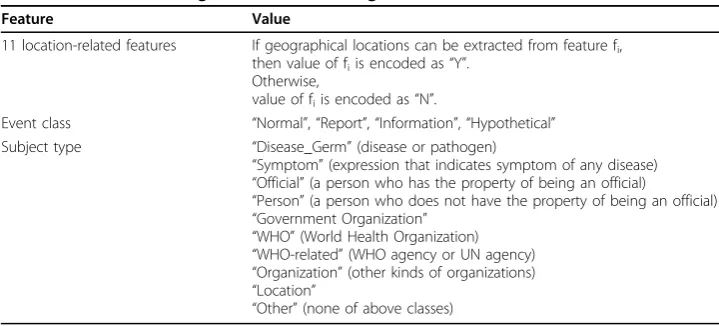
The resulting feature set given to the learners is shown in Table 1.
Results
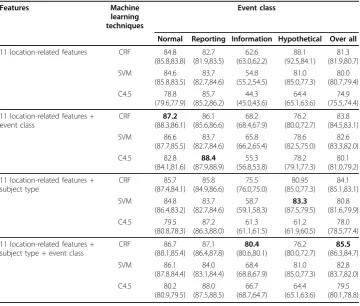
The results of attribute annotation are shown in Table 2. The scores for overall perfor-mance were based on micro-averaging. Note that the event class used as a feature in the model is the result from an automatic event classification system.
Table 1 Feature encoding method for learning task
Feature Value
11 location-related features If geographical locations can be extracted from feature fi, then value of fiis encoded as“Y”.
Otherwise,
value of fiis encoded as“N”.
Event class “Normal”,“Report”,“Information”,“Hypothetical”
Subject type “Disease_Germ”(disease or pathogen)
“Symptom”(expression that indicates symptom of any disease) “Official”(a person who has the property of being an official)
“Person”(a person who does not have the property of being an official) “Government Organization”
“WHO”(World Health Organization) “WHO-related”(WHO agency or UN agency) “Organization”(other kinds of organizations) “Location”
Comparing between the three machine learning techniques, CRF yielded the best performance (F = 87.2%). From the results, the CRF model, incorporating location-related features, subject type, and event class gained the highest performance.
While the CRF and SVM models with all features performed the best, incorporating only 11 location-related features and event class yielded a better result for Decision tree (F = 80.1%). Although the subject type feature obviously improved the perfor-mance for CRF (from F = 81.3% to 84.1%) and Decision tree model (from F = 74.9% to 78.0%), it has slight positive impact to the SVM model (from F = 80.0% to 80.8%). Nevertheless, the result from the models trained by the three machine learning techni-ques indicates that the event class and subject type features are useful for recognizing the spatial attribute of events in the information class.
In order to study the contribution of each spatial-related textual feature, another set of experiments was conducted. In these experiments, each spatial-related textual fea-ture was removed from the model in an excluding-one-feafea-ture-per-training manner.
According to the results, compared to the model trained with all the features (cf. Table 2), removing the headline feature improved recognition performance for the SVM (from 82.8 to 83.3 F-score) and Decision tree models (from 80.1 to 80.95 F-score), while yielded the same level of performance for the CRF model. Excluding the feature from the event coreference also improved the performance of the SVM model, but degraded the performance of the Decision tree model. For the CRF model, Table 2 Experimentation results for recognizing spatial attribute of events based on statistical machine learning approach
Features Machine
learning techniques
Event class
Normal Reporting Information Hypothetical Over all
11 location-related features CRF 84.8
(85.8,83.8) 82.7 (81.9,83.5) 62.6 (63.0,62.2) 88.1 (92.5,84.1) 81.3 (81.9,80.7) SVM 84.6 (85.8,83.5) 83.7 (82.7,84.6) 54.8 (55.2,54.5) 81.0 (85.0,77.3) 80.0 (80.7,79.4) C4.5 78.8 (79.6,77.9) 85.7 (85.2,86.2) 44.3 (45.0,43.6) 64.4 (65.1,63.6) 74.9 (75.5,74.4)
11 location-related features + event class CRF 87.2 (88.3,86.1) 86.1 (85.6,86.6) 68.2 (68.4,67.9) 76.2 (80.0,72.7) 83.8 (84.5,83.1) SVM 86.6 (87.7,85.5) 83.7 (82.7,84.6) 65.8 (66.2,65.4) 78.6 (82.5,75.0) 82.6 (83.3,82.0) C4.5 82.8 (84.1,81.6) 88.4 (87.9,88.9) 55.3 (56.8,53.8) 78.2 (79.1,77.3) 80.1 (81.0,79.2)
11 location-related features + subject type CRF 85.7 (87.4,84.1) 85.8 (84.9,86.6) 75.5 (76.0,75.0) 80.95 (85.0,77.3) 84.1 (85.1,83.1) SVM 84.8 (86.4,83.2) 83.7 (82.7,84.6) 58.7 (59.1,58.3) 83.3 (87.5,79.5) 80.8 (81.6,79.9) C4.5 79.5 (80.8,78.3) 87.2 (86.3,88.0) 61.3 (61.1,61.5) 61.2 (61.9,60.5) 78.0 (78.5,77.4)
11 location-related features + subject type + event class
CRF 86.7 (88.1,85.4) 87.1 (86.4,87.8) 80.4 (80.6,80.1) 76.2 (80.0,72.7) 85.5 (86.3,84.7) SVM 86.1 (87.8,84.4) 84.0 (83.1,84.4) 68.4 (68.8,67.9) 81.0 (85.0,77.3) 82.8 (83.7,82.0) C4.5 80.2 (80.9,79.5) 88.0 (87.5,88.5) 66.7 (68.7,64.7) 64.4 (65.1,63.6) 79.5 (80.1,78.8)
removing the object/indirect object coreference feature raised the recognition perfor-mance to 85.9, compared to the 85.5 F-score in the model that was trained with all the features. In CRF and SVM models, the recognition performance was most reduced when excluding the previous event feature (F = 78.8% for CRF; F = 76.2% for SVM). On the other hand, the performance of the Decision tree model was the lowest when excluding the location-related subject feature (F = 73.9%).
We also analyzed spatial attribute recognition performance for each event class. For events in the normal class, removing the nearest locations and the previous event fea-ture causes a significant drop in performance for the CRF model (F = 79.7% for CRF and 79.1% for SVM).
For events in the normal class, by removing the nearest locations and the previous event feature cause a significant drop in performance for the CRF model (F = 79.7% for CRF and 79.1% for SVM). Among the SVM models, removing the previous event features has the biggest impact on the spatial attribute recognition performance (F = 76.6%). Although the performance trend is quite similar between SVM and CRF models, the results from the decision tree model are obviously different. For the deci-sion tree-trained model, removing the location-related subject feature has the most impact on the recognition performance (F = 72.8%).
For the spatial attribute recognition of reporting events, the results show that the performance was reduced the most when the spatial information of the subject and subject co-reference was removed from the model (F = 81.4% for CRF; F = 78.9% for SVM, and F = 78.7% for Decision tree). This situation is reflected in all the models trained by using the three techniques.
Next, we analyzed the spatial attribute recognition performance on the information class. For the CRF and SVM models, removing the previous event feature has the lar-gest negative impact on recognition performance (F = 63.2% for CRF; F = 51.9% for SVM). While removing the object and indirect object coreference features has almost no impact on the CRF and SVM models in recognizing the spatial attribute of the information class, it surprisingly causes the biggest drop in performance for the deci-sion tree model (F = 62.9%).
For the spatial attribute recognition of hypothetical events, without taking the nearest locations into consideration, the recognition of the spatial attribute of the event in the hypothetical class was significantly reduced in all the models trained by using the three techniques.
Discussion
We conducted a detailed data analysis in order to find the main sources of errors in spatial attribute recognition. Based on the analysis, we found out that the main causes of the errors can be grouped into 5 cases, which are:
Case 1: Incorrect event class prediction
Most errors in this group occurred when an event in the normal class was classified by the model as an information class or vice versa. A major subcategory of the infor-mation class is a generic event (e.g. world knowledge), which, in this work, we assigned
Case 2: Error propagation
Errors sometimes occurred when the most reliable source for spatial attribute anno-tation of the current event relies on the predicted locations of another event, such as a previous event location, event coreference’s location or a subject coreference’s location that was identified according to the model-predicted location. For example, if the spa-tial attribute of the previous event, ei-1, was incorrectly recognized, then the spatial
attribute of the event eithat relies on ei-1will also be incorrectly recognized.
Case 3: Confusion between selecting the country-level and city-level nearest location
There is usually confusion, even for a human annotator, in deciding between select-ing the location at the country-level or the lower level of administration as a spatial attribute of events. For example:
The villages, some 10 km north Jowhar lack Health Care centers and children have been dying from contagious diseases for the last years as the official confirmed.
The above example is an excerpt from an outbreak report for villages around Soma-lia’s middle Shabele region. While the automatic system selected Jowhar as the spatial attribute, according to our annotation guidelines, the preference should be for the Sha-belle region to be selected for the event“confirmed”.
Base on the investigation, this type of error occurred most often with the reporting events.
Case 4: Spatial attribute recognition for information class
The information class can be subcategorized into generic knowledge and non-eventive clauses (for example, “The patient is a 6-year-old boy.”). While the spatial attribute of generic knowledge is usually annotated as world or sometimes as a country-level loca-tion, the spatial attribute of a non-eventive clause is generally a specific location.For example:
It is the first time something like this is happening at our school.
The non-eventive information represented by the phrase“is the first time ...”should be anchored to the location of the school. Or,
Local Community Health Care in the area told AFP that lack of health care is the main cause of the amazing children death number.
The clause “lack of health care is the main cause ...” refers to the fact in a specific region, (which, in this news, is “Shabele”), so Shabele was intuitively selected by the human annotator as the location of this non-eventive clause.
It is quite difficult to find explicit textual signals that can guide a model to select the most appropriate feature source for spatial attribute annotation. However, we often found that, in cases where the event is classified as information, when the subject of the verb referred to a non-specific, concept-level entity, such as “Bird flu”, “Patients”,
“Children”, the event represented by that verb is usually considered world knowledge, i.e. the spatial attribute is “World”. Based on this observation, the analysis of a subject whether it refers to a concept level entity or not might help solve this error.
Case 5: Event that causes the spatial movement of the object
When the event involves the movement of an object from one place to another, both the source and destination locations should be recognized as the spatial attribute of the event. For example:
This news reported an outbreak in Sudan, so the hypothetical event “could spread” should be associated with a source location, e.g. Sudan, and the destination location, e.g. Uganda.
However, this type of event seldom occurred in our training corpus. So, it is difficult for the model to recognize this.
Conclusions
In this article, we extended our work on event-spatial attribute recognition by focusing on machine learning techniques, which are CRF, SVM, and Decision tree. Our approach avoided the costly development of an external knowledge base by employing the feature sources that can be acquired locally from the analyzed document. The features incorpo-rated to our models were evaluated to assess their contribution to the event-spatial attri-bute recognition task. The results showed that the CRF model performed the best. Moreover, apart from location-related features, subject type and event class are also important to the spatial attribute annotation. Among location-related features, our study indicated that the nearest location name and previous event location are the most impor-tant features for the CRF and SVM model, while the subject location feature is the most important to the Decision tree model. In the future, we plan to extend our experiment by selecting the best combination of the classifiers and features for each type of event.
In the experiment, the named entity, co-reference information as well as subjects and objects of all verbs were manually identified. In practice, such information can be auto-matically acquired by using linguistic tools, such as named entity annotation [21], par-ser [22] and co-reference resolution [27]. Since the errors from these tools could degrade the annotation accuracy, it is necessary to have the tools with acceptable per-formance. With the continual advances in natural language processing, we believe that such reliable tools can be obtained, and consequently, make the spatial attribute anno-tation reliable enough to be useful for practical purposes in online health surveillance systems.
In this study, we focused on analyzing outbreak reports in news articles. However, our methodology was designed to be independent of the specific patterns related to the language, document genre, or writer’s idiosyncrasy. Therefore, we believe that it can be applied to other types of outbreak reports, such as ProMED mail, blog entries, or official reports.
Acknowledgements
We gratefully acknowledge the kind support of Mukda Suktarachan and Chotika Tunleng in participating in the annotation experiments. We would also like to express our gratitude to the anonymous reviewers for their helpful comments.
Authors’contributions
This work was directed by NC. HC carried out the framework design and analysis with the technical support and advice from NC. HC also carried out the experiments. Both authors contributed to the framework development and in writing the paper. Both authors read and approved the final manuscript.
Competing interests
The authors declare that they have no competing interests.
Received: 13 December 2009 Accepted: 31 March 2010 Published: 31 March 2010
References
2. Butler D:Disease surveillance needs a revolution.Nature2006,440(7080):6-7.
3. Yangarber R, Steinberger R, Best C, Etter Pv, Fuart F, Horby D:Combining Information Retrieval and Information Extraction for Medical Intelligence.Proceeding of Mining Massive Data Sets for Security, NATO Advanced Study Institute Gazzada, Italy 2007.
4. Mawudeku A, Lemay R, Werker D, Andraghetti R, John RS:The Global Public Health Intelligence Network.Infectious Disease SurveillanceValk Hd: Infectious Disease SurveillanceM’ikanatha NM, Lynfield R, Beneden CAV 2007, 304-317. 5. Collier N, Doan S, Kawazoe A, Goodwin RM, Conway M, Tateno Y, Ngo Q-H, Dien D, Kawtrakul A, Takeuchi K,et al:
BioCaster: detecting public health rumors with a Web-based text mining system.Bioinformatics2008,24:2940-2941. 6. Wilson JM:Argus: A Global Detection and Tracking System for Biological Events.Advances in Disease Surveillance
2007,4:21.
7. Tolentino H, Kamadjeu R, Fontelo P, Liu F, Matters M, Pollack M, Madoff L:Scanning the Emerging Infectious Diseases Horizon-Visualizing ProMED Emails Using EpiSPIDER.Advances in Disease Surveillance2007,2(4):169.
8. Chaudet H:Extending the event calculus for tracking epidemic spread.Artificial Intelligence in Medicine2006, 38(2):137-156.
9. Lee S, Lee GG:A Bootstrapping Approach for Geographic Named Entity Annotation.Information Retrieval Technology: Asia Information Retrieval Symposium, AIRS 2004, Beijing, China, October 18-20, 2004, Revised Selected Papers
SpringerMyaeng S-H, Zhou M, Wong K-F, Zhang H 2005,3411:178-189.
10. Borthwick A, Sterling J, Agichtein E, Grishman R:NYU: Description of the MENE Named Entity System as Used in MUC-7.Proceeding of the 7th Message Understanding ConferenceFairfax, Virginia 1998.
11. Pouliquen B, Kimler M, Steinberger R, Ignat C, Oellinger T, Blackler K, Fuart F, Zaghouani W, Widiger A, Forslund A-C, et al:Geocoding multilingual texts: Recognition, disambiguation and visualisation.Proceedings of the 5th International Conference on Language Resources and Evaluation (LREC-2006), Genoa, Italy2006, 53-58.
12. Leidner JL:Toponym resolution in text: annotation, evaluation and applications of spatial grounding.ACM SIGIR Forum2007,41(2):124-126.
13. Grishman R, Huttunen S, Yangarber R:Information extraction for enhanced access to disease outbreak reports.
Journal of Biomedical Informatics2002,35(4):236-246.
14. Freitag D, McCallum A:Information extraction with HMMs and shrinkage.Proceeding of the AAAI-99 Workshop on Machine Learning for Information Extraction, Orlando, FL1999, 31-36.
15. Amitay E, Har’El N, Sivan R, Soffer A:Web-a-where: geotagging web content.Proceeding of the 27th annual international ACM SIGIR conference on Research and development in information retrievalSheffield, United Kingdom: ACM Press 2004, 273-280.
16. Chanlekha H, Collier N:A methodology to enhance spatial understanding of disease outbreak events reported in news articles.International Journal of Medical Informatics2010,79(4):284-296.
17. Doan S, Kawazoe A, Conway M, Collier N:Towards role-based filtering of disease outbreak reports.Journal of Biomedical Informatics2009.
18. Levin B:English Verb Classes and Alternations: A Preliminary Investigation.The University of Chicago Press 1993. 19. Saurí R, Littman J, Knippen B, Gaizauskas R, Setzer A, Pustejovsky J:TimeML Annotation Guidelines Version 1.2.1.2006. 20. Lafferty JD, McCallum A, Pereira F:Conditional Random Fields: Probabilistic Models for Segmenting and Labeling
Sequence Data.Proceedings of the Eighteenth International Conference on Machine LearningMA, USA: Morgan Kaufmann Publishers 2001, 282-289.
21. Kawazoe A, Jin L, Shigematsu M, Barrero R, Taniguchi K, Collier N:The development of a schema for the annotation of terms in the BioCaster disease detecting/tracking system.Proceedings of KR-MED 2006, the Second International Workshop on Formal Biomedical Knowledge RepresentationBaltimore, Maryland 2006, 77-85.
22. Klein D, Manning CD:Accurate unlexicalized parsing.Proceeding of the Association for Computational Linguistics (ACL) 2003Sapporo, Japan: Association for Computational Linguistics 2003, 423-430.
23. Quinlan JR:C4.5: Programs for Machine Learning.Morgan Kaufmann Publishers 1993.
24. Burges CJC:A Tutorial on Support Vector Machines for Pattern Recognition.Data Mining and Knowledge Discovery 1998,2(2):121-167.
25. CRF++: Yet another CRF toolkit.[http://crfpp.sourceforge.net/].
26. LIBSVM: a library for support vector machines.[http://www.csie.ntu.edu.tw/~cjlin/libsvm].
27. Soon WM, Ng HT, Lim DCY:A machine learning approach to coreference resolution of noun phrases.Computational Linguistics: Special issue on computational anaphora resolution2001,27(4):521-544.
doi:10.1186/2041-1480-1-3
Cite this article as:Chanlekha and Collier:Analysis of syntactic and semantic features for fine-grained