SemEval-2007 Task 14: Affective Text
Carlo Strapparava
FBK – irst
Istituto per la Ricerca Scientifica e Tecnologica I-38050, Povo, Trento, Italy
Rada Mihalcea
Department of Computer Science University of North Texas Denton, TX, 76203, USA
Abstract
The “Affective Text” task focuses on the classification of emotions and valence (pos-itive/negative polarity) in news headlines, and is meant as an exploration of the connec-tion between emoconnec-tions and lexical seman-tics. In this paper, we describe the data set used in the evaluation and the results ob-tained by the participating systems.
1 Introduction
All words can potentially convey affective mean-ing. Every word, even those apparently neutral, can evoke pleasant or painful experiences due to their semantic relation with emotional concepts or cate-gories. Some words have emotional meaning with respect to an individual story, while for many others the affective power is part of the collective imagina-tion (e.g., words such as “mum”, “ghost”, “war”).
The automatic detection of emotion in texts is becoming increasingly important from an applica-tive point of view. Consider for example the tasks of opinion mining and market analysis, affective computing, or natural language interfaces such as e-learning environments or educational/edutainment games. Possible beneficial effects of emotions on memory and attention of the users, and in general on fostering their creativity are also well-known in the field of psychology.
For instance, the following represent examples of applicative scenarios in which affective analysis would give valuable and interesting contributions:
Sentiment Analysis. Text categorization according to affective relevance, opinion exploration for
market analysis, etc. are just some exam-ples of application of these techniques. While positive/negative valence annotation is an ac-tive field of sentiment analysis, we believe that a fine-grained emotion annotation would in-crease the effectiveness of these applications.
Computer Assisted Creativity. The automated generation of evaluative expressions with a bias on some polarity orientation are a key component for automatic personalized advertisement and persuasive communication.
Verbal Expressivity in Human Computer Interaction. Future human-computer interaction, accord-ing to a widespread view, will emphasize naturalness and effectiveness and hence the incorporation of models of possibly many hu-man cognitive capabilities, including affective analysis and generation. For example, emo-tion expression by synthetic characters (e.g., embodied conversational agents) is considered now a key element for their believability. Affective words selection and understanding is crucial for realizing appropriate and expressive conversations.
The “Affective Text” task was intended as an ex-ploration of the connection between lexical seman-tics and emotions, and an evaluation of various au-tomatic approaches to emotion recognition.
The task is not easy. Indeed, as (Ortony et al., 1987) indicates, besides words directly refer-ring to emotional states (e.g., “fear”, “cheerful”) and for which an appropriate lexicon would help, there are words that act only as an indirect reference to
emotions depending on the context (e.g. “monster”, “ghost”). We can call the former direct affective
words and the latter indirect affective words
(Strap-parava et al., 2006).
2 Task Definition
We proposed to focus on the emotion classification of news headlines extracted from news web sites. Headlines typically consist of a few words and are often written by creative people with the intention to “provoke” emotions, and consequently to attract the readers’ attention. These characteristics make this type of text particularly suitable for use in an automatic emotion recognition setting, as the affec-tive/emotional features (if present) are guaranteed to appear in these short sentences.
The structure of the task was as follows:
Corpus: News titles, extracted from news web sites (such as Google news, CNN) and/or newspa-pers. In the case of web sites, we can easily collect a few thousand titles in a short amount of time.
Objective: Provided a set of predefined six emotion labels (i.e., Anger, Disgust, Fear, Joy, Sadness, Surprise), classify the titles with the appropri-ate emotion label and/or with a valence indica-tion (positive/negative).
The emotion labeling and valence classification were seen as independent tasks, and thus a team was able to participate in one or both tasks. The task was carried out in an unsupervised setting, and con-sequently no training was provided. The reason be-hind this decision is that we wanted to emphasize the study of emotion lexical semantics, and avoid bias-ing the participants toward simple “text categoriza-tion” approaches. Nonetheless supervised systems were not precluded from participation, and in such cases the teams were allowed to create their own su-pervised training sets.
Participants were free to use any resources they wanted. We provided a set words extracted from WordNet Affect (Strapparava and Valitutti, 2004), relevant to the six emotions of interest. However, the use of this list was entirely optional.
2.1 Data Set
The data set consisted of news headlines drawn from major newspapers such as New York Times, CNN, and BBC News, as well as from the Google News search engine. We decided to focus our attention on headlines for two main reasons. First, news have typically a high load of emotional content, as they describe major national or worldwide events, and are written in a style meant to attract the attention of the readers. Second, the structure of headlines was ap-propriate for our goal of conducting sentence-level annotations of emotions.
Two data sets were made available: a develop-ment data set consisting of 250 annotated headlines, and a test data set with 1,000 annotated headlines.
2.2 Data Annotation
To perform the annotations, we developed a Web-based annotation interface that displayed one head-line at a time, together with six slide bars for emo-tions and one slide bar for valence. The interval for the emotion annotations was set to[0,100], where 0 means the emotion is missing from the given head-line, and 100 represents maximum emotional load. The interval for the valence annotations was set to
[−100,100], where 0 represents a neutral headline,
−100represents a highly negative headline, and100 corresponds to a highly positive headline.
Unlike previous annotations of sentiment or sub-jectivity (Wiebe et al., 2005; Pang and Lee, 2004), which typically relied on binary0/1annotations, we decided to use a finer-grained scale, hence allow-ing the annotators to select different degrees of emo-tional load.
2.3 Inter-Annotator Agreement
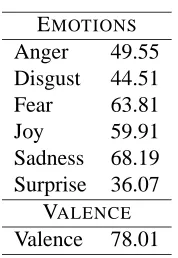
We conducted inter-tagger agreement studies for each of the six emotions and for the valence an-notations. The agreement evaluations were carried out using the Pearson correlation measure, and are shown in Table 1. To measure the agreement among the six annotators, we first measured the agreement between each annotator and the average of the re-maining five annotators, followed by an average over the six resulting agreement figures.
EMOTIONS
Anger 49.55
Disgust 44.51
Fear 63.81
Joy 59.91
Sadness 68.19 Surprise 36.07
VALENCE
[image:3.612.142.231.199.328.2]Valence 78.01
Table 1: Pearson correlation for inter-annotator agreement
2.4 Fine-grained and Coarse-grained Evaluations
Fine-grained evaluations were conducted using the Pearson measure of correlation between the system scores and the gold standard scores, averaged over all the headlines in the data set.
We have also run a coarse-grained evaluation, where each emotion was mapped to a 0/1 classifica-tion (0 = [0,50), 1 = [50,100]), and each valence was mapped to a -1/0/1 classification (-1 = [-100,-50], 0 = (-50,50), 1 = [50,100]). For the coarse-grained evaluations, we calculated accuracy, precision, and recall. Note that the accuracy is calculated with re-spect to all the possible classes, and thus it can be artificially high in the case of unbalanced datasets (as some of the emotions are, due to the high num-ber of neutral headlines). Instead, the precision and recall figures exclude the neutral annotations.
3 Participating Systems
Five teams have participated in the task, with five systems for valence classification and three systems for emotion labeling. The following represents a short description of the systems.
UPAR7: This is a rule-based system using a lin-guistic approach. A first pass through the data “un-capitalizes” common words in the news title. The system then used the Stanford syntactic parser on the modified title, and tried to identify what is being said about the main subject by exploiting the depen-dency graph obtained from the parser.
Each word was first rated separately for each emo-tion (the six emoemo-tions plus Compassion) and for va-lence. Next, the main subject rating was boosted. Contrasts and accentuations between “good” or “bad” were detected, making it possible to identify surprising good or bad news. The system also takes into account: human will (as opposed to illness or natural disasters); negation and modals; high-tech context; celebrities.
The lexical resource used was a combination of SentiWordNet (Esuli and Sebastiani, 2006) and WordNetAffect (Strapparava and Valitutti, 2004), which were semi-automatically enriched on the ba-sis of the original trial data.
SICS: The SICS team used a very simple ap-proach for valence annotation based on a word-space model and a set of seed words. The idea was to create two points in a highdimensional word space -one representing positive valence, the other repre-senting negative valence - and then projecting each headline into this space, choosing the valence whose point was closer to the headline.
[cosine * 100 + 50]) of the closest valence vector (headlines that were closer to the negative valence vector were assigned a negative valence value). In 11 cases, a value of -0.0 was ascribed either because no words were left in the headline after frequency and stop word filtering, or because none of the re-maining words occurred in the LA times corpus and thus did not have any context vector.
CLaC: This team submitted two systems to the competition: an unsupervised knowledge-based sys-tem (ClaC) and a supervised corpus-based syssys-tem (CLaC-NB). Both systems were used for assigning positive/negative and neutral valence to headlines on the scale [-100,100].
CLaC: The CLaC system relies on a knowledge-based domain-independent unsupervised approach to headline valence detection and scoring. The system uses three main kinds of knowledge: a list of sentiment-bearing words, a list of valence shifters and a set of rules that define the scope and the result of the combination of sentiment-bearing words and valence shifters. The unigrams used for sentence/headline classification were learned from WordNet dictionary entries. In order to take advan-tage of the special properties of WordNet glosses and relations, we developed a system that used the list of human-annotated adjectives from (Hatzivas-siloglou and McKeown, 1997) as a seed list and learned additional unigrams from WordNet synsets and glosses. The list was then expanded by adding to it all the words annotated with Positive or Neg-ative tags in the General Inquirer. Each unigram in the resulting list had the degree of membership in the category of positive or negative sentiment assigned to it using the fuzzy Net Overlap Score method de-scribed in the team’s earlier work (Andreevskaia and Bergler, 2006). Only words with fuzzy member-ship score not equal to zero were retained in the list. The resulting list contained 10,809 sentiment-bearing words of different parts of speech.
The fuzzy Net Overlap Score counts were com-plemented with the capability to discern and take into account some relevant elements of syntactic structure of the sentences. Two components were added to the system to enable this capability: (1) valence shifter handling rules and (2) parse tree analysis. The list of valence shifters was a com-bination of a list of common English negations
and a subset of the list of automatically obtained words with increase/decrease semantics, comple-mented with manual annotation. The full list con-sists of 450 words and expressions. Each entry in the list of valence shifters has an action and scope associated with it, which are used by special han-dling rules that enable the system to identify such words and phrases in the text and take them into ac-count in sentence sentiment determination. In order to correctly determine the scope of valence shifters in a sentence, the system used a parse tree analysis using MiniPar.
As a result of this processing, every headline re-ceived a system score assigned based on the com-bined fuzzy Net Overlap Score of its constituents. This score was then mapped into the [-100 to 100] scale as required by the task.
CLaC-NB: In order to assess the performance of basic Machine Learning techniques on headlines, a second system ClaC-NB was also implemented. This system used a Na¨ıve Bayes classifier in order to assign valence to headlines. It was trained on a small corpus composed of the development corpus of 250 headlines provided for this competition, plus an ad-ditional 200 headlines manually annotated and 400 positive and negative news sentences. The probabil-ities assigned by the classifier were mapped to the [-100, 100] scale as follows: all negative headlines re-ceived the score of -100, all positive headlines were assigned the score of +100, and the neutral headlines obtained the score of 0.
UA: In order to determine the kind and the amount of emotions in a headline, statistics were gathered from three different web Search Engines: MyWay, AlltheWeb and Yahoo. This information was used to observe the distribution of the nouns, the verbs, the adverbs and the adjectives extracted from the head-line and the different emotions.
es-timated and used to weight the final PMI score. The obtained results were normalized in the 0-100 range.
SWAT: SWAT is a supervised system using an u-nigram model trained to annotate emotional content. Synonym expansion on the emotion label words was also performed, using the Roget Thesaurus. In addi-tion to the development data provided by the task organizers, the SWAT team annotated an additional set of 1000 headlines, which was used for training.
Fine Coarse
r Acc. Prec. Rec. F1
CLaC 47.70 55.10 61.42 9.20 16.00 UPAR7 36.96 55.00 57.54 8.78 15.24
SWAT 35.25 53.20 45.71 3.42 6.36
[image:5.612.76.295.209.293.2]CLaC-NB 25.41 31.20 31.18 66.38 42.43 SICS 20.68 29.00 28.41 60.17 38.60
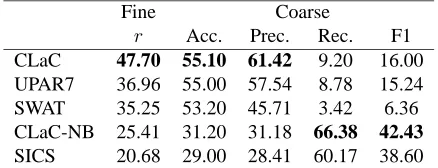
Table 2: System results for valence annotations
Fine Coarse
r Acc. Prec. Rec. F1
Anger
SWAT 24.51 92.10 12.00 5.00 7.06
UA 23.20 86.40 12.74 21.6 16.03
UPAR7 32.33 93.60 16.67 1.66 3.02 Disgust
SWAT 18.55 97.20 0.00 0.00
-UA 16.21 97.30 0.00 0.00
-UPAR7 12.85 95.30 0.00 0.00
-Fear
SWAT 32.52 84.80 25.00 14.40 18.27 UA 23.15 75.30 16.23 26.27 20.06 UPAR7 44.92 87.90 33.33 2.54 4.72
Joy
SWAT 26.11 80.60 35.41 9.44 14.91
UA 2.35 81.80 40.00 2.22 4.21
UPAR7 22.49 82.20 54.54 6.66 11.87 Sadness
SWAT 38.98 87.70 32.50 11.92 17.44
UA 12.28 88.90 25.00 0.91 1.76
UPAR7 40.98 89.00 48.97 22.02 30.38 Surprise
SWAT 11.82 89.10 11.86 10.93 11.78
UA 7.75 84.60 13.70 16.56 15.00
[image:5.612.82.290.354.667.2]UPAR7 16.71 88.60 12.12 1.25 2.27
Table 3: System results for emotion annotations
4 Results
Tables 2 and 3 show the results obtained by the par-ticipating systems. The tables show both the fine-grained Pearson correlation measure and the coarse-grained accuracy, precision and recall figures.
While further analysis is still needed, the results indicate that the task of emotion annotation is diffi-cult. Although the Pearson correlation for the inter-tagger agreement is not particularly high, the gap between the results obtained by the systems and the upper bound represented by the annotator agreement suggests that there is room for future improvements.
Acknowledgments
Carlo Strapparava was partially supported by the HUMAINE Network of Excellence.
References
A. Andreevskaia and S. Bergler. 2006. Senses and senti-ments: Sentiment tagging of adjectives at the meaning level. In Proceedings of the 19th Canadian
Confer-ence on Artificial IntelligConfer-ence, AI’06, Quebec, Canada.
A. Esuli and F. Sebastiani. 2006. SentiWordNet: A publicly available lexical resource for opinion mining. In Proceedings of the Fifth International Conference
on Language Resources and Evaluation (LREC 2006),
Genoa, Italy, May.
V. Hatzivassiloglou and K. McKeown. 1997. Predicting the semantic orientation of adjectives. In Proceedings
of the 35th Annual Meeting of the ACL, Madrid, Spain,
July.
A. Ortony, G. L. Clore, and M. A. Foss. 1987. The ref-erential structure of the affective lexicon. Cognitive
Science, (11).
B. Pang and L. Lee. 2004. A sentimental education: Sentiment analysis using subjectivity summarization based on minimum cuts. In Proceedings of the 42nd
Meeting of the Association for Computational Linguis-tics, Barcelona, Spain, July.
C. Strapparava and A. Valitutti. 2004. Wordnet-affect: an affective extension of wordnet. In Proceedings
of the 4th International Conference on Language Re-sources and Evaluation, Lisbon.
C. Strapparava, A. Valitutti, and O. Stock. 2006. The affective weight of lexicon. In Proceedings of the Fifth
International Conference on Language Resources and Evaluation.
J. Wiebe, T. Wilson, and C. Cardie. 2005. Annotating ex-pressions of opinions and emotions in language.