www.wjpr.net Vol 8, Issue 11, 2019. 882
FORMULATION AND EVALUATION OF BILAYER TABLETS OF
ACECLOFENAC AND ALLOPURINOL
B. Bhargavi*, Vineela and Divya Laxmi
Gyana Jyothi College of Pharmacy, Uppal Bus Depot, Hyderabad-500089, Telangana, India.
INTRODUCTION
Oral Drug Delivery
Despite phenomenal advances in the inhalable, injectable, transdermal,
nasal and other routes of administration, the unavoidable truth is that
oral drug delivery remains well ahead of the pack as the preferred
delivery route. There are of course many applications and large
markets for non-oral products and the technologies that deliver them.
However, if it is a viable option, oral drug delivery will be chosen in
all but the most exceptional circumstances. Moreover, if the oral route
is not immediately viable, pharmaceutical companies will often invest
resources in making it viable, rather than plumping for an alternative
delivery method.[1,2,3,4] drugs via polymeric degradation (surface or bulk matrix erosion) or
cleavage of drug from a polymer chain.
Immediate Release Drug Delivery System
Introduction: Immediate release drug delivery system is a conventional type of drug
delivery. It is designed to disintegrate and release their medicaments with no special rate
controlling features.
These are the dosage forms in which ≥85% of labeled amount dissolves with in 30min.
However for immediate release tablets, tablet disintegrants play an important role in ensuring
that the tablet matrix break up on contact with fluid in the stomach to allow the release the
active drug which then become available in whole or in part, for absorption from GIT.
Mechanism of Drug Release: On exposure to aqueous fluids, hydrophilic matrices take up
water and the polymer starts hydrating to from a gel layer. Drug release is controlled by
Volume 8, Issue 11, 882-895. Research Article ISSN 2277– 7105
Article Received on 15 August 2019,
Revised on 05 Sept. 2019, Accepted on 25 Sept. 2019
DOI: 10.20959/wjpr201911-15872
*Corresponding Author
B. Bhargavi
Gyana Jyothi College of
Pharmacy, Uppal Bus Depot,
Hyderabad-500089,
www.wjpr.net Vol 8, Issue 11, 2019. 883 diffusion barriers/by erosions. An intial burst of soluble drug may occur due to surface
leaching when a matrix containing a swellable glassy polymer comes in to contact with an
aqueous medium, there is an abrupt change from a glassy to rubbery state associate with
swelling process with time, water infiltration deep in to a case increasing the thickness by the
gel layer. The outer layer become fully hydrated and starts dissolving or eroding. When water
reaches the centre of the system and the concentration of drug falls below the solubility value,
the release rate of the drug begins toreduce. At the same time an increase in thickness of the
barrier layer with time increases the diffusion path length, reducing the rate of drug release.
Advantages Immediate Release Drug Delivery Systems
1. Improved compliance/added convenience.
2. Improved stability.
3. Suitable for controlled/sustained release actives.
4. Allows high drug loading.
5. Ability to provide advantages of liquid medication in the form of solid preparation.
6. Adaptable and amenable to existing processing and packaging machinery.
7. Cost- effective.
Super Disintegrants in Immediate Release
These are especially important for an immediate release product where rapid release of drug
substance is required. A disintegrant can be added to powder blend for direct compression.
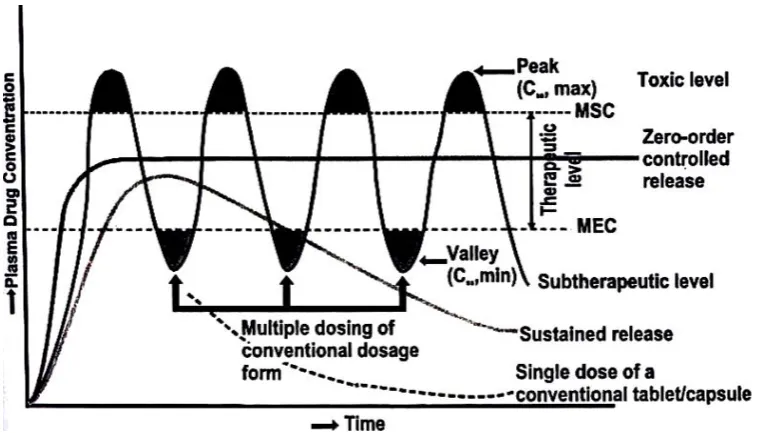
Figure 1.1: A hypothetical plasma concentration–time profile from conventional
[image:2.595.106.489.504.720.2]www.wjpr.net Vol 8, Issue 11, 2019. 884 Potential advantages of sustained release systems
Avoid patient’s compliance problems
1. Employ less total drug
a) Minimize or eliminate local side effects.
b) Minimize or eliminate systemic side effects.
c) Obtain less potentiation or reduction in drug activity with chronic use.
d) Minimize drug accumulation with chronic dosing.
3. Improve efficiency in treatment
a) Cures or controls condition more promptly.
b) Improves control of condition i.e., reduced fluctuation in drug level.
c) Improves bioavailability of some drugs.
d) Make use of special effects, e.g. sustained-release aspirin for morning relief of arthritis by
dosing before bed time.
4. Economy i.e. reduction in health care costs. The average cost of treatment over an
extended time period may be less, with less frequency of dosing, enhanced therapeutic
benefits and reduced side effects. The time required for health care personnel to dispense and
administer the drug and monitor patient is also reduced.[7,8,9,10]
Disadvantages
1) Decreased systemic availability in comparison to immediate release conventional dosage
forms, which may be due to incomplete release, increased first-pass metabolism,
increased instability, insufficient residence time for complete release, site specific
absorption, pH dependent stability etc.
2) Poor in vitro-in vivo correlation.
3) Possibility of dose dumping due to food, physiologic or formulation variables or chewing
or grinding of oral formulations by the patient and thus, increased risk of toxicity.
Manufacturing Methods of Tablets
Direct compression.
Wet granulation method.
Dry granulation method.
Fluidized bed granulation.
www.wjpr.net Vol 8, Issue 11, 2019. 885 Definition
Dual release tablet is a unit compressed tablet dosage form intended for oral administration. It
contains two parts in which one part having conventional or immediate release part another
one is sustained or controlled release part.
Bi layer tablets
Several pharmaceutical companies are currently developing bilayer tablets, for a variety of
reasons like patent extension, therapeutic marketing to name a few.
Applications
Used in the combination therapy.
Used to deliver the loading dose and sustained dose of the same or different drugs.
Used for bilayer floating tablet in which one layer is floating layer another one is release
layer of the drug.
Used to deliver the two different drugs having different release profiles.
Advantages
Extension of a conventional technology.
Potential use of single entity feed granules.
Separation of incompatible components
Patient compliance is enhanced leading to improve drug regimen efficacy.
Patient convenience is improved because fewer daily doses are required.compared to
traditional delivery system.
Maintain physical and chemical stability.
Retain potency and ensure dose accuracy.
Disadvantages
Adds complexity and bilayer rotatory presses are expensive.
Insufficient hardness, Layer separation, reduced yield.
Inaccurate individual layer weight control.
www.wjpr.net Vol 8, Issue 11, 2019. 886 Ideal properties for bilayer tablets press
Preventing capping and separation of the two individual layers that constitute the bilayer
tablet.
Preventing cross-contamination between the two layers.
Producing a clear visual separation between the two layers.
High yield and accurate and individual weight control of the two layers.
Types of bilayer tablet press
1. Single sided tablet press.
2. Double sided tablet press.
3. Bilayer tablet press with displacement monitor
METHODOLOGY
Direct Compression Method
All the ingredients were passed through the sieve#40 followed by the other ingredients were
passed the same sieve. CCS, SSG, Cp, MCC, talc, were taken in a poly bag and mixed for
5minutes to ensure uniform mixing of the ingredients. Then the granules were dried in Hot air
oven samples were removed randomly at different time intervals from the total bulk of the
granules and then checked out for moisture content. The materials were passed through the
sieve#22. Then magnesium stearate, talc, Colouring agents were added and compressed as
Immediate release tablet.
Method of preparation and characterization of powder blend
Table 7: Composition of Sustained release tablet formulation.
Ingradients F1 F2 F3 F4 F5 F6 F7 F8 F9
Aceclofenac 100 100 100 100 100 100 100 100 100
HPMCK4m 25 50 75
HPMCK15m 25 50 75
HPMCK100m 25 50 75
MCC 117 92 67 117 92 67 117 92 67
Magnasium Stearate 4 4 4 4 4 4 4 4 4
Talc 4 4 4 4 4 4 4 4 4
www.wjpr.net Vol 8, Issue 11, 2019. 887 Table 8: Composition of Immediate release tablet formulation.
Ingradients F1 F2 F3 F4 F5 F6 F7 F8 F9
Allopurinol Hydrochloride 50 50 50 50 50 50 50 50 50
CCS 6.25 12.5 25
SSG 6.25 12.5 25
Cross Povidone 6.25 12.5 25
MCC 39.75 33.5 21 39.75 33.5 21 39.75 33.5 21
Magnasium Stearate 2 2 2 2 2 2 2 2 2
Talc 2 2 2 2 2 2 2 2 2
Total wt 100 100 100 100 100 100 100 100 100
*All the quantities are expressed as mg per tablet.
Compression of Powder Blends Into Tablets
After evaluation of powder blend Immediate release tablets and sustained release tablets were
prepared by Direct Compression granulation method using (4mm diameter, round flat faced
punches) multiple punch tablet compression machine. Each tablet contained 250mg of
Aceclofenac and 100mg of Allopurinol, the batch size for each formulation was 10 tablets.
RESULT AND DISCUSSION
PREFORMULATION PARAMETERS
Physicochemical parameters of drug
Organoleptic properties
Odourless, white or almost white crystalline powder
Melting point
Melting point values of Aceclofenac sample was found to be in range of 1850C to 1890C. The
reported melting point range for Aceclofenac is 183.50C to 1840C. Hence, experimental
values are in good agreement with official values.
Solubility study
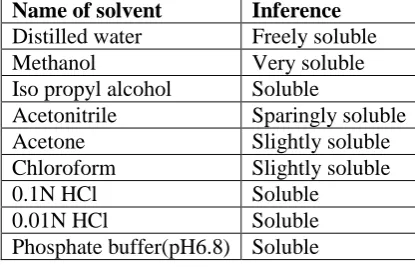
Table 12: The solubility of Aceclofenac in various solvents.
Name of solvent Inference Distilled water Freely soluble Methanol Very soluble Iso propyl alcohol Soluble
Acetonitrile Sparingly soluble Acetone Slightly soluble Chloroform Slightly soluble 0.1N HCl Soluble
[image:6.595.193.401.631.764.2]www.wjpr.net Vol 8, Issue 11, 2019. 888 Analytical methods
λ max Determination
The absorption maximum for Aceclofenac was found to be 237nm.
Preparation of standard graph of Aceclofenac
Preparation of standard graph of Aceclofenac in 0.1N HCl
UV absorption spectrum of Aceclofenac in 0.1N HCl shows λ max at 237nm. Absorbances
obtained for various concentrations of Aceclofenac in 0.1N HCl are given in table no 6.2. The
graph of absorbance vs concentration for Aceclofenac was found to be linear in the
concentration range of 2-16 μg /ml. The drug obeys Beer- Lambert’s law in the range of 2-16
μg /ml.
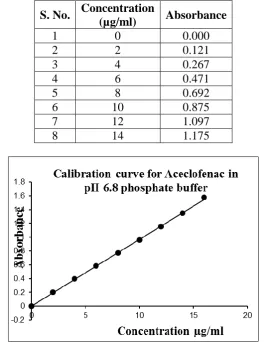
Preparation of standard graph of Aceclofenac in pH 6.8 Phosphate buffer
UV absorption spectrum of Aceclofenac in pH 6.8 Phosphate buffer shows λ max at 238nm.
Absorbances obtained for various concentrations of Aceclofenac in pH 6.8 phosphate buffer
are given in table no.6.3. The graph of absorbance vs concentration for Aceclofenac was
found to be linear in the concentration range of 2-16 μg /ml. The drug obeys Beer- Lambert’s
law in the range of 2-16 μg /ml.
Table 13: Data of Concentration and Absorbance for in Aceclofenac 0.1N HCl.
S.No. Concentration (µg/ml) Absorbance
1 0 0.000
2 2 0.118
3 4 0.276
4 6 0.452
5 8 0.796
6 10 0.982
7 12 1.089
8 14 1.181
www.wjpr.net Vol 8, Issue 11, 2019. 889
Table 14: Data of concentration and absorbance for Aceclofenac pH 6.8 phosphate
buffer.
S. No. Concentration
(µg/ml) Absorbance
1 0 0.000
2 2 0.121
3 4 0.267
4 6 0.471
5 8 0.692
6 10 0.875
7 12 1.097
[image:8.595.164.433.113.456.2]8 14 1.175
Figure 8: Standard graph of Methocabamol in 6.8 buffer.
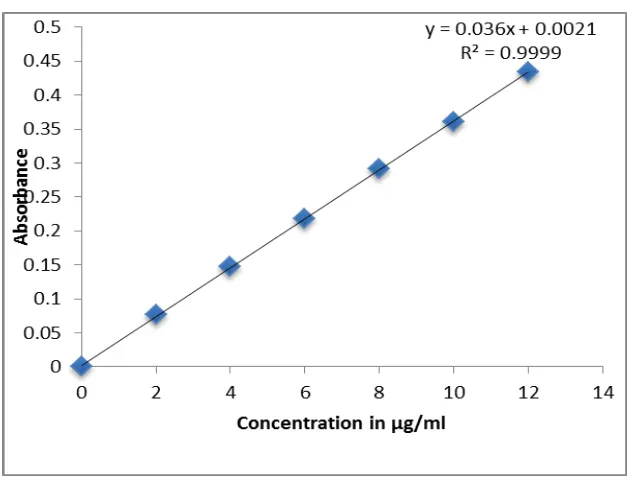
Preparation of standard graph of Allopurinol in pH 6.8 Phosphate buffer
UV absorption spectrum of Allopurinol in pH 6.8 Phosphate buffer shows λ max at 286nm.
Absorbances obtained for various concentrations of Allopurinol in pH 6.8 phosphate bu in pH
6.8 phosphate buffer are given in table no.6.3. The graph of absorbance vs concentration for
Allopurinol was found to be linear in the concentration range of 2-8 μg /ml. The drug obeys
Beer- Lambert’s law in the range of 2-8μg /ml.
S. No. Concentration (µg/ml) Absorbance
1 0 0.000
2 2 0.065
3 4 0.134
4 6 0.265
5 8 0.318
6 10 0.375
7 12 0.442
[image:8.595.178.418.635.749.2]www.wjpr.net Vol 8, Issue 11, 2019. 890 Evaluation of Sustained Release Tablet
Table 17: Physico-chemical characterization of Aceclofenac tablets.
S.no Formulation Weight
variation Thickness Hardness Friability
Disintegration Time
1 F1 0.398 1.5 4 0.26 0.26
2 F2 0.415 1.6 4 0.62 0.62
3 F3 0.395 1.7 4.5 0.78 0.78
4 F4 0.413 1.6 4 0.79 0.79
5 F5 0.407 1.5 4.5 0.41 0.41
6 F6 0.386 1.6 4 0.38 0.38
7 F7 0.394 1.5 4 0.35 0.35
8 F8 0.405 1.6 4.5 0.36 0.36
9 F9 0.412 1.5 4.5 0.29 0.29
Table 18: Physico-chemical characterization of Allopurinol tablets.
Sno Formulation Weight
variation
Thickness (mm)
Hardness (Kg/Cm2)
Friability %
Disintegrating Time (sec)
1 F1 0.472 2.1 2.8 0.34 43
2 F2 0.765 2.1 2.6 0.37 47
3 F3 0.646 2.3 2.9 0.27 53
4 F4 0.629 2.3 2.6 0.32 40
5 F5 0.685 2.3 2.5 0.43 34
6 F6 0.704 2.2 2.8 0.34 43
7 F7 0.698 2.2 2.6 0.37 45
8 F8 0.712 2.1 2.5 0.34 47
www.wjpr.net Vol 8, Issue 11, 2019. 891 6.2.5. In-vitro dissolution studies
Table 6.6: Dissolution data of formulations.
Time (hours) Dissolution medium % Drug release of F1 % Drug release of F2 % Drug release of F3 % Drug release of F4 % Drug release of F5 % Drug release of F6 % Drug release of F7 % Drug release of F8 % Drug release of F9 0
0.1 N HCl
0 0 0 0 0 0 0 0 0
0.5 12.43 5.16 3.16 5.89 13.46 5.12 3.79 8.56 13.49
1 21.65 13.46 9.19 11.29 25.54 11.25 9.46 18.64 23.76
1.5 30.21 2079 15.46 24.57 31.48 19.21 16.48 26.79 31.49
2 40.77 31.48 22.78 31.87 38.49 25.89 27.64 34.67 44.19
3
pH 6.8 phosphate bufffer
46.10 46.19 29.16 39.46 45.76 36.19 35.57 44.59 50.73
4 54.69 59.87 38.46 45.21 57.49 45.73 43.58 57.19 64.18
5 65.87 67.46 44.59 52.34 66.87 56.79 56.78 64.28 74.46
6 75.63 78.46 50.76 60.79 79.47 62.49 69.47 79.49 88.46
7 83.61 88.76 60.46 65.16 88.87 70.23 75.89 88.46 99.91
8 95.89 65.16 72.46 100.78 79.45 85.46 99.76
9 100.69 69.46 80.77 87.74 99.46
[image:10.595.23.571.79.770.2]10 72.46 98.47 98.16
Fig: % drug release of formulation F1,F2,F3.
www.wjpr.net Vol 8, Issue 11, 2019. 892 Fig: % drug release of formulation F7,F8,F9.
Various sustained release formulations were formulated with HPMC K4M, K15M, K100M,
polymer alone; and microcrystalline cellulose was used as diluents. The drug release data of
dissolution studies of formulation f4 containing HPMC K100M is shown concentration levels
were found to be 98.47% respectively.
Different kinetic models for Aceclofenac Multi-Particulate Mini tablets
Code
Zero order First order Higuchi Peppas
Best fit model
R2 K0
mg/h−1 R
2 K1
(h−1) R
2 K
(mg h−1/2) R
2
n
www.wjpr.net Vol 8, Issue 11, 2019. 894 CONCLUSION
The conclusions drawn from the present investigation were given below:
Suitable analytical method based on UV-Visible spectrophotometer was developed for
Aceclofenac max of 228 nm, 206nm were identified in 0.1N HCl and pH 6.8 Phosphate
buffer.
The tablets were evaluated for pharmacopoeial and non-pharmacopoeial (industry specified)
tests. Based on the results, F-8, F-3 were identified as better formulation amongst all
formulations.
In vitro release profiles of optimized formulations of Aceclofenac F8 Formulation.
The conclusions arrived in this thesis indicated that the formulations of Aceclofenac
sustained tablets in this investigation was found to be satisfactory based on in vitro
release studies. Thus the objectives envisaged in this thesis were arrived.
The bioavailability of the drug can also be improved with this sustained drug delivery system
which increase efficacy, compliance and better clinical usefulness of patients.
BIBLIOGRAPHY
1. Harika Ryakala,1 s. dineshmohan,1 alluri ramesh,1 and v. r. m. gupta2 formulation and in
vitro evaluation of bilayer tablets of nebivolol hydrochloride and nateglinide for the
treatment of diabetes and hypertension journal of drug delivery, 2015. (2015), article
id 827859, 14 pages http://dx.doi.org/10.1155/2015/827859
2. M. sravanthi*, dr. k. abbulu and aastha saxena formulation and evaluation of bilayer
floating tablets of amlodipine besylate and metoprolol succinate ipp, 2014; 2(1): 328-339.
3. V.t. iswariya1*, a hariom prakash rao1, v lokeswara babu1, mohd abdul hadi1, a srinivasa
rao2 formulation and evaluation of bilayer tablet of amlodipine and metoprolol in the
treatment of hypertension int. j. pharm. sci. rev. Res., September–October, 2014; 28(1):
21: 111-118.
4. Saad m. majeed*, yehia i. khalil** formulation and evaluation of bilayer matrix tablets of
amoxicillin and esomeprazole as an oral modified release dosage form for treatment of
peptic ulcer int j pharm pharm Sci, 6(3): 134-142.
5. Sanjay K. sharma1*, shailender mohan1, manish jaimini1, bhupendra singh chauhan1,
www.wjpr.net Vol 8, Issue 11, 2019. 895 pioglitazone hcl and gliclazide for type ii diabetes int. j. pharmtech Res., 2014; 6(2):
607-622.