
R E S E A R C H
Open Access
L
γ
-PageRank for semi-supervised
learning
Esteban Bautista
1,2*, Patrice Abry
2and Paulo Gonçalves
1*Correspondence:
[email protected] 1Univ Lyon, Inria, CNRS, ENS de Lyon, UCB Lyon 1, LIP UMR 5668, F-69342 Lyon, France
2Univ Lyon, Ens de Lyon, Univ Claude Bernard, CNRS, Laboratoire de Physique, F-69342 Lyon, France
Abstract
PageRank for Semi-Supervised Learning has shown to leverage data structures and limited tagged examples to yield meaningful classification. Despite successes, classification performance can still be improved, particularly in cases of graphs with unclear clusters or unbalanced labeled data. To address such limitations, a novel approach based on powers of the Laplacian matrixLγ(γ >0), referred to as
Lγ-PageRank, is proposed. Its theoretical study shows that it operates on signed graphs, where nodes belonging to one same class are more likely to share positive edges while nodes from different classes are more likely to be connected with negative edges. It is shown that by selecting an optimalγ, classification performance can be significantly enhanced. A procedure for the automated estimation of the optimalγ, from a unique observation of data, is devised and assessed. Experiments on several datasets
demonstrate the effectiveness of bothLγ-PageRank classification and the optimalγ estimation.
Keywords: Semi-supervised learning, PageRank, Laplacian powers, Diffusion on graphs, Signed graphs, Optimal tuning, MNIST
Introduction Context
Graph-based Semi-Supervised Learning (G-SSL) is a modern important tool for classi-fication. While Unsupervised Learning fully relies on the data structure and Supervised Learning demands extensive labeled examples, G-SSL combines limited tagged examples and the data structure to provide satisfactory results. This makes the field of G-SSL of utmost importance as nowadays large and structured datasets can be readily accessed in comparison to expert data which may be hard to obtain. Examples where G-SSL pro-vide state of the art results are vast, ranging from classification of BitTorrent contents and users (Avrachenkov et al.2012a), text categorization (Subramanya and Bilmes2008), medical diagnosis (Zhao et al.2014), or zombie hunting under BGP protocol (Fontugne et al. 2019). Algorithmically, PageRank constitutes the reference tool in G-SSL. It has spurred a deluge of theory (Chung 2010; Avrachenkov et al.2018; Litvak et al. 2009; Chung2007), applications (Avrachenkov et al.2008; Graham et al.2009; Avrachenkov et
al.2012a; Fontugne et al.2019) and implementations (Andersen et al.2007; Andersen and
Chung2007). Despite successes, the performance of G-SSL can still be improved, particu-larly for graphs with unclear clusters or imbalance of labeled datasets, two situations that we aim to address in this work.
Related works
In graphs, a ground truth class is represented by a subset of graph nodes, denotedSgt.
Thus, in graphs, the classification challenge corresponds to finding the binary partition of the graph vertices:V =Sgt∪Scgt. If the data is structured, thenSgtforms a cluster, i.e.,
a densely and strongly connected graph region that is weakly connected to the rest of the graph. This is exploited by G-SSL methods that essentially amount to diffuse information placed on the tagged nodes ofSgt, through the graph, expecting a concentration of
infor-mation inSgtthat reveals its members. Among the family of G-SSL propositions obeying
this rationale (Zhou et al.2004; Zhou and Burges2007; Avrachenkov et al.2012b), PageR-ank is considered the state of the art approach in terms of performance, algorithms and theoretical understanding. The PageRank algorithm can be interpreted as random walk-ers that start from the labeled points and, at each step, diffuse to an adjacent node with probabilityαor restart to the starting point with probability(1−α). In the limit (of infinite steps), each node is endowed a score proportional to the number of visits to it. Thus, ver-tices ofSgtare expected to get larger scores as walkers get trapped for a long time by the
connected structure ofSgt. The capacity of PageRank to confine the random walks within Sgt depends on a topological parameter ofSgtknown as the Cheeger ratio, or
conduc-tance, counting the ratio of external and internal connections ofSgt. More precisely, it is
shown in Andersen et al. (2007) that the probability of a PageRank random walker leaving Sgtis upper bounded by the Cheeger ratio ofSgt. In other terms, a small Cheeger ratio
des-ignates a strongly disconnected cluster that PageRank can eventually easily detect. Based on the scores, a binary partitioning via a sweep-cut procedure allows to retrieve an esti-mateSˆgt. This procedure is granted to obtain an estimateSˆgtwith a small Cheeger ratio if
a sharp drop in magnitude appears on the sorted scores, thenSˆgtis potentially a good
esti-mation of the ground truthSgt(Andersen and Chung2007). In Zhou and Belkin (2011),
an issue affecting G-SSL methods, coined as the ‘curse of flatness’, was highlighted. Such work proposes to extend PageRank by iterating therandom walkLaplacian in the PageR-ank solution, as a mean to enforce Sobolev regularity to the vertex scores and amend the aforementioned problem. However, with this approach, guarantees that a sweep-cut still leads to a meaningful clustering remains unproven and it can be given neither diffusion nor topological interpretations. Thus, preventing insights on the properties and qualities of partitions it retrieves. This makes it hard to build upon and to address the issues listed above.
Goals, contributions and outline
the potential to improve classification as the signed edges introduce what can be seen as agreements (positive edges) or disagreements (negative edges) between nodes, allowing to revamp clusters as groups of nodes agreeing between them and disagreeing with the rest of the graph. This paper investigates the potential of theseLγ-graphs to better delin-eate a targetedSgt, compared to PageRank. The theoretical analysis of our proposition
permits to extend the Cheeger ratio toLγ-graphs and to prove that if there is aLγ−graph in whichSgthas a smaller Cheeger ratio, then we can more accurately identify it with our
generalizedLγ-PageRank procedure using the sweep-cut technique. Then, by means of numerical investigations, we point the existence of an optimalγ value that maximizes per-formance. As a second contribution, we propose an algorithm that allows to estimate the optimalγ directly from the initial graph and the labeled points. Lastly, we demonstrate the classification improvements permitted byLγ-PageRank on several real world datasets commonly used in classification, as well as the relevance of the estimation procedure for the optimal tuning.
The paper is organized as follows: “State of the art” section sets definitions and recalls classical results on G-SSL. “Lγ-PageRank for semi-Supervised learning” section presents the main contributions of the paper: “The Lγ-graphs” section introduces Lγ-graphs;
“The Lγ-PageRank method” section definesLγ-PageRank and its theoretical analysis;
“The selection of γ” section discusses the existence of an optimal γ and its
estima-tion. “Lγ-PageRank in practice” section evaluatesLγ-PageRank and the algorithm for the optimalγ estimation in practice.
State of the art Preliminaries
LetG(V,E,w)denote a weighted undirected graph with no self-loops in which:Vrefers to the set of vertices of cardinality|V| =N;Edenotes the set of edges, where a connected pairu,v ∈ V, denoted u ∼ v, implies(u,v),(v,u) ∈ E; andw : E → R+ is a weight function. The graph adjacency matrix is denoted byW in whichWuv = w(u,v)ifu ∼v
andWuv = 0 otherwise. For a vertexu ∈ V we letdu = vWuv denote the degree
ofuandD = diag(d1,. . .,dN)be the diagonal matrix of degrees. Let uv denote the
geodesic distance betweenuandv. Given a set of nodes S ⊆ V, we denote by1Sthe
indicator function of such set, meaning that(1S)u=1 ifu∈Sand(1S)u =0 otherwise.
The volume ofSis defined to bevol(S) =u∈Sdu. We refer to the volume of the entire
graph byvol(G). Letf : V → Rbe a signal lying on the graph vertices. Graph signals are represented as column vectors, wherefurefers to the signal value at nodeu. The sum
of signal values in the setSis denoted byf(S) = u∈Sfu. We denote byL = D−W
the combinatorial graph Laplacian which, by construction, is a real symmetric matrix with eigendecomposition of the formL = QQT. The positivity of the Dirichlet form fTLf =u∼vWuv(fi−fj)2≥0 implies thatLhas real non-negative eigenvalues.
A random walk on a graph is a Markov chain where the nodes form the state space. Thus, when a walker is located at a nodeuat a specific time t, at time stept+1 the walker moves to a neighborvwith probabilityPuv, whereP=D−1W. If the graph signalχ
Clustering is the search of groups of nodes that are strongly connected between them and weakly connected to the rest of the graph. The Cheeger ratio is a metric that counts the ratio of external and internal connections of a group of nodes, thus assessing its perti-nence as a cluster, while penalizing uninteresting solutions that may fit the cluster criteria, like isolated nodes linked by a few edges. It is defined as follows.
Definition 1For a set of nodes S⊆V, the Cheeger ratio, or conductance, of S is defined as:
hS:=
u∈S
v∈ScWuv
min{vol(S),vol(Sc)}. (1)
Thus, we define clustering as finding the binary partition of the graph vertices:V = S∪Scsuch thatShas lowhS.
PageRank-based semi-Supervised learning
LetVSgt ⊆ Sgtdenote the set of nodes tagged to belong to the ground truthSgtandybe
indicator function ofVSgt, i.e.yu=1 if nodeu∈VSgtandyu=0 otherwise. The PageRank
G-SSL is defined as the solution to the optimization problem (Avrachenkov et al.2012b):
arg min
f
fTD−1LD−1f +μf −yTD−1f−y. (2)
Optimization problem (2) can be seen as the search of a smooth graph signal in the sense that strongly connected nodes should have similar values (left term), while the labeled data is respected (right term), and a regularization parameterμtunes the trade off between both terms. Notably, problem (2) is convex with closed form solution given by Avrachenkov et al. (2012b):
f =μLD−1+μI−1y. (3)
We present the PageRank solution in this form as it will simplify derivations in the reminder of the paper, but it is not hard to rewrite (3) to its more popular version: fT = (1 −α)∞k=0αkyTPk where α = 1/(1+ μ). This latter helps to expose the connection between PageRank and diffusion processes. Namely, it corresponds to the equilibrium state of a random walk that decides either to continue with probabilityα, or to restart to the starting distributionywith probability(1−α). Asy=u∈V
Sgtδuis the
combination of different random walk initial distributions, it is clear that the PageRank score assigned to a particular node is (up to re-normalization) the probability of finding a walker that started from the labels, at equilibrium, at this node. PageRank diffusion sat-isfies the following properties (Tsiatas2012): (i) mass preservation:u∈Vfu=u∈Vyu;
(ii) stationarity:f = πify=π; and (iii) limit behavior:f →πasμ→0 andf →yas
μ→ ∞.
In Andersen et al. (2007), it is shown that the behavior of this type of random walks is tightly related to the cluster structure of graphs. This connection between PageRank and clustering is quantified in the following result.
degree in S, i.e. du/vol(S), the PageRank satisfies:
E[f(Sc)]≤ hS
μ. (4)
This lemma implies that if we apply PageRank diffusion to the labels ofSgtand it has a
smallhSgt, then the probability of finding a walker outsideSgtis small and the nodes with
largest PageRank value should indexSgt. This is formalized in Andersen et al. (2007) and
Andersen and Chung (2007). The former shows that a proxySˆgtthat has smallhSgtˆ can be found by looking for regions of high concentration of PageRank mass. The latter improves that result, showing thatSˆgtcan be found more easily by looking for a sharp drop in the
PageRank scores. To state their result, we first introduce the sweep-cut technique.
Definition 2A sweep-cut is a procedure to retrieve a partitionV = ˆSgt∪ ˆSgtc from the PageRank vector. The procedure is as follows:
• Letv1,. . .,vNbe a rearrangement of the vertices in descending order, so that the
permutation vector q satisfiesqvi=fvi/dvi≥qvi+1 =fvi+1/dvi+1 ; • LetSj=
v1,. . .,vj
be the set of vertices indexed by the first j elements of q ;
• Letτ(f)=minjhSj ;
• RetrieveSˆgt=Sjfor the setSjachievingτ(f).
Now, we state the result of Andersen and Chung (2007), showing that if there is a sharp drop in rank atSj, then the setSjhas small Cheeger ratio.
Lemma 2Andersen and Chung (2007) Let h ∈ (0, 1), j be any index in[ 1,N]and
α∈(0, 1]denote the PageRank restarting probability. Let C(Sj,Sjc)=
u∈Sj
v∈Sc j Wuvbe the numerator of the Cheeger ratio. Then, Sjsatisfies one of the following: (a) C(Sj,Scj) <
2hvol(Sj); or (b) there is some index k > j such that vol(Sk) ≥ vol(Sj)(1 + h) and qk ≥qj−α/hvol(Sj).
In other words, this lemma implies that eitherSjhas a small Cheeger ratio, or there is
no sharp drop atqj.
Generalization to multiple classes
PageRank G-SSL can be readily generalized to a multi-class setting in which labeled points ofK classes are used to find a partitionV = S1∪S2∪ · · · ∪SK. LetVSk denote the
labeled points of classkand the indicator function ofVSkbe placed as thek-th column of
a matrixY. Then, the multi-class PageRank is computed in matrix form as (Sokol2014): minF{FTD−1LD−1F+μ (F−Y)TD−1(F−Y)}, with classification matrix given in closed
form byF = μLD−1+μI−1Y. This leads a nodeuto haveK associated scores and it is assigned to the clusterksatisfying arg maxkFuk. In Sokol (2014), the following rule
explaining the classification is provided: letpruvdenote the probability that a random walk
reaches nodevbefore restarting to nodeu, thenvis assigned to the classkthat satisfies the inequality:
u∈Vk pruv≥
w∈Vk
This inequality highlights an important issue of the multi-class approach as the sums depend on the cardinality of the sets of labeled points. Thus, cases of unbalanced number of labeled points can potentially bias the classification.
Lγ-PageRank for semi-Supervised learning TheLγ-graphs
In this work, we propose to change the graph topology in which the problem is solved as a means to improve classification. We evoke such change by considering powers of the Laplacian matrix, noting that theLγ operator, forγ >0, generates a new graph for every fixedγ value. More precisely, the Laplacian definition indicates thatLγ = VγVT = Dγ −Wγ codes for a new graph, whereDγuu = [Lγ]uu refers to a generalized degree
matrix andWγuv= −[Lγ]uv, withu=v, to a generalized adjacency matrix that satisfies
the Laplacian propertyDγuu =v
WγuvsinceLγ1= 0. We refer to such graphs as Lγ-graphs.
TheLγ-graphs reweight the edges of the original structure and creates links between originally far-distant nodes. Indeed, forγ ∈ Z the new edges can be related to paths of different lengths. To have a grasp on this, let us take the topology fromγ = 2 as an example: forL2=(D−W)2=D2+W2−(DW+WD), the elements of the emanating graph are given as [D2]uu=[L2]uu= D2uu +
vWuv2 and [W2]uv = −[L2]uv= (Duu + Dvv)Wuv−l=u,vWulWlv, showing that, inW2, nodes originally connected get their link reweighted (still, remaining positive) while those at a 2-hop distance become linked by a negatively weighted edge.
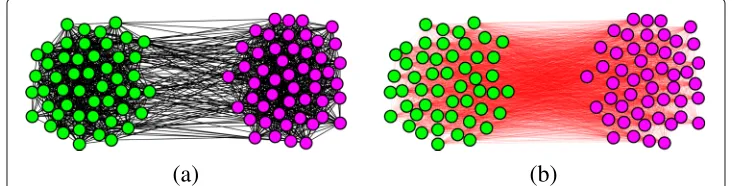
This change in the topology has the potential to impact clustering, as the emergence of positive and negative edges opens the door for an interpretation in terms of an agreement (positive edge) or a disagreement (negative edge) between datapoints. Hence, clustering can be revamped to assume that nodes agreeing should belong to the same cluster and nodes disagreeing should belong to different ones. From this perspective, a revisit to the case of γ = 2 shows that this is indeed a potentially good topology since, for several graphs, it is more likely that vertices having a 2-hop distance lie in different clusters than in the same one, thus creating a considerable amount of disagreements between clusters, that may enhance their separability. This idea is illustrated in Fig.1, where for a realization of the planted partition model we show that withγ =2 a big amount of negative edges appear between clusters.
(a)
(b)
Fig. 1Exemplification of the topology emerging fromL2on a realization of the Planted Partition with 100
Thus, in the reminder of the paper we investigate if for a target set of nodesSgt, the
detection ofSgtcan be enhanced by solving the clustering problem in some of these new
graphs.
Remark 1The graphs emerging in the regime 0< γ <1 have already been studied in Pérez Riascos and Mateos (2014); de Nigris et al. (2017); Bautista et al. (2017), where it is shown that such graphs remain within the class of graphs with only positive edges, hence preserving the random walk framework. In these works, the graphs were shown to embed the so-called Lévy flight, permitting random walkers to perform long-distant jumps in a single step.
TheLγ-PageRank method
The signed graphs emerging fromLγpreclude the employment of the random walk-based approaches to find clusters, as ‘negative transitions’ appear. Thus, theLγ-graphs call for a technique to find clusters in such graphs. In this subsection, we introduceLγ-PageRank, a generalization of PageRank to find clusters on theLγ-graphs. Further, we analyze the Lγ-PageRank theoretical properties and clustering capabilities.
For our analysis, it is useful to first extend some of the graph topological defini-tions to theLγ-graphs. Letvolγ(S) = u∈SDγuu denote the generalized volume of S. Let πγ denote a generalized stationary distribution with entries given by (πγ)u =
Dγuu/volγ(G). It is important to stress that [Dγ]uu=kλ γ
kQ2uk ≥0. Thus, for allγ >
0, the generalized volume and the generalized stationary distribution are non-negative quantities.
The Cheeger ratio metric, lacking the ability to account for the sign of edges, cannot be employed to assess the presence of clusters in theLγ-graphs. Thus, we generalize the Cheeger ratio definition to the new graphs as follows.
Definition 3For a set of nodes S ⊆ V , the generalized Cheeger ratio, or generalized conductance, of S is defined as:
h(γ )S =
u∈S
v∈Sc
Wγuv
minvolγ(S),volγ(Sc). (6)
This generalization of the Cheeger ratio is mathematically sound. First, it is a non-negative quantity since u∈Sv∈Sc
Wγuv = 1TSLγ1S ≥ 0. Second,
the set S attaining the minimum value coincides with a sensible clustering. To show the latter, let the edges in Wγ be split according to their sign as Wγ = Wγ+ + Wγ−. Let A(γ )in (S) = u∈Sw∈S|
Wγ+
uw| be the sum of agreements
within S, A(γ )out(S) = u∈Sv∈Sc|
Wγ+
uv| the agreements between S and S c,
Din(γ )(S) = u∈Sw∈S|
Wγ−
uw| the disagreements within S, and D (γ ) out(S) =
u∈S
v∈Sc|
Wγ−
uv|the disagreements betweenSandS
c. Then we state the following
lemma.
• MaximalD(γ )out(S∗)andA(γ )in (S∗);
• MinimalDin(γ )(S∗)andA(γ )out(S∗).
The proof is provided in AppendixProof of Lemma 3.
Lemma 3 shows that, for a given Lγ-graph, sets of small generalized Cheeger ratio are bound to have strong between-cluster disagreements and strong within-cluster agreements as well as small between-cluster agreements and small within-cluster dis-agreements, thus coinciding with our definition of clusters in signed graphs.
Now, we introduce the Lγ-PageRank formulation. Departing from the optimization problem in (2), we revamp PageRank to operate on theLγ-topology as follows.
Definition 4The Lγ-PageRank G-SSL is defined as the solution to the optimization problem:
arg min
f
fTD−γ1LγD−γ1f +μ(f −y)TD−γ1(f −y). (7)
The two following Lemmas show that, for anyγ >0, theLγ-PageRank solution exists in closed form and such solution preserves the PageRank properties.
Lemma 4Letγ >0. Then, problem (7) is convex with closed form solution given as:
f =μLγDγ−1+μI−1y. (8)
The proof is provided in AppendixProof of lemma 4.
Remark 2 Eq. (8) emphasizes the difference between our approach and the one in Zhou and Belkin (2011): they propose to iterate the operator in the G-SSL solution as f = μLD−1m+μI−1y, form ∈Z>0, for which the formulation of the optimization problem having this expression as solution remains unknown.
Remark 3The solution ofLγ-PageRank in Eq. (8) can be easily cast as a low-pass graph filter, allowing a fast and distributed approximation via Chebyshev polynomials (Shuman et al.2018).
Lemma 5Letγ >0. The Lγ-PageRank solution in (8) satisfies the following properties: (i) mass preservation:u∈Vfu = u∈Vyu; (ii) stationarity: f = πγ if y = πγ; and (iii) limit behavior: f →πγ asμ→0and f →y asμ→ ∞.
The proof is provided in AppendixProof of lemma 5.
The previous Lemmas are important because they show that our generalization, for any
γ >0, is a well-posed problem. Indeed, the properties of Lemma5imply that, while not necessarily modeled by random walkers,Lγ-PageRank remains a diffusion process having
πγas stationary state and diffusion rate controlled by theμparameter.
Our next results shows that it is hard for such diffusion process to escape clusters in the Lγ-graphs.
in S, i.e. [Dγ]uu
volγ(S), Lγ-PageRank satisfies:
Ef(Sc)≤ h (γ ) S
μ . (9)
The proof is provided in AppendixProof of lemma 6.
Lemma6admits a similar interpretation as Lemma1. Namely, ifLγ-PageRank is applied to the labeled points of some setSwith small h(γ )S , then diffusion is confined toSand the score values outside ofSare expected to be small. Thus, by looking at the nodes with largest score values we should be able to retrieve a good estimation ofS. If such score concentration phenomenon takes place, then a sharp drop must appear after sorting the Lγ-PageRank scores in descending order. We will use the following lemma to show that if a sharp drop is present, then the sweep cut procedure applied on theLγ-PageRank vector retrieves a partitionSˆthat has smallh(γ )ˆ
S .
Lemma 7Let q denote the permutation vector and Sj denote the set associated to qj obtained by applying the sweep-cut procedure on the Lγ-PageRank vector. Then, the partitionV=Sj∪Sjcsatisfies the inequality:
A(γ )out(Sj)
2− (qj−qj+1)
(q1−qN)
−D(γ )out(Sj)
2(qj−qj+1)
(q1−qN) −
1
≥ μ
y(Sj)−f(Sj)
(q1−qn) ≥A(γ )out(Sj)
2(qj−qj+1)
(q1−qN) −
1
−D(γ )out(Sj)
2−(qj−qj+1)
(q1−qN)
. (10)
The proof is provided in AppendixProof of lemma 7. We have thatu∈Sjv∈Sc
j
Wγuv = A(γ )out(Sj)−Dout(γ )(Sj) ≥ 0. Thus, the generalized
Cheeger ratio ofSjis small ifA(γ )out(Sj)is not much larger thanD(γ )out(Sj). In the inequality
above, we have two cases in which(qj−qj+1)/(q1−qN) ≈ 1: (a)q is approximately
constant; and (b)qhas a drop that satisfiesqj ≈q1andqj+1≈qN. The former can only
occur iff →πγand clearly no cluster can be retrieved from that vector, as confirmed by the inequality growing unbounded. The latter case is what we coin as having a sharp drop betweenqjandqj+1. In such case, the inequality is controlled by the differencey(Sj)−f(Sj)
which, due to the mass preserving property and the assumption thatqj+1 ≈ qN, should
be small. Thus, granting thatA(γ )out(Sj)is not much larger thanD(γ )out(Sj)andSjhas a small h(γ )Sj .
Discussion.The previous results show thatLγ-PageRank is a sensible tool to find clus-ters in theLγ-graphs, i.e. groups of nodes with small generalized Cheeger ratio. Thus, revisiting the classification case in which we target group of nodesSgt, we have that the
smaller the value ofh(γ )Sgt, the better theLγ-PageRank method can recover it. This observa-tion, in addition to noting that standard PageRank emerges as the particular case ofγ =1, indicate that we should be able to enhance the performance of G-SSL in the detection of Sgtby finding the graph, i.e. theγ value, in whichh(γ )Sgt <h(1)Sgt.
The selection ofγ
Case ofγ =2: analytic study
In “TheLγ-graphs” section, it was argued that the topology emerging fromL2places a
place a big amount of disagreements between clusters that may enhance their separability. Our next result formalizes this claim, demonstrating that on graphs from the Planted Partition model it is expected that theL2-graph improves the generalized Cheeger ratio.
Theorem 1Consider a Planted Partition model of parameters (pin, pout) and cluster sizes|Sgt| = |Sgt| =c n. Then, as n→ ∞we have that
Eh(2)Sgt=2Eh(1)Sgt2, (11)
whereEh(1)Sgt=pout/(pin+pout).
The proof is provided in AppendixProof of theorem 1.
Corollary 1If pin ≥pout, thenE
h(2)Sgt
≤E
h(1)Sgt
, with equality occurring in the case pin=pout.
The proof is provided in AppendixProof of corollary 1.
Theorem1and Corollary1open the door to investigate, on arbitrary graphs, in which cases theL2-graph improves the generalized Cheeger ratio of a set. In the next Propo-sition, we provide a sufficient condition in which theL2-graph improves the generalized Cheeger ratio a set.
Proposition 1LetDSgtdenote the mean degree of Sgt. A sufficient condition on Sgtso that h(2)Sgt ≤h(1)Sgtis that
DSgt ≥max u∈Sgt
v∈Scgt
Wuv+max w∈Scgt∈Sgt
Ww. (12)
The proof is provided in AppendixProof of proposition 1.
This proposition points in the same direction as Theorem1, saying that graphs having a cluster structure are bound to benefit fromL2. Concretely, the first term on the right hand side of the inequality searches, among all the nodes ofSgt, the one that has the maximum
number of connections towardsScgt. The second term does the reverse for the nodes of Sgtc. Hence, asking for the nodes of Sgtto have, on average, more connections than the
maximum possible boundary implies thatSgtshould have a cluster structure.
An algorithm for the estimation of the optimalγ
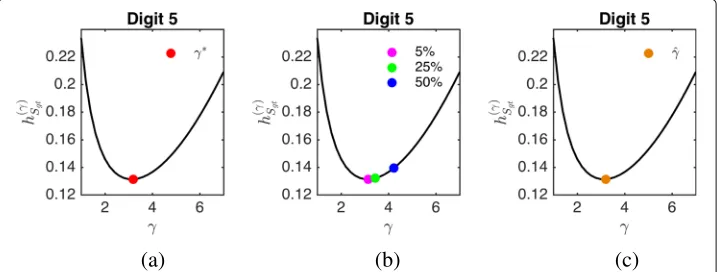
Numerical experiments show that increasing γ can further decrease the generalized Cheeger ratio up to a point where it starts increasing. We show an example of this phenomenon in Fig.2a, displaying the evolution ofh(γ )Sgt as a function ofγ whenSgt
corre-sponds to a digit of the MNIST dataset. From the figure, it is evident that an optimal value appears, denotedγ∗=arg minγh(γ )Sgt, raising the question of how to find such value. Since
the behavior ofh(γ )Sgt depends onSgt, in practice, the derivative or a greedy search to find γ∗cannot be employed sinceS
gtis unknown. A second question that arises is whether
the optimal value changes drastically or smoothly with changes inSgt. We perform the
following test: for a givenSgt (same MNIST digit), we remove some percentage of the
(a)
(b)
(c)
Fig. 2Generalized Cheeger ratio ofSgtas a function ofγ. Percentages in (b) represent a fraction of nodes randomly chosen fromSgtand removed fromSgt. For the plot,Sgtis a digit of the MNIST dataset.a
γ∗=arg minγh(γ )
Sgt.bγ
∗on subsets ofSgt.cγˆby algorithm
indexingSgtin1Sgt, set them to zero and obtain a new indicator function indexing a
sub-set ofSgt. Mean results are evaluated in the original curve and displayed in Fig.2b. The
figure suggest that it is not necessary to knowSgtto find a proxyγˆ ofγ∗, it suffices to
know a subset ofSgt. Based on the last observation, we propose Algorithm 1 for the
esti-mation ofγ∗. The rationale of the algorithm is to exploit the labeled points and the graph to find a proxySˆofSgton which we can compute the estimate. The procedure consists in
letting walkers started from the label points, run for a number of steps that is determined by the maximum geodesic distance between the labels. This allows walkers to exploreSgt
without escaping too far from it. After running the walk, we list the nodes in descending order according to the probability of finding a walk at a node. We take the first element on the list (the one where it is more likely to find a walker), add it toSˆand remove it from the list, so that the former second element becomes the first in the listing. We repeat the procedure until the probability of finding a walker in the nodes conformingSˆis 0.7.
In Table1, we evaluate the performance of Algorithm 1 on the estimation ofγ∗for all the digits of the MNIST. The first row displays, asγ∗, the value ofγ (from the input range) attaining the minimum generalized Cheeger ratio. The second row displays the performance of the algorithm when estimating such value. The last three rows show the value of the generalized Cheeger ratio evaluated atγ∗,γˆ andγ = 1, respectively. The estimator finds values ofγˆwhose Cheeger ratios are: (a) significantly smaller than those ofγ =1; (b) close to the optimal.
Table 1Evaluation of Algorithm 1 on the MNIST Dataset
Digit 1 2 3 4 5 6 7 8 9
γ∗ 7.0 3.0 7.0 3.2 3.2 7.0 7.0 3.2 4.2
ˆ
γ 5.45 (0.15)
3.10 (0.14)
6.41 (0.11)
4.92 (0.16)
3.20 (0.14)
6.04 (0.15)
4.98 (0.17)
4.40 (0.18)
5.08 (0.15)
h(γS ∗)
gt 0.065 0.166 0.035 0.141 0.131 0.011 0.052 0.116 0.135
h(Sγ )ˆ
gt 0.073
(9e-4)
0.174 (8e-4)
0.041 (1e-3)
0.185 (4e-3)
0.148 (2e-3)
0.017 (1e-3)
0.074 (2e-3)
0.142 (2e-3)
0.149 (9e-4)
h(S1)
gt 0.175 0.248 0.216 0.258 0.233 0.107 0.203 0.215 0.285
Algorithm 1Estimation ofγ∗
Input:G,VSgtand a grid ofγ values. Output:γˆ
Computeuv∀u,v∈VSgt.
Setk=maxu,v{uv}
Setχ =y/y1
Run ak-step walk with seedχ:xT =χTPk
Reorder the vertices asv1,· · ·,vN, so thatxvi≥xvi+1 fori=1 :Ndo
ifij=1xvj <0.7then
Set(1Sˆ)vi=1 else
Set(1Sˆ)vi=0 end if
end for Computeh(γ )ˆ
S = 1Tˆ
SL γ1
ˆ S 1Tˆ
SDγ1Sˆ ∀γ
Returnγˆ=arg minγh(γ )ˆ S .
Lγ-PageRank in practice Planted partition
Experimental setup and goals.In the following experiment, we show thatLγ-PageRank can increase the performance of G-SSL as the graph approaches the Planted Par-tition detectability transition. More precisely, it is shown in Mossel et al. (2015) that the Planted Partition possesses a detectability threshold above which unsuper-vised methods are unable to retrieve a meaningful clustering. Indeed, if the clusters sizes are denoted as |Sgt| = |Sc
gt| = n, the mean degree of a node is given as Cavg = Cin + Cout, where Cout = (pout)(n) and Cin = (pin)(n − 1). It is then
possible to recover a cluster that is positively correlated with the true partition, in an unsupervised manner, if (Cin − Cout)2 > 2(Cin + Cout), and impossible
other-wise. As for G-SSL, the work in Zhang et al. (2014) showed that such threshold can be overcome when a fraction of labeled points is introduced to the task. Nonethe-less, the performance of G-SSL drastically degrades when approaching the detectability transition.
The experimental setup is the following: for a givenCout/Cin, a realization of the Planted
Partition is drawn withn = 500 and Cavg = 3. Then, 1% of labeled points are
Results and discussion. Figure3 displays the performance of Lγ-PageRank at recov-ering the Planted Partition as a function of the ratio Cout/Cin. Standard PageRank
(γ = 1) performs poorly as the configuration approaches the phase transition (referred by the vertical line) sinceh(1)S becomes large. Clearly, the introduction ofγ allows to decrease h(γ )Sgt, which, accordingly, enhances the clustering performance. Furthermore,
the figure verifies that the smaller the value of h(γ )Sgt (right plot), the better the Lγ -PageRank recovers the true partition (left plot). It is important to remark that, for this experiment, while γ = 2 shows good improvements, larger values of γ keep improvingh(γ )S , until it reaches a saturation plateau, designating a region of optimalγ values (γ ≥6).
Real world datasets
Experimental setup and goals. In our following experiment, we assesses the perfor-mance ofLγ-PageRank and Algorithm 1 on real world datasets.
The experimental setup is as follows: graphs are build connecting the K-Nearest Neigh-bors (KNN) with distances computed via the Gaussian kernel, so that the weight between pointsxuandxvis given byWuv = exp{−||xu−xv||22/σ2}. For each class, 2% of labeled points are randomly selected,Lγ-PageRank is applied for a grid ofμvalues, partitions are retrieved via the sweep-cut, and the best performance, assessed in terms of MCC, is retained. Such procedure is repeated for 100 realization of labeled points, except for the MNIST on which 30 realizations only are employed. In all cases, classes are balanced in size and the graph construction parameters are selected to provide a good distribution of weights as follows: (a) MNIST (Lecun et al.1998): Images of handwritten digits (1 to 9). From the entire dataset, 200 images of each digit are selected and used to build the graph with KNN = 10 andσ =104; (b) Gender Images (Hond and Spacek1997): Images of male and female subjects for gender recognition. From the entire dataset, 200 images of each gender are selected and used to build the graph with KNN = 60 andσ = 104. The large value of KNN is to avoid disconnected components; (c) BBC articles (Greene and Cunningham2006): Word frequency attributes from news media articles. From the entire dataset, 200 business and 200 entertainment articles are used to build the graph with KNN = 5 andσ =50; and (d) Phoneme (The phoneme database): Five attributes to discern nasal sounds from oral sounds. From the entire dataset, 200 oral and 200 nasal sounds are used to build the graph with KNN = 10 andσ =2.
Results and discussion. Table2shows the performance ofLγ-PageRank on the classifi-cation of these real world datasets. Clearly, the introduction ofγcan significantly improve performance and, in general, the estimationγˆ performs close to the optimal valueγ∗. It can be seen that some datasets are more sensitive toγ than others. For instance, in the BBC articles we observe that a small change inγ, going fromγ =1 toγ∗=1.1, increases performance, and going further toγˆ = 1.3 andγ = 2 significantly worsens the classi-fication. On the other hand, the MNIST dataset is less sensitive toγ, obtaining similar performances with larger variations inγ.
It is important to stress that, thus far, we have assumed possession of the proper tuning of the diffusion rate (μ) that attains the best results. However, when working with real data, clusters may have intricate local structures, e.g. sub-clusters, that play an important role in the way information diffuses, and that can make more difficult the finding of the optimal diffusion rateμ. As a result, two clusters may have equal Cheeger ratios but one of them being harder to find if its local structure is complex. Digit 8 poses an example of this phenomenon, where the mean performance forγˆ is slightly better than that ofγ∗. This anomaly can be explained as an aftereffect of using a finite grid onμ: for some realization of labeled points, the best performance forγ∗falls in a region not covered by the grid.
Unbalanced labeled data
Experimental setup and goals In our last experiment, we show that Lγ-PageRank, adapted to the multi-class setting described in “Generalization to multiple
classes” section, can improve the performance of G-SSL in the presence of unbalanced
labeled data.
The experimental setup is as follows: graphs with two balanced classes (in size) are built using the datasets from the preceding experiments. The parameters of the graphs’ construction follow the guidelines provided in “Real world datasets” section. For the Planted Partition, the configuration isn= 200,Cavg =3,Cout =0.1. Then, unbalanced
labeled points are drawn at random: 2% from one class and 6% from the other. Lastly, Lγ-PageRank, in the multi-class setting, is applied for a grid ofμ values and the best
Table 2Performance on real world datasets: each cell reports MCC, 95% confidence interval (parenthesis) and the value ofγ[squared brackets]
Sgt γ =1 γ =2 γ = ˆγ γ=γ∗
MNIST Digit 1 0.67 (0.075) 0.78 (0.032) 0.78 (0.034) [5.4] 0.80 (0.027) [7.0]
Digit 2 0.38 (0.042) 0.60 (0.064) 0.64 (0.059) [3.3] 0.64 (0.059) [3.0] Digit 3 0.47 (0.040) 0.61 (0.032) 0.61 (0.028) [6.0] 0.61 (0.028) [7.0] Digit 4 0.39 (0.022) 0.48 (0.036) 0.53 (0.044) [4.7] 0.53 (0.037) [3.2] Digit 5 0.44 (0.036) 0.56 (0.046) 0.61 (0.036) [3.3] 0.64 (0.035) [3.2]
Digit 6 0.90 (0.039) 0.94 (0.003) 0.94 (0.002) [6.0] 0.94 (0.002) [7.0] Digit 7 0.43 (0.027) 0.66 (0.043) 0.71 (0.042) [4.8] 0.75 (0.032) [7.0] Digit 8 0.47 (0.062) 0.65 (0.057) 0.74 (0.038) [4.8] 0.72 (0.050) [3.2] Digit 9 0.43 (0.020) 0.52 (0.026) 0.53 (0.023) [4.9] 0.56 (0.026) [4.2] Gender images Female 0.51 (0.039) 0.57 (0.028) 0.57 (0.020) [3.0] 0.57 (0.028) [2.0]
Male 0.55 (0.028) 0.61 (0.021) 0.60 (0.022) [3.3] 0.61 (0.021) [2.4] BBC articles Business 0.80 (0.020) 0.53 (0.038) 0.72 (0.040) [1.3] 0.81 (0.021) [1.1] Entmt. 0.84 (0.027) 0.57 (0.040) 0.76 (0.047) [1.5] 0.86 (0.025) [1.3]
Phoneme Nasal 0.37 (0.030) 0.41 (0.028) 0.43 (0.025) [2.9] 0.43 (0.025) [3.0]
Table 3Performance on unbalanced labaled data: each cell reports MCC, 95% confidence interval (parenthesis) and the value ofγ[squared brackets]
Planted Partition
MNIST 4vs9
MNIST 3vs8
BBC arti-cles
Gender images
Phoneme
γ=1 0.81 (1.1e-2)
0.51 (1.5e-2)
0.70 (1.4e-2)
0.66 (1.8e-2)
0.63 (2.1e-2)
0.44 (2.3e-2)
γ=2 0.87 (8.7e-3)
0.56 (1.5e-2)
0.76 (1.2e-2)
0.92 (5.0e-3)
0.73 (1.6e-2)
0.48 (1.4e-2)
γ=Best 0.90 (7.0e-3) [6]
0.57 (1.5e-2) [3]
0.78 (1.2e-2) [4]
0.93 (1.5e-3) [3]
0.75 (1.7e-2) [3]
0.48 (1.4e-2) [1.9]
performance, assessed by MCC, is recorded. For the planted partition, the procedure is repeated over 15 realizations of the labeled points and for 100 graph realizations. For the other datasets, 100 realizations of labeled points are employed.
Results and discussion Table3displays the performanceLγ-PageRank in the presence of unbalanced labeled data. It is important to stress that, in this framework, a unique value ofγ is used to retrieve all the clusters at the same time, precluding the notion of an optimalγ as defined in “The selection ofγ” section. However, one value ofγ seems to perform better, we denote it asγ =Best. The results confirm that the introduction ofγ helps to improve the classification in the presence of the unbalanced labeled data.
Conclusion
This work proposedLγ-PageRank, an extension of PageRank based on (non necessary integer) powers of the (combinatorial) Laplacian matrix. Our analysis shows that the added degree of freedom offers more versatility than standard PageRank, providing the potential to address some of the limitations of G-SSL. Precisely, we showed that when clusters are obtained via the sweep-cut procedure,Lγ-PageRank can significantly outper-form standard PageRank. Further, we showed that the multi-class approach also benefits from our proposition, as performance was enhanced in the presence of unbalanced labeled data. These improvements were possible due to theLγ (γ >0) operator coding for graphs whose topology can reinforce the separability of clusters. The richness of such graphs comes from the sign of edges, allowing to code for similarities but also to empha-size dissemblance between individuals. Thus, while 2 nodes can only be disconnected on the initial graph, they can ‘repulse’ themselves in these topologies. Notably, we have shown that there is an optimal graph (related to an optimalγ) on which the classification will lead to a maximal performance. We proposed a simple yet efficient algorithm to esti-mate the optimalγ and hence determine the best topology for analyzing a given dataset. The procedures proposed in this work open the door for more in-depth study of theLγ -graphs and what determines their optimal topology. They also pave the way towards the extension of other standard clustering tools, such as Unsupervised Learning via Spectral Clustering, to exploit these richer topologies.
Appendix: Proofs Proof of Lemma3
h(γ )S =r/(r+1), which is monotonically increasing withr. Thus, the setSthat minimizes ralso minimizesh(γ )S .
Proof of lemma4
ProofIt suffices to show the positive semi-definiteness of the functional and to apply the first order optimality condition. Letf˜=QTD−1
γ f. Then, the left term satisfiesjλγjf˜j2≥
0. It can be shown that [Dγ]uu=jQ2ujλ γ
j ≥0 granting the right term satisfies
u(fu− yu)2/[Dγ]uu≥0. Now, computing the derivative of the functional with respect tof and
equaling to 0 leads to:LγD−γ1f +μ(f −y)=0. The lemma is proved after isolatingf.
Proof of lemma5
ProofFrom the demonstration of Lemma4we have thatLγDγ−1f +μ(f−y)=0. Then, 1TLγD−γ1 +μ1Tf = μ1Ty. Since1TLγ = 0 we have that 1Tf = 1Ty, proving (i). We prove property (iii) using the same expression. We only develop the case μ → 0 since the caseμ→ ∞follows the same steps: taking limμ→0
LγD−γ1f +μ(f−y)=0 leads toLγD−γ1f = 0, whose solution is proportional toπγ = Dγ1/volγ(G). Lastly, we prove (ii) by noting that the operatorLγD−γ1has a positive real spectrum as it is similar toD−γ1/2LγD−γ1/2which is positive semi-definite. Thus, we can use the inverse Laplace transform of the resolvent(LγD−γ1+μI)−1=0∞e−te−tLγD−1γ /μdt, which, after using its
Taylor expansion, allows to rewrite the PageRank solution asf =∞k=0(−μ1)kk
LγD−γ1ky. Ify=πγ, the previous equation is only non-zero fork=0, proving (ii).
Proof of lemma6
ProofLety=Dγ1S/volγ(S). Using (8) we can see that
1TScf = u∈S
Dγuu volγ(S)1
T Sc
μLγD−γ1+μI
−1
δu
, (13)
showing that1TScf can be interpreted asE
f(Sc)when labels are selected with probability proportional to their generalized degree inS. Using the fact that
LγD−γ1+μI−1LγD−γ1+μI=I, (14)
we express
f =
I− 1
μLγD−γ1+
1
μLγD−γ1
LγD−γ1+μI
−1 LγD−γ1
y. (15)
The upper bound is thus obtained by substitutingyand summing overS.
1TSf = 1 T SDγ1S volγ(S) −
1TSLγ1S μvolγ(S)+
1TSLγLγ +μDγ−1Lγ1S μvolγ(S)
≥1TSDγ1S volγ(S) −
1TSLγ1S μvolγ(S)
=1−h (γ ) S
μ . (16)
Proof of lemma7
ProofWe only show the proof of the lower bound as the upper bound follows a similar derivation. We recast (4) asLγD−γ1f =μy−f. Thus, the setSjsatisfies:
μ(y(Sj)−f(Sj)
=1TSjLγD−γ1f =1TSjLγq =
u∈Sj,v∈Scj
Wγuv(qu−qv)
=
u∈Sj,v∈Scj |Wγ+
uv|(qu−qv)− u∈Sj,v∈Scj
|Wγ−
uv|(qu−qv)
+ u∈Sj,v∈Sjc
|Wγ+
uv|(qj−qj+1)− u∈Sj,v∈Scj
|Wγ+
uv|(qj−qj+1)
+ u∈Sj,v∈Sc
j
|Wγ−
uv|(qj−qj+1)− u∈Sj,v∈Sc
j |Wγ−
uv|(qj−qj+1)
≥(qj−qj+1)
2A(γ )out(Sj)+Dout(γ )(Sj)
−(q1−qN)
2D(γ )out(Sj)+A(γ )out(Sj)
. (17)
Re-ordering terms finishes the proof.
Proof of theorem1
ProofLetn = |S|. Foru,v ∈ Sandw ∈ Scthe Planted Partition satisfiesvWuv ∼ B(n−1,pin)and
wWuw∼ B(n,pout). The key step in the proof is to show that, in the
limitn→ ∞,Eh(1)S =E
1TSL1S vol(S)
= E
1TSL1S
E[vol(S)], and the same forh(2)S . By application of
the Chebyshev inequality we have that
Pr(du−E[du]≥E[du])≤
var(du) var(du)+E[du]2
=O(n−1). (18)
Thus, in the limit ofn→ ∞we can establish the inequalitydu<2E[du] and further that vol(S) <2E[vol(S)]. This latter allows to expressE
h(1)S
as follows (Rice2008):
E
h(1)S
=E
1TSL1S vol(S)
= E
1TSL1S
E[vol(S)] + ∞
i=1
(−1)iE[1
T
SL1S]ivol(S) + 1TSL1S,ivol(S) E[vol(S)]i+1
= E
1TSL1S
E[vol(S)] + ∞
i=1
(−1)iE
1TSL1S(vol(S)−E[vol(S)])i
E[vol(S)]i+1
= E
1T SL1S
E[vol(S)] + ∞
i=1
(−1)iE
1TSL1S E[vol(S)]
vol(S) E[vol(S)]−1
i
= E
1TSL1S
E[vol(S)] + ∞
i=1
wherea,ib = E(a−E[a])(b−E[b])i. The fact thatvol(S) <2E[vol(S)] and the monotonicity of the expected value imply that the sequence i|ci| decreases mono-tonically. Also, it can be shown that its dominant term: c1 = O(n−2). Replacing the expectations and evaluating the limit leads to:
lim
n→∞E
h(1)S
= pout pin+pout
. (20)
The case of E[h(2)S ] follows a similar derivation. Since [D2]uu = d2u + du, the
Jensen inequality implies that [D2]uu < 2E[[D2]uu] and consequently thatvol2(S) < 2E[vol2(S)]. Thus, we cast:
E
h(2)S
=E
1TSL21S vol2(S)
= E
1TSL21S
E[vol2(S)] +
∞
i=1
(−1)iE
1TSL21S E[vol2(S)]
vol2(S) E[vol2(S)]−
1
i
= E
1TSL21S
E[vol2(S)] +
∞
i=1
(−1)ic(2)i . (21)
Let the random variableOu =w∈ScWuw. Then we have that1TSL21S=2
u∈S(Ou)2.
This fact, in addition to vol2(S) = u∈Sd2u + du, allow to show that the sequence
i|c(2)i |is monotonically decreasing withc1(2)=O(n−1). Replacing the expectations and evaluating the limit leads to:
lim
n→∞E
h(2)S =2
pout pin+pout
2
. (22)
Proof of corollary1
ProofLet pin = pout + and assume that h(1)S ≥ h(2)S . Thus pout/(pin + pout) ≥
2(pout/(pin+pout))2, which can be further simplified to 1≥2pout/(2pout+). We observe
that such expression holds for ≥0 and equality occurs when =0.
Proof of proposition1
ProofWe search a condition onSthat permits 1
T SL1S 1TSD1S ≥
1TSL21S
1TSD21S, or equivalently, that
satisfies the inequality1
T SD21S 1TSD1S −
1TSL21S
1TSL1S ≥0. We have
1TSD21S
1TSD1S
− 1TSL21S
1TSL1S
≥ 1TSD21S
1TSD1S
− 1TSL21S
1TSL1S
≥ 1TSD21S
1TSD1S −
max
u∈S w∈Sc
Wuw+max ∈Sc
v∈S Wv
≥ 1TSD1S
1TS1S −
max
u∈S w∈Sc
Wuw+max ∈Sc
v∈S Wv
= vol|(S) S| −
max
u∈S w∈Sc
Wuw+max ∈Sc
v∈S Wv
where we have used Lehmer’s and Holder’s inequalities and that 1TSL21S =
u∈S
w∈ScWuw2+∈Scv∈SWv2. Thus, it is sufficient thatSsatisfies:
vol(S) |S| −
max
u∈S w∈Sc
Wuw+max ∈Sc
v∈S Wv
≥0. (24)
Acknowledgements
Not applicable
Author’s contributions
EB, PA and PG participated equally in designing and developing the project, and in writing the paper. All authors read and approved the final manuscript.
Funding
This work was supported by CONACyT and the Labex MILyon
Availability of data and materials
All data generated or analysed during this study are included the following articles (Lecun et al.1998; Hond and Spacek 1997; Greene and Cunningham2006; The phoneme database). The code to replicate the results is available in the GitHub repository,https://github.com/estbautista/Lgamma-PageRank_Paper.
Competing interests
The authors declare that they have no competing interests.
Received: 1 March 2019 Accepted: 22 July 2019
References
Andersen R, Chung FRK, Lang KJ (2007) Using pagerank to locally partition a graph. Int Math 4:35–64.https://doi.org/10. 1080/15427951.2007.10129139
Andersen R, Chung F (2007) Detecting sharp drops in pagerank and a simplified local partitioning algorithm. In: Cai J-Y, Cooper SB, Zhu H (eds). Theory and Applications of Models of Computation. Springer, Berlin. pp 1–12
Avrachenkov K, Dobrynin V, Nemirovsky D, Pham SK, Smirnova E (2008) Pagerank based clustering of hypertext document collections. In: Proceedings of the 31st Annual International ACM SIGIR Conference on Research and Development in Information Retrieval. ACM, Singapore. pp 873–874
Avrachenkov K, Gonçalves P, Legout A, Sokol M (2012a) Classification of Content and Users in BitTorrent by
Semi-supervised Learning Methods. In: International Wireless Communications and Mobile Computing Conference (3rd International Workshop on Traffic Analysis and Classification). IEEE, Cyprus. Best paper award
Avrachenkov K, Gonçalves P, Mishenin A, Sokol M (2012b) Generalized Optimization Framework for Graph-based Semi-supervised Learning. In: Proceedings of the 2012 SIAM International Conference on Data Mining. pp 966–974. https://epubs.siam.org/doi/abs/10.1137/1.9781611972825.83
Avrachenkov K, Kadavankandy A, Litvak N (2018) Mean Field Analysis of Personalized PageRank with Implications for Local Graph Clustering. J Stat Phys 173(3-4):895–916.https://doi.org/10.1007/s10955-018-2099-5
Bautista E, De Nigris S, Abry P, Avrachenkov K, Gonçalves P (2017) Lévy Flights for Graph Based Semi-Supervised Classification. In: 26th Colloquium GRETSI. GRETSI, 2017 - Proceeding of the 26th colloquium. GRETSI, Groupe d’Etudes du Traitement du Signal et des Images, Juan-Les-Pins
Chung F (2007) Four cheeger-type inequalities for graph partitioning algorithms. In: Proceedings of ICCM. Scietech Publisher, Hiroshima
Chung F (2010) Pagerank as a discrete green’s function. Geom Anal I ALM 17:285-302
de Nigris S, Bautista E, Abry P, Avrachenkov K, Goncalves P (2017) Fractional graph-based semi-supervised learning. In: 2017 25th European Signal Processing Conference (EUSIPCO). pp 356–360.https://doi.org/10.23919/EUSIPCO.2017. 8081228
Fontugne R, Bautista E, Petrie C, Nomura Y, Abry P, Gonçalves P, Fukuda K, Aben E (2019) BGP Zombies: an Analysis of Beacons Stuck Routes. In: PAM 2019 - 20th Passive and Active Measurements Conference. Springer, Puerto Varas. pp 1–13.https://hal.inria.fr/hal-01970596
Graham FC, Horn P, Tsiatas A (2009) Distributing antidote using pagerank vectors. Int Math 6:237–254 Greene D, Cunningham P (2006) Practical solutions to the problem of diagonal dominance in kernel document
clustering. In: Proceedings of the 23rd International Conference on Machine Learning. ICML ’06. ACM, New York. pp 377–384.https://doi.org/10.1145/1143844.1143892
Hond D, Spacek L (1997) Distinctive descriptions for face processing. In: Clark AF (ed). BMVC. British Machine Vision Association, Essex
Lecun Y, Bottou L, Bengio Y, Haffner P (1998) Gradient-based learning applied to document recognition. Proc IEEE 86(11):2278–2324.https://doi.org/10.1109/5.726791
Litvak N, Scheinhardt W, Volkovich Y, Zwart B (2009) Characterization of tail dependence for in-degree and pagerank. In: Avrachenkov K, Donato D, Litvak N (eds). Algorithms and Models for the Web-Graph. Springer, Berlin. pp 90–103 Matthews BW (1975) Comparison of the predicted and observed secondary structure of t4 phage lysozyme. Biochim
Mossel E, Neeman J, Sly A (2015) Reconstruction and estimation in the planted partition model. Probab Theory Relat Fields 162(3):431–461.https://doi.org/10.1007/s00440-014-0576-6
Pérez Riascos A, Mateos J (2014) Fractional dynamics on networks: Emergence of anomalous diffusion and lévy flights. Phys Rev E 90:032809.https://doi.org/10.1103/PhysRevE.90.032809
Rice SH (2008) A stochastic version of the Price equation reveals the interplay of deterministic and stoch astic processes in evolution. BMC evolutionary biology 8(1):262
Shuman DI, Vandergheynst P, Kressner D, Frossard P (2018) Distributed signal processing via chebyshev polynomial approximation. IEEE Trans Signal Inf Proc Over Netw 4(4):736–751.https://doi.org/10.1109/TSIPN.2018.2824239 Sokol M (2014) Graph-based semi-supervised learning methods and quick detection of central nodes. PhD thesis.
Université de Nice, Ecole Doctorale STIC, Inria Sophia Antipolis, Maestro
Subramanya A, Bilmes J (2008) Soft-supervised learning for text classification. In: Proceedings of the Conference on Empirical Methods in Natural Language Processing. EMNLP ’08. Association for Computational Linguistics, Stroudsburg. pp 1090–1099
Tsiatas A (2012) Diffusion and clustering on large graphs. PhD thesis. University of California at San Diego, La Jolla The phoneme database.https://www.openml.org/d/1489. Accessed 1 Feb 2019
Zhang P, Moore C, Zdeborova L (2014) Phase transitions in semisupervised clustering of sparse networks. Phys Rev E Stat Nonlinear Soft Matter Phys 90.https://doi.org/10.1103/PhysRevE.90.052802
Zhao M, Chan RHM, Chow TWS, Tang P (2014) Compact graph based semi-supervised learning for medical diagnosis in alzheimer’s disease. IEEE Signal Proc Lett 21(10):1192–1196.https://doi.org/10.1109/LSP.2014.2329056
Zhou X, Belkin M (2011) Semi-supervised learning by higher order regularization. In: Gordon G, Dunson D, Dudík M (eds). Proceedings of the Fourteenth International Conference on Artificial Intelligence and Statistics. Proceedings of Machine Learning Research. PMLR, Fort Lauderdale Vol. 15. pp 892–900.http://proceedings.mlr.press/v15/zhou11b/ zhou11b.pdf
Zhou D, Bousquet O, Lal TN, Weston J, Schölkopf B (2004) Learning with local and global consistency. In: Thrun S, Saul LK, Schölkopf B (eds). Advances in Neural Information Processing Systems 16. pp 321–328.http://papers.nips.cc/paper/ 2506-learning-with-local-and-global-consistency.pdf
Zhou D, Burges CJC (2007) Spectral clustering and transductive learning with multiple views. In: Proceedings of the 24th International Conference on Machine Learning. ICML ’07. ACM, New York. pp 1159–1166.https://doi.org/10.1145/ 1273496.1273642
Publisher’s Note

![Table 2 Performance on real world datasets: each cell reports MCC, 95% confidence interval(parenthesis) and the value of γ [squared brackets]](https://thumb-us.123doks.com/thumbv2/123dok_us/823573.1579886/14.595.118.480.537.736/performance-datasets-reports-confidence-interval-parenthesis-squared-brackets.webp)
![Table 3 Performance on unbalanced labaled data: each cell reports MCC, 95% confidence interval(parenthesis) and the value of γ [squared brackets]](https://thumb-us.123doks.com/thumbv2/123dok_us/823573.1579886/15.595.118.478.111.206/performance-unbalanced-labaled-reports-confidence-interval-parenthesis-brackets.webp)
